Every Night, a Stray Cat Waited by the School Gate for Me—When I Finally Understood Why, I Realized She Had Been Holding On to Something I Needed Too
PART3:
This time, I had brought a pouch of cat food from the corner store.
I told myself it was practical.
A stray cat should not eat turkey sandwich every night.
That was all.
It was not because I had spent the whole day wondering if she would come back.
It was not because I had found myself saying to an empty kitchen that morning, “Maybe I should buy cat food,” and then nearly crying because there was no Daniel there to say, “For the imaginary cat or the real one?”
I put the food in a shallow plastic lid and set it near the fence.
She waited until I stepped back.
Then she ate.
That became our routine.
At first, I did not give her a name.
Naming things is dangerous.
Names attach.
Names make absence specific.
A cat without a name can vanish and remain only “that stray.”
A cat with a name leaves an empty place where the name used to land.
So I called her “little miss” or “schoolyard queen” or “your majesty” or, on one particularly rainy night when she glared at me for not controlling the weather, “the tiny superintendent.”
She never came close enough to touch.
Not for weeks.
But she came every evening.
I would finish Room 12 first because Mrs. Peterson’s first graders always left the most crumbs. Then the kindergarten hallway. Then the bathrooms, the staff lounge, the front office, and finally the corridor near the gym where muddy footprints multiplied no matter how many mats the principal ordered.
At 8:45, I would empty my last trash bag into the outdoor bin.
At 8:52, I would turn off the corridor lights.
At 8:58, I would lock the side gate.
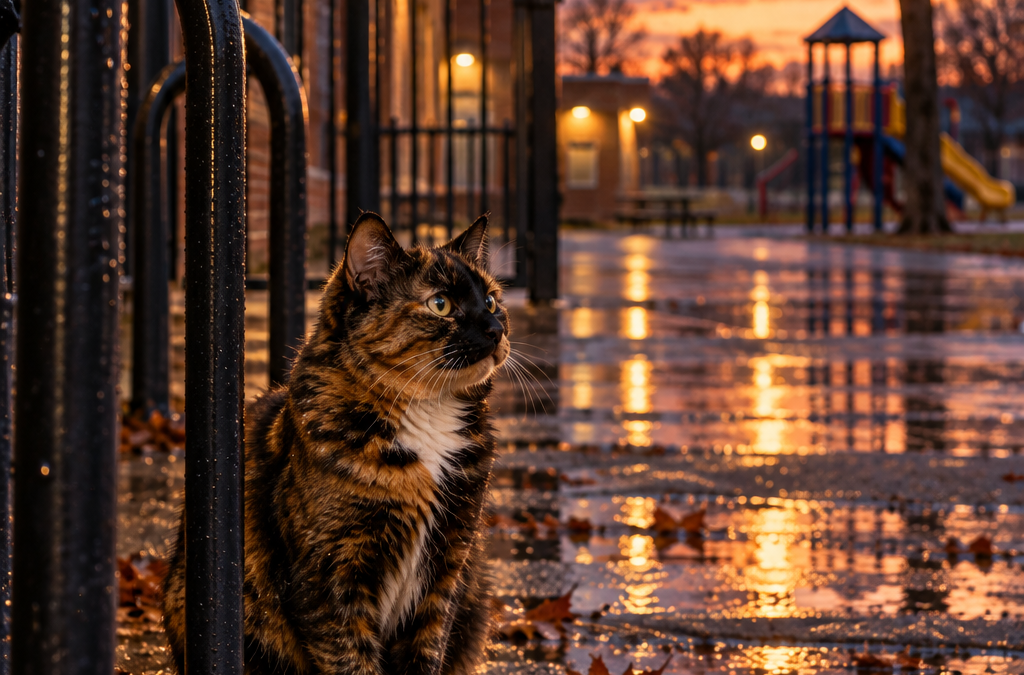
And there she would be beneath the bicycle rack.
Waiting.
Or so I thought.
Waiting for food.
I told myself that was all it was.
Food is simple.
Food does not ask questions.
Food does not look like grief.
I began talking to her while she ate.
At first, it was nonsense.
“Cold tonight.”
“You would not believe what a second grader did with glue today.”
“The art room smells like a marker exploded.”
“You have leaves stuck to your tail, but I suppose that’s a fashion choice.”
She never answered except with the occasional slow blink, which I chose to interpret as deep respect.
Then one night, without meaning to, I told her about Daniel.
It was raining hard. The kind of rain that makes everything shine and blur. The cat sat under the bicycle rack, mostly dry but visibly offended. I had brought chicken pâté because it was on sale, and she seemed to approve.
“My husband would’ve liked you,” I said.
The words came out before I could stop them.
The cat looked up from the food.
I leaned against the fence, keys cold in my hand.
“Actually, he would’ve pretended not to,” I continued. “He would’ve said we were not adopting a cat. Then he would’ve built you a little shelter behind the garage and acted like I did it.”
The cat licked gravy from her mouth.
“His name was Daniel,” I said softly.
The schoolyard was empty around us.
The rain tapped the metal bicycle rack. Water dripped from the maple tree at the edge of the playground. Somewhere far away, a car passed through a puddle.
“He died in March.”
The cat kept eating.
That helped.
People stop eating when you tell them sad things. They put down forks. They touch your arm. Their faces fold into the shape of sympathy, and then you have to take care of their discomfort while carrying your own pain.
Pepper did not do that.
I did not know her name was Pepper then, but that is who she was.
She simply ate and listened.
So I talked.
Not every night.
Some nights, I was too tired.
Some nights, she was too wary.
Some nights, the cold made my knees ache, and I only said, “Eat up, little miss,” before heading to my car.
But other nights, I told her things I could not tell anyone else.
That I still slept on my side of the bed because Daniel’s side felt occupied by memory.
That I had not thrown away his toothbrush.
That I hated the word widow because it sounded like a black dress someone else had chosen for me.
That people had stopped checking in after three months, as if grief came with a polite expiration date.
That I sometimes sat in my car outside the house for twenty minutes before going in.
That I missed ordinary things more than the big things.
Not anniversaries.
Not vacations.
Not even holidays.
I missed hearing Daniel sneeze too loudly in the kitchen.
I missed him complaining about the neighbor’s wind chimes.
I missed buying two apples instead of one.
The cat never came closer than six feet.
But she stayed.
That winter, she became the reason I kept cat food in my handbag and a towel in my car.
She became the reason I checked the weather with someone else in mind.
She became the first living creature I said goodnight to after work.
I told no one at the school at first.
Not because feeding a stray was forbidden exactly, though I suspected it would be frowned upon. Schools have policies for everything. Policies about visitors, cleaning products, playground equipment, cafeteria leftovers, door locks, snow days, nut allergies, hallway displays, and which tape could be used on painted walls.
I doubted there was an official policy titled Lonely Widow Feeds Suspicious Cat by Bicycle Rack, but I had lived long enough to know someone could create one quickly if needed.
The first person who noticed was Marcus, the evening security guard.
Marcus was in his early thirties, broad-shouldered, kind-eyed, and always carrying a travel mug of coffee that smelled better than anything in the staff lounge. He had two daughters at the school and worked nights because, as he once said, “Kids require shoes every time you turn around.”
One night in November, he opened the side door just as I was setting down a pouch of food.
“Well,” he said, smiling. “I thought we had a visitor.”
I froze.
The cat froze.
Marcus lifted both hands.
“I’m not calling animal control.”
I exhaled.
“She’s not bothering anyone.”
“I can see that.”
“She stays outside.”
“I can see that too.”
“She’s probably hungry.”
His smile softened.
“Marian, I said I’m not calling animal control.”
The cat gave him a look of deep suspicion, then returned to her food.
Marcus leaned against the doorframe.
“She got a name?”
“No.”
“That means yes, but you’re fighting it.”
I frowned at him.
He laughed quietly.
“My grandma was the same way. Fed a porch cat for three years and called him ‘Not My Cat’ until the day she took him to the vet and paid four hundred dollars for dental surgery.”
“She’s not my cat.”
“Of course not.”
“She belongs to herself.”
“Absolutely.”
The cat finished eating and slipped toward the bushes.
Marcus watched her go.
“She comes here some mornings too,” he said.
I looked at him.
“What?”
“I’ve seen her near the dumpsters when I open up. Not every day. But enough.”
A strange protectiveness moved through me.
“Does anyone bother her?”
“No. Most people don’t notice her.”
Most people don’t notice her.
The sentence followed me home.
Maybe because I knew what that felt like.
December arrived sharp and bright.
The school decorated for winter break. Paper snowflakes covered classroom windows. Children tracked glitter down hallways like a crime scene. The kindergarten students made handprint wreaths. Someone in the office played holiday music until even Marcus threatened to hide the speaker.
I bought the cat a small heated outdoor pad.
Then I returned it before opening the box because I told myself it was ridiculous.
Then I bought it again two days later.
Marcus helped me set it inside a plastic storage bin turned sideways beneath the bicycle rack, with a towel and a little flap cut from an old shower curtain.
“She’s going to hate this,” I said.
“Probably,” he agreed.
That night, she refused to go near it.
The next night, she sat on top of it.
The third night, I found her inside, pretending she had invented shelter.
“That’s gratitude for you,” Marcus said.
On the last school day before winter break, something happened that should have warned me how attached I had become.
I arrived for my shift and found a sign taped near the staff entrance.
Please do not feed stray animals on school property.
No one had spoken to me.
No one had asked.
Just a sign.
Printed in cheerful blue ink, laminated, taped at eye level.
My face went hot.
I found Mrs. Hollis, the principal, in the front office packing files into her bag.
Mrs. Hollis was not cruel. That mattered later, but at the time I only saw the sign. She was efficient, polished, and always smelled faintly of peppermint. She wore bright scarves and believed in phrases like “best practices” and “liability concerns.”
“Did you put up the sign?” I asked.
She looked up, surprised.
“The animal feeding one? Yes.”
“Is there a problem?”
“A parent reported seeing a cat near the bicycle rack.”
“She doesn’t bother anyone.”
“That’s not the point, Marian.”
It never is when people say that.
“We cannot encourage animals to gather on school property,” she continued. “There are health concerns. Allergies. Scratches. Rabies risk. Children may try to approach.”
“She’s afraid of people.”
“Until she isn’t.”
I hated how calm she sounded.
“I’ve been feeding her after hours.”
Mrs. Hollis sighed.
“I assumed that might be the case.”
“She’s hungry.”
“I understand your concern. But you have to stop.”
Something in me tightened.
Not just because of the cat.
Because of how easily the word stop fell from her mouth.
Stop feeding.
Stop caring.
Stop making one small exception in a world designed to look away.
“What happens to her if I stop?”
Mrs. Hollis’s expression softened, which made it worse.
“She’s a stray, Marian. Strays survive.”
Not all of them, I thought.
But I did not say it.
Instead, I said, “And if she doesn’t?”
Mrs. Hollis looked uncomfortable.
“I can contact animal control. They may be able to trap her and take her to the county shelter.”
I knew the county shelter.
Everyone who cared about animals in our town knew it.
Too many animals.
Not enough space.
Overworked staff.
Good people trapped inside a system built from shortage.
A fearful adult stray cat would not be first on anyone’s adoption list.
“No,” I said too quickly.
Mrs. Hollis’s eyebrows lifted.
“I mean,” I corrected, forcing my voice lower, “let me find a rescue. Or a foster. Someone safe.”
“You have until winter break ends,” she said. “After that, I need this handled.”
Handled.
Another word people use when they want compassion made tidy.
That night, the cat did not come.
I waited twenty-seven minutes in the cold.
The food sat untouched beneath the rack.
The shelter bin looked embarrassingly hopeful.
I walked home with the pouch still sealed in my pocket and cried in my car before I could even start the engine.
The next night, she returned.
I should have been relieved.
Instead, I was terrified.
Because suddenly she was not just a stray I fed.
She was a problem with a deadline.
I called three rescues over winter break.
One was full.
One did not handle feral or semi-feral cats.
One said they could put her on a waiting list if I trapped her, vaccinated her, and fostered her myself until space opened.
“I can’t foster,” I said automatically.
Even as I said it, I knew it was not completely true.
I had a house.
I had quiet rooms.
I had money enough for cat food.
What I did not have was courage.
Because bringing a living creature into my home meant inviting future loss inside.
And I had barely survived the last one.
On December 19, my sister Ruth called from two counties away.
Her voice sounded wrong from the first hello.
Ruth was six years older than me and had spent most of our lives acting like she had personally invented competence. She lived alone, kept a vegetable garden, sent birthday cards early, and believed all soup could be improved by adding barley.
“I had a little spell,” she said.
A little spell turned out to be a stroke.
Mild, the doctor said.
Manageable, the doctor said.
Temporary weakness, speech therapy, follow-up appointments, support at home.
I packed a bag that night.
I told myself I would be gone three days.
Maybe four.
Before I left, I went to the school.
It was closed for break. The parking lot was empty, the playground still, the building dark except for one security light above the side entrance.
The cat was under the bicycle rack.
Waiting.
I had brought extra food.
I set down two bowls and filled the shelter bin with a fresh towel.
“I have to go away for a little while,” I told her.
She watched me.
“My sister is sick.”
The wind moved dry leaves across the asphalt.
“I’ll be back soon.”
The cat blinked.
I almost reached toward her.
I almost tried.
But she was still too far away, and I did not want our last moment before my trip to be me frightening her.
So I stood.
“Be safe, little miss.”
She lowered her head to eat.
I drove to Ruth’s house before dawn.
Three days became two weeks.
Two weeks became a month.
Ruth improved, then developed pneumonia. Then the pipes in her laundry room burst during a freeze, because hardship has a vulgar sense of timing. Then her insurance became a battle. Then speech therapy needed transportation. Then she cried one night because she could not remember the word for colander, and I realized I could not leave her alone yet.
I called the school twice.
The first time, no one answered because of break.
The second time, I reached the office secretary, who said she had not seen any cat but would “keep an eye out,” in the voice of someone who would absolutely forget.
I texted Marcus.
He replied that he had seen the cat once near the bike rack but not close enough to catch.
I asked him to leave food if he could.
He did.
For a while.
Then he was moved to a different evening rotation at the middle school because another guard quit.
After that, I had no one.
I thought about the cat every night.
That sounds foolish, maybe.
My sister had suffered a stroke. My own grief was still sitting inside me like a stone. I had responsibilities, appointments, medication charts, insurance calls, grocery runs, and a house that was not mine slowly filling with the strange fear illness brings.
Still, I thought of that tortoiseshell cat under the bicycle rack.
I wondered if she waited.
I wondered if she thought I had stopped coming because she had finally trusted the wrong person.
Then I would scold myself.
Cats are survivors.
She would move on.
She would find another food source, another porch, another person.
Maybe she would be better off.
That became the story I told myself because guilt needs a bedtime story or it never sleeps.
By April, Ruth was stable enough for her daughter to come from Oregon and stay with her.
I drove home on a Sunday.
My house smelled stale when I opened the door.
Five months away had changed nothing and everything.
Daniel’s boots were still by the basement door.
His mug was still in the cabinet.
The mail stack was absurd.
Dust lay over the dresser like a soft accusation.
For the first time since his death, I stepped inside and did not immediately feel crushed by the house.
Maybe because I had been needed somewhere else.
Maybe because time had done some quiet work while I was not looking.
Maybe because the house was no longer the only place my grief lived.
I returned to school the next evening.
Maple Ridge looked exactly the same.
That almost offended me.
Same red brick building.
Same flagpole.
Same playground painted with hopscotch lines.
Same side gate.
Same bicycle rack.
Same lonely maple tree near the fence, now carrying tiny green leaves instead of winter branches.
But the cat was gone.
Of course she was.
I told myself that.
Of course.
The food routine had ended. Winter had passed. Cats roam. Cats choose. Cats survive.
Still, when I locked the gate, I looked beneath the bicycle rack.
Nothing.
Tuesday, nothing.
Wednesday, nothing.
All week, nothing.
Mrs. Hollis saw me glance toward the rack one evening and said, more gently than I expected, “I haven’t seen her in months.”
I nodded like that did not hurt.
“That’s probably good,” she added. “Maybe she found somewhere.”
“Maybe.”
But Marcus, when he returned to our school rotation in May, told me the truth.
“She came for a long time,” he said.
I turned to him.
“What do you mean?”
He looked uncomfortable.
“After you left. She kept showing up around closing.”
“How long?”
He rubbed the back of his neck.
“I saw her through February. Maybe March. Not every night, but a lot. She’d sit by the rack. Sometimes by the side gate.”
I gripped the mop handle.
“Did she eat?”
“When I had food, yeah. Sometimes cafeteria scraps. But…” He stopped.
“But what?”
Marcus sighed.
“It didn’t seem like she came for that.”
The hallway felt suddenly too bright.
“What do you mean?”
“She’d look at the door whenever keys jingled. If someone came out, she’d sit up. Then if it wasn’t you, she’d leave.”
I could not speak.
Marcus’s face softened with regret.
“I’m sorry, Marian. I thought you knew.”
That night, I sat in my car after work with both hands on the steering wheel and cried for an animal I had never touched.
Because all those months, while I told myself she had moved on, maybe she had been returning to the same patch of cold pavement, waiting for the sound of my keys.
The world can be very cruel to quiet faith.
Especially when no one recognizes it as faith.
Three weeks later, on a rainy Thursday in late May, I found her again.
It had been a long day.
A third grader had vomited outside the library.
The cafeteria drain backed up.
A substitute teacher left an entire cup of coffee to spill slowly across a desk and into a drawer full of construction paper.
By 9:10 p.m., I was tired enough to feel hollow.
Rain fell in a steady silver curtain over the playground. The kind of spring rain that smells like worms and wet grass. I locked the side door, pulled my hood tighter, and walked toward the gate.
Then I heard it.
A soft scratching sound.
Metal against claw.
I froze.
There it was again.
Not loud.
Not desperate.
Just a small, persistent scrape near the fence.
I turned.
A tortoiseshell cat stood on the other side of the gate.
Wet.
Thin.
Older-looking somehow, though that made no sense because only five months had passed.
One paw was muddy.
Her fur clung to her sides in dark patches.
The white stripe on her chest was barely visible beneath the rain.
But it was her.
The same split-dark face.
The same serious eyes.
The same little nick in one ear.
My breath left me.
“Oh,” I whispered.
She stared at me.
I did not move.
I did not want to break whatever fragile bridge had formed across those months.
“Little miss?”
Her ears came forward.
That was all.
Just her ears.
But it felt like being forgiven before I deserved it.
I opened the gate slowly.
The hinges creaked.
The rain fell between us.
She did not run.
I crouched, ignoring the water soaking through my pants.
“I’m sorry,” I said.
The words were ridiculous and necessary.
“I’m so sorry I was gone so long.”
She took one step.
Then another.
I expected her to go around me toward the place where I used to set food.
She didn’t.
She walked straight to my shoes.
I stopped breathing.
She looked up at me, gave one small, cracked meow, and pressed the side of her wet body against my ankle.
The touch was so gentle it nearly destroyed me.
After all those months of distance, after all those nights of waiting, after all that caution, she had decided the first touch would not be a test.
It would be a claim.
I sat down in the rain.
Not crouched.
Not careful.
Sat.
Right on the wet pavement beside the school gate in my work pants and old coat while water ran down the back of my neck.
The cat climbed into my lap.
Awkwardly at first, front paws pressing against my thigh, back paws slipping a little on the wet fabric. Then she tucked herself against me, thin and soaked and trembling.
I put one hand above her, not touching yet.
“May I?” I whispered.
She pushed her head into my palm.
That was the first time I touched Pepper.
Her fur was cold.
Her body was too light.
But beneath my hand, she was real.
Alive.
Waiting made flesh.
I bowed over her and cried into the rain.
The side door opened behind me.
“Marian?”
Marcus’s voice.
I looked up.
He stood under the awning, coffee mug in one hand, eyes wide.
Then he saw the cat in my lap.
“Oh,” he said softly. “You know her.”
I laughed through tears.
“I think I do.”
Marcus stepped closer, careful not to startle her.
“She’s the one,” he said. “That’s Pepper.”
I looked down.
The cat’s eyes were half closed, face pressed against my coat.
“Pepper?”
“That’s what the cafeteria kids called her,” he said. “Because of all the colors. Like someone spilled pepper and cinnamon on her.”
Pepper.
After all those months of calling her everything but a name, someone had given her one that fit.
“Pepper,” I said softly.
Her tail moved once against my wrist.
Marcus smiled.
“She’s been coming here a long time.”
“I thought she was gone.”
“She was, sometimes. But she came back. Especially around closing.”
The rain tapped the pavement around us.
“She wasn’t waiting for food,” I said.
Marcus shook his head.
“No. I don’t think so.”
And there it was.
The truth I had been afraid to name.
Pepper had not been waiting for the pouch in my handbag.
She had been waiting for the sound of my keys.
The click of the side door.
The woman who spoke to her when nobody else noticed she existed.
The voice that had made the schoolyard feel, for a few minutes each night, like a place where she was expected.
Marcus told me more as he stood with me in the rain.
A nearby family on Sycamore Street had tried to take Pepper in sometime in February. A kind family, he said. Two parents, one teenage son, a quiet house. They fed her, gave her a bed in the laundry room, planned to take her to the vet.
“She escaped through an upstairs window the same night,” Marcus said.
“An upstairs window?”
“Pushed through a loose screen somehow. Came back here before morning.”
I looked down at her.
“You foolish little thing.”
Pepper opened one eye, offended.
I had no right to judge her.
Hadn’t I done the same in my own way?
Hadn’t I returned again and again to an empty school, an empty house, a dead man’s memory, because grief teaches the body that waiting is safer than choosing somewhere new?
The next evening, I brought a carrier.
It sat on the passenger seat the whole way to work like a challenge.
I had spent the morning preparing my house, though I kept telling myself not to get ahead of things.
I bought a litter box.
A scratching post.
Food bowls.
Cat food.
A small bed I knew she might never use.
I moved Daniel’s boots from beside the basement door.
That took me almost twenty minutes.
I had not moved them since the week he died.
I carried them to the closet, held them against my chest, and cried so hard I had to sit down on the floor.
Not because I was putting him away.
Because I was making room for something living.
There is a difference.
A painful one.
A holy one.
After my shift, I placed the carrier near the gate with the door open. Inside, I put a soft towel that had spent the day on my couch, soaking up the scent of my house. I set food just inside the carrier door, not at the back. I did not want to trap her.
Then I sat on the ground and waited.
No calling.
No grabbing.
No pleading.
Pepper had spent her whole life surviving people’s decisions. I wanted this one to be hers.
Twenty minutes passed.
Then forty.
The school lights clicked off behind me, one hallway at a time.
Marcus came outside once, saw me sitting there, and wordlessly handed me a cup of coffee.
At nearly an hour, Pepper appeared beneath the maple tree.
She stood in the wet grass, watching.
“Hi, Pepper,” I said.
She stared at the carrier.
Then at me.
Then at the carrier again.
“You don’t have to,” I whispered.
She took one step.
Stopped.
Another.
The whole world seemed to hold its breath.
She came close enough to sniff the towel.
Her whiskers twitched.
She looked at me once more, and I swear there was a question in her face.
Not fear exactly.
Not trust exactly.
Something between them.
Something like: If I come with you, will you disappear again?
I swallowed hard.
“I can’t promise I’ll never leave the house,” I said. “But I can promise you’ll know where home is.”
Maybe she understood the words.
Maybe she only understood the voice.
Either way, Pepper stepped inside.
Not because I forced her.
Not because hunger tricked her.
Because she chose.
I closed the carrier door with hands that shook.
Pepper turned around once inside, then sat on the towel and looked out at me through the bars.
Marcus let out a breath behind me.
“Well,” he said quietly. “Looks like you’ve been adopted.”
I laughed.
Then I cried.
Then I carried Pepper to my car like she was something breakable and brave.
The first night in my house, Pepper hid behind the washing machine.
I had prepared the laundry room for her because it was quiet and warm. I placed food, water, a litter box, and the towel from the carrier near the wall. Then I sat on the floor outside the doorway and read aloud from a magazine because I had once heard that cats liked voices without pressure.
The article was about kitchen storage.
Very dramatic.
Pepper stayed hidden.
But at 2:00 a.m., I woke to a small sound.
Not a meow.
A bell.
Not real, exactly.
A soft clink from the laundry room.
I got up and found Pepper standing beside Daniel’s old key bowl, which I had moved from the hallway shelf months earlier because seeing his keys hurt too much.
I had placed my keys there without thinking.
Pepper was staring at them.
I picked them up.
They jingled.
Her ears came forward.
“Oh,” I whispered.
That was when I truly understood.
She knew that sound.
For months, maybe longer, the jingle of my keys had meant I was coming through the side door.
It meant the lights were going off.
It meant the woman with tired feet and half a heart would appear by the gate and speak gently into the dark.
I sat down on the laundry room floor.
Pepper approached slowly.
She did not climb into my lap.
Not yet.
But she lay down three feet away, facing me.
That was enough.
Trust grows strangely after abandonment.
Not all at once.
Not neatly.
Pepper spent her first week inside studying the rules of the house.
She learned the refrigerator hum was not dangerous.
She learned the furnace made noises but did not attack.
She learned windows were for watching birds and judging neighbors.
She learned that I left in the morning and came back in the evening.
That last lesson took time.
The first few days, when I returned from errands, I found her by the front door.
Not relaxed.
Waiting.
It broke my heart every time.
So I began speaking before I even opened the door.
“It’s me, Pepper.”
Keys.
Lock.
Door.
Voice.
Return.
Again and again.
Slowly, the panic left her body.
Slowly, she stopped crouching when I entered.
Slowly, she stopped eating only at night.
Slowly, she claimed the armchair Daniel used to sit in.
The first time she did it, I stood in the doorway and felt grief rise so suddenly I had to grip the wall.
That chair had been empty for over a year.
Not unused.
Empty.
There is a difference.
Pepper jumped into it one rainy afternoon, circled twice, tucked her paws beneath her, and closed her eyes like she had always belonged there.
I almost told her to get down.
Not because I wanted the chair preserved.
Because part of me feared that letting life sit where loss had lived meant betraying Daniel.
Then I remembered something he had said years earlier when we found a mourning dove nesting in our gutter.
“Life is rude,” he had told me, laughing as he climbed the ladder to check on it. “It shows up wherever it wants.”
So I let Pepper have the chair.
That night, for the first time since Daniel died, I sat on the sofa and watched television without feeling like the room was waiting for someone missing.
Pepper slept in his chair.
I slept better than I had in months.
There were complications, of course.
Stories like this make adoption sound like a soft blanket and instant healing.
It is not.
Pepper scratched the side of the couch.
Pepper knocked a plant off the windowsill and looked at the dirt like it had disappointed her.
Pepper refused three brands of food and accepted the fourth only after I bought an entire case of the second, which is exactly how cats remind humans who holds power.
The first vet visit was a disaster of opera-level betrayal.
She screamed in the carrier the entire drive, then became silent at the clinic in a way that scared me more.
The vet estimated she was around six years old.
No microchip.
Old ear injury.
Slight limp from a healed paw wound.
Underweight but otherwise stronger than she looked.
“Had a rough life,” the vet said, running gentle hands along Pepper’s back.
Pepper glared at all of us.
“But she’s lucky now.”
I looked at Pepper, who was trying to disappear beneath the exam table.
“No,” I said softly. “I think I am.”
By summer, Pepper had become part of the house.
She waited by the front door at dusk, but no longer with fear. More like a supervisor checking attendance.
She sat near my shoes when I tied them.
She slept on Daniel’s chair during thunderstorms.
She followed me into the kitchen every morning and complained until I fed her, despite having no legal authority over breakfast time.
I began opening windows again.
I began cooking actual meals.
I began inviting Ruth over once she was strong enough to visit.
The first time Ruth met Pepper, she said, “That cat looks like she knows your secrets.”
“She does.”
“All of them?”
“Most.”
Ruth lowered herself onto the sofa carefully, still moving slower after the stroke. Pepper watched from the armchair with narrowed eyes.
“She’s beautiful,” Ruth said.
Pepper pretended not to hear.
“She waited for me,” I said.
Ruth looked over.
“For five months.”
My sister’s face softened.
“Then she’s not a stray anymore.”
“No.”
“She’s family.”
I looked at Pepper.
Pepper yawned.
“Yes,” I said. “She is.”
In September, Maple Ridge held its annual open house.
I was cleaning the hallway near the second-grade classrooms when a little girl stopped beside me.
She had two missing front teeth and purple glasses.
“You’re the lady who saved Pepper,” she said.
I blinked.
“How do you know Pepper?”
“My brother called her Pepper because she was spicy.”
“That sounds right.”
The girl smiled.
“She used to sit by the gate. My mom said not to touch her because she was scared.”
“She was.”
“But she’s not scared now?”
I thought about Pepper asleep in Daniel’s chair, one paw over her eyes, snoring faintly like she paid rent.
“She’s less scared.”
The girl considered this.
“Because you came back?”
The question landed gently and deeply.
Children do that sometimes.
They place the truth in your hands without knowing its weight.
“Yes,” I said. “Because I came back.”
That night, when I got home, Pepper was by the door.
My keys jingled.
Her ears lifted.
But she did not tense.
She did not cry.
She did not look behind me as if expecting the world to change its mind.
She simply stood, stretched one back leg, and walked into the kitchen ahead of me, tail high.
I followed her, laughing.
“You’re welcome,” I said. “Nice to see you too.”
She meowed without turning around.
Dinner, apparently, was more important than sentiment.
The anniversary of Daniel’s death came the following March.
I had dreaded it for weeks.
The first anniversary had nearly crushed me. I had spent that day alone, wearing his old flannel shirt, listening to the house make noises without him. People texted heart emojis and “thinking of you,” which was kind, but kindness from a distance does not always reach the room you are sitting in.
The second anniversary was different.
Not easy.
Different.
I took the day off.
In the morning, I visited the cemetery. I brought Daniel’s favorite gas-station coffee, because grief makes rituals out of absurd things. I sat on the damp grass beside his grave and told him about Ruth’s recovery, the school, Marcus’s new baby, and Pepper’s ongoing war against the living room plant.
“She stole your chair,” I said.
The wind moved through the trees.
“You would’ve pretended to be annoyed. But you would’ve loved her.”
I cried then.
Not the sharp, panicked crying of the first year.
This was softer.
A grief that had learned how to breathe.
When I came home, Pepper was sitting in Daniel’s chair.
Of course she was.
I hung my coat, placed my keys in the bowl, and stood in the living room looking at her.
“I miss him,” I said.
Pepper opened her eyes.
“I think you would’ve liked him.”
She jumped down from the chair and walked toward me.
Then, without ceremony, she climbed into my lap.
Pepper was not a lap cat.
Not usually.
She preferred closeness on her terms: beside me, near me, judging me from a distance of authority. But that afternoon, she settled against my chest, tucked her head under my chin, and began to purr.
A low, steady sound.
Like a small engine.
Like something broken learning how to run again.
I held her and let the house be full of both things at once.
Loss and life.
Memory and warmth.
Goodbye and return.
That is what Pepper taught me.
Not that grief ends.
It doesn’t.
Not that love replaces love.
It can’t.
She taught me that the heart has more rooms than we think.
Some stay closed for a long time because we are afraid opening them means erasing who used to live there.
But love is not a tenant that evicts the dead.
Love is more like light.
It enters where it can.
It touches what is still standing.
It makes dust visible.
It makes silence less cruel.
A year after I brought Pepper home, Mrs. Hollis asked me to come to the front office before my shift.
I thought I was in trouble again.
Old fear is persistent.
Instead, she handed me an envelope.
Inside was a handmade card from Mrs. Peterson’s class.
On the front was a drawing of a tortoiseshell cat by the school gate. Around her, twenty-three children had drawn hearts, flowers, stars, and something that might have been a raccoon.
Inside, in Mrs. Peterson’s neat handwriting, it said:
Thank you for teaching us that kindness is something we practice even when no one is watching.
I looked up.
Mrs. Hollis seemed embarrassed.
“I owe you an apology,” she said.
I held the card carefully.
“For what?”
“For treating the cat like a problem before I understood she was part of someone’s story.”
I did not know what to say.
Mrs. Hollis folded her hands on the desk.
“I still have to care about safety. But I’ve been thinking about how quickly institutions turn living things into issues to manage.”
That sounded like principal language, but her eyes were sincere.
“We partnered with a local rescue,” she continued. “If another stray shows up, we’ll call them before animal control. We’ll assess, not just remove.”
I looked down at the children’s card.
There was Pepper, drawn with six legs and a smile she would have found offensive.
“Thank you,” I said.
Mrs. Hollis nodded.
“Also, for the record, I’m glad she chose you.”
I smiled.
“Me too.”
Pepper is beside me as I write this.
Not on my lap.
Let’s not exaggerate her generosity.
She is on Daniel’s chair, which is now simply Pepper’s chair, though I still think of him every time she curls there. Her fur has grown glossy. Her white chest stripe shines when the afternoon sun hits it. The dark side of her face still makes her look serious, but there is softness around her eyes now that was not there before.
At dusk, she still goes to the front door.
Every evening.
She sits beside the little table where I keep my keys and watches the hallway.
At first, I thought that habit meant she was still waiting for the school gate.
Now I understand it differently.
Some waiting is not fear.
Some waiting is remembrance.
Some waiting is a ritual of gratitude.
Pepper hears the keys, sees me come home, and the old story changes a little each time.
The person returns.
The door opens.
The voice says her name.
The night does not have to be survived alone.
And maybe that ritual is for me too.
Because every evening when I turn the key and step inside, I am no longer walking into a house occupied only by absence.
I am walking into a home where a once-stray cat looks up as if to say, There you are. I knew you would come back.
For a long time after Daniel died, I believed my life had become a place where love only left.
I believed doors closed.
People vanished.
Houses went silent.
I believed the best years were behind me, and what remained was duty, work, and getting through the day without falling apart in the detergent aisle.
Then a tortoiseshell cat started waiting beneath a bicycle rack.
I thought I was feeding her.
I thought I was helping her survive the cold.
I thought I was teaching her that one person in the world could be gentle without wanting anything from her.
But Pepper was teaching me too.
She taught me that trust can be wounded and still return.
She taught me that waiting is not always foolish.
She taught me that coming back matters, even when you come back late, even when you arrive soaked and sorry, even when you sit down in the rain because that is the only apology big enough for the moment.
She taught me that a house can be silent for a long time and still learn another sound.
A meow at dusk.
A purr in an old chair.
The jingle of keys.
The soft footsteps of a creature who once waited outside a school gate and now waits by my front door, not because she is afraid of being forgotten, but because she knows she is loved.
I used to believe I saved a stray cat from the rain.
Now I know the truth.
Pepper saved me from believing the rain was all I had left.








