Every Night, a Starving Mother Dog Stole One Bag of Food—Until a Man Followed Her and Discovered Who She Was Fighting to Save
PART3:
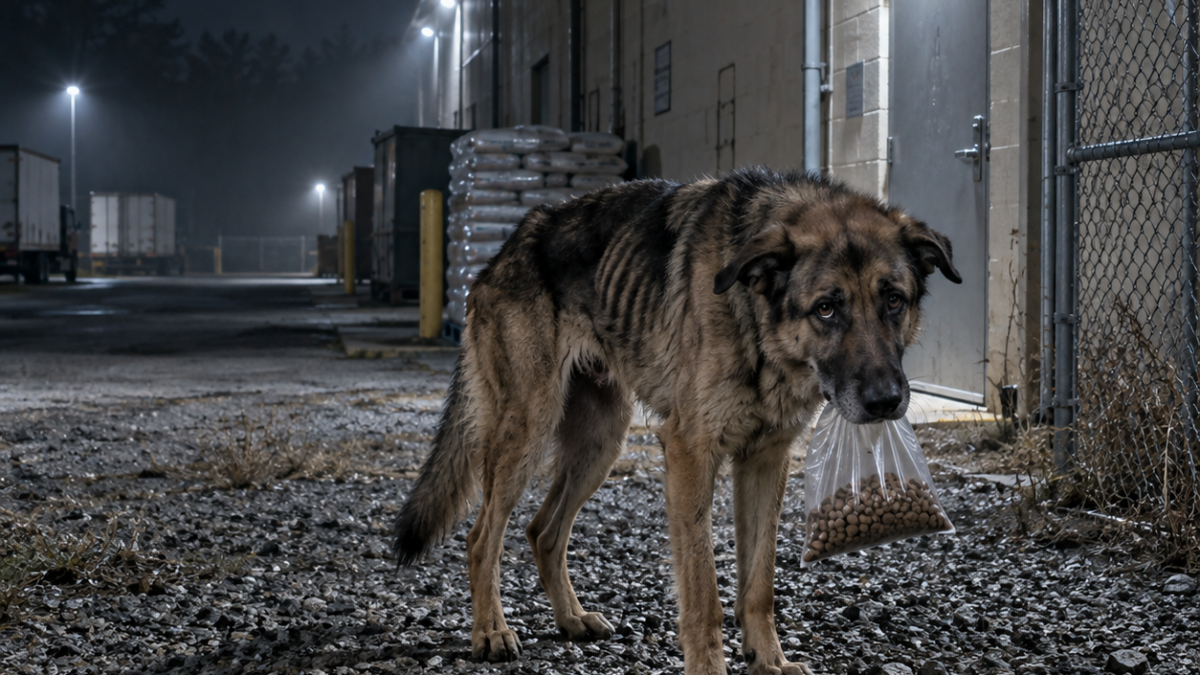
When the dog took the bag and looked into the camera, Sofia leaned closer.
“Dad.”
“I know.”
“She’s lactating.”
I frowned.
“How can you tell?”
“Look at her belly. Her underside. She’s nursing.”
My chest tightened.
“So there are puppies.”
“Maybe. Probably.”
Mateo, who had abandoned the seeds to listen, looked up.
“Puppies?”
Sofia muted me with a glare that said do not promise puppies to my child unless you personally plan to become a zoo.
“We don’t know yet,” she told him.
But she looked at me.
We both knew.
That night, I did not pretend to do paperwork.
I made coffee strong enough to make my ancestors complain, turned off most of the store lights, and waited by the side entrance wearing old jeans, work boots, and a jacket. In my pocket were my keys, phone, flashlight, and a bag of soft treats.
At 2:26 a.m., she came.
Later than usual.
The moon was hidden behind clouds, and the air smelled like rain waiting for permission.
She stepped under the awning, thinner than ever, paws making no sound on concrete. Her head turned constantly, checking the street, the storefront, the alley, the road.
She approached the crate.
I opened the side door.
Slowly.
“Hey,” I called softly.
She flinched so hard the bag in her mouth whipped sideways.
But she did not drop it.
“It’s okay, mamá,” I said, because sometimes Spanish leaves my mouth when gentleness is required. “Easy. I’m not mad.”
Her ears flattened.
She backed away.
I crouched.
The asphalt was cold through my jeans.
“You need help, don’t you?”
She stared at me.
I tossed one soft treat toward her.
It landed halfway between us.
Her nostrils moved.
She did not take it.
She gripped the kibble tighter, turned, and disappeared into the darkness.
This time, I followed.
Not close.
I knew enough about scared dogs to understand that pressure can become danger fast. I stayed half a block behind, keeping to shadows, flashlight off unless absolutely necessary, watching the pale shape of her move through the sleeping street with a bag of kibble in her mouth.
She did not wander.
That was the first thing I noticed.
She knew exactly where she was going.
She crossed the road at the same place a person might, pausing beneath a broken streetlight, checking both directions. She passed an overflowing dumpster behind a taqueria and did not stop. She passed trash bags torn open by raccoons and did not stop. She passed a half-eaten sandwich on the sidewalk and did not stop.
That scared me.
A dog as hungry as she was should have stopped.
Unless her hunger was not the emergency guiding her.
She moved through the warehouse district, past chain-link fences and dark loading docks, past a tire shop, past a vacant lot where weeds grew through cracked concrete. Twice, she stumbled.
The second time, she dropped the bag.
She stood over it, panting.
Her sides moved too fast. Her legs trembled. For a moment, I thought she would collapse.
I took one step closer.
She looked back at me.
Not aggressive.
Warning.
Please don’t.
So I stopped.
She lowered her head, gripped the bag again, and kept going.
By then, rain had begun misting through the air.
Small drops darkened the pavement.
Thunder muttered somewhere west.
I whispered, “Where are you taking it?”
She led me behind an abandoned warehouse on Culebra Road, the kind of place developers buy, fence badly, forget, then describe as “future mixed-use opportunity” for ten years. Weeds tangled along the loading bay. Graffiti covered the roll-up doors. Rusted metal pallets leaned against a wall. Behind the building sat an old box truck with no wheels, sunk slightly into mud, its cargo box tilted toward a drainage ditch.
The dog approached it carefully.
Then dropped to her belly and crawled underneath.
I stopped fifteen feet away.
At first, I heard only rain tapping the truck roof.
Then came the sound that made my heart stop.
Tiny cries.
Not one.
Several.
Thin, hungry, frightened cries from under the truck.
I turned on my flashlight and lowered myself to the gravel.
The beam slid beneath the truck.
Six puppies huddled in the dirt.
They were maybe four weeks old. Maybe five. Too small. Too thin. A pile of trembling bodies in shades of tan, black, cream, and brown, pressed together for warmth against the cold metal belly of the truck.
The mother pushed the bag of kibble toward them.
Then she tore it open with her teeth.
The puppies swarmed.
They were too young for dry kibble to be ideal, but hunger does not wait for ideal. They mouthed at the pieces, chewed clumsily, climbed over one another, squeaking and whining.
The mother stepped back.
She did not eat.
Not one bite.
She stood in the rain, ribs showing, head low, and watched her babies eat.
I forgot how to breathe properly.
All week, I had thought she was stealing food for herself.
But the food was never for her.
This starving mother had been walking through the dark every night, carrying food miles across town so six tiny lives could survive beneath an abandoned truck.
I wiped my face and realized the wet on my cheeks was not rain.
“Madre de Dios,” I whispered.
She looked at me.
Her eyes reflected the flashlight.
I lowered it immediately so it would not blind her.
“I’m sorry,” I said, though for what, exactly, I did not know.
For the world.
For people.
For the fact that she had needed to become a thief to feed her babies.
Then I noticed the smallest puppy.
It lay apart from the others, near the back wheel well, barely moving. A dark little thing with tan eyebrows and one white paw. Its head lifted weakly when the food spilled, but it did not crawl forward.
The mother noticed too.
She picked up pieces of kibble in her mouth and carried them to the puppy, dropping them gently near its nose.
It tried to eat.
Failed.
Tried again.
My chest tightened.
I shifted closer.
The mother moved immediately between us.
Not lunging.
Not growling at first.
Just placing her body in front of the weak puppy.
A wall made of skin and bone.
“I know,” I whispered. “I know. That one needs help.”
Her lips lifted slightly.
A warning.
I backed away.
Rain strengthened, tapping harder against the metal roof of the truck. Water began running through the dirt in thin lines. I looked around and saw what I had missed in the dark: the ground under the truck sloped toward a drainage ditch. If the rain turned heavy, water would run straight beneath the truck.
Rusted metal hung low near the puppies.
Sharp edges.
Twisted brackets.
Broken suspension pieces.
This was not shelter.
It was a trap pretending to be shelter.
I pulled out my phone and called Sofia first.
She answered on the second ring, voice thick with sleep and instant worry.
“Dad?”
“I found puppies.”
She was awake immediately.
“Where?”
“Abandoned warehouse behind Culebra. Old box truck. Six puppies. Mother is very thin. One puppy is weak. Maybe trapped. Rain is coming harder.”
“I’m calling Marisol.”
Marisol Reyes ran Safe Harbor Animal Rescue and had pulled more animals out of bad situations than anyone I knew. She was small, fierce, and capable of making grown men apologize to cats.
“Send me your location,” Sofia said. “Stay back from the mother.”
“I know.”
“Dad, I mean it.”
“I know.”
“Do not try to grab puppies by yourself.”
“I know.”
“You say that when you are about to do something.”
“I am sitting on gravel in the rain. My knees are already negotiating surrender. I am not grabbing anything.”
“Send the location.”
I sent it.
Then I sat.
Waiting is harder when something helpless is ten feet away.
I had another bag of puppy food in my truck, but the truck was back at the store. All I had in my backpack was a small bag of soft training treats and a bottle of water. I took out the treats and placed them on the ground between us.
The mother stared.
Then at the puppies.
Then back at me.
“You need to eat,” I said.
She did not move.
I opened my water bottle and poured some into the shallow lid of a plastic container I found near the truck. I slid it slowly across the gravel.
She watched it.
Her tongue moved once across her nose.
But she did not drink.
Instead, after several silent minutes, she approached the treats.
I held my breath.
She sniffed them.
Picked up the entire little treat bag in her teeth.
And carried it beneath the truck.
She placed it beside the weakest puppy.
That was when I truly understood.
She was not asking for food anymore.
She was showing me which baby needed help first.
“I see,” I whispered, voice breaking. “I see him.”
The rescue team arrived seventeen minutes later, though it felt like an hour.
First came Marisol in her dented white van, wearing rain boots and a jacket thrown over pajamas. Then Sofia in her SUV, hair twisted up, face pale. Behind her came two volunteers, Andre and Kim, carrying crates, blankets, slip leads, and a trap. A veterinary tech named Hannah arrived last, breathless, with a medical bag.
The mother dog panicked when the vehicles came.
She darted beneath the truck, placing herself between the puppies and all of us.
Marisol lifted one hand.
“Everybody stop.”
We stopped.
Rain ran down her face as she crouched low.
“Hi, mama,” she called softly. “You did good. We’re going to help.”
The dog growled.
It was not a threat so much as a statement.
I have nothing left, and I will still spend it fighting you.
Marisol looked at me.
“She trust you at all?”
“She let me follow. That’s all.”
“That’s not nothing.”
We formed a loose half circle at a distance. No one rushed. No one reached. The rain grew heavier, and water began to slide beneath the truck in thin streams.
Hannah lowered herself to look under with a flashlight.
Her face tightened.
“The small one is caught.”
The mother growled louder.
“Caught how?” Sofia asked.
“Back leg maybe pinned under a strip of corroded metal. I can’t see clearly. It’s wedged near the frame.”
Thunder cracked closer.
The puppies cried.
My hands curled into fists.
Marisol began giving quiet instructions.
“We need the mother contained without terrifying her into crushing the pups. Food lure first. Luis, do you have more from the store?”
“In my truck.”
Sofia tossed me her keys.
“Go.”
I ran badly.
There is no dignified way for a fifty-two-year-old man with bad knees to sprint through rain in work boots, but fear improves form enough to prevent shame from mattering. I drove Sofia’s SUV back to the store, grabbed puppy food, wet food, bottled water, towels, a tarp, bolt cutters, gloves, and every blanket in the donation crate.
When I returned, the water under the truck was worse.
The mother dog stood half out from beneath it, torn between hunger and fear. Marisol had opened a can of wet food, and the smell filled the wet air.
The dog trembled.
Her body wanted the food.
Her mind refused to leave her babies.
I approached slowly with the bags.
“Mamá,” I said softly.
Her eyes flicked to me.
I set the food down and backed away.
Marisol placed the open can near the entrance beneath the truck.
The mother sniffed.
Took one step.
Then turned back to the weak puppy.
“Of course,” Marisol murmured. “She won’t leave him.”
Hannah looked up.
“We may not have time to wait her out. Water is rising under there.”
Marisol’s jaw tightened.
“Nobody gets bitten unless we have to.”
“I’m not worried about being bitten.”
“I’m worried about making her panic.”
Another volunteer, Andre, moved toward the far side of the truck to assess the metal.
“Careful,” Marisol warned.
“I am.”
The mother shifted, tracking him.
That opened a narrow view.
Hannah lowered the flashlight.
“I see it. The metal strip is curled over the puppy’s rear leg. Not crushing fully, but trapping. He’s weak.”
“Can we lift it?”
“Maybe. But not with her guarding.”
I looked at the mother.
At her ribs.
At the faded blue rope around her neck.
At the way she stood trembling between help and her child, unable to understand that this time people had come to save instead of take.
An idea came to me.
Maybe foolish.
Maybe not.
“Give me the bowl,” I said.
Sofia’s eyes narrowed.
“Dad.”
“Just the bowl.”
Marisol studied me, then handed over a collapsible dish.
I filled it with wet food, warm water from a thermos Kim had brought, and a little dry kibble softened into mush. Then I crouched and placed it near myself instead of near the truck.
The dog watched.
I did not look directly at her.
I sat on the wet gravel, turned my body sideways, and began speaking quietly.
“My father used to say mothers are the strongest creatures God ever made,” I said. “He meant human mothers, I think, but he should have known better. Look at you.”
The rain fell harder.
“You carried food every night. You passed dumpsters. You passed trash. You passed things your body needed because they needed you more.”
Her growl faded into a low rumble.
“I know you don’t trust us. I wouldn’t either.”
I pushed the bowl an inch forward.
“But that baby is trapped. And if we don’t move that metal, he may die.”
She stared at me.
Dogs do not understand every word.
But they understand tone.
They understand stillness.
They understand whether a body is asking or taking.
“Take the food,” I whispered. “Stay close. Watch us. But let us help him.”
For a long moment, nothing happened.
Then she stepped toward me.
One step.
Another.
Sofia covered her mouth behind me.
The mother lowered her head to the bowl.
She did not eat.
She picked it up.
My heart sank.
I thought she would carry it back to the puppies again.
But she took only three steps, then set it down where she could stand over it and still see the truck opening.
Then she ate.
Not much.
Three desperate mouthfuls.
Four.
Her whole body shook with the effort of allowing herself to need something.
Marisol moved silently, signaling Andre and Hannah.
The mother’s head jerked up.
I spoke again.
“Easy. Watch them. You can watch.”
Hannah slid carefully toward the trapped puppy from the side opposite the mother. Andre used gloved hands and a pry bar from his kit to lift the rusted strip.
The puppy cried.
The mother lunged two steps.
I froze.
So did everyone.
“Almost,” Hannah whispered.
Marisol held her breath.
Andre lifted.
Hannah reached.
The puppy squealed.
The mother barked, sharp and raw.
I thought she would attack.
Instead, she looked at me.
I do not know how else to explain it.
She looked at me as if asking whether this pain meant betrayal or rescue.
“Hold on,” I whispered. “Hold on.”
The metal shifted.
Hannah pulled the puppy free.
“I’ve got him!”
The mother tried to rush forward, but Marisol gently blocked with a blanket, not grabbing, just redirecting. Hannah immediately placed the puppy near the entrance, close enough for the mother to smell.
The mother pushed past and curled around him.
Licked him frantically.
Nosed his face.
The puppy made a weak sound.
Alive.
The whole group exhaled at once.
Now that the weakest was free, everything moved quickly.
We created a barrier with the tarp to block rainwater. The mother, exhausted beyond resistance, allowed Marisol to slip a lead over her head while she stayed pressed against the puppies. One by one, Hannah lifted them into warm towels, checked gums, breathing, temperature, limbs.
Six puppies.
Five hungry and cold.
One injured and dangerously weak.
The mother watched every movement.
When Hannah lifted the smallest, the dog staggered after her despite barely standing.
“We’re not taking him away,” Hannah said softly. “See? He stays with you.”
We loaded them into Marisol’s van, mother and puppies together in a large crate padded with blankets. The mother refused to enter until the smallest puppy was placed inside first.
Only then did she climb in.
Before Marisol closed the crate door, the mother looked at me.
Her face was wet with rain.
Her body was ruined by hunger.
Her eyes, for the first time, held something other than fear.
Not trust fully.
Not yet.
But recognition.
I stepped close enough to touch two fingers to the edge of the crate.
“You don’t have to steal anymore,” I told her. “You don’t have to do it alone.”
The dog lowered her head over her puppies.
And for the first time since I had seen her, she rested.
We named her Lucia.
It means light.
Sofia suggested it because, she said, “She carried food through the dark.”
The smallest puppy became Milagro, because miracle was the only name that made sense.
At Safe Harbor, the vet confirmed what we already feared. Lucia was severely malnourished, dehydrated, anemic, and exhausted. She had old rope burns under the collar and scars along one hind leg. She had been nursing while starving, her body giving everything to the puppies until there was almost nothing left for itself.
Milagro’s leg was bruised and swollen but not broken. The metal had pinned him long enough to weaken circulation, but Hannah’s quick work likely saved the limb. He also had hypothermia and needed tube feeding for the first day.
The other five puppies were underweight but stronger: two boys, three girls, all with soft folded ears and bellies that slowly began to round once proper feeding started.
Lucia refused to eat for the first twelve hours unless food was placed beside the puppies.
So we placed it there.
She would take a bite, check each baby, take another bite, lick Milagro, then eat again. Every sound from the clinic hallway made her stiffen. Every new person made her curl tighter around them.
But she never snapped.
She only guarded.
There is a difference.
On the second day, Marisol called me.
“She’s looking for you.”
“For me?”
“She keeps lifting her head when men walk by. Andre came in and she ignored him. The vet came in and she growled. I played your voicemail from last week by accident while checking messages, and she perked up.”
“You played my voicemail to a dog?”
“I was multitasking.”
“What do you want me to do?”
“Come talk to her.”
So I went after closing the store.
Lucia lay in a quiet recovery room under warm light. Her puppies were pressed against her belly, sleeping in a pile. Milagro lay closest to her chest, bandaged leg stretched out, tiny white paw twitching in dreams.
Lucia lifted her head when I entered.
Her tail did not wag.
That would have been too much.
But it thumped once against the blanket.
I sat on the floor outside the kennel.
“Hola, mamá.”
Her ears softened.
Marisol stood behind me, smiling like she had just won an argument I did not know we were having.
“She knows you.”
“I followed her. That is not the same.”
“She knows you followed and didn’t take.”
I sat with Lucia for an hour.
I told her about the store. About my father. About Sofia and Mateo. About how my knees hurt because I was foolish enough to run in rain. About how she had scared ten years off my life by not eating.
She watched me the whole time.
At the end, she finally lowered her head and slept.
The story spread because stories like Lucia’s always do now.
One of the volunteers posted a careful version online: starving mother dog carries stolen food nightly to six puppies under abandoned truck. Photos followed, with vet-approved limits. Lucia curled around her babies. Milagro wrapped in a towel. The blue rope collar cut off and placed in an evidence bag.
Donations came fast.
Food.
Money.
Blankets.
People offered to adopt the puppies before their eyes fully focused.
People called Lucia a hero.
They were right.
But I worried about that word.
Humans love calling suffering noble after the suffering is over. It makes us feel better. It lets us admire survival without asking why survival required so much.
Lucia was heroic.
She was also failed.
By someone.
By many someones, probably.
A week after the rescue, we learned more.
A woman came into the store holding her phone with a picture of Lucia from the rescue page.
“I know that dog,” she said.
Her name was Carla Jimenez. She worked nights cleaning offices near the warehouse district. She had seen Lucia months earlier in the yard of a mechanic who rented space behind the abandoned warehouse. The mechanic, a man named Brent Haskins, had kept several dogs chained behind the shop. Carla had reported him once after seeing no shelter and dirty water.
“Nothing happened,” she said bitterly.
Then Haskins left suddenly after eviction notices went up on the warehouse property. The dogs vanished.
Or seemed to.
Lucia must have either escaped or been left behind.
The faded blue rope collar matched what Carla remembered.
Marisol filed the information with animal cruelty investigators. Carla gave a statement. So did I. So did the vet. Photos of Lucia’s condition became evidence. The abandoned truck site was documented. The rope collar. The scars. The lack of shelter.
Brent Haskins was found two counties away, running mobile repairs out of a storage lot.
He denied owning Lucia.
Then investigators found photos on his old social media page.
There she was.
Healthier then, standing behind his shop with the same blue rope collar around her neck.
He claimed she ran away.
The prosecutor asked why he never reported her missing.
He had no good answer.
He claimed he did not know she had puppies.
The vet records showed she had likely been pregnant when he vacated the property.
He claimed she was “just a dog.”
That phrase followed him into court like a bad smell.
By then, Lucia had gained weight.
Milagro could stand.
The other puppies had become round little criminals who chewed everything, including one corner of Marisol’s clipboard and my shoelace.
The day of Haskins’s first hearing, I attended with Sofia and Marisol.
He wore a clean shirt and annoyed expression, as if animal cruelty charges were an inconvenience between errands. When the prosecutor showed photographs of Lucia’s condition, he looked away.
Not in shame.
In irritation.
As if her suffering had become rude by being visible.
The judge did not dismiss the case.
That felt like a small miracle.
Haskins eventually pled guilty to animal neglect and abandonment. The sentence included fines, probation, community service, restitution to the rescue, and a ban on owning animals for years. Many people said it was not enough.
They were right.
But Carla said something outside the courthouse that stayed with me.
“He had to stand there while everyone saw what he did. Men like that hate being seen.”
Lucia had been invisible when she suffered.
Now the whole city knew her name.
That mattered.
Recovery was slow.
People imagine rescued animals understand immediately that they are safe. Some do. Many do not. Safety is a language the body must relearn.
Lucia hid food in blankets for weeks.
If anyone picked up a bag of kibble, she rose instantly, following, nervous, as if food leaving her sight might disappear forever. She panicked during storms. Rain against the roof made her gather the puppies close and tremble. She would not walk through narrow spaces. She refused collars, so Marisol used a soft harness once the vet approved.
But she changed.
Little by little.
The first time she accepted food and ate before checking every puppy, Marisol cried.
The first time she wagged her tail at Sofia, Mateo cheered so loudly Lucia hid behind me.
The first time Milagro climbed over his mother’s paw and barked at absolutely nothing, Lucia looked exhausted in a way every parent recognizes.
By eight weeks, the puppies were chaos.
We named them properly by then.
Milagro, the smallest.
Luna, with a crescent-shaped patch on her forehead.
Chico, who was not actually small but acted offended by everything.
Pepper, black-muzzled and dramatic.
Sol, golden and fearless.
Bean, because Mateo insisted one puppy looked like a bean and none of us had the strength to argue.
Applications poured in.
Marisol screened every adopter like she was placing royal children. Fenced yards, vet references, home visits, contracts, follow-ups. Anyone who said “free puppy” was immediately removed. Anyone who asked if they could take two “for breeding later” was removed and spiritually cursed.
The puppies left one by one.
Lucia watched each adoption carefully.
We worried she would grieve.
She did, in her way. She searched after Luna left. She sniffed the blanket where Sol had slept. But each time, after a day or two, she relaxed. It was as if some part of her understood they were not vanishing into hunger.
They were going where food bowls stayed full.
Milagro stayed longest.
Partly because of his leg.
Partly because I kept finding reasons he needed “just another week” of observation.
Sofia noticed.
“You’re attached.”
“I am responsible.”
“You bought him a tiny blue bandana.”
“It was on clearance.”
“You embroidered his name on it.”
“The embroidery machine at the mall was also on clearance?”
She gave me the look daughters reserve for fathers who think they are clever.
But it was Lucia I could not stop thinking about.
Everyone wanted the puppies.
Many people asked about them.
Few asked about the mother.
That happens too often.
The animal who suffered most, sacrificed most, fought hardest, becomes background once the babies are safe.
I visited Lucia every evening after closing.
At first, I told myself it was because she trusted me and trust should be maintained for adoptability.
Then one evening, I arrived late and found her waiting near the kennel door.
Tail wagging.
Just once.
Then twice.
I sat on the floor and she came to me, pressed her forehead against my chest, and sighed.
A deep, tired sigh.
The kind that says, I have been holding up the world and would like to set it down for a minute.
I wrapped my arms around her carefully.
That was when I knew.
“Oh no,” Marisol said from the doorway.
I looked up.
“What?”
“You have that face.”
“I have no face.”
“You have adopted-the-dog face.”
“I own a business. I’m busy. My house is small. My knees are bad.”
“Lucia doesn’t care about your excuses.”
Lucia pressed harder against me.
Traitor.
“I’ll think about it,” I said.
Marisol smiled.
“Sure.”
Two weeks later, Lucia came home with me.
Milagro came too.
Temporarily, I said.
Foster-to-adopt, I said.
A trial period, I said.
Mateo walked into my house, saw Milagro sleeping upside down on a blanket, and said, “Abuelo, your baby dog is broken.”
Lucia explored my home slowly.
She sniffed every corner, every chair, every doorway. The first night, she would not sleep in the dog bed I bought. She curled beside the kitchen door instead, facing outward, guarding.
So I dragged a blanket near the kitchen and slept on the floor six feet away.
At 3:00 a.m., I woke to her standing over me, staring.
“What?”
She huffed.
Then lay down closer.
By morning, her back was against my shoulder.
Progress.
Milagro adapted faster. Puppies are arrogant about survival. Within two days, he believed my house existed for his teeth. Within a week, he had stolen one sock, three receipts, Mateo’s toy dinosaur, and my dignity.
Lucia watched him like a tired queen.
At the store, we changed the donation crate.
The old sign came down.
A new one went up:
LUCIA’S CRATE
For animals and families who need help before it becomes an emergency.
We added a shelf for free pet food, no questions asked. A small form people could fill anonymously if they knew of an animal in trouble. A list of rescue numbers, emergency vet contacts, low-cost clinics, and legal reporting steps. We kept bottled water and collapsible bowls near the front door.
We also started a night camera fund to help small rescues monitor known dumping sites.
The first week, someone left five bags of puppy food.
The second, an elderly man came in and quietly took one.
He stood at the crate with his hand on the bag, shame flooding his face.
“My dog’s old,” he said to no one in particular. “I get my check Wednesday.”
I pretended to straighten seed packets.
“Old dogs like chicken flavor,” I said. “Take two.”
He did.
Lucia watched from behind the counter.
She no longer flinched when bags of food moved.
Not always.
Sometimes.
Healing is not a straight road.
But she watched that man leave with food, and I wondered if she knew.
No one should have to steal to feed someone they love.
Months later, on the anniversary of the night I followed her, rain came again.
Hard rain.
The kind that drums on roofs and turns gutters into rivers.
Lucia paced at my back door, whining.
Milagro, nearly full grown but still ridiculous, watched her with concern.
I knew what she was remembering.
So I took a blanket, sat on the kitchen floor, and called her.
She came reluctantly.
The thunder rolled.
I placed one hand on her back.
“You’re home,” I said. “They’re safe.”
She trembled.
Milagro crawled into her side, far too large now to be a baby but trying anyway.
She sniffed him.
Then lowered her head.
I pulled out my phone and opened the folder Marisol had made: Lucia’s babies.
There was Luna on a couch.
Chico at a park.
Pepper wearing a bow she clearly hated.
Sol asleep beside a toddler.
Bean covered in mud.
Milagro chewing my slipper two feet away in real time.
I showed Lucia the screen.
Maybe she understood nothing.
Maybe she understood everything.
She rested her chin on my knee.
The storm continued.
But she did not pace again.
People still ask about her.
Sometimes customers come in just to see “the mother dog from the story.” Lucia tolerates admiration with dignity. Milagro demands it shamelessly. If someone kneels too quickly, Lucia steps back. If someone lets her come in her own time, she may place her head beneath their hand.
Children love her.
She loves children back cautiously, especially the quiet ones.
Once, a little girl asked why Lucia was famous.
I said, “Because she loved her babies very much.”
The girl looked at Lucia.
“My mom loves me very much too.”
“I bet she does.”
“Would she steal food for me?”
Her mother turned bright red.
Lucia licked the child’s fingers.
I said, “I think mothers do all kinds of brave things when they have to.”
The mother cried in aisle three.
It happens often in feed stores.
You would be surprised.
I still think about those five nights before I followed her.
How many times I watched the footage, curious but not urgent enough.
How easily I could have said, Well, at least she got food.
How close we came to being too late.
That is the part I carry.
Not guilt exactly.
A reminder.
Need does not always make noise.
Sometimes it moves quietly after midnight, careful not to bother anyone, taking only one small bag because even desperation has manners.
Sometimes sacrifice looks like theft because nobody bothered to ask who was hungry.
Sometimes the one starving is not eating because love has taught her to give everything away.
Lucia never stole again.
She did not need to.
But every once in a while, at the store, she will pick up a small bag of kibble from the shelf and carry it to me. Not tearing it. Not trying to open it. Just holding it gently in her mouth the way she carried food through the dark.
The first time she did it, my throat closed.
I took the bag and said, “Who needs help, mama?”
Maybe no one.
Maybe she remembers.
Maybe she is reminding me.
Either way, I check the crate. I check the messages. I check the alley behind the store. I listen.
That is what she taught me.
To listen before the crying gets loud.
To move before the storm reaches the ditch.
To understand that the quietest animals, and sometimes the quietest people, may be carrying burdens heavier than anyone can see.
One night, nearly a year after the rescue, I closed the store late again.
The donation crate sat beneath the awning, fuller than usual. A bag of puppy food leaned against the side. The security light hummed. Rain clouds gathered far off, but the air was still.
Lucia stood beside me, healthy now, coat shining, blue harness soft against her chest. Milagro bounded near the truck, chasing nothing.
I looked toward the road where she had first appeared.
For a second, I could almost see her as she had been: ribs sharp, eyes frightened, a small bag of food in her mouth, walking into darkness because six tiny lives were waiting.
“You were so tired,” I whispered.
Lucia leaned against my leg.
“But you kept going.”
She looked up at me.
Then at the crate.
Then back again.
I unlocked the front door, took one small bag of kibble from the donation pile, and set it aside with a note for Marisol’s next rescue transport.
In honor of Lucia.
Then I turned off the light.
This time, no starving mother disappeared into the dark.
This time, she climbed into my truck with her son, settled on a blanket, and rode home full, safe, and loved.
For the first time in her life, maybe, she did not have to be the only hope.
She got to rest.
And every night when she sleeps at the foot of my bed, one paw touching Milagro as if counting him even in dreams, I remember the lesson she carried through rain, hunger, fear, and darkness.
Love does not always bark.
Sometimes it steals one small bag of food.
Sometimes it walks miles on trembling legs.
Sometimes it stands between danger and the weakest child.
And sometimes, if we are lucky, we notice in time.








