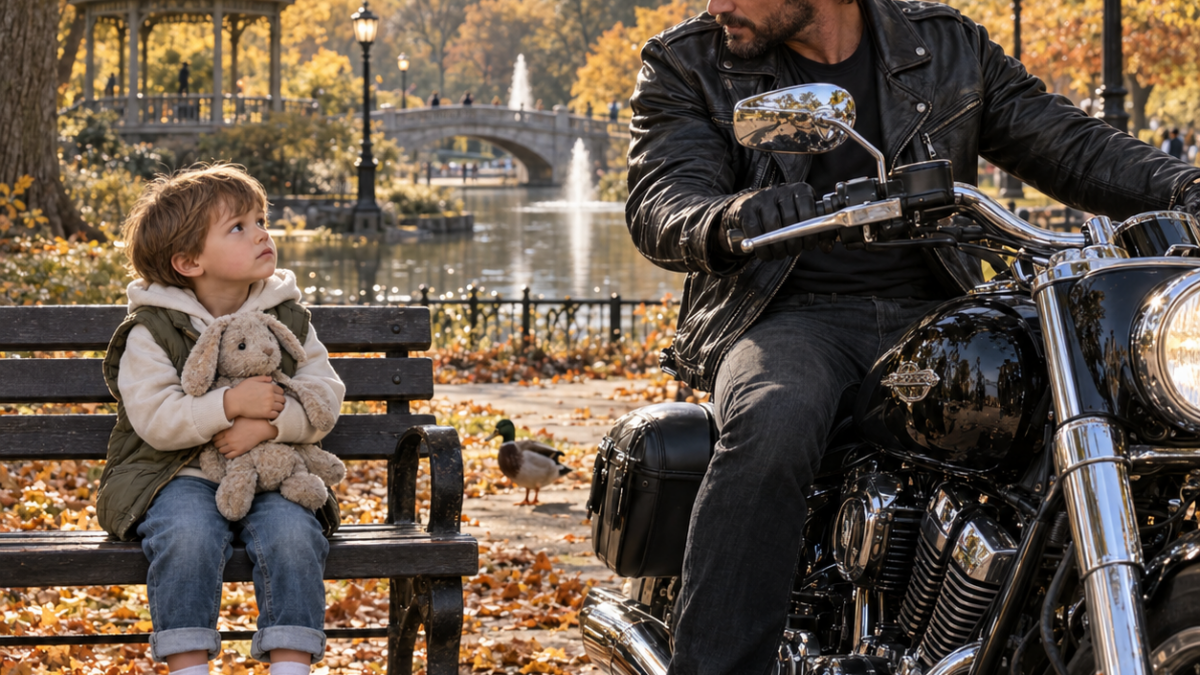
Every Morning, a 3-Year-Old Boy Guarded the Same Empty Park Bench—Until a Biker Finally Asked Why
PART3:
“My real name is Dashiell, but Mommy only says that when I put crackers in my pockets.”
Despite everything, I almost smiled.
“I’m Michael.”
He studied me.
“You have a loud bike.”
“I do.”
“It sounds like thunder but nicer.”
“I’ll take that as a compliment.”
He nodded gravely, as if I had passed the first test.
“Dash, why do you have to guard Mommy’s spot?”
He looked down at the rabbit and rubbed its torn ear between two fingers.
“Because she said if I leave, she won’t know where to find me.”
My throat tightened.
“When did she say she’d come back?”
“When it gets dark.”
I checked my phone.
7:43 a.m.
That child was prepared to sit there alone for more than ten hours.
I looked around again, hoping for someone to appear, someone who would make this make sense.
No one did.
“What’s your rabbit’s name?” I asked because if I asked the next question too fast, I knew my voice might change.
“Hopper.”
“Good name too.”
“He used to have two eyes.”
“Looks like he still sees plenty.”
Dash considered that.
Then nodded.
A duck waddled from the pond toward the path, fat and arrogant, shaking water from its tail.
Dash’s face softened for the first time.
“That’s Herbert,” he whispered.
“The duck?”
“He visits me every day.”
Every day.
The words landed hard.
This was not a one-time emergency.
This was routine.
This child had a relationship with a park duck because adults were walking past him daily while he waited for darkness.
I sat on the far end of the bench, leaving the empty space between us.
Dash immediately stiffened.
“Not there,” he said.
I froze.
“That’s Mommy’s spot.”
I stood.
“Sorry.”
He relaxed when I moved to the other side of the bench, not touching the space he guarded.
Rules matter to scared children.
Sometimes rules are the only control they have left.
“Do you have food?”
He patted his backpack.
“Crackers. Juice. A cheese stick but Mommy says eat that before the sun gets big.”
Smart, I thought.
Heartbreaking, but smart.
“Does Mommy work near here?”
He shook his head.
“She rides the bus.”
“Do you know where?”
“Tall hotel.”
“There are a lot of tall hotels.”
He lifted Hopper and made the rabbit’s limp ear bounce.
“Mommy cleans rooms where people don’t say thank you.”
That narrowed nothing and explained too much.
I stayed with him until 8:15, standing near the bench, not too close, pretending to check my phone whenever someone passed so Dash would not feel watched. Then I called Coop.
“I’m going to be late.”
“How late?”
“I don’t know.”
“That kid?”
“Yeah.”
“You need backup?”
I looked at Dash, who was explaining to Herbert the duck that ducks were not supposed to eat crackers because Mommy said bread made their bellies hurt.
“Maybe.”
“I’ll open the shop.”
I spent the morning near that bench.
At first, Dash tolerated me.
By ten, he asked why my jacket had patches. I told him some were from places I had ridden, some from friends, and one from my late brother’s unit. He asked if my brother was in heaven. I said I hoped so. He said his daddy was “not in heaven, just gone,” and my heart did something painful behind my ribs.
“Gone where?”
He shrugged.
“Mommy doesn’t know.”
“Do you remember him?”
Dash pressed Hopper’s face against his own cheek.
“He smelled like soap and pennies.”
That was one of the saddest descriptions of a father I had ever heard.
Around noon, I bought lunch from a food truck at the corner and brought back a grilled cheese, apple slices, and water. I asked before opening anything. He looked suspicious until I set it on the bench near him and stepped back.
“Mommy says don’t take food from strangers.”
“Your mommy is right.”
“You’re a stranger.”
“Yes.”
He thought hard.
“What if Hopper takes it?”
“That seems like a loophole.”
“Hopper says okay.”
So Hopper accepted the grilled cheese.
Dash ate most of it.
At two, an older woman stopped and asked if he was mine.
“No,” I said.
Her face sharpened.
“Then why are you sitting with him?”
I looked at her.
“Because he was sitting alone.”
That shut her up, but not kindly. She walked away looking over her shoulder like I was the danger she had nearly caught.
By four, I knew Dash’s mother’s name was Laurel, that she wore black pants to work, that she cried quietly sometimes on the bus when she thought Dash was asleep, that they slept “where lots of ladies sleep,” and that he was not allowed to be there when the sun was awake.
I also knew he was used to being hungry but not used to complaining about it.
That kind of self-control in a child is not maturity.
It is evidence.
At 6:32 p.m., Laurel arrived.
I saw her before Dash did.
She came across the park fast, wearing black work pants, a white shirt under a cheap gray sweater, and shoes made for hotel hallways, not city sidewalks. Her dark hair was pulled back tightly. One strap of her worn bag was fraying. Her face looked exhausted in the deep way that sleep cannot fix because sleep is not what the body is missing.
Dash saw her and launched himself off the bench.
“Mommy!”
Laurel dropped to her knees on the path and caught him so hard they almost fell. She closed her eyes and held him against her chest with both arms.
For a moment, I turned away.
There are things you do not watch directly unless invited.
Then I heard her voice.
“Were you good? Did you stay? Did you stay right here?”
“I guarded, Mommy. I guarded your spot.”
Her face folded.
Only for a second.
Then she saw me.
Fear crossed her face so fast it looked practiced.
She pulled Dash behind her.
“Who are you?”
“My name is Michael.”
“What did you say to my son?”
“Nothing that would hurt him.”
“That’s not an answer.”
“No,” I said. “It isn’t.”
Her eyes darted toward the street, then back to me.
“I didn’t do anything wrong.”
Those words told me more than any confession could have.
People who expect fairness do not lead with defense.
“I’m not here to accuse you,” I said. “I ride past this park every morning. I’ve seen him here.”
Her color drained.
Dash clung to her leg.
“How many mornings?” she whispered.
“Enough.”
Her mouth trembled.
Then she bent, scooped Dash into her arms, and started walking.
“Wait,” I said.
She moved faster.
“Laurel.”
She stopped because I used her name.
Slowly, she turned.
“How do you know my name?”
“Dash told me.”
She looked at her son.
He pressed his face into her shoulder.
“He’s three,” I said. “He shouldn’t have to keep secrets this heavy.”
Her eyes filled with tears, but she blinked them back hard.
“You think I don’t know that?”
“I think something is very wrong.”
She laughed once.
There was no humor in it.
“That must be nice.”
“What?”
“Noticing from the outside that something is wrong.”
The words hit me clean.
She turned again.
This time, I let her go.
But I followed at a distance.
Not to frighten her.
Not to trap her.
Because Dash had said “tall hotel,” and Laurel moved like a woman who believed if she stopped, the whole world would catch her.
They walked three blocks to a bus stop.
I stayed across the street.
When the bus came, they got on.
I memorized the route number.
Then I went back to my motorcycle and followed the bus downtown.
That may sound extreme.
Maybe it was.
But there is a point where concern either becomes action or becomes self-forgiveness disguised as worry.
I was done with worry.
The bus let them out near the hotel district, where old brick buildings had been polished into boutique stays for business travelers and people with money to spend on charm. Laurel carried Dash past three restaurants, a valet stand, and a glass-fronted hotel with gold letters above the entrance.
The Harrington Grand.
Dash pointed at it.
“Mommy cleans there?”
Laurel took his hand and hurried him past.
They did not go inside.
They walked two more blocks to a shelter entrance tucked between a church office and a laundromat.
Women’s Outreach House.
I sat on my bike across the street until they disappeared inside.
Then I went home and did not sleep.
The next morning, Dash was on the bench.
At 7:15.
Exactly.
That was when I stopped pretending Laurel had a better option hidden somewhere.
I brought coffee for myself, milk for him, and a banana. Hopper approved the banana after a long inspection. Dash told me Herbert was late and that Mommy had cried in the bathroom because “a mean lady with shiny hair said she smelled like outside.”
I knew then I would find Laurel after work and make her talk to me, whether she wanted to or not.
That evening, I parked across from the employee exit behind the Harrington Grand.
At 6:08, kitchen staff came out laughing.
At 6:21, a valet lit a cigarette near the dumpster.
At 6:37, a woman with shiny blond hair stepped outside holding a clipboard and speaking sharply into her phone.
At 6:49, Laurel came through the service door.
Alone.
Dash was already at the park, waiting.
She looked smaller without him beside her. Her shoulders were rounded forward, her bag clutched close. She walked quickly toward the bus stop.
“Laurel.”
She spun.
Fear again.
Then recognition.
“You followed me?”
“I followed the bus yesterday. I’m sorry.”
“That does not make it better.”
“No. But your son is sitting alone in a park for eleven hours a day.”
Her eyes flashed.
“You think I need you to tell me that?”
“I think you need help.”
“I need people not to notice me.”
“That stopped being possible when I noticed Dash.”
She backed toward the brick wall of the alley.
“Are you police?”
“No.”
“Child services?”
“No.”
“Then what are you?”
I thought about that.
A stranger.
A biker.
A man who kept riding past until he couldn’t.
“Someone who doesn’t want to see your boy get hurt.”
Her face twisted.
“My boy is the only thing I have left. Everything I do is so he doesn’t get hurt.”
“Then tell me why.”
She looked toward the hotel door.
“Not here.”
“Where?”
She wrapped both arms around herself.
“I don’t know.”
There was nowhere safe.
That was the shape of her life.
I nodded toward the alley corner.
“There’s a coffee shop two blocks down.”
“I can’t afford coffee.”
“I can.”
“I don’t take things from men.”
“Then don’t take coffee. Take five minutes indoors.”
She stared at me for a long moment.
Then followed.
Inside the coffee shop, she sat with her back to the wall and her eyes on the door. She refused food twice before accepting a paper cup of water. Her hands shook around it.
“We lost our apartment six weeks ago,” she said finally.
The words came out flat.
Like facts read from a form.
“Dash’s father disappeared eight months before that. Evan. Evan Brooks. He worked maintenance at the Harrington.”
She looked through the window toward the hotel district.
“They said he stole money from a guest safe and ran. I didn’t believe it. Then they said there was video. Then the police came. Then people started looking at me like maybe I knew where he went.”
“Did you see the video?”
“No. Nobody would show me. They just kept saying the investigation was active. Then Mr. Weller, the general manager, called me into his office and said he felt sorry for me. He said Evan had embarrassed the hotel, but he wouldn’t punish a mother for her husband’s sins.”
Her mouth tightened.
“He gave me a housekeeping job. Night laundry first. Then rooms. Said I should be grateful.”
“And your apartment?”
“Our landlord said we were behind. We weren’t. Evan always paid by money order. But when I asked for receipts, Mr. Hayes said he couldn’t find them, and if I made trouble, he’d tell the police I was hiding stolen money. Then Dash got sick. I missed shifts. Late fees piled up. One day I came home and the locks were changed.”
“Illegal.”
She gave me a tired look.
“Illegal doesn’t open a door at midnight when your child is crying.”
I had no answer for that.
“We got into the women’s shelter,” she continued. “But children can’t stay there during daytime hours unless the mother is there. I tried daycare. The cheapest place wanted more than half my weekly pay. I asked a church. They had a waitlist. I asked a woman at work. She told Ms. Kemp.”
“Who’s Ms. Kemp?”
“Housekeeping supervisor. Shiny hair.”
I remembered the woman by the service door.
“Laurel, what are you saying?”
She looked down at her hands.
“I leave Dash at the park because if the hotel finds out I don’t have childcare, they’ll fire me. If I lose the job, I lose the shelter bed. If I lose the shelter bed, I lose him.”
She pressed her fist to her mouth.
“I know how horrible it sounds. I know what people would say. I know what I deserve to hear. But every morning I tell myself it’s one more day. One more day until I save enough for a room. One more day until someone from a daycare calls. One more day until something changes.”
Her voice broke.
“But nothing changes.”
The paper cup crumpled in her hands.
“I tell him he’s guarding my spot so he won’t wander. So he’ll stay where I can find him. So he’ll think he’s helping instead of being abandoned.”
She covered her face.
“I am not leaving him because I want to.”
I sat across from her, feeling something hot and ugly moving under my ribs.
Not at her.
At the world that had cornered her so neatly she had begun apologizing for bleeding on the trap.
“Why that bench?” I asked quietly.
Her hands lowered.
“What?”
“Why that specific bench?”
She looked confused.
“Evan and I used to sit there. Before Dash was born. Before everything. We’d get cheap takeout and watch ducks like it was dinner somewhere fancy. After Dash came, we took him there too. Evan called it our spot.”
“Our spot,” I repeated.
Her face crumpled.
“Dash remembers because I told him stories.”
“We need to get him.”
“I know.”
“No. I mean now.”
Her fear returned.
“I have twenty minutes before shelter check-in.”
“We’ll make it.”
We did.
Barely.
The evening shadows stretched long across Maplewood Park when Laurel and I reached the bench. Dash was still there, exactly where she had left him, Hopper in his lap, backpack tucked by his feet.
The second he saw her, he jumped up.
“Mommy!”
Laurel ran.
This time she did not simply hug him.
She folded around him like a person trying to shield him from every hour he had spent alone.
“I’m sorry,” she whispered into his hair. “I’m so sorry, baby.”
Dash patted her cheek.
“I guarded good.”
“I know.”
“Mister Michael stayed far away but not too far.”
Laurel looked at me through tears.
I looked away.
Then Dash squirmed.
“Mommy, can I show you now?”
“Show me what?”
He pointed beneath the bench.
“There’s a thing. You said never touch things that aren’t ours, so I didn’t. But it has your name.”
Laurel went still.
“What thing?”
Dash crouched and reached under the bench.
“Dash, wait,” I said, but he had already pulled it free.
A small metal box wrapped in a plastic grocery bag.
Duct tape hung from one side, old and dirty, as if it had been secured beneath the bench for a long time.
Laurel stared at it.
“I didn’t put that there.”
My pulse quickened.
On top of the box was an envelope, sealed in plastic, the ink faded but readable.
FOR LAUREL. FROM DASH’S FATHER.
Laurel made a sound I will never forget.
Not a scream.
Not a sob.
A broken little intake of breath, like her heart had recognized handwriting before her mind could protect her.
“Evan,” she whispered.
I took the box carefully.
It was locked.
Inside the plastic around the envelope was a small key taped to the back.
Laurel’s hands shook too badly to use it, so she handed it to me.
“Are you sure?” I asked.
“No,” she said. “Open it.”
Inside was a folded letter, a flash drive, a cheap burner phone with a cracked screen, several photographs, a hotel key card, a receipt for a storage locker, and a small silver bracelet.
Laurel picked up the bracelet first.
Her knees nearly gave.
I caught her elbow.
“That was Dash’s baby bracelet,” she whispered. “From the hospital. Evan wore it on his keychain.”
Dash reached for it.
“Daddy’s?”
Laurel closed her fist around it and pressed it to her mouth.
Then she opened the letter.
I did not read over her shoulder.
Not at first.
Some words belong to the person they were written for before they become evidence.
Her eyes moved across the page.
Then widened.
Then filled.
Then hardened.
“Oh God,” she whispered.
“What?”
She looked up at me.
“He didn’t run.”
The letter was short because Evan had written like a man without much time.
Laurel,
If you are reading this, then I did not make it back to you the way I promised.
I did not steal from the hotel. I did not leave you and Dash. I need you to believe that before anything else.
Gregory Weller and Marla Kemp are running something through the Harrington. I don’t know the full shape, but it involves guest safes, fake maintenance logs, wage theft, and cash transfers through rooms marked out of service. I found copies in the basement office after the flood alarm. They know I saw too much.
If I go to the police too soon, it disappears. If I wait, they may come for me first.
So I made copies.
The drive has video from the service corridor, payroll records, photos of the ledger, and recordings from my phone. The storage locker has the originals. The key card opens the old maintenance archive behind laundry. The burner phone has messages from Weller threatening me.
If they tell you I ran, they are lying.
If they tell you I stole, they are lying.
If they offer you a job, be careful. It means they want you close and tired and scared.
I hid this at our spot because it is the only place I know you would come if the world fell apart.
Tell Dash I love him more than engines, pancakes, and Saturday cartoons combined.
Tell him I’m sorry I missed the rest.
I love you.
Evan
Laurel’s tears fell onto the paper.
The park around us kept existing like nothing had changed.
Ducks moved across the grass.
Cars passed on the road.
A jogger went by without looking.
Dash pressed against his mother’s leg, too young to understand that a ghost had just spoken from beneath the bench.
I looked at the Harrington key card.
Then at the storage locker receipt.
“Laurel,” I said carefully, “we need to take this to someone.”
“No police.”
I understood why before she said more.
“When Evan disappeared, I begged them to look harder. They said maybe I didn’t know my husband the way I thought I did. One detective asked if Evan had a girlfriend. Another asked whether he used drugs. They never looked at Mr. Weller. They looked at me.”
“Not all cops are the same.”
“No,” she said. “But I don’t know which ones are different.”
I did.
At least one.
Her name was Nora Reyes, and she owed me nothing except the kind of trust built over years of fixing her brother’s bike, donating to her youth boxing program, and once pulling her nephew out of a ditch after he slid his car on black ice.
I called her from the park.
She answered on the fourth ring.
“Rawlings, if this is about your parking tickets, die mad.”
“I need help.”
Her voice changed.
“What happened?”
“I found evidence tied to the Harrington Grand. Missing maintenance worker named Evan Brooks. Disappeared eight months ago, accused of theft.”
Silence.
Then, “Where are you?”
“Maplewood Park.”
“Do not move.”
Laurel looked terrified when I hung up.
“Nora’s good,” I said.
“You promise?”
I looked at Dash.
There are promises you should not make because the world has too many ways to break them.
But children are not the only ones who need something firm to hold.
“I promise she’ll listen.”
Detective Nora Reyes arrived in an unmarked sedan fifteen minutes later.
She was forty, sharp-eyed, tired in the way honest detectives often look tired, wearing a navy blazer over a T-shirt and sneakers instead of department polish. She took one look at Laurel, one at Dash, one at the box in my hands, and her face tightened.
“Tell me everything from the beginning.”
So we did.
Not quickly.
Not cleanly.
Laurel shook through most of it. Dash fell asleep against her side halfway through, Hopper tucked under his chin. Nora listened without interrupting except to ask precise questions.
When she read Evan’s letter, her jaw set.
“I remember this case,” she said.
Laurel looked up.
“You do?”
“Not mine. I saw the bulletin. Maintenance worker accused of theft from guest safe. Video evidence from hotel security. Suspect disappeared before questioning.”
“He didn’t steal.”
Nora looked at the box.
“We’ll find out.”
Laurel flinched.
Nora’s voice softened.
“That came out wrong. I mean we’ll prove what happened.”
We moved to my shop because it had cameras, locks, and a back office with a couch Dash could sleep on. Coop met us there with pizza, juice boxes, and a look that said he had questions but enough sense to swallow them.
Dash woke enough to eat one slice and tell Coop that Herbert was a duck with “business feet.”
Coop nodded solemnly.
“I respect a duck with a profession.”
Laurel almost smiled.
Almost.
Nora called in one person she trusted: Detective Marcus Bell, financial crimes. He arrived with evidence bags, a portable drive reader, and the careful expression of a man who knew one wrong move could turn truth into inadmissible rumor.
They photographed everything.
Logged everything.
Copied the flash drive without altering it.
The videos loaded slowly.
The first showed a basement hallway inside the Harrington, timestamped nine months earlier. Evan appeared in maintenance coveralls, carrying a toolbox. He moved toward a door marked OUT OF SERVICE. Two minutes later, Gregory Weller entered behind him.
I recognized Weller from Laurel’s description before she said his name.
Tall.
Silver hair.
Expensive suit.
Face arranged in permanent disappointment.
The video had no sound, but Weller’s body language was clear. He was furious. Evan stood his ground. Then Marla Kemp appeared. She held a folder. Evan pointed toward the room. Weller moved too close. Evan stepped back.
The clip ended.
Another video showed employees clocking out before returning to work upstairs—wage theft documented by camera and payroll edits.
Another showed Weller removing cash envelopes from guest safes in rooms listed as vacant.
Another showed a private meeting in the basement archive with a man Laurel identified as Colton Hayes, their former landlord.
In the video, Hayes accepted an envelope from Weller.
Laurel whispered, “He said we were behind on rent.”
Nora said nothing, but her pen moved fast.
The burner phone was worse.
Texts from a blocked number Evan had saved as GW.
You saw nothing.
Think about your wife.
Men disappear over less.
Return the copies and this ends.
One audio recording nearly broke Laurel.
Evan’s voice filled the back office, low and tense.
“I’m telling you, Mr. Weller, I have copies.”
Then Weller’s voice, cold and clear.
“You have a wife who cleans houses under the table, a toddler, and a lease already stretched thin. You think truth feeds them? Truth makes widows. Truth puts children in foster care.”
Laurel covered her mouth.
Dash slept through his father’s voice.
I was grateful for that.
Nora stopped the recording.
Her face had gone very still.
“This is enough to reopen Evan’s case,” she said.
“Enough to arrest him?” I asked.
“Enough to get warrants if the originals are where the letter says they are.”
“The storage locker,” Laurel said.
Nora nodded.
“We move carefully. Quietly.”
But quiet ended the next morning.
Laurel still insisted on going to work.
I told her she was insane.
She told me missing a shift could cost her the shelter bed.
Nora wanted her protected but could not put a unit on her without tipping someone off before warrants were secured. So we compromised badly, as people often do when systems move slower than danger.
Coop’s sister Tessa ran a licensed home daycare. She had one emergency spot open because a family had moved. I paid the first week before Laurel could refuse and told Tessa to say it was covered by a community fund.
Tessa did not lie well, but Laurel was too exhausted to challenge it fully.
Dash was suspicious until he saw Tessa had a rug with roads printed on it and a basket of toy cars.
“Is there ducks?” he asked.
“No ducks,” Tessa said. “But I have a guinea pig named Senator.”
Dash considered this.
“Hopper says okay.”
Laurel cried in the driveway after leaving him.
“I don’t know how to walk away from him somewhere safe,” she said.
That sentence told me how long fear had been training her body.
I drove her to the hotel.
She refused to let me walk her in.
“People already look at me.”
“Let them.”
“You don’t understand.”
“I understand more than you think.”
She looked at my vest, my bike, my scarred hands.
Then gave a tired half-laugh.
“Maybe you do.”
At 11:43, she called me from a supply closet.
Her voice shook.
“Mr. Weller knows.”
My blood went cold.
“How?”
“I don’t know. Ms. Kemp asked where Dash was today. She said it smiling. Michael, she knew he wasn’t at the park.”
“Get out.”
“I can’t just leave.”
“Yes, you can.”
“No,” she whispered. “You don’t understand. Mr. Weller called me to his office at noon.”
“I’m coming.”
“Michael, don’t—”
I was already moving.
By the time I reached the Harrington, the lobby was full of noon checkout traffic. Marble floors. Brass fixtures. Tall floral arrangements. A place that sold elegance to people who never saw the laundry rooms beneath it.
I walked in wearing leather and road dust.
Conversations dipped.
A valet stepped forward like he wanted to stop me, then reconsidered my face.
“Sir, can I help you?”
“Gregory Weller’s office.”
“Do you have an appointment?”
“No.”
“That area is staff only.”
“Then get Gregory.”
The young man swallowed.
Before he could decide whether to be brave, Laurel appeared near the service hallway.
Behind her walked Gregory Weller.
In person, he was exactly what I expected: polished, controlled, and cruel in the tidy way of men who prefer paperwork to bruises because paperwork leaves fewer marks.
Marla Kemp stood beside him, blond hair shining under the lobby lights, mouth curved in satisfaction.
“Laurel,” Weller said loudly enough for nearby guests to hear, “I asked you to come to my office, not invite outside disturbances into our lobby.”
Laurel’s face burned.
“I didn’t invite him.”
Weller looked at me.
“Mr…?”
“Rawlings.”
“Mr. Rawlings, this is a private business.”
“And Laurel is a private citizen.”
“She is an employee with a history of unfortunate associations.”
Laurel flinched.
I stepped forward.
Weller smiled.
Small.
Victorious.
“Careful,” he said softly. “A man dressed like you threatening a hotel manager in front of witnesses? That story writes itself.”
He was good.
I had to give him that.
Cruel men who survive long enough to become powerful usually are.
I forced my hands open.
“I’m not threatening anyone.”
“No? You followed one of my employees here. You involved yourself with her child. A child, I understand, she has been leaving unattended in a public park for weeks.”
The lobby shifted.
People turned.
Laurel went white.
There it was.
The knife.
Weller raised his voice just enough.
“As a responsible employer, I am deeply concerned. Perhaps the proper authorities should determine whether Ms. Brooks is fit to care for a child at all.”
Laurel’s eyes filled.
“You told me if I brought him here, I’d be fired.”
Weller’s eyebrows lifted.
“I told you hotel policy prohibits children in work areas. A reasonable rule. I did not tell you to abandon him in a park.”
The humiliation was public and precise.
He had trapped her both ways.
A few guests stared with open judgment. One woman whispered behind her hand. A man near the front desk frowned at Laurel like neglect was something she had chosen from a menu.
I wanted to put Weller through the marble floor.
Instead, I looked up.
Security cameras covered the lobby.
Good.
“You’re really going to do this here?” I asked.
Weller smiled.
“I am trying to protect a child.”
“No,” Laurel said suddenly.
Her voice was quiet.
But something had changed.
She lifted her head.
“No, you are not.”
Weller’s smile faded slightly.
“Laurel—”
“You gave me a job after Evan disappeared because you wanted to watch me. You helped Colton Hayes push us out of our apartment. You let me scrub rooms for people who left more in tips than I made in a day, and every time I asked for more hours, you reminded me my husband was a thief.”
The lobby went silent.
Marla stepped forward.
“That is enough.”
Laurel turned on her.
“You asked where my son was today like you were disappointed he wasn’t alone on that bench anymore.”
Marla’s face tightened.
Weller’s voice sharpened.
“Ms. Brooks, you are clearly distressed. I am placing you on immediate suspension pending—”
“No,” said a voice behind me.
Nora Reyes walked through the front doors with Marcus Bell and two uniformed officers.
Her badge was visible.
“You’re not.”
Weller recovered fast.
“Detective. Is there a problem?”
“Yes.”
Nora looked at him.
“And it is about to become yours.”
The warrants were not for arrest yet.
Not then.
They were search warrants.
Basement archive.
Security office.
Payroll room.
Manager’s office.
The storage locker connected to Evan’s receipt had produced the originals that morning. Nora had moved faster than I knew. The evidence was already enough to begin pulling threads.
Hotel guests filmed on their phones as officers moved through the lobby.
Weller’s face remained composed until Marcus Bell said, “We’ll need access to all security backups from the month Evan Brooks disappeared.”
Then the mask cracked.
Only for a second.
But enough.
Marla Kemp tried to leave through the service corridor.
A uniform stopped her.
Laurel stood beside me shaking.
I leaned close.
“You okay?”
“No.”
“Good answer.”
She laughed once, broken and stunned.
The hotel did not fall that day.
Life is not that clean.
Powerful people have lawyers. Evidence takes time. Warrants become hearings. Hearings become delays. Delays become pressure. Pressure reveals who built their lives on truth and who built them on fear.
But the Harrington Grand changed that afternoon.
Employees began talking.
Quietly at first.
Then all at once.
Housekeepers brought pay stubs showing hours missing.
A night auditor admitted Weller had ordered him to alter room status logs.
A former valet came forward about cash envelopes moved through private cars.
A maintenance worker remembered Evan arguing with Weller two nights before he disappeared.
Colton Hayes, Laurel’s landlord, denied everything until investigators found matching cash deposits after each illegal eviction tied to hotel employees who “became inconvenient.”
And Evan?
For two weeks, we still did not know.
That was the cruelest stretch.
Laurel had proof he had not abandoned her, but proof is not presence. Dash began daycare and stopped going to the bench each morning, but every day at 7:15, Laurel looked like part of her was still sitting there, waiting.
We moved them into the apartment above my shop.
Laurel refused at first.
Hard.
“I’m not becoming your project.”
“You’re not.”
“I won’t owe a man.”
“You won’t.”
“I can pay.”
“When you can.”
She narrowed her eyes.
“Do you always argue by agreeing?”
“Only when I’m right.”
The apartment had once belonged to my younger brother, Danny, before the overdose that took him eleven years earlier. After he died, I left it mostly untouched for too long, then emptied it in one brutal weekend, then used it for storage because grief hates useful space.
Dash transformed it in three hours.
A blanket fort in the corner.
Hopper on the pillow.
Toy cars from Tessa lined across the windowsill.
Laurel stood in the doorway holding a grocery bag and crying silently.
“I can’t accept this.”
“You already did. Your kid put a rabbit in the bed. Legally binding.”
She wiped her face.
“You joke too much.”
“Only when things hurt.”
That was the first time she really looked at me.
Not as a threat.
Not as a stranger.
As a person.
“What happened to you, Michael?”
I thought about lying.
Then decided truth deserved company.
“My brother Danny got hooked on pills after a work injury. He lived upstairs. I thought tough love meant letting him hit bottom. Turns out bottom can be a grave.”
Laurel’s face softened.
“I’m sorry.”
“Me too.”
“Is that why you helped Dash?”
I looked toward the apartment window where Dash was telling Coop that dinosaurs were “old lizards with big feelings.”
“Partly.”
“What’s the other part?”
“I rode past him three times.”
She understood.
Not because it made sense to forgive me.
Because she had been forgiving herself for worse.
We became, for a while, a strange little unit.
Laurel worked with Nora’s help to file wage claims and illegal eviction complaints. Tessa kept Dash during the day. Coop pretended not to adore the kid and failed loudly. My shop became an unofficial command center of paperwork, coffee, and people dropping by with useful things they insisted were “extra.”
A booster seat.
Children’s clothes.
A slow cooker.
A box of picture books.
Someone left a stuffed duck on the shop counter with a note: For Herbert’s friend.
Dash named it Business Herbert.
Laurel started sleeping.
At first in fragments.
Then longer.
The first morning she woke after sunrise, she panicked so badly she tripped over the blanket fort trying to get to Dash. He was in the kitchen with me, eating pancakes shaped badly like rabbits.
She stopped in the doorway.
Dash waved syrupy fingers.
“Mommy, Mister Michael made Hopper flat.”
“I attempted a rabbit,” I said.
Laurel leaned against the doorframe and covered her face.
Not crying this time.
Laughing.
The sound changed the room.
I had not realized until then that I had been waiting to hear who she was beneath survival.
The investigation widened.
Nora found the original hotel theft video.
The one used to accuse Evan.
It showed a man in maintenance coveralls entering a guest room, opening a safe, and removing cash.
At first glance, it looked like him.
At first glance.
But Evan had a slight limp from an old ankle break. Laurel pointed that out immediately. The man in the video did not. The timestamp metadata had been altered. The original file had been exported, edited, and reuploaded through a manager account.
Weller’s account.
Then came the phone records.
The night Evan disappeared, his cell pinged near the riverfront service road behind the Harrington. Weller’s phone pinged there too. So did a prepaid number later connected to a former security contractor with an assault record.
Three days after the lobby search, that contractor vanished.
Two days later, he was picked up in Kentucky with ten thousand dollars cash and a fake ID.
He talked.
Men like that often do when they realize rich men plan to let poor men do all the prison time.
Evan had confronted Weller in the basement. Weller ordered him to hand over the copies. Evan refused. The contractor grabbed him in the service lot. There was a struggle. Evan hit his head against the edge of a loading dock.
He died there.
Not in a dramatic shootout.
Not in some hidden room.
In the alley behind the hotel where Laurel still walked out every night months later, exhausted and afraid, never knowing she was passing the place her husband had spent his final living moments refusing to let criminals destroy his family.
They moved his body.
Weighted it.
Dropped it into the river beyond the industrial bridge.
The contractor told them where.
Nora came to the shop herself.
I knew when I saw her face.
Laurel was at the table filling out forms. Dash was on the floor building a tower with blocks Coop had found in his attic.
Nora said, “Laurel.”
The pen fell from Laurel’s hand.
“No.”
Nora did not insult her by pretending not to understand.
“I’m sorry.”
Dash looked up.
“Mommy?”
Laurel stood, then sat back down as if her legs had forgotten the job.
I picked Dash up before he could get scared by all the adult silence.
Laurel looked at Nora.
“Did he suffer?”
The question was unbearable.
Nora answered carefully.
“We believe it was quick.”
Laurel closed her eyes.
For months, people had told her Evan ran.
For months, she had lived under the shame of a lie.
Now the truth arrived, and it did not bring him back.
That is something people forget about justice.
It does not undo.
It reveals.
It answers.
Sometimes it punishes.
But it does not return the dead to the kitchen table.
Laurel broke that night.
Not politely.
Not beautifully.
She screamed into a pillow until her voice went hoarse. She threw a mug against the kitchen wall. She sank to the floor and sobbed Evan’s name like a person calling across water.
Dash cried because she cried, and then Laurel cried harder because Dash was frightened, and then I sat on the floor outside the apartment door because she had asked me to leave but not go far.
So I did both.
Left.
Did not go far.
Around midnight, the door opened.
Laurel stood there hollow-eyed.
“Can you sit with Dash for a minute?”
“Yeah.”
Dash was asleep, thumb near his mouth, Hopper under one arm, Business Herbert under the other.
I sat beside his bed while Laurel stood in the bathroom with the water running, trying to remember how to breathe.
The next morning, she told Dash.
Not everything.
Enough.
Daddy did not leave because he wanted to.
Daddy loved him.
Daddy tried to do the right thing.
Daddy could not come home.
Dash listened with the solemn seriousness only very small children can carry when they understand the feeling but not the facts.
“Daddy not lost?”
Laurel’s face trembled.
“No, baby.”
“He found?”
“Yes.”
“Can he come park?”
“No.”
Dash hugged Hopper.
“Because heaven?”
Laurel closed her eyes.
“Yes.”
Dash thought about that.
“Herbert duck can’t fly that high.”
Laurel pulled him into her arms and held on.
The arrests came two days later.
Gregory Weller was taken from the Harrington lobby in handcuffs during morning checkout. Marla Kemp was arrested at her apartment. Colton Hayes was arrested outside housing court, where he had apparently been trying to evict another tenant. The former security contractor took a plea and testified.
The owner of the Harrington tried to claim ignorance until financial records proved the laundering ran higher than Weller. That took longer. Rich men often have more walls between their hands and the dirt. But walls can become evidence too.
The story hit the news.
Not because of me.
Because Nora made sure Evan’s name was cleared publicly.
The headline read:
MISSING HOTEL WORKER FRAMED AFTER UNCOVERING CORRUPTION, POLICE SAY.
Laurel stared at it on my laptop for a long time.
Then she whispered, “He wasn’t a thief.”
“No.”
“He didn’t leave us.”
“No.”
Her shoulders shook.
“I knew it.”
“I know.”
“No,” she said, looking at me. “You don’t understand. I knew it, but everybody looked at me until I started wondering if knowing was just what grief does when it can’t accept being abandoned.”
I did understand more than she thought.
Shame is loud when enough people repeat it around you.
The trial came almost a year later.
By then, Laurel had changed.
Not healed completely.
People love that phrase because it lets them stop worrying.
But healing is not a door you walk through and close behind you. It is a house you rebuild while still living inside it.
She had moved from the apartment above my shop into a small duplex six blocks from Tessa’s daycare. Not because I asked her to leave. Because she wanted a lease with her name on it, a door no landlord could change without consequence, and a bedroom where Dash could tape dinosaur drawings to the wall.
The wage settlement from the Harrington helped.
The victims’ compensation fund helped.
The civil suit helped more, eventually.
But what helped most was watching Laurel learn that needing help had not made her weak.
It had kept her alive long enough to become strong somewhere safer.
Dash turned four.
He no longer sat at the park bench every morning.
But sometimes we visited.
He still greeted Herbert, who may or may not have been the same duck. I never questioned it. Some truths belong to children.
Before the trial, Laurel asked me to go with her to the courthouse.
“You don’t have to,” she said.
“I know.”
“I’m not asking because I can’t do it alone.”
“I know that too.”
“I’m asking because I don’t want to.”
That distinction mattered.
“I’ll be there.”
The courtroom was packed on the day Laurel testified.
Reporters.
Former hotel employees.
Lawyers.
Curious citizens.
People who had judged her in the lobby.
People who had whispered when she lost her apartment.
People who had believed Evan guilty because a polished man in a suit said so.
Weller sat at the defense table in an expensive suit, silver hair perfect, face carefully arranged into injured dignity.
Marla Kemp stared straight ahead.
Colton Hayes looked smaller without arrogance to stand on.
Laurel wore a navy dress Tessa helped her choose. Her hair was pulled back, but softer now. Around her wrist she wore Evan’s chain with Dash’s hospital bracelet attached.
When the prosecutor asked her to describe the months after Evan disappeared, the courtroom went still.
Laurel told the truth.
Not dramatically.
That made it stronger.
She described police suspicion. The hotel’s false kindness. Weller’s warnings. The job that kept her close and afraid. The landlord’s missing receipts. The changed locks. The shelter. The park bench. The crackers in Dash’s backpack. The way she told him to guard her spot because she was terrified he would wander and more terrified someone would take him if she asked the wrong person for help.
A woman in the gallery began crying.
Laurel did not look at anyone but the jury.
Then the prosecutor played Weller’s recording.
Truth makes widows. Truth puts children in foster care.
Weller’s face changed.
Not much.
Enough.
The jury heard Evan’s voice.
They saw the videos.
They saw the doctored footage.
They saw the texts.
They heard the contractor describe the loading dock, the fall, the river.
Laurel sat through all of it.
Strong.
Dignified.
Destroyed and standing anyway.
The defense attorney tried to suggest Evan had been involved, that Laurel had benefited, that desperation could make people dishonest.
Laurel looked at him and said, “Desperation made me leave my son on a bench with crackers and a rabbit because I believed that was safer than losing my job. It did not make my husband a thief, and it did not make Gregory Weller a victim.”
That line made the courtroom breathe differently.
Even the judge looked up sharply.
When Weller took the stand against advice, he exposed himself better than any prosecutor could have.
Arrogance does that.
He spoke about “low-level employees” having access to sensitive areas. He said people like Laurel were “vulnerable to misunderstanding workplace boundaries.” He referred to Evan as “a maintenance man with delusions of importance.”
The prosecutor asked, “Is that why you threatened him?”
“I never threatened him.”
The recording played again.
Think about your wife.
Men disappear over less.
Weller’s jaw tightened.
“That was taken out of context.”
The prosecutor paused.
“Mr. Weller, what context makes that sentence innocent?”
For once, he had no polished answer.
The verdict took seven hours.
Guilty.
Not on every count.
Justice rarely gives grief everything it asks for.
But guilty on murder conspiracy, evidence tampering, fraud, wage theft, obstruction, and related charges. Marla Kemp was convicted for conspiracy and payroll fraud. Hayes for bribery, illegal eviction schemes, and intimidation. The hotel owner’s case took longer, but he fell too, eventually, under the weight of records Evan had died to protect.
Outside the courthouse, reporters crowded Laurel.
“How do you feel?”
“What would you say to Mr. Weller?”
“Do you think justice was served?”
Laurel froze for half a second.
Then Dash, holding my hand, shouted, “Mommy is brave!”
People laughed softly.
Laurel looked at her son.
Then at the cameras.
“My husband was not a thief,” she said. “My son was not abandoned. And I was not weak because I needed help. I want people to remember that before they judge the next mother they see struggling.”
Then she walked away.
No tears for the cameras.
No performance.
Just truth.
Months later, Maplewood Park replaced the old bench.
Dash was offended.
“That’s Mommy’s spot.”
“The new bench is safer,” Laurel told him.
“But it doesn’t know us.”
So the city, after some pressure from Nora, Tessa, Coop, half the former Harrington staff, and a motorcycle club that absolutely did not intimidate anyone but did arrive in large numbers at the parks department meeting, agreed to place a small brass plaque on it.
It did not mention the trial.
Did not mention murder.
Did not mention corruption.
Laurel chose the words.
For Evan Brooks, who told the truth.
For every child waiting to be found.
For every parent doing the impossible.
Dash traced the letters with one finger.
“Daddy bench.”
Laurel knelt beside him.
“Yes.”
“Do I guard it?”
“No, baby,” she whispered. “Not anymore.”
He looked confused.
“Why?”
“Because grown-ups are going to do the guarding now.”
He considered that.
Then handed Hopper to me.
“Mister Michael can guard.”
I accepted the rabbit with full seriousness.
“I’m honored.”
Laurel smiled at me.
By then, our lives had become tangled in ways neither of us had planned.
I did not become Dash’s father.
That mattered.
Evan was his father. His name stayed alive in stories, photographs, pancakes shaped badly like dinosaurs because apparently Evan had been worse at shapes than I was, and the silver bracelet Laurel kept beside her bed.
But I became someone.
A safe adult.
A Saturday ride in the sidecar once Dash was big enough and helmeted like a tiny astronaut.
A repairer of broken toy trucks.
A holder of grocery bags.
A man Laurel called when the sink leaked, then later when nothing was wrong and she just wanted to tell someone Dash had written his name backward but proudly.
Love did not arrive dramatically.
It arrived with boundaries.
With grief still in the room.
With me learning not to mistake rescue for ownership.
With Laurel learning that accepting kindness did not mean surrendering control.
The first time she kissed me, it was outside Tessa’s daycare after Dash ran inside yelling about Senator the guinea pig’s birthday.
Laurel stood beside my bike, nervous in a way I had never seen her.
“I don’t want you to think I’m grateful.”
I blinked.
“That may be the strangest thing anyone has said before kissing me.”
She rolled her eyes.
“I mean, I am grateful. Obviously. But that isn’t what this is.”
I understood then.
She needed love, if it came, to stand separate from debt.
So did I.
“Good,” I said. “Because I don’t want to be paid back for being decent.”
Her eyes softened.
“You are more than decent.”
“Don’t spread that around. I have a reputation.”
She smiled.
A real one.
Then she kissed me.
It was gentle.
Careful.
Full of all the people we had been and were still becoming.
We took things slowly after that.
Pain teaches patience if it does not poison you first.
Some nights Laurel still woke from dreams where Dash was alone on the bench. Some mornings she texted Tessa twice before nine just to make sure he was okay. Some days grief for Evan came so sharply she could not speak much at all.
I did not try to fix it.
I had learned better.
I sat nearby.
Made coffee.
Took Dash to the park.
Let Laurel have whatever shape the day required.
On the anniversary of Evan’s death, we went to the river.
Nora came.
So did Coop, Tessa, and a few former Harrington employees. Laurel brought flowers. Dash brought a drawing of a duck wearing a badge because he had decided Herbert was “park police.”
Laurel laughed and cried at the same time when he explained it.
She stood by the railing and looked down at the water.
“I hated him for leaving,” she whispered.
I stood beside her.
“Before I knew. Some days I hated him so much because Dash would ask and ask, and I had no answer, and I thought maybe love had been easier for him to walk away from than it was for me to survive.”
She pressed the flowers against her chest.
“Now I hate that I ever thought it.”
“He knew you loved him.”
“How do you know?”
“Because he hid the truth in the place he trusted you to find.”
Laurel looked at me.
Then nodded.
She dropped the flowers into the river.
Dash dropped the duck drawing, then immediately regretted it and cried because Herbert Police was floating away. Coop, idiot and hero, climbed down the bank and rescued the soggy drawing with a stick while Nora threatened to arrest him for stupidity.
Dash cheered.
Laurel laughed so hard she had to sit down.
That is healing too.
Not replacing sorrow.
Letting laughter stand near it without apology.
Years have passed since I first saw Dash on that bench.
He is seven now.
Both sneakers usually match, though not always because he has opinions. Hopper has been repaired so many times he is more patch than rabbit. Business Herbert sits on a shelf above Dash’s bed, promoted to “executive duck.” Laurel works now as an advocate with a housing nonprofit that helps families facing illegal evictions. She is terrifying in meetings, especially when landlords try to sound reasonable while lying.
I still ride past Maplewood Park most mornings.
Sometimes I slow near the bench.
Sometimes I stop.
Not because Dash is there.
Because he is not.
That absence is one of the most beautiful things I know.
The bench is usually empty at 7:15 now.
Just wood.
Morning light.
Ducks.
A brass plaque catching the sun.
People pass by without knowing what happened there. They do not know a little boy once sat with crackers in his backpack, guarding his mother’s spot because she had run out of safe choices. They do not know his father’s truth was taped beneath him the whole time. They do not know how many adults walked past before one finally stopped.
I know.
That is enough to keep me honest.
I would like to tell you I became the man who stopped the first morning.
I did not.
I became the man who could not forgive himself if he rode past one more time.
There is a difference.
But sometimes grace begins there.
Not in perfect courage.
In finally turning around.
Laurel once asked me why I think Dash never touched the box until that night.
“He was three,” she said. “He touched everything. He once put oatmeal in my shoe because he said it looked hungry. Why not the box?”
I thought about that.
Maybe because she told him not to touch things that were not his.
Maybe because fear made him careful.
Maybe because some part of that child understood the bench was sacred ground.
Or maybe, as Dash later explained with complete seriousness, Hopper had told him it was “waiting for Mommy.”
I do not argue with Hopper.
He has been right too often.
The Harrington Grand changed names after the lawsuits.
New ownership.
New management.
Back pay issued.
Policies rewritten.
Plaques hung.
Speeches given.
I attended none of the speeches.
Laurel did once.
She stood in the renovated lobby where Weller had tried to humiliate her and watched the new general manager announce an employee emergency childcare fund named after Evan Brooks.
When they asked her to speak, she walked to the front.
She looked at the housekeepers standing in clean uniforms near the back.
The valets.
The kitchen workers.
The maintenance crew.
The people who keep luxury standing while rarely being allowed to feel seen inside it.
“My husband died because he believed workers telling the truth mattered,” she said. “Please do not honor him with a plaque and then ignore the next person who speaks up.”
Then she stepped away from the microphone.
That was Laurel.
No wasted words.
No mercy for comfortable lies.
Afterward, a young housekeeper approached her crying and said she had been afraid to report missing wages.
Laurel took her hands and said, “Then we’ll be afraid together, but we’ll do the paperwork anyway.”
I loved her so much in that moment it hurt.
Dash still asks about his father.
The questions change as he grows.
At four: “Did Daddy like ducks?”
At five: “Was Daddy scared?”
At six: “Did the bad man say sorry?”
At seven: “Why did people believe Daddy stole?”
Laurel answers what she can.
Honestly.
Carefully.
I answer when asked.
“People sometimes believe the person with the nicer office,” I told him once.
Dash frowned.
“That’s dumb.”
“Very.”
“Did you?”
I looked at him.
“No. But I almost didn’t stop to find out.”
He considered that with the brutal seriousness children bring to adult failures.
“Then stop faster next time.”
“I will.”
He nodded.
Forgiveness, from children, can be mercifully direct when earned and impossible when not.
I keep a photo in my shop now.
Dash at the park bench, older, grinning, holding Hopper in one hand and pointing at the plaque with the other. Laurel stands behind him, one hand on his shoulder. I am at the edge of the frame because Coop took the picture and claimed he was “capturing my mysterious emotional distance.”
I was crying.
A little.
Shut up.
People ask about the photo sometimes.
Customers waiting for oil changes.
Riders passing through.
Men who see the vest and think they know the whole story.
I tell them only this:
“That kid taught me to stop.”
Most do not understand.
A few do.
The world is full of benches.
Not always in parks.
Sometimes a bench is a woman sitting in a courthouse hallway with eviction papers in her lap.
Sometimes it is a kid wearing the same hoodie three days in a row at school.
Sometimes it is an old man counting change at a pharmacy counter.
Sometimes it is a coworker who laughs too quickly when asked if everything is okay.
Sometimes it is someone you pass every morning until their suffering becomes scenery.
Dash was small enough to miss if you were busy.
Quiet enough to ignore if you wanted to.
Brave enough to break your heart once you finally saw him.
He thought he was guarding his mother’s spot.
Really, he was guarding the last place his family had been whole.
He was guarding a promise.
A memory.
A truth hidden in a metal box.
And in a strange way, he guarded me too.
From becoming the kind of man who sees and keeps going.
The last time we visited the bench together, Dash was seven and missing one front tooth. Laurel had packed sandwiches. I had brought coffee. Herbert, or Herbert’s descendant, waddled by with the same arrogant walk.
Dash sat in the middle of the bench, no longer afraid of taking the empty space.
Laurel noticed.
So did I.
She sat on one side of him.
I sat on the other.
For a while, nobody said anything.
Then Dash leaned his head against Laurel.
“Mommy?”
“Yes, baby?”
“You found me every day.”
Laurel closed her eyes.
“Yes.”
“Even when it got dark.”
“Yes.”
“And Mister Michael found us too.”
I looked at the pond.
Laurel reached across Dash and took my hand.
Dash looked down at our joined hands, then nodded like a judge approving paperwork.
“Hopper says this is good.”
Laurel laughed softly.
I squeezed her hand.
The morning sun moved through the sycamores.
Cars passed on the road.
Somewhere nearby, a motorcycle waited, cooling in the shade.
The bench held all of us.
Not as we had been.
Not broken in the same places.
Not waiting for the same people to return.
But together.
That is not the ending Evan deserved.
He deserved to grow old with his wife, teach his son to ride a bike, complain about hotel plumbing, burn pancakes on Saturdays, and sit on that bench feeding ducks things ducks should not eat.
I will never pretend otherwise.
But it is the ending he fought to make possible.
His name cleared.
His family safe.
His son no longer waiting alone.
His wife no longer cornered by shame.
The truth no longer buried beneath a bench.
And me, the biker who almost rode past, lucky enough to be pulled into the promise a three-year-old kept with a torn stuffed rabbit in his arms.
Every morning at 7:15, Dash used to sit alone and guard his mother’s spot.
Now, when the sun rises over Maplewood Park, that bench is empty more often than not.
And every time I see it empty, I thank God for the day I finally stopped.








