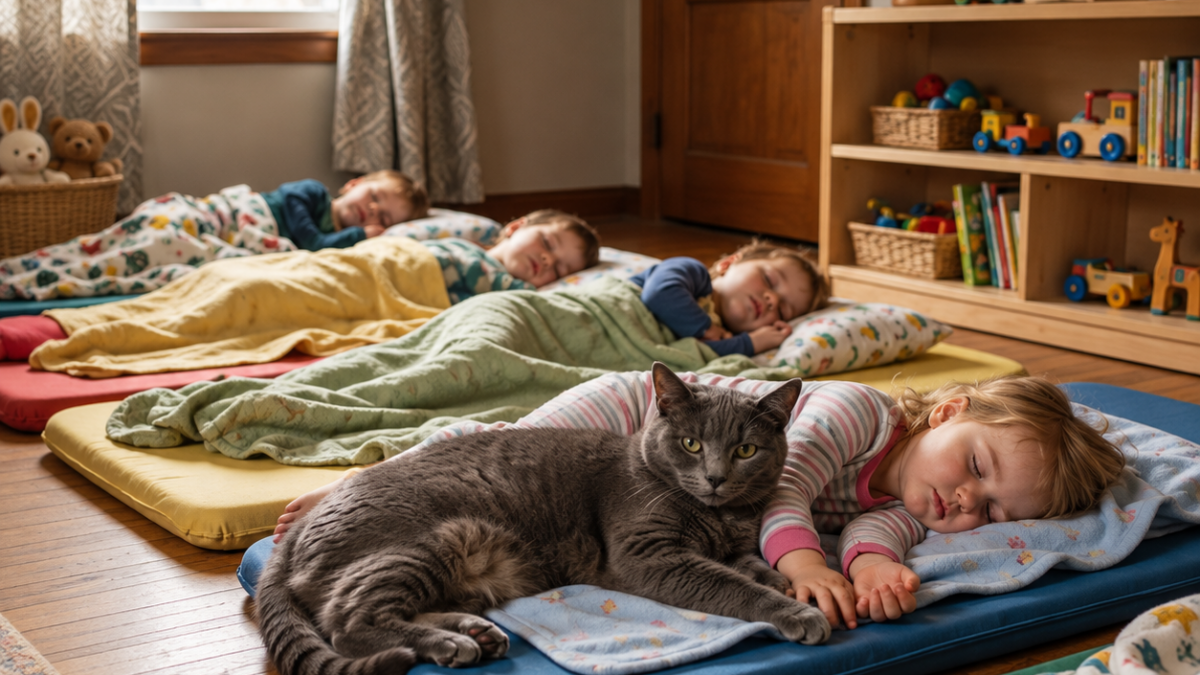
Every Day at Naptime, a Gray Cat Chose One Child to Sleep Beside—Then the Daycare Owner Realized He Always Found the One Who Was About to Break
PART3:
“She had a hard time when the lights went off, but Biscuit helped.”
No one laughed at it after a while.
Because every family had a day when they hoped somebody noticed their child before the breaking point.
By Christmas, Biscuit had become something between a mascot and a legend. One mother brought him a tiny red collar with a brass tag shaped like a star. Another parent crocheted him a blanket. A father who never said much stood in my entryway one afternoon with tears in his eyes because Biscuit had slept beside his son on the same day the boy’s grandmother died.
“I didn’t tell you,” he said, wiping his face with the heel of his hand. “I didn’t want him to hear me say it. We were going to tell him tonight.”
I looked down at Biscuit, who was sitting near the shoe rack, washing one paw as if he had not just made a grown man cry.
After that, one of the parents, Dana Mitchell, asked if she could make a sign for the front hall.
Dana owned a little print shop downtown and had the kind of cheerful bossiness that made community potlucks actually happen. She showed up the next Monday with a wooden sign painted cream and blue, with a tiny paw print in the corner.
BISCUIT IS ON DUTY.
HE WILL FIND WHO NEEDS HIM.
I hung it by the front door, mostly because the parents loved it.
I did not know that sign would later be photographed by a licensing investigator and used as evidence against me.
I did not know that people who never saw Biscuit press his body against a shaking child would one day call him dangerous.
I did not know that the thing families loved most about my daycare would become the weapon someone used to try to destroy it.
And I certainly did not know the child Biscuit would one day choose and refuse to leave would change every life inside that little house.
His name was Noah Price.
He arrived in January on a morning so cold the windows had frost in the corners. His mother, Lauren, brought him in wrapped in a navy puffer coat, his brown curls flattened under a knit hat, his small hands tucked into mittens with dinosaurs on them.
Noah was three, almost four. He had solemn dark eyes, a soft mouth, and a way of standing very still that made him seem older than he was. Some children burst into a room. Noah entered like he was afraid the room might burst back.
Lauren Price was beautiful in the exhausted way some mothers become beautiful when life has stripped away every unnecessary gesture. She had sharp cheekbones, tired eyes, and a smile that arrived a second too late, like it had to cross a long distance.
“I’m sorry,” she said before she had even finished stepping inside. “We’re running behind. New place, new routine, new everything.”
“No need to apologize,” I told her. “We’re glad you’re here.”
Noah stood pressed against her leg, staring at the floor.
I crouched down, keeping my voice gentle. “Hi, Noah. I’m Maren. We have waffles this morning, and there’s a truck basket over by the rug.”
He didn’t answer.
Lauren stroked his hat. “Can you say hi?”
His mouth moved, but no sound came out.
“That’s okay,” I said quickly. “You don’t have to say anything yet.”
Lauren looked grateful and ashamed all at once.
In the paperwork she had dropped off the week before, she had written that Noah was “slow to warm up,” “sensitive to loud voices,” and “currently adjusting to family changes.” I had read those phrases many times from many parents. They were small, polite boxes people used to carry large, messy truths.
At drop-off, Lauren kissed Noah twice, then a third time, then forced herself to leave before he could start crying. He did not cry. That worried me more.
A crying child releases something. A silent child stores it.
For the first hour, Noah stayed near the bookshelf, clutching a wooden fire truck. He watched other children without joining them. When Mason shouted, Noah flinched. When a block tower fell, he covered his ears. When I asked if he wanted more banana, he nodded without looking up.
Biscuit watched him from the armchair.
I noticed because Biscuit usually ignored new children until they proved themselves predictable. But that morning, he stared at Noah with unnerving focus, his tail tip flicking once every few seconds.
“Don’t overwhelm him,” I murmured as I walked past.
Biscuit blinked slowly, which was the closest he ever came to promising anything.
At nap time, I expected him to choose Noah.
Honestly, everyone did. Even the children had begun to understand the ritual in their own way. They watched Biscuit like he was part of the schedule: snack, story, potty, mats, Biscuit.
But that day, Biscuit walked past Noah.
He walked past him slowly, paused near his blanket, sniffed once, and kept going.
He chose Ava instead, who had woken up coughing and would later go home with a fever.
Noah lay awake for the entire nap, eyes open, hands folded tightly over his chest.
The next day, Biscuit chose Tyler.
The day after that, Sophie.
Noah watched him every time.
I started to wonder if maybe Biscuit sensed that Noah did not want to be touched. Some children don’t. Comfort can feel like a trap when life has taught you the wrong lessons. So I gave Noah space. I offered choices. I kept my voice low. I praised him gently when he joined circle time for thirty seconds. I didn’t force hugs. I didn’t ask too many questions.
On his fourth day, he spoke to me for the first time.
It was after lunch. The other children were wiping yogurt off their faces with more enthusiasm than skill, and I was collecting plates when Noah tugged softly at my sleeve.
I looked down. “What is it, sweetheart?”
He pointed toward the hallway.
“Bathroom?”
He shook his head.
“Your backpack?”
Another shake.
Then he whispered, barely audible, “The cat.”
I glanced toward the living room. Biscuit was lying beneath the window, one paw over his nose.
“You want to see Biscuit?”
Noah nodded.
We walked over together. I sat on the floor a few feet away, close enough to guide, far enough not to crowd.
“Biscuit,” I said softly, “Noah came to say hello.”
Biscuit opened his eyes.
For a long moment, neither of them moved.
Then Noah crouched and whispered, “Hi.”
Biscuit did not get up. He did not purr. He simply stretched one paw forward until it rested on the rug between them.
Noah stared at that paw like it was a bridge.
Then he reached out with one tiny finger and touched the fur.
His whole face changed.
It wasn’t a smile, exactly. It was smaller than that. More fragile. Like a light turning on in a room where someone had been afraid to breathe.
From that day forward, Noah watched Biscuit constantly.
He still didn’t talk much. He still flinched at loud sounds. But when Biscuit entered a room, Noah’s body loosened. If Biscuit sat by the blocks, Noah built nearby. If Biscuit slept in the patch of sun by the bookshelf, Noah turned pages beside him. Once, during music time, Biscuit sneezed, and Noah laughed so suddenly that all the adults in the room froze.
I had one assistant then, a twenty-two-year-old named Kelsey who was saving money for nursing school. She looked at me across the room, eyes wide.
“That’s the first time I heard him laugh,” she whispered.
“I know,” I said.
Neither of us made a big deal out of it. Children can retreat from joy if adults clap too loudly.
At pickup, I told Lauren.
“He laughed today,” I said.
Her face went still. “He did?”
I nodded. “Biscuit sneezed.”
Lauren put one hand over her mouth and turned away for a second.
When she faced me again, her eyes were wet. “He used to laugh all the time.”
I waited.
She looked down the hallway, where Noah was kneeling beside his backpack.
“We left his father in November,” she said quietly. “I thought once we were out, he would feel better. But I think sometimes leaving is just the first door. There are so many more after it.”
I understood that more than she knew.
“My husband left when my daughter was six,” I said. “For months, she slept in her closet. Not because she was afraid of the dark. Because she said the closet was too small for anybody to leave from.”
Lauren’s face crumpled in that silent way mothers cry when they are trying not to scare their children.
“I’m sorry,” she whispered.
“Me too,” I said. “But she’s twenty-four now. She has an apartment full of plants and a boyfriend who cries at dog commercials. Children can heal.”
Lauren looked at Noah, who was now trying to zip his coat without success.
“I hope so,” she said.
I almost said, He will.
But I had learned not to promise mothers things life had not yet signed.
Instead, I said, “We’ll take good care of him here.”
For a while, we did.
Noah began to unfold by inches. He played beside other children, then with them. He still hated sudden noises, but he stopped covering his ears every time a chair scraped. He started saying “more milk,” “my turn,” and once, with great seriousness, “Biscuit fat.”
Biscuit forgave him.
Then, in late February, something changed.
It started on a Thursday morning when Lauren did not bring Noah in.
A man did.
I saw the black SUV pull up at 7:36 a.m., five minutes before Lauren usually arrived in her dented silver Honda. The SUV was too shiny for my driveway, the kind of vehicle that seemed to announce money even when parked. A man stepped out wearing a charcoal overcoat, polished shoes, and a smile that didn’t reach his eyes.
Noah climbed down from the back seat slowly.
He was wearing the wrong coat, too thin for the weather, and his backpack hung open.
The man guided him toward the door with one hand on his shoulder. Not hard enough to look cruel. Firm enough that Noah’s neck had disappeared into his collar.
I opened the door before they knocked.
“Good morning,” I said.
The man’s eyes flicked over me, then past me into the house. “You must be Maren.”
“I am.”
“Evan Price.” He extended his hand. “Noah’s father.”
His grip was dry and deliberate.
Noah did not look up.
I kept my face pleasant. “Nice to meet you. Lauren usually texts me about schedule changes.”
“She’s been overwhelmed,” Evan said smoothly. “I’ll be handling more of Noah’s transportation now. We’re trying to bring some structure back into his life.”
The phrase sat wrong in my ears.
Structure.
People often used that word when they meant control.
“Of course,” I said. “I’ll need Lauren to update the pickup authorization if that’s changing.”
His smile tightened. “I’m his father.”
“I understand. It’s just policy.”
For a second, something cold moved behind his eyes. Then he laughed softly.
“Responsible. I appreciate that.”
He crouched beside Noah. “Have a good day, buddy. Be normal, okay?”
Be normal.
The words were light. Almost joking.
Noah’s face turned blank.
Evan kissed the top of his head, stood, and looked at me again. “He can be dramatic. Don’t let him manipulate you.”
I felt Kelsey behind me in the hallway, suddenly still.
“We don’t think of children that way here,” I said.
Evan’s smile vanished so briefly someone else might have missed it. “That’s sweet.”
Then he left.
Noah stood in the entryway after the door closed, staring at the place where his father had been.
I knelt. “Hey, sweetheart.”
He didn’t move.
“You want to hang up your backpack?”
No answer.
I reached slowly for the strap, giving him time to refuse. He let me take it.
His hands were ice cold.
That day, Noah did not speak once.
At nap time, Biscuit walked the row.
He passed every child.
Then he stopped beside Noah.
The room felt like it held its breath.
Biscuit lowered himself onto the mat, but instead of curling against Noah’s side the way he usually did, he positioned his body partly across Noah’s chest, heavy and warm, like a living weighted blanket. Noah’s eyes filled immediately.
He made no sound.
Not at first.
Then one tear slid into his hair.
Biscuit began to purr.
Noah’s hands rose slowly and gripped Biscuit’s fur—not pulling, just holding on as if he had been falling for a long time and finally found something that did not move.
I stood there with my clipboard pressed to my chest, feeling a pressure behind my ribs I could not explain.
Kelsey came up beside me.
“Miss Maren,” she whispered. “Look at Biscuit.”
“I see.”
“No. Look.”
Biscuit was not asleep.
He was staring directly at me.
I had known that cat through flea baths, vet visits, thunderstorms, heartbreak, and one terrible summer when I thought kidney disease would take him. I knew his ordinary expressions. Hunger. Annoyance. Disdain. Sleepy affection.
This was different.
This was warning.
After nap, Noah woke disoriented and clung to Biscuit so tightly I had to gently remind him to use soft hands. When I helped him put on his shoes later, I noticed a faint yellow bruise on his upper arm.
My stomach sank.
Children bruise. Toddlers are built like small drunk people with poor judgment. I had filled out hundreds of incident forms over the years for bumped foreheads, scraped knees, bitten fingers, and mysterious shin marks.
But this bruise looked like fingers.
Not fresh. Not dark. Fading.
I did not touch it. I did not react in front of him.
I documented it.
That is what you do when you care for children. You observe. You write down facts. You do not accuse without evidence, and you do not ignore what you see because the truth might make your life inconvenient.
At pickup, Lauren came, not Evan.
She rushed in breathless, cheeks red from cold. “I’m sorry. Work ran late. How was he?”
I looked at Noah sitting beside Biscuit near the bookshelf.
“Quiet,” I said. “Tired. Biscuit stayed with him at nap.”
Her face changed. She knew by then what that meant.
“Oh.”
I lowered my voice. “Lauren, his father dropped him off this morning.”
She closed her eyes. “I know. Court temporary order. He gets Wednesday overnight now.”
“I also noticed a bruise on Noah’s arm. It may be nothing. I documented it because I’m required to.”
Lauren went pale so quickly I reached for her elbow.
“He told me he bumped into a dresser,” she whispered.
“Who told you?”
She didn’t answer.
Noah looked up then. “Mommy?”
Lauren pulled herself together like a woman yanking a curtain closed over a burning room.
“I’m here, baby.”
I wanted to say more, but there are lines you have to walk carefully when a family is in the middle of custody conflict. Too much, and you become part of the fight. Too little, and a child disappears between everybody’s caution.
So I said only, “Call me tonight if you need to.”
She nodded.
She did not call.
The next week, Evan brought Noah twice.
Both mornings, Noah arrived smaller somehow, folded inward. Both afternoons, Biscuit chose him at nap. Both times, I saw something new—a scrape near his collarbone, a red mark on his wrist, the way he flinched when Mason knocked over a bin and Evan’s name came up in a phone call.
I filed observations. I dated them. I took no photographs of the child without parent consent, but I wrote everything with the plainness of a legal document.
March 3. Noah arrived at 7:41 a.m. with father, Evan Price. Child quiet, avoided eye contact. Flinched when another child shouted during free play. At 12:38 p.m., Biscuit lay beside Noah. Noah cried silently for approximately four minutes, then slept. Noticed yellow-brown bruise on left upper arm, oval, approximately size of adult thumbprint.
March 6. Noah stated during block play, “Don’t tell or he gets mad.” When asked neutral follow-up, “Who gets mad?” child did not respond and left area.
March 8. Child became distressed when assistant Kelsey dropped metal spoon in sink. Covered ears, crouched under table, said, “I’m good, I’m good,” repeatedly.
I called Children’s Services after the spoon incident.
I had made calls before. Any daycare provider who has worked long enough has. It never gets easier. You tell a stranger on the phone the small facts that may or may not add up to a child’s private nightmare, and then you hang up and continue serving graham crackers as if your heart is not pounding.
The woman on the hotline was calm and kind. She took the information. She asked if the child was in immediate danger. I said I did not know.
That was the honest answer.
I did not know.
But Biscuit did.
The next day, everything exploded.
It was a Friday. Rain had turned the front yard soft, and the children were restless from being indoors all week. By lunch, everyone was cranky. Ava wanted the green cup that Lily had. Tyler cried because his cracker broke. Mason announced that he hated soup, then ate two bowls.
Noah arrived with Lauren that morning, not Evan. He seemed better at first. He even smiled when Biscuit waddled into the kitchen and tried to pretend he was not begging.
Then, during nap, Biscuit walked the row as usual.
I expected him to choose Noah again.
But he did something he had never done before.
He climbed onto Noah’s mat, pressed his nose to Noah’s chest, and let out a low, distressed sound.
Not a meow.
A yowl.
Every hair on my arms rose.
Noah was lying completely still, eyes open, staring at the ceiling.
Biscuit pawed gently at his shirt.
“Biscuit,” I whispered.
He yowled again.
Kelsey looked up from the rocking chair where she was soothing Sophie. “What’s wrong?”
I crossed the room and knelt beside Noah. “Sweetheart?”
Noah did not blink.
His breathing was shallow. Too fast.
I touched his forehead. No fever.
“Noah, can you look at me?”
His eyes shifted, but only barely.
Then he whispered, “I didn’t tell.”
My blood went cold.
“What, baby?”
“I didn’t tell.”
Biscuit pressed harder against him, purring now in a frantic, uneven rhythm.
I kept my voice steady with effort. “You’re safe right now. You’re at my house. Mommy is coming later.”
Noah’s face twisted.
“He said Biscuit goes away.”
Kelsey’s hand flew to her mouth.
I leaned closer. “Who said that?”
Noah squeezed his eyes shut. “Daddy said if I tell, the cat goes away. He said he knows the lady who checks houses. He said she’ll take Biscuit and I can’t sleep.”
For one second, I could not breathe.
Then Noah pulled up his sleeve.
On the inside of his upper arm were four fresh red marks.
Finger marks.
Kelsey started crying silently behind me.
I stood slowly, because if I moved too fast I was afraid I would frighten him.
“Kelsey,” I said quietly, “take the other children into the kitchen for quiet snack. Now.”
She obeyed.
I called Children’s Services again. Then I called Lauren. Then, because the hotline worker told me to, I called the police non-emergency number and asked for an officer trained in child welfare response.
By 2:15 p.m., my little daycare was no longer a daycare.
It was a scene.
A social worker named Denise arrived first, wearing a navy raincoat and the tired eyes of someone who had seen too many living rooms become battlefields. A police officer came ten minutes later. Lauren arrived before both of them had finished speaking to me, her hair wet from rain, terror written across her face.
“Noah!” she cried.
He ran to her then, finally breaking open. He sobbed so hard his knees gave out. Lauren sank to the floor and gathered him in her arms, rocking him while Biscuit stood beside them, tail puffed, as if he had personally called the authorities and intended to supervise the response.
I thought that would be the worst day.
I was wrong.
Because Evan Price was not a man who accepted consequences quietly.
At 5:40 p.m., after Noah and Lauren had left with Denise to get a medical evaluation, my phone rang.
Unknown number.
I answered because I was still shaking and not thinking clearly.
“Maren Holt?” a woman asked.
“Yes?”
“This is Patricia Voss with BrightPath Licensing. I’ve received an emergency complaint regarding an animal in your childcare facility.”
I looked toward Biscuit, who was sitting on the stairs, exhausted.
“An emergency complaint?”
“Yes, ma’am. The report alleges that you allow an untrained animal to roam freely among sleeping children, that the animal has interfered with children’s breathing during nap, and that you used the animal as part of an unauthorized emotional therapy program.”
For a moment, all I heard was the dishwasher humming.
Then I understood.
Evan.
“He threatened to do this,” I said softly.
“I’m sorry?”
I closed my eyes. “Nothing. What happens now?”
“We’ll need to conduct an inspection Monday morning. Until then, you are required to keep the animal separated from daycare children.”
I gripped the counter. “Biscuit has never hurt a child.”
“That may be,” she said, not unkindly. “But until we investigate, he cannot have contact with children in care.”
After I hung up, I sat on the kitchen floor and cried.
Not because I was afraid of rules. Rules exist to protect children. I had followed rules my entire career. I had outlet covers in outlets no child could reach, medication logs for children who took nothing stronger than allergy syrup, emergency cards alphabetized in a red binder, fire drills documented with dates, times, and weather conditions.
I cried because Noah had told the truth, and the first consequence was that Biscuit was punished.
When parents arrived Monday morning, the sign by the door was gone.
Biscuit was upstairs in my bedroom behind a baby gate and a closed door, howling like his heart had been locked away from his work.
The children noticed immediately.
“Where Bis-kit?” Tyler asked.
“Biscuit is resting today,” I said.
Emma began to cry.
Noah did not come. Lauren texted that they were staying with her sister.
By 9:00 a.m., Patricia Voss stood in my entryway with a clipboard. She was in her fifties, neatly dressed, with steel-gray hair and an expression trained into professional neutrality.
I showed her everything. Vaccination records. Cleaning logs. Parent consent forms mentioning the household cat. The vet letter stating Biscuit was healthy, neutered, vaccinated, and gentle. Incident logs showing zero injuries caused by him in ten years.
She listened. She took notes. She photographed the sign I had taken down because it was still leaning in the hall closet.
“That sign concerns me,” she said.
“It was made by a parent.”
“It suggests the cat is assigned a caregiving role.”
“He’s a cat,” I said, more sharply than I intended. “He lies beside children.”
“During sleep.”
“Yes.”
“Without direct parental supervision.”
“With my supervision. I am in the room.”
She looked at me. “Ms. Holt, I understand you care about the children. But emotional attachment can make providers minimize risks.”
That sentence hurt more than I expected.
Because I did care. And because people who care are always vulnerable to being accused of caring wrong.
By noon, the temporary order was formal: Biscuit could remain in the home but had to be physically separated from daycare areas during operating hours pending review.
I signed the paper with a hand that did not feel like mine.
That afternoon’s nap was a disaster.
Ava cried for her mother. Jordan kicked off his blanket seventeen times. Tyler screamed so hard he hiccupped. Emma crawled off her mat and curled beside the bookshelf where Biscuit usually slept. Even children who had never been chosen by him seemed unsettled, as if the room had lost a quiet piece of its gravity.
Upstairs, Biscuit scratched at my bedroom door until his paws bled.
I stood in the nap room listening to children cry below and my cat cry above, and for the first time in fourteen years, I wondered if I could keep doing this work.
That night, the story hit Facebook.
I do not know who posted first.
I only know that by 8:00 p.m., my name was being passed around in local parenting groups attached to words like unsafe, weird, negligent, and cat therapy scam.
One post said: “Would you let your toddler sleep with a random animal on top of them? This woman literally advertises that her cat ‘finds’ emotionally vulnerable kids. Creepy.”
Another said: “I heard a child was hurt and authorities got called.”
Then someone posted a photo of my front door sign. No context. Just the words: BISCUIT IS ON DUTY. HE WILL FIND WHO NEEDS HIM.
Under it, strangers built a monster out of my life.
This is why home daycares scare me.
Sounds like she was using kids for TikTok content.
Where were the parents?
That cat should be removed.
Call the news.
I sat at my kitchen table refreshing comments like a person touching a bruise to see if it still hurt. Kelsey texted me every few minutes telling me not to read them, which of course meant I read them all.
At 9:13 p.m., Dana Mitchell called.
“Don’t look online,” she said immediately.
“Too late.”
“They don’t know you.”
“They know my address.”
A silence.
Then Dana’s voice changed. “Maren, listen to me. We’re going to fix this.”
“We?”
“The parents.”
“Dana—”
“No. You don’t get to spend fourteen years helping everyone else’s babies and then sit alone while people tear you apart. Not happening.”
By morning, she had organized a private group chat with current and former daycare families. By noon, parents were posting their own stories.
My daughter stopped having panic attacks at nap because of Biscuit.
My son had speech delays and Biscuit was the first name he ever said clearly.
The day my husband died, Biscuit stayed with my child before anyone at daycare knew what had happened.
But the internet does not reward tenderness the way it rewards outrage.
For every parent who defended me, two strangers accused them of being irresponsible.
Then Evan gave an interview.
Not to a real newspaper. To a local online page that mostly posted restaurant openings, police scanner rumors, and pictures of potholes. But it was enough.
The headline read: LOCAL FATHER RAISES ALARM ABOUT CAT SLEEPING WITH TODDLERS AT HOME DAYCARE.
In the photo, Evan stood in front of his black SUV wearing a concerned expression I recognized as performance. He said he was “grateful authorities were taking the matter seriously.” He said he had been “deeply disturbed” to learn his son had been allowed to sleep beneath an animal. He said children needed “professional care, not superstition.”
Superstition.
I stared at that word until it blurred.
He did not mention that his son had disclosed threats.
He did not mention the bruises.
He did not mention that Biscuit had only become a problem after Noah spoke.
He simply stood in public wearing the costume of a protective father and pointed at the safest creature in my house.
Two days later, three families withdrew from Little Lantern.
Not because they believed Evan, they said.
Just because things felt “complicated.”
“I hope you understand,” one mother told me over the phone, crying. “My husband is worried about being involved.”
I did understand.
That was the terrible part.
Fear makes decent people step backward.
By Friday, I had lost nearly a third of my income.
By the next Monday, someone had left a note in my mailbox.
KEEP ANIMALS AWAY FROM CHILDREN, CRAZY CAT LADY.
I stood on the porch holding that piece of paper while Biscuit watched me through the upstairs window, his face pressed to the glass.
For the first time since I had rescued him from behind a grocery store dumpster ten years earlier, I wondered if loving him had made me vulnerable in a way I could not afford.
That thought lasted exactly eight seconds.
Then I folded the note, put it in my documentation binder, and called Patricia Voss.
“Ms. Voss,” I said when she answered, “I’d like to request a formal review hearing.”
There was a pause. “You have that right.”
“I’d also like the complaint file, the inspection notes, and the specific regulations I’m alleged to have violated.”
Another pause. Longer.
“Most providers wait for our determination.”
“I have spent my career teaching children to use their words,” I said. “I’m going to use mine.”
The hearing was scheduled for March 24.
In the meantime, Noah disappeared.
Lauren texted once: We are safe. I can’t talk right now. Thank you for believing him.
Then nothing.
I wanted to call. I wanted to drive to her sister’s house. I wanted to know whether Noah was sleeping, whether he had his dinosaur mittens, whether he asked for Biscuit.
But I knew enough not to interfere with an investigation.
So I waited.
Biscuit did not understand waiting.
Every morning, when daycare began, I carried him upstairs. Every morning, he pressed his forehead under my chin and made a broken little sound. Every afternoon, when the children settled for nap without him, he scratched at the door.
After a week, he stopped eating breakfast.
The vet said stress.
“He’s old,” Dr. Patel told me, gently palpating Biscuit’s belly while Biscuit glared at both of us. “Routine matters. Purpose matters.”
Purpose.
I had never thought of a cat having a purpose.
But of course he did.
Some lives are built around being needed.
I understood that too well.
Without Biscuit, the daycare felt less like my home and more like a business under surveillance. I noticed every possible hazard with new paranoia. I over-documented. I asked parents to sign updated forms. I removed rugs someone could trip over. I stopped playing soft music at nap because I worried someone would say it was therapeutic without authorization.
The children felt it.
Children always know when adults are pretending everything is fine.
One afternoon, Emma looked at me while I tucked her blanket and said, “Miss Maren, did Biscuit do bad?”
My throat tightened.
“No, sweetheart.”
“Then why he in trouble?”
I sat back on my heels.
How do you explain to a three-year-old that sometimes the world punishes goodness because cruelty files paperwork first?
“He’s not in trouble,” I said. “The grown-ups are figuring out rules.”
Emma frowned. “Grown-ups take long.”
“Yes,” I whispered. “They do.”
The hearing took place in a county office building with beige walls, fluorescent lights, and chairs designed by someone who had never waited for life-changing news. I wore my navy dress, the one I used for funerals and parent conferences that might turn into legal meetings. Dana came with me. So did Kelsey. So did four parents, including Emma’s mother, Rebecca, who took time off from court-ordered mediation to sit behind me with her arms crossed like she was ready to fight God.
Evan was there too.
I did not know he would be.
He sat on the opposite side of the room in a gray suit, looking calm and expensive. Beside him sat a woman I recognized from the BrightPath board website: Marjorie Leland, regional director, donor, former family court advocate, and according to Lauren’s old paperwork, Evan’s aunt.
That was when I understood how he had known “the lady who checks houses.”
My stomach turned over.
Patricia Voss sat at the front with two other officials. She looked less certain than she had in my kitchen.
The hearing began with procedural language. Complaint. Temporary restriction. Provider response. Safety standards.
Then Evan spoke.
He stood slowly, as if reluctant to be there, as if duty alone had dragged him from his important life.
“My concern has always been the children,” he said. “Especially my son. Noah has been through instability because of his mother’s choices, and I was disturbed to learn that Ms. Holt encouraged an unhealthy attachment between him and an animal.”
My hands curled in my lap.
“Children in vulnerable emotional states can be easily influenced,” he continued. “I believe Ms. Holt projected meaning onto the cat’s behavior and used that to insert herself into private family matters.”
There it was.
Not just a complaint about Biscuit.
A complaint about me seeing too much.
Dana muttered something under her breath that I was glad the officials did not hear.
Evan turned slightly, performing for the room. “I’m not saying Ms. Holt is malicious. I’m saying she may have poor boundaries. When a daycare provider starts claiming her pet can detect distress, and then uses that claim to question parents, we should all be concerned.”
He sat down.
My face burned, not with shame, but with the fury of being calmly lied about by someone who knew exactly where to place the knife.
Then it was my turn.
I stood.
For a second, my knees felt weak. I thought about Biscuit upstairs, locked away from the work he loved. I thought about Noah whispering, He said Biscuit goes away. I thought about every child who had fallen asleep with one hand in gray fur and every parent who had understood that comfort is not always clinical, authorized, or easy to explain.
“My name is Maren Holt,” I began. “I have operated Little Lantern Home Daycare for fourteen years. In that time, I have had no substantiated safety violations, no animal-related incidents, and no injury connected to Biscuit.”
I handed copies of my records to the panel.
“Biscuit is not a therapy animal. I have never advertised him as one. I have never charged extra because of him. I have never left him unsupervised with children. He is my household cat, disclosed to every enrolled family, vaccinated, healthy, and known to them.”
Marjorie Leland’s mouth tightened.
I continued.
“The sign near my door was a gift from parents. It reflected something they noticed: Biscuit often chose to lie near children who were having difficult days. I did not diagnose children through my cat. I did not replace supervision with an animal. I observed both the children and the cat, and when a child seemed distressed, I did what any responsible provider should do. I paid attention.”
I looked at Evan then.
“Sometimes paying attention makes people angry.”
A stir moved through the room.
One of the officials asked, “Ms. Holt, did your observations related to Biscuit contribute to your decision to report concerns regarding a child?”
“Yes,” I said. “But they were not the basis of the report. The basis was the child’s statements, visible marks, behavioral changes, and my mandated reporter obligations.”
Evan’s jaw tightened.
“Can you provide documentation?”
“Yes.”
I handed over the binder.
Every date. Every quote. Every bruise description. Every nap note. Every neutral observation.
I had written the truth before I knew I would need it as armor.
The officials read in silence.
Then Rebecca Whitaker stood.
“May I speak?”
Patricia looked surprised. “Briefly.”
Rebecca walked to the front. Her hands shook, but her voice did not.
“My daughter Emma attends Little Lantern. When my husband and I separated, I thought I was hiding it well. I wasn’t. My little girl was falling apart quietly. Biscuit stayed with her at nap before I ever told Maren what was happening. Maren did not exploit that. She cared. She noticed my child when I was too overwhelmed to notice everything myself.”
Then Dana spoke.
Then Jordan’s father.
Then Kelsey, who cried halfway through but kept going.
One by one, they told the room what Biscuit had done, but more than that, they told them who I was.
Not perfect.
Not magical.
Not reckless.
Just present.
A woman with two hands, twelve children, and an old gray cat who somehow knew where warmth was needed.
Evan looked less calm with every testimony.
But the final turn did not come from me.
It came when the door opened.
Lauren Price stepped into the room.
She looked thinner than before, but steadier. Noah was not with her. A woman in a dark blazer stood beside her—her attorney, I guessed.
Evan half rose. “Lauren, this isn’t appropriate.”
Lauren did not look at him.
She looked at the panel.
“My name is Lauren Price,” she said. “I’m Noah’s mother. I’m here because my son told the truth in Ms. Holt’s daycare, and his father retaliated by filing this complaint.”
The room went silent.
Marjorie Leland stood. “This is a childcare licensing matter, not a custody hearing.”
Lauren turned to her. “And you helped him make it one.”
Marjorie’s face flushed.
The attorney beside Lauren stepped forward. “We have submitted a statement to the agency this morning, along with documentation relevant to potential conflict of interest in the handling of this complaint.”
Patricia Voss looked sharply at Marjorie.
Lauren’s voice trembled, but she continued.
“Noah told Ms. Holt his father threatened to have Biscuit taken away if he talked. My son loved that cat. Evan knew that. He used the thing that made Noah feel safe as leverage to keep him quiet.”
Evan snapped, “That is not true.”
Lauren finally looked at him.
For the first time since I had known her, she did not seem afraid.
“No,” she said softly. “You don’t get to use that voice anymore.”
Something in the room shifted.
Power does not always leave loudly. Sometimes it simply fails to work on the person it used to control.
Lauren turned back to the panel. “There is now an active protective order. Noah has been interviewed by a child advocacy specialist. Medical documentation supports concerns Ms. Holt reported. I cannot share every detail because my son deserves privacy. But I can say this: if Ms. Holt had ignored what she saw, if Biscuit had not stayed with Noah that day, my son might still believe no one would help him.”
Her voice broke.
“That cat did not endanger my child. He comforted him long enough for him to speak.”
No one moved.
Even the fluorescent lights seemed quieter.
The hearing did not end dramatically. Real justice rarely does. There was no gavel. No thunder. No instant apology.
The panel recessed. People whispered in corners. Evan left with Marjorie, his face pale and furious. Lauren hugged me in the hallway and cried against my shoulder without making a sound.
Two days later, I received the determination.
The complaint was unsubstantiated.
The restriction on Biscuit was lifted, with updated safety conditions: he could be present during daycare hours with parent consent, current vaccination records, direct supervision, and the option for any family to request separation.
I read the letter three times before I believed it.
Then I opened the bedroom door.
Biscuit was sitting on my pillow like a wronged king.
“Come on,” I whispered.
He stared at me.
“You’re back on duty.”
He rose slowly, stretched with theatrical dignity, and followed me downstairs.
The children saw him and erupted.
“Biscuit!”
“Kitty!”
“He back!”
Emma burst into tears and wrapped both arms around him before I could remind her about gentle hands. Biscuit endured this with the grave patience of a saint and the mild annoyance of a cat.
That day at nap, he walked the row again.
The room watched him.
So did I.
He passed Mason. He passed Lily. He paused by Ava, sniffed, then kept going.
Then he stopped beside Emma.
Not Noah.
Emma, whose parents had finalized their divorce that morning.
Rebecca had told me at drop-off with dry eyes and a voice that had gone too flat.
Biscuit folded himself against Emma’s side, and she whispered, “I missed you.”
I turned away before the children could see me cry.
Noah returned two weeks later.
He walked in holding Lauren’s hand and wearing his dinosaur mittens even though spring had begun to warm the mornings. He looked nervous, but not empty. That was the difference. Fear was still there, but someone had opened windows inside him.
When he saw Biscuit, he stopped.
Biscuit was sitting by the shoe rack beneath the sign Dana had rehung.
BISCUIT IS ON DUTY.
HE WILL FIND WHO NEEDS HIM.
For a long moment, boy and cat stared at each other.
Then Noah whispered, “He didn’t go away.”
Lauren squeezed her eyes shut.
“No,” I said, kneeling beside him. “He didn’t.”
Noah let go of his mother’s hand and walked to Biscuit.
He crouched.
Biscuit stepped forward and pressed his forehead against Noah’s chest.
Noah wrapped both arms around him and began to sob.
Not silent tears this time.
Real sobs. Loud, messy, shaking sobs from the deepest part of a child who had finally learned that crying did not make love disappear.
Lauren covered her mouth. Kelsey cried openly. I sat on the floor beside them and placed one hand on Noah’s back.
“You’re safe,” I whispered.
Biscuit purred so loudly the children gathering nearby could hear it.
After that, healing came slowly, the only way it ever does.
Noah did not transform overnight into a carefree child. He still startled at loud male voices. He still sometimes asked if doors were locked. He still had days when he crawled under the art table and would not come out until Biscuit joined him there, large gray body squeezed among chair legs, tail flicking in silent irritation at the inconvenience of saving a child in such cramped quarters.
But he began to laugh more.
He painted a picture of Biscuit as a round gray cloud with ears. He learned to say, “I don’t like that,” in a firm voice. He made a friend named Mateo, who shared crackers illegally from his lunchbox. He stopped asking Lauren, “Are you mad?” every time she sighed.
And Lauren began healing too.
At first, she arrived at pickup looking over her shoulder. Then, little by little, her spine straightened. She cut her hair. She got a new job at a dental office. She brought cupcakes on Noah’s fourth birthday and stood in my kitchen laughing with other mothers like the sound surprised her.
Evan faced consequences, though not the kind people imagine in stories.
There was no single dramatic scene where he confessed everything under a spotlight. Men like Evan rarely confess. They explain, minimize, counteraccuse, charm, threaten, and when cornered, call themselves victims.
But documents told a story he could not talk his way out of.
Noah’s statements. Medical evaluations. My records. Lauren’s texts. The conflict involving Marjorie. A pattern of coercive behavior that, once named, became harder for everyone to politely ignore.
His custody was suspended, then restricted to supervised visitation pending further review. Marjorie resigned from the BrightPath advisory board after the conflict-of-interest inquiry. Evan’s interview remained online for a while, but the comment section changed. People who had once praised him as a concerned father began asking questions he did not answer.
As for my daycare, not every family came back.
That hurt.
I won’t pretend it didn’t.
Trust, once frightened, does not always return just because the truth arrives with paperwork.
But new families came. Families who had heard the whole story, not just the ugly first version. Families with children who were shy, grieving, anxious, newly adopted, medically fragile, speech delayed, or simply tender in a world that often rewards loudness.
They came because of the sign.
They stayed because of the care.
One afternoon in May, a mother named Celeste stood in my entryway after picking up her twin boys. She looked at Biscuit sleeping beneath the sign and said, “Is it true?”
I smiled tiredly. “Depends what you heard.”
“That he knows.”
I looked at him.
His paws twitched in a dream. A bit of drool shone on his chin. He looked less like a mystical guardian and more like a retired pillow with digestive opinions.
“I don’t know what he knows,” I said. “I only know he pays attention.”
Celeste nodded slowly. “That’s more than a lot of people do.”
She was right.
That was the lesson Biscuit had been teaching me long before I was ready to understand it.
Not magic.
Attention.
The sacred, ordinary act of noticing who gets quiet when the room gets loud. Who smiles too fast. Who says “I’m fine” before anyone asks. Who stands near the edge of the group. Who stops asking for comfort because they learned comfort costs too much.
Biscuit noticed.
And then he moved closer.
That was all.
That was everything.
Summer came warm and bright. The children played with water tables in the backyard, shrieking every time someone poured a cup down someone else’s shoe. Biscuit watched from the shaded porch, too dignified to participate and too invested to leave.
By then, he was slowing down.
He slept more deeply. His jumps became careful calculations. Some mornings, I carried him downstairs because he stood at the top step pretending he had not wanted to come down anyway.
Dr. Patel adjusted his arthritis medication and told me, gently, “He’s an old man.”
“I know,” I said.
But knowing does not soften the first time you see someone you love hesitate before doing what used to be easy.
At nap, though, Biscuit still worked.
Slowly. Stubbornly. Faithfully.
He walked the row even when his hips were stiff. He paused longer between mats. Sometimes he chose quickly. Sometimes he stood in the middle of the room with his eyes half closed, listening to something the rest of us could not hear.
Then he would go.
To the child whose mother had lost her job.
To the child with an ear infection no one had noticed yet.
To the child whose family dog had died.
To the child who had been brave all morning and had no bravery left for sleep.
One September day, nearly a year after Noah first arrived, Biscuit chose me.
It happened after lunch.
The children were on their mats. Rain tapped against the windows. I had been moving through the day with a heaviness I could not shake because that morning my daughter Claire had called to tell me she was moving to Oregon.
“It’s a good opportunity, Mom,” she had said carefully. “Daniel got the fellowship, and I can transfer offices, and we’ve talked about it for months.”
I had told her I was happy.
I was happy.
That was the cruel thing about love. It can be genuinely happy and genuinely devastated in the same breath.
After we hung up, I cried for exactly three minutes in the pantry between the animal crackers and the paper towels, then washed my face and went back to work. Children needed lunch. Life did not pause because a mother’s house was about to become quieter.
At nap, I sat in the rocking chair with the attendance sheet and pretended to read.
Biscuit began his walk.
I watched him pass each child.
Then he turned.
He did not choose a mat.
He crossed the room, climbed painfully into my lap, turned twice, and settled against my chest.
The attendance sheet blurred.
“Traitor,” I whispered.
He purred.
I held him carefully, one hand over his thin shoulders, and the tears came before I could stop them. Quiet tears, but real ones. The kind I had swallowed for years because there was always a child awake, a parent waiting, a bill due, a form to file, a person to reassure.
Biscuit pressed his head beneath my chin.
Across the room, Noah lifted his head from his mat.
He looked at me for a long moment.
Then he whispered, “Biscuit found you.”
I laughed through tears.
“Yes,” I said. “I guess he did.”
Noah considered this seriously. Then he got up, dragging his blanket behind him, and walked over. For a second, I almost corrected him—nap time, stay on your mat—but something stopped me.
He placed one small hand on my knee.
“It’s okay,” he said. “You can cry. He won’t go away.”
There are moments in life when healing travels in a circle.
You give comfort to a child. A cat gives comfort to him. The child learns what safety feels like. And one day, when your own heart cracks open, that child offers the truth back to you in the only words that matter.
He won’t go away.
I put my hand over Noah’s.
“Thank you, sweetheart.”
He nodded, satisfied, and returned to his mat.
Biscuit stayed with me until my breathing steadied.
After that, the parents stopped asking only, “Did Biscuit choose my child today?”
Sometimes they asked, “Did Biscuit choose anybody?”
And sometimes I said, “No. Everybody had a pretty good day.”
Those were my favorite days.
Not because Biscuit wasn’t needed.
Because maybe, for once, no one was close to breaking.
The following winter, Biscuit’s health declined.
I will not dress that part up. Old age is not cinematic when you are the one measuring medicine into a syringe and pretending not to notice the food left in the bowl. His fur lost some of its shine. His body grew lighter under my hands. He still walked the row at nap, but some days he only made it halfway before lying down in the middle of the room as if the choosing could come to him.
The children adapted with the tender flexibility adults often lack.
They learned to step around him. They used soft voices. They made him pictures with gray circles and enormous whiskers. Emma told new children, “Biscuit is old, so you don’t squeeze him unless you want Miss Maren’s serious face.”
My serious face had become famous.
Noah, now five and preparing for kindergarten, became especially protective. He filled Biscuit’s water bowl every morning. He reminded other children, “Slow hands.” He sat with Biscuit during free play and told him elaborate stories about dinosaurs who went to court and won.
Lauren once arrived early and found Noah lying on the rug beside Biscuit, speaking softly into his fur.
“He tells him things,” she said from the doorway.
“I know.”
“Does Biscuit mind?”
I looked at Biscuit, who appeared to be asleep but was purring.
“No,” I said. “I think he’s been keeping secrets for children his whole life.”
Lauren wiped her eyes.
“Noah starts kindergarten in August,” she said.
“I know.”
“He says Biscuit has to come.”
I smiled. “Biscuit has retired from field trips.”
“He’s worried he won’t sleep at rest time without him.”
I looked toward Noah.
“He will,” I said. “Not at first maybe. But he will.”
Lauren was quiet.
Then she said, “I’m worried too.”
“I know.”
She took a breath. “Sometimes I think I’m fine. Then something small happens. A door slams. A man raises his voice at the grocery store. Noah has a nightmare. And suddenly I’m back there.”
“You survived something,” I said. “Your body remembers. That doesn’t mean you’re failing.”
She nodded, tears slipping down her cheeks.
I wanted to say the perfect thing. I had spent years trying to find perfect words for imperfect pain. But most pain does not need poetry. It needs presence.
So I stood beside her while Noah whispered to Biscuit.
That spring, the town held a small fundraiser for the child advocacy center that had helped Noah. Dana, naturally, organized half of it before anyone officially asked her. There was a bake sale, a raffle, a children’s art display, and a “community helpers” board where kids drew pictures of people who made them feel safe.
Someone submitted a crayon drawing of a firefighter.
Someone drew a grandmother.
Someone drew a teacher.
Noah drew Biscuit.
A huge gray oval with stick legs, yellow eyes, and a heart on his chest.
Under it, with help from Lauren, he wrote:
HE CAME BEFORE I CRIED.
The drawing was displayed near the entrance.
People stopped in front of it all afternoon.
Some smiled.
Some cried.
Some asked questions.
Lauren stood beside me as strangers read her son’s words.
“You okay?” I asked.
She nodded. “For the first time, I don’t feel ashamed.”
“You never should have.”
“I know,” she said. “But knowing takes time to reach the places shame gets into.”
At the end of the fundraiser, Patricia Voss came over.
I had seen her earlier near the registration table, but we had not spoken. She looked softer out of her official blazer, wearing jeans and a green sweater, holding a paper cup of lemonade.
“Ms. Holt,” she said.
“Ms. Voss.”
She glanced toward Noah’s drawing.
“I owe you something,” she said.
I waited.
“An apology. I followed procedure, but I did not ask enough questions about why the complaint was made. I saw risk, but I did not see retaliation. I’m sorry.”
It would have been easy to make her suffer for that. Some part of me wanted to. A small, tired, angry part.
But then I thought of the children.
How often had I told them, “When someone says sorry, we listen with our whole heart, and then we decide what healing needs”?
So I said, “Thank you.”
She looked relieved and ashamed.
“And for what it’s worth,” she added, “I’ve reviewed a lot of childcare homes. Yours is one of the good ones.”
I swallowed hard.
“It’s worth a lot.”
She smiled faintly. “And Biscuit?”
I looked across the room, where he sat in a stroller Dana had decorated with a ridiculous blue ribbon because his walking was limited by then. Children were lined up to pet him one at a time like he was a visiting dignitary.
“Still on duty,” I said.
Biscuit died on a Sunday morning in late June.
He waited until the daycare was closed.
I have always believed that.
Saturday had been bright. I carried him onto the porch, and he slept in the sun while the neighborhood hummed with lawn mowers and bicycles. That evening, he ate three bites of tuna, drank a little water, and rested his head in my palm.
At 4:12 a.m., I woke to a sound.
Not a cry.
Just a breath that seemed to ask for me.
I found him on the old quilt at the foot of my bed, eyes open, body tired beyond pretending.
“Oh, Biscuit,” I whispered.
I lay down beside him on the floor because lifting him felt wrong. He pressed one paw against my wrist.
For ten years, he had gone first.
Before the tears. Before the collapse. Before the child knew how to ask.
This time, I stayed with him before he had to ask me.
I told him everything.
I told him he was good. I told him he was loved. I told him he had done enough. I told him about Emma and Noah and Jordan and Ava and every child whose name was written somewhere in the soft gray archive of his body.
I told him he could rest.
When his breathing changed, I put my forehead against his.
“You found them,” I whispered. “Every time.”
His paw flexed once.
Then he was gone.
For a while, the room was completely still.
Grief is strange when it enters a house built around care. My first thought was not poetic. It was practical and unbearable.
How do I tell the children?
I called Kelsey first. She came over in sweatpants, hair unbrushed, and cried on my kitchen floor. Then I called Dana. By noon, the parent group knew. Messages began arriving.
I’m so sorry.
He helped our family more than you know.
Can we bring flowers?
Emma wants to draw him something.
Noah needs to know in person.
That afternoon, Lauren brought Noah.
He walked into my living room holding a small bouquet of dandelions.
He looked older than the boy who had first arrived silent in dinosaur mittens. Taller. Stronger. Still tender, but no longer disappearing.
“Where is he?” he asked.
I had wrapped Biscuit in his favorite blue blanket and placed him in a shallow box lined with towels. I had worried it might be too much for a child, but Lauren and I had talked, and Noah had insisted. Children deserve truth when it is given gently.
Noah knelt beside the box.
He did not cry at first.
He touched Biscuit’s head with two careful fingers.
“His ears are cold,” he said.
“Yes.”
“He can’t purr now?”
“No, sweetheart.”
Noah nodded as if confirming something terrible but logical.
Then his face crumpled.
Lauren reached for him, but he leaned toward me instead, and I gathered him in my arms as he cried with the full force of a little boy losing the creature who had guarded the doorway between fear and trust.
“He was supposed to come to kindergarten,” Noah sobbed.
“I know.”
“He was supposed to find me if I got sad.”
I held him tighter.
“Oh, Noah,” I whispered. “He already did.”
He pulled back, confused and angry. “No, he didn’t. He’s gone.”
I put one hand over his heart.
“He found you so many times that you started learning how to find yourself.”
Noah’s tears slowed.
I continued, because sometimes children need the truth in words they can carry.
“When Biscuit first met you, you didn’t know how to tell people when you were scared. Now you do. You didn’t know you were allowed to cry. Now you know. You didn’t know safe love stays. Now you know that too.”
Noah looked down at Biscuit.
“But I still want him.”
“I do too,” I said.
Because healing does not erase wanting.
We buried Biscuit beneath the maple tree beside the front walk, the one whose red leaves had fallen the day I first understood him. Parents came with flowers. Children came with drawings. Dana brought a smooth river stone engraved with his name.
BISCUIT
ON DUTY ALWAYS
Emma placed a purple crayon beside the grave because, she said, “He might want to color in heaven.” Mason brought a toy truck. Ava brought a cookie, which we gently redirected before ants could become part of the memorial. Noah brought the dandelions and a folded picture.
In the picture, Biscuit was standing at the door of a school.
A line of children waited behind him.
Above them, in careful kindergarten letters, Noah had written:
HE WILL FIND WHO NEEDS HIM.
We left it in a plastic sleeve under the stone.
For days after, the house felt impossibly large.
At nap time, the absence walked the row.
The children lay on their mats waiting for footsteps that did not come. Some cried. Some whispered his name. Some stared at the empty patch of sunlight by the bookshelf.
So I changed nap time.
Not with another cat. No animal could be hired into a calling like that.
Instead, I began what we called “Biscuit Minutes.”
Before nap, each child placed one hand on their own heart and one hand on their blanket. I would sit in the rocking chair and say, “Let’s look around gently. Does anyone need a little extra kindness today?”
At first, they didn’t understand.
Then they did.
A child might point to another and say, “Lily sad.”
Or, “Mateo miss Mommy.”
Or, sometimes, “Me.”
Especially “me.”
That was the bravest one.
We learned to notice.
We learned to move closer.
We learned that the work Biscuit had done did not have to end just because his body was gone.
On Noah’s last day before kindergarten, Lauren arrived with cupcakes and a backpack shaped like a rocket ship. Noah wore new sneakers and a nervous smile. He hugged Kelsey. He hugged Dana, who had stopped by pretending she had business in the neighborhood. He let the younger children admire his backpack.
Then he walked to Biscuit’s grave.
I followed at a distance.
He crouched under the maple tree and whispered something I could not hear.
When he came back, his eyes were wet but steady.
“What did you tell him?” I asked.
Noah thought about it.
“I told him I’ll look for kids who need somebody.”
My throat closed.
“That’s a very Biscuit thing to do.”
He smiled.
At the door, he hugged me hard.
“Miss Maren?”
“Yes?”
“If I get sad at school, and Biscuit can’t come, what do I do?”
I knelt so we were eye to eye.
“You look for the helpers. Your teacher. Your mom. A friend. And if you can’t find one right away, you put your hand here.” I touched his chest gently. “And you remember you are not back where you started. You are not alone anymore.”
He nodded.
Then he ran to Lauren’s car, because five-year-olds can hold grief and excitement in the same small body without asking permission.
Years have passed since then.
Little Lantern is still open. The maple tree is taller now, and every fall it drops red leaves over Biscuit’s stone like the world remembering. Children still nap in my living room. They still spill juice, argue over trucks, cry over broken crackers, and say things so funny I write them down before I forget.
There is no cat walking the row anymore.
But his sign still hangs by the door.
BISCUIT IS ON DUTY.
HE WILL FIND WHO NEEDS HIM.
Some new parents ask about it.
I tell them the truth.
I tell them there was once an old gray cat who lived in this house and somehow knew which child was closest to tears. I tell them he never performed tricks, never wore a vest, never did anything more complicated than pay attention and move closer. I tell them that for a while, people misunderstood him. Some feared him. One man tried to use him as a weapon because his comfort had given a child enough courage to speak.
And I tell them Biscuit won.
Not in the loud way people think victory happens.
He won because Noah grew up safe.
He won because Lauren learned that leaving was not the end of her story, but the beginning of her freedom.
He won because a room full of toddlers learned that sadness is not shameful and comfort is not weakness.
He won because every child who passes through my door still learns to ask, “Who needs someone today?”
Last winter, I received a letter from Noah.
He is ten now.
Lauren mailed it in a blue envelope with a school photo tucked inside. In the picture, Noah is taller, missing one front tooth, wearing a crooked tie for picture day. His eyes still hold that old seriousness, but now there is light behind it.
The letter was written in pencil.
Dear Miss Maren,
Today at recess a new boy was crying behind the slide. Everybody thought he was weird because he didn’t want to play. I remembered Biscuit. I sat next to him and didn’t ask too many questions. After a while he told me his parents are getting divorced. I told him mine did too and it gets better when safe people know.
I think Biscuit would have picked him.
Love, Noah
I read that letter at my kitchen table with my hand over my mouth.
Then I walked outside to the maple tree.
Snow was falling lightly, dusting Biscuit’s stone. The yard was quiet. The house behind me was full of sleeping children, soft blankets, and the steady hum of the white-noise machine.
I brushed snow away from his name.
“You found another one,” I whispered.
Of course, he had.
That is the thing about real comfort. It does not end where one life ends. It passes from hand to hand, lap to lap, heart to heart. A frightened child becomes a gentle boy. A gentle boy becomes the person who sits beside someone else before the tears come. A daycare becomes more than a place where children are watched. It becomes a place where they are seen.
And maybe that is what every room in the world needs.
Not someone magical.
Not someone perfect.
Just someone willing to notice the quietest pain before it becomes a scream.
Someone willing to cross the room first.
Someone willing to sit close without demanding an explanation.
Because in every room, there is always one person closer to breaking than the rest.
The tired one.
The ashamed one.
The one smiling too hard.
The one who has learned to make suffering convenient for everyone else.
Most of us wait until the tears fall.
Biscuit never did.
He arrived before the tears.
He laid his old gray body beside the breaking place.
And somehow, again and again, love got there in time.








