Every Afternoon, the Biker Opened a Tiny Window for His Silent Daughter—Then One Stranger Called Him by a Name No One Knew
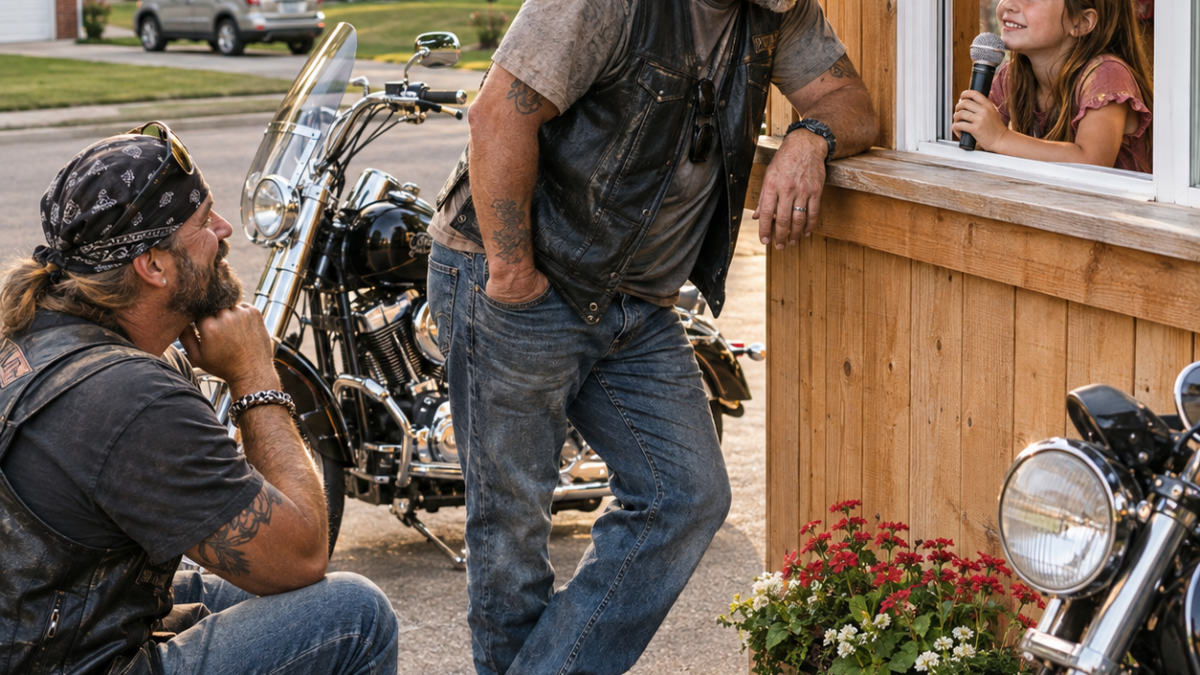
Every Afternoon, the Biker Opened a Tiny Window for His Silent Daughter—Then One Stranger Called Him by a Name No One Knew.
At exactly 4:17 every afternoon, Wade Mercer killed the engine of his black Harley, opened a six-inch wooden shutter in the side of his garage, and waited for his eight-year-old daughter to say one kind sentence to someone she had never met.
The first time I saw cars curling around Willow Street, I assumed the tattooed biker across from me was selling something.
I was wrong.
He was giving something away.
Then one afternoon, an elderly man in a rusted Ford stopped at the little window.
Lily studied his face for nearly a minute.
Finally, she whispered:
“You have hands that never stopped helping people.”
The old man gripped his steering wheel.
His mouth trembled.
Behind Lily, Wade dropped the wrench he was holding.
The stranger looked toward him.
And called Wade by a name none of us had ever heard.
The Iron Hounds standing along the curb stopped talking.
Lily turned toward her father.
And beneath his beard, the toughest man on Willow Street went pale.
My name is Claire Donnelly.
For most of this story, I lived in the white bungalow directly across from Wade Mercer’s garage in Lebanon, Tennessee.
That gave me a perfect view of the window.
It did not give me a perfect view of Wade.
Nobody had that.
Wade arrived on our street eighteen months earlier with his daughter Lily in the cab of an old pickup and a black Harley-Davidson Road King strapped to a trailer behind them.
They didn’t bring much.
One mattress.
Six plastic tubs.
Two kitchen chairs.
A red toolbox that looked older than Wade.
By sunset, three members of the Iron Hounds motorcycle club had arrived.
That did not calm the neighborhood.
These were large men.
Leather cuts.
Tattooed arms.
Heavy boots.
Engines loud enough to shake old windows.
One of my neighbors closed her curtains when they pulled up.
Another called her husband home early.
Then we watched the bikers carry furniture.
One repaired Wade’s leaking water heater.
Another assembled Lily’s bed.
A third hung paper stars above it.
Nobody stayed for dinner.
PART2:
At seven, the motorcycles left together.
The street went quiet.
The next morning, Wade walked Lily to school.
He did that every day.
If it rained, they took the truck.
The Harley was for work, club rides, and the occasional late-night ride after Lily had gone to sleep and one of his brothers sat in the living room.
I learned these things slowly.
Wade did not volunteer personal information.
Asking him about his past felt like knocking on a steel door.
Sometimes it opened an inch.
He repaired motorcycles at a shop near Interstate 40.
Before that, he’d welded bridge supports in Kentucky.
Before that?
“Nothing worth printing.”
That was his answer.
PART3:
Lily’s mother had died when Lily was five.
Her name was Hannah.
Cancer.
Fast.
That was almost everything Wade told me.
I learned the rest from Rosa Vega, the Iron Hounds’ road captain.
Rosa was fifty-two, Mexican American, broad-shouldered, tattooed from wrist to collarbone, and wore scarlet motorcycle boots that Lily once said made her look “like a superhero who got tired of capes.”
Rosa told me Hannah could talk to anybody.
Cashiers.
Police officers.
Waitresses.
Strangers sleeping beneath bridges.
It didn’t matter.
“She could make people feel like they weren’t taking up too much room,” Rosa said.
“What happened to Lily?”
Rosa looked toward the garage.
Wade was sanding cedar.
Lily sat beside him sorting paintbrushes by size.
“The hospital.”
During Hannah’s last week, too many adults had leaned toward five-year-old Lily.
Did she understand Mommy was sick?
Did she want to say goodbye?
Did she want to tell Mommy something?
Did she want to talk?
Did she understand what was happening?
Everyone meant well.
But eventually, Lily stopped speaking.
After Hannah died, she spoke only to Wade.
Doctors called it situational mutism.
A counselor explained that Lily’s voice wasn’t physically broken.
Fear was closing the door.
Pressure made it worse.
Shame made the lock stronger.
Wade tried everything he could understand.
Picture cards.
Breathing exercises.
A jar where Lily earned glass marbles each time she spoke outside home.
He enrolled in a twelve-week parenting class in the basement of a Methodist church.
For the first three sessions, several mothers looked nervous whenever the enormous biker took the chair in the back.
By week twelve, Wade was helping stack their folding tables.
Still, Lily couldn’t order ice cream.
Then one afternoon, she had to read a paragraph at school.
I was substituting for her class.
Her assignment was about hummingbirds.
It was excellent.
Precise facts.
Neat handwriting.
A tiny ruby-throated hummingbird drawn in the margin.
Lily stood at the front.
She opened her mouth.
Nothing came.
Ten seconds.
Twenty.
Thirty.
A boy near the back snickered.
Lily folded the paper once.
Then again.
Until the little bird disappeared inside the creases.
That afternoon, Wade’s Harley reached the parking lot before he did.
He walked inside carrying his helmet.
Oil-stained jeans.
Black T-shirt.
Leather cut.
The receptionist sat a little straighter.
Wade signed Lily out.
Then crouched beside her.
He saw the crushed paper.
“Bad day?”
Lily nodded.
“Want me to fix it?”
Another nod.
He unfolded the page carefully.
Studied the bird.
Then said:
“Might take lumber.”
Two days later, a circular saw started screaming inside Wade’s garage.
He cut a small square opening through the side wall.
Framed it in cedar.
Built a narrow counter.
Added a sliding shutter.
Then mounted an old silver diner microphone beneath it.
The Iron Hounds helped.
Nine motorcycles lined the curb.
For men who looked capable of dismantling a bar with furniture still inside it, the objects passing through their hands were strangely gentle.
Yellow paint.
Warm string lights.
A child-sized stool.
Flower-shaped brass bell.
Lily painted the sign.
LILY’S COMPLIMENT WINDOW
NO MONEY ACCEPTED
On the first afternoon, Wade taped five cards behind the counter.
I LIKE YOUR SMILE.
YOUR SHIRT IS A GOOD COLOR.
YOU HAVE KIND EYES.
YOUR DOG LOOKS LOVED.
I AM GLAD YOU CAME.
Then they waited.
Nobody came.
At 4:42, Lily looked down the empty driveway.
Wade rested one hand on the cedar counter.
“At least you tried, bug.”
Then nine Harley engines started around the corner.
The Iron Hounds had been waiting.
They rode in one at a time.
Every rider stopped beside the window.
Every engine was switched off before Lily spoke.
Nobody hurried her.
Nobody finished her sentence.
Nobody said:
Come on.
You can do it.
Don’t be shy.
The first compliment took forty-three seconds.
The second took twenty-seven.
The third took eighteen.
By the ninth biker, Lily stopped using the cards.
Mateo rolled up.
He was enormous.
Shaved head.
Black beard.
Arms like bridge cables.
Lily studied him.
Then:
“You laugh like a friendly bear.”
Mateo put one fist over his heart.
“Kid.”
His voice cracked.
“I needed that.”
The next afternoon, I drove through.
Lily stared at me so long that I began wondering whether I had something on my face.
Then she said:
“Ms. Claire, your silver hair looks like winter sunshine.”
I gripped the steering wheel.
Nobody had said anything kind about my hair since my husband Patrick died.
“Thank you.”
Lily rang the brass bell.
Next.
Wednesday brought our mail carrier.
Thursday, a nurse finishing a night shift.
Friday, three teenage boys in a rusted pickup.
They had laughed at the “compliment drive-thru” when they first heard about it.
Lily looked at their truck.
Then said:
“Whoever painted that stripe has a really steady hand.”
The boys stopped laughing.
The next day, they returned with flowers for her counter.
The line grew.
Some visitors came cheerful.
Others came looking like they were carrying invisible weight.
Lily never asked what was wrong.
She watched.
Then found one thing.
Not generic praise.
Something true.
“You always return your shopping cart.”
“You are gentle when you help your little sister.”
“You remember every dog’s name.”
“You look like someone people can tell the truth to.”
Those compliments landed differently because they were specific.
Then came the old man.
Rust-red Ford.
White hair.
Weathered face.
Hands gripping the wheel.
Lily watched him.
Longer than usual.
“You have hands that never stopped helping people.”
Behind her, Wade dropped the wrench.
The old man lifted his face.
His eyes moved beyond Lily.
Toward Wade.
“Wade Callahan.”
The driveway went silent.
Rosa stopped mid-sentence.
Boone slowly turned.
Wade’s face lost color.
Lily looked over her shoulder.
“Dad?”
The stranger opened his door.
Wade walked forward.
“Thomas.”
The old man nodded.
“Been a long time.”
Nobody knew who Thomas was.
Nobody knew who Wade Callahan was.
Lily did what Lily always did when adults became complicated.
She closed the shutter.
Wade didn’t stop her.
Thomas Reed had been a paramedic.
Decades earlier, before Lily, before Hannah, before the Iron Hounds, Wade Mercer had been Wade Callahan.
At twenty-three, Wade worked demolition.
Drank hard.
Fought often.
Spent money faster than he earned it.
One night outside Bowling Green, Kentucky, he punched a man during a bar fight.
The man fell badly.
Thomas Reed was the paramedic who kept him alive during the ride to the hospital.
The injured man was Thomas’s younger brother.
Wade served twenty-two months for aggravated assault.
Thomas began visiting him in county jail.
Not because he forgave Wade.
Not because he liked him.
For eleven months, Wade refused every visit.
Thomas kept coming.
When Wade finally entered the visitation room, he expected rage.
Thomas placed both hands on the metal table.
Then looked at Wade’s scarred knuckles.
“You’ve got strong hands.”
Wade said nothing.
“Decide what they’re for.”
That sentence followed Wade everywhere afterward.
Prison.
Sobriety.
Welding school.
Construction jobs.
Motorcycle repair.
Church projects.
Marriage.
Fatherhood.
He eventually changed his surname to Mercer—his mother’s maiden name.
He wanted the old story to end with him.
He never told Lily.
He barely told Hannah.
Thomas had not come to expose him.
His granddaughter had seen the compliment window online.
Thomas recognized Wade.
He drove to Lebanon because he wanted to see what the angry young man from the jail visitation room had done with those strong hands.
He saw cedar.
Yellow paint.
A microphone.
A child learning to speak.
And when Lily told him his hands looked like they had spent a lifetime helping people, Thomas understood something.
Wade had taken the sentence seriously.
He had come to see that.
Not destroy it.
A few days later, another stranger arrived.
A woman named Marlene Price.
She had a photograph taped to her dashboard.
A young woman in a diner uniform.
Hannah.
Marlene had been one of Hannah’s oncology nurses.
She carried an envelope.
Three years earlier, Hannah had asked her to keep it.
“Until Wade creates a place where Lily’s voice can come back.”
Marlene admitted she hadn’t understood those words.
Neither had Wade.
Until now.
When Wade saw Hannah’s handwriting, he stopped breathing.
“Not here.”
Marlene nodded.
“When she’s ready.”
Lily stared.
“Is that from Mom?”
Seven vehicles waited behind Marlene.
Three years earlier, Wade might have lied.
Instead:
“Yes.”
Lily pressed her thumbnail into her palm.
Wade touched two fingers to his chest.
Breathe.
Lily copied him.
“Can we read it?”
Wade looked at the cars.
“Not while people are waiting.”
Lily reached for the sign.
Turned it around herself.
CLOSED — BACK TOMORROW
Nobody complained.
That evening, I sat at Wade’s kitchen table with Rosa and Boone.
Lily held the envelope.
Wade’s hands could rebuild a transmission without shaking.
They shook now.
Lily opened it.
Wade read.
Then his voice failed.
Rosa continued.
Hannah wrote about Lily.
About the hospital.
About how fear had attached itself to words.
She didn’t want Lily to spend her life believing every important sentence had to be a goodbye.
So she left a game.
Whenever Lily felt ready, say one true, kind thing to a stranger.
Then another.
No pressure.
No performance.
Just one small door.
Near the end, Hannah wrote directly to Wade.
You think your job is making sure nothing hurts her.
It isn’t.
Your job is standing close enough that hurt doesn’t get the last word.
Wade bent forward.
Hands behind his neck.
For a long time, nobody spoke.
Lily stood between his boots.
“Dad?”
“Yeah, bug?”
“Mom knew about my window?”
“No.”
“Then how did she know?”
Wade looked toward the old diner microphone.
“Your mom knew us.”
That could have been the ending.
It wasn’t.
The following Monday, Wade received an HOA violation notice.
Traffic obstruction.
Unauthorized commercial activity.
Excessive noise.
Unapproved structural alteration.
It did not matter that Wade had never accepted a dollar.
The line had become too long.
Videos of Lily’s window had spread online.
People were arriving from Nashville.
Murfreesboro.
Kentucky.
One family drove almost three hours.
Kindness had become popular.
Popularity was beginning to become a problem.
Wade read the notice.
I asked:
“Who complained?”
“Doesn’t say.”
“You can appeal.”
“No.”
He removed the brass bell.
Then the microphone.
At 4:15 the next afternoon, six vehicles arrived.
The shutter stayed closed.
Lily sat on the garage floor with her knees pulled against her chest.
“Maybe we can move it somewhere else,” I said.
Wade continued coiling the microphone cable.
“Leave it.”
“She worked hard for this.”
“I said leave it.”
His voice struck the concrete.
Lily flinched.
Wade saw it.
The anger disappeared immediately.
He crouched several feet away.
“Not at you, bug.”
Lily looked down.
“I know.”
But her voice had returned to a whisper.
The next day at school, she didn’t speak.
Wednesday, she couldn’t tell me whether she wanted apple juice.
By Friday, the center of her palm held a small purple bruise where her thumbnail had pressed too hard.
The window had not cured Lily.
That was never what it did.
It gave her control.
Practice.
Distance.
A safe way to stop.
Taking it away suddenly made the world unpredictable again.
Wade blamed himself.
The Iron Hounds found out he planned to dismantle the entire thing Saturday.
Nine motorcycles arrived at 3:50.
Engines shut down one after another.
Boone.
Rosa.
Mateo.
Six more.
They entered the garage.
Voices stayed low at first.
Then Wade said:
“My house. My kid.”
Boone replied:
“Exactly.”
“Don’t tell me how to raise her.”
“Then stop raising her like you’re still in a cell.”
Silence.
A wrench hit the workbench.
Wade stepped toward Boone.
Boone didn’t move.
Neither did Rosa.
For all their talk of brotherhood, this was the kind of moment that actually tested it.
Not a bar fight.
Not a highway.
A suburban garage beside a yellow stool.
Would loyalty mean agreeing with Wade?
Or refusing to help him retreat?
Rosa removed her leather cut.
Placed it on the counter.
“We built this because you asked us.”
Wade’s jaw tightened.
“We take it down if Lily asks us.”
“She is eight.”
Rosa looked toward the house.
“She owns the voice.”
A tiny sound came from the doorway.
“Keep it.”
Lily stood in sock feet.
Wade turned.
“What?”
She pushed her thumbnail into her palm.
Then deliberately opened her hand.
“I want to keep my window.”
The sentence was thin.
But clear.
Wade looked at his daughter.
Then the bikers.
Then the violation notice.
Finally, he asked the question he should have asked first.
“What do you need from me?”
Lily thought.
Then:
“Stand close.”
The HOA hearing was held Tuesday night at Cedar Grove Community Church because the usual meeting room couldn’t hold the crowd.
Wade planned to go alone.
At 5:40, he opened his garage.
Forty-three vehicles waited outside.
Not customers.
Supporters.
Our mail carrier had signatures.
Jamal’s mother had drawn traffic patterns redirecting the line away from driveways.
Three business owners offered insurance help.
A child therapist brought a written explanation of why controlled, low-pressure interaction was helping Lily.
Marlene carried Hannah’s letter.
Thomas wore his retired paramedic jacket.
The Iron Hounds stood silently beside their motorcycles.
Wade stared.
“I didn’t ask for this.”
“I know,” I told him.
“Then why are they here?”
“Because you didn’t ask.”
The hearing lasted two hours.
HOA president Gerald Pike was a retired bank manager.
Rules mattered to him.
Annoyingly, he wasn’t entirely wrong.
Traffic sometimes blocked driveways.
Social-media attention had become difficult to control.
Strangers were appearing.
Cameras were appearing.
Lily’s private struggle was slowly becoming entertainment for people who had never met her.
Then Pike read the original complaint.
Submitted by:
Wade Mercer.
The room erupted.
Rosa stared at him.
“Brother.”
I couldn’t speak.
Wade stood.
One week before the official violation notice, he had reported his own structure.
He’d realized the traffic was becoming unsafe.
He expected the HOA to help create limits.
Instead, the complaint triggered an automatic shutdown process.
He had let us assume somebody else reported him.
Why?
Because admitting the truth was harder.
The window’s success frightened him.
Every new car brought another stranger near Lily.
Every viral video created another expectation that she perform tomorrow.
Every smiling visitor made it easier to forget that this began as therapy, not entertainment.
Wade stood before the HOA board.
“I know what people see.”
He looked around.
“Cute kid.”
Then at himself.
“Scary-looking dad.”
A few people shifted.
“Nice story.”
His fingers tightened around the chair.
“She is not a story.”
Silence.
“She is my daughter.”
He proposed restrictions.
Local visitors unless personally invited.
No photographs.
No filming.
Ten vehicles per afternoon.
Reservation cards distributed through the library.
The window closes immediately whenever Lily wants.
No explanation required.
Most important:
It only opens when Lily chooses.
Pike adjusted his glasses.
“Mr. Mercer, the structural alteration still violates the covenant.”
Behind me, a chair scraped.
Lily stood.
She had spent most of the meeting wrapped in Wade’s leather jacket.
Now she walked forward.
Wade instinctively moved after her.
Then stopped.
Stand close.
Three steps behind.
Lily faced Pike.
Her breathing quickened.
Her thumbnail moved toward her palm.
She stopped.
Opened her hand.
“Mr. Pike?”
He leaned closer.
“Yes?”
“You read every paper people give you.”
Several people smiled.
Lily swallowed.
“That means you take people seriously.”
Pike’s expression changed.
It was exactly the kind of compliment Lily gave.
Not flattering.
Observant.
True.
She continued.
“The window helps me practice.”
Her voice shook.
“But Dad is right.”
Wade touched two fingers to his chest.
Breathe.
Lily breathed.
“Sometimes too many people come.”
Pike removed his glasses.
“What do you want?”
Lily answered:
“Ten.”
“Ten cars?”
“Yes, sir.”
“No cameras?”
“No cameras.”
Pike looked at the board.
The vote was four to one.
The window could stay.
Afterward, while people stacked chairs, Thomas approached Wade.
He carried a small cassette recorder sealed in plastic.
“Hannah gave this to Marlene too.”
Wade stared.
“Why do you have it?”
Thomas answered:
“Because she wanted somebody to know when you were ready.”
Thomas had volunteered at the hospice where Hannah received care.
He never knew she was Wade’s wife at first.
She knew him only as the retired paramedic with steady hands.
Near the end of her illness, Hannah learned Wade’s old surname.
Callahan.
Wade thought she died without knowing about the assault.
She knew everything.
She discovered old legal documents Wade had hidden in his toolbox.
Then saw an article about Thomas receiving a county service award.
She contacted him.
Not to expose Wade.
To ask one question.
“Did he really change?”
Thomas told her what Wade had never told her.
Seven years of apology letters to Thomas’s brother.
None answered.
Anonymous payments toward rehabilitation expenses.
Sobriety.
Church volunteer projects.
Wheelchair ramps built without Wade’s name attached.
Thomas told Hannah:
“He’s ashamed.”
She answered:
“Good.”
Then:
“Shame means the old pain still has a pulse.”
Pause.
“But it can’t be the only thing steering him.”
We listened to Hannah’s cassette that night.
Lily was asleep.
The garage lights were dim.
The silver diner microphone lay on the workbench.
Hannah’s recorded voice was weak.
But still unmistakably Hannah.
She told Wade she knew.
She was angry he’d hidden his past.
But she also understood why.
Fear had taught Wade to confuse secrecy with protection.
Then she talked about the microphone.
They had met at a diner drive-thru.
Wade was twenty-nine.
Newly sober.
Unable to look people in the eye.
He came through on a Harley one cold November evening and ordered black coffee.
Hannah looked through the little window and told him:
“You have honest eyes.”
Wade had looked behind himself.
He assumed she meant someone else.
She didn’t.
He returned the next night.
And the next.
Wade always claimed he came back because the diner parking lot had the only slope steep enough to roll-start his motorcycle.
Hannah never believed him.
On the tape, she laughed.
“I wasn’t flirting that first night.”
Wade stared at the recorder.
“I wanted to see if the frightening biker could accept one gentle sentence without running away.”
A pause.
“He came back.”
Another laugh.
“So I suppose it worked.”
Then Hannah said something that made Wade stop breathing.
“Lily gets quiet like you, Wade.”
The garage became completely still.
“Don’t treat that silence like there’s something broken inside her.”
Wade closed his eyes.
“Build her a safe place.”
Then:
“You’re good at building.”
The tape clicked.
We assumed it was finished.
Then Hannah’s voice returned faintly.
“And compliment her every day.”
Pause.
“Even when she pretends she hates it.”
The cassette stopped.
Wade sat beneath the little cedar window.
The tattoos across his forearms folded over muscle and scars.
Across his knuckles:
STAY.
This time, Wade cried.
No hiding.
No beard turned away.
No pretending sawdust had gotten in his eyes.
He took the diner microphone.
Polished the grille with his shirt.
Mounted it beneath Lily’s counter again.
That was Wade’s language.
Action.
The window reopened Wednesday.
Ten reservation cards had been claimed.
Twelve cars arrived.
Wade walked to the final two.
Apologized.
Offered Friday cards.
Nobody argued.
At 4:17, Lily raised the shutter.
The first visitor was Gerald Pike.
His immaculate beige Buick stopped exactly at Wade’s yellow line.
Window rolled down.
Lily studied him.
Pike waited.
“You have a voice people listen to.”
Pike nodded slowly.
“And you changed your mind when you learned something new.”
Wade, standing behind her, said:
“That second thing is rarer.”
Pike nearly smiled.
Then he placed a wooden box on the counter.
Inside:
A brass plate.
NEIGHBORHOOD KINDNESS WINDOW
No fee.
No expiration.
Second visitor:
Thomas Reed.
Lily looked at his white hair.
“You look like somebody who knows how to find the way home.”
Thomas closed his eyes.
“Thank you.”
Then he walked into the garage.
Stopped in front of Wade.
They had spent years connected by the worst thing Wade had ever done.
Forgiveness could not erase injury.
It could not return time.
It could not change the past.
Thomas extended his hand anyway.
Wade took it.
Strong hands.
Different purpose.
Another visitor was a teenage boy who stuttered.
He needed nearly a minute to ask Lily if he could volunteer.
She waited through every blocked syllable.
Never looked away.
When he finished, Lily said:
“You don’t make people feel rushed.”
He came back the following week.
Began managing reservation cards.
The fifth visitor that afternoon was me.
Patrick had been gone almost one year.
Two days remained until the anniversary of his death.
Grief had changed shape.
It no longer screamed.
It hid in grocery aisles.
Quiet kitchens.
The untouched half of my bed.
I stopped at Lily’s window.
She leaned toward the microphone.
“Ms. Claire?”
“Yes?”
“You keep coming outside even on hard days.”
My hands tightened around the steering wheel.
Behind her, Wade suddenly became very interested in adjusting a hinge that did not need adjustment.
“Thank you.”
Lily smiled.
Not the careful smile she gave adults.
A full one.
Then she hit the brass bell.
Next.
Autumn came.
Leaves gathered beneath Wade’s Harley.
The garage smelled like cedar, motor oil, and old leather.
Each weekday at 4:15, Wade rolled the Road King aside.
Placed the yellow stool behind the counter.
Some days Lily opened the window.
Some days she didn’t.
On red days, Wade turned the sign around without apology.
Visitors learned that respecting the closed shutter was part of the gift.
On green days, Lily no longer used cards.
Her compliments became bolder.
She told Rosa:
“The scar in your eyebrow looks like you survived an interesting chapter.”
Boone:
“Kids feel safe when you crouch down instead of making them look up.”
Mateo:
“Your laugh gives quiet people permission to join.”
Every afternoon, Lily saved Wade for last.
“You make pancakes shaped like animals even when you’re tired.”
“You check my helmet strap twice.”
“You don’t laugh when my voice gets stuck.”
Wade’s answer was always:
“Good eye, bug.”
The Iron Hounds began building other versions of Lily’s idea.
Never exact copies.
At a veterans center, they built a quiet coffee window where isolated veterans could order without walking into a crowded lobby.
At an elementary school, they made a reading booth for students afraid to speak before classmates.
Wade had one rule.
No Lily in publicity.
No using her story to make the club look heroic.
No giant photographs of bikers handing over checks.
Build it.
Leave it.
Ride home.
By winter, Lily volunteered to read the school weather report.
She practiced for three weeks.
Boone pretended to be a classmate.
Rosa deliberately dropped pencils.
Mateo coughed loudly.
Pike asked pointless questions.
Thomas sat quietly.
I listened.
On the actual morning, Wade parked his Harley outside school.
Lily had asked him not to come inside.
She wanted him where she could see him through the window.
Her first sentence shook.
Her thumbnail moved toward her palm.
Then she looked outside.
Wade touched two fingers to his chest.
Breathe.
Lily opened her hand.
Continued.
Not perfectly.
Clearly enough.
When she came out after school, Wade was waiting beside the Harley.
She ran toward him.
He caught her.
“How’d it go?”
“I got stuck once.”
“And?”
“I got unstuck.”
He nodded.
“That’s the whole trick.”
The compliment window stayed on Willow Street for years.
Cedar faded.
Yellow paint peeled.
The brass bell eventually cracked and developed a strange little ring.
Lily changed too.
She never became the loudest child in a room.
That wasn’t the goal.
Strangers still took energy.
Crowds still exhausted her.
Some words remained difficult on some days.
But fear stopped making every decision.
At eleven, she started helping younger children at the window.
At thirteen, she convinced the public library to create a quieter checkout desk for visitors with communication difficulties.
At sixteen, she repainted the original sign.
Wade sat beside the Harley watching.
His beard was almost completely gray by then.
The new sign read:
ONE TRUE THING — FREELY GIVEN
Inside the garage, Lily kept the crooked final S from her childhood sign.
Hannah’s letter stayed there too.
Every year on the anniversary of Hannah’s death, the window changed.
No cars.
Neighbors walked over carrying handwritten compliments for people they had lost.
We read them aloud if we could.
Someone else read them if we couldn’t.
Wade always went last.
One year, he wrote only six words.
SHE SAW THE MAN I COULD BECOME.
He folded the card.
Placed it beside Hannah’s microphone.
Years after that first afternoon, I asked Lily whether she remembered the first compliment she ever gave through the window.
“Mr. Boone’s soft beard.”
Boone was standing nearby.
He groaned.
Everyone laughed.
Wade looked at the faded cedar counter.
The neighbors.
The Iron Hounds.
Then at the daughter who once couldn’t order her own ice cream.
“My kid was afraid to talk,” he said.
Lily immediately corrected him.
“I still get afraid.”
Wade looked at her.
“Fair.”
She smiled.
Then:
“Dad?”
“Yeah?”
“Your turn.”
Wade sighed.
He never enjoyed receiving compliments.
Lily leaned near his ear.
“You make people feel safe without making them feel small.”
The big man stared down at his Harley’s fuel tank.
No answer.
For once, nobody teased him.
Then Wade cleared his throat.
Started the Road King.
The V-twin filled the garage with that familiar low thunder.
Lily climbed onto the passenger seat.
Wade checked her helmet strap once.
Then again.
She rolled her eyes.
He ignored her.
They eased toward the street.
The motorcycle rolled beneath the Tennessee dusk.
Its red taillight grew smaller as it headed toward Highway 70.
Behind them, the little cedar window stayed open.
For years, I had thought Wade built it because his daughter was afraid to speak.
Eventually, I understood that wasn’t quite right.
He built it because people had spent too long trying to make Lily talk.
Wade gave her somewhere she could choose to.
And somewhere along the way, while teaching his daughter that silence did not make her broken, the frightening biker across the street finally learned the same thing about himself.
Strong hands.
A quiet child.
One little window.
And one true thing, freely given.








