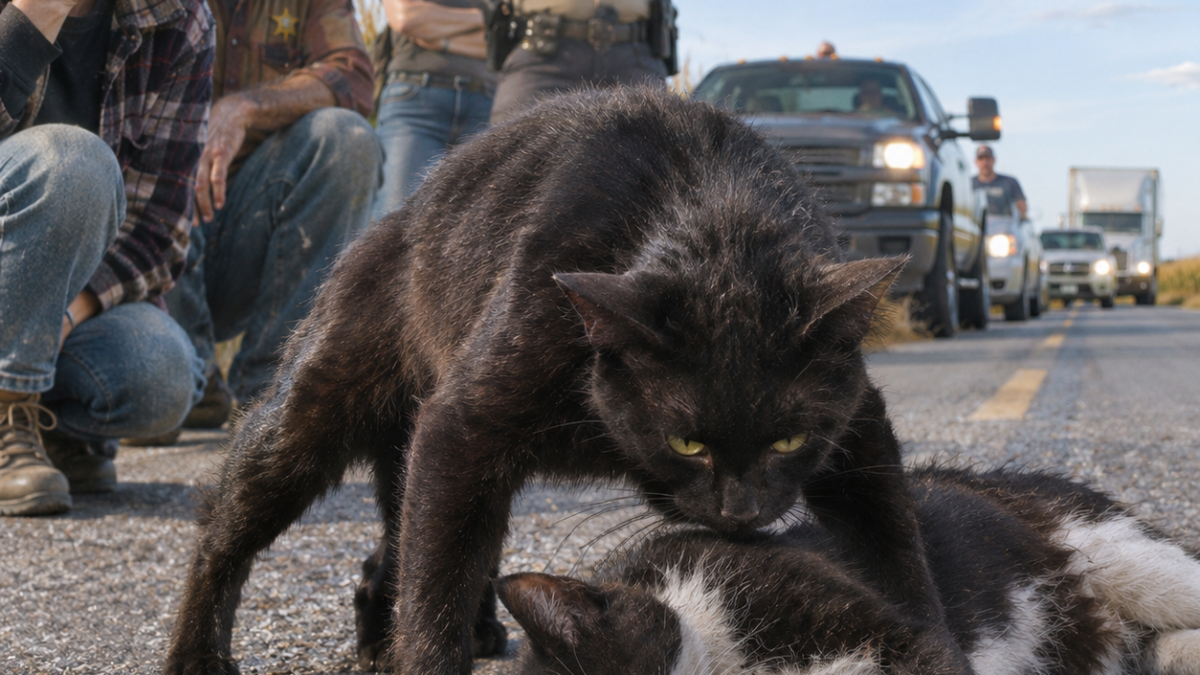
Eighteen Cars Stopped for a Black Cat Standing in the Middle of the Highway—Then Rescuers Realized What He Was Refusing to Leave Behind.
PART3:
Denise’s voice broke.
“You can’t stay here.”
He stared.
A horn sounded behind her.
Denise spun.
“Shut up!”
The pickup driver raised both hands.
She turned back.
The cat had not moved.
She called the sheriff’s office.
“This is going to sound ridiculous.”
The dispatcher said, “Try me.”
“There’s a cat blocking County Fourteen.”
“A cat?”
“Two.”
“Are they injured?”
“One is dead.”
A pause.
“And the other?”
“He won’t leave her.”
The dispatcher became quieter.
“Is traffic getting around?”
“No. I don’t want anybody driving around them. He’s standing right over her.”
“Stay safely off the roadway if you can.”
“I’m trying.”
“We’ll send someone.”
By 6:25, six vehicles had stopped.
By 6:31, there were nine.
Some drivers understood immediately.
Others did not.
A man in work boots walked forward.
“Just move the cat.”
Denise blocked him.
“Don’t.”
“We’re gonna have cars backed up to the intersection.”
“I called somebody.”
“It’s a cat.”
Denise looked at him.
“So?”
The man sighed.
He approached anyway.
“Come on, buddy.”
The black cat watched him.
The man extended a boot carefully and nudged toward the cat’s shoulder.
The cat shifted.
Not away.
Back over his sister.
He lowered his chest until it almost touched her body.
The man’s expression changed.
“Oh.”
Denise crossed her arms.
“Yeah.”
He stepped back.
No one tried with a boot again.
At 6:40, the first sheriff’s deputy arrived.
Deputy Marcus Hale had been with the Reno County Sheriff’s Office for seven years.
He parked diagonally across the lane and activated his lights.
He expected the situation to resolve in two minutes.
It did not.
Marcus walked toward the cats.
The black male watched.
Marcus crouched five feet away.
“Hey, man.”
The cat did nothing.
Marcus glanced at Denise.
“How long?”
“I’ve been here almost half an hour.”
“He hasn’t moved?”
“Maybe two inches.”
Marcus looked at the female.
“You sure she’s gone?”
Denise’s face tightened.
“Yes.”
Marcus nodded.
He removed his gloves.
He tried approaching from the side.
The black cat repositioned.
Marcus went left.
The cat shifted left.
He tried right.
The cat moved right.
Always maintaining himself between the human and the body.
“He’s guarding her,” Marcus said.
Denise nodded.
“I know.”
Another deputy arrived to direct traffic.
Cars now stretched behind Denise’s sedan.
A grain truck.
Two pickups.
A school maintenance van.
A woman heading to a medical appointment.
A teenage boy driving to his first day at a new job.
People got out.
Some impatient.
Some curious.
Then they saw.
The mood changed.
One by one, engines shut off.
At 6:48, a farmer named Carol Bennett saw the line of stopped vehicles from her kitchen window half a mile away.
Carol was sixty-two and lived alone on 120 acres she and her late husband had once farmed together.
She drove down in an old Ford truck.
“What happened?”
Denise pointed.
Carol saw the cats.
“Oh, honey.”
She immediately called her friend.
“Mara?”
The woman on the other end was half asleep.
“What?”
“It’s Carol.”
“I know what your name looks like.”
“I need you.”
“At seven in the morning?”
“Bring a carrier.”
Silence.
“What happened?”
“Cat in the road.”
“Hit?”
“One.”
“Alive?”
“One.”
“Carol.”
“Just come.”
Mara Collins volunteered with Prairie Haven Animal Rescue.
She was forty-eight, divorced, worked three days a week at a dental office, and spent the rest of her time transporting dogs, trapping feral cats, fostering bottle kittens, arguing with veterinarians about discounts, and telling people she did not “run a rescue” even though half the county called her whenever an animal was in trouble.
She arrived at 7:05.
By then eighteen vehicles had stopped.
No one honked anymore.
No one complained.
The black cat was still standing.
Mara parked near the shoulder and stepped out carrying a hard plastic carrier, a towel, leather gloves, and a bottle of water.
Marcus met her.
“He’s not aggressive.”
“That’s good.”
“He won’t move.”
“That’s different.”
“He hasn’t left her.”
Mara looked.
She understood immediately.
“Oh.”
The black cat’s legs were trembling.
Not slightly.
Violently.
His muscles quivered beneath his coat.
Mara glanced at the road.
She put the back of her hand close to the asphalt.
Pulled it away.
“How long has he been here?”
“At least since six twelve.”
Denise said, “The female was already stiff.”
Mara’s face changed.
“He could’ve been here all night.”
She looked at the black cat’s paws.
The pads were difficult to see while he stood.
But she noticed how he shifted weight.
Front left.
Back right.
Front right.
Back left.
Not because he wanted to move.
Because the road hurt.
“The asphalt’s heating up.”
Marcus looked at the sky.
The temperature had already passed eighty degrees.
The pavement would be hotter.
“Can you grab him?”
Mara shook her head.
“If I go for him, he may bolt.”
“Into traffic?”
“Exactly.”
Marcus looked at the female.
“What if we move her?”
Mara was quiet.
“That’s probably the only way.”
She placed the carrier on the shoulder.
Then spread a clean towel on the road six feet from the cats.
She sat.
Not crouched.
Sat.
Hands in her lap.
The black cat stared.
“Hey.”
His ears moved.
“I’m not going to grab you.”
Traffic remained completely silent behind her.
Eighteen stopped vehicles.
Thirty or more people.
And everyone seemed to understand they were waiting for one animal.
Mara slid closer.
One foot.
Then stopped.
The cat trembled.
“Okay.”
Another foot.
“You’re doing good.”
He lowered his head.
Touched his sister again.
Mara’s throat tightened.
She had seen bonded animals separated before.
Dogs surrendered together and then placed apart.
Cats crying after littermates died.
Animals searching houses for companions who would never return.
She did not pretend to know what animals understood about death.
People often said things like, “He knew she was gone.”
Maybe.
Maybe not.
But Mara knew what behavior looked like.
The black cat was refusing to leave.
That was real enough.
She moved closer.
Four feet.
Three.
The cat did not retreat.
Mara whispered, “I need to move her.”
The black cat looked at her.
“You’re hurting.”
He shifted one paw.
Mara saw the pad.
Red.
Blistered.
“Oh, baby.”
She pulled the towel toward the female.
The moment her fingertips touched the dead cat’s shoulder, the black cat made a sound.
Everyone heard it.
A low, broken trill.
Not a meow.
Not a growl.
Something softer.
Almost questioning.
Mara stopped.
The male lowered his face to his sister’s.
Nose to nose.
Then made the sound once more.
Quieter.
Denise covered her mouth.
Carol turned away.
Even Marcus looked down.
Mara waited.
“Okay.”
Her voice shook now.
“I’m sorry.”
She gently slid the towel beneath the female.
The male stayed close.
His body trembled harder.
Mara wrapped the black-and-white cat.
Carefully.
Respectfully.
No rushing.
She lifted her.
The black male stepped forward.
One step.
Then another.
Following.
Mara moved toward the shoulder.
The moment his sister’s body left the spot where she had been lying, his legs folded.
He fell.
Straight down.
Not sideways.
Not as if he had been struck.
His body simply surrendered.
Exactly where she had been.
Mara lowered the wrapped body quickly.
“Oh God.”
She scooped the male with both hands.
He did not resist.
His head rested against her forearm.
His paws were hot.
Too hot.
His body was dehydrated.
His heart raced beneath his ribs.
For hours, he had apparently remained upright for one reason.
She was still there.
Now she wasn’t.
And he had nothing left to hold himself up for.
Mara carried him to the truck.
Denise followed.
“Is he dying?”
“I don’t know.”
“What can we do?”
“Move traffic.”
Marcus nodded.
He and the second deputy cleared the lane.
People returned to their vehicles slowly.
No one complained.
The grain-truck driver removed his hat as he passed.
Denise sat behind her wheel for nearly a minute before starting the engine.
She cried the entire drive to work.
Mara placed the female cat’s wrapped body on the back seat.
The male went into the carrier beside her.
He pressed himself against the side nearest his sister.
At the veterinary clinic, Dr. Evelyn Price examined him.
“Second-degree burns on all four paw pads.”
Mara stared.
“All four?”
“Yes.”
“From the pavement?”
“Almost certainly.”
“How long would he need to stand on hot asphalt for that?”
Evelyn sighed.
“Depends on surface temperature.”
“He could’ve been there four hours.”
“Then yes.”
Mara looked through the kennel door.
The cat lay on a cooling pad.
Six pounds, three ounces.
Underweight.
Dehydrated.
Mild heat exhaustion.
No fractures.
No major internal injuries.
No evidence he had been hit.
“He’s lucky.”
Mara gave the veterinarian a look.
“You know what I mean.”
“Yeah.”
They checked for a microchip.
Nothing.
No collar.
No tattoo.
No medical record.
The female also had no chip.
She appeared roughly the same age.
Maybe two.
Black-and-white tuxedo markings.
Small.
Healthy before the impact.
The injuries indicated she had probably been struck hard and died quickly.
Mara was relieved by that.
She hated herself for being relieved.
But if death had happened, she wanted it to have been fast.
“Sibling?” Evelyn asked.
“That’s what it looks like.”
“Could be bonded pair.”
“They look the same age.”
“Doesn’t prove anything.”
“I know.”
Mara stared at them.
“But tell me you don’t think they’re related.”
Evelyn looked at the male.
He had begun calling softly when technicians moved the wrapped female from the room.
Not loud.
Not frantic.
A low trill.
Same sound.
Evelyn exhaled.
“I’d call them family.”
That afternoon, Mara brought the female cat home.
She had no owner to contact.
No name.
No history.
No one claiming her.
Mara refused to send her body to communal disposal.
She couldn’t.
Not after the road.
So she chose a place at the far edge of her property beneath a catalpa tree.
The tree had been planted by her father forty years earlier.
Wide leaves.
White flowers in spring.
Long bean-shaped seed pods in summer.
Shade large enough for three lawn chairs.
Mara dug the grave herself.
Carol helped.
Neither talked much.
They wrapped the cat in the same towel.
Before covering her, Mara touched the top of her head.
“I’m sorry.”
Carol stood beside her.
“Name?”
Mara looked up.
“What?”
“She should have one.”
Mara considered.
“June.”
“Why June?”
“I don’t know.”
Carol smiled.
“June.”
They buried her.
Mara placed a flat river stone on top.
No inscription.
Not yet.
At the clinic, the black cat spent the night.
He ate only when food was placed directly beneath his nose.
He drank.
Then slept.
For almost fourteen hours.
When Mara arrived the next morning, he was awake.
She entered the room.
“Hey.”
His ears moved.
She sat near the kennel.
“You scared half the county.”
No response.
“Do you know how many people were late for work?”
His eyes half closed.
“Eighteen cars.”
He looked away.
“Very inconsiderate.”
The technician smiled.
“He’s not impressed.”
Mara leaned closer.
“He doesn’t have to be.”
His paws required bandages.
Pain medication.
Topical treatment.
Rest.
He would recover.
Physically.
That was the good news.
The other part was harder.
He seemed to have no interest in anything.
He ate if food was put in front of him.
Used the litter box.
Allowed handling.
Did not hide.
Did not fight.
Did not engage.
The veterinarian called it withdrawal.
Mara called it heartbreak even though she knew that was an interpretation.
When he was discharged three days later, Mara fostered him.
She put him in a quiet room facing the back acreage.
The catalpa tree was visible through the window.
At first she did not notice where he sat.
Then she did.
Always the same corner.
Window.
Body facing east.
Toward the tree.
Maybe coincidence.
The best morning light came from that direction.
Birds gathered there.
There were mice near the woodpile.
Any number of explanations.
Still.
Every morning.
Every afternoon.
Same place.
Mara named him Ash.
It didn’t stick.
She tried Midnight.
No reaction.
Theo.
Nothing.
Carol suggested Guard.
“Absolutely not.”
“Why?”
“That’s not a cat name.”
“Says who?”
“Me.”
For paperwork, they listed him as BLACK MALE — FOUND COUNTY ROAD 14.
Weeks passed.
His paws healed.
The raw red pads became pink scar tissue.
He walked carefully.
For months, he would always walk carefully.
Not limping exactly.
Thinking about each step.
He ignored toys.
Ignored catnip.
Ignored the foster kittens screaming in the next room.
Mara tried a feather wand once.
He watched it move.
Then looked back outside.
“You’re depressing.”
No reaction.
She sat beside him.
“That’s rude to say to someone grieving.”
His ear moved.
She sighed.
“Fine. You’re mysterious.”
Every evening, she carried dinner into the room.
If she placed food across the room, he waited.
If she put it near him, he ate.
Mara began moving the bowl farther each day.
One foot.
Two.
Three.
She wanted him to choose movement.
Not just survival.
On day nineteen, he stood voluntarily.
Walked four feet.
Ate.
Mara smiled like someone had handed her a lottery ticket.
“There you go.”
He sat afterward.
Faced the window.
Mara followed his gaze.
Catalpa.
“You know she’s there?”
The cat blinked.
“No. That’s silly.”
Still, she moved his bed to another wall.
He moved back to the window.
Mara returned the bed.
The rescue posted his story.
They did not include graphic photographs.
Just the image a driver had taken that morning.
The black cat standing over June.
Mara hated the photograph at first.
It felt intrusive.
Then she realized it documented something people needed to understand.
Animals could form bonds humans underestimated.
The post spread around Reno County.
Then farther.
People asked to adopt him.
A lot of people.
Mara rejected most before they visited.
Not because they were bad.
Because they wanted the story.
“I want that loyal cat.”
No.
“My kids saw him online and fell in love.”
No.
“He’d be perfect for our farm.”
No.
“Does he still guard things?”
Definitely no.
Mara wanted someone who wanted the cat after the story stopped being dramatic.
Someone who could live with a quiet animal.
Someone who did not expect gratitude.
Someone who understood that grief did not make a good party trick.
Eight weeks after the highway, a man named Henry Ward called.
He was sixty-four.
Retired machinist.
Widower.
Lived forty minutes away in a small house outside McPherson.
His friend from church had shown him the post.
Mara asked the usual questions.
Other pets?
“No.”
Children?
“Two. Grown.”
Indoor cat?
“Yes.”
Veterinary reference?
He gave one from a dog he had owned fifteen years.
Why this cat?
Henry was silent.
Mara waited.
Finally:
“My wife died in January.”
Mara’s pen stopped.
“I’m sorry.”
“Thank you.”
“Why does that make you interested in him?”
“It doesn’t.”
That answer surprised her.
Henry continued.
“The picture did.”
“What about it?”
“The way he was standing there.”
Mara looked toward the foster room.
“People keep saying it’s loyal.”
“I don’t know what it is.”
“Okay.”
“But I know what it feels like not to know where to stand after somebody is gone.”
Mara said nothing.
Henry added, “If that’s too sentimental, I’m sorry.”
“It isn’t.”
“I don’t need him to fix anything.”
That mattered.
“What do you need from him?”
“Nothing.”
Mara wrote that down.
Not because it was the perfect answer.
Because it was the first answer she trusted.
Henry came Saturday.
He arrived ten minutes early and waited in his truck until exactly the appointment time.
Mara liked him immediately for that.
He wore jeans.
Work shirt.
Clean boots.
Carried no treats.
No toys.
No expectation.
Mara led him into the foster room.
The black cat sat at the window.
Henry stopped.
“He’s smaller than I thought.”
“Six and a half pounds now.”
“He was six-three?”
“Yes.”
“What do I do?”
“Whatever feels natural.”
Henry nodded.
Then sat on the floor.
Not near the cat.
Not far.
Just sat.
Mara leaned against the doorway.
Five minutes.
The cat did not turn.
Ten.
Henry said nothing.
Fifteen.
Mara started feeling awkward.
Henry didn’t.
At twenty minutes, the cat turned.
Looked at him.
Henry remained still.
The cat stood.
Walked slowly across the room.
One careful step at a time.
He stopped beside Henry.
Henry looked down.
Did not reach.
The cat sat.
Shoulder nearly touching Henry’s knee.
That was all.
Mara felt tears rise.
“Well.”
Henry looked at her.
“What?”
“Nothing.”
He looked back at the cat.
“Am I supposed to pet him?”
“If you want.”
Henry placed one hand flat on the floor.
The cat sniffed.
Then settled beside him.
Henry’s eyes filled.
He looked embarrassed.
“Sorry.”
“Don’t apologize.”
Henry wiped his face with his sleeve.
“My wife used to sit beside me like this.”
Mara’s throat tightened.
“Quiet?”
“Always.”
He smiled.
“Everybody thought she was shy.”
“Was she?”
“No.”
“Just quiet?”
“Just didn’t waste words.”
The cat closed his eyes.
Henry looked at him.
“I’d like to adopt him.”
Mara nodded.
“I figured.”
Paperwork took an hour.
Henry asked what name the rescue had been using.
“Nothing consistent.”
“What about June?”
“That was his sister.”
He nodded.
“What was your wife’s name?”
Henry looked down.
“Eleanor.”
Mara smiled.
“Pretty.”
“Her maiden name was Ward.”
Mara looked at him.
“That’s your last name.”
“No.”
He smiled faintly.
“My last name is Keller.”
She blinked.
“Really?”
“I took her name socially after she died sometimes. Stupid thing.”
“Not stupid.”
Henry looked at the cat.
“Ward.”
The black cat’s ear turned.
Mara smiled.
“I think that’s it.”
Henry adopted Ward that afternoon.
The first night, Ward hid behind the sofa.
Henry sat in his recliner.
Read the newspaper.
Said nothing.
At midnight, Ward emerged.
He sat beneath the window.
Facing east.
Henry noticed.
Did not comment.
In the morning, same place.
East.
The next morning.
East.
Henry began sitting nearby.
Not because he thought Ward wanted company.
Because Henry did.
Every morning at six thirty, he made coffee.
Ward sat on the sill.
Henry took the chair.
Neither looked at the other much.
Two grieving creatures facing sunrise.
Henry’s daughter Laura visited after three weeks.
She called Mara afterward.
“I’m worried about Dad.”
“Why?”
“He barely talks.”
“Was he talkative before?”
“No.”
“Then what’s different?”
Laura sighed.
“He sits with the cat every morning.”
“That sounds okay.”
“It’s strange.”
Mara almost laughed.
“Your father adopted a quiet cat because they both like sitting silently. This is going to look strange from outside.”
Laura softened.
“Is Ward happy?”
“I don’t know.”
“Helpful.”
“I mean it. Cats don’t submit reports.”
“Does he eat?”
“Your father says yes.”
“Litter box?”
“Yes.”
“Hide?”
“Less.”
“Sleep?”
“Yes.”
“Then give them time.”
Henry called Mara at the six-month mark.
She had been meaning to contact him.
“How’s Ward?”
“Fine.”
“That’s all?”
“He gained weight.”
“How much?”
“Nine pounds.”
Mara smiled.
“Good.”
“Vet says his feet healed.”
“Better.”
“He walks normal now unless the floor’s hot.”
Mara’s smile faded.
“He remembers?”
“Maybe.”
“What else?”
Silence.
Then Henry said:
“He still sits east.”
Mara looked out her own kitchen window toward the catalpa tree.
“Every morning?”
“Every morning.”
“That’s strange.”
“I do too.”
Mara said nothing.
Henry continued.
“After Eleanor died, I started drinking coffee in her chair.”
“Why?”
“Because it faced the cemetery.”
Mara’s chest tightened.
“You can see the cemetery from your house?”
“Not really. Just the direction.”
“Oh.”
“Doesn’t make sense.”
“It doesn’t have to.”
Ward climbed into Henry’s lap for the first time nine months after the adoption.
It happened during a storm.
Kansas thunder shook the windows.
Ward had always hated loud sounds.
Henry sat in his recliner.
A crack of thunder hit.
Ward ran from beneath the table.
Henry expected him to hide.
Instead the cat jumped onto the chair.
Pressed into his side.
Henry froze.
“Okay.”
Ward trembled.
Henry put one hand near him but did not touch.
Another thunderclap.
Ward moved beneath Henry’s arm.
That gave permission.
Henry rested his hand across the cat’s back.
Ward stayed there until the storm passed.
Henry cried.
Not because the cat sat with him.
Because Eleanor had been terrified of thunderstorms.
Every storm during forty years of marriage, she had moved closer on the couch.
Never admitted she was afraid.
Henry never teased her.
He just sat there.
Now Ward did the same thing.
Two days later, Henry called Mara.
“He touched me.”
Mara laughed.
“Congratulations.”
“I’m serious.”
“I know.”
“He got on the chair.”
“He’s a cat. They do that.”
“Not him.”
“No.”
Henry became quiet.
“Do you think animals know when you’ve lost someone?”
Mara thought about the highway.
June’s body.
Ward refusing to move.
“I think animals know absence.”
“What does that mean?”
“I don’t know.”
“Helpful again.”
“Best I can do.”
Henry never turned Ward into a replacement for Eleanor.
That mattered.
He kept Eleanor’s photographs.
Her clothes stayed in the closet for nearly two years.
Her recipe cards remained in the kitchen.
Ward became something separate.
A living presence that did not erase the dead one.
That was exactly what Henry needed.
People around him had spent months telling him to “move forward.”
He hated that phrase.
Forward toward what?
As though grief was a road and the goal was distance.
Ward taught him something else.
You could sit.
You could face the same direction.
You could remember.
And then, eventually, stand up and eat breakfast.
That was movement too.
Mara visited them one spring afternoon.
Ward was asleep in a patch of sunlight.
“You spoiled him.”
Henry looked offended.
“How?”
“That bed costs more than mine.”
“He needs support.”
“For what?”
“His feet.”
“He has four other beds.”
“Different rooms.”
Mara smiled.
“You okay?”
Henry looked toward Eleanor’s photograph.
Then toward Ward.
“Better.”
“Because of him?”
“Partly.”
He thought.
“Mostly because I stopped thinking better meant forgetting.”
Mara sat.
Ward opened one eye.
Henry continued.
“For a while, every good day felt like betrayal.”
“Of Eleanor?”
“Yeah.”
“If I laughed, I felt guilty.”
Mara nodded.
“If I enjoyed dinner, guilty.”
“That’s common.”
“If I slept through the night, guilty.”
He pointed toward Ward.
“Then I watched him.”
“What about him?”
“He misses something.”
“You think?”
“I don’t know what else to call it.”
Henry looked toward the east-facing window.
“But he still eats tuna.”
Mara laughed.
“Profound.”
“I’m serious.”
“I know.”
“He can sit there every morning looking toward whatever he looks toward and still chase a bug at noon.”
Henry smiled.
“Maybe that’s allowed.”
“It is.”
That summer, Ward chased his first toy.
A stupid red string.
Henry nearly called the rescue as if reporting a medical emergency.
Mara answered.
“What?”
“He played.”
“Who?”
“Ward.”
“With what?”
“A string.”
“Henry.”
“What?”
“Normal cats do this.”
“Not Ward.”
She smiled.
“Record it.”
He did.
The video was eleven seconds.
Ward jumped awkwardly after the string.
Missed.
Tried again.
Henry’s laugh could be heard behind the camera.
It was the first time Mara had ever heard him laugh.
She saved the video.
Years passed.
Ward became less haunted.
Not transformed.
He remained quiet.
Still sat at windows.
Still disliked hot pavement.
On summer days he refused to cross the concrete patio if it had been in direct sunlight.
Henry put outdoor rugs from the door to the grass.
His daughter thought this was excessive.
“You built him a runway.”
“He burned his feet.”
“Four years ago.”
“He remembers.”
“Do you know that?”
“No.”
“Then—”
“He likes the rugs.”
Laura stopped arguing.
Ward developed a strange habit.
Whenever Henry lay down for an afternoon nap, Ward sat beside his feet.
Not sleeping.
Guarding.
At least, that’s what Henry called it.
“You think he’s protecting you?”
Laura asked.
“No.”
“You literally just said he guards you.”
Henry shrugged.
“Let me have this.”
She smiled.
“Fine.”
At seventy, Henry had a mild heart attack.
He survived.
Laura found him because Ward would not stop yowling near the back door when she arrived to drop off groceries.
Henry was on the kitchen floor.
Conscious.
Weak.
Ward stood beside him.
Four legs spread.
Laura noticed.
The image made her cry later.
Not then.
Then she called 911.
At the hospital, she phoned Mara.
“You’re not going to believe this.”
Mara did.
She believed immediately.
Ward had not learned medical response.
He had not “saved” Henry in the dramatic sense.
Laura was already coming.
But the cat had returned to an old pattern.
Someone important was down.
Ward stayed.
Henry came home four days later.
Ward avoided him for an hour.
Then approached.
Henry sat.
Ward touched his nose to Henry’s hand.
“Still here.”
Ward climbed onto his lap.
The older man cried.
“Yeah.”
Ward aged.
At ten, his black coat began showing white hairs beneath the chin.
At eleven, his kidneys showed early changes.
At twelve, arthritis crept into his back legs.
Henry understood aging better by then.
His own knees hurt.
His hands shook slightly.
His hearing wasn’t what it had been.
They became two old males complaining at sunrise.
Henry verbally.
Ward through judgmental staring.
Laura visited more often.
Mara remained in touch.
Carol died at seventy-three.
Denise retired from the diner.
Deputy Marcus Hale became a sergeant.
The road where Ward had been found was repaved.
No physical mark remained.
But Mara still drove that route occasionally.
Every time, she knew the place.
Not because of a sign.
Because the landscape arranged itself in memory.
Telephone pole.
Drainage ditch.
A field entrance.
The spot where eighteen vehicles stopped.
The spot where one little cat refused to leave another.
Mara maintained June’s grave beneath the catalpa.
A stone eventually replaced the plain river rock.
JUNE
FOUND AUGUST 17, 2021
SHE WAS NOT ALONE.
Henry saw the stone for the first time when he finally visited Mara’s property.
Ward did not come.
Henry thought about bringing him.
Decided against it.
“Would that mean anything to him?”
“No idea.”
“Exactly.”
They stood beneath the tree.
Henry touched the inscription.
“She wasn’t alone.”
“No.”
“How long do you think he stayed?”
“Could’ve been four hours.”
“Could’ve been longer?”
“Yes.”
Henry looked across the field.
“Why?”
Mara knew what he meant.
Not why was she hit.
Why did Ward remain?
She shrugged.
“Maybe he didn’t understand she was dead.”
“Maybe.”
“Maybe he was waiting for her to get up.”
Henry closed his eyes.
That idea hurt.
“Or maybe he understood something we don’t.”
“What?”
“I don’t know.”
Henry smiled faintly.
“You say that a lot.”
“Because people want rescue workers to explain animals.”
“Can you?”
“Rarely.”
She touched the stone.
“I can tell you what he did.”
“What?”
“He stayed.”
Henry nodded.
“Sometimes that’s enough.”
The catalpa leaves moved in the wind.
For a while, neither spoke.
Five years after Ward’s adoption, Henry began volunteering at a grief-support group hosted by his church.
He resisted at first.
“I’m not a talker.”
Laura said, “You talk to the cat.”
“He’s discreet.”
“Please go.”
He went.
At the first meeting, he said almost nothing.
At the fourth, a man named Robert described losing his husband.
He said the worst part was mornings.
“I still make two cups of coffee.”
Everyone was silent.
Henry understood.
He said, “Don’t stop until you’re ready.”
Robert looked at him.
“The counselor says I need new routines.”
“Maybe.”
Henry shrugged.
“My cat stared east for years.”
Confusion around the circle.
Henry told Ward’s story.
Not dramatically.
No embellishment.
A road.
A dead sister.
Burned paws.
A window.
Robert cried.
Afterward he told Henry, “I think I understand your cat.”
Henry said, “That’s more than I do.”
But Ward became a metaphor in the group.
Not officially.
People began saying “east-window days.”
A day when grief pulled you toward the same old place.
A day when you did little except look toward what was gone.
Henry liked that.
Not because Ward became inspirational.
Because it gave people permission.
“East-window day,” Robert would text.
Henry replied:
Sit there.
Eat something later.
That was enough.
When Ward was thirteen, Henry woke one morning and found him beside the wrong window.
West.
Henry stared.
“You’re broken.”
Ward ignored him.
The next day, east again.
Henry laughed.
He called Mara.
“He sat west.”
“What?”
“Yesterday.”
“Okay.”
“You don’t understand.”
“No. I really don’t.”
“He always sits east.”
“For thirteen years?”
“Since I got him.”
“Maybe the sun was annoying.”
Henry went quiet.
Then laughed.
“Probably.”
That mattered.
Because grief patterns that once seemed sacred could also simply be habits.
Not every behavior needed a tragic explanation forever.
Ward was allowed to be a cat.
He scratched furniture.
Threw up on a rug.
Refused medication.
Stole turkey.
Attacked Henry’s shoelaces at seventy-four years old like he was still a kitten.
His life became bigger than the road.
That was perhaps the best thing anyone could have done for him.
Not force him to forget.
Give him enough ordinary days that one terrible morning stopped defining every hour.
At fourteen, Ward’s kidney disease worsened.
Henry had seen it coming.
More water.
Less appetite.
Weight loss.
Bloodwork.
Fluids.
Medication.
The veterinarian, Dr. Maya Chen, explained everything gently.
“We can manage this.”
“For how long?”
“I can’t tell you.”
Henry nodded.
He had stopped demanding guarantees from life a long time ago.
He learned to give subcutaneous fluids.
Ward hated it.
Henry hated it.
They tolerated one another.
“You think I enjoy stabbing you?”
Ward glared.
“I’ve got arthritis too.”
Ward tried to leave.
“Fine.”
Treat.
Two years passed.
Ward became thinner.
Slower.
He spent more time in the east window.
Henry sat beside him.
By then Henry was seventy-eight.
White-haired.
Widowed for almost fifteen years.
He still wore his wedding ring.
No one asked anymore when he planned to take it off.
One October morning, Laura arrived and found them in the same chairs.
Ward on the window bench.
Henry beside him.
She smiled.
“Morning grief club?”
Henry looked offended.
“We’re discussing investments.”
Ward blinked.
“He’s conservative.”
Laura laughed.
She brought breakfast.
Ward ignored his food.
Henry noticed.
“Not hungry?”
The cat smelled the bowl.
Walked away.
That was the beginning.
Over the next month, his kidney values declined rapidly.
Medication helped less.
He stopped grooming.
He lost another pound.
Henry called Mara.
“I think it’s getting close.”
She did not pretend not to understand.
“How are you?”
“Not the one dying.”
“That wasn’t the question.”
Henry looked at Ward.
“Scared.”
Mara’s voice softened.
“I know.”
“I’ve done this before.”
“With Eleanor.”
“Yeah.”
“That doesn’t make it easier.”
“No.”
“Maybe it makes you braver.”
Henry laughed bitterly.
“I don’t feel brave.”
“Neither did Ward on the road.”
Henry went quiet.
Mara continued.
“He was shaking.”
“You told me.”
“His paws were burned.”
“I know.”
“He wasn’t fearless.”
Henry closed his eyes.
“He just stayed.”
“Exactly.”
The final morning came in December.
Snow had dusted the fields.
Ward could no longer climb onto the window bench.
Henry lifted him.
The cat settled.
East.
Of course.
Sunrise turned the sky pale orange.
Henry sat beside him.
Laura arrived.
Then Mara.
Dr. Chen came to the house.
Ward remained conscious but weak.
Henry stroked his head.
The cat had become comfortable with touch over the years.
He leaned into Henry’s hand.
“You’re tired.”
Ward blinked.
“I know.”
Mara stood behind them.
She thought about June.
The road.
The towel.
The moment Ward collapsed where his sister had been.
That cat had once refused to surrender because someone else was still lying there.
Now everyone around him was asking him to surrender because they loved him enough not to demand more.
Life had a cruel symmetry sometimes.
Dr. Chen asked Henry whether he wanted more time.
“No.”
His voice shook.
“Yes.”
Everyone understood.
She waited.
Henry pressed his forehead to Ward’s.
“You know, I thought you were supposed to help me.”
Mara smiled through tears.
Ward breathed.
“You were terrible company.”
Blink.
“Never answered questions.”
Blink.
“Stole my chair.”
Ward’s eyes closed.
Henry’s voice broke.
“And somehow you did.”
Laura put one hand on his shoulder.
Henry looked toward the east window.
“Eleanor’s that way too.”
Maybe.
Maybe not.
It did not matter.
He stroked Ward.
“Your sister’s somewhere else.”
Mara’s eyes filled.
Then Henry whispered something no one forgot.
“You don’t have to guard anybody anymore.”
Ward exhaled.
Dr. Chen gave the medication.
Henry kept his hand on him.
Ward’s breathing slowed.
Once.
Twice.
Then stopped.
Henry did not move.
For a long time.
No one asked him to.
Mara looked at the cat.
The black coat.
White hairs now around the mouth.
Old scar tissue hidden beneath the pads of four paws.
Those paws had once stood on burning highway asphalt.
Then on carpet.
Grass.
Kitchen tile.
Window ledges.
Henry’s lap.
Years of ordinary ground.
That was what survival had given him.
Not a replacement sister.
Not an erased past.
More places to stand.
Henry buried Ward beneath a cottonwood on his property.
Not east of the house.
South.
Laura asked why.
Henry said, “Because he spent enough time facing one direction.”
They placed a stone.
WARD
2021–2036
HE STAYED.
Mara brought a small handful of soil from beneath June’s catalpa tree.
She did not tell Henry until afterward.
He cried when she did.
“Now what?”
Mara asked months later.
They were drinking coffee in Henry’s kitchen.
He looked toward the empty window bench.
“I don’t know.”
“Good answer.”
“You taught me.”
They smiled.
The silence between them was comfortable.
Eventually Henry said, “It’s strange.”
“What?”
“I thought losing Ward would take me back to when Eleanor died.”
“Did it?”
“No.”
“Where did it take you?”
Henry considered.
“Forward.”
He laughed immediately.
“I hate that word.”
“So do I.”
“Maybe not forward.”
“What then?”
“More.”
Mara waited.
“More life.”
That was the phrase.
Not moving on.
Not getting over.
More.
Ward had not gotten over June.
Henry had not gotten over Eleanor.
Neither erased anything.
They simply lived enough additional days that grief had to share space with other things.
Breakfast.
Storms.
Tuna.
Sunlight.
Phone calls.
Arthritis.
Visitors.
Laughter.
Kidney medicine.
An east-facing window.
More.
Years after Ward died, people in the county still occasionally told the highway story.
The details changed.
They said twenty cars instead of eighteen.
Some claimed Ward had attacked anyone who approached.
He hadn’t.
Some said he had dragged June from the shoulder into the road.
No one knew that.
Some said he stayed two days.
Impossible.
Stories grow when people love them.
Mara corrected what mattered.
He wasn’t aggressive.
He wasn’t heroic in the way people meant.
He was frightened.
Hot.
Dehydrated.
His paws hurt.
He stayed anyway.
That was enough.
Denise Keller kept a photograph from that morning.
Not the graphic one.
A distant shot.
Cars lined along County 14.
A tiny black shape in the road.
She framed it in the diner’s back office.
When employees asked why, she told them:
“Because eighteen people had somewhere to be.”
Then she would point to the cat.
“And for forty minutes, none of it mattered more than him.”
That was another part of the story.
People who began irritated became quiet.
A traffic obstruction became a vigil.
Strangers stepped out of cars.
Watched.
Waited.
The world did not improve permanently because of that morning.
People drove too fast again the next day.
Animals still died on roads.
Drivers still honked.
But for forty minutes, a line of people understood that the black cat was not an inconvenience.
He was losing someone.
That deserved time.
Mara never knew whether June and Ward were biological siblings.
No DNA test.
No history.
No owner records.
They could have been littermates.
Could have simply been bonded strays.
But “sister” became the word everyone used.
Not because science proved it.
Because behavior made the relationship obvious enough.
Family is often a word for the one whose absence changes where you stand.
June changed where Ward stood.
Eleanor changed where Henry sat.
Then Ward changed where Henry looked.
That was family enough.
The catalpa tree on Mara’s property eventually became enormous.
Every August, white flowers were long gone, replaced by heavy leaves casting deep shade.
Mara would sometimes sit beneath it.
The stone remained.
JUNE.
SHE WAS NOT ALONE.
Years after Ward’s death, she added a second small stone beside it.
Not his grave.
Just a marker.
WARD FOUND HIS WAY HOME.
One afternoon Laura visited.
She stood beneath the tree.
“My dad would like this.”
“How is he?”
“Ninety.”
Mara stared.
“You’re kidding.”
“No.”
“Still impossible?”
“Completely.”
“Good.”
“He’s in assisted living now.”
Mara’s expression softened.
“How’s he doing?”
“East-facing room.”
Mara laughed before she could stop herself.
Laura laughed too.
“Did he request it?”
“No.”
“Of course.”
They stood quietly.
Laura touched June’s stone.
“Dad still talks about Ward.”
“I figured.”
“He tells everyone the cat taught him how to grieve.”
Mara smiled.
“I don’t think Ward knew he was teaching anybody.”
“Probably not.”
“Better that way.”
Laura looked at the tree.
“Do you think Ward knew June was dead?”
There it was again.
The question everyone eventually asked.
Mara had answered it many ways through the years.
Maybe.
Probably.
I don’t know.
This time, at seventy-two, she chose something else.
“I think he knew she wasn’t getting up.”
Laura looked at her.
“That’s different?”
“Maybe.”
Mara thought about animals.
About humans.
About how often understanding arrives in fragments rather than sentences.
“Sometimes that’s all grief is at first.”
“What?”
“Waiting for someone to get up.”
Laura’s eyes filled.
Mara continued.
“Then realizing they’re not.”
Wind moved through the catalpa leaves.
“And after that?”
Laura asked.
Mara smiled.
“Finding somewhere else to stand.”
Ward had stood on a highway until his paws blistered.
Then he stood by a foster window.
Then beside Henry.
Then on a window ledge facing east.
Then on carpet.
Grass.
A chair.
A man’s lap.
A life.
His first story had been about refusing to move.
His second was about learning that moving did not mean leaving June behind.
That was the deeper miracle.
Not loyalty frozen forever on asphalt.
Loyalty carried forward without destroying the one who remained.
Henry learned the same thing.
He did not stop loving Eleanor when he laughed.
Ward did not betray June when he chased string.
Grief had convinced both of them that stillness was proof of devotion.
Time taught them otherwise.
Love did not require permanent suffering.
Memory did not demand punishment.
You could miss someone and eat breakfast.
You could miss someone and enjoy sunlight.
You could miss someone and make room beside you for another living thing.
Maybe that was why Henry and Ward found each other.
Not because two broken souls magically healed one another.
That version is too simple.
They did something quieter.
They stopped asking each other to be healed.
Henry didn’t need Ward cheerful.
Ward didn’t need Henry over Eleanor.
They sat.
They ate.
They waited.
They made routines.
Then eventually those routines became a life.
One morning.
Then another.
Then years.
That is how most healing happens anyway.
Not with revelations.
With repetition.
A bowl filled.
A chair occupied.
A window opened.
Someone still there tomorrow.
When Henry died at ninety-two, Laura found one photograph in his wallet.
Not Eleanor.
That photograph was framed beside his bed.
The wallet photograph showed Ward.
Black cat.
Older.
Sitting in the east window.
On the back Henry had written:
HE KNEW.
Laura stared at the words.
Knew what?
Loss?
Waiting?
Love?
The direction of sunrise?
She never figured it out.
Maybe Henry had not meant anything precise.
She placed the photograph inside his casket beside a picture of Eleanor.
Then she drove to Mara’s house.
Mara was eighty.
They sat beneath the catalpa.
Laura told her.
“He wrote, ‘He knew.'”
Mara smiled.
“Sounds like Henry.”
“What do you think he meant?”
Mara looked at June’s stone.
Then at Ward’s marker.
“I think he meant Ward knew what it was like when somebody should be there and isn’t.”
Laura nodded.
They stayed beneath the tree until sunset.
No dramatic revelation.
No perfect ending.
Just two women beneath a tree planted decades before either cat was born.
That felt appropriate.
Because Ward’s story had never really been about death.
Death started it.
But the rest was about what happens after.
A sister lies in a road.
A brother stays.
A rescuer lifts her.
The brother collapses.
A tree becomes a grave.
A window becomes a ritual.
A widower sits down.
A cat sits beside him.
And somehow the story continues.
That is what Ward taught everyone who knew him.
Not consciously.
Not heroically.
Just by living.
Some losses never completely disappear.
They become scar tissue.
Like the thick pink pads beneath Ward’s paws.
Evidence of a place that once hurt too much to stand.
Those scars remained his entire life.
But he walked anyway.
Carefully at first.
Then normally.
Then toward Henry.
That is what healing looked like.
Not untouched feet.
Scarred feet capable of carrying him somewhere new.
And perhaps that is the best anyone can hope for after losing someone who once occupied the whole map.
Not forgetting where they were.
Not pretending the road never happened.
Just learning that there are other roads.
Other windows.
Other mornings.
Other places to sit.
Other creatures who understand the silence beside you.
Ward once stood in the middle of a Kansas highway because the sister he had always known was lying beneath him and he would not leave her alone.
Years later, when his own life ended, he was not alone either.
Henry’s hand was on his back.
Laura was beside him.
Mara stood nearby.
There was no traffic.
No burning pavement.
No fear.
Only a quiet room.
An east-facing window.
And a man telling him he had guarded enough.
The world had asked Ward to move once before he was ready.
Eventually, he did.
Not because he forgot June.
Because someone sat down beside him and made moving possible.
And that is sometimes all grief asks of us.
Not to stop loving the one who is gone.
Just to let someone living sit beside us while we learn how to stand again.








