Dosoon was only about forty days old when rescuers found him alone beside a parked car, thin, weak, and still too young to survive easily without special feeding.
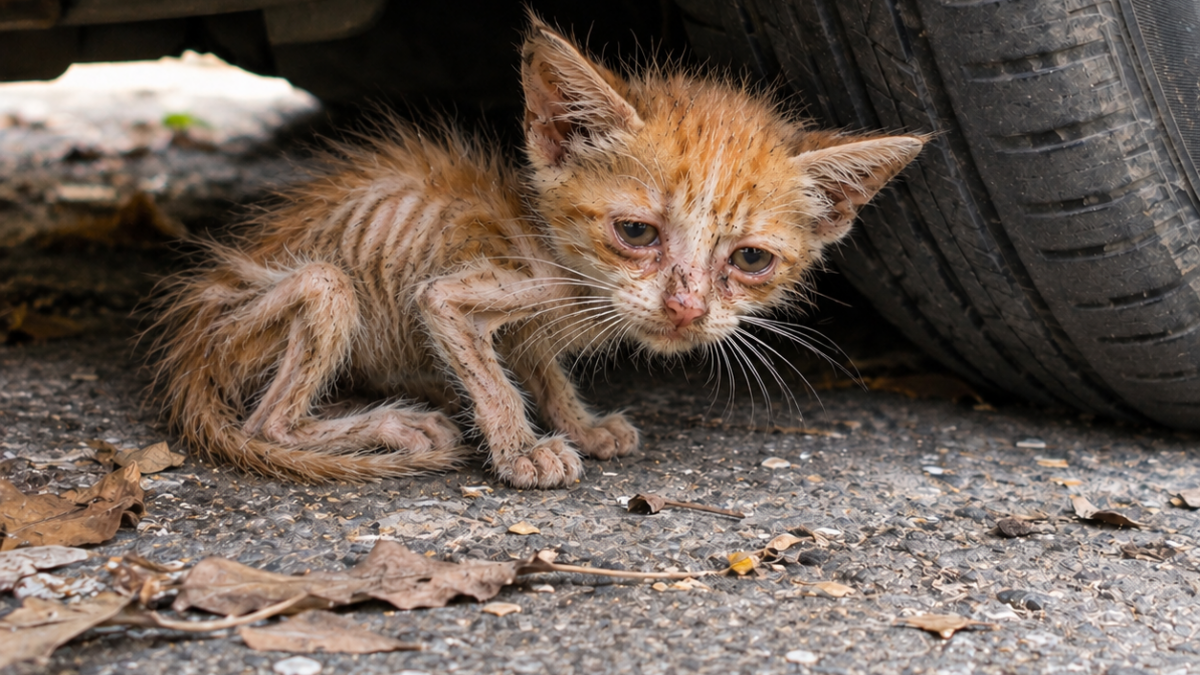
Dosoon was only about forty days old when rescuers found him alone beside a parked car, thin, weak, and still too young to survive easily without special feeding.
He did not hiss or try to run—he simply sat there quietly, as if he had already learned not to expect anyone to stop.
Then, after several careful days in a warm home, the tiny orange kitten looked into the eyes of the person holding him and made a sound nobody there was ready for.
The first thing people noticed about Dosoon was how easy he would have been to miss.
He was not crying loudly.
He was not trapped beneath machinery.
He was not limping through traffic.
There was no dramatic rescue scene demanding attention.
He was simply sitting beside a parked car.
Tiny.
Orange.
Quiet.
So small that if someone had walked past without looking down, he could have disappeared into the ordinary clutter of the street.
A tire.
A shadow.
A fallen leaf.
A frightened kitten.
All of them almost the same size from several steps away.
The rescuer stopped because something about the shape looked wrong.
At first, she thought the kitten might belong to someone nearby.
Perhaps his mother was under another car.
Perhaps siblings were hidden beneath a stairwell.
Perhaps somebody would open a door and call for him.
She waited.
Nobody came.
The kitten did not move.
That was the second thing she noticed.
A healthy street kitten around that age should have been suspicious.
He should have darted under the vehicle.
Flattened himself against the pavement.
Hissed.
Run.
Anything.
Instead, Dosoon sat with his paws close together and looked up.
His face was small even for his body.
Large ears.
Bright orange fur made dull by dust.
Eyes that seemed too serious for a kitten barely six weeks old.
The rescuer crouched.
“Hey.”
Dosoon blinked.
No hiss.
No movement backward.
She moved one hand slightly closer.
Still nothing.
Not trust.
She understood that almost immediately.
Exhaustion.
PART2:
There is a dangerous mistake people sometimes make with weak animals.
Stillness looks like gentleness.
A kitten does not fight.
So people say:
He is so sweet.
Maybe.
But sometimes an animal is not fighting because there is not enough strength left.
Dosoon seemed to exist somewhere between those two possibilities.
Naturally gentle.
And deeply tired.
The rescuer looked around again.
Cars.
Concrete.
Heat trapped between buildings.
No mother cat.
No bowl.
No person searching.
She took a photograph in case someone later claimed him.
Then waited another few minutes.
Dosoon lowered his head.
That decided it.
She reached slowly.
Her hand touched the side of his body.
The kitten flinched.
Only slightly.
Then remained still.
“You’re tiny.”
She slipped both hands beneath him.
Dosoon weighed almost nothing.
His ribs were not dramatically exposed, but his body lacked the soft fullness a well-fed kitten should have.
She could feel how young he was.
How little muscle existed.
He rested in her hands without struggling.
The rescuer looked into his face.
“Where’s your mother?”
Dosoon had no answer.
His head leaned against one finger.
The rescuer carried him inside.
That was the beginning.
No sirens.
No blood.
No surgery.
No dramatic wound.
Just one person noticing that a tiny life had nobody else visibly standing beside it.
At home, the first challenge appeared immediately.
Food.
Dosoon was around forty days old.
Young enough that the transition from milk to solid food was still important.
He was not a newborn.
But he was not fully independent either.
A kitten at that age should be learning to eat increasingly substantial food while still benefiting from soft, easily consumed nutrition.
Dosoon seemed behind.
When food was placed in front of him, he sniffed.
Then looked away.
The rescuer tried something softer.
Warm.
More aromatic.
Dosoon licked once.
Stopped.
His body needed nutrition.
But his instincts around eating did not yet seem reliable enough.
The rescuer contacted veterinary support.
The advice was cautious.
Monitor closely.
Keep him warm.
Offer appropriate kitten nutrition.
Small frequent meals.
Do not assume one refusal means he will eat later.
At this age and size, every meal matters.
That phrase stayed with her.
Every meal matters.
The rescuer set up a small area.
Not a cage.
A safe corner.
Soft blanket.
Low bed.
Warmth.
Food.
Water.
A shallow litter tray.
Dosoon looked around.
Then curled into the smallest possible shape.
He slept.
For hours.
The rescuer checked him repeatedly.
She told herself not to hover.
Then hovered anyway.
Is he breathing?
Yes.
Too fast?
Maybe.
Too slow?
No.
Warm enough?
Probably.
She touched the blanket.
Adjusted it.
Dosoon remained asleep.
The first night became an exercise in anxiety.
He ate a little.
Not enough to reassure her.
She prepared a more specialized feeding mixture appropriate for a kitten transitioning from milk.
Dosoon accepted some.
Then turned away.
She waited.
Tried again later.
A few more licks.
That counted.
The rescuer wrote the amount down.
She had not intended to start a feeding chart.
By midnight, she had one.
Time.
Amount.
Stool.
Water.
Activity.
Sleep.
Kittens look simple from the outside.
Feed them.
Keep them warm.
Let them sleep.
But when one is weak, every small behavior becomes information.
Dosoon slept with his head tucked toward his chest.
The rescuer watched.
“Come on, little guy.”
No response.
She lowered the light.
The room became quiet.
Several hours later, Dosoon woke.
He looked around.
For a moment, he seemed confused by the blanket.
Then he stood.
One step.
Another.
His legs looked stable but delicate.
The rescuer held her breath.
Dosoon walked toward the edge of the bed.
Stopped.
Looked at her.
She smiled.
“Hi.”
He sat.
That was all.
Then he curled again.
Still, she felt relief.
He had enough strength to stand.
Enough curiosity to look.
That night, the rescuer slept on the couch nearby.
Morning arrived without crisis.
That alone felt like a gift.
Dosoon ate a little more.
His stomach looked slightly round afterward.
The rescuer stared.
It was the first time he looked like a normal kitten for several minutes.
A tiny belly.
Warm body.
Sleepy eyes.
She took a picture.
Not because it was dramatic.
Because it looked ordinary.
And ordinary was suddenly beautiful.
The next few days were built around repetition.
Wake.
Food.
Rest.
Small amount of play.
Food.
Sleep.
Try litter box.
Sleep again.
The rescuer learned Dosoon’s rhythm.
He tired quickly.
A few minutes awake could be followed by an hour of sleep.
That was not unusual for kittens.
But she watched for signs of weakness.
If he became too quiet.
If he stopped eating.
If he felt cold.
If his belly became too distended.
If stool changed.
Everything mattered because his body was still catching up.
The feeding slowly improved.
At first, Dosoon needed encouragement.
A little food placed near his lips.
A small spoon.
Sometimes a syringe when he was not taking enough.
Not forced quickly.
Never enough to risk choking.
Just patient support.
“Come on.”
Dosoon licked.
“Good.”
Another.
“Good.”
He did not understand praise.
But the rescuer needed to say something.
The meals became conversations.
Mostly one-sided.
“You’re going to be trouble, I can tell.”
Dosoon licked food from the spoon.
“You look innocent now.”
Another lick.
“Temporary.”
His ears moved.
“That’s right.”
Food disappeared.
The rescuer smiled.
“See?”
The first big change was appetite.
Not dramatic.
Dosoon simply began showing up for food instead of being persuaded toward it.
He heard the small bowl.
Head up.
Nose moving.
One day he took several steps toward it.
The rescuer froze.
Dosoon reached the dish.
Smelled.
Then ate.
Not much.
But voluntarily.
That mattered.
The rescuer sat on the floor several feet away.
She did not interrupt.
Dosoon took another bite.
Then another.
His tiny stomach began rounding.
Afterward, he walked away and collapsed into sleep.
The rescuer laughed quietly.
“Eat. Sleep. Excellent career.”
The next meal was better.
Then another.
Within days, feeding changed from rescue task to routine.
Dosoon began developing a preference for certain textures.
One meal he ate happily.
Another he looked at as though insulted.
The rescuer stared.
“You were starving three days ago.”
Dosoon sniffed.
Walked away.
“You already have standards?”
She adjusted the meal.
Dosoon returned.
Ate.
“Unbelievable.”
His body started filling out.
The change was subtle at first.
Less sharp along the shoulders.
Slightly fuller face.
Rounder belly after meals.
His fur looked softer.
Not yet glossy.
But cleaner.
Health has a way of appearing first in details.
Eyes more alert.
Ears more responsive.
Body temperature stable.
Interest in the environment.
Dosoon became interested.
That was the next milestone.
The room stopped being merely a place where he slept and ate.
It became something to investigate.
A blanket edge moved.
Dosoon watched.
A cable shifted.
Head turn.
A shadow crossed the wall.
Eyes widened.
The rescuer moved one finger along the floor.
Dosoon followed it.
One paw lifted.
Touched.
The rescuer smiled.
“Okay.”
Finger moved again.
Dosoon pounced.
Or attempted to.
His body lunged forward with more enthusiasm than coordination.
He nearly fell sideways.
The rescuer laughed.
Dosoon looked offended.
“Sorry.”
He attacked the finger again.
That became the first game.
Not a toy.
Not officially.
But enough.
The next day, the rescuer offered a small soft ball.
Dosoon stared.
The ball rolled.
He watched it pass.
Nothing.
She rolled it back.
Dosoon’s paw moved.
Tap.
Ball rolled.
Dosoon froze.
The object had obeyed him.
He tapped again.
Stronger.
Ball moved farther.
Within minutes, he was chasing it.
Not fast.
Not gracefully.
But with the determination of someone discovering physics.
The rescuer watched, smiling.
The kitten who had sat silently beside a car was beginning to interact with the world.
That mattered more than anyone outside the room would understand.
A weak animal conserves energy.
A recovering animal spends it on curiosity.
Dosoon was spending.
Then sleeping.
A lot.
After every small burst of activity, his body demanded rest.
The rescuer respected that.
No endless play.
No showing him off.
No constant handling just because he was cute.
Sleep was growth.
Sleep was recovery.
Sleep mattered.
His bed became his sanctuary.
At first, he curled tightly.
Later, he stretched.
One leg.
Then two.
Sometimes belly partly exposed.
That posture changed how the rescuer felt.
A vulnerable animal does not casually expose the body if it expects immediate danger.
Dosoon was beginning to believe the room would remain safe while he slept.
The first purr came unexpectedly.
The rescuer was holding him after a feeding.
Not tightly.
One hand supported the chest.
The other rested along his side.
Dosoon had become warmer and heavier than on the first day, though still tiny.
He looked at her.
The rescuer looked back.
“Full?”
Dosoon blinked.
His body relaxed slightly.
Then something vibrated against her palm.
She stopped breathing.
A purr.
So faint that for a second she thought it was her own imagination.
Then again.
Tiny.
Steady.
The rescuer looked toward the other person in the room.
“Do you hear that?”
Silence.
Dosoon purred again.
The room went completely still.
Nobody wanted to move.
The rescuer looked down.
The kitten’s eyes were half closed.
His head rested against her chest.
Purr.
Purr.
She whispered:
“Oh my God.”
Nobody answered.
There was nothing useful to say.
It was not that Dosoon had literally never purred before.
No one could know that.
They did not know every moment of his first forty days.
But it was the first time they had heard it.
And because he had been found alone, weak, underfed and too quiet to resist being lifted, the sound carried emotional weight far beyond its volume.
Purring does not always mean happiness.
Cats can purr when frightened.
In pain.
While self-soothing.
The rescuer knew that.
Still, Dosoon’s body looked different.
Loose.
Warm.
No tension.
No attempt to escape.
He had eaten.
He was being held.
He seemed comfortable.
The rescuer’s eyes filled.
Dosoon continued.
“Okay.”
She did not squeeze him tighter.
Did not turn the moment into a dramatic hug.
She simply held him the same way.
Supported.
Loose.
Easy to leave.
Dosoon stayed.
That choice mattered.
A few minutes later, he moved.
The rescuer let him.
Dosoon climbed from her lap.
Walked toward the blanket.
Turned.
Collapsed into sleep.
The rescuer looked at the person beside her.
“Did that really happen?”
“Yes.”
“He purred.”
“Yes.”
They both laughed.
The moment became one of those memories that mattered more later than anyone expected.
Because it marked the beginning of something.
Not just recovery.
Relationship.
Dosoon had started associating human arms with warmth.
Food.
Safety.
That was a powerful shift.
Trust in young animals can develop quickly when their environment becomes consistently safe.
But quick does not mean meaningless.
Every experience still teaches.
Hands can grab.
Or support.
Voices can frighten.
Or predict food.
Being held can mean restraint.
Or warmth.
Dosoon was learning one version.
The gentler one.
The rescuer became careful not to take advantage of his softness.
Because Dosoon was calm, people naturally wanted to hold him.
But he was still very young.
Rest mattered.
Choice mattered.
So visits remained controlled.
No passing him from person to person.
No constant stimulation.
If Dosoon moved away, he was allowed.
That became normal.
The result was the opposite of what some people might expect.
The less people forced contact, the more Dosoon sought it.
He began walking toward the rescuer.
At first for food.
Then without food.
A few steps.
Sit near her.
Look up.
She offered a hand.
Dosoon sniffed.
Rubbed his cheek once.
Then left.
Next day, again.
Soon he began climbing onto her lap.
Not every time.
But often.
His favorite place after meals became the warm space against her body.
Round belly.
Sleepy eyes.
Purr.
The rescuer joked:
“You’re using me as furniture.”
Dosoon closed his eyes.
“Good talk.”
His weight continued improving.
The rescuer kept tracking.
Not obsessively forever.
Just during the vulnerable period.
A few grams.
Then more.
The number moved upward.
His body was growing rather than merely surviving.
The veterinarian was pleased.
“Appetite?”
“Good.”
“Stool?”
“Normal.”
“Energy?”
“Too much.”
The veterinarian smiled.
“That’s appropriate.”
“Can you reduce it?”
“No.”
“Unfortunate.”
Dosoon sat on the examination table staring at a metal instrument.
Then reached for it.
The veterinarian moved it.
“Definitely improving.”
The checkup confirmed what everyone could already see.
No major illness.
Good hydration.
Body condition improving.
Continue appropriate kitten nutrition.
Continue monitoring.
Continue normal developmental care.
The rescuer exhaled.
That appointment felt like permission to stop expecting disaster every hour.
Not completely.
The anxiety lingered.
Caretakers sometimes need longer to recover from a rescue than the animal does.
The first several days had trained her nervous system to monitor Dosoon constantly.
Is he eating?
Is he warm?
Is he breathing?
Is he gaining?
Even when the answers became yes, the questions kept appearing automatically.
She had to relearn too.
One afternoon Dosoon slept longer than usual.
The rescuer touched his side.
He opened one eye.
She immediately felt ridiculous.
“Sorry.”
Dosoon closed it again.
“You’re just sleeping.”
No response.
“Normal kitten activity.”
Purr.
She laughed.
“Fine.”
Another developmental challenge appeared.
Litter box.
Dosoon understood some things instinctively.
Others required guidance.
A shallow tray had been placed near his area.
At first, he investigated it like any other object.
Sniff.
Step in.
Step out.
Dig once.
Leave.
The rescuer thought:
Maybe he understands.
Then Dosoon urinated on a towel.
“No.”
He looked at her.
“Okay. You’re a baby.”
She cleaned it thoroughly.
No punishment.
No shouting.
The towel disappeared.
After meals and naps, Dosoon was gently placed near the litter tray.
Not trapped.
Just shown.
He stepped inside.
Sniffed.
Dug.
Left.
Again later.
Day after day.
Sometimes success.
Sometimes confusion.
One morning the rescuer heard scratching.
She looked.
Dosoon was in the litter box.
Digging with enormous seriousness.
He stopped.
Turned.
Used it properly.
Then covered the spot.
The rescuer stared.
“You did it.”
Dosoon continued digging.
“You did it!”
He looked up.
She lowered her voice.
“Sorry.”
Dosoon stepped out.
The rescuer laughed.
Another ordinary milestone.
Huge to the person caring for him.
Independent eating.
Litter box.
Play.
Sleep.
Each step made Dosoon less fragile.
More like a kitten moving naturally through development.
By day five or six, the transformation was already obvious.
The quiet kitten had started disappearing.
In his place:
Chaos.
Orange chaos.
He chased toys.
Climbed over pillows.
Investigated shoes.
Attacked fabric.
Followed moving feet.
The rescuer learned to watch where she stepped.
One morning Dosoon appeared behind her heel.
She nearly tripped.
“Sir.”
Dosoon looked up.
“You are four inches tall.”
He meowed.
“You cannot walk directly beneath me.”
He did anyway.
The rescuer changed how she walked.
That was the beginning of Dosoon reorganizing the household.
His appetite became almost comic.
The kitten who once needed encouragement now heard the feeding bowl from another room.
Metal against counter.
Dosoon appeared.
“How?”
Meow.
“You were asleep.”
Meow.
“You can hear food through walls?”
Louder meow.
The bowl went down.
Dosoon ate.
His belly became round.
Not dangerously bloated.
Just the full little kitten stomach the rescuer had wanted so badly to see.
Afterward, Dosoon sat like a tiny orange pear.
The rescuer took pictures.
Every time.
She could not help it.
The round belly represented security.
Food inside.
Enough calories.
No empty stomach.
No guessing where the next meal came from.
Eventually the rescuer stopped photographing every meal.
That too was progress.
Food became ordinary.
It was always going to be there.
Dosoon learned that quickly.
He stopped eating as though each bowl might be the last.
His pace became calmer.
Sometimes he left a little and returned later.
The rescuer noticed.
That tiny behavior told her something important.
Dosoon expected the bowl to remain.
Expectation is one of the most meaningful signs of security.
An animal living with scarcity often behaves as if resources can disappear.
An animal who feels safe begins believing there will be more.
Dosoon began believing.
More food.
More sleep.
More warmth.
More morning.
More human contact.
His curiosity expanded.
Sounds that once made him still now made him investigate.
A drawer opened.
Dosoon appeared.
Paper crinkled.
Dosoon.
A bag placed on the floor.
Dosoon inside it before anyone could stop him.
The rescuer laughed.
“You were terrified of everything six days ago.”
Dosoon attacked the bag handle.
“Never mind.”
He discovered mirrors.
That experience lasted several minutes.
Dosoon saw another orange kitten.
Froze.
Moved left.
The other kitten moved.
Dosoon moved right.
Same.
He puffed slightly.
Approached.
Sniffed glass.
Nothing.
Touched it with a paw.
The other kitten touched too.
Dosoon looked behind the mirror.
No cat.
The rescuer nearly cried laughing.
“Very advanced.”
Dosoon ignored her.
He checked again.
Eventually decided the mirror cat was irrelevant.
The next discovery:
His tail.
This became an ongoing conflict.
Dosoon would turn.
See movement.
Chase.
Spin.
Lose balance.
Fall.
Stand.
Repeat.
The rescuer watched from the floor.
“You know that belongs to you?”
Dosoon bit the tail.
“Apparently not.”
His coordination improved every day.
At forty days, kittens are still learning what their bodies can do.
Dosoon had started weak.
Now strength gave him opportunities to experiment.
Jump from cushion.
Climb low furniture.
Run too fast.
Stop too late.
Slide.
Get up.
Again.
Nothing made the rescuer happier than watching him fail at normal kitten things.
Failure meant participation.
You cannot tumble off a cushion if you are too weak to climb it.
You cannot chase your tail if you are lying exhausted.
Dosoon’s mistakes were evidence of life getting larger.
The eleventh day became the point everyone later mentioned.
Not because something miraculous happened exactly on day eleven.
Because the difference between the first day and the eleventh was astonishing.
Day one:
Tiny kitten beside a car.
Underweight.
Too young to be fully independent.
Quiet.
Weak.
Uncertain around food.
Day eleven:
Eating well.
Using the litter box.
Playing.
Sleeping deeply.
Following people.
Purring.
Exploring.
Demanding attention.
The rescuer held two photographs side by side.
Same kitten.
Same orange fur.
But everything else looked different.
His eyes.
Posture.
The way he occupied space.
The first photograph showed a kitten trying not to disappear.
The later photograph showed one who assumed the room belonged to him.
That transformation could tempt people into romantic language.
Love changed him overnight.
It did not.
Food changed him.
Warmth changed him.
Sleep.
Routine.
Appropriate care.
Development.
Safety.
And yes, affection mattered.
But affection worked because the practical needs came first.
A starving kitten cannot live on cuddles.
Dosoon needed calories.
Temperature stability.
Age-appropriate nutrition.
A clean environment.
Veterinary oversight.
Then love had a body strong enough to receive it.
That mattered.
The rescuer did not want his story reduced to:
Love saves everything.
Kindness is powerful.
But kindness should become action.
Notice.
Pick up.
Feed correctly.
Monitor.
Seek veterinary guidance.
Provide warmth.
Teach.
Stay.
That was what changed Dosoon’s life.
The bond was the beautiful result.
By the second week, Dosoon began following the rescuer.
Kitchen.
Living room.
Hallway.
If she disappeared behind a door, he waited.
Sometimes complained.
“Dosoon.”
Meow.
“I’m in the bathroom.”
Meow.
“This is not an emergency.”
Meow.
She opened the door.
Dosoon walked away.
The rescuer stared.
“You just wanted proof.”
He ignored her.
That became their relationship.
Dosoon needed to know where she was.
Not constantly.
But enough.
The rescuer wondered whether early separation had made him more attached.
Maybe.
Or maybe he was simply social.
No one knew.
There was no need to invent trauma beyond what had been observed.
Dosoon had been found alone.
That was fact.
Whatever came before was unknown.
His behavior now was what mattered.
He chose proximity.
His purr became louder.
The first one had been tiny.
Almost secret.
Within weeks, Dosoon sounded like a small engine.
The rescuer could feel it before hearing it.
Pick him up.
Purr.
Head scratch.
Purr.
Warm blanket.
Purr.
Food sometimes triggered purring too.
The rescuer joked that his emotional range had collapsed into one setting.
Happy?
Purr.
Hungry?
Purr.
Sleepy?
Purr.
Being annoying?
Also purr.
One evening Dosoon climbed onto her chest.
Turned in three circles.
Lay down directly beneath her chin.
The rescuer tried moving him slightly.
Dosoon protested.
“Your tail is in my face.”
Purr.
“I cannot breathe.”
Purr.
“This is abuse.”
Dosoon stretched.
She stopped arguing.
This was what she had wanted without realizing it on that first day.
Not specifically a cat sleeping on her face.
But a kitten comfortable enough to become inconvenient.
Safety produces inconvenience.
Hungry animals do not demand specific bowls.
Terrified animals do not interrupt phone calls for attention.
Weak kittens do not attack socks.
Dosoon did all of it.
Beautiful.
The question of adoption arrived sooner than the rescuer wanted.
People who saw pictures asked.
“Will he need a home?”
“Is Dosoon available?”
“Can I adopt him?”
The rescuer had expected this.
He was orange.
Tiny.
Cute.
Healthy now.
Young kittens rarely struggle to attract attention.
She should have felt relieved.
Instead, each message created tension.
She told herself the normal things.
You rescued him.
You foster him.
You find him a good home.
Then you help another.
That was how rescue worked.
One person cannot keep every animal.
Dosoon did not seem concerned.
He continued destroying a paper bag.
The rescuer watched.
“People want you.”
Dosoon bit the edge.
“A lot of people.”
Tear.
“You could have a nice family.”
Dosoon climbed into the bag.
“You don’t care.”
The bag moved across the floor.
“Great conversation.”
The rescuer began reviewing potential homes.
Good people.
Safe homes.
People with veterinary references.
Families who understood kitten care.
Objectively, several were excellent.
Still, something felt wrong.
She questioned herself.
Attachment is not always a reason to keep a foster.
Sometimes letting go makes space to save another.
She knew that.
She had told other people that.
Now the advice felt very annoying.
Dosoon made it worse.
He had developed a habit of sleeping against her neck.
At night, he climbed into the crook of her shoulder.
Warm orange body.
Purr.
One night she looked down.
“You cannot do this while I’m trying to emotionally detach.”
Dosoon slept.
“Very manipulative.”
Nothing.
She touched his back.
The kitten stretched.
The rescuer sighed.
The decision came during an ordinary afternoon.
Dosoon was playing.
The rescuer received another adoption inquiry.
Excellent home.
She opened the message.
Read it.
Then looked at Dosoon.
He was chasing the ball.
He caught it.
Turned.
Saw her.
Immediately ran toward her.
No food.
No fear.
No reason except recognition.
He reached her feet.
Climbed one pant leg halfway before she stopped him.
“Absolutely not.”
Dosoon looked up.
Purr.
The rescuer suddenly knew.
Not because Dosoon could not thrive elsewhere.
He probably could.
Not because another family would fail him.
They might have been wonderful.
But because the question had changed.
Could she provide a permanent appropriate home?
Yes.
Did she want to?
Yes.
Was the only reason she was considering letting him go the belief that a rescuer was supposed to?
Yes.
She picked Dosoon up.
He immediately settled.
“Okay.”
Purr.
“You win.”
Purr.
“I’m serious.”
Dosoon bit her drawstring.
“Terrible timing.”
The adoption paperwork was completed.
The rescuer became Dosoon’s official family.
People congratulated her.
Someone called it a foster failure.
She laughed.
It did not feel like failure.
Dosoon had gone from alone beside a car to permanently belonging somewhere.
That was the assignment.
The route had simply changed.
Home was already the place he lived.
Now the paperwork caught up.
Nothing changed for Dosoon that evening.
Same bowl.
Same room.
Same person.
Same blanket.
He did not know a form had been signed.
Animals understand consistency better than contracts.
Dosoon had already known.
This person feeds me.
This person comes back.
This is where I sleep.
This is where I play.
This is where I am safe.
That was adoption in his language.
As he grew, his personality became more obvious.
Playful.
Curious.
Social.
Determined.
Slightly dramatic around food.
Extremely dramatic around closed doors.
He loved warm spaces.
Sunlight.
Blankets.
Laps.
Laptop computers.
The rescuer discovered the laptop habit while working one morning.
Dosoon climbed onto the desk.
She moved him.
He returned.
She moved him again.
Dosoon climbed directly onto the keyboard.
Random letters appeared.
“Dosoon.”
He sat.
“I need that.”
Purr.
“This is not a bed.”
Dosoon lowered his body.
“You have four beds.”
Eyes closed.
The rescuer worked around him.
That was how Dosoon won most negotiations.
He became bigger but never enormous.
A compact orange cat with bright eyes and the confident walk of someone who had forgotten he was ever fragile.
The rescuer did not forget.
Not completely.
Sometimes she caught herself watching him eat.
Not because anything was wrong.
Because memory remained.
Dosoon lowered his head into the bowl.
Chewed.
Swallowed.
Moved to the next bite.
Normal.
The rescuer remembered the first days.
Would he eat enough?
Would he gain?
Would his tiny body make it through the night?
Now she worried about him stealing food from another plate.
Good problem.
One day Dosoon somehow obtained a piece of chicken from the counter.
The rescuer caught him.
“Excuse me.”
Dosoon froze.
Chicken in mouth.
“Drop it.”
He ran.
The rescuer laughed while chasing him.
“Forty-day-old you would be ashamed.”
Dosoon disappeared under a chair.
He ate the chicken.
“Criminal.”
Orange face appeared.
No regret.
His health remained good.
Routine veterinary care.
Growth.
Vaccinations as appropriate.
Parasite control.
Weight monitoring.
No dramatic illnesses.
That allowed Dosoon’s rescue story to recede naturally.
Eventually, most days did not involve remembering the car at all.
That was healthy.
Animals deserve to become more than the worst circumstance in which humans first saw them.
Dosoon became:
The cat who steals hair ties.
The cat who sleeps on keyboards.
The cat who knows exactly when dinner should happen.
The cat who waits outside the bathroom.
The cat who attacks blanket-covered feet.
The cat who runs through the house at three in the morning.
Much better identities.
His litter-box training remained solid.
The rescuer occasionally laughed remembering how proud she had been the first time.
“You learned toilet etiquette before social etiquette.”
Dosoon scratched the sofa.
“Exactly.”
The sofa survived.
Mostly.
The rescuer provided scratchers.
Dosoon used them.
And occasionally the sofa anyway.
Normal.
His appetite remained excellent.
That round kitten belly eventually became the sleek body of a growing cat.
The rescuer made sure not to confuse loving him with overfeeding him.
Food had once represented survival.
Now nutrition had to represent health.
Proper portions.
Balanced meals.
Treats controlled.
Dosoon disagreed with the final point.
Every treat was apparently insufficient.
He learned the sound of containers.
Cupboard.
Drawer.
Packet.
If something crinkled, Dosoon appeared.
“You were asleep.”
Meow.
“From another room.”
Meow.
“Impossible.”
The rescuer opened a non-food package.
Dosoon stared.
“No treat.”
He looked personally betrayed.
The first purr remained one of the rescuer’s favorite memories.
People sometimes asked:
“When did you know he trusted you?”
She thought about several moments.
The first meal.
Sleeping in her arms.
Following her.
Choosing her lap.
But she always returned to the purr.
Not because purring scientifically proves trust.
It does not.
Because of the context.
Tiny body.
Warm embrace.
Relaxed posture.
No struggling.
A kitten who had been quiet from exhaustion beginning to make a sound associated, in that moment, with comfort.
That was the first time she felt the relationship moving both ways.
She was not only keeping Dosoon alive.
Dosoon was responding to her.
Connection had started.
That connection deepened without becoming dependency in an unhealthy way.
Dosoon could play alone.
Sleep separately.
Explore.
Spend time with other trusted people.
That mattered.
The rescuer did not want to create a cat unable to function without constant contact.
Safety should expand a life.
Not shrink it around one person.
Dosoon became social.
Visitors who followed his pace often earned attention quickly.
He sniffed shoes.
Investigated bags.
Sometimes climbed into laps without invitation.
One friend came over wearing an open hoodie.
Dosoon climbed halfway inside.
The friend froze.
“What do I do?”
“Nothing.”
“He’s inside my clothes.”
“Yes.”
“Is this normal?”
“For him?”
“Yes.”
Dosoon purred.
The friend looked at the rescuer.
“I understand why you kept him.”
Exactly.
Dosoon had a way of making ordinary closeness feel important because people knew where he started.
But his rescuer remained careful.
His past should not make every normal behavior sentimental.
Sometimes Dosoon climbed onto a person because the hoodie was warm.
That was enough.
Not every moment needed symbolism.
Still, some moments found it anyway.
One morning the rescuer parked near the place Dosoon had originally been found.
Not intentionally.
Errand nearby.
She looked toward the row of cars.
For a second, memory replaced the present.
Tiny orange shape.
Concrete.
Silence.
She imagined how small he had looked.
Then she looked at the passenger carrier.
Dosoon was not with her that day.
He was home.
Probably asleep on the laptop.
The rescuer smiled.
The place had not changed.
Dosoon had.
Or perhaps the better way to say it:
Dosoon had been given enough time to grow into who he already had the potential to become.
That is what rescue often does.
It does not manufacture worth.
The worth was there.
Rescue creates conditions where that life can continue.
Food.
Shelter.
Medicine.
Safety.
Time.
Then the animal does the rest.
Dosoon grew.
Years later, people who saw his earliest photograph sometimes struggled to believe it was him.
“So tiny.”
“Yes.”
“He looks sad.”
“He was tired.”
“Was he sick?”
“Mostly weak and undernourished, still young enough to need careful feeding.”
“Did you know you’d keep him?”
“No.”
The rescuer always laughed at that.
“No idea.”
If someone had told her that the silent kitten beside the car would someday control household meal schedules, she would not have believed them.
Dosoon matured into the kind of cat who considered human sleep optional.
At dawn:
Paw.
No response.
Paw again.
The rescuer opened one eye.
“Too early.”
Meow.
“It’s five-thirty.”
Meow.
“You do not eat until six.”
Dosoon sat on her chest.
“Threatening me will not work.”
Purr.
“Emotional manipulation.”
Purr louder.
At 5:42, breakfast usually happened.
Dosoon had trained the human successfully.
His routine was stable.
Morning meal.
Window watch.
Play.
Nap.
More play.
Evening meal.
House patrol.
Bed.
Repeat.
Eat.
Play.
Sleep.
The same simple cycle the rescuer had hoped for during his first vulnerable days.
Back then, the phrase had been a dream.
Now it was boring.
Perfectly boring.
The rescuer occasionally shared updates with people who had followed him.
Dosoon sunbathing.
Dosoon sleeping.
Dosoon inside a box too small for him.
Dosoon staring at food.
Comments arrived.
“He looks amazing.”
“He got so big.”
“Such a handsome boy.”
“He knows he’s loved.”
That last one always made the rescuer pause.
Did Dosoon know the abstract idea of love?
Who could say?
But he knew its routines.
Food arrives.
The hand is gentle.
The bed is warm.
The door opens again.
Nobody leaves him beside a car.
No one makes him search for milk.
He does not sleep hungry.
He can close his eyes completely.
If that is not the word love, it is at least the life love creates.
Dosoon had that.
The rescuer also became more observant of other kittens after him.
Whenever she saw one alone, she stopped before assuming.
Is the mother nearby?
Is the kitten healthy?
Does intervention help or disrupt?
Dosoon had taught her that rescue begins with attention, but attention should include judgment.
Not every kitten alone for ten minutes is abandoned.
Not every small cat needs immediate removal.
But Dosoon had been weak.
Quiet.
Without a visible caregiver.
And young enough that waiting indefinitely carried risk.
The decision to help had mattered.
His story became a reminder to notice without rushing into assumptions.
That nuance mattered to the rescuer.
She never wanted his story turned into a slogan that encouraged people to snatch healthy kittens away from their mothers.
Dosoon’s case was his case.
Individual.
Real.
The principle was simpler.
Pay attention.
If something is wrong, act responsibly.
The rescuer did.
Dosoon lived.
Sometimes that was enough of a lesson.
As Dosoon grew older, the first blanket remained in the house.
Not because Dosoon cared.
He had many better blankets.
The rescuer kept it.
Soft fabric.
Faded.
A little worn.
The place where he had slept during those first uncertain nights.
One day she took it from storage.
Dosoon sniffed.
Walked over it.
Then chose a cardboard box instead.
The rescuer laughed.
“Sentimental value means nothing to you.”
Dosoon curled inside the box.
“Correct.”
She kept the blanket anyway.
Human memory needed objects.
Cats did not.
Dosoon lived almost completely in the present.
Warm today.
Hungry now.
Play now.
Sleep now.
That may have been part of why he adapted so beautifully.
No one asked him to carry the story for them.
The humans remembered.
Dosoon lived.
One evening the rescuer sat with the old photograph on her phone.
Forty-day-old Dosoon beside the car.
She looked at the adult cat sleeping nearby.
His body now took up most of the cushion.
She whispered:
“You looked like the wind could take you.”
Dosoon’s ear moved.
“Now you’re heavy.”
One eye opened.
“That’s a compliment.”
The eye closed.
She smiled.
The rescue had not changed the world.
Millions of street cats still struggled.
Other kittens still needed help.
Dosoon’s survival did not solve that.
But rescue rarely happens at the scale of the entire problem.
It happens one body at a time.
One bowl.
One litter box.
One bed.
One clinic visit.
One person stopping.
That scale can feel small.
To Dosoon, it was everything.
The difference between being unnoticed beside a car and sleeping with a full belly in a safe home is not small to the life experiencing it.
That was why the rescuer never dismissed individual rescue as meaningless.
You do what you can.
One animal does not become all animals.
But one animal is still one complete life.
Dosoon got his.
The orange kitten’s first weeks of safety became months.
Then years.
The questions changed.
Will he survive tonight?
Became:
Why is he awake at five?
Will he eat enough?
Became:
How did he open the treat drawer?
Will he gain weight?
Became:
Stop stealing chicken.
Will he learn the litter box?
Became:
Why are you digging litter onto the entire floor?
Will he trust people?
Became:
Please get off my chest.
Those were excellent problems.
The rescuer appreciated them even while complaining.
Especially while complaining.
Because normal frustration is a luxury compared with emergency fear.
Dosoon became healthy enough to annoy.
Safe enough to demand.
Loved enough to assume.
That final word mattered.
Assume.
He assumed breakfast.
Assumed warmth.
Assumed someone would answer his meow.
Assumed the bed was his.
Assumed the person would return.
An abandoned or vulnerable young animal cannot begin with those assumptions.
They have to be taught.
Dosoon learned through repetition.
Nothing bad today.
Again tomorrow.
Again.
Again.
Eventually safety stops feeling temporary.
It becomes reality.
That is what home did for him.
The first purr became a memory.
The warm embrace became normal.
Years after that first fragile vibration, Dosoon could purr loudly enough to be heard across a quiet room.
He would climb beside the rescuer.
Push his forehead against her.
Curl.
Purr.
She sometimes laughed.
“You were so quiet.”
Dosoon purred louder.
“You had no opinions.”
Meow.
“Now you have all of them.”
He settled.
The rescuer rested her hand over him.
There was no need to hold tightly.
Dosoon was not going anywhere.
That was the difference.
The first time she held him, she had been afraid that letting go might mean losing him.
Now she could open her arms completely.
Dosoon could leave whenever he wanted.
Most nights, he stayed.
That choice carried more meaning than any forced cuddle ever could.
Dosoon’s story did not need a larger miracle.
He did not survive a catastrophic surgery.
Did not relearn walking.
Did not defeat some rare disease.
His story was quieter.
That was part of its power.
A tiny kitten was found early enough that ordinary care could become extraordinary in consequence.
He needed nutrition.
Warmth.
Monitoring.
Developmental support.
Patience.
A home.
He received them.
Sometimes rescue means preventing the dramatic tragedy instead of surviving it afterward.
Dosoon was found while he still had a chance to grow normally.
The people around him took that chance seriously.
Every meal mattered.
Every nap mattered.
Every day mattered.
Then, eventually, meals became just meals.
Naps became naps.
Days became life.
That was success.
The rescuer stopped counting how many days he had been safe.
At first:
Day one.
Day three.
Day eleven.
One month.
Then she forgot.
The calendar no longer mattered because Dosoon was not on probation with life.
He belonged.
That was perhaps the final stage of rescue.
Not when the animal eats.
Not adoption paperwork.
When everyone stops thinking of safety as temporary.
Dosoon reached that point.
His food lived in the cupboard.
His toys stayed scattered across the floor.
His name was used in ordinary sentences.
“Dosoon, move.”
“Dosoon, dinner.”
“Where’s Dosoon?”
“Dosoon, stop.”
Nothing ceremonial.
Family names are used that way.
Constantly.
Casually.
Because the person or animal is assumed to be part of tomorrow.
Dosoon had become part of tomorrow.
The kitten beside the car could not have known any of this.
He could not know the person crouching toward him would become the person whose footsteps he recognized.
He could not know the strange bowl would become something he demanded every morning.
He could not know the blanket would lead to beds.
The hands to hugs.
The first purr to thousands more.
He simply sat.
Small.
Weak.
Quiet.
And someone stopped.
That was enough to begin.
Everything after came from continuing.
One meal.
Then another.
One night.
Then another.
One small success.
Then the next.
Dosoon did not transform because somebody loved him in one dramatic moment.
He transformed because care became consistent enough that his body could grow and his mind could relax.
Food.
Warmth.
Sleep.
Play.
Routine.
Gentle touch.
Those things sound ordinary.
That is why people underestimate them.
To a kitten without them, ordinary is life-changing.
Dosoon learned what ordinary felt like.
A full belly.
A clean litter box.
Sunlight.
A toy.
A familiar lap.
The sound of a person coming home.
His first purr did not promise the ending.
It simply told the people around him that, for one quiet moment, the tiny kitten in their arms felt safe enough to let go.
Then they gave him another moment.
And another.
Until safety was no longer a moment.
It was his life.
Today, Dosoon no longer looks like a kitten who could disappear with the wind.
He is bright-eyed.
Playful.
Curious.
Healthy.
Confident enough to demand what he wants.
Affectionate enough to climb into the same arms that once held him so carefully.
He has toys.
Warm places to sleep.
Food prepared for him.
A litter box he now understands perfectly.
A home with the person who noticed him.
And when he settles into that familiar embrace, his body heavy with the healthy weight everyone once hoped he would gain, the purr begins almost immediately.
Loud.
Steady.
Certain.
Nobody becomes speechless anymore.
They smile.
Because the sound that once felt like a miracle has become part of the house.
And maybe that is the best ending of all.
Not that Dosoon purred once.
That he grew up somewhere safe enough to keep doing it.








