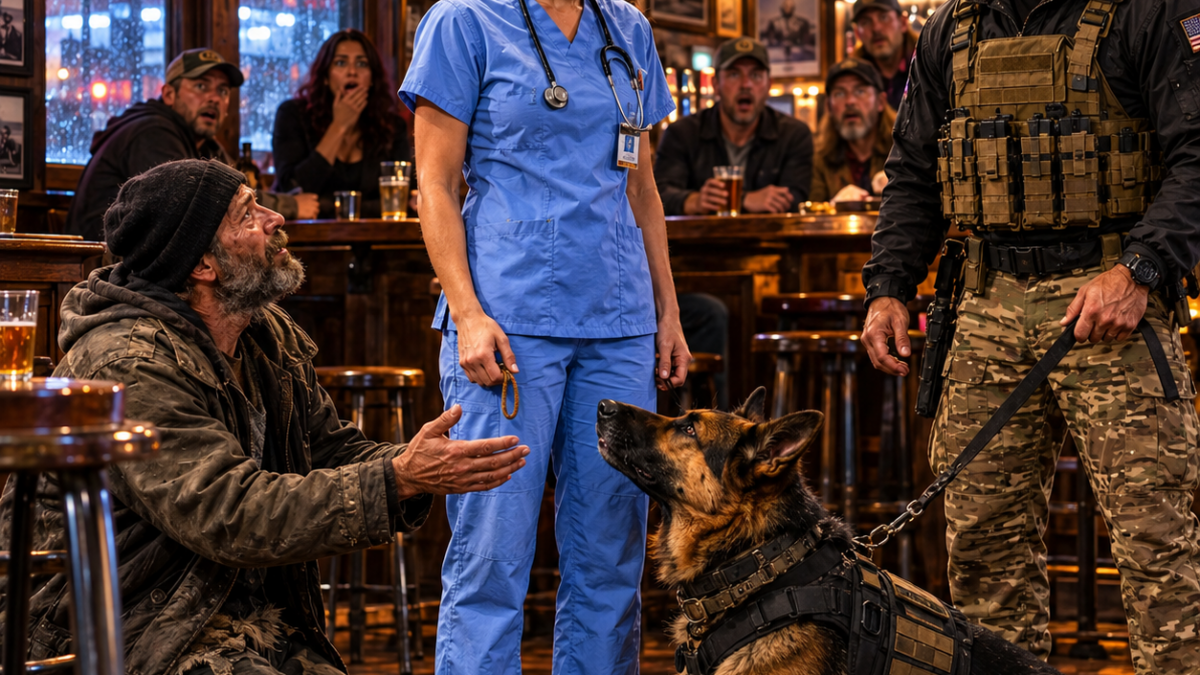
“Don’t Touch Him,” the Navy SEAL Warned—Then His K9 Broke Away, Ran Straight to the Overlooked Nurse, and Refused to Leave Her Side.
PART2:
That Thursday night had already been fourteen hours long when Dr. Imani Reed caught me closing a chart at the central desk.
She looked at the wall clock.
Then me.
Then the clock again.
“You know your shift ended forty-two minutes ago?”
“My documentation disagrees.”
“Your documentation needs therapy.”
“I’ll refer it.”
Imani folded her arms.
“Go home.”
“Room eleven is still waiting for transport.”
“The day team can—”
“They’ve been saying that for an hour.”
Imani sighed.
She knew.
Room eleven held a seventeen-year-old boy named Caleb who had been treated after getting assaulted outside a bus station.
Nothing life-threatening.
Bruised ribs.
Split lip.
No parent.
No coat.
His aunt had stopped answering.
A shelter bed had been found.
Transportation had not.
I looked through the glass.
PART3:
He sat on the edge of the bed holding a clear plastic bag containing everything he owned.
Imani looked too.
“You do this to yourself.”
“I’m aware.”
“You cannot rescue every person.”
“I’m also aware.”
“Those two sentences don’t seem connected in your brain.”
“Probably not.”
Twenty minutes later, a transport van finally arrived.
Caleb stood.
I handed him my rain jacket.
He stared.
“What about you?”
“I own another.”
That was technically true.
It was at home.
He hesitated.
“Take it.”
He did.
I watched the van leave.
Then walked through the emergency entrance into cold Tacoma rain wearing only scrubs and a thin long-sleeved undershirt.
The hospital lights turned the wet pavement silver.
Ambulances hissed through puddles.
It was almost eleven.
I was thinking about my apartment.
Hot shower.
Cereal.
Sleep.
Then I saw a man sitting beneath the narrow shelter beside the building.
Gray beard.
Soaked military surplus coat.
One boot missing.
One bare foot resting on the pavement.
The other wrapped in something that might once have been gauze.
Blood had soaked through.
I stopped.
“Sir.”
His head lifted.
His eyes were sharp despite the exhaustion on his face.
“I’m fine.”
“No.”
He almost smiled.
“No?”
“You are bleeding through a bandage while sitting barefoot in November rain.”
“I’ve been worse.”
“That doesn’t make this good.”
His gaze moved toward the automatic hospital doors.
“I’m not going inside.”
“Why?”
“Because I said so.”
“That is not usually a medical reason.”
“It is tonight.”
I should have called security.
Hospital policy would have supported it.
Instead I sat on a concrete ledge several feet away.
The man watched.
“You going to drag me in?”
“No.”
“Call somebody?”
“No.”
“You people always call somebody.”
“Then tonight can be exciting.”
Rain moved between us.
He looked toward my shoes.
“They let nurses wear those?”
“Yes.”
“They’re ugly.”
“They were advertised as ergonomic.”
“You got robbed.”
That surprised a laugh out of me.
He looked almost pleased.
“What’s your name?”
“Tomas Creed.”
“Maris Bell.”
“I didn’t ask.”
“Now you know.”
Tomas shook his head.
“You always talk this much?”
“Only when strangers are bleeding near my workplace.”
I took the small emergency pouch from my work bag.
“Can I clean your foot?”
“No.”
“Okay.”
I waited.
People underestimate waiting.
We are taught to fill silence.
Silence frightens professionals because it feels like failure.
Sometimes silence is the first time a frightened person has been given control.
Five minutes passed.
Tomas looked down at his foot.
Then toward me.
“You really going to sit there all night?”
“No. I have cereal.”
He laughed softly.
“Fine.”
“Fine what?”
“You can look.”
I moved closer.
Slowly.
The wounds were ugly but superficial.
Cracked skin.
Blisters.
One deeper split near his heel.
No obvious infection yet.
Cold damage beginning.
I washed the skin with warmed saline from the pouch.
He flinched.
“Sorry.”
“I’ve had worse.”
“You keep saying that.”
“Because it’s true.”
“It remains irrelevant.”
He stared at me.
“You some kind of smartass?”
“Registered.”
I dressed both feet.
Then looked at the remains of his shoes.
The sole of one had peeled halfway off.
The other had disappeared entirely.
“You can’t walk in those.”
“I’ve walked in worse.”
“That sentence again.”
“I like consistency.”
I looked at my nursing shoes.
Then at his feet.
Bad idea.
Immediate solution.
The kind of decision exhaustion makes simple.
I untied my shoes.
Tomas frowned.
“What are you doing?”
“Solving the problem we have.”
“No.”
I handed them toward him.
“No.”
“You need them more.”
“You’re going to walk home barefoot?”
“I have socks.”
“That is not the same.”
“They are thick socks.”
“Woman.”
I raised an eyebrow.
“Put them on.”
He stared at me.
Not at the shoes.
At me.
There was suspicion there.
Something else too.
Almost anger.
“Why?”
“Because your feet are injured.”
“People don’t just give things away.”
“People do lots of things.”
“You want something.”
“Eventually I want cereal.”
“That isn’t what I mean.”
I sat back.
“No paperwork.”
“No insurance.”
“No shelter referral unless you ask.”
“No police.”
“No charity.”
Something changed when I said the last word.
His eyes sharpened.
“Good.”
I noticed.
“You had trouble with one?”
His jaw tightened.
“I’ve had trouble with everybody who says they help veterans.”
“I’m not a veterans organization.”
“No.”
He looked toward the hospital.
“You just work inside one of the buildings that cleans up afterward.”
That sentence carried history.
I did not chase it.
I pushed the shoes closer.
Eventually Tomas put them on.
Too small.
Better than open pavement.
He tied the laces carefully.
Then said:
“I need you to do something.”
There it was.
I almost laughed.
“I knew the shoes had a price.”
“No.”
Tomas reached beneath his coat.
I tensed despite myself.
He noticed.
“Relax.”
He withdrew a silver medical bracelet.
Heavy.
Scratched.
Old blood near the clasp.
He placed it in my hand.
Three engraved lines.
ELI SUTTER
O NEGATIVE
SEVERE CEPHALOSPORIN ALLERGY
I looked up.
“Who is Eli?”
“Take that to the Iron Lantern.”
“The veterans bar?”
“Yes.”
“Why?”
“Someone there will know.”
“Who?”
“If Eli is there, give it to him.”
“And if he isn’t?”
Tomas looked at me.
“Give it to someone whose dog still waits.”
I stared.
“That sentence makes no sense.”
“It will.”
“Where did you get this?”
Tomas stood.
The nursing shoes made his posture strange.
“They moved him.”
“Who moved who?”
“People who know how to make men disappear without killing them.”
My fatigue vanished.
“Tomas.”
He stepped into the rain.
“Where did you get the bracelet?”
“From somebody who trusted the wrong charity.”
“What charity?”
He looked back once.
“They’re all charity until you read the bank records.”
Then he walked away.
Limping.
Wearing my shoes.
I stood under the hospital light barefoot in soaked socks with a dead-or-missing stranger’s medical bracelet in my hand.
A reasonable person would have walked back inside.
Called security.
Police.
Hospital administration.
I had spent too many years working around vulnerable people to mistake institutions for neutral places.
Institutions are tools.
Sometimes excellent.
Sometimes dangerous.
Tomas had looked frightened of the word charity in a way that mattered.
So I put the bracelet in my pocket.
And walked six blocks to the Iron Lantern.
Tacoma rain has a way of finding every opening in clothing.
By block three my socks were soaked.
By block five my feet were numb.
The Iron Lantern sat near the waterfront between an old bait shop and a boarded ferry office.
Red neon lantern.
Military flags in the windows.
Motorcycles outside.
Pickup trucks.
A banner above the entrance:
BRING THEM HOME
BENEFIT FOR MISSING SERVICE MEMBERS
That was almost enough to make me turn around.
Too convenient.
Instead I went in.
Warm air hit first.
Then music.
Beer.
Grilled onions.
Wood smoke.
Conversation.
Maybe sixty people.
Veterans.
Families.
Active-duty personnel.
Bikers.
Local donors.
A small stage stood near the back.
Photographs of missing or deceased service members covered one wall.
Heads turned toward me.
Not because I wore scrubs.
Because I was barefoot.
A man near the pool table looked down.
“Hospital cut the footwear budget?”
Somebody laughed.
Another voice:
“Nurse forgot something.”
I kept walking.
Mockery rarely improves with acknowledgment.
Behind the bar stood a woman I recognized.
Simone Kells.
Silver-blonde hair.
Late forties.
Perfect posture.
Former Navy logistics officer.
Founder and executive director of Iron Lantern Veterans Outreach Foundation.
I had seen her at Harbor Mercy fundraising dinners.
Magazine features.
Billboards.
She was the kind of charitable figure who always looked polished even while discussing suffering.
Her eyes traveled from my scrubs to my bare feet.
“What happened to you?”
“I gave my shoes away.”
“To whom?”
“A man outside Harbor Mercy.”
She looked annoyed rather than concerned.
“Then you should have called outreach.”
“He didn’t want outreach.”
“You cannot let unstable people dictate their own care.”
I disliked that sentence instantly.
“I came to deliver something.”
Simone held out her hand automatically.
“To whom?”
“You.”
“I haven’t shown you anything.”
A fractional pause.
Then smile.
“This is a veterans event. You said someone sent you.”
I reached into my pocket.
Removed the bracelet.
Simone changed.
Only for half a second.
Shoulder stiff.
Eyes narrowed.
Breath paused.
Recognition.
Then gone.
“Give that to me.”
I closed my fingers.
“Who is Eli Sutter?”
The bar grew quieter.
Simone’s smile remained.
“That belongs to an open missing-person matter.”
“How did you know what it was?”
“Medical bracelet.”
“You didn’t read the name.”
“Ms.—”
“Bell.”
“Ms. Bell, I have worked with missing veterans for years.”
“That did not answer me.”
Her warmth disappeared.
A few people nearby stopped pretending not to listen.
I asked:
“Do you know Eli?”
“Yes.”
“Where is he?”
“If we knew, he wouldn’t be missing.”
I looked at the wall.
One photograph showed a young man in military gear beside a sable German Shepherd.
Name below.
ELI SUTTER.
My stomach tightened.
Simone reached again.
“The bracelet belongs with our case materials.”
“Then the police should have it.”
“No.”
Too fast.
She recovered.
“Military investigators are already involved.”
“Then I can call them.”
Simone leaned closer.
“You have no idea what you’re involved in.”
“That is true.”
“So give me the bracelet.”
“No.”
A murmur traveled through the room.
Simone’s eyes hardened.
“Who gave it to you?”
“Tomas Creed.”
Her face told me everything.
Not guilt.
Knowledge.
“Tomas is mentally unwell.”
“That doesn’t explain his feet.”
“He refuses housing.”
“He said people who claim to help veterans keep taking from them.”
“People like Tomas say many things.”
That sentence bothered me more than insult would have.
People like Tomas.
Category replacing person.
I put the bracelet back in my pocket.
“I think I’ll leave.”
“Leave the property.”
“No.”
“This is stolen property.”
“So call the police.”
Silence.
She did not.
That mattered.
I turned toward the entrance.
Then the door opened.
The entire room changed.
A man stepped inside wearing a dark tactical jacket.
Tall.
Forties.
Broad shoulders.
Close-cropped dark hair touched with gray.
The kind of stillness some military people carry long after they leave active operations.
He scanned exits before people.
Beside him walked a sable German Shepherd.
Large.
Lean.
Dark face.
Military harness.
The dog’s eyes never stopped moving.
Someone near the entrance reached down.
“Hey, buddy—”
The man caught his wrist before fingers touched fur.
“Don’t touch him.”
Everything in his voice stopped movement.
The drunk man withdrew his hand.
“Okay.”
“He won’t warn twice.”
The handler released him.
The dog continued inside.
Simone immediately said:
“Nolan.”
So that was him.
Senior Chief Nolan Vay.
I knew the name vaguely.
Navy SEAL.
Part of several recovery operations for missing service members.
He did not look toward me initially.
The dog did.
Flint stopped.
Completely.
Nolan took another step.
The leash tightened.
“Flint.”
No response.
The dog’s nose lifted.
His body turned toward me.
More accurately, toward my right scrub pocket.
Where the bracelet was.
Nolan frowned.
“Heel.”
Flint moved forward.
“Flint.”
Harder.
The dog pulled.
Simone came from behind the bar.
“Control him.”
Nolan issued a sharper command.
“Flint, heel.”
The dog twisted.
The leash slipped free.
People shouted.
Someone moved a chair.
I stayed still.
Running from a working dog did not seem intelligent.
Flint crossed the bar at full speed.
Then slowed abruptly three feet away.
His head dropped.
He sniffed.
Once.
Twice.
Then he pressed his body against my bare legs.
Not attacking.
Not searching me.
Clinging.
A broken whine came from his throat.
The room went silent.
Nolan reached us.
“Flint.”
The dog refused to move.
Nolan took the leash.
Gentle tension.
Nothing.
Flint pushed harder against me.
His nose struck my closed fist.
I opened my hand.
The bracelet lay there.
Flint froze.
Then something happened I will never forget.
The dog licked the scratched metal.
Once.
And lay across my feet.
Eyes closed.
Whining.
Grieving.
Nolan stopped breathing.
I saw it.
His face emptied of authority.
“What is that?”
I showed him.
He read the name.
Eli Sutter.
His skin went pale.
“Where did you get this?”
“Tomas Creed.”
Behind him, Simone stepped backward.
Only once.
Nolan saw.
So did I.
“Who is Eli?” I asked.
Nolan crouched beside Flint.
The dog remained touching me.
“Flint’s first handler.”
I looked at the photograph wall.
“The missing SEAL?”
“Eli wasn’t a SEAL.”
Nolan’s voice sounded far away.
“Combat support specialist. K9 handler attached to us.”
“Missing how long?”
“Eighteen months.”
He looked at Flint.
“I took him after Eli disappeared.”
“Where?”
“Philippines.”
“Body recovered?”
“No.”
“Why does everyone say he died?”
Nolan’s jaw tightened.
“Because there was blood.”
“Equipment.”
“Enemy contact.”
“And months of searches.”
Simone spoke behind him.
“This proves nothing.”
Nolan looked over.
Her face had regained composure.
“Bracelets can be copied.”
Flint growled.
Low.
At Simone.
Nolan looked down.
That seemed to disturb him more than anything else.
I examined the bracelet again.
Emergency nursing trains people to notice imperfect closures.
The clasp was thick.
Slightly misaligned.
I rubbed one edge.
“Has this been repaired?”
Nolan took a closer look.
“No.”
“You’re sure?”
“I gave it to Eli.”
That surprised me.
“When?”
“Before deployment.”
I pressed the metal.
A tiny click.
Everyone leaned forward.
One side of the clasp separated.
Not fully.
Enough.
Inside was a narrow waterproof cavity.
A black memory chip slid into my palm.
Simone took one step toward me.
“Give me that.”
Flint stood.
Growl.
Nolan raised a hand.
“Stop.”
Simone stopped.
Her expression became cold.
“That may contain classified material.”
Nolan looked at the chip.
“If it did, Eli wouldn’t hide it in civilian medical jewelry.”
“You don’t know that.”
“I knew Eli.”
“So did I.”
Nolan’s eyes moved toward her.
“How?”
Simone smiled.
“Our foundation worked with his family.”
Something in Nolan sharpened.
“You never told me that.”
“It wasn’t relevant.”
“Everything about Eli was relevant.”
The bar had gone utterly quiet.
I closed the chip in my palm.
“We need a secure reader.”
Nolan looked at me.
“You trust anyone?”
“Yes.”
“Who?”
“An emergency physician who distrusts almost everyone.”
“Perfect.”
An hour later, Dr. Imani Reed stared at me inside Harbor Mercy’s administrative workroom.
Then at Nolan.
Then Flint.
Then my bare feet.
“I told you to go home.”
“I tried.”
“You returned with a Navy SEAL and a military dog.”
“Former Navy SEAL.”
Nolan corrected automatically.
Imani glared.
“You are not helping.”
I handed her the chip.
Her expression changed.
We told her everything.
Tomas.
Shoes.
Bracelet.
Iron Lantern.
Flint.
Simone.
Imani listened without interrupting.
Then said:
“This goes to law enforcement.”
“Yes.”
“Before we open it.”
Nolan agreed.
He contacted a federal liaison he trusted.
Not local police first.
That decision mattered later.
While we waited, I finally found disposable hospital slippers.
Flint remained beside me.
If I walked, he walked.
If I sat, he lay across my feet.
Nolan watched with increasing disbelief.
“He hasn’t done that with anyone since Eli.”
“He’s smelling the bracelet.”
“The bracelet is on the table.”
Flint’s head remained on my shoe.
I looked at Nolan.
“Maybe Tomas touched me.”
“Maybe.”
He did not sound convinced.
I asked:
“Why did Flint come to you?”
“After Eli disappeared, he stopped working.”
“Completely?”
“Wouldn’t eat.”
“Wouldn’t engage.”
“Wouldn’t enter aircraft.”
“Spent weeks searching doors.”
I looked at the dog.
“What changed?”
“Nothing, really.”
Nolan sat across from me.
“I was Eli’s teammate.”
“Flint knew me.”
“He tolerated me.”
“That sounds affectionate.”
“For him, it was.”
Flint opened one eye.
I scratched beneath his chin.
Nolan stared.
“He doesn’t let strangers do that.”
“He chose.”
“That makes it worse.”
“For your ego?”
“Exactly.”
Imani laughed despite the tension.
Federal investigators arrived forty minutes later.
Special Agent Lena Ortiz.
Cyber investigator.
Another man from VA Office of Inspector General.
Names.
Badges.
Documentation.
Chain of custody.
Only then did they open the chip.
The first folder appeared ordinary.
Spreadsheets.
Names.
Housing records.
Veterans disability payments.
Then bank transfers.
Shell organizations.
Private rehabilitation companies.
Iron Lantern Veterans Outreach Foundation appeared repeatedly.
Imani leaned closer.
“That is Simone’s organization.”
Agent Ortiz said nothing.
More files.
Medical assessments.
Guardianship paperwork.
Power-of-attorney documents.
Some appeared legitimate.
Others had duplicated signatures.
Several veteran records showed one doctor’s name approving incompetency evaluations.
Dates overlapped impossibly.
Nolan stood behind me.
His body had gone rigid.
“What is this?”
The inspector answered:
“We don’t know yet.”
Then came audio.
Simone’s voice.
Clear.
“They don’t ask questions after relocation.”
Another man:
“Families?”
“Most stopped visiting.”
“And benefits?”
“Continue through guardianship.”
Nolan’s hand closed into a fist.
Agent Ortiz raised one finger.
“Do not react yet.”
Next spreadsheet.
TOMAS CREED.
STATUS: TRANSFERRED.
Housing site.
Payments.
Then:
ELI SUTTER.
STATUS: HOLDING SITE B.
Nolan stopped breathing.
Next words:
NOT DECEASED.
TRANSFERRED.
I looked at him.
He did not move.
“Could this be fake?”
His voice broke.
Ortiz said:
“We verify before conclusions.”
Correct.
Hope can be dangerous when evidence is incomplete.
Then a video file opened.
Dark room.
Eli.
Thinner.
Bearded.
Bruised.
Date stamp seven months earlier.
He spoke quietly toward a camera.
“If this gets out, don’t trust Iron Lantern.”
Nolan covered his mouth.
Flint stood.
Walked to the monitor.
Whined.
Eli continued:
“They’re taking veterans with no close family.”
“Changing guardianship.”
“Moving benefits.”
“Private facilities.”
“Flint knows Tomas.”
“Find Tomas.”
The recording ended.
Nolan sat.
Actually fell into the chair.
Flint immediately pressed against him.
For several seconds, the Navy SEAL stopped being the controlled man from the bar.
He bent over the dog.
Both hands in Flint’s fur.
“I stopped looking.”
His voice cracked.
“I stopped.”
I said:
“You believed evidence.”
“I believed everybody else.”
“You searched eighteen months.”
“Not long enough.”
“Nolan.”
He looked at me.
“Flint didn’t stop.”
“No.”
I rested my hand near the dog’s shoulder.
“Maybe he couldn’t.”
Nolan laughed once through tears.
Then my phone vibrated.
Unknown number.
Six words.
YOU SHOULD HAVE GIVEN HER THE BRACELET.
Second message.
NOW WE’RE COMING FOR YOU.
Imani read over my shoulder.
“Wonderful.”
Nolan stood instantly.
Grief vanished behind training.
“Lock the emergency entrance.”
Agent Ortiz took the phone.
“Do not respond.”
Flint rose.
Ears forward.
At that exact moment, hospital security called.
Dark SUV.
Idling near staff parking.
No visible plates.
Nolan looked toward the corridor.
“You’re not going home.”
“I have an apartment.”
“You’re not going there.”
“I am not hiding.”
“This isn’t hiding.”
“What is it?”
“Not making their job easy.”
I considered.
That was fair.
The SUV left before police units arrived.
No confrontation.
No chase.
Whoever sat inside had wanted us to know they were there.
By sunrise, the first attack was not physical.
It was reputational.
An edited video from Iron Lantern appeared online.
Me walking barefoot into the fundraiser.
Me holding Eli’s bracelet.
Simone reaching for it.
Me putting it back in my pocket.
Caption:
HOSPITAL NURSE REMOVES MISSING VETERAN’S PROPERTY FROM CHARITY EVENT.
The parts where Tomas gave it to me?
Gone.
Flint identifying the bracelet?
Gone.
Nolan confirming Eli?
Gone.
Comments multiplied.
Thief.
Attention seeker.
Disrespectful.
Crazy barefoot nurse.
By 7:30 my hospital administrator summoned me.
“I know what the video looks like.”
I sat across from him.
“Then you know it is incomplete.”
“We’ve received complaints.”
“From Iron Lantern?”
He hesitated.
“Yes.”
“Did they mention federal investigators?”
His face changed.
“No.”
I said nothing.
He leaned back.
“Maris, I’m not accusing you.”
“Good.”
“But until this resolves, avoid speaking publicly.”
“I was not planning to.”
“Do you still have the bracelet?”
“No.”
“Where?”
“Federal custody.”
That ended his concern quickly.
When I stepped into the corridor, coworkers looked away.
Not all.
Enough.
Imani found me.
“Don’t read comments.”
“I don’t.”
“You absolutely do.”
“Only factual ones.”
“There are no factual comments.”
That was probably true.
Nolan waited near the ambulance entrance with Flint.
The dog stood when he saw me.
Walked over.
Pressed himself against my leg.
Nolan sighed.
“He’s made his position very clear.”
I scratched Flint’s neck.
“Where is Tomas?”
His face hardened.
“Missing.”
“What?”
“The shelter says he left before dawn.”
“Voluntarily?”
“They don’t know.”
“He was wearing my shoes.”
Nolan looked confused.
“What?”
“I gave him my shoes.”
“You keep saying that like it’s normal.”
“It solved a problem.”
“Did he have anything else?”
“Coat.”
“Bracelet.”
“Nothing obvious.”
“Did he mention a place?”
I thought.
Someone who trusted the wrong charity.
“They moved him.”
Nolan looked toward Ortiz.
The agent had joined us.
“He may know the holding sites.”
That made him dangerous.
The chip contained maps.
Encrypted coordinates.
Facility codes.
Site A.
Site B.
Site C.
For twenty-four hours, investigators worked.
Iron Lantern’s public statements became louder.
Simone went on local television.
“We are deeply concerned that stolen materials connected to vulnerable veterans have been mishandled.”
She never named me directly.
Did not need to.
The hospital received protest calls.
A stranger left a message calling me a disgrace.
Another thanked me.
Both felt equally uncomfortable.
I kept working.
People still came in bleeding.
A man’s opinion online does not stop a cardiac monitor.
Then one encrypted map resolved.
Tacoma waterfront.
Old warehouse district.
Holding Site B.
The address belonged on paper to a defunct transitional-housing nonprofit.
Building supposedly closed eighteen months earlier.
Federal agents obtained authority to enter.
I was not supposed to go.
Nolan was not technically supposed to either.
Then investigators realized the basement likely held medically fragile people.
A tactical medical team was assigned.
Harbor Mercy provided staff.
Imani volunteered.
So did I.
“You’re not going,” Nolan said.
“Why?”
“Because somebody threatened you.”
“They know my workplace.”
“That does not improve the argument.”
“I am a trauma nurse.”
“There will be tactical medics.”
“And if there are twenty neglected patients?”
Silence.
Agent Ortiz intervened.
“You stay behind the entry team.”
“Absolutely.”
“You follow commands.”
“Yes.”
Nolan looked at Flint.
“Apparently nobody listens to me anymore.”
Flint wagged once.
We arrived after sunset.
Warehouse exterior looked abandoned.
Broken windows.
Rust.
Faded sign:
HARBOR PATH VETERANS TRANSITIONAL RESIDENCE.
Nolan stared at the name.
“Never heard of it.”
Ortiz said:
“That seems intentional.”
Flint worked near the entrance.
Nose low.
Then stopped.
Body stiff.
Nolan whispered:
“He has scent.”
“Eli?”
“Could be.”
The entry team cleared the first floor.
Empty beds.
Boxes.
Medical supplies.
Documents.
No people.
Then I heard something.
“Help.”
Very faint.
I looked at Imani.
“You hear that?”
Again.
Below us.
Agents found a false storage wall.
Behind it, stairs descended.
The air changed immediately.
Stale.
Urine.
Disinfectant.
Damp concrete.
Small rooms lined the corridor.
Locked from outside.
That image never left me.
Not cages.
Not chains.
Something more respectable.
Cheap medical rooms.
Narrow beds.
Plastic drawers.
Medication cups.
Enough institutional appearance to disguise captivity as care.
An elderly man stared as agents opened the first room.
I entered slowly.
“My name is Maris.”
He recoiled.
“I’m a nurse.”
“They all say that.”
I stopped.
Sat on the floor outside his door.
Did not approach.
“What is your name?”
He looked away.
“Leon.”
“Okay, Leon.”
“I’m not going to touch you unless you ask or you’re in immediate danger.”
He looked back.
That changed something.
Other rooms opened.
Veterans.
Men and women.
Some elderly.
Some with traumatic brain injuries.
Some with amputations.
Some sedated enough to be disoriented.
Several believed family had abandoned them.
One woman had been told her disability payments stopped.
They had not.
Someone else had been receiving them.
Nolan moved down the corridor with Flint.
The dog searched every doorway.
Then stopped at the last.
One whine.
Nolan froze.
“Eli.”
Agents forced the lock.
Inside, a man sat on a narrow cot.
Thin.
Long beard.
One eye swollen.
Older than the photograph.
Still unmistakable.
Flint made no sound.
He crossed the room.
Lowered himself against Eli’s chest.
The man stared.
Then both arms went around the dog.
“I knew.”
His voice broke.
“I knew you’d keep looking.”
Nolan stood in the doorway.
Unable to move.
Eli looked up.
For one second neither man spoke.
Then:
“You took your time.”
Nolan laughed and cried at once.
“You stubborn son of a—”
They embraced.
Flint trapped between them.
I checked Eli.
Dehydrated.
Malnourished.
Weak.
Bruising.
But stable.
Alive.
That word felt impossible.
Alive.
Nolan had attended memorial ceremonies.
Spoken with Eli’s parents.
Carried guilt for eighteen months.
Now his friend was breathing beneath my stethoscope.
“What happened?”
Eli’s eyes closed.
“Later.”
I nodded.
He looked around.
“The others.”
“We found them.”
“All?”
“We’re still searching.”
“Tomas?”
“We’re looking.”
Eli tried to sit.
“No.”
“What?”
“Tomas knew about site C.”
Agent Ortiz leaned closer.
“Where?”
“Old naval storage buildings south of the port.”
“We don’t have exact location.”
“Tomas does.”
That sent another team moving.
The raid became three raids.
By midnight, two more properties had been identified.
At the second site, investigators found records.
At the third, people.
Tomas was there.
Alive.
Drugged.
Bruised.
Still wearing my nursing shoes.
When paramedics brought him out, I was standing beside an ambulance.
His eyes opened.
He looked at me.
Then down at his feet.
“Shoes held up.”
I started laughing.
Then crying.
“You could’ve just returned them.”
“Didn’t get the chance.”
He grinned weakly.
Nolan stood nearby.
“You are Tomas Creed?”
Tomas examined him.
“Depends who’s asking.”
“Nolan Vay.”
Recognition.
“You finally listened to the dog.”
Nolan looked toward Flint.
“Eventually.”
Tomas smiled.
“Dogs are smarter.”
“No argument.”
Federal warrants hit Iron Lantern offices before dawn.
Simone Kells was not at home.
She was at the bar.
Packing.
Boxes near the rear exit.
Financial documents.
Computer drives.
Cash.
A passport.
When investigators entered, she remained strangely calm.
Nolan and Flint arrived with the federal team.
I did not need to go.
I went because several rescued veterans were being transferred through the building for identification purposes.
That was my professional excuse.
The truth?
I wanted to see her face when the story stopped belonging to her.
Simone stood near the bar where she had mocked my bare feet.
“You’re making a mistake.”
Agent Ortiz displayed the warrant.
“No, ma’am.”
“These records are misunderstood.”
“We’ll determine that.”
Simone saw me.
Her expression changed.
“You.”
“Yes.”
“You were supposed to deliver the bracelet.”
“I did.”
“You stole it.”
“I gave it to investigators.”
“You destroyed years of work.”
Behind her, Flint stood silent.
She laughed bitterly.
“You think that animal understands what happened?”
I looked at Flint.
“No.”
Then at her.
“He understands who people are safe around.”
Her jaw tightened.
“Compassion doesn’t change the world.”
“No.”
I agreed.
That surprised her.
“Compassion notices who greed hopes everyone else ignores.”
Agents carried records out.
Iron Lantern Veterans Outreach Foundation had spent years identifying veterans with weak family networks.
People with brain injuries.
Substance-use histories.
Homelessness.
Mental illness.
Estranged relatives.
Men and women easy to discredit if they complained.
The scheme was not simple kidnapping.
That would have drawn attention.
It was paperwork.
Guardianships.
Manipulated evaluations.
Fraudulent housing contracts.
Redirected benefit payments.
False medical reports.
Private facilities labeled transitional care.
Sedation described as behavioral management.
People moved from shelter to clinic to housing program until nobody knew where responsibility ended.
Some veterans left voluntarily.
Others had their legal decision-making stripped away through falsified or manipulated processes.
Millions disappeared into shell companies.
Simone was not alone.
There were doctors.
Administrators.
A lawyer.
Facility managers.
People who told themselves different versions of the same lie.
We are helping people who cannot manage themselves.
Once you believe someone incapable of directing their own life, stealing their choices becomes easier to rename.
Care.
Protection.
Placement.
Eli discovered inconsistencies while helping another veteran appeal a guardianship.
He copied financial records.
Recorded meetings.
Then disappeared during what had been described publicly as an overseas mission failure.
The truth was more complicated.
His unit deployment had created the perfect cover.
A local contractor tied to Iron Lantern arranged false intelligence that separated Eli from his team during an extraction.
He was injured.
Captured by people working for the network.
Transported back through private channels using forged medical records.
It sounded impossible.
Until investigators followed the paperwork.
Paper can hide people better than walls.
Flint survived because Eli pushed him onto the evacuation aircraft before he disappeared.
That part of the official story had been true.
He had chosen the dog’s survival over his own immediate escape.
Flint had spent eighteen months searching.
Airfields.
Shelters.
Veterans centers.
Crowds.
Nolan thought grief had broken him.
It had not.
Flint had simply never received the evidence humans needed to stop believing his handler might still be somewhere.
Tomas entered the story months later.
He had been one of Iron Lantern’s clients.
Former Marine mechanic.
Traumatic brain injury.
Homelessness.
No close family.
They targeted him.
But Tomas understood machines and systems.
He noticed locks.
Schedules.
Vehicles.
Staff patterns.
He escaped from Site C once.
Found Eli.
Eli gave him the bracelet.
“Find Flint.”
That was the instruction.
Tomas made it as far as Harbor Mercy.
Then saw me.
“Why me?” I asked him later.
He looked confused.
“You stopped.”
“Lots of people stopped.”
“No.”
He shook his head.
“They looked.”
“You stopped.”
That difference became difficult to forget.
My reputation recovered faster than it had been damaged.
That bothered me.
Not because I wanted people to keep suspecting me.
Because the correction became another extreme.
One day I was:
BAREFOOT NURSE ACCUSED OF TAKING MISSING VETERAN PROPERTY.
The next:
HERO NURSE EXPOSES MILLION-DOLLAR VETERAN FRAUD RING.
Both versions made me uncomfortable.
I did not expose anything.
Tomas carried evidence.
Eli collected it.
Flint identified scent.
Nolan believed the dog.
Imani helped preserve the chip.
Federal investigators followed records.
Veterans testified.
Accountants traced money.
One exhausted nurse gave away her shoes and chose not to surrender a bracelet to a woman who recognized it too quickly.
That was my part.
Small actions matter without becoming mythology.
For weeks, Flint stayed close to Eli during recovery.
Then something unexpected happened.
He stayed close to me too.
If we were in the same room, he moved between us.
Eli laughed.
“You stole my dog.”
“I did not.”
Flint lay across my feet.
“Evidence suggests otherwise.”
Nolan crossed his arms.
“He abandoned me first.”
“You were temporary staff.”
“I fed him eighteen months.”
Eli scratched Flint’s ears.
“Apparently not memorable.”
Nolan looked wounded.
That was the first time I saw all three of them laugh together.
Eli’s recovery took months.
Malnutrition.
Untreated injuries.
Medication withdrawal.
Nightmares.
Distrust.
The hardest part was not physical.
He had spent over a year being told nobody was looking.
That his parents accepted his death.
That Flint had been reassigned.
That Nolan had stopped searching.
Lies engineered for isolation.
One afternoon, I found Eli sitting alone in the rehabilitation courtyard.
Flint beside him.
“You okay?”
“No.”
Honest.
I sat.
He looked toward the hospital.
“Everybody wants me to be happy.”
“You’re alive.”
“Exactly.”
“That sounds complicated.”
He nodded.
“I thought getting out would feel like something.”
“What?”
“Victory.”
“It doesn’t?”
“Mostly I’m tired.”
“That is allowed.”
He looked at me.
“People keep saying I’m strong.”
“People say irritating things when they’re scared of pain.”
That made him smile.
“What do I do now?”
“I’m a nurse.”
“So?”
“We hate philosophical questions.”
He laughed.
Then I answered anyway.
“Today?”
“Yes.”
“Eat lunch.”
“That’s it?”
“Then physical therapy.”
“And after that?”
“Dinner.”
He stared.
“You’re serious.”
“Yes.”
Recovery becomes unbearable when presented as a lifetime.
A meal.
An appointment.
A night.
Those are survivable.
Nolan understood that from a different world.
Operational thinking.
Next task.
Next checkpoint.
Next sunrise.
He and I became friends slowly.
Not romance.
People assumed that immediately.
A male Navy SEAL.
A female nurse.
One dramatic dog.
The internet wanted us married before investigators finished indictments.
Reality disappointed them.
Nolan was married.
Happily.
His wife, Elena, met me two weeks after the rescue.
She hugged me.
Then said:
“I’ve heard entirely too much about your feet.”
“That seems fair.”
She brought me socks.
Good ones.
Flint preferred her too.
This pleased me because it annoyed Nolan.
The thing that grew between Nolan and me was respect.
He had entered the Iron Lantern believing civilians should stay away from his dog.
Believing control kept everybody safe.
Then Flint had ignored him and chosen a stranger carrying a scent from Nolan’s lost friend.
That changed him.
One afternoon, while Eli slept, Nolan said:
“I almost pulled Flint away from you.”
“You tried.”
“No. I mean harder.”
“Why?”
“I thought he was unstable.”
“He was grieving.”
“Same thing, sometimes.”
“No.”
I shook my head.
“Grief can change behavior.”
“That is not instability by default.”
He considered.
“You sound like a nurse.”
“Occupational hazard.”
He stared at Flint.
“I kept trying to correct him.”
“Instead of asking what he knew?”
“Yes.”
That answer cost him something.
I respected it.
Iron Lantern’s case went federal.
Fraud.
Conspiracy.
Kidnapping-related charges in some cases.
Health-care fraud.
Wire fraud.
False imprisonment.
Benefit theft.
Obstruction.
Different defendants faced different charges.
Simone Kells fought everything initially.
Publicly she claimed rogue employees had acted without her knowledge.
Then financial records tied approvals to her.
Audio.
Emails.
Payments.
Instructions.
She eventually accepted a plea agreement.
People wanted me at sentencing.
I declined the first invitation.
Eli asked me to reconsider.
“Why?”
“Because Tomas won’t speak.”
“Why?”
“He hates courtrooms.”
“Reasonable.”
“Nolan is speaking.”
“You don’t need me.”
Eli looked at me.
“I want somebody to talk about what they took that wasn’t money.”
So I went.
The courtroom was crowded.
Recovered veterans.
Families.
Reporters.
Simone sat at the defense table.
She looked smaller without the bar, donors, staff, photographs, and polished authority around her.
When my turn came, I did not talk about myself.
I said:
“The crime was not only financial.”
I looked toward the judge.
“Money can be returned.”
“Benefits can be restored.”
“Accounts can be corrected.”
“What was stolen from these people was credibility.”
The room quieted.
“When a veteran said, ‘Something is wrong,’ someone had already written unstable in a file.”
“When he said, ‘I want to leave,’ someone had written lacks capacity.”
“When a family asked where their relative had gone, paperwork said transferred.”
“When Tomas said people were taking things from veterans, most people heard homelessness before they heard the sentence.”
I looked at Simone.
“This scheme worked because forgotten people are easier to steal from.”
Then I sat down.
No applause.
Courtrooms are better without applause.
After sentencing, Tomas waited outside wearing new boots.
He looked at me.
“Not bad.”
“That is high praise.”
“You talk too much.”
“You said that the first night.”
“You still do.”
He had housing now.
His own apartment.
Not a program bed assigned as charity.
A lease.
Key.
Choice.
The distinction mattered to him.
Iron Lantern’s building eventually reopened under entirely different leadership.
Some people argued the name should change.
Eli disagreed.
“Make it mean what it claimed to mean.”
So they did.
The bar area remained.
No hidden accounts.
No fake housing companies.
Back offices became legal-aid rooms.
Benefits counseling.
Peer support.
Veterans could drink coffee without becoming case files.
A nonprofit board with veteran representation controlled finances.
Public audits.
Independent oversight.
Tomas joined the board.
He hated every meeting.
That made him ideal.
Harbor Mercy launched a mobile medical outreach program.
I volunteered Thursdays.
The first time I returned to the place outside the hospital where I had met Tomas, I brought three pairs of shoes.
Imani saw.
“You cannot solve homelessness with footwear.”
“I know.”
“Good.”
“Four pairs?”
She walked away.
Nolan donated the van’s emergency supplies.
Eli volunteered after his health improved.
Flint came sometimes.
Mostly he slept beneath the folding table.
A famous military dog reduced to accepting crackers from strangers.
Retirement suited him.
Six months after the rescue, a waterfront gathering honored the recovered veterans.
I tried not to attend.
Eli threatened to send Flint after me.
I attended.
Tomas stood near the back.
Clean jacket.
Trimmed beard.
Still looked uncomfortable around crowds.
Eli spoke at the microphone.
He had gained weight.
Color returned.
Voice stronger.
“I spent months believing nobody was looking.”
He paused.
“But somebody was.”
He looked toward Nolan.
“Somebody never really stopped.”
Then Flint.
“And one of them had better instincts.”
People laughed.
Eli turned toward me.
“And one person I had never met stopped for Tomas.”
I disliked where this was going.
“She gave him her shoes.”
The crowd laughed gently.
I looked at Tomas.
“You told everyone?”
He shrugged.
“Good story.”
Eli continued:
“That simple decision put the bracelet in the hands of somebody who would not surrender it merely because an important person demanded it.”
I wanted the ground to open.
Nolan stood beside me smiling.
“You hate this.”
“Deeply.”
“Good.”
After Eli finished, Nolan approached holding a box.
“No.”
“I haven’t done anything.”
“Box means something.”
He handed it to me.
Inside:
New nursing shoes.
Very expensive.
On the inside of one:
FOR THE NURSE WHO NEVER WALKS PAST SOMEONE IN NEED.
I looked up.
Tomas stood several feet away.
“Veterans bought them.”
“I don’t need—”
“We know.”
He smiled.
“That is why they’re a gift.”
I cried.
Annoying.
Flint crossed the lawn.
Lay across my feet.
Someone asked Nolan:
“Why did he choose her that night?”
Nolan looked at Flint.
Then me.
“He smelled Eli’s bracelet.”
Practical answer.
Good.
Then Eli said:
“He also knew she listened.”
Nolan nodded.
“That too.”
I preferred that answer less because it sounded sentimental.
Maybe it was true anyway.
Years passed.
The headlines faded.
That is one mercy of time.
People who had once recognized me from television stopped doing so.
I returned to being Maris.
Night nurse.
Later charge nurse.
Still overlooked sometimes.
Less willing to make myself invisible.
That changed.
Not dramatically.
I learned to say:
“No, I cannot stay another four hours.”
“I need help.”
“That workload is unsafe.”
“Someone else can handle this.”
Imani noticed first.
“Who are you?”
“Growth.”
“I hate it.”
“No, you don’t.”
“Correct.”
Being useful had once kept me safe.
Childhood shelters.
Temporary homes.
Borrowed rooms.
If I caused no trouble, adults tolerated me.
If I solved problems, I belonged.
Nursing rewarded the same habit.
But usefulness is not the same as worth.
That took longer to learn than any clinical procedure.
One evening, a new nurse named Sophie stayed two hours past her shift.
I found her charting alone.
“Go home.”
She shook her head.
“Room seven needs placement.”
“Social work has it.”
“They’re overloaded.”
“So are you.”
“I can stay.”
“I know.”
She looked at me.
“Then why are you making me leave?”
Because I heard Imani inside my own voice.
“Being dependable is not supposed to become punishment.”
Sophie stared.
Then smiled.
“Who taught you that?”
“An annoying doctor.”
Imani was standing behind me.
“I heard that.”
“Good.”
Flint aged.
German Shepherds always do too quickly.
At ten, his hips worsened.
At eleven, stairs became difficult.
Eli moved into an accessible apartment where Flint could avoid them.
Nolan visited often.
I did too.
At twelve, Flint stopped accompanying outreach events.
He hated being left behind.
One rainy Thursday, I visited Eli after shift.
Flint did not come to the door.
That told me before Eli said anything.
“He can’t get up.”
I knelt.
Old dog.
Gray muzzle.
Eyes still sharp.
He lifted his head when he smelled me.
Tail moved once.
I sat beside him.
“Hi.”
He pushed his nose toward my shoes.
Different shoes.
Same idiot nurse.
Eli sat on the floor opposite me.
“He’s hurting.”
“I know.”
“The vet says we can maybe get another week.”
“Good week?”
Eli’s eyes filled.
“No.”
There are questions medicine cannot answer without becoming personal.
Life.
Time.
Pain.
Love.
Eli asked:
“How do I do this?”
I looked at Flint.
The dog who waited eighteen months.
The dog who refused to believe absence meant abandonment.
“You stay.”
That was all.
Two days later, we gathered at the veterinary clinic.
Eli.
Nolan.
Elena.
Me.
Flint lay on a blanket.
Eli held him.
Nolan scratched behind his ear.
I rested one hand near his shoulder.
No crowd.
No medals.
No cameras.
Flint looked at Eli.
Then at Nolan.
Then me.
His breathing slowed.
Eli whispered:
“You found me.”
Flint’s tail moved weakly.
“I’m sorry it took so long.”
Nolan said:
“He never blamed you.”
“How do you know?”
“Because he’s smarter than us.”
Eli laughed through tears.
The veterinarian gave the medication.
Flint relaxed.
Then was gone.
I cried harder for that dog than I had for some relatives.
Grief is not democratic.
We buried nothing at Iron Lantern.
No memorial exploitation.
Eli kept Flint’s ashes.
At the veterans center, they installed one small photograph.
Flint lying at my bare feet with Eli’s bracelet between his paws.
Underneath:
HE KEPT LOOKING.
No explanation.
People who knew understood.
People who did not asked.
That was enough.
Years later, I asked Tomas why he had trusted me.
We were sitting outside Harbor Mercy.
Same concrete ledge.
He had coffee.
I had tea.
He wore good shoes.
“I didn’t.”
“That is comforting.”
“I trusted nobody.”
“Then why give me the bracelet?”
He thought.
“You cleaned my feet without asking who I was.”
“I asked your name.”
“After.”
“That matters?”
“Yes.”
He looked toward the emergency entrance.
“Most places start with forms.”
“Name.”
“Birth date.”
“Insurance.”
“Diagnosis.”
“Service record.”
“You started with the wound.”
I considered.
“Nurses do that.”
“No.”
He shook his head.
“Good nurses do.”
We sat quietly.
Then he said:
“You gave me shoes.”
“I regret that part.”
“They were ugly.”
“They were expensive.”
“They were ugly and expensive.”
“Both can be true.”
He smiled.
Tomas eventually became a peer outreach worker.
That shocked everyone, especially Tomas.
He refused uniforms.
Refused an office.
Carried socks.
Bottled water.
Bus cards.
And one rule:
Never promise a veteran something you cannot actually deliver.
He said broken promises were how systems trained people not to ask for help.
Eli became an advocate for guardianship reform.
Nolan retired from the Navy.
Not because of the case alone.
Time.
Age.
Enough deployments.
He began training search-and-rescue handlers.
Whenever young handlers overcorrected dogs who fixated on something unusual, Nolan used Flint’s story.
Not romantically.
Operationally.
“Before assuming the dog is wrong, ask what information you don’t have.”
Good rule for humans too.
Simone remained in prison long enough for the Iron Lantern case to become something trainees studied in fraud courses.
People sometimes asked whether I hated her.
I did for a while.
Then hate became boring.
She had already taken enough time from other people.
I would not volunteer mine indefinitely.
That is not forgiveness.
It is resource allocation.
At forty-five, I became emergency nursing supervisor.
The promotion made me laugh.
Imani did not.
“You deserve it.”
“I hate meetings.”
“So does every competent manager.”
“I am not inspirational.”
“Thank God.”
Leadership changed how I saw overlooked people.
Environmental services staff.
Transporters.
Unit clerks.
Security guards.
New graduates too afraid to speak.
Quiet competence disappears inside institutions because emergencies reward visible authority.
I started asking one question at monthly meetings:
“Who knows something we are not hearing?”
The first few times, people stared.
Then answers came.
A transporter knew patients waited forty minutes longer on one corridor because an elevator failed intermittently.
A housekeeper knew a homeless patient had been returning every night because he was being robbed at the shelter.
A new nurse caught an unsafe medication workflow others had normalized.
Systems improve when quiet people become audible.
Maybe Flint taught me that too.
He had been communicating for eighteen months.
People saw grief.
Behavior.
Noncompliance.
He was saying:
Keep looking.
Nobody understood the sentence until a silver bracelet entered the room.
When I turned fifty, Harbor Mercy created a small outreach wing for unhoused patients and veterans.
They wanted to name a room after me.
I refused.
They named it after Flint instead.
I allowed that.
Dogs care less about ego.
A plaque by the entrance read:
THE FLINT ROOM
LISTEN BEFORE YOU ASSUME.
Tomas called it corny.
Then donated the first box of socks.
Eli donated a framed copy of the bracelet engraving.
Not the original.
He wore the original again.
The hidden compartment remained empty.
Scars still visible along the clasp.
Whenever someone asked why he kept damaged jewelry, he answered:
“Because broken things can still carry truth.”
Also corny.
I told him.
He accepted it.
Nolan’s warning from the bar became a joke over time.
“Don’t touch him.”
People used it whenever Flint stole food.
Whenever he chose someone else’s lap.
Whenever he ignored Nolan.
But I remembered the original tone.
Protective.
Certain.
Don’t touch him.
Then the dog made a different choice.
That moment stayed with me because it represented something larger.
Humans decide quickly who needs protection from whom.
Stranger.
Homeless man.
Civilian.
Veteran.
Nurse.
Charity director.
Hero.
Threat.
Flint ignored categories.
He followed scent.
Memory.
Trust.
That night, Simone looked respectable.
I looked ridiculous.
Barefoot.
Wrinkled scrubs.
Exhausted.
She stood behind a veterans charity banner.
I stood holding a bracelet I did not understand.
If appearance were evidence, she would have won.
That is why I became cautious about stories that make virtue too visible.
The person doing the most good in a room may not look important.
The person with the microphone may not be telling the truth.
The frightened man refusing help may have very good reasons.
The dog disobeying a handler may know something the handler does not.
And the quiet nurse everyone walks past may be the only person who stopped long enough to hear the first sentence correctly.
I retired from full-time emergency nursing at fifty-eight.
Imani threw a party.
I demanded no speeches.
There were six.
Tomas spoke for eleven minutes despite claiming he hated crowds.
Eli brought the bracelet.
Nolan brought a photograph of Flint.
Someone gave me nursing shoes.
Again.
I said:
“This joke has expired.”
Nobody agreed.
At the end, after people left, Imani and I sat at the desk where years earlier she had told me to go home.
“You finally did it.”
“What?”
“Left on time.”
“Retirement is technically not a shift.”
“Still counts.”
We looked around the emergency department.
Same fluorescent lights.
Different staff.
Same alarms.
Different patients.
“You know,” I said, “I almost didn’t stop for Tomas.”
Imani looked at me.
“Why?”
“I was tired.”
“You were always tired.”
“I wanted cereal.”
“That part is tragic.”
“I thought somebody else would help.”
She smiled.
“Someone else.”
“Yes.”
Then we both laughed.
Because for years, I had been someone else.
That was the dangerous thing about compassion.
Everyone supports it conceptually.
But in the actual moment, compassion usually arrives disguised as inconvenience.
Cold rain.
Dirty feet.
Extra paperwork.
A conversation when your shift already ended.
A stranger whose story makes no sense.
It asks for time when you have none.
Shoes you need.
Attention you wanted to spend elsewhere.
That does not mean you must save everyone.
You cannot.
I couldn’t.
Sometimes safety requires distance.
Sometimes call professionals.
Sometimes say no.
But when you can stop safely, stop.
Look.
Listen.
Ask what happened before deciding what kind of person you’re looking at.
That is all I did with Tomas.
One small stop.
The rest belonged to many hands.
Today, I am sixty-one.
I still volunteer on Thursdays.
Not every Thursday.
My knees have joined the rebellion.
The mobile clinic parks near shelters, encampments, and community centers.
Tomas sometimes works the same route.
Eli visits.
Nolan complains about retirement.
Imani claims she will never retire because she enjoys controlling residents too much.
The Iron Lantern still operates.
Different board.
Transparent books.
Real outreach.
On one wall hangs the photograph of Flint.
The old red neon lantern still glows over the entrance.
Rainy nights make me think of the first one.
Sometimes a young nurse asks whether the story is true.
“Did a Navy SEAL’s dog really run across a bar and refuse to leave you?”
“Yes.”
“Why?”
I give the unromantic answer.
“I was carrying his first handler’s bracelet and probably his scent through Tomas.”
They usually look disappointed.
Then I add:
“But he stayed after the bracelet was gone.”
That part I cannot explain scientifically.
Maybe I reminded him of Tomas.
Maybe he associated me with Eli’s recovery.
Maybe dogs notice nervous systems better than people admit.
Maybe he simply liked me.
Not everything needs mythology.
What matters is what happened because everyone finally paid attention.
A missing man came home.
Tomas survived.
Dozens of veterans recovered their identities, benefits, and choices.
A fraudulent network collapsed.
A dog stopped searching.
And one quiet nurse who had spent her whole life believing usefulness was the price of being allowed to stay finally learned something too.
People worth loving do not need to earn their place by constantly rescuing someone.
That was my lesson.
Not Flint’s.
Mine.
For years, I helped because being needed felt safer than being known.
Tomas needed shoes.
Eli needed evidence carried.
Nolan needed someone to challenge what he assumed.
Patients needed nurses.
There was always another useful thing.
Eventually, I had to learn how to sit beside people without fixing them.
How to accept gifts.
How to go home.
How to let someone else handle room eleven.
How to be present even when I had nothing to offer.
Flint understood that from the beginning.
When he ran to me in the Iron Lantern, he did not ask anything.
He simply lay across my feet.
No task.
No demand.
No performance.
Stay.
That was all.
Maybe that was why I loved him.
Most of my life, people valued me for what I did.
Flint valued where I was.
There is a difference.
The original medical bracelet now sits in a small display case inside the genuine Iron Lantern Veterans Resource Center.
Eli agreed reluctantly.
Beside it is a card.
Not dramatic.
Three sentences:
A HOMELESS VETERAN CARRIED THIS.
A NURSE LISTENED.
A DOG REMEMBERED.
That is the whole story.
Everything else is paperwork.
Sometimes I visit after closing.
Sit near the old bar.
The room feels different now.
No fundraising spectacle.
No secret ledgers.
Just quiet.
Veterans playing cards.
Someone meeting a benefits counselor.
Coffee brewing.
People coming and going without needing to prove their suffering.
Once, Nolan sat beside me there.
Older.
Gray hair now.
He looked toward Flint’s photograph.
“I still think about that first night.”
“So do I.”
“I told that drunk guy not to touch him.”
“You were very dramatic.”
“He was a working dog.”
“He ignored you thirty seconds later.”
“I remember.”
“You sounded terrifying.”
“Good.”
“You lost control of your dog.”
“That part is unnecessary.”
I smiled.
He became quiet.
Then:
“I thought I knew Flint better than anyone.”
“You probably did.”
“Except Eli.”
“Yes.”
“And maybe Tomas.”
“Possibly.”
“And that night, you.”
“No.”
I shook my head.
“I knew nothing.”
Nolan looked at me.
“That might’ve been why.”
“What?”
“You weren’t trying to make him do anything.”
I thought about the frightened patients over decades.
Tomas.
Flint.
People who had been managed until they stopped trusting help.
“Choice matters.”
Nolan nodded.
Then laughed softly.
“What?”
“I spent half my career giving commands.”
“And?”
“Turns out sometimes you shut up.”
“Growth.”
“I regret becoming your friend.”
“Understandable.”
We sat there until the cleaning staff arrived.
Before leaving, I stopped beneath Flint’s photograph.
Old dog.
Eyes alert.
Harness on.
Waiting.
For eighteen months, humans told themselves he was grieving someone gone.
He was.
But grief did not make him wrong.
He kept searching because somewhere inside scent, memory, instinct, and loyalty, Flint had never accepted the conclusion everyone else found easier.
That is what I carry from the story now.
Not that dogs are magical.
Not that every instinct is evidence.
Not that kindness always exposes conspiracies.
Life is not that tidy.
What I believe is simpler.
When someone who has been ignored keeps insisting something is wrong, do not automatically confuse repetition with instability.
When frightened people refuse help, ask what help has done to them before.
When quiet people speak, do not make them shout before you listen.
When a loyal animal reacts to something everyone else dismisses, pause before dragging it away.
And when someone places trust in your hands, treat that trust carefully even if you do not yet understand what it means.
Tomas gave me a bracelet.
I nearly took it to security.
Instead I listened.
Flint found the scent.
Nolan listened.
Investigators found the records.
Eli came home.
No single hero.
Just a chain of people choosing not to look away.
People still call me the barefoot nurse sometimes.
I prefer Maris.
I own plenty of shoes now.
Too many, actually.
Veterans kept giving them to me for years.
My favorite pair is still the one from the waterfront ceremony.
Inside the left shoe, the writing has faded:
FOR THE NURSE WHO NEVER WALKS PAST SOMEONE IN NEED.
I disagree with that sentence.
Sometimes I do walk past.
Everyone does.
We are tired.
Busy.
Afraid.
Human.
The goal is not to become someone who saves every stranger.
The goal is to notice when stopping matters.
That rainy night, I noticed Tomas.
Then Flint noticed me.
And because both of us stopped where the rest of the world kept moving, a man everyone had already begun mourning got another sunrise.
Years ago, Nolan entered the Iron Lantern and warned a stranger:
“Don’t touch him.”
Thirty seconds later, Flint ran straight toward the one person nobody in the room respected enough to watch carefully.
He lay across my bare feet.
Refused to move.
And forced every human there to ask the question they should have asked much earlier.
What does he know that we don’t?
That question brought Eli home.
It exposed Simone.
It saved Tomas.
It found people whose names had been reduced to account numbers.
And in a strange way, it changed me too.
Because sometimes being overlooked is painful.
Sometimes it is protective.
But nobody should become so accustomed to invisibility that they forget their own voice matters.
I had spent years helping quietly.
Flint did not let that night stay quiet.
He found me.
Stayed.
And made the whole room look.
For once, I did not disappear.
For once, I did not need to.
And somewhere in that silence between a grieving dog, a missing man’s bracelet, and a Navy SEAL who finally realized his partner had been trying to tell him the truth all along, the forgotten began becoming visible again.








