Don’t Touch, He’ll Attack, SEAL At The Vet Smirked—Until The Elderly Nurse Spoke And His K9 Salute
PART3:
He walked around to the passenger side and opened the door.
Briggs emerged slowly.
That was the first thing I noticed.
Not the scars.
Not the sharp eyes.
The slowness.
The old Belgian Malinois lowered himself from the truck with careful dignity, favoring his rear left leg. His once-black muzzle had gone silver. His coat was thinner along his shoulders. Old scars crossed his body like pale lightning beneath fur.
But his eyes had not aged.
They moved constantly.
Parking lot.
Door.
Window.
Man near the entrance.
Dog behind glass.
Declan’s hand.
My face.
Back to the entrance.
Threat assessment.
Always working.
“Easy, partner,” Declan said.
His voice was low.
Briggs obeyed instantly.
Inside the waiting room, the staff gave them space.
That was the rule with Briggs.
Do not crowd.
Do not reach.
Do not speak too loudly.
Do not assume old means harmless or calm means relaxed.
Declan approached the reception desk.
“Morning,” the receptionist said gently.
“Morning.”
“Good to see you again.”
He gave a tired smile.
“I wish it were under better circumstances.”
Briggs settled beside his chair.
Not lying down.
Never fully.
He sat upright, body aligned with Declan’s leg, eyes watching everything. His ears flicked at every sound. When a small terrier barked behind him, Briggs did not react outwardly, but I saw the muscles tighten along his back.
Pain had shortened his fuse.
That was my first thought.
Not aggression.
Pain.
I stood near the magazine table, arranging brochures no one read, and studied him quietly.
Not staring.
Staring is pressure.
I watched the rhythm of his breathing.
The way his weight shifted away from one hip.
The tension around his eyes.
The slight tremor in his rear leg when he sat too long.
The way Declan’s hand hovered near his collar but did not touch unless necessary.
That handler loved his dog.
That was obvious.
He also believed he understood him completely.
That worried me.
Love can make us attentive.
It can also make us blind where fear is concerned.
Twenty minutes later, Isabel approached with a clipboard.
“We’re ready whenever you are, Commander Roarke.”
Declan stood.
“So is he.”
Briggs rose carefully.
Isabel crouched out of habit.
Not a bad habit with many dogs.
A bad one with Briggs.
The instant her body lowered, Briggs stiffened.
His ears flattened.
A low growl rumbled from deep in his chest.
Isabel froze.
Then wisely stepped back.
One of the technicians whispered, “He’s guarding again.”
Dr. Pierce joined them, hands relaxed.
“Let’s not rush him.”
Declan exhaled through his nose.
“I told you over the phone. Pain makes him suspicious. Too many people crowding him, and he thinks he’s trapped.”
“We understand,” Dr. Pierce said.
But the room did not understand.
Not fully.
Understanding something in theory is not the same as standing three feet from a military dog whose eyes say he is deciding whether your hand is a threat.
Briggs growled again when Isabel shifted her weight.
Declan gave a small, dry smile.
Not cruel.
Protective.
A little proud, perhaps, in the way handlers can be proud of what others fear because fear confirms the dog’s power.
“Don’t touch him,” he said. “He’ll attack.”
The words cut through the waiting room.
No one argued.
No one moved closer.
I saw Isabel’s face tighten.
Dr. Pierce looked toward the sedative tray.
Declan saw that too.
“No,” he said immediately.
“Nobody is sedating him unless there’s no other option.”
“We may not have another safe option,” Dr. Pierce replied.
“He hates waking confused.”
“I know.”
“You don’t,” Declan said.
His voice was calm, but there was steel under it.
“You see a bite risk. I see my partner.”
Dr. Pierce’s face softened.
“I see both.”
That was when I stepped away from the magazine table.
I did not walk directly toward Briggs.
Direct approach can feel like a challenge.
I curved wide, slow enough that every movement announced itself. My hands stayed visible. My shoulders stayed low. I stopped several feet away—far enough for the dog to choose distance, close enough for him to read me.
Declan noticed immediately.
“Ma’am,” he said, polite but firm, “I appreciate the kindness, but I wouldn’t come any closer.”
I smiled.
“I understand.”
Briggs watched me.
His growl continued, but quieter.
Declan said, “He doesn’t like strangers.”
“No,” I said. “He doesn’t like uncertainty.”
The words changed the air.
Declan turned his head slightly.
For the first time, he really looked at me.
Not at the cardigan.
Not at the silver hair.
Not at the volunteer badge.
At me.
Briggs stopped growling.
That got everyone’s attention.
The waiting room became so quiet I could hear Winston snoring from the rug.
I kept my eyes soft, not fixed directly on Briggs’s.
He watched my face.
My hands.
My feet.
Then my face again.
Something stirred at the edge of memory.
Not mine at first.
His.
I had felt that before in hospitals. Recognition coming before certainty. A dog hearing a voice and not yet knowing why his body believed it.
I inhaled slowly.
Then I said four words I had not spoken in more than a decade.
“Easy watch, partner.”
Briggs froze.
One ear lifted.
Then the other.
Declan’s face changed.
“What?”
I raised one open hand to shoulder height, palm inward.
Not a command.
Not exactly.
An invitation.
A signal from another life.
Briggs stared at my hand.
His breathing slowed.
The room held still.
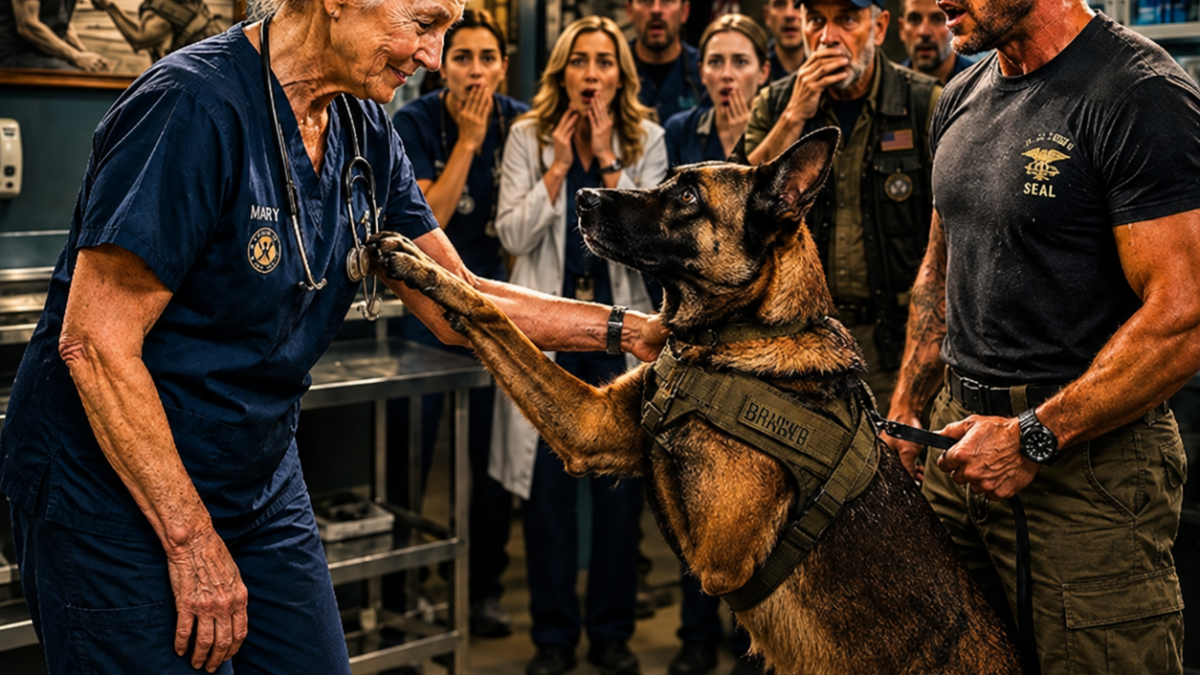
Then the old Belgian Malinois stepped away from Declan.
Several technicians stopped breathing.
Declan whispered, “No.”
But Briggs did not lunge.
He did not growl.
He did not limp with uncertainty.
He walked straight toward me with the calm confidence of a dog who had finally found a hallway he remembered.
He stopped beside me.
Looked up into my face.
And lifted one front paw.
Carefully, gently, he rested it against my forearm.
The rehabilitation salute.
The old ceremonial signal we had practiced years before, back when his body was healing and his mind was still young enough to believe pain always ended when kind hands told him it would.
Silence filled the clinic.
Even the phones seemed to stop ringing.
Declan’s face lost every trace of color.
Only one person outside formal training had ever used that phrase with Briggs.
Only one person had taught him that salute.
And he had not seen her in over ten years.
Declan’s voice barely rose above a whisper.
“Who are you?”
I smiled because if I did not, I might have cried too soon.
“Hello, Briggs.”
The dog leaned into my side like no years had passed at all.
I stroked gently beneath his collar, exactly where he had liked it when he was young and furious about physical therapy.
His eyes closed.
Every line of tension in his face softened.
Declan removed his ball cap slowly.
“This can’t be happening.”
“I remember you,” I said.
His eyebrows lifted.
“You do?”
“You were younger,” I said. “And much louder.”
A few staff members laughed softly, grateful for permission to breathe again.
Declan stared at me.
“Naval rehabilitation center,” I said. “Virginia. Briggs had orthopedic surgery after deployment. Shrapnel damage, if I recall correctly. Rear leg, shoulder compensation, nerve irritation, stubborn patient.”
Declan’s mouth opened slightly.
The memories came into his eyes all at once.
The ward.
The long recovery hall.
Physical therapy mats.
Young Briggs snapping at towels and refusing stretches.
A nurse in blue scrubs sitting beside him after treatment, reading aloud while he calmed down because his handler had been in surgery for his own injuries.
“You,” Declan said.
I nodded.
“I filled in after his assigned rehab nurse retired.”
“You sat with him.”
“I did.”
“You read to him.”
“Badly.”
His voice roughened.
“You taught him that salute.”
“No,” I said softly. “I gave him a way to tell us when he felt safe again. He invented the rest.”
Briggs leaned heavier against my leg.
His paw remained on my forearm.
My bones ached under the weight.
I did not move.
Declan looked from Briggs to me like he was watching time fold in half.
“I searched for everyone who helped us,” he said. “I never found your name.”
“You weren’t supposed to.”
His expression tightened.
“What does that mean?”
“It means you and Briggs were the mission. I was only fortunate enough to be part of it.”
That was not modesty.
It was truth.
Nurses pass through lives at strange angles. We enter during pain, hold things together for a time, then step back when families reclaim what fear nearly stole from them. We are remembered sometimes. Forgotten often. Both are acceptable if the patient survives.
Briggs remembered.
That was enough.
Dr. Pierce slowly lowered the unused sedative syringe he had been holding.
No one had noticed him pick it up.
No one blamed him.
Briggs had made many appointments difficult before that day. Teeth. Growls. Postponed exams. Staff clearing rooms. Declan apologizing without ever letting go of the leash.
Today, the old dog stood beside me as if he had walked into the one place in the world where time had not taken his courage.
Dr. Pierce stepped forward carefully.
“Miss Maggie,” he said, voice gentle, “would you mind staying with him while we examine his hip?”
I looked down at Briggs.
“You all right if they help you now, partner?”
Briggs looked up at me.
His tail gave one slow wag.
Then he sat.
Calmly.
Deliberately.
The entire staff watched as Dr. Pierce knelt beside him and placed a hand on the painful rear leg.
No growl.
No snap.
No panic.
Only Briggs’s paw pressing lightly against my shoe.
Dr. Pierce examined carefully. Flexion. Extension. Pressure. Reflex. Spine. Hip. Knee. Old scars. New inflammation. Each movement told a story if you knew how to listen.
His expression changed.
“This isn’t aggression,” he said quietly.
Declan’s jaw tightened.
Dr. Pierce looked at the X-rays now displayed on the monitor.
“This is advanced arthritis. Significant nerve pain, probably lumbar involvement. He has likely been compensating for months.”
Declan looked at Briggs.
The big man seemed suddenly smaller.
“I thought he just stopped trusting people.”
“No,” Dr. Pierce said. “He trusted you enough to hide how much he hurt.”
Those words landed harder than any diagnosis could have.
I saw it in Declan’s face.
He had spent his life reading danger.
Movement in doorways.
Pressure plates under dirt.
The wrong silence in a village street.
But he had missed the quiet pain in the partner who had never once failed him.
That is the kind of guilt handlers carry.
It is not logical.
It is not fair.
It is real.
I placed one hand gently on Declan’s arm.
“Our strongest partners often hide suffering because they are trying to protect us.”
His eyes shone.
“They deserve the same patience they gave us.”
He nodded once.
Not because it fixed anything.
Because it gave him somewhere to put the hurt.
Briggs’s treatment plan changed that morning.
Pain management.
Joint support.
Targeted injections.
Physical therapy.
Acupuncture if he tolerated it.
Home adjustments.
No unnecessary sedation.
No crowded exam rooms.
No rushing.
Declan listened to every word like a man receiving mission orders.
When Dr. Pierce explained the medication schedule, Declan took notes.
When Isabel demonstrated support harness placement, he practiced until Briggs accepted the fit.
When I stepped away to get a biscuit from my tote bag, Briggs stood immediately.
Declan smiled sadly.
“He thinks you’re leaving.”
I looked at Briggs.
“I’m only crossing the room.”
The old dog stared.
“Good heavens,” I murmured. “You’re still dramatic.”
His tail moved once.
I gave him the biscuit.
He took it gently.
Declan watched.
“He doesn’t take food from strangers.”
“I’m not a stranger.”
“No,” he said softly. “I guess you’re not.”
News traveled through Harbor Ridge before lunch.
Not as gossip.
As wonder.
Briggs saluted Miss Maggie.
Briggs let Dr. Pierce examine his hip.
Briggs didn’t need sedation.
Miss Maggie knew him from the rehab ward.
By noon, even the kennel attendants had found excuses to pass through the waiting room.
I hated attention.
But I loved what it did for the handlers watching.
One young Marine with a retired shepherd mix named Atlas approached me while Briggs rested on a thick mat beside Declan.
“Ma’am,” he said, awkwardly respectful.
“Yes, dear?”
“How did you know what to do?”
“I didn’t.”
He frowned.
“You said the exact thing.”
“I remembered the dog. That helped.”
“But before that. The way you walked up.”
I looked at Atlas, who had one ear missing and both eyes fixed on his handler’s boots.
“I listened.”
“To what?”
“To what Briggs was already telling us.”
The Marine looked confused.
So I explained.
“His growl said, ‘Don’t trap me.’ His eyes said, ‘I’m tracking too much.’ His weight shift said, ‘My hip hurts.’ His handler said, ‘I’m scared of failing him,’ though he used different words.”
Declan glanced up.
I smiled.
The Marine looked down at Atlas.
“So what’s my dog saying?”
Atlas leaned against his leg and sighed.
I said, “Right now? That you talk too much and he wants to go home.”
The Marine laughed.
Atlas wagged.
Later that afternoon, Dr. Amelia Kesler, the clinic director, found me in the break room washing biscuit crumbs from my hands.
She leaned against the counter.
“Maggie.”
“That tone usually means paperwork.”
“No paperwork.”
“Then I’m suspicious.”
She smiled, but her eyes were thoughtful.
“What happened today… could it help others?”
I dried my hands slowly.
“With old military dogs?”
“With old dogs. With handlers. With staff. With all of us.”
I hung the towel neatly.
“What are you asking, Amelia?”
She crossed her arms.
“I’m asking whether we’ve been treating these appointments like medical events when many of them are emotional reunions with pain.”
I liked that.
Not because it was polished.
Because it was true.
“These dogs know how to tell us things,” I said. “We simply need to learn how to listen before they have to shout.”
Within weeks, Harbor Ridge launched what Amelia called the Comfort Watch Program.
I told her the name sounded dramatic.
She kept it anyway.
Retired military nurses volunteered.
Former medics.
Experienced rehabilitation specialists.
Veteran handlers whose dogs had passed but who still needed somewhere to put their love.
They did not restrain.
They did not rush.
They welcomed.
A dog came in, and before the exam began, someone sat nearby without pressure. The handler talked if they wanted. Or didn’t. The dog sniffed. Watched. Settled. Or didn’t.
We learned each dog’s old words.
“Stand easy.”
“Check in.”
“Break.”
“Safe house.”
“Easy watch.”
We learned which dogs hated white coats.
Which needed mats under their paws.
Which could tolerate touch only if their handler gave a release command first.
Which handlers needed peppermint candies and five minutes to admit they were frightened.
Sedation rates dropped.
Missed appointments dropped.
Bites dropped.
More importantly, shame dropped.
Handlers who had dreaded veterinary visits began arriving early just to sit in the waiting room among people who understood that retirement was not a clean finish line.
It was a new mission with worse maps.
Declan kept bringing Briggs every month.
At first, strictly for treatment.
Then for therapy.
Then because Briggs wanted to come.
Then, finally, because Declan did too.
He had spent years handling things alone. That was common among men like him. Competence becomes a cage when you believe needing help means failure.
He began talking to younger handlers in the waiting room.
Not in speeches.
Declan did not do speeches then.
He answered questions.
“How do you know when it’s pain and not behavior?”
“You don’t always. That’s why you ask for help.”
“What if he hates retirement?”
“Then you build him a new job.”
“What if I miss the work?”
Declan would look at Briggs, sleeping with his head on his paws.
“You will.”
“What do you do about that?”
“You stop making your dog carry all of it.”
I watched him change slowly.
Not soften.
That is the wrong word.
Declan had always been soft where Briggs was concerned.
He became less alone.
There is a difference.
Briggs changed too.
Pain medication helped.
Physical therapy helped.
The harness helped.
But recognition helped in ways medicine could not measure.
Every time he saw me, he lifted his paw.
Not always high.
Some days arthritis made the movement small.
Still, he offered it.
And every time, I touched his forearm gently and said, “Easy watch, partner.”
The staff pretended not to get emotional after the first dozen times.
They failed.
Three months after that first morning, Harbor Ridge renovated its Hall of Honor.
It was a long hallway connecting the main clinic to the rehabilitation wing. Before the renovation, it held outdated posters about flea prevention and faded photos of working dogs from various bases. Amelia wanted to make it a proper tribute.
Families donated pictures.
Handlers wrote short memories.
Departments sent old badges, unit patches, retirement certificates.
One afternoon, Amelia asked me to walk the hallway before the official unveiling.
“I want your opinion,” she said.
“My opinion is usually that things need less glitter.”
“There is no glitter.”
“Good start.”
The hallway was beautiful.
Not fancy.
Respectful.
Black frames. Warm lighting. Each photograph with a small bronze plaque. Retired dogs running in fields. Dogs in uniform harnesses. Handlers kneeling beside partners. A Labrador sleeping with a child. A German Shepherd sitting beside a wheelchair. A Malinois with one eye standing proudly on a beach.
Then I stopped.
Near the center hung an old photograph I had not seen in more than twelve years.
A younger Briggs lay on a blue rehabilitation mat.
His coat was glossy then, his eyes bright, one rear leg shaved from surgery. Beside him sat a Navy nurse in faded blue scrubs, hair darker, face less lined, one hand raised near her shoulder.
Briggs had one front paw lifted in salute.
My hand went to my mouth.
“I forgot this existed,” I whispered.
Amelia stood beside me.
“We found it in the Navy rehabilitation archives.”
The plaque beneath read:
HEALING BEGINS WHERE TRUST RETURNS.
I could not speak.
For once, words left me.
Declan arrived a few minutes later with Briggs.
He stopped beside me and stared at the photograph.
Briggs looked at it too.
I do not know what dogs understand of pictures. Probably less than we wish. Perhaps more than we know.
But he stared long enough that Declan’s breathing changed.
“I spent years searching for the people who helped us,” he said.
I looked at the young nurse in the photo.
“You were busy surviving.”
“So were you.”
I smiled.
“Nurses don’t get to call it that.”
“You should.”
Briggs lifted his paw slowly.
Not to the photograph.
To me.
I touched his forearm.
“Easy watch, partner.”
Declan looked away.
The annual Military Working Dog Appreciation Ceremony came that spring.
I disliked ceremonies almost as much as I disliked interviews, but Amelia insisted the Comfort Watch volunteers be recognized. I told her I would sit in the back. She pretended to agree.
The courtyard was filled with handlers, veterans, families, clinic staff, children waving small American flags, and retired dogs resting proudly beside the people they had served.
Briggs wore his old ceremonial harness.
Declan wore dress whites.
I had forgotten how tall he looked in uniform.
He stepped onto the small stage with prepared papers in his hand.
He looked down at them.
Then folded them.
“Oh no,” I whispered.
Amelia, standing beside me, smiled.
Declan looked across the courtyard.
“I had a speech about missions,” he said. “About deployments, operations, loyalty under fire, and all the things people expect a Navy man to talk about when there are cameras nearby.”
Soft laughter moved through the crowd.
“But I’d rather tell you about someone who never carried a rifle.”
My heart sank.
“Amelia.”
She did not look sorry.
Declan continued.
“When Briggs and I first came home, I thought survival meant control. I controlled doors, rooms, voices, distances, schedules. I controlled who touched him, who approached him, who stood too close. I told myself I was protecting him.”
He paused.
Briggs sat beside the stage, watching him.
“I did not understand that protection without trust becomes another cage.”
The crowd went quiet.
“A few months ago, I brought Briggs here in pain. I warned everyone not to touch him. I said he would attack. And I believed that. Because believing he was dangerous was easier than admitting he was hurting.”
His voice roughened.
“Then a seventy-one-year-old retired Navy nurse walked toward him like she had all the time in the world. She said four words. My dog remembered her before I did.”
People turned toward me.
I considered sinking into the ground.
Declan looked directly at me.
“Miss Maggie Ellsworth reminded me that healing does not always come from command. Sometimes it comes from patience. Sometimes from a voice that remembers who you were before pain changed your shape.”
My eyes burned.
He held out a hand.
“Miss Maggie, would you join us?”
I shook my head.
The crowd applauded anyway.
Traitors, all of them.
Amelia nudged me.
“Go.”
“I am too old for ambushes.”
“This is not an ambush.”
“It is absolutely an ambush with better lighting.”
Still, I walked to the stage.
Briggs rose as I approached.
His movements were slower now. Age had taken more from him since that first day. His pain was better managed, but time remains undefeated.
Declan stepped back.
I leaned toward him and whispered, “I did not prepare anything.”
“You don’t need to.”
“That is something people say right before someone needs to.”
He smiled.
Then Briggs came to my side.
The courtyard fell silent.
He looked up at me with those sharp old eyes.
Then, with careful determination, he lifted one front paw and rested it against my forearm.
The salute.
A sound moved through the crowd.
Not applause at first.
A collective breath.
Veterans who had held themselves together through speeches wiped their faces. Younger handlers stood straighter. One Marine saluted the dog without seeming to realize he had done it.
Then everyone rose.
The applause came like rain.
I placed my hand gently over Briggs’s paw.
“Easy watch, partner,” I whispered.
His tail moved once.
Declan’s voice trembled when he spoke again.
“I thought I was bringing Briggs here so people could honor his service. It turns out the greatest service was honoring the people who helped him find his way home.”
I looked at him.
“No,” I said softly, forgetting the microphone was close enough to catch me. “He found his way. We only stopped blocking the door.”
The crowd laughed through tears.
That was all I said.
It was enough.
Briggs lived fourteen more months.
Good months.
Managed pain.
Soft beds.
Short walks.
Appointments he no longer feared.
Handlers who greeted him with respect.
A community that knew his name.
Declan brought him to the clinic even when there was no appointment. Briggs would lie near the reception desk while I handed out biscuits to other dogs. Sometimes young technicians sat beside him and read charts aloud because I told them he liked being included in medical decisions.
He did not understand charts.
He did understand tone.
He aged the way warriors sometimes age when they finally trust the perimeter.
Slowly.
Reluctantly.
With dignity.
There came a morning when Declan called before sunrise.
I knew before he spoke.
Nurses learn the silence before bad news.
“Maggie,” he said.
“I’m here.”
“He didn’t get up for breakfast.”
I closed my eyes.
Briggs always got up for breakfast.
“How is his breathing?”
“Slow. Not labored. Just… tired.”
“Is he in pain?”
“Not like before.”
That was mercy.
“Do you want me to come?”
His voice broke.
“Yes.”
I arrived at Declan’s house an hour later with my tote bag, though I had forgotten to put anything in it.
Habit carried it anyway.
His home sat near the water, quiet and spare. Briggs lay on a thick orthopedic bed by the window, where morning light touched his silver muzzle. His old ceremonial harness hung on a chair nearby.
Declan sat on the floor beside him.
He looked up when I entered.
No uniform.
No command face.
Just a man losing his partner.
Briggs opened his eyes when he heard my voice.
“Hello, sweetheart,” I said.
His tail moved.
Barely.
But it moved.
I sat carefully beside him.
He tried to lift his paw.
Couldn’t.
So I placed my forearm gently beneath it and raised it enough for him to feel the old position.
“There it is,” I whispered. “Easy watch.”
Declan covered his mouth.
Dr. Pierce came soon after.
So did Amelia.
Isabel arrived carrying a blanket warmed from the clinic dryer because she said Briggs deserved “hospital-level service at home.” Dave, one of the old handlers from the Comfort Watch Program, stood quietly on the porch until Declan called him in.
Briggs was not alone.
That mattered.
Dr. Pierce examined him gently.
There were options, because medicine always has options if you are willing to confuse time with kindness.
But Declan knew.
So did I.
So did Briggs.
We moved his bed outside to the porch because he loved watching the water.
The morning was clear.
No rain.
No wind.
Just gulls in the distance and sunlight on the bay.
Declan sat with Briggs’s head in his lap.
I sat on the other side, one hand resting lightly on the old dog’s shoulder.
Dr. Pierce explained each step.
Declan nodded.
His hand never stopped moving through Briggs’s fur.
“You carried me longer than I deserved,” he whispered.
Briggs’s eyes stayed on him.
“You stubborn old bastard.”
I smiled through tears.
Briggs’s tail thumped once.
Declan laughed and broke at the same time.
When the first injection eased him into deep comfort, Briggs exhaled like a dog setting down a pack he had carried across too many years.
Declan bent low.
“You can stand down, partner.”
I touched Briggs’s paw.
“Easy watch,” I whispered.
His breathing slowed.
The final breath came so softly that for a moment none of us moved.
The world did not announce the passing of a decorated military dog.
No rifles fired.
No bugle played.
No official voice read his record.
But on that porch, every person present understood that a warrior had left the room.
Declan lowered his forehead to Briggs’s.
“Thank you,” he said.
That was all.
Those are the truest words at the end.
Not enough.
Never enough.
But true.
Months later, Harbor Ridge added Briggs’s photo to the Hall of Honor.
Not the old rehabilitation picture.
That one stayed where it was.
The new one showed him at the ceremony, paw resting against my forearm, Declan standing behind us with tears in his eyes and pride on his face.
The plaque beneath read:
BRIGGS
Military Working Dog. Partner. Protector.
He never forgot the hands that told him he was safe.
Visitors still stop there.
Handlers read the words and fall quiet.
Some ask me about him.
If I have time, I tell them.
Not the whole story.
Stories like Briggs’s are too large for hallways.
I tell them he was brave.
I tell them he was hurting.
I tell them those two things often look the same until someone takes the time to listen.
The Comfort Watch Program spread beyond Harbor Ridge. Other clinics called. Then training centers. Then military bases. Amelia developed guidelines with veterinary behaviorists, retired handlers, nurses, and medics. I reviewed drafts with a red pen and complained about language that sounded too much like policy and not enough like compassion.
The final version began with a sentence Amelia stole from me without permission.
Let the dog tell you who he is before fear tells you for him.
I pretended to be annoyed.
I was proud.
Declan kept volunteering after Briggs passed.
At first, I thought it would hurt him too much.
It did hurt.
But sometimes hurt becomes useful when given somewhere honorable to go.
He sat with new handlers whose dogs had begun growling during exams. He told them about Briggs. He admitted what he had missed. That mattered more than expertise.
“I thought guarding was the problem,” he would say. “Pain was the problem. Fear was the language.”
He became very good at saying hard things plainly.
One afternoon, nearly a year after Briggs died, I found Declan standing in the Hall of Honor.
He was looking at the two photographs.
Young Briggs on the rehabilitation mat.
Old Briggs at the ceremony.
Beginning and end.
I stood beside him.
“Do you ever get used to it?” he asked.
“To what?”
“Missing them.”
I looked at the photos.
“No.”
He nodded.
“But you learn not to treat missing them as proof something went wrong.”
His jaw tightened.
“Feels wrong.”
“Of course it does.”
“Then what is it proof of?”
I reached for the small bronze plaque beneath old Briggs’s photo.
“That he mattered.”
Declan said nothing.
Then he saluted.
Not sharply.
Not for show.
A quiet salute from one warrior to another.
I gave him privacy and walked back to the waiting room.
Winston’s owner had brought him in again, older and rounder and still convinced he was a puppy. Isabel was trying to convince a young shepherd mix that the scale was not enemy equipment. Dr. Pierce had skipped breakfast again, so I left a granola bar on his desk with a note that said, Eat before I tell Amelia.
Life continued.
That is the mercy and the cruelty of it.
Dogs come in.
Dogs go home.
Some heal.
Some decline.
Some leave us.
Their handlers cry in parking lots and apologize for crying, as if grief should be embarrassed to exist.
I keep peppermint candies in my pocket.
I keep biscuits in my tote.
I keep my hands open.
And when an old military dog growls because the room is too loud, the floor is too slick, the hip hurts, the memories crowd too close, and every stranger looks like uncertainty, I do not think monster.
I think pain.
I think service.
I think Briggs.
People remember the salute.
I understand why.
It was beautiful.
A scarred old Malinois recognizing a woman time should have erased from his memory. A paw lifted with ceremonial care. A room full of hardened people realizing at once that trust can survive more than we imagine.
But I remember something quieter.
Before the salute, before the tears, before the applause months later, there was one small moment when Briggs stopped growling.
That was the miracle.
Not obedience.
Not performance.
The pause.
The moment he heard a familiar phrase and chose, despite pain and fear and age, to wonder whether the world might be safe again.
Healing often begins there.
Not with certainty.
With a pause.
A breath.
A dog deciding not to bite.
A handler deciding to ask for help.
An old nurse stepping forward in a curve instead of a line.
Four words from another life.
Easy watch, partner.
I am seventy-one now.
Soon I will be older.
One day I will not walk through Harbor Ridge’s doors at seven-thirty with my tote bag and my peppermint candies. Someone else will arrange the blankets. Someone else will kneel beside the anxious dogs. Someone else will learn that gentleness is not weakness, that patience is not passivity, and that the strongest beings often need permission to stop being strong.
I hope they remember Briggs.
Not as a legend.
Not as a dangerous dog who became sweet because an old woman said magic words.
That is not what happened.
Briggs was never sweet in the simple way people like dogs to be sweet.
He was loyal.
He was guarded.
He was brilliant.
He was hurting.
He was old.
He was brave enough to trust again when trust cost him effort.
That is much better than sweet.
The last time I touched his paw, he was too weak to lift it himself.
So I lifted it for him.
Some might say that means the final salute was mine.
They would be wrong.
Briggs had been saluting all along.
Every time he endured pain because he thought Declan needed him steady.
Every time he entered our clinic though his body told him to fear the room.
Every time he stood between his handler and uncertainty.
Every time he remembered a nurse from a long-ago rehabilitation ward and chose recognition over fear.
His final salute was not a trick.
It was not a performance.
It was a thank-you.
To Declan.
To the clinic.
To the young dog he had once been.
To every hand that had helped him come home.
And perhaps, in a small way, to me.
The nurse who never expected to be remembered.
But was.








