“Don’t Go Near Him,” the Retired Navy SEAL Warned—Then His Military K9 Laid His Head on the Nurse’s Lap and Revealed the Pain No One Had Seen
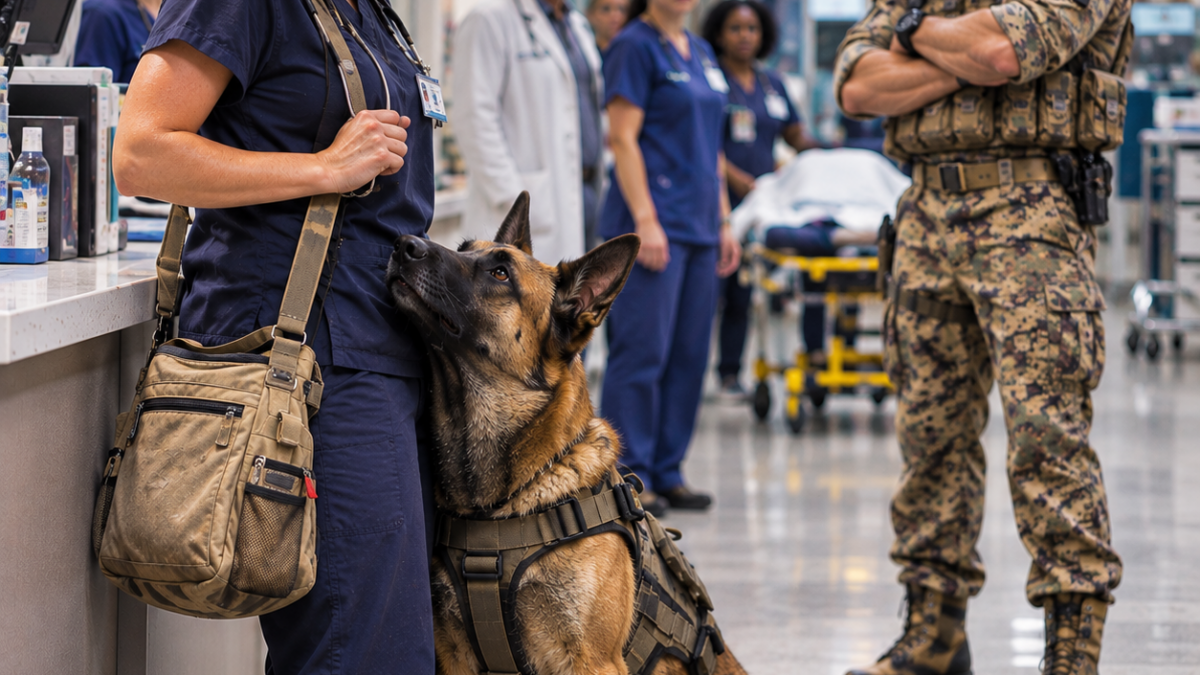
“Don’t Go Near Him,” the Retired Navy SEAL Warned—Then His Military K9 Laid His Head on the Nurse’s Lap and Revealed the Pain No One Had Seen.
For three days, Bram had growled at every nurse, rejected food from veterinary staff, and planted his aging body between retired Navy SEAL Commander Amon Strike and anyone who approached the wheelchair.
Everyone thought the scarred German Shepherd had become dangerously overprotective—until hospice nurse Annelise Crow sat silently across the room, refused to command him, and watched the old military dog limp toward her before lowering the full weight of his gray head into her lap.
Less than an hour later, a neurological exam revealed that Bram had not been guarding his handler at all; he had been enduring severe spinal pain while staying on duty for the one man he believed he could never abandon.
At North Star Veterans Hospice and Rehabilitation Center, silence was rarely empty.
Families filled it with fear.
Veterans filled it with memories.
Doctors sometimes filled it with explanations nobody was ready to hear.
Annelise Crow had learned not to rush any of them.
At forty-one, she had spent nearly two decades working with veterans whose bodies had become unfamiliar territory.
Spinal injuries.
Amputations.
Chronic pain.
Traumatic brain injuries.
Neurological disease.
Cancer.
Men and women who had once carried other people out of impossible places now needed help standing from a bed.
Some adapted quickly.
Some did not.
Annelise never confused resistance with failure.
She had watched patients refuse medication because accepting it meant admitting the pain was real.
She had watched decorated officers become furious because a twenty-three-year-old aide offered to tie their shoes.
She had watched spouses speak for veterans who were perfectly capable of answering but had stopped trying because everyone had grown accustomed to finishing their sentences.
Her rule was simple.
Behavior was information.
Before it became a problem, it meant something.
That afternoon, the information in the family lounge was a low, exhausted growl coming from a German Shepherd.
Annelise heard it before she entered.
Not explosive.
Not frantic.
A warning held low in the chest.
She paused outside.
Security Officer Damien Cole stood at the doorway.
He looked relieved to see her.
“You’re the third person they called.”
“Who were the first two?”
“Behavioral health.”
“Veterinary.”
“And?”
Damien glanced inside.
“Dog nearly got a technician.”
“Nearly?”
“He warned.”
“Technician backed off.”
“So he didn’t get anybody.”
Damien looked at her.
“That’s one way of describing it.”
“It’s the accurate way.”
She stepped to doorway.
PART2:
The room had been mostly cleared.
One couch.
Two chairs.
A small table.
Rain tapped the tall windows overlooking the memorial garden.
Near the center sat Commander Amon Strike.
Retired Navy SEAL.
Fifty-seven.
Broad through shoulders despite weeks of limited mobility.
His right leg was immobilized from thigh to ankle after a fall down wet coastal stairs.
The injury itself was repairable.
The problem was what came with it.
Loss of independence.
Amon had spent most of his adult life giving orders in places where hesitation could kill people.
He did not enjoy needing someone to push his wheelchair.
He enjoyed being told to wait even less.
Beside him stood Bram.
Large black-and-tan German Shepherd.
Gray muzzle.
Scarred ears.
Old abrasions visible beneath the coat if you knew where to look.
Twelve years old.
Retired military K9.
PART3:
The dog’s posture was stiff.
His head remained slightly lower than Annelise expected.
His right front paw touched the floor, then dragged half an inch when he repositioned.
Amon noticed her watching.
“Don’t go near him.”
Annelise stayed where she was.
“I wasn’t planning to.”
“He doesn’t tolerate strangers right now.”
“Then I’ll let him decide whether I’m one.”
Amon gave a dry smile.
“You always talk like that?”
“Only when people warn me before I’ve done anything.”
The veterinarian standing near the far wall looked tired.
Dr. Mira Hensley specialized in geriatric and working dogs.
She held a tablet but kept her distance.
“Amon.”
She said.
“We need to examine him.”
“You already tried.”
“He nearly bit Allison.”
“He warned her.”
“He snapped.”
“Because she grabbed his neck.”
“She was checking cervical range of motion.”
Amon’s voice hardened.
“He’s protecting me.”
Annelise looked at Bram.
The dog’s eyes tracked every movement.
When Damien shifted his boots, Bram growled.
But he did not move toward him.
Did not lunge.
Did not widen his stance.
He simply turned his whole body.
Not just his head.
That was the first thing Annelise noticed.
The second was the paw.
The third was how slowly Bram lowered himself when he finally sat.
Amon said:
“He’s been like this since I fell.”
Annelise looked at him.
“Exactly since?”
“Close enough.”
“Before the fall?”
“No.”
Dr. Hensley corrected gently.
“He was restless before.”
Amon glanced at her.
“How long?”
“Your daughter mentioned it.”
Amon frowned.
“My daughter lives in Oregon.”
“She told one of our techs during intake that Bram had stopped sleeping through the night.”
Amon looked at dog.
“That’s age.”
Annelise asked:
“What else changed?”
“Nothing.”
“Think.”
Amon’s jaw tightened.
He disliked the tone.
Not because disrespectful.
Because it assumed there was something he had missed.
“He stopped using stairs.”
“When?”
“Couple months.”
“Jumping into truck?”
A pause.
“I lift him now.”
“Eating?”
“Fine.”
Dr. Hensley said:
“He prefers bowl elevated.”
Amon looked at her.
“You asked about that already.”
“I know.”
Annelise watched Bram lean the side of his head against wheelchair frame.
Not rub.
Press.
Hold.
Release.
Then repeat.
She asked:
“Does he do that at home?”
Amon followed her gaze.
“What?”
“Press his head against things.”
“He stays close.”
“That isn’t what I asked.”
Amon looked back at Bram.
The dog leaned again.
Side of skull against the metal frame.
Amon’s expression changed.
Slightly.
“I thought he was staying close.”
“He may be.”
Annelise said.
“Closeness and pain can exist at the same time.”
Amon’s hand moved to Bram’s shoulder.
The dog flinched.
Barely.
But enough.
Amon removed his hand.
He looked at Annelise.
She did not say anything.
That mattered.
People who notice something painful often rush to explain it.
Annelise let him see it first.
Damien shifted again.
Bram growled.
Amon stiffened.
“He’s doing his job.”
Annelise listened.
“Tired growl.”
“What?”
“It sounds tired.”
Amon stared.
“You can hear that?”
“I can hear he isn’t escalating.”
“He warns when people move.”
“He doesn’t pursue them.”
“He’s creating distance.”
“Could be guarding.”
“Could be pain.”
Amon leaned back.
“So what do you want?”
“Nothing.”
That answer irritated him.
Annelise placed clean linens on side table.
Took the low chair by window.
Sat.
Far enough away that nobody could mistake it for approaching.
She rested hands in lap.
No treats.
No baby voice.
No extended hand.
No eye contact.
Amon watched.
“What are you doing?”
“Sitting.”
“I can see that.”
“Then we’re making progress.”
Dr. Hensley almost smiled.
For nearly a minute nothing happened.
Rain.
Wall clock.
A cart rolling somewhere beyond hallway.
Bram watched Annelise.
She looked toward garden.
A maple tree bent in wind.
Wet stone path.
Memorial flags darkened by rain.
Then nails clicked lightly across floor.
One step.
Amon’s voice changed immediately.
“Bram.”
The dog paused.
Amon lowered tone.
“Here.”
Bram looked at him.
Then at Annelise.
Amon tried again.
“Bram.”
The dog moved.
One careful step.
Then another.
His right front paw dragged.
Not every stride.
Enough.
Annelise did not move.
Bram crossed half the room.
Stopped.
His breathing was shallow.
He stood directly in front of her knees.
Amon’s hand tightened on wheelchair arm.
“Annelise.”
She remained still.
Bram lowered his head.
Slowly.
His neck trembled.
For one moment she thought he might lie down.
Instead he leaned forward.
And placed the full weight of his head across her lap.
Amon stopped breathing.
So did half the room.
The growling ended.
Bram’s eyes closed.
His jaw loosened.
A long breath left him.
Not dramatic.
Relief.
Annelise looked down.
She did not stroke him.
Not yet.
She watched angle of neck.
The way he had transferred weight.
The tremor fading because he no longer had to hold his head upright.
Then she placed two fingers beneath his lower jaw.
Very lightly.
Bram exhaled again.
Amon whispered:
“He doesn’t do that.”
Annelise looked at him.
“He isn’t guarding you.”
Amon’s face hardened.
“What did you say?”
“He may still be protecting you.”
“But that isn’t the whole thing.”
She looked down at Bram.
“He’s asking someone to notice that holding his head hurts.”
Dr. Hensley stepped closer.
Slow.
Bram opened one eye.
No growl.
Annelise kept hand under jaw.
“Mira.”
“I want neuro.”
Dr. Hensley nodded.
“I do too.”
Amon’s expression had changed.
Not convinced.
Afraid.
That was more honest.
Less than an hour later, veterinary neurologist Dr. Elias Boone arrived with a mobile exam kit.
Because Bram remained beside Annelise, they did not restrain him.
They worked around where he had chosen to settle.
Eye response.
Paw placement.
Reflexes.
Proprioception.
Gentle neck motion.
Bram’s right front paw corrected slowly.
Then Dr. Boone pressed near upper cervical spine.
Bram flinched hard.
Amon looked away.
“Enough.”
Dr. Boone immediately stopped.
“That’s enough.”
He did not need to prove pain twice.
Imaging was arranged.
The process took several hours.
Amon hated waiting.
Annelise knew because he asked what time it was four times despite the clock being visible.
When results came, everyone gathered in consultation room.
Bram lay on thick pad.
Sedation wearing off.
His head rested flat.
Dr. Boone displayed images.
“These are cervical vertebrae.”
He pointed.
“There’s substantial degenerative disc disease.”
“Chronic inflammation.”
“Nerve compression.”
“And here.”
He enlarged.
“This lesion is creating significant pressure near the upper spine.”
Amon stared.
“How bad?”
“Painful.”
“Very likely for some time.”
“Is he paralyzed?”
“No.”
“Will he be?”
“Not necessarily.”
“We’ve caught it before that.”
Amon’s shoulders lowered slightly.
Dr. Boone continued.
“It explains the paw dragging.”
“Difficulty with stairs.”
“Head pressing.”
“Restlessness.”
“Preference for raised bowl.”
“And defensive behavior.”
Amon looked up.
“He wasn’t becoming aggressive.”
“No.”
“He was avoiding pain.”
Amon looked toward Bram.
The dog slept.
For days Amon had defended every growl as proof of loyalty.
Now each one had a different meaning.
Do not touch me there.
Do not make me move.
I cannot turn my neck.
I am tired.
I hurt.
Amon said quietly:
“I thought he was protecting me.”
Annelise answered:
“He probably was.”
Amon looked at her.
“He kept doing his job while he hurt.”
“Yes.”
Amon stared at dog.
“That proves he’s strong.”
Annelise’s voice softened.
“It proves he’s loyal.”
“Those are not always the same thing.”
That landed harder than diagnosis.
Amon had built much of his life around confusing the two.
Strength.
Endurance.
Duty.
Pain tolerated without complaint.
These things were celebrated where he came from.
Sometimes necessarily.
Sometimes too much.
Dr. Boone explained treatment.
Pain control.
Anti-inflammatory medication.
Carefully managed rehabilitation.
Hydrotherapy.
Mobility work.
Permanent retirement from protective behavior.
No long patrols.
No stairs if avoidable.
No hard floors.
No sudden neck strain.
Amon frowned.
“He’ll hate that.”
Annelise looked at Bram.
“Or maybe he’s been waiting for permission.”
That evening, after veterinary team left, Amon remained beside Bram’s bed.
The old dog slept more deeply than he had in weeks.
No scanning door.
No lifting head every time cart passed.
Medication had softened pain enough for body to let go.
Annelise entered with schedule.
Amon did not look up.
“I should have seen it.”
She placed chart on table.
“You saw what you expected.”
“That isn’t an excuse.”
“No.”
“But it is an explanation.”
“I praised him.”
“For staying awake.”
“I told people he was still sharp.”
“He was hurting.”
Annelise sat.
“Amon.”
He finally looked.
“You loved the dog who protected you.”
“So you interpreted everything through that history.”
“That doesn’t make you careless.”
“It makes you human.”
He looked at Bram.
“He stopped jumping into truck.”
“I lifted him and joked he was lazy.”
“He stopped taking stairs.”
“I called him stubborn.”
“He flinched during brushing.”
“I thought he hated brush.”
Annelise let silence sit.
Then:
“Guilt can become another way of avoiding help.”
Amon’s eyes narrowed.
“What does that mean?”
“If you spend all your energy blaming yourself…”
“…you don’t have enough left to help him recover.”
Amon looked almost offended.
Then tired.
“That sounds like something from therapist.”
“No.”
“Therapists use better grammar.”
For first time that day, Amon laughed.
Small.
Bram’s ear moved.
They both looked.
Annelise smiled.
“There.”
“He’s checking whether you’re still dramatic.”
Amon shook head.
Recovery began slowly.
Bram did not become a different dog overnight.
Pain medication helped.
It did not erase twelve years.
Some mornings he still growled when a technician approached too quickly.
The difference was response.
Nobody called him difficult.
They paused.
Changed angle.
Raised food.
Supported neck.
Asked what movement triggered warning.
Annelise worked with veterinary staff even though canine rehabilitation was not her specialty.
Her role was observation.
Context.
Helping Amon see behavior without interpreting it only through loyalty.
Bram’s first hydrotherapy session lasted seven minutes.
He hated pool.
Amon loved that.
“You’ll swim in open ocean but not therapy tank?”
Bram gave him a look.
Annelise said:
“He’s retired.”
“He gets opinions.”
“He always had opinions.”
“Now he has union representation.”
Amon laughed.
Bram eventually tolerated water.
Short supported walks followed.
His paw placement improved.
Sleep improved faster.
That was what Amon noticed most.
At night Bram stopped pacing.
He slept.
Real sleep.
Amon sometimes watched him breathing.
Then felt guilt again.
Annelise would catch him.
“You’re doing it.”
“What?”
“Blaming instead of helping.”
“I’m observing.”
“You’re brooding.”
“I was a commander.”
“I can multitask.”
She ignored him.
Then one morning rehabilitation team brought Bram’s old tactical vest.
They needed to discuss retiring gear.
Amon froze when he saw it.
Faded black nylon.
Scuffed buckles.
Old patch points.
The vest had crossed oceans.
Been soaked in seawater.
Dust.
Mud.
Blood.
Amon had cleaned it after missions with same ritual every time.
Brush.
Rinse.
Dry.
Inspect.
Repair.
The vest represented years when he and Bram had a job no one else could do.
Amon reached for it.
Held.
Annelise entered.
Stopped.
“You okay?”
“No.”
He said it immediately now.
Progress.
She sat beside him.
“I can’t take it off him.”
“He’s not wearing it.”
“You know what I mean.”
She did.
“If I put it away, feels like admitting he’s finished.”
“Finished with what?”
“Work.”
“Purpose.”
Annelise looked at Bram resting on mat.
“What do you think his purpose is now?”
Amon did not answer.
She continued.
“I don’t think Bram believes his value lives in a vest.”
Amon smiled weakly.
“It does for me.”
That was not about Bram.
They both knew.
Amon had been retired eighteen months.
His own uniform hung in closet.
Medals in box.
Phone stopped ringing as often.
Former teammates dispersed.
Some still active.
Some injured.
Some divorced.
Some dead.
Bram remained one piece of identity that still woke every morning and looked at him like mission continued.
If Bram retired completely, Amon had to admit something else.
He had retired too.
Annelise understood.
She did not force.
Instead she reached for one buckle.
Unfastened it.
Then stopped.
“Your turn.”
Amon looked at dog.
Bram watched.
No tension.
No expectation.
Amon opened second buckle.
Then third.
Vest came away.
Bram shook coat once.
Lay back down.
Nothing happened.
No loss of dignity.
No identity crisis.
Dog simply seemed more comfortable.
Annelise pulled simple dark leather collar from bag.
A small brass plate.
BRAM
FAMILY
Amon read.
“Who made this?”
“Rehab staff.”
“You approved?”
“No.”
“They’re mutinous.”
Annelise smiled.
“Put it on.”
Amon fastened collar.
Bram leaned into his leg.
Amon’s throat tightened.
“Family.”
Annelise said:
“Seems accurate.”
Amon rubbed ear.
“No rank?”
“He outranks you.”
“Always did.”
Bram improved.
Then Annelise turned her attention to more stubborn patient.
Amon.
His leg injury required aggressive rehabilitation.
He skipped sessions.
Not every one.
Enough.
Claimed fatigue.
Headaches.
Paperwork.
Once said he had “operational phone call.”
Annelise later discovered the call was with insurance company about Bram.
She found him trying to stand alone beside bed.
Right leg buckled.
She caught his torso before he fell.
“What are you doing?”
“Standing.”
“Poorly.”
“I had it.”
“You were headed toward floor.”
Amon gripped bed rail.
“I can manage.”
Annelise looked toward Bram.
Dog stood in doorway.
Watching.
“You tell him to trust therapy.”
Amon sighed.
“Not same.”
“No.”
“It’s familiar.”
He glared.
She smiled.
“For years Bram did whatever difficult treatment you asked because he trusted you.”
“Can you trust someone else the same way?”
Amon looked at dog.
Bram sat.
Head tilted.
Traitor.
Amon muttered:
“I never thought I’d lose argument to hospice nurse.”
“You didn’t.”
“You lost it to your own dog.”
After that, Amon stopped skipping.
Not gracefully.
But consistently.
Physical therapy.
Strength work.
Balance.
Pain management.
Progress.
Bram often lay beside parallel bars.
When Amon complained, therapist pointed at dog.
“He came.”
“So can you.”
Amon hated everyone.
Recovery no longer lonely.
That was different.
North Star staff began talking about Bram’s case.
Not because diagnosis was rare.
Cervical disease in aging dogs happens.
Pain-related defensive behavior happens.
What struck them was how easily everyone—including experienced people—had interpreted behavior as temperament before asking whether it was pain.
Annelise proposed a small review.
Veterinary medicine.
Nursing.
Rehabilitation.
Psychology.
Former working-dog handlers.
They built a protocol.
Nothing grand initially.
One page.
Then three.
Then training.
They called it Quiet Room Protocol.
First line:
BEHAVIOR IS INFORMATION BEFORE IT IS A PROBLEM.
For retired military and service dogs showing new aggression, guarding, withdrawal, refusal, or sleep changes:
Screen for pain.
Neurological issues.
Mobility changes.
Sensory decline.
Medication effects.
Environmental stress.
Handler dependence.
Do not assume aging alone explains behavior.
Do not assume loyalty means comfort.
That last line came from Bram.
Amon pretended not to be proud.
He was.
The protocol also addressed humans.
Handlers often normalize decline because dogs keep working.
Veterans can depend emotionally on retired working dogs in ways that make acknowledging canine frailty feel threatening.
Care plans needed both.
Not separate animal and veteran.
A pair.
That insight became the program’s real contribution.
Bram’s recovery continued over months.
His front paw never became perfect.
He did not need perfect.
He needed comfortable.
He used ramp instead of stairs.
Raised bowls.
Medication.
Short walks.
Hydrotherapy twice weekly.
Soft bed.
No protective work.
At first, Amon still gave him commands out of habit.
“Watch.”
Bram would lift head.
Annelise caught it once.
“No.”
Amon looked.
“What?”
“He’s off duty.”
“I was joking.”
“Dog doesn’t know your sarcasm.”
Amon looked at Bram.
The dog already scanning doorway.
Amon felt it.
Then:
“Bram.”
Dog looked.
“Stand down.”
Bram’s ears moved.
Amon pointed toward bed.
“Rest.”
The dog turned.
Lay down.
No protest.
Amon stared.
Annelise stood beside him.
“See?”
“What?”
“He was waiting.”
Amon swallowed.
“Yeah.”
One year later, North Star held veterans family day.
Spring.
Blue sky.
Garden in bloom.
Former patients returned.
Children ran between tables.
Retired service dogs wore simple collars.
Some wheelchairs.
Some walkers.
Some people with no visible injuries at all.
Amon arrived using a polished black cane.
No wheelchair.
He hated cane less than expected.
Mostly because Bram was slower too.
They matched pace.
Bram’s gray muzzle had spread nearly to eyes.
But coat shone.
Movement deliberate.
Comfortable.
Most striking difference:
He no longer scanned every door.
Someone walked behind Amon.
Bram noticed.
Then chose not to react.
His watch had ended.
Annelise sat beneath large window drinking tea between visits.
She saw Amon across courtyard.
Raised hand.
Bram saw her.
Without command, changed direction.
Amon stopped.
“Really?”
Bram kept walking.
Annelise put cup down.
The dog reached her.
Stood.
Then slowly lowered himself beside chair.
For one moment, he rested chin on her knee.
Then shifted.
Placed gray muzzle fully across lap.
Exactly like first day.
This time no tremor.
No desperate relief.
No pain asking to be noticed.
Just choice.
Annelise stroked behind his ear.
Amon approached.
“He still comes to you.”
“I think he knows this is where somebody finally listened.”
Amon looked at Bram.
“For years I thought protecting him meant keeping him ready.”
Annelise smiled.
“And now?”
“Letting him stop.”
That afternoon, a young veteran approached Amon.
He had a Labrador beside him.
Asked about Bram.
“How did you know he was done?”
Amon looked toward Annelise.
Then dog.
“I didn’t.”
“Someone else saw what I couldn’t.”
“Was that hard?”
“Yes.”
“Still is.”
The veteran nodded.
“My dog’s ten.”
“Slowing down.”
“I keep thinking he’ll tell me.”
Amon touched Bram’s collar.
“He might.”
“Just don’t assume words are required.”
Years later, that became sentence quoted in North Star training manuals.
Not officially.
Staff remembered.
Bram lived another three years.
Not three years of heroic duty.
Better.
Three years of being a dog.
Car rides with ramp.
Short walks.
Warm sunlight.
Sleeping through thunderstorms.
Stealing half sandwich from Amon once because retirement had apparently relaxed ethics.
Annelise laughed for five minutes when told.
Amon insisted theft showed cognitive health.
Dr. Hensley agreed.
“Excellent executive function.”
Bram attended rehabilitation less frequently as condition stabilized.
But whenever Amon had North Star appointments, dog looked toward window.
The window.
Annelise’s chair.
Sometimes she was there.
Sometimes not.
When she was, Bram went.
At first Amon teased.
Then stopped.
Some bonds did not need explanation.
Amon’s own recovery was more complicated.
His leg healed enough for walking.
But retirement injuries were not only physical.
His nightmares increased after body slowed down.
For years Bram had been first response.
Pressure against bed.
Warm body.
A familiar breathing rhythm.
As Bram slept more deeply, Amon had to learn other tools.
Therapy.
Breathing.
Medication briefly.
Calling people.
That last one was hardest.
He had spent life being person others called.
Annelise noticed.
“You have phone.”
“I know.”
“Use it.”
“For what?”
“Conversation.”
“I’m familiar with concept.”
“You’re not demonstrating.”
He rolled eyes.
Then called former teammate.
Next week teammate called back.
Then another.
Slowly, isolation loosened.
Bram did not need to carry entire emotional load of one retired commander.
That was part of his retirement too.
One evening Amon told Annelise:
“I made him responsible for too much.”
“You gave him job.”
“He took it.”
“Both true.”
“He’d wake because I woke.”
“Then stay awake after.”
“Probably.”
Amon looked ashamed.
Annelise said:
“You’re doing it again.”
“What?”
“Turning understanding into punishment.”
“Guilt.”
He sighed.
“Yes.”
“What do I do?”
“What you did for Bram.”
“Adjust now.”
That became their shared language.
Not:
Why didn’t I know?
But:
What now?
It was useful beyond dog.
Amon eventually volunteered with North Star.
Not official counselor.
He refused that title.
He spoke to retired handlers.
Especially men who insisted their aging dogs were “fine” because dogs still followed commands.
Amon did not lecture.
He told one story.
“Bram growled.”
“I thought he was guarding me.”
“He was hurting.”
Then:
“Your dog can love you and be in pain at same time.”
“Don’t make one explanation erase other.”
People listened because Amon was not outsider telling them to retire a partner.
He was someone who almost missed same thing.
Quiet Room Protocol expanded.
Other veterans centers requested materials.
Some adapted.
Some built multidisciplinary clinics.
North Star never claimed Bram invented veterinary pain screening.
That would have been silly.
The contribution was cultural.
A reminder to look beneath behavior before labeling it disobedience, aggression, stubbornness, or decline.
Particularly in animals whose entire careers rewarded endurance.
The same lesson applied to veterans.
Annelise thought that was why program spread.
People recognized themselves in dogs.
One nurse said:
“We keep calling patients difficult when sometimes they’re scared.”
Annelise replied:
“Sometimes they’re difficult too.”
Everyone laughed.
Compassion did not require pretending behavior harmless.
Safety still mattered.
Bram had nearly bitten a technician.
That mattered.
Pain explained.
It did not erase risk.
So protocol balanced.
Distance.
Safety.
Assessment.
No forcing.
No romanticizing.
That was Annelise.
One winter, Bram’s symptoms worsened.
Neck pain returned.
Medication adjusted.
Imaging showed progression.
Not crisis.
Aging.
Amon took it harder this time.
He knew what signs meant.
Knowledge does not make loss easy.
It makes it visible.
He called Annelise late evening.
Not emergency.
“Can I ask something?”
“Of course.”
“How do I know when helping becomes asking too much?”
She paused.
That question was bigger than medicine.
“What does Bram still choose?”
Amon looked at dog.
Bram lying by fireplace.
“He eats.”
“He wants morning walk.”
“Short.”
“He still loses mind over cheese.”
“Important metric.”
Amon smiled.
“He sleeps.”
“He doesn’t pace.”
“He comes to me.”
“He comes to you.”
“Then maybe today is still good.”
“And tomorrow?”
“Ask tomorrow.”
Amon hated that answer.
Because correct.
People want one line.
One score.
One certainty.
Life rarely gives.
Bram’s final months were gentle.
Not free from pain.
Managed.
He stopped car rides eventually.
Then longer walks.
Amon put rugs over hardwood so paws would not slip.
Moved bed closer to living room.
Annelise visited once.
Bram heard her voice before seeing.
Tail thumped.
She sat on floor.
He placed head in lap.
Same.
Amon watched.
“You stole my dog.”
Annelise smiled.
“He has good taste.”
Then Bram fell asleep.
No watch.
No duty.
Amon and Annelise talked over him.
Not about war.
Not dog.
Ordinary things.
Books.
Bad hospital coffee.
Amon’s disastrous attempt at gardening.
Normal conversation can be a form of healing when life has spent years organized around crisis.
Bram died at home the following spring.
Amon knew morning.
Dog refused breakfast.
Not even cheese.
Could not lift head comfortably.
Eyes tired.
Amon called veterinarian.
Then Annelise.
She arrived before vet.
Amon sat on floor.
Bram’s head in his lap.
Annelise sat opposite.
No one said much.
Dr. Hensley came.
Examined.
Amon asked:
“Is this it?”
She answered honestly.
“I think he’s telling us.”
Amon looked at dog.
For years he had struggled to hear what Bram said without words.
Now he knew.
He whispered:
“You’re off duty.”
Bram breathed.
Amon stroked scarred ear.
“No more watch.”
Annelise put hand on Amon’s shoulder.
The dog exhaled under sedation.
Relaxed.
Then was gone.
Amon did not move for long time.
Eventually he said:
“He stayed until I could do it.”
Annelise asked:
“Do what?”
“Let him stop.”
Bram’s tactical vest never went back on.
Amon placed it in shadow box.
Beside simple leather collar.
The brass plate:
BRAM
FAMILY
Not his medals.
Not operation patches.
Family.
At North Star, Quiet Room Protocol continued.
Outside consultation rooms, same line remained:
BEHAVIOR IS INFORMATION BEFORE IT IS A PROBLEM.
New staff asked where phrase came from.
Annelise usually answered:
“An old dog.”
If they asked more, she told story.
Not famous SEAL.
Not dramatic K9.
An animal in pain who crossed room because one person stopped asking him to perform.
Amon kept visiting North Star.
At first without Bram, it hurt.
Every hallway wrong.
The window chair especially.
He nearly stopped coming.
Annelise caught him turning toward exit.
“You leaving?”
“Yes.”
“Why?”
“Because he should be here.”
She nodded.
“That’s true.”
Amon looked at her.
She did not add:
But he would want you to stay.
She hated putting words into dead.
Instead:
“Sit five minutes.”
He did.
Five became twenty.
Eventually he stayed.
Years later, Amon spoke at family day.
No cane by then? Actually as he ages maybe cane remains. Let’s say still cane occasionally.
He stood beneath same garden window.
A group of veterans.
Retired handlers.
Nurses.
Veterinarians.
A young German Shepherd lay beside one veteran.
Amon said:
“I spent my career believing strength meant continuing.”
“Sometimes it does.”
“Sometimes strength means recognizing the mission changed.”
He paused.
“My dog spent years protecting me.”
“At end, protecting him meant asking nothing more.”
He looked toward Annelise.
“She noticed before I did.”
Annelise shook head slightly as if warning him not to make speech about her.
He smiled.
“She’ll argue with that later.”
People laughed.
Then Amon continued:
“If your partner’s behavior changes…”
“Don’t insult him by assuming he’s becoming weak.”
“And don’t flatter yourself by assuming everything he does is loyalty.”
“Look.”
“Listen.”
“Check pain.”
“Ask for help.”
“Let somebody else see what you can’t.”
That was Bram’s legacy.
Not heroics.
Permission.
Permission for an old working dog to hurt.
Permission for a retired commander to need treatment.
Permission for caregivers to slow down.
Permission for loyalty to change shape.
The first day, Amon had warned:
“Don’t go near him.”
He believed Bram would never accept Annelise.
He believed the growl meant:
Stay away from my handler.
What Bram actually said was more complicated.
Do not touch me there.
I am tired.
I am still trying.
Somebody please notice.
Annelise heard because she did not force him to speak in the language everyone expected.
She sat.
Waited.
Let him choose.
Then the old German Shepherd crossed the room and placed his head in her lap.
For the rest of his life, Amon remembered that moment not as surrender.
As communication.
Bram had protected him through nightmares, crowds, retirement, loneliness, and the terrible quiet that follows a life built around teams.
But on that rainy afternoon at North Star, Bram finally trusted someone else enough to admit he needed protection too.
And once Amon understood that, everything changed.
The dog stopped standing watch.
The commander stopped pretending he needed none.
And both learned what Annelise Crow had understood long before either of them.
Sometimes the greatest act of loyalty is not staying on duty until you collapse.
Sometimes it is allowing someone you trust to say:
You’ve done enough.
You can rest now.








