Dad Promised the Stray Dog Would Stay One Night—Thirteen Years Later, We Took Him to the Ocean to Say Goodbye
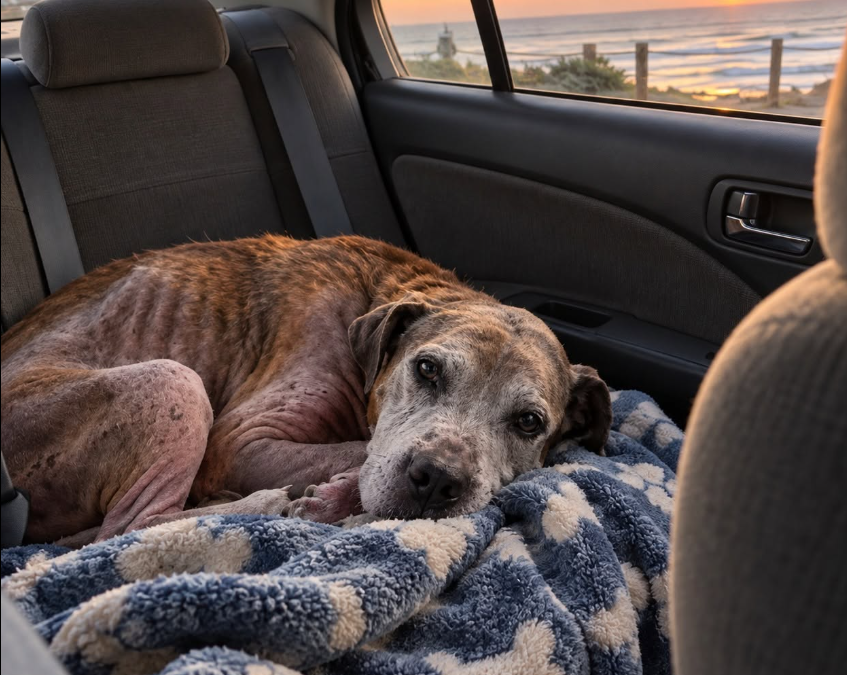
Dad Promised the Stray Dog Would Stay One Night—Thirteen Years Later, We Took Him to the Ocean to Say Goodbye
For thirteen years, my father pretended the stray dog he found in a storm was just a lucky accident, but I knew Bruno was the reason our broken house never completely fell apart.
Now Bruno was dying in the back seat while Dad drove us toward the same ocean where he used to run like pain could never catch him.
By sunset, my father would finally say the words he had been holding inside since the night my mother left—and they would change how I understood love for the rest of my life.
My name is Elias Hayes.
I was twenty years old the evening we drove Bruno to the ocean, but every mile of that road seemed to pull me backward through time until I was seven again, small enough that my feet didn’t touch the floor when I sat at the kitchen table, old enough to understand when people stopped saying certain names out loud.
My mother had left the year before Bruno came.
People always expect abandonment to sound loud.
A slammed door.
A screaming fight.
A suitcase dragged across hardwood.
But my mother leaving sounded, mostly, like quiet.
It sounded like Dad washing one plate instead of two after dinner. It sounded like the refrigerator humming in a kitchen where nobody sang anymore. It sounded like my school bus pulling away every morning while I stood at the window and watched my father’s truck disappear in the opposite direction because he had to get to his first job before sunrise.
Her name was Marlene.
For months after she left, I still expected her to walk back in with some explanation that would make everything make sense. I pictured her setting her purse on the counter, brushing rain from her hair, and saying, “I’m sorry, honey. I got lost. I’m home now.”
Children believe in impossible returns long after adults have stopped waiting.
Dad never told me she was gone forever. He didn’t have the cruelty for that. Instead, he said things like, “Your mom needs some time,” and “Grown-up problems aren’t your fault,” and “Eat your eggs before they get cold.”
But I knew.
I knew by the way he folded her sweaters and put them in a box but kept the box in the hall closet for six months. I knew by the way he paused whenever the phone rang, as if part of him still wanted it to be her and another part was afraid it would be. I knew by the way he worked until his hands were rough and split, then came home and sat at the kitchen table staring at bills like they were written in another language.
My father, Thomas Hayes, was not a dramatic man.
He did not break things.
He did not curse my mother’s name.
He did not cry in front of me, at least not then.
He simply became quiet.
That quiet filled our house like dust.
It settled on the couch where my mother used to sit. It settled in the hallway where her laugh used to carry. It settled in my bedroom every night when I lay awake listening for Dad’s truck, wondering whether people who left could forget the faces of the people they left behind.
Then came the storm.
I remember the rain more clearly than almost anything from that year. It came down so hard it sounded like handfuls of gravel thrown against the windows. Thunder rolled over the roof. Wind pushed tree branches against the glass with long scraping fingers.
I woke after midnight because the house had gone dark.
The power was out.
For a few seconds I lay in bed staring at the ceiling, breathing fast, listening to the storm shake the world outside. Then I heard the front door open.
I climbed out of bed.
The hallway was cold beneath my bare feet. I moved toward the stairs, one hand on the railing, and saw a faint yellow glow coming from the kitchen. Dad had lit the old lantern we kept under the sink.
He stood by the table in his work boots and soaked jacket, rain dripping from his hair onto the floor.
Something small and brown trembled inside his arms.
At first I thought it was a bundle of rags.
Then it lifted its head.
A dog.
He was thin enough that I could see the shape of his ribs beneath wet fur. Mud streaked his legs. One ear folded awkwardly, as if it had once been hurt and never healed quite right. His eyes were wide and terrified, the color of weak tea in the lantern light.
“Dad?” I whispered.
PART2:
Dad turned quickly, and the guilt on his face was almost funny, as if I had caught him stealing cookies instead of carrying a half-drowned dog into our kitchen.
“Go back to bed, Eli.”
“What is that?”
He looked down at the dog.
“A problem.”
The dog shivered so violently that Dad’s arms moved with him.
“Where did you get him?”
“Highway 17.”
“Did you hit him?”
“No.” Dad’s voice changed at once, firm and hurt by the idea. “No, I saw him near the drainage ditch. He was out there in the rain.”
I came down the remaining steps slowly.
The dog saw me and pressed himself deeper into Dad’s chest.
Dad lowered his voice. “Easy, buddy. He’s just a kid. Nobody’s hurting you.”
“Are we keeping him?”
Dad exhaled.
That was the first time I remember seeing how tired he really was. Not tired like someone who needed sleep. Tired like someone who had been carrying too much for too long and had no idea where to put any of it down.
“No,” he said. “Just tonight.”
“Just tonight?”
“One night, Elias. We’ll call around tomorrow. He probably belongs to somebody.”
The dog looked like nobody had belonged to him in a long time.
I stepped closer.
Dad crouched so I could see him better.
The dog’s paws were dirty. His nails were too long. His fur was matted around his chest and neck. There was a scratch near his shoulder, not deep, but fresh enough that the sight made me swallow hard.
“What’s his name?” I asked.
“We don’t know his name.”
“We have to call him something.”
Dad looked at the dog, then at me.
“Don’t name him.”
PART3:
That was my father’s first mistake.
I tilted my head. “He looks like a Bruno.”
“He does not look like a Bruno.”
“Yes, he does.”
“He looks like a wet mop.”
“Bruno.”
The dog blinked at me.
Dad stared.
I smiled for the first time in what felt like months.
“He likes it.”
“He blinked.”
“That means yes.”
Dad tried not to laugh.
He failed.
It was a small laugh, barely more than air, but I heard it. In that dark kitchen, with rain battering the windows and a frightened dog shaking in his arms, I heard my father laugh for the first time since my mother left.
That was how Bruno entered our lives.
Not heroically.
Not cleanly.
Not with a plan.
He came in dripping mud onto the kitchen tile while my father muttered about fleas and towels and how this was absolutely temporary.
Temporary lasted through breakfast.
Then lunch.
Then another night.
Dad called the local shelter. Nobody had reported a missing dog. He called two veterinary clinics. Nobody recognized the description. He put up a handwritten notice on the bulletin board at the grocery store: Found brown male dog near Highway 17 during storm. Call Thomas Hayes.
The phone did not ring.
Bruno spent the first day hiding behind the couch.
The second day, he accepted a piece of toast from my hand.
The third day, he followed me to the bathroom and waited outside the door as if I had performed a magic trick by disappearing.
By the end of the week, he slept beside my bed.
Dad kept saying, “We’re still looking for his owner.”
But he bought dog food.
Then a leash.
Then a cheap collar from Walmart.
Then, one Saturday morning, I came downstairs and found Bruno sitting in the passenger seat of Dad’s truck.
Dad stood outside the open door holding his coffee.
Bruno looked at him.
Dad looked at Bruno.
I stood on the porch in my pajamas, holding my breath.
“Out,” Dad said.
Bruno wagged his tail once.
“I mean it.”
Bruno rested his chin on the dashboard.
Dad rubbed his face with one hand.
“You can’t come to work.”
Bruno did not move.
Dad glanced toward me and saw me watching.
“Don’t say it,” he warned.
I said nothing.
Dad sighed, walked around the truck, opened the driver’s door, and climbed in.
“Fine,” he said to Bruno. “But you embarrass me in front of customers, and you’re walking home.”
Bruno rode with him that morning.
Then the next.
Then every morning after that whenever Dad’s job allowed it.
At first, I thought Bruno had chosen me because I was the kid, and kids believe every new love in a house must belong mainly to them.
But Bruno belonged to Dad in a way I didn’t understand then.
He followed me, yes. He slept by my bed. He pressed his head into my lap when I cried. He waited at the window when my school bus came.
But with Dad, Bruno seemed to recognize something deeper.
Something wounded.
Something quiet.
My father was the one who had found him in the rain, but sometimes when I watched them together, I wondered which of them had really been rescued.
Dad talked to Bruno when he thought I couldn’t hear.
In the kitchen late at night, while I pretended to be asleep upstairs, I would hear the refrigerator open, the scrape of a chair, then Dad’s low voice.
“She always said I worked too much.”
A pause.
“I was trying to keep us afloat.”
Another pause.
“No, you don’t care about that, do you?”
Then Bruno’s tail would thump once against the cabinet.
Dad would laugh softly.
“Yeah. Maybe that’s why I like you.”
Bruno never gave advice.
He never told Dad to move on.
He never told me everything happened for a reason.
He simply stayed.
That was his gift.
When I was nine, my mother sent me a birthday card with twenty dollars inside and no return address. The card had a cartoon dinosaur on the front and said, Hope your day is special! She had written, Love, Mom, in handwriting that made my chest hurt.
I carried that card to my room and shut the door.
Dad didn’t follow me.
Bruno did.
He pushed the door open with his nose and climbed onto my bed even though Dad had technically declared the beds off limits about thirty times by then.
“Go away,” I told him.
He did not.
“I’m not sad.”
He rested his chin on my knee.
“I hate her,” I whispered.
His eyes stayed on mine.
“I hate her.”
Bruno sighed.
“I don’t mean it.”
He stayed.
That was the first time I cried with my arms around his neck.
When I was eleven, three boys at school found out my mother had left.
Children can be cruel with the confidence of people who have never been broken.
One boy asked if my mother left because I was annoying.
Another said maybe she found a better family.
I punched him in the mouth.
The school called Dad.
He picked me up in his work shirt, grease on his knuckles, Bruno sitting proudly in the passenger seat like he was part of the disciplinary committee.
Dad didn’t say anything on the drive home.
That was worse than yelling.
I sat in the back seat, furious and ashamed, staring out the window while Bruno kept turning around to look at me.
At home, Dad said, “We’ll talk after dinner.”
I stormed to my room.
Ten minutes later, Bruno appeared.
He climbed onto the bed, stepped directly on my stomach, and collapsed half on top of me as if emotional support required full body weight.
“Get off,” I muttered.
He licked my chin.
“You’re disgusting.”
His tail wagged.
That night, Dad sat on the edge of my bed.
Bruno lay between us.
Dad looked at my swollen knuckles.
“You can’t hit people because they hurt you.”
I stared at the wall.
“I know.”
“Do you?”
I said nothing.
Dad was quiet for a long moment.
Then he said, “When your mother left, I wanted to be angry enough that I didn’t miss her.”
I looked at him then.
It was the first time he had said something like that.
“It doesn’t work,” he continued. “Anger feels stronger than sadness, but it’s heavier. You carry it too long, and it starts choosing for you.”
“They said she found a better family.”
Dad’s jaw tightened.
For a second, I saw the anger he usually hid.
Then Bruno shifted, pressing his head against Dad’s leg.
Dad put a hand on his back.
“Your mother leaving was about her,” Dad said quietly. “Not you. Never you.”
I wanted to believe him.
Bruno stayed pressed against my side until I did.
Years passed.
That is the strange thing about a house after loss. At first you think grief will be the only weather inside it forever. Then, slowly, without asking your permission, life begins sneaking back in through ordinary things.
Dad learned how to cook more than eggs.
Badly, at first.
He burned meatloaf so completely one night that Bruno sniffed it and walked away, which Dad considered a deep betrayal.
I learned how to mow the lawn, change the oil in the truck, and lie about being fine less convincingly than I thought.
Bruno learned how to open the pantry door with his nose.
He stole bread, socks, one entire Thanksgiving roll, and once, memorably, the ham sandwich Dad had packed for work.
Dad called him a criminal.
Then gave him half a pancake the next morning.
By the time I turned fourteen, Bruno’s muzzle had started to whiten around the edges. Dad’s hair had begun to gray at the temples. I was taller, angrier in the way teenagers often are when sadness hardens before it heals, and convinced that I understood more than I did.
That was the year my mother came back.
Not fully.
Not to stay.
She returned like someone stepping onto a porch without knowing whether the house still belonged to her.
It happened on a Thursday afternoon in October. I got home from school and saw a silver car parked at the curb. It was too clean for our street, glossy enough to reflect the oak trees overhead.
A woman stood near the porch.
For one breath, I did not recognize her.
Then she turned.
My mother.
She looked almost the same and completely different. Her hair was shorter, her coat expensive, her face thinner. She held herself like someone who had learned how to appear calm in rooms where people were watching.
Bruno was at my side immediately, low growl rumbling in his chest.
“Elias,” she said.
My name in her voice hit me so hard I almost hated her for it.
“What are you doing here?”
She flinched.
“I wanted to see you.”
“It’s been seven years.”
“I know.”
“Do you?”
Her eyes moved past me to Bruno.
The look on her face changed.
It was quick, but I saw it.
Recognition.
Not surprise.
Recognition.
“You have a dog,” she said.
“His name is Bruno.”
She stared at him a second too long.
Before I could ask why, Dad’s truck pulled into the driveway.
Bruno left my side and ran to him.
Dad climbed out, saw my mother, and stopped.
For a few seconds, nobody moved.
Then Dad shut the truck door gently.
“Marlene.”
“Tom.”
It was the first time I heard them say each other’s names in the same space since I was too young to understand what marriage could become when love ran out of shelter.
Mom looked at Dad and then at the truck and then at our house, and shame flickered across her face.
“I should have called.”
“Yes,” Dad said.
That was all.
No shouting.
No public scene.
No dramatic accusation.
Just one word.
Yes.
She swallowed.
“I’m in town for the weekend.”
Dad looked at me.
He let me decide.
That was the kind of man he was. He had been left too, maybe more deeply than I understood, but he did not use his pain to control mine.
“I don’t want to talk today,” I said.
Mom nodded too quickly, like she had expected worse.
“Okay.”
She reached into her purse and pulled out a card.
“This has my number.”
I did not take it.
Dad did.
“I’ll give it to him,” he said.
Her eyes filled.
Bruno stood between us, not aggressive, not barking, just present.
Mom looked at him again.
“Where did you find him?”
Dad’s expression sharpened slightly.
“Why?”
“No reason.”
But there was a reason.
I could feel it.
Dad must have felt it too.
“Highway 17,” he said. “During the storm. Seven years ago.”
My mother’s face lost color.
For one second, she looked like the scared one.
Then she recovered, thanked us for our time as if she had just completed a business meeting, and walked back to her car.
I watched her drive away.
Dad stood beside me.
Bruno leaned against his leg.
“What was that?” I asked.
Dad did not answer right away.
“I don’t know.”
But his voice told me he wondered the same thing I did.
Two weeks later, we found out.
The trouble started with a man named Warren Vale.
If my father was the kind of man people underestimated because he was quiet, Warren was the kind people overestimated because he was loud in expensive clothes.
He owned Vale Development, the company buying up old properties around our town and turning them into gated subdivisions with names like Willow Crest and Harbor Ridge, even when there were no willows and no harbor. He sponsored charity dinners, donated to campaigns, shook hands in photographs, and talked about “family values” on local radio.
He was also the man my mother had left with.
I learned that not from Dad, but from a newspaper clipping I found years later tucked inside a box of old tax forms.
At fourteen, all I knew was that Warren Vale entered our lives with a lawyer.
The letter came certified.
Dad opened it at the kitchen table.
I watched his face change as he read.
“What is it?”
He didn’t answer.
I took the paper from his hand.
The words swam at first.
Property.
Unlawful possession.
Canine registered under the name “Bruno.”
Demand for return.
My ears rang.
“They’re saying Bruno is his?”
Dad reached for the letter, but I held it away.
“They’re saying you stole him?”
“Elias.”
“No.” My hands shook. “No, he was on the highway.”
“I know.”
“He was starving.”
“I know.”
“He was hurt.”
Dad’s jaw worked.
“I know.”
Bruno lay under the table, head on his paws, unaware that adults had found a way to turn love into paperwork.
Dad called the number on the letter.
The lawyer spoke so loudly I could hear him from across the room.
Dad kept his voice level.
“I found the dog abandoned during a storm.”
Pause.
“No identification.”
Pause.
“I called the shelter. I posted notices.”
Pause.
“He has lived with us for seven years.”
Pause.
Then Dad’s face went still.
“You tell Mr. Vale if he wants to speak with me, he can do it himself.”
He hung up.
“What did they say?”
Dad rubbed both hands over his face.
“They say Bruno was stolen from a private kennel on Warren’s property the same night I found him.”
“That’s a lie.”
“Yes.”
“So we fight it.”
Dad looked at me.
There was love in his face.
And fear.
Not fear for himself. Fear that I would discover too early how often truth needed money to defend it.
“We’ll do what we can,” he said.
“What does that mean?”
“It means lawyers cost money.”
“Dad.”
“It means he has resources we don’t.”
“Bruno isn’t a couch he can just take back.”
“No,” Dad said, and his voice hardened. “He’s not.”
For the first time in my life, I saw my father prepare for war.
Not with fists.
Not with shouting.
With a file folder.
He gathered everything.
The grocery store notice, yellowed and curled at the edges. A photocopy of the shelter intake call log showing he had reported a found dog. The first vet bill, which listed Bruno as “underweight, dehydrated, minor shoulder abrasion, no microchip detected.” Photos of Bruno from that first month, thin and frightened, sleeping on towels in our laundry room.
Dad called every clinic within fifty miles. He called the county animal control office. He called the state registry for dog licenses. He wrote down names, dates, and times with the precision of a man who had never had much power but understood that details were one kind ordinary people could still claim.
I helped after school.
At first, it felt exciting, like a mystery.
Then came the humiliation.
Warren Vale didn’t just want Bruno.
He wanted the town to know he was taking him.
A local blog ran a story: Developer Fights to Recover Beloved Family Dog Allegedly Taken Years Ago.
There was a photograph of Warren in a navy suit, standing beside my mother outside a country club. He looked wounded in the way rich men look when they know a camera is nearby.
The article said Bruno had been a “cherished pet” stolen from Warren’s private kennel after a storm damaged the gate. It quoted him saying, “For years, my family has wondered what happened to our dog. We are grateful to have finally found him, and we hope Mr. Hayes will do the right thing.”
Mr. Hayes.
Not Thomas.
Not Dad.
Mr. Hayes, like a stranger.
At school, people talked.
One girl asked if my dad really stole a dog.
One teacher gave me the careful look adults give children when they think their home has become gossip.
I punched no one this time.
I wanted to.
But Dad’s voice lived in my head.
Anger feels stronger than sadness, but it’s heavier.
So I carried the heavier thing quietly.
Then Warren made it public.
There was an animal rescue fundraiser at the town hall that November. Dad had gone because one of the shelter volunteers told him a local attorney, Linda Perez, sometimes volunteered there and might be able to advise him for free. He didn’t want to go. He hated asking for help. But for Bruno, he went.
I went with him.
We left Bruno at home because the room would be crowded, and Bruno had never liked crowds.
Town hall had been decorated with cheap white lights and folding tables covered in blue cloth. There were donation jars, framed photos of adoptable pets, and a small stage where the mayor planned to give a speech about community compassion.
Dad wore his one good button-down shirt.
It had been ironed badly.
I had done it.
We were speaking quietly with Linda Perez near the refreshment table when the room’s energy shifted.
Warren Vale had arrived.
So had my mother.
She wore a black dress and pearls. Warren wore a suit that probably cost more than Dad’s truck was worth. People moved toward them the way people move toward money.
I felt Dad stiffen beside me.
Warren saw us.
He smiled.
It was the kind of smile that already believed it had won.
“Thomas Hayes,” he said, loudly enough for the nearby tables to hear.
Dad turned.
“Mr. Vale.”
Warren’s gaze dropped to Dad’s shirt, his work boots, the calluses on his hands.
Then he looked at me.
“And you must be Elias.”
I said nothing.
My mother stood behind him, pale and tense.
“I wish you had brought Bruno,” Warren said. “It would have been meaningful, considering tonight’s cause.”
Dad’s face did not change.
“Bruno is home.”
“Your home,” Warren corrected gently, performatively. “For now.”
People stopped pretending not to listen.
Linda Perez shifted beside us.
Dad said, “This isn’t the place.”
“I disagree,” Warren said. “This is exactly the place. A room full of people who care about animals ought to know when one has been kept from his rightful owner.”
Heat climbed my neck.
Dad’s hand brushed my shoulder once.
A warning.
Stay calm.
Warren stepped closer.
“You are a working man. I respect that. I understand attachments form. But at the end of the day, property has to be returned.”
Dad’s eyes changed.
“Bruno is not property.”
Warren chuckled.
“Legally, he is.”
That was when my mother spoke.
“Warren, please.”
He ignored her.
“You found a dog and kept him. Maybe at first you didn’t know. Fine. But now you do know. The honorable thing would be to stop making this harder.”
Dad’s jaw tightened.
“I found a starving animal in a ditch during a storm.”
“You found my dog.”
“Then why didn’t you report him missing?”
Warren’s smile sharpened.
“We did.”
“No record of it.”
“You don’t have access to every record.”
Linda Perez spoke then, calm and cool.
“I might, if this goes before a judge.”
Warren looked at her as if noticing an insect.
“And you are?”
“Linda Perez. Attorney.”
The word changed the air.
Dad looked surprised. So did I.
Warren recovered fast.
“Then you understand ownership.”
“I understand abandonment too,” Linda said.
A murmur moved through the room.
Warren’s face tightened.
Dad took a breath. “We’re done here.”
He turned to leave.
Warren raised his voice.
“You can walk away from me, Hayes, but you won’t walk away from a court order.”
Dad stopped.
I saw his shoulders move.
For one terrible second, I thought he might turn around and do something that would give Warren exactly what he wanted.
Instead, Dad looked back and said, “I turned around once for Bruno when everybody else drove past. I’ll stand in front of him now for the same reason.”
The room went quiet.
It was the strongest thing I had ever heard my father say.
But Warren wasn’t done.
He laughed.
A small, cruel sound.
“You people always make sentiment out of irresponsibility.”
My mother flinched.
I looked at her then, really looked.
She wasn’t just embarrassed.
She was afraid.
Not of Dad.
Of Warren.
That was when I understood there were secrets in this story older than the lawsuit.
After that night, Linda Perez took our case.
Pro bono.
“I don’t like bullies,” she told Dad in our kitchen while Bruno sat beneath the table with his head on her shoe. “And I especially don’t like bullies who use rescue fundraisers as courtrooms.”
Dad looked ashamed.
“We can pay something.”
“I said pro bono, Mr. Hayes.”
“Tom.”
“Tom, then.” She leaned down and scratched Bruno’s ears. “Besides, your dog has already retained me.”
Bruno wagged his tail.
The investigation began with paperwork and ended in a place none of us expected.
Linda requested Warren’s supposed ownership records. He produced a registration form from a private breeder, veterinary receipts, and photographs of a young brown dog that looked like Bruno but not exactly. The dates were close enough to be dangerous.
Then Linda found the first crack.
The vet listed on Warren’s records had retired.
Linda tracked him down.
His name was Dr. Mallory, and he remembered Warren Vale perfectly.
“Men like that make themselves memorable,” he told us in his small retirement office, surrounded by dusty books and framed pictures of dogs.
Dad sat rigid beside me.
Dr. Mallory adjusted his glasses and examined the photocopies.
“This dog was brought in twice,” he said. “Young male. Brown. Nervous. I don’t remember the name Bruno. I believe Mr. Vale’s staff called him Buck.”
“Buck?” I repeated.
Bruno lifted his head from the floor at the sound of my voice, then settled again.
“What happened to him?” Linda asked.
Dr. Mallory frowned.
“He had a shoulder injury. Not severe. I recommended rest.”
“Was he a family pet?”
The doctor looked at Dad.
Then at me.
Then back at Linda.
“No.”
Dad’s hand tightened around Bruno’s leash.
“What was he?” Linda asked.
Dr. Mallory hesitated.
“I suspected Mr. Vale had dogs on that property for security at first. Later, I became concerned there was something else going on. Training. Aggressive conditioning. I reported concerns, but nothing came of it.”
My stomach turned.
Dad’s voice was low.
“Bruno has never hurt anyone.”
“I believe you,” Dr. Mallory said gently. “Some dogs refuse to become what people try to make them.”
That sentence stayed with me.
Some dogs refuse to become what people try to make them.
Some people too.
The next piece came from my mother.
She called Dad late one evening.
I was in the kitchen doing homework when the phone rang. Dad answered, listened, and went still.
“Marlene.”
I looked up.
Bruno did too.
Dad said very little.
Mostly he listened.
Then he closed his eyes.
“Why didn’t you say this before?”
A pause.
“No. Don’t come here.”
Another pause.
“Then meet us at Linda’s office.”
He hung up.
“What happened?”
Dad sat slowly.
“She says she knows how Bruno ended up on the highway.”
The next day, I saw my mother in Linda Perez’s office.
She looked smaller than she had at town hall. Without Warren beside her, the polish seemed fragile.
She held a tissue in both hands.
“I didn’t know at first,” she said.
Dad said nothing.
Linda had a yellow legal pad ready.
Mom looked at me.
“I need you to understand—”
“No,” I said.
Her mouth closed.
“You don’t get to start by telling me what I need to understand.”
Dad looked at me, but he did not stop me.
Mom nodded.
“You’re right.”
That surprised me.
She took a shaking breath.
“When I left, I was selfish.”
The room went silent.
“I told myself I was drowning. I told myself your father didn’t see me. I told myself I deserved a different life, a life where I wasn’t counting coupons and waiting for him to come home exhausted.” Her eyes filled. “None of that excused leaving you, Elias.”
The apology landed somewhere inside me, but I did not know what to do with it yet.
“So what does this have to do with Bruno?” I asked.
Mom looked down.
“Warren had dogs on his property. He called them guard dogs, but some of the men who came there…” She stopped. “I didn’t like it. There was a young brown dog. Gentle. Too gentle for what Warren wanted.”
Dad’s face hardened.
“One night there was a storm,” she continued. “A gate came loose. Warren was furious. He said the dog was useless, skittish, costing him money. I heard him tell one of his employees to get rid of it.”
The room seemed to tilt.
Dad’s voice was barely controlled.
“Get rid of it.”
Mom nodded.
“I asked what that meant. Warren told me not to be dramatic.”
My hands curled into fists.
“Did you stop him?”
She looked at me.
“No.”
That one word did more damage than any excuse could have.
“No,” she repeated, crying now. “I didn’t. I was afraid of him. I was ashamed. I told myself maybe he’d give the dog away. Then the next morning, the dog was gone. Warren said it ran off.”
Dad stood and walked to the window.
Bruno rose slowly and followed him, pressing his body against Dad’s leg.
Mom watched them.
“When I saw Bruno at your house,” she whispered, “I recognized him. Not immediately from how he looked, but from the ear. And the eyes.”
“Why didn’t you say anything?” I asked.
“Because Warren saw him too.”
Linda leaned forward.
“And now he wants him back because?”
Mom’s mouth twisted.
“Because people started asking why he never mentioned this beloved missing dog before. Because he lied publicly, and now he has to win or be exposed.”
Dad turned from the window.
“Will you sign a statement?”
Mom nodded.
“Yes.”
“And testify?”
Fear moved across her face.
Then she looked at Bruno.
“Yes.”
Warren’s mistake was arrogance.
Cruel people often reveal themselves not because good people are clever enough to trap them, but because cruelty eventually gets tired of wearing a mask.
Linda filed a response with witness statements, veterinary inconsistencies, and evidence that Dad had reported Bruno found. She also sent a request for records from Warren’s former groundskeeper, a man named Harold Meeks.
Harold had moved two counties away and worked at a hardware store.
Dad and I drove there on a Saturday.
Bruno came with us.
The store smelled like sawdust and fertilizer. Harold Meeks was in his sixties, narrow-shouldered, with a face that looked permanently sunburned. When Dad introduced himself and said Bruno’s name, Harold’s eyes dropped to the dog.
He whispered, “Buck.”
Bruno wagged his tail uncertainly.
Harold had to sit down.
“I always wondered,” he said.
Dad stood very still.
“Were you the one?”
Harold nodded.
I hated him then.
I hated his lined face, his work vest, his trembling hands.
“I was working for Vale,” Harold said. “Had three kids. Wife was sick. Needed the job.”
Dad’s voice was flat.
“So you dumped him.”
Harold flinched.
“I was told to take him to the far road and leave him. Warren said if I didn’t, I could pack my things.”
“And that made it okay?”
“No.” Harold looked at Bruno. “No, sir. It did not.”
Dad’s anger filled the aisle like heat.
Bruno, sensing it, leaned against him.
Harold wiped his eyes with the back of his hand.
“I left him near the drainage ditch because there was a gas station less than a mile away. I thought maybe someone would see him. God forgive me, I drove off. Then the rain got worse, and I turned around.”
Dad stared.
“You turned around?”
Harold nodded.
“But he was gone. I looked for an hour. I thought he’d died out there.”
Nobody spoke.
Harold looked at Dad.
“You found him.”
Dad put one hand on Bruno’s back.
“Yes.”
The old man covered his face.
“Thank God.”
I still hated what Harold had done.
But for the first time, I understood that guilt could live in a person for years without turning into repair until somebody opened the door.
Harold signed an affidavit.
He also gave us something stronger.
A voicemail.
Warren had left it the morning after the storm, angry that Harold had returned late and warning him not to mention the dog. Harold had saved it because he was afraid of being blamed for something worse someday.
Linda listened to it in her office with her face completely still.
Warren’s voice crackled from the small speaker.
“I don’t care where you left him, Harold. If the mutt couldn’t do what I paid for, he’s not my problem. And if anyone asks, the gate broke and he ran. Do not make me repeat myself.”
Dad closed his eyes.
My mother cried silently.
I stared at the phone.
That was the moment Warren lost Bruno.
Not legally yet.
But morally, completely.
The legal hearing happened in December.
It was held in a small county courtroom with wooden benches and fluorescent lights that made everyone look tired.
Warren arrived with two attorneys.
Dad arrived with Linda, me, my mother, Harold Meeks, and Bruno.
The judge allowed Bruno to sit beside Dad because Linda argued, with a straight face, that his presence was relevant to his welfare.
Bruno slept through most of the hearing.
Warren did not.
He smiled when he entered, shook hands with people, acted injured and patient. But as Linda presented the evidence, his confidence began to crack.
The found-dog report.
The veterinary record showing no microchip.
The grocery store notice.
Dr. Mallory’s statement.
My mother’s testimony.
Harold’s affidavit.
Then the voicemail.
Warren’s face changed when his own voice filled the courtroom.
“If the mutt couldn’t do what I paid for, he’s not my problem.”
The judge looked over her glasses.
Warren’s attorney stood too fast.
“Your Honor, context—”
The judge raised one hand.
The room went quiet.
Warren leaned toward his lawyer and whispered angrily, but everyone could see him losing control.
Linda asked him only one question when it was her turn.
“Mr. Vale, when you told Harold Meeks that the dog was not your problem, were you referring to the dog you now claim was your cherished family pet?”
Warren’s mouth opened.
Closed.
He looked at my mother.
She looked away.
He looked at Dad.
Dad did not move.
Then Warren made his final mistake.
“He was an animal,” he snapped. “I had staff handle animals all the time. This ridiculous sentimental circus doesn’t change ownership.”
There it was.
Not grief.
Not love.
Ownership.
The judge ruled that Warren had abandoned any claim to Bruno years earlier, that Dad had followed appropriate found-animal procedures, and that removing Bruno from the only home he had known for seven years would not be in the animal’s welfare.
Bruno stayed.
Warren was fined later for animal abandonment and investigated for conditions on his property. Some charges were harder to prove because years had passed, but enough came out that his spotless public image cracked. Sponsors dropped him. The rescue organization returned his donations. The town that once moved toward him like money began stepping back.
As for my mother, justice was more complicated.
She did not go to jail.
She did not magically become the mother I had needed.
But she lost the comfortable lie that she had simply followed her heart into a better life. She had to look at the dog she failed to protect and the son she left behind and understand that some choices keep echoing long after the person who made them moves on.
After the hearing, she approached Dad outside the courthouse.
Snow had begun falling lightly.
Bruno stood between us, wearing the red bandana I had bought him for good luck.
Mom looked at Dad and said, “I’m sorry.”
Dad nodded.
“I know.”
“I should have told you sooner.”
“Yes.”
“I should have done a lot of things.”
Dad looked at Bruno.
“We all should have.”
That was not forgiveness.
Not exactly.
It was something more honest.
A door left unlocked but not opened for her.
She turned to me.
“Elias—”
“I’m glad you testified,” I said.
She started crying.
It was not what she wanted from me.
It was all I had to give.
Years later, I would speak to her sometimes. Not often. Not easily. We would build something narrow and imperfect, more like a bridge over deep water than a road. I would learn pieces of her pain that did not excuse her leaving but helped me stop letting her absence decide who I became.
But that day, I walked away with Dad and Bruno.
Dad did not celebrate in the truck.
He sat behind the wheel, one hand resting on Bruno’s back, staring through the windshield as snow softened the courthouse steps.
“You okay?” I asked.
“No,” he said.
It was one of the first honest answers he ever gave me.
Then he looked at Bruno.
“But he’s coming home.”
Bruno wagged his tail once, like that was all any of us needed to know.
After the lawsuit, something shifted in Dad.
Not suddenly.
My father was not built for sudden transformation.
But Bruno’s story had become public in a way Dad never wanted, and people responded. They sent letters. They dropped off dog treats. The shelter asked Dad to speak at their next fundraiser, and he refused so quickly Linda laughed for a full minute.
But he did agree to help fix broken kennel doors.
Then he agreed to transport two dogs to a foster home.
Then he agreed to take in one senior hound “for the weekend” because the shelter had flooded.
The hound stayed eleven days.
Dad complained every day.
He also slept downstairs on the couch because the dog had arthritis and whined when left alone.
When the hound finally went to a rescue, Dad stood in the driveway after the van left and said, “Good. House will smell better.”
Bruno looked up at him.
Dad sighed.
“I know. I miss him too.”
That was when I realized Bruno had not only healed us.
He had changed what we did with the healing.
By the time I graduated high school, Dad had become the man people called when a stray dog was seen near the highway.
He always said he wasn’t an animal rescue.
Then he got in his truck.
Bruno always went with him.
One rainy evening, when I was nineteen, I found Dad sitting on the kitchen floor beside Bruno’s water bowl.
Bruno was lying on his side.
Dad had both hands on the dog’s face.
He didn’t know I was there.
“You scared me, old man,” he whispered.
Bruno blinked slowly.
Dad pressed his forehead to Bruno’s.
“Don’t do that yet.”
I stepped back before he saw me.
That was the first time I understood Bruno would not live forever.
I hated the knowledge immediately.
For years, Bruno had seemed less like a living creature and more like a law of our house.
Dad’s truck had four tires.
The kitchen light buzzed.
Bills arrived on the first of the month.
Bruno waited at the window.
Some things simply were.
Then time began taking him from us in little pieces.
First, he stopped jumping into the truck.
Dad built a small wooden step.
Bruno ignored it, because Bruno had opinions about objects he had not approved.
So Dad lifted him.
At first, he made jokes.
“You’re getting lazy.”
Bruno licked his chin.
“Don’t sweet-talk me.”
Then Dad began lifting him more carefully.
Later, Bruno stopped climbing the stairs to my room.
I slept downstairs for a week and pretended it was because the air conditioner worked better there.
Bruno’s walks grew shorter.
His hearing faded.
His eyes clouded.
Sometimes he stood in the hallway looking confused, as if our house had rearranged itself while he slept.
The vet was kind in the practiced way of people who spend their lives giving unbearable news softly.
“There are good days left,” she told us.
Dad heard the rest without her saying it.
Not many.
The medications lined the kitchen counter.
Pain relief.
Anti-inflammatory.
Supplements.
Dad labeled them with painter’s tape and wrote times in black marker.
Morning.
Evening.
With food.
After food.
I found him one night at the sink, washing Bruno’s bowl with such care that it broke my heart.
“Dad.”
He didn’t turn.
“I’m fine.”
“No, you’re not.”
His hands stopped.
For a long moment, water ran over the bowl and into the drain.
Then he said, “He was supposed to stay one night.”
I swallowed.
“You missed the deadline.”
Dad laughed once.
A broken sound.
“By a lot.”
That summer, Bruno had one good week.
A strange bright flare of energy that came from nowhere.
He ate all his breakfast. He walked to the mailbox. He barked at a squirrel with the offended dignity of a much younger dog.
Dad watched him like a man watching weather he did not trust.
On Wednesday, he asked me, “Do you want to take him to the beach this weekend?”
Bruno had always loved the ocean.
The first time Dad took us, Bruno had been young and strong and insane with joy. He ran at the waves as if they had insulted him personally, then fled from them when they chased him back. I had laughed so hard I fell in the sand.
Dad had laughed too.
Real laughter.
Full laughter.
The kind that made people nearby smile without knowing why.
Now Dad stood in the kitchen with one hand on Bruno’s back and asked the question quietly.
“Do you want to take him to the ocean?”
He did not say why.
He didn’t have to.
So that Saturday, near sunset, Dad folded Bruno’s old blue blanket and put it in the back seat. He packed water, medication, towels, and the red bandana Bruno had worn to court years earlier.
Bruno watched from the living room rug.
Dad knelt beside him.
“Ready, old man?”
Bruno lifted his head.
His tail moved once.
Dad closed his eyes.
Then he picked him up.
Bruno was so light.
That was what hurt most.
Not the gray muzzle. Not the clouded eyes. Not the way his legs folded beneath him now.
The lightness.
As if life had slowly been leaving him and we had been pretending not to notice the weight changing in our arms.
Dad placed him on the back seat because Bruno could no longer sit upright in the passenger seat.
For a moment, Dad stared at the front seat.
Bruno’s seat.
The leather there was scratched from years of nails. White fur still clung stubbornly near the seat belt. A faint nose print marked the inside of the window.
Dad reached toward it, then stopped himself.
I climbed into the passenger seat.
It felt wrong.
Dad noticed.
“You can sit in the back with him.”
“No,” I said. “I’m okay.”
I wasn’t.
Neither was Dad.
We drove without music.
The road to the coast carried us past places layered with memory. The gas station where Dad once bought Bruno a hot dog after saying dogs should not eat hot dogs. The school where Bruno used to wait in the truck during parent-teacher conferences. The courthouse where Warren Vale lost any right to call Bruno his. The grocery store that once held Dad’s handwritten found-dog notice.
At a red light, I turned and reached into the back seat.
“Hey, Bruno.”
His eyes opened halfway.
“That’s my boy.”
His tail did not move.
But he knew my voice.
I believed that then.
I still do.
Dad gripped the steering wheel so tightly his knuckles whitened.
“You okay?” I asked.
“No.”
He said it immediately.
No pride.
No performance.
Just the truth.
It may have been the bravest answer I had ever heard from him.
The coast came into view just as the sky began turning gold.
Dad parked near the dunes.
For a moment neither of us moved.
Then he got out, opened Bruno’s door, and stood looking down at him.
The sound of waves reached us faintly.
Dad bent.
“I’ve got you, old man.”
He slid one arm beneath Bruno’s chest, the other beneath his hips, and lifted him as gently as if Bruno were made of glass.
I carried the blanket.
We crossed the sand slowly.
People were still there, but not many. A family packing up chairs. Two teenagers taking photos of the sunset. A little girl chasing foam at the edge of the water.
Nobody looked twice at us.
That felt impossible.
How could the world not know?
How could the sky turn beautiful on a day like this?
Dad stopped where the waves could almost reach us. I spread the blanket. He lowered himself carefully and settled Bruno against his chest.
Bruno’s breathing was shallow.
In.
Out.
A pause.
In.
Out.
Dad stroked his fur.
“Remember this place?” he whispered.
Bruno’s eyes opened.
He looked toward the ocean.
Then at me.
Then at Dad.
With what seemed like the last little strength he had saved for anything, Bruno lifted his head and slowly licked Dad’s hand.
Dad’s face crumpled.
He lowered his forehead into Bruno’s fur.
His shoulders shook.
No sound at first.
That made it worse.
I had seen my father cry before, but never like that. Not loudly. Not dramatically. Quiet grief is heavier because there is nowhere for it to go.
I sat beside them and placed my hand on Bruno’s back.
His body was warm beneath my palm.
The waves moved forward and back.
Forward and back.
For thirteen years, Bruno had held our broken little family together without ever asking us to admit we were broken. He had waited at windows, ridden in trucks, slept beside beds, survived storms, courtrooms, and the strange cruelty of people who thought love was ownership.
Now he lay between us at the edge of the ocean, tired beyond fear.
Dad lifted his face.
His eyes were red.
He whispered, “You can rest now, buddy.”
Bruno breathed in.
Out.
Dad’s hand moved slowly along his back.
“We’re both here.”
A few seconds passed.
Bruno breathed again.
Very slightly.
Then his chest fell.
Dad’s fingers stopped moving.
I waited.
Five seconds.
Ten.
I leaned closer.
“Dad.”
“I know.”
His voice was barely audible.
Bruno did not take another breath.
There was no struggle.
No cry.
No sudden frightening moment.
He simply rested his head against Dad’s arm and did what Dad had finally given him permission to do.
He stopped fighting.
Dad held him as the sun touched the horizon.
I wrapped one arm around my father’s shoulders and kept my other hand on Bruno.
For several minutes, all three of us remained that way.
A father.
A son.
And the dog who had somehow become the bridge between them.
The sun disappeared.
The orange sky faded into deep blue. Small lights appeared far out on the water. Behind us, families carried coolers and shook sand from towels. Children complained about leaving. A car door slammed.
To the rest of the world, it was an ordinary evening at the beach.
To us, an entire era had ended.
Dad finally lifted his head.
He looked down at Bruno.
“I promised one day,” he said.
I knew exactly what he meant.
Thirteen years earlier, soaked from the rain, he had stood in our kitchen holding a frightened stray and promised me Bruno would stay only one night.
I almost smiled through tears.
“You missed the deadline.”
Dad laughed once.
A broken little sound.
“By a lot.”
“Best mistake you ever made.”
He looked toward the ocean.
“No.”
I turned to him.
He swallowed hard.
“You were.”
I couldn’t speak.
Dad held Bruno tighter.
“I thought I saved him that night,” he said. “I thought I was bringing home some lost dog.”
His voice cracked.
“But he saved us.”
The drive home was almost unbearable.
Dad wrapped Bruno in the faded blue blanket, the one with the torn corner and years of fur embedded so deeply no washing machine could ever remove it. When we reached the parking lot, he opened the back door, then froze.
For thirteen years, Bruno had belonged in the passenger seat.
But Dad could not place him there now.
“Dad,” I said softly.
He stared at the empty front seat.
“That’s his seat.”
“I know.”
He stood there for several seconds, caught between habit and reality.
Then he placed Bruno gently in the back, adjusted the blanket around him, and touched his head one last time.
“Still your truck, buddy.”
We drove home with no radio.
Halfway there, Dad said, “I should have brought him here more.”
“You brought him plenty.”
“Not enough.”
“It was enough.”
“How do you know?”
“Because he always wanted to go home with us.”
Dad looked straight ahead.
That seemed to hit him.
I continued, quietly, “He didn’t care where we went.”
Dad’s jaw tightened.
He reached one hand toward the passenger seat before remembering.
Then he put it back on the wheel.
When we got home, the house felt wrong before we even opened the door.
Grief lives inside habits.
The next morning, I woke and listened for Bruno’s nails moving down the hallway.
Nothing.
I went downstairs expecting him near the kitchen.
Nothing.
Dad poured coffee into two mugs.
Then he opened the cabinet where Bruno’s food had been kept.
He stopped.
His hand stayed on the handle.
After a few seconds, he closed it again.
Neither of us said anything.
The silence felt like the silence our house had known before Bruno.
That frightened me more than I expected.
I had almost forgotten it.
Dad sat across from me.
He drank half his coffee.
Then he said, “I think we should go to the shelter.”
I stared at him.
“What?”
“I’m not replacing Bruno.”
“I know.”
“I don’t want you thinking that.”
“I don’t.”
“He can’t be replaced.”
“I know, Dad.”
Dad rubbed his hands together.
“I keep thinking about the highway.”
“What about it?”
“What if somebody else drives past the next Bruno?”
I looked down at my coffee.
“I don’t know.”
“I do.” He stood. “I don’t want it to be us.”
We went that afternoon.
I thought it was too soon.
Part of me felt disloyal. Bruno had died less than twenty-four hours earlier. How could we look at another dog when his blanket still lay folded in the laundry room? How could Dad even suggest it?
But grief makes some people close every door.
Bruno had taught Dad to open one.
The shelter was loud.
Dogs barked from every row. Some jumped against kennel doors. Some wagged wildly. Others sat in corners with the tired stillness of animals who had learned not to expect too much.
A volunteer named Natalie walked with us.
“What kind of dog are you looking for?”
Dad answered first.
“One that needs us.”
Natalie smiled sadly.
“That doesn’t narrow it down much.”
“No,” Dad said. “I guess it doesn’t.”
We walked slowly.
A young shepherd mix bounced at his gate. A beagle howled like he was personally offended by confinement. An old Labrador pressed his paw through the bars and rested it in Dad’s palm.
Dad stopped at every kennel.
But nothing happened.
I wasn’t looking for Bruno.
At least I told myself I wasn’t.
Then we reached the final row.
A medium-sized brown and white dog lay curled in the back corner of his kennel. Too thin. Ears lowered. Eyes watchful. Unlike the others, he did not come forward.
Natalie sighed.
“That’s Oliver.”
Dad looked at me.
“Oliver?”
“He came in about three weeks ago. Found behind an abandoned building.”
“Anybody claim him?” I asked.
“No.”
Oliver looked at us for half a second.
Then away.
Something about his eyes stopped me.
Not because they looked exactly like Bruno’s.
They didn’t.
But I recognized the question in them.
Are you safe?
I crouched.
“Hey.”
Oliver didn’t move.
Natalie said, “He’s nervous around men, especially at first.”
Dad immediately stepped backward.
That was my father.
He didn’t insist.
He didn’t take offense.
He made himself smaller in someone else’s fear.
I extended my hand.
Oliver watched.
One minute passed.
Maybe two.
Finally he stood.
One careful step.
Then another.
He approached the bars, sniffed my fingers, and licked them.
Behind me, Dad made a sound.
I turned.
He was crying.
Not dramatically.
Just tears running down his face.
“He has the same eyes,” he whispered.
I knew what he meant.
Not the color.
The question.
The hope hidden underneath fear.
Natalie looked between us.
“Do you want to meet him outside the kennel?”
Dad laughed softly.
“That’s probably how trouble starts.”
She smiled.
“Usually.”
Oliver came home with us.
Not that day officially. There was paperwork, a waiting period, and a vet check. But emotionally, the decision had already been made the moment he placed his chin in Dad’s palm in the meet-and-greet room.
On the first ride home, Oliver trembled in the back seat.
I sat beside him.
Dad drove.
For several miles, Oliver remained curled near the door. Then, at a red light, he slowly stood and moved toward the front.
I reached to stop him.
Dad said, “Let him.”
Oliver climbed between the seats.
Carefully, uncertainly, he stepped onto the passenger seat.
Bruno’s seat.
He turned around twice.
Then sat.
Dad gripped the wheel.
Oliver looked at him.
Then at me.
Then back at Dad.
His tail moved.
Just once.
A small, uncertain wag.
Dad’s face crumpled.
I put my hand on his shoulder.
“Dad.”
He nodded.
“I’m okay.”
He wasn’t.
Neither was I.
But for the first time since the beach, the tears did not feel entirely like grief.
Something else was inside them.
Hope.
Dad reached one hand from the steering wheel and placed it gently against Oliver’s back.
Oliver froze.
Dad almost removed it.
Then Oliver leaned toward him.
Dad smiled.
We drove home that way.
Exactly how I had watched Dad and Bruno leave for work thousands of mornings.
One hand on the wheel.
One hand on a dog.
But it wasn’t the same.
That mattered.
Oliver was not Bruno.
We never wanted him to be.
Bruno had been quiet; Oliver snored like industrial machinery.
Bruno hated rain; Oliver became obsessed with puddles.
Bruno politely waited beside the table; Oliver once stole half a loaf of bread and tried to hide it beneath Dad’s pillow.
Bruno loved tennis balls; Oliver was afraid of them for reasons nobody ever understood.
But little by little, Oliver began to trust us.
The first week, he slept beside the front door.
The second week, he moved into the hallway.
By the third week, I woke and found him curled at the foot of my bed.
I smiled in the darkness.
“Careful,” I whispered. “That’s how the last guy got thirteen years.”
His tail thumped once.
Dad began talking again too.
One morning I came downstairs and found him making coffee while Oliver sat nearby.
“You understand there’s a sixty percent chance of rain?” Dad said to him.
Oliver tilted his head.
Dad noticed me in the doorway.
“I’m talking to a dog again.”
“You never stopped.”
For a moment, sadness crossed his face.
Then he smiled.
“No. I guess I didn’t.”
Grief and love learned how to live in the same house.
That surprised me.
I had always imagined healing as something that replaced pain.
It didn’t.
Bruno remained everywhere.
His photograph stayed beside the fireplace. His leash hung on a hook in the garage. One of his scratched bowls became a planter in the backyard because Dad couldn’t throw it away. Sometimes Dad still reached automatically toward the passenger seat when Oliver wasn’t there. Sometimes I dreamed of Bruno and woke expecting to find him beside my bed.
Those moments hurt.
But the pain no longer made the house empty.
Oliver filled spaces differently.
Because he was different, loving him never felt like betraying Bruno.
Months after Bruno died, Dad and I returned to the beach.
Oliver came with us.
I had been afraid Dad would never want to see that place again.
Instead, he suggested it.
We reached the same stretch of sand near sunset. Oliver immediately tried to eat seaweed.
Dad laughed.
“Bruno had more dignity.”
“Not much more.”
“Fair.”
We walked toward the place where Bruno had spent his final evening.
There was no marker.
No plaque.
No stone.
The tide had erased every footprint months ago.
Still, I knew.
Dad knew too.
We sat.
Oliver wandered several feet away on his long leash, sniffing shells.
Dad watched the horizon.
“I thought coming back would hurt more,” he said.
“Does it?”
“Yes.”
He paused.
“But not in the way I expected.”
I waited.
Dad pulled something from his jacket pocket.
Bruno’s old collar.
Worn leather.
Faded tag.
He held it between his hands.
“I almost brought this to the shelter.”
“Why?”
“Thought maybe Oliver could wear it.”
I looked at him.
“But?”
Dad smiled faintly.
“It belongs to Bruno.”
“Yeah.”
“So I bought Oliver his own.”
Oliver’s new blue collar was visible around his neck.
Dad turned Bruno’s collar over in his hands.
“We don’t honor somebody by asking the next one to become them.”
For a man who claimed not to talk much, my father sometimes found exactly the right sentence.
We sat until sunset.
Oliver eventually returned and lay between us.
His head rested on Dad’s leg.
Dad placed one hand on Oliver’s back.
The other still held Bruno’s collar.
Past and present.
Not competing.
Simply touching.
Life kept moving.
I moved into an apartment across town. Dad pretended it did not bother him. Oliver exposed him.
On my first visit after moving, Oliver nearly knocked me over at the door.
Dad stood behind him.
“You’d think nobody feeds him.”
“I think he missed me.”
Dad shrugged.
“Maybe.”
“You missed me too?”
“No.”
“Good talk.”
“Your room’s still there.”
That was Dad’s version of yes.
I visited often.
Sometimes I found Dad asleep on the couch with Oliver beside him. Sometimes they were in the truck together, same passenger seat, same hand on the back, different dog.
One Sunday morning, I followed Dad outside.
Oliver jumped into the truck.
Dad looked toward me.
“Coming?”
“Where?”
“Coffee.”
“You need Oliver for coffee?”
“He has opinions.”
“About coffee?”
“Parking.”
I laughed and climbed into the back.
For a second, I was seven again.
Dad driving.
A dog beside him.
Me in the back seat.
Except the boy who had waited for his mother was gone.
In his place was a man who finally understood something his father had spent years learning.
Families are not always built by the people who stay exactly where you expect them to.
Sometimes they are built after somebody leaves.
Sometimes they arrive soaked from the rain.
Sometimes they have four legs.
Sometimes they stay one night.
Sometimes that night lasts thirteen years.
Dad eventually retired.
His final day at work, Oliver rode with him.
Of course he did.
When Dad returned home that afternoon, he sat on the porch. I brought beer. Oliver lay between us.
Dad stared toward the driveway.
“You know what scares me?”
“What?”
“I used to think I’d work until I died.”
“That’s cheerful.”
“I’m serious.”
“I know.”
“Work kept me busy after your mother left.”
He looked at Oliver.
“Bruno taught me to come home.”
I took a drink.
“And Oliver?”
Dad scratched Oliver’s head.
“He’s teaching me how to stay there.”
Retirement suited Dad better than anyone expected.
He started gardening.
Badly.
Oliver dug up half of what he planted.
Dad complained constantly and replanted everything.
I never told him the garden looked terrible.
It made him happy.
Then one afternoon, almost three years after Bruno’s death, Dad called me.
“Can you come over?”
“What happened?”
“Nothing.”
That answer immediately worried me.
I drove over.
Dad was sitting at the kitchen table. An envelope lay in front of him.
“What is it?”
He pushed it toward me.
Inside was a letter from my mother.
I froze.
“What does she want?”
“She wants to talk.”
I looked at Dad.
“Do you?”
“I don’t know.”
Anger rose inside me faster than expected.
“She doesn’t get to decide she wants to come back now.”
“I didn’t say she was coming back.”
“She left.”
“I know.”
“You worked two jobs.”
“I remember.”
“You raised me.”
“I know.”
“Bruno was there when she wasn’t.”
Dad looked toward the living room.
Oliver was asleep.
“Yes.”
I stood.
“I don’t want to see her.”
Dad didn’t argue.
That irritated me more.
“Say something.”
“What do you want me to say?”
“That she doesn’t deserve it.”
Dad studied me.
Then he spoke quietly.
“Bruno never taught me much about deserving.”
I stared.
“He taught me about staying.”
“That has nothing to do with Mom.”
“No.”
Dad folded the letter.
“But he also taught me that carrying anger is heavy.”
I did not answer.
“You don’t have to forgive her today,” Dad said. “You don’t have to see her. You don’t owe anybody a relationship.”
“Then what are you saying?”
“I’m saying don’t let what she did decide who you become.”
That conversation stayed with me.
It took months before I agreed to speak with my mother.
The meeting did not magically repair anything.
There was no dramatic reunion.
No perfect apology.
Real life rarely gives you that.
She cried.
I stayed guarded.
She explained things I understood but did not excuse.
We spoke twice after that.
Then occasionally.
It was complicated.
But something changed inside me.
For years, I had believed Bruno saved me from missing my mother.
That wasn’t exactly true.
Bruno had given me enough love that her absence did not get to define me.
That was different.
And stronger.
Dad had understood before I did.
Years later, when Oliver grew older, the old fear returned.
He stopped jumping into the truck.
Dad bought a ramp.
Oliver refused to use it.
Dad tried treats.
Oliver walked around the ramp and stared at him.
I laughed.
“This seems familiar.”
Dad pointed at me.
“You’re not helping.”
Eventually Dad lifted him.
One morning I watched Dad place Oliver into the passenger seat and adjust the blanket around him. His hand stayed on Oliver’s back a little longer than necessary.
I knew what he was thinking.
Bruno.
He looked at me.
“Don’t.”
“I didn’t say anything.”
“You’re thinking loudly.”
We both smiled.
Loving another dog had reopened the possibility of loss.
That was the bargain.
Dad knew it.
I knew it.
And we chose it anyway.
That was Bruno’s real legacy.
Not avoiding grief.
Accepting that grief was the price of having been lucky enough to love something deeply.
Oliver’s goodbye came years later.
He died at home, on a soft blanket near the fireplace, with Dad on one side and me on the other.
Different room.
Different dog.
Same promise.
Nobody alone.
Afterward, Dad cried.
Then he looked at me and said, “Well.”
“What?”
“We did it again.”
“What?”
“Loved something enough to make this hurt.”
I nodded.
“Yeah.”
He touched Oliver’s head.
“Worth it.”
“Yeah.”
“Every time.”
We buried Oliver beneath the tree in Dad’s backyard where he liked to sleep. Bruno had been cremated years before, and Dad kept his ashes in a simple wooden box. After Oliver died, Dad placed Oliver’s collar beside Bruno’s.
Two dogs.
Two lives.
Neither replacing the other.
Several months later, Dad surprised me.
He wanted to visit the shelter.
“You’re almost eighty,” I said.
“So?”
“You use a cane.”
“I’ve noticed.”
“You cannot adopt a puppy.”
“I don’t want a puppy.”
“Dad.”
“Drive.”
At the shelter, he walked slowly through the kennels.
He stopped beside an old dog.
Twelve years old.
Arthritis.
Gray muzzle.
Owner had died.
Nobody wanted him because people feared the time would be too short.
Dad sat in a chair beside him.
The dog placed his head on Dad’s knee.
I already knew.
“No,” I said.
Dad looked at me.
“What?”
“You cannot keep doing this.”
“Why?”
“Because this one might only have a year.”
Dad stroked the dog’s head.
“Then he needs somebody for a year.”
That ended the argument.
His name was Walter.
Dad adopted him.
Walter never sat in the passenger seat. He preferred the floor in front of it. Dad said this proved he was an independent thinker.
Walter lived eighteen months.
They were good months.
Warm bed.
Slow walks.
Scrambled eggs on Sundays.
Dad sitting beside him on the porch.
When Walter died, Dad was there again.
I once asked how he kept doing it.
“How do you keep choosing dogs when you know what happens?”
Dad looked at me like the answer was obvious.
“I know what happens if nobody chooses them too.”
That was my father.
The man who had once believed his only responsibility was to work until every bill was paid.
Bruno changed him.
Not overnight.
Not magically.
But permanently.
Dad started stopping.
Not only for dogs.
For people.
For me.
For himself.
Years later, after Dad became slower, I often drove him to the ocean.
Sometimes we sat in the same place.
One afternoon, I finally asked him something that had been inside me for years.
“Do you still think about Bruno every day?”
Dad answered immediately.
“Yes.”
“Does it still hurt?”
“Yes.”
“Even after all this time?”
He nodded.
“But it isn’t only pain anymore.”
“What is it?”
Dad thought.
“Gratitude with a scar.”
I smiled.
“That sounds like something you practiced.”
“No.”
“It definitely does.”
He laughed.
Then his expression softened.
“You don’t stop loving somebody because you learned how to live without them.”
I looked toward the ocean.
That was the truth.
Bruno’s absence had never disappeared.
It had simply changed shape.
First it was an empty passenger seat.
Then a photograph.
Then a collar kept in a drawer.
Then stories we told.
Then lessons we recognized inside ourselves.
The longer Bruno was gone, the more clearly I saw everything he had left behind.
Dad’s habit of stopping for stray dogs.
My ability to forgive without pretending I had not been hurt.
Our willingness to keep loving even though love guaranteed another goodbye someday.
Then I became a father myself.
My daughter, Mia, was five when she first asked about the brown dog in the photograph at Grandpa’s house.
“Who’s that?”
“Bruno.”
“Where is he?”
I looked at Dad.
He nodded toward me.
My question to answer.
“He died a long time ago.”
Mia frowned.
“Was he Grandpa’s dog?”
“Yes.”
“And yours?”
“Yes.”
“How can he be both?”
Dad laughed from his chair.
“That dog belonged to anybody with food.”
I smiled and sat beside Mia.
“He came when I was about your age.”
“Did you pick him?”
“No.”
“Did Grandpa?”
Dad answered.
“I think Bruno picked us.”
Mia studied the photograph.
“Was he nice?”
“The best.”
“Better than Oliver?”
Oliver had been gone by then, but Mia knew the stories.
Dad gasped theatrically.
“You can’t ask questions like that.”
She giggled.
“Which one did you love more?”
I looked at Dad.
He was smiling.
“Love doesn’t always work like that,” I said.
Mia considered this.
Then she stretched her arms wide.
“I love Grandpa this much.”
Dad’s eyes filled instantly.
He pretended to cough.
Later that evening, Dad gave Mia Bruno’s old red bandana.
Not the collar.
The collar remained his.
Mia tied the bandana around one of her stuffed dogs.
Dad watched.
His eyes shone.
“You okay, Grandpa?”
“Yep.”
“You’re crying.”
“Old people leak.”
Mia accepted that explanation.
I did not.
When Dad eventually became too old to drive, the passenger seat tradition ended.
But before we sold the truck, he asked me to take him for one last ride.
“Where?” I asked.
He looked offended.
“The beach.”
Of course.
I drove.
Dad sat in the passenger seat.
For the first time in my life, that felt strange.
Bruno’s old seat.
Oliver’s old seat.
Now Dad’s.
Halfway there, Dad rested his hand on the door.
“He used to put his nose right there.”
“Bruno?”
“Yeah.”
He smiled.
“Couldn’t keep him from sticking his head out the window.”
“You yelled at him every time.”
“I was responsible.”
“You laughed every time too.”
Dad looked out at the road.
“Maybe.”
We reached the coast near sunset.
Same water.
Same orange light.
Different life.
Dad walked slowly across the sand while I stayed beside him. When we reached the place where Bruno had spent his final evening, Dad lowered himself carefully onto a bench someone had installed nearby.
For several minutes, we said nothing.
Then Dad surprised me.
“I’m not scared anymore.”
“Of what?”
He kept watching the ocean.
“Leaving.”
My throat tightened.
“Dad.”
“I’m not saying tonight.”
“I know.”
“I’m just saying…” He breathed deeply. “Bruno was terrified when I found him.”
“Yes.”
“And when he left us, he wasn’t.”
I looked toward the water.
Dad continued.
“He knew we were there.”
“Yes.”
“I think that matters.”
“It does.”
Dad smiled faintly.
“If I get that much, I’m lucky.”
I hated the conversation.
But I understood.
Years earlier, we had told Bruno he could rest.
Now Dad was teaching me that someday I would have to say the same thing to him.
When that day eventually came, Mia and I were both there.
Dad was at home.
That mattered to him.
His bed had been moved near the window so he could see the yard. Bruno’s photograph sat on the table. Beside it was the wooden box containing his ashes.
On his final afternoon, Dad asked me to bring Bruno’s collar.
I placed it in his hands.
His fingers moved slowly across the worn leather.
“You kept this all these years,” I said.
Dad smiled.
“You knew that.”
“I did.”
He closed his eyes.
For a while, I thought he had fallen asleep.
Then he whispered, “One day.”
I laughed through tears.
“Thirteen years.”
His smile became slightly wider.
“Best mistake.”
“Best one you ever made.”
Dad looked toward me.
“No.”
His voice was weak.
“You were.”
I couldn’t answer.
He squeezed my hand.
Barely.
Then he looked toward Mia.
“Take care of your dad.”
She was crying.
“I will.”
Dad closed his eyes again.
He died that night.
Peacefully.
No struggle.
No panic.
Mia held one hand.
I held the other.
And Bruno’s collar rested against his chest.
For a long time after Dad stopped breathing, I sat beside him.
I understood the beach all over again.
The silence.
The disbelief.
The strange feeling that the world should have stopped because yours had.
But outside, wind moved through the trees. Cars passed. Somebody’s dog barked down the street.
Life continued.
That used to feel cruel to me.
Now I understood it differently.
Life continuing is not an insult to the person who died.
It is the place where their love has to go next.
After Dad’s funeral, I went through his room.
There was very little he had kept.
Old photographs.
Some tools.
Receipts for things nobody needed anymore.
A box containing dog tags, collars, and veterinary records.
Then I found an envelope inside the bedside drawer.
My name was written across the front.
Elias.
I sat on the edge of his bed before opening it.
Inside was one sheet of paper.
Dad’s handwriting had become shaky.
Elias,
You once asked what would have happened if I hadn’t turned around for Bruno that night. I still don’t know, and I’m glad I never had to find out.
I spent most of my younger life believing taking care of somebody meant earning money, paying bills, fixing broken things, and never letting anyone see you scared. Bruno taught me I had it backward. Sometimes taking care of somebody means sitting beside them when nothing can be fixed.
You did that for me more times than you know.
I had to stop reading.
When I continued, the words became harder to see.
If life ever gives you a reason to turn around for someone, do it. A person. A dog. Anybody who needs somebody to stop.
One night can become thirteen years.
And thirteen years can change everything that comes after.
Love, Dad.
I cried harder reading that letter than I had at the funeral.
Not because it made Dad feel gone.
Because it made him feel unbearably close.
A few weeks later, Mia asked me to take her somewhere.
“Where?”
“The shelter.”
I stared at her.
“No.”
She smiled.
“You don’t even know why.”
“I absolutely know why.”
“There’s a dog.”
“Of course there is.”
“He’s old.”
That got me.
“How old?”
“Eleven or twelve.”
“Health issues?”
“A little arthritis.”
I sighed.
“What else?”
“Nobody wants him.”
I looked at her.
She knew exactly what she was doing.
“You’re using Grandpa against me.”
“I learned from the best.”
I closed my eyes.
“One visit.”
Mia immediately started laughing.
“What?”
“Nothing.”
“What?”
“Grandpa said Bruno was staying one day.”
I pointed at her.
“Do not start.”
The shelter dog’s name was Charlie.
He was a senior mixed breed with cloudy eyes, a gray face, and the resigned expression of a dog who had stopped expecting anybody to choose him.
When we entered his kennel, he did not stand immediately.
Mia sat on the floor.
I crouched beside her.
“Hey, old man.”
Charlie looked at us.
Then slowly stood.
He walked toward Mia first.
Sniffed her.
Then approached me.
He placed his chin on my knee.
I stopped breathing for a second.
Not because he looked like Bruno.
He didn’t.
Not because he behaved like Bruno.
He didn’t.
But that gesture.
The quiet trust.
The question without words.
It felt familiar.
Mia looked at me.
“Dad?”
I sighed.
“One day.”
She burst out laughing.
“We are absolutely keeping him.”
“We are doing no such thing.”
We kept him.
Of course we did.
On the drive home, Charlie started in the back seat. Five minutes later, he pushed his way forward.
Mia tried to guide him back.
“Charlie.”
I looked at her.
“Let him.”
He climbed carefully into the passenger seat.
Turned once.
Then sat.
His gray head faced the windshield.
My vision blurred.
Mia noticed.
“You okay?”
I nodded.
“Yes.”
Charlie leaned against my arm.
At the next red light, I placed one hand on the steering wheel.
Then, without thinking, I rested the other on his back.
I froze.
Dad.
That was exactly how Dad used to drive.
One hand on the wheel.
One hand on Bruno.
Mia saw it too.
“You look like Grandpa.”
For a moment I couldn’t answer.
Then I smiled.
“Thank you.”
We drove home in silence.
But it wasn’t the silence of the house after Mom left.
It wasn’t the silence of the drive home after Bruno died.
It wasn’t even the silence after Dad’s funeral.
It was full.
Full of people who were no longer sitting beside me.
Full of dogs whose collars remained in boxes.
Full of rainy nights.
School mornings.
Courtrooms.
Beaches.
Empty passenger seats that never stayed empty forever.
Charlie lived with us for four years.
Much longer than the shelter expected.
He became Mia’s shadow.
He slept outside her bedroom when she studied late. When she left for college, he waited near the front door for days. Every time Mia returned, Charlie behaved like she had survived a war. His old legs suddenly became young. His tail hit furniture. He barked until she dropped her bags and sat on the floor with him.
Watching them, I thought about Bruno waiting for my school bus.
Same love.
Different dog.
Different generation.
When Charlie eventually died, Mia was home.
We were beside him.
Nobody alone.
That had become our family rule without anybody ever saying it.
We stayed.
Afterward, Mia asked me the same question I had once asked Dad.
“How do you keep doing this?”
“Doing what?”
“Loving dogs when you know you’re going to lose them.”
I looked at Charlie’s empty bed.
Then at her.
“Your grandpa answered that for me a long time ago.”
“What did he say?”
“He said he knew what happened if nobody chose them.”
Mia wiped her eyes.
“The ending hurts,” I said.
She nodded.
“But the ending isn’t the whole life.”
That became the lesson I carried forward.
Bruno died at the ocean.
But Bruno’s story was not about death.
It was about thirteen years before it.
Dad died in his bedroom.
But Dad’s story was not about that final night.
It was about every morning he got up anyway.
Every bill he paid.
Every school pickup.
Every dog he stopped for.
Every time he put a hand on somebody’s back without knowing how else to say, I’m here.
Charlie died old and loved.
That was not tragedy.
That was success.
Years after Dad died, I returned to the beach alone.
I brought his letter.
Not Bruno’s collar.
That remained at home.
The ocean was quiet.
I sat in the same area where Bruno had rested in Dad’s arms. For a long time, I watched the horizon. Then I read Dad’s letter again.
One night can become thirteen years.
He had been right.
But even Dad had underestimated it.
One night had become far more than thirteen years.
That rainy night became Bruno.
Bruno became a family.
That family became Oliver.
Then Walter.
Then Charlie.
It became Mia asking to visit a shelter.
It became me stopping on the side of the road whenever I saw an animal wandering alone.
It became the reason I once helped an elderly neighbor carry her sick dog to the car instead of telling myself I was too busy.
It became the reason Mia volunteered at an animal rescue during college.
It became hundreds of small decisions made by people who might never have known Bruno’s name but were still living inside the consequences of Dad turning his truck around.
I looked toward the waves.
For most of my life, I thought legacy meant leaving something behind.
Money.
Property.
A name.
Something permanent.
Bruno left none of those things.
He left behavior.
He made people kinder.
Dad did too.
Maybe that is the only legacy that truly moves forward.
Not what people remember about you.
What they do differently because you existed.
The sun began setting.
Orange light spread across the water.
For a moment, I could see Dad exactly as he had been that final evening with Bruno.
Kneeling in the sand.
Bruno in his arms.
His head lowered.
His hand moving through that old brown fur.
“You can rest now, buddy. We’re both here.”
I had spent years thinking that was the saddest sentence my father ever said.
It wasn’t.
It was one of the most loving.
Because Dad wanted Bruno to stay.
I wanted Bruno to stay.
But love had finally become more important than wanting.
We let him go because he trusted us enough to rest.
Years later, Dad trusted me the same way.
And someday, if I am lucky enough to grow old, I hope Mia sits beside me with the same courage.
Not begging for one more day simply because goodbye frightens her.
Just staying.
That is what Bruno taught us.
Stay when someone is afraid.
Stay when nothing can be fixed.
Stay until they know they are not alone.
Then carry the love forward when staying physically is no longer possible.
I folded Dad’s letter.
The sun disappeared.
I stood and brushed sand from my jeans.
Before leaving, I looked at the ocean once more.
“Thanks, Bruno.”
It felt ridiculous talking to a dog who had been gone most of my adult life.
I said it anyway.
“Thanks for making Dad turn around.”
A wave reached farther onto the shore.
Then disappeared.
I smiled.
On the drive home, the passenger seat was empty.
For once, I did not hate it.
Empty did not mean abandoned anymore.
I had finally learned the difference.
Sometimes an empty seat means somebody was loved there.
Sometimes silence means a voice mattered enough to be missed.
Sometimes grief is simply proof that something beautiful stayed longer than you expected and not nearly long enough.
When I reached home, Mia had sent me a photograph.
She was volunteering at the shelter near her apartment.
Beside her sat an elderly dog with one cloudy eye.
Her message read:
Don’t panic. I’m only bringing him home for one night.
I stared at the phone.
Then I started laughing.
Really laughing.
The kind Dad used to do when Bruno stole food from his plate.
I typed back:
That sentence has never worked in this family.
Three dots appeared.
Then:
I know.
I looked toward Bruno’s old collar hanging beside Dad’s letter.
And for the first time, the ending felt complete.
Not because Bruno had somehow never left.
He had.
Not because Dad was still alive.
He wasn’t.
Not because grief had disappeared.
It never would.
The ending felt complete because the love had reached the next person.
That was all it had ever needed to do.
A frightened dog beside a highway had once waited in the rain.
A tired man turned his truck around.
He carried that dog home and promised his lonely son, “One night.”
He was wrong.
Bruno stayed thirteen years.
And then he stayed much longer than that.
He stayed in the way my father learned to love.
He stayed in the way I learned to forgive.
He stayed in every old dog Dad brought home afterward.
He stayed in Mia.
He stayed in Charlie.
He stayed in the simple family rule nobody ever formally created.
If someone is alone, stop.
If someone is frightened, sit beside them.
If someone needs a home and you can give one, turn around.
And if you love someone enough that losing them will someday break your heart, love them anyway.
Because thirteen years later, when you are sitting beside the ocean saying goodbye, you will not wish you had loved them less.
You will only wish one day had lasted a little longer.
Dad once thought he rescued Bruno.
For most of my childhood, I believed Bruno rescued Dad and me.
Now I understand the truth was larger.
Bruno rescued people he never met.
People who came years after him.
Dogs who slept in beds that existed because he had once been given one.
Children who learned compassion from stories about him.
An old man who kept turning his car around.
A grown son who finally understood his father.
A granddaughter who brought another unwanted dog home and used the oldest excuse in our family.
Only one night.
And somewhere, I like to imagine Dad heard that and laughed.
Maybe Bruno was sitting beside him.
Maybe there was a truck.
Maybe Bruno had already claimed the passenger seat.
Maybe Dad placed one hand on the wheel and the other on Bruno’s back.
And maybe, wherever they were going, nobody had to say goodbye again.








