Church was found beneath a trash bin, hissing and striking at every hand that tried to reach him.
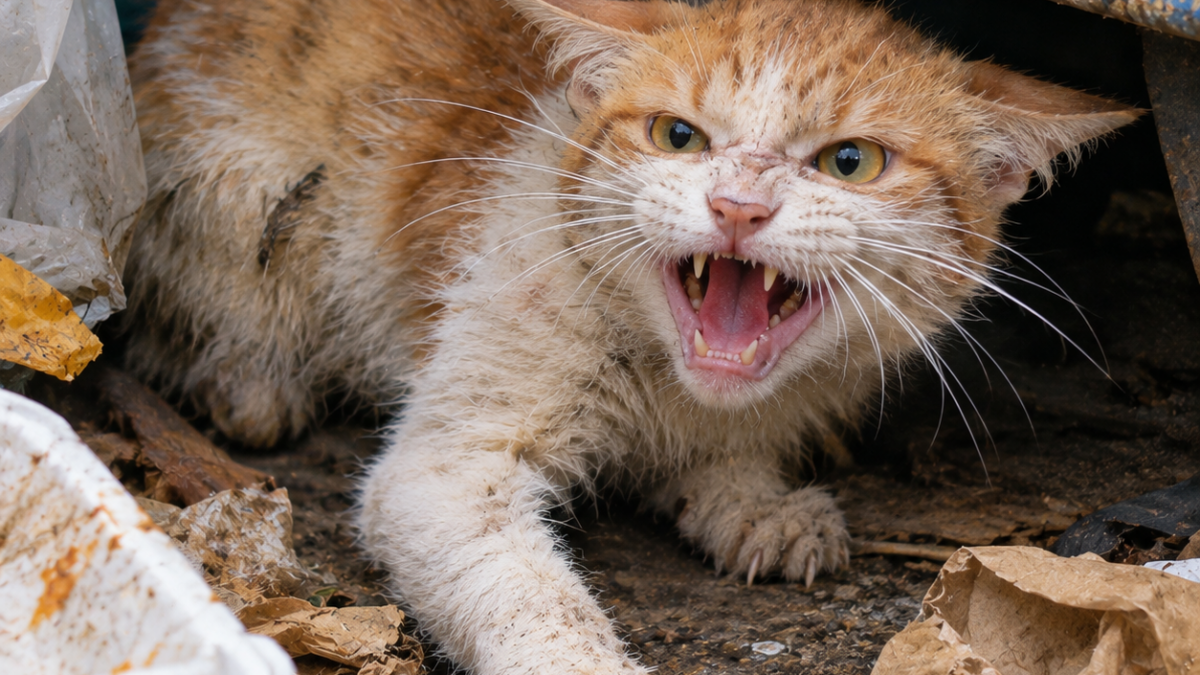
Church was found beneath a trash bin, hissing and striking at every hand that tried to reach him.
The young cat was healthy enough to survive, but so frightened that even food and warmth felt dangerous.
Then one quiet night, he crawled toward the only person who had stopped asking him to trust—and made a choice nobody expected.
Sometimes rescue begins with something loud.
A dog barking behind a locked gate.
A kitten screaming from inside a storm drain.
A frantic call about an animal lying in traffic.
Church’s story began with something much easier to miss.
A sound so faint that the rescuer who heard it almost kept walking.
It came from behind a row of trash bins near the edge of an apartment complex.
Not a full meow.
Not the demanding cry of a healthy cat asking for food.
More like a thin question.
One small sound.
Then silence.
The rescuer stopped.
Listened.
Traffic moved somewhere beyond the buildings.
A plastic bag rustled against concrete.
Someone closed a car door.
Nothing else.
Then:
“Mrrr.”
Soft.
Uncertain.
The rescuer turned toward the bins.
There were three of them lined against a wall.
Old plastic containers stained by weather.
Cardboard boxes leaned beside them.
A broken chair.
Two bags of yard waste.
Nothing unusual.
At first.
Then a pair of eyes appeared beneath the narrow gap between the lowest edge of one bin and the concrete.
Wide.
Unblinking.
Golden-green.
PART2:
The rescuer crouched.
“Hey.”
The eyes disappeared instantly.
A shadow pulled deeper underneath.
The rescuer lowered herself farther.
Now she could see him.
Small male cat.
Maybe one year old.
Thin.
Dusty.
Body flattened almost completely against the ground.
His front legs stretched in front of him like he was trying to make himself longer and harder to reach.
His ears were pinned so far sideways they almost disappeared into his head.
He did not look injured.
He looked terrified.
“Okay.”
The rescuer remained where she was.
“You don’t have to come out.”
Church did not know he would eventually be called Church.
At that moment he was simply a young cat beneath a garbage bin trying to disappear.
Nobody knew where he had come from.
No collar.
No tag.
No obvious person searching for him.
Maybe he had been dumped.
Maybe he had escaped from somewhere.
Maybe he had spent weeks outside.
The truth of his history would remain mostly blank.
But his behavior told them enough about the present.
He did not believe humans were safe.
The rescuer placed a small dish of food several feet away.
Church stared.
His nose twitched.
Hunger was there.
So was fear.
The rescuer backed away.
Ten feet.
Then fifteen.
Church did not move.
She waited.
Five minutes.
Ten.
Finally, one paw emerged.
Church looked left.
Right.
Another paw.
His belly remained close to the ground.
He moved toward the food in tiny steps.
Stopped.
Looked at the rescuer.
She turned her face slightly away.
Church moved again.
He reached the dish.
Sniffed.
Then froze when a truck passed on the road.
His whole body compressed.
The truck disappeared.
Church waited.
Then ate.
Fast.
Not relaxed.
Not savoring.
He swallowed several bites as if somebody might steal the bowl.
Then looked up.
The rescuer remained where she was.
Church ate again.
That was the first agreement between them.
Food could appear without hands grabbing him.
The rescuer returned later with a humane carrier and another person.
Getting Church out from beneath the bin became much harder.
He had tolerated food.
That did not mean he accepted capture.
The second a hand came too near, he exploded.
Hiss.
Swat.
Claws.
Another swat.
His body seemed to double in size.
People often use the word aggressive for behavior like that.
But aggression suggests an animal moving toward conflict.
Church was trying desperately to make conflict move away.
His whole message was:
Do not touch me.
The rescuer withdrew her hand.
Church remained pressed into the corner.
Breathing fast.
“Okay.”
She looked at the second rescuer.
“We’re not pulling him out.”
“So what?”
“We give him an exit.”
A carrier was placed near the gap.
Food went inside.
A towel covered part of the carrier to make it feel darker.
Then they waited again.
Church watched.
No movement.
The rescuer sat on the pavement.
Five minutes.
Ten.
Fifteen.
A resident walked past and asked:
“You still trying to get that mean cat?”
The rescuer looked up.
“He’s not mean.”
The man shrugged.
“Tried feeding him yesterday. Almost took my hand off.”
“He’s scared.”
“Same difference if you’re the hand.”
Then he left.
The rescuer looked back toward Church.
“No offense.”
Church stared.
Eventually hunger and exhaustion beat suspicion.
He moved toward the carrier.
One paw inside.
Pause.
Another.
Food.
He stepped farther.
The rescuer did not move.
Church entered completely.
The carrier door closed.
Instant panic.
Church slammed against one side.
Turned.
Struck at the bars.
Hissed.
His claws scraped plastic.
The rescuer threw a towel over the carrier immediately.
Darkness.
Less visual stimulation.
Her voice became low.
“Easy.”
Church kept moving for several seconds.
Then froze.
Not calm.
Frozen.
There is a difference.
His breathing remained fast.
The rescuer carried him carefully.
Inside the car, Church made no sound.
That frightened her more than the hissing.
She spoke during the drive.
Not because she thought he understood words.
Because predictable sound sometimes helps.
“Clinic first.”
Church stayed silent.
“We’ll get you checked.”
Silence.
“Then food.”
Nothing.
“And somewhere better than a trash bin.”
The carrier shifted once.
The veterinary clinic was bright.
Too bright for Church.
The smells were overwhelming.
Dogs.
Disinfectant.
Other cats.
Medication.
Strangers.
Metal.
When the towel was lifted, Church immediately hissed.
One technician paused.
“Got it.”
They lowered the towel again.
The veterinarian decided to examine him as calmly and efficiently as possible.
No unnecessary handling.
Church was young.
Thin, but not emaciated.
No obvious fractures.
No major wounds.
Temperature normal.
Heart fast, likely from fear.
Fur dirty.
A few small scabs.
No severe infection.
No catastrophic illness.
For everyone involved, that should have been wonderful news.
And it was.
Physically, Church had gotten lucky.
But the examination revealed something else.
The moment restraint increased, Church panicked.
He twisted.
Swatted.
Growled.
Tried desperately to retreat into any available corner.
The veterinarian released pressure immediately once the necessary checks were complete.
Church pushed himself against the back of the carrier.
Eyes enormous.
The rescuer asked:
“Is he feral?”
The veterinarian watched him.
“Maybe undersocialized.”
“Or abused?”
“Could be.”
“So you think somebody hurt him?”
“I don’t know.”
The veterinarian was careful.
Fear does not tell you exactly where it came from.
A cat can become deeply afraid because of abuse.
Or neglect.
Or lack of early human contact.
Or one terrifying experience.
Or many.
Church’s behavior showed fear.
It did not provide a biography.
“What matters,” the veterinarian said, “is what he needs now.”
The rescuer nodded.
“What does he need?”
“Time.”
That answer sounded simple.
It was not.
The plan was basic.
Food.
Water.
Quiet.
A safe room.
A hiding place.
Routine.
Minimal forced contact.
Medical follow-up.
Observe appetite.
Observe litter box use.
Let Church decide the pace of everything not medically necessary.
The rescuer brought him home.
She had fostered cats before.
Friendly cats.
Sick cats.
Bottle babies.
Recovering strays.
Church was different.
He did not arrive seeking comfort.
He arrived expecting danger.
The foster room was small.
Quiet.
One window.
One low bed.
A covered hiding box.
Food and water placed away from the litter box.
Soft blankets.
A scratching pad.
A few simple toys.
Nothing crowded.
The carrier went on the floor.
Door opened.
The rescuer sat several feet away.
Church did not come out.
Ten minutes.
Thirty.
An hour.
She left.
When she returned later, the carrier was empty.
Church had disappeared into the covered box.
Food untouched.
Water untouched.
She did not look inside.
That became important.
Church needed somewhere human eyes did not follow.
The rescuer simply said:
“Okay.”
Then left again.
The first night, he did not eat.
The second morning, nothing.
The rescuer became concerned.
Cats cannot safely go too long without food.
She tried different options.
Dry food.
Wet food.
Warm wet food.
Strong-smelling fish.
Tiny pieces placed near the hiding box.
Church ignored everything while she was present.
Then one evening she left the room for two hours.
When she returned, the fish was gone.
She smiled.
“All right.”
Church’s eyes appeared inside the box.
“We have rules.”
He stared.
“You eat when I leave.”
Stare.
“I pretend I don’t know.”
The rescuer walked away.
The next day, food disappeared again.
That was enough.
Church was eating.
Not comfortably.
But eating.
He used the litter box only at night.
Drank when nobody watched.
Moved around the room after the house went quiet.
The rescuer knew because objects changed position.
One toy ball would be six inches from where she left it.
A blanket bunched.
Scratch marks appeared on the cardboard pad.
Church had a life when humans were absent.
The challenge was convincing him that life did not have to stop when humans entered.
The rescuer began sitting in the room.
Not approaching.
Not staring.
She read.
Answered messages.
Sometimes drank coffee.
At first Church remained invisible.
Then he began watching from the box.
Only eyes.
Then part of his face.
Then his entire head.
The rescuer ignored him.
This went on for days.
One morning, Church hissed when she entered.
She stopped.
“Good morning to you too.”
She placed food.
Sat down.
Church kept watching.
Ten minutes later, he came halfway out of the box.
The rescuer did not move.
Church retreated.
That was still progress.
Fear recovery often looks ridiculous if you measure only dramatic moments.
A cat shows one shoulder instead of two eyes.
Progress.
Eats while you sit twelve feet away.
Progress.
Stops hissing until your hand crosses an invisible line.
Progress.
Sleeps with his head outside the hiding place.
Progress.
The rescuer learned to celebrate silently.
No excited voices.
No reaching.
No turning every milestone into contact.
Church’s sharp behavior began making sense.
Every swat happened after a boundary was crossed.
Hand too close.
Body blocking escape.
Unexpected movement.
He did not pursue.
He defended space.
So the rescuer made escape routes obvious.
If Church was near a wall, she did not approach directly.
If he was between her and the door, she moved aside.
If he hissed, she stopped.
That simple respect changed something.
Church learned that warning worked.
Humans listened.
He did not have to escalate every time.
The swats became less frequent.
Then one day the rescuer entered with food.
Church was outside the hiding box.
Fully visible.
He froze.
She froze too.
For several seconds they stared at each other.
Then the rescuer looked away.
Set the bowl down.
Sat.
Church did not retreat.
He remained in the open.
That morning he did not eat.
But he stayed visible for almost twenty minutes.
The rescuer left with tears in her eyes.
Nobody watching from outside would have understood.
“He just sat there?”
Yes.
That was the point.
He had sat there while a human existed in the same room.
For Church, that was enormous.
Later that week, he ate while she remained inside.
Not close.
Across the room.
But he ate.
One bite.
Look up.
Another.
Check.
Another.
The rescuer kept her eyes on her phone.
Church finished half the bowl.
The next morning, more.
Eventually he stopped checking her after every mouthful.
His body began changing too.
Regular nutrition filled out his thin frame.
His coat lost some of the dusty dullness.
He groomed himself more.
The first time the rescuer saw Church washing his face, she smiled.
Cats groom when stressed too, but Church’s movement looked deliberate and normal.
Paw.
Lick.
Face.
Again.
Something ordinary.
Ordinary was becoming precious.
She introduced toys slowly.
A ball sat untouched for days.
A cloth mouse moved only at night.
A wand toy was more complicated because it required a human at the other end.
The rescuer sat across the room and moved one feather very slightly.
Church’s pupils widened.
Fear and prey drive collided.
He watched.
Feather moved.
Church crouched.
Then remembered the person.
Stopped.
The rescuer moved it away from herself.
Church’s head followed.
Again.
He took one step.
Then another.
Pounced.
Grabbed the feather.
Immediately retreated with it.
The rescuer laughed softly.
Church froze.
“Sorry.”
She stopped laughing.
Church released the feather.
Five minutes later, he attacked it again.
Play became the first activity they shared without touch.
That mattered.
The wand created distance.
Church controlled whether to participate.
No hands came near his body.
He could chase.
Stop.
Retreat.
Return.
Every session ended before he became overwhelmed.
The rescuer never used play to lure Church close and grab him.
Trust would have collapsed.
Instead, play remained exactly what it promised to be.
Play.
Week two.
Church began waiting near the hiding box when food arrived.
Week three.
He crossed the room while the rescuer sat inside.
Week four.
He walked behind her once.
She felt movement.
Turned.
Church disappeared.
Lesson learned.
Do not turn too fast.
She became better at moving like someone living beside a frightened cat.
Slowly.
Predictably.
Announce entry.
No sudden hands.
No cornering.
Church learned her sounds.
Footsteps.
Door handle.
Food dish.
Voice.
The house had other people, but she remained his main caregiver.
He tolerated one other person from a distance.
Strangers were different.
If someone new entered, Church disappeared completely.
That was fine.
Nobody forced introductions.
One afternoon, the rescuer had to take Church back to the veterinarian.
The carrier created a problem.
Church had learned the carrier meant restraint.
The rescuer could not simply pick him up.
So days earlier she had begun leaving the carrier open in the room.
Blanket inside.
Treat nearby.
No door closing.
Church investigated it at night.
Then slept inside once.
On appointment day, food went in.
Church entered.
The door closed.
Panic.
Not as intense as before.
But immediate.
The rescuer covered the carrier.
“I know.”
Church hissed.
“I know.”
At the clinic, his physical condition looked much better.
Weight up.
Coat improved.
No major illness.
The veterinarian asked:
“How is behavior?”
“Better.”
“Touch?”
“No.”
“Any bites?”
“No.”
“Swats?”
“Less.”
“Eating?”
“Yes.”
“Playing?”
“Yes.”
The veterinarian smiled.
“Then you’re doing fine.”
The rescuer looked toward Church.
“He still looks terrified.”
“Recovery isn’t the absence of fear.”
“What is it?”
“More options besides fear.”
That sentence stayed with her.
Church had started with one response.
Defend.
Now he sometimes chose to watch.
Or retreat.
Or eat.
Or play.
More options.
That was progress.
Back home, Church emerged from the carrier sooner than expected.
He hid for an hour.
Then appeared.
The rescuer sat nearby.
He looked offended.
“You can blame me.”
Church stared.
“You probably should.”
She offered food.
Church ignored it.
Then approached the wand toy.
Apparently forgiveness was unnecessary if play was available.
The first accidental touch happened around week five.
Church chased the feather.
The toy landed near the rescuer’s leg.
Church lunged.
His side brushed her knee.
Both froze.
Church jumped back.
The rescuer did not move.
No hand.
No attempt to turn contact into something bigger.
Church watched.
Nothing happened.
The feather moved again.
He chased.
This time he passed even closer.
The rescuer felt air from his movement.
That night, Church sat three feet from her for nearly ten minutes.
His body was not fully relaxed.
But no hissing.
The next milestone came unexpectedly.
The rescuer wore an old jacket while sitting on the floor because the room was cold.
The zipper was partly open.
Church had become fascinated with the moving drawstring near the pocket.
He watched.
One paw reached.
Tapped it.
Retreated.
The rescuer smiled.
Church tapped again.
Then climbed onto the edge of the jacket lying against the floor.
The rescuer stopped breathing.
Church sniffed the fabric.
One paw moved into the open pocket.
Then his head.
The pocket was too small for his whole body, but Church tried anyway.
He pressed his face inside.
Warm.
Dark.
Close to the rescuer’s side.
She remained completely still.
Church shifted.
His shoulder touched her.
Then the side of his head.
The rescuer could feel his breathing through the jacket.
Fast at first.
Then slower.
She whispered:
“Hi.”
Church did not run.
Her heart pounded so hard she wondered if he could feel it.
Maybe he could.
Church stayed almost two minutes.
Then backed out.
Looked at her.
Walked away.
The rescuer sat alone after he left.
Tears ran down her face.
No hug.
Not yet.
No purring.
Just a cat choosing warmth beside a human body.
That was enough.
The jacket became part of the room.
The rescuer left it on a chair.
Church slept on it at night.
The next day, she found fur on the sleeve.
By then she had stopped pretending she was objective.
She was attached.
Fostering always carries that risk.
You tell yourself the animal is temporary.
You provide safety.
Medical care.
Socialization.
Then eventually a home.
That is the job.
Church complicated the job because his trust had become so specific.
He did not simply learn humans were safe.
He learned she was safe.
The rescue coordinator began asking when Church might be ready for adoption.
The rescuer answered:
“Not yet.”
A week later:
“Not yet.”
Then:
“Soon.”
But soon remained vague.
Church continued changing.
One morning the rescuer entered and he did not move away.
She sat.
Church approached food.
Ate.
Then instead of returning to the hiding box, he sat several feet from her.
His paws tucked under his chest.
Loaf position.
That posture nearly made her laugh.
A frightened animal does not tuck every limb beneath itself unless it feels reasonably confident it will not need to flee instantly.
Church looked almost normal.
She took one photograph.
No flash.
Sent it to the rescue coordinator.
Caption:
LOOK AT HIS FEET.
The response:
I see a cat.
Exactly.
Days later, Church began napping in the open.
Still near cover.
But visible.
The first deep sleep happened on the blanket.
Church lay on his side.
Front legs loose.
One paw twitched.
Whiskers moved.
The rescuer entered quietly.
Stopped.
Watched.
Then left without waking him.
She cried in the kitchen.
Fear changes sleep.
An animal who expects danger sleeps differently.
Church had allowed his body to become vulnerable.
That meant safety was beginning to live inside him, not only around him.
Touch remained the final wall.
The rescuer never forced it.
She began placing one hand flat on the floor while Church played.
He approached.
Sniffed.
Left.
Next day.
Sniff.
Longer.
One day his whiskers touched her finger.
He flinched.
But did not run.
Another day he bumped her hand accidentally while chasing the toy.
Stayed.
Then came a moment so small it almost looked meaningless.
Church walked toward the hand.
Sniffed.
Then rubbed one cheek against the tip of one finger.
The rescuer froze.
Church did it again.
Her eyes filled instantly.
He stepped away.
The hand remained where it was.
Church returned.
This time the rescuer moved one finger.
Barely.
Along the side of his cheek.
One inch.
Church stiffened.
She stopped.
He did not retreat.
Several seconds passed.
Church pushed his face into the finger.
Permission.
Another tiny stroke.
Stop.
Church leaned.
The rescuer began crying silently.
The cat who had once attacked every approaching hand was asking one to continue.
She did not hug him.
That would come much later.
This was enough.
Cheek.
Finger.
Trust.
Over the following days, touch expanded slowly.
Side of face.
Behind ear.
Top of head.
Never reaching directly over him.
Never grabbing.
Church decided the duration.
Two seconds.
Five.
Sometimes none.
If he moved away, the hand stopped.
That consistency mattered.
Church learned another rule.
Touch ended when he asked.
It was not a trap.
Then came the purr.
The rescuer did not expect it.
Church was sitting beside her.
Not touching.
She offered her hand.
He sniffed.
Rubbed.
She scratched lightly behind his ear.
Church’s eyes narrowed.
A vibration started.
So faint she thought she imagined it.
Then again.
Purring.
The rescuer covered her mouth with her free hand.
Church kept purring.
She whispered:
“Oh, buddy.”
The purr stopped.
Church opened his eyes.
“Sorry.”
He rubbed her hand.
The sound returned.
That was the beginning.
Purring became less rare.
Church did not purr every time.
He remained selective.
But the body that once filled every interaction with tension now had another response.
Comfort.
The first actual hug happened by accident.
Months after rescue.
Church had become comfortable enough to climb onto the rescuer’s lap briefly.
Not settle.
Just cross.
One afternoon he startled at a loud crash outside.
A garbage truck dropped something metal.
The sound echoed.
Church bolted.
Then stopped in the middle of the room.
No hiding box nearby.
His body flattened.
The rescuer sat on the floor.
She did not reach.
“Church.”
His ears moved.
“It’s okay.”
Church looked toward the window.
Then toward her.
The noise came again.
This time Church ran toward the rescuer.
Not away.
Toward.
He pushed himself against her legs.
The rescuer instinctively brought her arms around him.
Then immediately realized what she had done.
Too much.
She began to loosen her hold.
Church did not fight.
He did not hiss.
He did not strike.
His body stayed pressed against her chest.
Still.
The rescuer barely breathed.
One hand rested along his back.
Not restraining.
Just there.
Church’s face tucked beneath her chin.
Then the purring began.
Loud.
Deeper than she had ever heard from him.
The rescuer closed her eyes.
Church stayed.
Seconds.
Then longer.
She could feel the vibration against her chest.
For the first time, the frightened cat who once built walls with claws allowed himself to be held.
Not because somebody overpowered him.
Because he had chosen the person holding him.
That distinction was everything.
The rescuer cried into his fur.
Church kept purring.
When he eventually pulled away, her arms opened immediately.
He jumped down.
Sat nearby.
Groomed one shoulder.
As though nothing historic had happened.
The rescuer laughed through tears.
“Fine.”
Church licked his paw.
“Be casual.”
That hug changed the rescuer more than Church.
She had spent months believing she was teaching him trust.
In that moment she realized trust had become mutual.
Church had trusted her not to hurt him.
She had trusted Church to choose.
That was why it worked.
The rescue coordinator called the following week.
“We have an application.”
“For Church?”
“Yes.”
The rescuer’s stomach tightened.
“Good application?”
“Very.”
“What kind of home?”
“Quiet. One adult. No kids. Experienced with shy cats.”
“That sounds good.”
“It does.”
Silence.
The coordinator asked:
“You okay?”
“Yeah.”
“You don’t sound okay.”
“I’m fine.”
“You’re lying.”
The rescuer looked toward Church.
He sat on the windowsill.
The same cat who once hid under garbage now watched birds from a safe room.
“You said the adopter is good?”
“Yes.”
“So we should meet.”
The meeting was scheduled.
The potential adopter did everything right.
Sat quietly.
Did not stare.
Did not reach.
Asked practical questions.
What frightened Church?
What food?
How did he react to carriers?
Could he live with another cat?
How long did touch take?
What happened if he hid for weeks?
The rescuer answered honestly.
Church remained invisible.
The adopter smiled.
“That’s okay.”
Second visit.
Church watched from the doorway.
Third.
He came into the room.
The adopter still did not touch him.
Objectively, the match looked excellent.
That evening the rescuer sat beside Church.
“You know what this is, right?”
Church groomed himself.
“You’re supposed to leave eventually.”
No reaction.
“That’s the whole foster system.”
Church stretched.
“I save you. You become normal-ish.”
Church looked at her.
“I find somebody better adjusted than me.”
Church jumped onto the sofa.
“And then you leave.”
He sat beside her.
Not touching.
The rescuer looked at him.
“I don’t like this conversation either.”
The next day the coordinator called.
“Applicant wants him.”
The rescuer closed her eyes.
“Okay.”
“Are you sure?”
“No.”
“That is not the answer I expected.”
The rescuer laughed nervously.
“I’m trying to do the right thing.”
“What is the right thing?”
“He gets adopted.”
“Maybe.”
“What does that mean?”
“It means foster failure exists for a reason.”
The rescuer looked through the doorway.
Church was sleeping on her jacket.
“You think I should keep him?”
“I think you should stop pretending you haven’t already decided.”
Silence.
The rescuer sat down.
“I didn’t plan this.”
“Nobody does.”
“He trusts me.”
“Yes.”
“What if he could trust somebody else?”
“He probably could eventually.”
“So keeping him because he trusts me is selfish.”
“Maybe.”
“That’s helpful.”
The coordinator laughed.
“Then ask the better question.”
“What?”
“Can you give him the life he needs for the rest of his life?”
That stopped everything.
Not:
Do you love him?
She did.
Not:
Will he miss you?
Probably.
Not:
Will letting him leave hurt?
Absolutely.
Can you meet his needs?
Quiet home.
Patience.
Veterinary care.
Time.
Consistency.
No expectation that Church become a lap cat for anyone else.
Understanding that progress could reverse during stress.
Long-term commitment.
The rescuer went through the list.
Yes.
Yes.
Yes.
Yes.
Church came into the room.
Walked toward her.
Rubbed her ankle.
Then sat.
The rescuer stared.
“I think that’s unfair.”
Church blinked.
She called the coordinator back.
“I want to adopt him.”
The answer came immediately.
“Finally.”
“You knew?”
“Everyone knew.”
“Who’s everyone?”
“The clinic.”
“What?”
“They have a pool.”
“You people are terrible.”
“You’re keeping the cat?”
“Yes.”
“Then we’re wonderful.”
The adoption became official.
No dramatic ceremony.
No giant bow around Church’s neck.
He would have hated that.
Paperwork.
Records.
Microchip registration.
Medical history.
A signature.
Church had gone from unidentified cat beneath a garbage bin to somebody’s cat.
Legally.
Permanently.
But his real adoption had happened gradually.
Every bowl of food.
Every ignored hiding place.
Every hand withdrawn when he said no.
Every quiet evening.
Every shared play session.
The first cheek rub.
The first purr.
The first hug.
Family had been forming long before anyone signed a form.
The foster room door eventually stayed open more often.
Church began exploring the rest of the home.
At first only at night.
Then morning.
Hallway.
Living room.
Kitchen.
Every new space received the same investigation.
Corners.
Escape routes.
High places.
Under furniture.
The rescuer—now officially his person—did not rush.
Church chose a chair in the living room.
Then abandoned it for the couch.
Discovered a window.
Claimed it.
A cat tree appeared.
Church ignored it for five days.
Then climbed to the top at three in the morning.
His person found him there the next day looking smug.
“You could have used that when I bought it.”
Church licked his paw.
He slowly became comfortable with normal household sounds.
Washing machine.
Microwave.
Television.
Doorbell remained suspicious.
Vacuum cleaner remained an enemy of civilization.
Garbage trucks remained difficult.
That particular metallic crash could still send him running.
His person never punished the fear.
A hiding place remained available.
Church knew where to go.
Then, over time, another change happened.
He started returning faster.
A loud noise.
Run.
Hide.
Pause.
Then emerge.
Minutes instead of hours.
One evening the garbage truck came.
Crash.
Church ran behind the sofa.
His person sat nearby.
Did not call.
Five minutes later, Church appeared.
Walked directly to her.
Climbed onto the couch.
Sat against her leg.
That was resilience.
Not never feeling fear.
Recovering from it.
Church also discovered affection in increasingly dramatic ways.
He had started with two seconds of cheek scratches.
Then five.
Then full head rubs.
Eventually he developed a habit of pressing his forehead into the person’s chin.
If she stopped petting too soon, Church looked offended.
One morning she laughed:
“You spent three months trying to remove my fingers.”
Church pushed his head under her hand.
“And now this?”
Purr.
“You’re a hypocrite.”
Church did not care.
His appetite transformed too.
The cat who once refused food unless completely alone became extremely interested in everything edible.
His person opened tuna.
Church appeared.
Chicken.
Church.
Cheese wrapper.
Church.
Bread bag.
Church.
“You’re a cat.”
Church stared.
“You don’t even like bread.”
He sniffed.
“See?”
He tried to steal it anyway.
Healthy weight returned.
His coat became glossy.
The dusty young cat from beneath the bin disappeared physically.
Not erased.
Transformed.
At his veterinary checkup months later, the same veterinarian barely recognized him.
“Church?”
The cat remained in the carrier.
The towel lifted.
Church stared.
The veterinarian smiled.
“Well, you look expensive now.”
His person laughed.
“Emotionally expensive.”
Church hissed once when the exam began.
The veterinarian paused.
“Still Church.”
But something was different.
He recovered faster.
A hand approached.
Church watched.
Sniffed.
Allowed the brief exam.
When released, he returned to his person instead of throwing himself into the farthest corner.
He pushed against her side.
The veterinarian noticed.
“That’s new.”
“Yeah.”
“You kept him?”
“She failed fostering.”
“I knew it.”
“Apparently everyone knew it.”
The veterinarian scratched lightly near Church’s cheek.
Church tolerated it.
Then stepped away.
“Good boundary setting,” the veterinarian said.
The medical report was uncomplicated.
Healthy.
Good weight.
No major concerns.
That was a beautiful word.
Healthy.
Church’s biggest wounds had never shown on X-rays.
There was no lab test for distrust.
No scan showing where fear lived.
The recovery was behavioral.
Slow.
Inconsistent.
Built through repetition.
His person learned that emotional healing does not follow a clean timeline.
Months after adoption, Church had a bad week.
Construction began nearby.
Drilling.
Hammering.
Men shouting.
Church stopped eating as confidently.
Spent more time hiding.
Hissed when touched.
His person’s first thought was:
We’re going backward.
Then she remembered the veterinarian’s advice.
More options besides fear.
Church had lost some options temporarily because the environment felt unsafe.
So she simplified.
Food near the hiding place.
Quiet room.
No touching unless Church initiated.
Play only if he wanted.
Routine.
Three days.
Four.
The construction quieted.
Church emerged.
Ate.
Then rubbed against her hand.
Nothing had been erased.
He had been scared.
That was all.
Healing does not require never being scared again.
It means fear does not control every day.
Church became playful.
Truly playful.
The wand toy remained sacred.
He learned ambush techniques.
Behind chair.
Around corner.
Under blanket.
His person would drag the feather past.
Church launched.
Sometimes he miscalculated and crashed into a cushion.
He immediately pretended the crash was intentional.
Cats maintain dignity through denial.
One evening, Church caught the feather and refused to release it.
His person gently pulled.
Church growled.
She stopped.
“Possession is nine-tenths of the law?”
Church dragged the entire wand away.
His person laughed until she cried.
That laughter would have terrified Church once.
Now he continued stealing the toy.
The first guest Church willingly approached arrived nearly a year after rescue.
A friend visited regularly.
She followed rules.
No reaching.
No calling Church.
No staring.
Months passed.
Then one afternoon Church walked over and sniffed her shoe.
The friend froze.
His person whispered:
“Don’t make it weird.”
The friend whispered:
“I am not making it weird.”
She was absolutely making it weird internally.
Church rubbed one cheek against her ankle.
The friend’s eyes filled.
His person smiled.
“Now you understand.”
Church moved away.
The friend exhaled.
“That was amazing.”
“It was three seconds.”
“I know.”
“That’s how he gets you.”
Church gradually expanded his circle.
Never becoming the cat who adored everybody.
That was not the goal.
Confidence does not require universal friendliness.
Church had preferences.
Some visitors never saw him.
Others eventually received a sniff.
A rare person earned a cheek rub.
His person remained different.
Church followed her.
Not constantly.
But enough.
Kitchen.
Living room.
Office.
If she closed the bathroom door, Church sometimes sat outside and complained.
The irony was not lost on her.
“You used to hide from me.”
Meow.
“Now I’m not allowed privacy?”
Meow.
“Unbelievable.”
Church waited.
She opened the door.
He walked away immediately.
Classic.
The rescuer sometimes thought about the trash bins.
Not often.
She did not want Church’s entire identity anchored there.
But occasionally she drove through that area.
The bins remained.
Cars parked.
People came and went.
Nothing about the place looked important.
It was difficult to imagine Church beneath one of them.
Flat against concrete.
Eyes wide.
Paws stretched.
Hissing at a hand because fear was all he had.
She thought about what would have happened if she had not heard that faint cry.
Maybe somebody else would have.
Maybe not.
Those thoughts never helped.
So she returned to what was real.
Church was home.
The rescue organization shared an update on his adoption.
A simple photograph.
Church asleep on a blanket.
Not hiding.
Body stretched.
One paw over his face.
Caption:
Church is home.
People responded emotionally.
Some called the transformation miraculous.
Others asked how the rescuer had “tamed” him.
She disliked that word.
Tamed sounded like conquest.
Church had not been conquered.
He had been given enough safety to make different choices.
That distinction became important whenever she talked about him.
“If a frightened cat hisses at you,” she would explain, “the hiss is information.”
Back away.
Slow down.
Give space.
Do not punish communication.
Because if an animal learns a warning does not work, it may escalate to biting.
Church’s hissing had never been a character flaw.
It had been language.
When people started listening, he needed it less.
The same was true of his swats.
Church had not become good because he stopped swatting.
He had become safer because he no longer felt forced to defend every inch around him.
That is different.
His person kept the old jacket.
The one whose pocket Church had crawled into during the early weeks.
It became worn.
Fur-covered.
Eventually unusable outside the house.
She could not throw it away.
Church still slept on it occasionally.
One winter evening, she found him curled across the sleeves.
She sat nearby.
“Remember this?”
Church looked up.
“Probably not.”
He blinked.
“You hid in the pocket.”
Church stretched.
“You were tiny.”
He closed his eyes.
“You’re still tiny.”
One eye opened.
“Fine. Medium.”
Purr.
She rested her hand beside him.
Church moved closer.
His head settled against her wrist.
That was all.
No need to compare past and present every day.
But sometimes the distance between them deserved noticing.
Years passed.
Church remained healthy.
No dramatic medical complications.
No hidden disease suddenly appearing to justify why he had been abandoned.
He had simply been a frightened young cat who needed someone to notice him.
He developed adult habits.
Morning patrol of windows.
Nap.
Breakfast demands.
Second nap.
Random sprint at an unreasonable hour.
Inspection of every cardboard box.
Suspicion of grocery bags.
Complete devotion to one particular blanket despite several objectively better blankets.
He became obsessed with sun patches.
If sunlight moved across the floor, Church moved with it.
His person joked he was solar-powered.
He still disliked being picked up unexpectedly.
That boundary remained.
Hugs happened differently.
Church came to her.
Sometimes he climbed against her chest while she sat.
Sometimes she wrapped one arm loosely around him.
If he shifted, she let go.
Because that first gentle hug had taught them both what made affection meaningful.
A hug mattered only if Church could leave.
One evening, a visitor watched Church climb into her arms.
“You’re lucky he lets you do that.”
His person smiled.
“It isn’t luck.”
“What is it?”
“Years of being willing not to.”
The visitor looked confused.
She explained.
“If I had insisted on holding him when I wanted to, he might never have learned that he had a choice.”
Church purred.
The visitor nodded slowly.
That became one of the biggest lessons Church gave everyone around him.
Love is not measured only by what an animal allows you to do.
Sometimes love is what you refuse to force.
No picking up.
No hugging.
No touching.
No dragging from hiding.
No demanding eye contact.
No punishing fear.
Respect can look like distance.
Church had needed distance before closeness became possible.
His person never forgot it.
The trash-bin story spread through local rescue circles.
Occasionally someone sent her a frightened-cat case asking for advice.
She always began with the same thing.
“Rule out medical problems first.”
Pain can look like aggression.
Then:
“Give the cat a safe place.”
Then:
“Stop expecting a timeline.”
She told them about Church eating only when she left.
Watching from the box.
Touching the sandal.
Crawling into a jacket pocket.
The first cheek rub.
The first purr.
She did not tell them every cat would become Church.
Some cats remain more distant.
Some need medication.
Some require professional behavior support.
Some have medical pain.
Some may never enjoy being held.
That does not mean the rescue failed.
Success is not turning every cat into a cuddle toy.
Success is creating a life where the animal can function with as little fear and stress as possible.
Church happened to discover he liked affection.
On his terms.
That was his story.
A young volunteer once asked:
“When did you know he loved you?”
His person laughed.
“I don’t know what a cat thinks love is.”
“But when did you know he trusted you?”
That question was easier.
“Probably before I admitted it.”
“The hug?”
“Maybe.”
“The purr?”
“Maybe.”
“The jacket pocket?”
She smiled.
“Probably.”
The truth was there had been no single transformation.
The first hug made a beautiful moment.
But it was built from dozens of earlier moments.
Food.
Distance.
Stillness.
Predictability.
Respect.
A safe hiding place.
The rescuer stopping when Church hissed.
Returning the next morning anyway.
Trust had not arrived suddenly.
The hug merely made it visible.
Church aged.
Not old yet.
But no longer the one-year-old cat beneath the bin.
His face filled out.
His shoulders became broader.
The kittenish proportions disappeared.
His eyes remained the same.
People often said they looked softer.
Maybe.
Or maybe the environment around them had changed.
Fear changes what we see in a face.
Safety changes posture.
Muscles.
Breathing.
Ears.
Pupils.
Church was physically capable of relaxation now.
That made him look like a different animal.
But his person knew the defensive cat had never been some separate version.
Both were Church.
The frightened Church deserved care just as much as the affectionate one.
That mattered.
We tend to reward rescue animals once they become easy to love.
Before:
Aggressive.
After:
Sweet.
Before:
Broken.
After:
Perfect.
Real life is not that simple.
Church had always been worthy.
Even while hissing.
Even while swatting.
Even while refusing food.
He did not become valuable because he purred.
The purr simply allowed humans to see what fear had been hiding.
One night, Church became ill.
Nothing catastrophic.
A stomach issue.
But he stopped eating breakfast.
His person noticed immediately.
Church refusing food used to be normal.
Now it was an emergency because food had become one of his greatest passions.
Veterinary clinic.
Tests.
Fluids.
Medication.
Church hated the visit.
He hissed.
Tried to retreat.
For a few moments, the old behavior returned with full force.
His person felt her heart tighten.
Then the veterinarian said:
“He’s scared. That doesn’t mean you lost progress.”
Church looked at her.
She put one hand near the carrier.
Not inside.
Church sniffed.
Pressed his face against the bars.
His person exhaled.
Right.
Fear had returned because the situation was frightening.
Trust had not disappeared.
Church recovered within days.
His appetite returned violently.
He screamed at breakfast as if starvation had lasted six years instead of thirty-six hours.
His person laughed.
“Medical miracle.”
Church ate.
“Truly inspiring.”
He looked up.
“Fine. I’ll stop.”
Normal life resumed.
That became a good reminder.
The goal was never to make Church fearless.
Fear protects animals.
A cat without fear can die quickly.
The goal was appropriate fear.
Recovery.
Choice.
Church learned the difference between danger and unfamiliarity gradually.
The vacuum remained danger.
Obviously.
The mail carrier was suspicious.
The person opening a can of food was trustworthy beyond question.
He developed a relationship with the household routine.
At 6:30 a.m., breakfast.
If the human remained in bed after 6:35, Church walked across her chest.
This was not negotiable.
At 6:40, nose to face.
At 6:45, destruction of civilization presumably became authorized.
“You lived under a trash bin.”
Church stared down at her.
“You had no breakfast schedule.”
Meow.
“You’re spoiled.”
Meow.
“Fine.”
She got up.
Church ran toward the kitchen.
Spoiled.
The word made her happy.
There are worse things a once-abandoned cat can become.
He had once believed resources disappeared.
Now he expected them.
Food.
Warmth.
Clean litter.
Attention.
That expectation was security.
Church slept wherever he wanted.
Sometimes the bed.
Often the couch.
Occasionally directly in the center of a hallway where everybody had to walk around him.
His person did.
Every time.
“You know you’re an obstacle.”
Church remained asleep.
“I’m enabling you.”
No response.
She stepped over him.
This was what success looked like.
A cat taking up space without apology.
Visitors sometimes could not believe the story.
“That cat?”
“Yes.”
“He was aggressive?”
“Terrified.”
“He scratched people?”
“He tried.”
“He lets you hold him now.”
“When he wants.”
Church sat in her lap, purring.
The contrast looked dramatic.
But his person always corrected one thing.
“He didn’t soften because I hugged him.”
People would look confused.
“The hug happened because he softened.”
That was important.
A gentle hug was not a cure.
You cannot heal a terrified cat by forcing affection onto him.
Church first needed food.
Safety.
Predictability.
Space.
Then his body became capable of choosing touch.
The hug was evidence.
Not treatment.
That nuance made his story stronger, not weaker.
Because patience is less cinematic than rescue.
But patience did the real work.
Anybody could feel emotional seeing Church beneath the trash bin.
The harder part was day eleven when he still hid.
Day twenty-three when he still swatted.
Week five when progress looked microscopic.
Month two when a stranger’s visit sent him backward.
There was no applause during those days.
No dramatic soundtrack.
Just somebody showing up.
That is where compassion proves itself.
Not in the moment you feel sorry.
In the repetition after feeling sorry stops being exciting.
Church’s person kept showing up.
Church kept noticing.
Eventually his world became predictable enough that he could spend energy being curious instead of vigilant.
He began watching birds.
Investigating bags.
Playing.
Sleeping.
Grooming.
Demanding food.
Seeking touch.
These were ordinary behaviors.
That was the point.
For the first time, Church had room to be ordinary.
One anniversary of his rescue, his person brought out the original photograph.
The first picture taken near the trash bin.
Church barely visible.
Eyes wide.
Body flattened.
She looked at it.
Then at the cat sleeping beside her.
“What would you think of him?”
Church opened one eye.
She held the phone toward him.
“You’d hate that guy.”
Church closed the eye.
“Very antisocial.”
Purr.
She put the phone away.
There was no reason to make him revisit it.
The anniversary mattered more to her than to him.
Church’s life was happening today.
That afternoon, he chased a toy.
Ate dinner.
Slept on the jacket.
Nothing dramatic.
Perfect.
The rescuer never discovered exactly how Church ended up beneath the bins.
No person came forward.
No hidden owner.
No dramatic investigation.
That absence bothered some people.
They wanted a villain.
A reason.
A complete story.
Real rescue does not always give one.
Maybe somebody abandoned him.
Maybe he had been born outside and moved through the neighborhood.
Maybe a frightening event sent him hiding there.
Church could not tell them.
So nobody invented an answer.
What they knew was enough.
He had needed help.
Someone heard him.
That person stopped.
Everything after grew from that decision.
The rescuer sometimes wondered what made Church cry out that first time.
Hunger?
Pain?
Fear?
Trying to call another cat?
Nobody knew.
But the sound had been enough.
If Church had stayed completely silent, she might have passed.
That thought made her more attentive everywhere.
Parking lots.
Alleyways.
Under cars.
Behind dumpsters.
Not paranoid.
Just aware.
Quiet lives are easy to miss.
That became part of what Church taught her too.
Rescue often belongs to attention before it belongs to action.
Notice first.
Then decide.
Church’s story eventually inspired people to foster fearful cats.
That pleased his person more than compliments.
One woman wrote:
“I always thought hissing meant a cat hated me. Church made me realize it can mean he’s scared.”
Another:
“I stopped trying to pull my foster cat from under the bed. Three weeks later she came out herself.”
Another:
“My rescue never became cuddly, but she sleeps in the open now. I finally understand that counts.”
Those messages mattered.
Church did not have to become a model every fearful animal copied.
His story could simply make people more patient.
That was enough.
Years after rescue, Church still sometimes hissed.
Usually at the veterinarian.
Sometimes at the vacuum.
Once at a new lamp.
Nobody knew why the lamp offended him.
His person laughed.
“There he is.”
The hiss did not mean failure.
It meant Church still had a voice.
That was something worth preserving.
The difference was what came after.
Once, a hiss meant hours of hiding.
Now, after protesting the lamp, Church walked over, smelled it and rubbed his cheek against the base.
Conflict resolved.
His person shook her head.
“Very brave.”
Church strutted away.
One winter evening, the power went out.
The house became cold.
His person piled blankets on the couch.
Church appeared.
At first he chose his own blanket.
Then the room cooled further.
He moved closer.
Finally he climbed onto her chest.
She covered them both.
Church’s body tucked under her chin.
His purr vibrated through the blanket.
The room was dark.
Quiet.
His person remembered the trash bin.
Cold concrete.
Old plastic.
A cat hiding in shadow.
Now Church was hidden again.
But beneath warmth.
Against someone he trusted.
He could leave whenever he wanted.
He did not.
That choice still moved her every time.
She rested one arm around him.
Loose.
Never trapping.
Church purred louder.
“You know,” she whispered, “you’re terrible at being aggressive.”
Church did not react.
“You had everybody fooled.”
Purr.
She closed her eyes.
There was never a single moment when Church became safe.
Safety accumulated.
Meal by meal.
Night by night.
Touch by touch.
Nothing bad.
Again.
Nothing bad.
Again.
Eventually the body learns.
The shoulders lower.
Pupils soften.
Sleep deepens.
A paw kneads.
A head rubs.
A cat climbs into a jacket.
Then one day the same animal who once tried desperately to keep every human away buries his face beneath somebody’s chin.
Not because fear was defeated.
Because trust became larger.
That was Church’s real transformation.
His person did not save him by loving him harder than everyone else.
She saved him first by noticing.
Then by refusing to demand anything in return.
Church did the rest at his own pace.
He learned food could appear every day.
A door could close without trapping him forever.
Footsteps could mean breakfast.
A hand could stop when he said no.
A voice could be predictable.
A human body could be warmth.
A hug could contain an exit.
A home could belong to him.
Those lessons were built from experiences small enough to overlook.
And eventually Church began behaving as if tomorrow was expected.
That may have been the greatest change of all.
A frightened abandoned animal lives heavily in the present.
Where is danger?
Where is the exit?
Where is food?
Who is approaching?
Church eventually developed expectations about the future.
Breakfast will come.
The person will return.
The blanket will remain.
The hiding place will still exist even if I no longer use it.
The hand will wait.
Tomorrow is part of the plan.
That is security.
Today, Church is not the cat people might imagine from the word aggressive.
He is playful.
Healthy.
Affectionate with the person he chose.
Still cautious.
Still opinionated.
Still capable of a sharp warning when something crosses his boundaries.
Exactly as he should be.
He sleeps in warm places.
He demands meals.
He patrols windows.
He destroys feather toys.
He sometimes crawls into the old jacket when it is left on the couch.
And on nights when the house is quiet, he will climb onto the rescuer who became his family.
He pushes his forehead beneath her chin.
Her arm rests around him.
Then the purring begins.
People who see that scene now might believe Church was always meant to be somebody’s affectionate house cat.
Maybe.
Maybe not.
What matters is that no one knew when he was found.
The rescuer had no guarantee.
She did not know whether he would ever tolerate touch.
Whether he would remain distant.
Whether he would become adoptable.
Whether he might need a specialized home.
She only knew a young cat was crying beneath a trash bin.
That was enough reason to help.
Everything else came later.
The food.
The sleep.
The playing.
The pocket.
The touch.
The purr.
The hug.
The adoption.
Those were gifts that arrived after the decision to care had already been made.
That is why Church’s story is not really about turning an aggressive cat into a loving one.
He was never full of rage.
He was full of fear.
Rage moves toward you because it wants a fight.
Church struck because he wanted distance.
Once the world began respecting that distance, he stopped needing claws to create it.
Then curiosity moved into the space fear left behind.
Then play.
Then comfort.
Then affection.
No one forced those things into him.
They were already possible.
Safety simply gave them somewhere to grow.
The cat beneath the trash bin had not been broken.
He had been defending himself with the only tools available.
The same paws that once swatted at hands eventually kneaded a blanket.
The mouth that once hissed eventually purred beneath a person’s chin.
The body that once flattened itself beneath garbage eventually stretched across the middle of a bed as though the entire house belonged to him.
In a way, it did.
Church had finally learned something he should have known from the beginning.
He was allowed to take up space.
Allowed to want.
Allowed to hide.
Allowed to come closer.
Allowed to say no.
Allowed to change his mind.
Allowed to be difficult.
Allowed to be loved anyway.
And maybe that is what rescue looks like when you strip away the dramatic photographs and emotional music.
Not changing an animal into what humans want.
Giving him enough safety to discover who he is when survival no longer takes all his strength.
For Church, that cat turned out to be curious.
Funny.
Stubborn.
Food obsessed.
Selective.
Playful.
And deeply affectionate once affection became his choice.
The first gentle hug did not magically erase the life he had known before.
It proved something much quieter.
Church had finally found one pair of arms he did not believe he needed to escape.
And when those arms loosened so he could leave whenever he wanted, Church stayed.
Purring.
Warm.
Safe.
Home.








