Chained and Helpless, She Could Only Reach Toward the Rescuers—While Her Hungry Puppies Waited for Someone to Save Them Before It Was Too Late
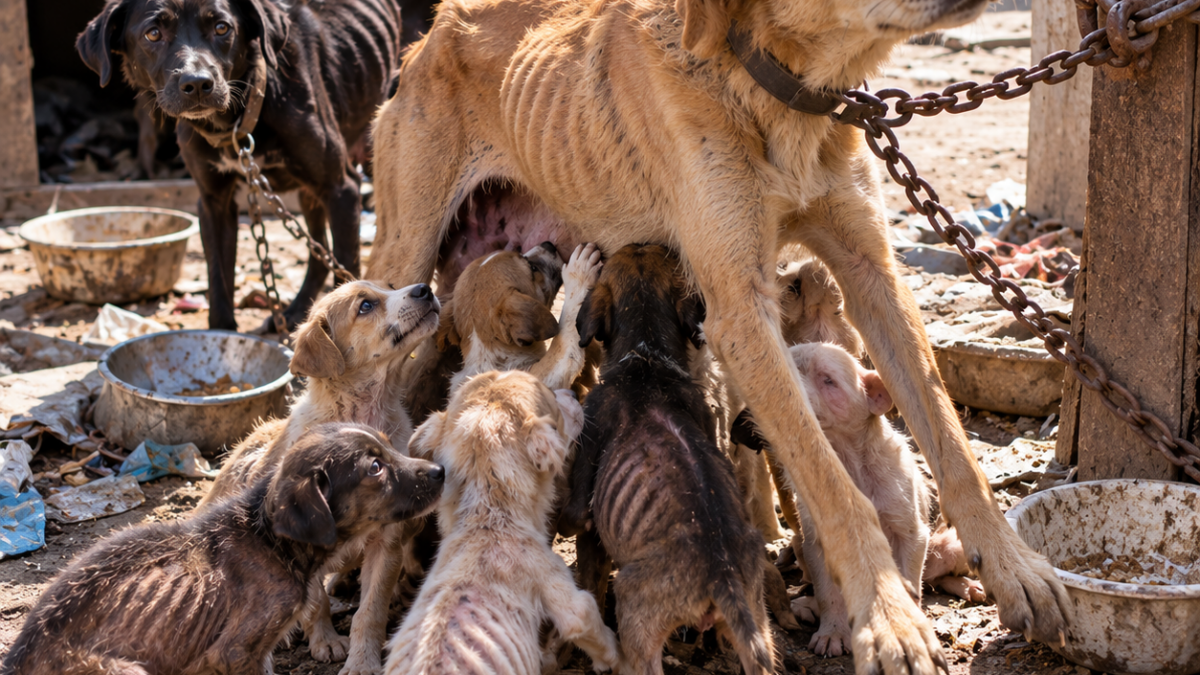
Chained and Helpless, She Could Only Reach Toward the Rescuers—While Her Hungry Puppies Waited for Someone to Save Them Before It Was Too Late.
The first time I saw Michelle, she was pulling against a chain so short she could barely reach the puppies playing only a few feet away from her.
Her babies were hungry, dirty, and disappearing one by one, but all she could do was stretch her neck toward them and cry whenever they wandered too far.
By the time we finally found the yard where they were being kept, I understood that we were not simply rescuing dogs—we were racing against a life that had already taken too much from them.
The video came from a neighbor.
It was shaky, filmed through a fence, and only a few seconds long. At first, I saw two adult dogs tied outside on short chains. One was black, thin but still bright-eyed, bouncing with restless energy even though the chain kept jerking him backward every time he tried to move. The other was golden, quieter, sitting close to the dirt with her head turned toward several puppies stumbling around nearby.
Then I watched it again.
And again.
That was when the details began hurting.
The chains were too short.
The ground was bare.
There was no proper shelter.
The puppies were too young to be left like that.
Some were still small enough to need their mother’s milk, but the golden dog could barely reach them. When one puppy toddled too far, she stretched forward until the chain tightened against her neck. She opened her mouth as if calling to him, but the video had no sound.
The neighbor’s message was simple.
Please help them. Some puppies have already disappeared.
I stared at that sentence for a long time.
Disappeared.
In rescue work, people often use soft words because the harder ones are too painful.
Missing.
Gone.
Disappeared.
But puppies do not simply disappear from a yard like that unless something is deeply wrong. They wander into traffic. They starve. They are taken. They become sick in some hidden corner where no one finds them in time.
I sent the video to our team and said, “We need to go today.”
The address was difficult to find. The house was tucked behind a narrow dirt road, past a row of low homes, broken fencing, and yards full of old tools and scrap. The closer we got, the tighter my chest became.
Because sometimes you can feel neglect before you see it.
You hear it in the silence.
No barking from healthy dogs.
No playing sounds.
No bowls being moved.
Just wind, chains, and animals waiting.
When we stepped out of the car, the black dog saw us first.
PART2:
He exploded toward us with such desperate excitement that the chain snapped tight and pulled him back. He did not seem angry. He did not seem dangerous. He seemed overwhelmed by the sight of people walking toward him as if people were a possibility he had almost stopped believing in.
The golden dog stood more slowly.
She was beautiful in a way that made her condition even harder to accept. Pale golden fur, dusty and tangled. A gentle face. One eye blue and the other brown, both full of fear, exhaustion, and something that looked too much like hope.
The puppies were scattered around them.
Too many.
Some were near the mother.
Some were under a broken board.
Some were nosing at dirt as if food might grow there if they searched hard enough.
I counted quickly.
Then counted again.
My stomach dropped.
There were far more puppies than the video had shown.
A neighbor came to the fence and told us several had already wandered away and never come back.
“She couldn’t follow them,” the neighbor said, nodding toward the golden dog. “She tried. She pulled until she hurt herself.”
The golden dog looked at me.
Then toward the puppies.
Then back at me.
That look stayed with me.
It was not the wild panic of a dog who did not understand.
It was worse.
It was the look of a mother who understood too much.
She knew her babies were not safe.
She knew she could not protect them.
And she knew people had walked past before.
I crouched slowly.
“Hi, mama,” I whispered. “We’re here now.”
The black dog whined and stretched toward me again.
The golden dog wagged her tail once.
Only once.
PART3:
As if she was afraid to believe in more.
Then the owner appeared.
She came from the side of the house, wiping her hands on her clothes, looking more irritated than worried. I had already prepared myself for arguments. Denial. Excuses. Claims that the dogs were fine. Promises that food would be given later. Accusations that we were interfering.
Instead, when I asked if we could take the dogs and puppies, she barely hesitated.
“Take them,” she said. “We’re tired of having them around.”
For a moment, I could not speak.
Tired of having them around.
The golden dog had been chained beside her hungry puppies.
The black dog had lived his life lunging against the same small circle of dirt.
Puppies had vanished.
And the answer was not shame.
Not grief.
Not even defensiveness.
Just tired.
I kept my voice steady because anger would not help the dogs.
“I can take them today,” I said. “All of them.”
She shrugged.
“If you want.”
I would have paid anything in that moment if it meant getting them out alive. But what mattered most was that she agreed. No delay. No negotiation that trapped the dogs another night. No chance for her to change her mind.
Our priority was simple.
Get them safe.
We called another shelter and asked for a large van. There were too many dogs for our vehicle. While we waited, we started loading the puppies first because they needed medical care immediately.
Some were easy to scoop up.
Others hid beneath boards or behind debris, unsure whether hands meant safety or harm. Their little bellies were round, their coats dusty, their eyes too serious for puppies. A few tried to nurse from the golden mother when we brought them close, but she was so thin and exhausted that I wondered how long her body had been trying to feed them without enough food for herself.
Neighbors began gathering.
Some watched silently.
Some whispered.
Some looked relieved.
One woman said, “I’m glad somebody finally came.”
I wanted to ask why no one had come sooner.
But I already knew the answer.
People wait.
They hope someone else will act.
They tell themselves it is not their business.
They get used to suffering if they see it every day.
But one neighbor had finally sent the video.
And because of that, everything changed.
When it was time to free the black dog, I knelt beside him with bolt cutters and gentle hands.
He danced in place, tail whipping, body trembling with excitement. He wanted to jump on me, kiss my face, run, spin, do anything except stand still in the same patch of dirt where the chain had taught him the size of his world.
“Easy,” I said. “I know. I know.”
The chain was old and heavy.
When it finally came loose, he froze.
Not because he wanted to stay.
Because he did not understand.
He took one step forward.
Then stopped.
No pull.
No metal tightening.
No sudden jerk at his neck.
He looked back at the place where the chain had been attached, then at me, then at the open space in front of him.
His body shook.
The black dog had lived so long with resistance that freedom confused him.
I clipped on a soft leash.
“You’re okay,” I whispered. “You don’t have to run yet.”
He pressed his head against my chest.
That was when I named him Mika.
The golden mother waited quietly.
She did not leap. She did not fight. She did not panic.
She stood still, watching me with those two different-colored eyes as if she had decided to trust me before I had earned it.
Her chain was twisted around a post, worn into the dirt from years of circling the same small space.
I touched her shoulder.
“I’m sorry,” I said.
I did not know what else to say.
Sorry for the chain.
Sorry for the puppies who had vanished.
Sorry for every day she had stretched toward her babies and could not reach them.
When I removed the chain, she lowered her head.
Then she wagged her tail.
Softly.
Slowly.
Almost politely.
As if she were thanking us for something that should never have been withheld from her in the first place.
I named her Michelle.
By the time the van arrived, the whole vehicle filled with dogs who had known far too much hardship. Puppies in carriers. Mika trembling with excitement. Michelle looking back constantly, trying to keep track of everyone.
It took several trips to move them all safely.
The puppies went first to the hospital.
They needed exams, parasite treatment, vaccines when appropriate, nutrition plans, and careful monitoring. There were so many of them, and every one had a different need. Some were weaker. Some were frightened. Some cried whenever they were separated. Some fell asleep the moment they touched a clean blanket.
The first night, I stood in the hospital room and watched them.
Rows of small bodies.
Tiny paws.
Dirty noses.
Little bellies rising and falling.
They had been playing in dirt to distract themselves from hunger.
Now they were finally warm.
Michelle had to say goodbye to them for the moment.
That was the hardest part.
We let her see them before they were taken into care. She sniffed each carrier, touching her nose to the doors. Some of the puppies cried when they smelled her. Michelle’s body stiffened every time.
I wished I could explain.
They are safe.
They are not disappearing.
They are going where food and medicine are waiting.
But all she knew was that her babies were leaving, and for so long, leaving had meant not coming back.
Mika and Michelle came with me to the shelter.
Michelle became anxious inside the crate, so I moved her into the cabin with me for part of the ride. Even then, she kept turning her head toward the back, looking for Mika.
Mika whined from behind us.
She answered with a soft sound of her own.
They had been chained near each other for so long that their fear moved together.
“You’re both coming,” I told her. “No one is being left behind.”
When we reached the shelter, I took them to the fenced grass yard before anything else.
The moment their paws touched the grass, both dogs changed.
Mika went first.
He stepped onto the soft ground, sniffed, then suddenly launched forward so fast I nearly dropped the leash. He ran in a wide circle, then another, then another, as if his body had been saving every movement the chain had stolen and was determined to spend them all at once.
Michelle stood still.
She looked down at the grass.
Then up at the trees.
Then at Mika running like a fool.
For the first time since we found her, her face changed.
Her ears lifted.
Her tail rose.
Then she ran too.
Not as wildly as Mika.
Michelle’s joy was quieter, but it was no less powerful.
She ran a few steps, stopped, looked back at me, then ran again. As if checking whether freedom was still allowed. As if expecting the chain to reappear.
It did not.
So she ran farther.
Watching them in that yard broke something open in me.
There are moments in rescue that feel almost unfair in their beauty. You spend hours looking at dirt, chains, sickness, fear, and neglect. Then suddenly a dog who has known nothing but a circle of dust discovers grass, and you remember why you keep doing this.
Later, I bathed them gently.
I expected fear.
Resistance.
Panic.
Mika stood still, leaning against my legs as water ran brown from his coat.
Michelle closed her eyes when I massaged shampoo into her neck where the chain had rested.
Neither fought me.
Maybe they were too tired.
Maybe they understood kindness faster than I expected.
Or maybe this was the first time touch had come without pressure, without a chain, without someone pushing them away.
After the bath, Michelle tried to dry herself by rolling dramatically on every towel in the room.
Mika joined her immediately.
Within seconds, the clean towels were twisted, the floor was wet, and both dogs looked extremely proud of their work.
I laughed so hard I had to sit down.
“You two are chaos,” I told them.
Mika wagged like that was a compliment.
It was.
But freedom did not erase everything.
Years on chains had left marks deeper than the ones on their necks.
Mika and Michelle mostly played with each other. Around other dogs, they were unsure. New faces made them nervous. Strange places made them cautious. They did not understand normal social signals the way dogs raised in healthier environments often do.
The world had been too small for too long.
Now it was suddenly huge.
That kind of freedom can be overwhelming.
So we moved slowly.
Short introductions.
Quiet routines.
Safe spaces.
Gentle walks.
No forced affection.
No crowded yard before they were ready.
Michelle surprised me more every day.
She was five years old, healthy despite what she had survived, and heartbreakingly sweet. Her mismatched eyes made people stop and stare, but it was her gentleness that stayed with them. She had every reason to distrust the world, yet she kept offering soft little pieces of herself.
A wag.
A lean.
A glance back on walks.
A paw placed carefully on my knee.
Mika’s new life began sooner.
A family met him and fell in love almost immediately. They understood he was sensitive. They understood he would need patience. They did not see him as broken.
They saw him as ready.
On adoption day, Mika pressed himself against me before leaving, then jumped into his new family’s car like he had decided life was finally allowed to move forward.
I cried after they drove away.
Not because I was sad.
Because he had spent so long tied to one place, and now he belonged somewhere.
Michelle remained with us.
The only one left.
I took her to an adoption event not long after that. It was a special gathering for homeless dogs and cats, a place where people could meet animals looking for families. The hall was full of barking, meowing, talking, laughter, volunteers, children, crates, leashes, and hopeful eyes.
At first, Michelle stayed close to my leg.
Too many sounds.
Too many dogs.
Too many people.
I knelt beside her.
“We can leave whenever you need.”
She looked at me, then looked around.
Slowly, curiosity began winning.
She sniffed a small dog through a barrier.
She accepted a treat from a woman in a blue coat.
She let a child admire her eyes from a respectful distance.
By the end of the event, she was walking beside me with her head higher, tail relaxed, looking at everyone as if she had realized the world was not only made of chains.
Several people asked about her.
Some took my phone number.
Some said she was beautiful.
Some promised to call.
I had learned not to believe every promise made at adoption events, but still, hope entered my heart before I could stop it.
Around the same time, updates began coming in about the puppies.
Many had been adopted.
One was sleeping in a little girl’s bed.
One had learned to climb onto a couch but not how to get down.
One had discovered squeaky toys and apparently planned to destroy every one.
One had followed his new family’s older dog everywhere like a tiny shadow.
Each photo felt like a small miracle.
Puppies who had once played beside a chained mother to forget hunger were now being held, spoiled, fed, vaccinated, loved.
The owner was later called in to explain the situation. At first, she described it as a hobby, as if keeping dogs and puppies in those conditions was simply something that had gotten out of hand. But the truth was obvious to everyone involved.
The puppies needed saving.
Michelle needed saving.
Mika needed saving.
And the neighbors who spoke up made that possible.
I will always be grateful to them.
Not everyone gets involved.
Not everyone risks angering the person next door.
Not everyone sends the video.
But they did.
Because of them, the chains came off.
Because of them, the puppies had a future.
Because of them, Michelle and Mika learned what grass felt like beneath free paws.
Then one day, the call came.
A woman who had met Michelle at the event wanted to see her again.
She had thought about her every day.
She had prepared her home.
She understood Michelle was shy.
She understood love would not fix everything overnight.
She was willing to give time.
That mattered more to me than excitement.
Many people want the beautiful dog.
Fewer people want the healing process.
We arranged the meeting.
On the drive there, Michelle sat quietly beside me.
She looked out the window at passing trees and houses, calm but alert. I kept one hand near her, and every few minutes she pressed her nose into my palm.
“You’re going to meet someone special,” I told her.
She blinked at me with one blue eye and one brown eye.
I smiled.
“I know. I’m nervous too.”
Her new home was peaceful.
A small yard.
Soft beds already prepared.
A bowl of fresh water.
Toys waiting in a basket.
The woman came outside slowly, not rushing, not squealing, not overwhelming her. She crouched at a distance and let Michelle choose.
For a while, Michelle stayed near me.
Then she stepped forward.
One step.
Two.
She sniffed the woman’s hand.
The woman did not grab her.
She simply whispered, “Hi, beautiful girl.”
Michelle’s tail moved.
Just once.
Then again.
I felt my throat tighten.
I had seen that same small wag the day we removed her chain.
Back then, it meant maybe.
Maybe you are safe.
Maybe this is real.
Maybe I can believe you.
Now it meant something else.
Maybe this is home.
We spent time together in the yard. Michelle explored slowly, checking corners, sniffing the fence, returning to me often. Each time she came back, I touched her head and told her she was doing well.
Eventually, she lay down near the woman’s feet.
Not fully relaxed.
Not asleep.
But close.
For Michelle, that was a decision.
The adoption was confirmed.
I signed the paperwork with a hand that did not feel steady.
People think rescue workers get used to goodbyes.
We do not.
We get better at understanding them.
That is different.
Michelle had been part of my life from the moment I saw her chained beside her puppies, stretching toward babies she could not protect. I had watched her step onto grass for the first time. Bathed dirt from her coat. Learned her fears. Watched her become curious, playful, and brave.
Now I had to leave her.
I knelt in front of her and held her face gently.
“I’m going to miss you so much, Michelle.”
She looked at me calmly.
No panic.
No frantic pulling.
No desperate confusion.
That helped.
“You have wonderful things waiting for you,” I whispered. “You don’t have to be strong all the time anymore.”
Her new mother stood nearby, crying quietly.
Michelle leaned forward and licked my chin once.
Just once.
Then she turned and walked toward the woman who would become her family.
That was the moment I knew she would be okay.
Not because she forgot me.
Not because the past disappeared.
But because she was able to move forward.
That is what rescue is supposed to become.
Not ownership.
Not possession.
A bridge.
We carry them from the worst place to the place where they can finally live.
Michelle’s first update came that evening.
A photo.
She was lying on a soft blanket, head resting on her paws, eyes half-closed. A toy lay beside her. The message said:
She is still shy, but she ate dinner and followed me into the kitchen. I think she is starting to understand.
I cried again.
Of course I did.
Later came more updates.
Michelle walking in the yard.
Michelle sleeping on the couch.
Michelle greeting her new mother at the door.
Michelle learning that hands could brush her fur without tying her down.
Michelle standing in sunlight, her golden coat shining, those two different-colored eyes bright and calm.
Mika’s family sent updates too.
He was loved deeply.
He had his own bed, though he preferred the sofa.
He still got excited too quickly sometimes, but his family laughed and helped him learn. They called him gentle, sensitive, funny, and perfect in all the ways that mattered.
The puppies grew.
One by one, they became family dogs.
Loved dogs.
Spoiled dogs.
Dogs with names on tags, vaccine records, favorite toys, and people who would notice if they were missing.
That was the future the chain had almost stolen.
Sometimes I still think about the day we found them.
The short chains.
The bare dirt.
The puppies playing beside hunger because puppies do not understand they are in danger until their bodies begin to fail.
The golden mother stretching toward babies she could not reach.
The black dog throwing himself toward us because hope had finally entered the yard.
I think about the owner saying she was tired of them.
And I think about Michelle’s face when the chain came off.
She did not run away from us.
She did not bite.
She did not collapse.
She simply stood there, confused by freedom, then wagged her tail like a thank-you.
But she should never have had to thank anyone for being released from suffering.
No dog should.
The world owed her more than a chain.
It owed Mika more than a circle of dirt.
It owed those puppies more than hunger and disappearance.
For a while, we were the ones who paid that debt.
Then their families took over.
And that is why I keep doing this work.
Not because every rescue is easy.
Not because every ending is perfect.
But because sometimes a neighbor sends a video.
Sometimes someone decides not to look away.
Sometimes a chain comes off.
Sometimes a dog touches grass and remembers how to run.
Sometimes a mother who could not reach her puppies lives long enough to become someone’s beloved girl.
And sometimes, after years of being held back, a dog like Michelle finally walks through a door where no chain is waiting on the other side.








