Cats Who Copy Human Body Language Way Too Well—Then You Realize They’re Not Mimicking Us, They’re Learning How to Belong
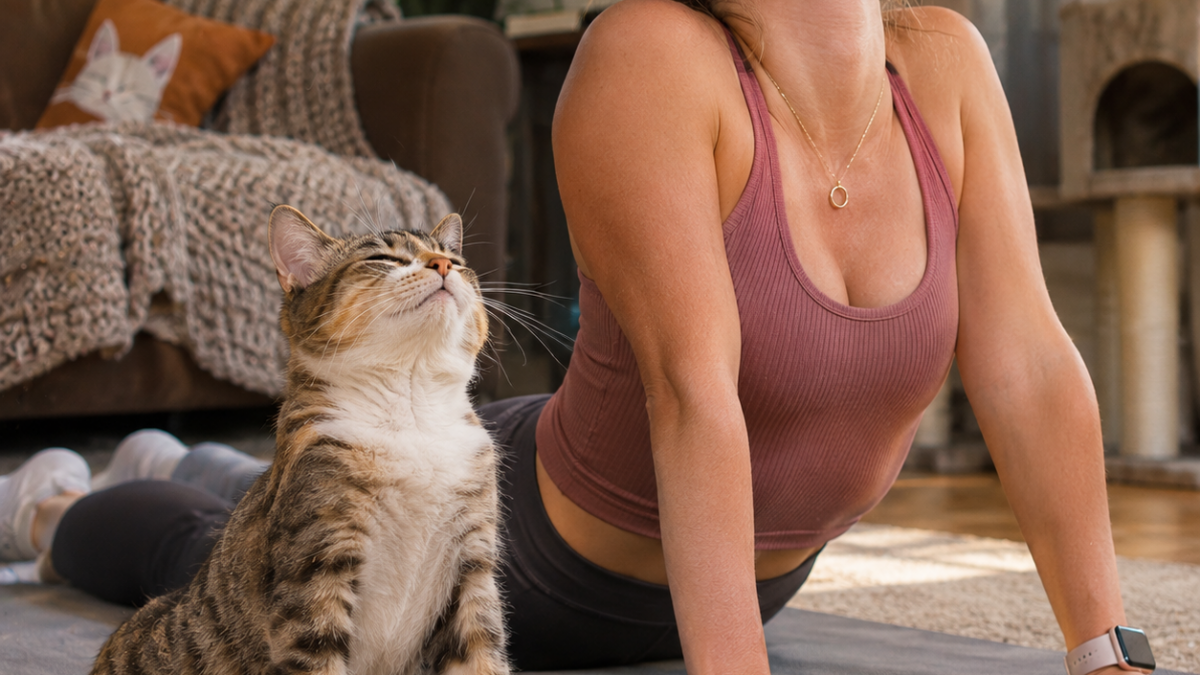
Cats Who Copy Human Body Language Way Too Well—Then You Realize They’re Not Mimicking Us, They’re Learning How to Belong
At first, everyone laughed when the cats started sitting like their owners, copying hand gestures, pretending to use laptops, and even matching the sleeping positions of the people beside them.
Then the imitation became so precise that some families began noticing their cats weren’t only copying movements—they were repeating routines, moods, and tiny expressions that nobody had deliberately taught them.
And somewhere between the cat raising a paw for the family huddle and another falling asleep in exactly the same pose as her human, the joke started feeling like something much sweeter.
There is a moment in almost every cat owner’s life when they look across the room and wonder whether the animal living with them has been secretly studying everyone.
Not watching casually.
Studying.
Taking notes.
Building a database.
Waiting for the right moment to reveal that every strange human habit has been carefully memorized.
A father sits on the couch with one leg stretched out.
His cat sits beside him with one leg stretched in almost the same direction.
A woman rests her chin on her hand.
Five seconds later, a paw comes up beside her.
A baby lies on the floor kicking both feet.
The cat beside her rolls over and starts doing something suspiciously similar.
Everybody laughs.
Coincidence.
Probably.
Then it happens again.
And again.
And again.
Until eventually somebody reaches for a phone and says:
“Wait. Do that again.”
Of course the cat never does it again when asked.
Cats have standards.
The whole thing begins with the little moments.
A baby sits on the floor surrounded by toys.
Beside her sits a fluffy little princess of a cat who has apparently decided that whatever the baby does must be correct.
The baby lifts one hand.
The cat watches.
The baby leans sideways.
The cat shifts.
The baby reaches toward a doll.
The cat reaches toward absolutely nothing, because apparently nobody bought her a doll.
That injustice is obvious.
If the baby gets one, why doesn’t she?
She looks around with the expression of an employee who has discovered unequal workplace benefits.
Someone behind the camera laughs.
The baby continues playing.
The cat continues copying.
At first it looks like random movement.
Then the baby changes position.
A moment later, so does the cat.
Same direction.
Same relaxed posture.
Same total confidence.
There is no explanation.
PART2:
Only the growing suspicion that somewhere in that small feline mind is one simple rule:
If she does it, I do it too.
Maybe that is how some cats learn family life.
They arrive in houses already knowing how to be cats.
They know how to stretch.
How to stalk.
How to climb somewhere they have specifically been told not to climb.
They know how to appear from another dimension the second a bag of treats opens.
But human life is stranger.
Humans sit at tables when perfectly good floors exist.
They stare at glowing rectangles for hours.
They put hands together before games.
They talk to devices.
They sleep under blankets.
They exercise voluntarily.
They pretend not to notice cats stealing food directly from their plates.
A smart cat watches all of that.
Then adapts.
Charlie learned the family huddle.
Nobody formally trained him.
At least not in the beginning.
The family would gather before a game or some little celebration.
Hands stacked together.
One over another.
PART3:
A simple ritual.
Charlie watched.
One day somebody called him.
“Charlie, put your hand.”
Charlie looked at the pile of human hands.
No movement.
“Come on.”
The humans waited.
“You’re part of the team.”
Still nothing.
“Put it in.”
Charlie slowly lifted a paw.
There was immediate laughter.
He placed it on top.
A perfect little furry contribution.
“Good boy.”
Charlie looked around as if he had no idea why everybody was suddenly emotional.
He had simply followed instructions.
Yet the image was perfect.
Human hands.
One cat paw.
Everyone included.
That was the thing about these moments.
They looked ridiculous until they suddenly didn’t.
There was another cat whose favorite person seemed to be Dad.
Not because Dad gave the most treats.
Although that probably helped.
Not because Dad bought the fanciest toys.
The cat simply liked being near him.
At dinner, Dad sat down with his food.
The cat found her place.
Two seats.
Two faces.
Two beings sharing the moment like an old married couple who had been eating together for thirty years.
Dad lifted his food.
She watched.
Dad chewed.
She seemed to chew.
Dad paused.
She paused.
Somebody filmed them and laughed.
“Just Dad and his girl sharing a meal for two.”
It looked like a date.
She had the serious expression of a restaurant guest who expected proper service.
Dad had the resigned expression of a man who knew half his dinner might eventually be inspected.
That was their thing.
Other families showed affection with hugs.
This family apparently showed it by letting a cat stare directly at a plate until the human lost the psychological battle.
Then came the sunbathing pair.
A person stretched peacefully in the warmth.
The cat nearby copied the relaxed posture so perfectly that from a distance they looked like they had coordinated it.
No responsibilities.
No appointments.
No emails.
No thoughts.
Just sun.
That was the ideal anyway.
The peace lasted until a vehicle passed or somebody made noise outside.
Then the cat’s head shot up.
Instant neighborhood security officer.
Sunbathing was wonderful.
But only if the street remained quiet.
Humans relax conditionally.
Cats apparently do too.
Perhaps that was what made the imitation so funny.
Cats did not always copy the obvious action.
Sometimes they copied the attitude.
A woman injured her leg.
Nothing serious, but enough to make her walk differently.
She limped slightly.
Her cat noticed.
Soon the cat began moving with what looked remarkably like the same dramatic little limp.
The woman stared.
“Are you making fun of me?”
The cat continued.
One slow step.
Another.
Everybody laughed.
The injured woman did not know whether to be offended.
Was the cat expressing sympathy?
Copying?
Mocking?
Cats never clarify.
That is part of their power.
All day, the little girl repeated the exaggerated walk.
Mom limped.
Cat limped.
Mom stopped.
Cat suddenly remembered that all four legs worked perfectly.
Then Mom moved again.
Back came the performance.
Maybe imitation really is the highest form of flattery.
Unless your cat is clearly enjoying it too much.
Music created another kind of copycat.
Someone sat at a piano.
Fingers moved.
Notes played.
Nearby, the cat watched with enormous interest.
Then she approached her own little toy.
Paw up.
Tap.
Nothing.
Another tap.
Nothing.
She looked confused.
Her piano had apparently run out of treats.
That was unacceptable.
Human pianos make sounds when pressed.
Cat pianos should produce snacks.
This seemed like a serious design flaw.
She tapped again.
Looked at the humans.
Tap.
Nothing.
At some point her expression changed from curiosity to betrayal.
If she was going to join the family band, somebody needed to improve the compensation package.
Another cat had a different job.
Kitchen assistant.
Every chef needs a taste tester.
This particular cat took the position with extreme seriousness.
Someone cooked at the counter.
The cat sat nearby.
Watching.
Not begging.
Evaluating.
A spoon moved.
Her head moved.
A bowl came down.
Eyes locked.
She had the posture of a professional restaurant critic preparing to destroy a business with one review.
No smiling.
No nonsense.
Just concentration.
The family laughed.
She did not.
This was work.
Food needed inspection.
Quality control did not perform itself.
Sometimes cats copied people without any visible practice.
They just woke up one morning apparently knowing how to do something.
One mother slept on her side.
Her cat slept beside her.
Same direction.
Same curve of the body.
Heads nearly aligned.
Arms and paws arranged so similarly that somebody walking into the room stopped.
There are poses that look accidental.
This did not.
They looked like one person and a smaller furry version.
The closer two living things become, people joke, the more they start to resemble each other.
Apparently cats take that literally.
Another owner decided to teach his cat words.
Not complicated words.
Just sounds.
“I love you.”
The cat stared.
The human repeated it.
Nothing.
Then another attempt.
“Say it.”
The cat opened its mouth.
Something came out.
Not exactly English.
Not exactly meow either.
But close enough that everyone exploded.
Cats learn quickly when humans react dramatically.
One successful sound becomes entertainment.
Entertainment becomes repetition.
Soon the entire household is sitting around asking the cat to perform language lessons while the cat wonders why these strange mammals are so easily impressed.
Chico had his own class.
“Chico, meow.”
Chico looked at Dad.
“Meow.”
Dad demonstrated.
“Meow.”
Chico responded.
A sound came out almost on cue.
Laughter.
Again.
“Meow.”
Again.
The cat answered.
Somewhere inside Chico’s brain, the logic was probably very different from what the humans imagined.
Perhaps he thought he was teaching Dad.
Poor man keeps making terrible cat sounds.
Better correct him.
Another cat noticed Dad’s phone habit.
Dad sat scrolling.
Thumb moving.
Up.
Pause.
Up.
Pause.
The cat watched.
Humans complain about cats stepping on phones.
This cat apparently decided to assist.
A paw reached out.
Touched the screen.
Dragged.
Content moved.
Everyone laughed.
Dad’s hand must be exhausted from doing all that scrolling.
Good thing he hired support staff.
The cat continued tapping.
Not randomly anymore.
Almost purposefully.
The most dangerous moment in a pet owner’s life is realizing the animal has learned how touchscreens work.
After that, nothing is safe.
Messages.
Videos.
Calls.
Online shopping.
One morning the family may wake to discover the cat has ordered thirty-seven cans of tuna and subscribed to three bird-watching channels.
Biscuits had a different talent.
Biscuits ate biscuits.
That alone was funny enough.
Someone held up the snack.
“Are you eating biscuits?”
The cat chewed.
“That’s funny because your name is Biscuits.”
Biscuits did not care.
Names were a human concern.
Food was real.
The person filming called him the coolest cat they had ever met.
Biscuits continued eating.
Correct response.
Cool people do not need validation.
Then there were cats who learned games.
Or appeared to.
One day a cat understood exactly what to do.
Push here.
Pull there.
Move the toy.
Success.
The owner celebrated.
Brilliant.
Genius.
Possibly ready for college.
By the next morning, the same cat looked at the toy as if it had arrived from another planet.
No memory.
No interest.
No evidence that yesterday had ever happened.
This is another thing cats copy from humans extremely well.
Selective competence.
Some days we are brilliant.
Other days we walk into a room and forget why.
Cats understand.
Board games produced another battle.
A human tried to move a piece.
The cat interfered.
“Come on.”
The human moved.
The cat moved again.
“Let me move first.”
Cat moved.
“Jesus Christ, you moved twice in a row.”
The cat stared.
“Stop.”
No.
Rules are merely suggestions when you are covered in fur.
The human thought he had a game partner.
The cat thought she had discovered a board containing multiple small objects that obviously belonged on the floor.
Two completely different sports were happening.
Both believed they were winning.
Kids made everything more chaotic.
Children play loudly.
Cats interpret movement differently.
A child runs.
A cat crouches.
A toy swings.
Eyes widen.
Some cats join happily.
Others issue warnings.
One cat seemed to treat family playtime as combat training.
The kids laughed.
The cat moved with dramatic little defensive gestures.
Paws up.
Body turned.
Ready.
She looked like she had secretly enrolled in kung fu lessons.
One paw forward.
Other paw ready.
Somebody laughed harder.
Maybe she had been training while everybody slept.
That would explain the mysterious noises at 3:00 a.m.
Another cat had learned begging.
Or apologizing.
Nobody could decide.
She sat up.
Front paws together.
Little pleading motion.
Again.
Again.
The humans melted immediately.
Was she asking for something?
Probably.
Was she saying sorry?
Unlikely.
Did she understand that putting both paws together made humans surrender faster?
Almost certainly.
That face had nothing to apologize for anyway.
People underestimate how quickly cats learn emotional economics.
One cute gesture equals one treat.
Two cute gestures equal two treats.
Humans insist they are training the cat.
The cat knows better.
Technology created its own copycats.
One family worked on laptops constantly.
Eventually the cat began sitting directly in front of the keyboard.
Normal cat behavior.
Then someone had an idea.
Give the cat her own laptop.
A toy.
A small screen.
A miniature workstation.
Suddenly she had a desk.
She sat in front of it.
Serious.
Professional.
A tiny business executive.
The human could finally work.
Maybe.
The cat stared at her laptop like quarterly reports were disappointing.
If cats ran companies, meetings would be five minutes long.
Eat.
Sleep.
Push expensive object off desk.
Meeting adjourned.
The similarities became even stranger between daughters and mothers.
One woman sat a very specific way.
Relaxed against the couch.
Shoulders positioned one way.
Legs another.
Her cat sat beside her.
Same posture.
People laughed.
“That’s a daughter who takes after her mom.”
Maybe.
Or perhaps living together creates physical habits.
Humans do it too.
Couples begin using the same phrases.
Families laugh similarly.
Friends start copying expressions.
Why would cats be completely different?
They spend hours watching us.
Every day.
From furniture.
Windowsills.
Beds.
Counters they are not supposed to be on.
They know when we wake.
When we eat.
When we leave.
When we come home.
Which chair belongs to whom.
Which person gives treats after pretending they will not.
Which person cries quietly.
Which person talks too loudly on the phone.
Which child drops food.
Cats might understand our routines better than we do.
Sleeping made that obvious.
A person sleeps with one arm above the head.
Cat beside them stretches one paw the same way.
A person curls tightly.
Cat curls too.
A father naps with mouth slightly open.
Cat nearby somehow achieves the same deeply relaxed expression.
Sometimes photographs looked almost staged.
They weren’t.
That was why they were funny.
Nobody can reliably stage a cat.
A cat who does not want to cooperate becomes liquid.
You cannot position liquid.
Then there was the workout cat.
Mom tried to exercise.
The cat saw this and decided support was necessary.
Not exercise.
Support.
There is a difference.
Mom climbed onto equipment.
Cat climbed onto Mom.
Now Mom was exercising for two.
The cat rode comfortably on top.
Everyone laughed.
Was she joining the workout?
Technically.
Was she burning calories?
Absolutely not.
If anything, Mom was doing extra work while the cat conserved energy.
Evolutionarily efficient.
The cat watched with the satisfied expression of a personal trainer who contributes nothing except added resistance.
Then nail day.
Mom had nails done.
The cat extended her claws.
Comparison.
Human manicure.
Cat manicure.
Honestly, the cat had a point.
Her nails were sharp, naturally shaped, and required no appointment.
Someone asked how she always won the cutest lady award.
She did not answer.
Winners rarely explain technique.
Weekend rituals became another form of imitation.
Dad came home.
Cat appeared.
“Hey, what’s up?”
He spoke the way he would to another person.
The cat responded with body language.
Head up.
Tail.
Eyes.
Approach.
Weekend time with Dad had become their thing.
He might sit down.
She climbed beside him.
He stretched.
She stretched.
He relaxed.
She relaxed.
The happiness was obvious.
It was not really the copying that mattered.
It was the synchronization.
They knew how to be together.
That is different from merely sharing a room.
Some animals live around people.
Others live with them.
There is a point where routines begin overlapping.
Dad sits here, so I sit here.
Mom sleeps now, so I sleep now.
Baby plays, so I play.
Family gathers hands, so I add a paw.
It looks like imitation.
Maybe it is also participation.
One mother discovered this during her morning workout.
She tried to stretch.
Her cat decided the moving limbs were clearly an invitation.
Paw.
Jump.
Interfere.
Mom tried another movement.
Cat followed.
People behind the camera laughed.
If exercise had been difficult before, it had now become nearly impossible.
The cat considered the entire routine interactive entertainment.
Mom called it a workout.
The cat called it:
Finally, something interesting before breakfast.
Babies and cats created some of the sweetest copies.
Both are curious.
Both become fascinated by objects adults ignore.
Both can fall asleep in impossible positions.
Both occasionally stare at empty corners with information nobody else has.
Both demand attention on schedules known only to themselves.
Put a baby and a cat together long enough and somebody will eventually ask:
Who is teaching whom?
One little baby lay down.
Cat nearby copied.
Baby rolled.
Cat adjusted.
Two innocent faces.
Two sets of curious eyes.
The resemblance was not physical.
It was energy.
Pure curiosity.
No self-consciousness.
Everything in the world still worth investigating.
Water created another comedy.
Someone demonstrated something near a pool.
“Like this. Do you see?”
The cat watched.
Then responded with the expression of someone who absolutely did not see why anyone needed to enter water voluntarily.
Humans swim.
Cats frequently consider this a poor choice.
But even then, some will imitate the posture.
Approach the edge.
Look down.
Move a paw.
Immediately reconsider the entire experiment.
One family had an artistic cat.
Dad painted.
The cat watched.
Brush.
Paint.
Movement.
Then the cat entered the operation.
Too close.
Paw near color.
Fur near paint.
Suddenly everyone had a new question.
Was she painting with Dad?
Or painting herself?
Blue appeared where blue had not previously existed.
Laughter.
Dad continued working.
The cat looked perfectly innocent.
Art requires sacrifice.
Sometimes that sacrifice is white fur.
Another woman noticed that she and her cat even chewed similarly.
A strange little synchronized motion.
Human chewing something.
Cat moving her mouth too.
Somebody asked:
“Does chewing along ease the craving?”
No idea.
But the cat committed.
That was important.
If a cat does anything, it does it with complete seriousness.
That seriousness makes everything funnier.
A person can look ridiculous while knowing they are ridiculous.
Cats look ridiculous while fully convinced they are performing essential work.
Then came the relaxed face.
Dad sat back.
Completely comfortable.
His cat sat nearby.
Same half-lidded expression.
Same posture.
Same total lack of urgency.
Someone joked:
“She’s not copying him anymore. She is him.”
That was exactly how it looked.
Maybe at some point imitation becomes identity.
Children copy parents.
Students copy teachers.
Friends copy friends.
Pets copy people.
Not because they are trying to become another species.
Because belonging has a rhythm.
Every family has one.
Cats learn it.
A family speaks in certain tones.
Moves through rooms in certain ways.
Sleeps at certain times.
Celebrates certain things.
Touches in certain patterns.
A cat entering that family gradually learns all of it.
When Dad says a certain word, dinner might happen.
When Mom sits in that chair, there may be room beside her.
When the baby lies on the rug, play begins.
When everybody stacks hands, something exciting is about to happen.
When someone opens the laptop, that person will remain in one place long enough to sit on.
Useful knowledge.
One cat even learned how to look fierce on command.
Someone encouraged her.
“Come on.”
The cat stared.
“Show us.”
A little face changed.
Ears.
Eyes.
Paw.
Everyone laughed.
The supposedly terrifying pose somehow made her cuter.
That is the curse of being a fluffy predator inside a loving home.
You can display your ancestral hunting power all you want.
Someone will still say:
“Look at the little baby.”
Cats never recover from this disrespect.
Another fluffy hunter flexed claws.
Pure instinct.
Tiny tiger.
Ready.
Yet even the claws looked adorable because everything changes when humans love the animal attached to them.
A lion showing claws is danger.
Your cat showing claws while sitting on a blanket becomes:
“Look at those little murder mittens.”
Language changes with affection.
Then there was the vegetable helper.
Mom prepared food.
Cat joined.
Not because she understood cooking.
Because Mom was doing something.
And if Mom was doing something, participation was required.
Vegetables moved.
Paw followed.
Mom rearranged.
Cat inspected.
At that point she was not a pet.
She was staff.
Unpaid.
Unqualified.
Impossible to fire.
That might be the best description of many family cats.
They do not simply live in the house.
They join operations.
Laundry.
Cooking.
Work.
Exercise.
Sleep.
Parenting.
Phone use.
Bathing.
Eating.
They appear.
Watch.
Copy.
Interrupt.
Assist badly.
Then receive affection for it.
Perfect system.
Still, beneath all the funny moments was something people often missed.
Cats do not imitate everybody equally.
Many choose someone.
A child.
Dad.
Mom.
The person who works from home.
The person who wakes earliest.
The person who feeds them.
The person who rescued them.
The person who never wanted a cat but somehow became the favorite.
That last one happens suspiciously often.
A family adopts a cat.
Dad says:
“I don’t want the cat on me.”
Two weeks later:
Cat sleeping on Dad.
Dad unable to move.
Nobody else allowed to touch them.
Cats enjoy irony.
But attachment has patterns.
A cat watches the person they trust.
Trust becomes proximity.
Proximity becomes familiarity.
Familiarity becomes synchronization.
That is when the copying begins to look uncanny.
One paw moves when the human hand moves.
One head turns.
One body shifts.
One yawn triggers another.
One person lies down.
The cat settles beside them in almost the same shape.
Researchers might describe social referencing, observational learning, conditioning, routine.
Families describe it differently.
“She thinks she’s one of us.”
Maybe both are true.
Charlie placing his paw into the team huddle probably did not understand team spirit as humans define it.
But he understood invitation.
Everybody had hands together.
Everyone was focused on him.
He had seen the ritual.
He joined.
That is belonging.
The cat beside the baby probably did not understand dolls.
But she understood that the little human on the floor was important.
So she stayed near.
Watched.
Moved with her.
That is belonging too.
The cat sharing dinner with Dad probably did not care about human table manners.
But she knew:
Dad sits here.
I sit here.
We eat.
Together.
The cat sleeping in Mom’s exact pose did not need to understand why it was funny.
She simply felt safe enough to sleep deeply beside the person she loved.
Safety creates similarity.
When living things relax together, bodies often find the same rhythm.
Breathing slows.
Muscles loosen.
Postures soften.
The photograph captures the joke.
The reality underneath is trust.
That is why some of the funniest cat videos become emotional if you watch long enough.
At first:
Look, she copies Mom.
Then:
Look how close she stays to Mom.
At first:
Look, the cat is scrolling Dad’s phone.
Then:
She spends every evening beside him.
At first:
Look, Charlie joined the team.
Then:
Nobody in that family considered leaving him out.
At first:
The cat mimics a baby.
Then:
The baby is growing up with an animal who has decided her activities deserve full supervision.
The little scenes accumulate.
One afternoon a cat reaches toward Dad’s phone.
Another morning a cat follows Mom’s limp.
A sleepy cat matches her human’s arms.
A playful cat copies a child.
A cat places a paw on a laptop.
A kitten tries to help with vegetables.
Individually, funny.
Together, they tell the same story.
Cats are always watching.
Not in a sinister way.
Mostly.
They learn our homes through repetition.
They understand pattern before language.
The sound of keys.
The refrigerator opening.
Shoes being put on.
Laptop closing.
Lights turning off.
A baby crying.
A familiar person laughing.
A specific car in the driveway.
A bedroom door.
A favorite chair.
They know which sounds mean somebody is leaving.
Which mean somebody has returned.
That knowledge affects them.
Some cats wait at doors before the owner arrives.
Not magic.
Routine.
Maybe engine sound.
Maybe timing.
Maybe a collection of clues humans do not notice.
They become experts in us.
Meanwhile, humans remain confused about why the cat screamed at 4:37 in the morning.
The relationship is uneven.
Still, people try.
We learn tail positions.
Ear angles.
Slow blinks.
Purring.
Little chirps.
The difference between:
Feed me.
Open this.
Look at that bird.
Stop touching me.
Continue touching me immediately.
Cats learn human signals.
Humans learn cat signals.
Eventually both sides create a shared language that belongs to neither species entirely.
That may be where the copying comes from.
A household develops its own vocabulary of movement.
Dad taps the couch.
Cat jumps up.
Mom lifts the blanket.
Cat crawls under.
Child runs toward the toy box.
Cat appears.
Someone says “team.”
Charlie lifts a paw.
Nobody designed that language.
It grew.
Just like families do.
The funniest part is that cats often look embarrassed when caught.
They copy a posture.
Camera comes out.
They immediately move.
Evidence destroyed.
A cat may sit like a human for twenty minutes.
The moment someone says:
“Look at her!”
Normal cat again.
This is deliberate.
They know documentation creates accountability.
Or perhaps cats simply hate giving humans what they want.
Either explanation is reasonable.
There was one cat who seemed almost offended by applause.
She learned a trick.
Humans cheered.
Her face said:
Please control yourselves.
Another cat performed the same action ten times when nobody filmed.
Camera appeared.
Nothing.
People begged.
Treats offered.
Still nothing.
Camera off.
Perfect performance.
Cats understand negotiation.
Yet eventually enough moments are captured that patterns become impossible to deny.
People compile videos.
Cats sitting like owners.
Cats using paw gestures.
Cats copying babies.
Cats mirroring workouts.
Cats participating in games.
Cats pretending to work.
Cats sleeping like their humans.
Millions of people watch.
Why?
Probably because the scenes are funny.
But maybe also because they confirm something every animal lover wants to believe.
That the animal notices us.
Not merely the food.
Not merely the warm house.
Us.
Our habits.
Our moods.
Our strange little rituals.
A cat cannot say:
“I have watched you sit like this every evening and I associate that posture with feeling safe beside you.”
Instead, she sits the same way.
A cat cannot say:
“I see that the baby matters to you, so I want to stay beside her.”
She lies next to the baby.
A cat cannot say:
“I understand this family ritual means everyone belongs.”
Charlie puts in his paw.
Body language becomes the message.
That is why imitation can feel like affection.
The cat is saying:
This is what my people do.
I am one of the people.
Or at least:
I am with them.
Families often begin calling cats their sons or daughters as a joke.
“This is Dad and his girl.”
“This is Mom’s daughter.”
“My boy.”
“My baby.”
The cat does not understand human family labels.
But the relationship underneath the language is real.
Care.
Routine.
Protection.
Attachment.
Shared space.
Shared sleep.
Shared meals, when humans surrender.
Shared frustration over closed doors.
Shared mornings.
Shared nights.
Eventually the distinction between pet and family becomes almost meaningless inside the home.
Outside, documents may call the animal a pet.
Inside, everybody knows who owns which side of the bed.
One little cat became so synchronized with her mother that visitors noticed before the family did.
Mom sat.
Cat sat.
Mom leaned.
Cat leaned.
Mom crossed her legs.
Cat arranged herself into the closest feline equivalent.
Someone said:
“She’s becoming you.”
Mom laughed.
But then she started watching.
It happened constantly.
Not perfect copying every time.
More like echoing.
A movement repeated through another body.
Perhaps the cat had simply learned the posture meant:
We’re relaxing now.
So she relaxed too.
That explanation is less magical.
It is also somehow more beautiful.
She was not performing.
She was participating in the same emotional state.
Another father had the same experience.
He came home from work tired.
Dropped onto the couch.
His cat climbed up.
He exhaled.
She settled.
His shoulders softened.
Her eyes closed.
Someone filmed them.
Same expression.
Same exhaustion.
“She is him.”
Everyone laughed.
Maybe she was not copying the face.
Maybe she was responding to his calm.
Animals read tension.
Tone.
Movement.
A familiar person settling down can signal that the environment is safe.
So the cat settles too.
Human relaxation becomes feline relaxation.
That is not imitation in the circus-trick sense.
It is relationship.
Even the silly moments fit.
Mom exercises.
Cat climbs on.
Why?
Because Mom is moving unusually.
Interesting.
Because being near Mom is rewarding.
Because Mom reacts.
Soon the cat learns:
When this mat appears, climb here.
When these movements begin, join.
A ritual forms.
Weeks later, nobody remembers who created it.
That is family life.
Half the traditions in any house probably began accidentally.
One person did something once.
Another repeated it.
Everyone laughed.
Then it became “what we do.”
Cats are excellent at turning accidents into traditions.
Feed a cat one piece of chicken beside the refrigerator at 6:17 p.m. once.
Congratulations.
You now have a legally binding daily appointment.
Cats take precedent seriously.
That may explain why they copy us so well.
They worship routine.
Humans are routine machines pretending to be spontaneous.
We sit in the same places.
Walk the same routes.
Repeat gestures.
Say the same phrases.
A cat has unlimited opportunities to memorize us.
Maybe the real surprise is not that they copy.
Maybe the surprise is that it takes us so long to notice.
The little princess beside the baby had probably been studying that baby every day.
Dad’s dinner companion knew his exact mealtime.
Charlie knew the family huddle.
The workout cat knew when the mat appeared.
The laptop cat knew work hours.
The sleeping cats knew bedtime.
The vegetable assistant knew where Mom stood while cooking.
The copying did not begin in the viral moment.
The viral moment was only when a human finally caught it.
Before the camera, there were hundreds of quieter repetitions.
Watching.
Learning.
Belonging.
That is why some people become emotional looking through old pet videos after an animal is gone.
What seemed ordinary becomes precious.
A cat sitting beside Dad.
A paw on Mom’s arm.
A strange sleeping pose.
A ridiculous attempt to copy a baby.
At the time:
Funny.
Later:
Proof of a life shared.
The videos preserve more than tricks.
They preserve habits.
This is how she sat.
This is where he slept.
This was the sound she made.
This was how he looked at Dad.
This was the way she always joined Mom in the kitchen.
Memory attaches to tiny things.
Maybe that is why people film them.
Some part of us already knows ordinary moments disappear.
One day the baby will no longer be a baby.
The cat beside her will grow older.
Dad’s couch may be replaced.
The family may move.
The old kitchen changes.
Children leave for school.
Years move.
But somewhere there may still be a video of a cat putting her paw next to a baby’s hand.
That matters.
People often ask why animal videos are so popular.
Maybe because they offer a form of emotion that does not require much explanation.
A cat copies a human.
Everybody understands.
No complex plot.
No long speech.
Just recognition.
Love is visible in proximity.
Trust is visible in sleep.
Belonging is visible when an animal voluntarily joins what the family is doing.
One cat copied a limp.
Everyone laughed.
But she had noticed Mom closely enough to notice the limp.
One cat copied Dad’s phone scrolling.
She had watched his hand long enough to know the motion.
One cat joined the huddle.
He had watched the ritual enough to recognize his turn.
One cat matched a sleeping pose.
She had chosen to sleep close enough for the similarity to happen.
The comedy sits on top.
Connection sits underneath.
That is why people keep watching.
Near the end of one evening, a mother prepared vegetables.
Her cat sat beside her, paw reaching toward the work.
Not useful.
Possibly dangerous to the vegetables.
But determined.
Mom moved something.
The cat followed.
Mom laughed.
Someone behind the camera said something that captured the whole thing better than any scientific explanation could.
“She’s not a pet in this house. She’s family.”
That was it.
Family members copy each other.
Children copy parents.
Partners share expressions.
Friends pick up slang.
Siblings imitate habits.
Sometimes even pets begin moving to the same rhythm as the people they love.
Not because they stop being animals.
A cat remains a cat.
Independent.
Predatory.
Opinionated.
Capable of destroying a roll of toilet paper for reasons known only to God.
But being fully cat does not prevent being fully part of a family.
Both can be true.
A cat can stalk imaginary prey at midnight and sit like Dad at breakfast.
She can flex claws like a hunter and help Mom with vegetables ten minutes later.
She can ignore her name nineteen times and then copy the baby perfectly.
Contradictions are part of the charm.
Maybe that is why people love them.
Dogs often advertise affection.
Cats frequently make you earn the interpretation.
A dog may run across a room.
A cat may simply choose the chair beside you.
A dog may lick your face.
A cat may sit in the exact same posture three feet away.
Different language.
Same possibility.
I am here because you are here.
One father had a cat who followed weekend routines so faithfully that the family began expecting her before she appeared.
Dad sat down.
Three seconds.
There she was.
He greeted her.
“Hey, what’s up?”
She looked at him.
Walked over.
Settled in.
That tiny ritual had no purpose.
That was why it mattered.
The best family rituals often accomplish nothing.
Coffee together.
Sitting on a porch.
Watching television.
A child leaning against a parent.
A cat joining Dad on weekends.
No productivity.
Just presence.
The cat had learned:
This is our time.
Humans like to imagine they choose all these relationships.
Sometimes animals choose too.
A cat picks one lap.
One pillow.
One person to follow.
One baby to supervise.
One chair beside Dad.
One spot near Mom’s feet while she cooks.
That repeated choice becomes intimacy.
Then imitation follows.
Maybe copying is simply what closeness looks like after enough time.
A young cat sees everything the family does.
She tries it.
Some behaviors disappear.
Others remain.
She copies sitting.
Sleeping.
Reaching.
Playing.
Chewing.
Working.
Exercise, sort of.
Eventually people stop being surprised.
Of course she’s there.
Of course she does that.
That is how family status becomes permanent.
At first:
“Why is the cat doing this?”
Later:
“That’s just what she does.”
There is a moment when novelty becomes identity.
The cat who once copied Mom is now simply Mom’s shadow.
The kitten who once joined the baby is now the baby’s companion.
Charlie does not merely place his paw in the huddle anymore.
Everyone waits for him.
The ritual would feel incomplete without that paw.
That might be the strongest evidence of belonging.
Not when the animal copies the humans.
When the humans change the ritual to include the animal.
A place is left on the couch.
A hand waits for the paw.
A laptop appears beside the real laptop.
A cat-sized portion gets considered at dinner.
A blanket gets lifted.
A door stays open.
A chair is moved to the sunny place.
Humans start copying the animal back.
We adjust.
That part does not get enough attention.
The relationship becomes mutual imitation.
Cats learn us.
We learn them.
A cat waits by the food bowl at seven.
Soon we start walking toward the bowl automatically at seven.
Who trained whom?
A cat sleeps in one spot.
We stop putting things there.
A cat likes one blanket.
That blanket becomes the cat blanket.
A cat meows a certain way at a closed door.
Someone opens it.
Excellent training.
Cats may be copying human body language.
Humans are reorganizing entire homes around feline preferences.
Call it even.
Maybe the real story is not that cats copy us too well.
It is that living closely changes everyone.
Two species meet.
Neither speaks the other’s language perfectly.
So both begin watching.
Repeating.
Responding.
Creating rituals.
A family forms in the space between.
One night, a mother and her cat fell asleep beside each other.
No performance.
No treats.
No commands.
The cat’s body curled almost exactly like hers.
A photograph captured them.
Perfect match.
People laughed when they saw it.
Then someone wrote:
“The closer two hearts get, the more their sleeping poses start to match.”
Sentimental?
Maybe.
But look at them.
Two bodies relaxed enough to sleep inches apart.
Whatever else was happening, trust was there.
And trust is not a trick.
You cannot command real trust.
You cannot buy it with one treat.
It is built through ordinary days.
Food arriving.
Doors opening.
Gentle hands.
Predictable voices.
Shared space.
Time.
Eventually an animal sleeps beside you without monitoring every movement.
Eventually she sits the way you sit.
Reaches when you reach.
Waits when you wait.
Joins when everyone joins.
Maybe she is copying.
Maybe she is saying:
This is how my family does things.
So this is how I do things too.
That is why the final vegetable scene always made everyone smile.
Mom preparing dinner.
Cat beside her.
Tiny paw involved.
Completely unnecessary assistance.
Yet nobody pushed her away.
She belonged there.
Not because she was useful.
Family does not always need to be useful.
She belonged because she had become part of the picture.
And perhaps that is the secret behind every cat who copies human body language a little too well.
They are not trying to become people.
They are learning the language of the people they love.
They watch long enough.
Sit close enough.
Sleep beside us long enough.
Share enough mornings, meals, games, naps, workdays, and quiet weekends.
Then one day we look over—
and there they are.
Sitting like us.
Reaching like us.
Sleeping like us.
Joining the family huddle.
Helping with the phone.
Working on their own laptop.
Imitating Mom.
Imitating Dad.
Imitating the baby.
And everyone laughs.
Because it is funny.
But somewhere underneath the laughter is recognition.
They have been paying attention.
We mattered enough to watch.
We mattered enough to learn.
And after copying the people they loved for long enough, nobody in the house was calling them “just the cat” anymore.
They were family.








