Caplang was found barely breathing, his eyes swollen almost shut and his tiny body too weak to eat on its own.
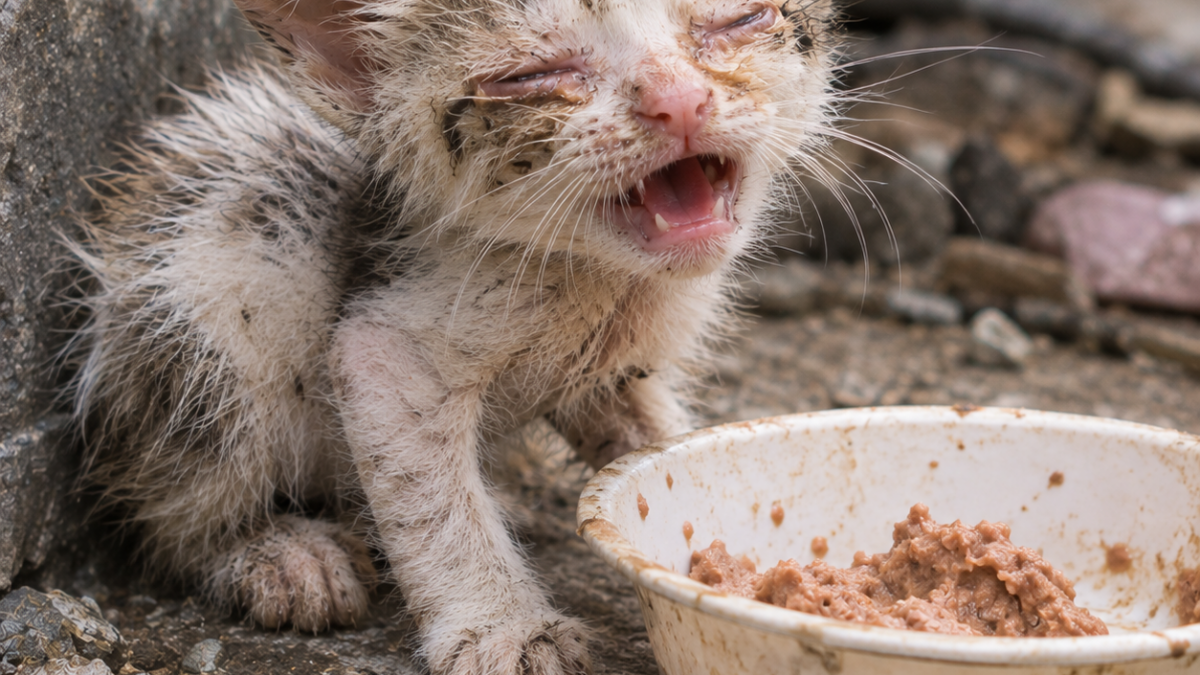
Caplang was found barely breathing, his eyes swollen almost shut and his tiny body too weak to eat on its own.
The street kitten needed food by syringe, constant warmth, and treatment just to survive another night.
Then one morning, after weeks of watching the world through swollen eyes, Caplang noticed the bowl in front of him—and something changed.
The first thing anyone noticed about Caplang was how small he looked.
Not simply young.
Small in the way a sick kitten looks when illness has taken more from the body than the body had time to build.
His ribs were not sharply visible, but there was too little weight over them.
His fur sat unevenly against his sides.
His face looked almost swallowed by swelling.
And where bright kitten eyes should have been, there were two narrow openings beneath inflamed lids crusted with discharge.
He was a kucing kampung.
A local street cat.
The kind of kitten people passed every day without thinking twice.
No pedigree.
No collar.
No person standing nearby calling his name.
Just one tiny life tucked into a corner of a world that had already taught him how easily something small could disappear.
When the rescuer first saw him, Caplang was trying to breathe through a nose that barely worked.
Each breath carried a faint congested sound.
He would inhale.
Pause.
Exhale.
Then do it again.
His chest moved too quickly for such a small body.
The rescuer crouched.
Caplang did not run.
That was the first warning.
Healthy street kittens usually have opinions about strangers.
They bolt.
Hide.
Hiss.
Flatten themselves beneath something impossible to reach.
Caplang remained where he was.
He turned his face slightly.
PART2:
One swollen eye opened just enough to show the dark pupil beneath.
Then it closed again.
“Hey, little one.”
No response.
The rescuer moved closer.
Caplang’s body trembled.
Not from aggression.
Not even clearly from fear.
He looked cold.
Exhausted.
Feverish.
He tried to lift his head.
It rose for a second.
Then dropped.
The rescuer slipped both hands beneath him.
He weighed almost nothing.
There was no dramatic struggle.
No clawing.
No angry meow.
That frightened her more.
A kitten with enough strength to fight has something in reserve.
Caplang simply collapsed into the towel.
The rescuer wrapped him loosely.
His face remained exposed.
His nose ran.
The skin around his eyes was wet from discharge.
She could feel the tremor traveling through his tiny body.
“We’ll get you through this.”
Caplang did not know what the words meant.
He only knew the warmth of the fabric was different from the ground.
The rescuer placed him in a carrier lined with towels and drove toward the veterinary clinic.
The whole way there, she kept glancing over.
Caplang barely moved.
At one stoplight she reached toward the carrier door.
Not inside.
Just close.
“Stay with me.”
His ear twitched.
That was enough to make her breathe again.
The clinic took one look at him and moved quickly.
Respiratory infection.
Severe congestion.
Inflamed eyes.
Possible dehydration.
Low body condition.
Young age.
Every one of those things was dangerous.
Together they could kill a street kitten frighteningly fast.
Cats, especially kittens, depend heavily on smell to recognize food.
When the nose is blocked, appetite can disappear.
When appetite disappears, strength falls.
When strength falls, fighting infection becomes harder.
Then dehydration follows.
Temperature drops.
The entire body begins losing the argument.
Caplang was already somewhere inside that cycle.
The veterinarian placed a stethoscope against his tiny chest.
Caplang flinched weakly.
Breathing sounds.
Congestion.
The doctor examined his nose.
Then his mouth.
Then the eyes.
The eyelids were so swollen that the rescuers had feared the infection might have permanently destroyed the eyes beneath them.
The veterinarian cleaned away discharge carefully.
Warm compress.
Moist gauze.
Patience.
Caplang tried to pull his head away.
That tiny protest was almost reassuring.
“Good,” the veterinarian whispered.
The rescuer looked up.
“Good?”
“He’s objecting.”
Caplang objected again.
“Keep doing that.”
The lids were eased open enough to examine what was underneath.
The veterinarian looked carefully.
Then again.
“The eyeballs are intact.”
The rescuer’s shoulders dropped.
“So he can see?”
“Possibly. We need the swelling down before we know how well.”
“But they’re there?”
“Yes.”
That was the first good news.
Small.
Incomplete.
But real.
The infection around the eyes was severe.
Conjunctivitis.
Inflammation.
Discharge.
Swelling.
The left eye looked worse.
Treatment would need to start immediately.
Eye drops.
Cleaning.
Warm compresses.
Antibiotics appropriate for the infection.
Supportive care.
The respiratory infection mattered just as much.
Caplang’s breathing had to be watched closely.
His nose needed frequent cleaning so he could move air as freely as possible.
Hydration needed support.
Temperature needed monitoring.
Then came food.
The veterinarian offered a tiny amount.
Caplang did not react.
The food was brought near his nose.
Nothing.
Touched carefully near his lips.
Still nothing.
The rescuer’s stomach tightened.
“He hasn’t eaten?”
“Not here.”
“Maybe before I found him?”
“Maybe.”
The answer helped nobody.
A kitten this weak could not simply be left to decide when hunger became strong enough.
Nutrition was part of treatment.
At first, tiny amounts were offered.
Caplang did not swallow reliably.
So the feeding had to become deliberate.
Slow.
Careful.
Syringe feeding.
A small amount placed into the side of his mouth.
Wait.
Let him swallow.
Another.
Never force too much.
Never rush.
Aspiration could create another life-threatening problem.
The rescuer watched the first feeding.
Caplang’s head barely fit into the palm supporting him.
A drop.
Pause.
Swallow.
Another.
Pause.
His face looked exhausted.
The rescuer whispered:
“Come on.”
The veterinarian kept working.
“Don’t hurry him.”
“I’m not.”
“I know.”
Caplang swallowed another tiny amount.
Everybody in the room relaxed by one degree.
That became the pattern.
Every few hours.
Food.
Slowly.
Measured.
Enough to give his body energy.
Not enough at once to overwhelm him.
In between feedings came medication.
Eye cleaning.
Nose cleaning.
Warmth.
A heating pad was placed beneath part of his resting area so he could receive steady warmth without being trapped against excessive heat.
Soft blanket.
Quiet room.
No unnecessary stimulation.
Caplang spent much of the first day asleep.
Not peaceful kitten sleep.
Sick sleep.
Heavy.
Shallow.
Interrupted by congestion.
The rescuer sat nearby longer than necessary.
Every few minutes she checked that his chest still moved.
In.
Out.
In.
Out.
Sometimes she thought the pause between breaths lasted too long.
Then Caplang inhaled again.
She realized she had been holding her own breath.
Nobody knew whether he would survive the night.
That was the truth.
Not because the team had given up.
Because kittens like Caplang can decline quickly.
His body had almost no reserves.
The infection had already spread through the parts of him he needed most.
Nose.
Eyes.
Breathing.
Appetite.
The rescuer went home only because the staff insisted.
“You need sleep.”
“I can sleep here.”
“You won’t.”
“What if—”
“We’ll call.”
She looked at Caplang.
The kitten’s face was mostly hidden inside the blanket.
“You’ll call?”
“Yes.”
She left.
The phone stayed beside her bed all night.
At 1:40 a.m., she woke and checked it.
Nothing.
At 2:15.
Nothing.
3:07.
Nothing.
By four she stopped pretending to sleep.
At six, she called.
“How is he?”
The technician answered.
“He’s still with us.”
The rescuer closed her eyes.
“Eating?”
“With help.”
“Breathing?”
“Still congested, but stable.”
“Eyes?”
“Same.”
“Can I come?”
A pause.
“Yes.”
She arrived before breakfast.
Caplang looked almost exactly as he had the night before.
That should have felt disappointing.
It did not.
He was alive.
No worse.
That counted.
She sat beside him.
“Morning.”
One ear twitched.
Then, after several seconds, something vibrated.
So faint she almost imagined it.
The rescuer leaned closer.
There.
Again.
A purr.
Not loud.
Not continuous.
A tiny motor somewhere beneath all the congestion.
She laughed softly.
“You’re serious?”
Caplang’s eyes remained closed.
The purr continued for three seconds.
Then stopped.
The rescuer covered her mouth.
A technician entered.
“What?”
“He purred.”
“Really?”
“I think so.”
The technician listened.
Nothing.
“Maybe.”
“I heard it.”
“I believe you.”
The rescuer looked at Caplang.
“That’s your answer, huh?”
Of course, purring did not mean recovery was guaranteed.
Cats can purr when afraid.
In pain.
While self-soothing.
But to the rescuer, the sound mattered because it meant Caplang still had enough energy to respond to something.
Maybe warmth.
Maybe touch.
Maybe simply being alive.
It became something she waited for every morning.
Some days it came.
Some days it did not.
Treatment continued.
Antibiotics.
Eye drops.
Warm compresses.
Nutrition.
Hydration.
Cleaning.
And constant observation.
The eyes were difficult.
Discharge accumulated quickly.
If allowed to dry, it stuck the lids together.
The rescuer learned the routine.
Warm cloth.
Hold gently.
Do not rub harshly.
Wait for crust to soften.
Wipe.
Another clean section of cloth.
Again.
Caplang hated it.
The moment he became strong enough, he began turning his head away.
“Sorry.”
Turn.
“We have to.”
Turn again.
“I know.”
His front paw finally became strong enough to push against her wrist.
The rescuer smiled.
“There you are.”
Caplang pushed harder.
“You can fight me when you’re healthy.”
He tried anyway.
“That’s actually encouraging.”
The infection around the eyes started changing slowly.
The swelling did not vanish.
One morning, however, the right eye opened a fraction wider.
The rescuer saw it immediately.
“Wait.”
She moved toward the window for better light.
Caplang turned his head.
The eye followed.
“You can see me?”
Caplang blinked.
“Or maybe you hate the light.”
Either way, the eye was open.
The veterinarian confirmed the improvement.
Inflammation decreasing.
Corneal surface still needing monitoring.
Left eye remained more swollen.
But both eyeballs remained intact.
Keep treatment going.
Caplang had another problem.
His stomach.
The first few days of syringe feeding had been carefully calculated, but his digestive system seemed incapable of making up its mind.
Diarrhea.
Then constipation.
Then loose stool again.
Every change worried the rescuer.
She called the veterinarian so often that eventually she started with:
“Sorry, it’s me.”
The veterinarian laughed.
“I know.”
“His stool—”
“I knew it would be stool.”
“Too soft.”
They adjusted the food.
Monitored hydration.
Watched frequency.
Then the problem swung the other way.
No stool.
The rescuer panicked.
“How long is too long?”
The diet changed again.
Gentle support.
Observation.
Eventually Caplang passed stool.
The rescuer nearly celebrated.
Then realized what her life had become.
“I’m cheering about cat poop.”
Caplang slept.
“Your influence is terrible.”
Every part of his body seemed fragile.
Feed too much, stomach upset.
Too little, weight loss.
Change food too quickly, diarrhea.
Do not change enough, constipation.
The team experimented carefully.
Texture.
Frequency.
Portion.
Ingredients.
His body gave feedback whether anyone wanted it or not.
One meal worked.
Another did not.
The rescuer began keeping notes.
7:00 a.m.—syringe feeding, accepted 8 ml.
10:00—small loose stool.
11:30—eye drops.
1:00 p.m.—better appetite response.
2:15—slept comfortably.
4:00—warm compress.
7:00—less congestion.
She had never imagined a kitten’s bowel movements would become data worth documenting.
But every detail mattered.
Caplang began gaining weight by grams.
Tiny changes.
The scale became sacred.
The first time the number went up instead of down, the rescuer stared.
“Again.”
The technician reset the scale.
Caplang was weighed again.
Same result.
Gain.
Small.
But real.
The rescuer grinned.
The veterinarian warned:
“One measurement doesn’t make a trend.”
“I know.”
“You’re celebrating anyway.”
“Yes.”
She did.
Weight meant calories were staying inside him.
It meant the body had enough energy not only to survive but perhaps to build.
That was the goal.
The day after the weight gain, Caplang had diarrhea again.
The rescuer felt crushed.
The veterinarian reminded her:
“Recovery is messy.”
Literal and figurative.
Caplang did not improve in a straight line.
Some mornings his nose sounded clearer.
By afternoon, congestion returned.
One eye opened better.
The other swelled.
He ate a little more.
Then refused the next feeding.
He slept deeply.
Then spent an entire evening restless.
The rescuer learned not to turn every bad hour into a prediction.
Caplang was not a chart moving upward.
He was a body healing.
Bodies fluctuate.
By the second week, one major thing had changed.
Caplang could hold his head up consistently.
It sounds insignificant.
Until you remember the first day.
He had barely been able to lift it.
Now when the rescuer approached, Caplang raised his face.
His eyes remained narrowed.
The left still puffy.
But he looked.
He watched.
He knew the person coming toward him.
Maybe not as family.
Not yet.
But as something familiar.
The rescuer brought a tiny dish of food.
Caplang sniffed weakly.
Nothing.
She touched a little to his lips.
He licked once.
Then stopped.
The syringe came back.
“Not ready.”
Caplang turned his head.
“I don’t like this either.”
Feeding took time.
Drop.
Swallow.
Pause.
The rescuer talked through it.
“You’re going to eat by yourself eventually.”
Caplang swallowed.
“I’m going to complain that you eat too much.”
Another.
“You’ll wake me up at five.”
Another.
“You’ll probably steal my food.”
Caplang’s paw touched her hand.
“Exactly.”
At night, the heating pad remained one of his favorite places.
He curled against the warm section of bedding.
The rescuer began placing a small blanket partly over him.
Caplang would tuck his nose beneath the edge.
For the first time, his sleep began looking less like collapse.
He stretched occasionally.
One front leg forward.
Tiny toes opening.
Once, his whole body relaxed enough that he rolled slightly onto his side.
The rescuer watched.
There was something painfully beautiful about a sick kitten beginning to take up more space.
Fear and weakness make animals small.
Safety lets them stretch.
The first grooming movement came soon after.
Caplang lifted one paw.
Licked it.
Stopped.
Tried again.
Then dragged the damp paw over the side of his face.
The movement was clumsy.
His eyes still bothered him.
But grooming was deeply normal.
The rescuer smiled.
“You’re cleaning yourself?”
Caplang continued.
“After everything I’ve done?”
He licked.
“Unbelievable.”
She let him.
That small act meant he had energy left over for something beyond survival.
The infection had not vanished.
But it no longer occupied every second.
Week three brought more visible improvement.
The right eye opened almost normally.
The left eye remained swollen, though better.
Caplang began following movement.
He watched fingers.
Tracked the edge of a towel.
Turned when someone walked past.
His world was coming back visually.
The first toy was introduced almost accidentally.
A crumpled piece of paper fell from the rescuer’s pocket.
It rolled across the floor.
Caplang’s head turned.
The paper stopped.
The rescuer stared.
Caplang stared.
She nudged it.
His pupils widened.
For one second, illness disappeared from his face.
Kitten.
Pure kitten.
The rescuer nudged the paper again.
Caplang lifted one paw.
Reached.
Missed.
Tried again.
Touched it.
The paper moved.
Caplang froze in surprise.
Then slapped it.
Harder.
The rescuer laughed.
Caplang looked at her.
“Sorry.”
He returned to the paper.
That was the first play session.
Thirty seconds.
Maybe less.
Then Caplang became tired.
He curled up.
But the rescuer sat nearby smiling.
The kitten who had arrived too weak to eat had spent energy on something unnecessary.
Play.
That mattered.
His appetite remained the biggest hurdle.
Syringe feeding continued because Caplang still could not reliably take enough calories himself.
But interest was growing.
He smelled food.
Licked small amounts.
Sometimes took a bite from a spoon.
Then stopped.
The rescuer did not force the transition.
The syringe remained insurance.
Every few hours.
Again.
Again.
Again.
There were moments she was exhausted.
One night Caplang refused almost every attempt.
Turned his head.
Pushed away.
The rescuer sat on the floor with the syringe in one hand.
“Please.”
Caplang stared.
“Just a little.”
He turned.
She looked at the clock.
Past midnight.
She had work in the morning.
Her clothes smelled like kitten food and disinfectant.
The left eye needed another warm compress.
Laundry waited.
She wanted to cry.
Instead she put the syringe down.
Took a breath.
Then whispered:
“Okay. Five minutes.”
She wrapped Caplang in the blanket.
Not tight.
Just warm.
He settled.
She sat beside him.
Five minutes later she tried again.
This time he swallowed.
Not much.
Enough.
That was caregiving.
Not endless inspiration.
Sometimes it was being tired and doing the next small thing anyway.
Caplang never knew what it cost the rescuer emotionally.
He did not need to.
Care is not a debt an animal has to repay.
The next morning he purred.
The rescuer laughed.
“You have no idea what you put me through.”
Purr.
“Exactly.”
The digestive problems slowly became easier to manage.
The team found a diet Caplang tolerated better.
Fresh ingredients prepared carefully.
Simple.
Consistent.
No sudden changes.
Portions adjusted to his size.
Hydration watched.
His stool stabilized for longer stretches.
Then one bad day.
Then normal again.
The rescuer stopped expecting perfection.
Sensitive digestion might remain part of his life.
That was okay.
Management mattered more than pretending the problem did not exist.
His body began filling out.
Legs stronger.
Shoulders less sharp.
Belly no longer tucked from weakness.
The coat changed.
Sick animals often wear illness in their fur.
Dull.
Greasy.
Uneven.
As Caplang improved, his coat became softer.
Cleaner.
He groomed more.
The natural color returned.
He looked less like a kitten who had been found fading on the street and more like the ordinary kucing kampung he should have had the chance to become.
One morning, the rescuer placed the food bowl down.
She expected Caplang to sniff and turn away.
Instead he moved closer.
Not quickly.
One step.
Then another.
His nose hovered above the food.
The rescuer froze.
Caplang licked.
Once.
Then again.
He took a bite.
The rescuer said nothing.
Caplang took another.
Then another.
Something changed.
He began eating faster.
The rescuer’s eyes widened.
“Caplang?”
He kept eating.
She reached for her phone, then stopped.
No.
Do not interrupt.
Caplang lowered his face into the bowl as if he had suddenly remembered hunger.
He ate.
And ate.
Not one polite taste.
A meal.
On his own.
The rescuer covered her mouth.
Weeks of syringe feeding.
Drops.
Tiny mouthfuls.
Negotiation.
Fear every time he refused.
Now Caplang was eating because his own body asked for food.
She started laughing.
Then crying.
Caplang looked up briefly.
Food on his chin.
The rescuer wiped her face.
“Keep going.”
He did.
When the bowl was nearly empty, Caplang licked the edges.
Then sat back.
The rescuer stared at him.
“You ate.”
Caplang blinked.
“All of that.”
He licked one paw.
“You have no idea what you just did.”
Of course he did not.
He had eaten breakfast.
That was the point.
The rescuer sent one message to the veterinarian:
HE ATE FROM THE BOWL.
The response came immediately.
How much?
She sent a photograph of the nearly empty dish.
Then:
I AM CRYING.
The veterinarian replied:
Good. Keep monitoring. Don’t overfeed because he suddenly has an appetite.
The rescuer stared.
Very professional of you.
The response:
Someone has to be.
Caplang ate again later.
Not as much.
Still on his own.
The syringe did not disappear immediately.
The team wanted consistency.
But the balance had shifted.
Support became backup instead of the only path to nutrition.
Within days, Caplang began approaching the bowl before it touched the floor.
The rescuer laughed.
“Who are you?”
Meow.
It was one of the first strong meows she had heard.
She nearly cried again.
“Don’t start.”
Caplang meowed louder.
“Oh, so now you’re demanding things.”
The food went down.
He ate.
That was when recovery accelerated visibly.
Calories gave him energy.
Energy created movement.
Movement strengthened him.
He began exploring.
The recovery room had been his entire universe.
Now the doorway mattered.
Caplang walked toward it.
Stopped.
The rescuer opened the door wider.
He looked into the hall.
New smells.
New sounds.
He stepped backward.
No problem.
The door remained open.
The following day he returned.
One paw into the hallway.
Back.
Next day.
Two paws.
Then entire body.
Caplang moved carefully.
The rescuer followed several feet behind.
He looked over his shoulder.
She stopped.
“Your trip.”
Caplang sniffed the wall.
A shoe.
A table leg.
Then suddenly sprinted three feet.
The rescuer laughed.
Caplang startled at the sound.
Then kept moving.
His body had discovered speed.
That was dangerous for furniture.
Within a week, Caplang seemed intent on using every calorie he consumed to test gravity.
He chased invisible objects.
Pounced on shadows.
Attacked blanket folds.
Climbed onto cushions.
The kitten who had spent days barely lifting his head now launched himself sideways for reasons nobody understood.
The rescuer watched one sudden sprint across the room.
“Where are you going?”
Caplang did not know.
That was the joy of it.
He did not need a destination.
He could move.
The eye infection continued improving.
The right eye looked bright.
The left remained slightly swollen.
Some days better.
Some days more noticeable.
The veterinarian continued monitoring.
No one pretended the appearance had to become perfectly symmetrical for recovery to count.
Caplang could see.
He interacted.
Tracked toys.
Moved confidently.
The left eye was still healing.
That was enough.
Eye drops remained part of the routine.
Caplang hated them more now that he had strength.
The irony was obvious.
When he was sick, treatment had been easier because he could barely resist.
Now recovery meant the patient could flee.
The rescuer approached with drops.
Caplang saw the bottle.
Ran.
“Traitor.”
He disappeared behind a chair.
“You need these.”
Silence.
“I syringe-fed you for weeks.”
One eye appeared.
“You owe me.”
Caplang vanished again.
The rescuer laughed.
“No, you don’t.”
She waited.
Eventually Caplang emerged.
Treatment happened with patience.
The moment it ended, he ran dramatically across the room as though escaping persecution.
Ten minutes later he returned asking for food.
“Emotionally resilient.”
The rescuer began taking Caplang to the office when appropriate.
At first, this seemed risky.
Would the new environment overwhelm him?
They tried short visits.
Carrier.
Familiar blanket.
Quiet corner.
No crowding.
Caplang emerged cautiously.
Office floors.
Chairs.
Desks.
Computer cables.
Paper.
Humans who had heard his story but had been instructed:
Do not overwhelm him.
Caplang inspected the first room.
Then discovered a keyboard.
Warm.
Slightly elevated.
Clearly designed for a cat.
He climbed onto it.
The person working at the desk stared.
“Seriously?”
Caplang sat.
Letters appeared across the screen.
The rescuer laughed.
“That’s his first report.”
Caplang turned in a circle.
Lay down.
The employee looked at her.
“Am I supposed to work?”
“Apparently not.”
That became a habit.
Caplang loved warm electronics.
Laptop.
Keyboard.
The top of a printer.
If a device produced even mild heat, he considered it public property.
The office staff adored him.
But the rescuer remained protective.
No passing him around.
No forcing cuddles.
Caplang could leave.
He had a carrier available.
A quiet area.
If he needed distance, people respected it.
He rarely did for long.
The kitten who once struggled to breathe now wandered through the office like a tiny supervisor.
He appeared beside desks.
Sniffed lunch.
Sat in chairs.
Chased paper corners.
One employee called him “active banget.”
Very active.
That description stuck.
Caplang was active banget.
Almost aggressively alive.
The phrase made the rescuer smile because it was the exact opposite of the kitten she had first lifted from the street.
That Caplang had been quiet because he had no energy to make noise.
This Caplang made himself everybody’s problem.
Paper on floor?
Toy.
Pen moving?
Toy.
Mouse cursor?
Enemy.
Shoelace?
Prey.
Coworker attempting serious video call?
Excellent time to walk across the keyboard.
The office staff began keeping treats.
This created corruption.
Caplang learned which desks paid best.
The rescuer caught him sitting beside one employee.
“What are you doing?”
The employee looked guilty.
“Nothing.”
Caplang chewed.
“What did you give him?”
“Tiny piece.”
“Of what?”
“Chicken.”
The rescuer sighed.
“His stomach is sensitive.”
“It was very small.”
Caplang stared hopefully.
“No more.”
The employee whispered:
“Sorry.”
Caplang looked betrayed.
Food required discipline.
His digestion had improved, but sensitivity remained.
The rescuer prepared fresh meals carefully.
Natural ingredients appropriate for his needs.
Consistent recipes.
Nothing reckless.
Caplang cared only that the bowl arrived.
The cat who once could not swallow began showing up early for meals.
He learned the preparation sounds.
Container opening.
Spoon against bowl.
Footsteps toward feeding area.
Instantly:
Caplang.
He meowed.
Louder.
The rescuer looked down.
“You remember when you refused food?”
Meow.
“I used to beg you.”
Meow.
“You nearly broke me.”
MEOW.
“Okay.”
The bowl went down.
Caplang ate like somebody had personally insulted him by making him wait thirty seconds.
One morning the rescuer caught herself crying while watching him eat.
Nothing special had happened.
No milestone.
No dramatic breakthrough.
Just Caplang eating breakfast.
She remembered the syringe.
Drop.
Swallow.
Pause.
Another.
Now this.
Head down.
Appetite.
Life.
She wiped her eyes before anyone at the office noticed.
Caplang finished.
Looked up.
Meowed for more.
She laughed.
“You’re unbelievable.”
He licked his mouth.
That word—unbelievable—followed him.
Not because his recovery was magical.
It was not.
Medical treatment worked.
Nutrition worked.
Time worked.
His body responded.
But the contrast remained astonishing.
Weak kitten.
Shallow breathing.
Sealed eyes.
Trembling.
Now:
Running.
Eating.
Playing.
Jumping.
Demanding cuddles.
The emotional side of recovery grew alongside the physical one.
At first, Caplang accepted touch because he did not have enough energy to resist.
Later, when strength returned, the rescuer gave him more choice.
Hand offered.
Caplang sniffed.
If he moved away, stop.
If he leaned closer, pet.
It quickly became clear that Caplang liked affection.
A lot.
Head scratches.
Cheek rubs.
Under chin.
He leaned.
Purred.
Turned his face to present the other side.
The rescuer laughed.
“So all this time you were secretly needy.”
Purr.
“Very manipulative.”
Purr.
At night, Caplang sometimes followed her through the house.
Bathroom.
Kitchen.
Bedroom.
If she closed a door, his paw appeared beneath it.
Scratch.
Scratch.
“Caplang.”
Scratch.
“I’m still here.”
Scratch.
She opened.
Caplang walked away.
Classic.
The jacket pocket incident became another favorite memory.
Caplang had been small enough in the early recovery weeks to fit partly inside the rescuer’s jacket.
One cold evening she sat down after feeding him.
Caplang approached.
Sniffed the jacket.
Then pushed his face into the pocket.
One paw.
Then another.
He tried to crawl inside.
The rescuer laughed quietly.
“You cannot fit.”
Caplang disagreed.
He pushed harder.
His body settled partly inside the opening, pressed close to her side.
The rescuer stopped laughing.
She could feel his warmth.
His heartbeat.
Then purring.
A kitten who had spent his early days struggling for heat now intentionally sought warmth from a human body.
The rescuer sat completely still.
Caplang stayed.
That became another routine.
Jacket out.
Caplang investigates.
Pocket.
Warmth.
Purr.
As he grew, the pocket became impossible.
Caplang kept trying.
His rescuer finally said:
“You have become geographically incompatible with this jacket.”
Caplang pushed his head inside anyway.
Only the head fit.
Purr.
“Fine.”
She left the jacket on the couch.
It became his bed.
Caplang also discovered morning sunlight.
The first time was accidental.
A rectangle of sun crossed the floor.
Caplang walked into it.
Stopped.
The warmth hit his body.
He lowered himself.
Stretched one leg.
Then another.
Rolled slightly.
Eyes closed.
The rescuer watched.
“You like that?”
Caplang did not answer.
He looked like a miniature lion.
Or believed he did.
Every morning afterward, if the sun appeared, Caplang found it.
The patch moved.
Caplang moved.
By late morning he would be several feet from where he started, following warmth across the floor.
The rescuer called him solar-powered.
At the office, he found sun there too.
Windowsill.
Desk.
Floor.
Wherever morning light fell, Caplang eventually occupied it.
His left eye remained the most visible reminder of the illness.
The swelling decreased dramatically but did not disappear completely.
Some days it looked nearly normal.
Other days, still slightly puffy.
The veterinarian continued checking it.
No catastrophic damage.
No reason Caplang could not live normally.
Treatment continued as appropriate.
The rescuer stopped wishing every sign would vanish.
Recovery did not need to erase history.
The eye could look a little different.
Caplang did not care.
He chased toys.
Found food.
Navigated rooms.
Jumped onto office chairs.
If the left eye gave him trouble, he adjusted.
Animals do not spend the day comparing their face with an imaginary perfect version.
Humans do that.
Caplang lived.
That was enough.
His story gradually changed from rescue case to household routine.
The medical schedule shrank.
Fewer eye-cleaning sessions.
No more syringe feeding.
Less monitoring every hour.
No heating pad needed constantly.
His body regulated temperature.
He slept where he wanted.
The rescuer no longer woke at night to check breathing.
At first, stopping those habits felt strange.
She would wake at two.
Listen.
Caplang somewhere nearby.
Normal breathing.
Silence.
Then she would remember:
He is okay.
The first full night she slept without waking, she felt guilty in the morning.
Then Caplang jumped onto the bed and demanded breakfast.
Guilt disappeared.
The rescue team had originally assumed Caplang might eventually need a new home once he recovered.
That was how rescue often worked.
Stabilize.
Treat.
Foster.
Adopt.
The rescuer understood that.
She had not planned to keep every animal she helped.
Caplang, however, had not read the plan.
He attached himself to her schedule.
When she moved rooms, he followed.
When she sat, he appeared.
When she returned home, he greeted her.
At the office, he explored but repeatedly came back to wherever she was.
The bond formed quietly.
There was no single moment when she said:
This is my cat.
It happened through repetition.
Food prepared.
Medication given.
Night spent checking him.
Morning purr.
The first independent meal.
The office.
The jacket.
The sunlight.
One day someone asked:
“When are you putting Caplang up for adoption?”
The rescuer hesitated.
Caplang was asleep on her desk.
“Soon.”
A week later, someone asked again.
“Soon.”
Another week.
“Maybe after the eye is completely better.”
The veterinarian looked at her.
“You know the eye may stay a little swollen.”
“I know.”
“So?”
The rescuer looked away.
The veterinarian smiled.
“Right.”
“What?”
“Nothing.”
The rescuer knew.
She was delaying.
Not because Caplang lacked potential adopters.
Because the idea of someone else taking him felt wrong in a way she had not prepared for.
She tried being logical.
A good family could love him.
Yes.
A good family could manage his sensitive digestion.
Yes.
A good family could continue eye follow-ups.
Yes.
Caplang could bond with someone else.
Probably.
Then why did she feel sick imagining the carrier leaving without returning?
She sat beside him one night.
Caplang stretched across the jacket.
“You’re causing administrative problems.”
Purr.
“I’m supposed to find you a home.”
Caplang opened one eye.
“A good one.”
Purr.
“You don’t care?”
He rolled onto his side.
“Unhelpful.”
The rescuer scratched his head.
Caplang pushed into her fingers.
She laughed.
“Very unhelpful.”
The adoption decision came not through drama but through honesty.
She asked herself the only question that mattered.
Could she provide the care Caplang needed for life?
Food appropriate for his sensitive stomach.
Veterinary care.
Potential ongoing eye monitoring.
Safe indoor environment.
Time.
Affection.
Financial commitment.
Yes.
Was keeping him merely because saying goodbye hurt?
Maybe partly.
But love and practicality did not have to cancel each other.
If the home was suitable and the commitment real, keeping him was not a failure.
It was adoption.
She told the rescue coordinator.
“I think Caplang already has a home.”
The coordinator laughed.
“Finally.”
“Everyone keeps saying that.”
“Because everyone knew.”
“How?”
“You bring him to work.”
“That proves nothing.”
“He sleeps on your keyboard.”
“He likes heat.”
“You bought him his own office blanket.”
“Necessary equipment.”
“You changed your lunch schedule around his medication.”
The rescuer sighed.
“Fine.”
Paperwork was completed.
Caplang became officially hers.
Not medically hers.
Not temporary.
Home.
The word felt bigger than expected.
That evening she placed his food down.
Caplang ate.
Nothing about him changed.
Of course not.
He had already been living there.
The label changed for the human.
The safety had already changed for the cat.
Caplang finished dinner.
Walked toward her.
Rubbed against her ankle.
Then left.
“Very emotional.”
He ignored her.
Home became ordinary quickly.
That was the best part.
Caplang did not spend every day behaving like a miracle.
He knocked things over.
Bit cardboard.
Woke too early.
Sat in inconvenient places.
Refused one carefully prepared meal because apparently the texture had offended him.
The rescuer stared at the bowl.
“You ate from a syringe.”
Caplang walked away.
“You had no standards.”
He looked back.
“Now this?”
She changed the texture.
Caplang ate.
“You’re spoiled.”
Purr.
Spoiled was a beautiful word for a kitten who once had almost nothing.
He developed favorite things.
Fresh meals.
Warm keyboard.
Morning sun.
The old jacket.
One specific toy mouse missing half a tail.
A cardboard box that should have been thrown away months earlier.
The rescuer tried replacing it.
Caplang sat inside the trash-bound box.
She sighed.
“Fine.”
The expensive cat bed remained empty.
The box stayed.
Office life made Caplang almost famous among coworkers.
People began greeting him before greeting the rescuer.
“Morning, Caplang.”
The rescuer walked behind him.
“Hello to you too.”
Caplang jumped onto a chair.
Coworkers photographed him asleep on keyboards.
One made a small sign:
MANAGEMENT.
The rescuer removed it.
Another appeared.
Caplang slept beneath it.
She gave up.
He became a tiny ray of sunshine in the office, not because he entertained people on command but because he lived normally among them.
A sleeping cat makes a room calmer.
Someone working late would look over and see Caplang curled beside the monitor.
Someone having a difficult morning would find him chasing a paper ball.
Sometimes he walked onto a desk and simply sat.
No grand therapy.
No mystical healing power.
Just presence.
People liked him.
Caplang liked many of them too.
Especially the ones who understood food.
The rescuer warned everyone about his sensitive digestive system.
That required constant enforcement.
“He cannot have everything.”
Coworker holding chicken:
“This is natural.”
“So is diarrhea.”
The chicken disappeared.
Caplang looked betrayed.
“Blame your intestines.”
Meow.
“They started it.”
His digestion remained stable most of the time because the routine stayed consistent.
Fresh food.
Appropriate ingredients.
No reckless treats.
Hydration.
Monitoring.
Occasional bad day.
Nothing catastrophic.
The rescuer stopped panicking at every imperfect stool.
She had learned Caplang’s normal.
That knowledge was part of long-term care.
What is normal for this cat?
Appetite.
Energy.
Eye appearance.
Stool.
Breathing.
Behavior.
Once you know baseline, changes become easier to recognize.
Caplang’s baseline became:
Hungry.
Active.
Nosy.
Affectionate.
Opinionated.
So when he had a quiet day, the rescuer noticed.
One afternoon he did not chase the toy.
She watched.
He still ate.
No vomiting.
Breathing normal.
Eye same.
Maybe tired.
By evening, he sprinted down the hallway for no reason.
Case closed.
Not every quiet hour required emergency medicine.
The rescuer gradually learned to stop treating Caplang like he was perpetually dying.
That was another part of healing.
Caretakers can become trapped by the crisis too.
For weeks, every change had mattered.
Every breath.
Every meal.
Every stool.
When the animal recovers, the human nervous system does not always receive the message immediately.
The rescuer had to learn:
He is not the sick kitten every second anymore.
Let him be a cat.
So she did.
Caplang jumped.
Played.
Fell off a cushion once.
The rescuer gasped.
Caplang immediately climbed back up.
She laughed at herself.
“Okay.”
He did not need bubble wrap.
Safety, yes.
Fear, no.
The left eye continued healing slowly.
Eventually only mild residual swelling remained.
People who did not know the story barely noticed.
People who did sometimes stared.
One visitor said:
“What happened to his eye?”
“Severe infection when he was little.”
“Does it hurt?”
“Not currently.”
“Can he see?”
“Yes.”
Caplang reached for the visitor’s shoelace.
“Seems fine.”
The rescuer smiled.
“It gives him character.”
She said it jokingly.
But there was truth there.
The slight difference in his face belonged to him now.
Not a defect needing an apology.
Not a tragedy.
A visible piece of history.
Caplang carried it without shame because cats do not understand shame about appearance.
Humans could learn something from that.
At night, Caplang’s behavior changed most dramatically from those first weeks.
Sick Caplang slept because his body had no choice.
Healthy Caplang chose sleep.
That difference was visible.
He stretched fully.
Belly partly exposed.
Paws loose.
Sometimes on his back.
Sometimes across the rescuer’s legs.
Deep sleep.
Dreaming.
Whiskers twitching.
Tiny paw movements.
Once he made a small chirp in his sleep.
The rescuer watched.
She remembered sitting beside the heating pad wondering if he would survive one night.
Now she whispered:
“What are you chasing?”
Caplang slept.
Probably imaginary insects.
He loved chasing things that did not exist.
Dust.
Light reflections.
Shadows.
The rescuer sometimes caught him stalking a completely empty wall.
“What?”
Caplang froze.
“What do you see?”
Nothing.
He pounced anyway.
“Ghost?”
Caplang stared.
“Fine. Keep your secrets.”
His reflexes had returned.
His body was no longer slow.
Every movement showed strength.
The kitten whose legs once trembled from illness now launched himself onto furniture.
He climbed.
Balanced.
Turned sharply.
Groomed with flexibility.
His body had become his again.
The emotional bond became equally obvious.
Caplang knew his name.
Or at least he knew the sound that usually predicted attention.
“Caplang.”
Ear turn.
“Caplang.”
Head up.
“Breakfast.”
Immediate arrival.
The rescuer laughed.
“So you know breakfast better than your name.”
Meow.
At the office, coworkers tested it.
“Caplang!”
Sometimes nothing.
“Food!”
Caplang appeared.
Scientific conclusion established.
The first time he waited at the door for his rescuer, she almost cried.
She had been gone longer than usual.
When the door opened, Caplang stood several feet away.
Tail high.
Meow.
Then walked toward her.
No frantic reunion.
No dramatic leap.
Just recognition.
You came back.
The rescuer crouched.
Caplang rubbed against her.
She scratched his head.
Purring.
For animals who have lived without consistency, return can be one of the most important promises humans make.
Leave.
Come back.
Leave.
Come back.
Eventually the animal expects the second part.
Caplang learned it.
The office day ended.
They went home.
Food.
Play.
Sleep.
Again.
The story became boring.
Wonderful.
The rescuer shared fewer updates because there was less medical drama to report.
People asked:
“How’s Caplang?”
“Good.”
That was it.
Good.
Eating.
Active.
Eye improving.
Stomach stable.
Playing.
Home.
Sometimes good is the most beautiful ending available.
The people who had followed his early rescue remembered the frightening photographs.
Swollen eyes.
Tiny body.
Towel.
Syringe.
Then saw newer images.
Caplang on a keyboard.
Caplang in sunlight.
Caplang biting a toy.
Caplang asleep on the rescuer.
The contrast created the usual language.
Miracle.
Fighter.
Warrior.
The rescuer understood why.
But she became more careful.
Caplang had fought in the sense that his body kept responding.
He accepted treatment.
He survived.
But she did not want people to believe animals who die did not fight hard enough.
Sometimes bodies cannot recover.
Sometimes treatment comes too late.
Sometimes infection wins despite perfect care.
Caplang had been lucky in several ways.
Found in time.
Eyes intact.
Treatment available.
A caregiver able to feed him every few hours.
A body that responded to antibiotics.
A digestive system difficult but manageable.
Luck did not erase the work.
Work did not erase luck.
Both mattered.
The phrase she preferred became:
He was given a chance, and his body used it.
That felt fair.
Caplang had needed humans for everything at first.
Warmth.
Food.
Medication.
Cleaning.
Transport.
Safety.
Later, he needed less.
That was success.
Independence where possible.
Support where needed.
The rescuer did not want him permanently dependent because dependence looked emotional.
She wanted him healthy enough to eat himself.
Groom himself.
Play without supervision.
Sleep without being checked every hour.
That happened.
The first independent bowl had been more meaningful than any cuddle because it represented function returning.
Caplang could feed himself.
Then movement.
Then grooming.
Then exploration.
Then normal kitten chaos.
Affection was wonderful.
But independence was equally beautiful.
One morning Caplang jumped onto the desk while the rescuer was preparing an update about another rescue animal.
He walked across the keyboard.
The sentence became:
eeeeeeeeepppppppp.
She pushed him gently aside.
“You’re not helping.”
Caplang returned.
“Seriously.”
He sat on the laptop.
“You used to fit in my hand.”
Caplang began grooming.
“Now you’re blocking my livelihood.”
He did not move.
The rescuer worked from another chair.
Caplang won.
The office staff had created an informal routine around him.
Morning greeting.
Caplang inspection.
Lunch protection.
Afternoon nap.
Someone occasionally brought a new toy.
The rescuer approved toys more readily than food.
A feather wand appeared.
Caplang became obsessed.
He stalked it from behind a desk.
Crouched.
Tail twitch.
Pounce.
Miss.
Turn.
Again.
His left eye did not stop him.
The toy moved.
Caplang tracked.
The staff cheered once.
He froze.
Everyone went silent.
Then Caplang attacked the feather again.
They laughed quietly.
He became comfortable enough with people to seek attention.
Not everyone.
But many.
He rubbed against legs.
Accepted scratches.
Sometimes climbed onto a lap.
The rescuer remembered the kitten whose eyelids were swollen shut.
It felt impossible.
But there he was.
Not transformed by one dramatic act.
By weeks of repetition.
Antibiotics on schedule.
Eye drops on schedule.
Food every few hours.
Warm compress.
Cleaning.
Rest.
Again.
Again.
The romantic part of rescue often comes afterward.
The difficult part is boring.
Caplang survived boredom.
So did his caregiver.
That was the real partnership.
The first bowl remained symbolic in her mind.
Not because it was literally Caplang’s first food ever.
Nobody could know that.
The title people later used—his first bowl of food—was emotional shorthand.
What they knew for certain was that the first time he voluntarily approached the bowl during recovery marked a turning point.
Before that, humans had delivered nutrition.
After that, Caplang participated.
That difference mattered.
He wanted food.
Hunger had returned as a healthy signal.
His body expected tomorrow enough to ask for fuel.
That was life reasserting itself.
Years later, Caplang still treated every bowl as though it were historic.
The rescuer would place breakfast down.
He would appear instantly.
“You have never missed a meal.”
Meow.
“Not once.”
Eat.
“You behave like a famine is coming.”
Eat faster.
“Fine.”
She watched.
Sometimes she remembered the first syringe.
Sometimes she did not.
That was good.
Caplang’s present did not need to be constantly compared with his worst day.
He deserved to exist without being a lesson every minute.
Some nights, though, memory returned.
The rescuer would find him curled beside her.
Healthy.
Warm.
Breathing silently through a clear nose.
Eyes closed comfortably instead of sealed by infection.
Left eye still slightly different.
Fur soft.
Body heavy enough now that moving him would wake her.
She would place one hand near his side.
Not wake him.
Just feel warmth.
Then she remembered the street.
The towel.
The question nobody said aloud.
Will he make it through the night?
He had.
Then another.
Then another.
Eventually enough nights became a life.
That was the part that moved her most.
Not the dramatic transformation.
Accumulation.
One night survived.
One feeding accepted.
One gram gained.
One eye opening.
One stool finally normal.
One lick from a bowl.
One step into a hallway.
One jump.
One purr.
One morning in the sun.
One day at the office.
One adoption form.
Each event small enough to dismiss by itself.
Together, they became Caplang.
The rescuer kept one old photograph.
Caplang wrapped in the first blanket.
Eyes swollen.
Face dirty.
Tiny.
She rarely showed it.
Not because she was ashamed.
Because people sometimes stared at the suffering so long they forgot the animal still existed afterward.
Beside it on her phone was another photograph.
Caplang lying across a keyboard.
One paw covering the enter key.
Left eye slightly puffy.
Healthy coat.
Expression deeply pleased with himself.
If someone asked which photograph represented the real Caplang, the rescuer answered:
“Both.”
The sick kitten was not less Caplang.
The healthy cat was not a replacement.
Healing did not delete the earlier version.
It carried him forward.
That idea mattered whenever another sick kitten arrived.
The rescuer had learned patience from Caplang.
New animals did not owe her his outcome.
Some healed faster.
Some slower.
Some not enough.
She treated the patient in front of her.
But Caplang had changed what she believed possible when a tiny animal received consistent care.
Not guaranteed.
Possible.
That distinction kept hope honest.
One rainy evening, Caplang sat near the window watching water trace the glass.
The rescuer sat beside him.
“Do you remember rain outside?”
Caplang looked at the window.
“No idea.”
He blinked.
“I hope not.”
She scratched the side of his face.
Purr.
“Better in here.”
Caplang leaned.
The rescuer smiled.
The question was never whether Caplang understood his rescue.
Animals do not need to narrate their history the way humans do.
His behavior told the present.
Warm.
Fed.
Curious.
Attached.
Secure.
That was enough.
He had stopped living like resources might vanish at any moment.
Food bowl empty?
He yelled until it was filled.
Door closed?
He waited because it would open.
Rescuer leaves?
She comes back.
Office ends?
Home follows.
Night comes?
Warm place available.
Expectation is one of the quietest signs of safety.
Caplang expected.
That meant something.
His eye gradually stabilized.
The slight swelling remained a visible reminder.
The rescuer stopped describing it as unfinished healing.
Eventually it was simply part of his face.
Caplang looked like Caplang.
Nothing needed correction for other people’s comfort.
At veterinary appointments, his health remained good.
Sensitive digestion.
Monitor.
Eye.
Monitor.
Otherwise active.
Good weight.
Bright.
The doctor who first examined him once looked over the records.
“This is the same kitten?”
The rescuer laughed.
“Unfortunately.”
Caplang sat inside the carrier glaring.
The veterinarian smiled.
“He looks offended.”
“He’s healthy enough to be offended.”
“Excellent prognosis.”
The examination began.
Caplang protested.
Strongly.
The vet laughed.
“I remember when he couldn’t push my hand away.”
“Now he’s trying to sue you.”
“That’s progress.”
Exactly.
Strength gave him boundaries.
Health gave him attitude.
The rescuer celebrated both.
Caplang did not become a perfect cat.
No such animal exists.
He scratched one chair despite having scratchers.
He chewed a charging cable once.
He knocked a glass from a table while maintaining eye contact.
The rescuer stared at the broken glass.
“Why?”
Caplang looked at the floor.
“Was that necessary?”
He walked away.
She cleaned it.
This too was a privilege.
People do not usually think of property damage as proof of recovery.
But compared with the kitten who could barely breathe?
Beautiful.
Not the broken glass.
The ability to cause it.
Caplang grew from a fragile kitten into a young adult cat.
The office staff noticed his body filling out.
“Remember when his head looked too big?”
“Yes.”
“Now he looks normal.”
The rescuer smiled.
Normal.
Another word she had once been afraid to hope for.
Caplang himself had never cared about normal.
He cared about lunch.
Sun.
Toys.
Humans he liked.
That perspective was healthier.
The rescuer followed his example.
She stopped comparing him to imaginary outcomes.
Could the left eye have looked perfect?
Maybe.
Could his stomach have been less sensitive?
Perhaps.
Would another cat have recovered faster?
Irrelevant.
Caplang was living well.
That was the metric.
His story reached more people over time.
Some saw the swollen-eye photograph and stopped.
Others shared the food-bowl video.
The rescuer appreciated the support but rejected one repeated claim.
“Love saved him.”
Love mattered.
But she corrected people gently.
“Love plus medicine.”
Antibiotics saved him.
Eye treatment mattered.
Nutrition mattered.
Heat mattered.
Veterinary evaluation mattered.
Digestive management mattered.
Love made somebody willing to keep doing those things at inconvenient hours.
But love alone would not have cleared severe infection.
That distinction mattered.
Kindness should lead to care, not replace it.
Caplang survived because compassion turned into action.
Pick him up.
Take him to clinic.
Give medicine.
Feed carefully.
Clean the eyes.
Adjust food.
Watch him.
Return tomorrow.
That was love with hands.
One afternoon, a coworker found Caplang asleep on a warm keyboard.
“You know, this cat has no idea how close he came.”
The rescuer looked over.
“Probably better.”
“Do you think animals remember being sick?”
“Some things, maybe.”
“Do you think he remembers the street?”
“I don’t know.”
Caplang stretched.
His paw pressed a key.
The coworker smiled.
“He looks happy.”
The rescuer watched him.
“He looks comfortable.”
She preferred that word.
Comfortable was observable.
Relaxed muscles.
Deep sleep.
Appetite.
Play.
Seeking contact.
Those were things she could see.
Whether Caplang conceptualized happiness did not matter.
His life contained good experiences.
That was enough.
At home, he developed one final habit that became the rescuer’s favorite.
Every night, once lights went out, Caplang wandered through the room.
Sometimes he slept elsewhere first.
Then, sometime after midnight, the rescuer would feel movement.
A small body climbing onto the bed.
Step.
Step.
Turn.
Then Caplang curled beside her ribs.
Not always touching.
Close enough.
Some nights he pressed against her.
Purring.
The rescuer never forced him under blankets.
Caplang decided.
On colder nights he tucked partly beneath the edge.
Warm.
Safe.
His breathing slow.
The contrast with the first night still occasionally made her chest hurt.
Then:
Shallow breathing.
Congested.
Trembling.
Heating pad.
Nobody knowing whether morning would come.
Now:
Deep breath.
Silence.
Purr.
Sleep.
Morning always came.
And Caplang expected breakfast when it did.
That expectation became his quiet declaration that the crisis was over.
The story people told about him began with abandonment and illness.
The life Caplang actually lived became much larger.
Office cat.
Sun seeker.
Keyboard thief.
Sensitive stomach.
Slightly puffy left eye.
Professional breakfast complainer.
Jacket-pocket enthusiast despite no longer fitting inside.
Shadow of the person who rescued him.
That was who he became when survival stopped taking all his energy.
The first time someone called him lucky, the rescuer looked at Caplang.
“Yes.”
He was.
Lucky somebody saw him.
Lucky treatment worked.
Lucky his eyes remained intact.
Lucky his body responded.
But the rescuer also knew how much luck depends on somebody deciding an inconvenient small life deserves time.
Caplang needed weeks of feeding.
Cleaning.
Medication.
Monitoring.
Vet visits.
Diet changes.
Office accommodations.
Not everyone could provide that.
The rescuer could.
So she did.
That did not make her extraordinary.
It made her responsible once she chose to help.
Caplang never thanked her.
Not in human language.
He did not need to.
His healthy body was not payment.
His purring was not debt.
His affection was freely given.
That made it more meaningful.
If he had grown into an independent cat who preferred distance, the rescue would still have mattered.
If he never slept beside her, still worth it.
If he never went to the office, still worth it.
Care was not an investment made in exchange for cuddles.
The affection was simply one of the beautiful things that followed.
The first bowl became another symbol people loved.
They imagined Caplang crying with gratitude.
That was not what happened.
He ate.
That was better.
He did not need to understand the emotional weight humans placed on the moment.
He needed calories.
His rescuer needed hope.
The bowl gave both.
Caplang ate.
The rescuer cried.
Each got what they needed.
The memory stayed with her because it was the moment the future widened.
Before the bowl:
Can we keep him alive?
After the bowl:
Maybe he can participate now.
Soon:
Maybe he can play.
Then:
Maybe he can explore.
Then:
Maybe he can live normally.
Then one day she realized she had stopped asking if he would survive at all.
She was asking whether he was going to destroy the office printer.
That was the journey.
Not miracle.
Distance.
From survival questions to ordinary complaints.
Caplang made the distance.
With help.
One morning, years after the rescue, the rescuer prepared his breakfast.
Caplang sat beneath the counter.
Meow.
“Wait.”
Meow.
“You have food every day.”
MEOW.
“Very moving.”
She put the bowl down.
Caplang ate.
The morning sun reached the floor.
After breakfast, he walked directly into it.
Turned twice.
Lay down.
Left eye slightly swollen.
Coat shining.
Belly full.
The rescuer sat nearby with coffee.
Caplang groomed one paw.
Then his face.
Paused.
Looked at her.
She held out a hand.
Caplang walked over.
Rubbed his cheek against her fingers.
Purring.
Nothing extraordinary happened.
That was why the moment was perfect.
The kitten who once needed help to swallow had eaten by himself.
The kitten whose eyes were almost sealed had found the sun.
The kitten whose breathing once kept people awake with fear now purred without effort.
He was not being rescued anymore.
He was living.
That is the ending every rescuer hopes for.
Not endless gratitude.
Not a dramatic pose.
Ordinary life.
Caplang had it.
He had food he could complain about.
Warm places he could abandon for other warm places.
People he could interrupt at work.
A home where his slight eye difference did not need explaining.
A rescuer who became family.
And enough confidence to behave as though tomorrow had already been promised.
Maybe nobody could promise any animal tomorrow.
But they could promise what happened today.
Medicine when needed.
Food when hungry.
Warmth when cold.
Patience when afraid.
A clean place to sleep.
A hand that did not give up because progress was slow.
Caplang’s entire life changed because somebody made those promises one day at a time.
He had been a tiny kucing kampung the world could easily have overlooked.
A street kitten.
Congested.
Eyes swollen.
Too weak to eat.
There was nothing about him that guaranteed a beautiful outcome.
There was only a spark.
A pulse.
A breath.
A tiny body still alive.
That was enough.
Enough to pick him up.
Enough to wrap him.
Enough to drive.
Enough to feed him one syringe at a time.
Enough to keep his body warm.
Enough to clean his eyes.
Enough to change his meals when his stomach rebelled.
Enough to get through one night.
Then another.
Then weeks.
The rest came slowly.
His eyes opened.
His nose cleared.
His body strengthened.
His stomach stabilized.
His appetite returned.
His bowl became empty.
His paws became fast.
His coat became bright.
The office became a playground.
The rescuer became home.
And Caplang became what no one looking at that fading little kitten could have confidently predicted.
Not a symbol.
Not a miracle.
Not a lesson.
A cat.
A demanding, playful, affectionate, food-obsessed little cat who woke up expecting breakfast and fell asleep expecting the same human to be there when morning came.
That expectation was perhaps the most beautiful thing of all.
Because an abandoned street kitten does not need to understand the word forever.
He only needs enough safe tomorrows to begin believing in it.
Caplang got them.
One bowl.
One sunrise.
One purr.
One day at a time.
And when he curls up at night now, warm and full, his left eye still carrying that small reminder of where he came from, nobody in the room sees a kitten who almost died.
They see Caplang.
Exactly as he is.
Alive.
Loved.
Home.








