“Can I Tell My Dad You’re Just Like Him?” — The SEAL’s 5-Year-Old Son Saw the Tattoo on the Shy Nurse’s Arm and Recognized His Father’s Elite Unit
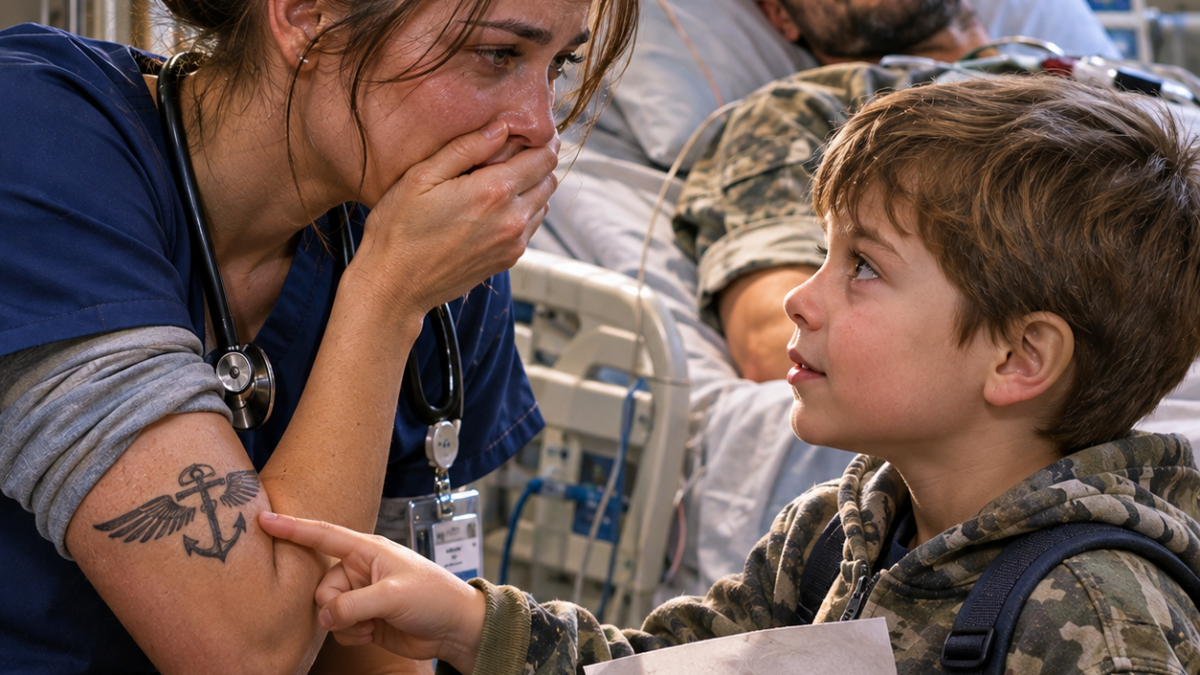
“Can I Tell My Dad You’re Just Like Him?” — The SEAL’s 5-Year-Old Son Saw the Tattoo on the Shy Nurse’s Arm and Recognized His Father’s Elite Unit.
For three months, Dana Whitfield had been the quiet rookie nurse everyone at Cascade Bay Medical Center overlooked—the woman doctors interrupted, residents laughed at, and supervisors described as “easy to replace”—until a wounded Navy SEAL’s five-year-old son caught one glimpse of the tattoo she kept hidden beneath her sleeve.
The boy unfolded a crayon drawing of the same anchor-and-wings symbol, leaned close enough that only Dana could hear him, and whispered, “Can I tell my dad you’re just like him? He says an angel with this tattoo saved his life.”
Before Dana could answer, a seventy-year-old patient collapsed across the ward—and the trembling little nurse everyone treated like furniture suddenly began giving orders with the calm, precise voice of someone who had once kept wounded men alive in places nobody in that hospital had ever seen.
Dana Whitfield had learned long ago that floors were safer than faces.
Floors did not judge.
Floors did not ask where scars came from.
Floors did not notice when your shoulders tightened at the sound of a helicopter passing overhead.
So at 6:45 on a gray Portland morning, Dana stood at the edge of morning rounds on the fourth floor of Cascade Bay Medical Center and kept her eyes on the polished tile.
Dr. Spencer Langley stood in the center of the cardiac step-down unit.
White coat pressed.
Silver pen clipped perfectly inside the breast pocket.
Four residents gathered around him.
Langley enjoyed teaching.
More accurately, he enjoyed being watched teaching.
He spoke loudly enough for patients to hear.
Especially when he was correcting someone.
“Nurse Whitfield.”
Dana raised her eyes.
“Yes, Doctor?”
“Bed Twelve asked for a blanket twenty minutes ago.”
A resident beside him smirked.
Langley continued.
“Did you get lost?”
The residents laughed.
“Or are you simply too small to find the supply closet?”
Dana was five-foot-four.
Blue scrubs.
Dark hair pulled tightly behind her head.
Long undershirt beneath the scrub top despite the unit being warm.
Sleeves down to her wrists.
Always.
Her fingers tightened around the clipboard.
“I’ll bring it.”
Langley smiled.
“Please do.”
Then, almost casually:
“And Whitfield?”
PART2:
She stopped.
“Try to be useful.”
A patient near the door looked away.
Langley gestured around the unit.
“In this building, quiet people become furniture.”
Another small laugh.
“Easy to move.”
He looked directly at her.
“Easy to replace.”
Dana nodded once.
Then walked away.
Her face stayed blank.
Her hands did not.
They trembled slightly.
She hated that.
Seven years earlier, those same hands had remained steady while a helicopter shook so hard her knees slammed against the deck.
Now a doctor making jokes about blankets could make them shake.
Trauma was stupid that way.
It did not care what was logically dangerous.
PART3:
Dana reached the end of the hallway.
Stopped.
Breathed.
In.
Four counts.
Hold.
Out.
Then she looked up automatically.
East stairwell.
West service elevator.
Fire door.
Nurses’ station.
Crash cart.
Oxygen.
Three routes off the floor.
She hated that she still counted exits.
She counted them anyway.
Old habits never asked permission.
“Nurse Whitfield?”
Dana turned.
Bed Fourteen.
The one room where she did not feel invisible.
Chief Petty Officer Ethan Cross had been admitted two days earlier.
His teammates called him Tex.
Forty-one years old.
Six-foot-two.
Broad shoulders reduced slightly by hospital gown and chest injury.
A Navy SEAL with a damaged sternum, bruised lungs, and a cardiac rhythm the doctors were watching carefully after a training accident.
Dana did not know much about the accident.
Only that a fast-rope exercise had gone wrong.
Ethan struck hard.
Then developed complications.
He should have been difficult.
Men like him often were.
Independent people hated hospital beds.
Ethan was not.
Every time Dana checked his IV:
“Thank you, ma’am.”
Every time she adjusted a monitor:
“Appreciate you.”
Every time she brought medication:
“Sorry you have to put up with me.”
Dana had finally told him:
“You apologize one more time and I’m putting it in your chart.”
That had made him laugh.
But Ethan was not the reason she liked Bed Fourteen.
His son was.
Liam Cross was five.
Messy brown hair.
Blue sweater at least two sizes too large.
Sneakers with one lace constantly coming undone.
He had spent most of the morning in the visitor chair holding a folded sheet of paper.
Dana crouched beside him.
“Your shoe again.”
Liam looked down.
“Oh.”
“You’re trying to kill me.”
His eyes widened.
Dana almost smiled.
“Trip me.”
“You keep leaving traps.”
He whispered:
“Sorry.”
She tied the lace.
Then stood and reached across Ethan’s bed to straighten the blanket.
Her sleeve caught against the rail.
It slid back.
Barely an inch.
Dana froze.
Liam stopped moving.
His eyes locked on her forearm.
Dark ink.
An anchor.
Open wings.
Small enough to hide.
Distinct enough that anyone who knew the symbol would never confuse it with decoration.
Dana pulled her arm back.
Too late.
Liam unfolded the paper.
Slowly.
Carefully.
A child’s crayon drawing.
An anchor.
Open wings.
Dana stopped breathing.
The proportions were wrong.
The colors were wrong.
The symbol was not.
Liam climbed down from the chair.
He came close.
Then cupped one little hand around Dana’s ear.
His whisper trembled.
“Can I tell my dad you’re just like him?”
Dana stared at the drawing.
“What?”
“He says this is for special people.”
Her throat tightened.
“Where did you get that?”
“My dad drew it.”
Ethan was sleeping.
Chest rising beneath monitor wires.
Liam lowered his voice further.
“He says an angel with this tattoo saved his life.”
Something cold moved through Dana’s body.
“He told you that?”
Liam nodded.
“He says he never saw her face.”
Dana looked toward Ethan.
The room seemed smaller.
“When?”
“He got hurt before I was born.”
Dana’s hand moved unconsciously toward her sleeve.
Liam continued.
“He said there was red light.”
“He was bleeding.”
“He thought he was going to die.”
“And somebody kept saying—”
Dana stopped him.
“Liam.”
The boy went quiet.
Dana crouched.
“Can you keep something private for a little while?”
His expression became very serious.
The way only a five-year-old could turn secrecy into sacred duty.
“Yes.”
“I need some time.”
“Okay.”
“Don’t show your dad yet.”
“Okay.”
He folded the drawing again.
Then whispered:
“Are you the angel?”
Dana looked away.
Before she could answer, something crashed in the hallway.
Metal.
Heavy.
Then an alarm changed pitch.
Dana turned instantly.
Bed Twelve.
Arthur Nolan.
Seventy years old.
The patient who had asked for the blanket.
His body had slumped sideways against the bedrail.
His face had gone gray.
Eyes open.
Not seeing.
The monitor screamed.
Dr. Langley looked up from his tablet.
For half a second, nobody moved.
Dana did.
She crossed the room fast.
“Mr. Nolan?”
No response.
She checked him.
No normal breathing.
The room around her disappeared.
Not literally.
But everything unnecessary vanished.
The humiliation from five minutes earlier.
Langley.
The laughter.
The shaking hands.
Gone.
There was only the patient.
Dana called for the emergency response.
Then began chest compressions.
Her shoulders came directly over her hands.
Elbows locked.
Rhythm controlled.
Hard.
Fast.
Consistent.
“Code Blue, fourth floor, Bed Twelve!”
One resident stared.
Dana looked up.
“You.”
The resident startled.
“Call it.”
Another nurse froze by the door.
Dana pointed.
“Crash cart.”
“Now.”
They moved.
Dr. Langley remained still.
Tablet against chest.
“Nurse Whitfield—”
Dana kept compressing.
“Doctor?”
“We should wait for the code team.”
Dana looked at him for the first time.
Not timidly.
Not from beneath lowered eyes.
Directly.
“He doesn’t have time.”
Langley’s face tightened.
“You are a probationary nurse.”
Dana continued.
Arthur’s chest rose beneath compressions.
“Then write me up when he has a pulse.”
A resident’s mouth fell open.
Langley stepped closer.
“You are not in command here.”
Dana’s voice became flat.
“He is in cardiac arrest.”
“Help me.”
“Or step away.”
Langley stepped away.
The ward seemed to notice all at once.
Dana’s hands were not shaking.
Not even slightly.
One minute.
Then two.
Sweat gathered along her hairline.
She did not slow.
The crash cart rattled around the corner.
Dana helped position the defibrillator pads.
The device analyzed.
Everyone cleared.
A shock was advised.
Delivered.
Arthur’s body jerked.
Dana immediately resumed compressions.
No dramatic pause.
No waiting to see whether the movie version of medicine happened.
She kept going.
Then—
A blip.
Another.
A rhythm.
Weak.
But organized.
Arthur coughed.
Gasped.
Someone near the nurses’ station cried out in relief.
Dana checked him.
“Stay with me, Arthur.”
His eyes moved.
Confused.
Alive.
Dana sat back for one second.
Her arms shook now.
Not fear.
Exhaustion.
Then she heard footsteps near elevator.
Two men had stopped outside the unit.
Plain clothes.
Coffee cups.
One was older.
Gray in beard.
Built like a man who had spent decades refusing to get soft.
Chief Petty Officer Nolan Knox.
Ethan Cross’s team leader.
Knox had come with another SEAL to visit Tex.
He had not watched Arthur Nolan.
Not at first.
He had watched Dana.
Her shoulders.
Hands.
Cadence.
The way she gave instructions.
The way she never raised her voice unnecessarily.
The way panic seemed to organize itself around her.
Knox slowly lowered his coffee.
The younger teammate beside him said:
“What?”
Knox did not answer immediately.
Then:
“Watch her hands.”
“What about them?”
“That isn’t rookie confidence.”
Dana stood.
Someone handed Arthur oxygen.
The code team took over.
Dr. Langley straightened his coat.
Then announced:
“Well.”
Nobody looked at him.
“I was just about to give the order.”
The residents stared at floor.
Knox looked at Langley with an expression so cold that the physician stopped speaking.
Then another voice came from doorway.
“Whitfield.”
Nurse Manager Gloria Pratt.
Arms crossed.
Dana knew the tone.
“My office.”
Ten minutes later, Dana stood in Gloria’s cramped office.
Badge still clipped to her scrub top.
Langley stood beside desk.
His voice had regained confidence.
“She ignored chain of command.”
Dana remained silent.
“She initiated compressions before a physician instruction.”
Gloria frowned.
Langley continued.
“She ordered my residents around.”
“He had no pulse,” Dana said.
Langley turned.
“That is exactly why physicians are trained to manage these events.”
Dana’s jaw tightened.
Gloria rubbed temple.
“Dana.”
“Yes?”
“You’re still probationary.”
“I know.”
“You can’t run a code like you’re commanding a team.”
The word commanding struck harder than Gloria knew.
Dana’s eyes dropped.
Langley noticed.
He pressed.
“If anything had gone wrong, the liability—”
“A man had no heartbeat.”
Dana’s voice was soft again.
“That was already wrong.”
Silence.
Gloria looked tired more than angry.
“This will go to review.”
Dana nodded.
“Until then, you’re suspended with pay.”
Dana looked up.
Gloria held out hand.
“Badge.”
For a second Dana could not move.
Three months.
She had kept her head down exactly as instructed.
Accepted jokes.
Accepted extra shifts.
Accepted being called furniture.
The one moment she acted without fear—
Badge.
Dana unclipped it.
Set it on desk.
“Understood.”
She walked out.
Knox was waiting in corridor.
Arms folded.
He had heard enough through thin wall to understand outcome.
“Where did you train?”
Dana stopped.
“Community college.”
Knox almost smiled.
“Which one teaches casualty management like that?”
Dana’s shoulders tightened.
“I’m a nurse.”
“Didn’t ask what you are now.”
She looked at him.
Knox studied her.
Then let the question go.
“Tex is awake.”
Dana hesitated.
“He’s asking for you.”
Bed Fourteen was quiet.
Ethan lay propped against pillows.
Liam curled beside him.
The drawing clutched in both hands.
When Dana entered, Liam said immediately:
“I didn’t tell.”
Ethan smiled weakly.
“Tell what?”
Liam’s eyes went wide.
“I promised.”
Ethan looked at Dana.
Dana almost laughed despite everything.
“You raised an honest spy.”
Ethan’s smile faded.
“I heard the code.”
“Most of floor did.”
“No.”
He looked at her.
“I heard you.”
Dana said nothing.
Ethan continued.
“The cadence.”
“The way you spoke.”
“And my son has been staring at your sleeve for an hour.”
Liam whispered:
“Dad…”
Ethan held out hand.
“Buddy, can I see drawing?”
Liam looked at Dana.
She closed her eyes.
Then nodded.
Liam unfolded it.
Ethan looked.
His face changed.
Dana felt trapped.
Not by him.
By time.
Seven years she had kept one door closed.
A five-year-old had just found the handle.
Ethan looked at her.
“Roll up your sleeve.”
Dana remained still.
“Please.”
She slowly pushed the fabric back.
Anchor.
Open wings.
Ethan stopped breathing for a moment.
Then covered his mouth with one scarred hand.
His eyes filled.
“No.”
Dana looked away.
Ethan whispered:
“No way.”
Liam looked between them.
“Dad?”
Ethan’s voice broke.
“Seven years ago…”
Dana closed her eyes.
“Tex.”
The nickname stopped him.
His entire body went still.
Only people from that night called him Tex in that tone.
Ethan stared.
Dana could hear helicopter blades again.
Not outside.
Inside.
A valley with no name.
Red cabin light.
Metal floor slick under her knees.
A man bleeding faster than she could replace volume.
Radio traffic.
Screaming.
Rotor wash.
Someone yelling that they were ten minutes out.
Then fifteen.
Then twenty.
Ethan whispered:
“Say it again.”
Dana did not want to.
“Please.”
Her voice barely carried.
“I have you, Tex.”
Ethan’s face folded.
He turned away, crying without hiding it.
Liam looked frightened.
“Dad?”
Ethan reached for him.
Pulled boy close.
“I’m okay.”
Then looked at Dana again.
“In the helicopter…”
Dana nodded.
“I couldn’t see anyone.”
“I know.”
“Red lights.”
“Yes.”
“My eyes kept closing.”
“Yes.”
“A hand held mine.”
Dana swallowed.
“You kept saying…”
“I have you.”
Ethan nodded.
“You were Sparrow.”
Dana said nothing.
That was answer enough.
Liam stared up.
“Sparrow?”
Ethan wiped his face.
“Before she was Nurse Dana.”
He looked at his son.
“She was Hospital Corpsman First Class Dana Whitfield.”
Dana flinched at full title.
Ethan continued.
“She worked with people like me.”
Liam looked at tattoo.
“Special people?”
Ethan smiled through tears.
“The toughest medic I ever met.”
Dana’s voice sharpened.
“Don’t.”
Ethan stopped.
She turned toward window.
“I wasn’t.”
“You kept me alive.”
“I lost two.”
The room went quiet.
There it was.
The thing she had never said at hospital.
Not to Gloria.
Not to anyone.
Two names.
Two faces.
Two men she could not save.
No matter how many times people told her it had been impossible.
No matter how many medals they pinned.
No matter how many officers said:
You did everything right.
She remembered two body bags.
Not commendation.
Ethan lowered his voice.
“You didn’t kill them.”
Dana’s jaw tightened.
“I know what report says.”
“That isn’t what I said.”
She turned.
Ethan held her gaze.
“You didn’t kill them.”
Dana looked at Liam.
Then back at Ethan.
“I left Navy two weeks later.”
“I heard Sparrow disappeared.”
“I needed quiet.”
“Did you find it?”
Dana almost smiled.
“No.”
Liam climbed down from bed.
Walked to her.
He held up crayon drawing.
“My dad said an angel saved him.”
Dana crouched.
“I’m not an angel.”
Liam considered.
“Okay.”
Then:
“Are you at least Sparrow?”
For the first time that day, Dana laughed.
Small.
Real.
“Yes.”
Liam smiled.
Ethan reached out.
Dana gave him her hand.
He closed both hands around it.
“I have a son because you didn’t quit.”
Dana’s eyes filled.
“Please don’t tell the hospital.”
Ethan frowned.
“Why?”
“Because then I become a story.”
“You already are.”
“I don’t want to be.”
Ethan studied her.
Then nodded.
“Your call.”
“Thank you.”
Liam whispered:
“I’m good at secrets.”
Ethan looked at him.
“You told her about me in twelve minutes.”
“That was before.”
Dana laughed again.
Outside, Portland darkened.
Rain began before sunset.
By six, the windows shook under gusts.
Weather alerts hit phones.
Worst storm in years.
Dana should have gone home.
She was suspended.
Badge surrendered.
But Arthur Nolan remained unstable.
And Ethan was still cardiac monitored.
So she sat in the break room wearing her coat, pretending she was waiting for a ride.
At 8:04 p.m., every light on the fourth floor went out.
Not flickered.
Out.
A low mechanical groan came through building.
Then darkness.
Emergency lights blinked once.
Failed.
Monitors switched to battery or went black depending on equipment.
Alarms began.
Someone screamed.
A ventilator battery sounded a warning.
Dana was moving before she consciously decided to.
She entered corridor.
Phones glowed.
Flashlights appeared.
Smoke smell.
Electrical.
Nurse Manager Gloria stood at nurses’ station.
“Facilities isn’t answering.”
Dr. Langley held phone.
“The generator will restart.”
Dana listened.
Nothing.
No hum.
No transfer.
She looked at ceiling.
Then toward stairwell.
“How many ventilated?”
Gloria blinked.
“What?”
“How many ventilator-dependent patients?”
“Three.”
“Battery runtime?”
A respiratory therapist answered:
“Forty minutes on the weakest one.”
Dana looked at west corridor.
Smoke smell stronger.
“Elevators?”
“Dead.”
Langley said:
“We wait.”
Dana turned.
“Wait for what?”
“Maintenance.”
“The generator failed.”
“You’re suspended.”
Dana ignored him.
She moved to ventilator closest station.
Checked battery.
Then patient.
“We move ventilated patients first.”
Langley stepped in front.
“You have no authority.”
Dana looked at him.
Something changed.
Gloria saw it.
The small nurse who hunched during rounds disappeared.
Dana’s shoulders squared.
Chin lifted.
Voice lowered.
“Doctor.”
Langley stopped.
“In about ten minutes, somebody who cannot breathe on his own is going to start losing options.”
She picked up manual resuscitation bag.
“You can argue with me.”
“Or you can squeeze this.”
She held it out.
Langley stared.
Gloria whispered:
“Tell us what to do.”
Dana did.
No speech.
No heroics.
Jobs.
“Red priority: ventilators and unstable cardiac.”
“Yellow: patients needing assistance walking.”
“Green: ambulatory.”
“Count every person.”
“Write names.”
“East stairwell.”
“Keep west corridor clear.”
“Manual ventilation one trained person per patient.”
“Do not leave anyone alone.”
Gloria repeated instructions.
Residents moved.
Langley took bag.
His hands shook.
“Like this?”
Dana adjusted his grip.
“Watch chest.”
“Steady.”
“Don’t race.”
Then two figures appeared from dark corridor.
Knox.
His teammate.
They had remained at hospital because storm made travel difficult.
Knox saw Dana.
One glance at situation.
Dana pointed toward stairwell.
“Chief.”
Knox’s expression changed at the word.
“I need six strong backs.”
“Sheets can become carry slings.”
“Heaviest first.”
“Clear east stairs.”
Knox nodded.
No questions.
“On it.”
Liam stood outside Ethan’s room shaking.
Dana knelt.
She needed him calm.
“Liam.”
He looked at her.
“Sailor, I’ve got an important job.”
His lip trembled.
“What?”
She handed flashlight.
“Keep light on my hands.”
“Can you do that?”
He nodded.
“Yes.”
“Then you stay beside your dad until I tell you.”
“Okay.”
Movement began.
Slow.
Organized.
Patients.
Equipment.
Manual bags.
Flashlights.
Beds would not fit stairwell, so wheelchairs and carry methods where medically appropriate.
Staff coordinated.
Dana moved between them.
Smoke crept along ceiling from distant corridor.
She pointed.
“Stay low.”
Then saw something.
Fire door.
Propped open by mop bucket.
The same fire door she had counted during morning rounds.
She kicked bucket away.
Door slammed.
Smoke spread slowed.
Gloria stared.
Dana said:
“That door should never have been propped.”
Gloria said nothing.
They kept moving.
A bed frame jammed.
Knox and another man shifted it.
A nurse began crying.
Dana touched shoulder.
“Look at me.”
The nurse did.
“One patient.”
“One task.”
“Nothing else.”
The nurse nodded.
Kept going.
Halfway down east stairs, Langley knelt with a ventilator patient and manual bag.
Tears ran down his face.
“I don’t know if I’m doing this right.”
Dana checked chest movement.
“You are.”
“I can’t—”
“You are.”
“Keep squeezing.”
His eyes met hers.
For once there was no arrogance.
Only fear.
Dana said:
“Stay with the patient.”
He nodded.
Knox carried Ethan.
Liam followed with flashlight.
Then Ethan looked upward through stairwell.
Dana was several steps above.
Counting.
Checking.
Last one down.
A young nurse whispered:
“Who is she?”
Ethan answered before Dana could stop him.
“That’s Sparrow.”
Knox stopped on the step.
Slowly turned.
“What did you say?”
Ethan looked at him.
“Sparrow.”
Knox stared upward.
“The corpsman?”
Ethan nodded.
“The one from Kunar?”
Dana’s face tightened.
Knox’s mouth opened slightly.
Then understanding hit.
He knew that name.
Every man in their world did.
Sparrow.
The corpsman who worked inside a dark helicopter for ninety minutes.
The corpsman who kept Tex alive after everybody thought he was gone.
The corpsman who refused evacuation until the last casualty was accounted for.
Then vanished from Naval Special Warfare.
Knox looked up at her.
“Petty Officer Whitfield.”
Dana froze.
Dozens of frightened people filled stairwell.
Knox straightened.
“It is an honor to serve under you tonight.”
Silence.
Dana swallowed.
Every instinct told her to hide again.
Instead:
“Thank you, Chief.”
Then:
“Eyes forward.”
“We’re not done.”
They were not done for three more hours.
Patients moved.
Smoke contained.
Fire crews reached affected electrical area.
Backup power partially restored elsewhere.
Staff established temporary monitoring.
Dana never sat.
At four in morning, she checked names.
Again.
Again.
Thirty-one patients moved.
Everyone accounted for.
No patient from fourth floor lost.
Only then did Dana lean against wall.
Her knees almost gave.
Liam appeared beside her.
Still holding flashlight.
Battery nearly dead.
“Did I do good?”
Dana crouched.
“You did perfect.”
He smiled.
Then hugged her.
Dana closed her eyes.
For seven years, touch after emergencies made her tense.
This time she let herself stay.
Morning came pale.
Rain weakened.
Hospital lobby filled with exhausted staff.
Review board convened before anyone went home.
Hospital president Margaret Ellis arrived in yesterday’s clothes.
No makeup.
Hair pulled back.
She listened.
Gloria spoke.
Respiratory therapy spoke.
Fire safety officer spoke.
Knox spoke last.
He stood at end of conference table.
No uniform.
No medals.
Nothing visual announcing who he was.
He did not need it.
“Thirty-one patients.”
“Zero losses.”
He looked at board.
“You suspended the person who organized that evacuation.”
Margaret Ellis looked toward Dana.
Knox continued.
“Her name is Hospital Corpsman First Class Dana Whitfield.”
Dana looked down.
“Call sign Sparrow.”
Several people shifted.
“She served alongside Naval Special Warfare.”
“Tex Cross is alive because of her.”
“Other men came home because of her.”
“And last night every patient on your fourth floor came out because when your systems failed, she didn’t.”
Dana whispered:
“Chief.”
Knox looked at her.
“That’s enough.”
He nodded.
Stopped.
Margaret turned to Dr. Langley.
His coat was wrinkled.
Hair disordered.
Hands empty.
“Dr. Langley.”
He stood.
“I have no excuse.”
Margaret waited.
Langley looked toward Dana.
Then floor.
“I told her she was furniture.”
Nobody moved.
“I treated her as though speaking softly meant knowing less.”
He swallowed.
“When Mr. Nolan arrested, I froze.”
Dana looked up.
Langley continued.
“She did not.”
“During evacuation, I told her she had no authority.”
“She handed me a ventilation bag anyway.”
His voice broke slightly.
“I was terrified.”
“She didn’t humiliate me.”
“She told me what to do.”
He looked directly at Dana.
“I was wrong.”
Margaret Ellis said:
“You are removed from teaching rounds pending review.”
Langley nodded.
“You will complete emergency-response retraining.”
Another nod.
“And the board will review complaints concerning your conduct toward nursing staff.”
“Yes.”
Then Langley approached Dana.
“Nurse Whitfield.”
She waited.
“I owe you…”
He stopped.
“A lot.”
Dana looked at him.
Then said:
“You owe Bed Twelve a blanket.”
For one second Langley stared.
Then someone laughed.
A nurse.
Then another.
Even Gloria.
And for the first time since Dana arrived at Cascade Bay, people were laughing with her.
Not at her.
Gloria approached carrying Dana’s badge.
Both hands.
“I was wrong too.”
Dana’s expression changed.
“I told you to stay quiet because I thought I was protecting you.”
“No.”
Gloria nodded.
“I know that now.”
“I was protecting the unit from conflict.”
“Not you.”
Dana said nothing.
Gloria held badge.
“The hospital would like you to consider head nurse.”
Dana blinked.
“Of this unit?”
“Yes.”
Dana looked at badge.
Then at nurses nearby.
Young nurse from stairwell.
Resident who had called code.
Arthur Nolan’s empty bed now transferred to ICU.
She clipped badge back onto scrubs.
“Thank you.”
Gloria waited.
“But no.”
Gloria looked surprised.
Dana continued.
“I don’t need title because everybody suddenly knows what I did before.”
“What do you need?”
Dana looked around.
“Nurses who can say a patient is deteriorating without being mocked.”
“Doctors who listen before deciding somebody’s rank from their voice.”
“Staff who know emergency procedures.”
“Fire doors that aren’t propped open.”
Gloria looked embarrassed.
Dana continued.
“And nobody gets called furniture.”
Langley lowered eyes.
Margaret Ellis said:
“That can be arranged.”
Dana nodded.
“Then I’ll stay.”
Two weeks later, Ethan Cross was discharged.
Liam packed crayons.
Blue sweater.
Toy helicopter.
Before leaving, he went to Dana’s locker.
He taped his drawing inside.
Anchor.
Wings.
Crayon lines.
Beside it Dana placed something she had kept hidden inside an envelope for seven years.
A photograph.
Three people.
Dana in uniform.
Ethan did not ask who other two were.
He understood.
Their names were written on back.
For years, Dana had believed remembering them meant carrying guilt alone.
Now she was trying something else.
Remembering without punishing herself.
Ethan came to locker room doorway.
“You sure?”
Dana looked at photo.
“No.”
He smiled.
“Good enough.”
Liam hugged her.
“Can I tell people you’re Sparrow now?”
Dana raised eyebrow.
“How many people?”
He thought.
“Everybody?”
“No.”
“Grandma?”
Dana smiled.
“Grandma is fine.”
“Teacher?”
“No.”
“My best friend?”
“Liam.”
“Okay.”
Ethan laughed.
Then became serious.
“You saved me twice.”
Dana frowned.
“Once.”
“Seven years ago.”
“And now my son gets to know the person who made his life possible.”
Dana looked at Liam.
“Don’t put that on me.”
“What?”
“My life isn’t why you survived.”
Ethan considered.
“Fair.”
Then he extended hand.
Not military salute.
Not grand gesture.
Just hand.
Dana took it.
“I never got to say thank you.”
“You just did.”
On Monday morning at 6:45, rounds began again.
Same floor.
Same lights.
Same polished tile.
Dana stood with clipboard.
But this time she looked at faces.
Dr. Langley stood at edge rather than center.
A resident presented Bed Twelve’s replacement patient.
Langley listened.
When a nurse interrupted with concern about rhythm change, he stopped resident.
“Go ahead.”
The nurse explained.
Langley thanked her.
Small.
Ordinary.
Important.
Near end of rounds, Dana walked past Bed Twelve.
A warm blanket was folded neatly at foot.
She smiled.
Then pushed her sleeve up slightly while washing hands.
Not to show tattoo.
Not to hide it either.
The anchor and open wings remained visible.
A young nurse noticed.
“What’s that?”
Dana looked at tattoo.
For years she had prepared answers.
Something old.
Nothing important.
Just ink.
Instead she said:
“A part of my life.”
The nurse nodded.
No interrogation.
No awe.
Just acceptance.
Dana liked that.
What people at Cascade Bay eventually understood was that she had never been hiding weakness.
She had been hiding command.
She had mistaken invisibility for safety because once, in another life, being capable had meant people handed her impossible situations and expected her to carry every outcome afterward.
The hospital did not heal that in one night.
Ethan did not heal it.
Liam did not heal it.
Recognition is not healing.
But it opened a door.
Dana began counseling again.
She attended emergency-response planning meetings.
She helped revise code training.
Nurses practiced speaking during simulations.
Residents practiced listening.
The propped-open fire-door problem became an actual safety review rather than a joke.
Langley spent several weeks off teaching service.
When he returned, he did something Dana did not expect.
He asked her to run a simulation with residents.
Not as decoration.
Not as redemption theater.
He said:
“You see things I don’t.”
Dana replied:
“That sentence probably hurt.”
“A lot.”
She agreed.
During the exercise, one resident froze.
Dana stopped scenario.
Did not embarrass him.
“Tell me what you see.”
He swallowed.
“Unresponsive patient.”
“What next?”
He answered.
They continued.
Afterward Langley stood nearby.
“You could have destroyed him.”
Dana looked at him.
“Why would I?”
Langley said nothing.
Because that had been his teaching style.
Humiliation as discipline.
Dana continued:
“People do not learn faster because they’re ashamed.”
Then walked away.
Months later, Arthur Nolan returned to the unit.
Not as patient.
With his daughter.
He carried something wrapped in paper.
Dana was charting.
“Nurse Whitfield?”
She looked up.
Arthur smiled.
“I owe you.”
“No.”
“Yes.”
He unwrapped a blanket.
Thick.
Blue.
Dana stared.
Arthur said:
“I hear I caused trouble over one.”
She laughed.
His daughter added:
“He insisted.”
Dana took blanket.
“Thank you.”
Arthur looked at her.
“I don’t remember much.”
“That’s normal.”
“I remember waking up.”
He placed one hand against chest.
“And somebody saying my name.”
Dana nodded.
“That was you?”
“Yes.”
Arthur’s eyes filled.
“Then thank you for not waiting.”
Dana swallowed.
“You’re welcome.”
After they left, she folded blanket and put it in staff break room.
A label appeared the next day:
BED TWELVE EMERGENCY BLANKET.
Someone added underneath:
DO NOT MAKE DANA COME FIND YOU.
She pretended to hate it.
She did not.
The tattoo became less important over time.
That was probably healthiest outcome.
At first everyone whispered about Sparrow.
The mysterious corpsman.
The SEAL medic.
The woman who saved Tex.
Knox shut down the worst rumors personally.
“She does not owe you war stories.”
Ethan did too.
Dana learned to say:
“No.”
Without explanation.
Some people accepted.
Some didn’t.
She survived.
Liam sent drawings.
First:
A bird wearing scrubs.
Then:
A nurse flying helicopter.
Then:
An extremely inaccurate picture of Dana fighting a dragon with a defibrillator.
Dana put that one on locker.
When Ethan asked why:
“Best clinical depiction of my job.”
Liam was proud.
One year after the storm, Cascade Bay held emergency drill.
No publicity.
No ceremony.
Fourth floor.
Power failure simulation.
Staff moved patients.
Checked batteries.
Cleared fire doors.
Dana watched quietly.
Young nurse from previous year led.
Clear voice.
No panic.
At end, Gloria asked Dana:
“Well?”
Dana said:
“They don’t need me.”
Gloria smiled.
“That was point?”
Dana nodded.
“Yes.”
Leadership had once meant being the person who could do impossible thing.
Now Dana understood better version.
Leadership meant building a room where the next person could act before you arrived.
After drill, Dana returned locker.
Liam’s first drawing was faded.
Tape yellowing.
Beside it photograph of three people.
Two lost.
One survivor.
Dana touched edge.
Then closed door.
At 6:45 next morning, rounds began.
Dana did not look at floor.
She looked at patients.
At nurses.
At exits too.
She would probably always count exits.
Some habits stay.
But when Langley asked for nursing concerns, Dana raised her hand before anyone else.
Not loudly.
She never became loud.
She did not need to.
The room listened.
And somewhere far from Cascade Bay, a five-year-old boy who had noticed one inch of tattoo still believed an angel worked on fourth floor.
Dana would have corrected him.
She was not an angel.
She was not fearless.
She was not perfect.
She had frozen before.
She had lost people.
She had spent seven years trying to make herself small enough that nobody would ever ask her to carry another impossible life.
But when Arthur Nolan’s heart stopped, she moved.
When the lights died, she moved.
When frightened nurses needed direction, she spoke.
When Langley admitted he was afraid, she did not punish him.
And when Ethan finally recognized the tattoo he had seen through red helicopter light seven years earlier, Dana discovered something she had never allowed herself to consider.
Survival had left evidence too.
Not only the names of the people she could not save.
A father.
A little boy.
A crayon drawing.
A whispered question.
“Can I tell my dad you’re just like him?”
Dana had spent years believing the tattoo reminded her of the worst night of her life.
Liam saw something different.
He saw proof that his father had come home.
And sometimes healing begins when somebody else recognizes the part of your story you have only ever learned to fear.








