Can I Sit Here? A Navy SEAL Asked a Pregnant Nurse — Then His K9 Stopped the Whole Room
PART3:
The man’s expression changed so slightly that most people would have missed it. I didn’t. Nurses notice those shifts—the tiny tightening around the mouth, the flicker of concern, the moment someone realizes something is not behaving the way it should.
“Atlas,” he repeated, firmer this time. “Heel.”
Nothing.
The dog ignored him.
The waiting room began to quiet around us. It happened in layers. One conversation stopped. Then another. A child went still. Someone lowered a phone. People had noticed the dog because dogs always drew attention, but now they noticed the silence around the dog.
Atlas took three slow steps toward me.
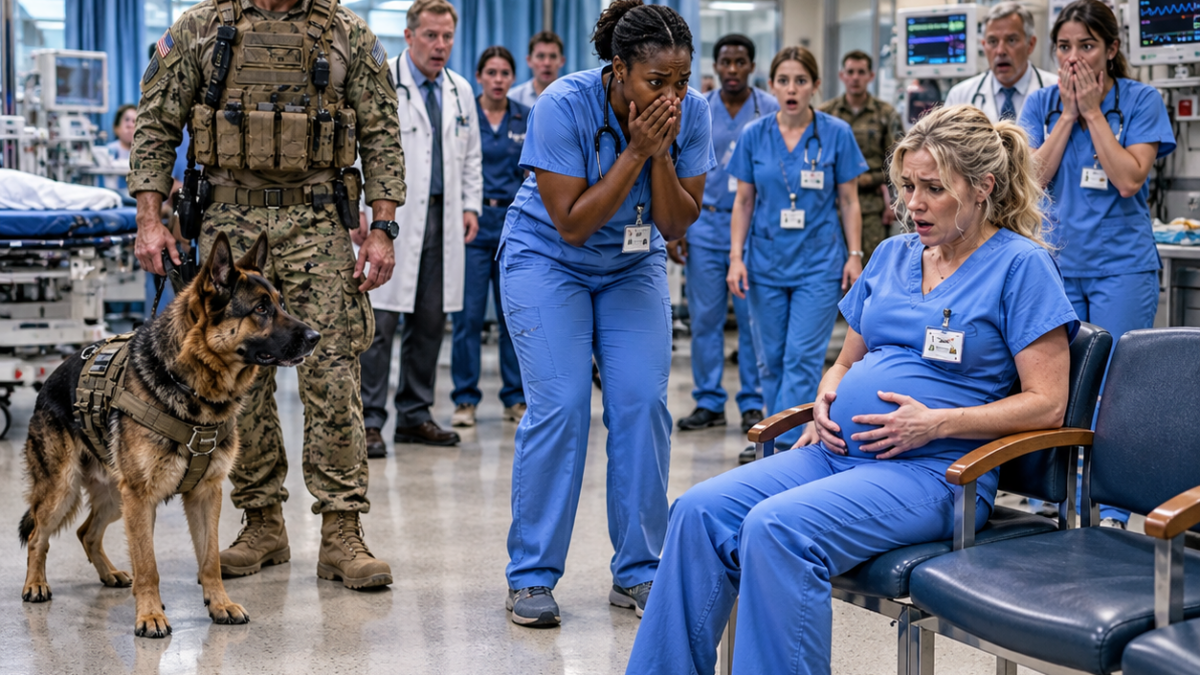
I should have been nervous. A large German Shepherd I did not know was now standing directly in front of me, staring at me with an intensity that felt almost personal.
But there was nothing threatening in him.
Only purpose.
“Well,” I said, forcing a small laugh, “hello there.”
Atlas looked at my face for several seconds. Then, very slowly, he lowered his head toward my belly.
My hand moved instinctively, protective, resting over my daughter.
He sniffed once.
Then again.
Then he did something I will remember until the day I die.
With extraordinary gentleness, he rested his chin against my hand.
The entire waiting room went silent.
A little girl across from us whispered, “Mommy, the puppy likes the baby.”
A few adults smiled.
The man did not.
He had gone completely still.
“Atlas,” he said again, but this time the command sounded less like an order and more like a question.
The dog let out a soft whine.
It was not loud. It was not dramatic. It was the kind of sound you could have missed in a crowded ER if you were not already listening.
But the man heard it.
And something in his face changed.
Cold traveled up my spine.
I laughed awkwardly because I suddenly needed everyone to stop staring. “I guess he likes babies.”
The man looked from Atlas to me.
“No,” he said quietly. “This isn’t that.”
My smile faded. “What do you mean?”
He crouched beside the dog and placed one hand on Atlas’s neck. The dog’s eyes never left me.
“What are you trying to tell me, buddy?” he whispered.
Atlas whined again. Then he nudged my wrist until my hand pressed more firmly across the upper curve of my abdomen.
It was deliberate.
Not playful.
Not random.
Deliberate.
The man went pale.
“Ma’am,” he said, standing slowly, “are you feeling okay?”
I answered too fast. “I’m fine.”
Every nurse knows that answer.
Every nurse hates that answer.
Every nurse gives that answer anyway.
The man watched me with those sharp, tired eyes. “When did you last eat?”
I blinked. “I don’t remember.”
“What about water?”
“I’ve had coffee.”
“That’s not water.”
For some reason, that annoyed me more than it should have. Maybe because he was right. Maybe because I was exhausted. Maybe because I had spent years proving I could handle everything alone, and now a stranger and his dog were making an entire room look at me like I was the patient.
“I’m a nurse,” I said. “I know how to take care of myself.”
The words sounded weak even to me.
Before he could respond, Melissa walked out from the treatment corridor carrying a clipboard.
“You finally sat down,” she said. Then she noticed Atlas standing in front of me. “And apparently made a friend.”
The man turned toward her. “Doctor?”
Melissa’s eyes moved to his posture, the harness on the dog, then back to his face. “Yes?”
“I’m probably wrong,” he said.
That sentence made me nervous. People who panicked rarely started with I’m probably wrong. People who had seen enough danger to respect uncertainty did.
“But I’d feel better if someone checked her blood pressure.”
Melissa looked at me.
I lifted both hands slightly. “I’m fine.”
Atlas whined.
Melissa’s gaze dropped to the dog.
The man said, “I trust him.”
There was a pause.
Melissa had worked emergency medicine for almost fifteen years. She believed in evidence. She believed in labs, scans, vitals, history, and instinct earned through repetition. She did not believe in making medical decisions because a dog looked concerned.
But she also did not dismiss warnings just because they came from strange places.
“Lena,” she said gently, “come with me.”
I stared at her. “Seriously?”
“Humor me.”
The whole waiting room was watching now. My face warmed. I pushed myself to my feet, trying to hide the effort it took.
Atlas immediately rose with me.
He stayed so close his shoulder brushed my leg.
The man watched him, and I could see that whatever this was, it had scared him.
“What’s your name?” Melissa asked him as we moved toward the treatment doors.
“Jack Mercer.”
“Military?”
“Retired Navy.”
“And the dog?”
“Atlas.”
Melissa nodded once. “Stay nearby.”
“I wasn’t planning to leave.”
I didn’t know why those words comforted me.
Behind the treatment doors, the sounds changed again. Less waiting-room noise, more urgency. Wheels rolling. Shoes squeaking. Monitors chiming. Someone calling for a respiratory therapist. Someone else asking for saline.
Melissa led me into an assessment room and closed the curtain.
“I promise this won’t take long,” she said.
I lowered myself onto the exam bed with a sigh. “Melissa, I’m eight months pregnant. I’ve worked thirteen hours, and a retired military dog apparently thinks I’m interesting. Today stopped making sense about an hour ago.”
She laughed softly. “Fair enough.”
Then she wrapped the blood pressure cuff around my arm.
The cuff inflated.
We waited.
The numbers appeared.
Melissa’s smile disappeared.
“What?” I asked.
She pressed the reset button. “Machine might be acting up.”
The cuff inflated again.
I watched her face instead of the monitor.
That was how I knew.
The reading was worse.
“Melissa.”
She did not answer immediately.
A strange ringing started in my ears. I suddenly became aware of everything at once—the fluorescent lights, the scratchy paper under my hand, the tightness of my wedding ring, the faint headache I had been ignoring all afternoon, the dull pressure beneath my ribs.
“Have you had headaches today?” she asked.
I swallowed. “A little.”
“Why didn’t you tell anyone?”
“I figured it was stress.”
“And the swelling?”
“I’m pregnant and I’ve been standing all day.”
“Blurry vision?”
The room tilted a little.
I looked away.
“Earlier,” I admitted.
Her voice changed.
Calm.
Professional.
Serious.
“Pain under your ribs?”
I didn’t want to answer.
Because answering made it real.
“Yes,” I whispered.
Melissa reached for the wall phone.
“I need maternal fetal in assessment three immediately,” she said. “And bring portable ultrasound.”
My heart kicked hard.
“Melissa.”
She gave me the kind of smile doctors give when they are trying to keep fear from spreading faster than facts.
“We’re just being careful.”
That was another phrase nurses know too well.
Just being careful can mean nothing.
It can also mean everything.
Outside the room, I heard voices gather in the hallway. Someone asked about the dog. Someone else said he hadn’t moved from the door. I imagined Atlas sitting there, gray muzzle lifted, refusing to abandon a woman he had known for less than ten minutes.
A woman who, until that moment, had been completely sure she was fine.
I closed my eyes.
For one second, I wanted Daniel so badly I could barely breathe.
My husband had been gone two years, but grief did not move in a straight line. Some days, I carried it like a small stone in my pocket. Other days, it became a wave that knocked my knees out from under me.
He had been a firefighter.
The kind of man children trusted immediately. The kind of man who danced badly in the kitchen just to make me laugh. The kind of man who kissed my forehead every morning and said, “Be careful out there,” as if I were the one running into burning buildings.
He died pulling two workers from a collapsing warehouse roof.
The city called him a hero.
I called him home.
And now I was lying in an assessment room without him, eight months pregnant with the daughter he would never hold, listening to doctors gather outside my curtain.
I pressed both hands to my belly.
“Stay with me,” I whispered.
A nurse I didn’t recognize came in with a urine cup. Then another physician entered. Then an OB specialist. The room filled with controlled urgency, the kind that scares patients because no one is running but everyone is moving too fast.
They asked me questions.
Headache.
Vision changes.
Nausea.
Pain.
Swelling.
I answered each one, and every answer seemed to pull the air tighter.
The ultrasound machine rolled in.
Cold gel touched my abdomen.
A grainy image appeared.
For one suspended moment, the room disappeared and there she was.
My daughter.
Tiny spine. Curled body. Flickering heartbeat.
“Her heartbeat is strong,” the specialist said.
I closed my eyes as tears leaked into my hairline. “Thank God.”
“But,” Melissa said softly.
One word.
Enough to shatter relief.
I opened my eyes.
The specialist exchanged a look with Melissa.
“What’s wrong?” I asked.
Melissa took my hand. “Your blood pressure is dangerously high.”
“How high?”
She hesitated.
I was a nurse. That hesitation told me more than any number could.
The OB specialist spoke gently. “Lena, you have severe preeclampsia.”
The words seemed to come from far away.
I knew what they meant. That was the terrible part. I had cared for patients with it. I had watched doctors monitor numbers, order magnesium, discuss seizures, organ damage, placenta problems, fetal distress. I had reassured terrified mothers while quietly watching monitors myself.
But knowledge did not protect you from fear when the diagnosis became yours.
“No,” I whispered.
Melissa squeezed my hand.
“I’m not ready,” I said.
The words came out childish, almost embarrassed. But they were true.
I had not finished the nursery. The crib was still in pieces against the wall of the baby’s room. Daniel’s fire department shirt was folded in a drawer because I planned to take one of those sentimental newborn photos with her wrapped in it. I had not packed the hospital bag properly. I had not chosen between two middle names. I had not figured out how to become a mother without my husband beside me.
I wasn’t ready.
No one in that room corrected me.
No one said I should have taken better care of myself.
No one said I should have noticed sooner.
That kindness nearly broke me.
“We need to deliver her earlier than expected,” the specialist said.
I stared at her. “Tonight?”
“Yes.”
“Surgery?”
“Emergency C-section is the safest option.”
The room became very still.
I could hear the monitor.
I could hear someone in the hallway say, “He’s still sitting there.”
Atlas.
That dog had known.
Somehow, impossibly, he had known.
Melissa leaned closer. “Lena, listen to me. We caught this because Atlas reacted. That gives us a chance. A real one.”
I nodded, though I was crying now.
“Mother and baby?” I asked.
“That’s what we’re protecting.”
My breath trembled.
“Can someone…” I stopped, ashamed of the question before I finished it.
Melissa understood anyway. “Can someone stay close?”
I nodded.
“Jack is right outside,” she said. “And Atlas hasn’t moved from your door.”
I laughed through tears because the whole thing was absurd and terrifying and strangely beautiful.
“My daughter’s guardian angel has four legs,” I whispered.
Melissa smiled. “Tonight, I’m not arguing with that.”
The next minutes blurred.
Consent forms.
IV line.
Magnesium.
Medication.
A surgical cap.
Someone removing my ring and placing it into a small labeled container.
That nearly undid me. Daniel had placed that ring on my finger on a bright October afternoon under a maple tree behind his parents’ house. He had cried during his vows and denied it afterward until I showed him the pictures.
When the nurse slid the ring off, I felt suddenly less anchored to the world.
“Please don’t lose it,” I said.
“We won’t,” she promised.
As they prepared to move me, the curtain opened.
Jack stood in the doorway, careful not to step in without permission. Atlas stood beside him, his eyes immediately finding me.
Jack’s face was calm, but I could see worry beneath it.
“Melissa said you’re going to surgery,” he said.
I nodded.
“Your dog caused a lot of trouble,” I whispered.
His mouth curved faintly. “He’s done that before.”
Atlas stepped forward until his head was near my hand.
I reached down with trembling fingers. He pressed his nose gently into my palm.
The moment he touched me, I started crying harder.
Not because I was afraid.
Because I suddenly realized I was not alone.
For two years, I had been strong in all the quiet ways people rarely applauded. I had gone to appointments alone. Assembled furniture alone. Paid bills alone. Cried in the shower alone so the apartment would not feel haunted by the sound. I had spoken to Daniel’s photograph before bed, telling him about the baby, pretending that somehow love could travel where voices could not.
And then, in the most frightening moment of my life, a dog who owed me nothing had refused to look away.
“Thank you,” I whispered.
Jack’s eyes softened. “He won’t leave until he knows you’re safe.”
“Neither will you?”
The question surprised both of us.
Maybe it was too personal. Maybe it was unfair to ask a stranger for a promise when the person who should have been there had been taken by fire and falling steel.
But Jack did not hesitate.
“I’ll be here,” he said.
The transport bed began moving.
Atlas walked beside me all the way down the corridor.
People stepped aside. Nurses, doctors, patients, visitors. Everyone seemed to sense that something unusual was happening. Not a spectacle. Not a show. Something sacred.
The old shepherd walked quietly beside my bed, no barking, no pulling, no excitement. Just silent escort duty.
At the operating suite doors, he stopped.
He was not allowed farther.
I reached my hand over the side rail one last time.
Atlas pressed his nose into my palm again.
Then the doors opened, and I was taken inside.
The operating room was colder than I expected.
Bright lights overhead. Blue drapes. Masked faces. The smell of antiseptic. Calm voices moving around me.
I had helped patients through fear hundreds of times, but lying there myself, I understood how little words could do against the body’s panic.
Melissa stayed near my head.
“You doing okay?” she asked.
“No.”
She laughed softly. “Fair answer.”
“My husband should be here.”
Her eyes changed.
“I know.”
That was all she said.
It was enough.
A mask adjusted. Someone explained what I would feel. Pressure, not pain. Movement, not pain. Voices, not panic. They kept telling me what was happening because I was a nurse and because I was a mother and because I was frightened enough to need truth without cruelty.
I turned my head slightly.
“Melissa?”
“I’m here.”
“If something happens to me—”
“No.”
“I need to say it.”
She leaned closer.
“If something happens to me, her name is Hope.”
Melissa’s eyes filled.
“Lena—”
“Daniel wanted that name,” I whispered. “He said if we ever had a daughter, he wanted her to have a name that sounded like sunrise.”
Melissa took my hand.
“Then we’re going to bring Hope into the world tonight,” she said, “and you’re going to tell her that story yourself.”
I closed my eyes.
The surgery began.
Outside, I later learned, Atlas lay directly in front of the operating room doors.
Jack waited against the wall with his arms folded, looking like a man who had survived battles but still hated waiting. Victor Hale, our charge nurse, brought him coffee. Neither of them drank much.
People passed through the hallway and slowed when they saw Atlas. Word had spread by then, the way things spread in hospitals. The retired military dog had stopped in front of a pregnant nurse. The dog had refused commands. The nurse had severe preeclampsia. The baby was coming early.
Some stories move faster because people need them to.
Doctors who normally dismissed rumors came to look. Nurses lowered their voices. Visitors whispered. Nobody asked Jack to move the dog.
Victor later told me the hallway felt like a chapel.
I don’t remember much from inside the OR except pressure, voices, Melissa’s hand, and the terrifying stretch of seconds when everyone seemed focused on something below the curtain.
Then I heard it.
A cry.
Tiny.
Sharp.
Furious.
Alive.
My daughter entered the world with the sound of someone deeply offended by being interrupted.
I sobbed.
Not pretty. Not controlled. Not the kind of tears you dab away with tissues. I sobbed from somewhere old and broken inside me.
“She’s here,” Melissa whispered.
“Hope,” I said.
“Yes,” she said. “Hope is here.”
They lifted her briefly, just enough for me to see a red, wrinkled, beautiful face beneath the lights. She was smaller than I imagined. Angrier too.
Daniel would have laughed.
I cried harder thinking of that.
Then they took her to be checked, and I kept asking if she was okay until someone finally said, “She’s strong.”
Strong.
That word stayed with me.
For so long, people had called me strong because I kept going after loss. But my daughter was strong before she even had a chance to understand the world she had entered. She had survived inside a body that was quietly turning dangerous. She had waited while I ignored every warning. She had been saved because an old dog listened better than I did.
Outside the OR, her first cry reached the hallway.
Atlas stood.
His ears lifted.
Jack looked toward the doors.
Victor froze with his coffee halfway to his mouth.
Then Atlas’s tail moved.
One slow wag.
Then another.
Jack told me later that was when he finally breathed.
Several minutes later, Melissa stepped into the hallway still wearing surgical scrubs. She pulled down her mask. Atlas walked toward her before Jack could move.
Melissa crouched and scratched behind his ears.
“You were right,” she told him.
Jack’s voice was rough. “Both of them?”
Melissa smiled.
“Mother and daughter are going to be just fine.”
The hallway exhaled.
Victor laughed out loud. A nurse clapped once before catching herself, then another joined in, and soon several staff members were applauding quietly in the corridor like we had all witnessed something bigger than medicine.
Atlas looked once more toward the operating room doors.
Then, for the first time in hours, he lay down and closed his eyes.
His job was done.
Mine was just beginning.
Two days later, morning sunlight filled my maternity recovery room.
Hope slept against my chest, wrapped in a pink blanket someone from the night shift had brought. A tiny crocheted hat sat slightly crooked on her head. Her cheeks were impossibly soft. Her fingers opened and closed against my gown like she was practicing holding on.
Cards covered the windowsill.
Flowers stood in plastic vases.
Victor had somehow convinced the cafeteria to send soup that tasted better than hospital food had any right to taste. Melissa checked on me too often and pretended each time that she was “just passing through.” Half the emergency department had found excuses to visit.
For the first time in years, I felt surrounded.
Not fixed.
Not healed.
Surrounded.
There is a difference.
A gentle knock came at the door.
“Come in,” I said.
Jack stepped inside carrying a weathered manila envelope.
Atlas walked beside him.
The old shepherd looked grayer in the daylight. Softer. But the second he saw me, his ears lifted.
“Come here, hero,” I whispered.
Atlas approached the bed carefully. He sniffed once toward Hope, then rested his head on the edge of the mattress near my hip, close enough to watch but not touching the baby.
Hope yawned.
One tiny fist stretched outward.
Her fingers caught a strand of Atlas’s fur.
The dog did not move.
Jack laughed softly. “I think you’ve been adopted.”
I looked up at him. “You say that like either of us gets a vote.”
His smile faded slightly as he looked at the envelope in his hands.
“What is that?” I asked.
He sat in the chair beside my bed.
“This belonged to Captain Rachel Donovan.”
I recognized the name. Melissa had told me pieces while I recovered. A combat medic. The woman who had trained Atlas not only to detect danger outside the body—explosives, threats, missing people—but danger hidden inside. Medical emergencies. Chemical changes. Subtle signs other people missed.
“She trained him?” I asked.
Jack nodded. “She did more than train him.”
He looked at Atlas with a kind of grief I understood immediately.
“She taught him why people mattered.”
I did not speak.
Grief recognizes grief. It does not need introductions.
“Rachel wrote letters before she died,” Jack said. “Not because she knew exactly what would happen. She just…” He swallowed. “She believed Atlas would keep finding the people who needed him. She told me to deliver this someday.”
He held out the envelope.
I stared at it. “To me?”
“No,” he said softly. “To whoever Atlas decided needed it most.”
My throat tightened.
I shifted Hope carefully against my chest and took the envelope.
The paper inside had yellowed slightly with age. The handwriting was neat but strong, the kind of handwriting that looked like it belonged to someone who knew how to stay calm in chaos.
I read slowly.
If you’re holding this letter, Atlas has probably ignored someone’s orders again.
Trust him.
People assume courage is charging toward danger. Sometimes courage is quietly noticing someone everyone else overlooked.
Atlas was never my greatest achievement. Teaching people to trust his compassion was.
If he refuses to leave someone, stay with them. Even when the monitors say everything looks normal. Even when everyone tells you they’re fine.
Sometimes the people smiling the brightest are fighting the hardest.
Take care of each other.
Rachel Donovan.
By the time I finished, tears blurred the page.
I looked at Atlas.
He blinked slowly, as if he had heard those words before.
Jack looked toward the window.
“She would have liked you,” he said.
“I wish I had met her.”
“So do I.”
Silence settled between us, but it was not uncomfortable.
Hope stirred against me.
Atlas shifted closer, still careful, still watching.
I touched the letter again.
“Sometimes the people smiling the brightest are fighting the hardest,” I whispered.
Jack looked back at me.
“I was fine,” I said, and my voice broke on the lie. “I kept telling everyone I was fine.”
“I know.”
“I almost made everyone believe me.”
Atlas lifted his head and rested his chin near my hand.
I laughed through tears.
“Not everyone.”
Jack smiled.
“No,” he said. “Not everyone.”
Six months later, St. Anne’s Regional Medical Center looked almost the same from the outside.
Inside, everything had changed.
Officially, administration approved new screening procedures for pregnant staff and high-risk maternity patients who came through the emergency department. Blood pressure checks became more frequent. Headaches were taken more seriously. Swelling was no longer brushed off as “just pregnancy” without asking more questions.
The program was named the Donovan Maternal Observation Initiative.
Unofficially, everyone called it the Atlas Protocol.
A framed photograph hung outside the maternity wing.
In the photo, I sat exhausted in a waiting-room chair, one hand on my pregnant belly, eyes wide with uncertainty. Atlas stood in front of me, his gray muzzle lowered gently against my hand. Jack was visible in the background, half-risen from his chair, already realizing his dog was warning us about something none of us could see.
Beneath the picture, a small plaque read:
Sometimes the first heartbeat a hero saves is one no one else can hear.
Patients stopped to read it every day.
Some smiled.
Some cried.
Some touched the glass as if it were a blessing.
I returned to work part-time when Hope was old enough for me to leave her with my sister on certain days and bring her to the hospital nursery on others. She became the unofficial mascot of the emergency department almost immediately. Victor claimed she smiled exactly like Daniel. Melissa said she had my stubbornness. The nurses argued over who got to hold her during breaks.
And Atlas?
Atlas appointed himself her personal security detail.
The first time Jack brought him back to visit, Hope spotted the old shepherd from her stroller and squealed so loudly three nurses came running.
Atlas crossed the maternity unit with the same quiet purpose he had shown that first night. He lowered himself beside her stroller, gray muzzle near the wheel, eyes alert.
Protecting.
Watching.
Remembering.
I stood beside Jack with two paper cups of terrible hospital coffee and watched my daughter reach one chubby hand toward him.
“I think she’s his patient now,” I said.
Jack laughed. “I don’t think either of us gets a vote.”
Hope babbled.
Atlas gave one slow tail wag.
For a moment, sunlight filled the hallway just right, warm across the polished floor, bright against the photograph on the wall. I thought of Daniel. I thought of Rachel Donovan. I thought of all the people who save lives without ever knowing how far their kindness will travel.
Rachel had trained Atlas years before she died.
Daniel had loved me before grief made me quiet.
Jack had trusted his dog instead of dismissing the impossible.
Melissa had listened.
Victor had waited.
Atlas had noticed.
And Hope was alive because of all of them.
People like to believe miracles are loud.
That they arrive with thunder, flashing lights, and impossible signs.
But sometimes a miracle enters through automatic hospital doors after midnight, walking quietly beside a tired man in faded fatigues. Sometimes it has gray fur around its muzzle and old eyes that remember every lesson love ever taught it. Sometimes it stops in front of a woman who keeps insisting she is fine and refuses to move until the whole room finally pays attention.
That night, when Jack Mercer asked, “Can I sit here?” I thought he only wanted a chair.
I had no idea he had brought the one soul in that hospital stubborn enough to see past my smile.
I had no idea Atlas would stop the room, save my daughter, and hand me back a kind of hope I thought I had buried with my husband.
And every time Hope laughs now, bright and wild and alive, I remember the old German Shepherd who heard her heartbeat before the rest of us understood how close we were to losing it.
Sometimes heroes wear uniforms.
Sometimes they wear scrubs.
And sometimes, they walk on four tired paws, ignore every command, and refuse to leave until danger has passed.








