Buddy Flinched at Every Hand That Reached for Him—Then One Gentle Touch Made the Frightened Cat Do Something Nobody Expected
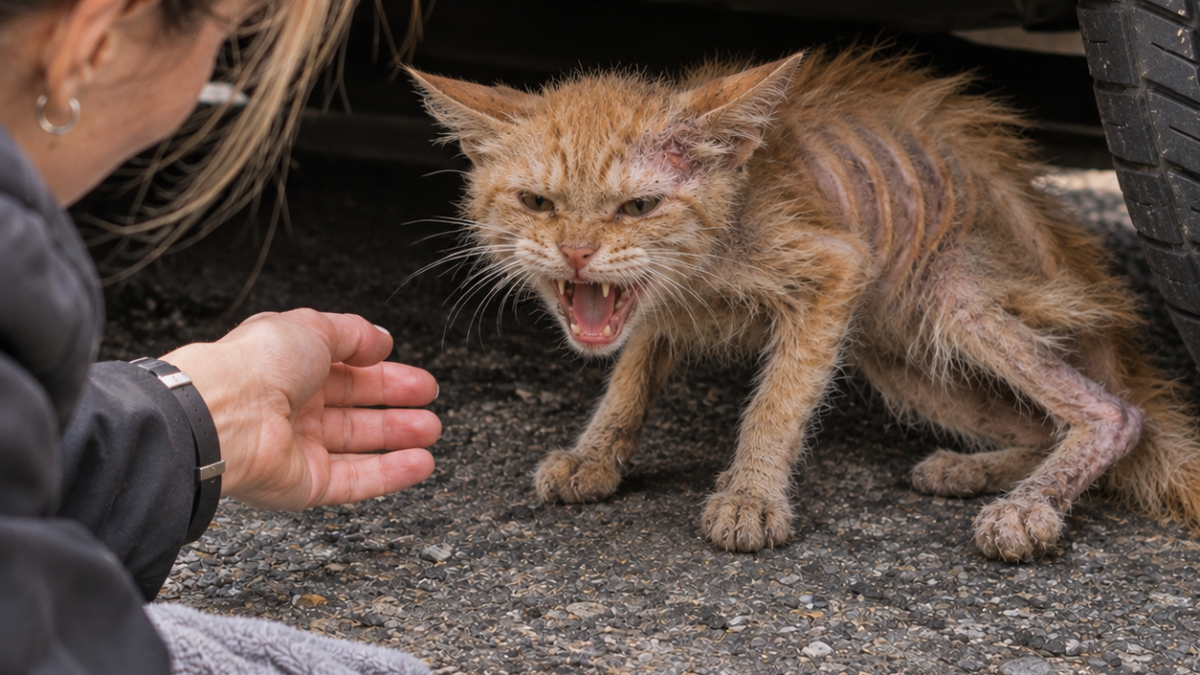
Buddy Flinched at Every Hand That Reached for Him—Then One Gentle Touch Made the Frightened Cat Do Something Nobody Expected
Buddy was trembling beneath a parked car, too frightened to run and too weak to trust the people trying to reach him.
His skin was inflamed, his body was thin, and old injuries had left his back legs struggling to carry him.
Then one quiet moment of kindness made the cat who feared every hand respond in a way no one expected.
The first thing rescuers saw was a pair of eyes beneath the car.
Not the whole cat.
Just the eyes.
Wide.
Still.
Watching.
A parked vehicle cast a long patch of shade over the pavement, and somewhere near the rear tire a golden cat had pressed himself as close to the ground as his body would allow.
Someone had already tried calling him.
He did not come.
Someone had placed food nearby.
He had not moved toward it.
Every time a person took one step closer, his body tightened.
But he did not run.
At first, that seemed strange.
Then one rescuer crouched low enough to see the rest of him.
His back legs were positioned awkwardly.
When Buddy tried to shift away from the movement outside the car, the front half of his body responded first.
His rear half lagged behind.
He managed only a few inches.
Then stopped.
That was when the rescuers understood.
Buddy was not staying because he trusted them.
He was staying because escape was difficult.
The woman nearest him sat down several feet away.
No reaching.
No sudden movement.
PART2:
Nothing that could make a frightened animal feel trapped.
“Hey, buddy.”
The cat stared.
The name had not belonged to him yet.
It was simply the first gentle thing someone called him.
“Can you hear me?”
One ear moved.
That tiny response made the woman smile.
“Okay.”
Buddy remained beneath the car.
His golden coat looked dirty and thin.
In several places, fur was missing almost completely.
The skin underneath appeared irritated and unhealthy.
His body was narrow.
Too narrow.
What should have looked soft beneath the fur instead showed the sharp outlines of an animal that had been surviving without enough food or care.
Nobody knew how long he had lived that way.
His eyes suggested longer than anyone wanted to imagine.
They followed every hand.
Every shoe.
Every shift in weight.
He seemed to record movement before deciding whether it meant danger.
The rescuers tried food again.
A small dish was slid near the edge of the car.
Buddy’s nose moved.
There.
Interest.
But hunger was not stronger than fear yet.
He remained where he was.
So they waited.
Cars passed nearby.
Doors opened.
People spoke in low voices.
The rescue team gradually moved unnecessary people away.
Too many bodies could turn concern into pressure.
One person remained close enough to monitor him.
Another stood ready with a carrier.
No one rushed.
Buddy needed help.
But frightened animals do not understand urgency the way humans do.
To him, fast hands were simply hands moving too fast.
So the rescuer sat.
Five minutes.
Ten.
Buddy watched.
Eventually his head lowered slightly.
His muscles stopped looking quite so rigid.
The woman moved the food one inch closer.
Then waited again.
Buddy sniffed.
He shifted his front paws.
The rear legs followed poorly.
A small movement.
Then another.
He reached the food.
One bite.
Pause.
His eyes returned immediately to the woman.
She did not move.
Another bite.
Then another.
Hunger finally began competing with fear.
Buddy ate quickly once he started.
Too quickly.
The woman whispered,
“Easy.”
Buddy froze at the voice.
She stopped speaking.
After a moment, he resumed.
When the dish was nearly empty, the rescuers prepared to move.
They could not leave him beneath a car indefinitely.
His body needed medical attention.
The difficulty was getting him out without teaching him that food and quiet voices were only tricks leading to force.
The woman placed a soft blanket near the car.
Buddy watched it.
Another rescuer slowly blocked the far side, not touching him, only preventing him from dragging himself deeper beneath the vehicle.
Buddy noticed.
His breathing changed.
He understood enough to know the space was becoming smaller.
The woman spoke again.
“Okay, Buddy.”
His ears flattened.
“We’re going to help you.”
The sentence had no meaning to him.
Not yet.
When the blanket moved beneath his chest, Buddy reacted.
A sharp hiss.
One front paw struck toward the hand.
Not much force.
But clear intention.
Stop.
The rescuer stopped.
Waited.
Buddy’s body trembled.
There was no hatred in the reaction.
Only fear.
Fear with nowhere to go often looks aggressive.
A cornered animal may growl, hiss, scratch or bite because those are the only tools left when running is impossible.
People unfamiliar with frightened animals sometimes call that behavior mean.
Buddy was not mean.
Buddy was scared.
The rescuers treated the behavior as information.
Too much.
Slow down.
They adjusted.
The blanket came closer again.
This time Buddy did not strike.
He watched.
The woman’s hand stayed visible.
No grabbing around the neck.
No sudden restraint.
The blanket slid beneath his body.
When he was finally lifted, Buddy stiffened completely.
His front paws spread.
Claws partly exposed.
His head stayed up.
He did not fight wildly.
Perhaps he did not have the energy.
Perhaps he realized fighting would not change where he was going.
The woman supported his rear half carefully.
The weakness there became even more obvious.
The back legs did not move normally.
Buddy was placed inside the carrier.
The door closed.
He retreated as far as he could.
The rescuers covered part of the carrier with a towel.
Less visual stimulation.
Less movement.
A smaller, quieter world.
The car ride began.
Buddy made no sound.
That silence worried the woman more than the hiss had.
She sat beside him.
Every few minutes she spoke softly.
“Buddy.”
Nothing.
“We’re almost there.”
Nothing.
She did not know whether he had ever been inside a vehicle before.
Whether every sound frightened him.
Whether a human voice had ever been paired with something good.
They knew nothing about his past.
That made it tempting to invent one.
People do that with rescue animals.
They see fear and imagine beatings.
See hunger and imagine abandonment.
See injuries and construct a villain.
Sometimes those guesses are right.
Sometimes they are not.
Buddy’s body could tell them what he had experienced physically.
His mind could only show what he expected now.
And what he expected from people was caution.
That was enough.
The veterinary clinic was prepared.
Buddy’s carrier was taken into a quieter examination room.
The door stayed closed.
No dogs passing directly outside.
No crowd.
The veterinarian opened the carrier and waited.
Buddy did not come out.
Food did not persuade him this time.
Eventually the top of the carrier was removed so he would not need to be dragged through the front opening.
The veterinarian examined him carefully.
Thin.
Underweight.
Dehydrated.
Skin badly inflamed.
Untreated mange had damaged the coat and caused irritation over large areas.
The golden fur that remained was dull and uneven.
There were injuries affecting his back legs.
Imaging would be needed to understand more.
Buddy tolerated the first part of the exam with his body rigid.
The moment a hand moved near a painful area, he hissed.
The staff backed away when possible.
Pain medication came early.
Relief mattered.
There is little chance of building trust with an animal when every touch hurts.
The team addressed discomfort first.
Then testing.
Imaging showed the injuries affecting Buddy’s hindquarters were not simply temporary weakness from hunger.
There was lasting damage.
His movement problems had a physical explanation.
The veterinarians could treat some parts of his condition.
Other parts might remain.
No one promised full recovery.
That mattered.
False hope helps nobody.
The goal was not to force Buddy into a perfect body.
The goal was to make his current body as comfortable, functional and strong as possible.
His skin needed treatment.
His weight needed rebuilding.
His body needed rest.
Whatever issues could be medically corrected would be addressed carefully.
Physical therapy could help him use the movement he still had safely.
And emotionally?
That part would take time.
A lot of time.
Buddy spent his first night at the clinic in a quiet enclosure.
Soft bedding.
Food.
Water.
Medication.
Warmth.
He stayed near the back.
Whenever someone entered, his eyes opened immediately.
Watching.
The staff began speaking before touching him.
“Buddy.”
Pause.
Then approach.
“Buddy, I’m changing your blanket.”
Pause.
Then hand.
The words were not understood.
The sequence was.
Voice.
Movement.
Nothing terrible.
Again later.
Voice.
Movement.
Care.
Nothing terrible.
It was the beginning of a pattern.
Patterns matter to frightened animals.
A single gentle touch can be dismissed as luck.
Ten gentle touches begin to become evidence.
A hundred become expectation.
Buddy needed evidence.
On the second day, he ate more.
That encouraged everyone.
He ate only when people stood farther away.
So they stood farther away.
No one needed to watch him prove anything.
Food disappeared.
Good.
That was enough.
His skin treatment began.
The mange had made parts of his body intensely uncomfortable.
Medication started working internally.
The skin still required careful care.
Buddy disliked it.
He did not understand why humans touched the places that already hurt.
At first, every treatment session brought tension.
Sometimes hissing.
Sometimes a weak attempt to move away.
Sometimes the front paw came up in warning.
The staff respected the warning when they could.
But some care had to be done.
The difference lay in how.
No anger.
No punishment.
No yelling because Buddy reacted.
A frightened animal does not become less frightened because someone punishes the expression of fear.
The staff worked slowly.
One technician became particularly good with him.
Her name was Elena.
She discovered that Buddy reacted less when she sat beside the enclosure for a few minutes before doing anything.
So she did.
Every time.
Even when the clinic was busy.
She would sit.
Check notes.
Speak softly.
Sometimes offer food.
Only then begin care.
Buddy watched.
At first, Elena could see his suspicion clearly.
Why are you here?
What are you going to do?
When will it hurt?
She never tried to convince him through words.
She simply became predictable.
One morning, she entered.
Buddy lifted his head.
Elena sat down.
“Morning.”
Buddy stared.
She placed food.
He looked at the bowl.
Then her.
Elena moved away.
Buddy ate.
The next morning, same thing.
The third morning, he began eating before she had fully stepped away.
Elena noticed.
She did not celebrate aloud.
She simply wrote in his chart:
Eating comfortably with staff nearby.
That line looked clinical.
To her, it meant something larger.
The clinic had stopped being a place where Buddy believed he could not lower his guard enough to eat.
His body began responding too.
Medication reduced inflammation.
Skin treatment slowly improved the mange.
The angry, irritated areas began calming.
Nutrition started giving his body more resources.
Buddy remained thin, but the downward slide had stopped.
That was the first physical victory.
Stop losing.
Then rebuild.
He ate consistently.
Meals became one of the easiest ways to communicate safety.
A person entered.
Food appeared.
No one took it away.
Nobody bothered him while eating.
The bowl returned later.
Again.
Again.
Buddy learned timing before he learned affection.
That was fine.
Food can be a form of trust because it is predictable care.
His rear legs remained a concern.
The injuries would not simply vanish when he gained weight.
Physical therapy was introduced gently.
At first, Buddy hated it.
Hands repositioning the limbs.
Supported standing.
Controlled movement.
Exercises designed to maintain what function he had and help him move in ways that reduced strain.
Buddy did not understand rehabilitation.
He understood inconvenience.
The first session lasted only a short time.
He tensed.
Tried to pull away.
Elena spoke.
“Almost done.”
Buddy turned his head sharply toward her.
“You can hate me.”
His eyes narrowed.
“Still almost done.”
When the session ended, Buddy retreated to the back of his bedding.
Elena placed food nearby.
Then left.
The next session went slightly better.
Then another.
Progress was measured in small reductions of resistance.
Less tension.
A little more supported weight.
More willingness to shift position.
Nothing dramatic.
The veterinarians were careful not to confuse cooperation with absence of pain.
Buddy’s movement was monitored.
Medication adjusted where needed.
His quality of life remained the central question.
Could he rest?
Could he eat?
Could he move enough to engage?
Could discomfort be controlled?
Were the treatments helping more than hurting?
These questions were repeated.
No treatment continued merely because people wanted a heroic recovery story.
Buddy’s body set the terms.
The emotional recovery was harder to measure.
There are no blood tests for trust.
No scan that shows:
Fear reduced by seventeen percent.
People had to watch behavior.
How quickly did Buddy tense when someone entered?
Did he eat with a person nearby?
Did he turn away from touch?
Did he shrink?
Did he stay?
Did he seek contact?
At first, almost every answer pointed toward caution.
Then came a morning when Elena placed her hand near Buddy’s head.
Not touching.
Just close.
Buddy watched.
She waited.
He did not move away.
Her fingers touched the fur behind his ear.
Once.
Buddy’s body tightened.
Elena stopped immediately.
Waited.
His muscles softened slightly.
She tried again.
One stroke.
Then another.
Buddy remained.
No purr.
No leaning.
No magical transformation.
Elena smiled.
“Okay.”
She stopped before Buddy needed to tell her.
That mattered.
Trust is easier to build when the animal learns that boundaries work.
If turning away makes a hand stop, the animal has control.
If staying leads only to more and more until discomfort becomes panic, he learns that tolerance is dangerous.
Elena kept interactions short.
Buddy’s tolerance increased.
One touch became three.
Three became several seconds.
A cheek scratch.
Behind the ear.
Top of the head.
He preferred some areas.
Disliked others.
They learned.
Buddy learned too.
Hands could stop.
Hands could be gentle.
Hands could bring food.
Hands could adjust bedding without grabbing.
Hands could sometimes reduce pain.
The old association—
hands equal danger—
began gaining competition.
Not disappearing.
Competition.
That is how new learning works.
A frightened animal rarely forgets completely.
He acquires more evidence.
Then one afternoon, Elena entered after Buddy’s physical therapy.
He looked tired.
She sat beside him.
No food.
No treatment.
Nothing to accomplish.
She simply rested her hand on the edge of his bedding.
Buddy watched.
Elena looked at her phone.
Minutes passed.
She did not reach.
Eventually Buddy shifted.
His front half moved slightly closer.
Elena noticed through peripheral vision but pretended she did not.
Buddy stopped.
Rested.
Another minute.
He moved again.
Now his face was near her fingers.
Elena stayed still.
Buddy sniffed.
Her hand smelled like soap, clinic, other animals and probably food somewhere underneath.
He touched his nose lightly to one finger.
Then froze.
Elena did nothing.
Buddy remained there.
She slowly moved one finger against his cheek.
A tiny stroke.
His eye softened.
Another.
And then—
a sound.
So quiet Elena thought she imagined it.
She stopped touching.
The sound stopped.
Her heart began beating faster.
She stroked again.
There.
A vibration.
Low.
Uneven.
Almost uncertain.
Buddy was purring.
Elena stared at him.
He did not look different.
Still thin.
Still patchy.
Still guarded.
Back legs still damaged.
But the sound continued.
A purr is not always evidence of happiness.
Cats can purr under stress, pain or self-soothing too.
Elena knew that.
She did not turn the moment into a medical conclusion.
But Buddy’s body had relaxed.
His eyes were half closed.
He had moved toward her.
The purr began during gentle contact.
Whatever exactly it meant, it was not rejection.
Elena whispered,
“Hi.”
Buddy purred.
That was the moment everyone remembered.
Not because it fixed anything.
Because it was the first time Buddy seemed to choose comfort from a human hand instead of merely enduring it.
Elena eventually called another technician.
Quietly.
“Come look.”
The technician approached.
Buddy’s eyes opened.
Purr stopped.
Elena laughed.
“Okay. Never mind.”
The technician whispered,
“He was purring?”
“Yes.”
“You sure?”
Elena looked offended.
“I know what a cat sounds like.”
Buddy watched both women suspiciously.
The technician left.
Elena resumed the cheek scratch.
Several seconds later, the purr returned.
“There.”
Nobody else came.
They let the moment belong to Buddy.
The story spread through the clinic anyway.
Buddy purred.
People who had seen him under the car understood why that mattered.
He had been so frightened that he seemed emotionally frozen.
Now his body was experimenting with relaxation.
After that, progress did not suddenly become easy.
The next morning Buddy hissed during skin treatment.
Later he refused touch.
Trust does not move in a straight line.
One good experience does not erase fear.
The staff did not interpret regression as failure.
Buddy was allowed bad days.
His body hurt differently from day to day.
Some procedures were unpleasant.
New people still made him nervous.
Loud sounds startled him.
That was real.
But the overall direction changed.
He began recovering physically.
His skin became less inflamed.
The mange receded.
New fur began appearing.
At first, thin fuzz.
Then thicker.
The original golden color returned gradually.
People who met Buddy later would have difficulty imagining how dull his coat had once looked.
Healthy fur requires more than grooming.
It requires nutrition.
A body with enough resources.
Less inflammation.
Less disease.
Buddy’s coat became visible evidence that his internal state was improving too.
His weight increased.
His face filled slightly.
The sharpness of bone softened.
His shoulders became stronger.
His movement still showed the lasting damage to the hind legs.
That did not disappear.
But physical therapy helped him use the body he had more efficiently.
The goals remained realistic.
Not:
Make Buddy move exactly like an uninjured cat.
Instead:
Increase comfort.
Maintain strength.
Improve safe movement.
Reduce unnecessary strain.
Protect quality of life.
Buddy started learning his own mechanics.
He shifted more weight forward when necessary.
Chose stable surfaces.
Used furniture strategically.
Paused.
Adjusted.
If a distance seemed uncertain, he studied it.
Then moved.
He fell sometimes.
Not catastrophic falls.
Small miscalculations.
The people around him learned not to rush toward him every single time.
Buddy needed some independence.
If he could recover himself safely, they let him.
That was another form of trust.
Not only Buddy trusting humans.
Humans trusting Buddy.
His confidence began showing in unexpected places.
At first he stayed near walls.
Protected edges.
Places where nothing could approach from behind easily.
Later, he rested in more open areas.
This mattered.
An animal who constantly chooses corners may be seeking security.
An animal sleeping in the middle of a room is making a different calculation.
One afternoon, Elena found Buddy stretched on a blanket nowhere near a wall.
Deeply asleep.
She stopped.
Buddy did not wake.
She smiled.
Months earlier, footsteps would have snapped his eyes open immediately.
Now he slept through her entering.
She backed out without disturbing him.
Another milestone nobody would put on an X-ray.
The veterinary team eventually began discussing where Buddy would go after intensive treatment.
Hospitalization is not a home.
He needed a quieter environment where his medical needs could continue to be managed but normal life could begin.
A foster home was arranged.
The foster caregiver, Maya, had experience with animals recovering from trauma.
She met Buddy at the clinic first.
Did not reach toward him.
Sat.
Talked with Elena.
Ignored him for several minutes.
Buddy watched.
Maya asked practical questions.
His medication.
Skin care.
Movement limitations.
Physical therapy.
Diet.
Signs of pain.
Preferred touch.
What frightened him.
How he behaved with new people.
Elena answered.
“He’s not aggressive.”
Maya nodded.
“He’s scared.”
“Yes.”
“Any bite history?”
“Warnings. No serious bite.”
“Good.”
Elena smiled.
“You like warnings?”
“I like animals that communicate.”
That answer made Elena trust her immediately.
Maya visited again.
The second visit, Buddy ate with her sitting nearby.
Third visit, he allowed a brief head touch.
No rush.
Then came transfer day.
Buddy entered another carrier.
His body became tense.
The clinic had become familiar.
Leaving meant another change.
Elena crouched.
“You’re okay.”
Buddy watched.
She stroked his cheek.
He leaned slightly.
That almost made her cry.
“Don’t make this difficult.”
Buddy gave a tiny meow.
Elena laughed.
“You were difficult from the beginning.”
The carrier door closed.
Maya took him home.
The foster room had been prepared carefully.
Non-slip rugs.
Low resting spaces.
Soft bedding.
Easy food and water access.
No high places he might attempt before understanding his body.
A covered hiding spot.
Quiet.
Buddy’s carrier was opened.
He stayed inside.
Maya left the room.
That was intentional.
No one needed to witness his first decision.
After half an hour, the carrier was empty.
Buddy was beneath a low table.
Fine.
He had moved.
Maya placed food.
Sat several feet away.
Buddy ate after she turned her back.
That first night, he remained cautious.
Every unfamiliar sound mattered.
Refrigerator.
Pipes.
Doors.
Footsteps.
A car outside.
The house had rhythms Buddy did not know.
Maya let him learn.
She slept nearby but not in the same room.
In the morning, food disappeared.
Water had been used.
A blanket shifted.
Buddy had explored when no humans were watching.
Good.
Day two.
Maya entered.
“Morning, Buddy.”
Buddy stared.
She placed breakfast.
He waited.
She sat.
No movement.
Eventually he ate.
Day three.
He began eating sooner.
Day five.
He remained on the blanket instead of retreating beneath the table when she entered.
Maya did not interpret that as permission to become affectionate.
She continued the routine.
Trust first.
Touch later.
But Buddy surprised her.
One evening, Maya sat on the floor reading.
Buddy had eaten.
Medication done.
Nothing else scheduled.
He moved from the blanket.
His hind legs worked imperfectly.
He crossed part of the rug.
Stopped near her.
Maya looked down.
Buddy looked back.
“Hi.”
He sat.
Not touching.
Just near.
Maya went back to reading.
Five minutes later, Buddy moved closer.
His shoulder touched her knee.
Maya kept reading.
A minute later, she felt vibration.
Purring.
She smiled.
No reaction beyond that.
Buddy stayed.
That became the first night he chose contact in the foster home.
The next night, he did it again.
Then skipped two nights.
Then returned.
Choice.
Always choice.
As his skin healed further, grooming became less uncomfortable.
Buddy began cleaning himself more.
That was encouraging.
A cat interested in grooming is participating in his own routine.
The fur returned thicker.
Golden.
Soft.
The comparison to his rescue photographs became dramatic.
His body looked more like a cat who belonged somewhere.
That phrase bothered Maya when she thought it.
Buddy had always belonged somewhere.
Even beneath the car.
Worth does not arrive with healthy fur.
But humans see health more easily than suffering.
The real change was not that Buddy had become prettier.
He had become comfortable enough to care about being a cat again.
That was different.
Food remained his greatest enthusiasm.
Maya discovered this quickly.
Breakfast delay of five minutes?
Unacceptable.
A food container opening?
Immediate interest.
Someone walking toward the kitchen?
Worth investigation.
Buddy’s movement improved noticeably whenever meals were involved.
Maya joked with Elena by message:
Physical therapy update: apparently dinner is the strongest rehabilitation tool.
Elena replied:
We knew.
Buddy began waiting near the area where meals were prepared.
At first, he stayed far enough back to retreat.
Later, closer.
Eventually he sat in the open.
Watching.
A cat once afraid of every approaching human now supervised them.
That was progress.
His naps changed too.
At the clinic, sleep had been necessary.
At the foster home, sleep became luxurious.
He discovered soft blankets.
Then a padded bed.
Then a couch cushion placed low enough to reach safely.
Buddy liked warmth.
If sun crossed the floor, he found it.
Maya would walk into the room and see golden fur lit by afternoon light.
Sometimes Buddy slept with his body fully stretched.
No defensive curl.
No eyes half-open.
Trusting sleep.
That may have been one of the biggest transformations.
Fear makes rest shallow.
Safety allows surrender.
Buddy began surrendering to sleep.
Maya learned his sounds.
A short meow around meals.
A low complaint during certain care.
Purr when content.
Silence when uncertain.
A particular breath when he settled.
A small chirp once when a bird appeared outside.
That sound made Maya laugh.
“There you are.”
Buddy watched the bird from the window area.
His back legs remained damaged.
He could not leap the way another cat might.
But he could still stalk with his eyes.
Track.
Listen.
Become intensely interested.
Disability had changed movement.
It had not removed instinct.
Maya built a low platform near the window.
Buddy inspected it.
The first day, he ignored it.
Second day, he placed his front paws on it and stopped.
Third day, he shifted more weight.
Fourth, he climbed.
Not gracefully.
But safely.
Then he sat.
Outside, birds.
Cars.
People.
Wind moving leaves.
A whole world.
The low platform became one of his favorite places.
Accessibility gave him something he could not have reached otherwise.
That is what accommodation should do.
Not announce disability.
Expand possibility.
Buddy’s foster room slowly expanded into the rest of the house.
First hallway.
Then living room.
Kitchen.
Maya kept surfaces predictable.
Rugs where traction mattered.
No unnecessary clutter.
Buddy mapped spaces.
He did not move quickly at first.
His back legs required thought.
But familiarity increased efficiency.
He stopped pausing before every doorway.
Learned where turns were.
Began appearing in rooms Maya did not expect.
One morning she opened the kitchen and found Buddy already there.
“How?”
Buddy stared.
“You beat me.”
He meowed.
“Breakfast isn’t late.”
Another meow.
“Three minutes.”
Buddy remained unmoved by the defense.
Food really was his love language.
It also became one of the ways Maya introduced new experiences.
A new person came over.
Buddy retreated.
Fine.
The visitor sat.
No reaching.
Food appeared at a distance Buddy considered safe.
He ate.
Next visit, closer.
Eventually, Buddy stopped disappearing whenever the door opened.
Not with everyone.
He remained cautious.
That was okay.
Recovery does not require becoming social with strangers.
It requires having enough security to make decisions instead of reacting automatically.
Buddy’s decisions became more nuanced.
Some people:
watch.
Some:
avoid.
Some:
approach later.
Maya:
follow into kitchen immediately.
Elena visited after two months.
Buddy heard her voice from the hallway.
His head came up.
Elena stepped into the room.
“Hey, Buddy.”
He stared.
She sat.
Buddy remained still for several seconds.
Then moved toward her.
Not fast.
But directly.
Elena’s face changed.
“He remembers.”
Maya smiled.
“Maybe.”
Buddy reached Elena.
Sniffed.
Then pushed his head into her hand.
Elena looked away because tears arrived immediately.
“Oh, don’t do that.”
Buddy leaned harder.
She scratched behind his ear.
The purr began.
Loud.
Nothing uncertain now.
Elena laughed through tears.
“You used to hate me.”
Buddy purred.
Maya said,
“I don’t think he hated anyone.”
Elena nodded.
“No.”
They both knew.
Fear looks like hate when you are only watching from the outside.
Buddy had been described early on by some people as aggressive.
The word followed him longer than it should have.
He hissed.
He struck.
He flinched.
He resisted.
Those behaviors were real.
The interpretation had been wrong.
He was protecting the only thing he still controlled.
Distance.
Once people respected that, the behavior changed.
Not because Buddy became a nicer cat.
Because he no longer needed the same defense.
That distinction became central to his story.
Maya began introducing gentle play.
Buddy had shown almost no interest early on.
A string toy moved.
He watched.
No pursuit.
Another day.
He tracked it.
Next time, one paw reached.
Maya froze.
Buddy tapped.
The toy moved.
Another tap.
Then a stronger one.
A tiny game.
Maya smiled.
Play returned slowly.
Like trust.
She did not turn it into exercise.
Buddy decided when.
Some days interested.
Some not.
As his body strengthened, he played more.
His front half remained more coordinated than the hindquarters, so games were adjusted.
Less jumping.
More ground-level movement.
Toys he could reach.
Objects that rolled slowly.
Buddy especially liked things connected to food.
Treat puzzle?
Immediate genius.
No-food toy?
Needs consideration.
That personality amused everyone.
The cat who once barely ate had become a critic of meal quality.
His coat now looked almost completely different.
The mange treatment had worked.
Inflammation eased.
Fur returned thick and golden.
Some areas remained slightly different in texture.
Scars or old skin damage told quieter pieces of the story.
Maya did not mind.
Buddy certainly did not.
The healthier coat made visitors call him beautiful.
Maya always thought:
He was beautiful under the car too.
Harder to see.
Still true.
By then, his weight had stabilized at a healthier level.
The ribs no longer dominated his shape.
His face looked fuller.
Eyes brighter.
His physical therapy remained part of the week.
Some days Buddy participated.
Some days he complained through every minute.
His back legs would never fully recover.
The veterinary team eventually said that clearly.
There had been improvement in strength and adaptation.
But lasting damage remained.
No miracle ending.
Buddy would always move differently.
Maya received the information without the heartbreak she might have felt months earlier.
She already knew Buddy.
He did not need full neurological recovery to be himself.
The goal had always been quality of life.
Was he eating?
Yes.
Moving enough to explore?
Yes.
Resting comfortably?
Yes.
Playing?
Increasingly.
Seeking interaction?
Absolutely.
Showing signs of persistent uncontrolled pain?
No.
Then they were succeeding.
That changed the emotional meaning of his legs.
Early:
problem to fix.
Later:
part of Buddy to manage.
That is often the shift special-needs care requires.
A permanent difference can stop feeling like a temporary failure.
It becomes reality.
You build around it.
Buddy built too.
He learned which furniture heights worked.
Which rugs gave grip.
Where to rest.
How to turn without overloading the weaker side.
How to pace himself.
If a movement became too difficult, he paused.
Humans wanted to help immediately.
Maya often stopped them.
“Give him a second.”
Buddy usually solved it.
Not always.
If he needed help, she gave it.
But she did not steal every problem from him.
Independence mattered.
A cat carried everywhere may remain physically safe and emotionally frustrated.
Buddy liked deciding.
He had spent too much time with fear making decisions for him.
Now he could choose.
One afternoon, he climbed onto the low window platform without thinking.
Maya happened to notice.
Months earlier, that action required several attempts.
Now:
up.
Sit.
Birds.
Normal.
She smiled.
That was one of her favorite kinds of progress.
When an achievement becomes so ordinary nobody applauds.
Buddy’s emotional recovery continued quietly.
He began meeting Maya at the doorway to his room.
Then in the hallway.
Eventually near the entrance when she came home.
Not every day.
Cats have reputations to protect.
But often enough.
The first time she opened the front door and saw Buddy waiting several feet away, she froze.
He looked at her.
She put down her bag.
“Were you waiting?”
Buddy turned toward the kitchen.
Maya laughed.
“Of course. Food.”
But he had been there.
Waiting where he could see her return.
A frightened cat under a car had once learned that people approaching meant potential danger.
Now a familiar person returning meant safety.
That is not a small change.
Maya sometimes wondered what happened before she knew Buddy.
Where had he lived?
Was he born outside?
Did he have an owner?
Was he injured by an accident?
Neglect?
Something else?
Why was the mange untreated?
How long had he been thin?
Did someone chase him away?
Did he once trust another person and lose that trust?
No answers came.
Eventually she stopped needing them.
Understanding history can help treatment.
But an animal is not a mystery that must be solved before he can be loved.
Buddy’s current behavior provided enough information.
He needed slow movement.
Predictability.
Safe handling.
Pain control.
Food.
Choice.
Time.
Those needs could be met without a full biography.
Maya let the unknown remain unknown.
There was dignity in that too.
Not turning suffering into entertainment.
Buddy did not owe anyone the worst things that happened to him.
He owed nobody anything.
The foster arrangement stretched longer than expected.
Buddy was technically available for adoption once medically stable enough.
But special-needs cats can wait.
His movement difference worried some people.
His history of fear worried others.
The rescue wrote an honest profile.
Golden adult cat.
Recovering from severe mange.
Chronic hind-leg impairment due to old injuries.
Needs a thoughtful home with safe surfaces and continued medical follow-up.
Initially cautious.
Very food motivated.
Affectionate once trust develops.
That last line felt almost unbelievable compared with the beginning.
Affectionate once trust develops.
It was true.
Potential adopters came.
One woman met him.
Buddy stayed under a chair.
She waited ten minutes.
“He doesn’t like me.”
Maya said,
“He doesn’t know you.”
The woman tried offering her hand.
Buddy moved farther back.
She looked disappointed.
“He’s not very friendly.”
Maya smiled politely.
“He is. Just not yet.”
The adoption did not happen.
That was okay.
Buddy needed someone who understood “not yet.”
Another couple came.
They sat on the floor.
Ignored him.
Talked with Maya.
After twenty minutes, Buddy moved closer because someone opened a treat bag.
The man laughed.
“So that’s the password.”
Food.
Exactly.
They offered a treat.
Buddy ate.
Then retreated.
They did not try to touch him.
Good.
But their home had several large energetic dogs.
Not impossible.
Still not ideal given Buddy’s limited ability to escape quickly.
They chose another cat.
Also okay.
An older man visited.
Quiet.
Patient.
Experience with cats.
Buddy approached sooner.
The meeting seemed promising.
But the man lived in a multi-level home with extensive slippery flooring and no practical way to modify the main area.
He wanted Buddy.
The rescue decided against it.
A difficult decision.
Love is not the only requirement.
Environment matters.
Buddy remained with Maya.
Weeks became months.
Maya pretended this was temporary.
Elena did not believe her.
One day at the clinic, during a follow-up, Elena asked,
“So when are you adopting him?”
Maya frowned.
“I’m fostering.”
“Right.”
“I am.”
“Right.”
Buddy sat near Maya’s leg.
Elena looked down.
“Maya.”
“What?”
“You rearranged your living room for him.”
“For safety.”
“You bought six rugs.”
“Traction.”
“You learned his physical therapy routine.”
“That’s foster care.”
“You know which side of his face he likes scratched.”
“Useful information.”
“You have seventeen photos of him sleeping.”
Maya crossed her arms.
“Why are you counting?”
Elena laughed.
Buddy looked between them.
Maya scratched his cheek automatically.
He leaned into her.
Elena pointed.
“That.”
Maya stopped.
Buddy looked annoyed.
Elena smiled.
“You stopped.”
Buddy pushed his head back into Maya’s hand.
Maya resumed.
“Fine.”
“Fine what?”
“Nothing.”
Two weeks later, Maya signed the adoption papers.
She did not tell Buddy.
He probably would have been unimpressed by paperwork.
The rescue staff celebrated more than she wanted.
Buddy received a new collar he disliked.
A photograph he refused to pose for.
And an official home that looked exactly like the foster home he already believed was his.
That was appropriate.
The best adoption day did not change his life dramatically.
It confirmed what his routines already knew.
This food bowl is yours.
This window is yours.
This blanket.
This person.
Tomorrow too.
Buddy had a family.
Not because he became easy.
Not because every medical problem disappeared.
Not because the hind legs healed completely.
He had a family because someone looked at the work, the limitations, the history and the personality and chose the whole thing.
His days became deeply ordinary.
Breakfast.
Medication when needed.
Window time.
Nap.
Maybe play.
Food supervision.
Physical therapy.
More nap.
Maya working.
Buddy interrupting.
Dinner.
Evening.
Couch.
He started sleeping beside Maya.
At first, near her feet.
Then closer.
One evening he climbed onto the couch and pressed his body against her thigh.
Maya remained still.
Buddy settled.
Purring.
Loud.
The same cat who had once recoiled from a hand.
Maya placed her fingers gently behind his ear.
Buddy pushed upward.
More.
She smiled.
“So demanding.”
Purr.
He slept.
Deeply.
His back turned partly toward her.
That position meant something.
You cannot watch a person constantly if you turn your back.
Buddy no longer needed to.
Maya could move while he slept.
Stand.
Return.
Buddy might open one eye.
Then close it again.
The body had learned safety through repetition.
That was perhaps the most important healing of all.
Not forgetting fear.
Reducing the need for it.
A year after Buddy was found, the rescue team shared updated photographs internally.
People who remembered the cat under the car almost did not recognize him.
Thick golden coat.
Healthy body condition.
Bright eyes.
Relaxed posture.
One photograph showed him asleep with his head against Maya’s leg.
Another showed him at the window.
Another beside a food bowl, obviously important.
Elena sent the original rescue image beside the new one.
Maya stared.
The contrast hurt.
Not because Buddy looked bad now.
Because she finally understood just how unwell he had been.
Memory softens details.
Photographs do not.
The first image showed a frightened animal pressed beneath metal.
Skin inflamed.
Coat poor.
Body narrow.
Eyes alert to danger.
The newer image showed the same eyes half closed beneath a hand.
Maya looked at Buddy.
He was sleeping.
“Was that really you?”
One ear moved.
She smiled.
“I know.”
Buddy did not need to remember.
Maybe he did.
Nobody knew how cats carry trauma.
They certainly learn from experience.
Whether Buddy mentally replayed the past was impossible to say.
His behavior showed that old fear could still return under certain conditions.
Unexpected grabbing.
A loud metallic noise.
A stranger moving too quickly.
Veterinary restraint.
Those things sometimes triggered tension.
Recovery had not erased everything.
Maya did not expect it to.
When Buddy froze, she slowed down.
When he needed space, he got it.
When a procedure had to happen, they minimized stress.
Trust does not mean an animal will never be frightened again.
It means fear no longer controls every interaction.
Buddy’s life now contained far more than fear.
That was enough.
The hind-leg damage also remained visible.
Some days movement looked better.
Other days, especially after too much activity, Buddy tired.
Maya watched.
Physical therapy changed over time.
Veterinary monitoring continued.
Weight was kept carefully controlled because excess weight could make movement harder.
Buddy strongly disagreed with this policy.
Meals were clearly too small in his professional opinion.
Maya reminded him that he was not starving.
Buddy meowed.
“This is medically appropriate.”
Meow.
“You ate twenty minutes ago.”
Meow.
“You are dramatic.”
Buddy stared at the food cabinet.
His love language remained unchanged.
Food.
Then naps.
Then Maya.
Possibly in that order.
His curiosity grew as security increased.
A cardboard box arrived?
Buddy investigated.
A new blanket?
Test.
A bag on the floor?
Smell.
A bird outside?
Monitor.
Maya’s shoes?
Occasionally worthy of inspection.
The cat once described as angry became almost nosy.
That transformation was not as dramatic as a physical miracle, but it mattered.
Curiosity requires emotional space.
Fear occupies attention.
When everything might be dangerous, exploration is expensive.
Buddy now had spare attention.
He could waste time on things that did not matter.
That is a luxury of safety.
One afternoon, Maya moved a small piece of furniture.
Buddy entered.
Stopped.
Looked.
The object was in a place it had never been.
He approached cautiously.
Sniffed.
Walked around.
Then rubbed his cheek against it.
Claimed.
Maya laughed.
“Inspection complete?”
Buddy moved on.
The house no longer belonged to unpredictable humans.
It belonged to Buddy too.
That sense of ownership showed in where he slept.
At first, one safe bed.
Then several.
Couch.
Window rug.
Bedroom blanket.
A chair he could access with a low step.
He distributed himself across the home like a cat who assumed every comfortable surface had been purchased for him.
Maya encouraged the delusion.
His relationship with touch became almost comedic.
Early:
Do not touch me.
Later:
Maybe.
Later still:
Only head.
Then:
More.
Eventually, Buddy learned how to ask.
He approached.
Pressed his head into Maya’s hand.
If she stopped too soon, he pushed again.
Once she was on the phone and absentmindedly scratched him.
Then stopped.
Buddy bumped her hand.
She resumed.
Stopped.
Bump.
Resume.
Her friend on the phone asked,
“What are you doing?”
“Being trained.”
Buddy purred.
That was exactly right.
The animal who once had no control over what hands meant now controlled one very effectively.
Gentle touch had become something he sought.
Not all touch.
Not all people.
His terms.
That was healthier.
The phrase “melted after his first gentle touch” sounded wonderful as a title.
Reality was slower.
Buddy did not become trusting in one second.
The first gentle touch mattered because it started a pattern.
Then the second.
The tenth.
The hundredth.
His transformation was built through repetition.
That distinction is important because traumatized animals are often expected to respond instantly to kindness.
A person rescues them.
Feeds them.
Pets them.
Then feels hurt when the animal remains afraid.
But fear is not ingratitude.
Trauma does not calculate:
This human is nice, therefore I should forget everything.
Buddy needed proof over time.
Kindness that disappears after one day is not safety.
Kindness repeated becomes safety.
Maya repeated it.
The clinic repeated it.
Buddy eventually believed the pattern.
Not every rescue animal reaches that point on the same schedule.
Buddy took his own.
That was allowed.
The rescue began using his story when training new volunteers.
Not the private details of his past—because nobody knew them.
The behavior.
A frightened animal under a car.
Hissing.
Swatting.
Unable to run properly.
Easy to label aggressive.
But look closer.
Pain.
Limited mobility.
Untreated skin disease.
Hunger.
No escape route.
Unknown human history.
What would aggression mean in that context?
A volunteer once asked,
“So how do you tell whether a cat is actually aggressive?”
The trainer answered,
“Start by asking what the behavior is accomplishing.”
Buddy’s hissing created distance.
His swatting stopped hands.
His stiffness prepared him for danger.
Those were defensive behaviors.
Once the reasons for defense reduced, the behaviors reduced too.
The lesson was not that every aggressive animal is secretly cuddly.
That would be dishonest.
Animals differ.
But labels can hide causes.
Buddy deserved investigation before judgment.
That lesson probably helped animals he would never meet.
A frightened cat in another parking lot.
A dog growling in a kennel.
An animal refusing touch.
Someone might remember Buddy and ask:
Pain?
Fear?
No escape?
What changed?
That mattered.
Buddy’s life had become useful beyond himself without requiring him to become a symbol.
He remained busy with food.
Years would eventually soften his golden face.
But for now, Buddy entered a stable adult rhythm.
His coat stayed healthy.
Skin flare-ups were monitored.
The back legs remained impaired but functional enough for his adapted life.
Maya learned when he needed rest.
Buddy learned where every comfortable surface was.
They understood each other.
One evening, a storm arrived.
Thunder.
Buddy disappeared.
Maya found him beneath the bed.
Old fear returned.
She sat on the floor nearby.
Did not pull him out.
The thunder rolled.
Buddy stayed hidden.
Maya talked quietly.
Not baby talk.
Just ordinary voice.
Weather.
Dinner.
Something from her day.
Anything.
Half an hour passed.
Buddy’s head appeared.
Another thunderclap.
He retreated.
Maya stayed.
Later, Buddy came out.
Moved toward her.
Pressed against her side.
Purring.
That night reminded Maya that trust is not the absence of fear.
It is knowing where to go with fear.
Buddy had somewhere now.
A person.
A room.
A home.
He no longer had to hide beneath a random parked car and hope danger passed.
He could hide under a familiar bed and know Maya was nearby.
That difference was enormous.
Buddy occasionally returned to the veterinary clinic.
He still disliked it.
The smells brought tension.
Carrier.
Car.
Exam table.
Old associations.
But Elena often came to see him.
“Hey, trouble.”
Buddy recognized her voice.
His body softened faster.
She touched his head.
Purr sometimes.
Not always.
Maya smiled.
“He remembers the food.”
Elena said,
“I gave him emotional support.”
“You gave him chicken.”
“Same thing.”
Buddy approved of this interpretation.
The staff who had cared for him early found his visits emotional.
He was no longer a rescue emergency.
He was a patient with a person.
A normal appointment.
Weight.
Skin.
Movement.
Medication review.
The kind of visit nobody remembers afterward.
That was success.
One newer employee once asked,
“What happened to him?”
Elena answered briefly.
Found under a car.
Mange.
Underweight.
Old injuries.
Hind-leg damage.
Very fearful.
The employee looked at Buddy leaning toward Maya’s hand.
“He was fearful?”
Elena smiled.
“Very.”
Buddy purred.
The employee stared.
“That cat?”
“That cat.”
Transformation becomes hard to imagine once the new pattern is stronger than the old one.
That is what happened with Buddy.
People who met him now saw an affectionate golden cat with a funny gait and strong opinions about food.
The phrase “aggressive and full of hate” would have sounded absurd.
It had always been wrong.
Buddy had not been full of hate.
He had been full of fear.
And perhaps pain.
And exhaustion.
Once those things stopped occupying every corner of him, there was room for other traits.
Affection.
Curiosity.
Demand.
Playfulness.
Stubbornness.
Trust.
The real Buddy had not suddenly appeared from nowhere.
He had been buried beneath survival.
Safety uncovered him.
That may be the most important thing Maya learned.
Rescue did not turn Buddy into a good cat.
He was never a bad cat.
Care changed the environment enough that he could show more of himself.
That is different.
Years from the rescue, Maya would still occasionally see the old Buddy for a second.
A hand moved unexpectedly.
Eyes widened.
Body tightened.
Then recognition.
Maya.
Home.
Safe.
Relax.
The entire transition happened in moments.
Those moments never made her sad.
They made her careful.
Memory lives in bodies.
Buddy had earned gentleness.
Not because he suffered more than another animal.
Because gentleness should have been normal all along.
Maya made it normal now.
At night, Buddy developed one final habit.
After dinner and his evening routine, Maya would sit on the couch.
Buddy often settled beside her.
Sometimes immediately.
Sometimes after supervising the house.
He would lower himself against her leg.
She would place a hand on his head.
One stroke.
Another.
Purr.
Deep.
Confident.
Nothing tentative about it anymore.
His whole body seemed to vibrate.
Maya sometimes remembered Elena describing the first purr.
Almost uncertain.
Now Buddy sounded like he had been saving years of purring and intended to repay the debt at once.
She joked,
“You’re making up for lost time.”
Buddy closed his eyes.
Perhaps.
There was no way to know.
What mattered was the present.
A cat who once watched every hand now slept beneath one.
That image became the story’s quiet conclusion.
Not that Buddy became physically perfect.
He did not.
His back legs never fully recovered.
His movement stayed different.
He still needed medical awareness.
The old mange required monitoring for skin health.
His body carried history.
But history no longer dictated the entire day.
He could move in his own way.
Eat with enthusiasm.
Nap deeply.
Watch birds.
Demand affection.
Find warmth.
Know a home.
Know a person.
That is quality of life.
No miracle needed.
The people who found Buddy beneath the car once wondered whether he would ever trust anyone enough to live comfortably around them.
At the time, his eyes seemed to say:
Stay away.
Now those same rescuers could visit and watch him walk toward Maya voluntarily.
Lean.
Purr.
Sleep.
The difference was not created by one heroic moment.
It was hundreds of quiet choices.
Sit instead of reach.
Speak before touch.
Treat pain.
Feed consistently.
Give space.
Come back tomorrow.
Do it again.
Let Buddy decide when possible.
Help when necessary.
Repeat.
That is how trust returned.
Buddy never had to forgive humanity as a whole.
That was too much to ask.
He only needed a few people to become safe.
Then one home.
One routine.
One hand.
That was enough.
Sometimes people looked at his rescue photographs and asked,
“How did you know he wanted to live?”
Maya disliked the question slightly.
Nobody really knew what an animal “wanted” in philosophical terms.
The medical team evaluated his condition.
He ate.
Responded.
Improved with treatment.
Quality of life became good.
Those were the facts.
But if someone asked what made her believe Buddy wanted to continue engaging with the world, she had answers.
He began finishing meals.
Then waiting for them.
He explored.
He watched birds.
He sought warmth.
He moved toward people.
He purred.
He complained.
Animals in misery withdraw from everything.
Buddy returned to things.
That return was the answer.
Not a dramatic refusal to die.
An increasing interest in living.
There is a difference.
Buddy’s interest became almost comical.
Food?
Very interested.
Maya moving a chair?
Investigate.
Bag?
Investigate.
Bird?
Investigate.
Visitor?
Maybe.
Touch?
Depends who.
Warm blanket?
Absolutely.
The world had become worth paying attention to.
That is healing.
The rescue team eventually stopped telling Buddy’s story as one about aggression.
They told it as one about misreading fear.
A cat under a car who could not run.
A hurting body.
A defensive animal.
People slowed down.
Treatment reduced pain.
Repeated gentleness created evidence.
Then the cat changed his behavior because the environment changed.
That was the lesson.
Not every frightened animal will become cuddly.
Buddy did.
That part belonged to him.
But every frightened animal deserves to have fear considered before being condemned.
Buddy had received that chance.
And because someone looked beyond the hiss, the thin body and the defensive eyes, they eventually met the golden cat underneath.
The one who leaned.
The one who purred.
The one who considered dinner a fundamental human obligation.
The one who slept so deeply beside Maya that storms sometimes had to be very loud before waking him.
The one who used damaged back legs with determination instead of shame.
The one who had no idea people once called him hateful.
Maybe that was best.
Buddy did not need to know how wrong people had been about him.
He only needed to know what came next.
Breakfast.
Sunlight.
Maya.
A gentle hand.
Dinner.
Sleep.
Tomorrow.
Then again.
The frightened cat beneath the car had lived minute to minute.
The loved cat in the house had a routine.
Routine means future.
The bowl will be there later.
The person will come home.
The blanket will remain.
The hand will stop when I turn away.
The pain will be treated.
Tomorrow has shape.
Fear thrives in uncertainty.
Buddy’s future became predictable.
That was perhaps the deepest form of love anyone gave him.
Not dramatic affection.
Predictability.
Maya did not promise forever in words.
Buddy would not have understood.
She showed forever through repetition.
She left for work.
Returned.
Fed him.
Returned the next day.
Again.
Again.
Again.
One day became a week.
A week became a month.
Months became years.
That is how animals learn what humans mean by home.
Not through paperwork.
Through return.
Buddy stopped watching the door as though every exit might be permanent.
He slept.
Maya came back.
He learned.
Near the anniversary of his rescue, Maya found herself sitting in the car outside the place where Buddy had first been found.
She had never visited before.
The parked car was obviously gone.
The street looked ordinary.
People passed.
Nothing marked the spot.
No sign.
No memorial.
Just pavement.
She imagined Buddy beneath a vehicle.
Thin.
Patchy.
Back legs weak.
Eyes terrified.
Unable to know whether the next human would help.
Then she drove home.
Buddy was asleep on the couch.
Maya entered.
His head lifted.
She put down her keys.
“Hey.”
Buddy stretched.
Moved toward the edge.
She sat.
He came closer.
Pressed his head into her hand.
Purr.
Maya looked at him.
“You have no idea where I’ve been.”
Buddy kept purring.
Good.
The place belonged to the past.
Home was here.
She stroked his golden fur.
Healthy now.
Soft.
Her fingers moved over places that had once been inflamed.
Buddy closed his eyes.
Maya thought about the first question surrounding him.
How do you learn to trust again when fear has been your only teacher?
Buddy had answered.
Slowly.
You do not learn because someone tells you the world is safe.
You learn because one person behaves safely.
Then does it again.
And again.
Until fear is no longer the only teacher in the room.
Buddy never stopped remembering how to protect himself.
He simply learned another lesson too.
Hands can hurt.
Hands can also heal.
Voices can frighten.
Voices can also announce breakfast.
A person approaching can mean danger.
A familiar person approaching can mean comfort.
The world had not become perfectly safe.
Buddy had become safe somewhere.
That was enough.
And every evening, when Maya’s hand settled gently against his head and the purr began beneath her fingers, the cat who once flinched before anyone touched him gave the same answer.
He had learned.
Not to trust everyone.
Not to forget.
To trust here.
To trust this hand.
To trust this home.
To trust that tomorrow would come with food, warmth, and someone who would still be there when he opened his eyes.
For Buddy, that was more than recovery.
It was a life.








