Born Without Back Paws, Mike Never Knew She Was Different—Then Everyone Around Her Began to See Her Differently
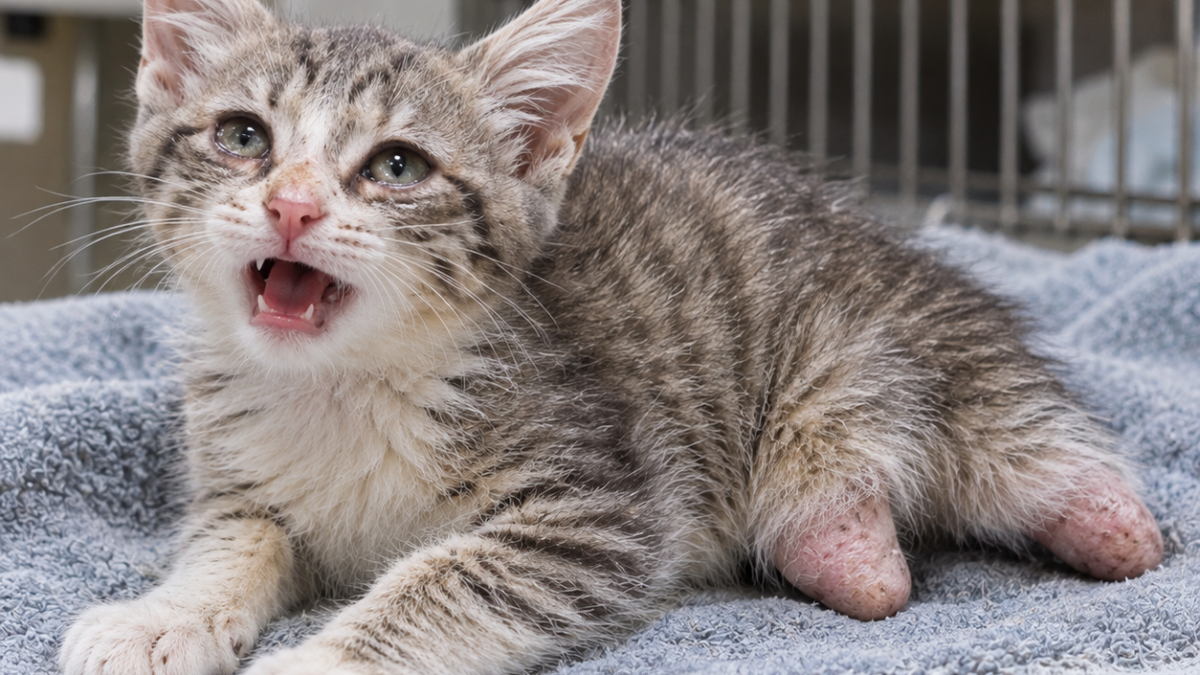
Born Without Back Paws, Mike Never Knew She Was Different—Then Everyone Around Her Began to See Her Differently
Mike was only two months old when one tiny detail made everyone stop and look twice.
She had been born without paws on either back leg, and no one could say exactly what that would mean for her future.
But the little kitten staring back at them seemed completely unaware that anyone expected her life to be limited.
Mike did not know she was unusual.
That was probably the first important thing about her.
She did not know what a normal kitten was supposed to look like.
She did not know that most cats ended their back legs with neat little paws, tiny pads, and sharp claws they could hook into fabric whenever someone tried to move them from a comfortable place.
She did not know that veterinarians would look at her hind legs longer than they looked at the legs of other kittens.
She did not know people would lower their voices when talking about her future.
She did not know anyone was worried.
Mike only knew that the room was new.
The smells were interesting.
There were things to investigate.
And if someone placed her on a blanket and expected her to stay there quietly, that person was going to be disappointed.
She was barely two months old.
Small enough to fit comfortably against a person’s chest.
Young enough that almost everything still felt like a discovery.
A shoe left on the floor could become an object worth studying for several minutes.
A moving string demanded immediate attention.
A sound from the other side of a door meant something interesting was probably happening without her.
And that, in Mike’s opinion, was unacceptable.
The first time someone noticed the shape of her back legs, the reaction was not horror.
It was confusion.
Something looked different.
The rear legs were there.
Mike could move them.
She could shift her body.
PART2:
She could attempt to push herself forward.
But the paws that should have been at the ends of both hind legs simply were not.
The legs ended differently.
No little rear toes.
No normal paw pads.
Nothing that matched the front feet she used so confidently to grab, climb, pull, and explore.
For a moment, everyone simply looked.
Then Mike moved.
That was what she did whenever people spent too long thinking about her body.
She interrupted them by living in it.
She wriggled.
Turned.
Reached toward the edge of the blanket.
Something beyond it had caught her attention.
Whatever questions the humans had could apparently wait.
Mike had somewhere to go.
The veterinary visit came quickly.
Nobody wanted to make assumptions.
Sometimes visible differences in a very young animal are only one part of a larger medical condition.
There could be problems with bones.
Joints.
Nerves.
Spine.
Internal development.
Pain that a kitten could not explain.
The people caring for Mike needed to know whether she was comfortable and whether her unusual legs created any immediate danger.
So she was carried into the clinic.
Mike did not appear impressed by the seriousness of the occasion.
There were smells everywhere.
Dogs.
Cats.
Disinfectant.
Food.
Humans.
Something metallic.
Something interesting beneath a chair.
She stretched toward it.
Her caregiver redirected her.
Mike tried again.
The veterinarian examined her front paws first.
Normal.
Chest.
Heart.
Eyes.
Ears.
Mouth.
Weight.
Temperature.
Then the rear legs.
The veterinarian handled them carefully.
Mike looked over her shoulder as though wondering why everyone had suddenly become fascinated with the least interesting part of her body.
The legs were assessed for movement.
Sensitivity.
Bone structure.
Joint alignment.
Skin condition.
Any indication that pressure from movement was already causing injury.
There was no obvious answer explaining why both rear paws were absent.
It could have been congenital.
Something that happened during development before birth.
But nobody could say with complete certainty.
There was no point pretending they knew more than they did.
That uncertainty frightened the humans more than it frightened Mike.
Mike had no interest in explanations.
She had never had rear paws.
She did not miss them.
People can spend a great deal of time grieving something an animal has never experienced as a loss.
The veterinarian seemed to understand that.
The most important question was not:
Why does Mike look different?
It was:
How is Mike doing?
And the answers were encouraging.
She was alert.
Eating.
Growing.
Responsive.
Curious.
Engaged with people.
Interested in her surroundings.
There was no sign that Mike herself believed something had gone terribly wrong.
The veterinarian explained that her development would need to be monitored.
Her body would change rapidly over the coming months.
She would gain weight.
Her bones would grow.
Her muscles would develop.
The way she moved at two months old might not be the way she moved at six months or a year.
Pressure on the ends of the back legs could become important.
Her skin needed to be protected.
Her hips and spine needed watching because compensating for missing paws could place different forces on the rest of her body.
But none of that meant they needed to turn Mike’s life into one long medical procedure.
There was no reason to stop her from discovering what she could do.
No reason to surround her with fear.
No reason to make every room a place where someone constantly told her:
Careful.
No.
Don’t.
You can’t.
So the plan was surprisingly simple.
Keep her safe.
Monitor her.
Feed her well.
Watch how she grows.
Give her surfaces that did not injure the ends of her back legs.
Let her build strength naturally.
And perhaps most importantly—
let Mike be a kitten.
She returned from the veterinary appointment without knowing that adults had just discussed her future.
She was placed on the floor.
Her caregiver expected her to rest.
Mike had other ideas.
A small object moved several feet away.
She immediately went after it.
Her movement was different from that of a four-pawed kitten.
That was obvious.
Her front half did more work.
She pulled.
Shifted.
Pushed with what she had.
Adjusted her balance.
Sometimes her rear legs moved together.
Sometimes they slid.
Sometimes she found a strange little rhythm all her own.
It was not elegant.
But elegance mattered far more to humans than it did to Mike.
The object moved.
Mike followed.
That was enough.
The first few days became an exercise in watching without interfering too quickly.
That was harder than it sounds.
When people see an animal doing something differently, the instinct is often to help immediately.
Pick her up.
Move her closer.
Place the toy within reach.
Prevent every stumble.
Remove every challenge.
The people around Mike had to learn a different kind of care.
They had to notice the difference between danger and difficulty.
Danger needed intervention.
Difficulty did not always.
If Mike was about to fall from somewhere high, someone stopped her.
If a surface seemed likely to damage her legs, they changed it.
If she became tired, she was allowed to rest.
But if a toy was simply farther away?
Mike could figure that out.
If she needed three attempts to climb onto a low cushion?
She was allowed three attempts.
If she slipped and immediately tried again?
Nobody treated the slip like tragedy.
That freedom changed the way everyone saw her.
At first, people watched her body.
Soon they watched Mike.
Those were not the same thing.
Her personality emerged quickly.
Curious was the first word everyone used.
Then determined.
Then mischievous.
Then, increasingly:
Fast.
Not fast in the way a healthy older cat could sprint across a house.
Mike was still tiny.
But fast relative to what people expected.
The first time someone placed her several feet from an interesting object and then looked away, Mike was suddenly much closer when they looked back.
“How did you get over there?”
Mike did not explain.
She was busy.
She learned which surfaces gave her better grip.
Blankets were easy.
Rugs were excellent.
Smooth flooring required more concentration.
Soft furniture presented challenges but also rewards.
If there was a person sitting on a couch, the couch became especially valuable.
People meant warmth.
Hands.
Attention.
And sometimes food.
Mike learned quickly.
Not formally.
Nobody sat her down and taught a class.
She learned the way kittens learn.
By repeating whatever worked.
Her front legs became strong.
Stronger than anyone expected at first.
She used them not only for normal feline activities but for much of the propulsion her back paws could not provide.
She reached.
Pulled.
Balanced.
If she needed to turn, she shifted her weight differently.
If something blocked one route, she tried another.
Sometimes the simplest path was not the path she chose.
That was also very kitten.
One morning, her caregiver found Mike trying to climb over an object she could easily have gone around.
She slipped.
Tried again.
Slipped.
Looked at it.
Then tried a third time.
Finally, she made it over.
The caregiver laughed.
“You know there was another way, right?”
Mike continued forward.
Victory does not require efficiency.
During those first weeks, the veterinarian’s advice stayed in everyone’s mind.
Watch.
Do not assume.
That became almost a philosophy around Mike.
They watched the ends of her back legs carefully.
Were there red areas?
Sores?
Swelling?
Any places where skin rubbed too hard?
They adjusted bedding.
Added softer surfaces where she spent a lot of time.
Checked her after active play.
Mike tolerated these inspections because she was young and forgiving.
Mostly.
Sometimes she wanted to bite the hand examining her.
Not aggressively.
Playfully.
A finger near her face was still, after all, a moving object.
Moving objects had responsibilities.
They were supposed to be attacked.
Her appetite was good.
That reassured everyone.
Mike ate with the enthusiasm of a kitten whose body had plans.
Growth.
Muscle.
Energy.
More trouble.
She gained weight.
Not too quickly.
Not too slowly.
Her body began changing.
Her chest broadened slightly.
Her front shoulders became stronger.
Her coat filled out.
Her face began losing some of the extremely young kitten roundness.
Yet the expression stayed bright.
Alert.
Always watching.
She was carried along during ordinary parts of her caregiver’s life.
That became important.
Mike did not grow up believing every day revolved around her condition.
Sometimes she simply went along while her caregiver worked.
A bag was prepared.
Blanket.
Food.
Water.
Whatever Mike might need.
Then Mike came too.
To her, these were not accommodations.
They were adventures.
The world beyond the safe space contained an impossible number of smells.
Doors opened to places she had never seen.
Voices belonged to people she had not inspected.
Floors felt different.
Sunlight fell in different shapes.
Machines made sounds.
Paper moved.
Shoelaces appeared.
Mike approached each environment with the same assumption.
This exists.
Therefore, I should investigate it.
People who met her often followed the same pattern.
First:
“Oh.”
They noticed her rear legs.
Then:
“What happened?”
Sometimes no one knew how to answer beyond the truth.
“She was born this way, as far as we can tell.”
Then people watched Mike move.
Within minutes, most of the questions changed.
“Is she always this curious?”
Yes.
“Does she ever stop?”
Eventually.
“When she sleeps.”
“She doesn’t seem bothered.”
Exactly.
That became one of the things her caregiver wished more people understood.
Mike’s life was not an endless emotional reaction to her physical difference.
She was not waking every morning thinking:
I have no back paws.
She woke thinking:
Where is everyone?
Is there food?
What moved?
Can I reach it?
What is behind that door?
Why is this object on the floor?
Can it be pushed?
Can it be bitten?
Can I sit on it?
Her body was not separate from her.
It was simply the body she knew.
The responsibility of the humans around her was not to convince her that she had overcome something.
It was to make sure the environment did not create unnecessary obstacles.
As Mike became more confident, she began interacting more with other cats.
This was another moment when everyone watched too closely at first.
Cats communicate with posture.
Movement.
Distance.
Play.
Chasing.
Wrestling.
A kitten who moved differently might struggle to respond normally.
Or so the humans worried.
Mike did not share the concern.
Another cat entered the room.
Mike noticed immediately.
Her entire body became alert.
The other cat noticed her too.
There was a pause.
Sniffing.
Assessment.
The universal feline question:
Who are you and why are you in my space?
Mike moved forward.
The other cat stepped away.
Mike followed.
The other cat turned.
Mike stopped.
Then something shifted.
A playful movement.
A little bounce.
Mike answered.
Within minutes, the two cats had begun the awkward negotiation that often becomes play.
A paw reached out.
Mike reached back.
The other cat moved away.
Mike chased as best she could.
Not perfectly.
Not at the same speed.
But participation does not require perfect symmetry.
Mike adapted.
She learned where she could corner a toy.
Where another cat might run.
When to wait instead of chase.
She did something cats are exceptionally good at.
She made the environment work for her.
Sometimes another kitten raced away too quickly.
Mike did not sit there feeling defeated.
She found something else.
A toy.
A shadow.
A human ankle.
An unsuspecting piece of fabric.
The world offered alternatives.
She accepted them.
Her caregivers also noticed that other animals rarely reacted to Mike the way humans did.
Cats did not gather around discussing her future.
They reacted to her behavior.
Friendly?
Annoying?
Playful?
Too close?
Sleeping?
Eating from my bowl?
Those were meaningful questions.
Whether she had rear paws was mostly relevant only if it changed an interaction.
That was freeing.
Mike was allowed to be socially ordinary.
Not the special kitten.
Not the fragile kitten.
Just Mike.
Sometimes welcomed.
Sometimes corrected.
Sometimes ignored.
Sometimes invited to play.
That helped her confidence grow.
Then came the dogs.
Humans worried again.
A dog is large when you are a kitten.
Even a gentle one can move quickly.
One excited paw can be dangerous.
Introductions had to be controlled.
Mike was given distance.
The dog was kept calm.
Everyone expected Mike to hesitate.
She looked at the dog.
The dog looked at Mike.
Mike moved closer.
Of course she did.
The dog lowered its head.
Sniffed.
Mike sniffed back.
One caregiver kept a hand ready.
Nothing happened.
Then the dog shifted.
Mike followed.
The dog looked confused.
Perhaps the dog had expected fear.
Mike had none available.
She was too interested.
Over time, those introductions became easier.
Mike learned dogs had smells unlike cats.
Different body language.
Different sounds.
Some moved slowly.
Others required supervision because enthusiasm is not the same as gentleness.
But she did not automatically fear them.
That surprised people.
A tiny kitten without rear paws confidently investigating a dog much larger than herself created a picture people remembered.
But Mike did not do it for inspiration.
She did not know anyone was watching.
She simply wanted to know who the dog was.
Her world expanded.
House.
Workplace.
Vet clinic.
Other cats.
Dogs.
People.
Each new experience gave Mike information.
This sound is safe.
That surface is slippery.
This animal likes play.
That animal wants distance.
This person gives good scratches.
That person carries food.
The important thing was that her caregivers did not teach her to expect danger everywhere.
They protected her without convincing her she was breakable.
That balance became harder as Mike grew.
At two months old, she weighed very little.
The ends of her back legs carried limited pressure.
As she gained weight, the physical question became more important.
Would her skin stay healthy?
Would movement become harder?
Would her hips compensate badly?
Would she develop pain?
The veterinarians continued checking.
Mike returned for follow-up visits.
Each time, she was weighed.
Examined.
Her back legs assessed.
Her gait watched.
Sometimes the veterinarian placed her on the floor and simply observed.
Mike would immediately start moving toward something.
That made evaluation easier.
Nobody needed to persuade her.
The veterinarian watched how her spine moved.
How she used her front end.
Whether she twisted excessively.
Whether one side carried more weight.
How the ends of her back legs contacted the floor.
There were still no guarantees.
Growing animals change quickly.
What worked today might need modification later.
But Mike continued answering the most important questions positively.
Was she eating?
Yes.
Growing?
Yes.
Playing?
Absolutely.
Engaging with other animals?
Whenever they allowed it.
Showing pain?
Not in the ways they would expect.
Her caregivers learned not to confuse unusual movement with suffering.
This distinction mattered.
A person unfamiliar with Mike might see her moving and immediately think:
Poor thing.
But the people who knew her watched her face.
Her appetite.
Her willingness to engage.
Her sleep.
Her behavior before and after activity.
Pain changes animals.
It makes them avoid movement.
Protect parts of the body.
Withdraw.
Lose appetite.
Become irritable.
Mike did the opposite.
She sought activity.
She initiated exploration.
She chose movement even when no one asked her to.
That did not mean she could never hurt.
It meant her difference itself was not evidence of misery.
The longer Mike stayed healthy, the more the language around her changed.
Early conversations included:
What will happen?
Will she manage?
What can she do?
Later conversations became:
Where did Mike go?
What is she into now?
Who left that where she could reach it?
Why is she in there?
How did she get up there?
Her physical difference stopped being the center of every conversation.
Her personality took over.
She loved attention.
At least when she chose it.
Sometimes she would move toward a person and settle close.
Other times she had important kitten business and could not be interrupted.
A hand reaching down might earn a purr.
Or a playful grab.
Or complete indifference.
Again—
normal cat.
That was exactly what her caregiver wanted.
One afternoon, after several weeks of growing and gaining confidence, Mike followed her caregiver through a room.
The woman moved.
Mike came after her.
Turned.
Moved again.
Mike followed.
No food involved.
No toy.
Nothing obviously rewarding.
Just proximity.
The caregiver slowed.
Mike caught up.
For a moment, she looked down at the tiny kitten moving in her own unusual way.
There had been so many discussions about Mike’s legs that it was easy to forget something much simpler.
Mike trusted her.
Not dramatically.
Not because she had been saved from some terrible villain.
Trust had grown through routine.
Being carried safely.
Fed.
Examined gently.
Allowed to explore.
Returned to familiar places.
Picked up when necessary.
Put down when she wanted.
Protected without being smothered.
That is how many animals learn love.
Not through one overwhelming moment.
Through repetition.
You are here.
Then you are still here tomorrow.
And the day after.
And the day after that.
Mike’s purr became louder as she matured.
Sometimes it began almost silently.
A vibration before sound.
Her caregiver would touch her cheek.
Mike would lean.
Then the vibration grew.
People often noticed the purr during the quietest moments.
After play.
During rest.
When Mike settled somewhere warm.
It was tempting to create a larger story around that sound.
To say she was grateful.
To say she understood everything people had done for her.
Maybe she did in her own way.
Maybe not.
What was clear was simpler.
Mike felt safe enough to relax.
That was enough.
As weeks became a month, her appearance changed.
She was bigger.
Healthier.
Stronger.
The small body that had first made people anxious now looked capable.
Not typical.
Capable.
Those words mattered.
Typical describes comparison.
Capable describes the animal in front of you.
Mike’s capabilities were becoming easier to understand because people had stopped assuming them in advance.
She could move farther than expected.
Could play longer.
Could interact with other animals.
Could follow her caregiver.
Could adapt to new environments.
Could learn which surfaces worked best.
Could rest when she needed.
Could choose.
The question was never whether she could perform every task exactly like another cat.
That would have been a pointless standard.
A cat with four normal paws might climb differently.
Jump differently.
Balance differently.
Mike had another body.
Her job was not to imitate theirs.
Her job was to live successfully in hers.
That idea changed how her environment was arranged.
Instead of constantly asking:
How do we make Mike behave like a four-pawed cat?
Her caregivers asked:
How do we make this space work for Mike?
Low steps could help.
Textured surfaces.
Soft places to land.
Routes that allowed her to climb gradually instead of requiring a large jump.
Keeping dangerous heights limited.
Making sure the ends of her back legs did not repeatedly strike rough surfaces.
Small changes.
Not a hospital.
Not a cage.
A home shaped around the animal who lived there.
Mike rewarded those changes by immediately testing their limits.
A low platform meant:
Can I reach the next one?
A ramp meant:
Can I go the wrong direction?
A soft bed meant:
Can I sleep beside it instead?
A toy placed in the safe area meant:
Can I push it underneath furniture?
Caregivers learned that accessibility did not create obedience.
Mike remained Mike.
One evening, she became fascinated with a moving shadow on the floor.
Her caregiver watched from nearby.
The shadow moved.
Mike followed.
It disappeared against furniture.
Mike stopped.
Looked around.
Waited.
The shadow returned.
She lunged.
Missed.
Tried again.
For several minutes, nothing in the world mattered more.
No veterinarian.
No unusual legs.
No uncertain future.
Just a kitten trying to catch something that could never be caught.
That scene stayed with her caregiver because it was so ordinary.
People often search for dramatic proof that an animal with a disability has a meaningful life.
Sometimes proof is a shadow.
Sometimes it is annoyance when dinner is late.
Sometimes it is choosing the warmest place in the room.
Sometimes it is becoming angry because another cat took your toy.
Life does not have to look extraordinary to be valuable.
Mike’s life became full of ordinary things.
Meals.
Naps.
Play.
Traveling alongside her caregiver.
Meeting animals.
Veterinary visits.
Finding comfortable sleeping positions.
Investigating bags.
Climbing where she could.
Trying where she could not.
Learning.
Growing.
She had difficult moments too.
That mattered.
Not every attempt worked.
Some surfaces frustrated her.
Sometimes fatigue arrived sooner than enthusiasm wanted.
The humans around her had to recognize when play had become too much.
Mike did not always have good judgment about that.
Kittens rarely do.
If something was interesting, she wanted it.
Her body could complain later.
So caregivers provided rest even when Mike objected.
Sometimes she was picked up and placed somewhere comfortable.
She looked offended.
Then fell asleep minutes later.
Her rear legs continued to receive special attention.
Skin checks.
Gentle cleaning.
Watching for irritation.
Her growing weight meant every little area mattered.
The veterinarians discussed future possibilities without forcing decisions too early.
Protective coverings might eventually help in certain situations.
Mobility aids could be considered if her movement changed.
Surgical options would only make sense if a specific medical problem developed.
No intervention simply for appearance.
That principle stayed consistent.
They would treat Mike’s needs.
Not people’s discomfort with how she looked.
That distinction protected her from unnecessary procedures.
There is a temptation with physically different animals to “fix” what looks unusual even when the animal is functioning well.
But every intervention has a cost.
Stress.
Anesthesia.
Recovery.
Potential complications.
Mike did not need to be made visually ordinary.
She needed to be comfortable.
Her body continued giving them reasons to wait.
She grew.
Played.
Explored.
Made friends.
The little kitten who had raised medical questions began answering most of them through behavior.
Not all.
Nobody could predict the future perfectly.
But the present was becoming hard to argue with.
Mike was doing well.
Her confidence around dogs became one of the things people loved watching most.
A dog entered.
Mike did not flatten herself or automatically hide.
She observed.
Approached when safe.
Sometimes sat surprisingly close.
A dog might sniff her from head to tail, pausing at the unusual hind legs.
Mike usually seemed more interested in the dog’s face.
One especially calm dog became comfortable enough that Mike would remain nearby without constant supervision.
They did not need to become storybook best friends.
Sharing space peacefully was enough.
Sometimes Mike followed.
Sometimes the dog followed her.
Sometimes they ignored each other.
Again—
ordinary relationships.
That ordinariness was important because it meant Mike’s world was not shrinking around her.
Her difference did not require isolation.
Careful introduction was not the same as keeping her away from life.
The same was true with people.
When strangers met Mike, her caregivers explained enough to keep her safe.
Do not pull on her rear legs.
Do not force her into a position.
Let her approach.
Watch where she is when walking.
Support her body properly if lifting.
After that, people were encouraged to interact normally.
Pet her.
Play.
Let Mike decide.
The kitten responded well.
New people became opportunities.
Different voices.
Different hands.
Different smells.
She was social without being desperate.
Confident without being reckless all the time.
Though sometimes she was absolutely reckless.
One day, Mike attempted to reach a place everyone assumed was beyond her.
She stared.
Measured.
Moved closer.
The caregiver recognized the look.
“No.”
Mike looked back.
Then at the destination.
“No, Mike.”
A pause.
The caregiver stepped closer.
Mike attempted it anyway.
She did not succeed.
She landed safely on the soft surface below.
Immediately looked back up.
The caregiver laughed despite herself.
“No.”
Mike apparently interpreted the laughter as encouragement.
Attempt number two began.
This was another part of loving her.
Not turning determination into mythology.
Mike could be stubborn.
Sometimes her determination was admirable.
Sometimes it was objectively bad judgment.
Her caregivers had to tell the difference.
They blocked the route.
Mike complained.
Then found another activity.
That ability to redirect herself mattered.
Failure did not destroy her confidence.
If one thing was impossible today, the world contained hundreds of other things.
Mike seemed to understand abundance better than the humans.
People focus on the one closed door.
Cats notice the open window.
The loose string.
The cardboard box.
The warm blanket.
The food bowl.
The noise behind the wall.
Mike’s world contained more possibilities than limitations.
Her caregiver slowly began realizing that most of her early fear had belonged to the humans.
Not Mike.
When Mike first arrived, everyone imagined futures.
Would she walk well?
Would she need equipment?
Would she hurt herself?
Would she be accepted by other animals?
Would she have a normal life?
Mike never asked for normal.
She asked for access.
Food.
Safety.
Love.
Freedom.
Once given those things, she constructed the rest herself.
Around the one-month mark, the difference between the kitten from the first examination and the kitten everyone knew now was striking.
Not because rear paws had appeared.
They had not.
Mike was still Mike.
Her physical difference remained.
The change was in everything around it.
Her body had grown.
Her front legs were stronger.
She moved with far more confidence.
Her caregivers had stopped rushing toward her every time she did something unusual.
Other animals treated her as part of the environment.
People who knew her no longer began every sentence with:
Poor baby.
Instead:
Mike, get out of there.
Mike, leave that alone.
Mike, where are you going?
Mike, that belongs to the dog.
Mike, why are you awake?
Mike.
Just Mike.
That may have been the greatest success of all.
She became an individual before she became an example.
Her story could have been told as tragedy.
Born different.
Uncertain future.
Medical questions.
It could also have been told as triumph.
Brave disabled kitten overcomes impossible odds.
Neither version felt completely right to the people closest to her.
Because Mike was not tragic.
And she did not spend every morning overcoming herself.
She lived.
That was the story.
Her difference influenced how she lived.
Of course.
It mattered.
Ignoring it would have been careless.
But it did not define every experience.
Mike still disliked waiting.
Still liked exploration.
Still became sleepy after active days.
Still responded to affection.
Still had preferences.
Still made decisions that made sense only to a kitten.
Still watched moving objects with complete concentration.
Still turned ordinary spaces into territory requiring inspection.
Those qualities were not inspirational.
They were personal.
They belonged to Mike.
As she continued growing, veterinary monitoring remained part of her routine.
The people around her understood that success today did not guarantee that her needs would never change.
A young kitten’s body is flexible.
An adult cat carries more weight.
Joint stress can emerge later.
Skin exposed to repeated contact can become vulnerable.
The safest plan was not complacency.
It was attentiveness without fear.
That balance became easier.
Check.
Observe.
Adjust.
Then continue living.
A follow-up examination brought more good news.
Weight gain appropriate.
Muscle development encouraging.
Skin healthy.
No major signs of discomfort.
The veterinarian watched Mike move.
Mike crossed the room toward something she had decided was interesting.
The veterinarian smiled.
“She has a system.”
That was exactly it.
Mike had a system.
Not one anyone designed for her.
Her own.
She used her body efficiently.
Front legs carried much of the work.
Her back legs provided what support they could.
She shifted momentum.
Used surfaces.
Adjusted routes.
A movement that looked awkward to someone seeing it once looked purposeful to someone who knew her.
That was another lesson.
Difference often looks like dysfunction until you understand the pattern.
Mike’s pattern worked.
The veterinarian did not promise it would work forever.
Nobody needed promises.
They had a healthy kitten today.
They would care for tomorrow when tomorrow arrived.
That philosophy freed Mike’s caregiver from constantly imagining disaster.
She had spent the early days looking at Mike and wondering what might happen months or years later.
Eventually she realized how much of the current life that fear could steal.
Mike did not have unlimited time as a kitten.
No kitten does.
Soon she would be larger.
More settled.
Some habits would remain.
Others disappear.
If everyone spent the first months anxiously waiting for future problems, they would miss who Mike was now.
So the caregiver began deliberately enjoying the present.
The tiny sound Mike made when she wanted something.
The way she positioned herself before moving quickly.
The ridiculous determination around toys.
The way she could become completely still when watching something.
The purr that began before she was fully settled.
The surprising comfort around dogs.
The casual friendships with cats.
The confidence.
One evening, Mike slept deeply near her caregiver.
The woman looked down at the rear legs that had once caused so much uncertainty.
They were resting naturally.
No tension.
No injury.
Mike’s breathing was slow.
A paw—one of the front ones—rested over her nose.
She looked completely at peace.
That image was quieter than any dramatic story people could tell about her.
But it represented what everyone had been trying to give Mike from the beginning.
Not achievement.
Not performance.
Comfort.
A body that could rest.
A place where she was safe enough to sleep deeply.
Someone nearby who would notice if something changed.
That is care.
Mike woke later and immediately started trying to attack the blanket.
Peace had lasted long enough.
As she entered the next stage of kittenhood, her social confidence grew.
She became increasingly willing to explore spaces without constantly checking where her caregiver was.
That independence was bittersweet.
Early on, Mike had followed closely partly because everything was new.
Now she knew more.
She could move away.
Investigate.
Return.
The caregiver watched from a distance.
Mike’s world was becoming hers.
Not something borrowed through another person.
That was important.
Animals with disabilities are sometimes loved in ways that accidentally make them dependent.
People do everything.
Carry constantly.
Place food directly beside them.
Prevent all effort.
Remove every obstacle.
The intention is kindness.
But the result can be a life where the animal never learns its own capabilities.
Mike’s caregivers wanted another outcome.
Help when needed.
Freedom when possible.
She learned routes.
Found sleeping spots.
Understood where food appeared.
Located people.
Interacted.
If she encountered a manageable challenge, she worked through it.
Success built confidence.
Confidence created more exploration.
More exploration built strength.
The cycle reinforced itself.
This did not mean leaving her to struggle unnecessarily.
It meant respecting that effort has value.
One day, Mike needed to cross a section of flooring she disliked.
She stood at the edge.
The caregiver almost picked her up.
Stopped herself.
Mike tested the surface with one front paw.
Pulled back.
Tried again.
Then crossed slowly.
At the other side, she continued as though nothing significant had happened.
For her, perhaps nothing had.
For the caregiver, it was another reminder.
Do not steal small victories because you are afraid of small difficulties.
Mike continued meeting dogs.
One became especially curious about her.
The dog would lower its head and watch Mike move.
Mike sometimes approached its front paws.
The size difference looked absurd.
The dog could have stepped over her.
Instead, it remained gentle.
Mike learned that the dog’s body could provide warmth.
She occasionally settled nearby.
The first time she leaned against the dog, everyone wanted a photograph.
Mike woke immediately.
Moved away.
The perfect moment ended.
That was fitting.
Mike had no responsibility to provide symbolism.
Her relationships existed for her.
Not the camera.
Still, photographs accumulated.
Mike growing.
Mike exploring.
Mike beside another cat.
Mike watching a dog.
Mike being held.
Mike sitting somewhere no one expected her to reach.
Looking back through them created a record of growth.
The earliest images showed a very small kitten whose unusual legs dominated the eye.
Later images showed a kitten whose face took over.
Confidence does that.
Once people know an animal, they stop seeing the medical description first.
Mike was no longer:
the kitten without back paws.
She was the kitten who tried to get into everything.
The kitten who came along during work.
The kitten who made friends.
The kitten who followed.
The kitten who had opinions.
The kitten who seemed unaware anyone had ever been worried.
That did not make her difference disappear.
It placed it where it belonged.
Inside a larger identity.
Months ahead would bring more examinations.
Potential adjustments.
Perhaps new methods of protecting her legs.
Maybe challenges nobody could predict yet.
But Mike had already changed the question everyone asked.
At first:
What will she be unable to do?
Later:
What does she want to do, and how do we help her do it safely?
That is a much better question.
It begins with possibility rather than absence.
The people around Mike started applying it to everything.
Can she interact with other cats?
Let her try safely.
Can she meet dogs?
Controlled introduction.
Can she travel alongside her caregiver?
Prepare properly.
Can she explore this room?
Remove true hazards.
Then yes.
Can she play?
Of course.
Can she climb?
Some things.
Give her safe routes.
Can she have a full life?
Watch her.
She was already having one.
There is a difference between extending life and allowing life.
Mike had both.
Good care protected her health.
Freedom gave that health meaning.
One without the other would have been incomplete.
A perfectly protected kitten who never explored would not have been Mike.
An unrestricted environment with no attention to her physical needs would have been irresponsible.
Love existed between those extremes.
Attention without control.
Protection without imprisonment.
That balance is difficult.
The people around Mike did not always get it right.
Sometimes they worried too much.
Sometimes Mike did something that proved they should have worried more.
They adjusted.
That was part of it.
Care is not perfect prediction.
It is responsiveness.
Notice.
Learn.
Change.
Mike made learning easy because she communicated clearly through behavior.
If she was tired, eventually she stopped.
If something irritated her legs, it showed.
If she liked a space, she returned.
If she disliked something, she made that opinion known.
If she wanted attention, she could become remarkably persuasive.
Her caregiver learned to trust those signals while still remembering that cats can hide discomfort.
Regular veterinary checks continued.
Observation continued.
But anxiety no longer filled every gap.
At home, Mike became increasingly playful.
She developed favorite objects.
Not necessarily expensive toys.
Cats rarely respect shopping budgets.
A small moving piece of something could outperform a carefully designed toy.
Boxes remained excellent.
Fabric was interesting.
Anything that rolled unpredictably demanded pursuit.
Mike’s style of play adapted naturally to her movement.
She did not need to chase the way another kitten did.
She could position herself.
Wait.
Pounce from closer range.
Use her front paws aggressively.
Grab.
Bite.
Wrestle.
She learned through repetition where her advantages were.
Her front body strength became useful during play.
Sometimes another cat underestimated her.
That mistake did not last.
Mike could hold her own.
Not always.
She was still small.
But enough.
The other animals adjusted to her as she adjusted to them.
That mutual adaptation fascinated the humans.
Nobody held a meeting.
Nobody explained Mike’s condition to the cats.
They interacted.
Learned.
Moved on.
Maybe humans could learn something from that.
Notice what matters.
Adapt where necessary.
Then stop making difference the topic of every conversation.
Mike certainly would have preferred that.
If she understood the concept.
Around this time, visitors began asking more questions about her future.
Would she need prosthetic paws?
Would she ever move normally?
Would surgery help?
Could she jump?
Would she have arthritis later?
Some questions had possible answers.
Others did not.
Her caregivers became comfortable saying:
“We don’t know yet.”
That phrase had once felt frightening.
Now it felt honest.
Not knowing did not mean disaster was waiting.
It meant Mike was growing.
They would respond to the animal she became rather than the imaginary one they feared.
Could prosthetics someday help?
Maybe.
Would Mike tolerate them?
Unknown.
Would they improve her quality of life enough to justify the stress?
That would need evaluation.
Could protective sleeves help her skin?
Possibly.
Would they restrict movement?
Maybe.
Every decision had to pass one test.
Does this improve Mike’s actual life?
Not:
Does this make her look more typical?
Not:
Does this make people feel better?
Mike remained the center.
That principle prevented the story from becoming about human heroism.
Her caregivers were important.
Veterinarians were important.
But Mike was not a project designed to prove how kind people could be.
She was a cat.
The goal was not to produce an inspiring transformation.
It was to let her live well.
If that inspired people, fine.
But inspiration was a side effect.
Not the treatment plan.
As Mike’s body continued growing, she became more physically secure.
Her movements, though unconventional, looked less tentative.
The awkwardness of very early kittenhood faded.
Strength created control.
Control created confidence.
She no longer paused as often before moving.
Some routes were automatic now.
The body remembers solutions.
Her caregiver noticed this when Mike crossed the room one morning.
Weeks earlier, she would have watched every movement carefully.
Now she barely looked up.
Then realized what had happened.
Mike had become ordinary in her mind.
Not because anything changed about the paws.
Because familiarity replaced fear.
The caregiver smiled.
Mike reached her destination and began investigating a bag.
“Absolutely not.”
Ordinary.
Exactly.
There were still emotional moments.
A photograph from the first veterinary visit appeared on a phone.
Tiny Mike.
The back legs drawing immediate attention.
The caregiver remembered how uncertain everyone had felt.
Would she be comfortable?
Would she struggle?
What would growing do?
Then she looked across the room.
Mike was trying to steal something from another animal.
The contrast created emotion not because Mike had become someone different.
Because she had been allowed to become more fully herself.
The first photograph showed what people feared.
The present showed what they had not known enough to imagine.
That is often the danger of judging a young animal too early.
A body difference is visible immediately.
Adaptation takes time.
Personality takes time.
Strength takes time.
Skill takes time.
If people make permanent conclusions from the first moment, they may never see what the animal could teach them later.
Mike had been given time.
And space.
And that combination revealed more than any early examination could.
The veterinarian continued to be pleased.
There was no reason to promise an entirely complication-free future.
No ethical professional would.
But Mike’s current quality of life remained good.
Her skin was monitored.
Mobility adequate for her lifestyle.
Appetite strong.
Development appropriate.
Engagement excellent.
The veterinarian watched her move again.
Mike crossed toward a cabinet.
“Does she always head directly for the thing she shouldn’t touch?”
Her caregiver laughed.
“Yes.”
“Good.”
“Good?”
“Curiosity is useful.”
Mike reached the cabinet.
The caregiver moved her away.
The veterinarian smiled.
“Maybe not for you.”
Another month passed.
Mike’s relationships with animals became more established.
Some cats liked her.
Some tolerated her.
Some wanted nothing to do with kitten energy.
Dogs varied too.
Mike learned social boundaries.
A hiss meant stop.
A growl meant distance.
A relaxed body meant maybe approach.
She made mistakes.
Received corrections.
Adjusted.
Social learning mattered as much as physical development.
A kitten protected from every animal because she looked fragile would have missed that education.
Instead, Mike became increasingly confident and appropriately cautious.
Not fearful.
Informed.
One calm dog became almost background furniture to her.
She moved around it without concern.
Sometimes she rested nearby.
Sometimes the dog sniffed her.
Nothing dramatic.
That peaceful normality mattered.
Her world had room for difference without making it an event.
At work with her caregiver, Mike became familiar to people.
They stopped saying:
“What happened to her legs?”
And started saying:
“Where’s Mike?”
If she was absent, people noticed.
If she appeared, someone greeted her.
She had become part of the routine.
That was belonging.
Not being tolerated as a special exception.
Being expected.
There is a quiet difference between a place allowing you and a place noticing when you are gone.
Mike had the second.
She moved through these spaces with growing confidence.
Her caregiver still prepared everything she needed.
Still watched surfaces.
Still prevented unsafe situations.
But the preparation became routine.
Accessibility often becomes invisible when done well.
A blanket placed here.
A safer route there.
An object moved so Mike would not catch a leg.
Nothing dramatic.
Just design shaped around reality.
Mike benefited without needing to understand why.
Her caregiver began thinking about the phrase people used around disabled animals.
“Despite.”
Mike plays despite having no back paws.
Mike explores despite her difference.
Mike makes friends despite her disability.
The word began bothering her.
It made Mike’s body sound like an enemy she defeated every morning.
Maybe sometimes “despite” was appropriate.
There were challenges.
But often Mike did things not despite her body—
with it.
Through it.
Because she had learned it.
Her movement style existed because of the body she had.
Her front strength developed because of the work she did.
Her strategies were hers.
The body was not separate from the accomplishment.
Mike did not overcome being Mike.
She became skilled at being Mike.
That was more accurate.
And more respectful.
Her story also changed how people thought about strength.
Strength is often imagined as dramatic.
Surviving danger.
Fighting.
Enduring pain.
Mike’s strength was quieter.
Trying again.
Learning.
Adapting.
Resting when tired.
Trusting the environment.
Staying curious.
There had been no catastrophic event in the story anyone knew.
No villain.
No dramatic rescue from cruelty.
Mike simply entered life with a body that looked different.
And because the people around her responded with care rather than panic, that difference did not become a tragedy.
That was powerful in another way.
Not every meaningful animal story needs a monster.
Sometimes the challenge is expectation.
The assumption that a body outside the usual pattern must create an unhappy life.
Mike contradicted that assumption every day without knowing it existed.
She ate.
Played.
Slept.
Investigated.
Made friends.
Grew.
Purred.
What else was a kitten supposed to do?
If someone had asked Mike whether she felt brave, she probably would have bitten the question.
Or ignored it.
She did not need bravery to chase a toy.
She needed interest.
Interest she had.
In abundance.
Her purr became part of the household soundtrack.
Sometimes barely audible.
Sometimes surprisingly loud for her size.
If she settled against her caregiver after an active day, the vibration could be felt before it was heard.
There was something moving about that.
The same small body that had made people afraid now relaxed completely against someone.
No tension.
No awareness of being watched.
No performance.
Just comfort.
Her caregiver would run a hand along her back.
Mike leaned.
Eyes partly closed.
Purr steady.
Then perhaps a sound elsewhere caught her attention.
Purr stopped.
Head up.
Adventure resumed.
That was Mike.
Love did not turn her into a passive symbol.
It made her secure enough to keep leaving the lap.
That might be one of the best measures of good care.
An animal loves you—
and still feels safe moving away.
Mike knew she could return.
That knowledge creates freedom.
As the seasons changed, so did Mike.
The tiny two-month-old kitten became visibly older.
Not adult yet.
But no longer fragile-looking in the same way.
People meeting her for the first time still noticed the legs.
People who knew her noticed the expression.
She had become confident enough that her movement did not invite immediate worry.
It was simply recognizable.
“That’s Mike.”
The caregiver sometimes watched strangers meet her and could almost predict the sequence.
Eyes to face.
Then rear legs.
Pause.
Question.
Then Mike did something funny.
The mood changed.
It happened again and again.
Mike’s personality refused to let pity stay in the room for long.
That was not because pity is always cruel.
Concern can come from compassion.
But pity becomes limiting when it prevents seeing the living individual.
Mike demanded to be seen because she was too busy being herself.
Her veterinarian eventually said something the caregiver remembered.
“Her job isn’t to reassure us.”
That was true.
Mike did not exist to make people feel optimistic about disability.
She could have developed complications.
She might someday.
If that happened, care would change.
The lesson was not:
Everything always works out.
The lesson was:
Assess the individual in front of you.
Do not write the ending before the animal has lived the middle.
Mike was still living the middle.
And she was doing it enthusiastically.
Her caregivers continued watching her weight carefully.
Extra weight could place unnecessary stress on her movement.
Healthy growth mattered.
Overfeeding would not be kindness.
So meals remained appropriate.
Play encouraged.
Veterinary guidance followed.
Mike disagreed with any restriction involving food.
That, too, made her ordinary.
She learned meal sounds.
Packaging.
Bowls.
Footsteps associated with feeding.
If someone entered the food area, Mike became interested immediately.
Her lack of rear paws did nothing to reduce her ability to appear exactly where food might exist.
Her caregiver joked that hunger improved mobility.
Mike did not appreciate jokes made at her expense.
Probably.
She appreciated the food.
Another small milestone arrived unexpectedly.
Mike crossed a larger space faster than anyone had seen before.
Something startled or excited her.
She moved.
Quickly.
Front legs pulling with surprising force.
Body coordinated.
The caregiver watched with her mouth open.
Then laughed.
Mike stopped.
Looked back.
For a second, the caregiver remembered the first day.
Tiny body.
Questions.
No answers.
Now this.
Not normal movement.
Mike’s movement.
Efficient enough.
Confident enough.
Hers.
That evening, the caregiver wrote down a few observations for the next veterinary appointment.
No skin irritation.
Appetite strong.
Energy high.
Social behavior good.
Movement improving with strength.
Then she paused.
Added:
Seems happy.
Not a medical measurement.
Still important.
Quality of life cannot be reduced to one laboratory result.
It lives in behavior.
Interest.
Rest.
Connection.
Choice.
Mike displayed all of them.
At the next appointment, she explored the examination table.
The veterinarian smiled.
“Still happy?”
The caregiver nodded.
“Very.”
Mike attempted to inspect the edge of the table.
The veterinarian gently redirected her.
“Maybe too happy.”
The exam remained reassuring.
They discussed long-term monitoring.
No urgent intervention.
Continue.
Watch.
Protect.
Let her live.
That became the rhythm.
By this point, the word “freedom” had taken on a different meaning for Mike’s caregiver.
At first, freedom sounded like allowing Mike to roam everywhere.
That was not it.
Freedom needed safety underneath it.
A kitten cannot be free if every movement risks injury.
But safety without choice becomes confinement.
True freedom was more subtle.
A space prepared enough that Mike could make decisions inside it.
She could choose where to move.
What to investigate.
Which animal to approach.
When to rest.
Whether to seek attention.
The environment did not constantly remind her of what she lacked.
It offered routes.
Mike chose among them.
That was perhaps the most important gift she received.
Not a device.
Not a procedure.
Not some dramatic medical breakthrough.
A world arranged so she could participate.
Participation changed everything.
Because Mike did not need people to give her a life.
She needed them not to block the one she was already trying to live.
Another animal might have needed different support.
That mattered too.
Mike’s story was not proof that every cat with limb differences will require little medical intervention.
Some animals need surgery.
Prosthetics.
Carts.
Pain management.
Extensive therapy.
Each body is different.
Mike’s success belonged to Mike.
The lesson was not to ignore disability.
It was to respond specifically rather than automatically.
Her caregivers did that.
They watched the individual.
Mike kept showing them what she needed.
And what she did not.
She needed safe surfaces.
She did not need constant carrying.
Needed monitoring.
Did not need isolation.
Needed medical assessment.
Did not need to be treated as sick when she was healthy.
Needed rest.
Did not need every challenge removed.
Needed love.
Did not need pity.
Those distinctions created the life she had.
As she grew even more confident, Mike’s caregiver realized she had stopped counting milestones.
In the beginning, every development felt significant.
First veterinary check.
First week.
Weight gain.
Stronger movement.
First successful interactions.
First month.
Eventually, life stopped being a recovery chart.
There was nothing to recover from.
Mike was developing.
The calendar became ordinary.
Monday.
Tuesday.
Vet visit sometime next week.
Work.
Meals.
Play.
Sleep.
Mike.
That normality may have been the final milestone.
Not needing milestones anymore.
She belonged to the rhythm of the days.
Visitors still found her remarkable.
The caregiver understood.
Seeing Mike for the first time could be emotional.
But she also smiled when someone said:
“She doesn’t even know she’s different.”
The phrase was almost right.
Mike certainly did not appear burdened by comparison.
But perhaps animals know their bodies better than humans imagine.
Mike probably knew she moved differently from other cats.
She watched them.
Played with them.
Adapted around them.
What she did not know was that difference was supposed to carry shame.
That was the important part.
She had no cultural story telling her that missing paws made her less.
No expectation that her value came from matching an ideal body.
She knew only experience.
Can I reach that?
Maybe.
Try.
Can I play with that cat?
Go closer.
Can I sit near that dog?
Find out.
Can I follow my caregiver?
Yes.
Can I climb this?
Sometimes.
Can I eat now?
Apparently not yet.
Life was practical.
And because the people around her did not load every difference with sadness, Mike had room to form her own relationship with her body.
It was functional.
Interesting.
Sometimes inconvenient.
Sometimes impressive.
Always hers.
Her story began attracting attention because people are drawn to animals who look different.
Photos made people pause.
Questions followed.
The caregiver tried to share Mike carefully.
Not as a tragedy.
Not as a miracle cure.
No false claims.
Born without back paws.
Cause uncertain.
Veterinary monitoring.
Healthy development so far.
Curious.
Playful.
Social.
Doing well.
That was enough.
The truth did not need exaggeration.
Mike herself was compelling.
A video of her moving toward a toy communicated more than a paragraph about resilience.
A photograph beside a dog communicated confidence.
A quiet clip of her purring communicated comfort.
People responded.
Some wrote about their own special-needs animals.
Cats missing limbs.
Dogs using carts.
Animals born with deformities.
Senior pets learning new ways of moving.
Stories accumulated.
Not all with perfect endings.
But many with the same central idea.
Quality of life is individual.
Do not decide from appearance alone.
Mike became part of a larger conversation without knowing it.
She remained focused on important things.
Like attacking fabric.
Her caregiver sometimes read messages while Mike slept nearby.
People said:
“She gives me hope.”
“I needed this today.”
“My cat was born different too.”
“We almost gave up on our dog until we saw how happy he still was.”
Those messages were meaningful.
But the caregiver always looked at Mike afterward and remembered:
She is not responsible for carrying everyone’s hope.
She is allowed to simply be a cat.
That kept the storytelling grounded.
Mike could inspire people.
Fine.
Then let her nap.
Let her be annoyed.
Let her dislike something.
Let her fail.
Let her have bad days.
An inspiring animal should not lose the right to ordinary imperfection.
Mike certainly did not.
She could be demanding.
Stubborn.
Inconvenient.
Occasionally determined to enter places that were closed specifically for her safety.
One afternoon, her caregiver spent several minutes creating a comfortable resting area.
Soft bedding.
Perfect position.
Mike inspected it.
Then slept on a piece of cardboard two feet away.
That photograph became a favorite.
Nothing summarized cats better.
Mike did not want the sentimental version of care.
She wanted options.
Weeks passed.
Then months.
Her growth continued.
At every stage, the same principles held.
Veterinary monitoring.
Safe environment.
Weight management.
Social experiences.
Freedom.
Observation.
No unnecessary attempts to force normality.
Her movement pattern matured with her body.
The front legs remained powerful.
Shoulders developed.
Back-end movement became coordinated enough for daily life.
She still could not do everything another cat could.
That remained true.
Certain jumps were unrealistic.
Some high surfaces needed ramps or steps.
Rough terrain could be dangerous.
Long activity could tire her.
These limits were acknowledged.
Not denied.
A good story does not require pretending limitations do not exist.
Mike’s strength was not that she secretly had no limitations.
It was that limitations did not erase everything else.
She could not do some things.
She could do many.
That is true of every living being.
The proportions simply differ.
Her caregivers focused on abundance.
What exists?
What works?
What brings comfort?
What keeps her engaged?
That approach created a life built around possibility without denying reality.
Mike continued making friends with dogs.
This remained funny because she approached some dogs with a confidence far larger than her body.
The introductions were always supervised.
But once familiarity developed, she seemed comfortable.
One dog became a regular companion.
They shared space.
Sometimes slept near each other.
Mike could move close without fear.
The dog learned to step carefully.
That mutual awareness became beautiful because neither animal needed to become something else.
The dog remained large.
Mike remained small and physically different.
They adjusted.
Relationships are often exactly that.
Not sameness.
Adjustment.
Mike’s interactions with other cats remained more complicated, because cats are cats.
Some loved play.
Some preferred distance.
Mike learned which was which.
She occasionally ignored warnings.
Then learned faster.
A hiss can be educational.
The caregivers allowed healthy communication as long as nobody was at risk.
Mike became socially competent.
Again, something she might have missed if isolated for protection.
Her world remained wide.
That was the recurring theme.
Every thoughtful decision expanded rather than contracted her life.
Safe flooring expanded movement.
Medical monitoring expanded confidence.
Controlled introductions expanded relationships.
Traveling with her caregiver expanded experience.
Allowing effort expanded skill.
Love expanded security.
The absence of rear paws did not disappear.
The consequences became manageable.
There is a profound difference.
One night, after a particularly active day, Mike settled beside her caregiver and began purring.
Quiet at first.
The woman placed a hand against her side.
The vibration strengthened.
Mike’s eyes closed.
For a few minutes, nothing happened.
No toy.
No exploration.
No medical observation.
Just a kitten and a person.
The caregiver remembered how people had looked at Mike during the first examination.
Concerned.
Curious.
Uncertain.
She wished she could send that early version of herself this moment.
Not as proof that every worry had been foolish.
The worries had helped them prepare.
But as a reminder:
Do not let fear become the whole story before the story has begun.
Mike’s scars were not visible in the way dramatic rescue scars are.
Her difference had been there from birth.
The title people might place over her life could easily become something sentimental:
Unloved since birth.
Broken.
Saved.
But that was not the truth the caregiver knew.
Mike’s most meaningful experience was not being rescued from hatred.
It was being met with acceptance before anyone demanded she become different.
Love did not erase scars.
It did not manufacture missing paws.
It did not transform her into a physically typical cat.
Love did something quieter.
It gave her the space to discover that her body was enough to begin.
From there, Mike did the rest.
She learned.
Adapted.
Strengthened.
Trusted.
Played.
Grew.
The purr beneath the caregiver’s hand was not a victory speech.
It was comfort.
That made it more beautiful.
Months earlier, someone might have seen Mike and immediately imagined everything she would never have.
Now the caregiver looked at her and saw what she did have.
A healthy appetite.
Strong front legs.
Curiosity.
Friends.
A safe place.
Veterinary support.
Warmth.
Attention.
Freedom.
And an apparently unlimited ability to find trouble.
Mike woke.
Looked toward a sound.
Purr stopped.
She moved away.
The caregiver smiled.
There she goes.
That became the sentence everyone could have used for Mike’s life.
Not:
Look what she cannot do.
There she goes.
Across the room.
Toward another animal.
Into a new place.
After a toy.
Behind her caregiver.
Through a day that did not need to be extraordinary to be worth living.
There she goes.
As Mike continued growing, nobody pretended to know exactly what adulthood would bring.
Her body might eventually require new support.
Her joints might change.
She could develop pressure areas.
Mobility could become easier in some ways and harder in others.
If that happened, her caregivers would adjust.
They had learned the most useful lesson already.
Listen to Mike.
Not literally.
Behavior.
Body.
Comfort.
Interest.
Let the animal in front of you guide the decision.
That principle would remain no matter how old she became.
And so Mike’s future did not need a promise.
It needed people willing to stay attentive.
She had that.
The kitten who first made everyone look twice became the cat people could no longer stop watching for entirely different reasons.
Not because her back legs were unusual.
Because Mike was Mike.
She entered spaces like they belonged to her.
Investigated animals larger than she was.
Followed people.
Tested routes.
Turned limitations into practical problems.
Turned practical problems into experiments.
Turned experiments into habits.
And then forgot humans had ever been amazed.
Perhaps that was the most extraordinary thing about her.
She never performed resilience.
She simply continued.
There was no moment when Mike decided:
I will overcome this.
No cinematic turning point.
No dramatic realization.
She had been born into her body.
She lived forward from there.
Humans supplied meaning later.
Mike supplied motion.
The people around her became better at separating their fear from her reality.
That may have been the transformation the story was actually about.
Mike changed physically, yes.
She gained weight.
Strength.
Confidence.
Skill.
But the humans changed too.
They stopped looking at missing paws and imagining a missing life.
They learned that adaptation can look strange before it looks ordinary.
They learned that protection can become limitation if fear takes over.
They learned that freedom must be designed, not simply declared.
They learned to ask what Mike needed rather than what would make Mike look more like everyone else.
They learned that a body can be different without being tragic.
And they learned that happiness often looks surprisingly mundane.
A kitten following a person through a room.
A nose investigating a new smell.
A purr beneath a hand.
A dog becoming a friend.
A toy moving across the floor.
A nap after an exhausting afternoon.
Mike did not know she was teaching anyone.
Thankfully.
If she had known, she might have demanded payment in food.
Instead, she continued exactly as before.
Curious.
Busy.
Unconcerned with symbolism.
One afternoon, her caregiver watched Mike move toward an open doorway.
Beyond it was another room.
Nothing dramatic.
Mike had been there before.
Still, she paused.
Looked.
Then continued.
The caregiver thought of the earliest days.
Every doorway then had felt like a question.
Can she?
Should she?
Is it safe?
What if?
Now the questions had become simpler.
Where is Mike going?
The answer:
Wherever interested her.
That was enough.
Her story does not need an ending where she becomes “normal.”
She never needed one.
She does not need four paws to make the story complete.
She does not need to prove every veterinarian wrong, because the veterinarians who cared for her had not sentenced her to failure.
They had watched.
Supported.
Adjusted.
Exactly what good medicine should do.
She does not need to climb the highest shelf.
Run the fastest.
Move like another cat.
She does not need to become an exception so extraordinary that people can feel comfortable believing most animals like her cannot thrive.
Mike only needs to be Mike.
That is the point.
At two months old, she arrived with no rear paws and a future nobody could predict.
People looked twice.
Then they watched.
And the longer they watched, the more the missing pieces became only part of what they saw.
They saw appetite.
Growth.
Curiosity.
Determination.
Sociability.
Confidence.
Play.
Rest.
Trust.
They saw a kitten who met dogs without believing she should be afraid.
A kitten who interacted with cats without needing to be separated from them.
A kitten who followed her caregiver into ordinary days and turned those days into exploration.
A kitten who became stronger because people gave her opportunities to use the body she had.
A kitten who purred because she was comfortable, not because she had somehow defeated herself.
And perhaps most importantly, they saw an animal whose life improved not because someone forced her to fit the world—
but because the world around her made enough room for her to belong.
Mike still does not know that anyone thinks she is different.
Or perhaps she knows and simply does not care.
Either way, the result looks the same.
Something moves.
She notices.
A door opens.
She wants to know what is behind it.
Another animal appears.
She investigates.
A person she trusts sits nearby.
She moves closer.
Sometimes she leans into a hand.
Sometimes the purr starts almost silently.
A small vibration.
Then stronger.
Warm.
Steady.
No grand announcement.
No explanation.
Just a cat comfortable enough to tell the world, in the simplest way she can, that this moment feels good.
The people who worried about Mike’s future once thought they would need to teach her how to live with what she was missing.
Instead, Mike taught them something else.
She was never waiting to become complete.
She already was.
All she needed was the chance to discover what that completeness could look like.
And once she was given that chance, Mike did what she had been trying to do from the very beginning.
She moved forward.
Not the way every other cat did.
Her way.
Toward every sound.
Every toy.
Every animal.
Every new place.
Every ordinary day that opened in front of her.
No rear paws.
No apology.
No idea that anyone had ever expected less.
Just Mike.
And a world she still intended to explore.








