Bikers Saw a 14-Year-Old Walking 6 Kilometers to School With His Three Siblings Every Morning—Then He Admitted Their Parents Had Been Gone for 5 Months and He Was Terrified Someone Would Split Them Up
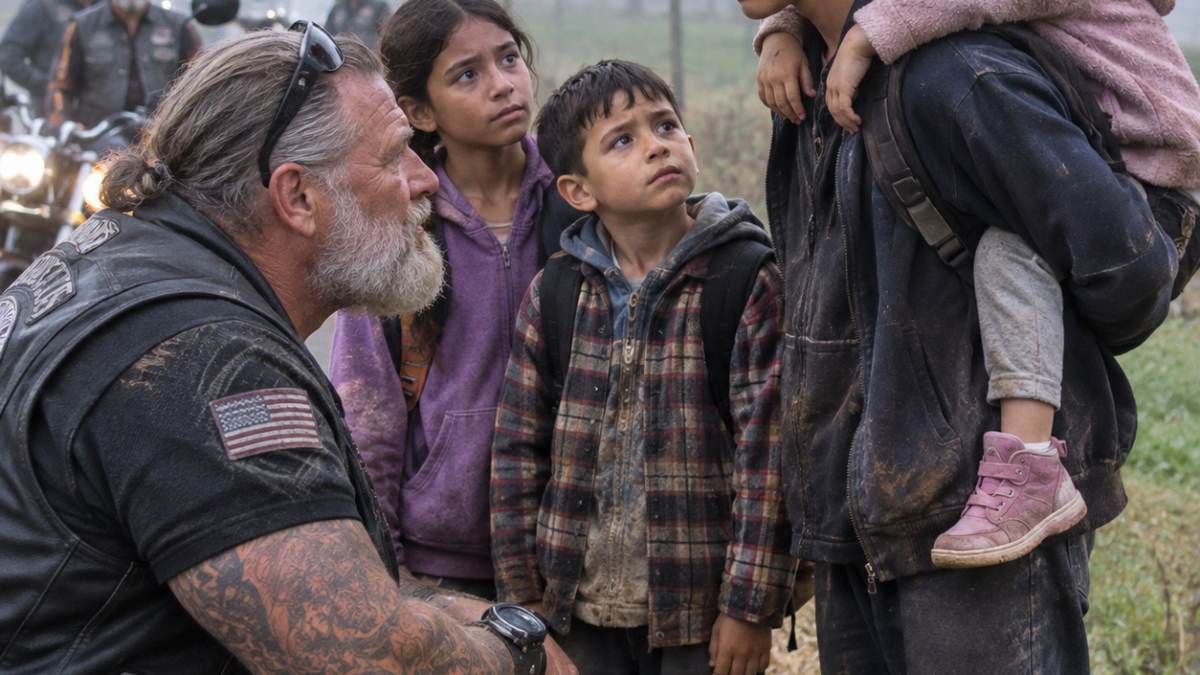
PART2:
School was almost four miles away.
Six kilometers, give or take.
“You walking all the way?”
“Yes, sir.”
“Every morning?”
The boy hesitated.
“Yes.”
Cal nodded.
“Road gets narrow around the Miller bend.”
“We know.”
“I could call somebody if you need a ride.”
“No, thank you.”
Polite.
Immediate.
Cal didn’t argue.
“All right.”
The smallest girl peeked around the boy.
Her cheeks were pink from cold.
She rubbed both eyes.
Cal smiled.
“Long morning?”
She hid again.
The boy said:
“We should go.”
“Okay.”
Cal stepped farther off the shoulder.
“Be careful around that bend.”
“Yes, sir.”
They walked.
We stayed where we were until they disappeared into the fog.
Then Vince said:
“Those kids walk that every day?”
PART3:
Cal put his helmet on.
“I don’t know.”
Nobody said much after that.
But all morning I kept thinking about the smallest one.
Half asleep.
Being carried.
And the way the oldest kept counting.
Tuesday we left fifteen minutes earlier.
Nobody admitted why.
We just happened to.
All seven of us.
Vince brought his pickup instead of his Harley.
That was less subtle.
“You brought a truck.”
“Truck needed driving.”
“At five-thirty?”
“Batteries appreciate exercise.”
We found the children at nearly the same spot.
This time they recognized us.
The little one waved.
The oldest did not.
Cal stopped farther ahead again.
Walked back.
I went with him.
“Morning.”
“Morning.”
The boy was wearing the same gray jacket.
One shoelace had broken.
He had wrapped what remained around the top of the shoe twice and knotted it.
Cal pointed.
“Name?”
The boy looked suspicious.
“Mateo.”
Cal pointed toward himself.
“Cal.”
Then me.
“Ray.”
I nodded.
The girl beside Mateo said:
“I’m Isabel.”
“Nine,” Mateo added.
Like it mattered that we know.
The younger boy said:
“Nico.”
“Seven,” Mateo said.
The little girl raised one hand.
“Mia.”
She held up five fingers.
“Five.”
Mateo almost smiled.
Almost.
Cal said:
“Nice to meet you.”
Mia looked toward the motorcycles.
“Are those loud?”
“Yes.”
“Why?”
“Because we make poor financial decisions.”
I coughed into my fist.
Mateo smiled for maybe half a second.
Then checked his watch.
Cheap digital watch.
Cracked plastic face.
“We need to go.”
Vince had parked his truck farther up the road.
He walked over but stayed behind Cal.
“Mateo, if your folks are okay with it, I could give everybody a ride.”
Mateo looked at the truck.
Then at Vince.
“No, thank you.”
“Could call home first.”
“No.”
“No problem.”
Vince stepped back.
That seemed to confuse Mateo.
He had expected persuasion.
Maybe pressure.
He got neither.
Vince said:
“You’re right not to get in somebody’s vehicle if you don’t know them.”
Mateo looked at him.
“Yeah.”
“We can still make sure traffic sees you around that bend.”
Mateo’s expression tightened.
“We’re fine.”
“Okay.”
Again:
No argument.
The children continued.
We waited.
Then rode slowly until they cleared the narrowest section.
Never beside them.
Never trying to herd them.
Just enough distance that approaching drivers saw seven motorcycles first and slowed.
Wednesday, Cal did something different.
He parked his Harley at the wide shoulder.
Then walked.
The rest of us waited with the bikes.
Mia was dragging by then.
Mateo had started the morning with her walking.
Halfway down the road, he lifted her onto his back.
Her arms went around his shoulders.
Her cheek rested against his jacket.
Mateo kept talking.
Something about pancakes.
Mia mumbled an answer.
He laughed for her.
Not because anything was funny.
Because she was listening.
The moment she fell asleep, Mateo’s face changed.
I saw it from twenty feet away.
Everything cheerful vanished.
His shoulders dropped.
Eyes half closed.
He looked exhausted.
Not sleepy.
Used up.
Cal asked:
“Someone at home able to take over some mornings?”
Mateo adjusted Mia higher.
“We’ve got a routine.”
“What kind?”
Mateo answered immediately.
“I get breakfast ready before they wake up.”
“Isabel checks backpacks.”
“Nico fills water bottles.”
“Mia’s supposed to remember her sweater.”
Nico said:
“She never does.”
“I do sometimes.”
“You forgot today.”
Mia lifted her head from Mateo’s shoulder.
“I’m wearing it.”
Nico frowned.
Mateo said:
“Because Isabel put it in your bag.”
Mia rested again.
Mateo continued.
“We leave early.”
“Mia walks first half.”
“I carry her if she gets tired.”
“We get there before the bell.”
He said all of it like a mechanic explaining startup procedure.
Turn key.
Check pressure.
Release brake.
Machine works.
Cal looked at him for a long moment.
“And your school?”
Mateo frowned.
“What about it?”
“You go too?”
“Yeah.”
I hadn’t noticed until then.
A spiral notebook stuck from Mateo’s backpack.
School folder.
Pencil case.
He wasn’t walking three children to school and returning home.
He attended too.
Every day.
A fourteen-year-old getting three children dressed, fed, packed, walked six kilometers, then sitting through classes as though his morning had been normal.
Cal asked:
“Afternoons?”
“We walk back.”
“And after that?”
Mateo looked at the road.
“Stuff.”
“What stuff?”
“Homework.”
“Dinner.”
“Just stuff.”
Time check.
“We have to go.”
Cal nodded.
“See you tomorrow?”
Mateo didn’t answer.
Mia did.
“Okay.”
That morning, Lena called the school.
Lena Martinez was fifty-eight and had spent twenty-seven years working in a school district office before retirement.
If anybody in our club understood where helpful concern ended and inappropriate interference began, it was Lena.
She did not say:
Four suspicious children.
She said:
Four students appear to be walking approximately six kilometers each morning along an unsafe road.
One is carrying a younger child.
Could someone check whether transportation or family support is needed?
The school thanked her.
Said they would follow up.
Gave no personal details.
Exactly as they should.
Thursday morning, the children were not on the road.
We assumed the school had arranged transportation.
I felt relieved.
Cal didn’t.
He rode the route twice.
Nothing.
“Maybe they got a ride,” I said.
“Maybe.”
Friday afternoon I happened to be driving near their neighborhood.
By then we had learned approximately where they lived.
I wasn’t looking for them.
At least that is what I told myself.
There was a grocery bag outside a small rental house near the end of a gravel lane.
No car in the driveway.
Bread sticking from the top.
Rice.
Apples.
Canned food.
A moment later Mateo opened the door.
He looked down the lane before stepping outside.
Then lifted the bag.
It was heavy enough that he needed both hands.
No note.
Nobody visible.
He carried it inside.
I told Cal.
That evening he said:
“Tomorrow I’m asking.”
“Asking what?”
“Parents.”
Lena looked up from her coffee.
“Carefully.”
“I know.”
“No accusations.”
“I know.”
“No promises.”
“I know.”
“And if something is actually wrong, we involve professionals.”
Cal stared at her.
“Do I look twelve?”
“You act twelve around motorcycles.”
“Fair.”
Saturday morning we found Mateo and the younger three near a community playground.
No school.
They were walking toward the general store.
Cal approached.
Talked about weather first.
Then Mia found a pebble she considered historically significant.
She crouched to examine it.
Cal looked at Mateo.
“Can I ask something?”
Mateo already knew.
His shoulders tightened.
“Where are your parents?”
Isabel looked at him immediately.
Nico stopped swinging his backpack.
Mateo watched Mia.
Waited until she was occupied with the pebble.
Then spoke so quietly I almost missed it.
“They’re gone.”
Cal did not react dramatically.
“Gone where?”
Mateo swallowed.
“Not here.”
“How long?”
Silence.
“Mateo.”
The boy’s eyes changed.
Not defiance.
Fear.
“If you tell anybody, they’ll separate us.”
Everything inside me went still.
Cal stayed where he was.
“Who told you that?”
“Nobody.”
“Then why do you think it?”
“I know what happens.”
“From where?”
“School.”
“People talk.”
“Kids get sent places.”
“Different places.”
“They’ll take Mia first because she’s little.”
His voice cracked on her name.
He recovered instantly.
“I can take care of them.”
Cal asked:
“How long have you been doing that?”
Mateo did not answer.
Isabel did.
“Since May.”
Five months.
Cal’s face did not change much.
I knew him well enough to see the anger behind it.
Not at Mateo.
At the situation.
“Where are your parents?”
Mateo looked at us.
Then finally explained.
Their mother and father were Elena and Rafael Alvarez.
Five months earlier, after an immigration matter they had been unable to resolve in time, they had been required to leave the United States.
All four children had been born here.
Mateo knew that distinction mattered legally.
He did not understand exactly how.
Their parents had tried to arrange care before leaving.
A relative had planned to come to Ohio.
Illness prevented it.
Elena and Rafael gave Mateo phone numbers.
Sent what money they could.
Believed a neighbor was helping.
Mateo made sure they never understood how much responsibility had shifted onto him.
“When they call,” Cal asked, “what do you tell them?”
“That we’re okay.”
“Are you?”
Mateo straightened.
“Yes.”
Mia came running back.
“Look!”
She held up the pebble.
Cal crouched.
“That is an excellent rock.”
“It has sparkles.”
“Definitely valuable.”
Mateo looked relieved the conversation had stopped.
We walked away fifteen minutes later.
Nobody said anything until we reached the bikes.
Then Cal kicked gravel.
Hard.
“We go back.”
Lena stepped in front of him.
“No.”
“Four kids are alone.”
“Yes.”
“So—”
“So we contact the people whose job is to make sure four children are safe.”
“I can stay there.”
“You are not walking into that house and declaring yourself their guardian.”
“They know us.”
“They’ve known us less than a week.”
Cal clenched his jaw.
Lena continued:
“Good intentions are not a safety plan.”
“They need adults.”
“Yes.”
“Qualified adults.”
“Accountable adults.”
“And the parents need to be located and involved.”
Cal looked down the road.
“What if the kid’s right?”
“About being separated?”
“Yes.”
Lena’s voice softened.
“Then the people handling the case need to know how important keeping them together is.”
“But we cannot promise something we do not control.”
Cal hated that answer.
Because it was honest.
We called the school again.
Shared what Mateo had told us.
Provided our names.
Asked to speak with whatever family-support workers became involved.
We emphasized one thing repeatedly.
Mateo had hidden the situation because he was terrified.
Please explain every step to him.
Do not let silence fill itself with his worst imagination.
That afternoon, trained workers met the children.
They contacted Elena and Rafael.
Started checking relatives.
Caregiving possibilities.
Household conditions.
Immediate safety.
A temporary adult caregiver stayed with all four children.
That evening Cal’s phone rang.
Mateo.
Cal answered.
“Hey.”
“You told.”
No greeting.
No question.
Just accusation.
“Yes.”
“You said you wouldn’t make us get in the truck.”
“I didn’t.”
“You told anyway.”
Cal sat at our garage workbench.
The rest of us stayed quiet.
“You four needed adults there tonight.”
“They’re going to take Mia.”
“I don’t know what the final plan will be.”
“Then why did you do it?”
“Because not knowing the outcome doesn’t make leaving four kids alone safe.”
Mateo breathed hard.
“You ruined everything.”
Maybe Cal wanted to defend himself.
He didn’t.
“Maybe that’s how it feels tonight.”
“Some woman is sleeping here.”
“That’s the temporary caregiver.”
“Mia hid under the bed when they came.”
Cal closed his eyes.
“I’m sorry she was scared.”
“You did this.”
“Yes.”
Long silence.
Then Mateo whispered:
“I trusted you.”
That hurt him.
I saw it.
Cal replied:
“I know.”
“And I still made the call.”
“Because I would rather you be furious at me with your brother and sisters safe than trust me while I pretend you should carry this alone.”
Mateo said nothing.
Cal continued:
“You don’t have to forgive me.”
Another silence.
“Are they splitting us?”
“The people I talked to said they’re trying to keep you together.”
“Trying.”
“Yes.”
“I’m not going to lie and say guaranteed.”
Mateo breathed.
“Okay.”
“Call this number if you need me.”
“You already gave it.”
“Good.”
The line disconnected.
Cal held the phone for several seconds.
I said:
“You okay?”
“No.”
Lena sat beside him.
“You still did the right thing.”
Cal rubbed his forehead.
“Right things can still hurt somebody.”
“Yes.”
He looked toward the garage door.
“Then I better keep showing up.”
The next morning, Mateo slept through his alarm.
First time in months.
Isabel woke at five-thirty.
Saw the time.
Panicked.
Ran into Mateo’s room.
“We’re late!”
The temporary caregiver appeared.
“It’s okay.”
“No, school!”
“I’m driving you.”
Isabel stared.
“Driving?”
“Yes.”
“Breakfast?”
“Already making it.”
Mateo woke during the conversation.
Sat upright.
Looked at the clock.
Jumped from bed.
“We have to—”
The caregiver said:
“You can shower.”
“I’ll handle breakfast.”
Mateo stopped.
Did not know what to do with that information.
Later Isabel told Lena that Mateo had slept so deeply she checked whether he was breathing.
The next afternoon Cal visited with permission.
Mateo waited outside by the gate.
Did not invite him in.
Cal stayed there.
“Anybody explain the plan for this week?”
“Workers are calling relatives.”
“All four of you together?”
“For now.”
“Good.”
Silence.
Then Cal asked:
“Are you angry with me?”
Mateo stared directly at him.
“Yes.”
Cal nodded.
“You can be.”
No explanation.
No demand for gratitude.
No:
You’ll understand someday.
Just:
You can be.
He left his number with the caregiver.
Then rode away.
Mateo stood at the gate until the engine disappeared.
The question was what happened next.
Not dramatically.
Not in one heroic decision.
Four children needed a legal, safe, stable adult arrangement while the parents, agencies, and lawyers worked through everything else.
Elena and Rafael offered family names.
One relative lived too far away to arrive immediately.
Another could help temporarily but did not have space for four children.
The support workers evaluated each option.
And Cal made an offer.
Himself and his wife June.
June Rourke had been married to Cal for thirty-six years.
She was five-foot-five.
Soft-spoken.
Former respiratory therapist.
And the only person I knew capable of stopping Cal mid-rant by saying:
“Enough.”
They had raised a daughter.
She now lived twenty minutes away with her own family.
Two spare bedrooms sat mostly unused.
Cal told June everything.
Then said:
“I think we should offer.”
June did not immediately agree.
Not because she didn’t care.
Because she did.
“You understand four children are not a charity project?”
“Yes.”
“They have parents.”
“I know.”
“They may hate us.”
“I know.”
“They may be frightened.”
“I know.”
“Mateo may spend six months waiting for us to fail.”
Cal looked down.
“I know.”
“Clean beds do not buy gratitude.”
“I don’t want gratitude.”
“Good.”
June reached for the forms.
“Then we ask to be considered.”
Background checks.
Home evaluation.
Interviews.
References.
Training.
Approval.
No shortcuts because Cal had a leather vest and good intentions.
While the process moved forward, the children stayed together in approved temporary care.
Cal visited only when invited.
Once he brought a card game.
Nico immediately wanted to play.
Isabel joined.
Mia cheated openly because she was five.
Mateo sat at the far end of the table.
Watching.
He corrected Cal twice.
“You can’t put that there.”
“I think I can.”
“You can’t.”
Cal checked instructions.
Mateo was right.
“No smiling,” Cal said.
Mateo did not.
Cal kept coming anyway.
Around then, we solved the mystery of the grocery bags.
Another bag appeared at the children’s old house even though they were no longer staying there.
Bread.
Vegetables.
Rice.
The following Thursday, Cal and I waited down the lane.
At dusk a small woman appeared pulling a wheeled shopping cart.
She took out a paper grocery bag.
Climbed the porch steps.
Set it carefully under the awning.
Adjusted the bread so it wouldn’t get crushed.
Then turned away.
Cal stepped into view.
“Mrs. Harlan?”
She froze.
Ruth Harlan.
Seventy-nine.
Two houses down.
Widow of Walt Harlan.
Walt had ridden with our club until cancer took him eight years earlier.
His photograph still hung in Cal’s garage.
Ruth looked at Cal’s vest.
Then at the empty house.
“I know they’re somewhere safe.”
Her voice shook.
“I forgot they weren’t here tonight.”
Cal walked closer.
“You’ve been leaving food?”
Ruth looked offended by the obviousness of the question.
“Somebody had to.”
“How long?”
“Since Elena and Rafael left.”
Cal closed his eyes.
The neighbor the parents believed was “checking” on the children.
Ruth.
She had been doing far more.
Every week she bought groceries from her pension.
At first she believed a relative would arrive soon.
Weeks passed.
Mateo begged her not to tell anyone.
“He said they’d take the little ones.”
Ruth looked ashamed.
“I knew it wasn’t right.”
“Four children alone.”
“I knew.”
“Why didn’t you call somebody?”
Her shoulders stiffened.
“Because every time I thought I would, that boy answered the door holding Mia.”
“He told me they were fine.”
“He looked terrified whenever a strange car slowed down.”
“I kept thinking another week.”
“Then another.”
“I brought food.”
“I watched the lights.”
“I knew when they got home.”
Cal asked:
“You knew he worked?”
Ruth nodded.
That was another thing we hadn’t known.
Several evenings a week Mateo walked to a car wash.
Dried cars.
Emptied bins.
Accepted cash.
The owner thought he had parental permission.
He did not know the boy went home afterward to three younger children.
Mateo did homework after they slept.
Somehow he had not missed one school day in five months.
People later praised his perfect attendance.
That always bothered June.
Perfect attendance sounded impressive until you understood what it concealed.
Cal looked at Ruth.
“Why didn’t you call us?”
She frowned.
“You boys have families.”
“Walt was our family.”
Ruth looked away.
“I thought you’d say I was interfering.”
“Ruth.”
“And Mateo trusted me.”
There it was again.
Trust.
A promise made to a frightened child.
A secret that was unsafe to keep.
Cal understood her better than he wanted to.
He didn’t scold.
He said:
“Will you tell the family workers what you saw?”
Ruth nodded.
“If Mateo knows I’m doing it.”
“Okay.”
“I tell him myself.”
“Okay.”
That night we held a club meeting.
Some members immediately wanted to reimburse every dollar Ruth had spent.
Lena said:
“Ask her.”
Vince wanted to repair her porch.
The steps sagged.
“Ask her.”
Someone suggested buying a new refrigerator.
“Does she need one?”
Nobody knew.
Lena repeated:
“Ask her.”
There is a temptation when you want to help somebody to make the help about your ability to provide it.
Lena refused to let us do that.
Ruth came to the garage.
Stood beneath Walt’s photograph.
Told us about the first winter evening after the parents left.
House cold.
Thermostat low.
Mia wearing a sweater over pajamas.
Ruth had brought soup.
She deliberately asked Mateo to return the pot later.
Not because she cared about the pot.
Because she wanted a reason for him to open the door again.
She used the same pot week after week.
Eventually the handle loosened.
Nobody accused her of interfering.
Cal offered a chair.
She stayed two hours.
When she left, Vince lifted her shopping cart.
“I can carry that.”
“Yes, ma’am.”
“Then put it down.”
He did.
Then walked beside her to the curb.
Cal and June were approved.
All four children together.
The parents were consulted through the channels available.
Family workers stayed involved.
There was no dramatic midnight move.
No bikers carrying suitcases.
No children being told:
This is your new home.
June hated that phrase.
“This is our house,” she told them on the first evening.
“You’re staying here while the adults work on the bigger plan.”
Two bedrooms.
Isabel and Mia together.
Mateo and Nico together.
Night-lights in hallway.
Snacks in lower pantry.
Cups in the cabinet beside the sink.
Bathroom towels.
Laundry hamper.
Back door.
Fire extinguisher.
June explained ordinary things because ordinary things make unfamiliar places less frightening.
Mateo unpacked very little.
That night he packed the younger three’s school bags.
Lined them against the wall.
Checked lunch containers.
Set Mia’s sweater on a chair.
June said:
“I set my alarm.”
Mateo looked at the clock.
“For what?”
“Morning.”
“I wake at five.”
“You don’t have to.”
“We have to leave.”
“I’m driving.”
He stared.
“You sure?”
“Yes.”
He checked June’s alarm.
Thirty minutes later he checked again.
At five the next morning, Mateo woke anyway.
Walked into the kitchen.
June was already there making toast.
He stopped.
“You’re up.”
June looked around theatrically.
“Apparently.”
“I can help.”
“You can wash those apples.”
He did.
Then stayed.
Watching.
Not relaxing.
Watching.
June understood.
He wasn’t evaluating breakfast.
He was collecting evidence.
Will this adult do it tomorrow?
And the next day?
What happens if I stop first?
So June did not tell him:
Trust me.
She made breakfast the following morning too.
And the one after.
Trust accumulated in toast.
Ruth visited.
With permission.
She waited outside until Mateo decided whether to see her.
He appeared with arms folded.
She did not hug him.
“I spoke with the workers.”
“I know.”
“I’m sorry.”
“For telling?”
“For waiting as long as I did.”
Mateo’s expression tightened.
“You’re the only one who kept the secret.”
Ruth nodded.
“That doesn’t mean I should have.”
“I asked you.”
“I know.”
“I made you promise.”
“I know.”
Mia came running.
“Miss Ruth!”
The tension broke.
Mia hugged her legs.
Then asked:
“Did you bring bananas?”
Ruth stared.
“I come here to make a serious apology and this child wants produce.”
She opened her handbag.
Pulled out one slightly bruised banana.
Mia accepted.
June fetched a plate.
Nico took Ruth upstairs to show his room.
Mateo walked her to the car.
That mattered too.
Cal finally asked Ruth about her porch.
Not:
We’re fixing it.
“Would you like Vince to look at it?”
Ruth said:
“He can look.”
Vince looked.
Explained what was needed.
Asked permission.
Fixed the steps.
Ruth paid for none of the labor.
She insisted on buying the screws.
That was the compromise.
June invited her to dinner twice a week.
Ruth came once.
Then twice.
During a winter illness she stayed several nights in their guest room.
She kept her own house.
Her own key.
Her own decisions.
Eventually she started calling the Rourkes’ place:
“The busy house.”
We knew then she felt welcome.
Mateo had the hardest adjustment.
Once immediate danger was gone, exhaustion arrived.
Teachers noticed.
He had been surviving on momentum.
Now he fell asleep in study hall.
Forgot assignments he would never have forgotten before.
Worried over every grade.
Every bill.
Every pair of worn shoes.
The car wash owner learned the truth and stopped scheduling him.
Mateo was furious.
“We need money.”
Cal said:
“No.”
“We do.”
“The adults need money.”
“You go to school.”
“What if you get tired of paying?”
Cal understood the real question.
What if you get tired of us?
He answered carefully.
“You will hear plans from us.”
“And from the people working with your parents.”
“We won’t make you guess.”
Mateo stared.
“That’s not an answer.”
“It’s the answer I can guarantee.”
Not:
I’ll never leave.
Not:
Everything will be okay.
Promises that sounded good and could become another betrayal.
Instead:
We won’t make you guess.
Mateo eventually stopped hiding food in his backpack.
That took almost two months.
June discovered granola bars.
Crackers.
Two apples.
A peanut butter packet.
“You hungry?”
“No.”
“Then why?”
Mateo looked embarrassed.
“Just in case.”
June did not confiscate it.
She opened the pantry.
Shelves stocked.
“Okay.”
“Keep some if it helps.”
“But check this every week.”
“Food will be here.”
Next week:
Still there.
Next:
Still.
After a while, the backpack became lighter.
His parents called whenever arrangements allowed.
Those calls were complicated.
Mia wanted dates.
“When are you coming home?”
Elena could not give one.
Nico wanted to show everything on camera.
A Lego car.
A loose tooth.
Snow.
Isabel asked practical questions.
Mateo reported.
Everybody’s fine.
School fine.
Food fine.
No problems.
He tried to protect Elena and Rafael from the five months they hadn’t known.
Elena heard it.
One evening she interrupted.
“Mateo.”
“What?”
“Stop reporting.”
“I’m not.”
“You sound like your father when he talks to insurance companies.”
Rafael said from somewhere off camera:
“I heard that.”
For the first time Mateo smiled.
Then Elena asked:
“Were you scared?”
“No.”
“Mateo.”
Silence.
His face changed.
“I kept them together.”
“I know.”
“I did everything.”
“I know.”
“I didn’t let anything happen.”
Elena began crying.
“Baby, you should never have had to.”
Mateo looked away from the screen.
“I’m not a baby.”
“I know.”
“You call Mia baby.”
“I call you all baby.”
“That’s weird.”
“Then I’ll stop when you’re forty.”
A tiny laugh.
Then Mateo cried.
Quietly.
Trying not to.
June left the room.
Cal stayed near the doorway but looked away.
Privacy can exist even when adults need to remain nearby.
The club helped Elena and Rafael obtain qualified immigration counsel.
That part was less dramatic than people wanted.
No magical biker connection.
No official who owed us a favor.
A lawyer.
Documents.
Past proceedings.
Applications.
Deadlines.
Fees.
Waiting.
More documents.
The lawyer was careful from the beginning.
Money could pay legal costs.
Money could pay travel costs if a lawful return became possible.
Money could not guarantee an outcome.
Could not erase requirements.
Could not turn hope into law.
We appreciated that.
So we raised what we could.
Charity ride.
Garage benefit.
Auction.
Food stand.
Every dollar recorded.
Parents and caregivers informed.
Some paid legal fees.
Some covered school transportation.
Counseling.
Clothes.
Supplies.
One purchase became unexpectedly important:
A dining table.
Cal and June’s old table seated four comfortably.
Six badly.
Seven with Ruth was ridiculous.
Mateo helped choose the replacement.
Not because he cared about style.
He pointed at one with rounded corners.
“That.”
June asked:
“Why?”
“Mia keeps hitting her hip when she runs through the kitchen.”
June bought that one.
It seated eight.
Ruth complained it was too large.
Then immediately claimed the chair nearest the stove.
At night Mateo sometimes sat on the back step.
If Cal saw him, he didn’t automatically join.
He’d open the door.
“You want company?”
Sometimes Mateo said no.
Cal closed the door.
Sometimes yes.
Then Cal sat.
They discussed motorcycles.
Weather.
School.
Once, the road.
Mateo said:
“I still dream about it.”
“The walk?”
“Yeah.”
“What happens?”
“I turn around.”
“One of them is gone.”
“Which?”
“Different every time.”
Cal waited.
Mateo continued:
“I know they’re inside.”
“Right now?”
“Yeah.”
“Want to check?”
Mateo looked embarrassed.
Cal shrugged.
“Check once.”
Mateo went inside.
Isabel asleep.
Nico asleep.
Mia sprawled sideways across her bed.
He came back.
“They’re there.”
“Good.”
Cal didn’t tell him the dream was irrational.
The boy’s brain had spent five months learning that constant checking kept people safe.
You do not switch that off because somebody else bought groceries.
They sat beneath the porch light until moths covered the screen.
Sixteen months passed.
Not quickly.
People summarize time after it ends.
“Sixteen months.”
Sounds neat.
Living it was different.
Appointments.
Delays.
Requests for new documents.
Birthdays over video.
School semesters.
Good news that became waiting.
Waiting that became another appointment.
Elena and Rafael remained the children’s parents.
Cal and June never tried to replace them.
That distinction mattered.
Mia occasionally became angry during calls.
“Why aren’t you here?”
Elena cried afterward.
June told her:
“You don’t have to fix her anger.”
“She’s allowed to miss you badly.”
Nico stopped waiting for scheduled calls.
If he built something he wanted to show Rafael, he asked whether they could call.
Sometimes they could.
Sometimes not.
Isabel kept a calendar.
Marked months.
Mateo gradually learned how to be fourteen.
Then fifteen.
He played basketball.
Complained about homework.
Got annoyed when June asked where he was going.
Then smiled afterward because somebody had asked.
His counselor helped him understand something none of us had language for at first.
He had been parentified by necessity.
The word sounded clinical.
The experience was simpler.
Mateo had learned that if he did not do something, maybe nobody would.
So he did everything.
Undoing that required repetition.
Permission slip?
June handled it.
Nico needs shoes?
Cal.
Mia has fever?
Adults.
Isabel forgot lunch?
School office calls caregiver.
The world did not collapse.
One afternoon the elementary school called because Nico had stomach pain.
Mateo stood immediately.
“I’ll go.”
June looked at him.
“No.”
“He needs someone.”
“I’m someone.”
Mateo froze.
June picked up her keys.
“I’ll text you after I see him.”
“You sure?”
“Very.”
Mateo sat.
Five minutes later he stood again.
Then sat.
By the time June returned, Nico’s “medical emergency” had become too much chocolate milk and anxiety about a spelling test.
Mateo laughed harder than the situation deserved.
That was progress too.
Ruth became permanent family without anybody announcing it.
Every Thursday:
Soup.
Children washed vegetables.
Arguments over spoons.
Walt stories.
The old pot with the repaired handle.
One afternoon Ruth handed it to Mateo.
“You keep it.”
“Why?”
“You used to worry about feeding everybody.”
“You can use this for something you actually enjoy.”
Mateo studied the dented pot.
June said:
“Not popcorn.”
“Why?”
“Wrong shape.”
Mateo tried anyway.
Burned the first batch.
Ruth laughed until she coughed.
After that, the old pot stayed on the bottom shelf.
Mia used it for wooden spoons when playing restaurant.
Then came the Tuesday call.
The lawyer contacted Elena and Rafael first.
Then family workers.
Then Cal.
A lawful path back had been completed.
Subject to final travel arrangements, Elena and Rafael could return.
Cal sat at his garage desk and wrote everything down.
Not because the details were complicated.
Because he had learned not to turn possibility into promise.
Flight not booked yet.
Do not tell children “next week.”
Do not guess.
Do not embellish.
When the date became official, June gathered all four around the big table.
Ruth sat beside Mia.
Cal stood because Cal always stood when nervous.
June said:
“We have confirmed travel information.”
Mateo stopped breathing.
Isabel put down her pencil.
Nico said:
“What?”
June smiled.
“Your parents are coming back.”
Mia screamed.
Not words.
Just sound.
Nico knocked his chair backward.
Isabel covered her face.
Mateo remained still.
Cal looked at him.
Mateo’s first question:
“All of us going to the airport?”
“Yes,” June said.
“If you want to.”
Isabel asked:
“Do we move home that night?”
June shook her head.
“Not immediately.”
“The people supporting your family have a reunification plan.”
“You’ll spend time together.”
“Everybody will know where everyone is staying.”
“No surprises.”
Mateo looked at Cal.
“You’re sure?”
“The lawyer spoke directly to them.”
“The flight is booked.”
Mateo stood so fast his chair scraped backward.
Then walked outside.
Cal waited a minute.
Followed.
Mateo stood at the back step staring at the yard.
“What?”
The boy laughed once.
Then covered his face.
“I don’t know what to do.”
Cal leaned against the railing.
“You don’t have to do anything.”
“I’ve been planning if they never came.”
The sentence hit harder than anything else.
Mateo lowered his hands.
“I had plans.”
“What plans?”
“School.”
“Jobs.”
“When Isabel could work.”
“What we’d do when Mia got older.”
“All this stuff.”
He shook his head.
“I don’t know how to plan for them coming back.”
Cal said:
“Then don’t.”
Mateo looked at him.
“You can just meet them.”
“We’ll handle the rest together.”
Fifty riders came to the airport.
Not inside.
That was important.
The family reunion belonged to the family.
We parked in a permitted area away from passenger doors.
Harleys lined side by side.
Nobody revved engines.
Nobody held signs inside.
Nobody turned a child’s reunion into club theater.
Ruth wore a navy coat Walt had bought years earlier.
She carried snacks.
June had also brought snacks.
Neither trusted the other’s supply chain.
Cal offered Ruth his arm walking through the terminal.
“I can walk.”
“I know.”
“The floor is slippery.”
“I can see.”
“Okay.”
She took his arm.
The arrival board changed.
Passengers emerged.
Business travelers.
Families.
Students.
A man carrying a guitar case.
Mia pressed toward the line.
June gently held her.
Nico had his phone ready.
Isabel studied every face.
Mateo stood beside Ruth.
Completely still.
Then Elena appeared.
Suitcase behind her.
For half a second she looked lost.
Searching.
Mia screamed:
“MAMA!”
Elena dropped the suitcase.
Rafael appeared behind her.
Dropped his too.
The children moved.
All four.
Together.
Mateo last.
Not because he hesitated.
Because even then he checked that Nico had cleared the crowd.
Elena grabbed Mia first.
Then Isabel.
Rafael wrapped his arms around Nico.
Mateo reached them.
His mother caught him with one arm while holding Mia with the other.
Rafael closed around everybody.
There is no elegant description for six people trying to occupy one embrace.
Arms everywhere.
Crying.
Mia halfway off the floor.
Nico’s phone falling into his pocket.
Isabel saying:
“You’re here.”
Again.
Again.
“You’re here.”
Mateo did not speak.
He buried his face against his father.
They stayed like that so long a traveler with a luggage cart quietly redirected around them.
Ruth stood beside Cal.
Crying.
Pretending she wasn’t.
Elena finally looked over Mateo’s shoulder.
Saw her.
Reached one hand outward.
“Ruth.”
Ruth stepped closer.
Elena took her hand.
“Thank you for feeding them.”
Ruth shook her head immediately.
“Mateo—”
“No.”
Elena tightened her grip.
“Thank you.”
Ruth looked down.
“He kept everybody going.”
“I just brought soup.”
“Soup matters.”
Outside, Rafael saw the motorcycles.
Fifty Harleys.
He stopped.
Looked at Cal.
Then at Mateo.
Mateo said:
“They’re the ones who saw us walking.”
Rafael looked back toward his children.
Something in his face changed.
Cal stepped forward.
Not for a hug.
Just his hand.
“Glad you made it.”
Rafael took it.
“Thank you.”
Cal shook his head.
“We can talk later.”
That was right.
Too much had already happened in public.
Reunion was not an ending.
That surprised people.
They expected the airport to solve everything.
Parents back.
Children safe.
Music.
Fade out.
Real families do not work that way.
The children had changed.
The parents had changed.
Sixteen months had created routines without permission.
Mia wanted Elena in sight constantly.
Then became furious if her mother walked into another room.
Nico dragged Rafael through the Rourkes’ house showing him everything.
His room.
Pantry.
Garage.
A tiny mark he had accidentally drawn on one shelf.
Isabel asked:
“Where are we living?”
“When do we go back to our school?”
“Who picks us up?”
“What about Ruth?”
Questions a child asks when she has learned that love and logistics are not the same thing.
Mateo was hardest.
He loved his parents.
Had wanted them every day.
He also had spent months functioning as decision-maker.
When Mia asked for cereal, Mateo answered before Elena could.
When Nico went outside, Mateo asked where.
When Isabel mentioned a school form, Mateo reached for it.
Rafael eventually said:
“Son.”
“What?”
“Let me.”
Mateo stiffened.
“I was just—”
“I know.”
“You don’t know where the school office—”
“Then show me.”
“I can do it.”
Rafael lowered his voice.
“I know you can.”
“That isn’t the same as you having to.”
Mateo looked angry.
“You weren’t here.”
The room went silent.
Rafael absorbed it.
“Yes.”
No defense.
No explanation in that moment.
Just:
“Yes.”
Mateo immediately looked guilty.
“I didn’t—”
Rafael shook his head.
“You’re allowed to be angry.”
That sounded familiar.
Cal heard it from the kitchen.
Said nothing.
Reunification took time.
Carefully.
With the people already involved.
No airport handoff.
No sudden removal from the Rourkes’ house.
Parents and children rebuilt ordinary authority.
Breakfast.
Homework.
Bedtimes.
Transportation.
Doctor appointments.
Arguments.
Mateo learned to disagree with his father as a son instead of a co-parent.
Sometimes he failed.
Sometimes Rafael got defensive.
Sometimes Elena cried privately because Mia called for June when she woke frightened.
June never treated that as victory.
“She’s used to me being here at night.”
“That doesn’t make me her mother.”
Elena nodded.
“I know.”
“It still hurts.”
“I know.”
“You can say that.”
One of the last dinners before the children moved fully back with their parents happened around the big rounded-corner table.
Ruth made soup.
Vince brought bread.
He left because there was barely room for the people who belonged at that meal.
Elena sat beside Mateo.
Rafael beside Nico.
June and Cal opposite.
Ruth beside Mia.
Isabel squeezed between them.
Halfway through dinner, Mia knocked over her water.
The glass tipped.
Water spread across the table.
Three adults moved simultaneously.
Elena.
Rafael.
June.
Mateo started to stand.
Then stopped.
He looked almost confused.
Elena grabbed a towel.
Rafael lifted the bowls.
June moved the papers.
Problem solved.
Mateo remained sitting.
His hands stayed beside his plate.
For something so small, it felt enormous.
He looked down.
Took another spoonful of soup.
Nobody praised him.
Thank God.
Some victories collapse under attention.
The morning after the children moved back with Elena and Rafael, I rode County Road 16 alone.
Fog lay low over the fields.
Same bend.
Same shoulder.
Same ditch.
I stopped where we had first seen them.
A school bus came around the corner.
Yellow lights through mist.
Passed.
Continued toward town.
There were no children walking beside the road.
I stayed there another minute.
Then rode to Cal’s garage.
He was tightening a mirror on his Harley.
“The road’s clear,” I said.
He nodded.
Turned the wrench once more.
That was it.
Cal was like that when things mattered too much.
We remained in the Alvarez family’s life.
Not rescuers.
Not substitute family.
Friends.
Call first.
Visit when invited.
Return children at the agreed time.
Ruth still brought food.
Difference was she stayed to eat it.
She and Elena became close.
Sometimes they cooked together.
Rafael helped Cal build kitchen shelves.
Ruth said Rafael measured better.
Cal said Ruth was allowed to be wrong in her own home.
Mateo visited the garage on Fridays sometimes.
Cal taught him basic maintenance.
Oil changes.
Brake inspection.
Torque.
No dangerous equipment without supervision.
Mateo asked good questions.
He also joined an after-school running group.
The first time he told me, I immediately remembered the six-kilometer walk.
I did not say it.
That mattered.
He had chosen running because two friends joined.
Not because anybody needed him to get three children somewhere safely.
He came to the garage one Friday covered in sweat.
“Coach is insane.”
“How far?”
“Five kilometers.”
I smiled.
He pointed at me.
“Don’t.”
“I said nothing.”
“You were thinking.”
“Impossible to prove.”
He laughed.
Then went home because dinner was at six.
The car wash owner came once.
Asked to speak with Mateo and his parents.
He apologized.
Said he should have asked more questions when a fourteen-year-old repeatedly accepted late shifts.
Mateo listened.
Did not reassure him.
Did not say:
It’s okay.
It hadn’t been.
He simply said:
“I’m glad I don’t work there anymore.”
Then returned to cleaning a motorcycle part.
That was enough.
Ruth turned eighty the following year.
We held a cookout at the Rourkes’ place.
Club.
Alvarez family.
Neighbors.
Too much food.
Someone found an old photograph of Walt from a ride eight years before he died.
Gray beard.
Harley polished.
Ruth standing beside him looking mildly embarrassed by the whole motorcycle culture she had voluntarily married into.
She put it beside a newer photograph from the airport.
Four children.
Two parents.
Cal.
June.
Ruth in her navy coat.
Someone suggested hanging the newer photograph higher.
Ruth refused.
“One isn’t replacing the other.”
That felt like something she understood better than most of us.
Toward evening Mateo carried folding chairs into the garage.
Cal grabbed two.
Mateo kept two.
Balanced.
On the way back, Mia ran toward them.
Tripped.
Scraped her palm.
Immediately:
“Mateo!”
He put down the chairs.
Checked her hand.
For a second I watched the old reflex return.
Assess.
Take over.
Fix.
Then Mateo called:
“Mom!”
Elena came.
Washed the scrape.
Found a bandage.
Mateo stayed beside Mia.
He didn’t disappear.
He didn’t stop caring.
He simply let her mother be the mother.
The three walked back outside together.
That was the change.
Not that Mateo stopped protecting his siblings.
Nobody wanted that.
He loved them.
He would probably always count heads faster than other people.
Always notice when Mia forgot a sweater.
Always ask whether Nico had his phone.
The difference was he no longer believed their survival depended entirely on him.
Years later, Mateo asked whether I remembered that first conversation.
We were at Cal’s garage.
He was sixteen by then.
Tall.
Almost able to look Cal straight in the eye.
“You remember what I said when you offered rides?”
“You refused.”
“Before that.”
I thought.
“You thanked us.”
He smiled.
“Yeah.”
“You were very polite for somebody who thought we might kidnap you.”
“I didn’t think that.”
“You absolutely thought that.”
“Maybe Vince.”
Vince shouted from across the garage:
“I HEARD THAT.”
Mateo laughed.
Then said:
“I was scared.”
“I know.”
Behind him, Nico and Isabel were arguing about which movie the family should watch.
Mia stood near Elena’s car holding a sweater.
Not wearing it.
Of course.
Mateo looked back.
Same quick movement.
Count.
One.
Two.
Three.
The motion had never completely disappeared.
Maybe it never would.
Then Elena called:
“Everybody in.”
Nico protested.
Isabel accused him of cheating the movie rotation.
Mia opened the wrong car door.
Mateo watched them.
And for once, he did not organize anybody.
He simply walked toward the car.
At the garage we keep two photographs.
Walt’s old club photo.
And Ruth’s eightieth birthday.
In the newer one, everybody looks tired.
Ruth mentions that every time.
Nobody is allowed to move it.
Every winter Ruth asks whether the Alvarez family has enough soup containers.
Elena always says yes.
Ruth brings one anyway.
But now she knocks.
Goes inside.
Sits.
Eats dinner.
Cal walks her to her car afterward.
She says:
“I can manage the path.”
He says:
“I know.”
Then walks beside her.
That sentence has come to mean more to me than it probably should.
I can manage.
I know.
And I’m still walking beside you.
There is a difference between helping someone and taking over their life.
We had to learn it with Mateo.
With Ruth.
With Elena and Rafael.
Maybe with ourselves.
The first week, we saw four children on a dangerous road and imagined the problem was transportation.
It was not.
Then we discovered four children living without an adult and imagined the problem was finding them a house.
Not exactly.
Then the immigration case became visible and some people imagined the story was about getting the parents back.
That mattered enormously.
Still not the whole thing.
The real work was quieter.
Keeping siblings together.
Making sure frightened children understood what adults were doing.
Helping parents remain parents across distance.
Giving a fourteen-year-old enough safety that he could stop being forty.
Letting Ruth help without turning her into a saint or blaming her for being afraid.
Letting Cal care without allowing him to confuse love with authority.
Following procedures even when procedures felt painfully slow.
Telling the truth when guarantees would have sounded kinder.
And staying after the dramatic part ended.
The road remains narrow.
Miller bend remains dangerous.
Cal still signals every time we approach it.
Slow.
Give space.
The school bus uses it now.
Sometimes we pass in the opposite direction.
Yellow body moving through morning fog.
Children behind the windows.
We slow.
Let it through.
Continue.
The last time I saw Mateo on that road, he was not walking to school.
There was a community fundraiser taking place at a park farther down.
Families were gathering for a morning walk.
Elena and Rafael were there.
Mateo.
Isabel.
Nico.
Mia.
All six.
Mia was older now.
Still reached for Mateo’s hand.
He took it automatically.
I watched his head turn.
Count.
One.
Two.
Three.
Then Rafael came alongside.
Elena called to Nico.
Isabel adjusted Mia’s hood.
The signal was given.
Everybody started walking.
Mateo did not go first.
He did not carry anybody.
He did not check his watch.
He walked beside them.
And as the family disappeared around that same bend where we had once seen four children moving through the fog alone, I finally understood what Cal had done right on the first morning.
He had not forced Mateo into a truck.
He had not demanded an explanation.
He had not decided that being bigger, older, stronger, or willing to help gave him the right to take control.
He had simply slowed down.
Stopped at a safe distance.
Asked.
Then kept showing up.
Sometimes that is where helping begins.
Not with carrying somebody.
Not with fixing everything.
Just noticing that the load is too heavy for one person and refusing to pretend otherwise.
Mateo had believed strength meant making breakfast at five in the morning.
Packing lunches.
Walking six kilometers.
Working evenings.
Doing homework after the younger children slept.
Watching every car.
Counting every head.
Never asking.
Never failing.
Never letting anybody see how frightened he was.
He had been wrong about one thing.
Asking for help did not cost him his family.
Eventually, it gave him permission to be part of it again.
Not the father.
Not the provider.
Not the person who had to stand between everybody else and every possible danger.
Just Mateo.
A brother.
A son.
A teenager who sometimes forgot assignments, complained about running practice, worked on motorcycles on Fridays, argued over movies, and still looked back once whenever his younger siblings walked behind him.
He would probably always look back.
Nobody asked him to stop.
The difference was that now, whenever he did, there were adults looking too.








