At My Purple Heart Ceremony, My Stepmother Broke My Arm—Then a Three-Star General Revealed the Secret I Took Home From War
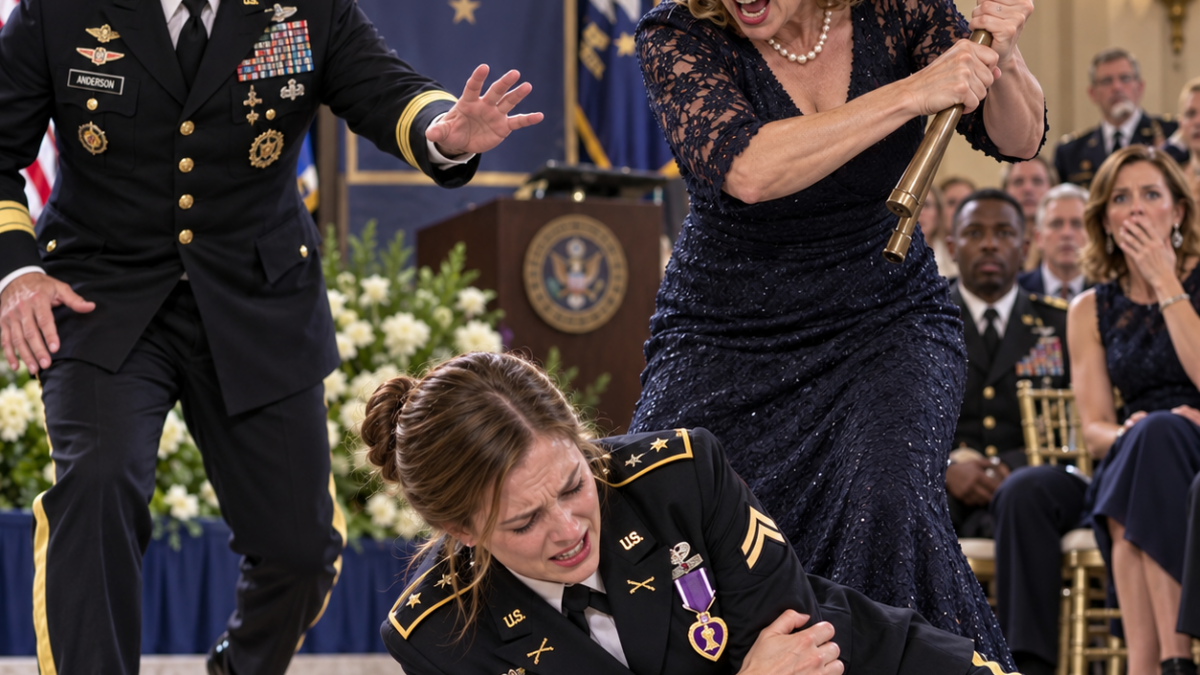
At My Purple Heart Ceremony, My Stepmother Broke My Arm—Then a Three-Star General Revealed the Secret I Took Home From War
I thought the hardest part of earning my Purple Heart was surviving the blast that tore through our convoy overseas.
I was wrong; the hardest part came months later, when my stepmother shattered my arm with a folding chair while my father stared at the floor.
Then the general I had dragged out of fire rose in front of everyone and exposed the one truth my family had spent my whole life trying to bury.
My name is Natalie Porter, and the day I received my Purple Heart should have been one of the proudest days of my life.
Instead, I ended up on the floor beside a stage in North Carolina, my left arm broken, my dress uniform twisted under me, while my own family stood close enough to help and chose not to.
That is the part people always struggle to understand when they hear what happened. Not the medal. Not the chair. Not the shouting. Not even the fact that military police had to drag my stepmother out of a room full of soldiers, veterans, and children while she kept screaming that I was “trash in uniform.”
People understand rage better than they understand silence.
My stepmother, Linda, had always been loud.
My father was the quiet one.
For most of my life, I thought quiet meant helpless, tired, trapped, maybe even kind in a cowardly way. I told myself Dad did not defend me because he hated conflict. I told myself he lowered his eyes because he did not know what to do. I told myself his silence was weakness, not permission.
That ceremony taught me the difference.
Weakness trembles before cruelty.
Permission makes room for it.
My father made room for Linda for fifteen years.
He made room for her comments at dinner, her little laughs whenever I tried to speak, her questions about why a girl like me wanted to “act like a man,” her habit of calling my Army career “playing soldier” even after I had stopped being a teenager and started leading people through nights that would have made her choke on her own certainty.
He made room for my stepbrother Kyle too.
Kyle was two years older than me, broad, smug, and lazy in the way some sons become when their mother teaches them the world is built to excuse them. He spent his twenties failing upward through jobs Dad found for him, wrecking trucks Dad paid to repair, and laughing at people who worked harder than he ever had.
Whenever I came home on leave, Kyle found some way to remind me that I was still the unwanted one.
“Sergeant Barbie.”
“GI Jane.”
“Dad’s discount son.”
Linda laughed every time.
Dad smiled weakly and said, “Come on, Kyle.”
That was the full extent of his courage.
Come on, Kyle.
As if cruelty were a dog begging at the table and not a grown man choosing where to put his teeth.
When the Army informed me that I would receive the Purple Heart at a formal ceremony, I almost did not invite them.
I sat on the edge of my barracks bed with the invitation list open on my laptop, cursor blinking in the empty space beside Family Guests. My left leg ached that morning because rain was moving in, and the healed shrapnel wound along my ribs felt tight beneath my shirt. My roommate, Staff Sergeant Carla Vega, watched me from the other side of the room while she polished her boots with the kind of violence she usually reserved for bad coffee and incompetent officers.
“You’re doing the family math again,” she said.
“I’m not doing anything.”
“You’ve been staring at that screen for twenty minutes.”
“I’m deciding.”
“You’re suffering.”
“Same thing.”
Carla was the kind of friend you earn only after both of you have seen each other at your worst and decided not to weaponize it. She had dragged me through physical therapy when I got too proud to admit I was in pain. She had sat beside my hospital bed in Germany and read celebrity gossip headlines out loud because she said I needed “trash medicine for the soul.” She had also been in the convoy the night everything changed.
She knew what I had done.
She knew what I had never told my family.
“You don’t have to invite them,” she said.
I looked at the screen.
Father: Richard Porter.
Stepmother: Linda Porter.
Stepbrother: Kyle Martin.
“They’ll hear about it anyway.”
“So let them hear about it.”
“My dad will say I embarrassed him.”
Carla snorted. “Your father should be embarrassed by his face every morning. That doesn’t mean you manage it for him.”
I almost smiled.
Almost.
“It’s a big day,” I said.
“Exactly.”
“He’s my dad.”
“That is a biological fact, not a courtroom defense.”
I looked at her then.
PART2:
Carla set down the boot brush and softened, which from her looked like lowering a weapon.
“Natalie,” she said, “some people don’t come to honor you. They come to prove you still belong under them.”
I knew she was right.
That did not make the decision easier.
The truth is, I still wanted my father there.
Not Linda.
Not Kyle.
Dad.
I wanted him to see me in that auditorium. I wanted him to hear my name read aloud in a room where no one could twist it into something small. I wanted him to watch a general pin a medal to my uniform and finally understand that the girl Linda called worthless had become someone the Army trusted, respected, and mourned when she was nearly lost.
I wanted his pride.
There. That is the ugly, honest thing.
At thirty-two years old, with scars across my body and rank on my chest, I still wanted my father to look at me like I mattered.
So I invited them.
That was my mistake.
Or maybe it was not.
Sometimes a wound has to be exposed in public before you finally stop calling it a bruise.
The ceremony was held on a cool Friday afternoon at a military auditorium outside Fayetteville. The building had polished floors, flags along the walls, rows of metal folding chairs, and that specific institutional smell of wax, coffee, old fabric, and nerves. Families arrived in clusters. Mothers held flowers. Children tugged at collars. Spouses took photos by the stage. Veterans in ball caps stood near the back, hands folded over canes, eyes sharper than their bodies looked.
I arrived early because the Army teaches you that early is on time and on time is late, but also because I needed a few minutes alone before people started calling me brave.
Brave is a complicated word.
People use it like a gift.
Sometimes it feels like a demand.
A young specialist from protocol guided me to the waiting room behind the stage. My uniform had been pressed so sharply the sleeves seemed to remember attention better than I did. My hair was pinned tight. My boots reflected the fluorescent lights. The Purple Heart ribbon I would wear after the ceremony waited inside a small case on the table. Beside it sat a second velvet case I had not expected to see.
I noticed it immediately.
“What’s that?” I asked.
The specialist’s expression flickered.
“Ma’am, General Hayes will explain during the ceremony.”
General Robert Hayes.
Three stars.
Command presence that could still quiet a room even after months of rehab and a cane he hated using. The official program listed him as the presenting officer. What it did not say was that the reason he insisted on presenting my medal personally was because the last time I had seen him in the field, his face was streaked with blood and dust and he was shouting at me to evacuate while I ignored a direct order.
I looked at the second velvet case.
My throat tightened.
“No surprises,” I said.
The specialist swallowed. “Ma’am, I’m just following—”
“I know.”
I backed off.
She did not deserve my fear.
A few minutes later, General Hayes entered with his aide, a major named Allison Greer, who carried a black folder and looked like she had organized entire wars using color-coded tabs. Hayes moved slower than he used to, but the room still adjusted around him. He had silver hair, deep lines at the corners of his eyes, and the steady gaze of a man who had made decisions under fire and carried every consequence home.
“Sergeant Porter,” he said.
I straightened.
“Sir.”
His eyes moved over my face, then briefly to the leg I was trying not to favor.
“How’s the pain today?”
PART3:
“Manageable.”
“That means bad.”
“It means manageable, sir.”
He almost smiled.
“Still stubborn.”
“Still observant, sir.”
Major Greer looked down to hide her smile.
Hayes stepped closer.
“I saw the guest list.”
My stomach tightened.
“Yes, sir.”
“Family coming?”
“Yes, sir.”
His face told me he remembered every word I had not said in the hospital.
After the attack, when I drifted in and out of surgery, he had visited once before being flown for more specialized care. I was on pain medication, feverish, furious at the weakness in my own body. He had asked if my family had been notified. I said yes. Then I said, “Don’t tell them details.”
He had asked why.
I told him, “They won’t know what to do with the truth.”
He never pushed.
That was one of the reasons I respected him.
Now he looked at me in the waiting room and said, “You sure?”
“No, sir.”
That answer seemed to satisfy him more than a lie would have.
“All right.”
He nodded toward the second velvet case.
“About that—”
“Sir.”
“I know.”
“No surprises.”
“It will not be a surprise. It will be an acknowledgment.”
“With respect, sir, acknowledgments can be ambushes when you’re standing in front of family.”
His expression softened just enough to hurt.
“Natalie.”
He rarely used my first name.
I looked away first.
“I didn’t do it for that.”
“For what?”
“For more hardware. For applause. For people staring.”
“I know.”
“Then why?”
“Because records matter,” he said. “Because what you did has been minimized once already by the classified portions of the incident report. Because young soldiers in that room need to know what courage looks like when it refuses to abandon someone. And because you do not get to decide that your sacrifice is less worthy of being seen just because some people failed to see you first.”
I did not answer.
He had always been good at giving orders that sounded like moral philosophy.
Major Greer checked her watch.
“Sir, we’re two minutes.”
Hayes looked at me.
“If at any point you want me to stop, say so.”
That almost made me laugh.
A three-star general asking permission from a sergeant.
But he meant it.
“Yes, sir.”
I stood behind the curtain as the auditorium filled. Through the small gap near the side, I could see rows of chairs, uniforms, civilian dresses, framed programs, flags. Carla sat in the second row with two of our team, Torres and McNair. She caught my eye through the gap and gave me a thumbs-up that looked more like a threat than encouragement.
Then I saw my father.
Third row.
Gray suit. Blue tie. Hands folded. Hair thinner than the last time I saw him.
Linda sat beside him.
She wore a cream-colored dress and a string of pearls, as if elegance could launder the venom out of her mouth. Her hair was sprayed into place. Her lips were already pressed tight with disapproval.
Kyle sat on her other side, legs spread too wide, phone in hand, smirking at something on the screen.
My stomach dropped.
For one moment, I was thirteen again, standing in my own kitchen while Linda looked at my report card and said, “Well, aren’t you desperate for attention.”
Then the announcer called the room to order.
The ceremony began.
There were speeches first.
There are always speeches.
A colonel spoke about service, sacrifice, resilience, and the obligation to honor those who carry wounds seen and unseen. He meant well. They all did. But words like sacrifice get strange when your body is the evidence. I stood at attention near the stage, hearing but not absorbing.
Then General Hayes came to the podium.
The room changed.
Some people command attention by demanding it.
He commanded it by not needing to.
“We are here today,” he said, “to recognize Staff Sergeant Natalie Porter for wounds received in action during an enemy attack while deployed in support of joint operations overseas.”
My name moved through the auditorium cleanly.
Not small.
Not mocked.
Not followed by Linda’s laugh.
“Staff Sergeant Porter demonstrated extraordinary composure under fire, decisive leadership during mass-casualty conditions, and personal courage that preserved the lives of fellow soldiers and allied personnel.”
I kept my eyes forward.
The official citation was sanitized, as such things often are. It mentioned the enemy attack. It mentioned shrapnel. It mentioned continued performance of duties despite injury. It did not mention the smell. The screams. The second blast. The way the night sky turned orange. The fact that my hands would not stop slipping because they were covered in someone else’s blood.
It did not mention Hayes trapped beside the lead vehicle, one leg pinned, radio dead, aide unconscious.
It did not mention me refusing the evacuation bird when it landed.
It did not mention what he had ordered me to do.
Leave me, Porter.
Get them out.
That part had not made the program.
Maybe it could not.
Maybe some truths are too heavy for folded paper.
When my name was called, I walked onto the stage.
My leg protested.
I ignored it.
General Hayes turned toward me with the Purple Heart in his hands. Up close, I could see the faint tremor in his left hand, the one he tried to hide by bracing his wrist.
The auditorium became very still.
“For wounds received in action,” he said, voice carrying, “and for faithful service to the United States Army.”
He pinned the medal to my uniform.
For one second, the weight of it felt unbearable.
Not because it was heavy.
Because of what it replaced.
Fire.
Dust.
Pain.
Loss.
A medal is such a small object for so much memory.
The room applauded.
I heard Carla’s whistle and almost broke military bearing right there.
Hayes leaned close as we turned for the official photograph.
“Breathe, Sergeant.”
“I am breathing, sir.”
“That was an order, not an observation.”
I inhaled.
The camera flashed.
Then the ceremony should have moved forward.
That is not what happened.
General Hayes stepped down from the stage.
He did not use his cane because he was stubborn and because generals are sometimes worse patients than privates. His foot caught the edge of the stage step, just slightly, but enough. I saw his balance shift before anyone else did.
I moved without thinking.
Caught his arm.
“Easy, sir.”
His weight settled against me for half a second.
Then he steadied.
He looked at my hand on his sleeve, then at my face.
“Still looking after everyone, Sergeant Porter.”
The line was quiet.
Too quiet for most of the room.
But not quiet enough for Linda.
“Look at her,” she said from the third row. “Always putting on a show.”
Every muscle in my body went cold.
Not because she had surprised me.
Because she had not.
I turned slowly.
“Linda,” I said, keeping my voice low. “Sit down.”
That was the wrong thing to say to a woman who believed public embarrassment belonged only to other people.
She stood in the aisle.
“Oh, don’t you use that tone with me.”
The room went still in that awful way rooms do when everyone senses a private ugliness escaping into public air.
My father reached for her wrist weakly.
“Linda, not here.”
Not don’t.
Not stop.
Not this is wrong.
Not here.
Even then, he was not defending me.
He was protecting the room from inconvenience.
Linda shook him off.
“You think this little costume makes you better than us?”
“Ma’am,” Major Greer said sharply from the side of the stage, “please return to your seat.”
Linda laughed.
“Ma’am. Listen to that. Now even she has people talking fancy around her.”
I stepped off the stage because instinct told me to contain the situation before it touched Hayes. Before it embarrassed the unit. Before Linda turned my ceremony into exactly what she wanted: proof that any honor given to me could still be dragged through the mud if she screamed loudly enough.
That was another mistake.
I should have let military police handle her from the first word.
But children raised around unstable adults often become experts at stepping toward danger to keep it from spreading.
I stopped at the bottom of the stage.
“Linda. Sit down.”
Her eyes shone.
Not with tears.
With pleasure.
She had wanted this. Maybe not the chair yet. Maybe not blood or a broken bone. But she had wanted the moment when everyone looked at me and saw the family conflict, the mess, the shame. She wanted to pull me out of my uniform and back into her kitchen, where she understood the rules.
“You don’t get to order me around,” she hissed.
“No one is ordering you.”
“You always thought you were better. Always walking around like you’re special. Richard, tell her.”
My father’s face had gone pale.
“Natalie,” he said quietly, “maybe just let it go.”
Let it go.
The family hymn.
I stared at him.
Something cracked inside me before my arm did.
Kyle leaned back in his chair, grinning.
“This is awesome,” he muttered.
Then Linda grabbed a metal folding chair from the end of the row.
Everything slowed.
I saw Carla rise in the second row.
Saw Major Greer move.
Saw Hayes turn from the stage.
Saw my father’s hand lift, then stop.
Linda swung.
I raised my left arm to block it.
The chair slammed into bone.
CRACK.
Pain exploded white-hot through my wrist, forearm, shoulder, teeth, skull. It was so sudden and complete that for a second I did not understand where I was. My knees buckled. The polished auditorium floor rushed up. I hit hard beside the stage, breath tearing out of me.
Gasps erupted.
Someone screamed.
My left arm lay wrong against my body, a jagged lightning storm of pain running from wrist to elbow. My medal pressed into my chest. My cap had fallen somewhere beside me.
Linda stood over me, still holding the chair.
“You think that medal makes you better than us?”
Military police moved fast now.
Too late for my bone.
Fast enough for everything after.
Major Greer shouted for medical.
Carla vaulted over a chair with a curse so vicious three chaplains probably felt it from nearby buildings.
Linda kept screaming as two MPs grabbed her arms.
“You’re still trash in uniform!”
The word trash echoed off the auditorium walls.
Not because she shouted it loudly.
Because everyone heard how practiced it was.
Then she called me the word she had used behind closed doors since I was fifteen and growing into a body she taught me to be ashamed of.
“Slut!”
The room inhaled as one horrified animal.
I did not look at Linda.
I looked at my father.
He was standing now.
Finally.
But not moving toward me.
His eyes were on the floor.
The floor.
His daughter lay at the foot of a military stage with a broken arm, and Richard Porter looked at polished tile like salvation might be hidden there.
For a second, I waited.
That humiliates me more than almost anything else.
I waited.
Even then.
Even after all the years, some small stupid child inside me still waited for my father to lift his head and choose me.
He did not.
Then Kyle laughed.
Actually laughed.
It burst out of him, short and sharp, before he covered it with one hand. Not because he was sorry. Because people were looking.
I remember that laugh more clearly than the crack of the chair.
Pain can blur.
Betrayal comes into focus.
Before I could process any of it, a voice thundered through the auditorium.
“Enough.”
The word did not sound shouted.
It sounded fired.
General Hayes was standing at the edge of the stage.
No cane.
No aide.
No careful patient posture.
Just command.
His expression was unlike anything I had ever seen from him. Not battlefield fury. Not tactical intensity. Something colder. More personal. The fury of a leader watching a soldier be attacked after surviving what should have killed her.
The MPs tightened their hold on Linda.
“She’s my stepdaughter!” Linda screamed. “This is a family matter!”
“No, ma’am,” Hayes said.
The auditorium went silent enough that I heard my own ragged breathing.
Linda’s face flushed darker.
“You don’t know what she’s really like!”
Hayes became very still.
“I know exactly who she is.”
His eyes moved to my father.
For the first time that afternoon, Dad lifted his head.
Hayes looked straight at him and said five words that silenced the entire room.
“She saved my life overseas.”
My father’s mouth opened.
Linda froze.
Even the MPs stopped pulling for half a second.
I stopped breathing.
Because Hayes had said it.
Out loud.
In front of everyone.
The truth I had carried home sealed under official language, painkillers, and the stubborn belief that telling my family would only give them something sacred to mock.
Hayes stepped down from the stage slowly.
Major Greer moved to help him, but he lifted one hand.
Not now.
He crossed the short distance to where I lay on the floor. A medic was already kneeling beside me, speaking in that calm tone medical people use when they are trying to keep you from noticing fear in their hands.
“Staff Sergeant Porter,” the medic said, “I need to assess the arm.”
“Yeah,” I gasped. “It’s not ideal.”
Carla dropped to her knees on my other side.
“Not ideal? Your bone made a sound, Nat.”
“Thank you for the diagnostic clarity.”
“You’re welcome.”
Her eyes were wet.
That scared me more than the arm.
Hayes stood above us, not blocking the medic, but close enough that his presence changed the air.
“Two years ago,” he said, voice carrying through the room, “Sergeant Porter was assigned to a convoy escort during a humanitarian transport operation overseas.”
My father whispered, “Natalie never told us that.”
Hayes did not look at him yet.
“No,” he said. “She didn’t.”
The medic touched my forearm.
Pain tore through me so sharply my vision spotted.
Carla grabbed my right hand.
“Squeeze.”
I did.
Hard.
She did not flinch.
Hayes continued.
“The convoy was struck by an improvised explosive device and then came under coordinated small-arms fire. Sergeant Porter sustained shrapnel injuries during the initial blast. She was ordered to evacuate with the first group of wounded.”
My throat closed.
Do not.
That was what I wanted to say.
Do not make me live it here.
Not on this floor.
Not with my father watching.
But Hayes had asked me earlier if I wanted him to stop.
I said nothing.
Some truths cannot heal if you keep protecting the people who hurt you from hearing them.
“She refused evacuation,” Hayes said.
Linda made a strangled sound.
Hayes looked at her.
“While injured, bleeding, and under fire, Sergeant Porter coordinated the movement of three wounded soldiers to cover. She crossed exposed ground twice to retrieve medical supplies and communication equipment.”
Images came back in broken pieces.
Heat.
Dust.
Sergeant McNair screaming that Torres was hit.
The radio dead.
My left side wet.
My ears ringing so hard every command sounded underwater.
Hayes trapped near the lead vehicle.
His aide, Captain Wells, unconscious beside him.
The second vehicle burning.
Someone yelling for smoke.
Someone praying.
Me crawling because standing made me too visible and because pain had turned my leg unreliable.
I had not felt brave.
That is the thing people do not understand.
I had felt furious.
Furious that the night had the nerve to keep happening. Furious that people I loved were bleeding. Furious that Hayes was trapped and still wasting breath ordering me out. Furious that my body wanted to quit before I gave it permission.
Hayes’s voice pulled me back.
“When I was pinned and unable to move, Sergeant Porter reached my position despite direct fire. I ordered her to leave me.”
His eyes lowered to me.
“She did not.”
The auditorium disappeared.
I was back in smoke.
“Porter!” Hayes had shouted that night. “Get out!”
“No, sir!”
“That is an order!”
“With respect, sir, it’s a bad one!”
He had stared at me through blood and dust, stunned, while I jammed a tourniquet into his hand and crawled toward the twisted metal trapping his leg.
“You’re wounded,” he snapped.
“So are you.”
“Get my aide.”
“Already did.”
“Then move.”
“I am moving.”
“Porter—”
“Sir, shut up and push when I tell you.”
He told me later no one had said shut up to him in twenty-nine years.
I told him it had been overdue.
In the auditorium, Hayes looked at my family.
“She freed my leg enough for evacuation personnel to move me. When the second blast hit, she shielded a wounded soldier with her own body and sustained further injury.”
That part I hated.
That part I remembered in flashes.
Private Ellis, nineteen, barely old enough to shave properly, eyes wide with terror. Me hauling him behind a broken axle. The second blast throwing gravel, metal, fire. My body over his because there was no time to think of anything else.
“The official Purple Heart citation,” Hayes said, “states that she was wounded during enemy action. It does not include every classified or sensitive detail of that night. It does not capture her refusal to abandon others. It does not capture the number of lives that moved because she did.”
An officer stepped toward the stage carrying the second velvet case.
Major Greer took it and brought it to Hayes.
My father looked as if he had forgotten how to breathe.
Linda had gone pale under her makeup.
Kyle was no longer laughing.
Hayes opened the case.
Inside was another decoration.
Not the Purple Heart.
The Soldier’s Medal had a specific shine under auditorium lights. I had seen it in photos, in award boards, in ceremonies for other people. Never imagined it would be held above me while I lay on the floor with a broken arm caused by my stepmother.
A murmur moved through the room.
Hayes said, “The Purple Heart recognizes Sergeant Porter’s wounds in combat. This award recognizes separate acts of heroism and lifesaving action under extreme conditions.”
“Sir,” I whispered.
He looked down.
My voice barely worked.
“Please.”
He understood.
He closed the case halfway, not hiding it but lowering it.
“This was meant to be presented after the Purple Heart,” he said softly enough that only the front rows heard. “Not like this.”
I swallowed against nausea.
“Not like this,” I agreed.
The medic secured my arm with a splint.
“Sergeant, we need to transport you.”
I nodded.
Linda suddenly found her voice again.
“You’re all making her into something she’s not!” she shouted. “You don’t know her. You don’t know what she was like growing up. Always sneaking around, always thinking she was better—”
“Remove her,” Hayes said.
The MPs began escorting her toward the side exit.
She twisted against them.
“You can’t do this! Richard! Tell them!”
My father looked at her.
Then at me.
Then back at her.
His mouth moved, but no sound came.
Linda saw it.
For the first time in my life, she looked truly afraid.
Not because she had broken my arm.
Because the room had stopped believing her.
That was the thing she could not survive.
Kyle stood and started after her, then looked toward the stage, toward Hayes, toward the veterans staring at him like they had watched something diseased crawl into daylight.
He lowered his head and followed his mother out.
No laugh this time.
The door closed behind them.
The auditorium stayed silent.
I wanted to vanish.
That sounds strange, maybe. People might imagine vindication feels like standing tall while everyone finally knows the truth. It does not always feel that way. Sometimes vindication feels like being stripped open in a room full of witnesses, every bruise you hid suddenly projected on the wall.
The medic and Carla helped me sit up.
Pain washed over me so hard I nearly blacked out.
Hayes crouched with effort.
I hated that he did.
“Sir, don’t.”
He ignored me.
“Natalie.”
I focused on his face.
“I’m sorry,” he said.
A general apologized to me while my father stood ten feet away having failed to say anything meaningful.
“For what?”
“For the fact that you were asked to survive one more attack in a room that should have honored you.”
I tried to answer.
Could not.
Major Greer closed the velvet case and held it like a promise.
My father took one step toward me.
“Natalie.”
The way he said my name hurt more than the arm.
Soft.
Pleading.
Late.
“Not now,” Carla snapped.
Dad flinched.
Good.
The medic looked at me.
“We’re moving.”
As they guided me toward the aisle, soldiers stood.
Then veterans.
Then families.
Not applause.
Something else.
Respect.
Quiet.
Heavy.
People rose row by row as I was carried past them with a broken arm and a medal pinned crooked to my chest.
I did not look at my father.
Not because I was strong.
Because if I looked, I might still search his face for something I should have stopped needing years earlier.
At the ambulance entrance, just outside the auditorium, Dad caught up.
“Natalie, please.”
Carla turned so fast I thought she might physically remove him from the state.
I lifted my right hand.
“It’s okay.”
“It is not okay,” Carla said.
“I know.”
She stepped back half an inch. Not permission. Tactical repositioning.
Dad stood in front of me in the corridor, face gray.
“I didn’t know,” he said.
That sentence.
I had expected it.
Still hated it.
The medic adjusted the sling, and pain flashed hot.
“You didn’t know what?”
He blinked.
“About what happened overseas.”
“No,” I said. “You didn’t.”
His shoulders sagged with relief, as if I had agreed to the shape of his excuse.
Then I finished.
“But you knew how she treated me.”
His face changed.
“You knew that.”
“Natalie—”
“You knew she mocked me when I enlisted. You knew she called me names when I came home on leave. You knew she told people I joined the Army because no decent man wanted me. You knew she called my promotions charity. You knew she said I was faking pain after I got hurt.”
My voice shook.
The hallway seemed to shrink around us.
“You knew enough.”
He lowered his eyes.
Again.
Same move.
Same floor.
Same cowardice.
“That was enough,” I said.
He looked up then, but too late.
“She lost control,” he whispered.
I stared at him.
“No. She showed control for years. Today she lost the room.”
He flinched as if I had struck him.
Maybe truth feels violent when you have spent years hiding from it.
“She showed you who she was a long time ago,” I said. “You just kept asking me to tolerate it.”
His mouth opened.
No answer came.
Because there wasn’t one.
Not an honest one.
The ambulance doors opened.
The medic helped me inside.
Dad stepped closer.
“Can I come to the hospital?”
I looked at him.
For years, I had imagined my father asking that question in some crisis. I imagined saying yes because I wanted him there. I imagined tears, apologies, a hand held at a bedside, the repair of something I could not stop hoping might still be repairable.
But hope is not always holy.
Sometimes hope is the chain that keeps you standing where people keep hitting you.
“No,” I said.
His face collapsed.
For one terrible second, I wanted to take it back.
Then Carla climbed into the ambulance beside me, sat with her shoulder pressed against mine, and said, “I’m coming.”
The doors closed on my father’s face.
I let them.
At the hospital, they confirmed what the chair had already announced.
Fractured ulna.
Severe contusion along the wrist and shoulder.
No surgery, thank God, but immobilization, pain medication, follow-up, and a fresh wave of paperwork that made every doctor in the emergency department stare at my uniform, then at the incident report, then at me with carefully controlled outrage.
“Your stepmother did this?” one resident asked before the attending shot him a look.
“Yes,” I said.
He opened his mouth.
Closed it.
Good choice.
Carla stayed through the X-rays, the splinting, the first dose of pain medication, and the moment I began laughing uncontrollably because trauma does strange things when your body realizes it is no longer in immediate danger.
“It’s not funny,” she said, though she was smiling in fear.
“I know.”
“You’re laughing like a haunted clown.”
“Please don’t put that in the chart.”
“I’m putting it in my personal notes.”
When the nurse left, Carla sat beside the bed and leaned forward.
“You okay?”
“No.”
“Good. Honest answer.”
I stared at the ceiling tiles.
“I keep thinking about Dad’s face.”
“Screw his face.”
“Carla.”
“No. I have held my tongue through a lot of your tragic family nonsense because boundaries are a journey and I am told threatening civilians is frowned upon. But your father stood there.”
I closed my eyes.
“I know.”
“He stood there, Natalie.”
“I know.”
“And your stepbrother laughed.”
“I know.”
“And you still look like you’re trying to figure out how to make this easier for them.”
That hit too close.
I turned my face away.
Carla’s voice softened.
“Hey.”
I did not look at her.
“You don’t have to protect people from the consequences of hurting you.”
Tears slid into my hairline.
I hated crying in hospital beds.
There is something uniquely humiliating about tears when you cannot wipe them properly because one arm is strapped down and the other has an IV.
Carla pulled a tissue from the box and dabbed my temple like she was handling live explosives.
“I still wanted him to be proud,” I whispered.
“I know.”
“That’s pathetic.”
“No,” she said. “That’s human.”
The pain medication began to pull at the edges of the room.
Before I drifted, Major Greer appeared at the doorway with the second velvet case tucked under one arm and a folder in her hand.
“Sergeant Porter.”
I tried to sit up.
She held out a hand.
“Don’t.”
“Yes, ma’am.”
Carla muttered, “Finally, someone outranks her.”
Major Greer gave her one dry look and walked in.
“General Hayes wanted you to know Linda Porter has been formally detained pending charges. Statements are being taken. The auditorium has multiple witnesses and video.”
I absorbed that slowly.
Charges.
Witnesses.
Video.
Not a family matter.
Not a misunderstanding.
Not Linda lost control.
Assault.
Public.
Documented.
Major Greer set the velvet case on the rolling tray beside my bed.
“He also asked me to return this to you.”
“I didn’t receive it.”
“No,” she said. “You were assaulted before the presentation could be completed.”
The bluntness helped.
It made the ugly thing real enough to stand on.
“The general wants to complete the ceremony privately when you’re ready,” she said. “Only if you want that.”
I looked at the case.
“What if I don’t?”
“Then he will respect it.”
“And the record?”
“Already stands.”
I looked back at her.
“Major.”
“Yes?”
“Did everyone hear?”
Her face softened.
“Yes.”
My throat tightened.
“All of it?”
“Enough.”
I closed my eyes.
“I never wanted them to know like that.”
“I know.”
“They’ll make it ugly.”
“With respect, Sergeant, they already did.”
That was the second thing someone said that day that stayed with me forever.
They already did.
I had spent years trying to prevent my family’s ugliness from spilling into public, as if hiding it made me noble instead of trapped. Linda’s violence felt like exposure, but maybe it was only revelation. The truth had not become ugly because people saw it.
It had been ugly all along.
When I was released from the hospital late that night, Carla drove me back to the barracks, ignoring every speed limit with the righteous confidence of a woman who believed rules were for people who had not spent the day watching their best friend’s stepmother commit aggravated stupidity.
My phone had thirty-seven missed calls.
Dad.
Unknown numbers.
Kyle.
Aunt Rebecca.
Dad again.
Voicemails stacked like land mines.
I stared at the screen until Carla took it from my hand.
“Nope.”
“I should—”
“Nope.”
“I need my phone.”
“You need pain meds and sleep.”
“My father—”
“Your father can write his cowardice in a diary tonight.”
I almost laughed.
She put the phone on the dresser across the room.
“Boundaries by distance.”
“Is that a therapy term?”
“It is now.”
I slept badly.
Pain woke me every few hours. So did dreams. Not of the convoy this time. Of the auditorium. Linda’s chair. Dad’s eyes on the floor. Kyle’s laugh turning into static. Hayes saying, She saved my life overseas, again and again until the words sounded less like honor and more like accusation.
Morning came gray.
Carla brought coffee and a breakfast sandwich I could barely hold.
“You’re trending locally,” she said.
I froze.
“What?”
“Not by name everywhere. But somebody posted part of the ceremony before command got it pulled down. The Army statement is tight. ‘An incident occurred after a formal awards presentation. The matter is under investigation.’ Very thrilling. Zero stars.”
My stomach rolled.
“People saw?”
“Yes.”
I put the sandwich down.
“Comments?”
She hesitated.
That told me everything.
“Carla.”
“Some support. A lot. Actually most. Veterans are furious. People are calling Linda things that would make sailors proud.”
“And?”
“And your stepbrother posted.”
Of course he did.
She handed me my phone only after opening the screenshot herself.
Kyle’s post was a masterpiece of cowardly self-pity.
People don’t know the whole story. Natalie has always been unstable and dramatic. My mom was pushed to her breaking point after years of disrespect. The military is covering for one of its own.
I stared at it until the words blurred.
Beneath it, comments from people who did not know me argued like my life was a sport.
Then I saw a comment from my aunt Rebecca, Dad’s older sister.
Kyle, delete this immediately. I was there. Your mother assaulted Natalie in front of witnesses. Your father should be ashamed.
I blinked.
Aunt Rebecca had been there?
I searched my memory of the auditorium but could not place her. Maybe she sat in the back. Maybe I had been too focused on the third row to see anyone else.
Carla took the phone gently.
“General Hayes saw the post.”
“Oh God.”
“He responded.”
My soul tried to leave my body.
“What do you mean he responded?”
“Not online. He issued a statement through the public affairs office with permission to clarify the record. Very formal. Very terrifying. Basically: Sergeant Porter’s actions overseas are a matter of documented military record, the assault occurred in front of numerous witnesses, and attempts to defame a wounded soldier will be addressed appropriately.”
I stared.
Carla smiled.
“Three-star generals can be petty when morally justified. It’s educational.”
My phone buzzed again.
Dad.
I let it ring.
That was the first victory.
Tiny.
Silent.
Mine.
Over the next week, the story grew despite every official attempt to keep it contained. Small towns and military communities have something in common: people know more than they are supposed to, and silence rarely survives outrage.
Linda was charged with assault.
Because it happened on a military installation, because I was in uniform, because there were MPs present, because the entire room had seen it and at least three phones had recorded the swing, nobody could bury it as “family drama.”
That infuriated her more than anything else.
Her lawyer tried to claim emotional distress. He suggested the ceremony had “provoked” her by highlighting a strained family relationship. He implied my military service had made me aggressive and that Linda feared me.
The prosecutor apparently asked whether she feared me before or after picking up the chair.
I wish I had been there for that.
Dad left voicemails every day.
At first, they were apologies.
Then explanations.
Then requests.
Then complaints that I was “shutting him out during a painful time for everyone.”
That phrase nearly made me throw the phone across the room.
A painful time for everyone.
It is amazing how often people who allowed harm become philosophers of shared suffering once consequences arrive.
Aunt Rebecca came to see me four days after the ceremony.
I had not seen her in almost eight years. She and Dad had fallen out after my grandmother’s funeral, mostly because Aunt Rebecca had told Linda she was “a mean woman with good china” and refused to apologize.
She arrived at the barracks visitor center wearing jeans, a navy coat, and the Porter family jaw set in a way I recognized from old photos. Her hair was silver now, cut to her chin. Her eyes filled the second she saw my arm.
“Oh, Natalie.”
That kindness almost made me step backward.
I had prepared for accusations, excuses, maybe awkward family obligation.
Not grief.
She hugged me carefully.
“I should have come sooner,” she said.
“You were at the ceremony?”
“In the back. I didn’t know if you’d want me near your father.”
My eyes burned.
“I would have.”
Her face crumpled.
“Well. That’s another thing I owe you an apology for.”
We sat in a small lounge that smelled like coffee and floor cleaner. Carla hovered near the hallway pretending not to hover.
Aunt Rebecca watched her.
“That one yours?”
“Best friend.”
“She looks ready to commit a felony on your behalf.”
“She has restraint issues.”
“Good.”
I laughed for the first time without pain catching it halfway.
Then Aunt Rebecca took my right hand.
“I saw him look down,” she said.
I stopped smiling.
“I saw Richard. When Linda lifted that chair. When you hit the floor. When she called you that word. I saw him choose not to move.”
The air left me.
“I keep thinking maybe I remember it worse than it was.”
“You don’t.”
That should not have comforted me.
It did.
Abuse makes memory slippery because everyone around it spends years greasing the floor.
Aunt Rebecca’s certainty gave me traction.
“He was not always like this,” she said quietly.
I looked down.
“No. But he is now.”
She nodded.
“Yes.”
No defense.
No childhood story.
No he loves you in his own way.
Just yes.
She reached into her bag and pulled out a small envelope.
“I have something for you.”
Inside was a photograph.
My mother.
I was seven when she died, and most of what I had were blurred memories and three pictures Dad kept in a box Linda hated. In this photo, Mom stood in a backyard wearing cut-off shorts and an old Army T-shirt, hair windblown, laughing at something off-camera. I was on her hip, chubby arms around her neck, face turned toward her like she was the whole sun.
I touched the edge of the picture.
“I’ve never seen this.”
“Your mother wanted you to have it when you were older. Richard kept saying he’d give you her things. Then Linda came along and…”
She stopped.
We both knew.
Linda had not thrown my mother away all at once. She erased her in pieces. A box moved to the attic. A framed picture removed because it made guests uncomfortable. A necklace “misplaced.” Stories corrected, shortened, eventually silenced.
“She would have been so proud of you,” Aunt Rebecca said.
My jaw tightened.
I hated sentences like that because they could not be proved and because I needed them too much.
“She wanted to join the Army, you know.”
I looked up.
“What?”
Aunt Rebecca smiled sadly.
“Before she met your father. Your grandfather talked her out of it. Said it was no life for a woman. She regretted listening to him.”
I stared at the picture.
My mother’s T-shirt suddenly looked different.
“She would have understood more than you think.”
That undid me.
Not loudly.
I just sat there with tears sliding down my face while Aunt Rebecca held my hand and Carla guarded the hallway like someone might try to steal the moment.
That night, I placed the photograph beside my bed.
Linda had spent years telling me I was unnatural, unfeminine, ungrateful, desperate for attention, trash pretending to be honorable.
My mother’s laughing face told another story.
Maybe I had not come from weakness after all.
Two weeks after the ceremony, General Hayes completed the second award presentation privately.
I almost refused.
Not because I did not respect the honor.
Because part of me feared another ceremony would feel like a trapdoor. A stage. A room. Eyes. The memory of metal swinging.
Hayes did not pressure me.
He sent one message through Major Greer:
No audience unless you ask for one. No speeches beyond what you approve. Your dignity, your pace.
That was what convinced me.
Dignity had not been something my family allowed me to control.
The Army, for all its faults and rigidities and paperwork disasters, gave me that choice.
I asked for a small room.
Hayes.
Major Greer.
Carla.
Torres and McNair.
A chaplain I liked because she never tried to turn pain into a greeting card.
Aunt Rebecca.
No father.
The room was plain, with a flag in one corner and sunlight falling across the carpet. My arm was still in a cast. My uniform jacket had been tailored temporarily because the left sleeve would not fit properly. Carla said I looked “lopsided but lethal,” which I accepted as support.
Hayes stood before me with the velvet case.
This time, there was no shouting.
No chair.
No father staring at the floor.
Major Greer read the citation.
It was more detailed than the first. Still not everything. But enough.
It named the attack.
The wounded soldiers.
The evacuation refusal.
The exposed ground.
The second blast.
The lives preserved.
My face burned as she read.
I kept my eyes forward.
When Hayes pinned the medal, his hand trembled again.
This time, I did not pretend not to notice.
I quietly raised my good hand and steadied his wrist.
He looked at me.
“Still looking after everyone,” he said softly.
“No, sir,” I said. “Just not letting you stab me with a pin.”
For one second, he looked scandalized.
Then he laughed.
A real laugh.
Everyone else did too, and the sound loosened something in the room.
Afterward, Hayes handed me the velvet case.
Then, lower, so only I could hear, he said, “Your worth was never on trial.”
My throat tightened.
“It felt like it.”
“I know.”
“I thought if Dad heard what happened, maybe he’d finally…”
I could not finish.
Hayes did not rush to comfort me.
That was one of his gifts.
He let truth stand without smothering it.
“Some people cannot recognize valor,” he said, “because recognizing it would require them to admit how poorly they treated it when it lived under their roof.”
I looked at him.
“That sounds like something the chaplain should say.”
He glanced toward the chaplain.
“I stole it.”
She smiled.
“You improved it, sir.”
A month after the assault, I agreed to meet my father.
Not at my barracks.
Not alone.
Not at his house.
A public coffee shop near post with Carla sitting three tables away reading a magazine upside down because subtlety was not among her gifts.
Dad arrived early.
He looked older.
That was the first thing I noticed. His suit hung looser. His hair needed cutting. His face had the gray exhaustion of a man discovering consequences do not respect his preferred timeline.
He stood when I approached.
“Natalie.”
“Dad.”
He reached as if to hug me, then saw my cast and stopped.
Good.
We sat.
For a moment, neither of us spoke.
The coffee shop hissed and clinked around us. Students laughed near the window. A toddler dropped a muffin. Life continued with rude indifference.
Dad folded his hands.
“How’s the arm?”
“Healing.”
“Good.”
Silence.
He looked toward the cast.
“I’m so sorry.”
I waited.
Not because I wanted more.
Because I had learned that first apologies are often bait.
“I should have stopped her,” he said.
“Yes.”
He flinched.
“I was shocked.”
“Yes.”
“I didn’t think she would actually—”
“You didn’t think she would use a chair,” I said. “But you knew she would hurt me if she could.”
His eyes filled.
“I never wanted to lose you.”
I leaned back.
“That’s not the same as choosing me.”
He looked down at the table.
Same move.
I felt something in me harden, but not with rage.
With recognition.
“You keep looking down,” I said.
He lifted his head.
“What?”
“At the ceremony. In the hospital hallway. Now. Every time truth enters the room, you look down until someone else carries it.”
His mouth trembled.
“I don’t know how to fix this.”
“You can’t fix what happened.”
“I want to try.”
I studied him.
There was a time when those words would have opened every locked door in me.
Now they opened one small window.
Nothing more.
“Then start with the truth,” I said.
He swallowed.
“I failed you.”
The words seemed to cost him.
I did not rescue him from that.
“Yes.”
“I let Linda control the house.”
“Yes.”
“I told myself you were strong enough to handle it.”
There it was.
The excuse that wears admiration as camouflage.
I felt my face go cold.
“You used my strength as permission not to protect me.”
He closed his eyes.
A tear slipped down his cheek.
“I did.”
The honest answer should have healed more than it did.
It did heal something.
Not everything.
“I left her,” he said.
I stared.
“What?”
“I moved into a hotel two days after the ceremony. Rebecca helped me find an attorney. Linda and Kyle are furious. She says I’m abandoning her when she needs support.”
The old reflex rose.
Pity.
Concern.
The urge to ask where he was staying, whether he had eaten, whether he needed help navigating the legal mess he had allowed to grow around us.
I let the reflex pass.
“That is between you and your attorney.”
Pain crossed his face.
“You’re not going to ask if I’m okay?”
“No.”
His eyes widened.
I kept my voice steady.
“I have spent most of my life worrying about whether you were okay with the consequences of not defending me. I’m done.”
He sat back as if struck.
Carla turned a page of her upside-down magazine.
Dad whispered, “Do you hate me?”
I looked at the man who raised me, failed me, loved me weakly, and watched me bleed on an auditorium floor.
“No,” I said.
His shoulders dropped slightly.
“But I don’t trust you.”
That hurt him more.
Good.
It was truer.
“I don’t know when I will,” I continued. “Or if I will. If you want any relationship with me, it will not include Linda or Kyle. It will not include excuses. It will not include asking me to forgive faster because your guilt is uncomfortable.”
He nodded slowly.
“I understand.”
“I don’t think you do.”
He looked up.
“But you can learn.”
That was all I offered.
Not reconciliation.
A door.
Closed mostly.
Unlocked only from my side.
Linda pleaded not guilty at first.
Of course she did.
Her version changed three times.
First, she claimed she had been provoked.
Then that she never intended to hit me.
Then that I stepped into the swing.
That last one made Carla so angry she had to leave the room when the prosecutor told us.
“Stepped into the swing?” Carla said in the hallway. “What were you doing, Nat, tactical bone placement?”
“Apparently.”
“I hate civilians.”
“You are technically a civilian in many contexts.”
“I hate contexts.”
The video ended the argument.
Multiple angles showed Linda grabbing the chair, swinging hard, and me raising my arm to defend myself. It also captured the audio. Trash in uniform. The other word. Hayes’s voice. My father’s silence, visible if not audible.
Linda changed her plea before trial.
The court appearance was small compared to the ceremony, but in some ways harder. I sat behind the prosecutor with my cast replaced by a brace, pain still sharp if I moved wrong. Aunt Rebecca sat beside me. Carla sat on my other side in civilian clothes, looking like she had been banned from three bars for justice-related reasons.
Dad came alone.
He sat two rows back.
Linda did not look at me when she entered.
Kyle did.
His face held resentment, not remorse.
That told me everything I needed to know about him.
Linda’s attorney spoke about stress, family strain, misunderstanding, emotional overwhelm, and my “unexpected military recognition triggering unresolved dynamics.”
Judges hear polished nonsense for a living.
This one did not look impressed.
When the prosecutor read my impact statement, my voice stayed steady.
I had written it at midnight after three failed drafts that sounded either too angry or too generous. The final version was simple.
Linda Porter did not break my arm because she was surprised by a medal. She broke my arm because violence was the loudest version of what she had been allowed to do emotionally for years. She called me trash in uniform because she has always needed me small. What changed that day was not her behavior. What changed was the number of witnesses.
I do not ask the court to punish her for being cruel. I ask the court to recognize that cruelty became physical in a room full of people, and that calling it family conflict would be another way of excusing it.
When the prosecutor finished reading, the room was very quiet.
Linda stared at the table.
The judge sentenced her to probation, anger management, community service, restitution for medical expenses, and a no-contact order. Some people later thought that was too light. Carla definitely did and expressed her opinion with a vocabulary that could peel paint.
I felt something stranger.
Relief.
Not because Linda suffered enough.
I had stopped measuring justice that way.
Relief because the record existed.
Not a family matter.
Not a misunderstanding.
Not Natalie being dramatic.
Assault.
Documented.
Named.
Afterward, in the courthouse hallway, Kyle approached me.
Carla stepped forward.
I touched her arm.
Kyle stopped a few feet away, jaw tight.
“You happy now?”
I looked at him.
“No.”
“Mom could’ve gone to jail.”
“She could have chosen not to hit me with a chair.”
His face reddened.
“You always do this.”
“Do what?”
“Act like you’re better.”
I almost laughed.
There it was again.
The old family accusation.
Better.
As if wanting not to be abused were arrogance.
As if surviving something they could not understand was an insult.
As if dignity were a weapon I had aimed at them.
“I never needed to be better than you,” I said. “I needed you to stop being cruel.”
He rolled his eyes.
“You’re such a victim.”
Carla made a sound.
I held her back without looking.
“No,” I said. “I’m a witness now.”
Kyle frowned.
“What?”
“I saw you laugh. I saw Dad look down. I saw Linda swing. And now other people saw too. That’s what bothers you.”
His mouth opened.
No answer came.
Like mother, like son.
I walked away.
Not dramatically.
No speech.
No final glance.
Just away.
That became one of the most important movements of my life.
For years, I thought healing would come when my family finally understood me.
It began when I stopped waiting for them to.
Recovery from the broken arm was slower than I wanted.
I hated that.
I had already survived shrapnel wounds, nerve pain, surgeries, physical therapy, nightmares, and the endless humiliation of asking my body to do things it used to do without negotiation. A broken arm from a folding chair should have felt minor in comparison.
It did not.
Maybe because it came from home.
Combat injuries are terrible, but at least enemy fire does not pretend to love you.
Linda’s chair carried every Christmas insult, every dinner-table sneer, every birthday forgotten because Kyle needed something, every moment Dad asked me to be the bigger person because he had married someone small.
My body knew the difference.
Physical therapy reopened more than stiffness.
The first time the therapist asked me to rotate my wrist and pain shot up my arm, I swore so loudly an older woman across the room whispered, “Army?” and Carla, who had driven me, said, “Unfortunately.”
I laughed.
Then cried in the parking lot afterward.
Carla sat beside me in the car without turning on the engine.
“I hate this,” I said.
“Reasonable.”
“I hate that she gave me another injury.”
“Also reasonable.”
“I hate that this one feels worse in some ways.”
Carla nodded.
“Because this one came with witnesses you still wanted to love you.”
That was too accurate.
I stared through the windshield at the PT building.
“I don’t know who I am without trying to prove them wrong.”
Carla was quiet.
Then she said, “Maybe tired.”
I looked at her.
“What?”
“Maybe without proving them wrong, you’re tired first. Then whatever comes after.”
That turned out to be true.
For weeks, I was tired in a way sleep did not fix.
The Army had given me a path after the attack. Heal. Report. Rehab. Ceremony. Evaluation. Next assignment possible if cleared. There was structure, because the military can turn even suffering into a checklist.
Family betrayal had no checklist.
No form asked: Did your father finally choose you?
No physical therapist measured the range of motion in a daughter’s hope.
No commander could order grief to stand down.
General Hayes checked on me twice.
Not excessively.
He had the instincts of a man who understood that too much attention can make a wounded soldier feel managed instead of cared for. His emails were brief.
How is the arm?
Are you sleeping?
Do you need intervention regarding media or family contact?
I answered honestly enough.
Healing.
Sometimes.
No.
After the court hearing, he asked me to visit his office.
I arrived in uniform because I did not know how not to.
He noticed the brace.
“Pain?”
“Manageable.”
“That word again.”
“It’s versatile.”
He gestured for me to sit.
His office was exactly what you would expect and nothing like you would expect. Flags, framed maps, challenge coins, photos with officials, yes. But also a child’s crayon drawing taped near a bookshelf, a mug that said WORLD’S OKAYEST GRANDPA, and a pair of running shoes under a side chair like evidence of optimism.
He lowered himself into the chair across from me instead of sitting behind his desk.
That mattered.
“How are you really?” he asked.
I looked at the floor.
Then caught myself.
He saw it.
Of course he did.
“Angry,” I said.
“Good.”
That startled me.
“Good?”
“Appropriate anger is information.”
“Mine feels messy.”
“Most accurate things are.”
I gave a short laugh despite myself.
He leaned back.
“I’ve been in rooms after combat where soldiers spoke with less difficulty than you did in that courthouse statement.”
I looked away.
“It felt harder.”
“I believe you.”
Two words.
No explanation.
No comparison.
No at least you survived.
Just belief.
My eyes burned.
Hayes waited.
Finally, I said, “I keep thinking if I had told Dad everything sooner…”
“No.”
The word came down like a door closing.
I blinked.
“No?”
“No. Do not make yourself responsible for his failure to recognize your humanity without a classified briefing.”
The bluntness almost knocked the breath out of me.
He continued, “If a father needs a three-star general to tell him his daughter has value, the failure is not the daughter’s communication strategy.”
I stared at him.
Then laughed once.
It came out broken.
He smiled faintly.
“You may quote me.”
“I might embroider it.”
“Major Greer knows vendors.”
That made me laugh harder.
Then the laugh cracked into tears.
I hated crying in front of him.
He did not look uncomfortable.
That helped.
“I wanted him to stand up,” I said.
“I know.”
“Not even for the medal. Not for the Army. Just when she hit me.”
Hayes’s expression darkened.
“He should have.”
The simplicity hurt.
“He should have,” I repeated.
“Yes.”
I sat there breathing carefully.
After a while, Hayes said, “The Army can honor what you did. It cannot replace what your family refused to give.”
“I know.”
“But it can give you witnesses.”
I looked at him.
“That matters more than people think,” he said. “A wound carried alone teaches lies. A wound witnessed truthfully has fewer places to hide.”
That became the sentence I carried into the next year.
A wound witnessed truthfully has fewer places to hide.
After my story became known on post, something unexpected happened.
People started telling me theirs.
Not always directly.
Not dramatically.
A specialist lingered after a training session and mentioned her mother never believed her assault report years earlier.
A captain joked too sharply about his father calling his PTSD “city-boy nerves,” then went quiet when no one laughed.
A civilian nurse at the clinic saw my brace and said, “Family?” with the weary accuracy of someone who knew.
I became, unwillingly at first, a kind of proof.
Not of bravery.
Of survival after being disbelieved by people who were supposed to know you best.
I did not always know what to say.
So I stopped trying to fix it.
I learned to say, “I believe you.”
I learned to say, “That was enough.”
I learned to say, “You don’t have to make it smaller for me.”
Those sentences worked better than advice.
My father kept trying.
Carefully at first.
Letters.
Not texts, because I blocked his number for three months after he sent a message saying, I hope someday we can all heal together, and I nearly lost my mind.
We all.
There was no we all in the chair hitting my arm.
There was Linda, swinging.
There was Kyle, laughing.
There was Dad, looking down.
There was me, on the floor.
Together is a word people use when they want forgiveness to be a group discount.
His letters improved after Aunt Rebecca apparently got involved with a red pen and decades of suppressed rage.
The first decent one came in February.
Natalie,
I am not writing to ask for anything.
I have been thinking about what you said at the coffee shop, that I used your strength as permission not to protect you. I did that. I told myself you were tough. I told myself Linda’s words bounced off you because you didn’t cry in front of me. I told myself your independence meant you didn’t need me.
Those were lies that made my life easier.
I failed you when you were a child. I failed you when you enlisted. I failed you when you came home wounded. I failed you in that auditorium.
I am not asking you to tell me it is okay.
It is not.
I am going to counseling. I have filed for divorce. I am trying to understand why I chose peace with Linda over protection for you.
You do not have to answer this.
Dad
I read it four times.
Then put it in a drawer.
I did not respond for eleven days.
When I did, my answer was short.
Thank you for not asking me to make you feel better.
That was all.
It was enough.
Linda violated the no-contact order once.
Of course she did.
She sent a letter to my unit addressed formally, as if bureaucracy might sanitize her handwriting. Major Greer intercepted it. She called me into her office and held it up between two fingers like it smelled bad.
“You do not have to read this.”
“Is it evidence?”
“Yes.”
“Then I’ll read it.”
She hesitated.
“Sergeant—”
“I know.”
The letter was exactly what I expected and still somehow worse.
Linda wrote that she forgave me for humiliating the family. That she hoped one day I would understand how hard it had been for her to raise another woman’s “angry child.” That the Army had filled my head with arrogance. That my father was being manipulated by me and by his sister. That she had suffered too.
She did not apologize for the chair.
Not once.
At the bottom, in looping script, she wrote:
Blood doesn’t make a family. Loyalty does.
For a moment, I stared at that line.
Then I laughed.
Major Greer looked alarmed.
“Sergeant?”
“She finally said something true.”
We sent the letter to the prosecutor.
Linda’s probation terms tightened.
Kyle posted online again, calling me vindictive.
This time, almost no one responded.
The world had moved on.
That was its own kind of justice.
Outrage burns hot and brief. Records last longer.
By spring, my arm had healed enough for most daily tasks. It still ached in rain. My left wrist protested push-ups. My shoulder tightened if I slept wrong. My body had become a collection of weather reports and old arguments.
But I was still serving.
Not in the same way.
The Army assigned me to a training and readiness role while medical boards continued evaluating my long-term fitness. At first, I hated it. I missed field rhythm. Missed my team. Missed the clarity of a job where the mission mattered more than PowerPoint fonts.
Then one morning, during a training block on casualty response under pressure, a nineteen-year-old private froze while demonstrating a tourniquet. His hands shook. His face emptied. The room began to turn on him in that subtle way groups do when someone’s fear makes everyone uncomfortable.
I stopped the exercise.
“Breathe,” I said.
He looked humiliated.
“I know how, Sergeant.”
“Then prove it slower.”
A few soldiers chuckled.
I gave them one look.
Silence.
I stepped beside him, not in front.
“Again,” I said. “No rush. Fast is useless if your brain leaves your body.”
He tried again.
Better.
Not perfect.
Better.
Afterward, he found me near the equipment table.
“My dad says I’m not built for this,” he said.
There it was.
Another room.
Another parent.
Another sentence trying to become fate.
I looked at him.
“What did you notice when your hands started shaking?”
He blinked.
“That I was screwing up.”
“No. Before that.”
He frowned.
“I stopped breathing.”
“Good. That’s information. Use it.”
He waited for more.
I said, “People who tell you what you’re not built for are usually describing the limits of their own imagination.”
His face changed.
Not fixed.
Not healed.
But something entered.
A question.
Maybe that became my new mission for a while.
Not leading convoys.
Not dragging generals out of fire.
Teaching younger soldiers that fear is not failure, pain is not weakness, and nobody’s voice from home gets to outrank what they do next.
On the anniversary of the attack overseas, I woke before dawn.
I always did.
The body keeps dates even when the calendar pretends they are ordinary.
For two years, I had spent that morning alone.
This time, I drove to the small memorial garden near post. Carla met me there with coffee. General Hayes arrived ten minutes later, cane in hand, no entourage. Major Greer came too. Torres and McNair. Private Ellis, the boy I had shielded during the second blast, who was no longer a boy but still looked at me sometimes like I was both person and ghost.
We stood together in the early light.
No speeches.
Just names.
The ones who came home.
The ones who did not.
Afterward, Hayes handed me a small folded paper.
“What’s this?”
“Something I should have given you earlier.”
It was a copy of a letter he had written for my personnel file after the attack. The kind commanders write when official citations are not enough.
I read it sitting on a bench while the others gave me space.
Sergeant Porter’s courage was not reckless. It was disciplined, deliberate, and rooted in devotion to the lives around her. She did not act for recognition. She acted because leaving others behind was incompatible with who she is.
I stopped there.
Leaving others behind was incompatible with who she is.
My father had left me behind in rooms my whole life because it was easier than conflict.
Linda had tried to convince me I was unworthy of rescue.
Kyle had laughed when I fell.
But somewhere overseas, under fire, someone had seen me clearly.
Not as Linda’s stepdaughter.
Not as Richard’s difficult child.
Not as the girl who needed to be tolerated.
As a soldier.
As a leader.
As a person for whom abandoning others was unthinkable.
I folded the paper carefully.
Carla sat beside me.
“You okay?”
“No.”
“Anniversary no?”
“Different no.”
She nodded like that made sense.
It did to her.
A month later, Dad asked to attend one of my physical therapy milestones.
Not a ceremony.
Not an award.
Just a regular appointment where I would be testing strength and range of motion.
At first, I said no.
Then I thought about it.
Not because he deserved to come.
Because I wanted to know what would happen if my father was present for pain and did not get to look away.
I told him he could sit in the waiting area afterward.
Not during.
He agreed.
When I came out, sweaty, sore, and irritated, he stood with two coffees.
“I didn’t know what you wanted,” he said, “so I got black and one with cream.”
I took the black.
We sat outside on a bench.
For several minutes, we watched traffic move through the parking lot.
Then he said, “I used to tell myself Linda was complicated.”
I said nothing.
“She wasn’t. She was cruel. I made it complicated so I didn’t have to act.”
I looked at him.
That was new.
He kept his eyes forward this time.
Not down.
Progress, maybe.
“I found some of your mother’s things,” he said. “Rebecca helped. There are letters. Photos. Her necklace. I should have given them to you years ago.”
“Yes,” I said.
“I’d like to bring them when you’re ready.”
“When I’m ready,” I repeated.
He nodded.
No pressure.
No hurt face.
No immediate need for absolution.
That was new too.
Healing with him, if it happened at all, would not look like a tearful reunion. It would look like consistency so repetitive it became believable.
I had learned that in physical therapy.
And war.
And grief.
And family.
In late summer, I received an invitation to speak at a resilience seminar for military families.
I almost threw it away.
Carla found it in my trash.
“You are predictable,” she said.
“I’m not doing inspirational trauma theater.”
“Valid concern.”
“I don’t want to stand in front of people and package pain into three lessons and a patriotic ending.”
“Then don’t.”
I looked at her.
She smoothed the invitation on my desk.
“Stand up and refuse to make it neat.”
That is how I ended up on a stage again.
Not the same auditorium.
A smaller conference room. Families, soldiers, spouses, parents. No metal folding chairs near the aisles, because Major Greer was apparently both thoughtful and terrifying. Carla sat in the back. Hayes near the side. Aunt Rebecca beside him. Dad came too, after asking twice if I was sure.
Linda and Kyle did not.
The moderator introduced me with too many adjectives.
Heroic.
Decorated.
Resilient.
I let them pass because correcting introductions can become its own performance.
Then I stepped to the podium.
For a moment, my body remembered the other stage.
The chair.
The crack.
The floor.
My father’s lowered eyes.
I placed my right hand on the podium and breathed.
Then I began.
“I used to think being strong meant needing less from people.”
The room quieted.
“That belief nearly destroyed me.”
I looked out.
“At my Purple Heart ceremony, my stepmother assaulted me in front of soldiers, veterans, and families. My father did not stop her. My stepbrother laughed. A general then told the room something I had never told my family: that overseas, during the attack that wounded me, I refused evacuation and helped save lives, including his.”
No one moved.
“I am not telling you this because medals fix family wounds. They do not. I am not telling you this because public recognition makes private cruelty disappear. It does not. I am telling you because some of you are loving people who are being hurt by people who keep calling it family.”
A woman in the second row covered her mouth.
I continued.
“Family is not a license to degrade someone. Blood is not permission to stay silent while someone is harmed. And strength is not an excuse for others to abandon you because they assume you can take it.”
My voice shook.
I let it.
“If someone in your life keeps asking you to be the bigger person, ask yourself why they are comfortable staying small.”
Carla looked like she might stand and cheer.
Thank God she did not.
“I learned something on the worst day of my military career and again on the worst day of my family life. Wounds need witnesses. Not audiences. Witnesses. People who will tell the truth about what happened and refuse to let shame rewrite the record.”
I looked toward Hayes.
He nodded once.
“I had those witnesses in uniform before I had them at home. That saved me in more ways than one.”
Then I looked toward my father.
His eyes were wet.
But lifted.
“I also learned that accountability is not cruelty. It is the only soil where repair can grow. Some relationships will not survive it. Some should not. Others may change slowly if the person who failed you stops asking for comfort and starts telling the truth.”
The room stayed silent.
Good.
I did not want applause yet.
“I am still healing,” I said. “My arm aches when it rains. So do other things. I still have days where I want an apology from someone who will never mean it. I still have days where I wish my father had stood up sooner. I still have days where being called brave feels like too much work.”
A few soft laughs moved through the room.
“But I am no longer trying to prove my worth to people committed to misunderstanding it. That has been its own kind of freedom.”
I stepped back.
This time, applause came gently.
Not thunder.
Not spectacle.
A room full of people recognizing something.
That was enough.
Afterward, a young woman approached with her mother. The young woman wore a uniform and a face carefully arranged not to cry.
“My stepdad says I joined because I couldn’t make it in college,” she said.
Her mother looked ashamed.
I asked, “What do you say?”
The soldier blinked.
“I don’t know.”
“Start there,” I said. “Before his voice.”
She nodded slowly.
Then her mother whispered, “I didn’t defend her enough.”
The soldier looked at her.
The hallway seemed to hold its breath.
I stepped away.
Some moments do not need a sergeant.
They need space.
Dad waited near the exit.
When I reached him, he said, “Thank you for letting me come.”
I studied him.
He did not say he was proud.
He did not make it about himself.
He did not ask whether we were okay now.
He simply stood there, eyes up, carrying the discomfort without handing it to me.
“You’re welcome,” I said.
It was not forgiveness.
It was not nothing.
That winter, my medical board determined I would not return to the same operational role.
I knew it was coming.
Still hit hard.
People think losing something hurts less if you expected it. Sometimes expectation only gives grief time to sharpen.
I sat in my car after the appointment with the paper in my lap, staring through the windshield at a row of bare trees.
Carla called.
I ignored it.
She called again.
I answered.
“Where are you?”
“Parking lot.”
“Which one?”
“The sad one.”
“Specificity, Porter.”
I told her.
She arrived seventeen minutes later with coffee and no questions. She got into the passenger seat, looked at the paper, and said, “Well, hell.”
“Yeah.”
“You okay?”
“No.”
“Different no?”
“Career no.”
She nodded.
We sat there while cold rain tapped the roof.
Eventually, I said, “I don’t know who I am if I’m not useful this way.”
Carla sipped her coffee.
“Annoying?”
I laughed despite myself.
“Loyal,” she said. “Stubborn. Good at seeing what everyone else misses. Terrible at accepting help. Weirdly attached to bad gas-station coffee. Still a soldier, whether the Army knows what to do with you or not.”
I looked down at the paper.
“I wanted to leave on my terms.”
“I know.”
“I wanted the last injury to mean something.”
“It does.”
“Linda breaking my arm?”
“No. You refusing to let that be the last definition of your service.”
That sentence stayed.
With Hayes’s help, I transitioned into training, trauma leadership instruction, and eventually advocacy for wounded soldiers navigating family systems that did not understand invisible injuries. It was not the career I imagined. It was not lesser either.
Different can feel like failure before it becomes calling.
Dad brought my mother’s things in January.
A small box.
Photos.
Letters.
A necklace with a tiny silver pendant.
A folded Army recruitment pamphlet from before I was born, creased and worn at the edges.
I held that pamphlet a long time.
Dad sat across from me at my kitchen table, older, sober in a way that had nothing to do with alcohol.
“She kept that hidden,” he said.
“From your father?”
He nodded.
“And from me, maybe. I think I didn’t want to know she had dreams I didn’t fit into.”
It was the most honest thing he had ever said about my mother.
I looked at him.
“Did you do that with me too?”
He did not look down.
“Yes.”
The answer hurt.
It also mattered.
He continued therapy.
I continued boundaries.
We had coffee sometimes.
He attended one veterans’ event.
He did not mention Linda unless I asked.
He did not ask me to see Kyle.
He did not use the word family like a crowbar.
Years do not heal by themselves.
People say they do because time passes and they mistake distance for repair.
What healed, slowly, was pattern.
Dad showing up without demanding entry.
Me saying no without guilt killing me afterward.
Aunt Rebecca becoming family in action, not just title.
Carla remaining Carla, which meant half love, half threat.
Hayes retiring eventually and sending me a note that said, Don’t let them make you modest about survival. I framed it because of course I did.
Linda disappeared from my life except for legal updates and one attempt through a cousin to “clear the air,” which I declined because some air is clear the moment the door closes.
Kyle remained angry online until people stopped rewarding it with attention.
I hope he changes.
I do not wait for it.
That is an important distinction.
Now, when people ask about my Purple Heart, I tell the truth carefully.
I tell them I received it for wounds sustained overseas.
I tell them the ceremony did not go as planned.
Sometimes, if the person has earned more, I tell them about the chair.
The floor.
The five words General Hayes spoke.
She saved my life overseas.
People always react to that part.
They like the reversal.
The stepmother exposed.
The silent father shamed.
The general defending the wounded soldier.
It is a good story, I suppose, if you need stories to behave.
But for me, the real turning point was not when Hayes stood.
It was not when Linda was dragged out.
It was not when the second medal appeared.
It was the ambulance door closing after I told my father no.
That was the first time I stopped waiting for someone else’s courage to become my rescue.
I had courage.
I had used it everywhere except home.
I wish that were not so common.
But I have met too many strong people who can run toward gunfire, hold pressure on wounds, lead teams through chaos, and still become children again when a parent refuses to love them properly.
If that is you, listen to me.
Your strength does not make what happened acceptable.
Your accomplishments do not erase the hurt.
Your medals, degrees, promotions, paychecks, children, marriage, house, or public success will not finally convince someone committed to keeping you small.
Stop handing them evidence.
Start giving yourself witnesses.
People who tell the truth.
People who stay.
People who do not ask you to bleed politely so dinner remains comfortable.
The Purple Heart is in a case on my shelf now.
Beside it is the other medal, the photograph of my mother laughing in that old Army T-shirt, and the folded note from Hayes.
My cast is gone.
The arm healed slightly crooked in a way only I notice unless rain is coming.
Sometimes I touch the spot where the bone broke and feel anger rise again.
I let it.
Appropriate anger is information.
Hayes was right about that.
But anger is not the only thing there anymore.
There is grief.
There is pride.
There is relief.
There is a strange, steady peace that comes from no longer trying to be understood by people who benefit from misunderstanding you.
Last month, I spoke to a room full of young soldiers about combat lifesaving under pressure. One private asked how to know when fear is taking over.
I thought about the convoy.
The auditorium.
The chair.
My father’s lowered eyes.
My own voice saying no.
“You notice what fear is asking you to abandon,” I said. “Then you decide whether you can live with leaving it behind.”
The room got quiet.
I did not explain further.
Some lessons have to find people at the right time.
After the training, I walked outside into bright North Carolina sunlight. My arm ached faintly. Somewhere across the field, a formation shouted cadence. A transport helicopter moved low on the horizon, its sound pressing briefly against my ribs before passing on.
My phone buzzed.
A text from Dad.
Coffee this weekend if you’re available. If not, no pressure.
No pressure.
Two words he had learned late.
Late still counts if it comes with change.
I replied:
Sunday afternoon.
Then I put the phone away and stood there for a moment, breathing.
I thought about the girl I had been.
The one standing in a kitchen while Linda laughed.
The one who enlisted with a duffel bag and a fury she could not name.
The one bleeding overseas while a general ordered her to leave and she refused.
The one on the auditorium floor still waiting, for one awful second, for her father to stand.
I wish I could go back and kneel beside her.
Not to tell her everything would be fine.
Everything was not fine.
I would tell her the truth.
You are not trash.
You are not too much.
You are not hard to love because someone cruel found loving you inconvenient.
One day, the room will see clearly.
One day, you will too.
And when the people who should have protected you finally lower their eyes, you will stop lowering your worth with them.
That is the medal no one pins on you.
The one you earn alone.
The moment you decide your life no longer has to wait for a coward to become brave.
Mine began on the floor beside a stage, with a broken arm, a Purple Heart, and a general’s voice cutting through years of family lies.
She saved my life overseas.
He was talking about one night in a war zone.
But in a way, he saved mine too.
Not by defending me forever.
By telling the truth loudly enough that I finally stopped whispering it to myself.
My name is Natalie Porter.
I am a soldier.
I am a daughter.
I am a survivor.
I am not the names Linda called me.
I am not my father’s silence.
I am not Kyle’s laugh.
And I never needed a medal to prove my worth.
I needed witnesses.
Now I have them.
Most days, finally, one of them is me.








