At Five Weeks Old, Kefir Sat Alone on the Street Without Crying or Running—waiting for someone who might never come.
PART3:
Obviously no answer.
I waited.
I expected him to crawl beneath the car.
He did not.
I moved one hand forward.
Still nothing.
His body did not relax.
But he did not flee either.
There is a kind of stillness that comes from confidence.
This was not that.
This was something quieter.
Exhaustion.
Resignation.
Maybe fear that had lasted long enough to stop looking dramatic.
I moved closer.
His eyes followed me.
“You’re very little.”
One paw shifted.
That was all.
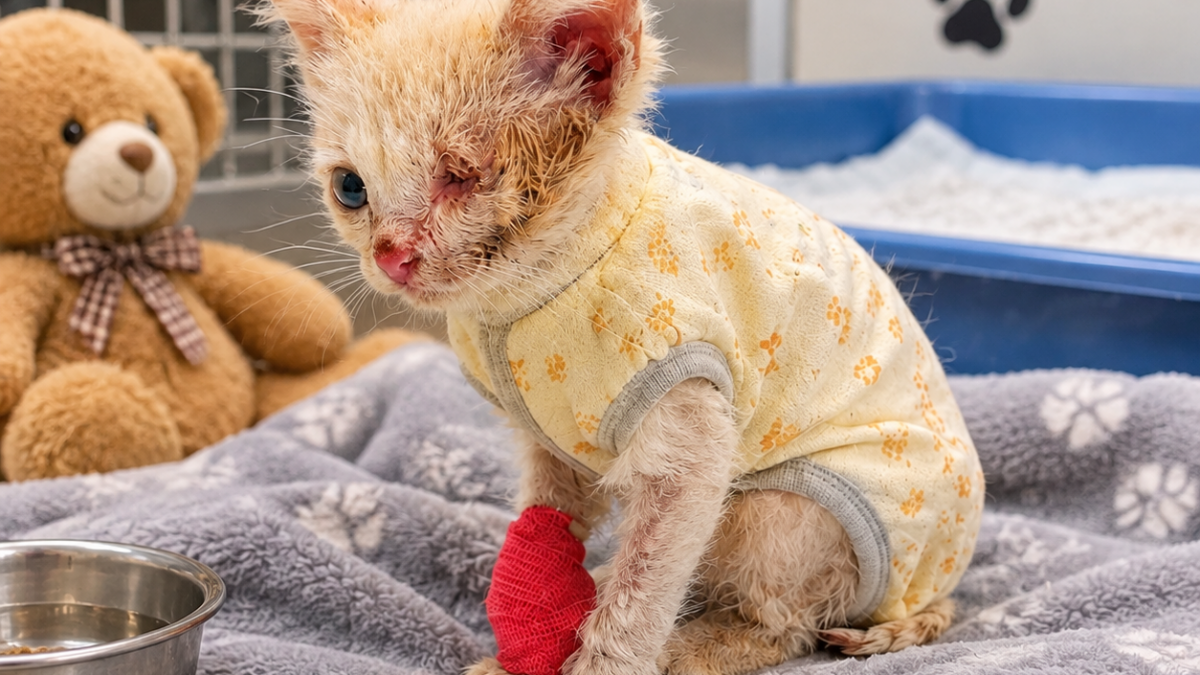
I could see his ribs slightly beneath the fur.
His coat was dirty but not matted.
No obvious major wound.
No blood.
No broken limb.
Just a baby cat sitting alone where a baby cat should never have been.
I looked beneath the car.
Nothing.
Behind the trash bins.
Nothing.
Along the wall.
Nothing.
I waited another ten minutes in case a mother returned.
She didn’t.
A man walked past carrying two shopping bags.
He glanced down.
“That kitten been there long?”
“I don’t know.”
“I saw him this morning.”
My stomach dropped.
“What time?”
“Maybe seven?”
It was nearly noon.
“You didn’t see another cat?”
He shook his head.
“I figured somebody was coming for him.”
That sentence.
Everybody thinks somebody is coming.
Until nobody does.
I took a small towel from my bag.
Moved slowly.
The kitten watched.
When I reached toward him, I expected panic.
His body stiffened.
But he did not fight.
My hands went beneath his chest and belly.
He weighed almost nothing.
Warm from the pavement.
Light enough that my arms automatically adjusted because they expected more.
The moment his paws left the ground, he gave one tiny movement.
Not a scratch.
Not a bite.
He simply curled inward.
As though he did not know what being carried meant yet.
I held him against the towel.
“It’s okay.”
His eyes lifted.
For one second, he looked directly into my face.
I know people like to imagine animals asking questions with their eyes.
Maybe that is us putting language where none exists.
But if I had to give that look words, they would have been simple.
Are you taking me somewhere?
And maybe:
Are you bringing me back?
I did not put him down.
I carried him to the car.
He stayed wrapped in the towel on my lap while a friend drove us to the clinic.
He barely made a sound.
That silence followed us.
At one stoplight, I touched the side of his head.
He blinked slowly.
No resistance.
No leaning in either.
Just acceptance.
The clinic smelled like disinfectant, warm air, and nervous animals.
A dog barked somewhere behind a door.
Kefir flinched for the first time.
His entire body tightened.
I placed one hand over him lightly.
“You’re okay.”
A technician named Anna came out.
“What have you got?”
“Very small kitten. Found alone.”
“How old?”
“Maybe five weeks.”
She looked at him.
“Maybe.”
We went into an exam room.
The scale read 684 grams.
Anna frowned.
“Little guy.”
The veterinarian, Dr. Marina, examined him carefully.
Temperature.
Gums.
Hydration.
Abdomen.
Eyes.
Ears.
Lungs.
Heart.
No obvious fracture.
No major respiratory distress.
He was underweight.
Mildly dehydrated.
Weak.
Dirty.
Likely had not been eating enough.
But there was no dramatic diagnosis.
That almost made the situation stranger.
He had not been struck by a car.
Not visibly attacked.
Not bleeding.
He was simply too young to be alone.
And sometimes that is enough to become an emergency.
A five-week-old kitten has very little reserve.
Cold matters.
Dehydration matters.
Missed meals matter.
Everything matters more when your entire body weighs less than a bottle of water.
Marina wrapped him in a soft blanket.
“He needs warmth first.”
I nodded.
“Food?”
“Small amounts.”
“Anything else?”
“Time.”
That answer would become the theme of Kefir’s recovery.
Time.
Not drama.
Not miracle medicine.
Time.
He was moved into a warm enclosure.
A folded fleece blanket beneath him.
Heating support positioned safely nearby.
Water.
Food appropriate for his age.
Everything quiet.
He curled into the blanket.
And slept.
Hours.
That first day, Kefir slept more than he was awake.
Every time I looked at him, he seemed smaller inside the blanket.
The fabric had little blue stars printed on it.
His head barely rose above one fold.
He did not cry when people walked past.
He did not reach toward the cage door.
Did not demand attention.
He slept.
Woke.
Looked.
Slept again.
That frightened me in a different way.
Energy is life in a kitten.
Even trouble is reassuring.
A kitten trying to climb a towel or bite a finger is doing something.
Kefir seemed to conserve every movement.
In the late afternoon, Anna offered food.
A shallow plate.
Soft kitten food thinned slightly.
She put it near him.
Kefir smelled it.
Then turned his head away.
My chest tightened.
“He needs to eat.”
“He will.”
“What if he doesn’t?”
Anna looked at me.
“Then we adapt.”
She moved the plate closer.
No force.
Five minutes.
Nothing.
Ten.
Kefir opened his eyes.
Smelled again.
His nose moved.
He lifted his head.
That alone looked like work.
Then he leaned forward.
One lick.
Stopped.
Another.
Then a tiny bite.
I held my breath.
He paused for almost thirty seconds.
Then took another.
Anna smiled.
“Good.”
That word felt enormous.
Good.
One bite.
Then another.
A kitten the size of my hands choosing to put food into his body.
People outside rescue would not understand why that could make someone cry.
I did.
The next morning, I returned early.
Kefir was asleep.
Anna showed me the intake sheet.
Ate small amount overnight.
Urinated.
No vomiting.
Temperature improved.
I smiled.
“Why are you smiling at urine?”
Marina asked as she passed.
“Low standards.”
“Best kind in rescue.”
The first few days were like that.
Tiny measurements.
Food.
Water.
Body temperature.
Weight.
Stool.
Energy.
Everything ordinary.
Everything important.
He gained grams.
Then lost a few.
Then gained again.
He did not suddenly become playful.
He did not spring from the blanket like nothing had happened.
His recovery was quiet.
Exactly like he was.
On the third day, I put my hand inside the enclosure.
Not on him.
Beside him.
Kefir opened his eyes.
Looked at my fingers.
No movement.
I left my hand there.
After a minute, his nose came forward.
Smell.
Then he stopped.
I did not move.
He sniffed again.
His whiskers touched my knuckle.
That was all.
The next day he did it faster.
The day after, he rested his chin against one finger.
For maybe two seconds.
Then moved away.
Trust is easy to miss when you expect it to look like affection.
Sometimes trust is simply staying.
Sometimes it is not flinching.
Sometimes it is putting your chin down because for one moment you believe the thing beneath you will not disappear.
By the end of the first week, Kefir began eating with more enthusiasm.
Still slowly.
But he looked toward the food when it arrived.
That mattered.
Expectation.
He was learning that meals came back.
One morning, Anna carried the bowl into the room.
Kefir stood.
Actually stood before she put it down.
His tail rose halfway.
Anna laughed.
“Well, look who suddenly has opinions.”
He gave one tiny sound.
Barely a meow.
I froze.
“Did you hear that?”
Anna looked at me.
“He has a voice.”
The kitten who had sat on the street without making a sound had finally asked for something.
Food.
Not rescue.
Not pity.
Breakfast.
Perfect.
He ate.
Then cleaned one paw afterward.
Awkwardly.
His balance was still babyish.
He licked the paw.
Rubbed it over his face.
Nearly tipped sideways.
I laughed.
Kefir looked offended.
That was probably the first time I saw personality instead of condition.
A week later, we moved him to a larger recovery space.
Still warm.
Still quiet.
But enough room to walk.
A small stuffed mouse sat in one corner.
I did not expect him to care.
For several minutes, he ignored it.
Then something changed.
His eyes followed the toy when Anna nudged it.
No movement.
She nudged again.
Kefir’s front paw lifted.
Stopped in the air.
Then touched the mouse.
Barely.
The toy rolled two inches.
Kefir stared.
His ears came forward.
Anna whispered, “There you are.”
He touched it again.
Roll.
Another paw.
This time harder.
The mouse flipped.
Kefir jumped backward.
I laughed.
He stared at it.
Then pounced.
Not well.
More of a stumble with ambition.
But it was a pounce.
That was the day I stopped thinking of him as the kitten from the street.
Because the kitten from the street waited.
This kitten wanted.
Wanted the toy.
Wanted food.
Wanted warmth.
Wanted us.
Little by little, he began following people.
At first only with his eyes.
Then a few steps.
If I moved from one side of the room to another, he watched.
Eventually, he came after me.
Slow.
Tiny paws.
Tail up.
A shadow barely six inches tall.
I would sit on the floor.
He would stop a foot away.
Think.
Then move closer.
Never directly into my lap at first.
Beside me.
That was his favorite distance.
Close enough to feel presence.
Far enough to leave.
I respected that.
Then one afternoon he changed the rule himself.
I was sitting against the wall answering messages.
Kefir had eaten.
Played.
Wandered.
I felt something touch my leg.
Looked down.
He had climbed onto my shoe.
One front paw.
Then the other.
He stood there.
I did not move.
He stepped onto my ankle.
Then my shin.
Then, with enormous effort for such a tiny body, crawled into the fold of my sweater near my stomach.
He turned around once.
Twice.
Lay down.
My phone stayed in my hand.
I did not dare breathe properly.
Kefir’s body softened.
That was different from sleep.
I had seen him sleep.
This was surrender.
Safe surrender.
Muscles loose.
Paws tucked.
Breathing slow.
His head settled against me.
A low vibration began.
Very faint.
I looked at Anna across the room.
“Is he—”
She smiled.
“Purring.”
I cried.
Of course I did.
Kefir slept on me for forty minutes.
My leg went numb.
My back hurt.
I did not move.
Because the first time a frightened animal chooses your body as a safe place, discomfort becomes irrelevant.
That moment changed something in me too.
Until then, I had thought the goal was to make Kefir healthy.
Eat.
Gain weight.
Stay warm.
Avoid illness.
Those things mattered.
But I realized survival was only the first half.
The second was teaching him that being alive could feel good.
Warmth.
Touch.
Play.
Routine.
Belonging.
Kefir began improving faster after that.
Not because affection magically healed him.
Because a body not spending every second braced against uncertainty has more room to grow.
He gained weight.
His coat improved.
His eyes brightened.
His movements became more coordinated.
The stuffed mouse lost one ear.
Then the other.
He discovered a plastic ball with a bell inside and became obsessed with shoving it beneath furniture where humans had to retrieve it.
He learned that the sound of the food container meant running.
Not walking.
Running.
His legs were still too short for his speed.
He frequently arrived sideways.
I called it controlled crashing.
Anna called it kitten physics.
Kefir disagreed with both assessments.
By the third week, he had started greeting people he knew.
Not strangers.
Kefir remained cautious.
But when I entered, his head came up.
When Anna spoke, he walked toward her.
When Marina opened the enclosure, Kefir sniffed her hands before allowing examination.
He had preferences.
That was another victory.
The kitten who once accepted whatever happened now began choosing.
Who to approach.
Where to sleep.
Which blanket.
Which toy.
Chicken over fish.
Definitely chicken.
He hated one yellow blanket for reasons nobody understood.
We replaced it.
Recovery gave him the luxury of being unreasonable.
I loved that.
One afternoon, a family visited the clinic.
They were there for another cat.
A little girl saw Kefir.
“Oh, look.”
She approached quickly.
Kefir backed away.
I raised one hand.
“Slow.”
The girl stopped.
Maybe eight years old.
She looked at me.
“He’s scared?”
“Sometimes.”
She crouched.
Did not reach.
Kefir watched.
The girl whispered, “Hi.”
He stayed.
That was enough.
After a minute, the girl put one finger on the floor.
Kefir smelled it.
Then walked away.
She looked disappointed.
I said, “That was good.”
“He left.”
“He chose to come close first.”
She thought about that.
Then smiled.
“Okay.”
That interaction reminded me how easily people confuse affection with access.
Kefir did not owe anyone contact because they thought he was cute.
His trust belonged to him.
The more we respected that, the more he offered.
By six weeks after rescue, Kefir hardly resembled the kitten from the street.
Still small.
Still delicate.
But alert.
Curious.
Playful.
He had grown enough that the original towel no longer wrapped around him twice.
I kept it anyway.
He had a favorite sleeping spot near a window.
Morning sunlight reached it around nine.
He would sit there.
Eyes half closed.
Warm.
The first time I saw him in that patch of sun, I remembered the pavement.
Same stillness.
Completely different meaning.
On the street, Kefir had sat still because he had nowhere to go.
Now he sat still because there was nowhere else he needed to be.
That difference was everything.
We began discussing adoption.
I hated it.
Rescue is strange.
You spend weeks teaching an animal that people stay.
Then one day you put them in someone else’s arms.
It can feel like betrayal even when it is the entire point.
Applications came.
Some good.
Some not.
One family wanted him because he was “so calm.”
I rejected them mentally before the interview ended.
Kefir was not calm.
He had become a tiny criminal.
He climbed curtains.
Attacked shoelaces.
Stole food.
Knocked over a water dish twice in one afternoon.
Anybody adopting the imagined silent kitten would be surprised by the actual cat.
Another applicant had a loud household with three large dogs.
Not impossible.
But Kefir still startled easily.
Wrong fit.
Then there was Elena.
Thirty-four.
Worked from home.
One older cat.
Quiet apartment.
She did not ask whether Kefir was cuddly.
Her first question was:
“What scares him?”
That got my attention.
“Sudden approaches.”
She nodded.
“Strangers?”
“Sometimes.”
“Children?”
“Depends how they approach.”
“Does he hide?”
“He likes a covered bed when overwhelmed.”
“Do I take him out?”
“No.”
She smiled.
“Good.”
“What?”
“I was hoping you’d say no.”
We arranged visits.
The first time, Kefir did not go near her.
Elena sat on the floor.
Talked to me.
Ignored him.
Perfect.
Second visit.
He came within three feet.
Third.
Sniffed her shoe.
Fourth.
Played with the end of a wand toy she held.
Fifth.
He climbed onto the chair beside her.
Not her lap.
Beside.
She looked at me.
Did not touch him.
That was when I knew.
“You’re going to take him.”
Elena’s eyes filled.
“If he’ll have me.”
I laughed.
“That’s the correct answer.”
Adoption day arrived.
I prepared food.
Blanket.
Toy.
Medical records.
Routine notes.
A ridiculous list of preferences.
Chicken.
Window sun.
Blue blanket.
No yellow blanket.
Bell ball.
Do not leave shoelaces unattended.
Elena read everything.
“Yellow blanket?”
“He has principles.”
“Understood.”
Kefir went into the carrier reluctantly.
I felt awful.
At the car, Elena put the carrier on the back seat and secured it.
Then looked at me.
“You okay?”
“No.”
She laughed softly.
“I’ll send updates.”
“Too many.”
“How many is too many?”
“Impossible.”
When the car left, I stood outside until it disappeared.
Then cried in the parking lot.
Anna found me.
“He got a home.”
“I know.”
“You’re crying.”
“I know.”
“That’s the job.”
“I hate the job.”
“You’ll do it again tomorrow.”
She was right.
The first update arrived forty minutes later.
Photo.
Kefir inside the carrier with the door open.
Not coming out.
Fine.
Second update two hours later.
He had eaten.
Third.
Explored the bathroom.
Fourth.
Found the sofa.
That night, Elena sent one image.
Kefir asleep inside a folded blanket.
Body completely loose.
I stared at it for a long time.
He had done it again.
Relaxed.
The same way he had first relaxed at the clinic.
Only now, it happened somewhere new.
That meant something.
Trust had become portable.
Not attached only to us.
Kefir had learned enough safety that he could begin building it again somewhere else.
Weeks passed.
Updates continued.
He and Elena’s older cat, Misha, tolerated each other.
Then shared a window.
Then shared a bed.
Then fought over the same cardboard box while two identical empty boxes sat nearby.
Normal cat behavior.
Perfect.
Kefir grew.
His face changed.
Baby roundness.
Longer body.
Tail that seemed too large for him.
He became affectionate.
Not constantly.
On his terms.
He followed Elena from room to room.
Sat beside her while she worked.
Slept near her feet.
Sometimes climbed onto her chest at night.
The kitten who once waited alone had become a shadow.
One year after I found him, Elena invited me to visit.
I almost said no.
Part of me worried Kefir would not remember me.
Another part worried he would.
Both possibilities hurt.
I went.
Elena opened the door.
Misha appeared first.
Then a pale blur crossed the hallway.
Kefir.
No longer 684 grams.
No longer fitting inside one hand.
He stopped when he saw me.
I crouched.
“Hey.”
He stared.
One second.
Two.
Then walked forward.
Sniffed my fingers.
I did not move.
His forehead touched my hand.
Then he leaned.
Exactly the way he had learned to lean at the clinic.
My throat closed.
“You remember.”
Elena smiled from behind me.
Kefir stepped into my lap.
Just briefly.
Then jumped away because apparently nostalgia has limits when there are curtains to attack.
I laughed.
That visit changed how I remembered the beginning.
Before, whenever I thought of Kefir, I pictured the street.
Tiny.
Still.
Alone.
After that day, a different image took its place.
Kefir running through Elena’s apartment with a toy mouse.
Healthy.
Annoying.
Loved.
That was the real rescue.
Not the moment I picked him up.
That was only transportation.
Rescue was everything after.
Every meal.
Every gram gained.
Every quiet hand.
Every time we stopped instead of forcing.
Every time somebody returned.
Every time Kefir woke and discovered the same people were still there.
People talk about trust like it is one decision.
It isn’t.
Trust is repetition.
I feed you today.
Then tomorrow.
I touch you gently today.
Then tomorrow.
You sleep.
You wake.
I am still here.
Again.
Again.
Again.
Eventually the nervous system stops asking when safety will disappear.
That happened to Kefir.
Slowly.
His silence changed meaning.
At first, it looked like surrender.
Later, peace.
That is what stays with me.
Some animals arrive screaming.
Some fight everything.
Some bite.
Some hide.
Kefir sat still.
It would have been easy to misunderstand.
People could have called him calm.
Easy.
Sweet.
Maybe even unusually well-behaved.
But a five-week-old kitten alone on a street should not look like he has accepted the world.
A kitten that age should be inconvenient.
Hungry.
Curious.
Climbing things.
Following warmth.
Demanding attention.
Kefir had to learn he was allowed to become that.
One evening, years later, Elena sent me a video.
Kefir was sitting on the windowsill.
Snow outside.
Misha asleep nearby.
Elena called his name.
Kefir turned.
Jumped down.
Walked toward her.
Then disappeared out of frame.
A second later, she laughed.
“He’s on my shoulder.”
I replayed it.
Not dramatic.
No rescue scene.
No sad music.
Just a cat responding when someone called.
But that was the part that broke me.
Because once, there had been no familiar person calling him.
No voice that meant home.
No one waiting.
Now someone could say:
“Kefir.”
And he knew exactly where to go.
I still keep the original photo from the day I found him.
Sometimes people ask why.
He looks terrible in it.
Tiny.
Dirty.
Too still.
I keep it because that photo contains a question.
Not “Will he survive?”
He was not dying dramatically.
The question was quieter.
Will anyone stop?
That is the danger with quiet suffering.
It does not demand attention.
It lets busy people keep walking.
Kefir did not chase us.
He did not scream.
He did not make rescue easy to notice.
Someone had to look twice.
That idea followed me into every rescue afterward.
The loud animal is not always the one in greatest need.
Sometimes you look for movement.
Then learn to notice stillness.
Sometimes you listen for cries.
Then learn silence can say just as much.
Years after Kefir, I found another kitten beneath a loading dock.
That kitten screamed so loudly I heard him from half a block away.
Easy to find.
Easy to understand.
While carrying him to the car, I thought about Kefir.
How little noise he had made.
How close he came to becoming invisible.
That is why his story stayed with me.
Not because he suffered more than every other animal.
Not because his recovery was miraculous.
It wasn’t.
His story stayed because almost everything important happened quietly.
A person stopped.
A hand lifted him.
A blanket stayed warm.
A bowl returned.
A kitten ate.
A body relaxed.
A paw touched a toy.
A head leaned into a hand.
A frightened little animal decided, one small experience at a time, that maybe people could be trusted.
There was no single moment when Kefir became safe forever.
Safety grew around him.
Layer by layer.
Routine by routine.
Until one day the life he had been waiting for became ordinary.
And ordinary was exactly what he deserved.
Food in the bowl.
Sun on the window.
A person working nearby.
Another cat stealing his bed.
A toy under the sofa.
Someone saying his name.
Someone expecting him to answer.
If I could return to that street and speak to the five-week-old kitten beside the parked car, I would not tell him to be brave.
He had already done enough.
I would not tell him everything was about to become perfect.
It wouldn’t.
There would be clinic smells.
Needles.
Strange rooms.
New people.
A carrier he hated.
Another home he would have to learn.
I would only crouch in front of him again and tell him one thing.
“You can stop waiting now.”
Because someone finally saw him.
And after that, Kefir never had to sit alone wondering whether anybody would come back again.








