At 7:14 AM, HOA Workers Tore the Roof Off My Home—Then Their Forged Work Order Exposed What the President Was Really Trying to Do
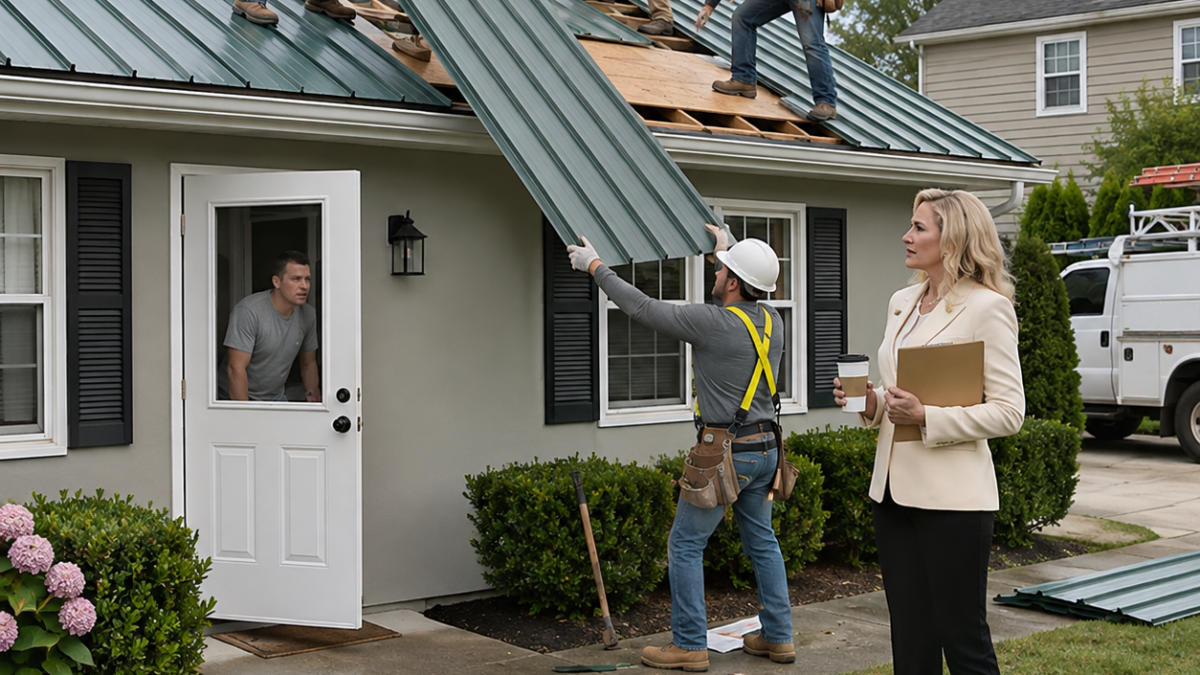
At 7:14 AM, HOA Workers Tore the Roof Off My Home—Then Their Forged Work Order Exposed What the President Was Really Trying to Do
By 7:46, two sheriff’s deputies had confirmed that Reed’s property was legally excluded from the HOA, the contractor had admitted Marla supplied the paperwork, and the signature authorizing the demolition wasn’t Reed’s.
Then Marla’s insurance company called while everyone was still standing beneath the exposed rafters—and the question they asked revealed that removing Reed’s roof may never have been about neighborhood standards at all.
Marla held the phone to her ear.
“What do you mean the insurance company already has the recording?”
Nobody said anything.
Deputy Aaron Bell stood beside Harlan Pike near the contractor’s trailer.
His partner, Deputy Lena Morris, was photographing the exposed section of my roof.
Harlan’s four workers had stopped packing.
Even they were listening.
Marla turned away from us.
“I understand that, but you haven’t heard the complete circumstances.”
Pause.
“No.”
Another pause.
“That is not what happened.”
Her voice had changed.
The confidence was gone.
This wasn’t HOA-president Marla anymore.
This was someone being asked questions she had not prepared to answer.
I stepped toward Deputy Bell.
“Who sent the recording?”
He looked at me.
“I did.”
That surprised me.
“When?”
“While we were verifying the parcel.”
“Why insurance?”
“Harlan’s company gave us their certificate when we asked for licensing information.”
Harlan rubbed the back of his neck.
“I called my carrier too.”
Marla turned.
“You what?”
Harlan did not look intimidated anymore.
“You gave me a homeowner authorization.”
“It is valid.”
“No.”
He pointed at the document in Bell’s hand.
“The parcel number is wrong.”
“That’s clerical.”
“The homeowner says the signature is forged.”
“It isn’t.”
“The county says no permit.”
“Emergency maintenance doesn’t require—”
Harlan cut her off.
“And now the sheriff says the property isn’t even in your HOA.”
Marla stepped toward him.
“You were paid to complete a job.”
PART2:
“I was paid to perform authorized work.”
“You’re breaching contract.”
Harlan stared at her.
“Then sue me.”
Marla froze.
That was the first moment I almost smiled.
Not because my roof was destroyed.
Not because a storm was approaching.
Because Marla had finally encountered someone she could not bully by invoking “community standards.”
The insurance representative was still talking in her ear.
Marla walked toward her SUV.
“I’m going somewhere private.”
Deputy Morris blocked her path without touching her.
“Ma’am, you’re free to make your call.”
Marla looked relieved.
Then Morris continued.
“But your vehicle remains here while we’re documenting the incident.”
“Why?”
“Because your work-order folder is inside it.”
Marla’s face changed.
“You cannot search my car.”
PART3:
“We aren’t searching anything.”
“Then why can’t I leave?”
Deputy Bell answered.
“You can leave.”
He gestured toward the sidewalk.
“The vehicle stays unless you want to remove the documents first under observation.”
Marla looked from one deputy to the other.
I could almost see her recalculating.
Then she ended the call.
Her eyes went to me.
“You have no idea what you’ve started.”
I looked at the opening in my roof.
“No, Marla.”
I pointed up.
“You started it.”
The storm was predicted to arrive around six that evening.
Heavy rain.
Potential hail.
Twenty-five-mile-per-hour gusts.
My bedroom ceiling was now protected by insulation, decking cut open in three places, and approximately half the metal panels removed over the north side.
Harlan walked toward me.
“Mr. Hollister.”
I turned.
He looked sick.
Not afraid.
Embarrassed.
“I need to make this weather-tight.”
Deputy Bell asked:
“Can you?”
“Yes.”
Harlan looked toward the truck.
“Temporary membrane. New underlayment over the cuts. We can reinstall the removed metal where it isn’t damaged.”
“Who pays?” I asked.
He hesitated.
“My company will handle emergency protection today.”
Marla laughed from near her SUV.
“You are not billing Ridgecrest for that.”
Harlan ignored her.
I asked:
“Why?”
“Because my crew removed it.”
“You were given forged authorization.”
“My crew still removed it.”
That answer earned my respect.
“I don’t want you admitting liability before speaking with your carrier.”
“I’m not.”
He nodded toward the sky.
“I’m keeping water out of your house.”
Fair enough.
Deputy Morris said:
“Document everything before you start.”
We did.
Hundreds of photographs.
Drone images from Harlan’s foreman.
Measurements.
Damaged panels.
Drill holes.
Cut seam.
Fastener locations.
Interior ceiling.
Attic.
Insulation.
Then Harlan called his insurer again.
Forty minutes later, a field adjuster was driving toward us from the county seat.
Marla stood on the curb throughout most of it.
Her coffee went cold.
At 9:05, Deputy Bell finally handed her a property receipt.
Not an arrest.
Not yet.
He had taken the forged homeowner authorization as evidence.
Made a copy for Harlan.
Photographed everything.
Marla asked:
“Am I being charged?”
Bell answered:
“Not today.”
She visibly relaxed.
Then:
“But the document is being referred for investigation.”
Relaxation disappeared.
“For what?”
“Potential forgery.”
“It isn’t forged.”
“Then that should be easy to establish.”
Marla looked at me.
“This is a civil dispute.”
Bell nodded.
“The HOA disagreement may be.”
Then held up the evidence bag.
“This document may not be.”
She drove away five minutes later.
No siren.
No handcuffs.
No dramatic arrest.
Real life usually moves slower than that.
By ten, Harlan’s crew was back on the roof.
This time with my written permission.
They installed temporary weatherproofing.
The irony wasn’t lost on anybody.
At 11:18, Rachel Kim arrived.
Rachel had handled my real estate matters for years.
She got out of her Volvo, looked at my roof, then looked at me.
“Please tell me you didn’t approve that.”
“Good morning to you too.”
“Reed.”
“No.”
She exhaled.
“Okay.”
Then:
“Start from the beginning.”
We sat at my kitchen table while drills ran overhead.
I showed her the recording.
Marla directing the crew.
Harlan producing the work order.
My refusal.
Marla ordering them to continue.
The county building department confirming no permit.
The parcel number.
Rachel stopped the video.
“Back up.”
I did.
“Again.”
She pointed at Marla.
“Listen.”
Marla’s voice came through:
Keep working. The authorization covers corrective exterior replacement.
Rachel looked at me.
“She knew you were disputing the document.”
“Yes.”
“She ordered them to continue after you said the signature was forged.”
“Yes.”
“Good.”
“Good?”
“From an evidence perspective.”
“From the roof perspective, less good.”
She ignored that.
“Show me the parcel.”
I brought out my deed.
Lot description:
Hollister Tract.
2.84 acres.
Recorded fifteen years before Ridgecrest Commons subdivision approval.
Parcel:
041-18-007.
The forged work order:
041-18-070.
Rachel stared.
“Someone transposed digits?”
“That’s what I thought.”
She shook her head.
“No.”
“What?”
She opened the county GIS database.
Typed 041-18-070.
A property appeared.
Ridgecrest Commons.
Lot 70.
Vacant.
Owned by:
Ridgecrest Commons Homeowners Association.
I stared.
“That parcel belongs to the HOA.”
“Yes.”
“So whoever prepared the document used the HOA’s own parcel number.”
“Looks that way.”
“Why?”
Rachel became quiet.
Then clicked through the ownership history.
Lot 70 wasn’t just an empty HOA lot.
It was designated:
Maintenance Reserve / Stormwater Access.
She zoomed the plat.
Its shape was strange.
Long.
Narrow.
Running behind several homes.
Then ending near the back corner of my property.
Rachel whispered:
“Interesting.”
“What?”
She opened the subdivision declaration.
Searched.
Found an exhibit.
“Reed.”
I moved beside her.
“Lot 70 was reserved for future common-area access.”
“To what?”
She looked at me.
“Possibly your parcel.”
I laughed.
“That doesn’t make sense.”
“Not yet.”
She kept reading.
The original Ridgecrest developer had proposed a second phase.
Phase Two would have added thirty-nine homes behind my property.
Never built.
The preliminary plan required a service connection from Lot 70 toward the county road.
Problem:
My house sat in the way.
Not literally on the road.
But my property separated the proposed expansion land from the existing subdivision.
“What happened to Phase Two?”
Rachel searched.
“Denied.”
“When?”
“Fourteen years ago.”
“Why?”
“No road frontage.”
I stared.
My property had remained independent because the developer could not cross it.
Ridgecrest built around me.
Marla had spent two years pretending that physical proximity somehow placed me inside the HOA.
Maybe that wasn’t just obsession with my roof color.
“Rachel.”
“I know.”
“No, you don’t.”
She looked at me.
“What if Marla didn’t care about the roof?”
Rachel leaned back.
“Go on.”
“What if she needed the house?”
“For access?”
“My property connects Cedar Road to the back acreage.”
Rachel looked again at the map.
Then measured.
My driveway entered directly from Cedar Road.
Behind my garage, an old utility lane extended toward the property line.
If someone controlled my parcel, they could connect Lot 70 through it.
Not elegantly.
But enough for an access corridor.
Rachel said:
“Who owns the land behind you?”
I knew the answer.
“Crosby Family Holdings.”
“What do you know about them?”
“Not much.”
“Let’s learn.”
We did.
Forty-one acres.
Wooded.
Purchased eleven months earlier by:
Westridge Residential Partners LLC.
Rachel stared.
“Developer.”
“New?”
“Yes.”
“Ridgecrest expansion?”
“Maybe.”
She pulled corporate records.
Registered manager:
Dalton Pierce.
Name sounded familiar.
Then I remembered.
Three months earlier, Marla had hosted something she called a “community growth meeting.”
I didn’t attend.
I wasn’t in the HOA.
She had sent me an invitation anyway.
The speaker listed:
Dalton Pierce, Regional Development Consultant.
I opened my email.
Found the invitation.
Rachel read it.
Then looked at me.
“This roof just became very interesting.”
At noon, Harlan’s insurance adjuster arrived.
His name was Mike Ellis.
He inspected everything.
Interviewed Harlan separately.
Then me.
Then asked for Marla’s work order.
Deputy Bell had the original, but Harlan had a copy.
Mike read it.
His eyebrows rose at the signature.
Then the parcel number.
“Who is Marla Voss insured through?”
Rachel asked.
Mike said:
“I can’t discuss another party’s coverage.”
“Does Ridgecrest carry directors-and-officers liability?”
“I would expect it.”
“Property management liability?”
“Possibly.”
“Crime or fidelity coverage?”
He looked at her.
“Are you counsel?”
“Yes.”
“That explains the questions.”
Mike documented everything.
Then said something important.
“My preliminary position is that Pike Roofing acted based on facially valid owner authorization supplied by the contracting party.”
Harlan looked relieved.
Mike continued.
“But after Mr. Hollister disputed authorization, continued work would have created a different problem.”
Harlan nodded.
“We stopped.”
“Eventually,” I said.
He looked at me.
“One worker restarted after Marla ordered him.”
“Yes.”
Harlan grimaced.
“About thirty seconds.”
I said:
“Thirty seconds with a drill is a long time on a roof.”
Nobody argued.
Mike said the carrier would cover emergency mitigation while liability was investigated.
By two, temporary roofing was complete.
At 3:20, clouds moved in.
At 5:51, rain started.
Hard.
I stood in the attic with a flashlight.
Dry.
At least the house survived the night.
Marla’s position didn’t.
The following morning, Rachel called.
“Do you know a man named Brandon Pike?”
“Harlan’s brother?”
“No.”
She sounded amused.
“Sorry. Different Pike. Brandon Pike is Ridgecrest’s former treasurer.”
“No.”
“He contacted me.”
“Why?”
“Apparently people talk.”
“What does he want?”
“To show us board minutes.”
That afternoon, Brandon sat at Rachel’s conference table.
Sixty-three.
Glasses.
Former bank manager.
He brought a binder.
“I resigned in March.”
“Why?” Rachel asked.
“Marla.”
Reasonable.
He opened to meeting minutes eighteen months earlier.
Agenda:
Ridgecrest Long-Term Access and Expansion Planning.
Marla presiding.
Guest:
Dalton Pierce.
Westridge Residential Partners.
My name appeared three times.
Rachel read aloud:
“Existing Hollister parcel represents primary obstacle to contiguous Phase Two development.”
I felt heat rise through my chest.
Next entry:
“President Voss recommends renewed integration strategy.”
Integration.
Rachel asked:
“What does that mean?”
Brandon looked uncomfortable.
“She wanted to bring Reed’s property into the HOA.”
“She knew it was excluded?”
“Everyone on the board knew.”
There it was.
Not mistaken.
Not confused.
Knew.
I asked:
“How?”
“Your parcel is marked as excluded on every association plat.”
“Then why violation letters?”
Brandon looked at me.
“Pressure.”
Rachel said:
“Whose idea?”
“Marla’s.”
“What was the end goal?”
“Acquisition.”
I sat back.
“Acquire my house.”
“Your property.”
“Same problem.”
Brandon nodded.
“Westridge offered incentives.”
“What incentives?”
He slid forward another page.
Potential payment to Ridgecrest:
$480,000.
For what?
Facilitation and community infrastructure participation.
Rachel gave me a look.
I knew that look now.
Translation:
Find us a road.
“How much to Marla?” I asked.
Brandon hesitated.
“That wasn’t in the board agreement.”
“Meaning?”
“I saw a separate email.”
Rachel leaned forward.
“What email?”
“Pierce asked whether her consulting arrangement would remain confidential until entitlement.”
My anger went cold again.
“How much?”
“I don’t know.”
“Do you have the email?”
“No.”
“Why not?”
“I saw it on Marla’s screen during a board meeting.”
Rachel asked:
“What happened when you raised this?”
“She said it concerned private professional services.”
“And?”
“I told her she could not personally profit from negotiating association business.”
“Her response?”
Brandon almost smiled.
“She said I didn’t understand modern development partnerships.”
Of course.
Rachel asked:
“Why resign?”
“Because three board members would vote with her on anything.”
“Did you report it?”
“To association counsel.”
“What happened?”
“They told me to raise it through internal governance.”
“Which Marla controlled.”
“Yes.”
Brandon opened another page.
Then:
“The roof came up in January.”
I stared.
“My roof?”
“Yes.”
“What did the board discuss?”
“Exterior compliance.”
“My house isn’t subject to exterior compliance.”
“I said that.”
“What did Marla say?”
“That she had an owner’s consent mechanism.”
Rachel and I looked at each other.
“How specific?”
“She said you would sign voluntary compliance authorization before spring.”
“I never spoke to her about that.”
“I know.”
“She knew that in January?”
“She claimed negotiation was underway.”
This was February now.
The forged work order had not been an improvisation.
It had been planned.
Rachel asked:
“Why the roof?”
Brandon looked at me.
“That part never made sense to me.”
It made sense two days later.
County planning records.
Rachel found a new submission.
Westridge Phase Two Concept Plan.
Thirty-nine homes.
Submitted six weeks before my roof was torn off.
Proposed road:
Lot 70.
Then through a strip labeled:
Future Association-Controlled Access Parcel.
That strip was mine.
Not part.
All 2.84 acres.
My house was shown with a note:
Structure removal / redevelopment anticipated.
I stared at it.
“Structure removal.”
Rachel said nothing.
“They planned to tear down my house.”
“Eventually.”
“And the roof?”
She looked at the dates.
“I think Marla was trying to create a different kind of record.”
“What?”
“Owner consent.”
I didn’t understand.
Rachel explained.
“If she gets you on paper authorizing HOA work on your home, she can later argue you recognized some HOA authority.”
“But one roof authorization doesn’t transfer land.”
“No.”
“Doesn’t join me to covenants.”
“No.”
“Then?”
“It muddies the record.”
There it was again.
Not ownership.
Ambiguity.
Marla didn’t need a perfect legal claim.
She needed enough documentation to make Westridge believe she could deliver my parcel eventually.
A signed owner authorization.
HOA-funded contractor.
Corrective work.
Maybe later dues.
Maybe an architectural approval.
One concession at a time.
Build a paper history.
Then negotiate from it.
Except I never signed.
So she forged the first step.
Rachel requested the complete county planning file.
Westridge’s application included a letter from Marla.
Ridgecrest Commons is actively integrating the Hollister tract into community governance and anticipates control of necessary access within the current fiscal year.
Current fiscal year.
I read it twice.
“She promised them my land.”
“Yes.”
“Did Westridge verify?”
“Apparently not.”
“Why would they trust her?”
“Because they wanted the answer.”
That line stayed with me.
People verify inconvenient facts more carefully than convenient ones.
Westridge wanted my property available.
Marla told them it would be.
So everyone treated the unresolved part as administrative.
Until five men were standing on my roof.
We sent preservation letters.
HOA.
Westridge.
Marla personally.
Pike Roofing.
County.
Association insurer.
No deletion.
No destruction.
No alteration.
Then Rachel sent Ridgecrest a demand.
Pay for full roof replacement.
Interior inspection.
Engineering evaluation.
Temporary mitigation.
Legal fees.
And disclose every communication involving my property.
The HOA board called an emergency meeting.
Marla tried to preside.
Three board members objected.
Brandon’s old ally, Linda Perez, moved to suspend Marla pending investigation.
Vote:
3-2.
Marla voted against.
So did one loyal member.
Suspended.
She called the vote illegal.
Association counsel disagreed.
Then something interesting happened.
Without Marla controlling the records, the board opened files.
Emails.
Contracts.
Invoices.
A consulting agreement.
Marla Voss Consulting LLC.
Client:
Westridge Residential Partners.
Success fee:
$175,000.
Condition:
“Securing viable community-controlled access for Phase Two development.”
There it was.
Not gray shingles.
$175,000.
Rachel called me.
“Sit down.”
“I am.”
“She was being paid by the developer.”
“How much?”
“Twenty-five-thousand-dollar retainer already received.”
I closed my eyes.
“And the rest?”
“On access approval.”
“How was she supposed to get access?”
“Your property.”
“Did Westridge know I didn’t consent?”
“That is becoming the central question.”
They knew enough.
That was obvious from emails.
Pierce wrote:
Need confirmation Hollister issue is resolved before final engineering.
Marla answered:
Owner integration in progress. HOA corrective authority being established.
Another:
Reed is difficult but isolated. No spouse, no children in residence. Pressure strategy remains viable.
I read that sentence several times.
Isolated.
There it was.
Why she kept coming after me.
Not because I had a green roof.
Because she saw a man living alone.
No wife.
No children.
No family in the neighborhood.
No HOA membership.
In her mind:
weak resistance.
She was wrong.
But I understood the calculation.
Another email from Pierce:
Do not proceed with any action that could be construed as unauthorized entry.
Interesting.
Marla responded:
Routine covenant enforcement is within association scope.
She knew it wasn’t.
Brandon had reminded her.
County plats showed it.
Association counsel had said it.
Yet she wrote the developer as though enforcement authority existed.
That helped Westridge.
Not enough to make them innocent.
But enough to create distance.
Dalton Pierce called Rachel personally.
Wanted a meeting.
We agreed.
Westridge brought counsel.
Pierce.
Vice president for land acquisition.
Rachel brought me.
Our meeting lasted fifty-two minutes.
Their attorney began:
“Westridge did not authorize the roof work.”
Rachel:
“Did you authorize Marla Voss to establish control over my client’s property?”
“No.”
“Did you pay her?”
“Yes.”
“For?”
“Development consulting.”
“Success fee tied to access?”
“Yes.”
“Access across what?”
Pierce answered:
“A corridor connecting Lot 70 to Cedar Road.”
“Through Reed’s land.”
“Yes.”
“Did you speak to Reed?”
“No.”
“Why?”
Pierce looked uncomfortable.
“We understood Ridgecrest was handling owner negotiations.”
I said:
“There were no negotiations.”
He looked at me.
“I understand that now.”
“You filed a map showing my house removed.”
“Conceptual.”
“You labeled my property future association-controlled access.”
“That language came from the HOA submission.”
“You submitted it.”
Silence.
Rachel let that sit.
Westridge eventually offered something.
Money.
Not to buy the property.
Settlement.
Legal fees.
Damage contribution.
Withdrawal of their application.
Termination of Marla’s consulting agreement.
Full written acknowledgment that they possessed no interest in my land.
I asked:
“What about Phase Two?”
Pierce said:
“Without your parcel, it isn’t viable.”
“Good.”
He looked at me.
“You wouldn’t consider selling?”
Rachel almost laughed.
I didn’t.
“No.”
He nodded.
“Understood.”
They withdrew the plan three days later.
Marla lost her $150,000 remaining success fee.
That wasn’t the worst part for her.
The HOA’s insurer denied coverage for her intentional conduct.
The carrier’s reservation-of-rights letter was brutal.
The forged authorization.
Knowing property exclusion.
Directing work after owner objection.
Potential undisclosed financial conflict.
Those weren’t normal board mistakes.
They might fall outside coverage.
That meant Marla could face personal liability.
Harlan’s insurer paid for my immediate roof restoration to prevent further loss, then pursued Ridgecrest and Marla through subrogation.
The replacement cost:
$61,870.
Why so much?
My roof was standing-seam metal.
Custom dark green.
Eleven years old but still had decades of life left.
Once they damaged the interlocking seams across multiple panels, partial repair wouldn’t restore manufacturer integrity.
Entire north plane replaced.
Then color-matching created another issue.
Manufacturer no longer made that exact shade.
I had a choice.
Different north side.
Or replace both visible planes.
Harlan’s carrier chose replacement.
Marla’s “corrective maintenance” got me a brand-new roof.
Same dark green.
When the delivery truck arrived, I sent Marla a photograph.
Rachel yelled at me.
“You contacted her?”
“Photograph only.”
“Stop enjoying yourself.”
“I waited two months.”
“Reed.”
“I won’t do it again.”
I didn’t.
Mostly.
Sheriff investigators took longer.
Forged signature.
Wrong parcel number.
Who created the work order?
Metadata eventually answered that.
The PDF originated on a laptop assigned to the Ridgecrest HOA office.
Created under Marla’s user profile.
Signature image extracted from a document I’d signed eighteen months earlier.
What document?
A certified-mail acknowledgment.
One of Marla’s violation notices.
She had used my signature acknowledging receipt of an invalid HOA demand and pasted it onto authorization for demolition.
Elegant.
In the worst way.
The parcel number came from Lot 70 because Marla copied a template used for HOA-owned maintenance property.
She changed the address.
Changed owner name.
Forgot to change parcel number.
That tiny mistake was the crack.
But even without it, the signature evidence was strong.
Then investigators found another file.
Hollister Integration Timeline.xlsx
Rachel called it the most arrogant spreadsheet she’d ever seen.
I thought she was exaggerating.
She wasn’t.
Entries:
Stage 1 — exterior compliance notices
Stage 2 — nuisance documentation
Stage 3 — corrective maintenance consent
Stage 4 — community governance acknowledgment
Stage 5 — access negotiation
My house had been turned into project management.
There was even a target date.
June 30.
Beside Stage 3:
Roof action Q1.
The forged work order wasn’t merely retaliation.
It was a scheduled step.
The spreadsheet included a projected value:
Westridge Success Compensation — $175,000.
Investigators now had motive.
The association board had its own questions.
Where did the $25,000 retainer go?
Marla claimed consulting income was personal and unrelated to HOA funds.
Problem:
She negotiated with Westridge in her capacity as HOA president.
Used HOA email.
HOA records.
HOA meetings.
HOA authority she didn’t possess over me.
And never disclosed the contract to homeowners.
That became a governance scandal separate from my criminal complaint.
Residents were furious.
Not because they loved my green roof.
Some hated it.
But because Marla had apparently used association enforcement to increase her own payday.
At a packed meeting, one homeowner asked:
“You spent our dues harassing Reed so a developer could pay you?”
Marla said:
“That is a gross mischaracterization.”
Another shouted:
“Then characterize it correctly.”
She couldn’t.
The board voted to remove her permanently.
Fifty-four homeowners voted.
Forty-nine supported removal.
Five opposed.
Marla walked out before the final tally.
Ridgecrest elected Linda Perez interim president.
Her first letter to me was one paragraph:
Mr. Hollister, Ridgecrest Commons acknowledges that your parcel is not and has never been subject to the association declaration. The association withdraws all prior notices, demands, architectural directives, penalties, or claims directed to your property. No future action will be taken without your written consent or lawful independent authority.
I printed three copies.
One for my file.
One for Rachel.
One taped inside the garage cabinet where I kept spare roofing screws.
Petty?
Maybe.
Comforting?
Definitely.
The criminal case against Marla did not explode overnight.
No SWAT team.
No dramatic confession.
Months.
Interviews.
Digital forensics.
Notary comparison.
Contractor testimony.
Insurance records.
Association emails.
Westridge documents.
Eventually the district attorney filed charges involving forgery, fraudulent use of an instrument, criminal trespass-related conduct, and property damage.
Her attorney argued:
Marla believed the HOA had authority.
That argument collided with Brandon’s testimony.
Association maps.
Counsel emails.
Westridge communications.
And the spreadsheet.
Especially the spreadsheet.
The prosecutor called me before the preliminary hearing.
“You’ll probably be asked whether Marla sincerely believed your property was subject to Ridgecrest.”
“She didn’t.”
“How do you know?”
“Because I showed her the deed seven times.”
“Can you document that?”
“Yes.”
“Every time?”
“Five.”
“Good.”
I had emails.
Certified letters.
One video.
A letter from Ridgecrest’s own attorney eighteen months earlier stating:
The Hollister parcel remains outside the declaration and cannot presently be compelled to comply with architectural restrictions.
Marla had received a copy.
Yet continued sending violations.
That destroyed the good-faith argument.
At the hearing, her attorney tried another strategy.
He said the roof work was meant to prevent neighborhood property-value harm.
Rachel whispered:
“They’re admitting motive.”
I whispered back:
“That sounds bad.”
“It is.”
Harlan testified.
Calm.
Direct.
“Mrs. Voss presented herself as having owner authorization.”
“Did you verify ownership?”
“No.”
“Why?”
“We were given a signed owner authorization and HOA contract package.”
“When did you become concerned?”
“When Mr. Hollister stated he had not signed.”
“Did Mrs. Voss order you to continue?”
“Yes.”
“What did you do?”
“I initially paused.”
“And then?”
“One employee restarted briefly after Mrs. Voss directed him to.”
“Why did you stop completely?”
“County confirmed no permit, and the authorization parcel didn’t match.”
“Who supplied the paperwork?”
“Mrs. Voss.”
Marla stared at him throughout.
Harlan never looked back.
Deputy Bell testified.
Then Brandon.
Then me.
The prosecutor showed the spreadsheet.
Marla’s attorney objected to interpretation.
Judge allowed the document but limited argument.
Fine.
The document interpreted itself.
The criminal case eventually resolved through a negotiated plea.
She pleaded guilty to felony forgery and a lesser property-damage-related count.
Other charges were dismissed.
She received jail time, suspended time, probation, restitution, and a prohibition against serving on an HOA board or acting in a fiduciary association role during probation.
Internet versions would probably have given her fifteen years.
Reality gave her less.
Enough.
I wasn’t interested in watching her life collapse.
I wanted my roof repaired.
My title left alone.
My property removed from her plans.
All three happened.
The civil claims took longer.
Harlan’s insurer recovered much of the roof cost from Marla and the HOA’s applicable coverage.
Ridgecrest settled my remaining claim.
Legal fees.
Interior inspection.
Lost work time.
Temporary mitigation.
Security upgrades.
And a written agreement stating the HOA could not enter, inspect, cite, photograph for enforcement, perform work, or contract work on my property without written permission or court authority.
That last provision was almost unnecessary.
Almost.
I installed two stone markers at the corners facing Ridgecrest.
Nothing aggressive.
Just:
HOLLISTER PROPERTY
No “Keep Out.”
No threats.
No giant fence.
Linda came over after they were installed.
“They look nice.”
“Thanks.”
“Marla would’ve hated them.”
“That’s becoming less important to me.”
Linda smiled.
“Growth.”
“I wouldn’t go that far.”
Ridgecrest abandoned the Phase Two development permanently.
Westridge sold the back acreage two years later to a land trust and a small custom-home builder.
Sixteen houses eventually went in.
Their access came from the county road on the opposite side.
More expensive.
Perfectly legal.
Not my problem.
My house remained.
Dark green roof.
Same color.
That mattered more than I expected.
After everything, multiple people suggested changing it.
New roof.
New beginning.
Gray shingles would have been cheaper.
I refused.
Not because green was beautiful.
Though I liked it.
Because changing color would have made Marla’s original demand accidentally successful.
So I ordered the closest available custom green.
Harlan joked:
“You know this whole thing started because of that color.”
“No.”
I looked at him.
“It started because somebody thought persistence could substitute for authority.”
He nodded.
“Fair.”
Harlan and I became friends in a strange way.
Every spring he inspects the roof.
No charge.
I tell him he doesn’t have to.
He says:
“After taking one apart without permission, I feel obligated to make sure the replacement outlives both of us.”
Reasonable.
At 7:14 every year, he sends me a text.
Roof still attached?
I respond:
So far.
People in Ridgecrest changed too.
Not dramatically.
HOAs don’t become utopias because one president gets removed.
But Linda instituted rules.
Conflict-of-interest disclosures.
No enforcement action without parcel verification.
No contractor authorization based only on an officer signature.
Legal review before any action involving nonmember property.
Board minutes posted online.
Development contacts disclosed.
Boring governance.
Beautiful thing.
A year after Marla’s sentencing, Brandon stopped by.
He stood on the porch looking up.
“Green.”
“Very.”
“She hated that roof.”
“She hated what it represented.”
“What?”
“That she couldn’t tell me what to do.”
Brandon nodded.
“I should’ve pushed harder when I was treasurer.”
“You did more than most.”
“Not enough.”
“That sentence can eat a person alive.”
He looked at me.
“Firefighter wisdom?”
“No.”
I laughed.
“Just being fifty-four.”
We drank coffee.
The strange part was that my house had never been especially valuable compared with the larger development project.
The parcel mattered.
Not the building.
That was what took me longest to understand.
Marla wasn’t trying to improve my roof.
She wasn’t even really trying to punish me for noncompliance.
She needed documentation showing HOA authority touching my land.
One signed-looking page.
One HOA contractor.
One piece of “corrective maintenance.”
Then another.
Then maybe an architectural acknowledgment.
Then perhaps a maintenance easement.
Then negotiation.
At some point the facts become muddy enough that somebody offers money just to clear them.
That was the plan.
Not legally brilliant.
But pressure campaigns don’t need to win cleanly.
They need to make resistance expensive.
Marla’s mistake was doing something too visible too early.
You can argue about letters.
Fines.
Maps.
Covenant interpretation.
It’s harder to argue when five men are physically peeling someone’s roof off while the owner stands below saying stop.
The act made the paper scheme real.
And once it became real, people started looking.
Sheriff.
County building department.
Insurance carrier.
Contractor.
Attorney.
HOA board.
Developer.
District attorney.
All because Marla wanted the roof gone before breakfast.
Sometimes arrogance is just impatience wearing expensive clothes.
Two years later, I found the original forged work order while organizing case records.
Not the evidence original.
A certified copy.
My name.
Fake signature.
HOA logo.
Wrong parcel.
Waiver of damages.
One paragraph said:
Owner acknowledges Ridgecrest Commons architectural jurisdiction over the subject property.
There it was.
I had missed it the first morning.
Of course.
I was watching my roof being destroyed.
That sentence had been the real purpose.
Not permission to remove metal panels.
Acknowledgment of jurisdiction.
If I had signed it, Marla would have held a document saying I accepted HOA authority.
I never did.
So she created one.
Rachel was right.
The roof was a vehicle.
The sentence was the objective.
I kept the copy.
Not because I enjoy remembering.
Because documents matter.
Marla understood that.
She just believed a fake one could become stronger than the real ones if she moved fast enough.
She was wrong.
My deed was older.
The subdivision plat was clearer.
The exclusion was recorded.
The developer’s own filings showed the motive.
And the county parcel number she forgot to change pointed directly back to the HOA lot the entire access plan depended on.
One transposed-looking number.
That’s all it took to turn a roof dispute into a map.
People ask sometimes whether I would have sold if Westridge had approached honestly.
Maybe.
Not the whole parcel.
Potentially a narrow access strip at the far edge for the right price and design.
Maybe not.
I honestly don’t know.
That’s what bothers me about the whole thing.
Marla never gave me the chance to decide.
She assumed a man living alone would be easier to maneuver than negotiate with.
If she’d knocked on the door and said:
“We have a developer willing to pay substantial money for access. Would you discuss it?”
I might have listened.
Instead:
Violation notices.
Threats.
Pressure.
Forged consent.
Roof demolition.
She converted a possible conversation into a permanent no.
That’s what entitled people often misunderstand about leverage.
The harder you try to remove someone’s choice, the more valuable the word no becomes.
These days the house is quiet.
Same bedroom.
Same driveway.
Same trees.
Same dark green roof.
At 7:14 on some mornings, sunlight catches the standing seams.
I notice it.
Hard not to.
I remember waking to metal screaming above my head.
Running outside barefoot.
Seeing strangers on the roof.
Marla at the curb with coffee.
Completely calm.
She thought the hardest part was already over.
The work had started.
Damage was happening.
I would panic.
Maybe negotiate.
Maybe sign something.
Maybe let her finish and fight later.
She had built the entire strategy around doing first and arguing second.
What she forgot was that doing creates evidence.
Five workers.
Two company trucks.
Street cameras.
My phone.
County records.
The contractor’s paperwork.
Her own voice ordering the crew to continue.
And one incorrect parcel number pointing straight toward the development access plan she’d been trying to create.
By sunset that Tuesday, rain was pounding against a temporary membrane over my bedroom.
The roof looked terrible.
My yard was covered in metal sheets.
The HOA president who ordered it still believed she could explain everything away.
But the important damage had already happened somewhere else.
Not to my house.
To her story.
Once people compared what Marla said with what the records showed, every layer came apart.
My property was not in Ridgecrest.
She knew it.
The HOA had no architectural jurisdiction.
She knew it.
I had never authorized roof work.
She knew it.
The developer needed my land.
She knew it.
And she stood to collect $175,000 if that access became viable.
She definitely knew that.
The roof took three weeks to replace.
Her version of events lasted less than three days.
I still have the first metal panel Harlan’s crew removed.
Bent at the seam.
Three drill holes.
Scratched paint.
He asked why I kept it.
I told him:
“Reminder.”
“Of what?”
I thought about Marla.
The forged work order.
The parcel map.
The development plan.
Then looked up at the new roof.
“That if someone needs to destroy your house before you have time to read the paperwork, you should probably read the paperwork.”
Harlan laughed.
I didn’t.
Because at 7:14 that Tuesday morning, Marla Voss thought she was removing a roof.
What she actually removed was the last layer hiding what she had been planning underneath it.








