At 6 a.m., the last Christmas tree truck left my farm carrying every tree the HOA president had promised to 1,000 paying guests for $79 each. She had sold them access to my land—then I discovered the festival was only a cover for something far more sinister.
PART3:
Decorative stone pillars.
Beautiful.
Completely inadequate for another 186 houses.
“The township won’t approve it?”
“Not without a second access route.”
I looked toward Harvest Road again.
Cold moved through me.
“And Tessa promised them mine.”
“Yes.”
I stood.
“How?”
“She told them Silverbrook held an easement.”
“The drainage easement?”
“Yes.”
“That thing is twelve feet wide.”
“I know.”
“It allows maintenance access.”
“I know.”
“Not residential traffic.”
“I know.”
The caller’s shame became audible.
“I helped prepare the preliminary package.”
There it was.
“Who are you?”
“Evan Cole.”
Name meant nothing.
“I work for Harrow.”
“Doing what?”
“Land planning.”
“Why are you calling me?”
“Because I saw the festival permit package.”
“And?”
“She isn’t just using the event to make money.”
I waited.
“She wants documentation showing continuous community use of Harvest Road and the southern grove.”
“One festival doesn’t create an easement.”
“No.”
Evan answered immediately.
“But that isn’t how she’s framing it.”
He continued.
“The application Harrow received includes photographs from previous Silverbrook events near your boundary.”
“Near.”
“Yes.”
“She labeled them as events on my farm?”
“Yes.”
My hand tightened around the phone.
“How many?”
“Five years.”
“That is impossible.”
“I know.”
“My property cameras—”
“Some photos are from Silverbrook’s common strip beside your fence.”
“And she described them as inside the easement.”
“Yes.”
I sat again.
“So what does tomorrow do?”
“Not tomorrow.”
“Saturday.”
“Saturday gives her one thousand ticketed guests.”
“So?”
“Vehicle counts.”
“Pedestrian counts.”
“Vendor access.”
“Emergency access.”
“Commercial traffic.”
“Temporary lighting.”
“Portable sanitation.”
“Insurance certification.”
“County event registration.”
He paused.
“She wants one day with enough documented activity to claim Harvest Road already functions as a community-access corridor.”
I stared into the dark.
“That still doesn’t create legal rights.”
“No.”
“Then why risk it?”
“Because Harrow doesn’t need her to own it yet.”
That sentence bothered me.
“What do they need?”
“A dispute.”
I said nothing.
Evan continued.
“If Tessa can produce enough documents suggesting Silverbrook has long-standing access rights, Harrow can submit the Phase Four plan with Harvest Road identified as a contested secondary route.”
“Contested isn’t approved.”
“No.”
“But it gets the project farther.”
“Yes.”
“How much farther?”
“Far enough to preserve their option contract.”
Now we were getting somewhere.
“What option?”
“Harrow has a land purchase deadline.”
“When?”
“December thirty-first.”
I looked at the calendar.
Three weeks.
“If they can’t show viable secondary access by then?”
“The project fails.”
“And?”
“The Becker tract reverts to another buyer.”
“How much money?”
“Harrow stands to lose about $1.8 million in option and predevelopment costs.”
I absorbed that.
“Tessa?”
Evan hesitated.
“She has a consulting agreement.”
“How much?”
“Two hundred forty thousand dollars.”
There it was.
Not Christmas spirit.
Not exposing my farm.
Not an HOA president trying to create a neighborhood tradition.
$240,000.
“What does she have to deliver?”
“Documented secondary-access pathway.”
“She can’t.”
“She thinks she can create enough ambiguity to force you into negotiating.”
I almost laughed.
“That was the plan?”
“Basically.”
“Put a thousand people on my property, generate photos, police traffic records, vendor contracts, ticket data, then claim community reliance?”
“Yes.”
“And when I object?”
“Harrow offers you money.”
“How much?”
“I don’t know.”
“I do.”
Evan went quiet.
“They think farmers always have a price.”
“Most things do.”
“Does Harvest Road?”
“No.”
Silence.
Then Evan said:
“You need to stop the festival.”
I looked toward the harvest schedule.
“No.”
“What?”
“I’m not stopping anything.”
“Mr. Boon—”
“They already sold tickets.”
“Yes.”
“They already advertised.”
“Yes.”
“They already told everybody the farm is theirs.”
“Yes.”
“Good.”
He sounded confused.
“Good?”
I stood and opened the harvest binder.
Saturday.
December 12.
Final scheduled loadout.
Every southern-grove tree sold under existing wholesale contracts.
Philadelphia hotel.
Three garden centers.
Two church fundraising lots.
One corporate buyer.
Everything tagged.
Everything paid.
Everything legal.
“I won’t stop the festival,” I said.
“What are you going to do?”
“My job.”
I hung up.
Then called Elise Hartwell.
She answered on the fourth ring.
“Harlon?”
“I know why Tessa needs the land.”
That woke her up.
Twenty-three minutes later, Elise was at my farmhouse kitchen table wearing jeans, boots, and a wool coat over what looked like pajamas.
I told her everything.
Harrow Development.
Phase Four.
One hundred eighty-six homes.
Secondary access.
Option deadline.
$240,000.
Manufactured community-use evidence.
Elise listened without interrupting.
Then said:
“Do you trust the caller?”
“No.”
“Good.”
“But?”
“The pieces fit.”
“Yes.”
She opened her laptop.
County planning portal.
Harrow Development.
Becker tract.
Preliminary concept application.
There it was.
186 residential units.
Clubhouse.
Stormwater basins.
Two proposed access roads.
One through Silverbrook.
Second listed as:
Existing Community Access Corridor — South Connection.
Elise zoomed.
The line went straight down Harvest Road.
My road.
Through my farm.
Across the southern grove.
I felt something inside me go very quiet.
“That’s my road.”
“I know.”
“Filed when?”
“Three weeks ago.”
“After Tessa started advertising.”
“Yes.”
“Applicant?”
“Harrow Residential Partners.”
“Supporting access document?”
She clicked.
Restricted.
“Not public.”
“Can you get it?”
“Eventually.”
“Before Saturday?”
“Maybe not.”
I stared at the map.
Elise said:
“Harlon.”
“What?”
“Do not confront Tessa with this yet.”
“Why?”
“Because right now we know what she wants.”
“And she doesn’t know we know.”
“Exactly.”
I looked toward the dark grove.
“What if I just harvest?”
Elise leaned back.
“You’re entitled to.”
“Trees are contracted.”
“Yes.”
“Festival tickets don’t create an interest.”
“No.”
“She threatened to sue if I harvest.”
“Let her.”
“Can she get an injunction?”
“She can ask.”
“Would she?”
“Not without admitting she sold access to property she doesn’t control.”
I smiled for the first time that night.
Elise didn’t.
“Don’t underestimate her.”
“I don’t.”
“This is no longer an annoying HOA issue.”
“I know.”
“If the Harrow documents were submitted using false representations about your land, that may become a planning-fraud problem.”
“Her problem.”
“And potentially Harrow’s.”
“Still not mine.”
“It becomes yours if they create a title dispute.”
That wiped away the smile.
“What do we do?”
“Document everything.”
I almost laughed.
“I’ve been doing that for nine years.”
“Then keep doing it.”
Friday was quiet.
Too quiet.
No Tessa.
No contractors.
No angry calls.
Colby spent the day coordinating final harvest.
We had six trucks scheduled overnight.
Twenty-one workers.
Two loading crews.
Every tree in the southern grove had a colored inventory ribbon.
Blue.
Philadelphia hotel.
Yellow.
Garden centers.
White.
Church lots.
Red.
Corporate contract.
At 4:10 Friday afternoon, Colby walked into my office.
“You sure?”
“Yes.”
“All of them?”
“All sold inventory.”
“That’s basically the whole festival area.”
“I know.”
“What about the decorative border trees?”
“Not contracted.”
“Leave them.”
He grinned.
“So she’ll have eighteen trees.”
“Seventeen.”
“What happened to eighteen?”
“Needle cast.”
He laughed.
Then became serious.
“She’s going to lose her mind.”
“That isn’t part of our harvest plan.”
“What is?”
“Get every customer what they bought.”
The first saw started at 8:00 p.m.
Not chainsaws through a forest.
Christmas harvest is more organized than people think.
Crews moved row by row.
Tag check.
Cut.
Shake.
Net.
Load.
Inventory scan.
Truck assignment.
Again.
By midnight the hillside had changed.
Rows that had been dense with ten-foot firs became open lanes of pale stumps.
Snow began around one.
Light.
Dry.
It settled over everything.
Under work lights, the farm looked almost theatrical.
Which was appropriate, considering Tessa had tried to turn it into a stage.
At 2:17 a.m., a black SUV stopped outside the main gate.
Colby radioed me.
“Visitor.”
I drove down in the farm truck.
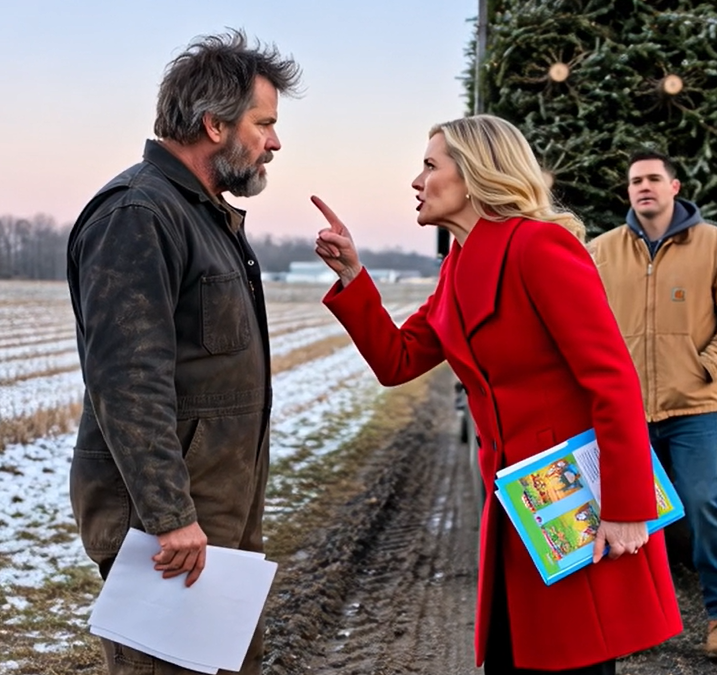
Tessa stood outside the SUV.
Red coat.
Of course.
Behind her were two men.
One held a camera.
The other had a clipboard.
“What are you doing?”
I looked toward the crews.
“Harvesting Christmas trees.”
“You cannot do this.”
“Looks like I can.”
“These trees are reserved for tomorrow.”
“Yes.”
“For my guests.”
“No.”
Her face changed.
“They bought tickets.”
“From you.”
“You knew.”
“Know what?”
“That families were coming.”
“I know now.”
“You’re deliberately sabotaging a community event.”
I pointed toward the nearest truck.
“Those trees were sold in September.”
“That doesn’t matter!”
I almost admired the consistency.
“It matters to the people who bought them.”
Tessa stepped closer.
“You think you’re clever.”
“No.”
“I have a thousand people arriving in seven hours.”
“That sounds difficult.”
“You will compensate Silverbrook for every lost ticket.”
“No.”
“For vendors.”
“No.”
“Security.”
“No.”
“Marketing.”
“No.”
Her phone came up.
Recording.
“You’re admitting you’re intentionally destroying our festival?”
“I’m fulfilling existing contracts on my own farm.”
“You’re removing community assets.”
“No.”
That phrase.
Community assets.
Elise had told me to listen for language like that.
I looked at the men behind her.
“Who are your friends?”
Tessa paused.
“Event staff.”
One man looked away.
I recognized the logo on his jacket.
Harrow.
Small embroidered H.
Interesting.
“You work for the festival?”
The man answered before Tessa could.
“Traffic planning.”
“For Silverbrook?”
“For the project.”
Tessa snapped:
“Don’t answer him.”
I looked at her.
“What project?”
Silence.
The man realized his mistake.
Tessa pointed her phone at me.
“You’ll hear from our attorney.”
“I’m sure.”
She got into the SUV.
Before closing the door, she said:
“By tomorrow afternoon, you’ll wish you’d cooperated.”
I watched them leave.
Then called Elise.
She answered:
“What happened?”
“Harrow is here.”
Pause.
“How do you know?”
“One of their people came with Tessa.”
“Did he identify himself?”
“Said traffic planning for ‘the project.’”
Elise went silent.
“That’s useful.”
“I thought you might say that.”
“Did you record it?”
“Farm gate camera.”
“Very useful.”
At 6:00 a.m., the final truck left.
I stood beside Colby at the gate.
Red taillights disappeared toward Route 16.
The southern grove was nearly empty.
Rows of stumps.
Snow.
Seventeen unsold trees.
A few utility poles.
Nothing resembling the magical forest shown on Tessa’s flyer.
Colby drank coffee.
“What now?”
I looked at my watch.
“Breakfast.”
At 8:43, the first family arrived.
Minivan.
Two children in matching red coats.
Dad driving.
Mother holding printed tickets.
They stopped at my gate.
I walked over.
“Morning.”
“Christmas Tree Walk?”
“No, sir.”
He looked behind me.
“This is Boon Evergreen.”
“Yes.”
“Our ticket says entrance here.”
“I know.”
He showed it.
$79.
Silverbrook Exclusive Christmas Tree Walk.
Address:
My farm.
I handed it back.
“Silverbrook did not have permission to sell access to this property.”
His face changed.
“What?”
“I’d recommend you contact the event organizer.”
“We drove an hour.”
“I’m sorry.”
His wife looked toward the empty field.
“Where are the trees?”
“Delivered to their owners.”
“But the ticket says we choose one.”
“That promise was made by somebody who didn’t own them.”
Two more cars arrived.
Then five.
Then twelve.
By 9:10, traffic backed onto Route 16.
I called the sheriff before somebody got hurt.
Not because people were aggressive.
Because a thousand-ticket event without a functioning entrance becomes a road hazard quickly.
Deputies came.
Then township police.
Then local news.
Tessa arrived at 9:37.
She stepped out in front of cameras like she had been waiting for the moment.
“Harlon Boon has intentionally destroyed a beloved community Christmas event.”
I was fifty yards away.
Colby muttered:
“She practiced that.”
“Definitely.”
Tessa continued.
“He removed more than one thousand trees overnight despite being notified that families had legally reserved access.”
A reporter asked:
“Did you own the trees?”
Tessa pivoted.
“The HOA has long-standing access rights.”
“Did you own the trees?”
“We have contractual rights to utilize the property.”
That was new.
I looked at Elise.
She had arrived fifteen minutes earlier.
“Contractual?”
Elise smiled without humor.
“Let her keep talking.”
Reporter:
“Can we see the contract?”
Tessa said:
“Our counsel has it.”
Elise whispered:
“No, they don’t.”
Another reporter asked:
“Did Mr. Boon receive any of the ticket money?”
Tessa ignored it.
One thousand customers became angry quickly.
Not all at once.
Some demanded refunds.
Some shouted.
Some filmed.
Some blamed me.
Most became confused once deputies explained they could not force a private landowner to admit ticket holders sold access by a third party.
At 10:14, Tessa did something stupid.
She ordered festival staff to move barricades and direct pedestrians onto the old easement.
Elise stepped in front.
“Do not.”
Tessa glared.
“You don’t control the easement.”
“Neither do you beyond its recorded purpose.”
“Residents have a right of access.”
“For drainage maintenance.”
“That’s your interpretation.”
“No.”
Elise held up the recorded instrument.
“That’s the language.”
Tessa turned toward a deputy.
“Remove her.”
The deputy said:
“She’s standing on private property with the owner’s permission.”
Tessa looked like the world had personally failed her.
Then two Harrow vehicles appeared.
Same black SUV from overnight.
Plus a white pickup.
Evan Cole stepped out.
I recognized his voice before his face.
He walked directly toward me.
“Tessa doesn’t know I called.”
“She will soon.”
“I know.”
Elise looked between us.
“This is Evan?”
“Yes.”
Evan held a folder.
“I brought copies.”
Tessa saw him.
Everything changed.
“Evan!”
He stopped.
Her face went pale.
Not angry.
Afraid.
“What are you doing?”
He looked at her.
“Correcting something.”
She started toward him.
One deputy shifted position between them.
Evan handed the folder to Elise.
Inside was the Harrow access package.
Tessa’s signed representation.
Silverbrook HOA possesses continuous community access rights over Harvest Road and adjoining southern recreational grove.
Supporting exhibits:
Photographs.
Maps.
HOA meeting minutes.
Event history.
One document carried my supposed acknowledgment.
I stared.
Signature line:
Harlon Boon.
Not my signature.
Not even close.
Elise said:
“Harlon?”
“No.”
“You’ve never seen this?”
“No.”
Evan looked sick.
“That was included in the packet.”
Tessa shouted:
“It was a draft!”
Nobody had asked her.
That was useful.
Elise looked at the date.
“Signed six weeks ago.”
“I said draft.”
“Notarized.”
Tessa stopped talking.
I looked at Evan.
“Harrow accepted this?”
“Preliminary.”
“Without calling me?”
“Our acquisitions group relied on counsel.”
“Whose counsel?”
He looked toward Tessa.
“Silverbrook’s.”
Elise closed the folder.
“This event is over.”
Tessa laughed.
“You don’t get to decide that.”
“No.”
Elise looked toward the deputies.
“But Harlon gets to decide who enters his farm.”
Then at the ticket holders.
“And unless Silverbrook produces an actual commercial-use agreement, none of those tickets authorize access.”
Tessa realized she was losing control.
So she tried the only tool she had left.
Emotion.
She walked toward the cameras.
“This man destroyed Christmas for a thousand families because he hates Silverbrook.”
A woman from the crowd shouted:
“Then refund us.”
Another:
“Where’s our money?”
A man held up three tickets.
“I paid $237!”
Another family had purchased premium photo packages.
$149.
Someone else:
“You sold us trees that weren’t yours!”
The story flipped in less than five minutes.
Not because I said anything.
Because customers asked the obvious question.
Who took the money?
By noon, Silverbrook’s event website went offline.
By 1:00, its payment processor had frozen remaining ticket funds after a surge of chargebacks.
By 2:30, Harrow Development issued a statement.
They had not authorized the festival.
They were reviewing documents supplied by Silverbrook HOA.
By 4:00, township planning suspended review of Phase Four’s secondary-access component.
At 6:15, Elise called.
“Do not celebrate.”
“I wasn’t.”
“Good.”
“What happened?”
“Harrow’s attorneys want to meet Monday.”
“With us?”
“Yes.”
“Why?”
“Because somebody submitted a forged acknowledgment with your name.”
I looked out over the empty grove.
“They’re scared.”
“Yes.”
“Should they be?”
“Yes.”
Monday morning, Harrow sent four people.
General counsel.
Land acquisitions director.
Civil engineer.
Evan.
Tessa was not invited.
Meeting happened in Elise’s office.
Their lawyer spoke first.
“We want to clarify that Harrow did not knowingly submit false documents.”
Elise replied:
“Then you should be eager to help establish where they came from.”
“We are.”
“Good.”
She slid my notarized denial across the table.
“Harlon never signed the acknowledgment.”
“We understand.”
“You performed no direct owner verification.”
The acquisitions director said:
“We relied on Silverbrook’s representations.”
“On a road crossing a separately owned farm.”
Silence.
Elise continued.
“You prepared a 186-home plan using a secondary access route without speaking to the person who owns the route.”
The engineer looked uncomfortable.
Their lawyer said:
“That was an internal process failure.”
I finally spoke.
“How much were you paying Tessa?”
The room changed.
Counsel looked at Evan.
Evan looked at the table.
Then the acquisitions director answered.
“Her consulting agreement provided a success fee.”
“How much?”
“Two hundred forty thousand.”
“For what?”
“Facilitating neighborhood approvals and access coordination.”
“Meaning my road.”
“Among other matters.”
“Had she been paid?”
“Twenty-five thousand retainer.”
That mattered.
Elise wrote it down.
“From Harrow?”
“Yes.”
“What was the remaining payment conditioned on?”
“Phase Four entitlement.”
Including secondary access.
There it was.
Tessa wasn’t only trying to rescue a festival.
The festival was a demonstration.
A staged thousand-person use of my land designed to produce something that looked like established community access.
Ticket revenue was gravy.
The real payday was $215,000.
And beyond that, Harrow’s $1.8 million option exposure.
Elise asked:
“Did anyone at Harrow instruct Ms. Blackwood to stage public use?”
“No.”
“Suggest it?”
“No.”
“Know about the festival?”
The counsel hesitated.
“We were aware there would be a community event.”
“Where?”
“Near the proposed corridor.”
“Near?”
He glanced at Evan.
Evan answered.
“We did not know she was selling access to Harlon’s trees.”
That I believed.
Because it was too stupid.
“What did you think the event was?”
“An HOA holiday walk demonstrating neighborhood connectivity.”
Elise leaned back.
“Demonstrating.”
Nobody spoke.
That word did a lot of work.
Harrow terminated Tessa’s consulting agreement the same day.
Refunded the $25,000 retainer to Silverbrook pending claims.
Removed Harvest Road from its Phase Four application.
Without secondary access, the project stalled.
The land option expired December 31.
Harrow lost the Becker tract.
The seller later sold it to a conservation partnership and a smaller builder that proposed thirty-eight homes instead of 186.
No road through my farm.
Tessa’s problems had only started.
One thousand festival tickets.
Average price wasn’t exactly $79 because of premium packages and child discounts.
Total collected:
$86,430.
That surprised even me.
Refunds requested:
Almost all of it.
Silverbrook’s festival account held only $41,700.
“Where’s the rest?” Colby asked.
“Excellent question.”
The HOA board asked the same thing.
Tessa had spent heavily before the event.
Advertising.
Radio.
Printing.
Decorations.
Contractors.
Portable toilets.
Entertainment deposits.
Insurance.
Photographers.
But approximately $18,000 remained unexplained.
Then Silverbrook’s treasurer resigned.
Not because she stole anything.
Because she had discovered Tessa had opened a separate “Festival Operations” account.
Treasurer had no access.
Tessa was the only authorized signer.
That violated Silverbrook’s own bylaws.
The board voted to suspend her.
Tessa declared the meeting invalid.
The board voted again with counsel present.
Same result.
Four to one.
Tessa was the one.
Refund chaos followed.
Families wanted their money.
Vendors wanted cancellation fees.
Harrow wanted its retainer.
The HOA’s insurer asked why a thousand-person commercial event had been sold on land the association did not own.
Nobody enjoyed December.
Except Colby.
He enjoyed it immensely.
“Best Christmas ever.”
“You’re a bad person.”
“Maybe.”
He pointed toward the southern grove.
“Philadelphia hotel sent photos.”
I looked.
Our Fraser firs filled a massive lobby.
Lights.
Gold ribbons.
Kids standing beside them.
Other trees went to garden centers.
Church lots.
Families.
Exactly where they were supposed to go.
That mattered.
I had honored every contract.
Tessa had sold people something that never belonged to her.
Those are not the same business model.
The forged document triggered a sheriff’s investigation.
Not dramatic.
Slow.
Paperwork.
Notary records.
Emails.
Metadata.
The signature had been applied digitally.
The notary block?
Copied from another Silverbrook document.
Notary denied ever seeing it.
Then investigators recovered Tessa’s laptop.
The acknowledgment file existed in three versions.
Version one:
No Harlon signature.
Version two:
Signature image pasted in.
Version three:
Notary added.
Creation history showed Tessa’s user account.
That was difficult to explain.
Her attorney called it “document preparation.”
The prosecutor eventually called it something else.
Forgery.
The HOA sued Tessa separately.
Ticket holders joined a class-action claim.
Harrow settled its part without admitting wrongdoing, contributing money toward refunds in exchange for ending claims against the company.
Silverbrook’s insurer covered some losses.
The HOA’s reserve fund covered more.
Homeowners were furious because they were effectively paying for their president’s fantasy festival.
That anger exposed another layer.
Tessa had been pitching Phase Four to Silverbrook homeowners for months.
But not honestly.
She called it:
Silverbrook Woodland Expansion.
Promised:
New walking trails.
Expanded amenities.
Property-value growth.
What she did not emphasize:
186 additional houses.
Hundreds more vehicles.
Potential traffic through existing streets.
And her personal $240,000 success fee.
That destroyed whatever support she had left.
One homeowner asked at a meeting:
“You were negotiating on behalf of Silverbrook while personally getting paid by the developer?”
Tessa answered:
“My consulting work was separate.”
Someone laughed.
Another shouted:
“How?”
She did not have a good answer.
By February, Tessa resigned from the board before removal proceedings finished.
She moved out of Silverbrook that summer.
The legal cases continued.
My case was simple compared with everything else.
Declaratory judgment.
No commercial-use rights.
No HOA ownership.
No authority under the drainage easement beyond its narrow maintenance purpose.
Permanent injunction against Silverbrook entering the grove for events, construction, surveying, traffic studies, or development access without my written permission.
Judge granted it.
The language was almost painfully obvious.
A twelve-foot drainage-maintenance easement was not a public road.
It did not authorize festivals.
It did not authorize residential access.
It did not create ownership of adjoining land.
And it did not give the HOA rights over Christmas tree inventory.
Colby framed that last page.
Actually framed it.
Hung it in the packing barn.
I made him take it down.
He moved it to his office.
I stopped fighting.
Tessa ultimately pleaded to several charges tied to the forged acknowledgment and financial handling of festival proceeds.
She did not go to prison for twenty years.
Real life is less theatrical.
There was restitution.
Probation.
A short custodial component.
Restrictions.
The larger consequences were financial.
Civil judgments.
Legal fees.
Loss of her HOA position.
Harrow’s terminated contract.
The $240,000 payday disappeared.
Silverbrook rewrote its governance rules.
No officer could sign development agreements without full board approval.
Any outside compensation tied to association business had to be disclosed.
Two signatures required on event accounts.
Property ownership verification mandatory before any event advertisement.
That last one seemed like something adults shouldn’t need written down.
Apparently we did.
The one thousand families eventually received refunds.
Not quickly.
Some waited months.
I got letters from several.
Most apologized for the messages sent to my farm.
One woman wrote:
We were told you waited until the last minute because you wanted to hurt families. I didn’t realize the trees were already sold months before our tickets even existed.
I kept that one.
Another father brought his two children to the farm the following year.
He asked before entering.
That mattered.
“Mr. Boon?”
“Harlon.”
“We had tickets last year.”
“I’m sorry.”
“Not your fault.”
His daughter looked across the new grove.
Trees were younger.
Not ready.
She asked:
“Can we buy one?”
“Wholesale farm.”
Her face fell.
I smiled.
“But Colby keeps a small retail patch near the barn.”
Her face came back.
We walked over.
They picked a seven-foot Douglas fir.
Paid the actual farm price.
No premium experience.
No champagne tent.
No staged photographer.
No HOA.
Just a tree.
As they tied it to the roof, the father said:
“This is better anyway.”
“What is?”
“Knowing where the tree actually came from.”
I liked that.
The next year, I did something everybody found amusing.
I hosted a Christmas open house.
Not a thousand people.
Two hundred maximum.
Reservation system.
Free entry.
Families could walk designated farm roads.
Hot cider.
Hay wagon.
A small retail tree section planted specifically for the event.
Everything else clearly marked wholesale inventory.
Elise reviewed the paperwork.
Colby handled parking.
Fire department approved capacity.
Insurance knew exactly what was happening.
And every map had one sentence at the bottom:
Boon Evergreen Farm is privately owned. Entry is by revocable invitation and creates no public, community, HOA, or development access right.
Colby laughed when he saw it.
“Subtle.”
“I’ve become cautious.”
“You’ve become paranoid.”
“Paranoid farmers keep farms.”
Tessa never saw that festival.
At least not in person.
Good.
It wasn’t built to spite her.
That mattered to me.
I had spent nine years growing trees because I liked producing something useful.
You plant a seedling.
Wait.
Shape.
Prune.
Manage disease.
Control weeds.
Protect against deer.
Wait again.
Seven years.
Eight.
Nine.
Then somebody carries that tree into a house and hangs their family’s history on it.
There is something honest about the transaction.
You own the tree.
They pay for it.
Then they own the tree.
Clear.
Tessa’s entire scheme depended on blurring ownership.
My road became “community access.”
My grove became “Silverbrook’s holiday destination.”
My trees became “guest selections.”
My refusal became “sabotage.”
The drainage easement became a “community corridor.”
Her developer contract became “HOA advocacy.”
A thousand ticket holders became evidence.
Language was doing all the stealing before anyone touched the land.
That’s what Elise taught me.
Fraud often begins with vocabulary.
Call a permission a right.
Call a proposal an agreement.
Call a narrow easement a road.
Call somebody else’s property a community asset.
Say it often enough and people stop checking the deed.
The following December, Evan Cole visited.
I almost didn’t recognize him.
No Harrow jacket.
He had left the company.
Working for a smaller planning firm.
He stood in my office looking embarrassed.
“I wanted to apologize properly.”
“You already helped.”
“Late.”
“Still helped.”
“I should’ve called when I first saw the access package.”
“Yes.”
He nodded.
“I knew something didn’t feel right.”
“But?”
“I didn’t want to be the guy slowing a multimillion-dollar project.”
I understood.
Not approved.
Understood.
“What changed?”
“The festival.”
He looked through the window.
“She turned your land into marketing before anyone had secured a right to cross it.”
“And that bothered you more than the access package?”
“No.”
He thought.
“It made the access package impossible to keep treating as a technical problem.”
That’s how a lot of wrongdoing survives.
Technical language.
Internal workflow.
Someone else’s department.
Until the real-world version becomes too obvious.
A thousand families driving toward a farm that had never agreed to host them was very real-world.
Evan handed me a small box.
Inside:
A silver tree ornament shaped like a survey marker.
I laughed.
“That’s terrible.”
“I know.”
I hung it in the office anyway.
Years later, the stumps from that December were gone.
New trees replaced them.
Rows stretched over the hill again.
Fraser firs.
Douglas firs.
Some Canaan fir.
Colby convinced me to try them.
The old drainage easement still existed.
Exactly twelve feet.
Exactly where it had always been.
Silverbrook occasionally used it for actual drainage work.
They emailed first.
I approved access.
Workers entered.
Fixed culvert.
Left.
Nobody brought 1,000 guests.
Simple.
Harrow’s abandoned Phase Four land became a mix of preserved woods and lower-density housing.
Traffic stayed manageable.
Silverbrook survived.
HOAs usually do.
Tessa had acted like the organization and herself were the same thing.
They weren’t.
New president was a man named Marcus Hill.
Accountant.
Boring.
Wonderful quality in HOA leadership.
First time he called me:
“Mr. Boon, we need to inspect the drainage swale Thursday.”
“Okay.”
“May our contractor enter between nine and eleven?”
“Yes.”
“Anything we need to know?”
“Stay inside the easement.”
“Of course.”
Five-minute call.
No threats.
No festival.
No forged document.
No developer.
I nearly sent him a Christmas card.
The framed court order remained in Colby’s office.
Eventually I stopped complaining.
At the bottom he taped a photograph.
Taken at 5:58 a.m. that December morning.
Final truck.
Snow.
Red taillights.
Empty grove.
He wrote beneath it:
SOLD MEANS SOLD.
That was Colby.
I pretended to hate it.
Every December 12, he texts me the photo.
And every time, I remember Tessa standing at my gate in that expensive red coat saying:
“These trees are reserved for my guests.”
She never understood the sentence I gave her.
“They’re already sold.”
Ownership isn’t complicated just because somebody has a bigger plan.
A ticket doesn’t become a deed.
An HOA vote doesn’t become a property transfer.
An access easement doesn’t become a highway because a developer needs one.
And one thousand people walking across my land would not have turned Harvest Road into Silverbrook’s road.
But Tessa had counted on something subtler.
She counted on confusion being valuable.
If the facts became messy enough, maybe I’d negotiate.
If enough families arrived, maybe I’d surrender rather than disappoint them.
If enough photographs showed public use, maybe planners would hesitate.
If enough paperwork carried HOA logos, maybe Harrow’s lawyers would call the question arguable instead of false.
If enough pressure accumulated, maybe the farmer would sell.
She had misunderstood the farmer.
I don’t enjoy attention.
I don’t enjoy fighting.
I don’t enjoy courtrooms.
I enjoy trees.
That’s why she thought I’d fold.
What she didn’t understand was that farming teaches a particular kind of patience.
You plant something today knowing the result may take eight years.
You don’t panic because one week becomes uncomfortable.
You don’t abandon a field because somebody shouts at the gate.
You keep records.
You honor contracts.
You wait for facts to grow large enough that nobody can pretend they aren’t there.
At 6:00 a.m. that December morning, the final truck left Boon Evergreen Farm.
By nine, families were arriving.
By noon, Tessa’s festival had collapsed.
By afternoon, her developer arrangement was exposed.
And within months, everybody understood that the thousand-ticket Christmas event had never been the real prize.
The real prize was my road.
My land.
And a $240,000 payday attached to turning somebody else’s property into the missing entrance for a 186-home development.
She thought one thousand paying guests would create leverage.
Instead, they created witnesses.
And all I had to do was exactly what I had planned before Tessa ever printed her first ticket.
Harvest my trees.
Load my trucks.
Honor my contracts.
And let her explain why a festival she had no right to sell was taking place in a field she had no right to use.








