At 3:17 A.M., a Bloodied Cat Collapsed on My Welcome Mat—Three Months Later, He Did Something I Never Expected.
PART3:
Then something moved at the bottom of the door.
I leaned closer.
Gray.
White.
I unlocked the deadbolt.
The sensible part of my brain told me I should put shoes on.
Maybe gloves.
Maybe call someone.
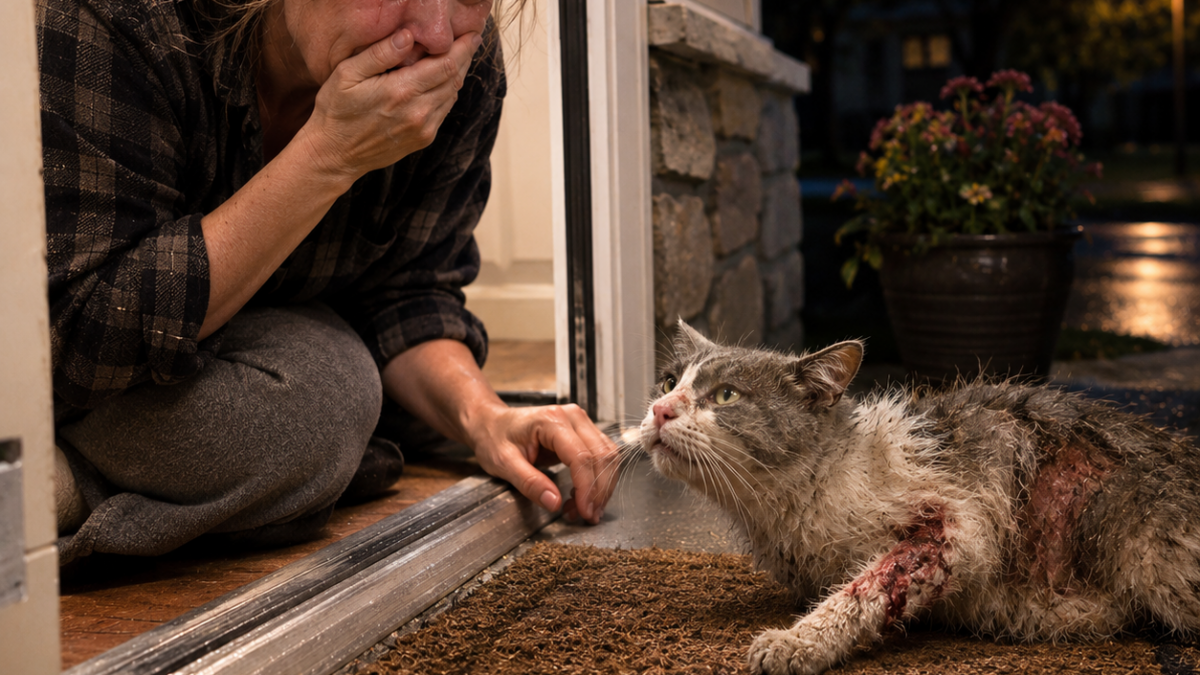
Instead, I opened the door.
A cat fell sideways.
Right onto the mat.
For a second, I just stared.
He was gray and white beneath layers of mud, blood, and whatever he’d crawled through to reach me.
One front leg bent at a sickening angle.
His side was streaked with dried blood.
His fur had been torn away in places around the shoulder and neck.
He was so thin I could see the points of his hips.
His chest moved rapidly.
Shallow breaths.
Too fast.
He did not cry.
That was the strangest part.
Most injured animals make noise when they’re frightened.
Hiss.
Growl.
Yowl.
Something.
This cat looked at me with yellow-green eyes and said nothing.
Then he tried to move forward.
One paw.
A tiny pull.
His bad leg dragged.
He made it maybe an inch.
Toward the open doorway.
Then collapsed again.
“Oh, sweetheart.”
I knelt.
He flinched before I touched him.
Not a small flinch.
His whole body tightened.
His eyes squeezed closed.
He expected pain.
I stopped.
“Okay.”
His chest fluttered.
“I’m not touching you.”
I stayed there.
Cold air moved into the hallway around me.
The porch boards were wet beneath my knees.
The cat’s eyes opened again.
He stared past me.
Into the house.
Something about that broke through the last of my hesitation.
“You came here for a reason, didn’t you?”
No answer.
Obviously.
I stood slowly.
He tensed again.
“Stay right there.”
As though he had options.
I grabbed an old bath towel from the linen closet.
When I came back, he had tried to move another few inches.
Half his body was inside now.
His back legs remained on the porch.
He had used what little strength he possessed to cross the threshold.
I put the towel over him.
His body jerked.
“Easy.”
I slid one hand beneath his chest and another beneath his hips, avoiding the injured leg.
He weighed almost nothing.
That scared me more than the blood.
A full-grown cat should have weight.
Muscle.
Warmth.
Resistance.
This animal felt like lifting a bundle of sticks wrapped in wet fabric.
His head fell against my forearm.
I carried him inside.
My phone was on the nightstand.
I called the nearest emergency veterinary hospital while trying to find sweatpants with one hand.
A woman answered.
“Allegheny Veterinary Emergency.”
“I found a cat.”
“What condition?”
“Bad.”
“Can you be more specific?”
“Bleeding. One front leg looks broken. He’s very thin. Barely moving.”
“Is he breathing?”
“Yes.”
“Conscious?”
“Yes.”
“Any active bleeding?”
“I don’t think so.”
“Bring him now. Keep him warm. Don’t give food or water unless instructed.”
“I’ll be there in fifteen.”
It took eighteen.
I put him in a laundry basket lined with blankets because I didn’t own a cat carrier anymore.
The last cat I had owned belonged more to Ellie than to me.
Muffin.
A ridiculous orange cat who lived seventeen years and died six months before Ellie moved away.
Afterward, Ellie told me I should adopt another.
I told her no.
I said I wanted freedom.
No litter boxes.
No vet bills.
No fur on black pants.
No arranging travel around an animal.
That was the official explanation.
The truth was that I had lost enough things.
I didn’t want to volunteer for another goodbye.
The cat in the laundry basket shifted as I backed out of the driveway.
“Stay with me.”
His breathing remained shallow.
“You picked a terrible house, by the way.”
One ear moved.
“I’m not a cat person anymore.”
No response.
“That arrangement ended.”
He blinked.
“Don’t look at me like that.”
At the red light near the interstate ramp, his eyes closed.
“Hey.”
Nothing.
My stomach dropped.
“Hey.”
I reached over and touched the blanket near his chest.
A breath.
Then another.
I exhaled.
“Don’t do that.”
The light turned green.
I drove faster.
The emergency hospital doors opened before I reached them.
A technician brought a stretcher.
“What happened?”
“I don’t know. He showed up at my door.”
“When?”
“Maybe twenty minutes ago.”
“Your cat?”
“No.”
They lifted the basket.
The cat opened his eyes.
For one second, he looked at me.
Then the doors closed.
And I stood alone under fluorescent lights wearing mismatched socks, slippers, gray sweatpants, and the robe I’d forgotten to remove.
I had blood on one sleeve.
I didn’t notice until a receptionist handed me paperwork.
“Name?”
“Mine?”
“The cat’s.”
“I don’t know.”
“Unknown male?”
“I think he’s male.”
“We’ll confirm.”
She looked at the form.
“Owner?”
“No owner.”
“Who is financially responsible for initial stabilization?”
That question brought reality crashing back.
I wasn’t wealthy.
I worked part-time bookkeeping for a plumbing company after retiring from a full-time administrative job.
My husband had been gone seven years.
Not dead.
Gone.
Different kind of grief.
Ellie’s father, Mark, decided at fifty-one that he had “missed too much life.”
Apparently life had been waiting in Scottsdale, Arizona, in the form of a woman named Brianna who taught Pilates and was fourteen years younger than me.
The divorce had been ugly.
The silence afterward had been worse.
I had savings.
Enough.
But I was not the kind of person who casually spent thousands of dollars on an animal I had met at 3:17 in the morning.
The receptionist waited.
I signed.
“Me.”
She nodded.
“Doctor will speak with you soon.”
Soon turned into forty-three minutes.
I sat in a molded plastic chair.
A man across from me held a shaking terrier.
A teenage boy cried quietly while his mother completed paperwork.
A woman came out from the treatment area carrying an empty leash.
I looked away.
Eventually a veterinarian approached.
“Mrs. Dawson?”
“Linda.”
“I’m Dr. Priya Shah.”
She looked exhausted.
Maybe early forties.
Dark hair pulled back.
Kind eyes.
Those details matter when someone is about to tell you whether a creature lives or dies.
“How is he?”
“He’s alive.”
The words hit harder than they should have.
“Okay.”
“He’s severely dehydrated and underweight. His temperature is low. The left front leg appears fractured, possibly more than one fracture.”
“I thought so.”
“He has bruising along the ribs and abdomen.”
“From what?”
“We don’t know yet.”
“And the blood?”
“Mostly older injuries. Some superficial wounds. There’s one area along his flank that concerns me.”
“Why?”
“It looks infected.”
I closed my eyes.
“Can you fix him?”
Dr. Shah did not give me the reassuring smile I wanted.
“We can treat him.”
“That’s not what I asked.”
“I know.”
She pulled a chair closer.
“He’s in poor condition.”
“What are his chances?”
She looked through the glass treatment-room door.
Then back at me.
“He’s still trying.”
Those words stayed with me.
Not good.
Not bad.
Not fifty-fifty.
He’s still trying.
“What does that mean?”
“It means when we handle him, he responds. He tracks movement. He attempted to pull himself upright after we placed the IV.”
I pictured him dragging himself across my porch.
“He’s still trying,” she repeated.
I nodded.
“So we try too.”
The doctor smiled.
“Yes.”
They kept him overnight.
Then another.
The fractures were complicated but repairable.
One bone had a newer break.
Another showed evidence of an older injury that had healed badly.
That bothered Dr. Shah.
It bothered me more.
“How old is the older injury?”
“Hard to date.”
“Weeks?”
“Possibly months.”
“Could he have been hit by a car twice?”
“Anything is possible.”
That phrase became one I learned to hate.
Anything is possible.
It means we don’t know.
His ribs showed old trauma too.
One had healed crooked.
Another had thickened callus around a previous fracture.
He had scars underneath the dirty fur.
Small ones.
Not obvious until his coat was clipped for treatment.
“Fights?” I asked.
“Could be.”
“Other animals?”
“Could be.”
“Cars?”
“Could be.”
I stared at Dr. Shah.
“You say that a lot.”
She gave me a tired smile.
“Because bodies tell us what happened physically. They don’t always tell us the story.”
No microchip.
No collar.
No missing-cat report matching his description.
Animal control had no record.
I posted his photograph in local groups.
No one claimed him.
On the second afternoon, Dr. Shah called.
“He’s eating.”
I nearly cheered.
“Really?”
“A little.”
“Can he come home?”
A pause.
“Are you taking responsibility for him?”
I looked around my kitchen.
At the quiet table.
Ellie’s blue mug in the cabinet.
At the empty corner where Muffin’s food bowls had once been.
“Temporarily.”
“Of course.”
“I mean it.”
“I’m sure.”
“You sound like my daughter.”
“I haven’t met your daughter.”
“You’re lucky.”
Dr. Shah laughed.
“He can discharge tonight if you’re comfortable administering medication and restricting activity.”
“How restricted?”
“Crate or small room.”
“I have a spare bedroom.”
“Good.”
“I am not adopting him.”
“Mrs. Dawson—”
“Linda.”
“Linda, I do not work for an adoption agency.”
“Good.”
“I wasn’t going to ask.”
“Excellent.”
“Six o’clock.”
I hung up.
Then called Ellie.
She answered on video from her apartment in Raleigh.
“Mom?”
“I have a cat.”
Her face changed immediately.
“What?”
“Temporary.”
“Oh my God.”
“Don’t.”
“Show me.”
“He’s at the hospital.”
“What happened?”
I explained.
Ellie went from delighted to horrified.
“Someone hurt him?”
“We don’t know.”
“Does he have a name?”
“No.”
“You need one.”
“No.”
“You can’t call him ‘cat.'”
“He’s temporary.”
“Temporary animals still require nouns.”
I sighed.
“Fine.”
“What does he look like?”
“Gray and white.”
“Call him Ash.”
“No.”
“Smokey.”
“Absolutely not.”
“Bandit.”
“He isn’t wearing a mask.”
“Mom, you’re difficult.”
“I raised you.”
She grinned.
“What about Bodie?”
I frowned.
“Why Bodie?”
“I don’t know. It sounds like him.”
“You haven’t seen him.”
“You said he’s stubborn.”
“He dragged himself onto my porch.”
“Exactly.”
I tried the name aloud after we hung up.
“Bodie.”
It felt ridiculous.
Then less ridiculous.
When I picked him up from the hospital, the name had already attached itself.
Bodie came home wearing a splint and a soft recovery collar.
He had antibiotics.
Pain medication.
Anti-inflammatory medication.
A feeding plan.
Follow-up instructions.
And a bill I refused to think about.
I put him in the spare room.
The room had once been Ellie’s.
Before college.
Before Raleigh.
Before the furniture became mostly decorative.
Her old bookshelf remained against one wall.
A pale blue quilt covered the bed.
The closet still contained two prom dresses she kept forgetting to take.
I set up a litter box.
Food.
Water.
A low padded bed.
Bodie ignored all of it.
He crawled beneath the bed.
I did not see him again for nine hours.
At first, I panicked.
I got down on my hands and knees.
“Bodie?”
Two eyes reflected from darkness.
“Okay.”
He did not move.
“You don’t have to come out.”
His ears flattened.
“Food is there.”
No response.
“I’m leaving.”
I backed away.
Fifteen minutes later, I heard the food dish scrape.
I smiled.
That became our routine.
I entered.
He froze.
I left.
He ate.
I changed the litter.
He watched.
I moved too quickly.
He flinched.
On day three, I dropped a plastic laundry basket.
The sound cracked through the room.
Bodie launched himself backward.
His injured leg hit the bedframe.
He screamed.
The first real sound I had heard from him.
I nearly threw up.
“Oh God.”
I crouched.
“Don’t move.”
He scrambled farther back.
His eyes were huge.
Not pain alone.
Terror.
I called Dr. Shah.
She checked the leg that afternoon.
No new damage.
“He’s very reactive to noise.”
“I noticed.”
“Could be trauma.”
“Physical?”
“Behavioral.”
I stared at Bodie in the carrier.
“What happened to you?”
Dr. Shah was quiet.
Then she said, “Don’t force contact.”
“I haven’t.”
“Good.”
“Will he ever stop being scared?”
“Maybe.”
“That’s encouraging.”
“I’m being honest.”
“Again, annoying.”
She smiled.
“Give him predictable days.”
“What does that mean?”
“Same food times. Same voice. Slow movement. Let him control distance.”
I nodded.
“Don’t teach him to love you.”
I frowned.
“What?”
“Teach him you’re safe.”
That sentence followed me home.
Teach him you’re safe.
Not love.
Safety first.
So I stopped trying to touch him.
I stopped kneeling beside the bed.
I stopped reaching.
Instead, every evening after dinner, I carried a book into Ellie’s old room.
I sat on the floor near the wall.
And I read.
Not aloud.
Not to Bodie.
Just near him.
The first night, I lasted twenty minutes.
My knees hurt.
“I hope you appreciate this.”
No movement.
“At my age, floor sitting is a medical event.”
Two eyes watched from beneath the bed.
The second night, thirty minutes.
The third, almost an hour.
I read two mystery novels that month sitting on a carpeted floor beside a cat who pretended I did not exist.
I learned his signals.
Ears forward meant curious.
One ear sideways meant uncertain.
Both back meant stop.
Wide pupils meant something had frightened him.
Slow blink meant maybe, just maybe, he wasn’t panicking.
He learned mine too.
My footsteps.
The sound of the medication bottle.
The kitchen cabinet where food was stored.
The difference between the vacuum cleaner and the furnace.
At the end of the first week, he stopped retreating every time I entered.
That was victory.
At ten days, he ate while I sat in the room.
Another victory.
At twelve days, he came out from beneath the bed before I left.
He walked three feet.
Sat.
Looked at me.
Then went back under.
I texted Ellie.
HE CAME OUT.
She responded:
Congratulations on your boyfriend.
I sent:
I can still change my will.
She called immediately.
“You’re keeping him.”
“No.”
“Mom.”
“He’s recovering.”
“Mom.”
“He needs a foster.”
“You’re a foster.”
“Temporary.”
“Sure.”
“What is wrong with your generation?”
“We understand denial.”
I hung up on her.
Two weeks after Bodie arrived, I woke around midnight and went to the kitchen for water.
Something sat at the far end of the hallway.
Bodie.
I stopped.
He froze.
We stared at each other.
“Hey, buddy.”
His head lowered.
“That’s all.”
I walked into the kitchen.
When I returned, he was gone.
The next night, he was there again.
Closer.
By the end of the week, he sat halfway down the hall.
Then outside my bedroom.
I began waking in the morning and finding a depression in the hallway rug where he’d slept.
Still no touching.
Still no lap.
Still no purring.
But presence.
I realized something during those nights.
Bodie was not learning to love me.
He was collecting evidence.
Evidence that I would walk past without kicking.
Evidence that hands could set down food and leave.
Evidence that doors could close without trapping him.
Evidence that loud sounds were accidents.
Evidence that sleep was safe.
Every ordinary day was testimony.
Nothing bad happened.
Nothing bad happened.
Nothing bad happened.
Maybe eventually that would outweigh whatever had happened before.
Then the first strange thing occurred.
A man came to the house.
His name was Ron McAllister.
He lived three streets over.
I knew him vaguely from neighborhood meetings.
He had seen one of my missing-pet posts and called.
“You found a gray-and-white male?”
“Yes.”
“Could be one I’ve seen.”
My heart lifted.
“You know him?”
“Maybe.”
“Owner?”
“Not sure.”
Ron came by Saturday afternoon.
Bodie had started spending time downstairs by then, usually beneath the dining table.
I warned Ron not to approach.
He stepped into the foyer.
“Where is he?”
“Kitchen.”
Ron took two steps.
Bodie saw him.
Everything changed.
The cat did not merely hide.
He flattened.
His body hit the floor.
He backed violently beneath a chair.
His breathing became rapid.
Ron stopped.
“Whoa.”
I stared.
Bodie had been nervous around strangers before.
The mail carrier.
Ellie’s friend during a video call.
The vet.
This was different.
He looked at Ron as if he had seen death.
I moved between them.
“You should go.”
Ron held up his hands.
“I didn’t do anything.”
“I know.”
“Maybe he doesn’t like men.”
“He likes Dr. Shah’s male technician.”
Ron frowned.
“I just wanted to see whether he’s that cat.”
“Which cat?”
“A stray around Maple Hollow.”
“Where?”
“Old Miller place.”
Something in his voice changed.
Not much.
Enough.
“What Miller place?”
“Farmhouse past the quarry.”
“Why would he be there?”
Ron shrugged.
“Owner had cats.”
“Owner?”
“Old guy named Frank Miller.”
“You said stray.”
“Yeah.”
“Which is it?”
Ron seemed irritated.
“I don’t know, Linda. I saw a cat.”
Bodie made a low noise.
Not a hiss.
More like a growl buried in his chest.
Ron looked toward him.
“That’s probably not him.”
He left quickly.
I closed the door.
Bodie stayed under the chair for almost three hours.
That night, he did not sit in the hallway.
The next morning, I called Dr. Shah.
“Am I overreacting?”
“Probably.”
“Thank you.”
“But.”
“I knew there was a but.”
“That response sounds conditioned.”
“What does that mean?”
“It means something about that person or something associated with him triggered a strong fear response.”
“You think Ron hurt him?”
“I did not say that.”
“But—”
“Could be smell. Voice. Body shape. Boots. Jacket. Anything.”
“What should I do?”
“Don’t confront anyone.”
“I wasn’t going to.”
That was a lie.
“Linda.”
“Fine.”
“Do you have information about where the cat might have lived?”
“Maybe.”
“Animal control.”
I called.
Officer Megan Price took the report.
She was younger than Ellie.
That annoyed me for reasons she did not deserve.
I explained Bodie’s injuries.
The old fractures.
Ron’s visit.
The possible location.
Megan listened without interrupting.
“Did Dr. Shah document suspected abuse?”
“She documented injuries inconsistent in age.”
“That isn’t the same thing.”
“I know.”
“Any chip?”
“No.”
“Okay. I’ll check prior calls associated with the Miller property.”
“That’s it?”
“That’s where we start.”
I hated how little everything started with.
A phone call.
A note.
A maybe.
The Miller property sat four miles from my house.
I drove past two days later.
I know Dr. Shah told me not to confront anyone.
I was not confronting.
I was observing.
That is what I told myself.
The farmhouse was old but occupied.
White siding.
Green metal roof.
Two rusted trucks.
A sagging barn.
Several outdoor cat bowls near the porch.
And cages.
Not pet carriers.
Wire cages.
Stacked near the barn.
I slowed.
A dog barked.
Then a man stepped onto the porch.
Tall.
Heavyset.
Gray beard.
Not Ron.
He watched my car.
I drove on.
That evening Megan called.
“We have history at the property.”
My stomach tightened.
“What kind?”
“Animal complaints.”
“Abuse?”
“Neglect.”
“How many?”
“Several over five years.”
“Animals removed?”
“Two dogs, three years ago.”
“Cats?”
“Harder.”
“Why?”
“Outdoor cats. No clear ownership.”
“Who’s the man?”
“Frank Miller.”
“Ron knows him?”
“I don’t know.”
“What did he tell you?”
“He says he hasn’t seen your cat.”
“He hasn’t even seen a picture.”
“I sent one.”
“And?”
“He says no.”
I looked toward the living room.
Bodie sat near the window.
“Do you believe him?”
“That’s not how I work.”
“Right.”
“Linda.”
“What?”
“Don’t go there.”
I went there again.
Not onto the property.
I parked farther down the road.
Yes, I know.
This is the part where Ellie would say I had lost my mind.
She eventually did.
“You did what?”
“I’m watching.”
“You’re fifty-seven, not Nancy Drew.”
“Nancy Drew had terrible judgment and solved everything.”
“Mom.”
“I am not trespassing.”
“Please stop.”
“I just want to know.”
“Know what?”
“What happened to him.”
Ellie sighed.
“What if you never do?”
I didn’t answer.
That possibility bothered me more than I wanted to admit.
Bodie improved.
His splint came off.
The newer fracture healed correctly.
He limped slightly from the older damage.
Dr. Shah said he probably always would.
His weight climbed.
Seven pounds.
Eight.
Nine.
His fur became clean.
Soft.
He had a white chest, gray saddle across his back, and a gray mask around one eye.
Handsome.
He discovered the living-room window.
Birds.
He could watch them for hours.
He discovered that the heating vent beneath my dining table was warm.
He began sleeping there.
He discovered canned chicken.
This created a criminal.
He still would not let me pet him.
But he followed.
Everywhere.
If I went upstairs, he appeared on the landing.
If I opened the refrigerator, he inspected operations.
If I sat at the table, he slept beneath my chair.
“You’re getting attached,” Ellie said during a video call.
“No.”
Bodie sat behind me.
She pointed.
“Exhibit A.”
“He likes the heater.”
“The heater is in the other room.”
“Exhibit B.”
“Stop lawyering.”
“You cried when Muffin died.”
“That’s unrelated.”
“You don’t want to keep Bodie because you’re afraid.”
My face changed.
Ellie saw it.
“Mom.”
“Don’t.”
“I’m not criticizing you.”
“Good.”
“You think if you call him temporary, losing him won’t count.”
I looked away.
Bodie began grooming his paw.
“I have to go.”
“Mom.”
“Love you.”
“Mom.”
I ended the call.
Then I sat in the quiet kitchen for a long time.
Sometimes your children get old enough to say things you spent decades hoping they would never understand about you.
Saturday morning changed everything.
I was making coffee.
The back screen door had not latched properly after I took out recycling.
I noticed it open maybe three inches.
I froze.
“Bodie?”
No answer.
I checked the dining room.
Empty.
Living room.
Empty.
Spare room.
Under the bed.
Nothing.
“Bodie?”
I climbed the stairs faster.
Bedroom.
Bathroom.
Closets.
Nothing.
I went outside.
Barefoot.
“Bodie!”
The yard was empty.
The fence had several gaps a cat could easily use.
I ran to the shrubs.
“Bodie!”
Nothing.
For forty minutes I walked around the block shaking treats.
I hated myself.
Not just for leaving the door open.
For caring this much.
Because this was exactly what I had tried to avoid.
He was temporary.
A stray.
I helped him.
He got healthy.
He left.
That should have been acceptable.
Instead, my hands shook so badly I dropped the treat bag.
I called Ellie.
She answered cheerfully.
“Hey—”
“He’s gone.”
Silence.
“Who?”
“Bodie.”
Her tone changed.
“When?”
“I don’t know.”
“How?”
“Door.”
“Mom, breathe.”
“I’m breathing.”
“Did you check inside?”
“Twice.”
“Check again.”
“I did.”
“Closets?”
“Yes.”
“Under the beds?”
“Yes.”
“Garage?”
“Yes.”
“Basement?”
“Yes.”
“Attic?”
“He can’t open the attic.”
“Mom.”
“I checked.”
“Okay. Post online.”
“I will.”
“Call shelters.”
“I will.”
“I’m booking a flight.”
“No.”
“I can—”
“Do not fly here because a temporary cat escaped.”
Ellie went silent.
Then gently:
“Temporary?”
I started crying.
Not polite tears.
Ugly crying.
Sitting on the front step at ten in the morning holding a bag of cat treats.
“I hate you.”
“I know.”
“He wasn’t supposed to—”
“I know.”
“I didn’t want—”
“I know.”
“I expected him to be there.”
That was the sentence.
The real one.
I expected him to be there.
Every morning.
Every evening.
Beneath the table.
At the hallway corner.
Watching from the stairs.
His presence had become part of the architecture.
And suddenly the house felt wrong.
Not empty.
Wrong.
Like somebody removed a wall.
I searched until dark.
Nothing.
That night, I didn’t turn on the TV.
I sat at the kitchen table.
His food bowl remained full.
I stared at it.
Then I cried again.
At 10:40, I went upstairs.
I heard a thump.
I froze.
Another sound.
From my bedroom.
I ran.
“Bodie?”
Nothing.
I flipped on the light.
The room was empty.
Then the curtain moved.
I looked beneath the chair near the window.
Two yellow-green eyes stared back.
“You.”
Bodie was curled in a narrow space between the chair and radiator.
A hiding place I had somehow missed six times.
I sat on the floor.
My legs nearly gave out.
“You scared ten years off my life.”
Bodie blinked.
“I walked three miles.”
Nothing.
“I called animal control.”
Ear twitch.
“I publicly cried on Facebook.”
He looked unimpressed.
“You were upstairs?”
Apparently.
“You horrible little man.”
I laughed.
Then cried.
Then laughed again.
Bodie watched.
I did not reach.
That had always been our rule.
I sat.
Waited.
After maybe five minutes, Bodie stood.
He moved slowly.
Across the rug.
Toward me.
I stopped breathing.
He came within a foot.
Then six inches.
Then pressed his forehead against my knee.
Once.
Not an accident.
Not passing by.
Contact.
I covered my mouth.
He stepped back.
Looked at me.
I whispered, “Okay.”
He touched me again.
Forehead to knee.
My hand hovered.
I did not touch him.
Not yet.
“Thank you.”
That night, he slept outside my bedroom door.
I slept better than I had in a year.
Megan Price called two days later.
“We found something.”
My stomach tightened.
“What?”
“A former tenant.”
“At the Miller property?”
“Yes.”
“Who?”
“A woman named Casey Nolan.”
“Okay.”
“She lived in a trailer on the rear acreage for about nine months.”
“Did she know Bodie?”
“She thinks so.”
I sat down.
“What did she say?”
“There was a cat named Beau.”
“Beau?”
“Gray and white.”
“Male?”
“Yes.”
“What happened?”
“She says he belonged to Miller.”
I looked toward Bodie.
He was watching from the window.
“Belonged how?”
“Barn cat.”
“What does that mean?”
“Outdoor. Pest control.”
“Did Frank hurt him?”
Megan hesitated.
“Casey reported concerns.”
“What concerns?”
“She says Miller was rough with animals.”
“How rough?”
“Throwing things. Kicking. Not providing consistent food.”
My grip tightened around the phone.
“Did she see him hurt Beau?”
“Once.”
“What happened?”
“She claims Miller kicked the cat after it got into a feed bin.”
I closed my eyes.
“What injuries?”
“She didn’t know.”
“Why didn’t she report it?”
“She says she did.”
“And?”
“We have a complaint from that period.”
“What happened?”
“Officer visited. Cat wasn’t located.”
“And that was it?”
“Without an animal present, witnesses willing to sign, or visible evidence, options were limited.”
I was furious.
“So nothing.”
“I’m not saying nothing.”
“It sounds like nothing.”
“Linda.”
“What?”
“Do not go confront him.”
“I know.”
“Say it.”
“I will not go confront Frank Miller.”
“Good.”
I didn’t.
Ron came back instead.
Three days later.
He stood on my porch at six in the evening.
I almost didn’t open the door.
“What?”
“I heard animal control’s asking questions.”
“Good.”
“Linda.”
“What?”
“Frank’s my brother-in-law.”
There it was.
I stared at him.
“Why didn’t you tell me?”
“I didn’t know if the cat was his.”
“Bodie panicked when he saw you.”
“I know.”
“Why?”
Ron looked ashamed.
“I’ve been at that property a lot.”
“Did you hurt him?”
“No.”
“Did Frank?”
Ron looked away.
My anger rose.
“Did he?”
“I never saw him seriously injure the cat.”
“That’s not an answer.”
“I saw him throw things.”
“At Bodie?”
“At the cats.”
“Kick?”
Ron said nothing.
I stepped closer.
“You came into my house knowing exactly where that cat might have come from.”
“I suspected.”
“And you lied.”
“I didn’t want trouble.”
I laughed once.
“Of course.”
“You don’t know Frank.”
“I don’t want to.”
“He’s got a temper.”
“So everyone protects him?”
“No.”
“Sounds like it.”
Ron rubbed his face.
“There was one night.”
I froze.
“What night?”
“Maybe two months before your cat showed up.”
“Go on.”
“Frank was drinking.”
“What happened?”
“Cat got into the porch.”
“Bodie?”
“I think.”
“And?”
“He threw him.”
I stared.
“Threw him where?”
“Off the porch.”
My stomach turned.
“How high?”
“Six feet maybe.”
“His leg.”
Ron looked sick.
“I know.”
“You knew.”
“I didn’t know it broke.”
“You didn’t check?”
“The cat ran.”
“On a broken leg?”
“I didn’t know.”
I wanted to hit him.
Instead I gripped the doorframe.
“What about the older fractures?”
“I don’t know.”
“Did Frank beat him?”
“I don’t know.”
“Did you ever stop him?”
Silence.
That answered enough.
“Get off my porch.”
“Linda—”
“Go.”
“I came to tell you.”
“You came because animal control is asking.”
He flinched.
I lowered my voice.
“If Bodie reacts to you the way he did, you were part of whatever scared him.”
“I never touched him.”
“Maybe standing there while someone else does it is enough.”
Ron left.
My hands shook for twenty minutes afterward.
Bodie had hidden upstairs.
I sat at the bottom of the stairs.
“I’m sorry.”
No response.
“I’m sorry people failed you.”
Still nothing.
I was not sure whether I meant Frank.
Ron.
Animal control.
Myself.
Everyone.
The investigation moved slowly.
Casey signed a statement.
Ron eventually did too.
Dr. Shah provided records showing injuries of different ages, consistent with repeated trauma.
Not proof of specific acts.
Consistent.
That word mattered.
Animal control obtained a warrant to inspect Miller’s property after another complaint involving an underweight dog.
They found seven cats.
Two dogs.
Food inadequate.
Water dirty.
One dog had an untreated skin infection.
Two cats had old injuries.
The animals were removed pending proceedings.
Frank Miller was charged with multiple counts related to neglect and animal cruelty.
Bodie’s case became part of the evidence but not the strongest part.
There was no video.
No definitive witness to every injury.
No forensic miracle.
Just patterns.
Statements.
Bodies.
Sometimes justice is assembled from pieces.
Not one dramatic truth.
Enough small truths finally pointing in the same direction.
Frank denied everything.
Said barn cats got hurt.
Said Casey was angry over unpaid wages.
Said Ron was scared of his wife.
Said I had invented a story because I wanted attention.
That one made Ellie furious.
“Give me his address.”
“No.”
“I’m serious.”
“What are you going to do from North Carolina?”
“I have vacation days.”
“Stay there.”
“You spent your entire life telling me to stand up to bullies.”
“Not by committing felonies.”
She sighed.
“Fine.”
The charges eventually resulted in a plea agreement.
Frank surrendered ownership of the remaining animals.
Paid fines.
Received probation.
Was prohibited from owning animals during that period.
Some people thought it wasn’t enough.
I was one of them.
But the other cats were placed.
The dogs were treated.
Bodie never saw Frank again.
That mattered more than a sentence.
Six weeks after Bodie came home, Dr. Shah cleared him from strict activity restriction.
“He’s officially allowed to be a cat.”
“That sounds dangerous.”
“It usually is.”
She watched him walk across the exam room.
Slight limp.
Better muscle.
Clean coat.
“He’s done well.”
“He still doesn’t like being touched.”
“Some cats don’t.”
“He does this thing.”
“What thing?”
“Follows me.”
“Terrifying.”
“I’m serious.”
“So am I.”
“He acts like it’s accidental.”
“Classic cat.”
I smiled.
“Can he be adopted?”
Dr. Shah looked at me.
“Yes.”
My stomach dropped.
I hated that reaction.
“Good.”
“Do you want me to contact rescues?”
“Yes.”
She waited.
“Absolutely.”
“Okay.”
I hated her calm.
“Why are you looking at me?”
“Because you’re staring at Bodie like I just offered to sell your kidneys.”
“I am not.”
“Linda.”
“I am fostering.”
“Okay.”
“You are very annoying.”
“I’ve heard.”
Two rescue groups agreed to list him.
I took photographs.
Bodie in the window.
Bodie beneath the dining table.
Bodie on Ellie’s old quilt.
I wrote a profile.
GRAY-AND-WHITE MALE, APPROXIMATELY FOUR YEARS OLD. RECOVERED FROM SIGNIFICANT INJURIES. SHY. NEEDS PATIENT, QUIET HOME.
I deleted it.
Too clinical.
I rewrote.
BODIE IS A GENTLE, CAUTIOUS CAT WHO TAKES TIME TO TRUST. HE DOES BEST WITH A PREDICTABLE ROUTINE AND SOMEONE WHO WILL LET HIM APPROACH ON HIS OWN TERMS.
Better.
I stared at the final line.
HE LOVES QUIET COMPANY.
I almost deleted that too.
It sounded personal.
It was.
Three applications came.
The first family had two young children.
No.
The second applicant had three dogs.
Probably no.
The third was a retired woman named Pamela.
Quiet home.
No other pets.
Experienced with shy cats.
Perfect.
I hated Pamela immediately.
Not because she did anything wrong.
Because she was perfect.
She came to meet Bodie.
I put him in the spare room with the door open.
Pamela sat on the floor.
Did not reach.
Did not call.
Good.
Bodie watched from beneath the bed.
Pamela smiled.
“He’s beautiful.”
“He’s improved a lot.”
“I read his history.”
“Some.”
“Poor thing.”
I disliked that.
I didn’t want anyone pitying him.
Then felt ridiculous.
Pamela stayed forty minutes.
Bodie came out once.
Sat near the wall.
Looked at her.
She respected the distance.
Afterward, Pamela said, “I’d like to adopt him.”
I smiled.
That is what I did.
“Great.”
The word felt like swallowing glass.
“We should schedule a home check.”
“Of course.”
“When would he be ready?”
I looked toward the stairs.
“Anytime.”
Bodie appeared at the top.
He looked down.
Pamela followed my gaze.
“Are you sure?”
“What?”
“That you want to place him.”
“Yes.”
She studied me.
“He’s watching you.”
“He does that.”
“He’s bonded.”
“He’ll bond again.”
Pamela smiled gently.
“Maybe.”
I didn’t like that either.
After she left, I sat at the kitchen table.
Bodie lay beneath my chair.
“You’re going to have a nice house.”
His tail moved.
“One person.”
Nothing.
“No dogs.”
Nothing.
“Probably nicer furniture.”
Bodie rested his chin on his paws.
“You’ll be fine.”
I wasn’t talking to him anymore.
Ellie called that night.
I told her.
“You found a home?”
“Yes.”
Silence.
“What?”
“Nothing.”
“Say it.”
“Do you want him to go?”
“That’s irrelevant.”
“It’s actually the entire question.”
“I didn’t ask you.”
“Mom.”
“Pamela’s perfect.”
“That’s not what I asked.”
I looked at Bodie.
He sat in the doorway.
“He’s temporary.”
Ellie’s voice softened.
“Why?”
I knew what she meant.
“Because.”
“Because Muffin died?”
“No.”
“Because Dad left?”
“Ellie.”
“Because I moved?”
I stared at the floor.
“I am happy you moved.”
“I know.”
“I am.”
“I know.”
“You needed to go.”
“I know.”
“North Carolina is good for you.”
“Mom.”
“What?”
“Missing me doesn’t mean you wanted me to fail.”
I closed my eyes.
That sentence hurt.
“I know.”
“Then why are you acting like loving Bodie means something bad has to happen?”
“I don’t want to depend on an animal.”
“Why?”
“Because animals die.”
“So do people.”
“That’s helpful.”
“Sorry.”
“No, you’re not.”
“No.”
I laughed despite myself.
Ellie continued.
“You’ve spent a year making your life smaller so nothing can leave.”
“That’s dramatic.”
“Your favorite mug is still in the cabinet because you don’t use it because it was Grandma’s.”
“That’s different.”
“You won’t replace the recliner because Dad picked it.”
“I like that chair.”
“You hate that chair.”
“I tolerate it.”
“You wouldn’t adopt another cat after Muffin because you said you wanted freedom.”
“I do.”
“What have you done with the freedom?”
I opened my mouth.
Nothing came.
“Mom?”
“I read.”
“You read before.”
“I garden.”
“You hate gardening.”
“I don’t hate all of it.”
“You planted tomatoes and called them freeloaders.”
“They produced three tomatoes.”
“Exactly.”
I laughed.
Then cried.
Ellie waited.
“I don’t want this house to become a place where I just replace people.”
“He’s not replacing anyone.”
She paused.
“Maybe he’s making room.”
The adoption transfer was scheduled for Saturday.
Friday night, Ellie called.
“I can’t come home next weekend.”
“I know.”
“Work.”
“You told me.”
“I feel bad.”
“Don’t.”
“I know you were expecting me.”
“I was looking forward to it.”
“Mom—”
“That doesn’t mean I want you to quit your job.”
She smiled.
“Growth.”
“Be quiet.”
We talked for twenty minutes.
After the call, the house felt quiet again.
Not crushing.
Just noticeable.
I sat on the edge of my bed.
Bodie appeared in the doorway.
Tomorrow he would leave.
I had placed his medication records in a folder.
Packed his favorite blanket.
Bought Pamela the food he liked.
Everything was ready.
Bodie walked in.
That itself was unusual.
He rarely entered my bedroom while I was awake.
He stopped near the dresser.
Looked at me.
“Hi.”
He approached the bed.
My chest tightened.
“You’re going somewhere tomorrow.”
His ears moved.
“Good place.”
He stepped closer.
“You don’t know what that means.”
He looked up.
Then he jumped.
Onto the bed.
I froze.
He had never done that.
Not once.
He stood near my feet.
Turned twice.
Walked carefully along the quilt.
Every movement deliberate.
He settled beside my hip.
Not touching.
Just close.
Then the purr started.
Quiet.
Almost uncertain.
My eyes filled.
“No.”
Bodie looked at me.
“That’s unfair.”
Purr.
“I’ve already signed forms.”
He remained.
“I bought your food.”
Nothing.
“Pamela likes you.”
Bodie shifted.
His head moved beneath my open palm.
I stopped breathing.
He touched himself to me.
My hand rested on his head.
For the first time, he was asking.
I stroked once.
Bodie closed his eyes.
I cried harder than I had when Ellie moved.
Not because I loved Bodie more than my daughter.
Because something inside me had been waiting to be chosen too.
That cat had spent weeks deciding whether my hands were safe.
Now he had decided.
The morning Pamela arrived, I was already crying.
She noticed immediately.
“Oh.”
“I’m sorry.”
She looked toward Bodie.
He sat in the hallway.
“You’re keeping him.”
I wiped my face.
“I’m a terrible person.”
Pamela laughed.
“No.”
“I wasted your time.”
“No.”
“I approved everything.”
“Linda.”
“I’m sorry.”
She stepped forward and hugged me.
I was not expecting that.
“Keep your cat.”
I cried harder.
“He’s not—”
She pulled back.
“He is.”
Bodie remained in the hallway.
Pamela smiled at him.
“You picked correctly.”
When she left, I closed the door.
Turned.
Bodie sat there.
“You caused a lot of paperwork.”
He blinked.
“Congratulations.”
That afternoon, I officially adopted him from the rescue.
Ellie made me send photographic evidence.
The certificate read:
BODIE DAWSON.
Owner: Linda Dawson.
I hated the word owner.
I kept the certificate anyway.
Bodie did not become a different cat overnight.
That matters.
Stories often make trust look like a switch.
One beautiful moment.
Then everything heals.
No.
He still hid when the doorbell rang.
A dropped pan sent him running.
Men wearing work boots scared him for months.
He never liked being picked up.
Sometimes, while asleep, his paws jerked and he woke frightened.
He would look around wildly until he saw me.
Then settle.
I learned not to say, “You’re okay.”
Instead I said, “You’re home.”
For some reason, that seemed truer.
Three months after the night he arrived, Bodie had gained almost four pounds.
His limp remained slight.
His coat shone.
The scars underneath stayed.
Dr. Shah said some always would.
“Will he ever stop flinching?”
“Maybe not completely.”
“That feels unfair.”
“It is.”
I looked at Bodie.
He was trying to bite the string on my hoodie.
Dr. Shah smiled.
“He’s also stealing your clothes.”
“Progress?”
“Absolutely.”
Megan Price called several months after the court proceedings.
“Casey adopted one of the Miller cats.”
“Really?”
“Orange female.”
“Good.”
“Ron volunteered a statement in another case.”
I was surprised.
“Against Frank?”
“Yes.”
“Why?”
“Maybe guilt.”
“Is that enough?”
“For what?”
“To make him a good person.”
Megan paused.
“I don’t think people work like that.”
Neither did cats.
Maybe that was the lesson.
Ron had failed once.
Maybe many times.
Then did something better.
Frank had consequences.
Not enough.
But some.
Bodie had scars.
And joy.
Things could coexist.
My life changed in small ways.
I stopped leaving the TV on just for noise.
Bodie supplied enough.
Not meowing.
He was actually quiet.
But living things create sound.
Paws on stairs.
Litter shifting.
Water being drunk.
A body jumping onto a chair.
A sudden sprint through the hallway at 2 A.M. because apparently recovery had transformed Bodie into a lunatic.
I complained constantly.
“Stop running.”
He ran faster.
“You have a bad leg.”
He attacked a rug.
“You cost thousands of dollars.”
He knocked over a pen.
“Ungrateful.”
Purr.
Ellie visited in spring.
Bodie disappeared the moment her suitcase entered.
She looked offended.
“He knows me.”
“From a phone.”
“I talked to him.”
“He doesn’t understand FaceTime.”
“Rude.”
She sat on the floor.
Waited.
The way I taught her.
After forty minutes, Bodie appeared.
Ellie did not move.
He came closer.
Sniffed her shoe.
Then sat three feet away.
She whispered, “I feel honored.”
“You should.”
“He likes me.”
“He tolerates you.”
“Family trait.”
That night, she slept in the spare room.
At breakfast, she said, “He slept outside my door.”
I smiled.
“That’s how it starts.”
Ellie looked at me.
“You know what?”
“What?”
“This house feels different.”
My chest tightened.
“Different good?”
“Yeah.”
She looked toward Bodie.
He sat by the sliding door watching birds.
“It feels like you live here again.”
I stared.
“What did it feel like before?”
She hesitated.
“Like you were waiting.”
“For what?”
“I don’t know.”
That answer followed me.
Waiting.
Maybe I had been.
For Ellie to come back.
For Mark to regret leaving.
For retirement to feel meaningful.
For grief to finish.
For loneliness to announce when it had become a problem.
I had spent years thinking waiting was neutral.
Bodie taught me it was still a way of living.
He had spent who knew how long waiting too.
Waiting for the next kick.
Next thrown object.
Next empty bowl.
Next place to hide.
Then he came to my porch.
Why mine?
I wondered about that for months.
There were six houses between the Miller property and mine if he traveled directly through the woods.
More if he followed roads.
Why did he scratch at my door?
Was there a smell?
Light?
Did he hear my furnace?
Was he simply out of strength?
Maybe my porch was the first one he reached.
I wanted there to be a reason.
Humans always do.
Then one evening, Casey Nolan visited.
She had asked through Megan.
I agreed.
Casey was forty-nine.
Thin.
Nervous.
She brought an old photograph.
Bodie healthy.
Younger.
Sitting on a wooden railing.
I stared.
“That’s him.”
“His name was Beau.”
Bodie was upstairs.
“He belonged to Frank?”
“Sort of.”
Casey sat at my kitchen table.
“He showed up as a kitten.”
“Frank fed him?”
“Sometimes.”
“You?”
“Mostly.”
She looked ashamed.
“I lived in a trailer behind the barn.”
“Why did you leave?”
“Frank.”
The answer was immediate.
I understood there was more.
I didn’t ask.
Casey continued.
“Beau started sleeping on my porch.”
“Did he come inside?”
“Sometimes.”
“Was he friendly?”
“With me.”
“Did Frank hurt him often?”
She stared at her hands.
“I don’t know how often.”
“Why didn’t you take him?”
“I tried.”
My expression changed.
“What?”
“The day I left.”
Casey’s eyes filled.
“I put him in my car.”
“What happened?”
“Frank saw.”
My stomach tightened.
“He said the cat belonged to the property.”
“That’s insane.”
“I know.”
“He took him?”
“He grabbed the carrier.”
“What did you do?”
“I was scared.”
The words barely came out.
“Of Frank?”
She nodded.
“I left.”
Anger rose.
Not at her.
At the situation.
“You called animal control.”
“Yes.”
“Why didn’t you tell them everything?”
“I did later.”
Bodie appeared at the top of the stairs.
Casey saw him.
Her mouth opened.
“Beau.”
He froze.
She did not move.
“It’s me.”
Bodie stared.
Then took one step down.
Another.
I watched.
He had never approached a stranger that quickly.
Casey cried silently.
“You remember.”
Bodie came to the bottom.
Stopped five feet away.
His tail moved.
Once.
Casey covered her face.
“I’m sorry.”
He stayed.
“I should’ve taken you.”
I looked away.
Sometimes guilt deserves privacy.
Casey did not touch him.
Not until Bodie chose.
He walked closer.
Sniffed her fingers.
Then leaned his cheek against them.
Casey sobbed.
“Oh, baby.”
Bodie purred.
I learned more that afternoon.
His first injury likely came from a barn door.
Maybe accidental.
His later fear came from Frank.
Frank hated cats inside.
If Bodie crossed the porch threshold, he was chased.
Sometimes kicked.
Casey remembered one night when Frank threw a boot hard enough to hit the cat’s side.
Another when he grabbed Bodie by the scruff and threw him off the porch.
That likely explained the newer fracture.
But the morning Bodie disappeared?
Casey had not been there.
She had already moved.
Ron later told investigators that Frank had been drinking and chased Bodie toward the road.
The cat vanished.
Somehow, injured, starving, and terrified, he traveled miles.
Then reached my porch.
Casey looked around my kitchen.
“He picked you.”
“I don’t know.”
“He did.”
“He was dying.”
“He passed other houses.”
“Maybe.”
She smiled through tears.
“He always liked women with quiet voices.”
That made me laugh.
“I yell at football.”
“So did I.”
Bodie sat between us.
For the first time, his story had a before.
Not complete.
But enough.
He had once been Beau.
He had known kindness in a trailer.
He had learned fear at a farmhouse.
Then he became Bodie at my house.
I worried that renaming him had erased something.
Casey shook her head.
“Names don’t matter to cats the way they do to us.”
“What did he answer to?”
“Can opener.”
I laughed.
Bodie looked offended.
After that, Casey visited occasionally.
She adopted another rescued Miller cat named Tessa.
Her apartment allowed two pets.
For a while I wondered whether she wanted Bodie too.
If she did, she never said it.
One afternoon she told me:
“I don’t need him back.”
I looked at her.
“I want him to know not everybody leaves.”
That sentence stayed with me.
Not everybody leaves.
Mark left.
Ellie left for the right reasons.
Muffin died.
My parents died.
Friends moved.
Jobs ended.
I’d started treating departure like the natural conclusion to attachment.
Bodie had too.
Maybe that was why we made sense.
Neither of us believed staying was permanent.
So neither demanded it.
We practiced.
Day by day.
Breakfast appeared.
I came home.
Bodie waited at the window.
Dinner.
Nine o’clock couch.
Sleep.
Morning.
Repeat.
Predictability healed both of us more than I expected.
A year after he arrived, I retired completely.
The plumbing company threw me a party.
My manager gave me a cake that said:
GOOD LUCK DOING NOTHING.
I brought the leftovers home.
Bodie sniffed the frosting.
“No.”
He tried again.
“No.”
He sat.
“You cannot bully me.”
He stared.
“You survived hardship. That does not mean you get buttercream.”
He stared harder.
“Fine. Tiny amount.”
Retirement worried me.
I expected the quiet to return.
Instead, Bodie created a schedule.
Breakfast at six.
Window patrol.
Follow me while I cleaned.
Nap.
Demand lunch he was not entitled to.
Nap.
Inspect mail.
Evening couch.
He became the clock in my house.
Ellie visited less often as her job grew busier.
That used to hurt more.
Now I could admit missing her without turning the feeling into accusation.
“Wish you were here,” I said on the phone one Christmas.
“I know.”
“I’m not saying come.”
“I know.”
“I mean, come if you can.”
She laughed.
“Mom.”
“I’m learning.”
“You are.”
Bodie jumped onto the couch beside me.
Not on my lap.
Never really became a lap cat.
Beside.
Always beside.
That was his way.
Ellie saw him on video.
“My brother.”
“Your brother bites.”
“So do some brothers.”
I smiled.
The following summer, Ellie called with news.
She was engaged.
His name was Noah.
I liked him.
Which was inconvenient because I had prepared many criticisms.
The wedding would be in North Carolina.
I would need to travel for five days.
The old me would have panicked about leaving Bodie.
The new me did too.
Just more rationally.
Casey stayed at the house.
The first night, she sent a photograph.
Bodie sleeping by my bedroom door.
Caption:
HE’S WAITING.
I almost cried.
On the second day, another photograph.
Bodie at the window.
Third day.
Bodie on the couch.
When I returned, he was in the hallway.
I opened the door.
“Hi.”
He froze.
Then walked toward me.
Not running.
Bodie did nothing dramatically.
He stopped.
Touched his forehead to my shin.
Once.
The same gesture from the night I thought he’d escaped.
I dropped my suitcase.
Sat on the floor.
“I came back.”
He leaned against me.
“I told you.”
Purr.
“I know people lie.”
Purr.
“But I came back.”
That became another piece of evidence.
I leave.
I return.
People can do both.
Years passed.
Bodie’s limp became arthritis.
The old fractures showed themselves more in winter.
Dr. Shah recommended joint supplements.
Later medication.
I installed small steps near the couch.
Ellie laughed.
“You said no pets.”
“I said no permanent pets.”
“He’s been there six years.”
“Temporary is subjective.”
“How old is he now?”
“Ten, maybe eleven.”
“Mom.”
“What?”
“He’s senior.”
“Don’t say that in front of him.”
Bodie slept beside me.
His gray fur had begun silvering around his mouth.
He remained afraid of thunder.
He still hid from strangers.
He never forgave men in heavy boots.
But he loved Noah eventually.
That took a year.
Noah earned it by sitting on the floor and ignoring him.
The first time Bodie rubbed against Noah’s leg, Noah looked at me like he’d received a military decoration.
“Did you see that?”
“I saw.”
“He touched me.”
“Stay calm.”
“This is huge.”
“Don’t ruin it.”
Ellie laughed.
Bodie walked away.
Noah whispered, “I think your mom likes me less than the cat.”
“Obviously.”
Bodie’s presence changed how I understood my own life.
For years, I believed I had been abandoned.
By Mark.
By age.
By the version of motherhood where your child lives down the hall forever.
But abandonment and change were not the same.
Ellie had not abandoned me.
She had grown.
I had encouraged it.
Then punished myself emotionally when she succeeded.
Mark?
Yes.
He left badly.
That was real.
But one person’s betrayal did not prove everybody eventually went.
Bodie did not know any of that.
He just stayed.
Every night around nine.
Living room.
Same corner of the couch.
If I sat elsewhere, he stared until I moved.
“You are controlling.”
Purr.
“Emotionally manipulative.”
Purr.
“Probably why I love you.”
He closed his eyes.
Ten years after Bodie first arrived, I woke at 3:17 A.M.
Not because of scratching.
Because my bladder was sixty-seven years old.
I looked at the clock and laughed.
3:17.
I went downstairs.
Bodie was in his heated bed.
Old now.
Actually old.
Maybe fourteen.
Maybe fifteen.
We never knew exactly.
His hearing was worse.
Vision slightly cloudy.
Arthritis controlled but present.
He raised his head.
“Hey.”
He blinked.
I sat on the floor beside him.
That was harder now.
My knees were worse too.
“Remember this time?”
Bodie yawned.
“I do.”
I touched his head.
He allowed it easily these days.
That part had taken years.
My hand moved slowly along the fur.
Scars still beneath.
Less visible.
Always there.
“You scared me.”
Purr.
“I was sleeping.”
Purr.
“I had work the next morning.”
He leaned closer.
“You had terrible timing.”
He slept.
I remained on the floor.
Bodie aged gradually.
Then suddenly.
That is how it always feels.
One year they’re old but fine.
Then you start counting.
Food eaten.
Water.
Steps.
Breaths.
Good days.
Bad days.
He developed kidney disease.
Manageable at first.
Special food.
Fluids later.
Medication.
I learned the routine.
Bodie hated the needle.
So did I.
“I saved you once.”
He glared.
“You could cooperate.”
No.
“You are ungrateful.”
Still no.
“Fine.”
I gave him chicken afterward.
Dr. Shah had retired by then.
But she still asked about Bodie through the clinic.
Once she visited.
He recognized her voice.
Hid.
She laughed.
“So much for gratitude.”
“You stuck needles in him.”
“I saved him.”
“Apparently that debt expired.”
At sixteen, maybe seventeen, Bodie stopped jumping onto the couch.
I increased the steps.
Then one morning he did not come for breakfast.
Fear rose immediately.
I found him in the spare room.
Ellie’s old room.
Under the bed.
Same place he hid during his first week.
“Bodie?”
His head lifted.
Barely.
My heart broke.
“No.”
I sat.
He watched.
“Not yet.”
That was selfish.
I knew as soon as I said it.
Bodie had no obligation to organize death around my readiness.
I called Ellie.
She answered from North Carolina.
“Mom?”
“It’s Bodie.”
She went quiet.
“I’m coming.”
“You don’t have to.”
“I’m coming.”
This time I didn’t argue.
She arrived that evening with Noah.
Bodie had moved from under the bed to the doorway.
Ellie sat on the floor.
“Hey, brother.”
His ear moved.
She cried.
“I’ve known you longer than I’ve known my husband.”
Noah whispered, “Rude.”
Ellie laughed through tears.
Bodie looked at them.
Then at me.
The next morning, the veterinarian came to the house.
Home euthanasia.
A phrase I had avoided thinking about for years.
We put Bodie’s favorite blanket on the living-room rug.
I sat beside him.
Ellie on my other side.
Noah nearby.
Casey came too.
She was older.
Gray hair now.
She sat quietly.
“Beau,” she whispered once.
Bodie’s ear moved.
Then she smiled.
“Bodie.”
He looked at her.
That felt right.
Both names.
Both lives.
The veterinarian explained everything.
I barely heard.
Bodie’s head rested against my thigh.
I stroked him.
No flinch.
No fear.
I thought about that first night.
The injured cat on the mat.
Trying to pull himself one more inch toward my door.
I had believed I was giving him shelter.
What arrogance.
He had spent years giving me one too.
My house had once been somewhere I stayed after everyone left.
Bodie turned it into somewhere someone waited for me.
The vet asked whether I was ready.
I wasn’t.
I nodded anyway.
I leaned close.
“Remember what Dr. Shah said?”
Bodie’s eyes were half closed.
“You’re still trying.”
My voice broke.
“You don’t have to anymore.”
Ellie cried.
I pressed my forehead gently against his.
The gesture he had given me first.
“Nothing bad happens here.”
That had been the promise.
The one I spent months teaching him.
Now I needed to keep it one last time.
“Nothing bad.”
The medication went in.
Bodie relaxed.
I whispered:
“You’re home.”
He took one last breath.
And stayed exactly where he had chosen to stay.
For a long time, nobody moved.
Casey cried quietly.
Ellie held my hand.
The veterinarian waited.
The house was silent.
But not the old silence.
Not empty.
Full.
Memories occupied rooms differently than people, but they still occupied them.
After Bodie was gone, I expected the silence to crush me again.
It didn’t.
It hurt.
God, it hurt.
But grief and loneliness were not the same anymore.
That distinction took me years to understand.
Grief meant something had been there.
Loneliness meant believing nothing would come again.
Bodie had cured me of the second.
Not permanently.
No one cures loneliness forever.
But he proved doors still opened.
Unexpected things arrived.
New routines formed.
Love did not require certainty.
I kept his food bowls for months.
Eventually Ellie asked whether that was healthy.
“Probably not.”
“Want me to move them?”
“No.”
She didn’t.
A year later, I donated them to the rescue that had helped with Bodie’s adoption paperwork.
Along with his steps.
Blankets.
Unused kidney food.
The volunteer asked whether I wanted to foster.
I laughed.
“No.”
She smiled.
“Okay.”
I walked toward the door.
There was a kennel beside reception.
Inside sat a black cat.
Older.
One ear missing.
He watched me.
I stopped.
“No.”
The volunteer said nothing.
“I know what you’re doing.”
“I’m doing paperwork.”
The cat blinked.
“How long has he been here?”
The volunteer looked up.
“Six months.”
I closed my eyes.
“Is he friendly?”
“Depends.”
“On what?”
“Whether you sit down.”
I laughed.
Actually laughed.
Then I sat.
I did not take that cat home.
Not that day.
I’m not going to make the ending too perfect.
I visited twice.
Then again.
Eventually I became a foster.
Sometimes temporary really is temporary.
Sometimes it isn’t.
I stopped being afraid of finding out.
Bodie’s ashes sit on a shelf near the front door.
Not because I think he needs to guard it.
Because that was where our story began.
Beside them is the old welcome mat.
Ellie tried to throw it away.
I nearly tackled her.
“Mom, it’s disgusting.”
“It’s historical.”
“It says PLEASE LEAVE BY 9.”
“Exactly.”
“That is deeply ironic.”
“I know.”
The mat is worn.
Faded.
One corner still bears a dark stain I never completely removed.
Blood, probably.
From Bodie’s side.
I used to think about cleaning it.
Then I stopped.
At 3:17 one morning, a frightened animal reached my house.
He had an injured leg.
Old scars.
No reason to trust anyone.
And somehow, he scratched.
Barely.
Three times.
I heard.
That sounds simple.
It wasn’t.
Bodie could have stopped at another porch.
I could have slept through the noise.
I could have opened the door, seen an injured stray, and called animal control without letting him inside.
I could have treated him and sent him away.
Pamela could have adopted him.
Any of those endings were possible.
Instead, he stayed.
Not because he instantly loved me.
That would make a nice story.
It would also be a lie.
Bodie stayed because safety became predictable.
And I loved him because he taught me to stop demanding that love look dramatic.
He never jumped into my arms.
Never greeted guests.
Never became the affectionate cat people post in videos.
He sat beside me.
Followed me.
Slept outside doors.
Touched his forehead to my knee when he was ready.
That was enough.
More than enough.
When Ellie left for North Carolina, I believed my house had lost something.
It had.
Children should leave.
That is part of raising them.
But knowing something is right does not mean it doesn’t hurt.
I was embarrassed by my loneliness.
At fifty-seven, I thought I should be better at being independent.
Strong women were supposed to enjoy the quiet.
Travel.
Take classes.
Drink wine with friends.
Reinvent themselves.
I did some of those things.
Still came home to silence.
Bodie didn’t cure that silence by making noise.
He changed what the silence meant.
Before him, quiet said:
Nobody is here.
After him, quiet said:
Someone is sleeping nearby.
That difference saved me in ways I did not understand until much later.
I spent months telling everyone I rescued Bodie.
That story made sense.
He came to me injured.
I paid for treatment.
Gave medication.
Fed him.
Protected him.
But rescue is a strange word when you live long enough with the thing you supposedly saved.
Eventually you stop knowing who did what.
I gave Bodie a room.
He gave the house a heartbeat.
I taught him hands could be gentle.
He taught me departure was not the only ending love could have.
I gave him somewhere safe to sleep.
He taught me sleeping alone did not mean living alone.
I gave him years.
He gave me back the years I had been spending waiting for something to end.
People asked me later why Bodie picked my door.
I used to tell them I didn’t know.
Now I think maybe that is the wrong question.
Maybe he didn’t pick me.
Maybe he simply reached the first place where he still had strength to ask.
And maybe the important part isn’t why he scratched.
It’s that I heard him.
The first thing Bodie ever asked from me was entry.
One more inch across the threshold.
That was all.
Not love.
Not forever.
Not adoption.
Just safety for one night.
Then another.
Then another.
Somewhere along the way, one night became a life.
And I learned something I wish I had understood years earlier.
Home is not the place where nobody leaves.
No such place exists.
Children grow.
Marriages break.
Friends move.
Animals age.
People die.
Home is the place where, while we are there, we are allowed to stop being afraid.
Bodie found that at my house.
And because of him, eventually I did too.








