Ashley Thought the Little Dog in the Dumpster Was Already Dead—Then Fern Did One Tiny Thing That Made Her Reach In.
PART3:
I climbed onto the lower metal bar and leaned farther inside.
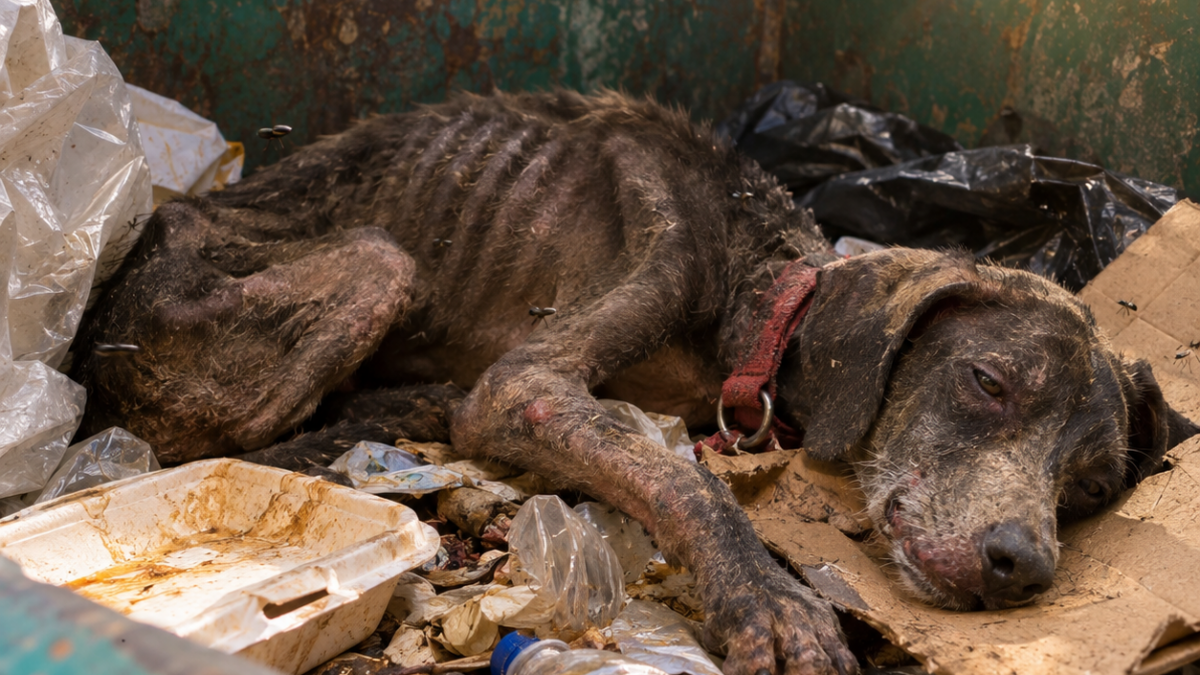
That was when her eyes opened.
Not fully.
Just enough.
Two dark eyes.
Cloudy with exhaustion.
But looking at me.
I stopped breathing.
“You’re alive.”
One ear moved.
Barely.
That tiny movement changed everything.
I put the flashlight down.
“Okay.”
I don’t know why I said it like that.
As if she and I had just entered an agreement.
“Okay, sweetheart. I see you.”
I reached toward her slowly.
She didn’t lift her head.
Didn’t growl.
Didn’t try to move away.
Her body gave no warning because she had no energy left for warning.
My gloved hand touched her side.
She was warm from the dumpster.
But the warmth felt wrong.
Surface heat.
Her body beneath it felt frighteningly weak.
I slid one hand under her chest and another beneath her hips.
She weighed almost nothing.
That shocked me more than seeing her ribs.
You prepare yourself visually when an animal is emaciated.
You see bones.
You know they are thin.
But then you lift them and your muscles expect weight that never arrives.
She felt like a coat.
A bundle of sticks.
I whispered, “I’ve got you.”
Her head rolled against my arm.
For half a second, I thought she had died there.
I pressed my fingers near her chest.
Heartbeat.
Fast.
Weak.
I climbed down with her against me.
The blanket went around her immediately.
She made no sound.
I carried her to my truck.
The air conditioning was already running.
I placed her across the passenger seat and called the emergency veterinary hospital.
“This is Ashley with Prairie Haven Rescue.”
The receptionist recognized my voice.
That told you how often I called.
“What have you got?”
“Small dog. Severe emaciation. Found inside a dumpster. Barely responsive.”
“How long exposed?”
“Unknown.”
“Breathing?”
“Yes.”
“Can she stand?”
“No.”
“Vomiting?”
“No.”
“Drinking?”
“Haven’t tried yet.”
“Come now.”
I looked at the dog.
Her eyes were still open.
“Ten minutes.”
“Drive safely.”
I hung up.
There are instructions rescue people hear often.
Drive safely.
Don’t rush.
Don’t become another emergency.
I knew all of that.
I still drove faster than I should have.
At a red light, I touched the blanket.
The dog’s eyes moved toward me.
“You stay.”
Her nose was dry.
Her gums looked pale.
I opened a small water bottle.
I didn’t let her gulp.
She probably couldn’t have anyway.
I wet one fingertip.
Touched it to her lips.
Nothing.
Again.
Her tongue moved.
Tiny.
Almost invisible.
She licked one drop.
Then another.
“That’s it.”
I wanted to give more.
Every instinct screamed water.
Food.
Something.
But severely starved animals can’t always be treated with simple abundance.
Too much too quickly can be dangerous.
I knew enough not to improvise.
So I gave her only another drop.
Then drove.
OVS sat in a low brick building off a busy road.
The doors opened before I reached them.
A technician came out with a stretcher.
“Here.”
I tightened my arms around the dog.
“I can carry her.”
The technician looked at me.
“Ashley.”
Right.
Professional help.
I let them take her.
The moment my arms were empty, I realized how badly my hands were shaking.
Inside, the team moved quickly.
Temperature.
Heart rate.
Blood pressure.
Glucose.
Blood draw.
IV access.
I stood against the wall.
Dr. Michael Reeves came in.
He was in his late fifties and had been practicing emergency medicine longer than I had been doing rescue.
He had seen animals hit by trucks.
Shot.
Burned.
Starved.
Attacked.
I had watched him remain calm through cases that made younger technicians leave the room afterward and cry.
He looked at the little dog.
Then at me.
His face changed.
Not much.
Enough.
“How long was she there?”
“I don’t know.”
“Who found her?”
“I did.”
“Dumpster?”
“Yes.”
“Direct sun?”
“Metal container behind the strip mall.”
He placed his hand gently against the dog’s chest.
Then checked the thermometer.
His brow tightened.
“What?”
“Temperature’s low.”
I stared at him.
“Low?”
The dumpster had been scorching.
“I know.”
“That doesn’t make sense.”
“It can.”
He kept working while he spoke.
“If her circulation is failing badly enough, she may no longer regulate temperature properly.”
He looked at the technician.
“Start controlled warming. Slow fluids. Get a pressure again in five.”
I moved closer.
“How bad?”
Michael didn’t answer immediately.
Doctors do that when they are deciding whether the truth needs cushioning.
I hated cushioning.
“Michael.”
“She’s in shock.”
The word did not sound dramatic when he said it.
That made it worse.
Shock is one of those words people use casually.
I was shocked.
He looked shocked.
What veterinarians mean is something different.
The body is failing to circulate enough oxygen and blood where they are needed.
Organs stop receiving what they need.
Systems begin conserving.
Then failing.
I looked at Fern—though she did not have that name yet.
“How close?”
Michael met my eyes.
“Very.”
I swallowed.
“Can you fix it?”
“We can try to stabilize her.”
“That isn’t what I asked.”
“No.”
His voice remained gentle.
“It isn’t.”
I hated him for about two seconds.
Then I hated the person who put her in the dumpster.
Someone had taken a living animal this far into starvation.
Someone had watched her body disappear.
Then, when she was too weak even to stand, somebody either placed her among the garbage or left her where garbage happened to become her last shelter.
I looked at her face.
Her eyes moved.
Still tracking us.
That was the thing.
Her body seemed finished.
Her eyes didn’t.
A technician placed warmed blankets around her.
Another adjusted the IV line.
Michael examined her mouth.
“Severe muscle wasting.”
“I can see that.”
“Ashley.”
“Sorry.”
“No need.”
He checked her abdomen.
“She’s profoundly dehydrated.”
“What about food?”
“Not yet.”
“When?”
“Small amounts once we’re sure she’s stable enough.”
I crossed my arms.
I wanted a task.
Tasks are easier than fear.
“What do you need from me?”
“History.”
“There is none.”
“Age guess?”
“Maybe two?”
He checked her teeth.
“Could be around three.”
“Chip?”
“We’ll scan when she’s more stable.”
“Pregnant?”
“No obvious signs.”
“Old injuries?”
“We’ll assess later.”
Later.
It sounded like a promise.
I held onto it.
Michael stepped away.
I stayed beside the table.
The little dog looked at me.
“What do we call her?” a technician asked.
I hadn’t thought about it.
Usually rescues came in with temporary names based on where they were found.
Dumpster Dog was not happening.
I looked at her.
Her fur, beneath dirt and grease, had a soft golden-brown color.
A few darker hairs around the ears.
Something about her looked delicate.
Not fragile exactly.
Fern came to mind.
I don’t know why.
Maybe because ferns grow in places where light barely reaches.
Maybe because they look soft while surviving under trees and stones.
“Fern.”
The technician smiled.
“Fern.”
Michael entered it into the chart.
That made her real in a different way.
Not female stray.
Not dumpster dog.
Fern.
I stayed for almost three hours.
Her temperature barely moved.
Her blood pressure remained poor.
She could swallow tiny drops but nothing more.
When they tried to reposition her, her head rolled.
I asked the question I did not want to ask.
“Is she suffering?”
Michael looked at me.
“Yes.”
That hurt.
“Can you control it?”
“As much as safely possible.”
I watched her.
“Am I doing the wrong thing?”
“What do you mean?”
“Keeping this going.”
The room became quieter.
He understood.
Rescue people talk publicly about never giving up.
Privately, the responsibility is uglier.
Sometimes continuing treatment is kindness.
Sometimes continuing because we cannot bear to say goodbye is not.
There is a line.
It is rarely obvious.
I whispered, “Look at her.”
Michael did.
“She can’t even lift her head.”
“No.”
“She has no idea where she is.”
“Probably not.”
“She’s terrified.”
“Possibly.”
“What if all we’re doing is making the last hours longer?”
Michael leaned against the counter.
“That is a fair question.”
I was grateful he did not answer too quickly.
“Do you think she has a chance?”
“Yes.”
The answer surprised me.
“A good chance?”
“No.”
There it was.
“But a real one?”
“Yes.”
I stared at Fern.
Her eyes moved toward me again.
Michael continued.
“If she were unresponsive, if her labs suggested irreversible organ failure, if we could not control her distress, I would tell you.”
“Tell me what?”
“That letting her go may be kinder.”
I swallowed.
“And you’re not telling me that.”
“Not yet.”
Not yet.
Another phrase I held.
I crouched beside Fern.
Her paw lay on the blanket.
Nails too long.
Pads rough.
I put one finger against the edge of her paw.
No pressure.
Just contact.
“Okay.”
Her eyes stayed on me.
“We try.”
Michael nodded.
“We try.”
I went home after midnight.
I did not want to.
The ICU staff practically ordered me.
“You’re no use if you collapse,” a technician named Rachel told me.
“I’m not going to collapse.”
“You’ve had two coffees and half a granola bar since noon.”
“That’s not collapse territory.”
“For you, maybe.”
I looked at Fern.
She was surrounded by warmed blankets.
Monitor leads.
IV tubing.
She looked smaller under medical equipment.
“I don’t want her waking up alone.”
Rachel softened.
“She won’t.”
“You promise?”
“Yes.”
I knew staff could not sit continuously beside every patient.
But I also knew Rachel.
She would check.
I touched Fern’s paw once.
“Tomorrow.”
No response.
I went home.
My house was twenty minutes away.
I remember nothing about the drive.
Inside, my own dog, Molly, greeted me at the door.
Molly was a ten-year-old mutt with white eyebrows and the moral certainty that every arrival required food.
She sniffed my clothes.
Then sniffed again.
She smelled Fern.
Her tail lowered.
I sat on the kitchen floor.
Molly leaned into me.
That was when I cried.
Not at the hospital.
Not while I was needed.
At home.
On the tile.
I cried because Fern’s body felt too light.
Because I could not stop picturing the dumpster lid.
Because somebody had thrown something alive into a place meant for things no one wanted.
Because she might die knowing only hunger, heat, fear, and then strangers touching her while her body failed.
I put my face into Molly’s neck.
“I don’t know if I did the right thing.”
Molly licked my ear.
Useless medical advice.
Comforting anyway.
I slept badly.
At 2:07 a.m., I woke and checked my phone.
No call.
That was good.
At 3:32, same.
At 4:18.
At 5:46.
Finally, at 6:03, I called.
Rachel answered.
“She made it.”
I sat upright.
“What?”
“She made it through the night.”
My eyes filled instantly.
“How is she?”
“Still critical.”
“Temperature?”
“Better.”
“Pressure?”
“Better than last night.”
“Eating?”
“Not really.”
“Can I come?”
Rachel laughed softly.
“I knew that was next.”
“I’m leaving now.”
“Drive safely.”
Everyone loved telling me that.
At the hospital, Fern looked almost exactly the same.
That was the strange part.
If you had shown me photographs from midnight and seven in the morning, most people would have seen no change.
But rescue teaches you to notice fractions.
Her head was positioned differently because she had moved it herself.
Her eyes were brighter.
Her ears reacted to sound.
When Rachel offered water from a syringe, Fern swallowed deliberately.
Not much.
But she chose it.
I sat beside the hospital bed.
“Hey.”
Her eyes shifted.
I placed my hand near hers.
No movement.
“I made you a deal last night without asking.”
Nothing.
“If you get strong enough to leave this place…”
My voice caught.
I restarted.
“If you get strong enough to leave, you’re coming with me.”
Rachel looked over from the counter.
I ignored her.
“You don’t know me.”
Fern blinked.
“And frankly, you may regret this because Molly snores.”
Another blink.
“But there’s a bed.”
I swallowed.
“A yard.”
My eyes filled.
“Food every day.”
Fern’s paw moved.
Barely.
I froze.
She wasn’t reaching for me.
Probably reflex.
Didn’t matter.
I placed one finger beneath it.
“And nobody puts you in the trash again.”
That was the promise.
I did not know whether she understood.
Promises do not need an audience to bind you.
That morning, her bloodwork came back.
Protein levels dangerously low.
Anemia.
Electrolyte abnormalities.
Evidence that starvation had affected virtually every system.
Michael recommended plasma.
“Will it help?”
“It can support her while we correct the underlying problems.”
“Do it.”
“We need donor plasma prepared.”
“Do it.”
He studied me.
“You know this could become expensive.”
“I know.”
“How expensive?”
“Don’t.”
“Ashley.”
“We’ll raise it.”
“You personally cannot keep—”
“We’ll raise it.”
He knew arguing was pointless.
The rescue posted Fern’s story.
Not the worst photographs.
I refused.
There is a line between showing suffering so people understand and turning pain into spectacle.
We showed one image.
Fern beneath blankets.
Eyes open.
People responded.
Donations came in.
Five dollars.
Ten.
Fifty.
A retired teacher sent twenty with a note:
For the little dog in the blankets.
A child mailed seven dollars in coins.
Someone paid for part of the plasma directly.
Strangers began calling.
“How is Fern?”
The answer remained:
Critical.
For two more days, almost nothing dramatic happened.
That is another thing stories get wrong.
We like survival to have moments.
A sudden awakening.
A leap.
A miracle.
Most real recovery is boring to everyone except the people waiting.
Temperature up half a degree.
Pressure holding.
Urine output.
One teaspoon of food.
Another.
Fern swallowed.
Fern blinked.
Fern moved her front paw.
Fern slept without her heart rate crashing.
We celebrated physiology.
On the third day, I walked into the ICU and heard a sound.
Tiny.
Raspy.
“Was that her?”
Rachel smiled.
Fern’s head was still down.
I crouched.
“Fern?”
Her mouth opened.
A little sound came out.
Not quite a bark.
More like air remembering what barking was.
I laughed.
“Oh my God.”
Fern tried again.
A faint yip.
Rachel said, “She started this at five.”
“You waited two hours to tell me?”
“I enjoy surprises.”
Fern’s eyes looked toward me.
I touched her paw.
“You have opinions now?”
Tiny bark.
“That’s going to be a problem.”
Her tail did not move.
Not yet.
Her legs did.
Small adjustments.
Front paws flexing.
Back legs pulling slightly.
Muscle where almost no muscle remained trying to remember its job.
The plasma transfusion took hours.
I sat nearby.
At one point Rachel sat on the other side and held Fern’s paw while checking the line.
Fern slept.
A veterinary assistant named Jonah brought in an iPad and placed it several feet away.
“What are you doing?”
“Calming videos.”
I stared at him.
“For a dog?”
“Birds.”
“You’re showing a starving dog YouTube birds?”
Fern’s ear moved toward the chirping.
Jonah looked smug.
“She likes it.”
I hated that he was right.
Soon Fern had an entire ICU routine.
Warm blankets.
Plasma.
Tiny meals.
Medication.
Monitoring.
Bird videos.
People sitting beside her.
Once she stabilized enough, Michael approved carrying her outside for five minutes.
Rachel wrapped her in a blanket.
I held her.
The automatic doors opened.
Warm Oklahoma air touched us.
Not dumpster heat.
Open air.
A breeze moved across Fern’s face.
She lifted her nose.
That was one of the first times I saw her do anything that was not purely survival.
She smelled.
Grass.
Cars.
Trees.
Rain somewhere far away.
The world.
I sat on a bench with her in my lap.
“You missed some things.”
Fern’s eyes stayed half closed.
“That’s okay.”
Her nose moved again.
“We’ll catch up.”
A few days later, she ate from a spoon.
Then from a shallow bowl.
One tablespoon.
Too fast.
Rachel removed it.
Fern looked offended.
I laughed.
“There she is.”
A dog who wants more food is easier to hope for than a dog who cannot lift her head.
But we remained careful.
Refeeding a severely starved animal can be dangerous.
Her body needed calories.
Her body also needed time to remember what to do with them.
The amounts increased gradually.
Her stomach tolerated more.
Her lab values began moving in the right direction.
She gained ounces.
Not pounds.
Ounces.
I kept a notebook.
Day 1: unable to stand.
Day 2: swallowed water.
Day 3: vocalized.
Day 4: moved hind leg.
Day 5: ate 1.5 tbsp.
Day 6: lifted head for 12 seconds.
Rachel found the notebook.
“You know we have medical records.”
“Mine are better.”
“You wrote ‘gave me side-eye’ under neurologic status.”
“That’s clinically relevant.”
“It is not.”
“It means personality.”
That mattered to me.
Personality meant Fern’s world was becoming larger than pain.
By the end of the first week, she could hold her head up.
Not long.
But long enough to look around the room.
I entered one morning.
She lifted it.
Saw me.
And her tail moved.
One small sweep against the blanket.
I stopped.
Rachel saw my face.
“What?”
“She—”
The tail moved again.
Rachel smiled.
“Yep.”
I sat beside Fern.
“You know me.”
Another tail movement.
That nearly meant more than the first bark.
Recognition.
Maybe expectation.
Somewhere in her exhausted brain, I had become familiar.
Safe.
The woman from the dumpster.
Or chicken provider.
I was fine with either.
The first attempt to stand happened on day eleven.
Nobody planned it.
Fern had become restless.
That itself was new.
Rachel opened the ICU door to change bedding.
Fern shifted her front paws.
Pulled.
Her chest lifted.
Rachel said, “Wait.”
I happened to be standing nearby.
Fern pushed again.
Her front legs straightened.
Her back end lagged.
Her body shook.
“Fern.”
She pushed harder.
For one impossible second, she stood.
All four feet.
Then collapsed.
I gasped.
Rachel laughed.
“You saw that?”
“Yes.”
Michael appeared from another room.
“What happened?”
“She stood.”
“For how long?”
“Forever.”
Rachel corrected me.
“Maybe one second.”
“Same thing.”
Michael crouched beside Fern.
“Don’t make her repeat it.”
“I wasn’t.”
He gave me the look.
I raised both hands.
“No miracle performance.”
“Good.”
Fern lay exhausted.
But her eyes were bright.
The next attempt happened hours later.
This time a technician supported her abdomen with a towel sling.
Fern placed her paws.
Shook.
Stood.
One second.
Two.
Three.
Then one front paw moved.
A step.
Her back leg followed awkwardly.
Another step.
Her whole body trembled.
I put my hand over my mouth.
Rachel whispered, “Come on, girl.”
Fern stepped again.
Three steps.
Then four.
Then she sat down abruptly.
The room exploded.
People cheered.
Not loudly enough to frighten her.
But nobody remained professional.
Jonah cried.
Rachel cried.
I cried.
Michael claimed allergies.
In July.
Inside an ICU.
“Sure,” I told him.
Fern looked confused by us.
She had taken maybe four feet of shaky movement.
To anybody outside rescue, it would have looked pathetic.
To us, it looked like a parade.
The dog I had lifted from garbage because she could not raise her head had just decided to move under her own power.
I crouched.
Fern looked at me.
“Do it when you’re ready.”
Her tail moved.
No demand.
No deadline.
She had already done enough.
From there, recovery accelerated and slowed at the same time.
Fern became stronger each day.
But every new ability revealed another challenge.
Standing meant learning balance.
Eating meant digestive adjustment.
Walking meant muscles had to rebuild.
More food meant her metabolism changed.
Her coat began shedding damaged hair.
Her skin needed treatment.
Her nails needed trimming.
She had dental issues.
An old scar beneath her jaw.
And she was terrified of trash bags.
We discovered that accidentally.
A technician removed a black garbage liner from a bin.
The plastic snapped.
Fern dropped to the floor.
Instantly.
Her entire body flattened.
She urinated beneath herself.
The room went silent.
The technician froze.
“Oh God.”
I knelt several feet away.
“Fern.”
She trembled.
Not weak trembling.
Fear.
Pure.
Immediate.
I looked at the black bag.
Something inside me went cold.
We would never know exactly what happened before I found her.
Maybe the bag meant nothing.
Maybe the sound reminded her of the dumpster.
Maybe somebody had used bags while moving her.
Trauma does not explain itself for our convenience.
I asked the technician to take the bag away.
Then sat on the floor.
No reaching.
No forcing.
Fern looked at me.
“Nothing’s happening.”
She trembled.
“You’re okay.”
Ten minutes.
Then fifteen.
Eventually she crawled toward me.
Not walking.
Crawled.
I let her choose.
When she reached my leg, she pressed her face against my knee.
That was the first time I understood that surviving starvation would be only one part of taking Fern home.
Bodies heal visibly.
Fear is quieter.
Fern left the ICU after eighteen days.
Eighteen.
I had counted every one.
By then she could walk short distances.
Slowly.
Her legs still lacked muscle.
She tired easily.
But she walked.
Her ribs were still visible.
Her face remained too narrow.
Yet when I arrived with a pink harness and a cheap little bed for the truck, Fern began barking.
Not faintly.
Properly.
Rachel laughed.
“She knows.”
“Knows what?”
“You’re taking her.”
Fern barked again.
“You told her?”
Rachel looked offended.
“She can read discharge paperwork.”
Michael came in holding the final instructions.
Medication.
Feeding schedule.
Follow-up labs.
Activity restriction.
Signs of trouble.
I took every page.
Then looked at him.
“You thought she’d die.”
“Yes.”
He did not lie.
“So did I.”
“Yes.”
Fern stood beside my feet.
She leaned against my ankle.
Michael looked down at her.
“I’m glad we were both wrong.”
I knelt.
“Ready?”
Fern licked my chin.
“Apparently.”
The ICU staff gathered near the doors.
Not for a ceremony.
They had patients.
Work.
But one by one they came.
Rachel kissed Fern’s head.
Jonah brought the bird-video iPad over one final time and played chirping sounds.
Fern ignored it.
“Ungrateful,” he said.
Michael scratched behind her ear.
Then the doors opened.
Fern walked out.
Four legs.
Slow.
Wobbly.
Alive.
I cried before we reached the parking lot.
The ride home took twenty-five minutes.
Fern sat on the passenger seat in a padded bed.
At every stoplight, I checked her.
She watched the world.
Cars.
Trees.
People.
A motorcycle.
Open sky.
No dumpster lid.
When we reached my house, Molly waited behind the front window.
She barked.
Fern froze.
“Oh.”
I had forgotten one important detail.
Existing dog.
I did not carry Fern straight inside.
We introduced them in the yard.
Distance first.
Leashes loose.
Molly was old and socially competent.
Fern was overwhelmed.
Molly smelled the air.
Then grass.
Then Fern.
Fern lowered her head.
Molly approached sideways.
One sniff.
Fern stiffened.
Molly moved away.
Perfect.
No drama.
No pressure.
Within ten minutes, Fern followed Molly toward the porch.
I opened the door.
Fern stopped at the threshold.
I realized she might never have been inside a normal home.
Maybe she had.
We didn’t know.
But that doorway looked enormous to her.
Molly walked in.
Turned around.
Waited.
Fern looked at me.
I crouched inside.
No pulling.
No lifting.
“Your choice.”
One front paw crossed.
Then the other.
She stepped into the house.
That was her real discharge.
Not the ICU.
The doorway.
Fern walked through and stopped on the living room rug.
Molly went to her bed.
Fern stood.
Smelled.
Looked.
Listened.
Refrigerator.
Air conditioner.
A clock.
Ordinary sounds.
Then she noticed the dog bed I had bought.
Cream-colored.
Soft.
Too expensive.
She approached.
Smelled it.
Stepped in.
Circled twice.
Lay down.
That was it.
No fireworks.
No grand understanding.
She just lay down.
I sat on the floor beside her and cried again.
Apparently Fern had destroyed my emotional stability.
The first night was terrible.
Fern did not understand bedtime.
Every time the house became quiet, she woke.
She paced.
Sometimes she stood near the back door.
Sometimes beside my bed.
At 1:12 a.m., she barked.
At 2:40, she vomited.
At 3:15, she had diarrhea.
At 4:03, Molly looked at me like this was my fault.
It was.
I slept maybe forty minutes.
At sunrise, Fern finally curled on the rug beside my bed.
I lay awake listening to her breathe.
Home is not immediately safe just because we decide it is.
Her body had arrived.
Her nervous system needed longer.
For weeks, Fern ate like every meal might disappear.
We followed the veterinary feeding schedule carefully.
But she watched the bowl.
Guarded crumbs.
Checked Molly’s dish after it was empty.
If I walked toward the pantry, she followed.
If I carried groceries, she inspected every bag.
Once, she found a sealed package of tortillas and hid it behind the couch.
I did not punish her.
Hunger had taught Fern that food vanished.
My job was not to discipline that memory out of her.
My job was to give her enough ordinary days that eventually the memory stopped being useful.
So meals arrived on time.
Every day.
Same place.
Same bowl.
No competition.
Nobody took it away.
At first, Fern inhaled food.
Then months later, she began leaving pieces.
The first time she left three kibble pieces in the bowl and walked away, I almost photographed them.
Molly ate them before I could.
Still counts.
Trash remained harder.
Black garbage bags were impossible.
We switched to white.
Then translucent.
Even those frightened her initially.
The outdoor garbage bin sent her into hiding.
So we worked slowly.
Bag across the room.
Treat.
Bag closer.
Treat.
Touch the bag.
Treat.
Move it.
Treat.
Never force.
Never corner.
Some days Fern progressed.
Other days the plastic crackled and she disappeared beneath the table.
That was recovery too.
The rescue investigation began while Fern was still in the hospital.
Animal control searched the dumpster area.
No camera pointed directly at it.
One business had security footage covering part of the alley.
We saw vehicles.
Delivery trucks.
Employees.
Nothing obvious.
Then a volunteer noticed a white SUV entering behind the abandoned storefront at 5:14 a.m. on the day Fern was found.
It stayed for ninety-three seconds.
The license plate was unclear.
That might have been nothing.
Then another camera from a gas station captured the SUV leaving.
Clearer.
Authorities traced it to a woman named Denise Harper.
I did not know her.
I wish I never learned her name.
Investigators interviewed her.
She initially denied owning a dog.
Then they found older social media photographs.
There was Fern.
Healthier.
Full coat.
Red collar.
Lying on a couch.
Same markings.
Same white patch under the throat.
Fern had been named Sophie.
She had belonged to Denise’s elderly mother.
When the mother died, Denise inherited the house and the dog.
According to neighbors, Sophie began losing weight months later.
They assumed illness.
One neighbor offered help.
Denise said the dog was “fine.”
She wasn’t.
The veterinary records showed no treatment.
No visits.
No attempt to surrender.
Nothing.
Investigators believed Fern had been kept confined for an extended period while starving.
Then dumped.
When I read the report, I became physically ill.
Not because there was some dramatic torture described.
Because there wasn’t.
Starvation is quiet.
That is what made it unbearable.
Meal after meal not given.
Day after day.
An animal getting thinner in front of somebody.
It required repetition.
Neglect repeated until bones appeared.
Then finally a dumpster.
I sat at my kitchen table with the report.
Fern slept near my feet.
She had gained six pounds by then.
Still thin.
But alive.
I looked at the old photograph of her on Denise’s couch.
Fern—or Sophie—looked different.
Healthy.
Bright.
That meant she knew what normal life had been.
She knew food.
Furniture.
People.
Maybe that made the abandonment worse.
I touched her ear.
She woke.
Looked at me.
“You had a life before.”
Tail thump.
I wondered whether she missed her first owner.
Denise’s mother.
Probably.
Dogs carry people differently than we do.
They do not write biographies.
But they remember scent.
Routine.
Tone.
Safety.
Maybe Fern’s first human had loved her.
Maybe after that woman died, everything disappeared.
Home.
Food.
Protection.
Name.
Then I thought of Denise.
Anger rose again.
Fern stood.
Pressed against my knee.
I exhaled.
The prosecutor later asked whether I wanted to attend court.
I said yes.
I regretted it immediately.
Courtrooms turn suffering into paperwork.
Dates.
Photographs.
Weights.
Blood values.
Officer testimony.
Defense arguments.
Denise sat across the room looking ordinary.
That was disturbing.
Cruel people are supposed to look cruel in stories.
Real life is less cooperative.
She wore a beige blouse.
Hair neatly tied.
She could have been anyone at the grocery store.
Her attorney argued that she had been overwhelmed after her mother’s death.
Financial problems.
Depression.
Lack of knowledge.
I understood grief.
I understood money problems.
I understood being overwhelmed.
What I did not understand was the dumpster.
There were shelters.
Police stations.
Veterinary offices.
Neighbors.
The humane society.
A thousand imperfect choices before the final one.
She chose the dumpster.
At one point the attorney said Fern had already been “in poor condition” when Denise’s mother died.
The prosecutor produced photographs taken shortly before the mother’s death.
Fern was healthy.
The lie collapsed.
Denise eventually entered a plea.
Animal cruelty.
Neglect.
Abandonment.
The sentence was not what I wanted.
They rarely are.
Fines.
Probation.
Restrictions on animal ownership.
Some jail time, though less than many people demanded.
Online, strangers called for worse.
I understood them.
I also learned to stop reading.
Fern did not know what sentence Denise received.
Fern knew breakfast arrived.
Fern knew Molly slept beside the couch.
Fern knew my truck meant rides to the park instead of a dumpster.
Justice mattered.
But revenge could not heal a dog.
Routine could.
Safety could.
Time could.
Love could, if we were careful not to demand that love erase everything.
Fern’s first breakthrough at home came three months after discharge.
A thunderstorm hit after midnight.
Oklahoma thunderstorms have no respect for emotional rehabilitation.
Lightning cracked over the house.
Fern panicked.
She ran.
Not toward me.
Into the laundry room.
I found her wedged between the dryer and wall.
Shaking.
I sat on the floor.
Did not pull her out.
Molly came too.
She lay in the doorway.
We waited.
Thunder.
Fern trembled.
Another flash.
I talked about nonsense.
What I had eaten for lunch.
A neighbor’s ugly mailbox.
How Molly had stolen cheese.
Anything except fear.
After twenty minutes, Fern moved.
One paw forward.
Then another.
She crawled from behind the dryer.
Passed Molly.
Came directly to me.
She climbed halfway into my lap.
Fern was too large for a lap.
Nobody told her.
I wrapped my arms around her.
The thunder continued.
She stayed.
That night was the first time Fern chose me when she was afraid.
Trust is not when an animal lets you touch them while things are calm.
Trust is where they go when the world becomes frightening.
I never forgot that.
Her coat changed over the next year.
It became thick.
Soft.
A rich reddish tan along the back with cream underneath.
People who saw new photographs sometimes did not believe she was the same dog.
Neither did I.
The eyes were the same.
That was how I knew.
The body transformed.
The eyes remained Fern.
She learned toys.
Badly.
Molly had no interest in toys, so Fern had no teacher.
I gave her a stuffed squirrel.
She stared at it.
I squeaked it.
She jumped backward.
“Not my best decision.”
I put it down.
Two days later, Fern carried the squirrel into the kitchen.
Then dropped it.
I threw it gently.
She watched it land.
Looked at me.
Looked at the squirrel.
The expression clearly said:
You threw it. You get it.
A month later she figured out fetch.
Then became unbearable.
The dog who had once been unable to lift her head eventually demanded that I throw a stuffed squirrel thirty times after dinner.
On throw thirty-one, I stopped.
Fern barked.
Molly left the room.
“Your sister has boundaries,” I told Fern.
Bark.
“Fine.”
Throw thirty-one.
The most emotional moment did not happen in the hospital.
Or court.
Or during a dramatic rescue anniversary.
It happened in my kitchen one ordinary Tuesday.
I was unloading groceries.
Fern sat nearby.
A package of chicken fell.
Not open.
Just fell.
Fern flinched.
Then looked at me.
Old Fern would have grabbed it.
Hidden it.
Protected it.
This Fern watched.
I picked the chicken up.
Put it on the counter.
Then continued unloading.
Fern walked to her water bowl.
That was it.
Nothing happened.
And everything had changed.
Food could fall near her without becoming emergency property.
Because more food would come.
Tomorrow existed now.
That is what security really gave Fern.
A belief in tomorrow.
Molly died two years after Fern came home.
Cancer.
Fast.
Fern had followed her everywhere by then.
She learned the house from Molly.
The yard.
Which neighbor gave treats.
Where to sleep during thunderstorms.
How to wait by the back door.
When Molly stopped eating, Fern became quiet.
She lay beside her.
On Molly’s last day, the veterinarian came to our house.
Fern stayed nearby.
After Molly died, Fern smelled her face.
Then lay down.
I sat on the floor between them and cried until my throat hurt.
Fern pressed her body against me.
Years earlier, I had sat on that same floor telling Molly I did not know whether Fern would survive.
Now Molly was gone.
Fern remained.
Grief moves chairs around.
That night, Fern slept in Molly’s bed.
I almost stopped her.
Then didn’t.
By morning, she had pulled her own blanket into it too.
Life makes room.
Fern grew older.
Her muzzle whitened.
She developed arthritis.
Nothing unusual.
Nothing dramatic.
That ordinary aging felt like a victory.
The dog somebody discarded before she reached middle age had been allowed to become old.
I celebrated every gray hair.
At age ten, she developed a habit of standing in the backyard at sunset.
Just standing.
Watching.
I often joined her.
One evening I said, “You know people still ask about you.”
Fern smelled the grass.
“They want updates.”
She scratched one ear.
“I tell them you’re spoiled.”
Tail thump.
“Apparently that is inspirational.”
She looked at me.
I laughed.
I never knew exactly how long Fern had been in that dumpster.
Investigators could not prove it.
Maybe hours.
Maybe less.
People often asked.
Eventually I stopped trying to answer.
The important thing was that her life after the dumpster became longer than everything that came before it.
Much longer.
One terrible day did not remain the largest thing that happened to her.
That mattered to me.
There was the morning she learned stairs.
The summer she discovered sprinklers.
The first Christmas she stole ham.
The time she barked at a plastic deer decoration for forty-five minutes.
The afternoon she fell asleep with her head inside my shoe.
The years.
Ordinary years.
Those were the real revenge against what happened to her.
Not court.
Not anger.
Time.
A long life.
When Fern turned twelve, Michael Reeves retired.
We brought her to his retirement gathering at the hospital.
He had not seen her in almost a year.
Fern walked through the ICU doors.
Older.
Rounder.
Confident.
Michael crouched.
She approached.
Smelled him.
Then licked his face.
He laughed.
“Do you remember me?”
I said, “She remembers you saying her odds weren’t good.”
“That is not how prognosis works.”
Fern leaned against him.
Michael’s eyes filled.
He touched the side of her face.
“I really didn’t think you’d be here.”
That room became quiet.
He corrected himself.
“I hoped.”
I nodded.
“So did I.”
Fern lived to fourteen.
Her final year was gentle.
Arthritis medication.
Short walks.
Soft beds.
A ramp to the porch.
She still loved the stuffed squirrel, though she stopped chasing it.
Instead, she carried it.
Room to room.
At night she slept beside my bed.
One August morning, almost exactly twelve years after I found her, Fern did not get up for breakfast.
That scared me immediately.
Fern had missed many things in life.
Breakfast was never one.
I sat beside her.
“Hey.”
Her eyes opened.
Same eyes.
Older.
Cloudier.
But the same eyes I had seen inside the dumpster.
“Come on.”
She tried.
Her front legs pushed.
Then stopped.
I remembered another day.
A hospital bed.
Trembling legs.
Fern standing because her body finally could.
Now she looked at me as if apologizing because it couldn’t.
“No.”
I put my hand against her chest.
“You don’t have to.”
The veterinarian came.
Not Michael.
A younger doctor named Claire who knew Fern’s history because apparently it had become clinic mythology.
Kidneys failing.
Heart weak.
Body tired.
Options existed.
But not good ones.
I asked the same question I had asked on the first night.
“Am I doing the wrong thing?”
Claire understood.
“No.”
“Could we get more time?”
“Yes.”
“How much?”
“We don’t know.”
“At what cost to her?”
Claire looked at Fern.
“That’s the question.”
Twelve years earlier, I had wondered whether continuing treatment was selfish.
Now I wondered whether stopping was.
Love never makes these decisions easy.
Sometimes it makes them harder because you know exactly what you are losing.
Fern’s breathing was labored.
She did not want food.
She did not want water.
She wanted my hand.
Whenever I moved it, her eyes followed.
I placed it back.
I called Rachel, who no longer worked ICU but still lived nearby.
She came.
Jonah joined by video.
Michael drove forty minutes despite being retired.
He walked into my house carrying nothing.
Fern’s tail moved once.
Michael sat on the floor.
“Well, look at you.”
Fern closed her eyes.
He touched her paw.
Rachel cried immediately.
“Sorry.”
“No apologies.”
I had cried for twelve years around this dog.
Nobody needed professionalism now.
I brought the stuffed squirrel.
Placed it beside her.
Fern smelled it.
Then rested her head against my leg.
Claire prepared the medication.
I looked around.
People who had kept her alive when she was trash to somebody.
Now surrounding her when she was the most precious thing in the room.
I thought about the dumpster.
I hated that memory.
But for once, it did not feel bigger than everything else.
The dumpster was a place Fern had been.
It was not who she was.
I leaned down.
“You remember our deal?”
Her eyes opened.
“You get out of the hospital, you come home.”
Her breathing remained slow.
“You did your part.”
My voice broke.
“You came home.”
Fern’s paw rested against my wrist.
“You stayed a while.”
Rachel sobbed softly.
Michael looked toward the window.
“You stayed a long time.”
I kissed her forehead.
“And nobody threw you away again.”
Fern exhaled.
I pressed my face into her fur.
“You were wanted every single day.”
Claire gave the first medication.
Fern relaxed.
The tension left her legs.
Her breathing became easier.
For twelve years I had watched her sleep.
I knew the moment her body stopped guarding itself.
She looked peaceful.
I whispered, “You can go.”
My throat closed.
“No dumpster.”
Another breath.
“No fear.”
Another.
“You’re home.”
The final medication went in.
Fern exhaled.
And did not inhale again.
I stayed with her until the light changed across the floor.
Nobody hurried me.
Later, Michael helped carry her outside.
Not because he needed to.
Because twelve years earlier, technicians had carried Fern through hospital doors while I followed wondering whether she would live.
This time I carried her.
She was heavier.
That made me smile through tears.
Healthy weight.
Age.
A whole life inside the difference.
We buried some of Fern’s ashes beneath a dogwood tree in my yard.
The rest remain on a shelf with her collar.
Beside it is a photograph.
Not the dumpster picture.
Not the ICU.
I refused those.
The photograph shows Fern at eight years old.
Standing in the backyard.
Stuffed squirrel in her mouth.
Sunlight on her face.
Tail up.
That is how I want people to know her.
Sometimes strangers still recognize the story.
They say:
Wasn’t Fern the dog found in a dumpster?
I tell them yes.
But I always want to correct the sentence.
Fern was not the dog in the dumpster.
She was the dog who came out.
There is a difference.
She came out.
She survived the night.
She took one unsteady step.
Then another.
She walked through my front door.
She stole tortillas.
She learned fetch.
She comforted me when Molly died.
She grew gray.
She became old.
She filled twelve years with enough ordinary moments to reduce one terrible afternoon to a single chapter.
That is what rescue can do at its best.
It cannot erase cruelty.
I could never undo what happened to Fern.
I could not make her unstarved.
Could not make the dumpster disappear from her nervous system.
Could not return whatever time she lost before somebody noticed.
But we could make sure cruelty did not get the final word.
People sometimes say compassion saved Fern.
Maybe.
Veterinary medicine saved Fern.
Plasma.
Fluids.
Controlled warming.
Nutrition.
Monitoring.
People sitting beside her through the night.
All of it mattered.
But there was another part.
Somebody looked.
That is where the whole story turned.
A dumpster is designed for things we stop seeing.
We throw something inside.
Close the lid.
Walk away.
Fern survived because somebody looked under the lid.
That lesson followed me.
You cannot save everything.
No human being can carry that.
But you can look.
You can notice the dog beside the road.
The animal behind the fence.
The neighbor who has become too quiet.
The person who says they are fine too quickly.
Sometimes mercy begins with refusing to look away.
I still remember lifting that dumpster lid.
The heat.
The smell.
Black garbage bags.
A little body I thought was already dead.
Then those eyes.
Open.
Tracking me.
Alive.
I had gone there expecting to remove an animal from the trash.
What I did not understand yet was that Fern’s life would eventually become something so much larger than the place where I found her.
She was not saved so she could become a symbol.
She was saved so she could have breakfast.
Beds.
Sunlight.
Grass beneath her paws.
Bad toys.
Thunderstorms with somebody beside her.
A home.
A chance to become old.
Sometimes we make rescue stories too dramatic.
We talk about miracles.
Heroes.
Defiance.
The most beautiful part is often simpler.
An animal who expected nothing learns to expect dinner.
A frightened dog falls asleep deeply.
A body once discarded becomes somebody’s favorite thing to come home to.
A creature left among garbage spends years being told, without words, that she belongs.
That was Fern’s real recovery.
Not the moment she stood in the ICU.
Not even those first trembling steps.
It was every ordinary day afterward.
Every meal that arrived.
Every door that opened.
Every hand that touched her gently.
Every night she closed her eyes knowing where she would wake up.
And if I could go back to that first afternoon, climb once more onto the side of that burning dumpster, and speak to the tiny dog whose eyes were barely open, I know exactly what I would tell her.
I would not promise the pain was almost over.
It wasn’t.
I would not promise recovery would be easy.
It wasn’t.
I would not tell her she was lucky.
There was nothing lucky about what had been done to her.
I would only reach down and say the one thing that eventually became true.
“Fern, this is the last place anyone will ever throw you away.”








