An Old Woman Tried to Sell Her German Shepherd for $5 in a Snowstorm—Then a Former Navy SEAL Saw the Dog Stand Up and Realized This Wasn’t a Chance Encounter
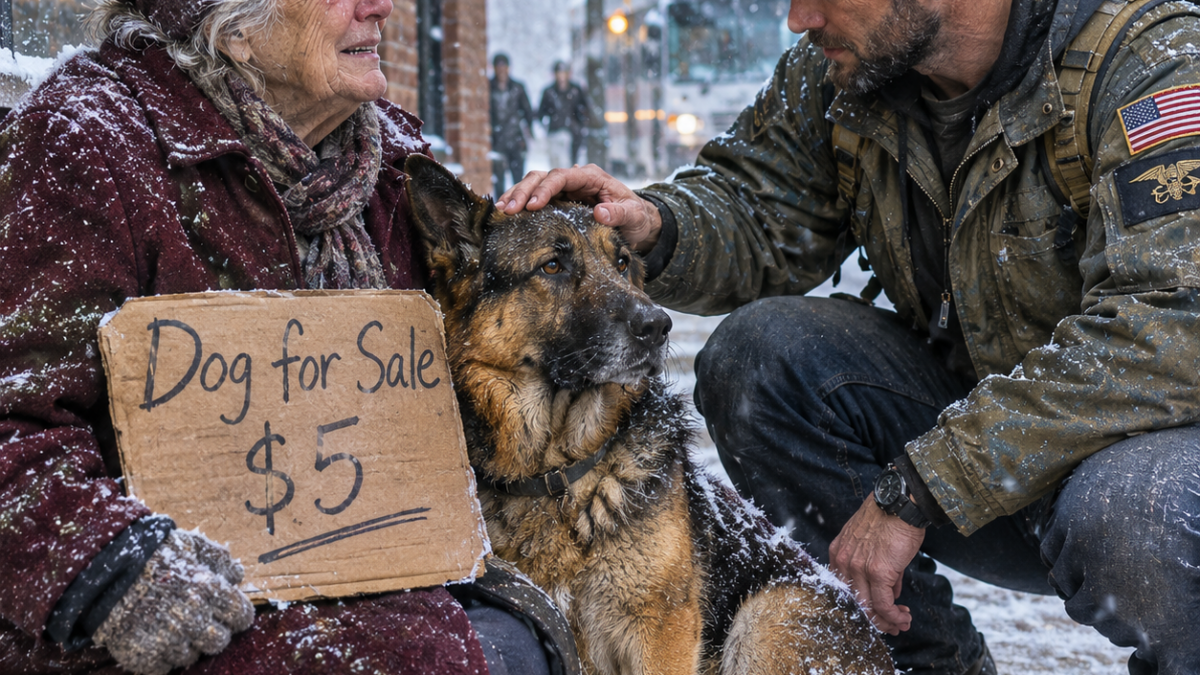
An Old Woman Tried to Sell Her German Shepherd for $5 in a Snowstorm—Then a Former Navy SEAL Saw the Dog Stand Up and Realized This Wasn’t a Chance Encounter.
Margaret Ellis sat beneath a frozen bus-depot awning with five dollars written on a piece of cardboard because selling the only creature she had left seemed kinder than letting him freeze beside her.
Former Navy SEAL Nathan Cole thought he was rescuing an old woman and her aging German Shepherd, until a photograph hidden among her dead husband’s papers showed Nathan the military dog he had spent eight years blaming himself for losing.
And before the storm ended, Margaret’s own son would try to steal her house, Atlas would stand between Nathan and the past he had never escaped, and five crumpled dollars would somehow become the beginning of three lives none of them believed they still deserved.
The sign said:
DOG FOR SALE — $5.
Nathan Cole almost kept walking.
Years later, that was the part he remembered with the most shame.
Not the snow.
Not the old woman.
Not even the German Shepherd.
The fact that he almost walked past.
Snow came sideways through Duth that afternoon, driven inland from Lake Superior by a wind sharp enough to slide beneath zippers and find bare skin.
By three o’clock, the city had started disappearing.
Parked cars became white humps.
Street signs blurred.
Storefronts looked softer around the edges.
The old bus depot stood beneath a yellow streetlight with its windows fogged from the people inside waiting for buses that probably weren’t coming.
Nathan had just left Miller’s Discount Market.
One paper grocery sack hugged against his chest.
Another hanging from his left hand.
Rice.
Beans.
Eggs.
Coffee.
Marked-down bread.
A bottle of aspirin.
Four chicken thighs with a yellow sticker that said MANAGER’S SPECIAL.
His VA payment had arrived three days earlier.
Rent had eaten most of it.
The electric company was waiting for the rest.
At forty-one, Nathan had become skilled at pretending poverty was simply another logistical problem.
You counted.
Adjusted.
Prioritized.
Ate eggs for dinner.
Wore a coat another winter.
Didn’t think too much about how a man who once had twenty million dollars’ worth of government equipment behind him now checked the price difference between two brands of canned beans.
Nathan had been a Navy SEAL.
Later, a canine handler.
PART2:
People who learned that expected stories.
They expected helicopters.
Night-vision goggles.
Explosions.
Courage.
Nathan rarely gave them what they wanted.
The memories he carried were quieter.
A dog breathing beside his leg in darkness.
Snow inside his collar.
A radio call ending halfway through a word.
A harness slipping through his gloves.
Ranger disappearing into white.
Nathan had been out of uniform for almost six years.
Ranger had been dead for eight.
Some mornings the difference felt like yesterday.
He tucked his chin lower into his field jacket and started uphill toward his apartment.
That was when he saw the sign.
At first he thought it belonged to someone selling something inside the depot.
Then the wind flattened it against a pair of thin knees.
Nathan slowed.
An elderly woman sat alone on a metal bench beneath the awning.
Burgundy wool coat.
PART3:
One button fastened into the wrong hole.
Gray scarf.
White hair escaping beneath a knitted hat.
Snow had melted into the shoulders of her coat.
Beside her lay a German Shepherd.
Old.
Dark sable coat.
Black saddle.
Silver around the muzzle.
One ear stood perfectly.
The other bent slightly at the tip.
The dog was pressed against the woman’s boots.
Not sleeping.
Watching.
That was what stopped Nathan.
Dogs watched in different ways.
A frightened dog watched exits.
A hungry dog watched hands.
An aggressive dog watched weakness.
This one watched responsibility.
Two younger men stood near the bench.
Too near.
One wore a blue puffer jacket.
The other had a black knit cap and a grin that made Nathan dislike him immediately.
The man in the cap nudged the cardboard sign with his boot.
“Five bucks?”
The woman tightened both hands around the leash.
“Yes.”
“Lady, the leash is worth more than the dog.”
His friend laughed.
The German Shepherd raised his head.
“Maybe he comes with a warranty.”
More laughter.
“Pull twice and pray.”
The woman said quietly, “Please don’t touch him.”
Blue Jacket reached down anyway.
“Five dollars means I get to inspect the merchandise.”
The dog stood.
Slowly.
Pain showed first.
Right front leg.
Arthritis, old injury, maybe both.
But once he stood, the pain disappeared behind discipline.
He moved in front of the woman.
Head low.
No teeth.
No barking.
Just a line.
The woman put a shaking hand against his shoulder.
“Atlas.”
Nathan stopped walking.
Atlas.
Big name.
Old dog.
Bad leg.
Standing anyway.
For half a second, the bus depot vanished.
Nathan saw a snow-covered ridge eight years earlier.
A black-and-tan dog standing ahead of him.
Harness tight.
Ears raised.
Ranger looking back once.
Then forward.
Nathan’s grocery sack creaked beneath his grip.
Keep walking.
That was what he’d taught himself after leaving the Navy.
You couldn’t fix every bad thing just because you recognized it.
He had a cold apartment.
An overdue electric bill.
Nightmares.
Bad knees.
No room in his life for an old woman.
No money for a dog.
No patience for two idiots.
Then Blue Jacket reached for Atlas’s leash.
Nathan placed his groceries in the snow.
The eggs clicked softly together.
He walked beneath the awning.
“That’s close enough.”
Neither man noticed him until he spoke.
Blue Jacket straightened.
“What?”
Nathan looked at his hand.
“Move it.”
The man in the cap laughed.
“You buying the dog?”
“No.”
“Then mind your business.”
Nathan glanced toward the black security camera mounted above the ticket window.
Then toward another camera across the street.
“Bus driver saw you.”
Blue Jacket frowned.
“Camera above you sees you.”
Nathan nodded toward the depot.
“Clerk inside is watching.”
The two men looked.
The woman behind the ticket counter had indeed stopped working.
Nathan continued.
“She asked you not to touch the dog.”
“So?”
“So back away.”
“You a cop?”
“No.”
“Then shut up.”
Atlas made a low sound.
Nathan looked down at him.
Controlled.
No wasted movement.
Old dog knew exactly how much threat was necessary.
Good boy.
Blue Jacket took a step toward Nathan.
Nathan didn’t move.
Men looking for fights often needed the other person to help create one.
A raised fist.
A shove.
A threat.
Nathan gave him nothing.
“What are you supposed to be?” the man asked.
Nathan shrugged.
“Tired.”
The man in the cap laughed.
Blue Jacket didn’t.
“Old military guy?”
Nathan said nothing.
“What are you gonna do? Salute me?”
Nathan looked at his boots.
Fresh tread.
Snow packed beneath one heel.
Bad footing.
Then at the man’s right wrist.
Hands slightly open.
No weapon visible.
Nathan hated that his brain still did this automatically.
Angles.
Distance.
Weight.
Exit.
Threat.
He wished he could look at another person without calculating how quickly they could become dangerous.
“I was hoping,” Nathan said quietly, “you’d be smarter than you look.”
The grin vanished.
Blue Jacket stepped forward.
Atlas barked once.
The sound exploded beneath the metal awning.
Everyone froze.
Not a frantic bark.
One command.
Enough.
The man in the cap grabbed his friend’s sleeve.
“Come on, Trevor.”
Trevor pulled away.
“I’m not scared of a grandpa dog.”
Nathan nodded.
“Good.”
Trevor stared.
“Then you won’t mind leaving before he embarrasses you.”
That did it.
Trevor’s face reddened.
For one second Nathan thought he’d swing.
Then the clerk stepped into the doorway holding her phone.
Trevor noticed.
His friend did too.
The equation changed.
They backed away.
As they stepped into the snow, Trevor looked at the old woman.
“Keep your mutt.”
Atlas watched him.
Trevor added:
“We know where you sleep anyway.”
The old woman’s shoulders collapsed inward.
Nathan heard it.
So did Atlas.
Nathan’s expression changed.
Trevor’s friend pulled him away.
The two disappeared into the snowfall.
Nathan waited until they turned the corner.
Then he crouched several feet from Atlas.
Hands visible.
“Good boy.”
Atlas stared at him like Nathan had failed an inspection.
Nathan almost smiled.
The woman touched the dog’s ear.
“His name is Atlas.”
“I heard.”
“He’s not mean.”
“I know.”
“He only stood because they came too close.”
“I know.”
Nathan looked at the sign.
DOG FOR SALE — $5.
“Is he really for sale?”
The woman lowered her eyes.
“I need him somewhere warm.”
“That’s not what I asked.”
Her hand moved along Atlas’s neck.
“I can’t keep him safe tonight.”
Nathan’s chest tightened.
“What’s your name?”
“Margaret Ellis.”
“Nathan Cole.”
She nodded politely.
The sort of polite nod a person gave at church or a bank.
Nathan looked at her coat.
Thin.
Wet.
“When did you eat?”
“This morning.”
“What?”
“Tea.”
“Tea isn’t food.”
“It is if you’re eighty-one and stubborn.”
He almost smiled.
“Atlas?”
Margaret looked ashamed.
“Half a dinner roll.”
Nathan glanced toward his grocery bags.
The paper was already wet.
“Where are you staying?”
Margaret stared across the street.
“My son arranged something.”
“Where?”
“He said a woman from church was coming.”
“When?”
“Six hours ago.”
Nathan looked at her.
Margaret’s mouth trembled.
“He’ll be all right with someone else.”
Atlas pressed his shoulder harder into her shin.
Nathan looked at the dog.
Then at the sign.
Five dollars.
There was something about it that bothered him.
Not the price.
The dignity behind it.
She wasn’t giving Atlas away.
Giving him away would feel like abandonment.
Selling him meant she could tell herself she had made a decision.
That she had provided for him.
That even at the bottom of whatever nightmare had brought her there, she still had something to offer in exchange for his safety.
Nathan understood pride used as a bandage.
He reached into his pocket.
Pulled out his wallet.
Inside were twenty-three dollars.
He removed a five.
Margaret stared.
“You want him?”
Nathan held the bill toward her.
“Yes.”
Atlas turned his head toward Nathan.
Margaret’s eyes filled instantly.
“You’ll be gentle?”
“Yes.”
“His right leg hurts in cold weather.”
“Okay.”
“His teeth are bad. Hard food—”
“I’ll soften it.”
“He doesn’t like thunder.”
Nathan swallowed.
“Neither do I.”
Margaret took the five-dollar bill.
Her glove shook.
She stared at it as though it weighed far more.
Nathan picked up the leash.
Atlas didn’t move.
The dog looked at Margaret.
Margaret forced a smile.
“Go on.”
Atlas remained against her leg.
She tried again.
“Go with him.”
Nothing.
Nathan looked at Margaret.
Then at Atlas.
He put the leash back in her hand.
Margaret blinked.
“What are you doing?”
“I bought him.”
“You changed your mind?”
“No.”
Nathan picked up his grocery bags.
“The dog is mine.”
She stared.
“And I’m not separating him from you.”
Her lips parted.
Nathan nodded toward the depot.
“The five dollars bought me the right to decide where he goes tonight.”
Margaret’s eyes filled.
“And I’ve decided he goes wherever you go.”
For several seconds she said nothing.
Then she looked down at the five dollars in her hand.
“That’s cheating.”
“Probably.”
“You can’t buy a dog and give him back immediately.”
“Show me the law.”
A laugh escaped her.
Tiny.
Broken.
But real.
Nathan felt something in his chest move that hadn’t moved in a long time.
He offered his arm.
“I have an apartment two blocks away.”
Margaret immediately shook her head.
“I don’t go home with strange men.”
“Good.”
She looked at him.
“That’s still the correct instinct.”
He pointed toward the depot clerk.
“She can photograph my ID.”
Then toward the building.
“You can call whoever you trust.”
He took out his keys.
“You keep my apartment key.”
Margaret stared.
“I sleep by the door.”
“Mr. Cole—”
“If you decide I’m dangerous, you lock me outside my own apartment.”
That almost made her smile again.
“Why?”
Nathan looked at Atlas.
The dog stood beside her despite pain.
“Because he stood up when it hurt.”
Then he looked at Margaret.
“And because you were trying to save him before yourself.”
A black SUV stopped across the street.
Atlas changed instantly.
His ears lifted.
Body stiff.
Margaret’s face went white.
The driver’s window lowered.
A man in his early fifties sat behind the wheel.
Expensive wool coat.
Clean haircut.
Square jaw.
The kind of face that had practiced appearing reasonable.
“Mother.”
Margaret stopped breathing.
“Get in the car.”
Nathan said quietly, “You know him?”
“My son.”
The woman in the passenger seat looked away.
Margaret added:
“My daughter Linda.”
The driver stared at Nathan.
Then at Atlas.
Then at the cardboard sign.
His embarrassment transformed into anger.
“Mother, this is ridiculous.”
“Peter.”
“You’ve made enough of a scene.”
Nathan heard the phrase.
Made a scene.
Not:
Are you cold?
Are you hurt?
Have you eaten?
Peter opened the door.
Snow collected instantly on his shoulders.
“Come on.”
Margaret didn’t move.
Peter’s gaze landed on the five-dollar bill.
“What is that?”
Margaret closed her fist.
“I sold Atlas.”
Peter laughed once.
“Good.”
Atlas growled.
Peter ignored him.
“Animal control can take him now.”
Nathan stepped slightly forward.
“No.”
Peter looked at him.
“Excuse me?”
“He’s my dog.”
Peter frowned.
Margaret looked at Nathan.
Nathan continued.
“I bought him.”
“For five dollars?”
“Yes.”
Peter smiled.
“Then take him.”
Nathan shook his head.
“I’m letting him stay with Margaret.”
Peter’s expression hardened.
“You don’t know what you’re interfering with.”
Nathan looked at the warm SUV.
Then Margaret.
Six hours in a snowstorm.
“You left your mother at a bus depot.”
“I arranged transportation.”
“She’s been here six hours.”
“She refused help.”
Margaret spoke.
“You changed the locks.”
Linda flinched.
Peter turned.
“Mother.”
“You changed my locks.”
“Repairs.”
“You took my purse.”
“For safekeeping.”
“You took my phone.”
“You lost it.”
Margaret’s voice sharpened.
“No.”
The ticket clerk moved closer to the window.
Peter noticed.
His tone softened instantly.
“Mother has been confused since Dad died.”
There it was.
Nathan had heard versions before.
VA hospitals.
Families.
Guardianships.
Older parents.
Pain translated into incompetence by whoever needed control.
Nathan looked at Margaret.
“Are you confused?”
Peter scoffed.
“That’s not how cognitive decline works.”
Nathan ignored him.
“Margaret?”
She lifted her chin.
“My name is Margaret Anne Ellis.”
Peter sighed.
“I was born September 18, 1943.”
“Mother—”
“My husband was Frank Ellis.”
Peter’s jaw tightened.
“He planted lilacs on the east side of our house because west wind killed two apple trees.”
Linda covered her mouth.
Margaret continued.
“My son convinced me to sign a power of attorney four months ago because I was behind on hospital bills.”
Peter stepped forward.
“Enough.”
“I signed so you could pay bills.”
Her voice trembled.
“Not sell my home.”
Silence.
Nathan looked at Peter.
Peter’s eyes turned cold.
“This is a family matter.”
Nathan had always hated that sentence.
Wars had rules.
Families sometimes believed love exempted them.
“What house?” Nathan asked.
Peter pointed at him.
“Stay out of this.”
Margaret clutched the canvas bag beside her.
Peter’s attention shifted to it.
“Give me the bag.”
“No.”
“Mother.”
“No.”
Atlas stepped forward.
Bad leg shaking.
Peter reached.
Nathan moved between them.
Not aggressively.
Enough.
Peter stopped.
“You threatening me?”
“No.”
“What are you doing?”
“Making the next decision obvious.”
Peter laughed bitterly.
“You some kind of veteran hero?”
The word hit Nathan in the old wound.
Hero.
Ranger disappearing into snow.
Nathan waking in a military hospital asking the same question until a medic finally answered.
No.
He said:
“No.”
Peter spread his hands.
“Then what are you?”
Nathan looked at Margaret.
Then Atlas.
“Available.”
Linda made a small sobbing sound.
Peter turned on her.
“Don’t.”
She lowered her eyes.
Margaret saw it.
Something in the old woman’s face broke.
“You left me.”
Linda started crying.
“Mom—”
“You left me at this bus stop.”
“Peter said Denise was coming.”
“Denise Walker hasn’t worked nights in three years.”
Linda looked at her brother.
Peter looked away.
That was answer enough.
Nathan offered Margaret his arm.
“Let’s get warm.”
Peter lifted his phone.
“I’ll call police.”
“Do it.”
“I’ll tell them a stranger took an elderly woman who isn’t competent.”
Nathan nodded toward the depot camera.
“Good.”
Peter hesitated.
Nathan continued.
“Ask them to pull footage showing her sitting here six hours.”
Peter’s face changed.
Margaret stood.
Her knees almost gave way.
Atlas immediately pressed against her.
Nathan steadied her without grabbing.
Behind them Linda whispered:
“Mom.”
Margaret stopped.
Linda’s face crumpled.
Margaret said only:
“You know where the lilacs are.”
Peter reacted.
Just slightly.
But Nathan saw it.
“What does that mean?” he asked later.
Margaret didn’t answer.
Not yet.
Nathan’s apartment was small.
Second floor.
Old brick building near the railroad tracks.
The radiator worked only after Nathan hit the valve with a wrench.
The kitchen held one table.
Two chairs.
A coffee mug beside unopened VA mail.
A photograph facedown on a bookshelf.
Nathan immediately regretted inviting anyone inside.
Loneliness looked more respectable when nobody saw it.
Margaret stepped through the doorway.
Atlas followed.
Nathan said:
“It’s not much.”
Margaret looked around.
“Mr. Cole.”
“Yeah?”
“I spent six hours attempting to sell my dog beneath a bus station.”
She removed her wet gloves.
“I am past judging furniture.”
Nathan laughed.
A real one.
It surprised him.
He placed the spare key in Margaret’s hand.
“Yours.”
She looked down.
“Bathroom there.”
He pointed.
“Fire escape through the bedroom.”
Then the front door.
“Locks from inside.”
Margaret stared at him.
“You always explain exits?”
Nathan shrugged.
“People relax when they know they can leave.”
She didn’t ask why he’d learned that.
Atlas inspected the apartment.
Chair.
Table.
Boot.
Radiator.
Then Nathan.
He sniffed Nathan’s knee for several seconds.
Apparently decided Nathan could remain.
Then collapsed beside the radiator.
Nathan unpacked groceries.
One chicken thigh became Atlas’s.
He chopped it small.
Added warm water.
Margaret watched.
“You can’t afford to feed him that.”
“I bought him.”
She looked at the five-dollar bill she’d placed on the table.
“About that—”
“No refunds.”
“I mean it.”
“So do I.”
Nathan cooked rice.
Beans.
Eggs.
Chicken.
He gave Margaret the larger plate.
She noticed.
He pretended she hadn’t.
After a few bites, color returned to her face.
“Frank would’ve liked you.”
“Frank your husband?”
“Forty-nine years.”
“What happened?”
“Heart.”
She looked at Atlas.
“Three winters ago.”
Atlas lifted his head at Frank’s name.
Margaret smiled sadly.
“Atlas became mine after that.”
“Wasn’t before?”
“He was ours.”
Nathan looked at the dog.
“Working dog?”
Margaret nodded.
“Search and rescue.”
Nathan froze almost imperceptibly.
“Frank?”
“Volunteer rescue for years.”
“Where?”
“Mostly winter response.”
Nathan looked away.
Margaret continued eating.
“He trained Atlas.”
“How old?”
“Eleven.”
Nathan calculated.
Atlas would’ve been young when Ranger died.
He told himself it meant nothing.
Plenty of rescue dogs.
Plenty of handlers.
Plenty of cold-weather training.
He washed dishes.
A pipe knocked in the wall.
Three metallic strikes.
Nathan disappeared.
Not physically.
His hands gripped the sink.
Apartment gone.
Snow.
White ridge.
Ranger ahead.
Radio chatter.
Pressure wave.
Nathan shouting.
Dog moving.
Then red staining snow.
He couldn’t breathe.
Atlas rose.
Crossed the room.
Pressed his shoulder against Nathan’s thigh.
Nathan looked down.
Atlas breathed slowly.
In.
Out.
In.
Out.
Nathan’s chest followed.
The apartment returned.
Radiator.
Sink.
Window.
Margaret.
Nathan whispered:
“Ranger.”
Atlas leaned harder.
Margaret didn’t ask.
Not that night.
Morning came gray.
Margaret was already sitting at Nathan’s table.
Atlas asleep beside her.
The five-dollar bill lay beneath Nathan’s coffee mug.
He noticed.
Didn’t mention it.
Oatmeal for breakfast.
Margaret described it as “what people eat when they want pancakes but regret their choices.”
Nathan decided he liked her.
Afterward, she opened the canvas bag.
That was when the real story began.
Power of attorney.
Property-tax notices.
Hospital bills.
A letter from North Harbor Property Group.
A temporary authorization.
Frank’s funeral bulletin.
Medication.
House documents.
Nathan read the North Harbor letter.
“Interior cleanout scheduled tomorrow.”
Margaret went still.
“What?”
“Buyer walkthrough after.”
“No.”
Nathan showed her.
“No.”
“My dishes are there.”
She looked suddenly small.
“My mother’s blue plates.”
Nathan kept reading.
“Your personal property too.”
“Frank’s tools.”
She stood too quickly.
Atlas rose.
Nathan put a hand up.
“Sit.”
“I’m going home.”
“Not yet.”
“That is my house.”
“I know.”
“Then—”
“That’s why we don’t walk in blind.”
That word.
Blind.
Margaret stared at him.
Nathan softened.
“Who do you trust?”
“Pastor Eli.”
“Anyone else?”
“Denise.”
“Call them.”
By eleven they were inside West Fourth Street Community Church.
Pastor Eli Monroe recognized Margaret before she’d crossed the door.
That mattered.
He didn’t say:
What happened?
He said:
“Margaret Ellis.”
Recognition before questions.
Denise Walker came from the kitchen.
Saw Margaret.
Saw Atlas.
Saw the dried five-dollar sign.
Her face changed.
“Oh, honey.”
Margaret lifted a finger.
“Do not honey me unless there is soup.”
“There is soup.”
“Then proceed.”
Denise hugged her.
Nathan looked away.
Pastor Eli remembered Frank.
Everyone did.
Frank repaired the church roof.
Delivered food.
Drove elderly neighbors during storms.
Never charged.
Denise called Harold Briggs.
Former JAG.
Now veterans’ legal advocate.
Harold met them at the county courthouse.
Records changed everything.
Margaret still owned the house.
No completed transfer.
Power of attorney existed.
But a supplemental authorization allowing property removal carried a signature Margaret denied.
“The M is wrong.”
Harold studied it.
“You’re sure?”
“Frank said my M looked like two hills and a fence.”
She pointed.
“That one looks like a sick bird.”
Even the clerk almost laughed.
Forgery became a possibility.
Adult Protective Services opened a case.
Legal Aid filed emergency papers.
North Harbor was notified of disputed authority.
Transfer frozen.
Then Linda arrived.
She stood in the courthouse hallway looking like someone who had not slept.
Margaret asked to speak privately.
Nathan couldn’t hear everything.
He heard enough.
“Peter said…”
“I thought…”
“I was afraid…”
Then Margaret:
“You left me in the snow.”
Linda folded.
“I know.”
No excuse.
Just:
“I know.”
Margaret did not forgive her immediately.
Nathan respected that.
Love that erased consequences too quickly wasn’t always love.
Sometimes it was fear of conflict.
Linda came back twenty minutes later.
Pale.
“Peter has Frank’s lockbox key.”
Harold looked up.
“Where?”
“In his office.”
Her phone rang.
PETER.
She didn’t answer.
Text:
IF YOU TALK, YOU LOSE YOUR SHARE.
Harold photographed it.
That evening, someone tried to break into Nathan’s apartment.
Ray Turner.
A man who worked odd jobs for Peter.
Atlas stopped him.
The old shepherd lunged to the doorway and barked once.
Ray tripped over a low cord Nathan had placed across the threshold and landed shoulder-first on the floor.
He had a pry tool.
A key.
And a property cleanout order.
Police found Frank’s lockbox key in his pocket.
That moved Peter’s actions from family disagreement into something far uglier.
Then something fell out of Ray’s documents.
An old photograph.
Nathan picked it up.
He stopped breathing.
Winter rescue team.
Men standing in snow.
Dogs at their feet.
Frank Ellis.
Young.
Strong.
Smiling.
Atlas beside him.
And at the far edge of the photograph—
Ranger.
Nathan sat down.
Margaret noticed.
“What is it?”
Nathan’s fingers shook.
“Your husband knew my dog.”
She looked at the photograph.
Then Nathan.
“Ranger?”
Nathan stared.
“You know his name?”
Margaret sat slowly.
“Frank talked about him.”
Nathan’s face changed.
“He did?”
“He called him the black-and-tan Navy dog.”
Nathan could barely speak.
“Ranger trained with a civilian cold-weather unit after an injury.”
Margaret nodded.
“Frank.”
Nathan stared at her.
“They told me someone worked with Ranger while I was in rehabilitation.”
“Frank did.”
Nathan looked at Atlas.
Margaret touched the photograph.
“Atlas was young.”
She smiled.
“He hated Ranger.”
Nathan almost laughed.
“What?”
“At first.”
“Why?”
“Ranger stole his blanket.”
That laugh came out of Nathan before grief could stop it.
Margaret continued.
“They became inseparable during training.”
Nathan lowered his head.
He had spent eight years thinking about Ranger’s last day.
Never the months before.
Never the life Ranger had when Nathan wasn’t there.
Margaret looked at him.
“Frank said Ranger had one fault.”
Nathan lifted his eyes.
“What?”
“He believed every person was worth bringing home.”
Nathan broke.
Not dramatically.
No collapse.
Just tears.
Silent.
Years late.
Atlas stood.
Came to Nathan.
Pressed against his leg.
Margaret whispered:
“Frank used to say some dogs carry doors inside them.”
Nathan touched Atlas’s head.
“What does that mean?”
“They open places in people nobody else can reach.”
Two days later, police accompanied Margaret back to her house.
Peter was already inside.
Boxes everywhere.
Donate.
Trash.
Sell.
Margaret’s life categorized by someone else.
Peter stood holding Frank’s lockbox.
He looked at his mother.
“You shouldn’t be here.”
Margaret stepped inside.
“This is my house.”
Atlas walked beside her.
Linda stood behind.
Nathan stayed near the officers.
Peter tried reason first.
“The house is too expensive.”
Margaret said nothing.
“Taxes.”
Nothing.
“Repairs.”
Nothing.
“Your medical bills.”
Margaret finally spoke.
“Yours?”
Peter froze.
Linda covered her mouth.
There it was.
Peter’s debt.
Business loans.
Investment losses.
Credit lines.
He needed Margaret’s home sale.
The power of attorney wasn’t about protecting her.
It was about liquidity.
Peter’s entire face changed.
“I was going to pay it back.”
Margaret closed her eyes.
That sentence hurt more than denial.
“You left me under a bus depot.”
“I panicked.”
“Six hours.”
“I thought Linda—”
“No.”
Margaret opened her eyes.
“For once in your life, do not hand your choice to someone else.”
Peter clutched the box.
“You don’t understand how bad this is.”
“Then tell the truth.”
“I can lose everything.”
Margaret’s voice softened.
“You were willing to let me lose everything first.”
Peter cried.
Angry tears.
Ashamed tears.
Nathan saw something uncomfortable.
Not a monster.
A frightened son who had made one selfish decision.
Then another.
Then another.
Until telling the truth became more terrifying than betraying his mother.
People imagined evil as a cliff.
Nathan had learned it was usually stairs.
Peter moved toward the kitchen.
The officer told him to stop.
He didn’t.
Atlas stepped into the doorway.
Old body.
Bad leg.
Silver muzzle.
Peter stopped.
Atlas did not bark.
Nathan whispered:
“Good boy.”
The officer took the lockbox.
Margaret used the recovered key.
Click.
Inside:
Frank’s will.
Insurance.
Savings bonds.
Rescue commendations.
A sealed letter addressed to Margaret.
And a notarized addendum.
Legal Aid attorney Claire Donnelly read it twice.
Then looked at Margaret.
“What?”
Margaret gripped the chair.
Claire smiled gently.
“Your husband protected you.”
The addendum granted Margaret a lifetime right of occupancy.
The house could not be sold while she lived unless she independently consented after separate legal advice and medical confirmation of capacity.
Peter’s power of attorney could pay bills.
Arrange repairs.
Manage certain financial matters.
It could not override Frank’s occupancy protection.
The sale was dead.
Margaret sat down.
She didn’t ask about money.
She asked:
“My dishes?”
Claire blinked.
“The blue ones.”
“They’re yours.”
Margaret cried.
Nathan understood.
People in crisis often cling to objects others consider small because objects prove a life existed before the crisis.
Blue dishes.
Frank’s jacket.
Atlas’s leash.
A five-dollar bill.
The legal consequences came slowly.
Forgery investigation.
Financial review.
Peter’s misuse of the power of attorney.
Ray’s attempted entry.
North Harbor withdrew immediately once the authorization became disputed.
Peter eventually admitted he had arranged the falsified supplemental document through a business contact.
He pleaded guilty to fraud-related charges.
No dramatic decades-long prison sentence.
Probation.
Restitution.
Mandatory financial counseling.
Loss of control over Margaret’s affairs.
Margaret revoked the power of attorney.
Linda testified.
That nearly destroyed the relationship between brother and sister.
Maybe it saved both of them.
Months later, Peter came to the house under supervision.
No expensive coat.
No black SUV.
Just Peter.
Margaret met him on the porch.
Atlas sat beside her.
Peter cried.
“I thought I was saving us.”
Margaret shook her head.
“No.”
Her voice was gentle.
“You were saving yourself and calling it family.”
Peter looked down.
“I’m sorry.”
“I believe you’re sorry.”
Hope entered his face.
Then Margaret continued:
“That isn’t the same as forgiveness.”
He nodded.
“What do I do?”
“Get help.”
“Then?”
“Become someone who can ask me again.”
She did not hug him.
She didn’t slam the door either.
Nathan thought that was harder.
Linda moved into the back bedroom.
Not forever.
Not as punishment.
To rebuild what she had damaged.
She drove Margaret to appointments.
Helped with bills.
Asked before touching paperwork.
Some mornings Margaret was warm.
Some mornings she barely spoke.
Linda accepted both.
“How long until she forgives me?” Linda once asked Nathan.
Nathan was repairing a porch board.
He kept hammering.
“Wrong question.”
“What is?”
“How long are you willing to deserve it without knowing if you’ll get it?”
Linda sat with that.
Nathan stayed too.
At first because the porch needed repair.
Then because the furnace inspection needed someone who understood when a contractor was inventing problems.
Then because Frank’s old shed roof leaked.
Then because Atlas needed a veterinarian.
Then because Margaret’s gutters were terrible.
Excuses.
All of them.
One evening Margaret put a key beside Nathan’s coffee.
He stared.
“What is this?”
“House key.”
“I have an apartment.”
“Denise says your apartment looks like a drawer where socks go after losing faith.”
“Denise talks too much.”
“Constantly.”
Nathan didn’t touch the key.
“I’m not replacing Frank.”
Margaret’s expression softened.
“I’m not asking you to.”
“Then what?”
“This house has three empty rooms.”
Nathan looked away.
“Margaret.”
“You spend half your nights sleeping on my couch because Atlas groans and you think every noise means his hip has fallen off.”
“He’s old.”
“So am I.”
“You’re worse.”
“Correct.”
Atlas thumped his tail.
Margaret pushed the key closer.
“You don’t have to be anyone’s replacement.”
She looked toward Frank’s photograph.
“Sometimes people are additions.”
Nathan picked up the key.
That frightened him more than most things he had done in uniform.
Because accepting somewhere to belong meant accepting the possibility of losing it.
Atlas helped.
Not by becoming Ranger.
Nathan never allowed that.
Atlas was Atlas.
Stubborn.
Opinionated.
Terrified of thunder.
Obsessed with chicken.
Suspicious of mail carriers.
He snored loudly enough to wake himself.
Nathan loved him precisely because he wasn’t Ranger.
That distinction healed something.
One night, Nathan found Margaret sitting at the kitchen table with the five-dollar bill.
She had flattened it between two books.
“You kept it.”
“Of course.”
“You should spend it.”
“No.”
“Why?”
She looked at Atlas sleeping beneath the table.
“Because that was the day I sold my dog.”
Nathan smiled.
“For approximately thirty seconds.”
“Still counts.”
“You cheated.”
“You bought him.”
“And returned him.”
“Poor business.”
“Terrible.”
Margaret smiled.
Then her eyes filled.
“I really thought I was losing him.”
Nathan said nothing.
“I thought if I could get five dollars, I could tell myself I hadn’t abandoned him.”
Nathan understood.
She continued.
“I was afraid if I gave him away for free, it meant he was worth nothing.”
Nathan looked at the bill.
“Five dollars doesn’t make him worth five dollars.”
“I know that now.”
“Did you not know then?”
Margaret stared.
“I wasn’t talking about Atlas.”
Nathan looked at her.
She folded the bill.
“I think I needed someone to pay something because I had started believing Peter.”
“What did he say?”
“That I was expensive.”
Nathan’s jaw tightened.
“That the house was expensive.”
“Margaret—”
“That Atlas was expensive.”
She looked toward the sleeping shepherd.
“Eventually you start wondering whether everything you love is a bill someone else has to pay.”
Nathan sat across from her.
“You’re not a bill.”
She smiled sadly.
“Neither are you.”
He looked away.
She knew.
Nathan’s own paperwork sat in a box at the old apartment.
VA letters.
Appeals.
Unopened forms.
A benefits case he had neglected for years because part of him believed needing help made him weak.
Harold found out.
Of course he did.
“You’ve been underpaid for your disability rating for how long?”
Nathan stared at the floor.
“Harold.”
“How long?”
“Years.”
“Why?”
“I manage.”
Harold nearly exploded.
“Managing badly is not a moral achievement.”
Nathan hated him for three days.
Then signed the appeal.
Months later, Nathan received retroactive benefits.
Enough to clear debt.
Enough to replace his truck.
Enough to stop calculating whether eggs or aspirin mattered more.
He did neither.
He kept the truck.
Paid debt.
Then used part of the money to help Margaret convert two upstairs rooms into temporary emergency housing.
That idea came from Frank.
The lockbox contained another document.
A small repair fund.
Frank had intended the house to become useful after him.
Not sold.
Useful.
Margaret named it Ellis Winter House.
Denise claimed naming rights because she painted the sign before anyone approved it.
The place began taking in people.
Not permanently.
A night.
A week.
Sometimes a month.
Older women displaced by family conflict.
Veterans passing through town for treatment.
Neighbors whose furnaces died during storms.
People who needed somewhere to be while paperwork caught up with disaster.
Margaret gave everyone a key.
Nathan noticed.
First thing.
Always a key.
“Why?”
Margaret shrugged.
“Nobody should sleep somewhere they can’t leave.”
Nathan understood too well.
Linda handled the finances.
But every check over five hundred dollars required Margaret’s signature and a second review.
Linda suggested the rule herself.
“I don’t ever want to be trusted carelessly again.”
Margaret looked at her.
“That’s the first trustworthy thing you’ve said about trust.”
Their relationship returned slowly.
Not to what it had been.
Something more honest.
Peter’s return took longer.
Nearly two years.
Therapy.
Debt restructuring.
Community service.
A small apartment.
A job that paid less but required fewer lies.
He wrote Margaret letters.
She read them.
Rarely answered.
Then one December afternoon, he came to Ellis Winter House carrying groceries.
Margaret opened the door.
Atlas barked once.
Peter stopped.
“May I come in?”
Not:
Mother, open the door.
Not:
This is ridiculous.
May I.
Margaret looked at him for a long time.
Then stepped aside.
Five minutes became coffee.
Coffee became twenty minutes.
Peter apologized without explaining himself.
That mattered.
No debt story.
No panic.
No Linda.
No:
I was only trying to help.
Just:
“I did something cruel because I was afraid, and then I kept doing cruel things because admitting the first one would’ve exposed me.”
Margaret cried.
Peter did too.
She did not tell him everything was fine.
It wasn’t.
She reached across the table.
Put her hand over his.
“Now we have somewhere to start.”
Nathan saw that.
And wondered whether forgiveness was less like opening a door and more like rebuilding a bridge one board at a time.
Atlas aged.
Twelve.
Then thirteen.
His front leg worsened.
Nathan built a low ramp for the porch.
Atlas refused to use it for four days.
Then began using it only when no one appeared to be watching.
Margaret said:
“Male pride.”
Nathan said:
“He’s a dog.”
“My point stands.”
At night Atlas slept outside Nathan’s room.
Not inside.
Outside.
The same way Ranger once slept near Nathan’s bunk.
The first few weeks, Nathan couldn’t handle it.
He would wake.
See the shape.
Freeze.
Ranger.
Then Atlas would snore.
The world corrected itself.
Nathan began sleeping longer.
Nightmares became less frequent.
Not gone.
Healing wasn’t erasure.
It was learning to wake without being surprised you were still alive.
Then Atlas stopped eating.
Thirteen years old.
Kidney numbers bad.
Pain medication increased.
Margaret knew before the veterinarian said anything.
People who love animals learn to read departures.
They wish they didn’t.
Dr. Karen Lee sat on the floor with them.
Atlas’s head rested in Nathan’s lap.
Margaret’s hand lay over his ribs.
“Days?” Margaret asked.
The veterinarian took a breath.
“Maybe weeks.”
Margaret nodded.
No bargaining.
No dramatic denial.
“What does comfortable look like?”
They made a plan.
Chicken.
Warm blankets.
Short walks.
Pain medication.
No unnecessary appointments.
Atlas spent his final weeks doing almost nothing.
It was perfect.
He slept near the wood stove.
Lay beneath the kitchen table.
Sat on the porch when sunlight came through.
One afternoon snow began falling.
Nathan brought him inside.
Atlas refused.
He stood in the snow.
Silver muzzle lifted.
Wind in his coat.
Nathan stared.
For a moment, Ranger stood there too.
Not as a ghost.
As memory.
Nathan sat beside Atlas.
“You like this?”
Atlas leaned against him.
Nathan cried.
“You know, your timing is terrible.”
Atlas breathed.
“You showed up eight years late.”
He touched the dog’s ear.
“Or maybe exactly when you were supposed to.”
The final night, Margaret slept on the living-room floor beside him.
Nathan sat against the couch.
Linda on the other side.
Peter arrived after Margaret called.
He stood in the doorway.
“Can I?”
Margaret nodded.
All four sat around Atlas.
No arguments.
No history.
No family accounting.
Just an old dog breathing.
At 2:17 in the morning, Atlas lifted his head.
Looked toward Margaret.
She touched his face.
“You don’t have to stand anymore.”
His eyes moved toward Nathan.
Nathan felt his throat close.
“Good boy.”
Atlas placed one paw against Nathan’s boot.
Then lowered his head.
His breathing slowed.
Stopped.
Margaret made a sound Nathan would never forget.
Not a scream.
A motherless sound.
Peter moved toward her.
Stopped.
Asked with his eyes.
Margaret reached.
He held her.
Linda joined.
Nathan sat beside Atlas.
Hands shaking.
For years, Ranger’s death had lived inside Nathan as a failure.
He had been twenty yards away.
Couldn’t reach him.
Couldn’t save him.
Had spent eight years unconsciously believing loving a dog meant owing him a rescue from death.
Atlas changed that.
Nathan had not saved Atlas from dying.
He had simply made sure Atlas didn’t die alone.
For the first time, Nathan understood those were not the same promise.
Some things cannot be prevented.
They can still be accompanied.
The next morning, Margaret placed the five-dollar bill in Nathan’s hand.
“No.”
“Take it.”
“Why?”
“You bought him.”
“He was yours.”
“He was ours.”
Nathan looked at her.
Margaret closed his fingers around the bill.
“All three of us.”
Nathan buried Atlas’s ashes beside Frank’s lilacs in spring.
Not underground exactly.
Half scattered there.
Half Margaret kept.
The lilacs bloomed heavily that year.
Purple against the white house.
Nathan found an old military-style identification tag in Frank’s papers.
ATLAS ELLIS.
Margaret gave it to him.
He put it beside Ranger’s tag.
Not replacing.
Beside.
Ellis Winter House continued.
The story of the five-dollar dog spread through Duth.
Not because Nathan told it.
Denise did.
Denise told everyone everything.
Within a year, donations arrived.
A contractor replaced windows.
A local veterans organization repaired the roof.
A veterinarian offered discounted care for pets belonging to temporary residents.
Someone donated a washer.
Someone else a freezer.
Pastor Eli organized winter emergency volunteers.
Linda turned the little repair fund into a properly managed nonprofit account under legal supervision.
Peter volunteered on Saturdays.
At first people distrusted him.
Fairly.
He kept coming.
Didn’t demand redemption.
That helped.
One day Nathan found Peter installing a handrail.
“That’s crooked.”
Peter looked up.
“Sixteenth of an inch.”
“Crooked.”
“You’re impossible.”
“So I’ve heard.”
Peter adjusted it.
Nathan held the level.
Small things.
Years later, Nathan would think those afternoons mattered more than Peter’s apology.
Change needs repetition.
So does trust.
Margaret lived to eighty-eight.
Seven more years.
Long enough to see Ellis Winter House shelter ninety-three people.
Long enough to watch Linda become someone she could trust with everything.
Long enough to watch Peter become someone she could trust with some things.
That distinction made her laugh.
Long enough to watch Nathan stop calling himself a temporary guest.
She never legally adopted him.
He joked that she tried.
What she did instead was add him to her healthcare contact list.
Nathan discovered it during an appointment.
“Relationship to patient: son.”
He stared at Margaret.
She looked innocent.
“What?”
“You wrote son.”
“I know.”
“You have a son.”
“I have two.”
Nathan couldn’t answer.
Margaret pretended not to notice his eyes filling.
The morning she died, Nathan was beside her.
So were Linda and Peter.
No snowstorm.
June.
Window open.
Lilacs fading.
Margaret had become smaller.
Voice weak.
Mind sharp.
She looked at Nathan.
“Do you still have my five dollars?”
He took it from his wallet.
Years of folding had softened it.
Margaret smiled.
“Worst business deal you ever made.”
“By far.”
“You paid five dollars for a dog.”
“Got an old woman free.”
“Rude.”
Peter laughed.
Linda cried.
Margaret’s eyes closed briefly.
Then opened.
“That sign.”
“What about it?” Nathan asked.
“I thought it was the lowest point of my life.”
Nathan took her hand.
“It wasn’t.”
“No.”
She smiled.
“It was the front door.”
Those were nearly her last words.
She died that afternoon.
Peacefully.
Peter on one side.
Linda on the other.
Nathan holding the five-dollar bill.
After the funeral, Nathan found an envelope with his name.
Inside was a photograph.
The same old winter rescue picture.
Frank.
Young Atlas.
Ranger.
On the back, Margaret had written:
Nathan—
You thought you stopped because you recognized Atlas.
I think Ranger recognized what you needed long before either of us did.
Some dogs carry doors inside them.
Thank you for walking through ours.
—Margaret
Nathan sat alone at the kitchen table for a long time.
Then Peter arrived.
Then Linda.
Nobody said anything.
They didn’t need to.
Years passed.
Ellis Winter House expanded into the neighboring property after a donor left money.
Nathan became director, though he refused the title until Denise printed business cards.
Peter managed maintenance.
Linda handled finances with independent oversight.
The rule about large checks remained.
Margaret’s rule.
A framed five-dollar bill hung near the entrance.
Not the original.
Nathan kept that.
The framed one had a small handwritten card:
THE FIRST ADOPTION FEE.
Visitors asked.
Nathan usually said:
“Long story.”
Children loved it.
Veterans understood it differently.
Older people understood it differently still.
One winter afternoon, Nathan walked outside during heavy snow.
He was fifty-two by then.
Knees worse.
Hair grayer.
Lake wind still merciless.
A new resident had arrived that morning.
Seventy-four-year-old man whose furnace failed.
His beagle slept near the stove.
Nathan stood beneath the porch light.
Snow falling.
For a second he remembered the bus depot.
Margaret.
Burgundy coat.
Atlas.
Cardboard sign.
Five dollars.
He thought about how close he’d come to walking past.
That’s the part people rarely understand about life-changing moments.
They don’t announce themselves.
No music starts.
No voice says:
This is where everything changes.
They look inconvenient.
You are tired.
You are late.
You are poor.
You have your own problems.
You see someone else’s trouble and think:
I don’t have enough to help.
Nathan truly hadn’t.
He had twenty-three dollars.
A past-due electric bill.
Groceries that barely lasted a week.
Trauma he couldn’t name without feeling ashamed.
He didn’t have enough.
He stopped anyway.
Margaret thought she was selling Atlas because five dollars was better than abandoning him.
Nathan thought he was buying a dog so an old woman could feel less ashamed.
Atlas probably thought both humans were idiots.
All three were wrong.
The five dollars wasn’t payment.
It was permission.
Permission for Margaret to accept help without feeling like charity.
Permission for Nathan to care about something again.
Permission for Atlas to do what he’d been trained to do his entire life.
Bring people home.
Frank had once said Ranger believed every person was worth bringing back.
Atlas believed it too.
At the bus depot, he stood between Margaret and danger.
In Nathan’s apartment, he stood between Nathan and a memory.
At Margaret’s house, he stood between Peter and another terrible choice.
He never fired a weapon.
Never understood a legal document.
Never knew what five dollars meant.
He only knew when someone needed him.
That was enough.
Nathan kept Margaret’s original sign too.
DOG FOR SALE — $5.
Blue marker.
Water stains.
Bent corner.
It hung in his office at Ellis Winter House beside the old photograph.
Underneath Nathan eventually added a small brass plaque.
Three lines.
ATLAS ELLIS
BOUGHT FOR $5.
NEVER ACTUALLY FOR SALE.
People laughed when they read it.
Then sometimes they cried.
Nathan understood both.
Because Margaret hadn’t really been selling her dog that afternoon.
She had been trying to sell the last thing she loved before life could take him from her too.
Nathan hadn’t really rescued her.
He had simply refused to accept the transaction she believed she had to make.
And Atlas?
Atlas had done what good dogs had been doing long before humans invented words like trauma, guardianship, fraud, grief, recovery, and redemption.
He stayed.
He stood up when standing hurt.
He leaned against people when they forgot where they were.
And somehow, by doing almost nothing anyone would call extraordinary, he changed the direction of three lives.
An old woman who believed she had become a burden found her home again.
A former Navy SEAL who thought the best part of him had died beside Ranger learned that grief wasn’t the end of usefulness.
And a tired old German Shepherd who was supposedly worth five dollars spent the rest of his life surrounded by people who finally understood that his value had never been something money could measure.
Nathan still carried that five-dollar bill until the day it finally tore along one fold.
Linda offered to tape it.
Peter suggested putting it behind glass.
Nathan shook his head.
He placed it inside Margaret’s old Bible beside the photograph of Ranger and Atlas.
“Better there,” he said.
Years later, when someone asked him why, Nathan gave the same answer.
“Because some money is meant to be spent.”
He closed the Bible.
“And some money is meant to remind you what couldn’t be bought.”
Outside, snow began falling over Duth.
Inside Ellis Winter House, an old radiator hissed, someone laughed in the kitchen, a dog barked near the front door, and the porch light came on before dark.
The door was unlocked.
There was soup on the stove.
And on the wall near the entrance hung a battered cardboard sign from the worst day of Margaret Ellis’s life.
A day she had once believed proved she had lost everything.
Instead, it was the day a lonely veteran stopped walking.
The day an old dog stood up despite the pain.
And the day three people began finding their way home.








