An Old Shelter Cat Stopped Eating the Day His Owner Entered Hospice—Then We Found a Handwritten Note Stitched Inside His Collar
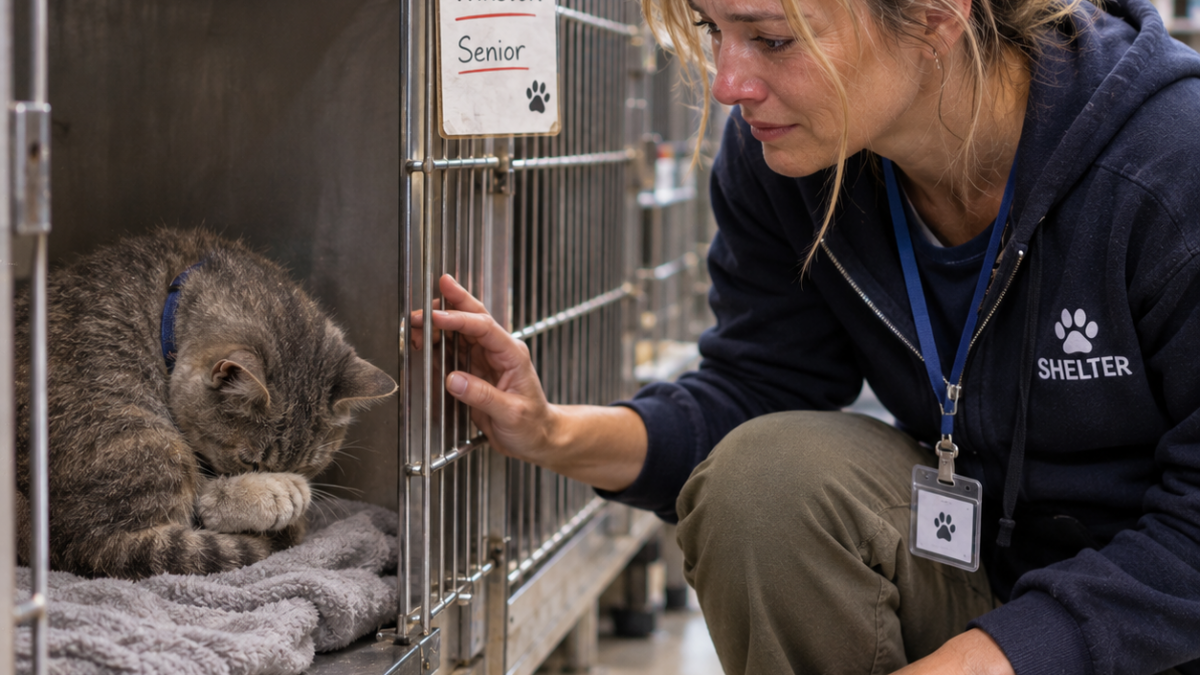
An Old Shelter Cat Stopped Eating the Day His Owner Entered Hospice—Then We Found a Handwritten Note Stitched Inside His Collar
The old gray cat stopped eating the same day we wrote him down as abandoned, but three days later I found a handwritten note stitched inside his collar proving somebody had loved him enough to plan for the goodbye.
What I did not know was that eighty-one-year-old Walter was still alive in hospice, asking every morning whether anyone had found Winston while the people around him assumed the cat had already moved on.
Then I discovered a phone number hidden in the intake paperwork, and when Winston heard Walter’s voice again, the old cat did something that forced an entire hospice facility to answer a question none of us wanted to face: why do we make dying people surrender the one soul still holding them here?
The first clue was a phone number written in faded pencil on the back of a veterinary invoice.
I found it at 2:17 that afternoon.
By then I had already spent most of the day thinking about Walter.
About the note.
About the sentence I could not get out of my head.
I am not leaving him because I want to.
I am leaving him because I ran out of time.
My name is Rachel Monroe.
I was forty-three years old then and had worked at the shelter for eleven years.
Long enough to understand that the word abandoned could cover a thousand different stories.
Some animals were truly dumped.
Thrown from cars.
Left tied to fences.
Carriers placed behind dumpsters.
Boxes abandoned outside locked shelter doors.
Others came through circumstances that looked cruel from the outside and turned complicated once you knew more.
Eviction.
Hospitalization.
Domestic violence.
Military deployment.
Death.
Poverty.
Sometimes people surrendered animals they loved because love did not magically create money, housing, health, or time.
You learn not to judge too quickly.
At least, you try.
Winston had tested that rule.
He arrived on a Tuesday morning in a faded plastic carrier outside St. Matthew’s Church.
Someone had set the carrier beside a stone planter before sunrise.
The church secretary found him at 7:10.
No person nearby.
No note visible.
Only an old blue collar and one gray tabby cat pressed into the rear corner of the carrier.
She called us.
Our animal-control officer picked him up.
At intake we scanned for a microchip.
Nothing.
No tag.
No phone number.
No identification.
He was thin.
Arthritic.
Dehydrated.
Probably seventeen or eighteen.
Kidney values not good.
Blood pressure high.
Dental disease.
Nothing immediately fatal.
But he had shut down.
That was the real problem.
We could treat kidneys.
We could treat dehydration.
We could manage pain.
We could not force a grieving animal to care whether morning came.
For two days Winston refused food.
Then almost all water.
PART2:
He did not hide in the way frightened cats hide.
He simply turned toward the kennel wall.
Face against it.
One paw over his nose.
If the front door opened, he looked.
Every time.
Then disappointment.
Back to the wall.
By Thursday morning I had begun carrying him in my thoughts even when I was home.
I hated that.
Shelter work requires boundaries.
You cannot bring every animal home emotionally even if you leave them physically at work.
If you do, eventually there is no part of you left that is not a kennel.
But Winston got through.
Maybe because he was old.
Maybe because he did not fight.
Maybe because the entire shape of him looked like waiting.
That Thursday I examined his collar again.
Old blue nylon.
Hand stitching beneath the inner seam.
Crooked.
Thick thread.
Not factory work.
I opened several stitches with a seam ripper.
The paper slipped out.
Walter’s note.
PART3:
I read it once.
Then again.
Then a third time because the first two times I was crying too hard.
My name is Walter. I am 81 years old.
If you are reading this, it means my cat has been found.
His name is Winston.
He has slept beside me every night since my wife passed six years ago.
I am going into hospice care today, and I was told I cannot bring him.
I do not have children.
I do not have family close by.
I only have him.
Please do not think he is unfriendly.
He is grieving.
If you can, say his name softly before you touch him.
He always trusted my voice first.
Please love him enough to help him forgive me.
I am not leaving him because I want to.
I am leaving him because I ran out of time.
I sat beside the kennel and read the entire thing aloud.
Winston came out.
Pressed his paws against my knee.
Climbed into my lap.
Trembled.
Did not purr.
That weekend I brought him home as a foster.
Temporary.
That was what I called it.
Shelter people are extremely talented at lying to themselves with professional vocabulary.
Foster.
Temporary placement.
Behavioral decompression.
Trial period.
Sometimes those terms mean:
This animal is already sleeping in my bed and I am afraid to admit what comes next.
The first week, Winston lived mostly near my back door.
He ate only after dark.
Drank if I moved the water bowl beside the armchair.
I said his name before touching him.
Always.
“Winston.”
Then hand.
Never hand first.
The first time I forgot, he startled so badly he fell against the wall.
After that I remembered.
Every night I told him:
“You’re safe.”
I did not know whether he believed me.
One rainy Tuesday, around two in the morning, I woke to find him stretched across my feet.
Not curled tight.
Not guarding himself.
Asleep.
Deeply.
That was the first moment I believed he might survive his grief.
Then I started thinking about Walter.
Where was he?
Was he still alive?
Had anyone told him Winston was safe?
Did hospice know about the cat?
Had somebody tried?
The note gave us a name.
That should have made finding him simple.
It did not.
Walter had written no last name.
No city.
No phone number.
Nothing else.
We searched recent obituaries.
Hospice listings were not public in a useful way.
I called St. Matthew’s Church.
Nobody knew a Walter fitting the description.
We posted quietly in neighborhood groups without sharing the private contents of the note.
No result.
Then Friday afternoon, while reorganizing Winston’s intake envelope, I found the veterinary invoice.
It had been folded beneath the bottom liner of his carrier.
We had overlooked it because it looked like trash.
Mountain View Animal Clinic.
Patient:
Winston.
Owner:
Walter Ames.
Address partly smudged.
The phone number on the printed invoice had been crossed out.
On the back, somebody had written another number in pencil.
And beneath it:
ELEANOR — HOSPICE RN.
My pulse jumped.
I called.
A woman answered on the fifth ring.
“Grace Valley Hospice.”
I nearly dropped the phone.
“My name is Rachel Monroe. I work with the county animal shelter.”
Pause.
“Yes?”
“I’m calling about Walter Ames.”
Silence.
Then:
“Are you family?”
“No.”
“What is this regarding?”
“His cat.”
The woman stopped breathing for half a second.
I knew immediately.
“You found Winston?”
That was the first thing she said.
Not:
What cat?
Not:
Who?
You found Winston?
“Yes.”
“Oh my God.”
Her voice cracked.
“Is he alive?”
“Yes.”
“Is he okay?”
“He’s stable now.”
“Hold on.”
I heard the receiver move.
Footsteps.
A door.
Then the woman came back.
“My name is Eleanor Pierce. I’m one of Walter’s hospice nurses.”
“I found your number on his veterinary paperwork.”
“He gave that clinic my number the week he was admitted.”
“He’s alive?”
“Yes.”
The room seemed to tilt.
For some reason, after reading the note, part of me had already turned Walter into a dead man.
Maybe because that made the story easier.
Owner dies.
Cat grieves.
Rescue.
Adoption.
Sad but clean.
Real life had no interest in clean.
“How is he?”
Eleanor paused.
“Declining.”
“How much?”
“I can’t discuss medical details without authorization.”
“I understand.”
“But yes, he is still here.”
“And he’s been asking about Winston?”
“Every day.”
I closed my eyes.
“Every day?”
“Every single morning.”
Something inside me became angry.
Not at Eleanor.
Not yet at anyone specific.
Just at the fact that two living beings were grieving each other within the same county because a system had decided they could not share a room.
“Does he know Winston was left at the church?”
“No.”
“What does he think happened?”
Another pause.
Eleanor’s voice lowered.
“He believes a volunteer found him a temporary home.”
“Who told him that?”
“He arranged something through a social worker before admission.”
“What arrangement?”
“I don’t know all the details.”
“Can I speak to him?”
“I need his consent.”
“Please ask.”
“I will.”
“When?”
“Now.”
I gripped the phone.
“Now?”
“Rachel, Walter has asked me for three weeks to find out whether Winston is safe.”
Her voice softened.
“If you are telling me that cat is sitting somewhere alive, I am not making him wait until tomorrow.”
I sat down.
Across the office, my coworker Melanie looked at me.
I held up one finger.
Wait.
I could hear Eleanor walking.
A hallway.
A cart.
Distant voices.
Then a door opening.
“Walter?”
A man’s voice, weak.
“Yes?”
“There’s someone on the phone.”
“I don’t want—”
“It’s about Winston.”
Silence.
Not ordinary silence.
The kind where an entire room changes shape.
Then:
“Give it.”
Eleanor came back.
“I’m putting you on speaker.”
My mouth went dry.
“Mr. Ames?”
“Yes?”
His voice was thin.
Older than eighty-one.
But alert.
“My name is Rachel.”
“Where is he?”
No hello.
No explanation.
“Winston is safe.”
I heard a breath.
Then another.
“Where?”
“With me right now.”
Technically he was at my house.
I was at the shelter.
But I did not correct that distinction.
“Is he hurt?”
“He was dehydrated and not eating when he came in.”
Walter made a small sound.
“God.”
“But he’s eating now.”
“How much?”
The specificity startled me.
“What?”
“How much is he eating?”
“About half his normal portion.”
“Wet food?”
“Yes.”
“He likes it warmed.”
I swallowed.
“I know now.”
Silence.
Then:
“Does he still paw the water?”
“Yes.”
Walter laughed.
Barely.
“That fool.”
Then his voice broke.
“I told them.”
“Told who?”
“That he needs the shallow bowl.”
He coughed.
Eleanor said something I couldn’t hear.
Walter continued.
“Will you do something?”
“Anything I can.”
“Say his name.”
“I do.”
“No.”
“Now.”
I looked around.
Winston was not at the shelter.
He was home.
“I’m not with him at this second.”
Walter went quiet.
“He’s at my house.”
“Your house?”
“Yes.”
“Why?”
“I’m fostering him.”
“For how long?”
I did not know how to answer.
Walter saved me.
“Can I hear him?”
My throat tightened.
“I can bring him here.”
Melanie was already looking at me.
I mouthed:
I’m leaving.
Walter said:
“Please.”
That word was enough.
I drove home too fast.
Not recklessly.
Close.
I kept Walter on the phone through the car speakers for the first ten minutes.
Then Eleanor said he needed rest.
I promised I would call as soon as I got Winston.
Twenty-two minutes later I opened my front door.
“Winston?”
He appeared from the hallway.
Slowly.
Tail low.
He had begun recognizing my arrival routine.
Keys.
Door.
My voice.
He walked toward me.
I sat on the floor.
“You’re about to have a strange afternoon.”
Winston blinked.
I brought my phone out.
Called Grace Valley.
Eleanor answered.
“He’s awake.”
“Put Walter on.”
I set the phone on speaker.
Winston sat three feet away.
Walter’s voice came through.
“Ollie?”
Winston froze.
Every hair along his back shifted.
His head snapped toward the phone.
Walter said:
“Winston.”
The cat moved.
Not slowly.
For an old arthritic cat, he moved shockingly fast.
He came to the phone.
Sniffed it.
Then made a sound.
I had never heard it.
A deep broken cry.
Not meowing.
Not yowling.
Grief with a voice.
Walter began crying on the other end.
“Oh, buddy.”
Winston pressed his face against my phone.
“Hey, Win.”
The cat pawed at the screen.
Walter laughed and sobbed at the same time.
“I’m here.”
Winston cried again.
I was sitting on my kitchen floor with both hands over my mouth.
Walter spoke.
“I’m sorry.”
Winston rubbed his face against the phone.
“I’m sorry I left.”
Another cry.
“I didn’t know what else to do.”
That was when something inside me broke open.
Because Winston had spent three weeks believing Walter disappeared.
And Walter had spent three weeks believing Winston was somewhere safe but confused.
Both were wrong.
Both were grieving the same separation.
Neither had chosen it.
After ten minutes, Eleanor said Walter was tiring.
He whispered:
“Goodnight, Win.”
Winston kept staring at the phone.
Then Walter said the sentence that changed everything.
“You still sleep on my side if somebody lets you.”
The line went quiet.
Winston sat beside the phone for twelve minutes.
He would not move.
That night he barely ate.
But he slept beside my pillow.
Not my feet.
Beside my face.
I spent most of the night awake.
Angry.
The question would not leave me alone.
Why had this been necessary?
Walter had been in hospice three weeks.
Winston had nearly starved himself from grief.
They were both alive.
They were less than thirty miles apart.
Why were they separated as though love became irrelevant the moment a person entered end-of-life care?
The next morning I called Eleanor.
“What are your pet policies?”
She sighed.
“I knew this was coming.”
“Good.”
“Rachel—”
“No.”
“I’m not blaming you personally.”
“But someone decided no.”
“Our facility does not allow resident-owned animals.”
“Why?”
“Health regulations.”
“Which ones?”
“Facility policy.”
“That is not a regulation.”
Silence.
“Correct.”
“Then why?”
“Allergies.”
“Private room.”
“Liability.”
“He’s a cat.”
“Cats scratch.”
“Winston barely moves.”
“Rachel.”
“Infection control?”
“Yes.”
“There are therapy animals.”
“Certified therapy animals.”
“So animals are allowed when they belong to the program but not when they belong to dying people?”
“That is not how I would phrase it.”
“It is exactly what happened.”
Eleanor became quiet.
Then:
“You think I don’t agree with you?”
That stopped me.
She continued.
“I asked.”
“You did?”
“Twice.”
“And?”
“Administration denied it.”
“Why didn’t Walter know?”
“He knew.”
“He thought you were finding a foster.”
“I was.”
“What happened?”
“The volunteer backed out.”
“When?”
“The morning Walter was admitted.”
My anger shifted.
“Then how did Winston get to the church?”
Eleanor’s voice changed.
“I don’t know.”
That mattered.
“Walter’s note says he was told he couldn’t bring Winston.”
“Yes.”
“He stitched it into the collar.”
“Yes.”
“Who took Winston from his house?”
“A discharge coordinator.”
“Name?”
“I can’t give you that.”
“Was it someone from hospice?”
“No.”
“Hospital?”
“I believe so.”
“Did they abandon him at the church?”
“I don’t know.”
Now we had another problem.
Walter had believed Winston would go to a temporary foster.
Somewhere between that plan and our intake desk, the cat ended up in a carrier outside a church.
Not surrendered properly.
Not transferred to rescue.
Abandoned.
I told Melanie.
She stared.
“That’s reportable.”
“Yes.”
We reopened Winston’s intake as possible unlawful abandonment.
Our director, Karen Holt, contacted county animal control.
The veterinary invoice became evidence.
The church secretary gave the exact time the carrier was found.
St. Matthew’s had one exterior camera.
Bad angle.
But something.
At 6:41 a.m. that Tuesday, a white SUV entered the parking lot.
Stopped near the planter.
A woman stepped out.
Carried a plastic animal carrier.
Set it down.
Waited.
Looked around.
Returned to the SUV.
Drove away.
No readable plate.
No face.
But the vehicle had a hospital parking decal in the windshield.
County investigators contacted the hospital Walter had been discharged from.
That took three days.
Meanwhile I kept bringing Winston’s voice to Walter.
Phone calls.
Video.
Walter could barely see the screen some days.
Did not matter.
He recognized Winston’s sounds.
Winston recognized him immediately.
Every call changed the cat.
Before Walter’s voice, Winston had been slowly adapting to me.
After, he became unsettled.
He waited by the front door more.
Paced.
Looked at my phone when it rang.
One evening, Walter was too weak to talk.
Eleanor simply placed the phone near him.
Winston sat beside my screen.
Walter breathed.
That was enough.
Then Saturday afternoon, Eleanor called me.
“He wants to see him.”
“I know.”
“I mean in person.”
My heart jumped.
“Can we?”
“Administration still says no overnight.”
“I’m not asking overnight.”
“I convinced the medical director to approve a supervised visit in the courtyard.”
“When?”
“Tomorrow.”
I had never packed a cat carrier more carefully.
Blanket.
Water.
Medication.
Towel.
Walter’s note inside Winston’s collar.
I almost removed it.
Then decided no.
It belonged with him.
Grace Valley Hospice sat on the edge of a wooded property outside town.
Low brick building.
Gardens.
Covered courtyard.
It looked peaceful.
That irritated me.
Buildings can be beautiful and still contain stupid rules.
Eleanor met me at the entrance.
Tall woman.
Sixty maybe.
Short silver hair.
Kind face.
She crouched beside the carrier.
“Hi, Winston.”
His ears moved.
“You know me from the phone?”
Nothing.
“Fair.”
We went to the courtyard.
Walter was already there.
Wheelchair.
Blanket across his lap.
Oxygen line.
Thin hands.
He looked much older than the voice.
Cancer.
I later learned.
Pancreatic.
Metastatic.
He had known for months.
Declined aggressive treatment.
Wanted comfort.
Wanted home.
Then pain became unmanageable.
Hospice facility.
Temporary, he had thought.
Until he weakened too fast.
Walter saw the carrier.
His entire face changed.
I put it on the ground.
Opened it.
Winston did not immediately come out.
Walter whispered:
“Ollie.”
The cat emerged.
Slowly.
Saw him.
Stopped.
Then crossed the concrete.
Walter leaned forward.
Winston climbed onto his slipper.
Then his shin.
Could not reach his lap.
I lifted him.
The second Winston touched Walter’s chest, both of them collapsed into each other.
That is the only way to describe it.
Walter wrapped both arms around him.
Winston pushed his face beneath Walter’s chin.
The cat began purring.
Not the rusty little sound I knew.
Loud.
Continuous.
Walter cried into his fur.
“I’m sorry.”
Winston kneaded the blanket with stiff paws.
“I thought they had you.”
I looked at Eleanor.
She was crying too.
Walter whispered:
“I tried.”
Winston pressed closer.
“I tried.”
I stepped away.
Their first twenty minutes belonged to them.
No staff.
No questions.
No photographs.
Just an old man and an old cat.
Eventually Walter looked toward me.
“You’re Rachel?”
“Yes.”
“Come.”
I sat.
He kept one hand on Winston.
“You found the note.”
“Yes.”
“Bad stitching?”
I laughed.
“Terrible.”
“My wife did the sewing.”
“That explains why you shouldn’t.”
He smiled.
“Mary died six years ago.”
“I know.”
“From the note.”
“Yes.”
“She found Winston.”
“I thought you did.”
“No.”
He looked down at the cat.
“Winter storm.”
“He was under our porch.”
“Half frozen.”
“Mary fed him.”
“I said no cat.”
Eleanor laughed.
Walter pointed weakly.
“You can tell how that went.”
Winston purred.
Walter continued.
“After Mary died, he slept where she did.”
“Right side?”
Walter looked surprised.
“Yes.”
“He sleeps there at my house.”
His eyes filled.
“Good.”
That word contained everything.
Not jealousy.
Not loss.
Good.
I asked:
“Walter, who took Winston from your house?”
His face changed.
“A hospital coordinator.”
“Name?”
“I don’t remember.”
“Man or woman?”
“Woman.”
“Did she tell you where he was going?”
“She said volunteer.”
“Did you see the volunteer?”
“No.”
“Did you know Winston was left at St. Matthew’s?”
He froze.
“What?”
I immediately regretted saying it so directly.
Walter’s eyes moved to Eleanor.
“What church?”
“Walter—”
“What church?”
Eleanor said gently:
“St. Matthew’s.”
His face drained.
“They left him outside?”
“We don’t know exactly who—”
“Outside?”
I nodded.
“In a carrier.”
“How long?”
“We believe less than an hour before he was found.”
Walter closed his eyes.
Winston lifted his head.
The old man’s breathing changed.
Eleanor stood.
“Walter.”
He shook his head.
“I’m fine.”
“You’re not.”
“Neither was he.”
That sentence silenced us.
Walter held Winston tighter.
“I paid.”
“What?”
“For placement.”
I leaned forward.
“Paid who?”
“The hospital.”
Eleanor looked at me.
Walter continued.
“Discharge office told me they had a partner program.”
“How much?”
“Five hundred dollars.”
That was not a small detail.
The county investigator returned Monday.
The hospital had no legitimate five-hundred-dollar pet placement program.
There was, however, a patient-support coordinator named Denise Crawford.
Fifty-six.
Worked in discharge services.
She handled complicated transitions.
Hospital-to-hospice.
Home care.
Transportation.
Pet issues sometimes.
She owned the white SUV.
The church camera vehicle matched.
When questioned, Denise denied abandoning Winston.
At first.
Then investigators found something worse.
Walter was not the first patient.
Over eighteen months, six elderly patients entering long-term care or hospice had paid Denise personally to arrange temporary pet placement.
She told them she worked with private fosters.
Sometimes she did.
Sometimes she did not.
Two dogs had been surrendered to shelters.
One cat went to a rescue.
Another animal was placed with a neighbor.
Winston had no available foster the morning Walter transferred.
Instead of returning the money and admitting failure, Denise left him at the church.
Why the church?
She said she believed someone would find him.
That was her defense.
Someone would find him.
She had attached no note.
No explanation.
No medical information.
Walter’s hidden collar note had saved Winston’s identity.
When the hospital confronted Denise, she argued she had been trying to solve problems the system ignored.
That part was not entirely false.
The hospital had no formal program for patients’ pets.
Social workers were overwhelmed.
Families failed to help.
Shelters were full.
Denise began arranging care informally.
Then she started taking money.
Then convenience became easier than honesty.
Somewhere along the way, the animals stopped being lives and became tasks to clear before discharge.
The hospital suspended her.
Then fired her.
County prosecutors reviewed the case.
Walter’s five hundred dollars was returned.
Other families were contacted.
Three had believed their pets were in carefully chosen foster homes.
They learned the truth months later.
The local news got hold of it.
That was when everything exploded.
The headline was not kind.
HOSPITAL COORDINATOR ACCUSED OF DUMPING DYING PATIENTS’ PETS.
People were furious.
Some wanted criminal charges far beyond what the law realistically supported.
Others defended Denise.
“She was doing what nobody else would.”
“She tried.”
“Shelters are full.”
“Families should take responsibility.”
All partially true.
None erased the carriers.
None erased Winston facing a kennel wall.
Walter saw one television report.
Eleanor turned it off.
He asked:
“Are they saying my name?”
“No.”
“Good.”
“Why?”
“I don’t want to be the dying man with the cat.”
“You are a dying man with a cat.”
Walter smiled.
“You know what I mean.”
He did not want his last weeks becoming content.
He did not want Winston turned into a symbol before being allowed to remain a cat.
I understood.
So when reporters called the shelter, we protected his privacy.
No video of Walter.
No photographs.
No interviews.
The story became public in general terms.
But not his face.
Not his room.
Not his final days.
What happened next mattered more anyway.
The hospice policy changed.
Not overnight.
Not because administrators suddenly grew hearts.
Policies involve insurance.
Infection control.
Legal review.
Board approval.
Facilities.
But outrage forced discussion.
Eleanor became relentless.
So did the hospice medical director, Dr. Sarah Nguyen.
They proposed a pilot program.
Resident-owned pets permitted under specific conditions.
Private room.
Veterinary records.
Vaccinations.
Behavior assessment.
Designated backup caregiver.
Written care plan.
No animal burden placed on clinical staff.
Families or volunteers responsible for food and litter.
Medical clearance for the resident.
The administrator resisted.
“What happens when a patient dies?”
Eleanor said:
“The same thing that already happens.”
“Someone has to care for what they leave behind.”
“What if the animal becomes disruptive?”
“We assess it.”
“Allergies?”
“Designated wing.”
“Sanitation?”
“Protocols.”
“Liability?”
“Insurance review.”
The administrator sighed.
“You’ve prepared for every objection.”
“No.”
Eleanor looked toward Walter’s room.
“I’ve listened to every objection for three weeks.”
Walter was the first applicant.
Winston underwent a behavior assessment.
He passed by doing almost nothing.
The veterinarian confirmed vaccines.
Kidney condition.
Arthritis.
No infectious disease.
I signed as backup caregiver.
That mattered.
If Walter became too ill to manage Winston, I would take him.
If Walter died, Winston came home with me.
Everything written.
Everything clear.
No church parking lots.
No mystery fosters.
The day Winston moved into Walter’s hospice room, I packed his things.
Old blue collar.
Medication.
Shallow water bowl.
Prescription food.
Blanket from my house.
I cried while packing.
That surprised me.
I had spent weeks fighting to reunite them.
Then reunion became real.
And suddenly my house would be quiet again.
I hated myself for feeling sad.
Walter noticed immediately when I arrived.
“You look miserable.”
“I’m thrilled.”
“You’re a terrible liar.”
“So I’ve been told.”
Winston walked around the room.
Bed.
Chair.
Window.
Then jumped onto Walter’s mattress using a small pet step we had brought.
Curled on the right side.
Walter closed his eyes.
“Home.”
I stood by the door.
There it was again.
Jealousy.
Smaller now.
But real.
Walter opened one eye.
“Rachel.”
“What?”
“He can love two houses.”
My throat tightened.
“I know.”
“No, you don’t.”
I looked at him.
Walter stroked Winston.
“Mary thought love was a room.”
“She used to say every time you put somebody new inside, the walls move.”
I laughed.
“That sounds suspiciously poetic for someone married to a man who stitched a note into a cat collar like a drunk sailor.”
Walter smiled.
“She was the poet.”
Over the next month, I visited every evening after work.
Sometimes Winston ran toward me.
Sometimes he stayed on Walter’s bed.
Both became okay.
Walter taught me Winston’s history.
He was not originally a Winston.
Mary named him Churchhill for approximately two days because she thought gray cats looked British.
Walter refused to yell “Churchhill” across the house.
So Winston.
Winston loved peas.
Not normal.
Stole butter.
Hated thunder.
Once fell asleep inside a laundry basket and was accidentally covered by towels.
Walter told stories slowly.
Breath shorter.
Pain medication stronger.
Some evenings he forgot where a story began.
I never corrected him.
Winston listened.
Or slept.
Same thing.
One night Walter asked:
“Do you have people?”
I knew what he meant.
“Some.”
“Children?”
“No.”
“Husband?”
“No.”
“Divorced?”
“Never married.”
Walter raised his eyebrows.
“What?”
“You interviewing me?”
“Dying gives you permission to be rude.”
“That is not a rule.”
“Should be.”
I laughed.
He asked:
“You lonely?”
There it was.
I looked at Winston.
“Sometimes.”
“More before him?”
“Yes.”
Walter nodded.
“Mary died.”
“I thought I’d like silence.”
“For about two weeks.”
“Then?”
“House sounded wrong.”
I understood exactly.
Walter said:
“Winston made noise without asking questions.”
“That’s useful.”
“People ask how you are.”
“Cats ask for food.”
“Much better.”
Then his face became serious.
“Take him when it’s time.”
I looked away.
“Don’t.”
“We need to.”
“No.”
“Rachel.”
“You’re not dying tonight.”
“No.”
“Then we don’t need to discuss it tonight.”
Walter stared at me.
“You think delaying unpleasant things makes them smaller?”
“Yes.”
“Does it work?”
“No.”
“Then sit down.”
I did.
Walter had already made a plan.
Winston would come to me permanently.
His remaining veterinary expenses were covered through a small account managed by his attorney.
His blue collar stayed with him.
Mary’s photograph.
One knitted blanket.
Walter’s old cardigan if I wanted it.
“Why the cardigan?”
“He sleeps on it.”
“Of course.”
Walter looked at me.
“And my voice.”
I frowned.
He pointed to his phone.
Eleanor had helped him record messages.
Dozens.
“Winston.”
“Breakfast.”
“Come here.”
“You’re okay.”
“Goodnight, buddy.”
“I’m here.”
My eyes filled.
Walter said:
“For when he waits.”
I could not speak.
“I don’t know if it’ll help.”
“It will destroy me.”
“That too.”
“Thank you.”
The final week came quietly.
Walter stopped walking.
Then stopped sitting in the chair.
Then stopped eating much.
Winston changed with him.
He left the bed only for food and litter.
Sometimes I arrived and found the cat stretched against Walter’s ribs.
Exactly the way he had apparently slept beside Mary during her final illness.
Animals do not understand prognosis.
They understand bodies.
Smells.
Routine.
Change.
Winston knew something.
On Tuesday evening, Walter was barely awake.
I sat by the bed.
Winston between us.
Walter opened his eyes.
“Rachel?”
“I’m here.”
“Where’s he?”
I touched Winston.
“Right here.”
Walter moved his fingers.
The cat pushed his head beneath them.
“Good.”
Long silence.
Then:
“Don’t let him think…”
His voice faded.
“What?”
Walter tried again.
“Don’t let him think I left.”
I started crying.
“You didn’t.”
“He won’t know.”
“I’ll tell him.”
Walter looked at me.
“Soft.”
I nodded.
“Always soft.”
He closed his eyes.
Walter died at 4:12 the next morning.
Eleanor called me at 4:19.
I was dressed by 4:24.
At Grace Valley by 4:51.
They had not moved him yet.
That mattered.
Eleanor met me outside the room.
“Winston won’t leave the bed.”
“Let him stay.”
“We are.”
I went in.
Walter looked peaceful.
That phrase sounds empty until you see someone who truly is.
No tension.
No pain.
Hands still.
Winston sat beside his chest.
Facing his face.
I walked closer.
“Winston.”
His ears moved.
I sat on the bed.
He looked at me.
I said it softly.
“Walter died.”
I knew he could not understand the words.
I said them anyway.
“He didn’t leave you.”
Winston stared at Walter.
“He ran out of time.”
My voice broke on the line from the note.
“He loved you.”
Winston moved.
Pressed his nose to Walter’s hand.
Waited.
Nothing.
Then lay down beside him.
We gave him twenty minutes.
Maybe thirty.
Nobody rushed.
The funeral home arrived.
When they lifted Walter, Winston stood.
Watched.
I held him.
He trembled.
Exactly as he had in my lap the first time.
I whispered:
“I’ve got you.”
This time he purred.
Barely.
But he did.
When I carried Winston through the hospice lobby, every staff member knew.
Some cried.
The administrator who had originally refused the pet program stood near reception.
She touched Winston’s back.
Then said:
“I’m sorry.”
I did not know whether she meant Walter.
Winston.
The policy.
All of it.
I said:
“Keep the program.”
She nodded.
“We are.”
That was Walter’s legacy, though he would have hated anyone calling it that.
Within a year, Grace Valley had accommodated nine resident pets.
A little white dog named Sophie.
Two bonded cats.
One ancient beagle.
A cockatiel that created more policy meetings than all other animals combined.
Not everyone could bring a pet.
Some circumstances made it impossible.
But “no” stopped being automatic.
That mattered.
The hospital also created a formal emergency pet-transition program after Denise’s case.
No cash.
No informal arrangements.
Verified rescue partners.
Documented transfers.
Family notification.
Written owner consent.
Nobody’s cat got left at a church because somebody did not want to admit a foster fell through.
Denise eventually pleaded guilty to misdemeanor animal-abandonment and financial misconduct charges related to several cases.
She lost her job.
Paid restitution.
Received probation.
People online wanted prison.
Walter, before he died, had told Eleanor something different.
“I don’t need her destroyed.”
“Then what do you want?”
“I want the next person to have nowhere to hide the mistake.”
That is what accountability looked like to him.
Not revenge.
A system where dishonesty became harder.
Winston came home with me.
Permanently.
The first night, he paced.
Door.
Window.
Hallway.
My phone.
Door again.
I knew what he wanted.
Walter.
At 9:15, I played the first recording.
“Winston.”
The cat froze.
Walter’s voice.
“Come here, buddy.”
Winston walked toward the phone.
He sniffed.
Then looked around.
My heart cracked.
I almost stopped.
Then another recording.
“You’re okay.”
Winston sat.
Another.
“Goodnight, buddy.”
He lay down.
I cried silently beside him.
We used Walter’s recordings rarely after that.
Not because they hurt.
Because Winston stopped needing them every day.
Once a week.
Then once a month.
Eventually only during thunderstorms.
Walter’s voice would say:
“You’re okay.”
Winston would settle.
Maybe it was scent memory without scent.
Maybe tone.
Maybe repetition.
Maybe love stored in sound.
I stopped trying to explain everything.
Winston lived another two years.
He made it to somewhere around nineteen.
Maybe twenty.
His kidneys worsened.
Arthritis slowed him.
Vision clouded.
He still followed me into the kitchen.
Still slept at my feet.
Then gradually moved closer.
By his final year, he slept beside my ribs.
One evening I realized it was the exact place he had slept beside Walter.
Maybe Mary too.
Same side of every life.
The side closest to a heartbeat.
I framed Walter’s note.
Not publicly.
No social-media story.
No inspirational poster.
It hung beside my desk.
Sometimes new shelter employees asked about it.
I told them.
Not all at once.
The important pieces.
An old man.
An old cat.
A bad policy.
A worse shortcut.
A hidden note.
A phone call.
And what happened when people decided the bond between human and animal mattered even at the end of life.
The shelter changed too.
Every senior surrender now received more questions.
Not interrogation.
Context.
Is the owner hospitalized?
Hospice?
Can we coordinate temporary care?
Is there a family member who thinks surrender is the only option but has not explored assistance?
Can veterinary costs be covered?
Can the pet visit?
What does the animal’s person want us to know?
We still took surrendered animals.
Sometimes surrender truly was the only safe option.
But we stopped assuming separation was inevitable just because somebody became old, sick, or inconvenient to a system.
I became insufferable about collars.
Every collar gets checked.
Tags.
Stitching.
Pockets.
Taped notes.
Everything.
My coworkers tease me.
“You expecting another secret will?”
“Maybe.”
“You know normal people just use ID tags.”
“Walter was not normal.”
True.
Three years after his death, Grace Valley invited me to a small event.
Not a fundraiser.
Staff training.
They were naming their pet-support initiative.
They wanted permission to call it the Ames Companion Program.
I almost said no.
Walter hated attention.
Then Eleanor showed me the proposal.
It did not use his photograph.
No sentimental biography.
Just one sentence.
Created in honor of a resident whose final wish was to remain connected to the animal who had shared his home and grief.
I agreed.
Then added:
“And Winston.”
Eleanor smiled.
“Ames-Winston?”
“No.”
“That sounds like a law firm.”
We laughed.
They called it Stay Together.
Walter would have liked that better.
Winston’s final morning came in February.
Snow.
Quiet.
He had stopped eating the night before.
I knew.
Shelter workers always know too early.
That is one of the curses.
You see the signs.
You bargain anyway.
I warmed tuna.
Nothing.
Chicken.
Nothing.
Water.
He drank once.
Then went to the armchair.
Walter’s old cardigan was still folded there.
I had brought it home from hospice.
Winston climbed onto it.
Slowly.
Lay down.
I called our veterinarian.
She came to the house.
Before she arrived, I played Walter’s final recording.
Not because Winston was frightened.
Because I was.
The recording began with breathing.
Then Walter’s voice.
“Hey, Win.”
Winston’s ear moved.
“You’re a good boy.”
The cat closed his eyes.
“Rachel’s got you now.”
I had forgotten that line.
I broke.
Completely.
Walter continued.
“So don’t be stubborn.”
A pause.
“You’re okay.”
Another pause.
“I’m here.”
The recording ended.
Winston opened his eyes.
Looked at me.
I said his name.
Soft.
“Winston.”
He leaned into my hand.
The veterinarian gave him the sedative.
His breathing slowed.
I kept one hand on his head.
The other against his side.
He purred.
Rusty.
Weak.
But there.
I whispered:
“You forgave him.”
I don’t know why that mattered so much to me.
Maybe because of Walter’s note.
Please love him enough to help him forgive me.
I wanted to believe we had.
But by then I understood something Walter probably had too.
Winston had never needed to forgive him.
There had been no betrayal between them.
Only separation.
Human rules.
Bad decisions.
Time.
Walter had blamed himself because dying people often apologize for things death is doing to them.
I leaned close.
“He never left you on purpose.”
Winston breathed.
“And you never stopped loving him.”
Another breath.
“So you can rest.”
The veterinarian gave the final medication.
Winston died on Walter’s cardigan.
At home.
With his name spoken softly before the last touch.
I buried Walter’s note with neither of them.
I kept it.
Not because I could not let go.
Because it became part of how I work.
Every time somebody says:
“It’s just a cat.”
Or:
“The patient won’t know.”
Or:
“The animal will adjust.”
Or:
“There’s no policy for that.”
I think about Winston pressing his face into a shelter wall.
I think about Walter asking every morning whether his cat was safe.
I think about the first time the phone speaker carried Walter’s voice across my kitchen floor and Winston cried like something inside him had been waiting three weeks to come back alive.
And I remember that rules designed for efficiency can become cruel when nobody asks what they are actually protecting.
Sometimes the answer is legitimate.
Safety.
Health.
Other residents.
Sometimes the answer is simply:
This is how we have always done it.
That is not good enough.
Not when somebody is dying.
Not when the only living soul who sleeps beside them every night is being treated like furniture that cannot come along.
The saddest part of Winston’s story was not Walter’s death.
Death was honest.
The saddest part was the unnecessary loneliness before it.
Walter thought Winston was safe somewhere else.
Winston thought Walter had disappeared.
Both suffered because people between them chose convenience over truth.
The beautiful part was not that I saved Winston.
I did not.
The beautiful part was that we found each other in time to repair the lie.
Walter heard his cat again.
Then held him again.
Winston slept beside Walter during his final weeks.
Walter died knowing Winston had a home.
Winston lived long enough to trust another person without having to forget the first.
That distinction mattered.
It still does.
People sometimes say animals live in the present.
Maybe.
But anybody who has watched an old dog wait beside a dead owner’s chair or a cat lift his head at a familiar voice knows the present can carry a lot of yesterday inside it.
Winston remembered Walter.
He remembered Mary too, I think, in whatever way cats remember people.
He remembered the right side of the bed.
The cadence of a voice.
The place beside a heartbeat.
He brought those memories into my house.
I did not have to replace them.
That was the mistake I almost made at the beginning.
I thought loving him meant helping him leave Walter behind.
It did not.
Loving him meant making enough room for Walter to stay.
That is why the blue collar never came off until Winston’s last day.
I repaired it when the fabric frayed.
Loosened it as he aged.
Restitched the hidden seam.
Walter’s note remained inside.
Not because Winston could read it.
Because I could.
Whenever I became impatient with his grief, there it was.
Please do not think he is unfriendly.
He is grieving.
Whenever Winston stared too long at the door:
He always trusted my voice first.
Whenever I felt afraid I could not be enough because he had already belonged to somebody else:
Please love him enough to help him forgive me.
And finally:
I am not leaving him because I want to.
I am leaving him because I ran out of time.
For years I believed that last line was the most painful thing Walter wrote.
Now I think it was the most honest.
Everyone runs out of time.
The only question is what we do before it happens.
Walter used his remaining strength to sew a note into a cat collar because he was afraid the world would mistake grief for bad behavior.
I made one phone call because I could not stop wondering who Walter was.
Eleanor challenged a policy.
A medical director challenged an administrator.
Investigators challenged a careless system.
A hospice changed.
A hospital changed.
A shelter changed.
All because one old gray cat stopped eating.
People like dramatic rescues.
Animals pulled from fires.
Floods.
Traffic.
Those stories matter.
But some rescues are quieter.
Sometimes rescue means realizing the animal in front of you is not difficult.
He is waiting.
Sometimes it means finding the person he is waiting for before there is no time left.
Sometimes it means changing a rule that everybody thought was harmless.
Sometimes it means sitting on the floor and saying a name softly.
Winston.
That was all Walter asked.
Say his name before you touch him.
Let him know somebody familiar might still exist in the world.
I did.
And years later, when Winston took his final breath, I said it the same way.
Soft.
Always soft.
Because Walter was right.
Winston had never been cold.
Never broken.
Never ungrateful.
Never difficult.
He was simply carrying a goodbye too large for one small body.
He did not need somebody to teach him how to stop loving Walter.
He needed people willing to help him survive loving Walter after Walter was gone.
There is a difference.
I understand it now.
And every time I walk past the senior-cat kennels at closing, I look at the ones sitting quietly in the back.
Not the loudest.
Not the cutest.
The ones who still turn their heads when the front door opens.
I know what that look can mean.
Sometimes they are not waiting for a home.
They are waiting for the home they already had.
Sometimes no one is coming.
Sometimes somebody still can.
And whenever there is even a chance, I make the call.








