An Old Shelter Cat Stopped Eating After Being “Abandoned”—Then I Found a Note Stitched Inside His Blue Collar From the 81-Year-Old Man Who Had Loved Him for Years
PART3:
He stayed curled in the back of the carrier while I opened the door.
Most abandoned cats resisted being handled. Some flattened themselves. Some bolted. Some became all claws and panic.
Winston simply let me slide one hand beneath his chest and lift him.
He weighed almost nothing.
His bones felt too close to my fingers.
His fur smelled faintly of old house, dust, and something warmer underneath. Not filth. Not neglect exactly. Something like blankets, medicine, and time.
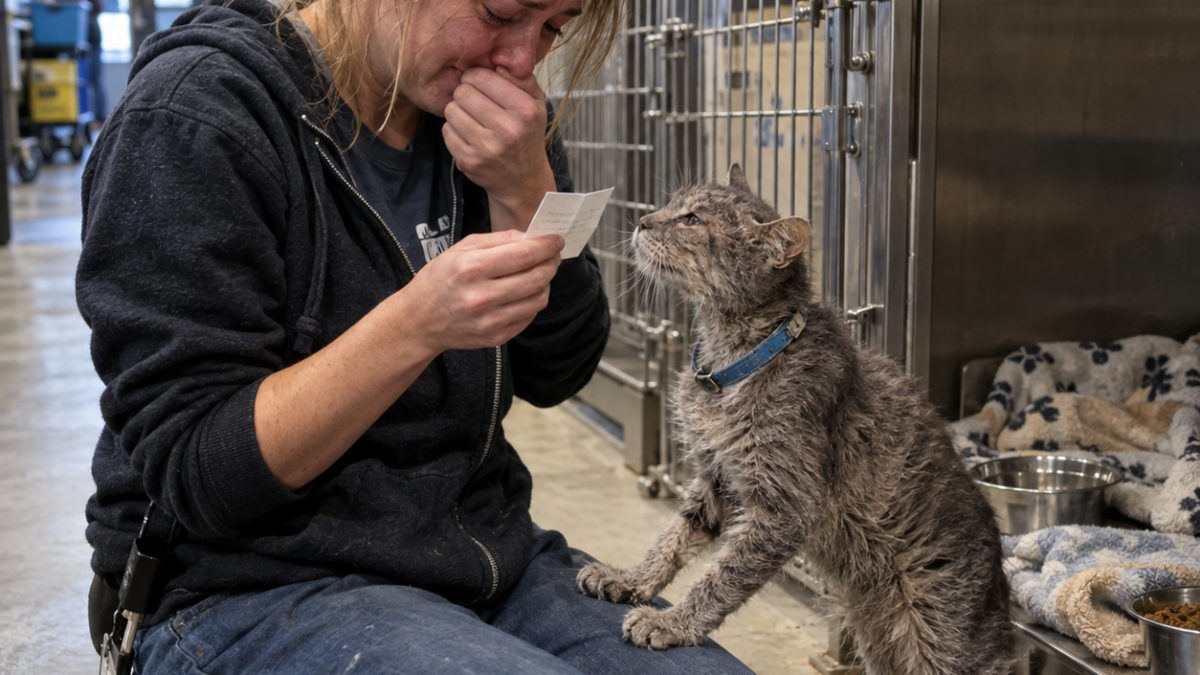
He wore a blue collar.
Old.
Soft from years of use.
The buckle was scratched silver where the blue coating had worn away.
“Somebody loved him once,” Mara said softly.
I hated that she was probably right.
Cruel abandonment has its own smell.
Panic abandonment has another.
This cat did not arrive looking like no one had ever cared.
He arrived looking like care had been interrupted.
We checked him for a chip.
Nothing.
I filled out the intake form while he sat on the scale without moving.
“Need a name,” Mara said.
I looked at him.
His gray face was narrow, his whiskers white, his eyes the color of old glass. He looked dignified in a devastated way.
“Winston,” I said.
Mara wrote it down.
“Winston it is.”
We set him up in isolation at first, not because he showed signs of infection, but because new cats needed observation and because the main cat room was too loud for a senior animal already halfway folded into himself.
I gave him a soft bed.
Wet food.
Water.
A litter box.
A towel over half the kennel so he could hide if he wanted.
He didn’t use the bed.
He didn’t touch the food.
He didn’t drink.
He backed into the rear corner, pressed his face into the wall, covered his nose with one paw, and became almost statue-still.
For the first two days, he refused everything.
Wet food.
Tuna.
Chicken baby food.
Treats.
Water from a bowl.
Water from a syringe.
He didn’t hiss when I reached in.
Didn’t scratch.
Didn’t make a sound.
He only lifted his head when the front door opened.
Every single time.
The shelter door had a specific sound.
A bell, then the suction of weather from outside, then voices.
Every time it happened, Winston’s ears rose.
His eyes sharpened with something so raw it almost hurt to see.
Hope.
That was the worst part.
Hope in an animal who had stopped eating.
For two or three seconds, the old cat came back into his body.
Then he realized the sound did not belong to whoever he was waiting for, and he folded into himself again.
By the third morning, I was carrying Winston around in my chest.
That is the best way I can say it.
He had not done anything dramatic.
He had not reached out.
He had not begged.
But grief has weight even when it makes no sound.
And Winston’s grief had settled somewhere beneath my ribs.
I opened his kennel that morning meaning only to check how much weight he had lost. He felt lighter than the day before. Too light. His old blue collar hung strangely around his neck, loose in some places and tight in others, like someone had adjusted it with shaking hands.
I slipped two fingers under it to check the fit.
That was when I felt the ridge.
At first, I thought the collar was folded.
Then I turned it over.
Inside the blue fabric, along the inner seam, was a line of crooked stitching.
Not factory work.
Not decorative.
Hand stitching.
Uneven.
Desperate.
I sat back on my heels.
“Winston,” I whispered. “What is this?”
He stared at me from the kennel doorway.
I should have waited.
I should have asked Mara to look.
Instead, something in my body already knew that whatever was inside that collar mattered.
I went to the front desk, took the small seam ripper we used for donation blankets, sat down on the floor beside his kennel, and carefully opened three stitches.
Then five.
Then seven.
A folded piece of paper slipped into my palm.
It had been folded so many times it felt soft as cloth at the creases.
For several seconds, I didn’t open it.
I just stared.
Shelter workers find notes all the time.
Cowardly notes.
Angry notes.
Apologetic notes.
Please take care of him.
I’m sorry.
My landlord won’t let me keep her.
He bites but only when scared.
I can’t afford medicine.
Don’t call me.
Sometimes those notes are lies.
Sometimes they are half-truths.
Sometimes they are the last evidence of a person drowning and trying to hand one living thing to shore.
I unfolded the paper.
The handwriting was shaky.
Blue ink.
Large letters, as if written by someone whose hands did not fully obey him anymore.
The note said:
My name is Walter.
I am 81 years old.
If you are reading this, it means my cat has been found.
His name is Winston.
He has slept beside me every night since my wife passed six years ago.
I am going into hospice care today, and I was told I cannot bring him.
I do not have children.
I do not have family close by.
I only have him.
Please do not think he is unfriendly.
He is grieving.
If you can, say his name softly before you touch him.
He always trusted my voice first.
Please love him enough to help him forgive me.
I am not leaving him because I want to.
I am leaving him because I ran out of time.
By the time I finished reading, I was crying so hard I had to lower my head.
The shelter around me kept moving.
Phones rang.
Dogs barked.
A washing machine thumped unevenly.
Someone laughed in the lobby, unaware that I was sitting on the floor with a note that had just split my morning wide open.
Winston watched me from the kennel doorway.
Not moving.
Not asking.
Just watching.
I wiped my face with my sleeve and said, very softly, “Hey, Winston.”
His ears moved.
That was all.
One tiny motion.
But after two days of nothing, it felt like a door cracking open.
I swallowed and tried again.
“Hey, buddy. Walter wanted me to say your name soft.”
I don’t know what I expected.
Maybe nothing.
Maybe I thought grief had carried him too far away.
But Winston stood up.
Slowly.
Like every bone in his body ached.
He stepped out of the kennel one paw at a time and looked straight at me.
Not through me.
At me.
Then he walked forward and put both front paws on my knee.
That was it.
No music.
No miracle.
No sudden purr.
Just one old cat, weak from grief, deciding he had enough strength left to trust one more person because I had spoken the name the right way.
I sat on the floor and read Walter’s note out loud to him.
All of it.
My voice shook the whole way through.
When I got to the line about running out of time, Winston climbed into my lap and pressed his face into my sweater.
He did not purr.
He trembled.
I held him there with one hand against his narrow back and the note in my other hand, and I cried in a way I had not allowed myself to cry at work in years.
Mara found us ten minutes later.
She stopped in the doorway.
“Hannah?”
I looked up.
She saw the note.
Then Winston in my lap.
Then my face.
“Oh no,” she whispered.
I handed her the paper.
She read it standing there beside the kennel, one hand pressed to her mouth.
When she finished, she turned away.
Mara had worked in rescue fifteen years.
She could handle blood, mange, bite wounds, hoarding cases, grief-stricken owners, furious owners, and dogs so afraid they urinated whenever a human looked at them.
But that note made her sit down in the hallway.
“Walter,” she said, like the name had become a person in the room.
I nodded.
“He’s in hospice.”
“And they made him leave his cat.”
“Apparently.”
Mara looked back at Winston.
The old cat still had his face pressed into my sweater.
“Do we know where?”
“No.”
“No last name?”
I shook my head.
“Just Walter.”
“Carrier?”
“No tag except the one we put on.”
“Church?”
“St. Mark’s.”
She closed her eyes.
“God.”
That was the first time I felt anger beneath the sadness.
Not at Walter.
Never at Walter.
At whoever had looked at an eighty-one-year-old man entering hospice, listened to him say he had no children, no nearby family, only this cat, and still decided the bond could be treated like extra luggage.
I knew there were rules.
I knew facilities had policies.
I knew allergies existed.
I knew liability existed.
I knew life was complicated.
I knew all of that.
Knowing it did not make Winston’s shaking body in my lap feel any less obscene.
I brought him home that weekend as a foster.
That was the word I used.
Foster.
Temporary.
Professional.
Responsible.
A word shelter workers use when they are lying to themselves gently.
The first week, Winston barely moved from the rug by my back door.
He ate a little at night when the house was quiet. He drank water only if I set the bowl near the old armchair in my living room. If I put it in the kitchen like a normal cat bowl, he ignored it.
So I left it by the chair.
I learned not to rush him.
Grief has its own clock.
Every evening when I came home, I said his name before I entered the room.
Soft.
Always soft.
“Hey, Winston.”
Sometimes he looked at me.
Sometimes he didn’t.
Every night, I told him he was safe, even when I wasn’t sure he believed me.
“You can stay here as long as you need.”
“You don’t have to eat fast.”
“No one is taking the bowl.”
“You’re not in trouble.”
That last one I said more than I expected.
Maybe because animals understand tone better than language.
Maybe because I needed to hear it too.
I had built a life around being useful.
Work, shelter, animals, crisis, cleaning, intake, paperwork.
People called me strong, which usually meant they had no plans to help.
My apartment was clean but impersonal.
A couch, a table, too many books, a bedroom with laundry I folded late at night while listening to podcasts so I wouldn’t have to hear the silence.
I had been divorced for five years.
No children.
No pets of my own.
That surprises people.
Shelter workers without pets are often treated like bakers who don’t eat bread.
But after my marriage ended, I told myself I gave enough at work.
That was true.
It was also incomplete.
Giving all day to animals who left, died, healed, got adopted, or came back taught me to keep a room inside myself empty.
Winston found that room immediately.
On the fourth night, I woke at 2:00 a.m. to a soft sound.
Click.
Click.
Click.
Nails on hardwood.
I lay still.
The bedroom doorway was half open.
A gray shape stood in the dim hall.
“Winston?” I whispered.
He froze.
I did not move.
He watched me.
Then took one step into the room.
Then another.
He walked like an old man crossing ice.
Slow.
Deliberate.
Ready to retreat if the world changed its mind.
He stopped at the foot of my bed.
I held my breath.
He looked at me for a long time.
Then he jumped.
It was not a graceful jump.
It was more of a careful, painful negotiation with gravity.
His front paws caught the blanket, his back legs scrambled, and I almost reached to help.
Then I remembered Walter’s note.
Say his name softly.
Trust his voice first.
So I whispered, “You’ve got it, Winston.”
He dragged himself up.
Turned once.
Settled at the foot of the bed.
Not curled tight like before.
Stretched out.
Resting.
Trusting the dark again.
I stared at the ceiling for almost an hour after that, afraid to move my feet.
That was the first night Winston slept near me.
Not beside me.
Not yet.
But near.
It felt like being chosen by something wounded enough to make the honor frightening.
The next morning, I called the shelter before my shift.
“Mara.”
“You keeping him?”
“That is not why I’m calling.”
“So yes.”
“Mara.”
“Fine. What?”
“I need to find Walter.”
The phone went quiet.
Then she sighed.
“I knew this was coming.”
“He deserves to know Winston is safe.”
“I agree.”
“And Winston deserves to know he wasn’t thrown away.”
“I agree with that too.”
“So help me.”
Another pause.
“Hannah, you know we can’t just get private information out of thin air.”
“I know.”
“And if he’s in hospice, there are privacy laws.”
“I know.”
“And if we call every hospice facility in the county asking for an elderly Walter with a cat, we’re going to sound insane.”
“Probably.”
“You’re still doing it.”
“Yes.”
She sighed again.
“I’ll check the intake file.”
That afternoon, I returned to the shelter on my day off.
The front desk smelled like paper towels, disinfectant, and old coffee, same as always. Mara had pulled Winston’s intake folder and spread it across the counter.
It contained almost nothing.
The carrier had been found near St. Mark’s Church.
The carrier itself was old but clean.
Inside, there had been a faded towel, a half-empty bag of senior cat food, and a small plastic dish.
No medication list.
No phone number.
No address.
No full name.
But on the carrier tag, nearly rubbed off by rain, someone had written two letters in black marker.
W. H.
I stared at them.
“Walter H,” Mara said.
“It’s something.”
“It’s not much.”
“It’s more than nothing.”
“That is exactly the kind of sentence people say before doing something exhausting.”
I smiled despite myself.
She handed me the file.
“One volunteer remembered the church parking lot.”
“Who?”
“Ben.”
Ben was nineteen and had the chaotic energy of a golden retriever in human form. He had been unloading donations the morning Winston was found.
I found him in the laundry room, wrestling a fitted sheet like it had personally offended him.
“Ben.”
He looked up.
“If this is about the dryer, it was making that noise before I touched it.”
“It’s about Winston.”
His face changed.
“The sad gray guy?”
“Yes. Do you remember anything from the church pickup?”
He dropped the sheet.
“Kind of.”
“Tell me.”
He leaned against the washer, thinking hard.
“There was a carrier by the donation bin. Groundskeeper called. Deputy brought it in. But Martha said she saw a man.”
“Martha?”
“One of the Sunday volunteers. She was at the church dropping blankets off early. She said an old guy in dark pants carried the carrier over, set it down, and walked away fast.”
“Did she talk to him?”
“No.”
“Did she see a car?”
“Maybe. An older sedan? Brown or silver? She wasn’t sure.”
“Anything else?”
Ben frowned.
“She said he sat in the car a while.”
“How long?”
“I don’t know. Long enough that she almost went over, but then a white van pulled in near the office and she got distracted.”
“A white van?”
“Yeah. Like medical transport maybe.”
That was enough to send electricity through me.
I drove to St. Mark’s that afternoon.
The church parking lot was nearly empty. A groundskeeper trimmed hedges near the side wall, his orange extension cord trailing behind him like a snake.
I hated how desperate I sounded the moment I opened my mouth.
“Excuse me. I’m sorry to bother you. Do you remember an elderly man leaving a gray tabby cat in a carrier here a few days ago?”
The groundskeeper turned off the trimmer.
“The cat by the blue bin?”
My heart jumped.
“Yes.”
He pushed his cap back.
“Hard to forget.”
“Why?”
“He sat in his car afterward.”
“Do you remember how long?”
He looked toward the far side of the lot.
“Not five minutes. Not ten. Long enough that I almost went to check on him.”
My throat tightened.
“What was he doing?”
The groundskeeper’s face softened.
“Crying.”
I looked away.
“Not loud,” he added quickly, as if protecting Walter’s dignity. “Not making a scene. Just… bent over. Like somebody folding in half.”
I gripped the strap of my bag.
“Did you hear anything?”
“One thing.”
I looked back.
“He was talking toward the carrier before he got out. I was close enough by the hedges to hear a little.”
“What did he say?”
The man rubbed his jaw.
“Mostly I couldn’t tell. But he said the cat’s name.”
“Winston.”
He nodded.
“Winston.”
The world tilted slightly.
I could see it too clearly.
Walter sitting in that car, trying to say enough in one minute to make up for the rest of his life.
Trying to sound calm for the one creature who had trusted his voice first.
Running out of time anyway.
“Did he leave alone?” I asked.
The groundskeeper shook his head.
“After he walked back to his car, a hospice transport van pulled up maybe twenty minutes later.”
“Hospice?”
“Or care transport. White van. Small logo. Driver went into the church office asking for directions to an address nearby.”
“Do you remember the name?”
“No. But I remember the street because my cousin lives over there.”
He gave it to me.
Maple Lane.
A quiet residential street ten minutes away.
“Thank you,” I said.
The groundskeeper looked toward my car.
“Cat okay?”
That question almost undid me.
“He’s safe.”
“Good.” He nodded. “That old man loved him.”
“I know.”
“No.” His eyes stayed on mine. “I mean he really loved him.”
“I know,” I whispered.
I drove to Maple Lane with both hands tight on the wheel.
It was one of those streets people miss if they aren’t looking for it. Old brick houses set back behind maples, lawns clipped short, porch lights on before dusk, curtains drawn against the rest of the world.
Near the end stood a quiet brick house with a brass sign near the front walkway.
CEDAR HOUSE.
The name told me nothing, which maybe was the point.
Hospice places often try not to announce themselves too loudly.
Inside, the waiting room was warm and too clean.
Fake flowers on a side table.
A lamp trying very hard to make the place feel less final than it was.
A framed watercolor of a field.
Soft instrumental music barely audible from somewhere behind a wall.
A woman at the desk greeted me with the professional gentleness people learn when their whole job happens around endings.
“Can I help you?”
I took the folded copy of Walter’s note from my bag.
“My name is Hannah Price. I foster animals through Maple Ridge Rescue. I’m looking for someone I believe may be a resident here.”
Her face changed just enough to become careful.
“I’m sorry, we can’t confirm resident information without—”
“I understand. I really do. But I found a note inside a cat’s collar.”
That stopped her.
I laid the copy gently on the counter.
“A senior gray tabby was found near St. Mark’s. The note was from a man named Walter. Initials W. H. He said he was eighty-one and entering hospice. His cat’s name is Winston.”
The woman looked at the note.
Then at me.
For several seconds, her face struggled between policy and humanity.
Then she asked, very softly, “Walter Haines?”
The relief that hit me almost took my knees out.
“Yes.”
She looked around the waiting room as if checking who could hear.
Then she said the sentence I had not prepared myself for.
“He asks about the cat every morning.”
I cannot tell you what that did to me.
All I could think was:
He is still here.
Still asking.
Still waiting too.
“What does he ask?” I managed.
Her eyes glistened.
“If anyone has seen him. If the church called. If the carrier was gone. If Winston looked afraid.”
I pressed one hand to my mouth.
“Does he know Winston was found?”
“I don’t think so.”
“Can I tell him?”
She stepped back slightly.
“I’m sorry. I can’t allow visitors without authorization. Are you family?”
“No.”
“Medical contact?”
“No.”
“Legal representative?”
“No.”
“Then I’m very sorry.”
The words were soft.
The wall behind them was not.
“Can you tell him Winston is safe?”
“I can try.”
Try.
That word should have comforted me.
It made me furious.
Not at her.
At the whole machine.
At the kind of world that can find fifteen forms for liability but somehow no box for lifelong companion with fur and a heartbeat.
“Can he see the cat?”
Her face tightened.
“No pets are allowed inside.”
“Even for hospice?”
“I’m sorry.”
“He is eighty-one years old.”
“I know.”
“He has no children.”
Her eyes dropped.
“I know.”
“The cat stopped eating.”
“I’m sorry.”
“Walter stopped eating too, didn’t he?”
She looked up sharply.
That was answer enough.
I lowered my voice.
“Please.”
The woman glanced toward the hallway behind her.
“Ms. Price, unofficially, I can tell you he hasn’t been eating much either. But I cannot override facility policy.”
“Who can?”
“The director.”
“Then I need to speak to the director.”
“She’s not available.”
“When will she be?”
“I don’t know.”
“When can I call?”
“Tomorrow morning.”
So I did.
And the next morning.
And the next.
I stayed polite.
I stayed calm.
I stayed the kind of reasonable person institutions always say they want.
It got me nowhere.
No pets allowed.
No outside animal visits.
Resident health concerns.
Allergy concerns.
Stress concerns.
Policy concerns.
I heard the word policy so many times that week I started feeling violent toward it.
Not toward people.
Toward the smug comfort of rules that call themselves neutral while real hearts break underneath them.
Let me say something some people will not like.
Sometimes a rule is just cowardice in a collared shirt.
Sometimes “we can’t” really means “we don’t want the risk of caring deeply enough to make an exception.”
Yes, there are reasons.
Yes, safety matters.
Yes, allergies matter.
Yes, facilities have responsibilities.
But I did not want Winston running through hallways.
I did not want chaos.
I did not want attention.
I wanted one visit.
Ten minutes.
Five, even.
Enough time for Walter to know Winston did not die thinking he had been thrown away.
Enough time for Winston to hear Walter’s voice one more time.
That should not have been radical.
Apparently it was.
A week passed.
Then ten days.
Winston grew stronger in tiny, almost insulting increments.
He ate more.
Walked farther.
Started sleeping on the couch during the day instead of hiding in the bedroom at dusk.
Once, I caught him sitting in a stripe of sun on the living room rug with his eyes half closed, and it almost looked like peace.
Almost.
But every evening around six, he went to the front door.
Sat there.
Waited.
Not crying.
Not scratching.
Just waiting with the dignity of something that had loved deeply and was not embarrassed by it.
I started sitting with him.
Some people would say that was unhealthy.
That animals need routine, not emotion.
That I was projecting.
Maybe.
But I do not think it is projection to recognize devotion when it is sitting right in front of you.
One night, my sister Claire came over with soup and the kind of face that said she was about to tell me something I wouldn’t enjoy.
Claire is three years older than me, practical to the point of cruelty when she is scared, and kinder than she sounds on first attempt.
She had heard me talk about Winston and Walter for days.
She sat at my kitchen table while Winston watched her from the armchair.
“You look terrible,” she said.
“Good to see you too.”
“I brought soup.”
“I forgive you.”
She didn’t smile.
“Hannah.”
“What?”
“Maybe you need to let it go.”
I looked at her like I didn’t know her.
She held both hands up immediately.
“I’m not being cold.”
“You are.”
“I’m being realistic.”
“That is what cold people call it.”
Her mouth tightened.
“You found the cat. You saved the cat. That matters. But Walter is in hospice. Maybe dragging this out isn’t helping anyone.”
There it was.
That line.
The one I had heard in a hundred different forms whenever tenderness became inconvenient.
Maybe this is enough.
Maybe stop trying.
Maybe don’t make it harder.
I wish I could tell you I answered calmly.
I didn’t.
I asked her whether she would say the same thing if it were not a cat.
If it were a wedding ring someone lost.
A final letter.
A son arriving too late.
A photograph left behind.
Would people still call it unnecessary?
Or do we only get stingy with mercy when the one grieving has four legs?
Claire got quiet.
Then she said, “You know that’s not what I mean.”
“I do know.”
I sat across from her.
“But I’m tired of the way people rank grief. I’m tired of how some losses get casseroles and sympathy cards while others get eye rolls and advice to be rational.”
Winston’s ears moved at my voice.
I lowered it.
“An old man loses the cat that slept beside him after his wife died, and somehow a lot of people still hear just a pet.”
Claire looked down.
“For a lot of elderly people,” I said, “for the isolated, for the ones who have buried spouses and siblings and friends until the room goes quiet around them, the animal is not an accessory.”
My voice shook.
“The animal is the witness. The routine. The reason the morning still starts. The small life in the room that says you are not done being needed yet.”
Claire blinked hard.
“That is not childish,” I said. “That is not sentimental nonsense. That is survival.”
She sat still for a long time.
Then she pushed her chair back and lowered herself onto the floor beside Winston.
He watched her suspiciously.
“I’m sorry,” she whispered.
To me.
To him.
Maybe to both of us.
She held out one hand.
Winston leaned forward after a full minute and sniffed her fingers.
Then he rested one shoulder against her shin.
Claire started crying.
Quietly.
The way people do when the truth sneaks in through the smallest possible door.
“I just hate that there’s nothing to do,” she said.
“There is,” I answered.
And that was the moment everything changed.
Because until then, I had been asking for permission.
After that, I started asking for witnesses.
I wrote a post that night.
Not dramatic.
Not manipulative.
Just true.
I did not name Cedar House.
I did not attack anyone.
I changed Walter’s last name.
I changed the location.
I kept everything private except the part that mattered.
An eighty-one-year-old man entered end-of-life care and was forced to surrender the senior cat who had slept beside him every night since his wife died.
The cat stopped eating.
The man stopped eating.
The cat was safe.
The man was asking for him.
And a simple goodbye was being blocked by policy.
That was the post.
I included a photo of Winston in the armchair, his old blue collar visible against the gray fur at his throat.
He looked straight at the camera.
Not cute exactly.
Not polished.
Just old and honest.
At the end, I asked one question.
When did compassion become harder to approve than paperwork?
Then I put my phone face down and went to make tea.
By the time the kettle whistled, the post had already started moving.
Messages came first.
Then comments.
Then shares.
Hundreds.
Thousands.
People told their own stories in the replies.
A woman in Ohio said her father called out for his dog for three days after moving into care.
A man in Arizona wrote that his mother forgot his name near the end but still remembered exactly how her cat liked to be held.
A nurse said she had watched residents decline faster after losing animals they were told were “not essential.”
A volunteer at another care home wrote, “Our residents visit with pets every week, and I will die on the hill that it keeps some of them alive longer.”
Then came the other kind of comments.
The ones that always show up when tenderness gets public.
People saying rules exist for a reason.
People talking about allergies like allergies erased grief.
People insisting emotional stories should not override safety.
People saying I was using a dying man and a cat for attention.
That last one stung because it is the easiest way to shut down anyone who cares loudly.
Accuse them of performance.
As if quiet grief is pure, but public grief is suspicious.
As if the problem is never the pain itself, only the fact that somebody made it visible.
I did not argue.
I didn’t need to.
Every cold reply got buried under twenty stories from people who had lived this exact kind of heartbreak.
That was the part that rattled me most.
Not that the post spread.
That the grief was so familiar.
So many people had their own version.
Different pet.
Different building.
Same ending.
Same phrase.
No exceptions.
Reading those comments felt like opening a wall and finding hundreds of hidden notes tucked inside.
Proof that this kind of sorrow was happening everywhere, quietly, while people kept calling it rare.
By the next morning, a local reporter had messaged asking if I would speak on record.
I almost deleted it.
Then Winston walked into the kitchen, sat in front of the door, and waited again.
I replied.
No names.
No facility.
No location.
No identifying details.
Only the issue.
Only the story.
Only the question.
The reporter agreed.
The article ran that evening under a plain headline about end-of-life care and animal companionship.
Nothing sensational.
Nothing cruel.
Still, it spread.
Then a second outlet asked.
Then a radio host.
Then a nonprofit that helped place senior pets messaged and offered support if Winston needed permanent placement.
I stared at that message for a long time.
Because by then, if I was honest, I had already crossed the line from foster to something far more dangerous.
Love.
The slow kind.
The kind that arrives disguised as responsibility and begins rearranging your life while you pretend not to notice.
Winston had started sleeping on my bed.
Not always near me.
Sometimes near the footboard.
Sometimes in the far corner, like he wanted the option to leave.
But he stayed in the room.
That counted.
One morning, I woke up to find him standing on my chest, staring into my face with the grim intensity only old cats can pull off.
I laughed so hard I scared him.
Then he stayed anyway.
That counted too.
Cedar House called me two days after the article ran.
The director herself.
She did not sound angry.
At least, not officially.
She sounded careful.
Professional.
Tired.
She said they had become aware of “community concern.”
That phrase almost made me laugh.
Community concern.
What a polished little coat to throw over heartbreak.
“We wanted to discuss whether a limited exception might be possible,” she said.
I gripped the phone so hard my hand hurt.
“Is Walter okay?”
There was a pause.
Then she said, “He has declined.”
I closed my eyes.
“Is he asking for Winston?”
Another pause.
“Yes.”
That yes cut deep.
Because it meant every day I had spent fighting policy had also been a day Walter spent waiting.
We arranged the visit for the following afternoon.
One supervised meeting.
Fifteen minutes.
A private room.
Vaccination records required.
Carrier required.
No roaming.
No hallway contact.
A list of conditions long enough to make mercy sound like a hostage negotiation.
I agreed to every single one.
I would have agreed to worse.
The next day, I brushed Winston even though he hated it.
I wiped down his carrier.
I tucked Walter’s original note into my bag.
I don’t know why.
Maybe because it had gotten us there.
Maybe because some things deserve to be present for the ending they started.
Winston seemed uneasy the whole drive.
He cried once at a stoplight.
Just once.
A rough little sound like a hinge in an old door.
I reached through the bars and said his name softly.
“Hey, Winston.”
He pressed his cheek into my fingers.
Cedar House looked different now that I knew Walter was inside.
The brick seemed heavier.
The windows sadder.
The fake flowers in the waiting room looked almost offensive.
The woman at the front desk saw me and stood.
Her name was Lorraine.
She had not told me that before.
“He knows you’re coming,” she whispered.
I swallowed.
“Does he know Winston is with me?”
Her eyes filled.
“Yes.”
She led me down a quiet hallway.
Every step felt too loud.
Behind closed doors, televisions murmured.
Somewhere a man coughed.
Somewhere a machine beeped softly.
The air smelled like lemon cleaner, lotion, medicine, and the kind of quiet that is not peace but waiting.
The room they gave us was small and sunlit.
Too bright for what it held.
A recliner.
A bed.
Two chairs.
A vase with flowers already bending at the neck.
Walter was thinner than I expected.
That sounds cruel, but there is no kind way to say it.
He looked like the outline of a man who had once been sturdy.
Paper skin.
Hands with veins like blue threads.
Eyes so tired they seemed half underwater.
But when I walked in carrying the carrier, he sat up.
I have seen joy before.
This was something more fragile and more terrifying.
Like his whole body was afraid to believe what his eyes were seeing.
“Winston?” he whispered.
I set the carrier on the floor.
My fingers shook on the latch.
“I have him.”
Walter covered his mouth with one hand.
I opened the door.
Winston did not leap out.
Did not rush.
Did not perform the miracle people always want from reunion stories.
He stepped out slowly.
One paw.
Then the next.
Then another.
He stopped halfway between us and lifted his head.
Walter started crying before Winston reached him.
Not loud.
Not theatrical.
Just tears falling down both sides of a face that had clearly practiced holding them back.
“Oh, buddy,” he said. “Oh, you’re here.”
Winston made a sound I had never heard from him before.
Small.
Broken.
Questioning.
Then he went the rest of the way.
He put his front paws against Walter’s blanket and stretched upward.
Walter bent over him with both hands shaking.
The room went absolutely still.
I know people use the word sacred too casually.
This was sacred.
Not because it was perfect.
Because it was real enough to hurt.
Walter kept saying his name.
Over and over.
“Winston. Winston. Winston.”
As if every repetition stitched him back to the world for one more second.
Winston pushed his face under Walter’s hand, into his wrist, into the blanket, into every inch of him he could reach.
Then Walter did something that broke me.
He apologized.
To the cat.
“I’m sorry,” he whispered. “I am so sorry. I tried, boy. I tried.”
Anyone who still thinks animals do not understand love has never seen a creature forgive in real time.
Winston climbed into his lap.
Not smoothly.
He was old too.
His back legs slipped once, and I moved instinctively to help, but Walter looked at me with a tiny shake of his head.
“Let him.”
So I did.
Winston got there himself.
He turned once, painfully, then settled against Walter’s stomach and chest like he had never been anywhere else.
The sound Walter made when Winston finally lay down on him is something I will hear for the rest of my life.
Relief.
Grief.
Love.
All one thing.
For a while, nobody spoke.
Not me.
Not Lorraine near the door.
Not Walter.
Only Winston’s breathing.
Walter’s breathing.
And the thin, shaking silence between them.
After several minutes, Walter looked at me.
“You found him.”
I nodded.
“He found me too.”
Walter smiled.
It changed his whole face.
For a moment, I could see the man he must have been before illness got its hands on him.
“I knew he’d wait by the door,” he said.
“He did.”
“I knew he’d stop eating.”
I swallowed hard.
“He did.”
Walter closed his eyes.
“After my wife died, he didn’t leave my bed for eight days. Not even for tuna.”
That almost undid me.
Because grief recognizes grief.
Species does not matter.
Body does not matter.
Love leaves the same wreckage everywhere.
“June loved him first,” Walter said.
“Your wife?”
He nodded.
“She saw him outside the pharmacy years ago. Rainy day. He was skinny then too. She said, ‘Walter, there is an old man trapped in that cat.’”
He laughed softly.
“I told her we already had enough old men in the house.”
Winston shifted against him.
Walter’s hand moved immediately, resting on Winston’s back.
“She named him Winston because she said he looked like he’d been disappointed by government.”
A laugh escaped me.
“Honestly, that fits.”
Walter smiled.
“She used to call him the gray supervisor. He watched every chore like he paid the mortgage.”
His voice weakened, but he kept going.
“After she died, I didn’t know what to do with mornings. You wake up, and no one is there to ask whether you slept. No one’s kettle on. No one’s slippers by the chair.”
He looked down.
“But Winston wanted breakfast. Wanted the curtain open. Wanted my chair warmed. Wanted the blanket arranged wrong so he could fix it. He gave orders like she did.”
A tear slid into the lines beside his mouth.
“He saved my life after she was gone.”
A lot of people would hear that and think it was a figure of speech.
It was not.
I could tell.
Some creatures keep you alive not by drama but by routine.
By insisting the bowl still needs filling.
By making you get up one more morning because somebody else expects you to.
That is not small.
That is everything.
Walter asked whether Winston had suffered at the shelter.
I told him the truth, but gently.
“He was frightened. Quiet. Heartbroken. But when I read the note to him, he came forward.”
“Of course he did,” Walter whispered. “He always came for his name.”
Then he laughed softly.
“He never respected anybody loud.”
Even Lorraine smiled at that.
Walter’s energy faded in waves.
I could see it happening.
His eyelids lowered.
His breathing thinned.
But he kept one hand on Winston the entire time.
Sometimes stroking.
Sometimes just resting there like contact itself was the point.
At one moment, he looked at me and said, “I thought he’d think I threw him away.”
“No,” I said.
And I meant it.
I do not know whether Winston understood the details.
I know he understood the grief.
And I know the moment he heard Walter’s voice, every part of him that had been frozen in waiting began to thaw.
That matters.
Walter asked me then, very quietly, whether Winston could stay with me.
Not forever in a legal sense.
He did not talk like that.
He asked it like a dying man asks the only question left that still feels like love.
“Will he be yours?” he whispered.
That sentence hit harder than any adoption form ever could.
I looked at Winston curled on his lap.
At the old blue collar.
At Walter’s trembling hand.
At the sunlight on the floor that would be gone soon.
“Yes,” I said. “If you want that, yes.”
Walter nodded once.
Then again.
He looked relieved and destroyed at the same time.
“Good,” he whispered. “Because he chooses carefully.”
I laughed through tears.
“So do I.”
Walter asked me to do one more thing.
He wanted me to take the note out of Winston’s collar after he was gone and write the date of their last visit on the back.
Not for him.
“For Winston,” he said.
So the cat would carry the whole story.
So the collar would hold more than abandonment.
So the final chapter would not end with a parking lot.
“I promise,” I said.
Before I left, Walter bent his head close to Winston and murmured something I could not fully hear.
I caught only the end.
“…until it’s your turn too, and not a day sooner.”
Then he kissed the top of Winston’s head.
I carried Winston back to the car afterward, and for the first time since I had met him, he did not look at the front door behind us.
He looked back once at the window.
Just once.
Then he settled into the carrier and closed his eyes.
Walter died three days later.
Cedar House called in the morning.
The director’s voice was different this time.
Less guarded.
More human.
She said Walter had been peaceful overnight.
She said that after the visit, he ate half a bowl of soup.
She said he slept for hours with what one of the nurses described as “the first easy face we’d seen on him since intake.”
Then she cried.
Actually cried.
Not on purpose.
And in that moment, I understood something important.
A lot of people inside broken systems are hurting too.
A lot of them know the rules are cruel.
They just live too deep inside them to believe change is possible until someone outside says, loudly, that it should be.
That does not excuse everything.
But it explains some of it.
I thanked her for making the visit happen.
She said, “You were right to push.”
That mattered more than she probably knew.
Because when you push against polite cruelty, people love to make you feel hysterical.
Overemotional.
Difficult.
Like caring too much is the embarrassing part.
Sometimes the most necessary person in the room is the one willing to be called difficult.
That evening, I took Winston outside in my arms.
The air was cool.
The sky had that bruised gold look right before sunset falls apart.
He sat against my chest, heavier now than when I first carried him from the shelter but still slight enough that I could feel every breath.
I told him Walter was gone.
I don’t know whether cats understand death the way we do.
I think they understand absence immediately.
Winston looked toward the street.
Then up at me.
Then he pressed his face under my chin and stayed there.
That night he did something new.
He purred.
Very faint.
More vibration than sound.
A rusty little engine buried deep in his chest, like his body was remembering how.
I cried into the pillow so I would not startle him.
After Walter died, the post kept spreading.
People argued in the comments for weeks.
And honestly?
Good.
Some stories should make people argue.
Not about hate.
Not about cruelty.
About values.
About what kind of society we are building when convenience keeps beating compassion.
About why elders are so often treated like they stop being fully human the moment their needs become slow, emotional, inconvenient, unprofitable, or hard to standardize.
That is the part people don’t like saying out loud.
Everybody talks about respecting the elderly.
Then too often we place them into systems built around efficiency and call it dignity.
Everybody says pets are family.
Then the second housing, illness, age, cost, or policy gets involved, suddenly that family becomes negotiable.
Those two lies crash into each other hardest at the end of life.
And the ones crushed between them are usually the quietest ones in the room.
The old.
The sick.
The grieving.
The animals.
That is why Winston and Walter hit such a nerve.
Not because it was unusual.
Because it was familiar enough to expose us.
A week after Walter died, I received a letter from Cedar House.
Inside was a short note from the director.
They were reviewing their animal visitation policy.
Not promising miracles.
Not pretending one story solved everything.
But reviewing it.
Training staff.
Exploring partnerships with local rescue groups and volunteer handlers for end-of-life visits.
I read that letter three times.
Then I sat at my kitchen table and cried again.
Because this is what people get wrong about stories that go viral.
They think the point is attention.
Sometimes the point is pressure.
Sometimes the point is making enough people look at one quiet cruelty that nobody can keep calling it normal.
I did what I promised Walter.
I opened the stitching on Winston’s collar again.
My hands shook worse than they had the first time.
I took the original note out and unfolded it carefully.
On the back, beneath the old creases, I wrote the date of their reunion.
Then I added one sentence.
He knew you loved him.
I stitched the note back inside the collar by hand.
Crooked.
Nothing pretty about it.
My fingers are not made for delicate work.
But I wanted Walter’s last request held together by another imperfect human hand.
Winston sat on the table watching me the whole time.
Judging, probably.
That became more common as he settled in.
He followed me from room to room.
Not clingy.
Just present.
He supervised laundry.
Sat in the bathroom doorway while I brushed my teeth.
Stared at me every time I cried at commercials like he was embarrassed on my behalf.
He discovered the windowsill in the guest room got the best afternoon sun.
He discovered the heating vent near the couch made a noise he did not trust.
He discovered that if he yelled once around five-thirty, I would get up and feed him faster even if he had literally just eaten.
Old age had not dulled his ability to manipulate.
I respected that.
Sometimes at night, he still stared at the front door.
But the waiting changed.
It did not feel frantic anymore.
It felt more like remembering.
As if the sharpest edge of grief had shifted from where is he to I knew him.
That is a painful change.
But it is still a change.
I think a lot of healing looks exactly like that.
Not forgetting.
Not replacing.
Just learning to carry memory without bleeding every time it moves.
A month after Walter died, I got invited to speak at a small community event about senior pets and end-of-life companionship.
I almost said no.
Public speaking makes my skin try to leave my body.
But then I thought about every comment from every person who had written:
This happened to my father.
My mother.
My aunt.
Me.
So I went.
I brought Winston.
He hated the carrier.
Hated the folding tables.
Hated the microphone test.
But he tolerated the attention with the grim martyrdom of a cat who knew he had become a symbol against his will.
People lined up afterward to meet him.
Not because he was flashy.
Because he was ordinary.
And that was exactly the point.
He was not some extraordinary internet animal doing tricks.
He was an old gray cat with cloudy eyes, a thinning coat, a soft blue collar, and a history of loving one person so deeply that losing him nearly shut his body down.
People saw themselves in that.
Or their parents.
Or the part of them terrified of ending life in a room where the most important bond in it gets dismissed as optional.
One woman in her seventies held Winston for less than thirty seconds before she started sobbing.
She said she had surrendered her dog when she moved into assisted living two years earlier.
Nobody there allowed pets over twenty pounds.
The dog was placed elsewhere.
Safe, she said.
Loved, probably.
But not with her.
“He died with strangers,” she whispered.
Then she looked at me with a kind of anger I understood immediately.
“They kept telling me I should be grateful he got a home.”
I am going to say something harsh.
Safety is not always enough.
A clean room is not always enough.
Food is not always enough.
Survival without the one you love can still be a devastating kind of poverty.
No, that does not mean every situation has a perfect solution.
No, it does not mean every facility can allow every animal.
Real life is messier than slogans.
But we have got to stop hiding behind complexity as an excuse for emotional laziness.
Because when people say, “Well, what do you expect them to do?” what they often mean is, “I have decided the suffering involved is acceptable because solving it would inconvenience somebody.”
That is the controversy, isn’t it?
Not whether rules matter.
Of course they do.
It is whether love is allowed to count as a real need.
Apparently, that still starts fights.
Good.
Let it.
Some fights are worth having if the goal is more mercy.
Months passed.
Winston’s body grew stronger, but age never left him.
He still moved slowly in the mornings.
Still took the stairs one deliberate step at a time.
Still had days when he seemed to carry invisible weather inside him.
On those days, I did not push.
I sat beside him in the armchair.
Sometimes I read aloud.
Nothing fancy.
Grocery lists.
Newsprint.
Recipes.
The dullest things.
He did not care about the words.
He cared about the voice.
Walter had known that first.
I only learned because he told me.
There is a lesson in that too.
Sometimes the most loving thing one person can do for another is leave instructions for how to be gentle after they are gone.
Walter did that.
In one note.
In crooked stitching.
In a collar around an old cat’s neck.
He taught a stranger how to reach Winston.
And because of that, Winston reached back.
I think about that whenever people act like small tendernesses don’t matter.
Say the name softly.
Move slower.
Put the water bowl near the chair.
Sit on the floor.
Read the note out loud.
These are tiny things.
Until they save somebody.
Winter came.
Winston became obsessed with the heating blanket and utterly shameless about claiming it.
If I stood up for tea, I lost my spot.
If I tried to move him, he turned into seventeen pounds of moral judgment.
He started sleeping pressed against the backs of my knees every night.
Not every other night.
Every night.
The first time I woke up and realized it had become routine, I lay there in the dark and smiled so hard my face hurt.
Because that was the moment I knew he had stopped staying by accident.
He had decided.
I took him to the vet for a checkup around then.
Senior panels.
Joint pain talk.
Kidney numbers.
All the frightening language that starts showing up when love lives long enough.
The vet asked how long I had had him.
“Not long,” I said. “And completely forever.”
She smiled like she understood exactly what that meant.
On the drive home, Winston yowled the whole way.
His voice was stronger now.
Indignant.
Alive.
I thanked Walter out loud in the car.
Maybe that sounds strange.
I don’t care.
Grief does not end when the living stop hearing you.
Love does not either.
Around the holidays, I hung a stocking for Winston because apparently I had become that person.
Claire laughed at me.
Then bought him a little stuffed mouse and addressed the tag from Uncle Walter in spirit, which made both of us cry in my kitchen like idiots.
This is another thing people underestimate.
The dead do not vanish from a house when love keeps making room for them.
Walter stayed.
Not like a ghost.
Like a presence shaped by habit and gratitude and the fact that Winston still carried him everywhere in that blue collar.
Sometimes visitors asked why I never replaced the collar with something new.
I always said the same thing.
“Because some things are not meant to be upgraded.”
Some things are meant to be honored.
Near the one-year mark of Walter’s death, Cedar House invited me back.
They had started a small companion-animal visitation program.
Case by case.
Carefully managed.
Volunteer supported.
Not perfect.
Not huge.
But real.
A start.
The director asked whether I would bring Winston for a quiet visit with a resident who missed her cat.
I looked at Winston asleep in his carrier and laughed softly.
“Do you think he knows he’s become an advocate?”
The director smiled.
“I think he’s the reason half our staff cried through training.”
So we went.
The woman we visited was named Elaine.
She had arthritis in both hands and a voice like tissue paper.
When Winston climbed onto the blanket over her lap, she didn’t say a word for almost a full minute.
She just rested her fingertips on his back and breathed differently.
Longer.
Deeper.
Like part of her had unclenched.
Then she whispered, “I forgot how warm they are.”
That line has stayed with me ever since.
I forgot how warm they are.
What a brutal sentence.
What a whole nation of loneliness packed into six words.
Winston visited three residents that winter.
He never became a cheerful therapy cat.
Let me be clear.
He remained opinionated, suspicious, and absolutely unwilling to perform beyond his terms.
But when somebody sat quietly enough, and their hands trembled for the same reasons Walter’s had, Winston seemed to understand.
He would go to them.
Not always.
But often enough to make the room go silent every time.
Maybe he knew grief by scent.
Maybe he knew stillness.
Maybe love leaves marks we do not have names for.
I only know that he kept choosing the people who looked most like they had run out of being held.
And every time he did, I thought:
How many animals have we separated from people who needed them most because someone reduced the whole bond to a sanitation issue?
How many final days have been made colder by a rule written by someone who has never had to survive the night alone?
That is the part I hope people argue about.
Not whether this story is sad.
Obviously it is.
I hope they argue about priorities.
About what we call essential.
About why compassion is treated like an extra service instead of core care.
Because here is the truth I learned from an old gray cat with a stitched note in his collar:
At the end of life, love is not a luxury.
It is not a cute add-on.
It is not something to permit only when convenient.
It is medicine of a kind our systems still do not know how to bill for, so they keep pretending it does not count.
But bodies know.
Animals know.
The dying know.
And the rest of us know too, if we are honest.
Winston is sleeping beside me as I write this.
He is older now.
Whiter around the mouth.
Slower to jump.
Faster to complain.
He still likes his name said softly.
He still watches the front door sometimes at sunset.
I let him.
Some waiting is no longer about return.
Some waiting is just another word for remembrance.
Every now and then, I touch the blue collar and feel the folded paper inside.
Walter’s note.
Walter’s date.
Walter’s proof that even when he had almost nothing left to offer, he still offered instructions for kindness.
That is one of the bravest things I have ever seen.
Not grand speeches.
Not dramatic sacrifice.
Just a man running out of time, trying to make sure the one creature who loved him would land in gentle hands.
And a cat, heartbroken enough to stop eating, still finding the strength to trust one more human when he heard love spoken the way he remembered it.
So yes, this is a story about a shelter cat.
But it is also about us.
About what we owe the vulnerable.
About how easy it is to call grief inconvenient when it belongs to someone with less power than us.
About whether we are brave enough to build systems that make room for love instead of treating it like a problem to manage.
That is the part I hope goes viral.
Not just the tears.
Not just the reunion.
The question.
The discomfort.
The comments from people saying, “This happened to my family too.”
The pressure that comes when enough people stop accepting quiet cruelty as normal.
Because Winston did not need fixing.
Walter did not need shame.
What they both needed was the same thing a lot of us need, whether we admit it or not:
To be treated like love is real.
And therefore worthy of protection.
If you ask me what changed Winston, I could say time.
Routine.
Safety.
Soft voices.
Warm blankets.
All of that would be true.
But it would not be the deepest truth.
The deepest truth is that he changed when he learned his goodbye had not been abandonment.
He changed when love became visible again.
Most of us do.
So here is the thing I want left long after this story slips out of sight:
Stop calling it just a pet when it is clearly somebody’s last reason to keep reaching for tomorrow.
Stop treating emotional survival like a childish need.
Stop building care around everything except the bonds that make life feel worth staying for.
And if you ever have the chance to be the person who says, “Bring the cat in anyway”—
be that person.
Be difficult.
Be inconvenient.
Be the reason someone gets one more goodbye, one more breath, one more peaceful face before the end.
Some rules protect life.
Some rules protect paperwork.
Learn the difference.
Winston is asleep now with one paw over his nose, the way he used to do in the shelter.
But it means something different tonight.
Back then, he was shutting the world out.
Now he does it because he is warm.
Safe.
Home.
And loved enough to sleep deeply again.
That should not be rare.
But until it isn’t, I am going to keep telling his story.








