An Old Farmer Came to a K9 Retirement Ceremony—Then Three Decorated Military Dogs Broke Formation and Lined Up at His Feet
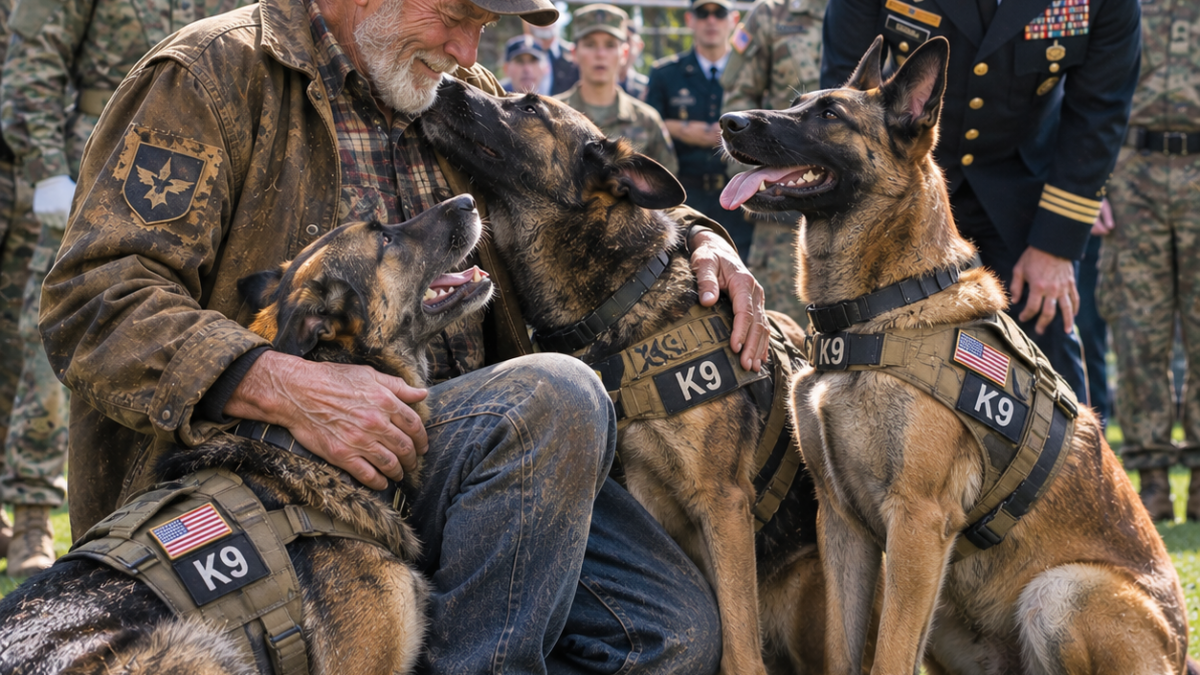
An Old Farmer Came to a K9 Retirement Ceremony—Then Three Decorated Military Dogs Broke Formation and Lined Up at His Feet
Jedediah Stone planned to stand unnoticed in the last row, watch three aging military dogs retire, and leave before anyone discovered why a seventy-six-year-old farmer had driven four hours to a ceremony where nobody had invited him.
Instead, all three decorated K9s ignored their handlers at the same moment, crossed the parade lawn in perfect silence, and lined themselves up at Jedediah’s mud-stained boots as though they had been waiting years for permission to find him.
Then the farmer’s coat fell open and the base commander saw the faded patch sewn inside it—a patch from a unit officially erased fifteen years earlier—and suddenly the question was no longer how three dogs knew an old farmer, but why someone had worked so hard to make sure nobody knew the farmer had once known them.
At 9:11 on a Saturday morning, Jedediah Stone almost turned his truck around.
He had already driven two hundred and seventeen miles.
Leaving now would have been ridiculous.
He knew that.
Still, when the signs for Fort Liberty appeared along the highway, he tightened both hands on the steering wheel and began looking for the next exit.
His truck was twenty-three years old.
Ford F-250.
Dark green under layers of dust.
Cracked dashboard.
Rust beginning around the rear wheel wells.
The heater only worked when the truck felt cooperative.
Today it did not.
Jedediah preferred the cold anyway.
Cold gave his hands something to blame for shaking.
He turned off the radio.
It had been talking about college football.
He had not heard a word.
On the passenger seat sat a brown envelope.
Inside were three photographs.
He had checked them at least twelve times during the drive.
He checked again.
First photograph.
A six-month-old Belgian Malinois with oversized ears standing inside an old red barn.
Written on the back:
COOPER — 2014.
Second photograph.
A darker Malinois puppy sitting beside a little girl in yellow rubber boots.
BANDIT — 2014.
Third.
A black-and-tan German Shepherd pup asleep beneath a feed table.
MILO — 2014.
Jedediah put the photographs back.
He closed the envelope.
“Stupid,” he muttered.
The road did not answer.
PART2:
He had spent most of his life talking to animals, tractors, weather, fence posts, and people who were no longer around.
Silence rarely bothered him.
Today it did.
The invitation had not come from the Army.
It had come from Facebook.
Technically from his neighbor’s granddaughter, who showed him a post on her phone while helping him unload fifty-pound bags of chicken feed.
“Mr. Stone, don’t these dogs look like yours?”
He almost told her no before looking.
Then he saw the photograph.
Three military working dogs standing in formation beneath an American flag.
RANGER.
ATLAS.
BISHOP.
All retiring together after long careers.
A ceremony scheduled at Fort Liberty.
Jedediah had stared until the girl asked whether he needed to sit down.
Ranger had Cooper’s eyes.
Atlas had Bandit’s narrow white mark beneath the throat.
And Bishop had the small notch along his left ear that Milo got when a barn cat introduced him to the concept of consequences.
Impossible.
Jedediah had told himself that for six days.
Dogs looked alike.
Malinois especially.
PART3:
Working shepherds came from the same bloodlines.
Scars happened.
Markings repeated.
Memories lied.
Old men wanted ghosts to be real.
Then the base posted individual retirement biographies.
Ranger.
Male Belgian Malinois.
Approximate age twelve.
Atlas.
Male Belgian Malinois.
Approximate age twelve.
Bishop.
Male German Shepherd.
Approximate age twelve.
All acquired through the same defense working-dog contractor in 2015.
All entered military service within six weeks of one another.
Jedediah stopped sleeping.
His three puppies disappeared from Stone Ridge Farm on November 17, 2014.
He had spent eleven years trying not to wonder what happened to them.
Now three decorated military dogs were retiring on the same morning.
And every instinct he still possessed told him they had once slept in his barn.
He pulled into the visitor lot at 9:38.
The ceremony began at ten.
Jedediah remained in the truck.
People crossed the parking lot.
Soldiers in dress uniforms.
Families.
Children.
Veterans.
A woman carrying flowers.
An elderly man in a Vietnam veteran cap.
Jedediah looked down at his clothes.
Work boots.
Dark jeans.
Blue button-down.
Brown canvas coat repaired twice at the elbow.
He had considered wearing something nicer.
Then decided he did not own anything nicer that felt like him.
The patch was sewn inside the coat.
Nobody would see it.
That was the point.
He touched the fabric through his shirt.
Old habit.
Then cursed himself for doing it.
“Go home.”
His own voice sounded pathetic inside the cab.
He started the engine.
Sat there.
Turned it off.
“Coward.”
That word worked better.
Jedediah got out.
The November air smelled like damp pine and cold grass.
He walked slowly toward the ceremony field.
His right knee complained.
It had been complaining since 1992.
He ignored it.
A young soldier at the entrance checked his visitor badge.
“Morning, sir.”
“Morning.”
“You here for the retirement?”
Jedediah looked past him.
“Yes.”
“Family?”
The question hurt more than it should have.
“No.”
The soldier smiled politely.
“Friends of the handlers?”
Jedediah looked toward the field.
“Something like that.”
He entered.
White chairs had been arranged across trimmed grass.
A small platform stood at the front.
Three handlers waited with their dogs near the right side.
Jedediah stopped.
He knew immediately.
Not logically.
Not scientifically.
He knew.
Ranger was Cooper.
The dog was older.
Scarred.
Gray along the muzzle.
But when Ranger shifted his weight, he lifted his right front paw slightly before settling.
Cooper had always done that after stepping on a thorn as a puppy.
Atlas was Bandit.
No doubt.
The dog scanned the crowd by moving his eyes before his head.
Bandit had done that from eight weeks old.
And Bishop—
Jedediah’s breath caught.
Milo.
The shepherd stood broad and steady beside his handler.
Left ear.
Tiny notch.
Still there.
Jedediah gripped the back of the nearest chair.
A woman looked over.
“Sir, are you okay?”
“Yes.”
“You sure?”
He nodded.
“Bad knee.”
She accepted that.
Jedediah moved toward the back row.
He chose the chair closest to the aisle.
Easy exit.
Always easy exit.
The handlers lined the three dogs beside one another.
Ranger.
Atlas.
Bishop.
Jedediah could not stop staring.
His mind refused the military names.
Cooper.
Bandit.
Milo.
He remembered them at eight weeks.
Chasing one another through grass.
Stealing gloves.
Tipping over a water bucket and then barking at it.
He remembered Cooper refusing to climb a wooden ramp until Bandit went first.
Milo asleep against Jedediah’s boot while he repaired fencing.
He remembered the morning they disappeared.
An empty barn.
A cut padlock.
Tire tracks in mud.
Three leashes left hanging.
The sheriff had called it theft.
The insurance company had called them livestock.
The defense contractor that had tried to buy them two months earlier had denied involvement.
Jedediah had called it what it was.
A hole in his life.
The ceremony began.
Colonel Marcus Turner stepped to the microphone.
Tall.
Fiftyish.
Broad shoulders.
Short gray hair.
Commanding officer of the base working-dog program.
Jedediah knew the name from the event post.
He had never seen him before.
Turner spoke about service.
Thousands of searches.
Combat deployments.
Lives saved.
Explosives detected.
Routes cleared.
Handlers protected.
Ranger had deployed four times.
Atlas three.
Bishop three.
Together, the dogs represented twenty-nine combined years of service.
Applause followed.
Jedediah did not clap.
He could not.
Each accomplishment brought conflicting emotions.
Pride.
Anger.
Relief.
Grief.
These dogs had lived.
They had mattered.
They had done extraordinary things.
And somebody had stolen them to make it possible.
Both truths sat inside him at once.
A handler named Master Sergeant Luke Serrano stepped forward with Ranger.
Another handler, Staff Sergeant Caleb Ross, stood with Atlas.
Sergeant First Class Nora Hale held Bishop’s leash.
The dogs were perfect.
Positions exact.
Eyes forward.
Leashes loose.
Jedediah almost smiled.
“You learned manners,” he whispered.
Nobody heard him.
Or so he thought.
Ranger’s right ear moved.
Jedediah froze.
The dog remained forward.
Probably coincidence.
Luke Serrano spoke.
He told a story about Ranger detecting explosives beneath a culvert in Afghanistan.
Applause.
Then Atlas.
Caleb described the dog finding a hidden weapons cache.
Then Bishop.
Nora talked about a hospital deployment where Bishop had stayed beside a wounded soldier for seventeen hours.
Jedediah swallowed.
The puppy Milo used to refuse to leave sick calves.
Of course.
Of course he did.
A chaplain offered a blessing.
Then came the ceremonial removal of each working harness.
Ranger first.
Luke unclipped the tactical vest.
“Ranger, stand down.”
The dog remained steady.
Atlas.
“Atlas, stand down.”
Bishop.
“Bishop, stand down.”
The audience applauded.
Jedediah’s eyes burned.
He stood.
Time to leave.
He had seen enough.
They were alive.
They were cared for.
That should have been enough.
He stepped into the aisle.
Ranger turned his head.
Luke noticed.
“Ranger.”
The dog did not look back.
Atlas’s ears rose.
Bishop shifted.
Nora glanced down.
Jedediah stopped.
Do not.
He looked at the exit.
Ten yards.
Just walk.
Ranger stepped out of formation.
Luke tightened the leash.
“Ranger. Heel.”
The dog stopped.
Atlas began whining.
Caleb looked confused.
“Atlas?”
Bishop stared at the back row.
Directly at Jedediah.
The farmer’s pulse hammered.
He whispered:
“No.”
Bishop’s ears lifted.
Jedediah looked away.
Then Ranger pulled.
Not aggressively.
Purposefully.
Luke planted his feet.
“Ranger, heel.”
For nearly a decade, Ranger had obeyed Luke Serrano under conditions that broke men.
He did not obey now.
Atlas moved next.
Then Bishop.
Three leashes drew taut at the same time.
The handlers exchanged looks.
Colonel Turner stepped away from the microphone.
“What’s happening?”
Luke shook his head.
“No idea, sir.”
Jedediah began backing toward the exit.
That made everything worse.
Ranger barked.
Once.
High.
Urgent.
Jedediah stopped.
He knew that bark.
His chest hurt.
“Cooper.”
The name escaped before he could stop it.
Ranger froze.
Luke Serrano went completely still.
Atlas began bouncing against the end of his leash.
Jedediah covered his mouth.
Too late.
“Bandit.”
Atlas screamed.
Not barked.
Screamed.
Caleb nearly lost the leash.
People stood.
Phones appeared.
Murmurs moved through the chairs.
Bishop had not moved.
He only stared.
Jedediah’s vision blurred.
“Milo.”
The German Shepherd lowered immediately into a down position.
Nora Hale looked from the dog to Jedediah.
“What the hell?”
Colonel Turner raised a hand.
“Hold formation.”
The command was for people.
The dogs had already abandoned the concept.
Ranger twisted.
The retirement leash slipped through Luke’s grip.
Then Atlas pulled free.
Bishop’s leash followed half a second later.
All three dogs crossed the lawn.
Not chaotic.
Not fighting.
Not even racing.
They moved together.
Three retired military working dogs walking directly toward an old farmer standing alone in the back row.
Jedediah could not move.
Ranger reached him first.
Stopped.
Sniffed his boots.
Then his pants.
Then his hand.
The dog’s body began shaking.
Jedediah whispered:
“Cooper.”
Ranger pushed his muzzle beneath Jedediah’s palm.
Atlas arrived.
Pressed against his left leg.
“Bandit.”
Tail hammering.
Bishop stopped directly in front.
Looked up.
Jedediah smiled through tears.
“Milo.”
The shepherd lifted one front paw.
Placed it on Jedediah’s boot.
Exactly as he had done under the feed table eleven years earlier.
The three dogs arranged themselves around him.
Ranger right.
Atlas left.
Bishop center.
Then, astonishingly, sat.
A line.
At his feet.
The field had gone completely silent.
Jedediah laughed once.
Brokenly.
“You boys got old.”
Ranger licked his hand.
Jedediah knelt as far as his knee allowed.
All three pressed toward him.
He buried his fingers in their fur.
Eleven years of questions disappeared beneath his hands.
“You’re alive.”
Atlas whined.
“I looked for you.”
Bishop pressed his forehead into Jedediah’s chest.
The old farmer began crying.
“I looked everywhere.”
Luke Serrano approached slowly.
He looked stunned.
“Sir.”
Jedediah tried to stand.
Ranger blocked him by leaning across his knees.
Luke almost smiled despite the confusion.
“Apparently they don’t want you leaving.”
Jedediah wiped his face.
“Never were good listeners.”
Luke stared.
“You know them.”
“Yes.”
“From where?”
Jedediah looked at the three dogs.
“My farm.”
Luke’s expression changed.
“What?”
“They were mine.”
Silence.
Caleb and Nora joined them.
Nora frowned.
“That’s impossible.”
Jedediah laughed without humor.
“I’m getting tired of that word.”
Luke crouched.
“What did you call them?”
“Cooper.”
He touched Ranger.
“Bandit.”
Atlas.
“Milo.”
Bishop.
Caleb looked at Atlas.
“Those names aren’t in any file.”
“I imagine that was intentional.”
Colonel Turner approached.
Jedediah stood carefully.
One dog remained against each leg.
Bishop stayed directly in front.
Turner looked at him.
“Mr…”
“Stone.”
“Jedediah Stone.”
Turner’s face changed.
Just slightly.
Jedediah noticed.
“You know the name.”
Turner recovered.
“I’ve heard it.”
“Where?”
Before Turner answered, Jedediah’s coat slipped open.
The wind caught the left side.
For perhaps two seconds, the inside lining became visible.
So did the patch.
Old.
Faded.
Triangular.
A black dog silhouette against a mountain.
Words nearly worn away:
SHEPHERD RECOVERY GROUP
SIX
Colonel Turner stopped breathing.
Luke noticed immediately.
“Sir?”
Turner stared at the patch.
Then at Jedediah.
“Where did you get that?”
Jedediah’s body stiffened.
“Close your coat.”
“What?”
“Close it.”
Jedediah did.
Too late.
Turner looked around the crowd.
“Luke.”
“Yes, sir.”
“Clear the area.”
Luke frowned.
“Sir?”
“Now.”
The ceremony disintegrated into confusion.
Families were politely directed toward the reception building.
Handlers collected equipment.
Phones were discouraged.
The three dogs refused to leave Jedediah.
Eventually Turner stopped trying.
Ten minutes later, Jedediah sat inside a small briefing room.
Ranger beneath one hand.
Atlas against his chair.
Bishop lying across the doorway.
Luke, Caleb, Nora, and Colonel Turner remained.
Turner closed the blinds.
Jedediah watched.
“Still dramatic.”
Turner turned.
“What was Shepherd Recovery Group Six?”
Jedediah studied him.
“You recognized the patch.”
“Yes.”
“Then you already know.”
“No.”
Turner sat across from him.
“I saw it once.”
“Where?”
“My father’s effects.”
Jedediah stared.
“What was your father’s name?”
“Captain Thomas Turner.”
Everything inside Jedediah stopped.
The room disappeared.
Afghanistan.
Mountains.
Snow.
Blood on a helicopter floor.
A young captain with one lung collapsing.
Jedediah using both hands to hold pressure against his chest.
Jedediah whispered:
“Tommy Turner.”
Colonel Turner went pale.
“Nobody called him that.”
“I did.”
“How?”
Jedediah looked at the commander.
“Your father was twenty-six when I met him.”
Turner sat slowly.
“He never talked about that deployment.”
“He wasn’t allowed.”
“What deployment?”
Jedediah looked around the room.
Old habits returned.
Doors.
Windows.
People.
Who knows what.
Who controls what.
He had spent fifteen years learning that truth could be dangerous even after everyone involved retired.
“No.”
Turner’s face hardened.
“No?”
“I came to see the dogs.”
“That patch belonged to a unit omitted from every accessible Army archive I have ever checked.”
“Then maybe you should respect the omission.”
Luke stared at Jedediah.
“You weren’t just a farmer.”
Jedediah looked at him.
“I’ve always been a farmer.”
“What else?”
The old man smiled sadly.
“Depends which year you’re asking about.”
Turner leaned forward.
“My father had that patch sealed inside a Bible.”
Jedediah’s expression changed.
“He kept it?”
“Yes.”
“Why?”
“I was hoping you could tell me.”
Jedediah looked down at Bishop.
The shepherd watched the door.
Fifteen years.
Maybe longer.
He had kept silence because men with authority told him silence protected lives.
Some of those men were dead.
Some became wealthy.
Some became respected.
Jedediah became a farmer again.
Now three stolen dogs were sitting at his feet.
Maybe silence had protected the wrong things.
He exhaled.
“Shepherd Six wasn’t a unit.”
Turner frowned.
“What was it?”
“A recovery cell.”
“Military?”
“Mostly.”
“Mostly?”
Jedediah looked at him.
“Dogs disappear in war.”
Luke frowned.
“Working dogs?”
“Yes.”
“Handlers die.”
“Teams scatter.”
“Contract dogs get abandoned.”
“Partner-force dogs get left when units move.”
“Sometimes paperwork says an animal died when nobody actually checked.”
He paused.
“Someone decided recovering them was useful.”
“Who?”
“Started with Special Operations veterinary staff and a few handlers.”
“Then civilian trainers.”
“Local assets.”
“Pilots who could make room.”
“People like me.”
Turner stared.
“What were you?”
“Civilian canine specialist.”
Luke asked, “How does a North Carolina farmer become a clandestine canine specialist?”
Jedediah smiled.
“By spending twenty years breeding working dogs and being stupid enough to answer the phone when an old Army friend calls.”
Turner glanced at the patch.
“My father?”
“Recovered dogs with us.”
“He was infantry.”
“He was also good at getting people through places they weren’t supposed to survive.”
Turner went quiet.
Jedediah continued.
“We operated off-book because nobody wanted another budget line.”
“Then because the work became politically inconvenient.”
“What does that mean?”
“Some dogs we recovered belonged to contractors.”
“Some contractors did not want records showing where those dogs had been.”
“Why?”
“Because dogs remember places.”
Luke frowned.
“Dogs can’t testify.”
“No.”
Jedediah looked at Ranger.
“But they can lead you back.”
The handlers exchanged looks.
Turner said, “What happened to Shepherd Six?”
Jedediah’s eyes darkened.
“Got too curious.”
“About what?”
“Procurement.”
The word landed heavily.
Jedediah continued.
“Dogs were being bought twice.”
“Listed dead and resold.”
“Acquired overseas under false papers.”
“Some came from American civilian breeders.”
“Some were stolen.”
Luke looked sharply at the three dogs.
Jedediah nodded.
“I told you.”
“They were mine.”
Turner sat back.
“You’re saying the retirement dogs were stolen as puppies?”
“Yes.”
“By whom?”
Jedediah reached inside his coat.
Nora tensed.
He noticed.
“Photographs.”
He removed the brown envelope.
Laid out the three pictures.
Luke picked up Cooper’s.
He compared it with Ranger.
Caleb stared at Bandit.
Nora looked at Milo.
The similarities were undeniable.
Turner asked, “Microchips?”
“Yes.”
“The dogs were chipped?”
“Every puppy from my program.”
“Numbers?”
Jedediah tapped his temple.
“Written records too.”
“Where?”
“Farm.”
Turner looked at the photographs again.
“When were they stolen?”
“November 17, 2014.”
Luke frowned.
“Ranger entered military service May 2015.”
“Atlas June.”
“Bishop June.”
Jedediah nodded.
“Exactly.”
“Did you report it?”
“Sheriff.”
“FBI after I became suspicious.”
“Defense Criminal Investigative Service.”
“Anyone who’d listen.”
“What happened?”
“Nothing.”
Jedediah’s mouth tightened.
“Then something.”
Turner recognized the distinction.
“What something?”
“A man came to my farm.”
“Name?”
“Colonel Victor Sayer.”
Turner knew it.
Everyone in the room seemed to.
Former director of a military canine procurement modernization office.
Later senior executive at a major defense contractor.
Now retired.
Luke whispered, “Sayer?”
Jedediah nodded.
“He told me three missing dogs were not worth destroying a relationship with the Department of Defense.”
Caleb’s face hardened.
“He threatened you.”
“He advised me.”
Jedediah smiled bitterly.
“Powerful men prefer that word.”
Turner asked, “Did he admit taking them?”
“No.”
“He didn’t have to.”
“What did you do?”
“Kept digging.”
That was when Shepherd Six reappeared in his life.
Jedediah had left the program years earlier.
After a helicopter accident injured his knee and killed two men.
He returned to North Carolina.
Farm.
Dogs.
Quiet.
Then an old teammate contacted him.
Several working dogs had military acquisition numbers linked to civilian microchips reported missing.
Jedediah compared records.
Found patterns.
Dogs disappeared.
Foreign breeder registration appeared months later.
Then government purchase.
“They washed dogs.”
Nora looked disgusted.
“Like stolen cars.”
“Yes.”
“Changed chips?”
“Sometimes removed them.”
“Sometimes left them and relied on military systems never checking civilian registries.”
Turner looked toward the three retired dogs.
“Why these three?”
Jedediah’s jaw tightened.
“Because they were good.”
“Exceptionally.”
“I bred them from my best working line.”
“Sayer’s contractor tried buying the litter.”
“I refused.”
“Why?”
“They wanted all six puppies.”
“Wouldn’t tell me where they were going.”
“Three were already promised to search-and-rescue programs.”
“I kept these three for evaluation.”
“Then they disappeared.”
Luke looked down at Ranger.
“Someone stole them and then sold them to the military.”
“Yes.”
“For how much?”
Jedediah’s smile was humorless.
“Documents I found suggested between sixty and ninety thousand dollars each after training.”
Caleb swore.
Turner stood.
He walked toward the window.
“When did you stop investigating?”
Jedediah did not answer.
Turner turned.
“When?”
“2017.”
“Why?”
The farmer looked at him.
“Because someone burned my barn.”
Silence.
Nora whispered, “With dogs inside?”
Jedediah’s face became empty.
“Five.”
Nobody spoke.
“Two died.”
“One never worked again.”
“I almost died getting them out.”
Luke looked sick.
“Police?”
“Electrical fire.”
“You disagree?”
“Electrical systems don’t pour gasoline.”
Turner sat.
“Did you have proof?”
“No.”
“Anything stolen?”
“Yes.”
“What?”
“Records.”
“What records?”
“Everything connecting Sayer’s contractor to suspicious dog acquisitions.”
Turner’s expression hardened.
“Who knew you had them?”
“Three people.”
“Names.”
Jedediah looked directly at him.
“One was your father.”
Turner went still.
“What?”
“Tom Turner helped me.”
“After leaving Shepherd Six.”
“He was stationed stateside by then.”
“He had access to old transport records.”
“He found duplicated animal ID numbers.”
Turner whispered, “My father died in 2018.”
“I know.”
“Car accident.”
Jedediah’s eyes held his.
“I know.”
Turner stood abruptly.
Chair scraping.
Luke looked between them.
“Sir?”
Turner’s voice changed.
“You think my father was killed.”
Jedediah did not answer.
That was answer enough.
“No.”
Turner paced.
“No.”
Jedediah remained seated.
“I did not say that.”
“You implied it.”
“I said he helped me.”
“And then your barn burned.”
“And then my father died.”
“Marcus.”
The use of his first name stopped him.
Jedediah said, “Do not do what I did.”
Turner stared.
“What?”
“Take every bad thing that happened afterward and force it into one story.”
Jedediah looked toward the dogs.
“Sometimes accidents are accidents.”
“Sometimes corruption is greed without murder.”
“Sometimes dead men are just dead.”
He paused.
“If you start wanting a conspiracy badly enough, you stop seeing evidence.”
Turner slowly sat.
Luke looked at Jedediah with new respect.
“Then what evidence do you have?”
“Not enough.”
“Yet.”
Jedediah looked at Ranger.
“Maybe more now.”
Turner frowned.
“What does that mean?”
The farmer touched Ranger’s old retirement collar.
“Where is their original intake equipment?”
Luke answered.
“Probably long-term storage.”
“Harnesses?”
“Some.”
“Collars?”
“Possibly.”
Jedediah nodded.
“Find them.”
“Why?”
He looked at the handlers.
“I taught every puppy one thing before placement.”
“What?”
“Carry home.”
Luke frowned.
Jedediah smiled faintly.
“Farm command.”
“If a dog found something unfamiliar in the field, I trained him to bring it to the barn.”
“Gloves.”
“Tools.”
“Dropped objects.”
“Anything.”
Caleb looked at Atlas.
“Why does that matter?”
“Because if someone trained them after theft, old behaviors may still have survived.”
Nora asked, “You think they carried something?”
“I don’t know.”
Jedediah looked at Bishop.
“But your commander says his father had a Shepherd Six patch.”
“That means Tom kept things he wasn’t supposed to.”
Turner’s expression shifted.
“My father’s effects.”
Jedediah nodded.
“Search them.”
The day ended nothing like a retirement ceremony.
The official photographs were postponed.
The reception food went mostly untouched.
Ranger, Atlas, and Bishop were temporarily placed in a quiet training yard with Jedediah while command staff made calls.
Nobody wanted videos of three decorated dogs lining up at a mysterious farmer’s boots spreading before anyone understood the situation.
That wish lasted approximately forty minutes.
Someone had recorded it.
By afternoon the video was online.
THREE MILITARY K9s BREAK FORMATION FOR OLD FARMER.
The clip spread.
Thousands of shares.
Then hundreds of thousands.
People speculated.
Former handler?
Breeder?
Secret commander?
Dog whisperer?
Jedediah refused to watch.
He sat on a bench beneath a pine tree while all three dogs slept nearby.
Luke brought him coffee.
“Black?”
Jedediah looked surprised.
“How’d you know?”
“You look like somebody who thinks cream is weakness.”
Jedediah smiled.
“Your friend Mason would’ve liked you.”
Luke sat.
“You knew Mason?”
“No.”
“But I know the type.”
Luke looked toward Ranger.
“You sure he was Cooper?”
Jedediah leaned down.
“Cooper.”
Ranger’s head lifted immediately.
“Titan.”
Nothing.
“Ranger.”
Head turned.
Luke smiled.
“Okay.”
Jedediah pointed toward a fallen pinecone.
“Cooper. Fetch home.”
Ranger looked at it.
Then at Jedediah.
The old man pointed.
The dog stood.
Picked up the pinecone.
Carried it to the covered kennel entrance twenty yards away.
Dropped it.
Luke stared.
“You’ve got to be kidding.”
Jedediah smiled.
“Old software.”
Atlas did it too.
Bishop needed the command twice.
But all three remembered.
That evening Colonel Turner called.
“Found something.”
Jedediah stood.
“What?”
“My father’s storage unit.”
Turner had kept it after his mother downsized.
Boxes he had not opened in years.
Inside one container were military papers.
Old maps.
Photographs.
A Bible.
And the Shepherd Six patch.
The same patch Jedediah wore.
Beneath the Bible was a sealed plastic folder labeled:
STONE.
Jedediah felt the past moving toward him.
They met at Turner’s house off base.
Luke came.
So did a DoD Inspector General investigator named Rachel Monroe after Turner decided they needed an outside chain of custody immediately.
Jedediah approved.
“Too many people keeping things inside units is how we got here.”
The folder contained copies of records Jedediah thought burned in the barn.
Transport manifests.
Microchip numbers.
Contract invoices.
Photographs.
Tom Turner had made duplicates.
Jedediah laughed softly.
“That sneaky son of a…”
Marcus Turner looked at him.
“My father?”
“Best compliment I can give him.”
Then Rachel found a handwritten note.
Tom’s writing.
JED—
IF YOU’RE READING THIS, I WAS RIGHT TO COPY EVERYTHING.
SAYER KNOWS WE’RE LOOKING.
I FOUND THE ACCOUNTING SIDE.
THE DOGS ARE THE SMALL PART.
Jedediah stopped smiling.
Rachel looked up.
“What does that mean?”
“I don’t know.”
They continued.
Raven Shield Canine Solutions—the contractor connected to Sayer—had charged the government for hundreds of animals.
Some legitimate.
Some not.
But the invoices contained other line items.
Overseas veterinary transport.
Secure kennel construction.
Canine medical pharmaceuticals.
Tracking systems.
Some costs were absurdly inflated.
Then Tom found duplicate billing.
Same dog.
Same serial number.
Charged to different programs.
Then dogs listed as dead continued generating expenses.
Luke stared.
“Ghost dogs.”
Rachel nodded.
“Paper animals.”
Jedediah’s jaw tightened.
Millions of dollars.
Possibly tens of millions.
But then another file appeared.
Payments routed to overseas facilities.
Not dog facilities.
Private security compounds.
Money hidden inside canine program budgets because the amounts drew less scrutiny.
Rachel went quiet.
“This is bigger.”
Jedediah nodded.
“That’s what Tom meant.”
Marcus stared at his father’s handwriting.
Then a photograph slipped from the folder.
Four men.
Afghanistan.
2009.
Jedediah younger.
Tom Turner.
Two others.
All wearing Shepherd Six patches.
Marcus touched the image.
“I’ve never seen this.”
Jedediah looked at Tom’s face.
“He saved me once.”
Marcus glanced over.
“How?”
“Bad extraction.”
“Vehicle hit.”
“Tom carried me for half a mile.”
Marcus’s eyes filled.
“He never told me.”
“He wasn’t allowed.”
“Did he talk about me?”
Jedediah smiled.
“Constantly.”
Marcus looked away.
That mattered.
Rachel cleared her throat gently.
“There’s another note.”
She read it.
SAYER ASKED ABOUT STONE’S FARM.
IF ANYTHING HAPPENS, ASSUME RECORDS ARE TARGET.
NOT PEOPLE.
Jedediah leaned back.
Marcus exhaled.
“My father didn’t think Sayer would kill.”
“Neither did I.”
“So the crash…”
“May have been a crash.”
Marcus nodded slowly.
The distinction hurt.
But truth was not supposed to comfort.
The next morning, investigators recovered the original intake records for Ranger, Atlas, and Bishop from archival storage.
Microchip scans had been omitted from final digital files.
But paper veterinary intake cards survived.
Each had a notation.
SECONDARY CHIP DETECTED — REMOVAL REQUESTED.
Jedediah slammed his hand against the table.
“There.”
Rachel looked at him.
“Removal requested by whom?”
The signature was illegible.
Approval code linked to Raven Shield.
The chips themselves?
Surgically removed.
Except Bishop’s.
The German Shepherd still had his.
It had migrated deep near the shoulder blade.
Modern scanning found it.
Number matched Jedediah’s veterinary records.
Ranger and Atlas required DNA.
Jedediah had preserved pedigrees from their parents.
Samples confirmed both belonged to his breeding line with extremely high confidence.
There was no longer any serious doubt.
The three decorated military dogs had been stolen from Stone Ridge Farm.
The story broke nationally.
Jedediah hated every second.
Reporters parked outside his farm.
Television producers called.
Some offered money.
One wanted to film “The Farmer Who Lost Three Heroes.”
Jedediah hung up.
He did agree to one statement.
Outside the county courthouse.
No microphones in his face.
No questions afterward.
He stood beside Ranger, Atlas, and Bishop.
Luke, Caleb, and Nora held the leashes.
Jedediah said:
“They were not stolen because someone loved dogs.”
“They were stolen because someone saw dollar signs.”
He looked at the cameras.
“What happened afterward does not make the theft noble.”
“These dogs served honorably.”
“Their handlers served honorably.”
“The soldiers they saved did nothing wrong.”
“But you cannot turn a crime into a good deed just because something good happened later.”
He paused.
“They deserved honest beginnings.”
Then he walked away.
The quote spread everywhere.
Raven Shield issued a statement denying institutional wrongdoing.
Robert Sayer appeared through an attorney.
He claimed any improper acquisitions had been committed by “rogue subcontractors.”
Jedediah laughed when he heard.
“Rogue.”
Rachel looked at him.
“You hate that word?”
“People use rogue when management wants criminal behavior without managerial responsibility.”
The investigation continued.
A former Raven Shield employee named Marcus Bell requested immunity.
He had worked dog acquisition.
He remembered Stone Ridge Farm.
He remembered Jedediah.
And he remembered the puppies.
“I told Sayer Stone wouldn’t sell.”
“What did Sayer say?”
Bell looked at the investigators.
“He said every dog has a price.”
“And when Stone still refused?”
“He told us to solve the sourcing problem.”
Jedediah sat in the observation room.
His hands went cold.
Solve the sourcing problem.
Bell claimed he did not participate in the theft itself.
But he knew two men who did.
Both dead now.
One from cancer.
One motorcycle accident.
Bell said the puppies were transported to a training property in Oklahoma.
Their chips were removed.
Names changed.
Birth dates altered.
Then they were routed through a European registry and sold back to the U.S. government as imported working dogs.
Rachel asked:
“Did Sayer know?”
Bell laughed nervously.
“He picked Ranger himself.”
Jedediah’s jaw tightened.
“Cooper.”
Rachel looked toward him through the glass.
He corrected automatically.
Bell continued.
“Sayer liked that one.”
“What about the other dogs?”
“Same program.”
“Why three?”
“Stone’s line was exceptional.”
Jedediah closed his eyes.
A compliment had never sounded so ugly.
Then Bell revealed something worse.
The puppies were not the only dogs taken from American civilians.
Investigators identified at least twenty-six suspicious acquisitions.
Some involved deceptive purchase contracts.
Some forged surrender documents.
At least nine appeared to be outright theft.
Families had reported dogs missing.
Years later, those same animals entered government or police programs under new identities.
Some were still alive.
Most were not.
Jedediah received letters.
One from a woman in Kentucky.
Her German Shepherd disappeared from a fenced yard in 2012.
He later served six years as a military detection dog.
Died overseas.
She had spent a decade thinking coyotes took him.
Another from a retired firefighter whose Labrador disappeared during a hunting trip.
The dog later became a federal explosives K9.
The man wrote:
I’m proud of what he did. I’m still furious they took away my choice.
Jedediah understood every word.
The government established a review process.
DNA.
Microchips.
Historical records.
Families contacted.
Some wanted remains returned.
Some wanted photographs.
Some wanted nothing.
Not every reunion was happy.
One retired working dog had lived with his handler eight years.
The original family wanted him back.
Legally they had a strong claim.
Emotionally, the dog had two families.
Jedediah testified before a federal committee.
A senator asked:
“Mr. Stone, in your view, who owns a working dog after a situation like this?”
Jedediah thought for a long moment.
“Depends what you mean by own.”
The senator waited.
“If you mean legal title, lawyers can answer.”
“If you mean who the dog loves, nobody gets exclusive rights to that.”
He looked toward Ranger sleeping beside Luke’s chair.
“Animals don’t organize their hearts according to paperwork.”
That became another quote he hated seeing online.
Back at Stone Ridge Farm, life became stranger.
Ranger moved in first.
Luke had planned to adopt him.
Then told Jedediah:
“I think he should spend some time here.”
Jedediah objected.
“He’s your dog.”
Luke looked at Ranger lying on Jedediah’s porch.
“Tell him.”
Atlas followed for a month.
Bishop too.
Eventually they settled into shared arrangements.
Ranger lived mostly with Luke.
Atlas with Caleb.
Bishop with Nora.
But every few weeks, all three returned to Stone Ridge.
The moment they reached the dirt road, they changed.
Noses out windows.
Ears forward.
Years of military discipline dissolving into something younger.
Jedediah pretended not to enjoy it.
He failed.
The old red barn was still standing.
Rebuilt after the fire.
The first time all three entered, Ranger stopped near a support post.
Sniffed.
Then scratched at the dirt.
Jedediah stared.
“What?”
The dog dug.
Atlas joined.
Then Bishop.
Luke laughed.
“What did you bury?”
“Nothing.”
The dogs disagreed.
After five minutes, Ranger pulled something from beneath the soil.
A rusted metal object.
Jedediah crouched.
Old feed scoop.
He laughed.
“Cooper used to steal that.”
Luke shook his head.
“Eleven years.”
Jedediah held the scoop.
The dog remembered.
Later they found an old wooden box in the loft.
Inside were puppy collars.
Blue.
Red.
Green.
Jedediah sat on the barn floor holding them.
Luke remained silent.
“Blue was Cooper.”
“Red Bandit.”
“Green Milo.”
Ranger sniffed the blue collar.
Then sneezed.
Jedediah smiled.
“Never liked it.”
Luke said softly:
“You kept everything.”
“Not everything.”
He looked toward the section of barn rebuilt after the fire.
Luke understood.
Two dogs had died that night.
Maisie.
Tuck.
Jedediah had buried them under the sycamore tree.
Luke followed him there later.
Two simple stones.
Jedediah said:
“This is why I stopped.”
“Investigating?”
“Yes.”
“I told myself staying alive mattered more than proving I was right.”
Luke sat beside him.
“That wrong?”
Jedediah shook his head.
“No.”
“I had dogs depending on me.”
“Employees.”
“Family.”
He paused.
“But fear gets comfortable.”
Luke looked at him.
“What does that mean?”
“You start with one good reason to stay quiet.”
“Then another.”
“Then you wake up fifteen years later and silence has become who you are.”
Luke thought about his own years in the military.
Things he had not said.
People he had not called.
He understood more than he wanted to.
The case against Sayer moved slowly.
Financial fraud.
Conspiracy.
Theft.
Obstruction.
Procurement corruption.
No murder charges.
No evidence tied him to Tom Turner’s crash.
No proof he ordered the barn fire.
Jedediah was disappointed.
Then ashamed of the disappointment.
He had warned Marcus not to force every tragedy into the same story.
Now part of him wanted exactly that.
Rachel reminded him gently:
“Wanting someone guilty of one thing to be guilty of everything is human.”
“Doesn’t make it evidence.”
Jedediah nodded.
“I know.”
“Doesn’t mean the fire was accidental either.”
“I know.”
“Just means we can’t prove it.”
That sentence defined more of life than Jedediah liked.
Sayer eventually accepted a plea deal on several federal charges after his former finance director cooperated.
He faced prison.
Asset forfeiture.
Civil claims.
His company collapsed.
People online called it justice.
Jedediah called it consequences.
Justice felt larger.
Harder.
Maybe impossible.
The most emotional hearing had nothing to do with Sayer.
It concerned government acknowledgment.
Families of stolen dogs filled the room.
Some held photographs.
Some collars.
Some empty leashes.
Jedediah sat beside Marcus Turner.
Marcus held his father’s Shepherd Six patch.
He had finally learned more about Tom.
Declassified records confirmed Captain Thomas Turner had participated in multiple Shepherd Recovery missions.
Recovered eight working dogs.
Three wounded handlers.
Two civilian interpreters.
One crashed helicopter crew.
His service record had contained none of it publicly.
Marcus whispered:
“He was a hero and never told us.”
Jedediah looked at him.
“He told you what mattered.”
“What?”
“He came home.”
Marcus looked unconvinced.
Jedediah continued.
“Men like your father didn’t do those things to become stories.”
“They did them because somebody needed carrying.”
Marcus looked at the patch.
“I spent forty years thinking I knew him.”
“You did.”
“Not all of him.”
“Nobody knows all of anybody.”
That helped.
A little.
The Department of Defense issued formal findings acknowledging contractor fraud and failures in historical canine acquisition oversight.
New verification requirements followed.
Mandatory multi-registry chip scans.
Chain-of-ownership documentation.
Independent review for foreign re-registration.
Audit trails.
Better retirement record access.
Jedediah read the policy once.
Then put it down.
Luke asked:
“That satisfy you?”
“No.”
“Anything would?”
Jedediah looked at the three dogs asleep in sunlight.
“This helps dogs I’ll never meet.”
“That’s enough.”
Maybe it was.
Years moved.
Ranger’s hips failed first.
Atlas developed kidney disease.
Bishop lost most of his hearing.
Retirement softened all of them.
Luke joked that Ranger had become “militarily useless.”
Jedediah called that the point.
The dogs learned farm life again.
Not exactly as puppies.
Memory did not reverse age.
They could not run all day.
Could not leap fences.
Could not chase tractors safely.
But they found pleasures.
Sunlight.
Mud.
Chicken smells.
Sleeping beneath Jedediah’s kitchen table.
Ranger stole biscuits.
Jedediah accused him of historical criminal tendencies.
Atlas became obsessed with riding in the truck.
Bishop followed Jedediah to the mailbox every morning.
Three hundred yards.
Eventually too far.
Jedediah shortened the route.
He moved the mailbox.
Luke discovered this.
“You moved a federally regulated mailbox because the dog got arthritis?”
Jedediah shrugged.
“It was inconvenient.”
“For whom?”
Jedediah pointed at Bishop.
Luke laughed.
One winter evening Marcus Turner visited.
Retired now.
Civilian jacket.
No rank.
He carried something.
An old wooden frame.
Inside were two Shepherd Six patches.
Tom’s.
Jedediah’s reproduced from photographs.
Below them a small plaque:
THE ONES WHO CAME BACK FOR THOSE LEFT BEHIND.
Jedediah stared.
“Hate it.”
Marcus smiled.
“You’re lying.”
“Font’s terrible.”
Marcus laughed.
Then became serious.
“I wanted you to have Dad’s patch.”
Jedediah shook his head.
“No.”
“He would’ve wanted—”
“No.”
Jedediah pointed at Marcus.
“Your father kept that for you.”
“He hid it.”
“He saved it.”
“Difference.”
Marcus looked at the frame.
“What am I supposed to do with it?”
“Tell your kids.”
Marcus smiled faintly.
“I have.”
“Good.”
“Grandkids too.”
“Better.”
Marcus looked toward Ranger sleeping near the fireplace.
“You know, Dad wrote about you.”
Jedediah froze.
“What?”
“In a notebook.”
“What did he say?”
Marcus pulled out a photocopy.
Jedediah accepted it.
Tom’s handwriting:
STONE PRETENDS HE LIKES DOGS MORE THAN PEOPLE.
TRUTH IS HE LIKES PEOPLE TOO MUCH AND DOESN’T TRUST WHAT THAT COSTS HIM.
Jedediah stared.
Marcus watched.
“Accurate?”
Jedediah folded the paper.
“Your father talked too much.”
Marcus smiled.
That night Jedediah placed the photocopy beside his bed.
He never admitted it.
Ranger died first.
Sixteen months after retirement.
Cancer.
Fast.
Luke brought him to the farm for the last week.
Ranger barely ate.
Jedediah made scrambled eggs.
The veterinarian objected.
Jedediah ignored him.
On the final morning, they carried Ranger beneath the sycamore tree.
Luke sat on one side.
Jedediah on the other.
Atlas and Bishop lay nearby.
Dogs understood enough.
Ranger’s breathing slowed.
Luke cried openly.
Jedediah held the old blue puppy collar.
He had kept it all those years.
He placed it near Ranger’s nose.
“Cooper.”
The dog’s ear moved.
Luke smiled through tears.
“He still knows.”
“Of course.”
Jedediah rubbed the gray muzzle.
“You did good.”
Luke whispered:
“He did more than good.”
Jedediah looked at him.
“That’s what people always say at the end.”
Luke laughed weakly.
“What should I say?”
“Tell him the truth.”
Luke thought.
Then leaned close.
“You were a pain in my ass.”
Ranger’s tail moved once.
Both men laughed.
Luke continued.
“You stole my sandwich in Kandahar.”
Another breath.
“You saved my life twice.”
Luke’s voice broke.
“And I love you.”
Ranger exhaled.
The veterinarian gave the medication.
Jedediah whispered:
“Cooper, home.”
The old dog became still.
Atlas refused food for two days.
Bishop slept beside Ranger’s empty blanket.
Jedediah did not try to fix them.
He sat nearby.
Let grief be grief.
Months later Atlas’s kidneys worsened.
Caleb brought him to Stone Ridge.
The dog died on the porch at sunset.
Bandit.
Second red collar.
Caleb held him.
Jedediah whispered the old name.
Again, one ear moved.
Again, memory survived to the edge.
Bishop lasted almost another year.
By then Jedediah was eighty.
His own health had begun failing.
Heart.
Knees.
Lungs.
Nora joked that she could not tell which old man she was visiting, Jedediah or Bishop.
“Dog complains less,” Jedediah said.
“That’s true.”
Bishop slept beside Jedediah’s chair most days.
Two aging bodies sharing a quiet house.
One morning Jedediah fell in the kitchen.
He could not stand.
Bishop barked.
Once.
Then again.
When Jedediah did not move, the almost-deaf shepherd walked to the front door and pushed at it until the loose latch opened.
He crossed the yard.
Slowly.
Painfully.
Found a farmhand near the barn.
Barked until the man followed.
Jedediah was taken to the hospital.
Heart rhythm problem.
Dehydration.
Nothing fatal.
Yet.
When he returned three days later, Bishop stood on the porch.
Jedediah got out of Luke’s truck.
The dog came down the ramp.
Jedediah whispered:
“Milo.”
Bishop pressed himself against him.
Luke looked away.
“Three days.”
Jedediah nodded.
“Longest we’ve been apart since retirement.”
Luke smiled.
“Guess he noticed.”
Bishop died that spring.
No dramatic illness.
His body simply ran out.
He stopped eating.
Then stopped walking beyond the porch.
Nora came.
Luke.
Caleb.
Marcus.
Claire too, though she had known Bishop least.
They gathered at Stone Ridge Farm.
Jedediah sat in his old wooden chair.
Bishop’s head across his lap.
The green puppy collar rested in his hand.
Nora asked:
“You okay?”
Jedediah laughed.
“What kind of question is that?”
“Fair.”
He looked down.
“Milo.”
The dog’s eyes opened.
Jedediah smiled.
“There you are.”
Bishop breathed slowly.
“You were the quiet one.”
Nora said, “He was absolutely not quiet in service.”
Jedediah looked offended.
“You ruined him.”
Everyone laughed.
It helped.
Jedediah touched the notch in Bishop’s ear.
“Barn cat.”
Nora had heard the story ten times.
She listened again.
“He was six months old.”
“Thought he was king of the farm.”
“Cat explained hierarchy.”
Bishop exhaled.
Jedediah’s voice broke.
“You found your way back.”
Another breath.
“All three of you.”
He pressed his forehead against the shepherd’s.
“Wish it hadn’t taken so long.”
The veterinarian administered the medication.
Jedediah whispered:
“Milo, carry home.”
Bishop’s ear moved.
His chest rose.
Fell.
Stopped.
Jedediah remained still.
Nobody rushed him.
After several minutes, Luke crouched beside the chair.
“You want us to take him?”
Jedediah shook his head.
“Not yet.”
They waited.
The three dogs were buried beneath the sycamore tree.
Cooper.
Bandit.
Milo.
Their military names appeared beneath.
Ranger.
Atlas.
Bishop.
Jedediah insisted on both.
Luke asked why.
“Both were theirs.”
“You don’t think the military names were false?”
Jedediah looked toward the stones.
“No.”
“The paperwork around them was false.”
“The dogs weren’t.”
He touched Ranger’s marker.
“Cooper was the puppy.”
“Ranger was the dog who saved Luke.”
“Same animal.”
“Different life.”
“Both count.”
That became the principle behind the memorial they eventually built.
Not on base.
At Stone Ridge Farm.
A small public garden for retired and deceased working dogs whose original civilian histories had been recovered.
Families could place photographs.
Old names.
Service names.
No dramatic statues.
Jedediah refused.
“Dogs don’t care about bronze.”
Instead there were trees.
Benches.
Water bowls.
Paths.
Children visited.
Veterans visited.
Families who had lost dogs to the acquisition fraud came.
Some cried.
Some laughed.
Some finally saw photographs of what their dogs had become.
One woman touched a picture of a shepherd wearing body armor and whispered:
“You always did need a job.”
Jedediah heard.
He smiled.
Years after the retirement ceremony, the famous video still resurfaced every Veterans Day.
Three dogs breaking formation.
An old farmer stunned in the back row.
Leashes dragging.
Then the dogs sitting in a perfect line at his boots.
People added sentimental music.
Captions.
Sometimes inaccurate stories.
One claimed Jedediah had trained all three in Afghanistan.
Another said he was their original military handler.
Another called him a retired general.
Luke showed him one.
Jedediah nearly choked laughing.
“General?”
“You have command presence.”
“I yell at chickens.”
“Basically same thing.”
Jedediah never corrected every story.
Impossible.
But when asked what actually happened, he gave the simplest answer.
“They remembered.”
People wanted more.
He rarely gave it.
Because the complicated truth involved crime.
Government failures.
Courage.
Fear.
Corrupt contractors.
Honest handlers.
Dead friends.
Recovered records.
Families who lost years.
Three dogs who lived extraordinary lives because something terrible happened to them first.
But beneath all of that was something simpler.
Memory.
The three dogs remembered a smell.
A voice.
A posture.
Maybe the farm.
Maybe his hands.
Maybe nothing humans could name.
They had been taken young.
Renamed.
Retrained.
Deployed.
Transferred.
Praised.
Wounded.
Decorated.
A lifetime had been built over those first months.
Yet when Jedediah Stone stood in the back row of a retirement ceremony, something underneath the military training recognized him.
No command.
No whistle.
No proof required.
They came.
Jedediah lived to eighty-four.
His final years were quieter.
The farm passed partly to his niece and partly into a nonprofit working-dog retirement trust.
Luke visited often.
So did Marcus Turner.
The Shepherd Six patch eventually went into a small museum exhibit about military working-dog history.
Jedediah agreed only if the exhibit included one sentence.
SHEPHERD SIX EXISTED TO RECOVER THOSE PAPERWORK HAD ALREADY ABANDONED.
Marcus thought it sounded accusatory.
Jedediah said:
“Good.”
When Jedediah died, there were no working dogs left in his house.
That felt wrong to Luke.
At the funeral, veterans came.
Handlers.
Families.
People Jedediah helped decades earlier.
Ruths and Bens from other stories.
Men and women who knew only pieces of him.
Marcus Turner stood beside the coffin wearing his father’s Shepherd Six patch inside his jacket.
Not outside.
Inside.
Exactly where Jedediah had worn his.
Luke noticed.
Said nothing.
At the graveside, a young military handler brought a retired Malinois whose original civilian family had been found because of reforms born from the investigation.
The dog did not know Jedediah.
That mattered.
Not every dog needed to.
The reforms were the part of Jedediah that continued without memory.
Afterward, Luke walked alone to the sycamore tree.
Four stones now.
Cooper / Ranger.
Bandit / Atlas.
Milo / Bishop.
And nearby:
JEDEDIAH STONE
FARMER
TRAINER
FRIEND
HE CAME BACK FOR WHAT OTHERS LEFT BEHIND.
Luke hated the inscription.
Too sentimental.
Jedediah would have hated it more.
That made it perfect.
Luke sat beneath the tree.
He remembered the ceremony.
Three leashes hitting grass.
Three dogs crossing the lawn.
The look on Jedediah’s face.
Not triumph.
Not vindication.
Disbelief.
An old man who had spent eleven years teaching himself not to hope suddenly surrounded by proof that hope had survived without his permission.
Marcus joined him.
“You know what I still think about?”
Luke asked.
“What?”
“Why all three went at once.”
Marcus smiled.
“They recognized him.”
“I know.”
“But Ranger moved first.”
“So?”
Luke looked toward the stones.
“Atlas followed Ranger sometimes.”
“Bishop followed Atlas sometimes.”
Marcus understood.
“You think one recognized him and the others trusted that?”
“Maybe.”
Marcus considered.
“Or maybe they all knew.”
“Maybe.”
They sat quietly.
Then Marcus said:
“My dad used to write that dogs are terrible at respecting secrets.”
Luke smiled.
“Sounds right.”
The wind moved through the sycamore leaves.
Luke looked across the farm.
Red barn.
Fence.
Fields.
Nothing dramatic.
No formation.
No flags.
No speeches.
Exactly where the dogs had begun.
He finally understood why the scene at the retirement ceremony had affected so many people.
It was not simply because three military dogs broke discipline.
It was because every person watching understood, at least for a second, what the dogs demonstrated better than humans often could.
A uniform could change.
A name could change.
A file could be rewritten.
A history could be buried.
A powerful man could insist the past no longer existed.
Years could pass.
People could disappear.
But recognition did not always ask permission from the official story.
Ranger had been called Cooper.
Atlas had been Bandit.
Bishop had been Milo.
They became military working dogs.
They saved lives.
They earned their new names honestly even though the paperwork that brought them there had been dishonest.
And when their service ended, they did not choose between those lives.
They carried both.
That morning at Fort Liberty, Jedediah Stone had planned to watch from the back and disappear before anybody noticed him.
He thought the dogs had forgotten.
He thought perhaps they should have.
Instead Ranger stepped first.
Atlas followed.
Bishop came last.
Three old warriors crossed the grass.
They dropped military formation.
They left their handlers.
And without needing anyone to explain where they had been for eleven years, they sat down at the muddy boots of the farmer who had once raised them in a red barn and waited.
The soldiers saw disobedience for half a second.
Then they saw something else.
The dogs had not forgotten their training.
They had simply remembered something older.
Home.








