An Old Carpenter Found Me Dying Beside My K9—Months Later, the Marines Learned Why I Had Disappeared
PART3″
I stared.
It smelled like creek water.
“You brought water?”
His tail moved once.
I pressed the cloth against my mouth.
Dirty.
Cold.
Best thing I had ever tasted.
By what I guessed was the second morning, Ranger looked almost as bad as I felt.
His ribs showed.
Mud covered his coat.
One paw shook when he stood.
Still he would not leave.
Cars passed.
Not many.
A few pickups.
One SUV.
I remember hearing tires.
Trying to raise my arm.
Nothing.
Ranger ran toward the road barking.
The vehicles continued.
Maybe they did not see me.
Maybe they saw a large German Shepherd and assumed danger.
Maybe people are simply better at convincing themselves someone else will stop.
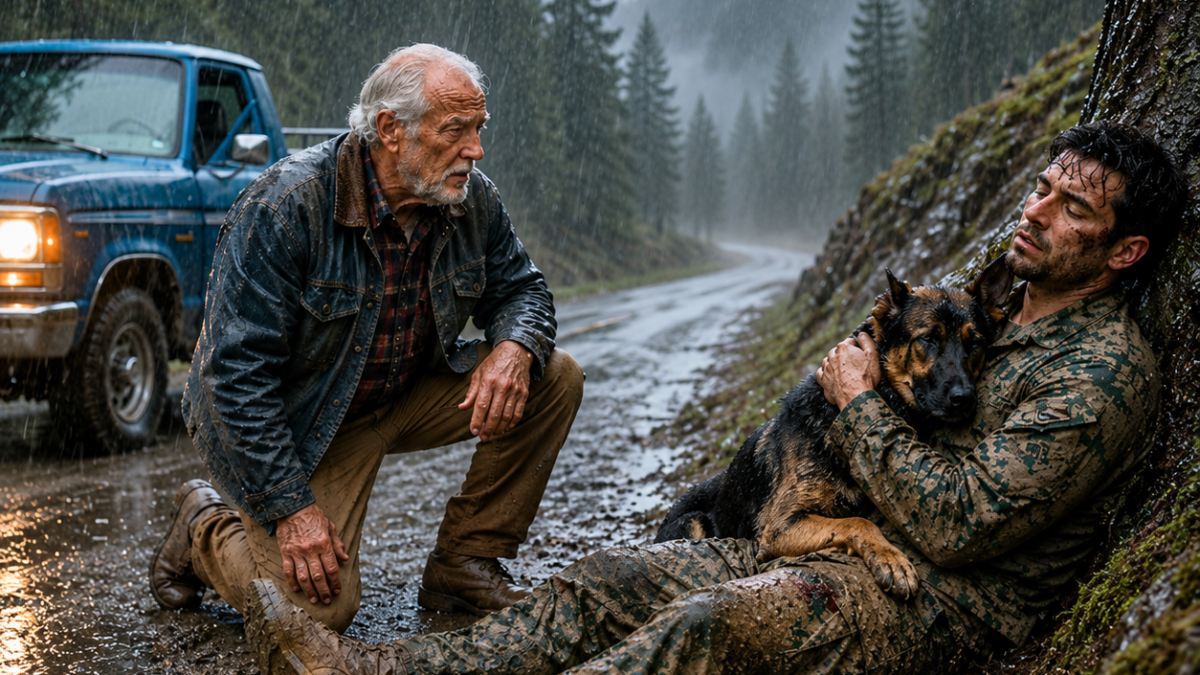
Then, sometime later, an engine slowed.
Old truck.
Rough idle.
Blue.
It stopped.
Ranger moved instantly.
Between me and the road.
His body changed.
Exhaustion disappeared behind duty.
A door opened.
Boots touched gravel.
Ranger growled.
Not loud.
Low.
A warning.
The man who stepped from the truck was old.
Late seventies.
Tall once, though age had bent him slightly.
Silver beard.
Faded denim jacket.
Hands that looked carved from dry wood.
He did not rush us.
That saved him.
He stood beside the open truck door with both hands visible.
“I won’t hurt him.”
Ranger growled again.
The old man nodded.
“I know.”
As if they were having a conversation.
“I’ve seen that look before.”
He reached into the truck.
Ranger stiffened.
The man came back holding a blanket.
Instead of approaching, he laid it on the road several feet away.
Then crouched.
Slowly.
His knees clearly hurt.
“I reckon you’ve been protecting him a while.”
Ranger’s ears moved.
“You’re tired.”
Another low growl.
“I would be too.”
The man took one step.
Ranger blocked him.
He stopped.
Then said something I will remember for the rest of my life.
“If you were my son’s dog, I’d hope somebody stopped for both of you.”
Ranger looked at him.
A long time.
Then moved.
Barely.
Three inches.
Maybe four.
Enough.
The man approached me.
His face came into focus.
Deep wrinkles.
Blue-gray eyes.
Rainwater clinging to his beard.
He put two fingers against my neck.
“Pulse.”
He sounded relieved.
I wanted to tell him not to touch Ranger.
Wanted to ask for a phone.
Wanted to say Marine Corps.
Counterfeit equipment.
Report.
Danger.
What came out was:
“Dog.”
The old man looked toward Ranger.
“He’s coming too.”
Good.
Everything went black.
I woke in a bed.
Not a hospital.
That frightened me immediately.
My hand moved for a weapon that was not there.
Ranger was on his feet before I fully opened my eyes.
Then a voice came from the doorway.
“Easy.”
The old man.
He carried a bowl of soup.
“Where am I?”
“Red Willow.”
“Hospital?”
“Nearest decent one is farther than I wanted to drive with you half-dead in the back.”
I tried standing.
Pain stopped me.
“Phone.”
“On the table.”
I looked.
Old landline.
No cell service, apparently.
“How long?”
“Since I found you? About eighteen hours.”
My head spun.
“What day?”
He told me.
I calculated.
Two days.
Almost exactly.
I had been missing for roughly forty-eight hours before Walter Brooks found me.
“What’s your name?” I asked.
“Walter.”
“Walter what?”
“Brooks.”
He set the soup down.
“You?”
I hesitated.
For the first time in twenty-two years, saying my own name felt dangerous.
“Nathan.”
Walter waited.
I gave him nothing else.
He did not ask.
“You hungry?”
“Yes.”
“Good.”
He nodded toward Ranger.
“Your dog already ate.”
I looked at Ranger.
He had a bowl near the wall.
Empty.
Of course.
I tried the soup.
Beef.
Potatoes.
Carrots.
Too much salt.
Perfect.
Walter watched only long enough to make sure I could eat without passing out.
Then turned to leave.
“Walter.”
He stopped.
“You didn’t call police?”
“No.”
“Why?”
“You looked like you needed food before questions.”
That answer irritated me.
Not because it was wrong.
Because I had spent most of my adult life surrounded by systems where questions came first.
Name.
Rank.
Unit.
Authorization.
Clearance.
Purpose.
Walter gave me soup.
“Why help me?”
He leaned against the frame.
“Do I need a better reason than finding you unconscious in the mud?”
Most people would.
Walter did not.
I ate.
Then slept another six hours.
When I woke, the house was dark except for firelight.
Ranger lay beside the bed.
Walter sat in the next room repairing what looked like an old chair leg.
He had a small workshop attached to the house.
The smell of cedar and pine dust was everywhere.
I sat up.
Slowly.
Pain.
Manageable.
My feet had been cleaned and bandaged.
Whoever Walter was, he had done careful work.
“You a medic?” I asked.
He looked up from the chair.
“Carpenter.”
“Bandages look better than some medics I know.”
“Spent enough years cutting myself to learn.”
I almost smiled.
Almost.
Then I remembered.
Warehouse.
Crates.
Coffee.
I stood.
“Need to make a call.”
Walter pointed toward the phone.
I dialed a number from memory.
Nothing.
The line gave me a connection.
Then transferred.
I identified myself.
Silence.
The person on the other end asked me to repeat.
“Master Gunnery Sergeant Nathan Cole.”
Another silence.
“Authentication?”
I gave information no civilian should have known.
The voice changed.
“Sir, where are you?”
“Montana.”
“Stay on the line.”
No.
Every instinct in me screamed.
Somebody inside the system had done this.
I did not know how far it went.
“Who reported me missing?”
The voice hesitated.
That was enough.
I hung up.
Walter watched from across the room.
No judgment.
“You expecting trouble?”
“Yes.”
“From people you know?”
“Maybe.”
He went back to sanding the chair.
“That kind’s worse.”
I looked at him.
He knew more about loss than his quietness suggested.
I said nothing.
He asked nothing.
That became our pattern.
For four days, I stayed.
I told myself I was recovering.
In truth, I did not know what to do.
If I contacted my command directly, I could be walking back toward whoever had staged my disappearance.
If I disappeared completely, I looked guilty.
Ranger solved his own problem.
He liked Walter.
Not immediately.
Military dogs do not hand out trust.
But Walter did not force it.
He fed him.
Left space.
Never touched without letting Ranger sniff first.
On the third day, Walter opened his workshop.
Ranger followed him.
I followed Ranger.
Morning sun came through dusty windows.
Tools hung in careful rows.
Hand planes.
Chisels.
Saws.
Clamps.
Everything maintained with a level of discipline I recognized.
Walter was poor.
You could tell.
The house needed paint.
His truck had rust around the wheel wells.
His work boots had been repaired rather than replaced.
But his tools were cared for like instruments.
He pointed toward an axe outside.
“Woodpile.”
I stared.
“Excuse me?”
“Breakfast tastes better after work.”
“I’m injured.”
“You were injured yesterday too. Still ate.”
I looked at him.
He looked back.
No smile.
I picked up the axe.
My first swing glanced off the log.
Walter split his cleanly beside me.
Said nothing.
Second swing.
Bad.
Third.
Better.
After forty minutes, sweat had replaced cold in my body.
My ribs hurt.
Palms burned.
My mind, for once, was quiet.
That afternoon, Walter put an oak board on a bench.
Handed me a plane.
“Push.”
I did.
The blade bit too deep and stopped.
“Damn it.”
Walter turned the board over.
“Ruined.”
“No.”
He adjusted the blade.
“You only met your first mistake.”
“I gouged it.”
“Wood survives worse.”
He handed it back.
“Stop forcing it.”
“I know how to use tools.”
“Not this one.”
Fair.
He placed my hands.
“Listen to the grain.”
“It’s wood.”
“Exactly.”
I looked at him like he was insane.
Walter smiled.
“Push.”
This time, I eased pressure.
The blade moved.
A pale ribbon curled from the board.
Clean.
Smooth.
Walter nodded.
“Better.”
That small satisfaction hit me unexpectedly.
I had led Marines.
Completed missions.
Earned commendations.
Survived places where men younger than me never came home.
And somehow shaving a thin strip from a board felt like the first thing I had done in years that did not involve protecting something from danger.
Days became weeks.
That was not the plan.
I always had a plan.
Then, for the first time in my adult life, I stopped.
Walter never asked me to stay.
That helped.
He never asked my last name again.
Never asked why Ranger obeyed hand signals.
Never asked about scars.
Never asked why I flinched when an unfamiliar truck slowed near the workshop.
He simply made room.
A woman named Margaret Ellis started bringing food.
Seventy-two.
Widowed.
Knitted cap.
Sharp eyes.
Her excuse was always the same.
“I cooked too much.”
Walter told me she had been cooking too much for fifteen years.
The first evening she met me, she set bread and stew on the table.
“Supper tastes better shared.”
That was all.
No biography required.
No interrogation.
Red Willow was like that.
Small.
Quiet.
People noticed everything but sometimes had the grace not to demand explanations.
Ranger changed first.
Children walked past Walter’s fence after school.
At first, Ranger tracked them like potential threats.
Then one boy threw a tennis ball.
Ranger stared.
The boy froze.
Ranger walked toward the ball.
Picked it up.
Brought it back.
Three children cheered like he had won a medal.
His tail moved.
Slowly.
Then more.
Watching my combat-trained dog play catch with children almost hurt.
I had spent years believing constant vigilance was responsibility.
Ranger showed me how exhausted that belief had made both of us.
Walter taught without admitting he was teaching.
One afternoon, I nearly destroyed my first chair.
One leg short.
Backrest crooked.
It rocked every time I touched it.
I reached for a hammer.
“Leave it.”
Walter’s voice.
“It’s bad.”
“Yep.”
“It’s useless.”
“Not unless you plan on sitting during an earthquake.”
I glared.
He placed the chair near the front window.
“First ten I made were worse.”
“You kept them?”
“No. Burned most.”
“Then why keep mine?”
“Because I got older.”
He ran one hand over the uneven back.
“If you destroy every imperfect beginning, eventually you start believing perfection is the only thing worth keeping.”
That landed harder than he intended.
Or maybe exactly as hard.
I lowered the hammer.
The chair stayed.
Months passed.
I started helping Walter around town.
Repairing a widow’s porch.
Fixing shelves at the library.
Reinforcing pews in the church.
Nothing glamorous.
Nobody saluted.
Nobody wrote reports.
An elderly couple gave us homemade jam for repairing their kitchen chairs.
A schoolteacher paid us with twenty dollars and too many cookies for a bookshelf.
Walter treated every project like it mattered.
One day I asked why.
“That table’s not valuable.”
“The people eating at it are.”
Simple.
He said things like that constantly.
Annoying man.
Then he took me to the cemetery.
Spring had started breaking through the last patches of Montana snow.
Ranger trotted ahead.
Walter carried wildflowers.
We climbed a hill.
He stopped at a grave marked with a small American flag.
DANIEL BROOKS.
Twenty-six.
Walter placed the flowers.
“This is my boy.”
I looked at him.
“Army?”
He nodded.
“Killed overseas?”
“Yes.”
I said the words Marines say because sometimes all we have are formal phrases.
“I’m sorry.”
Walter kept looking at the stone.
“I was angry for a long time.”
“I understand.”
“No, you don’t.”
I almost took offense.
Then he continued.
“You might understand your anger. Not mine.”
Fair.
He sat on a bench.
“I blamed everybody.”
Government.
Commanders.
War.
Politicians.
The world.
Himself.
“Then one day, I realized anger wasn’t bringing Daniel home.”
Walter looked toward me.
“It was just keeping me from helping somebody else’s son.”
My chest tightened.
I finally understood.
“You didn’t stop because you knew I was military.”
“No.”
“You didn’t know.”
“No.”
“Then why?”
Walter looked surprised by the question.
“Because somebody was waiting for you somewhere.”
I could not answer.
He added, “Just like I waited for mine.”
For months, I had been thinking about repayment.
Money.
Work.
Anything.
Walter did not want repayment.
He had already converted grief into something else.
That terrified me.
Because it meant maybe I could too.
Far away from Red Willow, Captain Emily Carter of the Naval Criminal Investigative Service had refused to accept the official story about me.
I would not learn that until later.
The report said I had disappeared during a logistics transfer.
Then an entry labeled me absent without authorization.
Eventually, the language moved toward desertion.
But my service record did not fit.
Twenty-two years.
No disciplinary history.
No unexplained financial problems.
No reason to run weeks before retirement.
Emily noticed the same supply discrepancy I had.
Counterfeit ballistic plates.
Missing medical kit components.
Changed records.
She reopened transportation files.
Interviewed contractors.
Found security footage gaps.
Then someone mentioned an old blue truck near Bitterroot National Forest around the time I vanished.
Small clue.
Almost nothing.
She followed it anyway.
Six months after Walter found me, a dark government SUV rolled into his yard.
Ranger heard it first.
His head lifted.
But he did not bark.
Progress.
The woman who stepped out wore plain clothes.
Short chestnut hair.
Document case.
No visible weapon.
She removed sunglasses.
“Master Gunnery Sergeant Nathan Cole?”
Every muscle in me tightened.
Walter came out carrying coffee.
Because apparently federal investigations did not override coffee.
“Drink first.”
Captain Carter actually smiled.
We sat on the porch.
Rain tapped against the roof.
She opened the case.
Photos.
Statements.
Records.
Lab reports.
“You never abandoned your post.”
I said nothing.
“We know.”
My hands stayed around the coffee mug.
“Who?”
“Several civilian contractors. Two military personnel are also under investigation.”
My jaw tightened.
She continued.
“The equipment substitution was larger than what you discovered. Counterfeit plates. Missing trauma supplies. Procurement fraud.”
“People could have died.”
“Yes.”
“Did they?”
“We are still reviewing deployment records.”
I looked away.
Anger returned quickly.
Old familiar heat.
Emily continued.
“Your disappearance bought them time.”
“Drugged coffee?”
“Lab evidence from the meeting room supports a sedative.”
“They stripped my uniform.”
“Yes.”
“Filed me as AWOL.”
“That filing was manipulated.”
I laughed once.
No humor.
“Convenient.”
“Nathan.”
It had been a long time since anyone outside Red Willow used my name like that.
“We’re clearing your record.”
I should have felt relief.
Victory.
Vindication.
Instead, I looked toward the workshop.
My crooked chair sat by the window.
The birdhouse Walter and I built hung near the church garden.
Ranger slept beneath the maple tree.
The life I had been desperate to recover six months earlier no longer felt like the only life available.
Emily seemed to understand.
“You don’t have to leave today.”
Walter sipped his coffee.
“Serious people are finally learning patience.”
I ignored him.
Emily closed the file.
“The investigation is secure.”
I stared at my hands.
Calluses.
Small scars from chisels.
Blisters healed into tougher skin.
Walter said, “Only one person decides what road comes next.”
I looked at him.
“I’m not afraid of going back.”
“No?”
“I’m afraid of becoming the man who left.”
Walter put down his cup.
“Look at your hands.”
I did.
“That man had hands too.”
“Not these.”
He smiled.
“You’re still Nathan.”
“I know.”
“Then stop acting like going somewhere means surrendering what you learned.”
I hated when he made sense.
Three days later, I left Red Willow.
Walter drove Ranger and me to a small station.
Before I boarded, he reached behind the truck seat.
Wrapped object.
He handed it to me.
The old wooden hand plane.
The one from my first day.
“No.”
“Yes.”
“Walter, this is yours.”
“Tools don’t belong on walls.”
“I can buy one.”
“Then buy a worse one.”
I held it.
The handle had been polished by decades of his hands.
“I can’t take this.”
“Already did.”
“What am I supposed to do with it?”
“Remember.”
He extended his hand.
No hug.
Thank God.
I shook it.
Ranger climbed aboard.
Then turned back.
Looked at Walter.
Walter raised one hand.
“Go on.”
Ranger obeyed.
At the Marine installation, conversations stopped when I walked through the gate.
Some men stared.
Some looked away.
Some had believed I ran.
I could see it.
I did not blame all of them.
Official stories have weight.
Especially in institutions built on trust.
Captain Carter presented the evidence.
My record was restored.
The AWOL designation removed.
The forged documentation exposed.
Those responsible were already facing charges.
My commanding officer offered apologies I could tell he meant.
Then something else.
A promotion.
I almost laughed.
“Sir, respectfully, no.”
He looked surprised.
“You’ve earned it.”
“Maybe.”
“Then why decline?”
Twenty-two years of my life lived inside that uniform.
I respected it.
Loved parts of it.
Lost people in it.
Found purpose through it.
But Walter had taught me that purpose does not have to wear rank.
“I’ve spent twenty-two years serving this uniform.”
I paused.
“I think I want to serve people differently now.”
I completed the formal process necessary to retire with my record restored.
No spectacle.
No dramatic ceremony.
Ranger and I returned to Montana.
Walter pretended he had not expected us.
Margaret baked an entire pie.
So clearly the whole town knew.
The workshop changed after that.
At first, slowly.
A former Marine stopped by because someone told him “that guy Nathan” worked with an old carpenter.
He had been out three months.
Could not sleep.
Did not know what to do with his hands when nobody gave him orders.
Walter handed him sandpaper.
“Table needs finishing.”
The Marine looked confused.
“That’s it?”
“That’s plenty.”
He came back the next day.
Then a teenager.
Expelled twice.
Good with tools.
Bad with classrooms.
Walter gave him a broken cabinet.
“Fix it.”
“I don’t know how.”
“Good place to start.”
Then another veteran.
Then another kid.
A widow asked whether we could teach her grandson.
A local church donated lumber.
A hardware store donated tools.
Nobody planned a program.
Walter would have hated a strategic plan anyway.
But the workshop filled.
Mornings smelled like cedar and coffee.
Afternoons sounded like sanding, laughter, arguments about measurements, Ranger barking at squirrels, and Walter telling everyone they were using too much glue.
He never charged anyone to learn.
We still took repair jobs.
That paid bills.
Not many.
Enough.
One afternoon, I caught Walter standing in the doorway watching a group of teenagers and veterans building benches.
“Looks different.”
He nodded.
“Louder.”
“You hate loud.”
“Not this kind.”
The old man smiled.
“Wood sounds different when people work together.”
I understood.
A year later, Walter started slowing.
Not suddenly.
Age does not always announce itself.
He carried lighter boards.
Sat more often.
Let me drive.
That last one was the strongest evidence he was declining.
Ranger began staying near him.
If Walter walked to the shed, Ranger followed.
If Walter sat on the porch, Ranger lay at his feet.
One autumn evening, after everyone left, Walter stood beside my crooked chair.
Still there.
Still rocking.
“You know,” he said, “that ugly thing has taught more people than anything else in here.”
“It’s not ugly.”
“It’s hideous.”
“You kept it.”
“That proves nothing.”
I smiled.
“Everyone sees themselves in it.”
Walter nodded.
“Exactly.”
That winter, Walter died in his sleep.
Eighty-two.
Peacefully.
Margaret found him when he did not come for coffee.
I knew before she said anything.
Ranger knew before I did.
He went to Walter’s bedroom door.
Lay down.
Would not move.
The funeral filled the church.
Farmers.
Teachers.
Children.
Veterans.
People whose homes Walter repaired.
People whose furniture he restored.
People who owed him money.
People he refused to let repay him.
Marines came from across the country after hearing what he had done for me.
I stood in front of the congregation holding his hand plane.
I had written a speech.
Then ignored it.
“The greatest teacher I ever knew never commanded a platoon.”
Silence.
“He never wore medals.”
I looked at the casket.
“He stopped an old pickup on a road where everyone else kept driving.”
My throat tightened.
“I thought Walter saved my life in that forest.”
I looked toward Ranger.
Gray beginning around his muzzle now.
“He did.”
I paused.
“But that wasn’t the biggest thing he gave me.”
The room was still.
“He taught me how to live after surviving.”
That was Walter.
Not rescue.
Rebuilding.
Years passed.
The workshop stayed open.
I kept my promise.
Not one I had spoken to Walter.
One I made to myself the evening he said the place finally sounded right.
Veterans came.
Teenagers came.
People recovering from addiction.
Widowers.
Men who had spent thirty years believing strength meant silence.
Women starting over after marriages ended.
Kids who needed somewhere to belong between school and darkness.
We never asked for a perfect explanation.
We asked what they wanted to build.
Sometimes a chair.
Sometimes a shelf.
Sometimes nothing.
Some people simply swept the floor for a week before touching a tool.
Ranger aged beside us.
His muzzle turned white.
He stopped chasing tennis balls.
Then stopped chasing squirrels.
Eventually he spent afternoons beneath the maple tree, opening one eye whenever children approached.
They always asked:
“Can I pet him?”
“Let him choose.”
Walter would have liked that.
One spring morning, a young man stopped outside the gate.
Late twenties.
Marine haircut growing out.
Backpack.
Nervous service dog pressed against his leg.
He did not enter.
Just stood there.
I recognized the look.
A man unsure whether he was still useful outside the life that had defined him.
I walked across the yard.
Opened the gate.
He said, “I heard veterans can come here.”
“Anybody can.”
“I don’t know woodworking.”
“Neither did I.”
His dog watched Ranger beneath the tree.
Ranger lifted his head.
Tail moved once.
The young Marine asked, “What do you charge?”
I smiled.
“Coffee’s terrible.”
He almost laughed.
“That the price?”
“Pretty much.”
He looked toward the workshop.
“What do you do here?”
A hundred answers came to mind.
Furniture.
Repairs.
Training.
Veteran support.
Mentoring.
None were right.
I looked at Walter’s old hand plane hanging beside my bench.
Not on display.
Still used.
“Build things.”
The Marine nodded.
“What kind?”
I opened the gate wider.
“Depends what needs rebuilding.”
He came in.
Years later, people would occasionally tell Walter’s story incorrectly.
They called him wealthy.
He was not.
They called him a decorated veteran.
He was not.
Some said he recognized Ranger’s military collar and knew immediately he had found a Marine.
Not true.
He noticed the collar.
But Walter helped us before he knew anything.
That mattered.
Because his kindness was not an investment.
He did not stop because saving a Marine would make a good story.
He stopped because two living creatures were dying beside a road.
That was enough.
People also liked the betrayal part.
Counterfeit armor.
Conspiracy.
Federal investigators.
A Master Gunnery Sergeant framed as a deserter.
It made a better headline.
But when I think about the most dangerous moment of my life, I do not think about the warehouse.
I think about the road.
Rain.
Ranger trembling over me.
Cars passing.
One after another.
Each driver probably had a reason.
Late.
Afraid of the dog.
Did not notice.
Assumed somebody else would handle it.
Then one rusted blue pickup slowed.
Walter did not know whether I was dangerous.
He did not know whether Ranger would bite.
He did not know whether I had money.
He did not know whether anybody would thank him.
He stopped anyway.
Sometimes I wonder what would have happened if he had driven past.
Ranger would have stayed.
I know that.
He would have stayed until his body failed.
Maybe someone else would have come.
Maybe not.
The distance between those possibilities was one old carpenter deciding not to keep driving.
That is why the workshop still has a rule.
It is written on a board near the entrance.
Not fancy.
I carved it myself.
Walter would have told me the letters were uneven.
They are.
It says:
IF YOU SEE SOMEONE STRUGGLING, STOP.
Not fix.
Not save.
Not control.
Stop.
Sometimes stopping is enough to see what is actually needed.
Walter stopped.
Then listened.
Then offered a blanket.
Then food.
Then work.
Then silence.
Then wisdom.
Piece by piece.
Like woodworking.
He never forced me into the shape he thought I should become.
He listened to the grain.
One evening, many years after his death, I sat alone in the workshop.
The crooked chair still rested beside the front window.
I was older.
Ranger was gone by then.
We buried him near the maple tree.
His collar hung beside Walter’s photograph.
The workshop was quiet because everyone had left.
Late sunlight moved through sawdust in the air.
I picked up Walter’s hand plane.
The handle fit my palm differently now.
Or maybe my hand had changed.
I placed an oak board on the bench.
Pushed.
A thin ribbon curled away.
Smooth.
Steady.
I heard Walter as clearly as if he were beside me.
Don’t force the wood.
I smiled.
“Yeah, old man.”
The next morning, I gave the hand plane to a young veteran named Caleb who had been coming to the shop for almost two years.
He stared at it.
“I can’t take this.”
I laughed.
Those exact words.
“Tools aren’t meant to spend their lives hanging on walls.”
“But this was Walter’s.”
“Then mine.”
“And now?”
“Yours.”
He held it carefully.
“What am I supposed to remember?”
I thought about Walter on the roadside.
My crooked chair.
Daniel’s grave.
Ranger sleeping peacefully for the first time.
Captain Carter’s folder.
My restored name.
The workshop full of people.
One act of kindness still moving through lives decades later.
“Patience,” I said.
Caleb nodded.
“That all?”
“No.”
I smiled.
“Stop when everybody else keeps driving.”
He looked down at the plane.
Then toward the open workshop doors.
Outside, two teenagers were unloading donated lumber.
An older veteran showed someone how to measure twice.
A nervous service dog lay beneath the maple tree where Ranger used to sleep.
The building was full of noise.
The right kind.
Walter once told me a safe place for something small could teach a man how to build one for people.
He was right.
The old carpenter never became wealthy.
Never received a medal for finding me.
Never saw his name on national television.
He never asked for recognition.
Most of what he did would have looked insignificant to somebody passing through Red Willow.
Repairing chairs.
Fixing doors.
Teaching a kid to use a saw.
Sharing dinner.
Stopping an old truck.
But I learned in combat that small actions determine whether people come home.
Walter taught me the same is true in peace.
One blanket.
One meal.
One open workshop.
One decision not to look away.
Those things built the rest of my life.
I served my country for twenty-two years.
I am proud of that.
But the mission that lasted longest began after I took off the uniform for the final time.
It began with an old man whose hands smelled like sawdust telling a broken Marine not to force the wood.
And if Walter could see the workshop now, filled with veterans, teenagers, widows, lost people, found people, and dogs sleeping safely beneath the trees, I know exactly what he would say.
He would complain the floor needed sweeping.
Then he would pour coffee.
Hand somebody a tool.
And make room at the bench.
Because that was how Walter Brooks loved people.
He built them somewhere safe to begin again.








