An Elderly Woman Gave a Navy SEAL and His K9 Shelter in a Blizzard—Then the Navy Showed Up to Save Her 2,000-Tree Farm
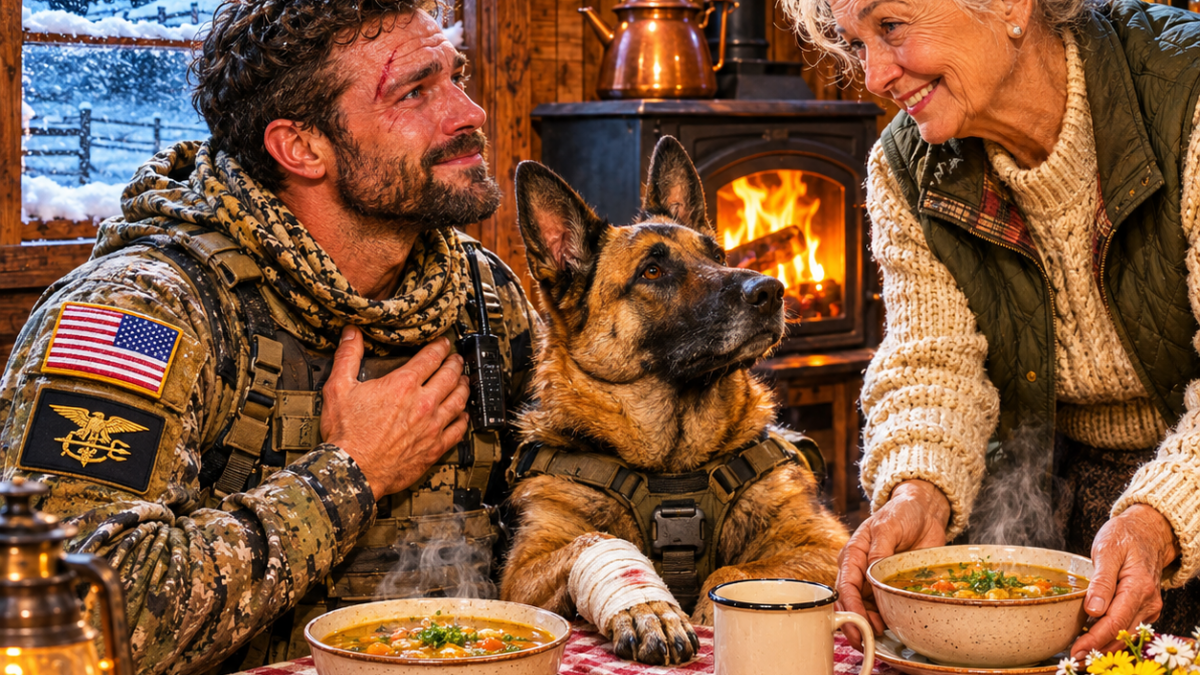
An Elderly Woman Gave a Navy SEAL and His K9 Shelter in a Blizzard—Then the Navy Showed Up to Save Her 2,000-Tree Farm.
When Navy Senior Chief Owen Kessler’s truck slid into a ditch during a brutal Upper Peninsula blizzard, a seventy-six-year-old widow named Aggie opened her farmhouse door without asking who he was, treated his injured K9 Diesel beside her woodstove, and fed them both before she even learned his name.
By morning, Owen discovered that the woman who had rescued two strangers was quietly preparing to lose the Christmas-tree farm she had spent forty-one years building because she could no longer swing a saw, see the hidden stumps beneath the snow, or risk another winter fall that might leave her lying alone for six hours.
Two weeks later, just as Aggie’s daughter prepared to move her into assisted living and the 2,000-tree field sat almost empty on what was supposed to be its final Christmas, Diesel came bounding over the hill—followed by trucks, sailors, children, dogs, saws, cocoa, generators, and an entire Navy team determined to repay the woman who had once said, “Bring the dog inside; you can come too.”
The snow came sideways.
That was what Owen remembered most.
Not down.
Sideways.
It moved through the darkness in long white sheets, erased the road faster than his headlights could find it, and made every mile along Michigan’s Upper Peninsula feel like he was driving through television static.
Diesel stood braced in the passenger footwell.
Ninety pounds of dark sable German Shepherd.
Broad chest.
Scar over one shoulder.
Three years into Navy service.
Still alert even though the truck had been crawling for nearly an hour.
Owen kept one hand on the steering wheel.
The other rested near the gear selector.
His mother’s voice came through the truck speakers.
“Honey, they closed the highway at Marquette.”
“I know.”
“You need to pull over.”
“There is nowhere to pull over.”
“Gas station?”
“Passed the last one forty minutes ago.”
“Motel?”
“Mom.”
“I’m just saying.”
Owen smiled despite himself.
“You’re seventy miles away trying to navigate a road you can’t see.”
“I’m your mother.”
“That apparently comes with satellite imagery.”
“It comes with knowing my son.”
Diesel’s head lifted suddenly.
Owen looked ahead.
Nothing.
Snow.
Trees.
Then taillights.
No.
Reflectors.
A curve sign.
Owen eased the truck left.
The rear end slid.
He corrected.
Too much.
The right tires dropped from the plowed edge.
Then the truck went sideways.
PART2:
“Hold on.”
His mother said:
“What?”
“Mom, I have to—”
The front end dropped.
The world tilted.
The truck slammed through snow and stopped hard against the shallow ditch bank.
Diesel yelped.
Owen’s shoulder struck the door.
Silence.
Engine still running.
Windshield covered white.
His mother’s voice:
“Owen?”
He breathed.
“I’m okay.”
“Diesel?”
Owen turned.
Diesel stood awkwardly.
Right front paw lifted.
“Easy.”
Owen killed engine.
Unbuckled.
Diesel tried moving.
Blood spotted the rubber floor mat.
“Damn.”
“What happened?”
“Diesel cut his paw.”
“You need help.”
“I know.”
“Call someone.”
PART3:
He looked at phone.
One bar.
Then none.
“Signal’s dropping.”
“Owen—”
“I’m going to check the truck.”
He opened door.
Wind hit like a physical blow.
Snow entered instantly.
His mother shouted through speaker.
“Do not walk anywhere.”
“I’m not.”
“That is exactly what you say before doing something stupid.”
“I learned from you.”
“Very funny.”
He stepped into knee-deep snow.
The truck was not driving out.
Rear wheel buried.
Front right tire nearly off ground.
Even with four-wheel drive, without shovel or traction boards it was finished until plow or tow.
He climbed back inside.
Phone disconnected.
No signal.
He took Diesel’s paw.
The cut was shallow but bleeding.
Probably ice or metal beneath snow during impact.
Owen cleaned it with bottled water.
Compressed gauze from field kit.
Diesel tolerated everything.
“Easy.”
The dog looked at him.
“You’re okay, buddy.”
Owen checked temperature.
Four degrees.
Windchill far lower.
Fuel tank half.
Could sit overnight with intermittent heat.
Maybe.
But Diesel’s paw concerned him.
So did visibility.
If plow came through and missed truck down ditch, maybe morning.
Owen looked through side window.
Across road.
Trees.
Then something faint beyond them.
Yellow.
One light.
Maybe porch.
Maybe barn.
Maybe reflector.
He waited.
Snow shifted.
Light remained.
House.
Quarter mile uphill.
Possibly less.
Owen looked at Diesel.
“See that?”
Diesel’s ears moved.
“That’s where we’re going.”
He layered coat.
Pulled gloves.
Wrapped Diesel’s paw with boot cover from K9 medical kit.
Took emergency pack.
Turned hazards on.
Left truck.
Walking was harder than expected.
Snow reached mid-thigh where drifts crossed ditch.
Wind erased footprints almost immediately.
Diesel limped.
Owen kept him on short leash.
“Easy.”
They crossed road.
Entered tree line.
Light disappeared twice.
Returned.
Farm lane.
Old fence.
Something large and dark to left.
Rows.
Trees.
Thousands maybe.
At top stood farmhouse.
Two stories.
Wood siding.
Porch.
One lamp.
Owen climbed steps.
Diesel leaned harder into left side.
Owen knocked.
Nothing.
Again.
He heard movement.
Then a woman’s voice from inside.
“Who’s out there?”
Owen leaned toward door.
“Ma’am, my truck went into ditch.”
“What?”
“My truck’s in the ditch.”
“Speak up.”
“My ears are seventy-six years old.”
Owen raised voice.
“My truck slid off road.”
Door cracked open.
A woman looked at him through narrow gap.
Small.
Silver hair pulled behind.
Wool cardigan under housecoat.
One hand on door.
Other holding a cast-iron skillet.
Owen almost smiled.
Then she saw Diesel.
Her expression changed.
“Dog hurt?”
“Cut paw.”
“Bring him in.”
Owen hesitated.
“Ma’am—”
“Do not stand there letting heat out.”
She opened door.
“Bring the dog.”
Then looked at Owen.
“You can come too.”
That was how Owen Kessler met Agnes Lindquist.
Everyone called her Aggie.
He learned this fifteen minutes later, after she ordered him to remove his boots, hang his coat, stop apologizing, put Diesel on a quilt beside a cast-iron woodstove, and hold the dog’s leg while she examined his paw beneath a kitchen lamp.
“Careful.”
Owen said.
“He was trained to bite.”
Aggie looked at Diesel.
Diesel looked at Aggie.
She touched paw.
Pressed gently around cut.
Diesel did nothing.
Aggie snorted.
“Terrifying.”
Owen watched.
“He doesn’t usually let strangers handle his feet.”
Aggie cleaned wound.
“He knows I’m useful.”
“Thirty years vet tech.”
“Mostly livestock.”
“You work with military dogs?”
“I stitched a Holstein during a blizzard once.”
Owen blinked.
“A Holstein.”
“A cow.”
“I know what a Holstein is.”
“Then keep up.”
She clipped fur.
Checked pad.
“No stitches.”
“Clean cut.”
“Bandage overnight.”
“Keep him warm.”
She wrapped paw professionally.
Diesel leaned his head against her knee.
Owen stared.
Aggie looked at dog.
“Smart boy.”
Then at Owen.
“Not once?”
“What?”
“You’ve been staring like he performed a magic trick.”
“He doesn’t do that.”
“What?”
“Lean on people.”
“Took me a year.”
Aggie scratched Diesel’s ear.
“Well.”
“He likes the cook.”
She stood.
“Soup.”
Owen said:
“Ma’am, I don’t want to—”
Aggie pointed wooden spoon at him.
“Nobody argues in my kitchen.”
Ten minutes later Owen sat at a heavy oak table eating thick yellow soup with ham, onions, carrots, and something smoky he could not identify.
Fresh bread.
Butter.
Diesel asleep near stove.
Owen realized he was starving.
“This is really good.”
“What is it?”
“Swedish pea soup.”
“My mother’s recipe.”
“Eat slower.”
Owen slowed.
Aggie sat opposite with coffee.
Studied him.
“You’re not from around here.”
“No.”
“You sit like you expect somebody to shoot through the window.”
Owen looked toward dark window.
“Old habit.”
“Military?”
“Navy.”
Aggie nodded as if that explained everything.
“On leave?”
“Yes, ma’am.”
“Going where?”
“Duluth.”
“Mom?”
He smiled.
“Yes.”
“Then she’s going to worry.”
“She already is.”
“Good.”
“That’s her job.”
Power flickered once.
Aggie glanced toward ceiling.
“Generator’s in barn if it goes.”
“You live alone?”
She looked at him.
“Eleven miles from town.”
“Forty-one years.”
“That wasn’t my question.”
Aggie narrowed eyes.
“You interrogate everyone who feeds you?”
“Occupational habit.”
She looked at his soup bowl.
“I can take that back.”
Owen smiled.
“Yes, ma’am.”
Later, he tried to pay her.
That went badly.
He took cash from wallet.
“For bandages.”
“And food.”
“And trouble.”
Aggie stared at twenty-dollar bills.
“Put that away.”
“Ma’am—”
“Try that again and you’re sleeping in barn with chickens.”
Owen put money away.
“Copy that.”
Aggie nodded.
“Better.”
She looked out window.
“Roads won’t open until Monday.”
Owen stopped.
“It’s Friday.”
“Yes.”
“County clears highway.”
“School road.”
“Then us.”
“We’re last.”
“Always have been.”
He checked phone.
Still no signal.
Guest room upstairs.
Clean sheets.
Old quilt.
Diesel slept on rug beside bed.
Owen lay awake.
House creaked.
Wind pressed walls.
At two in morning he gave up.
Went downstairs.
Aggie was already at table.
Coffee.
Lamp.
“You can’t sleep either.”
She asked.
“No.”
“This house creaks like a ship.”
Owen sat.
“I’m Owen.”
Aggie smiled.
“Aggie.”
“Feels strange introducing ourselves after you bandaged my dog and threatened me with chickens.”
“It builds trust.”
There was framed photograph on sideboard.
Young woman in nursing scrubs.
“Your daughter?”
“Diane.”
“Chicago.”
“Nurse.”
“Smartest girl in county.”
“She visit?”
“Christmas when she can.”
“Hospitals don’t close for holidays.”
Aggie looked toward stove.
Diesel slept.
“Your dog has better manners than most men I’ve known.”
“Present company included?”
“Maybe.”
Owen smiled.
Then silence settled.
Not uncomfortable.
Just old-house quiet.
Aggie looked around.
“I tell people I like quiet.”
She stirred coffee.
“That’s mostly true.”
“Mostly?”
She shrugged.
“Now it’s just quiet.”
“Nobody needs anything from me anymore.”
“Tonight somebody knocked.”
Owen looked at her.
“Glad it was your door.”
She looked away quickly.
“Go to bed, Sailor.”
Morning brought three feet of snow.
Owen cleared porch while Aggie criticized technique.
“You’re shoveling wrong.”
He looked back.
“What?”
“Push.”
“Don’t lift.”
“I’ve carried—”
“You’ll wreck your back by noon.”
“I’ve carried heavier things than snow.”
Aggie pointed.
“Forty-one winters.”
“Push.”
Owen pushed.
It was easier.
“Noted.”
Diesel limped behind, bandage dry.
Then a rooster charged from barn.
Diesel froze.
Large red bird lowered head.
Charged again.
Diesel retreated.
Owen laughed.
“Seriously?”
Aggie laughed so hard she had to hold porch rail.
“That’s Gustav.”
“He’s run this yard longer than your dog’s been alive.”
Diesel barked once.
Gustav advanced.
Diesel moved behind Owen.
“Lost to a chicken, buddy.”
Aggie kept laughing.
For first time Owen realized how different she looked when she laughed.
Her face changed completely.
Later they split kindling.
Aggie brought pieces too large.
Owen took axe.
“Smaller.”
She said.
“That stove’s older than me.”
“Likes them skinny.”
“Like I used to be.”
Owen laughed.
Aggie looked at him.
“There it is.”
“What?”
“I was starting to think you forgot how.”
Owen became busy with wood.
He had not forgotten.
Maybe.
But people around him were used to a different version of him.
Senior Chief Kessler.
Team leader.
Controlled.
Quiet.
The man who made other people less nervous because he rarely appeared nervous himself.
Aggie did not care.
To her he was simply a sailor who arrived in a blizzard with injured dog and poor shoveling technique.
He repaired porch step that afternoon.
Then barn hinge.
Aggie protested each time for approximately thirty seconds before finding something else broken.
“Who fixes things around here?”
Owen asked.
“I do.”
“You did.”
Aggie looked at him.
“My shoulder isn’t what it was.”
“Neither are eyes.”
She touched porch post.
“That step’s been cracked since summer.”
“I stopped seeing it.”
Owen tightened bolt.
“Happens.”
Her phone rang.
Aggie looked.
“That’ll be Diane.”
“It’s not Sunday.”
“So she wants something.”
She answered.
“Hello, honey.”
Diane’s voice came loudly through speaker.
“Mom, storm is all over news.”
“Are you okay?”
“Power on?”
“Power’s fine.”
“Road?”
“Closed.”
“Mom, I called place in Green Bay again.”
Aggie’s expression changed.
Owen pretended to focus on hinge.
“They have a room December fifteenth.”
“We talked about this.”
“Mom, you cannot even see rows anymore.”
“Nobody’s moving me before tree season.”
“You said tree field wasn’t opening this year.”
“I said we’d discuss it.”
“Mom.”
Aggie ended call with:
“I love you, honey.”
Then hung up before Diane could answer.
Owen waited.
“Green Bay?”
Aggie stared toward window.
“Assisted living.”
“My daughter means well.”
“She’s terrified.”
“Why?”
Aggie sighed.
“Last winter I slipped in barn.”
“Lay there six hours.”
Owen stopped.
“Six hours?”
“Mailman heard Gustav making noise.”
“Diane drove nine hours in snow.”
“She hasn’t stopped worrying.”
Owen looked toward barn.
“You could’ve died.”
Aggie’s jaw tightened.
“Yes.”
“I know.”
She went to window.
Outside, rows of Christmas trees disappeared under white.
“Planted first row in 1984.”
“Twelve seedlings.”
“Coffee can.”
She smiled faintly.
“Look at them.”
Owen stepped beside her.
Rows disappeared across hill.
“How many?”
“Two thousand.”
“Give or take.”
“Every December families come.”
“Cut their own.”
“Town square tree comes from here.”
“Forty feet of lights.”
“Kids wait all year.”
She looked at her hands.
“I can’t swing saw anymore.”
“Can’t see stumps under snow.”
“If I fall…”
She did not finish.
Owen understood.
“This is first year?”
“Forty-one Decembers.”
“This would be first time field stays dark.”
“Does town know?”
“Not yet.”
“I’ll put sign.”
“They’ll go to lot in Marquette.”
She looked at Owen.
“You got quiet.”
“Quieter than usual.”
“That’s saying something.”
“Thinking.”
“Don’t strain anything.”
Owen looked back over field.
Two thousand trees.
One old woman.
Closed road.
One daughter trying to protect her.
He said nothing.
Aggie pointed spoon at him from kitchen later.
“Do not get ideas.”
“What ideas?”
“You have mother waiting in Duluth.”
“I would never.”
She narrowed eyes.
“Liar.”
That night power failed.
House went black.
Wind louder immediately.
Aggie had flashlight before Owen stood.
“Generator.”
“Barn.”
“Five minutes there and back.”
“I’ll go.”
“No need to wake you.”
“I’m awake.”
Aggie already had coat.
“Owen, I’ve started that generator forty winters.”
“Stay inside.”
She glared.
“I am not one of your sailors.”
“No, ma’am.”
“Clearly.”
She opened door before he got boots on.
Owen muttered something Diesel heard.
Dog raised head.
Aggie’s flashlight bobbed toward barn.
Then vanished.
Owen pulled boots.
Coat.
He was halfway to door when Diesel stood suddenly.
Not slowly.
Instant.
Head high.
Ears forward.
Then bark.
Once.
Sharp.
Working bark.
Owen froze.
“What?”
Diesel ran to door.
Scratched.
Whined.
“Show me.”
Owen opened.
Diesel launched into snow.
Paw still bandaged.
“Diesel!”
Dog moved toward barn.
Not path Aggie took.
Around side.
Owen followed.
Knee-deep snow.
Wind.
Diesel disappeared behind drift.
Then barked.
Owen found Aggie lying beside barn ramp.
Flashlight several feet away.
Generator shed door open.
“Aggie!”
Her eyes opened.
“Took you long enough.”
Owen dropped beside her.
“Where hurt?”
“Ankle.”
“Just ankle.”
He checked head.
Pupils.
No obvious head injury.
Shoulder.
Hip.
Then ankle.
Swelling.
Likely sprain.
“Can you stand?”
“Of course.”
She tried.
Could not.
Owen took her under arms.
“No.”
“I can walk.”
“You’re lying in snow.”
“I was handling it.”
“Aggie.”
Her face changed.
Not stubborn.
Afraid.
“I wasn’t scared of dying.”
She whispered.
Owen stopped.
“I was scared of being found too late again.”
Diesel pressed nose into her cheek.
Aggie closed eyes.
“Your dog found me.”
“Not you.”
Owen swallowed.
“He’s smarter.”
“Clearly.”
He carried her inside.
Started generator himself.
Wrapped ankle.
Called county once signal returned.
No ambulance could reach immediately.
Volunteer medic came by snowmobile hours later.
Sprain.
Not break.
Aggie refused hospital once road opened.
Owen argued.
Lost.
Sunday morning plow finally came.
Road open.
His truck towed.
Diane called repeatedly.
Aggie stared at Owen while he answered one.
“Not one word.”
He covered microphone.
“I won’t lie.”
“If she asks, I tell truth.”
Aggie narrowed eyes.
“Fair.”
“Just don’t volunteer it.”
Owen smiled.
“Deal.”
His truck was drivable.
Diesel’s paw healing.
Aggie packed:
Coffee.
Bread.
Meatballs.
Enough food for platoon.
Owen stood by porch.
No idea what to say.
“There’s no way to thank you.”
“Then don’t.”
“Drive safe.”
Diesel stood beside truck.
Did not jump in.
Instead walked back to Aggie.
Sat at her feet.
She scratched his head.
“Well, look at him.”
“He’s made his choice.”
“He’s under orders.”
“Go on, handsome.”
She pointed toward Owen.
“Somebody has to take care of that sailor.”
Diesel returned.
Owen laughed.
“I’ll call Sunday.”
“Like Diane.”
“You’d better.”
He opened truck door.
Aggie called:
“Owen.”
He turned.
“Thank you for porch step.”
“And stew?”
She smiled.
“And stew.”
He drove to Duluth.
His mother cried when he arrived.
Then yelled at him for nearly dying.
Then fed Diesel more than veterinarian recommended.
Normal.
But Aggie stayed in his head.
Especially field.
Two thousand trees.
Sunday came.
Owen called.
“Aggie.”
“You remembered.”
“How’s ankle?”
“Fine.”
“What’s that banging?”
Silence.
“What?”
“Nothing.”
“A man from realty office.”
Owen sat straighter.
“Realty?”
“Diane’s listing place.”
“Spring.”
“It’s for best.”
“Did you open field?”
“No.”
“Sign’s up.”
“Closed this year.”
“Folks were kind.”
“Don’t worry.”
“You’ve got real work.”
“Aggie—”
“Give Diesel meatball.”
“Bye, Sailor.”
She hung up.
Owen stared at phone.
Twenty minutes later, Senior Chief Boone Halvorson threw balled napkin at him.
“Kessler.”
Owen looked up.
Team room.
“Twice I’ve called your name.”
“Where’s your head?”
“Sorry, Senior Chief.”
Boone looked at Diesel.
“Dog’s sharper than you.”
“That’s first.”
Owen said nothing.
Boone pointed.
“Coffee.”
“Then talk.”
“That’s order.”
Owen came back with mug.
Team gathered.
He told them.
Not dramatic.
Truck.
Storm.
Aggie.
Soup.
Dog.
Farm.
Fall.
Diane.
Two thousand trees.
Boone listened.
When Owen finished:
“She took in stranger and dog at midnight.”
“Didn’t ask who.”
“Just saw we were cold.”
One teammate, Mateo Ruiz, smiled.
“Sounds like my abuela.”
“Feeds first.”
“Questions never.”
Owen nodded.
“That’s her.”
Another sailor asked:
“How many trees?”
“Two thousand.”
Boone leaned back.
“We’ve got two weeks leave in December.”
Room went quiet.
Then Mateo:
“Half this room has nowhere better to be.”
Another:
“I’m in.”
“My kids have never cut real tree.”
“Can I bring dog?”
“Bring everybody.”
Someone laughed.
“Call your grandma, Chief.”
Owen shook head.
“No.”
“She’ll say no.”
Boone smiled.
“Then don’t ask.”
“What are you suggesting?”
“Mission.”
Everyone laughed.
Boone stood.
“Opening day?”
“December sixth.”
“Trucks roll 0500.”
The plan expanded stupidly fast.
Sailors.
Families.
Dogs.
Portable saws.
Hand saws for customers.
Cocoa urns.
Generators.
Lights.
First aid.
Parking.
Snow clearing.
Mateo’s cousin knew county plow operator.
Another teammate’s wife ran social media for school district.
Someone’s brother owned feed store.
Someone’s kids made signs.
Nobody was ordered.
That mattered.
This was leave.
Volunteer.
Boone made clear.
“If you don’t want to spend Saturday freezing on old woman’s tree farm, do not come.”
Almost everyone came.
Meanwhile Diane arrived early.
She had taken extra hospital shifts off.
Found mother using cane.
“Why are you using that?”
“Balance.”
“You sprained ankle.”
“On stairs.”
Diane looked at porch.
New step.
Barn door straight.
Fresh screws.
“Who fixed those?”
Aggie looked away.
“The sailor.”
“The stranger you let sleep here.”
“He had hurt dog.”
“You fell again.”
Silence.
Diane stared.
“Mom.”
Aggie sighed.
“Barn.”
“When?”
“Storm.”
“How long were you outside?”
“Not long.”
“How long?”
“Maybe an hour.”
Diane’s face crumpled.
“Last winter six hours.”
“I drove nine hours thinking I’d find you dead.”
“I cannot get that call again.”
Aggie softened.
“Come here.”
Diane shook head.
“I booked Green Bay.”
“December fifteenth.”
“One room.”
“It’s good.”
“Staff.”
“Meals.”
“Emergency pull cords.”
“I know.”
Aggie looked at tree field.
“Give me one more December.”
“What?”
“Open field.”
“One last time.”
“Then we talk.”
Diane laughed from disbelief.
“Who’s running it?”
“I will manage.”
“You cannot lift saw.”
“I can point.”
“Mom.”
“One weekend.”
“If nobody comes…”
Aggie swallowed.
“…we sign papers.”
Diane looked at rows.
Then mother.
“One weekend.”
“I stay.”
“If this fails, no argument.”
“Deal.”
Opening morning came gray and still.
Aggie was awake at four.
She put pea soup on stove even though nobody had asked.
Habit.
Hot cocoa.
Coffee.
Diane watched.
“Who exactly are you cooking for?”
“People.”
“Maybe.”
At eight:
No one.
At nine:
No one.
Diane looked toward road.
Snow had fallen overnight.
“Maybe weather scared people.”
“They’ll come.”
Aggie said.
At ten:
One truck.
Harlan Morris.
Retired school bus driver.
Been buying tree there forty years.
“Wouldn’t miss it.”
Aggie hugged him.
Then another family.
Then silence.
At noon:
Four families.
Two thousand trees.
Diane checked time.
“Mom.”
“I can count.”
Aggie looked across field.
“I guess we’re last again.”
“Always have been.”
Then Diesel barked.
From road.
Aggie froze.
A sable German Shepherd came over snowbank at full run.
Paw healed.
Tail high.
“Aggie?”
Diesel reached porch.
Nearly knocked her backward.
She laughed.
Dropped to knees as much as ankle allowed.
“Oh, you sweet boy.”
“Look at you.”
“Your paw.”
Then Owen appeared.
Heavy winter jacket.
Knit cap.
Smile.
Aggie stared.
“I thought you were in Duluth.”
“I was.”
“Mom sent pie.”
Then she heard engines.
One.
Then five.
Then more.
Pickup trucks.
SUVs.
Vans.
Trailers.
They rolled through entrance in line.
Children pressed windows.
Dogs barking.
Sailors getting out.
Families.
Saws.
Boxes.
Lights.
Portable heaters.
A Navy-blue banner someone made overnight:
AGGIE’S 42ND CHRISTMAS.
Aggie turned toward Owen.
“What did you do?”
Owen looked at field.
“Brought company.”
Senior Chief Boone Halvorson walked over.
“Ma’am.”
“Senior Chief Boone Halvorson.”
“We hear you have two thousand trees and no crew.”
Aggie looked at Owen.
Then Boone.
Then trucks.
“I do now.”
She started laughing.
Could not stop.
Diane stood on porch watching mother.
Her expression changed slowly.
Not convinced.
Not yet.
But something in her loosened.
The farm transformed.
Mateo organized parking.
Boone supervised cutting lanes like deployment.
Families checked in at old shed.
Owen repaired payment table.
Aggie handled cash box because nobody was taking that from her.
Hannah? Different story, no need.
Kids drank cocoa.
Someone brought marshmallows.
Aggie whispered to Owen:
“From a can.”
Boone overheard.
“Classified recipe.”
Children believed him.
Diesel patrolled rows.
Another teammate brought Labrador named Moose.
Moose stole ribbon.
Someone yelled:
“Moose, drop it.”
“That’s evidence.”
Laughter rolled across field.
Then Gustav attacked a sailor carrying tree.
“Ma’am!”
“Why is this chicken hunting me?”
Aggie leaned against Owen laughing.
“That’s Gustav.”
“He doesn’t care for Navy.”
“I can tell.”
By one, line of cars reached road.
By two, local families arrived because school district page posted photograph:
AGGIE’S FIELD IS OPEN.
VOLUNTEERS HERE.
COME GET YOUR TREE.
Some had bought from her for decades.
Some had never visited.
A county deputy helped traffic.
Not because called.
Because his family cut trees there when he was kid.
The town-square committee arrived for their annual tree.
Forty-foot lighting tradition.
Aggie walked slowly through rows with cane.
Owen beside her.
“This one.”
She touched a tall spruce.
Boone looked up.
“That big one?”
“Every year town square gets best.”
Team prepared.
Ropes.
Saw.
Controlled fall.
Children cheered.
Aggie stood with hands over mouth.
Diane came beside her.
“You okay?”
Aggie nodded.
Tears.
“Your father planted this one.”
Diane took her hand.
By sunset, more than six hundred trees had sold.
Six hundred.
In one day.
The field looked changed.
Open spaces.
Tracks.
Laughter.
Bonfire.
Lights.
Aggie sat near stove exhausted.
Diane brought tea.
“You need rest.”
“I’m seventy-six.”
“I’m allowed.”
Diane looked through window at sailors loading tree onto minivan.
“All this for one old woman.”
Owen overheard.
He was carrying firewood.
“She opened her door first.”
Diane looked at him.
“That’s enough reason?”
“Yes, ma’am.”
“She barely knew you.”
“That didn’t stop her.”
Diane sat.
There was something almost accusatory in her exhaustion.
“I booked her a room.”
“December fifteenth.”
Owen put wood down.
“Okay.”
“She fell twice.”
“I know.”
“You don’t know what it’s like to be four hundred miles away waiting for phone call.”
“No.”
“I don’t.”
Diane looked surprised by lack of argument.
Owen continued.
“But have you asked what she wants?”
Diane stared.
“Of course.”
“No.”
“I mean really asked.”
“She wants to stay.”
“That isn’t safe.”
“Maybe.”
“Then maybe question is how to make staying safer.”
Diane crossed arms.
“You’re here one weekend.”
“I’m her daughter.”
“You get to leave after you feel good about helping.”
“That’s fair.”
Owen nodded.
“You’re right.”
Diane expected defense.
He did not give one.
Then:
“So we make plan that doesn’t depend on me being here.”
Diane looked toward him.
Owen pulled notebook.
He had already started.
Ramp to barn.
Path lights.
Motion sensors.
Emergency bracelet connected to Diane and local contacts.
Camera at barn.
Handrails.
Snow service.
Weekend help.
Someone within fifteen minutes.
Mateo’s cousin lived in Marquette.
Another sailor’s daughter attended Northern Michigan and could visit Sundays.
Feed store owner volunteered plowing.
Deputy knew county responders.
No single hero.
Network.
Diane read.
“You did this today?”
“Some.”
“Most was people offering.”
Aggie came in.
“What’s that?”
Owen said:
“Nothing.”
Diane said:
“Everything.”
Aggie read.
“Ramp?”
“Yes.”
“Lights?”
“Yes.”
“Emergency bracelet?”
Aggie looked offended.
“Do I look ninety?”
Everyone laughed.
Diane did not.
“Mom.”
“Even in shower?”
“Especially in shower.”
Aggie groaned.
Owen said:
“One push calls Diane.”
“And local contact.”
“And base if needed.”
“Base?”
Boone shouted from outside:
“We’re not an ambulance, ma’am.”
“But we answer phones.”
More laughter.
Aggie looked at Diane.
“You really think this works?”
Diane’s eyes filled.
“I think I don’t want to move you because I’m scared.”
“I want you safe.”
“Those are not always same thing.”
Aggie sat.
For first time, mother and daughter spoke without fighting.
Not about Green Bay.
About January.
Ice.
Driving.
Medications.
Barn.
What tasks Aggie could stop doing.
Which neighbors could help.
What independence meant.
Diane finally said:
“I’m canceling December fifteenth.”
Aggie looked at her.
“Don’t do it because field sold trees.”
“I’m not.”
“I’m doing it because I realized I made decision without giving you another safe option.”
Aggie sniffed.
“Bracelet still ugly.”
“Wear it.”
“Fine.”
“Even shower.”
“Fine.”
“And I come more.”
Aggie smiled.
“Not because I fell.”
Diane smiled back.
“Because you’re my mother.”
“Deal.”
That night, after customers left, sailors stayed.
They ate soup.
Pea soup.
Meatballs.
Bread.
Every chair used.
Some sat on floor.
Aggie looked around kitchen.
Boone lifted spoon.
“So this is famous soup.”
Owen said:
“Careful.”
“She threatens barns.”
Aggie pointed spoon.
“Boots are off.”
“You’re safe.”
Gustav appeared at back door.
A sailor recoiled.
“That chicken is still alive?”
“He’s been waiting for you.”
Laughter.
Aggie bowed head.
Room slowly quieted.
“Lord.”
She said.
“Thank you for snow.”
“For soup.”
“And for strangers who knock.”
“Amen.”
Everyone answered.
“Amen.”
Owen looked at Diesel.
Dog’s head rested on Aggie’s knee.
That was when he understood something.
The storm had not stranded him at wrong house.
But he was careful with that thought.
People romanticize accidents too quickly.
His truck could have rolled.
Diesel could have been badly hurt.
Aggie could have fallen and frozen.
Bad things do not become good because something beautiful grows afterward.
Still, once bad thing happened, people made choices.
Aggie opened door.
Owen noticed what she needed.
Diesel found her.
Diane listened.
Sailors returned.
The meaning came from choices.
Not storm.
By end of weekend, 1,147 trees sold.
More than Aggie expected for entire season.
Some buyers left money but took no tree.
She refunded them.
“No charity.”
She said.
“Buy something or take money back.”
One family bought wreaths.
Another paid for town-square tree.
Boone bought smallest crooked pine on property.
Aggie stared.
“That one?”
“Yes.”
“It looks sick.”
“It has character.”
“It has one side.”
“Fits corner.”
He strapped it to roof.
Everyone laughed.
Monday, Owen and team stayed half day.
Built ramp.
Installed rail.
Fixed exterior lights.
Repaired barn door properly.
Not temporary hinge.
Diane called assisted living.
“Cancel reservation.”
Aggie listened from kitchen.
Did not interrupt.
After call, Diane cried.
Aggie hugged her.
“I’m not promising forever.”
“I know.”
“When I can’t do this…”
“I know.”
“I’ll tell you.”
Diane said:
“You said that last year.”
Aggie sighed.
“Fine.”
“You tell me.”
“We decide together.”
Better.
Before leaving, Owen stood on porch.
Aggie asked:
“You’ll come back?”
“Every December.”
“People promise things at Christmas.”
“Then forget.”
Owen held up phone.
“Sunday calls.”
“You’ll get sick of me.”
“Probably.”
She smacked his arm.
Diesel leaned into her.
Aggie whispered to dog:
“Take care of sailor.”
Owen said:
“That’s my line.”
“Not anymore.”
They left.
Sunday came.
He called.
Then next.
And next.
Sometimes Aggie answered:
“What do you want?”
Sometimes:
“You’re late.”
Once at 8:07 instead of eight:
“Navy cannot tell time?”
Owen apologized.
Diesel learned sound of her voice through speaker.
Head tilted.
Aggie always asked:
“Did he get meatball?”
Owen usually lied.
“Yes.”
She knew.
“No.”
“Give him one.”
“Aggie, he has diet.”
“Your dog survived war.”
“He can survive meatball.”
Hard to argue.
Diane adjusted work schedule.
Three-week visits around holidays.
Monthly trips when possible.
Video calls.
Local college student named Sara visited Sundays.
Mateo’s cousin Tomas split wood.
Sometimes too much.
Aggie complained.
“Enough for three winters.”
Owen told him:
“Split four.”
She threatened both.
The farm changed.
Not back to how it was.
That would be dishonest.
Aggie could not run two thousand trees alone anymore.
She stopped pretending.
A local couple leased portion for maintenance.
Aggie retained ownership and direction.
Community volunteer weekend became annual.
Navy families came.
Not official military event.
Just people.
The first year was repayment.
Second became tradition.
By third, people arrived because they liked Aggie.
Boone’s children insisted.
Moose still stole ribbons.
Gustav aged but remained hostile.
Aggie added sign:
CHICKEN HAS SENIORITY.
Visitors photographed it.
At seventy-seven, opening morning began with knock.
Aggie called:
“Who’s out there?”
“My ears are seventy-seven years old.”
Owen answered from porch:
“Sorry, ma’am.”
“My truck’s in your driveway.”
She opened.
Behind him:
Sailors.
Families.
Dogs.
Food.
Diane.
“Bring dog.”
Aggie said.
“You can all come too.”
Boots off.
Coats on hooks.
Soup on stove.
House full.
Aggie stood in kitchen doorway watching.
A year earlier she thought she would spend winter in assisted-living room with beige walls.
Nothing wrong with assisted living.
She knew.
Some people needed it.
Some loved it.
But she had not been ready.
Now she had house full of sailors.
Diane came beside her.
“What are you thinking?”
Aggie smiled.
“Last year I figured I’d spend this winter behind beige walls.”
“And now?”
Aggie looked around.
Owen arguing with Boone over cocoa.
Diesel asleep near stove.
Two children building fort from couch cushions.
Mateo being chased by Gustav.
Diane laughing.
“Now I’ve got house full of sailors.”
Owen heard.
“No room for beige.”
Aggie laughed.
Years passed.
Diesel retired fully.
His working days ended.
Owen’s did not immediately.
Deployments continued.
But something shifted in him after farm.
Before, leave meant recovery alone.
Quiet apartment.
Mom.
Maybe one or two teammates.
Now December had destination.
Aggie.
Tree farm.
He began noticing others in unit who hated holidays.
Divorced.
Estranged.
Families far away.
Young sailors with nowhere to go.
He invited them.
No pressure.
“Tree farm in Michigan.”
“Old woman will insult your posture and overfeed you.”
Some came.
Most returned.
Aggie had rules.
No rank in kitchen.
Senior chiefs washed dishes too.
Kids ate first if hungry.
Dogs allowed unless they chased Gustav.
Nobody touched soup pot without permission.
If you brought money as gift, she found way to return it.
If you repaired something without asking, she complained while secretly pleased.
One sailor named Evan spent first weekend almost completely silent.
Twenty-four.
Recent deployment.
Something heavy behind eyes.
Aggie did not ask.
She gave him bread.
Told him to fix gate latch.
Then to carry small tree for elderly couple.
By Sunday he laughed at Gustav.
Owen noticed.
Aggie noticed Owen noticing.
“Don’t make it a thing.”
She whispered.
Owen nodded.
Sometimes people need task more than conversation.
Farm gave tasks.
Carry.
Cut.
Tie.
Pour cocoa.
Shovel.
Load.
No one asked what happened overseas unless sailor wanted.
That became another reason people came.
Useful work without questions.
Aggie’s farm started becoming unofficial landing place for people who needed somewhere ordinary.
She never called it therapy.
Would have thrown spoon at anyone who did.
At seventy-nine, Aggie stopped going deep into rows.
Owen and Diane bought side-by-side utility cart with hand controls and heated windshield.
Aggie complained cost.
Then drove it like she was fleeing police.
“Slow down!”
Diane yelled.
“I’ve driven tractors since before you were born.”
“That is not a tractor.”
“Close enough.”
Owen sat passenger gripping handle.
“You scared?”
Aggie asked.
“I’ve been shot at.”
“Not answer.”
“Yes, ma’am.”
She laughed.
The field continued.
Some trees grew too large.
Some rows replanted.
Town-square tree still selected every year.
One December, town council offered to name annual ceremony after Aggie.
She refused.
“Name it Christmas.”
That was enough.
They compromised with small plaque near square:
FIRST TREES FROM LINDQUIST FARM, 1984.
Aggie tolerated.
At eighty, she finally agreed to more help inside house.
Diane wanted full-time caregiver.
Aggie refused.
They compromised on three mornings weekly.
A woman named Maribel came.
Aggie disliked her for six days.
On seventh, Maribel made cardamom bread.
Aggie promoted her to “acceptable.”
Owen called Sunday.
Maribel answered.
“Who are you?”
He asked.
“Person keeping your grandmother alive.”
“She isn’t my grandmother.”
Aggie shouted from background:
“Close enough.”
Owen went quiet.
That sentence stayed.
His own mother loved Aggie too.
After first year, Owen brought her.
Two mothers met.
Within twenty minutes they were discussing Owen like he was not in room.
“Never eats enough.”
Aggie said.
“He eats.”
Owen’s mother replied.
“He just forgets vegetables.”
“I’m sitting here.”
Neither acknowledged.
Diesel moved between women and accepted meatballs from both.
Traitor.
When Aggie turned eighty-one, Owen transferred closer to East Coast but still returned.
Flights.
Driving.
Sometimes only two days.
Always Sunday call.
One year operational needs prevented December trip.
He hated that.
Aggie said:
“Duty is duty.”
“Don’t sulk.”
“I’m not.”
“You are.”
She mailed him soup mix.
It leaked in package.
His team room smelled like peas for week.
Boone said:
“Worth it.”
They ate.
Diane video called during opening day.
Camera moved through rows.
Kids.
Dogs.
Trees.
Aggie in heated cart.
Owen watched from overseas.
For a few minutes he felt cold Michigan air.
Then mission resumed.
That is life.
Traditions survive interruptions if people return.
Diesel aged faster.
By ten, stiffness.
By eleven, slower.
Aggie recognized before Owen admitted.
“He’s hurting.”
“He’s fine.”
She looked at him.
“You sound like me.”
Owen stopped.
That was unfair and accurate.
Vet adjusted medication.
Shorter walks.
No more long field patrols.
Aggie put quilt by stove.
Same quilt first night.
Diesel slept there every December.
One winter, he no longer chased Gustav.
Chicken, now ancient, approached carefully.
Stood three feet away.
Diesel watched.
No bark.
Aggie shook head.
“Finally signed peace treaty.”
Gustav died following spring.
Aggie buried him near barn.
Owen sent small wooden marker:
GUSTAV
HE DID NOT CARE FOR THE NAVY.
Aggie laughed for ten minutes.
Diesel died two years later.
Not during Christmas.
Late summer.
Cancer.
Fast.
Owen called Aggie before anyone else except his mother.
He could barely speak.
She listened.
Then:
“Bring him home.”
“What?”
“To farm?”
“No.”
“Home.”
“Yours.”
“Let him be where he knows.”
Owen did.
Diesel spent final week beside window.
One morning could not stand.
Owen knew.
Vet came.
He held dog.
Remembered ditch.
Cut paw.
Aggie’s kitchen.
Diesel finding her in snow.
Farm.
Thousands of people.
One dog’s path through all of it.
“You did good.”
He whispered.
Diesel breathed out.
Gone.
Owen called Aggie.
She was silent long time.
Then:
“He found me.”
“Yes.”
“He saved my life.”
“Yes.”
“And you saved his that storm.”
Aggie corrected:
“No.”
“I bandaged a paw.”
“He did the saving.”
Owen smiled through tears.
“Typical.”
Next December he almost skipped farm.
Aggie would not allow.
“Diesel would think you’re stupid.”
“He was a dog.”
“Smarter than you.”
He came.
Beside stove, quilt empty.
Aggie placed one meatball on small plate.
Owen looked.
“This is ridiculous.”
“Yes.”
They left it there ten minutes.
Then Aggie ate it.
“Waste is sin.”
Owen laughed until he cried.
Life moved.
Boone retired.
Mateo became senior chief.
Owen advanced.
His mother aged.
Diane changed hospitals.
Aggie’s farm acreage reduced gradually.
Not sold all at once.
Some land conservation.
Some leased to neighboring family.
Christmas rows remained.
Five hundred trees instead of two thousand.
Then three hundred.
Tradition became smaller.
Still full.
At eighty-four, Aggie moved.
Not to Green Bay.
To small apartment built onto Diane’s house after Diane returned north.
They sold farmhouse? Eventually perhaps farm could remain under trust. But source original implies assisted living canceled and farm continues. If expanding we can have farmhouse maintained for seasonal use? Need grounded but can fictionalize. Let’s keep her staying with Diane seasonally while farm still operated by local family. Maybe no need overdo years.
She did not move because Diane forced.
Aggie chose.
That mattered.
One January she fell in bathroom.
Not badly.
Stood.
Looked at emergency bracelet.
Pressed.
Diane answered in seconds.
Aggie laughed.
Then called Owen.
“I think it’s time.”
He did not argue.
“You sure?”
“Yes.”
“My house is too much.”
“And I’ve had enough snow at seventy-six, eighty, eighty-four…”
“You loved snow.”
“I lied.”
He laughed.
She moved near Diane.
The farm stayed open under management.
Aggie came opening weekend.
Supervised from chair.
No beige walls.
Her room at Diane’s painted blue.
On purpose.
At eighty-five, local paper wrote story:
THE WOMAN WHO NEVER CLOSED HER DOOR.
Aggie hated headline.
“I close it all the time.”
Owen said:
“Metaphor.”
“Journalists.”
At eighty-six, Owen retired from Navy.
Aggie attended ceremony through video because travel too hard.
She wore Navy cap someone mailed.
Held wooden spoon during screen.
Master Chief Boone, also watching remotely, saluted her.
Aggie waved spoon.
After ceremony, Owen called.
“What now?”
She asked.
“I don’t know.”
“Good.”
“You’ve been knowing too much for thirty years.”
“Come plant trees.”
So he did.
Not full-time.
But more.
He bought small place within an hour.
Helped farm manager.
Volunteered.
Started program bringing veterans and military families for winter weekends.
No speeches.
Work.
Soup.
Trees.
Somebody asked to name program after Diesel.
Owen agreed.
DIESEL WEEKEND.
Aggie complained dog got better branding than she did.
“Deserved.”
Owen said.
“Traitor.”
At eighty-seven, Aggie’s health declined.
Heart.
Nothing dramatic.
Just age.
She spent more time sitting.
One Sunday Owen called.
Diane answered.
“She’s sleeping.”
“I’ll call later.”
“No.”
Diane paused.
“Come.”
Owen drove.
Snow beginning.
Not blizzard.
Gentle.
Aggie lay in bed near window.
Blue room.
She opened eyes when he entered.
“Took you long enough.”
Owen smiled.
“I drove legal speed.”
“Coward.”
He sat.
Her hand thin.
Warm.
“Field open?”
“Yes.”
“Town tree?”
“Delivered.”
“Cocoa?”
“From can.”
She smiled.
“Good.”
“Kids?”
“Too many.”
“Dogs?”
“Several.”
“Any chickens?”
“No.”
“Then standards slipping.”
They sat.
Aggie looked toward snow.
“Do you remember first night?”
“Yes.”
“You looked half frozen.”
“Diesel looked worse.”
“He was handsome.”
“I was handsome.”
“You were nervous.”
“I wasn’t nervous.”
“You sat like someone might shoot through window.”
Owen laughed.
“You said that.”
“I was right.”
She squeezed his hand weakly.
“Did your mother ever forgive me for feeding him meatballs?”
“No.”
“Good.”
Silence.
Then Aggie:
“I didn’t save you.”
Owen looked.
“What?”
“People say that.”
“I gave soup.”
“Bandage.”
“Bed.”
“You came back and changed everything.”
Owen shook head.
“You opened door.”
“That was first thing.”
“Everything after came from that.”
Aggie frowned.
“You military people make everything sound like mission briefing.”
“Occupational damage.”
She smiled.
Then:
“Keep knocking.”
“What?”
“People get quiet when they think nobody needs them.”
“I did.”
“You did too.”
Owen felt throat close.
Aggie continued:
“Keep knocking.”
“On doors.”
“On people.”
“Somebody might need reason to answer.”
Owen nodded.
“Copy.”
She smiled.
“Good sailor.”
Aggie died three days later.
Diane was there.
Owen too.
No dramatic last words.
She slept.
Did not wake.
Outside, snow covered trees.
Her funeral filled small church.
Nurses.
Farmers.
Families.
Sailors.
Veterans.
Children now grown who had cut first Christmas trees there.
Town-square committee.
Maribel.
Boone.
Mateo.
Owen’s mother.
People who knew pieces of Aggie.
At reception, Diane served pea soup.
Same recipe.
Someone asked if authentic.
Owen tasted.
“Too much salt.”
Diane hit his arm.
“My mother would’ve said same.”
The farm opened that December.
Not because people refused grief.
Because Aggie would have been furious if two thousand? By then maybe fewer trees. Let’s say “the remaining Christmas field.” The sign at entrance changed.
Not:
AGGIE’S FARM MEMORIAL.
She would hate that.
It read:
LINDQUIST CHRISTMAS TREES
41 WINTERS AND COUNTING.
Below, smaller:
BRING THE DOG.
YOU CAN COME TOO.
People laughed.
Some cried.
Owen stood near barn.
A young Navy sailor arrived with nervous German Shepherd.
The dog hesitated at doorway.
Owen crouched.
“Bring him inside.”
Sailor said:
“He sheds.”
“So?”
“He’s nervous.”
“So are you.”
The sailor smiled.
Owen pointed.
“Boots off.”
“Coat on hook.”
“Soup’s hot.”
“And nobody argues in kitchen.”
Diane heard from across room.
“That was my mother.”
Owen nodded.
“I know.”
The farm never became huge commercial operation.
That would have missed point.
It remained seasonal.
Messy.
Volunteer-heavy.
Financially modest.
People came because they remembered.
Military families.
Town residents.
Strangers who read story.
But Owen refused turning Aggie into saint.
“She was stubborn.”
He would say.
“Lied about injuries.”
“Threatened people with chickens.”
“Made terrible coffee.”
Diane protested:
“Coffee was fine.”
“It was not.”
“She also saved one sailor and one dog.”
Owen would answer:
“She opened door.”
“That’s all.”
Then people understood.
Sometimes the thing that changes a life is not grand sacrifice.
It is an ordinary choice made quickly.
Storm.
Knock.
Cold man.
Hurt dog.
Bring dog inside.
You can come too.
Aggie did not know Owen was Navy SEAL.
Did not know Diesel was K9.
Did not know men would later arrive with trucks.
Did not know farm would survive.
Did not know daughter would change plan.
Did not know one injured dog would later find her in snow before she froze.
She only knew someone stood outside her door.
So she opened it.
Years later, Owen kept her Sunday ritual.
Every Sunday he called someone.
His mother until she died.
Diane.
Former teammates.
Young veterans.
People he knew were alone.
Sometimes conversations thirty seconds.
Sometimes an hour.
When asked why Sunday, he said:
“Orders.”
One December evening, long after Aggie was gone, a storm moved over farm.
Not as severe as first.
Road remained open.
Owen sat in farmhouse kitchen—the old place now operated by trust and local manager, preserved as seasonal gathering home.
Someone knocked.
He looked toward door.
Another knock.
A voice outside.
“Hello?”
Owen stood.
For second, memory folded.
Aggie.
Skillet.
Seventy-six.
Diesel limping.
Then he opened.
Young couple.
Car trouble.
Toddler.
Golden retriever wet from snow.
The man said:
“I’m sorry.”
“Our car won’t start.”
“Phone’s dying.”
“Is there somewhere nearby—”
Owen stepped aside.
“Bring dog.”
Man blinked.
“What?”
“Bring dog.”
Then:
“You can all come too.”
Diane, visiting for weekend, laughed from kitchen.
“You sound exactly like her.”
Owen closed door against snow.
“Boots off.”
“Coats on hook.”
“Soup’s hot.”
The toddler stared at him.
“Soup?”
“Pea soup.”
The child made face.
Everyone laughed.
Owen looked around.
Warm kitchen.
Wet dog near stove.
Strangers becoming guests because weather decided they should meet.
For years people had told him the story as though Navy rescued an old woman.
They had it backward.
The sailors brought saws.
Lights.
Ramps.
Emergency bracelet.
Wood.
Labor.
Customers.
Those were things.
Aggie had given something harder.
A place where people were needed.
Owen had not known how much he missed that.
In Navy, he was always needed professionally.
Team needed him.
Mission needed him.
Diesel needed handler.
But Aggie needed him to repair porch.
Push snow instead of lift.
Start generator.
Carry wood.
Eat soup.
Laugh at chicken.
Simple usefulness.
No rank.
No medals.
No classified reasons.
That changed him.
And when team returned, they discovered same thing.
Men trained for difficult missions spent weekend cutting Christmas trees and tying them to minivans.
Children climbed snowbanks.
Dogs slept by stove.
Nobody cared who had done what overseas.
Aggie called everyone “honey” or “Sailor” depending mood.
For one weekend, nobody had to be impressive.
They only had to be helpful.
That was why they kept coming.
Not debt.
Belonging.
Diane once told Owen after Aggie died:
“You gave Mom extra years at home.”
Owen shook head.
“No.”
“We made home possible longer.”
“She chose when to leave.”
“There’s difference.”
Diane smiled.
“You always correct wording.”
“Occupational hazard.”
She looked toward field.
“She was afraid assisted living meant nobody needed her.”
“I think so.”
“She would have hated beige.”
“Definitely.”
Diane laughed.
Then:
“Thank you anyway.”
Owen accepted.
No argument.
By then he understood gratitude does not need technical correction every time.
The most famous photograph from farm was taken that first surprise weekend.
Aggie in red wool hat.
Owen beside her.
Diesel sitting between.
Behind:
Rows of Christmas trees.
Sailors.
Families.
Boone holding crooked pine.
Gustav blurry in foreground attacking someone’s boot.
Everyone laughing.
Aggie’s face fully alive.
Diane kept framed copy.
So did Owen.
Under his, he eventually wrote:
SHE OPENED THE DOOR FIRST.
That was the whole story.
A seventy-six-year-old woman alone eleven miles from town saw a freezing stranger and injured dog in a blizzard.
She could have stayed behind locked door.
Could have called through window.
Could have decided helping was dangerous.
Instead:
“Bring the dog.”
“You can come too.”
Weeks later, the man returned.
Not because she asked.
Because people remember the places where kindness expects nothing back.
And when Owen Kessler came over the snowy hill with Diesel and an entire line of trucks behind him, Aggie did not see a rescue operation.
She saw people.
People she could feed.
People she could boss around.
People who needed something from her again.
The farm stayed bright that Christmas.
So did she.
And every December afterward, when someone asked Owen why sailors kept driving hundreds of miles to cut trees for a stubborn old woman in Michigan, he gave the same answer.
“She opened her door first.”








