An 82-Year-Old Woman Lay on a Freezing Kitchen Floor for 9 Hours—Then the ER Doctor Looked at the Cat in Her Arms and Said Something Her Family Never Forgot
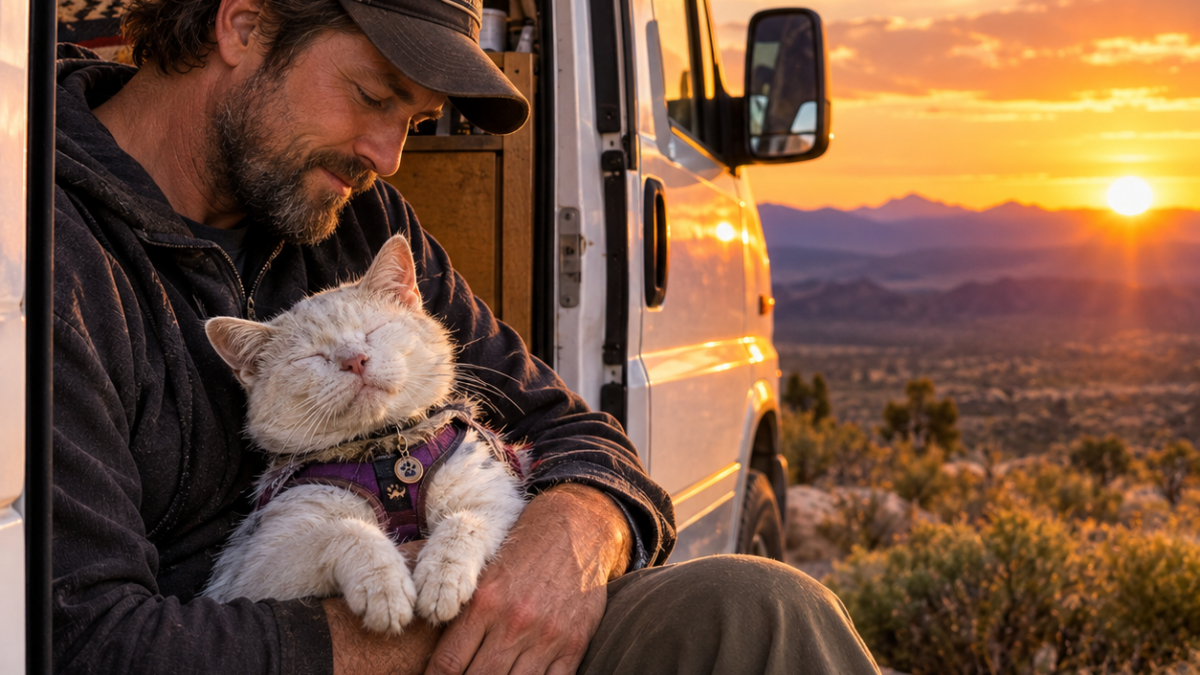
An 82-Year-Old Woman Lay on a Freezing Kitchen Floor for 9 Hours—Then the ER Doctor Looked at the Cat in Her Arms and Said Something Her Family Never Forgot.
This is my eighty-two-year-old mother’s hand.
The cat tucked beneath the emergency blanket is Biscuit, the twelve-pound tabby my father brought home from an animal shelter just a few months before he died.
And when my mother fractured her hip and spent nine hours helpless on a freezing kitchen floor, the emergency-room doctor told us something none of us were prepared to hear: Biscuit may have kept her warm enough to save her from becoming dangerously hypothermic.
The photograph was taken inside the ambulance.
You cannot see much of my mother.
Only part of her face.
A pale cheek.
White hair pushed away from her forehead.
Her left hand resting over Biscuit’s back.
And the wedding ring she has worn for more than sixty years.
Biscuit’s face is visible beneath the edge of the silver emergency blanket.
His ears are forward.
His eyes are open.
He is not looking toward the paramedics.
Not toward the ambulance doors.
Not toward my brother holding the phone.
He is looking directly at my mother.
That is what gets me every time.
Even after everything that happened.
Even after nine hours on the kitchen floor.
Even after strangers carried her out of the house on a stretcher.
Even after the sirens.
Even after being placed in a vehicle he had never seen before.
Biscuit was still watching her.
My mother’s name is Eleanor.
She has lived in the same small house outside Portsmouth, Ohio, for almost fifty years.
It is not a remarkable house.
Single story.
Two bedrooms.
Small kitchen.
Living room with an old brick fireplace that hasn’t worked in a decade.
A narrow porch facing a quiet residential street.
My father planted two maple trees in the front yard the summer after they bought the place.
One died during an ice storm years ago.
The other is still there.
My mother likes to point that out whenever we suggest she move.
We have suggested it many times.
My brother lives about fifteen minutes away.
I live farther north.
My sister is in Kentucky.
PART2:
All three of us have offered spare bedrooms.
Apartments closer to us.
A senior community.
Even a small house near my brother.
Every conversation ends the same way.
“I’m not moving.”
“Mom.”
“I’m not.”
“You’re eighty-two.”
“I noticed.”
“You’d be closer to family.”
“You know where I am now.”
“That’s not the point.”
“It’s my house.”
Then she says the sentence nobody has ever successfully argued against.
“I raised you children here.”
Usually followed by:
“And I buried your father from here.”
That ends it.
My father, Harold, died eight years ago.
Pancreatic cancer.
Fast.
Much faster than any of us understood while it was happening.
PART3:
He went from complaining about indigestion to being gone in less than seven months.
My mother had known him since she was nineteen.
They married when she was twenty.
For more than six decades, she had never lived alone.
Then suddenly she did.
The house changed after Dad died.
Not physically.
Emotionally.
There were too many quiet rooms.
Too many routines designed for two people.
Two coffee cups.
Two chairs at the kitchen table.
Two sides of the bed.
My mother adjusted better than we expected.
At least that is what we told ourselves.
She joined a church quilting group.
Went to the grocery store every Tuesday morning.
Watched game shows every evening.
Called my brother whenever her television “broke,” which usually meant she had accidentally changed the input.
But there was one thing in the house that became more important after Dad died.
Biscuit.
Dad chose him.
That matters.
Three months before he died, my parents went to the local animal shelter because my mother had casually mentioned that the house felt empty when Dad was at appointments.
They were supposedly “just looking.”
Nobody has ever gone to an animal shelter just looking.
Dad walked past several kittens.
Past a young black cat pawing through the bars.
Past an enormous orange tom.
Then stopped in front of a cage containing a chunky brown tabby.
The shelter card said:
Approximately four years old.
Male.
Neutered.
Friendly.
Overweight.
Enjoys laps.
Dad looked at him.
Biscuit looked back.
My mother said:
“He’s fat.”
Dad replied:
“So am I.”
That apparently settled it.
Biscuit came home that afternoon.
Dad named him because he said the cat’s paws looked like little biscuits.
My mother hated the name for exactly two days.
Then Biscuit became Biscuit permanently.
He was lazy.
Still is.
He dislikes rain.
Hates vacuum cleaners.
Loves rotisserie chicken.
Sleeps in warm laundry before anyone can fold it.
Has never caught a mouse that we know of.
Once spent twenty minutes stalking a leaf through the window.
And he loved my father.
When Dad became weaker, Biscuit began sleeping beside him.
Not on him.
Beside.
Usually pressed against Dad’s hip.
On bad days, Dad would sit in his recliner with a blanket over his legs.
Biscuit would climb up and wedge himself between Dad’s thigh and the armrest.
Sometimes Dad complained.
“This cat is cooking me.”
My mother would say:
“Then move him.”
Dad never did.
The morning my father died, Biscuit was asleep near his feet.
After the funeral, the cat began following my mother.
Bathroom.
Bedroom.
Kitchen.
Porch.
If Mom sat down, Biscuit eventually appeared.
At first we thought he was confused.
Then my mother said something none of us forgot.
“He lost him too.”
From that point forward, Biscuit became hers.
Or maybe they became each other’s.
My mother often called him:
“The last thing your father gave me.”
She said it lightly.
But none of us mistook what she meant.
Last Wednesday began like almost every other Wednesday.
Cold.
Late fall.
Cloudy.
Temperatures had dropped into the thirties after sunset.
My mother spent the afternoon doing laundry.
Called my brother around four.
Complained that the grocery store had raised the price of coffee again.
Everything ordinary.
At approximately seven that evening, she went into the kitchen to make tea.
She was wearing a lightweight blue housecoat.
No socks.
Slippers.
The kitchen floor is tile.
Old ceramic tile my father installed himself sometime in the 1990s.
It gets extremely cold in winter.
My mother later said she had just filled the kettle.
She turned toward the counter.
One slipper slid.
That was all.
No dramatic accident.
No ladder.
No stairs.
No medical event.
Her foot slipped.
Her body twisted.
She fell hard onto her left side.
The impact fractured her hip.
She knew something was badly wrong almost immediately.
She tried rolling onto her knees.
Could not.
Tried sitting.
Pain stopped her.
She reached toward the lower cabinet handle.
Too far away.
The counter was maybe thirty inches from where she landed.
It might as well have been thirty feet.
Her phone was in the living room.
On the couch.
She had been meaning to start carrying it in her housecoat pocket.
We had all told her.
My brother had told her.
I had told her.
My sister had told her.
She always said:
“I’m not carrying a telephone around my own house like a teenager.”
After the fall, she could see the doorway into the living room.
She could see the couch.
She could not reach it.
She yelled.
The nearest neighbor’s house sits far enough away that nobody heard.
She tried again.
Then stopped because every movement felt like something sharp was tearing through her hip.
That is when Biscuit came over.
He had been sitting near the kitchen table.
Mom said he approached slowly.
Sniffed her face.
Walked around her.
Meowed several times.
Then sat beside her right shoulder.
She spoke to him.
“Biscuit.”
The cat meowed.
“Go get somebody.”
My mother laughed when she told us that later.
“As if he was Lassie.”
Biscuit did not get anybody.
He did something simpler.
He lay down.
Not near her.
Against her.
He pressed his body tightly against the right side of her ribs.
Mom put one hand over him.
And there he stayed.
At first, she thought she would be on the floor only a few minutes.
Surely someone would call.
Maybe a neighbor would stop.
My brother sometimes visited after work.
But that Wednesday, nobody was expected.
Eight o’clock came.
Then nine.
The kitchen darkened.
My mother could not reach the light switch.
Only the small stove light remained on.
She began feeling cold.
The thermostat was set at sixty-six.
Normally comfortable.
Not when you are lying motionless on ceramic tile wearing a thin housecoat with no socks.
She tried pulling the housecoat farther over her legs.
Couldn’t move enough.
Biscuit stayed against her.
His body was warm.
Twelve pounds of cat.
Thick fur.
Steady breathing.
Mom put her hand along his side.
She could feel each breath.
In.
Out.
In.
Out.
At some point, Biscuit shifted.
My mother feared he was leaving.
Instead, he turned around.
Pressed even tighter against her torso.
Settled again.
His food bowl was ten feet away.
Water nearby.
His favorite bed was in the living room.
The couch was warmer.
Nothing physically prevented him from leaving.
He stayed.
That detail is what my brother cannot talk about without crying.
Not because Biscuit performed some trained rescue.
He didn’t.
He didn’t bark for help.
Didn’t call anyone.
Didn’t pull a blanket across the floor.
He simply chose not to leave her.
Hour after hour.
By ten, my mother was shivering.
By eleven, she said the shaking became harder.
Midnight.
One.
Two.
Time became strange.
There was a clock on the microwave, but from the floor she could not see the numbers clearly.
She knew the night was moving because the house became completely silent.
No passing cars.
No television next door.
Nothing.
She later told me she kept talking to Biscuit.
Not constantly.
Just when fear grew.
She told him:
“Your daddy would be mad at me.”
Then:
“He’d say I should carry that stupid phone.”
Biscuit purred.
She said:
“You always agree with him.”
At some point she began talking to my father.
Not because she believed he was in the kitchen.
She knew he wasn’t.
She was cold.
In pain.
Alone.
People talk to whoever makes loneliness smaller.
She said:
“Harold, I could use some help here.”
Biscuit lifted his head.
Looked at her.
My mother smiled despite everything.
“Well, I know you sent him.”
She rested her hand over Biscuit again.
The cold continued.
Elderly people lose body heat faster than younger adults.
They may also fail to notice hypothermia developing as clearly.
My mother knew she was cold.
She did not understand how cold.
By approximately three in the morning, she had stopped shivering as violently.
Later, the emergency physician told us that was not necessarily a good sign.
Her body was tiring.
Her temperature was falling.
Biscuit remained warm.
His normal body temperature is higher than a human’s.
His body was not enough to rewarm her.
But pressed continuously against her torso, he created a pocket of warmth.
Small.
Localized.
But real.
At 3:45 that morning, my brother David woke before his alarm.
He works construction and leaves early.
His alarm was set for 4:15.
He woke half an hour early.
No nightmare.
No phone call.
No obvious reason.
He says he lay there for several minutes feeling uneasy.
His wife asked:
“What’s wrong?”
He said:
“I don’t know.”
Then:
“I’m going to check on Mom.”
She looked at the clock.
“At four in the morning?”
“Yeah.”
“Why?”
“I don’t know.”
People later tried to make that part mystical.
Mother’s intuition in reverse.
Some invisible warning.
My brother refuses to describe it that way.
He says:
“I just had a bad feeling.”
That is enough.
Mom’s house was only about twelve minutes from his.
He pulled into the driveway shortly after four.
Porch light was off.
That was unusual.
Mom leaves it on overnight.
He knocked.
No answer.
Used his key.
“Mom?”
Nothing.
Then he heard Biscuit.
One loud meow from the kitchen.
David walked in.
He told me later that he stopped breathing when he saw her.
Our mother on the floor.
Pale.
Eyes half open.
One arm across her chest.
Biscuit pressed tightly along her side.
“Mom!”
Her eyes opened fully.
“David?”
He dropped beside her.
“Don’t move.”
“I can’t.”
“What happened?”
“Fell.”
“When?”
She hesitated.
“After seven.”
David looked at the clock.
4:08.
Nine hours.
He reached for his phone.
Called 911.
Then took off his sweatshirt.
Placed it over her legs.
Biscuit did not move.
“Come on, buddy.”
Nothing.
David touched him.
The cat looked up.
Did not stand.
David said:
“He looked at me like he was saying, ‘I’ve got her.’”
Paramedics arrived within minutes.
They assessed Mom.
Blood pressure.
Pulse.
Pain.
Hip position.
Neurological status.
Temperature.
95.8 degrees Fahrenheit.
One paramedic repeated it.
“95.8.”
David asked:
“Is that bad?”
They said she was hypothermic.
Not critically deep yet.
But concerning.
Especially at eighty-two.
They brought warming blankets.
IV fluids.
Prepared to move her.
That was when Biscuit finally became a problem.
Not aggressive.
He simply refused to leave.
When one paramedic tried sliding a sheet beneath Mom, Biscuit moved with her.
David tried lifting him.
Biscuit clung to my mother’s housecoat.
Mom opened her eyes.
“No.”
David said:
“Mom, we have to move you.”
“No, the cat.”
“He’ll stay here.”
“No.”
She reached with one hand.
“Bring him.”
David looked at the paramedics.
To their credit, nobody argued much.
One said:
“If he stays contained.”
So David held Biscuit while they lifted Mom.
Then placed him against her chest once she was secured on the stretcher.
Biscuit immediately settled.
Mom’s hand went over him.
Exactly like the photograph.
Outside, the air was colder.
The paramedics covered both of them with an emergency blanket.
David climbed into the ambulance.
Then took the picture.
He did not take it because he thought it would go online.
He took it because he had never seen anything like it.
Our mother.
White hair.
Oxygen cannula.
Pain medication starting to work.
Wedding ring visible.
Biscuit’s striped head beneath the silver blanket.
Her hand holding him.
His eyes looking only at her.
At the emergency room, Biscuit obviously could not remain in the treatment area.
David took him home temporarily.
Mom went for imaging.
X-rays showed a displaced left hip fracture.
The orthopedic surgeon recommended surgery.
Before that, they worked on her temperature.
Warm blankets.
Fluids.
Monitoring.
The emergency physician asked how long she had been on the floor.
David told him.
Nine hours.
The doctor shook his head.
“On tile?”
“Yes.”
“Heater?”
“Sixty-six.”
“Clothing?”
“Housecoat.”
“No socks?”
“No.”
Then the doctor asked something unexpected.
“Was the cat against her the whole time?”
David said:
“According to Mom.”
“And he was still there when you arrived?”
“Yes.”
The doctor nodded slowly.
Then explained.
He did not say Biscuit definitely saved her life.
Doctors are careful with sentences like that.
Too many variables.
The house temperature.
Her metabolism.
Her body position.
Exactly how much heat the floor drew away.
But his point was simple.
Prolonged exposure to a cold surface can lower core temperature quickly in an elderly patient.
95.8 was already below normal.
Another degree.
Two.
Three.
And the risks increase significantly.
Heart rhythm problems.
Confusion.
Reduced coordination.
More dangerous systemic effects.
Then he said:
“That cat probably kept her warm enough to help.”
David asked:
“Seriously?”
The doctor nodded.
“He was essentially a small warm compress against her torso for nine hours.”
Then, after a pause:
“A very committed one.”
That mattered to me.
Because a blanket has insulation.
But a blanket does not make a choice.
Biscuit did.
He had food.
Water.
Soft furniture.
Warm rooms.
He stayed on the coldest floor in the house because Mom was there.
Surgery happened Thursday morning.
A pin was inserted.
Everything went as planned.
When I arrived at the hospital, my mother was still groggy.
Her first question:
“Where’s Biscuit?”
Not:
How bad is my hip?
Not:
How long will I be here?
Not:
When can I walk?
Biscuit.
“He’s with David.”
“He eating?”
“Yes.”
“Don’t let David overfeed him.”
I laughed.
“Mom, the cat weighs twelve pounds.”
“He’s big-boned.”
“He’s fat.”
“He’s fluffy.”
The nurse smiled.
That was when I knew Mom was going to be okay.
Recovery was not easy.
At eighty-two, hip surgery is serious.
She had pain.
Weakness.
Dizziness the first time she stood.
Physical therapy.
Occupational therapy.
Arguments about walkers.
Arguments about whether she could return home alone.
Arguments about grab bars.
Medical alert systems.
Phones.
Especially phones.
I told her:
“You are wearing one now.”
She said:
“I am not wearing a telephone around my neck.”
“A medical alert.”
“Same concept.”
“Mom.”
“I already have Biscuit.”
“You cannot use the cat as emergency equipment.”
She looked at me.
“He did better than the phone.”
I had no immediate response.
Eventually we compromised.
Medical alert pendant.
Phone clipped to her walker.
Grab bars.
Non-slip kitchen mats.
Better lighting.
My brother installed everything before she returned.
Mom complained about all of it.
Which was encouraging.
Meanwhile Biscuit stayed at David’s house.
He hated it.
Not the people.
The situation.
David has two dogs.
Friendly dogs.
Biscuit considered friendship beneath him.
They gave him the guest room.
Food.
Water.
Bed.
Litter.
His own blanket.
Every morning, Biscuit sat beside the front door.
Usually around seven.
Just sat.
Looking toward it.
David would say:
“She’s not coming today, buddy.”
Biscuit remained.
At night he slept on one of Mom’s old sweaters David brought over.
My brother started sending her pictures.
Biscuit at the door.
Biscuit on the sweater.
Biscuit refusing to look at the camera.
Mom showed every nurse.
“That’s my boy.”
One physical therapist finally asked:
“Your son?”
Mom looked offended.
“My cat.”
The therapist laughed.
Mom did not.
“He kept me alive.”
That became her version.
We corrected her initially.
“Mom, the doctor said he may have helped.”
“He kept me alive.”
“Technically—”
“Were you there?”
“No.”
“Then hush.”
Eventually we stopped correcting her.
Maybe she was right in ways medicine does not measure.
One afternoon in rehab, I asked Mom what those nine hours had actually felt like.
I had avoided asking.
Partly because I didn’t want to make her relive it.
Partly because I was afraid of the answer.
She looked out the window.
Took a while.
Then said:
“The pain was terrible.”
I nodded.
“I thought I’d pass out.”
“Did you?”
“No.”
“Were you scared?”
She thought.
“Not exactly.”
That surprised me.
“You were alone on the floor all night.”
“I wasn’t alone.”
“Biscuit.”
She nodded.
“He stayed here.”
She pressed her hand against her ribs.
“Right here.”
Then:
“I could feel him breathing.”
She imitated it with her hand.
Small rise.
Fall.
Rise.
Fall.
“I knew if he was calm, I could be calm.”
“What did you think about?”
“Your father.”
I smiled.
“What about him?”
“That he’d be furious.”
“For falling?”
“For not carrying my phone.”
That sounded like Dad.
Then Mom became quiet.
“He used to say that cat knew when somebody needed him.”
I had never heard that.
“When?”
“Near the end.”
“Dad said that?”
“He’d wake up and Biscuit was already beside him.”
She looked at me.
“Your father didn’t like admitting he was frightened.”
“No.”
“He’d pet that cat instead.”
Mom smiled.
“Same thing, really.”
She looked down at her hands.
Then said the sentence that made me cry.
“He stayed, so I knew morning would come.”
I could not answer.
Mom noticed.
“Oh, stop.”
“I’m fine.”
“You’re crying.”
“I’m not.”
“You children lie terribly.”
She handed me a tissue.
The irony was obvious.
Three weeks after surgery, Mom could walk about sixty feet with a walker.
Five weeks:
More.
Six weeks:
Steps.
The rehab team began planning discharge.
All of us argued that she should stay with David initially.
Mom refused.
“I’m going home.”
“Mom.”
“Biscuit is there.”
“He’s at David’s.”
“Exactly.”
“What does that mean?”
“He needs his house.”
So did she.
The therapists agreed home was possible if we put enough support in place.
Home health visits.
Physical therapy.
Daily family checks.
Meals.
Alert pendant.
Walker.
Bathroom modifications.
No loose rugs.
The kitchen mat my brother installed looked industrial.
Mom hated it.
“It makes the kitchen look like a factory.”
David said:
“A factory where nobody breaks a hip.”
She kept it.
The day she went home, David brought Biscuit first.
We wanted to see what he would do.
He carried the cat through the front door.
Set him down.
Biscuit sniffed.
Living room.
Hallway.
Kitchen.
He walked to the exact spot where Mom had fallen.
Stopped.
Sniffed the floor.
Then looked around.
David said:
“She’s coming.”
Biscuit went to the front door.
Sat.
Twenty minutes later, my sister drove Mom into the driveway.
We helped her out.
Walker.
Slow steps.
The front door opened.
Biscuit came through like someone fired him from a cannon.
For a twelve-year-old overweight cat, he moved surprisingly fast.
He reached Mom.
Stopped because of the walker.
Then started meowing.
Not his normal meow.
Loud.
Repeated.
Mom laughed.
“Biscuit!”
He rubbed the walker.
Her ankles.
Walker again.
She could not bend.
So David picked him up.
Placed him carefully against her chest.
Mom held him.
Biscuit pushed his face beneath her chin.
Everybody cried.
Except Mom.
She said:
“You people are ridiculous.”
Her voice was shaking.
That first night, none of us wanted to leave.
Mom finally ordered us out.
“I have home-health numbers.”
“Emergency button.”
“Phone.”
“Walker.”
“And a cat who apparently has medical credentials.”
David said:
“We’re checking at seven.”
“Eight.”
“Seven.”
“Seven-thirty.”
“Fine.”
Before we left, I watched Biscuit follow her into the bedroom.
Mom settled into the hospital-style adjustable bed we had temporarily rented.
Biscuit jumped up.
We had been worried he might bump her hip.
Instead he walked around to her right side.
The uninjured side.
Turned twice.
Lay against her ribs.
Same place.
Mom looked at me.
“See?”
I did.
The photograph from the ambulance eventually spread farther than we intended.
At first, my brother sent it only to family.
Then Mom’s church friend asked if she could share it with the congregation.
Someone posted it.
Then another person.
People responded to the hand.
The ring.
The cat’s face.
The emergency blanket.
The story.
Some people called Biscuit a hero.
I understand why.
But when I think about what happened, hero feels almost too large.
Biscuit did not know about hypothermia.
He did not know normal human temperature is approximately 98.6 degrees.
He did not understand hip fractures.
Emergency medicine.
Age-related thermoregulation.
He knew one thing.
The woman he slept beside every night was on the floor.
She could not get up.
Something was wrong.
So he stayed.
Maybe that is why the story reaches people.
Because love often looks much less dramatic than we imagine.
Sometimes it is not rescue helicopters.
Or brave speeches.
Or someone bursting through a door at exactly the right second.
Sometimes it is twelve pounds of warm fur breathing against an old woman’s ribs.
For nine hours.
My mother continues recovering.
She still complains about the walker.
Still hates the safety mat.
Still argues about the medical alert pendant.
She now carries her phone.
Mostly.
We catch her forgetting.
She says:
“I survived eighty-two years without all this equipment.”
David replies:
“And then you spent nine hours on the kitchen floor.”
That usually ends the argument.
Biscuit has changed too.
Maybe we imagine it.
But he follows her more closely now.
If she walks into the kitchen, he comes.
If she stays too long in the bathroom, he waits outside.
When she uses the walker at night, he walks several feet ahead and then turns back.
The first few weeks, whenever Mom entered the kitchen, Biscuit stood near the spot where she fell.
Mom finally told him:
“You can stop supervising me.”
He did not.
Every evening around eight, Mom sits in her recliner.
Biscuit climbs onto the cushion beside her.
Not her lap anymore because she worries about her healing hip.
He presses against her right side.
She rests one hand over his back.
Sometimes I call during that hour.
I can hear her television.
Sometimes I hear Biscuit purring near the phone.
The house still belongs to her.
The maple tree still stands outside.
My father’s chair is still near the window.
His photograph remains on the mantel.
And the cat he chose a few months before he died still moves through those rooms like the final piece of him that never left.
I used to think my mother’s insistence on staying there was stubbornness.
Some of it is.
She is absolutely stubborn.
But I understand it differently now.
The house contains a lifetime.
Children coming home from school.
Christmas mornings.
Arguments.
Birthdays.
Dad repairing things badly.
Mom repainting after him.
Grandchildren sleeping on the floor.
Hospice equipment.
Funeral flowers.
Biscuit arriving from the shelter.
Loss.
Survival.
It is not simply a building where an old woman lives alone.
It is the map of her life.
And Biscuit belongs to that map.
When Dad chose him all those years ago, none of us knew what would happen.
He did not know he would die months later.
Did not know Mom would spend eight years alone afterward.
Did not know the overweight tabby he jokingly selected because they shared a body type would someday lie on cold tile for nine hours beside his wife.
Dad simply saw a cat in a cage.
Said:
“That one.”
Maybe that is enough.
We rarely know which ordinary decisions will matter later.
The final time I visited Mom, I found her sitting at the kitchen table.
Physical therapy exercises finished.
Walker nearby.
Biscuit sleeping on the chair beside her.
She had made tea.
Carefully.
I asked:
“Nervous being back in the kitchen?”
“No.”
“Not at all?”
She looked down at Biscuit.
“No.”
Then she smiled.
“I’ve got backup.”
I rolled my eyes.
She laughed.
Biscuit opened one eye.
The whole thing looked ordinary.
An elderly woman.
A cup of tea.
An overweight tabby.
Morning light through a kitchen window.
That is what nearly losing something does.
It makes ordinary scenes feel enormous.
I still look at the ambulance photograph sometimes.
My mother’s hand.
Her wedding ring.
Biscuit under the emergency blanket.
Her skin looks fragile in that picture.
His fur looks impossibly soft.
And between them is everything I have learned about that night.
Nine hours.
Cold tile.
A fractured hip.
A temperature of 95.8 degrees.
No phone.
No help.
No way to know when the door would open.
But Mom says she never believed she was completely alone.
Whenever the darkness felt too large, she put her hand on Biscuit.
Felt his ribs move.
In.
Out.
In.
Out.
A tiny living rhythm beside her.
Proof that something was still there.
Still warm.
Still staying.
And when I asked her how she kept believing somebody would eventually find her, she gave me the simplest answer imaginable.
“He stayed, so I knew morning would come.”
That is the entire story, really.
An eighty-two-year-old woman on a cold kitchen floor.
A twelve-pound cat beside her.
Nothing dramatic from Biscuit.
No miracle anyone can measure precisely.
He just stayed.
And somehow, for one long winter night, that was enough.








