An 8-Year-Old Girl Whispered, “If I Go Home Tonight, I Won’t Wake Up,” to a Biker—Days Later, 800 Riders Surrounded the Courthouse in Silence
PART3:
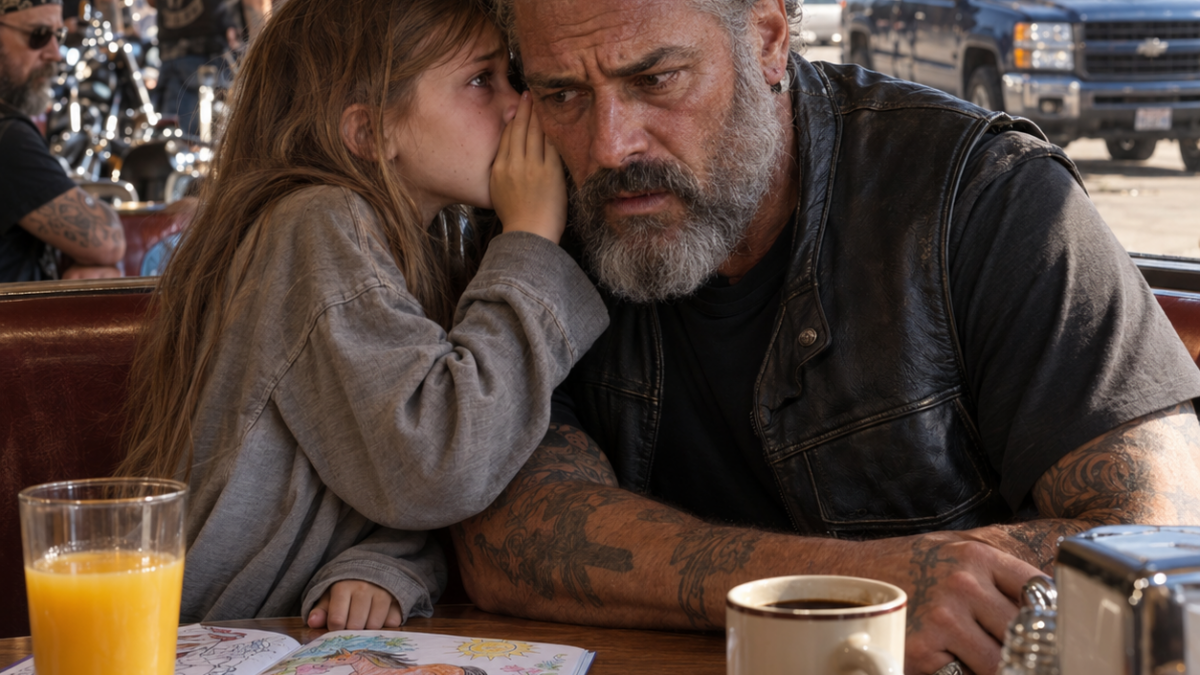
Nora sat rigid, both hands folded on top of her closed coloring book.
I waited.
She didn’t look over.
That bothered me more than anything.
I picked up my coffee and walked across the aisle.
Her eyes flicked up.
I pointed toward the empty bench across from her.
“Seat taken?”
She shook her head.
I slid in slowly, careful not to crowd her.
“You’re quiet today, trouble,” I said. “Even for you.”
She looked toward the front door.
Then down at her hands.
“Boss?”
Her voice was so small that I leaned forward.
“Yeah?”
“Can I ask you something?”
“Sure.”
She swallowed.
“If a person knew something bad was going to happen to them…”
Every nerve in my body sharpened.
“But nobody believed them…”
She stopped.
I kept my voice low.
“What should that person do?”
The coffee went sour in my stomach.
“What kind of bad thing?”
Nora’s eyes moved toward the window.
I followed them.
A dark blue pickup turned into the lot.
It parked crookedly near the front entrance.
The driver’s door opened.
A heavyset man in jeans, work boots, and a baseball cap stepped out.
Nora’s entire body changed.
Not just fear.
Recognition.
Training.
A child’s body preparing before the threat even crossed the room.
She leaned across the table.
Her lips barely moved.
“If I go home tonight,” she whispered, “I won’t wake up.”
The bell above the diner door jingled.
And for the first time in twenty years, I felt actual fear move through me.
The man in the baseball cap walked in like he owned the place.
I knew his face.
Dale Rener.
Forty-one.
Contractor sometimes.
Drinker often.
Charmer when someone useful was watching.
A man with shoulders wide enough to intimidate smaller men and a smile that never reached his eyes.
I had seen him around town.
Buying cigarettes.
Arguing with clerks.
Leaning too close to women at gas stations.
Men like Dale often mistook volume for power and silence for weakness.
He saw me sitting across from Nora.
His steps slowed.
“Cole Brennan,” he said.
I didn’t answer.
His smile widened.
“Didn’t know you were babysitting now.”
Nora stared at the tabletop.
Dale placed one big hand on her shoulder.
She shrank under it.
Not dramatically.
Not enough for the truckers to notice.
Just one inch.
But I noticed.
“There’s my girl,” Dale said too loudly. “Come on. Your mama’s busy. I’ll run you to school.”
Nora didn’t move.
Dale’s fingers tightened.
I saw the pressure in the fabric of her shirt.
“She’s eating,” I said.
Dale looked at the table.
No food sat in front of her.
Only the orange juice she hadn’t touched.
His smile stayed put.
“She’s fine.”
I looked at Nora.
“Nora?”
For one second, she looked up.
Her eyes pleaded with me to understand every word she could not say.
Then Dale pulled her out of the booth.
“Don’t bother Mr. Brennan,” he said.
He turned toward me.
“Kids, right?”
I said nothing.
That made his smile twitch.
The predator in him recognized the predator people believed lived in me, and something silent passed between us.
Not respect.
Not fear yet.
Measurement.
He guided Nora toward the door with his hand still on her shoulder.
Not the way a father guides a child.
The way a man moves property.
The bell jingled again.
The blue pickup pulled away.
I stayed in that booth until the truck disappeared down the street.
Then I stood and went to find Sharon.
She was in the back hallway near the walk-in cooler, one hand pressed to her forehead.
When she saw me, she tried to put the waitress smile back on.
It didn’t make it all the way.
“Everything okay, Mr. Brennan?”
“Is she safe?”
Her face changed.
Three things at once.
Fear.
Shame.
Hope.
The hope died first.
“I don’t know what you mean.”
“Yes, you do.”
She looked toward the dining room.
“I need to get back.”
“Sharon.”
Her name stopped her.
Maybe because I rarely used it.
Maybe because my voice didn’t sound like a customer anymore.
“Is Nora safe at home?”
She wrapped both arms around herself.
“Dale is strict.”
“That wasn’t my question.”
“He takes care of us.”
“Does he?”
Her eyes flashed.
“You don’t understand.”
“Then explain it.”
She laughed once.
No humor.
“You? You want me to explain fear to you?”
That hit closer than she knew.
I stepped back half a pace.
“I know bruises.”
Her face went pale.
“I don’t know what you think you saw.”
“I saw the mark on her wrist last week.”
Sharon turned away.
“I saw the way she stopped breathing when his truck came in.”
“You’ll make it worse.”
The words came fast.
Desperate.
Practiced.
“Please. Men like you always think you can just step in, break something, scare somebody, fix it. You don’t have to live in the after. We do.”
The truth of that landed hard.
I could have kicked Dale’s teeth down his throat.
I could have dragged him out of his truck.
I could have made him afraid.
And then what?
I went back to my shop.
Nora went home.
Sharon swallowed another punishment for causing trouble.
Dale learned to be more careful.
I had spent half my life using fear as a tool.
For the first time, I understood how clumsy a tool it was.
“I’m not going to touch him,” I said.
Sharon looked at me like she didn’t believe that was possible.
“I just need the truth.”
Her eyes filled.
For one second, I thought she might give it to me.
Then a customer bell rang out front.
She flinched.
And the wall came back.
“There’s nothing to tell,” she whispered.
Then she walked away.
I left the diner, but I didn’t leave it alone.
That afternoon, I did three things I never imagined myself doing voluntarily.
First, I went to Nora’s school.
Jefferson Elementary stood under two dying sycamores and a flag that snapped weakly in the hot wind.
The office secretary nearly swallowed her tongue when I walked in wearing my cut.
“I need to speak to Nora Callaway’s teacher,” I said.
“Are you family?”
“No.”
“Then I can’t—”
A woman’s voice came from behind me.
“It’s all right, Denise.”
I turned.
Eleanor Pratt stood in the hallway holding a stack of papers.
Fifty-three.
Sharp eyes.
Gray-streaked hair pinned in a bun.
The kind of teacher who could smell a lie through drywall.
“You’re Cole Brennan,” she said.
“Yes.”
She looked at my vest.
Then my face.
“You’re worried about Nora too.”
The relief nearly knocked me sideways.
Too.
Not why.
Not how dare you.
Too.
Eleanor led me into her classroom.
The walls were covered in multiplication charts, book posters, and children’s drawings. On one bulletin board, every picture had sunshine except one.
A house colored dark blue.
Black windows.
No people outside.
Nora Callaway was written in careful pencil at the bottom.
Eleanor opened a file folder.
“I’ve reported concerns twice.”
She laid papers on the desk.
Dates.
Case numbers.
Notes.
Bruises observed.
Hunger.
Withdrawal.
Statements.
An essay where Nora had written:
I wish I could live somewhere quiet where nobody yells and doors don’t slam.
I read it twice.
“What happened?”
“A visit.”
“By child services?”
“Yes.”
“And?”
“Dale was charming. Sharon denied everything. Nora wouldn’t speak. House looked clean.”
“Clean?”
Eleanor’s mouth twisted.
“People like him know how to prepare for visitors.”
“Why wasn’t Nora interviewed alone?”
“She was supposed to be.”
“Was she?”
Eleanor looked down.
“Not long enough.”
I pressed my thumb against the edge of the desk until it hurt.
“They closed it?”
“They marked it inconclusive.”
I looked at the folder.
“Inconclusive.”
“It’s a word that lets adults sleep.”
I left the school with copies Eleanor probably shouldn’t have given me.
She gave them anyway.
Second, I went to the county child welfare office.
Patricia Hollis was the caseworker whose name appeared on the report.
I expected indifference.
I expected a desk worker with clean hands and a practiced voice telling me procedure.
Instead I found a woman who looked like she had been drowning for years and still came to work because nobody else would jump in.
Patricia was forty-four and looked sixty.
Files covered her desk in uneven towers.
Her coffee had gone cold.
A child’s drawing was taped to her computer monitor.
She listened.
The whole thing.
Without interrupting.
When I finished, she rubbed both hands over her face.
“I believe you.”
That should have helped.
It didn’t.
“Then do something.”
She looked at me with exhausted eyes.
“Belief is not evidence.”
I leaned forward.
“She told me she won’t wake up if she goes home.”
“A child told an unrelated adult with a criminal record something vague in a diner.”
My jaw tightened.
Patricia held up one hand.
“I am not saying I don’t believe it. I am telling you what it becomes in court.”
I stood.
“What do you need? A body?”
Pain crossed her face.
“No.”
“Then what?”
“A disclosure to a forensic interviewer. Medical evidence. A witness. Police report. Something I can put in front of a judge that won’t collapse when Dale Rener puts on a clean shirt and says an outlaw biker is harassing his family.”
“I’m trying to keep her alive.”
“So am I.”
Her voice cracked for the first time.
The room went quiet.
She looked away.
“I have a hundred and forty open cases. Last month I had a baby hospitalized because nobody had enough proof two weeks earlier. Yesterday I placed three kids with an aunt who doesn’t want them because the alternative was a shelter. I am not your enemy, Mr. Brennan.”
I sat back down.
“What are you, then?”
She smiled sadly.
“Under-resourced.”
Third, I went to the police.
Detective Daniel Voss heard me out with his arms crossed.
Forty-five.
Tired.
Suspicious of me in particular.
We had history.
Not personal history, but category history.
Cops and men in my world often inherit each other’s worst stories.
When I finished, he leaned back.
“No crime reported. Mother denies. Child hasn’t made a formal statement. Teacher has concerns, not evidence. Caseworker has no removal order.”
“She said she won’t wake up.”
“To you.”
“Yes.”
“You understand how that looks?”
“Like a kid asked for help.”
“Like a notorious biker with a record claims a child whispered something to him right before he decided to target her stepfather.”
My hands curled.
Voss saw.
“Exactly.”
I forced them open.
“If I go to that house—”
“You go to jail.”
He didn’t hesitate.
“And then?”
“Dale plays victim. Sharon gets more scared. Nora either disappears or gets coached harder. If she survives.”
The words were brutal.
They were also true.
“What do I do?”
“Nothing stupid.”
“That’s not an answer.”
“It’s the only one that keeps you useful.”
I drove back to my shop as the sun went down red behind the orchards.
For the first time in years, I felt helpless.
Not outnumbered.
Not outgunned.
Helpless.
I had spent my life solving problems with my hands.
Wrenches.
Fists.
Throttle.
Force.
Loyalty.
A phone call could put fifty men at my back before sunset.
But none of that could open the right door.
Not without hurting the child behind it.
That night I didn’t sleep.
Friday morning, Nora was in booth nine.
Alive.
The breath that left me almost hurt.
But she was paler.
Her hair uncombed.
A fresh mark circled one wrist, partly hidden by her sleeve.
She would not look at me.
“Morning, trouble,” I said softly as I passed.
She stared at her orange juice.
Nothing.
Sharon’s face was swollen around one eye, carefully powdered.
Dale’s pickup idled across the street for ten minutes.
The message was clear.
He knew somebody was watching.
Men like Dale don’t loosen their grip when watched.
They tighten it.
Monday morning, Nora wasn’t at the diner.
I told myself she was sick.
At eight-thirty, Eleanor Pratt called my shop.
“She’s not at school.”
I closed my eyes.
“At all?”
“Withdrawn.”
“What?”
“Dale came in himself. Signed papers. Said the family is moving to Arizona for work. No forwarding address.”
The wrench in my hand hit the floor.
“He’s isolating her,” Eleanor said.
Her voice shook.
“He’s cutting off witnesses.”
“How long do we have?”
“I don’t know.”
I got the address from Eleanor’s school file.
For eleven minutes, I stood beside my bike.
Helmet in hand.
All I had to do was ride.
I could be there before anybody stopped me.
Kick the door.
Take the girl.
Break the man.
It was the simplest plan in the world.
Simple plans are often selfish.
Voss’s voice came back.
He walks, you go to jail, and the kid pays for all of it.
I set the helmet down.
Picked it up again.
Set it down.
My hands shook with the effort of not moving.
Standing still while a child was in danger felt like betrayal.
I rode to the clubhouse that night because if I stayed alone, I would do something I couldn’t undo.
Hank Dawson, our chapter president, was fifty-six, white beard, old eyes, slower now than he used to be but still the kind of man who could make a room straighten by entering it.
He listened to the whole story without interrupting.
When I finished, he turned his coffee mug in both scarred hands.
“You want us to go get her.”
It wasn’t a question.
“I want her safe.”
“Those aren’t the same thing.”
“I know that.”
“No. You’re learning that.”
I hated him for being right.
Hank set the mug down.
“You bust that door, maybe you feel like a hero for an hour.”
I said nothing.
“Then you’re in a cell, the news calls it a biker attack, Dale plays the victim, and the girl vanishes into a system already afraid of making a mistake.”
His eyes hardened.
“Or worse, she goes right back to him.”
“What do you want me to do? Wait until she’s dead?”
“No.”
“Then what?”
“We take away the dark.”
I stared at him.
“That man’s whole power is isolation,” Hank said. “One scared woman. One scared kid. A clean shirt when the worker comes. A nice voice when the cops knock. Nobody sees the whole picture.”
He leaned forward.
“So we make the picture too big to hide.”
“How?”
“The law wants witnesses? We become witnesses.”
I almost laughed.
“Hank—”
“Not ten of us. Not fifty.”
His eyes lit with a slow, hard purpose.
“All of us.”
I went quiet.
He continued.
“We don’t threaten. We don’t touch. We don’t trespass. We don’t give anybody a reason to turn this into a story about us.”
His voice lowered.
“We stand in the light where everybody can see us and we make sure everybody sees him too.”
It went against everything thirty years had taught me.
That force answered force.
That men who hurt smaller people only understood fear.
That justice was something you took because nobody gave it willingly.
But Hank had buried more men than I had.
Lost a son on Highway 99 and somehow kept breathing.
He had outlived enough rage to learn which kinds burned useful and which kinds burned everything.
“And if it doesn’t work?” I asked.
“If the judge sends her back anyway?”
“Then we find the next right thing.”
“That’s not enough.”
“It never is.”
He stood.
Knees cracking.
“But it’s better than doing the wrong thing because it feels stronger.”
He put one heavy hand on my shoulder.
“Make your calls.”
The longest night of my life began there.
Hank called Fresno.
Oakland.
Sacramento.
San Bernardino.
Los Angeles.
San Jose.
Bakersfield.
Chapters.
Friends.
Old rivals.
Men who owed favors.
Men who didn’t owe a damn thing but came anyway.
A child is in danger.
The system needs light.
Ride quiet.
Ride legal.
Ride seen.
While we made calls, Patricia Hollis did something that saved Nora’s life.
At two in the morning, unable to sleep, she went back through the file.
Then Dale Rener’s name.
Then associated addresses.
Then old documents.
Then a discrepancy.
The name on his license was only three years old.
Before that, in another state, Dale had been someone else.
Different last name.
Different woman.
Different little girl.
Sealed juvenile file.
Closed case.
A case nobody in California had connected because systems often fail at the borders where children cannot afford failure.
Patricia called Detective Voss.
Voss called a judge.
By dawn, the machinery that had refused to move for fear of making a mistake began grinding forward because one exhausted caseworker decided to look one more time.
The emergency custody hearing was set for Thursday morning at Kern County Superior Court.
Fast.
Too fast to trust.
The petition cited new evidence, prior allegations under an alias, risk of flight, withdrawal from school, and statements from mandated reporters.
Sharon was subpoenaed.
Eleanor would testify.
Patricia would testify.
Detective Voss would present the interstate records.
Nora had been located late Wednesday night with Sharon at a motel south of town.
Dale had taken them there after telling the school they were moving.
Police did not arrest him yet.
Not enough for that.
But the hearing would determine emergency removal and further investigation.
It was the kind of moment that could change everything.
Or collapse on a technicality.
Dale had a lawyer.
Sharon was terrified.
Nora was eight.
And the truth was fragile.
I arrived at the courthouse at seven.
The sky was pale pink over Bakersfield, heat already building in the pavement.
For several minutes, I stood alone.
Then I heard the first engines.
A dozen motorcycles rolled in off Truxtun Avenue.
Then fifty.
Then a hundred.
Then the sound became something physical.
Thunder through downtown.
Windows trembled.
People stepped out of offices.
Cameras appeared.
Traffic slowed.
They came from every direction.
Gray-bearded men who had ridden all night.
Women on their own machines.
Young riders barely out of their teens.
Old-timers leaning stiffly when they dismounted.
Patches from every corner of California and beyond.
Some faces I hadn’t seen in years.
Men I owed.
Men who owed me.
Men I’d fought beside.
Men I’d fought with.
Nobody asked me to explain.
The word had gone out:
A child told the truth.
Now the world needed to watch.
By eight-fifteen, the courthouse plaza was full.
Eight hundred riders.
Maybe more.
I stopped counting at five hundred.
They parked legally.
They stood silently.
No shouting.
No weapons.
No threats.
No engines revving after the first wave shut down.
Hank walked along the front line repeating the order.
“Today we are the most peaceful men in California.”
A young rider asked, “What if he starts something?”
Hank stared at him.
“Then you become furniture.”
“What?”
“You stand there and do nothing so well that your grandmother would be proud.”
The news vans came because eight hundred bikers outside a courthouse is a spectacle.
For once, the spectacle was the point.
The cameras turned on.
Reporters whispered into microphones.
The courthouse became impossible to ignore.
Dale Rener arrived at eight-thirty in the blue pickup.
He stepped out in a clean shirt.
Hair combed.
Face arranged into injured dignity.
Then he looked up.
Eight hundred silent faces turned toward him.
For the first time since I had known of his existence, Dale looked small.
Not harmless.
Predators don’t become harmless just because people see them.
But small.
Exposed.
A man who had done his worst in rooms where nobody else stood.
Now there was nowhere private for him to hide.
His lawyer put a hand on his shoulder and guided him forward.
Dale’s eyes found me.
I did not move.
Inside, the hearing room was ordinary.
That was what struck me.
After all that thunder outside, after the cameras, after the wall of leather and chrome, the room itself was plain.
Wood benches.
Fluorescent lights.
A judge with silver hair and reading glasses.
A bailiff.
Files.
Microphones.
People shifting nervously in churchlike silence.
Nora was not in the room at first.
Thank God.
Some truths can be represented without forcing a child to bleed them in public.
I sat in the back.
Hank beside me.
Eleanor near the aisle with her red folder clutched in both hands.
Patricia at the petitioner’s table.
Detective Voss in a suit that didn’t fit his shoulders.
Dale sat with his lawyer, posture stiff, jaw tight.
Sharon sat on the other side, pale as paper, hands shaking in her lap.
The hearing began.
Patricia testified first.
Her voice trembled once at the beginning, then steadied.
She described the earlier reports, the home visit, the lack of disclosure, the mother’s denial, the agency limitations, and then the new discovery: Dale Rener’s previous identity, the out-of-state case, the prior removal of another child.
Dale’s lawyer objected repeatedly.
The judge allowed enough.
Detective Voss testified next.
He had barely slept in forty-eight hours.
He looked like hell.
He also looked determined.
He explained the records.
The alias.
The motel.
The withdrawal from school.
The risk factors.
Eleanor Pratt testified with the precision of a woman who had documented everything because no one believed her feelings were enough.
Dates.
Bruises.
Statements.
Behavior changes.
Nora’s writing.
Her sudden withdrawal.
Every ignored report entered into the record where it could not be politely forgotten.
Dale’s lawyer tried to call it speculation.
Eleanor looked at him over her glasses.
“I have taught children for thirty-one years. I know the difference between a child who is shy and a child who is surviving.”
That made even the bailiff look up.
Then Sharon was called.
The room changed.
I saw Dale’s posture shift.
Relax.
Just slightly.
He expected her to save him.
She had probably done it before.
Denied.
Smoothed.
Minimized.
Explained.
A woman trapped long enough can begin to mistake survival for loyalty.
Sharon raised her right hand and swore to tell the truth.
Her voice shook when she stated her name.
Dale’s lawyer smiled faintly.
He thought fear was still his witness.
Then Sharon looked toward the window.
Through the courthouse glass, sunlight fell across the plaza.
Beyond it stood a wall of bikers.
Eight hundred people who had ridden through the night for a child they did not know.
Not one of them could testify to what happened inside Sharon’s home.
Not one of them could tell the judge what Dale had done behind closed doors.
But their presence told Sharon something else.
She was not alone in the room with him anymore.
She took a breath.
“I lied before,” she said.
The lawyer’s smile disappeared.
The courtroom went still.
“I lied to the caseworker.”
Her voice shook but did not break.
“I lied to the teacher.”
She looked at Patricia.
“I lied because I was afraid.”
Dale turned sharply.
“Sharon.”
The judge looked over her glasses.
“Mr. Rener, you will not speak.”
Sharon’s hands gripped the edge of the witness stand.
“He told me if I ever made trouble, nobody would believe me.”
Tears ran down her face.
“He told Nora that too.”
Dale shook his head.
“She’s confused.”
The judge’s voice hardened.
“Mr. Rener.”
Sharon kept going.
Once the truth started, it came like floodwater.
Not dramatic.
Not polished.
Not perfect.
Real truth rarely is.
She told the court about the yelling.
The control.
The isolation.
The blue pickup circling the diner.
The nights Nora slept in her shoes because she was afraid they’d have to leave fast.
The threats.
The way Dale coached them before visits.
The withdrawal from school.
The motel.
The plan to leave California before anyone could ask more questions.
Dale’s lawyer tried to interrupt.
The judge let the testimony continue.
At one point Sharon broke completely.
“I thought staying quiet was protecting her.”
Her voice collapsed.
“I thought if I told, he’d hurt her worse. I thought if we left, we’d have nowhere to go. I thought…”
She looked down.
“I thought I was choosing the least dangerous thing.”
Nobody spoke.
The judge finally asked one question.
“Ms. Callaway, do you believe your daughter is safe with Mr. Rener?”
Sharon looked at Dale.
Then at the window.
Then at her hands.
“No.”
The word was quiet.
It was enough.
The judge ordered emergency protective custody for Nora pending full investigation. She ordered Dale detained pending further criminal inquiry based on risk of flight and the developing evidence. The bailiff moved before Dale fully understood that the room had turned against him.
For once, the clean shirt did not work.
For once, the calm voice had nowhere to land.
When cuffs closed around Dale’s wrists, he stared at me.
Not because I had beaten him.
Not because I had threatened him.
Because I hadn’t.
And somehow that had trapped him more completely than my fists ever could have.
Outside, when word reached the plaza, eight hundred engines did not roar in victory.
Hank had ordered silence.
Instead, a low sound moved through the crowd.
Breath.
Relief.
Men who had been holding themselves still for hours finally exhaling.
It sounded like a storm moving away.
Patricia drove me to the children’s shelter that afternoon.
I asked why.
She looked straight ahead.
“Nora asked for you.”
My throat tightened.
“She asked for me?”
“She said she wanted Boss.”
I looked out the window and didn’t trust myself to answer.
The shelter was on the north side of town.
Clean.
Quiet.
A swing set in the yard.
A mural of mountains on one wall.
Inside, the air smelled like laundry detergent and crayons.
Not fear.
Nora sat on the edge of a cot in a sunlit room that looked too large around her.
Her hair had been brushed.
She wore clean clothes.
Her feet didn’t touch the floor.
When she saw me in the doorway, her face opened and broke at the same time.
Like she had been holding herself together with thread and someone finally cut it.
“You came,” she whispered.
I crossed the room and knelt so low that, for once, a grown man was looking up at her.
“Of course I came, trouble.”
My voice wasn’t steady.
I didn’t care.
“You called.”
She stared at me like she was checking whether I was real.
Then she slid off the cot, stepped forward, and wrapped both arms around my neck.
I had been hit with fists, bottles, batons, grief, fear, and memory.
Nothing ever hit me like that child’s arms.
She held on and shook.
I held her carefully, terrified my hands were too rough for something so breakable.
“I’m sorry,” she whispered into my shoulder.
“No.”
“I made trouble.”
“No.”
“I told.”
I closed my eyes.
“You did exactly right.”
Her body trembled.
“Am I in trouble for what I said at the diner?”
That question burned through me.
I pulled back enough to look at her face.
“No, sweetheart.”
Her eyes searched mine.
“What you said at that table was the bravest thing I ever heard.”
She didn’t believe me yet.
That was all right.
Truth takes time when lies raised you.
“You whispered because that was all you had,” I said. “And it was enough.”
Her lower lip shook.
“The truth was strong enough that eight hundred people heard it.”
She cried then.
Not quietly like before.
Not controlled.
Not careful.
A child’s full broken sobs.
The counselor stepped into the doorway.
I looked over, uncertain.
She nodded.
So I stayed.
In the weeks that followed, I learned that rescue is not the same as healing.
Rescue is loud.
Healing is repetitive.
Rescue looks like eight hundred motorcycles at a courthouse.
Healing looks like a child refusing to sleep unless a lamp is on.
Rescue looks like handcuffs.
Healing looks like Sharon learning how to become a mother again without fear choosing every word.
Rescue takes a morning.
Healing takes years.
There were hearings.
Interviews.
Counseling sessions.
Medical exams.
Court dates.
Paperwork.
Setbacks.
Dale was eventually charged with multiple offenses. The out-of-state case helped prosecutors show a pattern. He tried to claim persecution. Tried to say Sharon had been influenced. Tried to say a motorcycle club had intimidated the process.
The record did not agree with him.
The judge did not agree with him.
The evidence, finally gathered correctly, did not agree with him.
But Nora’s healing had very little to do with him after a while.
That surprised me.
I thought removing the threat would fix the fear.
It didn’t.
Fear, especially in children, has roots.
Nora still flinched at loud footsteps.
Still hid food.
Still whispered for months, as if volume itself were dangerous.
Still asked permission to use the bathroom.
Still apologized when adults dropped things.
Still watched doors.
Sharon moved into transitional housing with Nora after completing her own safety planning and counseling requirements.
She got a job at a different diner.
Then a better one in a medical office.
She went to therapy.
She cried often.
She apologized too much at first, then learned apologies alone were not repair.
She had to show up too.
Nora needed her mother to become safe in ways that words couldn’t prove.
So Sharon came to every appointment.
Kept every promise she could.
Told the truth when she was scared.
Learned to say, “I was wrong,” without making Nora comfort her.
That mattered.
The men in leather did not disappear when the cameras left.
That mattered too.
We fixed Sharon’s car.
Not because she asked.
Because the brakes were shot and Hank said, “No child we just filled a courthouse for is riding around on rotors that bad.”
We built a ramp at the shelter because one of the residents used a walker and the old concrete step was dangerous.
We painted the swing set.
We stocked the shelter pantry.
We sat in the back of every hearing.
Not as threat.
As proof.
Whenever Nora had to enter a courthouse, she could look back and see familiar faces.
Hank.
Me.
Two women from the Oakland chapter.
Marcus from San Bernardino, who brought coloring books every time and never asked her to color bright colors.
Eleanor Pratt came too.
Patricia Hollis.
Detective Voss once, pretending he was there for professional reasons and not because Nora had drawn him a picture labeled Nice Police.
She eventually started school again.
New school.
New teacher.
New backpack.
On the first morning, she refused to get out of Sharon’s car.
I was parked across the street on my bike because Nora had asked if I could “maybe just be nearby but not weird.”
I took that assignment seriously.
After ten minutes, Sharon called me.
“She’s stuck.”
I walked over.
Nora sat in the back seat clutching her backpack straps.
“I can’t.”
I crouched by the open door.
“Okay.”
She looked surprised.
“You’re not going to make me?”
“No.”
“But I have to go.”
“Probably.”
“What if I can’t?”
“Then we sit a minute.”
She looked toward the school doors.
“What if people ask things?”
“You don’t owe anybody your story.”
“What if they know?”
“Then they still don’t own it.”
She thought about that.
“What if something bad happens?”
I looked at the school.
“Then you tell your teacher. Or your mom. Or Patricia. Or me.”
“What if nobody believes me?”
That question still owned her.
I tapped two fingers lightly against the car door.
“Then we keep telling until somebody does.”
She looked at me.
“And if they don’t?”
“Then eight hundred motorcycles is not our limit.”
For the first time that morning, she almost smiled.
“That’s too many.”
“You started it.”
“I did not.”
“You whispered. Caused traffic problems across half of California.”
She gave me a tiny eye roll.
It was the most childlike thing she’d done in weeks.
Then she stepped out of the car.
By Halloween, she spoke above a whisper sometimes.
By Thanksgiving, she laughed once in front of me when Hank dropped an entire pie face-down on the clubhouse floor and blamed gravity.
By Christmas, she colored a picture with yellow in it.
Not much.
A small sun in the corner.
Eleanor saw it and cried in the staff bathroom where Nora wouldn’t notice.
One night in January, Nora woke screaming.
Sharon called me at 3:04 a.m.
“I’m sorry,” she said immediately.
“Stop.”
“I didn’t know who else—”
“I’m coming.”
When I got there, Nora was inside her room with the door open, curled on the bed, shaking.
The counselor had said not to crowd her.
Not to grab.
Not to demand she explain.
So I sat on the hallway floor outside the door and leaned against the wall.
“Hey, trouble.”
No answer.
“Shop cat knocked over a parts bin today.”
Silence.
“He looked me dead in the eyes first.”
A tiny hitch in her breathing.
“I think it was personal.”
Still nothing.
I kept talking.
Not about dreams.
Not about fear.
About carburetors.
Stray dogs.
A customer who tried to fix his own clutch with online advice and nearly invented a new kind of disaster.
The names of stars.
The difference between coyotes and dogs when they moved at the edge of orchards.
My voice stayed low.
Steady.
Present.
After twenty minutes, her breathing slowed.
After thirty, she whispered:
“Boss?”
“Yeah?”
“Are you outside?”
“Right here.”
“Will you stay until I sleep?”
“Yes.”
“Promise?”
I stared at the hallway carpet.
There was that word again.
I had avoided promises for years.
They felt like traps set by grief.
But some promises were not arrogance.
Some promises were simply the next right thing.
“Yes,” I said.
“I promise.”
I stayed until sunrise.
People asked me later why I did all of it.
Reporters especially.
They wanted something dramatic.
A quote about justice.
Brotherhood.
Outlaws with hearts of gold.
I hated every version.
The truth was smaller and bigger.
I did it because an eight-year-old girl whispered the truth and trusted me to hear it.
I did it because the kind of strength I had worn my whole life was useless unless it protected someone smaller.
I did it because I had once been a boy in a house where nobody came.
That was the part I didn’t tell reporters.
My father drank.
My mother left.
The first time I learned not to cry, I was younger than Nora.
The first time I learned that adults could hear something break and still not enter the room, I was seven.
I built myself into a wall because nobody had stood between me and harm.
For thirty years, I thought the world was made of two kinds of people.
Those who hit.
And those who got hit.
So I became someone people feared before they could decide to hurt me.
It took Nora’s whisper to show me there was a third kind.
People who show up.
Not because they are pure.
Not because they have never done wrong.
Not because they know exactly what to do.
But because a child should never have to calculate whether telling the truth will cost her life.
The day Nora started third grade at her new school, months after the hearing, I rode alone to the edge of the almond orchards.
The morning was cool.
Wind moved through the trees in a soft dry whisper.
I shut off my engine and sat there a long time.
I thought about all the doors I had kicked down in my life.
All the fights I had won that solved nothing.
All the men I had made afraid.
Then I thought about the one door I had not kicked down.
The one I had been right not to.
Some battles are not won by force.
Some are won by patience so painful it feels like cowardice.
Some are won by paperwork.
By testimony.
By a teacher who keeps copies.
By a caseworker who looks one more time.
By a detective who admits the first answer wasn’t enough.
By a mother who tells the truth while shaking.
By eight hundred people standing silently in the light.
By one child whispering because whispering is all she has left.
Years passed.
Nora grew taller.
Her voice came back slowly.
At ten, she could order for herself in restaurants.
At eleven, she joined art club.
At twelve, she painted a motorcycle bright red and gave it to me for Christmas.
“It’s not your bike,” she said, before I could comment.
“I didn’t say anything.”
“You were thinking it.”
“My bike is black.”
“Exactly. Boring.”
I framed it and hung it in my shop where customers had to look at it before speaking to me.
At thirteen, she asked if motorcycles were hard to ride.
Sharon gave me a look that should have peeled paint.
I said, “Extremely dangerous.”
Nora narrowed her eyes.
“That’s not what you tell boys.”
“I lie to boys.”
At fifteen, she finally asked me about my childhood.
We were sitting outside the clubhouse after a fundraiser, eating hot dogs off paper plates.
“You always knew, didn’t you?” she asked.
“Knew what?”
“What it was like.”
I looked toward the road.
“Some of it.”
“Did anyone help you?”
The honest answer sat between us.
“No.”
She looked down.
“I’m sorry.”
“Don’t be.”
“That’s sad.”
“It is.”
“What happened to him?”
“My father?”
She nodded.
“Died.”
“Did you forgive him?”
The question came too cleanly.
Kids grow into teenagers and suddenly carry knives made of insight.
“No.”
“Are you going to?”
“I don’t know.”
She considered that.
“My counselor says forgiveness isn’t rent. You don’t have to pay it to move on.”
I looked at her.
“Your counselor is expensive.”
“She’s right.”
“Unfortunately.”
Nora smiled.
Then she said:
“I don’t know if I forgive Mom.”
That one I handled carefully.
“You don’t have to know yet.”
“She says she understands.”
“Good.”
“She cries.”
“Also understandable.”
“I hate when she cries.”
“Because you feel like you have to make it better?”
Nora looked at me sharply.
I smiled a little.
“Yeah. I know that one.”
She picked at the edge of her paper plate.
“I love her.”
“I know.”
“I’m mad at her.”
“I know.”
“Both things.”
“Both things.”
She leaned against the bench.
“Feelings are annoying.”
“The worst.”
At sixteen, Nora stood in front of a county committee and testified—not about every detail, because she owed nobody that, but about what it felt like to tell the truth and not be believed.
I sat in the back.
So did Sharon.
Eleanor.
Patricia.
Voss.
Hank, older now, cane across his knees.
A smaller group of bikers than before, but enough that the committee looked nervous.
Nora unfolded her paper.
Her hands shook.
Then she looked back at us.
I nodded once.
She began.
“When I was eight, I thought adults needed me to say things perfectly before they would help me.”
The room went silent.
“But scared kids don’t talk perfectly.”
She looked down at her paper.
“Sometimes they whisper.”
Her voice strengthened.
“Sometimes they lie because someone told them what happens if they don’t.”
She looked at the committee.
“So if a child is quiet, that is not proof they are safe.”
Patricia cried openly.
Voss stared at the floor.
Hank whispered, “Damn.”
Nora continued.
“Adults kept saying they needed proof.”
She swallowed.
“I understand that now. But I also know this: when every person waits for someone else to be the proof, kids disappear.”
That sentence made the local paper the next day.
It also helped change county protocol for repeated reports involving coercive households.
Not perfectly.
Nothing changes perfectly.
But more children were interviewed separately.
School withdrawals after open reports got flagged faster.
Cross-county identity checks became stricter.
Patricia told Nora later that her testimony mattered.
Nora said, “Good.”
Then threw up in the courthouse bathroom from nerves.
Healing is rarely elegant.
At eighteen, Nora graduated high school.
Eight hundred bikers did not come.
Sharon begged us not to.
So we compromised.
Forty-seven.
Nora said that was still insane.
Hank said, “That’s restraint.”
When her name was called, she walked across the stage with her head high.
I stood.
Sharon stood.
Eleanor screamed like she was at a football game.
Voss clapped awkwardly.
Patricia cried again because that had become her resting state around Nora.
Afterward, Nora found me near the gym doors.
“You okay, boss?”
“No.”
She laughed.
“You cried?”
“Dust.”
“In a gym?”
“California is dry.”
She hugged me.
She was taller now, almost to my shoulder.
Not the tiny girl from booth nine.
Still, for one second, I felt that first hug at the shelter.
The little arms around my neck.
The shaking.
The trust that terrified me.
“Thank you,” she said.
“For what?”
She pulled back.
“For hearing me.”
I couldn’t answer.
She understood.
At twenty-three, Nora became an advocate for children in high-risk homes.
At twenty-seven, she started training teachers and mandated reporters.
At thirty, she stood on courthouse steps—not the same ones, another county—and spoke to a group of volunteers about what children mean when they ask indirect questions.
She called me afterward.
“You know what I told them?”
“What?”
“If a child asks what a person should do when nobody believes them, stop everything.”
I closed my eyes.
“Good.”
“I used your line too.”
“What line?”
“Keep telling until somebody does.”
I smiled.
“Send royalty checks.”
“You owe me trauma damages.”
“Fair.”
When Hank died, Nora came to the funeral.
She stood beside me while motorcycles lined the road.
Hank had requested no speeches.
Naturally, everybody gave speeches.
Nora spoke last.
She looked at the rows of leather and chrome, at men and women who had once filled a courthouse because Hank told them to stand still and be seen.
“I was eight when I met Hank Dawson,” she said.
“He scared me.”
A ripple of laughter moved through the crowd.
“Sorry, Hank.”
She looked at his casket.
“But he also understood something most people didn’t.”
Her voice softened.
“He understood that saving someone is not always the same as taking them.”
I looked down.
“He understood that power could be quiet.”
The wind moved through the cemetery trees.
“He told eight hundred loud people to stand silently in the light. And because they listened, I got to grow up.”
She paused.
“Thank you for teaching them the right kind of strong.”
No one spoke for a long time after that.
At forty-seven, the age I had been when Nora whispered across the diner table, she returned to the Sunrise with her own daughter.
I was old by then.
Not ancient, no matter what Nora claimed.
But old enough that my knees had opinions and my beard had gone fully white.
The diner had new paint.
New owners.
Same bell above the door.
Same corner booth.
Nora’s daughter, Lily, climbed into booth nine and immediately asked for pancakes.
“You named her Lily,” I said quietly.
Nora smiled.
“I liked the sound.”
She had learned about my childhood, my crimes, my grief, my ghosts.
She knew Lily was the name I had once imagined giving a daughter if life had made me a different man.
“You didn’t ask me.”
“No.”
“Good.”
“I didn’t need permission.”
“No, you didn’t.”
Lily colored while we talked.
Bright colors.
Messy.
No attention to staying inside lines.
Nora watched her with a softness that made my chest ache.
After a while, Lily dropped her crayon.
It rolled under the table.
She looked at her mother.
“Can you get it?”
Just like that.
Easy.
No fear.
A child asking an adult for help because something was out of reach.
Nora froze.
Then laughed, but her eyes filled with tears.
She bent down, picked up the crayon, and handed it back.
“Here you go.”
“Thanks.”
Lily kept coloring.
Unaware she had just handed her mother a miracle.
Nora looked at me across the booth.
“You okay?” I asked.
She wiped under one eye.
“Yeah.”
“You sure?”
“My kid asks for help like it’s normal.”
Her voice broke.
I looked at Lily.
Pink sun.
Purple dog.
Green house.
Open windows.
No dark blue pickup.
No black clouds.
No child facing the door unless she wanted to.
“That’s because it is normal,” I said.
Nora smiled through tears.
“Exactly.”
Before we left, she stood beside booth nine for a moment.
Her fingers touched the tabletop.
“This is where I said it.”
“Yes.”
“I was so scared.”
“I know.”
“I thought you might not understand.”
“I almost didn’t.”
“But you did.”
I looked toward the door.
The bell.
The parking lot where Dale’s truck had once idled.
“I heard you.”
She took a breath.
Then nodded.
That was enough.
Years later, after my own hands shook too badly to hold tools steady and the shop had passed to a younger mechanic who still called me boss even though I wasn’t, Nora asked me to come speak at a training for child advocates.
I told her no.
She ignored me.
So I went.
The room was full of social workers, teachers, nurses, cops, foster parents, counselors, and volunteers.
People who wanted to help.
People who were tired.
People who had failed before and were afraid of failing again.
Nora introduced me as “the man who taught me that the right grown-up doesn’t always know what to do, but he knows when to stop pretending nothing is wrong.”
I stood at the front.
My knees hurt.
My hands looked like old leather.
I stared at the crowd.
“I’m not an expert,” I said.
Several people laughed politely.
“I mean that. I was a mechanic with a record and a temper. I almost did the wrong thing because it would’ve made me feel strong.”
The room went quiet.
“What stopped me was people who understood that protecting a child is not about satisfying your rage.”
I looked toward Nora.
“It’s about making sure the child is safer after you act than before.”
I told them about the diner.
Not every detail.
Nora owned those.
I told them about the whisper.
About wanting to kick the door down.
About being told not to.
About standing still outside a courthouse with eight hundred engines quiet behind me.
Then I said the thing I had learned too late and tried never to forget afterward.
“Sometimes a child will not say, ‘Help me.’”
I looked around the room.
“Sometimes they will ask a strange question.”
A teacher lowered her pen.
“Sometimes they will tell you something impossible in a whisper.”
A nurse wiped her face.
“Sometimes they will deny it five minutes later because fear is sitting beside them.”
I swallowed.
“When that happens, don’t make them carry the whole truth alone.”
Nora looked down.
“Document. Call. Follow up. Ask again. Find allies. Keep going.”
My voice roughened.
“And if the first door doesn’t open, do not tell yourself you tried and go home.”
I thought about Patricia at two in the morning.
Eleanor’s folder.
Voss changing course.
Sharon looking through the courthouse window.
Hank’s steady hand on my shoulder.
“Some children survive because somebody looks one more time.”
When I finished, nobody clapped at first.
Then Nora stood.
That was enough.
Near the end of my life, when I spent more time in chairs than on motorcycles, Nora visited my porch every Sunday.
Sometimes with Lily.
Sometimes alone.
She brought coffee I complained about and pastries I ate anyway.
One evening, the valley was gold with sunset, and the almond trees beyond the road moved in the wind.
Nora sat beside me.
“Do you ever think about what would’ve happened if you hadn’t been in the diner?”
“Yes.”
She looked at me.
“What do you do with that?”
“Nothing useful.”
She smiled sadly.
“Me too.”
We sat quietly.
Then I said:
“I also think about what would’ve happened if you hadn’t whispered.”
She looked away.
“I almost didn’t.”
“I know.”
“I thought it would make it worse.”
“You were told that.”
“It did make it worse for a while.”
“Maybe.”
She turned back.
“But not forever.”
“No.”
I looked at my hands.
Old scars.
Oil that never really left.
Knuckles swollen now with age instead of fighting.
“You ended it.”
She shook her head.
“You always say that.”
“Because it’s true.”
“Eight hundred bikers ended it.”
“They helped.”
“The judge ended it.”
“She helped.”
“Mom helped.”
“Yes.”
“Patricia. Eleanor. Voss. Hank.”
“All helped.”
She stared at me.
“So why do you always say I ended it?”
I looked at her then.
Really looked.
Not the frightened child.
Not the survivor.
The woman.
Mother.
Advocate.
The person she had become because the worst thing that happened to her did not get the final word.
“Because all of us were standing around locked doors,” I said. “You were the one who opened the first one.”
Her eyes filled.
This time, she didn’t look away.
When I died, Nora spoke at my funeral.
I know because she wrote the speech years before and read it to me once, pretending it was “just in case” like death was a weather event she wanted to prepare for.
She stood in front of bikes and old men and women in leather and townspeople who had long since stopped crossing the street.
She told them I was not a saint.
That got a laugh.
She told them I had been stubborn, frightening, often rude, terrible at accepting medical advice, and emotionally constipated until at least sixty.
That got a bigger laugh.
Then she told them I had listened.
“When I was eight,” she said, “I whispered because whispering was the only amount of courage I had.”
The crowd went still.
“Cole Brennan heard me.”
She touched the edge of the podium.
“But more than that, he believed me without making me prove my pain perfectly.”
Her voice shook.
“He did not save me by being fearless. He saved me by being careful.”
A few men lowered their heads.
“He wanted to break down a door. Instead, he helped build a wall of witnesses.”
She looked at the rows of motorcycles.
“He taught me that strength is not how loud you can roar when you’re angry.”
She smiled through tears.
“Sometimes strength is eight hundred engines choosing silence so one little girl’s whisper can finally be heard.”
That line spread further than any of us expected.
People quoted it.
Printed it.
Painted it on the wall of the advocacy center Nora opened three years later.
The center had a small office for legal support.
A room for therapy.
A hotline.
Training space.
A children’s room with bright windows.
On one wall hung a framed black crayon drawing of a cloud.
The original.
Eleanor Pratt had kept it all those years.
Beside it hung another drawing.
Made by Nora’s daughter Lily.
A green house.
Yellow sun.
Purple dog.
Open windows.
Under both, a brass plaque read:
KEEP TELLING UNTIL SOMEBODY DOES.
Every year, on the anniversary of the courthouse hearing, riders came.
Not always eight hundred.
Sometimes two hundred.
Sometimes fifty.
Sometimes just Hank’s old bike brought by his grandson and parked out front in the morning light.
They never revved their engines.
That was tradition.
They parked.
Removed helmets.
Stood silently for nine minutes.
One minute for each word Nora whispered.
If I go home tonight, I won’t wake up.
Then Nora would step outside.
Older each year.
Stronger.
Still sometimes carrying that same old sadness, but now carrying it like something she owned instead of something that owned her.
She would look over the riders.
Teachers.
Social workers.
Former foster kids.
Parents.
Police officers.
Survivors.
People who had once been afraid.
People who had once failed and returned to do better.
Then she would say:
“Thank you for listening.”
And every year, someone new cried.
Because the story was never really about bikers.
Not only.
It was about what happens when the world stops requiring a child to scream before it responds.
It was about the cost of looking away.
The discipline of not making your anger the center of someone else’s rescue.
The courage of mothers who tell the truth late but still tell it.
The exhaustion of workers buried under impossible caseloads who look one more time anyway.
The teachers who document.
The detectives who reconsider.
The old men who learn that standing still can be braver than kicking in doors.
And the little girl in booth nine who believed she might not survive the night but still found enough breath to whisper.
That whisper crossed a table.
Then a diner.
Then a school.
Then a county office.
Then a police desk.
Then a clubhouse.
Then every highway in California.
By the time it reached the courthouse, it sounded like eight hundred engines.
But it began as one small voice.
That is the part I hope people remember.
Not the leather.
Not the chrome.
Not the news cameras.
Not even the number.
Eight hundred sounds impressive.
But all eight hundred came after one.
One child.
One sentence.
One adult who heard it and decided not to explain it away.
There are children everywhere speaking in small ways.
A strange question.
A drawing too dark.
A sleeve pulled low in summer.
A flinch at a harmless sound.
A whisper across a table.
A silence where laughter should be.
The world does not always give them eight hundred witnesses.
So the rest of us have to become better at being one.
Nora once told me that she survived because I heard her.
I told her she survived because she spoke.
We were both right.
A child’s truth needs both things.
The courage to say it.
And someone willing to let it change what happens next.
That is how the dark loses.
Not all at once.
Not easily.
Not cleanly.
But one light at a time.
One witness at a time.
One person saying, “I believe you,” and then proving it with what they do after.
And if enough people do that, even the men who hurt children in silence learn the one thing they fear most.
The world can still show up.
The world can still watch.
The world can still stand in the light and say:
Not this child.
Not tonight.
Not alone.








