An 8-Year-Old Girl Entered a Bakery at Dawn With Money Clutched in Shaking Hands—But the Way She Kept Looking at the SUV Outside Made Everyone Inside Go Silent
PART2′
The counter blocked her view of the lower part of the door, and the bakery was arranged for grown people, not small frightened ones.
Then she heard the sound.
A faint, uneven tapping.
Like water dripping onto wood.
She looked down.
It was water.
But not from the ceiling.
Drops fell from the hem of a pale nightdress onto the floor.
Margaret’s eyes lifted.
A little girl stood at the counter.
Barefoot.
Soaked.
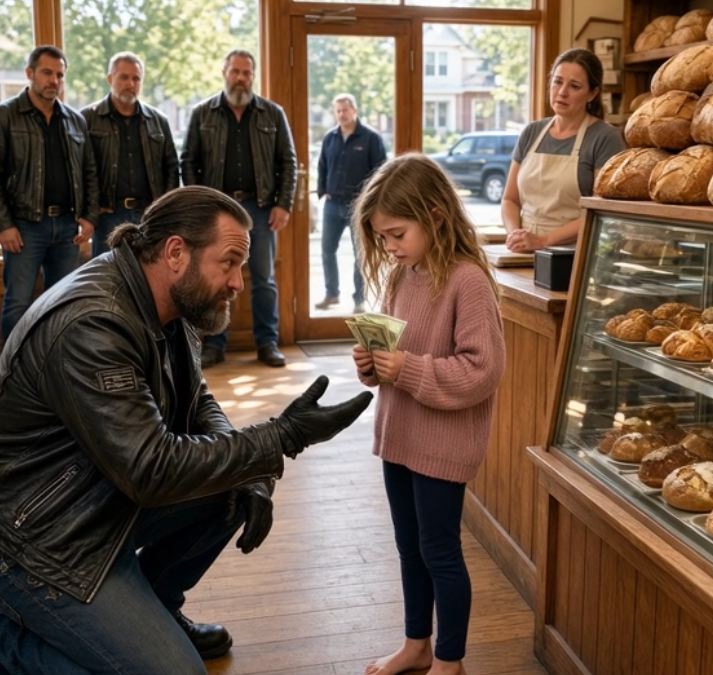
She could not have been older than eight, though the expression on her face belonged to someone who had already learned too much. Her dark hair hung in tangled strands around her cheeks. Rainwater ran from her sleeves. Her pale nightdress clung to her thin frame, streaked with mud near the knees. Her feet were red from cold against the tile.
Her hands trembled as she pushed a few crumpled bills across the counter.
They were red.
Not bright in a dramatic way.
Not like something from a movie.
Just red and raw, the skin scraped and irritated, as if she had fallen, climbed, or tried to shield herself from something hard.
Margaret’s breath caught.
The girl whispered, “Bread… please. I can pay.”
The voice was barely there.
PART3:
Fragile.
Like speaking too loudly might break whatever courage had brought her through the door.
For one second, Margaret froze.
Not because she did not know what to do, but because the sight of the child split the morning in half. There had been the world before the girl, warm and ordinary and smelling of cinnamon.
And now there was this.
A barefoot child at dawn, buying bread with shaking hands.
Margaret moved slowly from behind the counter.
“Honey,” she said softly, “are you hurt?”
The girl did not answer.
Her eyes darted toward the front window.
Margaret followed her gaze.
Across the street, partly hidden by rain, sat a black SUV.
Angled near the curb.
Engine running.
Headlights off.
Windows dark.
Margaret looked back at the girl.
The child’s whole body had gone rigid.
Her breathing shortened.
One of the bills slipped from her fingers and landed on the floor.
“He found me,” she whispered.
At the corner table, the laughter stopped.
No chair scraped loudly. No one shouted. No one created panic.
But every person at the Iron Haven table changed.
Caleb stood first.
He did it slowly, with the careful control of a man who understood that sudden movement could frighten a child more than it helped. Jordan leaned forward, eyes already moving from the girl’s face to her hands to her feet to the way she held one arm close to her ribs. Darren looked toward the black SUV and reached for his phone beneath the table.
Margaret felt her own hand move beneath the counter, finding the phone she kept there.
The girl took one tiny step backward.
Caleb stopped several feet away and lowered himself into a crouch, putting his large body below the child’s eye level.
“Hey,” he said gently. “My name’s Caleb. You’re okay right now.”
The girl stared at him but did not speak.
He did not reach for her.
That mattered.
Jordan stood but remained behind Caleb.
“Her hands,” he murmured quietly enough that only the adults heard. “And her feet. She needs care.”
Darren’s gaze stayed on the SUV.
“Someone’s watching.”
Margaret dialed 911 with her thumb.
She kept her voice low when the dispatcher answered.
“This is Margaret Holloway at Maple Hearth Bakery on Bell Street. I have a barefoot little girl here in distress, possibly injured, and a man waiting outside in a black SUV. Send police and medical.”
The dispatcher began asking questions.
Margaret answered while watching the child.
“What’s your name, sweetheart?” Caleb asked.
The girl shook her head.
“That’s okay. You don’t have to tell me yet.”
The bakery door rattled faintly as wind pressed rain against it.
The girl flinched so hard she nearly stumbled.
Caleb shifted slightly, not touching her, only placing himself between her and the door.
At 6:46 a.m., the door opened.
The man who stepped inside did not look like a monster.
That was the first thing Margaret would remember later.
He did not storm in wild-eyed or shouting. He did not wear dirty clothes or carry himself like someone obviously dangerous. He was tall, composed, maybe late thirties, with neatly combed hair and an expensive rain jacket that looked strangely dry considering the weather. His face was handsome in a forgettable way, the kind that might smile from a church directory or local business advertisement. His eyes moved once across the room, measuring everything.
Then they settled on the girl.
A faint smile appeared.
Not warm.
Not relieved.
Possessive.
“There you are,” he said calmly. “You’ve had people worried.”
The girl made a sound that did not become a word and stumbled backward until her shoulder brushed Caleb’s sleeve.
Caleb stood fully now.
He did not puff up. He did not threaten. He simply became an immovable thing between the man and the child.
The man’s eyes flicked to him.
“This doesn’t concern you.”
Darren had already moved to the side, angling for a clear view of the SUV outside. Grace stepped to the left of the counter. Ben quietly guided the only other customer, an elderly woman with a coffee cup, behind a display shelf and out of the direct path.
Margaret kept the dispatcher on the line.
Caleb’s voice stayed even.
“A scared child walked into this bakery barefoot in the rain. That concerns everyone in here.”
The man gave a short laugh.
“She’s my niece.”
The girl shook her head once.
Barely.
But Jordan saw it.
So did Caleb.
The man continued, smooth and controlled.
“She has behavioral issues. She ran from the house this morning. Her mother is frantic.”
Margaret felt the girl’s eyes snap to him at the word mother.
Fear changed shape.
Not less.
Different.
Caleb said, “Then we’ll let the proper people sort that out.”
The smile faded slightly.
“I said she’s family.”
“And I said we’ll let the proper people sort that out.”
The man took one step forward.
Jordan moved instantly, blocking his path with surprising speed for someone so quiet.
“She needs medical care,” Jordan said. “Not pressure.”
The man looked at him.
“And who are you?”
“Someone who knows what shock looks like.”
Darren spoke from near the window.
“Black SUV. Tennessee plate. First three characters H7K. Dash camera facing west if anyone needs it.”
The man’s jaw tightened.
Margaret heard the dispatcher say, “Ma’am, officers are en route. Stay on the line.”
The girl began trembling harder.
Caleb looked down at her without turning his back on the man.
“You’re okay,” he said. “No one is handing you to anyone until the sheriff gets here.”
At the word sheriff, the man’s expression shifted.
Only a flicker.
But every adult in the bakery saw it.
Outside, distant sirens began to rise.
The man stepped back.
“This is a misunderstanding,” he said.
Nobody answered.
He looked at the girl one last time.
Not with concern.
With warning.
Then he turned and walked out.
The bell above the door rang behind him.
The SUV pulled away before the first patrol car turned onto Bell Street.
But Darren had already written down the plate.
Grace had taken a photo through the rain-streaked glass.
Margaret had the dispatcher on the phone.
And Caleb had heard the girl whisper three words so softly they nearly vanished beneath the rain.
“Eli’s still there.”
Caleb crouched again.
“Who’s Eli?”
The girl’s lower lip trembled.
“My brother.”
By the time deputies arrived, the bakery had transformed into something between a shelter and a command center.
Margaret locked the front door but left the lights on. Grace stood near the entrance to direct responders. Jordan warmed towels in the bakery’s small dryer because Margaret kept extra for spills and early-morning cleanup. Ben brought a chair near the oven’s warmth but not too close. Caleb stayed on the floor several feet from the child because she seemed calmer when he remained where she could see him.
The girl had not eaten the bread.
She held it with both hands as if it were more important than food.
When Deputy Anna Bell entered with another officer, the child shrank instantly.
Margaret moved beside her.
“It’s all right, honey. This is Deputy Bell. She’s here to help.”
Deputy Bell was in her forties, with kind eyes and rain on her uniform shoulders. She lowered herself just as Caleb had done.
“Hi,” she said. “I’m Anna. Can you tell me your name?”
The girl stared at the floor.
Deputy Bell waited.
No pressure.
No impatience.
Finally, the child whispered, “Sophie.”
“Hi, Sophie. Are you hurt?”
Sophie looked toward the door.
“He’ll come back.”
Deputy Bell’s expression did not change, but her voice became even softer.
“We have people watching for him now. He cannot take you from here.”
Sophie’s eyes filled with tears.
“My brother.”
“Eli?”
Sophie looked startled.
Caleb said quietly, “You told us his name.”
She swallowed.
“He’s five.”
Deputy Bell nodded.
“Where is Eli right now?”
Sophie’s whole body tightened.
For a moment, it seemed she might disappear inside herself.
Margaret knelt nearby and placed a wrapped roll on a napkin.
“No one is mad at you,” she said. “No matter what you say next.”
That was when Sophie began to cry.
Not loudly.
Not the way children cry when they want comfort.
This was silent crying, tears slipping down a face that had learned sound could make things worse.
“He said if I told,” she whispered, “Eli would get hurt.”
Deputy Bell did not rush.
“Who said that?”
Sophie closed her eyes.
“Trevor.”
The name landed in the room.
“Trevor who?” Deputy Bell asked.
Sophie hugged the bread to her chest.
“Trevor Vale.”
Grace, still near the door, stiffened.
Darren looked at her.
“You know him?”
Grace’s mouth tightened.
“He runs Vale Security Systems. Sponsor for half the town fundraisers. His company did the alarm upgrades at the veterans hall last year.”
Deputy Bell’s face hardened by degrees.
“Where does Trevor live, Sophie?”
Sophie shook her head quickly.
Not refusal.
Fear.
Margaret reached behind the counter and pulled out an old bakery order pad.
“Could you draw it?” she asked gently. “Not the house. Just something near it. A sign. A road. A tree. Anything.”
Sophie stared at the pad.
Her hands trembled too badly to hold the pencil.
Caleb did not take it from her. He placed his own large hand palm-up on the floor between them.
“You can rest your hand on mine if that helps,” he said. “You hold the pencil. I don’t move unless you tell me.”
Sophie looked at him for a long moment.
Then she placed her small wrist lightly against his hand.
With shaky lines, she drew a mailbox.
A long driveway.
A pond.
And a crooked sign with one word: HAWTHORN.
Deputy Bell stood.
“Hawthorn Lane,” she said to the other officer. “Call it in. Possible child still at residence. Suspect Trevor Vale. Black SUV. Get units moving now.”
Sophie heard and started breathing too fast.
Jordan stepped closer but kept his hands visible.
“Sophie,” he said, voice calm and firm, “look at me.”
She looked.
“You are in a bakery. You are warm. There are deputies here. Caleb is there. Margaret is there. Your brother is being looked for right now. Breathe with me.”
He lifted one hand slowly, showing her how.
In.
Out.
In.
Out.
Little by little, Sophie followed.
Sirens grew again outside, more distant this time, moving away from the bakery toward Hawthorn Lane.
Sophie clutched the bread.
Margaret understood then.
“You were buying it for Eli,” she said.
Sophie’s chin trembled.
“He didn’t eat dinner.”
Margaret turned away because if she did not, she would cry in front of a child who needed adults to remain steady.
She filled a bag.
Rolls. Banana bread. cheese biscuits. bottled water. crackers. Anything soft, simple, comforting.
When she handed it to Deputy Bell, she said, “For Eli. And Sophie when she’s ready.”
Deputy Bell nodded.
“We need to get her to the hospital.”
Sophie’s eyes went wide.
“No.”
Jordan spoke gently.
“Your hands and feet need help, kiddo. And you need to get warm.”
“No hospital.”
Margaret looked at Deputy Bell.
“Can I ride with her?”
The deputy hesitated.
Caleb spoke.
“She trusts Margaret.”
Sophie looked at Margaret.
It was barely a look.
But it was a request.
Deputy Bell nodded.
“All right. Until child services arrives.”
Margaret grabbed her coat.
Before they left, Sophie turned toward Caleb.
For the first time, she looked directly at him.
“Don’t let him take Eli.”
Caleb’s face changed.
Not dramatically.
Something deeper.
A promise settling into bone.
“I won’t,” he said.
The hospital in Willow Creek was small, with a twelve-bed emergency department and nurses who knew half the town by name. Sophie sat on the edge of the exam bed wrapped in warm blankets, her wet nightdress replaced by a pediatric gown printed with tiny blue whales. Margaret remained beside her because every time she stepped away, Sophie’s eyes followed.
Doctors examined her gently.
They confirmed what the adults already feared: injuries in different stages of healing, raw hands, chilled feet, exhaustion, and signs that neglect had gone unnoticed too long. No one said the worst possibilities out loud in front of her. They did not need to.
Sophie spoke very little.
When she did, she asked the same question.
“Is Eli here?”
Not yet.
“Did they find Eli?”
They are looking.
“Is Eli okay?”
We’re going to find out.
Margaret kept one hand on the edge of the bed where Sophie could see it but did not touch her without permission.
At 8:12 a.m., Deputy Bell returned.
Sophie saw her face and stopped breathing.
Deputy Bell crouched near the bed.
“They found Eli.”
Sophie’s hands flew to her mouth.
Margaret felt her own knees weaken.
“He’s alive,” Deputy Bell said quickly. “He’s scared, but he’s alive. An ambulance is bringing him here.”
Sophie began sobbing then.
Not silently this time.
Brokenly.
Like a child again.
Margaret sat beside her and let her cry into the sleeve of her coat.
Thirty-seven minutes later, Eli arrived.
He was small for five, with the same dark hair as Sophie and eyes too large for his face. He wore pajama pants, one sock, and a police jacket wrapped around his shoulders. A paramedic carried him in because he would not let go of the man’s sleeve.
Sophie slid off the exam bed before anyone could stop her.
“Eli!”
He turned.
For a second, neither child moved.
Then Eli ran to her.
The force of their hug nearly knocked Sophie backward. She held him fiercely, one hand cradling the back of his head. He buried his face in her shoulder.
“You came back,” he cried.
“I told you I would.”
“I thought he caught you.”
“No.” Sophie looked toward Margaret, then Deputy Bell, then Jordan, who had come to the hospital to give a medical statement. “People helped.”
Eli clung harder.
Margaret stepped into the hallway and cried where they could not see her.
There are sounds a person never forgets.
That morning, Margaret would remember the bell above the bakery door.
Sophie whispering, “He found me.”
Caleb saying, “No one is handing you to anyone.”
But most of all, she would remember Eli saying, “You came back,” and Sophie answering as if the whole world depended on it.
I told you I would.
The man from the SUV was not at the house when deputies arrived.
Trevor Vale had fled.
But he had not fled far.
He was arrested that afternoon outside a storage facility twenty miles south, where Darren and Grace had helped deputies identify a second vehicle tied to his business. Caleb did not go with them. He stayed at the hospital until Sophie saw Eli with her own eyes because he had made a promise and understood promises to frightened children must be kept in visible ways.
The investigation revealed what small towns hate to admit: everyone had seen pieces.
Not enough, they told themselves.
Never enough.
A teacher had noticed Sophie falling asleep in class.
A neighbor had heard shouting.
A grocery clerk had seen Eli with bruises and accepted the explanation that he was clumsy.
A church member had wondered why their mother, Rachel Lang, stopped bringing the children.
A deputy had responded to one noise complaint and left after Trevor answered the door calmly and said the children were asleep.
Trevor Vale was not Sophie’s father.
He was Rachel’s boyfriend.
He had entered their lives slowly after Rachel lost her job and then her confidence. He helped with bills. Fixed the porch light. Drove Rachel to appointments. Watched the children when she worked temporary shifts. People called him dependable. Generous. Protective.
Then Rachel became isolated.
Then the children became quiet.
Then the curtains stayed closed.
Then everyone assumed someone else knew more.
Rachel Lang was found that morning in the house on Hawthorn Lane, heavily medicated and disoriented. Later, doctors would determine she had been kept in a state where she could not fully understand what was happening. The shame of that nearly destroyed her. People would judge her anyway, because people often prefer simple blame to complicated grief.
But Sophie did not blame her mother.
Not at first.
Not later.
“She tried to wake up,” Sophie told the child advocate softly. “Sometimes she tried.”
That sentence became part of the case.
Trevor had counted on silence.
On fear.
On the town’s trust in his clean jacket and calm voice.
On Rachel’s confusion.
On Sophie being too small to be believed.
He had not counted on rain, hunger, a bakery door, and six veterans who had learned to read danger before it announced itself.
The days that followed were not loud or dramatic.
They were careful.
Steady.
Intentional.
Sophie and Eli were placed first in emergency foster care with a licensed family outside town while Rachel received treatment and the investigation continued. Margaret was allowed supervised visits as a familiar support person. Caleb and the Iron Haven Riders coordinated with law enforcement, not outside it. That mattered to him. He did not want vigilante stories. He wanted the children safe, the case clean, the truth documented, and no mistake that could be used by Trevor’s attorney later.
“We do this right,” he told the riders at their next meeting.
Tank, who had heard the story and ridden in from the neighboring county, growled, “Right feels slow.”
Caleb looked at him.
“Slow is still faster than letting him walk.”
So they did it right.
Darren provided his observations and the SUV plate details. Grace turned over time-stamped photos. Margaret gave her 911 call recording and bakery security footage. Jordan wrote a statement about Sophie’s visible condition without speculation. Ben and Luis identified the moment the SUV left.
Deputy Bell worked the case with a child crimes investigator from the county.
A forensic interviewer spoke with Sophie and Eli separately in a child-friendly room with soft chairs and no uniforms.
Doctors documented carefully.
Social workers built safety plans.
Rachel entered inpatient treatment and later trauma counseling.
The town talked, of course.
Small towns always do.
Some spoke with compassion.
Some with judgment.
Some said they had always known Trevor was strange, though they had never said it before.
Some defended him until the evidence grew too heavy.
Margaret heard whispers in the bakery.
“How could the mother not know?”
“Why didn’t the girl tell sooner?”
“Those biker men probably scared the guy off.”
“People shouldn’t get involved in family matters.”
The last one made Margaret slam a tray down hard enough to silence the morning rush.
She looked at the man who had said it.
A retired banker named Mr. Collins, who liked his biscuits extra buttered and his opinions unchallenged.
“A hungry barefoot child is not a family matter,” she said.
The bakery went silent.
Mr. Collins blinked.
Margaret continued, voice shaking but clear.
“A child afraid to speak is not a family matter. A little boy locked in a house is not a family matter. If your definition of family requires the rest of us to look away from suffering, then your definition is wrong.”
No one spoke.
Then Mrs. Alvarez from the post office set down her coffee and began clapping.
One person.
Then another.
Not loud.
Not theatrical.
Enough.
Mr. Collins stopped coming for two weeks.
When he returned, he ordered quietly and left a twenty-dollar bill in the donation jar Margaret had placed by the register.
The jar read:
FOR SOPHIE AND ELI — SAFE START FUND
The money was not for publicity.
It paid for clothes, school supplies, therapy transport, books, pajamas, shoes, and anything the children needed while adults decided legal things too slowly for childhood.
The Iron Haven Riders added more.
Then the church.
Then the elementary school teachers.
Then strangers who had heard the story from the local paper.
But the most important gift came from an old woman named June Baker, who lived three houses down from Hawthorn Lane. She entered Maple Hearth one rainy afternoon two weeks after the rescue, gripping her purse with both hands.
Margaret recognized her.
June had been one of the people quoted in the article saying Trevor “always seemed polite.”
She stood at the counter, face pale.
“I need to put something in the jar,” June said.
Margaret slid it closer.
June placed an envelope beside it instead.
“This isn’t money.”
Margaret waited.
“It’s a statement.”
“A statement?”
June nodded.
“I saw Sophie by the mailbox once in January. No coat. She looked scared. I asked if she was all right, and Trevor came out before she could answer. He smiled and said she was being dramatic because she didn’t want school. I believed him.”
Her voice cracked.
“I believed the smiling man instead of the frightened child.”
Margaret’s anger softened into something heavier.
June continued.
“I wrote down what I remember. Deputy Bell said it might help establish a pattern.”
Margaret took the envelope carefully.
June’s lips trembled.
“I don’t want to be one of those people who says, ‘I wish I’d done something,’ and then still does nothing.”
Margaret came around the counter and hugged her.
June broke.
“I’m so sorry,” she whispered.
“Then help now,” Margaret said.
“I will.”
And she did.
June became one of the first residents to join the town’s new child safety awareness group. She spoke publicly at the community meeting, voice trembling, telling everyone that politeness could be camouflage and fear deserved attention.
“I am ashamed,” she said from the church fellowship hall stage. “But shame that only makes you hide is useless. Let it make you brave instead.”
Caleb stood in the back of the room with his arms crossed, listening.
Beside him, Jordan murmured, “That one’s got spine.”
Caleb nodded.
“Late spine.”
“Still spine.”
It took six weeks before Sophie asked to return to the bakery.
Not because she wanted bread.
Because she wanted to know if the room still existed the way she remembered it.
Trauma has a strange way of turning places into monsters and miracles at the same time. Maple Hearth was where Trevor had found her. It was also where adults had finally stood between her and him. Sophie needed to see which memory was stronger.
Margaret closed the bakery early for the visit.
No customers.
No noise.
Only warm light, fresh bread, and the people Sophie had asked to see.
Margaret.
Caleb.
Jordan.
Deputy Bell, out of uniform.
And Eli, who refused to let Sophie go anywhere important without him.
Sophie entered holding her foster mother’s hand. She wore jeans, a yellow sweater, and pink sneakers that flashed tiny lights when she walked. Her hair was brushed into two braids. She looked healthier, but her eyes still scanned every corner.
Margaret stayed behind the counter at first.
“Hi, sweetheart.”
Sophie looked at the spot where she had stood that morning.
Then at the front window.
The rain was gone. Sunlight touched the glass.
“No SUV,” Caleb said quietly.
Sophie looked at him.
“No SUV,” she repeated.
Eli tugged her sleeve.
“Can we get bread now?”
Everyone laughed softly.
Sophie almost smiled.
Margaret brought out a basket.
Rolls, honey biscuits, cinnamon twists, and one small loaf shaped like a bear because Eli had asked for “bread that looks like it has ears.”
He gasped.
“For me?”
“For you,” Margaret said. “But Sophie gets first pick.”
Sophie looked at the basket.
Then at Margaret.
“I only had three dollars that day.”
“I know.”
“I was going to come back and pay more.”
Margaret had to steady herself against the counter.
“Honey, you paid plenty.”
Sophie’s brow furrowed.
“No, I didn’t.”
Caleb crouched near her, just as he had that morning.
“You got help for your brother,” he said. “That was the bravest payment anyone ever brought through this door.”
Sophie looked down.
“I was scared.”
“Brave doesn’t mean you weren’t.”
She considered that.
Then she chose a honey roll and broke it in half for Eli.
He took it solemnly.
Margaret turned away again, wiping her hands on her apron.
Deputy Bell pretended to study the menu board.
Jordan looked at the ceiling.
Caleb blinked hard.
Sophie noticed anyway.
“Why do grown-ups cry when things are good?”
Margaret laughed through tears.
“Because good things sometimes have to travel through bad places to reach us.”
Sophie did not respond immediately.
Then she said, “I don’t like bad places.”
“No,” Margaret said. “Neither do I.”
The trial did not happen quickly.
Trevor’s attorney tried to make everything muddy.
He suggested misunderstanding. Family conflict. A child coached by adults. A respected businessman targeted by people eager for drama. He questioned the bikers’ involvement, implying intimidation. He questioned Margaret’s memory because she was emotional. He questioned Rachel’s reliability because of her medical state. He questioned Sophie’s ability to remember.
But truth had arrived in pieces too numerous to dismiss.
The 911 call.
Bakery footage.
Darren’s plate note.
Grace’s photo.
Medical documentation.
Rachel’s toxicology report.
Prior complaints.
June’s statement.
A recovered phone with messages Trevor thought he had deleted.
Most of all, Sophie’s interview.
Clear.
Consistent.
Heartbreaking.
Eli’s too, in the fragmented way a five-year-old tells truth: about hiding, hunger, his sister singing softly when he was scared, and Trevor saying no one would believe bad children.
When Sophie testified by closed-circuit video months later, Margaret sat in the courthouse hallway holding a paper cup of coffee gone cold. Caleb stood nearby in his Iron Haven jacket. Jordan paced. Deputy Bell came in and out with updates.
Rachel Lang sat alone at the end of the hallway.
She looked thinner than anyone remembered, her hair pulled back, her face bare and pale. Treatment had returned her to herself enough to understand what had happened, which meant it had also returned her to grief. Some people in town still hated her. Some pitied her. Some did both in the same breath.
Margaret did not know what she felt.
Then Rachel stood and walked toward her.
Margaret stiffened.
Rachel stopped several feet away.
“I don’t expect forgiveness,” she said.
Her voice shook.
Margaret did not answer.
Rachel looked toward the courtroom door.
“I didn’t protect them.”
“No,” Margaret said quietly. “You didn’t.”
Rachel flinched.
Caleb glanced over but did not interfere.
Rachel’s eyes filled.
“I was not myself.”
“I know.”
“That doesn’t make it okay.”
“No,” Margaret said. “It doesn’t.”
Rachel nodded as if accepting a sentence.
“I’m working every day to become someone they can be safe near again. Even if that means they never come home to me.”
That was the first thing Rachel said that made Margaret believe she understood the size of the damage.
Not “when I get them back.”
Not “once this is over.”
If that means they never come home to me.
Margaret looked at her then.
Really looked.
Rachel Lang was not a villain.
She was not innocent either.
She was a mother who had been controlled, drugged, isolated, and broken down by a man who had chosen his targets carefully. She was also the adult in a house where children had suffered. Both truths could stand in the same hallway. Neither erased the other.
“What do Sophie and Eli need from you right now?” Margaret asked.
Rachel swallowed.
“For me to get well. For me not to rush them. For me to tell the truth even when it makes me look bad.”
Margaret nodded.
“Then do that.”
Rachel began to cry.
“I am.”
A few minutes later, Sophie’s advocate came out and said her testimony was finished.
Caleb exhaled like he had been holding his breath for months.
Sophie emerged later through a side door with her therapist. She looked exhausted, but upright.
Eli was not there that day, by court order and common sense.
Sophie saw Caleb first.
“Did I do it?” she asked.
He crouched.
“Yes.”
“Was I brave?”
His eyes softened.
“You were brave before anyone saw you.”
She looked at Margaret.
“Can we go to the bakery?”
Margaret smiled.
“Already saved you a honey roll.”
Trevor Vale was convicted.
Not on every count.
The world is not a perfect storyteller.
But enough.
Enough to keep him away from Sophie and Eli. Enough to put his name where it belonged. Enough to reveal him publicly as the man the children had known behind closed doors.
When the verdict came, Sophie did not cheer.
She only asked, “Does that mean he can’t come back?”
Deputy Bell, who had stayed through the whole process, answered carefully.
“He cannot come take you.”
Sophie closed her eyes.
Eli, sitting beside her with a stuffed dinosaur, whispered, “Can we have pancakes?”
Children survive in fragments.
Terror.
Relief.
Breakfast.
All real.
The healing afterward was not simple.
Sophie had nightmares. Eli panicked when doors closed too loudly. Rachel continued treatment and supervised visits. Foster placement turned into kinship placement with Rachel’s sister, Aunt Mara, who lived twenty minutes outside town and had a big yard, a gentle dog, and enough patience to sit on the floor during meltdowns without taking them personally.
Margaret became “Bakery Grandma,” though Sophie said it first by accident and then refused to take it back.
Caleb became “Mr. Caleb,” then simply Caleb, though Eli once called him “the wall man” because he had stood between Sophie and Trevor.
Jordan taught Sophie how to wrap her hands safely when they were sore from anxiety picking. Grace taught Eli how to tighten a bolt on a bicycle. Ben built a small free library outside the bakery shaped like a tiny house. Luis fixed Rachel’s old car when she reached the stage of treatment where supervised visits could happen outside the center.
The Iron Haven Riders did not replace family.
They became something else.
A circle.
A reminder.
Proof that safe adults could exist in more than one form.
At the one-year anniversary of the rainy morning, Margaret arrived early at Maple Hearth as usual.
Rain fell again.
Soft at first, then steady.
She stood at the counter for a long moment, looking at the spot where Sophie had pushed forward three crumpled dollars and asked for bread.
Margaret had kept those bills.
Not in the register.
In a small frame in the office, beside a note Sophie had written months later:
Thank you for opening the door.
The bakery bell rang at 7:10.
Margaret stepped out front.
Sophie entered wearing a purple raincoat and yellow boots. Eli came behind her, carrying a backpack almost as large as he was. Aunt Mara stood at the door, smiling. Behind them, Caleb and Grace shook rain from their jackets.
Sophie walked to the counter.
She was taller now.
Still watchful.
Still careful.
But her face had changed.
There was childhood in it again.
Not all the time.
But enough to make Margaret believe in miracles that worked slowly.
Sophie placed three dollars on the counter.
Margaret looked at them.
Then at her.
Sophie lifted her chin.
“For bread.”
Margaret’s throat tightened.
“Honey, you don’t have to pay.”
“I know.”
“Then why?”
Sophie looked toward the window, where no black SUV waited.
“Because this time I’m not scared.”
Margaret pressed one hand to her heart.
“What would you like?”
Sophie looked at Eli.
He grinned.
“Bear bread!”
Margaret laughed.
“Of course.”
Caleb stood quietly near the door, watching the street out of habit more than fear. Sophie noticed.
“You don’t have to stand there,” she said.
He looked back.
“No?”
She shook her head.
“It’s safe.”
Caleb absorbed that like a medal.
Then he stepped away from the door and joined the others at the corner table.
Margaret brought out warm bear-shaped rolls, honey butter, coffee for the adults, cocoa for the children, and one cinnamon twist for Sophie because she had earned sweetness.
The rain blurred the world outside.
Inside, the bakery glowed.
At the corner table, Eli told Grace an extremely complicated story about a dinosaur who opened a motorcycle repair shop. Grace listened with full seriousness. Caleb let Sophie show him a drawing she had made in therapy: a bakery with yellow windows, six people standing in front of a door, and a little girl holding bread.
“What’s this?” Caleb asked, pointing to a small shape in the sky.
“A bird,” Sophie said.
“Where’s it going?”
She shrugged.
“Wherever it wants.”
He nodded.
“That sounds right.”
Rachel arrived later that morning for a supervised breakfast visit.
She stood outside in the rain for nearly a full minute before coming in.
Margaret watched Sophie see her mother.
The girl’s face changed in that complicated way children of wounded parents learn too young. Love, anger, fear, hope, all arriving together.
Rachel did not rush to hug her.
She had learned.
Instead, she stopped several feet away.
“Hi, Sophie.”
“Hi, Mom.”
“Hi, Eli.”
Eli hid half behind Aunt Mara but waved.
Rachel smiled through tears.
“I brought the library books you asked for.”
Sophie looked at the bag in her mother’s hand.
Then at Margaret.
Margaret gave the smallest nod.
You choose.
Sophie stepped forward and took the bag.
Not a hug.
Not forgiveness.
A step.
Rachel accepted it like grace.
They sat together at a small table near the window, Aunt Mara nearby, the therapist scheduled to arrive later, the world moving carefully around them.
Healing, Margaret had learned, was not a grand door swinging open.
It was a hundred small doors, each unlocked slowly.
Some never opened.
Some opened only a crack.
Some opened to rooms full of pain.
And some, if everyone stayed patient, opened to mornings where a child could eat bear-shaped bread across from her mother and feel safe enough to ask for more honey butter.
Months after that anniversary, Willow Creek changed in ways people did not notice all at once.
The bakery placed a small sign in the window:
IF YOU NEED HELP, COME INSIDE.
NO PURCHASE NECESSARY.
Other businesses copied it.
The library trained staff to respond to distressed children and vulnerable adults. The school district updated reporting protocols. The sheriff’s office worked with advocates to teach the community what coercive control could look like. The Iron Haven Riders started an annual fundraiser called the Safe Door Ride, raising money for child advocacy services, emergency foster supplies, and trauma counseling.
Margaret donated bread for every event.
Caleb hated speeches but gave one at the first ride because Sophie asked.
He stood in front of forty motorcycles, a crowd of townspeople, and a banner painted by children from the elementary school.
He kept it short.
“A lot of people think protection means being strong after danger arrives,” he said. “Sometimes it means paying attention before it does. A child should not have to be bleeding, barefoot, or terrified before we decide something is wrong. Look closer. Ask twice. Believe fear when you see it.”
Then he stepped away from the microphone before anyone could make him say more.
Sophie clapped the loudest.
Eli shouted, “Wall man!”
The crowd laughed.
Caleb turned red.
Grace never let him forget it.
Years later, people in Willow Creek would tell the story differently depending on who was telling it.
Some would say it was about a brave little girl who escaped in the rain to save her brother.
Some would say it was about Margaret Holloway, who saw a child instead of a customer.
Some would say it was about the Iron Haven Riders, who proved that gentleness and strength were not opposites.
Some would say it was about Deputy Bell, who moved fast and did not let a respected man’s reputation slow the truth.
Some would say it was about a town that learned too late, then tried to do better.
Sophie would tell it differently.
At sixteen, when she spoke at the opening of the new child advocacy center funded partly by the Safe Door Ride, she stood at a podium with Eli in the front row, Margaret crying already, Caleb pretending not to, and Rachel sitting quietly beside Aunt Mara.
Sophie had grown tall. Her hair was long now, braided over one shoulder. She still carried some shadows, because survival does not erase memory. But she also carried herself with a steadiness that made Margaret ache with pride.
She unfolded her paper.
Then folded it again.
“I was eight years old when I walked into Maple Hearth Bakery,” Sophie said. “I thought I was buying bread. I didn’t know I was walking into the first safe room I had seen in a long time.”
The room went silent.
“I used to think people didn’t help because they didn’t care. Now I know sometimes people don’t help because they don’t understand what they’re seeing. Sometimes they’re scared. Sometimes they don’t want to be wrong. Sometimes the person doing harm seems too normal.”
She looked at June Baker in the second row.
June wiped her eyes.
“But I also learned that one person stopping can change everything. Mrs. Holloway stopped. Caleb stopped. Jordan stopped. Deputy Bell stopped. My foster family stopped. My aunt stopped. My mom stopped running from the truth and got help. A lot of people stopped long enough to see us.”
Her voice trembled.
“Children should not have to be brave enough to save themselves. But if they try, please be brave enough to believe them.”
Margaret covered her mouth.
Caleb stared at the floor.
Rachel cried openly, one hand pressed to her chest.
Sophie took a breath.
“My brother is safe. I am safe. We are not a sad story anymore. We are proof that safe adults matter.”
The applause that followed was not loud at first.
People were crying too hard.
Then it rose.
Full.
Standing.
Sophie stepped away from the podium and went straight to Margaret.
Margaret held her as if she were still the soaked child at the counter and also the young woman she had become.
“I’m so proud of you,” Margaret whispered.
Sophie smiled against her shoulder.
“I know.”
That made Margaret laugh.
That evening, after the ceremony, they all returned to Maple Hearth.
The bakery was closed to the public, but warm light filled the windows. Bear-shaped rolls sat on trays. Eli, now nearly as tall as Sophie, complained that Margaret still made his with “baby ears,” then ate three. Grace argued with Luis about motorcycle maintenance. Jordan helped Deputy Bell carry coffee. Rachel washed dishes in the back without being asked. Aunt Mara packed leftovers.
Caleb stood by the front window.
Sophie joined him.
“No SUV,” she said.
He glanced down, surprised she still remembered those words from the first return visit.
“No SUV.”
“I used to look for it everywhere.”
“I know.”
“I don’t anymore.”
Caleb swallowed.
“That’s good.”
She looked at him.
“Do you still watch doors?”
He considered lying.
Did not.
“Yes.”
“Because of me?”
“Because I know what can come through them.”
Sophie nodded.
Then she said, “Doors can be good too.”
Caleb looked toward Margaret behind the counter, laughing at something Eli said.
“Yes,” he said. “They can.”
Sophie reached into her pocket and pulled out three old crumpled bills.
Caleb recognized them immediately.
Not the same ones, of course. The originals were framed in Margaret’s office. But Sophie had folded these to look like them.
“I keep these sometimes,” she said.
“Why?”
“To remember I got myself there.”
Caleb nodded slowly.
“You did.”
“But I don’t need to hold them every day anymore.”
She placed them on the windowsill.
Rain began outside, gentle against the glass.
Not the same storm.
Not the same morning.
Just rain.
Sophie looked through the window at the shining street.
“I used to think brave meant not being scared.”
Caleb smiled faintly.
“People say that.”
“They’re wrong.”
“Usually.”
She glanced at him.
“Brave means being scared and still walking toward the light.”
Caleb looked at the warm bakery reflected in the glass, the people inside, the girl beside him alive and safe and free to leave or stay as she chose.
“That’s a good definition,” he said.
Sophie smiled.
“I learned it from bread.”
He laughed then.
A real laugh.
Margaret looked over from the counter, saw them, and smiled.
Years would pass.
People would move. Children would grow. The bakery sign would fade and be repainted. The Iron Haven Riders would get older, slower, grayer, though none of them would admit it. Margaret’s knees would ache more, and she would finally hire two young bakers to help with the morning shift. Eli would become a teenager who pretended not to like bear bread but still requested it on birthdays. Rachel would continue rebuilding trust one honest choice at a time. Sophie would leave for college with a scholarship from the advocacy center and call Margaret every Sunday evening.
But the bell above the bakery door would remain.
And every time it rang before sunrise on a rainy morning, Margaret would look up.
Not with fear.
With readiness.
Because she had learned that sometimes life asks a person to open more than a shop.
Sometimes it asks you to open a door between terror and safety.
Sometimes it asks you to recognize that a child with three dollars and trembling hands is not there by accident.
Sometimes it asks you to stand still while danger smiles politely and says, “This doesn’t concern you,” and answer with your whole life:
Yes, it does.
That was what changed Willow Creek.
Not heroics.
Not violence.
Not vengeance.
A door opened.
A baker noticed.
A child whispered.
A group of strangers stood.
A town learned, painfully and late, that safety is not something children should have to beg for with crumpled bills on a rainy morning.
And Sophie Lang, who once walked barefoot through the rain carrying only fear, three dollars, and love for her little brother, grew into a woman who never again doubted the truth that had saved them both:
The wrong person can make a child believe the whole world is dangerous.
But the right people, standing together at the right door, can prove the world still has safe places waiting.








