An 8-Year-Old Boy Walked Barefoot Into a Biker Bar With Duct Tape Across His Mouth—Then He Said His Father’s Road Name and 500 Riders Went Silent.
PART2:
The quiet moved across the tavern in rings, one table at a time, until five hundred voices shrank into the buzz of ceiling fans and the scratch of music no one was hearing anymore.
Grant set down his beer.
He turned.
The crowd near the entrance had parted.
Not the way men step aside for a leader.
The way people move back from something their bodies understand before their minds can name it.
A boy stood in the doorway.
He was small.
Painfully small.
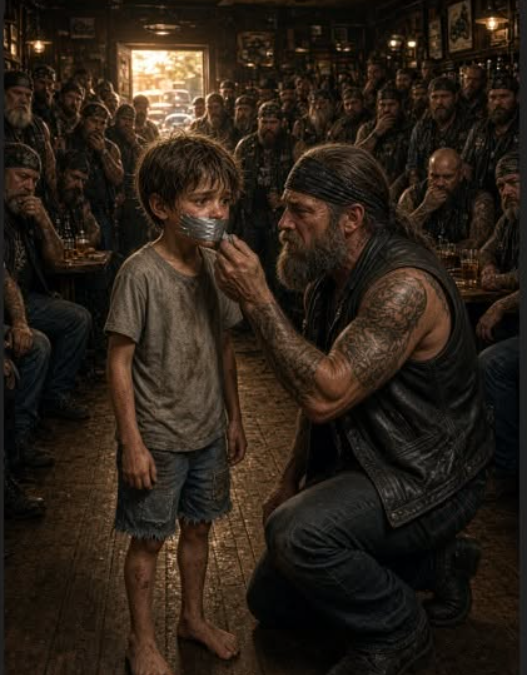
Brown hair stuck to his forehead with sweat. A gray T-shirt hung off him like it had been made for someone three sizes bigger. His shorts were cut unevenly from old jeans. His feet were bare, black with road grime, and blood marked the outside of one foot where gravel or glass had opened the skin.
But no one was looking at his feet.
They were looking at his mouth.
Three thick strips of silver duct tape crossed his lips from cheek to cheek.
The edges had curled from heat and sweat.
The skin around it was raw.
A line of dried blood ran from one corner of his mouth down to his chin.
His eyes were not crying.
That was what made the room colder.
They were wide, hazel, and burning with a purpose no eight-year-old should have to carry.
The boy looked across the room until his gaze found Grant.
Then he walked toward him.
Five hundred men watched that child cross the floor.
No one moved.
No one knew how.
Boots shifted aside.
Chairs scraped softly.
PART3:
Men who would stand in front of fists, knives, and engines locked up at the sight of a child with his mouth taped shut walking through their clubhouse as if he had reached the last place on earth that might still answer.
The boy stopped in front of Grant.
He tilted his head back.
Then he lifted one shaking hand and pointed at the tape.
Grant slid off the barstool.
His knees hit the wooden floor with a sound like a judge’s gavel.
Up close, the tape looked worse. It pulled at the boy’s skin with every breath. His nostrils flared because his mouth could not open. His chest rose and fell too fast.
Grant kept his hands visible.
“I’m going to take it off,” he said.
His voice cracked on the last word, and every man close enough to hear pretended not to notice.
The boy nodded once.
Grant peeled the first strip slowly.
The boy’s eyes watered, but he did not flinch.
The second strip came away with a thin, wet sound that made Donna Tate behind the bar turn her face toward the shelves and press both hands to the counter.
The third strip pulled hardest.
Grant worked it free inch by inch until the boy’s lips parted and he sucked air through his mouth like he had been underwater.
For a moment, the room held still.
Then the boy spoke.
“My name is Levi Beckett,” he said, voice rough and small. “My daddy was Bolt. He rode with you. And my mama needs help.”
The silence that followed was not confusion.
It was recognition.
Derek “Bolt” Beckett had been dead three years.
He had died on Interstate 20 on a clear October morning, eleven miles east of Fort Worth, when a flatbed truck lost steel pipe on a curve and the road gave him no place to go.
The paramedics said it was instant.
The club said he died riding.
His wife, Sarah, had stood at the graveside with five-year-old Levi’s hand in hers while the boy kept asking when his daddy was coming home.
Stone Creek had promised.
Of course they had promised.
They had promised Sarah groceries.
Repairs.
Rides.
Help with the yard.
Help with bills.
Help raising Derek’s boy around men who would tell him who his father had been.
For three months, they kept that promise.
Then life moved.
Grief aged.
Men got busy.
Runs happened.
Arguments happened.
New crises demanded attention.
The calls became less frequent.
The visits thinned.
No one decided to abandon Sarah and Levi.
That was the shame of it.
They simply stopped remembering with their hands.
Now Derek Beckett’s son stood in their bar with blood on his chin and tape burns around his mouth.
Hank Mercer stepped forward, his face pale beneath his beard.
“Bolt’s boy,” he whispered.
Grant did not look away from Levi.
“I know.”
He put both hands gently on the child’s shoulders.
“Levi, tell me what happened.”
The words came fast then, like he had been holding them behind the tape for miles.
“Mama married a man named Wade after Daddy died. He was nice at first. He said he would take care of us. Then he moved us out past Lake Worth, where nobody comes. He took Mama’s phone. He took her keys. He said the club was bad and Daddy was gone and nobody cared anymore.”
Grant’s hands tightened, then loosened.
Levi kept going.
“Mama got sick. She coughs all night. There’s blood on her pillow. Wade won’t take her to a doctor. He locks her bedroom from the outside so she won’t leave. He says she’s dramatic.”
A sound moved through the room.
Not words.
Breath.
Anger pulled in through five hundred chests.
Grant’s voice was low.
“Why did he tape your mouth, son?”
Levi looked at the floor.
“I tried to tell the mailman two weeks ago. Wade found out. He said if I couldn’t keep quiet, he’d keep me quiet himself. Yesterday morning he put the tape on and locked me in my room.”
“Yesterday morning?” Hank said.
Levi nodded.
“I waited until it got dark. Then I climbed out the window. I couldn’t get my shoes because they were in the hall by Wade’s room. I remembered the way Daddy used to drive. Mama told me. She said if I ever got out, go to the Iron Horse.”
“How far did you walk?” Donna asked, voice breaking behind the bar.
Levi looked at her.
“I don’t know.”
Grant knew.
Twenty miles.
An eight-year-old boy had walked twenty miles barefoot in Texas heat with tape over his mouth because the men who had promised to be his family had become a story he was not sure would still be true.
Grant stood slowly.
When he turned to the room, no one spoke.
“You heard him,” he said.
His voice was quiet, but every man heard it.
“That is Derek Beckett’s son. That is our brother’s son. And we let him down.”
The words landed harder than shouting.
“We are going to fix it,” Grant said. “Tonight.”
The first thing they did was care for Levi.
Not because it was dramatic.
Because it was necessary.
Grant carried him to the back office, the small room behind the bar where Donna kept the books, spare towels, and a cot she used during late inventory nights.
Levi did not resist.
He collapsed against Grant’s chest in the terrible way children do when exhaustion finally finds a safe place to land.
Donna brought water, a wet cloth, and a first aid kit.
“Small sips,” Grant said, holding the glass.
Levi drank slowly, throat working hard.
Donna cleaned his feet.
The cuts were ugly, packed with road dust, but Levi only gripped the edge of the cot and stared at the ceiling.
“You can cry, honey,” Donna said.
Levi looked at her like she had suggested something impossible.
“I’m okay,” he whispered.
Grant turned away.
There are sentences children should never have to say.
I’m okay is one of them.
Especially when every adult in the room can see they are not.
In the hallway, Hank waited.
“What’s the play?”
Grant looked toward the main room, where five hundred riders stood in silence, waiting for permission to become thunder.
“We do it right,” he said.
Hank’s eyes were hot.
“Right is slow.”
“Right keeps Levi from watching us get hauled off before we reach his mother.”
Hank breathed hard through his nose.
Grant pointed toward the main room.
“Call Tarrant County Sheriff. Tell them we have a child with injuries reporting unlawful restraint, child abuse, and a medical emergency. Give them the address. Then the club rides.”
“All of us?”
Grant looked through the doorway at the sea of men waiting.
“All of us.”
Hank pulled his phone out.
“They’ll tell us to stay put.”
“They can tell us anything they want,” Grant said. “We ride behind them. We don’t cross the property line. But we are not sitting here with beer in our hands while Sarah Beckett is locked in a room.”
That sentence went through Hank like a match dropped into gasoline.
He nodded once and made the call.
Grant returned to the office.
Levi lay on the cot with a damp towel over his eyes. His breathing was uneven, his mouth raw and swollen. Grant pulled a chair beside him. The chair groaned beneath his weight.
“Levi.”
The boy moved the cloth.
“Yes, sir?”
“I knew your daddy.”
Levi’s eyes sharpened.
“Really?”
Grant nodded.
“He rode too fast. He laughed too loud. He once fixed a carburetor with a butter knife and then bragged about it for six months. He talked about you every chance he got.”
Levi’s lips trembled.
“He did?”
“Every meeting. Every ride. ‘Wait till Levi’s old enough,’ he’d say. ‘That boy’s going to ride circles around me.’ Hank told him he had to pay a dollar every time he mentioned your name.”
A tiny sound escaped Levi.
Not a laugh exactly.
The first piece of one.
“Your daddy loved you so much it made the rest of us tired,” Grant said.
Levi stared at him.
“He said if something happened, come here. He said the club was family.”
Grant closed his eyes briefly.
When he opened them, they were wet.
“He was right,” Grant said. “And I’m sorry we made you walk so far to prove it.”
Hank appeared in the doorway.
“Sheriff’s sending units. They want us to remain here until they assess.”
Grant stood.
“No.”
Hank nodded because he had already known the answer.
Within five minutes, the Iron Horse Tavern emptied.
The sound of five hundred motorcycles lining Lancaster Avenue was something Fort Worth would talk about for years.
Engines fired one by one until the street vibrated.
Headlights stretched down the block in white and amber lines.
Men who had been laughing over beers minutes earlier now sat upright on machines built for speed, their faces locked into the calm discipline of a club moving with one purpose.
Grant rode at the front.
Levi sat behind him wearing boots from the lost and found, stuffed with bar towels to make them fit. Donna’s old reading glasses protected his eyes from the wind. His arms wrapped around Grant’s waist. His cheek pressed against the leather vest that had once meant family to his father and had almost become a lie.
At the junction of Route 199 and Lake Worth Road, two Tarrant County Sheriff’s cruisers waited with lights flashing.
Sergeant Ellen Crawford stepped out of the lead cruiser and stared at the line of motorcycles stretching behind Grant.
“I was told there would be a few of you,” she said.
Grant cut his engine.
“There are a few more.”
Her eyes moved to Levi.
Her expression changed, but only slightly.
She was a professional.
Professionals learned not to show every wound a case gave them.
She crouched near him.
“You’re Levi?”
“Yes, ma’am.”
“I’m Sergeant Crawford. You did a brave thing tonight. Can you tell me what we’ll find at the house?”
Levi swallowed.
“Mama’s bedroom door locks from the outside. Wade has the key. He sleeps hard after he drinks. Mama needs a doctor.”
Crawford stood.
For half a second, she looked toward the road behind them, at five hundred riders sitting in silence.
Then she looked back at Grant.
“My units go in first. Your people stay on the road. No one crosses the property line. If one rider steps onto that property without my request, I arrest him. If two step on it, I arrest you. Understood?”
Grant held her gaze.
“Not one foot,” he said.
“I mean it.”
“So do I.”
Crawford nodded.
“Follow us. Keep the engines low.”
Old Creek Road wound through dark pasture land with no streetlights and no forgiveness.
The Dunlap property sat at the end of a gravel driveway behind trees and a sagging fence. The house was a single-story ranch with gray-white paint, a dead porch light, and one front window flickering blue from a television inside.
The cruisers turned up the driveway.
Grant stopped at the road.
Behind him, five hundred motorcycles lined up along the shoulder, engines low, headlights cutting through the dark.
From where Grant sat, he could see Crawford knock.
“Tarrant County Sheriff’s Department. Open the door.”
Silence.
Then a light came on.
The door opened.
Wade Dunlap appeared in a T-shirt and boxer shorts, squinting into flashlights, irritated like a man awakened for a delivery he did not order.
Grant could not hear the words, but he could read the body language.
Wade crossing his arms.
Crawford steady.
Wade shaking his head.
Another deputy moving toward the side of the house.
Then a sound cut through the night.
A woman’s voice.
Thin.
Ragged.
Desperate.
“Help me. Please, somebody help me.”
Levi made a noise against Grant’s back.
Grant put one hand over the boy’s arms.
Crawford moved past Wade and into the house.
The second deputy stepped between Wade and the doorway.
Three minutes later, Crawford came out supporting Sarah Beckett.
She was thirty-two, but she looked older, hollowed by sickness and fear. Her nightgown hung from her shoulders. Her hair was matted. Her face was pale except for the bruises along one cheekbone and wrist. She blinked at the lights like she had not seen open night in weeks.
“Mama,” Levi whispered.
Grant’s voice was rough.
“She’s out, son.”
Levi did not move.
For the first time that night, he looked like he might break.
Grant turned slightly so the boy could see without letting him down from the bike.
Sarah was eased toward the ambulance that had arrived behind the cruisers. Paramedics moved quickly, wrapping her in a blanket, checking her oxygen, speaking to her gently, not too loud.
Crawford stepped back out.
Wade was in handcuffs.
He was still talking.
Men like Wade always talk when they realize silence no longer belongs to them.
Grant could not hear him over the engines and ambulance radio, but he could see the shape of it.
Excuses.
Anger.
Insults.
Denial.
Then Wade looked past the cruisers for the first time and saw the road.
Five hundred headlights.
Five hundred riders.
No shouting.
No threats.
No movement.
Just witnesses.
Wade stopped talking.
The cruiser door closed behind him.
Only then did Levi start to shake.
Not loud.
Not dramatic.
His small body simply gave up holding itself together.
Grant took one of the boy’s hands and pressed it against his vest.
“You did it,” he said.
Levi shook his head.
“Mama told me the way.”
“And you walked it.”
“I was scared.”
“Brave doesn’t mean you weren’t scared.”
Levi looked toward the ambulance.
“What does it mean?”
Grant swallowed hard.
“It means you kept going anyway.”
Sarah spent nine days at Harris Methodist Hospital.
Doctors found pneumonia that had gone untreated too long. Dehydration. Malnutrition. Bruises in different stages of healing. Wrist marks. Exhaustion so severe it seemed to have settled into her bones. They found evidence of confinement and neglect.
What they did not find was surrender.
Because Sarah Beckett had been weak in body, but she had not stopped fighting.
Every night, through a locked bedroom door, she had whispered stories to Levi.
Stories about Derek.
About the Iron Horse.
About Grant and Hank and Donna.
About the route into Fort Worth.
Past the lake.
Under the bridge.
Left on Lancaster.
Ninth Street.
Black sign.
Loud engines.
“If you ever get the chance,” she had whispered, “go to the club. Your daddy said they were family.”
She had given Levi the map.
He had walked it.
Grant visited the hospital every day.
The first day, Sarah looked at him with gratitude and accusation mixed so tightly he could barely breathe.
“I’m sorry,” he said before she could speak.
She turned her face toward the window.
“He waited for you.”
“I know.”
“So did I.”
Grant stood beside the bed, his vest suddenly heavier than it had ever felt.
“We were late,” he said. “That’s on me.”
Sarah’s eyes filled.
“But you came.”
“No,” Grant said quietly. “Your boy came. We answered the door.”
That was the truth.
And it was not enough to make the shame smaller.
Levi stayed with Donna in the apartment above the Iron Horse until Sarah was strong enough to leave the hospital.
He slept in a bed with clean sheets.
He ate slowly at first, waiting for permission, then a little faster each day.
Donna trimmed his hair.
Hank bought him sneakers.
Grant sat with him in the office and let him hold the little angel-wing tattoo on his wrist with one finger.
“Who is that for?” Levi asked.
“My son,” Grant said.
“Where is he?”
Grant looked at the wall.
“Gone.”
Levi nodded with the solemn understanding of a boy who knew gone too well.
“My daddy is gone too.”
“I know.”
“Do you think they know each other?”
Grant’s throat tightened.
“If there’s any justice, your daddy’s already teaching him how to ride too fast.”
Levi smiled for the first time.
It was small.
It changed the whole room.
Donna began keeping crackers in the office drawer because Levi sometimes woke hungry and did not want to ask.
Hank taught him how to double-knot sneakers so they would not come loose when he ran.
A prospect named Miguel found a small backpack and filled it with pencils, socks, comic books, and a flashlight.
Men who had once made jokes about never knowing what to do with kids found excuses to pass through the bar during the day.
They brought toy motorcycles.
Baseball cards.
A stuffed dog.
A model kit too difficult for an eight-year-old and, apparently, most bikers.
Levi accepted these things politely.
But what he wanted most were stories.
About Derek.
About Bolt.
About the man his father had been before the word dead attached itself to him.
At night, when the bar was closed and the last chairs were turned upside down on tables, Grant sometimes sat with Levi in the back booth and told him the truth.
Not the shiny version.
The true one.
“Your daddy was stubborn,” Grant said.
Levi sat across from him with a glass of chocolate milk Donna insisted counted as comfort.
“How stubborn?”
“Once rode seventy miles with a bad spark plug because Hank told him it couldn’t be done.”
“Could it?”
“No.”
“But he did it?”
“Barely.”
Levi smiled.
“Did he get in trouble?”
“Constantly.”
“Was he bad?”
Grant leaned back.
“No. There’s a difference between bad and wild. Your daddy was wild. He had a good heart. Sometimes his brain had to run to catch up with it.”
Levi looked down at his hands.
“Wade said Daddy was trash.”
Grant’s face changed.
He did not mean for it to.
It happened anyway.
Levi saw it.
Grant forced his voice steady.
“Wade lied.”
“He said bikers don’t care about families.”
Grant stared at the table.
“Sometimes we forget to act like we care.”
Levi looked up.
“That’s not the same?”
“No,” Grant said. “But it can hurt the same.”
Wade Dunlap took a plea after Levi’s testimony and Sarah’s medical records made a trial unwinnable.
In court, he tried to make himself sound misunderstood.
“I was overwhelmed,” he said. “She was sick. The kid was always running his mouth. I didn’t mean for it to get out of hand.”
Judge Marlene Ruiz looked down at him over her glasses.
“You placed tape over a child’s mouth,” she said. “You locked a sick woman inside a bedroom. This did not get out of hand, Mr. Dunlap. Your hand was on it the entire time.”
Grant sat behind Sarah and Levi in the gallery.
Hank sat beside him.
Donna sat on Levi’s other side with one hand around his.
Outside the courthouse, two hundred riders waited quietly in the heat because not everyone could fit in the room, and no one wanted Levi to walk out alone.
Wade was sentenced to prison.
Levi did not cheer.
He leaned against his mother and breathed.
That was all.
Sometimes justice does not feel like victory.
Sometimes it just feels like a door locking from the right side.
On the day Sarah was released from the hospital, Grant drove her not to Old Creek Road, but to a small two-bedroom house on Crenshaw Lane.
The club had rented it, furnished it, stocked the refrigerator, paid the deposit, fixed the plumbing, patched the porch steps, and painted the front door blue because Sarah once said Derek loved blue doors.
Levi waited on the porch wearing new sneakers and a T-shirt that fit.
When Sarah stepped out of Grant’s truck, she walked slowly.
Her breathing was still shallow.
Her legs shook.
But no one held her against her will.
No lock clicked behind her.
No one told her when to speak.
She reached the porch, knelt in front of Levi, and took his face in both hands.
“You found them,” she whispered.
“You told me the way,” Levi said.
Sarah pulled him into her arms.
Grant turned away to give them privacy, but not before seeing Hank wipe his eyes with the back of his hand.
The blue door became a club project whether Sarah wanted it to or not.
A crew came Saturday to repair the fence.
Another fixed the window locks.
Donna organized the pantry like she was preparing for inspection by God Himself.
Hank installed motion lights.
Miguel mowed the lawn badly, then got corrected by three older riders who claimed grass had a correct direction.
Sarah watched from a porch chair with a blanket around her shoulders.
At first, she kept thanking them.
After the fifth time, Donna put a hand on her shoulder.
“Honey, don’t wear yourself out thanking men for doing what they should’ve done three years ago.”
The porch went quiet.
Donna did not apologize.
No one asked her to.
Sarah looked at the men patching the steps.
“They promised Derek,” she said.
“I know.”
“I was angry.”
“You should be.”
Sarah’s hands tightened around the blanket.
“I still am.”
Donna nodded.
“Good. Anger means part of you knows you deserved better.”
Sarah looked at her.
For the first time since the rescue, something like strength flickered in her face.
“So did Levi.”
“Yes,” Donna said. “He did.”
That evening, Stone Creek held church in the back room of the Iron Horse.
The big summer gathering was over.
Chapters had gone home.
But the Fort Worth chapter filled the room, eighty-seven men seated in silence around the long table.
No beer.
No music.
No jokes.
Grant stood at the head.
“Three years ago, we buried Derek Beckett,” he said. “We promised his wife and his son that they were family. We kept it for a little while. Then we let life make liars out of us.”
No one looked away.
“An eight-year-old boy walked twenty miles in bare feet with tape on his mouth because he still believed a promise we forgot. That never happens again.”
He reached into his vest and placed a small patch on the table.
Black background.
Gold letters.
FAMILY.
“This goes to every spouse, every child, every parent of every member who has ridden under our name,” Grant said. “It means they can walk into any Stone Creek clubhouse, anywhere, anytime, and be heard. No waiting. No proving. No twenty-mile walk.”
Hank started the applause.
It spread hard and fast until the walls shook.
Not celebration.
Commitment.
Then Grant raised a hand.
The room settled.
“A patch doesn’t mean anything by itself,” he said. “A promise sewn onto leather is still just thread unless men back it up.”
He looked around the table.
“So here’s how we back it up. Every family connected to this chapter gets a monthly check-in. Not a text if we remember. A visit. A phone call answered by a real person. A list that lives in this room, not in somebody’s head. Widows. Kids. Sick parents. Brothers in prison. Brothers overseas. Ex-wives raising children who still carry our names whether the relationship worked or not. We do not get to decide family stops being family because things are inconvenient.”
A few men shifted.
Good.
Grant wanted them uncomfortable.
Comfort had made them careless.
He continued.
“If someone misses a check-in, I hear about it. If someone needs help, the road captain assigns it. If a child walks into this bar with fear in his eyes, no one asks whether it’s our business.”
He looked at Hank.
“What do we ask?”
Hank’s voice was rough.
“Who do we call, and how fast do we ride?”
Grant nodded.
“That’s the new rule.”
The vote was unanimous.
Not because anyone dared oppose it.
Because every man in that room had seen Levi’s face.
Some lessons do not need debate.
The first family patch went to Sarah.
Grant gave it to her on the porch of the blue-doored house a week later.
She held it like it was heavier than cloth.
“I’m not a rider,” she said.
“No,” Grant replied. “You’re family.”
Levi leaned over her shoulder.
“Do I get one?”
Hank, standing beside Grant, grinned.
“Yours is already on your shirt, kid.”
Levi looked down.
There it was.
Black patch.
Gold letters.
FAMILY.
Pinned carefully above his heart.
He touched it with two fingers.
“Daddy would like it?”
Grant thought of Derek Beckett laughing too loud, riding too fast, promising everyone his boy would grow into trouble with a smile.
“He’d brag about it so much we’d all get sick of hearing it.”
Levi smiled.
A real one this time.
Wide enough to show the gap where a front tooth had fallen out.
After that, the Iron Horse became part of Levi’s map in a different way.
Not a rescue point.
A place he belonged.
He came by after school sometimes with Sarah’s permission. He did homework in the back booth while Donna checked spelling from behind the bar. He learned not to touch pool cues unless invited, not because they were sacred but because bikers were dramatic about their cues. He learned which men had soft hearts and loud mouths. He learned Hank pretended to be grumpy when children beat him at checkers.
He learned Grant drank coffee black and hated birthday cake but ate it anyway when Donna threatened him.
He learned his father had been loved by men who had failed and were now trying to do better.
That mattered.
Because children do not need dead parents turned into saints.
They need truth that can hold.
Derek had been funny.
Derek had been reckless.
Derek had been loyal.
Derek had loved Sarah and Levi with the fierce, imperfect devotion of a man who thought tomorrow would always give him more time.
And because tomorrow had not, Stone Creek had to carry the rest.
Two weeks later, Grant pulled his Road King up to the blue-doored house on Crenshaw Lane.
Levi was sitting on the porch with the family patch pinned to his shirt and his sneakers double-knotted the way Hank taught him.
Sarah stood in the doorway with a cup of coffee, color returning to her cheeks, fear no longer the first thing anyone saw when they looked at her.
“Ready?” Grant asked.
Levi ran down the steps.
Sarah’s face tightened with the natural terror of a mother watching her child climb onto a motorcycle, then softened with something stronger than fear.
Trust.
Grant helped Levi onto the back and showed him where to hold.
“Where are we going?” Levi asked.
Grant started the engine.
The sound rolled beneath them, deep and steady, no longer the sound of men who had forgotten, but men who had remembered in time.
Grant looked back at Derek Beckett’s son.
“Wherever you want, son.”
They rode through Fort Worth under a wide Texas sky.
Past the Iron Horse.
Past Lancaster Avenue.
Past the roads Levi had walked alone.
This time, he did not walk.
This time, he did not bleed.
This time, his mouth was uncovered, his hands were free, and the road did not feel like something that had taken his father away.
It felt like something that could carry him forward.
Years later, people would still tell the story of the night the Iron Horse went silent.
They would talk about the boy at the door.
The tape.
The bare feet.
The line of motorcycles stretching down Lancaster Avenue like judgment with headlights.
Some versions got bigger with time.
Stories do that.
Someone would say there were seven hundred riders.
Someone else would say Levi kicked Wade in the courtroom.
Someone would claim Grant broke the door down with one hand, even though everyone who had been there knew Sergeant Crawford knocked, entered by law, and did the job right.
Grant corrected those versions every time.
Not because he cared about looking less heroic.
Because the truth mattered.
The truth was that five hundred riders did not save Sarah by becoming a mob.
They saved her by becoming witnesses.
By showing up without taking over.
By letting the law lead while making sure no one could pretend the call was small.
The truth was that Levi saved his mother first.
With bleeding feet.
With taped lips.
With a map made of whispered memories.
With more courage than any child should ever have to spend.
The truth was that Stone Creek had not been heroes that night.
They had been late.
And then they decided never to be late again.
That difference became sacred.
Every year after, on the anniversary of Derek Beckett’s death, Stone Creek rode to the cemetery in the morning and the blue-doored house in the afternoon.
Not for show.
For memory.
Sarah would sit on the porch with coffee while Levi stood beside Grant, taller each year, his shoulders slowly widening into the shape of the man he might become.
At thirteen, Levi asked to help wash bikes.
At fourteen, he learned basic engine parts.
At fifteen, he could change oil under Hank’s supervision while Hank shouted instructions as if oil filters were enemy combatants.
At sixteen, Sarah let him ride with Grant again for the annual summer run.
She cried when he put on a helmet.
Grant saw it.
“You sure?”
Sarah wiped her face.
“No.”
Grant waited.
Sarah looked at Levi.
“But I trust you.”
Grant nodded.
“I know what that costs.”
Levi rode that day with the family patch sewn properly onto a denim vest Donna had saved until he grew into it.
On the inside, where only he knew to look, Sarah had stitched four words in blue thread.
You found the way.
He touched those words before the engine started.
Then the road opened.
And this time, when engines rolled through Fort Worth, the sound did not remind anyone in the Beckett family of abandonment.
It reminded them of return.
That is what promises are supposed to do.
Not sit pretty in a funeral speech.
Not make mourners feel better for an hour.
A promise is supposed to outlive the emotion that made it.
It is supposed to survive busy weeks.
Bad weather.
Awkward phone calls.
The discomfort of showing up when grief is no longer new enough to draw a crowd.
Stone Creek learned that from an eight-year-old boy who walked twenty miles because he believed his father’s words longer than grown men remembered their own.
And Grant Harlan carried that lesson until the day his beard went white.
Whenever a young member treated family obligations like paperwork, Grant would point to the patch on the wall behind the bar.
The original one.
Black background.
Gold letters.
FAMILY.
Then he would say:
“That patch exists because a child had to bleed his way back to us. Don’t make another one do it.”
No one argued.
No one ever did.
Because every man at Stone Creek knew the rest of the story.
They knew that at 9:17 on a Thursday night, a boy walked into the Iron Horse Tavern with tape over his mouth.
They knew five hundred riders went silent.
They knew his first sentence changed the club forever.
My name is Levi Beckett.
My daddy was Bolt.
And my mama needs help.
That was the sentence that reopened a promise.
That was the sentence that turned shame into action.
That was the sentence that reminded five hundred hardened riders that family is not what you say beside a grave.
It is who can still find you when every other door has closed.
And the next time a child, a widow, a parent, or a frightened soul walked into the Iron Horse Tavern and asked for help, no one looked around to see whose responsibility it was.
They already knew.
It was theirs.








