An 11-Year-Old Offered Free Hugs to Strangers for 4 Days to Practice for His Mom’s Return—Then the Biker He Hugged Realized His Club Had Helped Bring Her Home 5 Years Early
PART2:
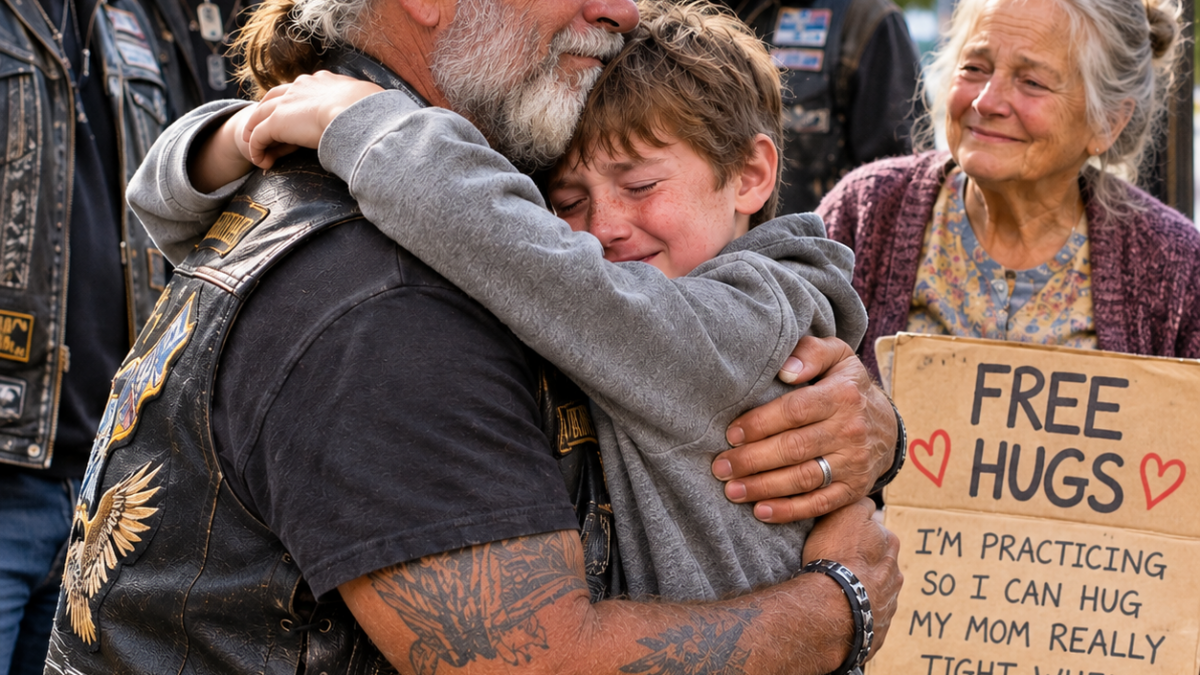
I’M PRACTICING SO I CAN HUG MY MOM REALLY TIGHT WHEN SHE COMES HOME.
Nobody in our group said anything for a few seconds.
Then Walt looked at the older woman.
“Ma’am?”
She straightened.
“Afternoon.”
“That your grandson?”
“Yes.”
“Mind if we talk to him?”
She looked at the six leather vests.
Then our motorcycles parked legally across the lot.
Then back at Walt.
“I mind if you don’t ask him first.”
Walt smiled.
“Fair.”
The boy had already been listening.
He looked at Walt.
“You want a hug?”
PART3:
Walt glanced at the grandmother.
She nodded.
The boy lowered the sign.
“What’s your name?”
“Walter.”
“People call you Walter?”
“Only when I’m in trouble.”
That earned the smallest smile.
“Then what do they call you?”
“Walt.”
“I’m Eli.”
Walt held out one hand.
Eli shook it seriously.
Then said:
“I need to practice.”
“We gathered that.”
Eli studied Walt’s vest.
“Are you strong?”
One of our guys, Ray, laughed.
Walt ignored him.
“Depends what needs lifting.”
Eli nodded as if that was acceptable.
“Can I hug you?”
“You can.”
“Really tight?”
“As long as you tell me before you break a rib.”
Eli didn’t laugh.
That was the first sign this wasn’t a joke to him.
Walt noticed too.
He set his helmet on the bench and crouched slightly.
Not because Eli was tiny.
Because Walt was six-foot-three and built like an old refrigerator.
Eli approached slowly.
Arms around Walt’s middle.
Then squeezed.
And began whispering.
“One…”
Walt looked down.
“Two…”
Nobody moved.
“Three…”
The grandmother clasped her hands.
Eli kept counting.
Ten.
Eleven.
Twelve.
This wasn’t a normal greeting.
By twenty, I understood that.
By twenty-five, Walt understood something else.
He stopped looking at us.
At thirty, Eli released him.
He immediately asked:
“Did that hurt?”
Walt blinked.
“No.”
“You sure?”
“Yes.”
Eli looked relieved.
“Because I’m bigger.”
Walt frowned.
“Bigger than what?”
“Last time.”
The grandmother closed her eyes.
That answer stayed in the air.
Walt sat on the bench beside her.
“What’s your grandmother’s name?”
“Rosa.”
She answered for herself.
“Rosa Vega.”
Walt looked at Eli.
“When did you last see your mom?”
“Four years ago.”
No hesitation.
He knew exactly.
“I was seven.”
Rosa said quietly:
“His mother comes home in two weeks.”
Eli lifted the sign again.
“I have fourteen days.”
“What are you practicing for?” I asked.
“The first hug.”
“Why?”
He looked genuinely surprised by the question.
“Because it has to be right.”
I crouched closer.
“What makes a hug right?”
Eli thought about that.
“Not too hard.”
“Okay.”
“Not too soft.”
“Sure.”
“And long enough.”
“How long?”
“Thirty.”
“Thirty what?”
“Seconds.”
Of course.
Walt rubbed his beard.
“Why thirty?”
Eli shrugged.
“That feels long.”
Fair enough.
Rosa explained.
Marisol Vega had been away since Eli was seven.
Calls when permitted.
Letters.
Visits early on, then fewer when transportation became difficult.
Four years is a strange amount of time to an adult.
Long.
Painful.
But measurable.
To a child, four years can be most of the life he remembers clearly.
At seven, Eli had been small enough to run into his mother’s arms.
At eleven, he had nearly reached Rosa’s shoulder.
He worried Marisol remembered the old version.
“She’ll think I’m little,” he said.
“She knows you grew,” I told him.
“I know.”
“But?”
He looked toward Rosa.
Then back at me.
“I don’t want to knock her down.”
That did something to all of us.
He remembered their old hugs.
Running.
Jumping.
Marisol lifting him.
He knew she couldn’t do that now.
He wanted the first moment to feel familiar without hurting her.
“So you’ve been hugging strangers?” Walt asked.
“Only people Grandma says are okay.”
Rosa nodded.
“And only after he asks.”
“Good rule.”
“I’m not reckless.”
Eli sounded offended.
Walt lifted both hands.
“Didn’t say you were.”
Rosa said:
“He asks everyone afterward whether he squeezed too hard.”
Eli looked embarrassed.
“I need accurate information.”
That made me laugh.
He looked at me.
“You want to practice?”
Apparently I did.
I set down my helmet.
He stepped close.
“Ready?”
“Ready.”
His arms wrapped around my ribs.
Then the count.
Quiet.
One.
Two.
Three.
I felt each number in the slight movement of his breath against my vest.
At eight, I stopped thinking about how strange it looked.
At fifteen, I started thinking about what he was carrying.
At twenty-two, I understood why Walt had gone still.
There was an entire homecoming inside that count.
Four years of missing someone translated into thirty seconds.
At thirty, he let go.
“Too hard?”
“No.”
“You sure?”
“I’m sure.”
“Could I do tighter?”
“You could.”
He considered.
“But probably don’t.”
He nodded.
Useful information filed away.
Before we left, Walt asked:
“You always stand here?”
“After school.”
“Why this corner?”
“More people.”
Rosa added:
“And enough room away from traffic.”
Walt looked at Eli.
“We might stop by again.”
Eli shrugged as though motorcycle clubs showed up to hug him every week.
“Okay.”
The next afternoon we did.
Not all six of us.
Just Walt and me.
We brought groceries.
Rosa objected immediately.
“No.”
Walt set milk on the counter.
“It expires next Thursday. You want to argue until then?”
“Yes.”
He added bread.
“Good.”
She stared at him.
Then noticed the brand.
Eli’s brand.
She sighed.
“Put it there.”
Their house stood on a quiet street a few miles from the intersection.
Small.
Clean.
Old.
The kind of place where every repair had been done carefully because there wasn’t money to do it twice.
Eli’s schoolbooks shared the kitchen table with Rosa’s reading glasses.
A jar of loose buttons sat on the windowsill.
Beside it was a pencil worn almost to nothing.
“That’s mine,” Eli said.
“You should probably get another one.”
“No.”
“Why?”
“I started with this one.”
He pointed toward the wall.
That was when I saw the calendars.
Not one.
Years.
Old pages had been removed and saved in a folder.
The current month hung on a board.
Numbers in every square.
Eli pulled out the folder.
Showed us.
Day 1.
Day 2.
Day 3.
The early numbers looked like a child had written them.
Because a child had.
Uneven.
Sometimes backward.
Sometimes crowded into corners.
Later, they became straighter.
Cleaner.
Older.
“How many?” Walt asked.
“1,447.”
He didn’t check.
Rosa said:
“He knows.”
The kitchen suddenly felt smaller.
At seven, Eli had started counting days because he was afraid that if he missed one, Marisol might come home and he wouldn’t be ready.
At first, Rosa thought it would pass.
It didn’t.
Each morning or evening, he numbered the day.
When a month ended, he filed the page.
Then began another.
At seven, he worried his mother wouldn’t recognize his face after a year.
At nine, he worried his voice sounded different on the phone.
At eleven, he worried about the hug.
Same fear.
Different shape.
Rosa had answered what she could.
For everything else, she encouraged him to ask Marisol.
But prison calls were short.
Sometimes monitored.
Sometimes delayed.
Some conversations became practical.
School.
Health.
Money.
Grandma.
Homework.
Weather.
A child can spend days thinking of a question and then forget it when the person says hello.
We unloaded groceries.
Apples.
Cereal.
Bread.
Milk.
Peanut butter.
Walt was putting cans in a cabinet when Rosa mentioned the sentence review.
She was explaining why the release date had changed.
Marisol had originally received nine years.
The case involved her former boyfriend.
Rosa used careful language.
Not because she was hiding something.
Because legal cases are rarely as simple as people want stories to be.
Marisol had been held responsible for conduct tied to the boyfriend’s activities.
Years later, records and testimony were reviewed.
A nonprofit found legal help.
An attorney and investigator uncovered evidence the family believed had not been properly considered.
The court reconsidered the case.
Nine years became four.
Walt stopped moving.
A can of beans remained in his hand.
“What was the attorney’s name?”
Rosa told him.
I saw the change immediately.
Walt set down the can.
“Say that again.”
She did.
He pulled out a kitchen chair.
Sat.
Rosa noticed.
“You know her?”
“Maybe.”
Eli was in the living room retrieving his cardboard sign.
Walt looked at me.
Three years earlier, our club had held a fundraiser.
I remembered.
Cold Saturday morning.
Ride fee.
Donation table.
Coffee in paper cups.
Auction items.
A local legal-aid nonprofit needed money for a woman’s case review.
We never got the client’s name.
That was deliberate.
Privacy.
The nonprofit had explained only enough.
Woman facing a long sentence.
Former boyfriend involved.
Questions about how responsibility had been assigned.
Young child affected by every year she remained away.
Attorney.
Investigator.
Records.
We raised money.
Other groups raised money.
The nonprofit later sent an update.
Sentence reduced.
Work successful.
We celebrated for about one evening.
Then another problem came along.
Another fundraiser.
Someone needed medical equipment.
A veteran needed a ramp.
A family lost a house in a fire.
Life moved.
The file went into a cabinet.
We had forgotten.
Walt hadn’t forgotten the attorney’s name.
He had spoken with her once about how donations were used.
Now Rosa had just said the same name.
Eli returned carrying the sign.
He noticed the silence.
“What?”
Walt looked at him.
“Nothing bad.”
“My mom knows about the lawyer.”
“We were talking about that.”
“She said somebody helped pay so the lawyer could keep working.”
Walt nodded.
“That sounds right.”
Eli stared at our vests.
Then at Walt.
“Was it you?”
I will always remember how easy it would have been for Walt to say yes.
He could have taken the moment.
Could have turned himself into the hero.
He didn’t.
“A lot of people helped.”
“But were you one?”
“Our club raised some money for a legal-aid organization three years ago.”
Eli’s eyes widened.
“We don’t know yet whether it was your mom’s case.”
“But maybe?”
“Maybe.”
Eli absorbed that.
Then leaned his sign against the table.
“Will you come tomorrow?”
“To the intersection?”
“Yes.”
“For another hug?”
He nodded.
“I still squeeze too hard at the beginning.”
Walt smiled.
“I’ll be there.”
In the truck afterward, Walt pulled out his phone.
Found an old email.
There it was.
Attorney’s name.
Month of the decision.
The nonprofit.
He showed me.
“You think it’s her?”
“Looks like it.”
“I want confirmation.”
“Good.”
“Wrong guess turns the kid’s last two weeks into a story about us.”
That was Walt.
He could be loud.
Stubborn.
Overbearing.
But sometimes he understood exactly where not to stand.
He called the nonprofit director.
She remembered him.
Wouldn’t confirm the client identity.
Good.
She shouldn’t have.
Walt explained why he was asking.
She repeated:
Client confidentiality.
He said:
“I understand.”
Rosa contacted Marisol through the channels available to the family.
Marisol gave permission.
A few days later, we learned the truth in Rosa’s kitchen while Eli was at school.
Yes.
Marisol was the client.
Our fundraiser had helped pay part of the attorney and investigator costs.
Other donors had contributed.
The legal team had done the real work.
Records.
Interviews.
Court filings.
Review.
The nonprofit director gave Walt names because he asked.
He wrote every one down.
That mattered to him.
If Eli ever learned the story, Walt wanted him to know it correctly.
Not:
The bikers freed your mother.
That wasn’t true.
The truth was better.
Many people each carried part of something too heavy for one person.
The director also said something important.
Marisol wanted us to wait.
She was grateful.
But release day wasn’t a show.
She wanted Rosa and Eli first.
No crowd pressed around her.
No photographs of Eli posted online without permission.
No surprise motorcycle parade at the gate.
Walt agreed before she finished.
Later, he spoke with Marisol directly.
I wasn’t on the call.
He told me afterward.
He introduced himself.
Explained how we’d met Eli.
Told her about the FREE HUGS sign.
Then about the thirty count.
She went silent.
Long enough that Walt checked whether the call had dropped.
Finally she said:
“He does that?”
“Yes.”
“He counts?”
“To thirty.”
Another silence.
She had known about the sign.
Rosa had mentioned it.
But not the practice.
Not strangers.
Not the boy trying to calibrate his arms for a mother who might feel unfamiliar.
Marisol said she wanted Eli and Rosa closest when she came through the gate.
If club members wished to come, we could stay back.
Let her decide when to approach.
Walt agreed.
That afternoon he went back to the intersection.
So did I.
Eli had new pencil marks on the back of the sign.
“What are those?” I asked.
“Notes.”
“About hugging?”
“Yes.”
Of course.
He demonstrated.
This time he approached more slowly.
Arms around my middle.
Didn’t squeeze suddenly.
Gradually.
Counted.
One through thirty.
“How was that?”
“Better.”
“What was better?”
“You didn’t hit me with the full squeeze immediately.”
He nodded seriously.
“Good.”
A woman waiting for the bus smiled.
“Can I volunteer?”
Eli looked at Rosa.
She nodded.
The woman crouched.
Eli asked:
“Is it okay if I hug you for thirty seconds?”
She said yes.
He practiced.
That became the pattern for the next week.
Some of us stopped by separately.
Never another full pack.
Six motorcycles had been enough attention.
We didn’t want to turn Eli into a neighborhood attraction.
I brought water.
Ray helped Rosa carry groceries.
Bev, one of our longest-serving members, brought a new roll of cardboard after rain softened one corner of the sign.
Eli refused to replace the original.
So she brought tape instead.
Walt came most often.
He learned about Eli’s school project.
A bridge built from wooden craft sticks.
The first one collapsed.
Eli explained why.
“Weight wasn’t going through the supports.”
Walt listened.
“So what’d you change?”
“Triangles.”
“Triangles solve a lot.”
“Not everything.”
“Fair.”
Eli asked after almost every hug:
“Did I do it right?”
Eventually Walt stopped answering yes or no.
He made Eli define it.
“Did you ask first?”
“Yes.”
“Did they say yes?”
“Yes.”
“Did they look uncomfortable?”
“No.”
“Then ask them what they thought.”
That changed something.
Eli began realizing his mother’s hug wasn’t a test he had to pass alone.
She would be part of it.
Eight days.
Seven.
Six.
On the sixth evening, Marisol called.
Rosa put her on speaker while Eli described the bridge.
He talked for almost ten minutes.
Support beams.
Glue.
Failure.
Redo.
Then he suddenly asked:
“Do you remember how tall I was?”
Marisol said:
“I remember the mark on Grandma’s kitchen doorframe.”
“I’m taller.”
“I know.”
“A lot taller.”
“I bet.”
Eli stared toward the old height mark.
“I’m different now.”
Marisol didn’t rush the answer.
“I know you are.”
Pause.
“I want to get to know you now.”
That sentence mattered.
After the call, Eli asked:
“Did Mom sound nervous?”
Rosa said:
“Probably.”
Eli froze halfway through marking the calendar.
He had never considered that.
All the preparation had belonged to him.
What if Marisol was preparing too?
Two nights before release, Walt opened the old nonprofit folder at the clubhouse.
Receipts.
Donation logs.
Request letter.
Final update.
The room smelled like oil and coffee.
I read the original request again.
A woman.
Nine-year sentence.
Questions about former boyfriend.
Investigation needed.
Child affected by every year.
That last part stopped me.
A child.
At the time, I’d pictured no one specific.
Some blurry kid in my mind.
Not Eli.
Not seven years old.
Not a worn pencil.
Not 1,447 squares.
Not Rosa answering the same questions year after year.
We had raised money.
Then moved on.
For Eli, that money became a date.
For us, success had been an email.
For him, success had been five fewer years on a kitchen wall.
Walt stared at the document.
“We should’ve asked what happened to the kid.”
“The nonprofit couldn’t have told us.”
“I know.”
He wasn’t criticizing them.
He was thinking about himself.
There are forms of help that feel finished when the check clears.
They aren’t.
We simply stop seeing what happens afterward.
The next morning I went to Rosa’s.
She was ironing a blue shirt.
Eli had chosen it because Marisol once told him blue looked good on him.
He came in holding the sign.
One corner bent.
He repaired it with tape.
“Are all the motorcycle people coming?”
“Some.”
“How many?”
“Maybe forty.”
His eyes widened.
Then immediately:
“Will they be close?”
“No.”
“Good.”
He looked guilty for saying it.
I said:
“Your first minutes belong to you.”
He nodded.
“Is Walt coming?”
“Yes.”
“Good.”
“Why?”
“He was my first practice hug.”
I told Walt later.
He didn’t answer immediately.
Just placed both hands on the workbench at his garage.
Looked down.
Then:
“Remind everyone where we’re parking.”
Forty riders confirmed.
Some had attended the old fundraiser.
Some joined the club afterward.
Walt told everyone the rules.
No banners.
No cameras in Marisol or Eli’s face.
No social media.
No surrounding the gate.
No rushing toward her.
Park only where the facility allowed.
Stay back.
The first reunion belonged to family.
Nobody argued.
Release morning started before dawn.
Forty Harley engines are loud under almost any circumstance.
That morning they sounded different.
Controlled.
We left in groups.
No formation designed for spectacle.
Just riders going somewhere together.
I rode behind Walt.
He wore the same vest Eli had hugged.
Rosa and Eli arrived first.
Visitor parking.
Facility instructions.
Everything checked.
Eli wore the blue shirt.
His sign was held across his chest but facing inward.
I asked why.
“I want Mom to see me before she reads it.”
Of course he did.
The motorcycles arrived over several minutes.
Engines shut down.
Silence spread.
People stood beside their bikes.
No one approached the family.
Eli came to Walt.
“Do I count out loud?”
“You can.”
“What if Mom doesn’t want thirty?”
“Ask her.”
Eli considered.
“I should’ve practiced asking.”
Walt smiled.
“You already have.”
We waited.
Longer than expected.
Release times have their own relationship with clocks.
Every time a door opened, Eli’s shoulders rose.
Staff member.
Not her.
Another person.
Not her.
Rosa put one hand between his shoulder blades.
He leaned back.
Still holding the sign.
Then the door opened.
Marisol Vega walked through.
Small bag in one hand.
Dark hair pulled back.
Jacket Rosa had brought.
She took three steps.
Saw the motorcycles.
Stopped.
Forty strangers in leather can be a lot after four years inside.
Then she saw Eli.
Everything else vanished from her face.
Eli stood still.
I could see him trying to remember what he had practiced.
Don’t run.
Approach slowly.
Don’t squeeze too hard at first.
Ask.
Thirty.
His mother put down the bag.
Opened both arms.
That was all he needed.
The cardboard sign dropped against his legs.
Eli went.
Not running.
Almost.
He slowed in the final steps.
Then wrapped his arms around her waist.
Carefully.
Marisol’s arms came around him.
One hand on the back of his head.
The other across his shoulders.
Eli began counting.
I was close enough to hear:
“One.”
Marisol’s eyes closed.
“Two.”
Her mouth trembled.
“Three.”
After that I looked away.
So did Walt.
There are moments you can be present for without looking directly at them.
Eli counted in the quiet between passing cars.
At thirty, he didn’t release.
Marisol didn’t either.
So the practice ended there.
Rosa picked up the cardboard sign before the wind took it.
She stood beside them.
Nobody moved from the motorcycles.
Eventually Marisol lifted her head.
Saw us again.
Waved.
Only then did Walt walk over.
Slowly.
Stopped several feet away.
“Marisol?”
She nodded.
“Walt.”
“Yes, ma’am.”
They had spoken by phone, but this was first time face-to-face.
She held out her hand.
Walt shook it.
Then Marisol pulled him into a hug.
Short.
No thirty-count.
When she stepped back, she said:
“Thank you.”
Walt immediately answered:
“A lot of people helped.”
“I know.”
“I wrote down names.”
She looked surprised.
“Of who?”
“People at the nonprofit. Donors we still have records for. Attorney. Investigator. Anyone I could identify.”
Her eyes filled.
“I’d like that.”
Eli had been listening.
Rosa and Marisol had explained the connection the night before.
Not every legal detail.
Enough.
The motorcycle club had helped a nonprofit pay for another look at what happened.
That review helped change the sentence.
Eli looked at Walt.
“You helped with my calendar.”
Walt’s face changed.
If you’ve ever seen a large man try not to cry in front of forty motorcycles, you know exactly what that looks like.
He glanced at the sign.
“A lot of people did.”
“Yeah.”
Eli nodded.
“Grandma told me.”
That made it better somehow.
No hero.
No savior.
Just a lot of people.
Bev came forward next.
She had worked the donation table during the fundraiser.
She told Marisol about the cold morning.
The raffle.
The coffee.
The woman who donated twenty dollars and apologized because she wished it were more.
Marisol listened.
Eli kept one hand on her sleeve.
Not gripping.
Just touching.
Proof.
More riders greeted her.
Nobody stayed long.
Rosa eventually said:
“We should go.”
Good.
The woman had a kitchen to enter.
A doorframe to see.
A son who had four years of sentences stored up.
We couldn’t give her that in a parking lot.
Eli asked:
“Walt, will you come over another day?”
“I’ll call first.”
That answer made Marisol smile.
She picked up her bag.
Rosa carried the sign.
Eli walked between them.
The car door closed.
They left.
Forty motorcycles remained.
Nobody started an engine for a little while.
Ray finally said:
“Well.”
Nobody had anything better.
Going home did not happen in one afternoon.
That is the part stories often skip.
Marisol recognized Rosa’s house.
Of course.
But the house had changed.
Eli’s shoes filled a shelf that once held tiny sneakers.
His coat was bigger.
School books harder.
The kitchen wall held years.
He tried to show her all 1,447 days in order.
She sat beside him after dinner.
Let him start.
Day one.
Day two.
Week three.
Month six.
At one page, Eli stopped.
Something about that week had been difficult.
He didn’t explain immediately.
Marisol didn’t make him.
They sat with the page.
There were many things four years had done to both of them.
You don’t undo that by hugging for thirty seconds.
Even a perfect hug.
Marisol struggled with sleep.
Noise.
Decisions.
Crowded stores.
Being asked what she wanted after years of being told what happened next.
Eli struggled differently.
He had built his mother into a person he remembered.
The real woman sometimes didn’t match.
She was quieter.
More cautious.
Sometimes tired.
Sometimes she needed space.
The first time she asked Eli not to surprise-hug her from behind, he thought he’d done something wrong.
Marisol sat with him.
Explained:
“I like your hugs.”
“Then why?”
“I need to see them coming.”
“Because prison?”
She paused.
“Yes.”
Eli absorbed that.
Then asked:
“Can I hug you now?”
“Yes.”
He did.
No counting.
Just five seconds.
Then school became school again.
Marisol needed work.
Walt offered contacts.
But this time he asked first.
“What do you want to do?”
That mattered.
Marisol had worked steadily before her sentence.
Office work.
Parts inventory.
Scheduling.
She wanted something stable.
Not charity disguised as employment.
Bev helped her write a résumé.
A local repair shop agreed to interview her.
Not hire.
Interview.
Marisol appreciated the distinction.
She got the job.
Then learned the bus route because she didn’t want rides to become another dependency.
Housing took longer.
She stayed with Rosa and Eli.
Saved.
Looked.
Rejected two apartments.
Accepted a third.
Close to Eli’s school.
Two bedrooms.
Small kitchen.
Decent windows.
The club offered help with the deposit.
Marisol asked:
“Gift or loan?”
Walt said:
“Your choice.”
She chose partial loan.
Written down.
Payment schedule she could manage.
Walt respected that more than if she’d simply accepted everything.
The first time Eli visited the new place, he checked the kitchen wall.
Marisol asked:
“What?”
“The sign.”
“What sign?”
He looked offended.
“My hug sign.”
Of course.
Marisol had kept it.
More than kept it.
She took it to a shop and had it laminated.
FREE HUGS.
I’M PRACTICING SO I CAN HUG MY MOM REALLY TIGHT WHEN SHE COMES HOME.
Tape still visible on the bent corner.
Pencil marks on the back.
They hung it near the kitchen table.
Marisol didn’t want it cleaned up.
Didn’t want new lettering.
Eleven-year-old handwriting belonged there.
Eli began spending time at Walt’s garage.
Sorting bolts.
Asking questions.
Learning that an engine can sound wrong before it fails.
Walt taught him to listen.
Not touch.
“Never put fingers near moving parts.”
“I know.”
“No, you know because I’m telling you. Later you’ll know because you remember.”
Eli rolled his eyes.
Which delighted Walt.
That was normal eleven-year-old behavior.
Normal became precious.
Marisol came by after work.
Sometimes she and Walt talked outside while Eli finished sorting hardware.
Not about prison every time.
Usually not.
Bus schedules.
Rent.
School.
Weather.
Ordinary things.
The first few months, Eli still asked after some hugs:
“Too hard?”
Marisol would answer honestly.
Once:
“A little.”
He released immediately.
“Sorry.”
“Don’t be sorry.”
“I did it wrong.”
“No.”
She took his hands.
“You listened when I told you.”
That was the part he had needed to learn.
The hug didn’t have to be perfect before it started.
People could adjust while loving each other.
That idea was larger than hugs.
One evening I brought over a box of books my niece had outgrown.
The laminated sign hung on the kitchen wall.
Beneath it, Rosa had placed an old photograph.
Marisol holding Eli when he was small enough to fit on one hip.
Both laughing.
On the opposite wall hung a new calendar.
Not numbered.
Dental appointment.
School project.
Marisol’s work shifts.
Rosa’s doctor appointment.
Eli’s birthday written large.
No count.
I stared at it.
Eli noticed.
“What?”
“You stopped numbering.”
He looked at the calendar.
“Oh.”
As if he hadn’t realized.
“When?”
He shrugged.
“After Mom came home.”
Simple.
The numbers had served their purpose.
The following spring, we rode through the same intersection.
Bus shelter still there.
Traffic still annoying.
Someone waited with grocery bags.
The pavement where Eli had held the sign was empty.
I looked.
Walt noticed.
At the next stop, he said:
“Marisol brought him by yesterday.”
“How’s he doing?”
“Building a shelf.”
“For what?”
“School projects.”
Walt had helped him choose a board.
Straight lumber.
No warp.
Showed him how to measure twice.
I asked:
“Sign still up?”
“Yeah.”
Pause.
“Marisol moved it higher to make room for the shelf.”
That felt right.
Not removed.
Moved.
Life making space without erasing what came before.
Back at the clubhouse, Walt opened the old legal-aid folder.
He had added something.
A letter from Marisol.
Handwritten.
She thanked the club.
Then the nonprofit.
The attorney.
Investigator.
Donors she’d never met.
People who probably forgot giving twenty dollars.
She didn’t claim innocence of everything.
Didn’t rewrite herself into a saint.
She wrote that the review had made the sentence better match the evidence and responsibility.
That distinction mattered.
She wrote about Eli.
Doing well in school.
Still building things.
Still visiting Walt’s garage.
Then one line near the end:
He has stopped worrying about the first hug.
Walt read it twice.
Closed the folder.
Returned it to the cabinet.
That might have been the end.
It wasn’t exactly.
Years later, Eli was seventeen.
Taller than Walt expected.
He came into the clubhouse during a charity drive carrying a box.
Inside were small wooden picture frames he had built in shop class.
He sold them to raise money for the same legal-aid nonprofit.
Walt looked at him.
“You don’t owe anybody that.”
“I know.”
“Then why?”
Eli shrugged.
“Somebody paid for Mom’s lawyer.”
“A lot of people did.”
“Exactly.”
Walt smiled.
The kid had learned the lesson accurately.
Marisol attended too.
She had kept the repair-shop job.
Moved into a better position.
Saved.
Raised her son.
Built a life where prison became part of her history without being the only word people used for her.
Rosa grew slower.
Still sharp.
Still suspicious of people who offered help too quickly.
She approved of Walt eventually.
Mostly.
Eli no longer carried the FREE HUGS sign.
But the laminated cardboard remained in Marisol’s kitchen.
Years of sunlight faded the black marker slightly.
Tape yellowed.
The message stayed readable.
One afternoon, Eli asked me whether I remembered the first time he hugged me.
“Yeah.”
“Was I really squeezing too hard?”
“A little.”
He laughed.
“You told me I wasn’t.”
“You asked whether it hurt.”
“Different question.”
“Exactly.”
He shook his head.
“You bikers lie.”
“Strategically.”
He looked toward Walt.
Then said:
“I was scared.”
“I know.”
“Not just about hurting her.”
“What else?”
He took a long time.
“That she’d hug me and it wouldn’t feel like I remembered.”
There it was.
The real fear beneath the thirty seconds.
Not size.
Not strength.
Recognition.
Four years apart.
What if home felt different?
“What happened?” I asked.
Eli looked down.
“It did.”
That surprised me.
“Bad?”
“No.”
He smiled.
“Just different.”
Then:
“It became normal again.”
I think about that sentence more than almost anything else.
Different became normal again.
That’s what Marisol’s release required.
Not pretending the four years never happened.
Not recreating the day she left.
Not trying to force Eli back into a seven-year-old body.
Not making Marisol become exactly the mother he remembered.
They had to meet as the people they were.
Eleven and older.
Both nervous.
Both changed.
The first hug didn’t repair everything.
It simply gave them somewhere to begin.
And our club?
People still occasionally told the story wrong.
They said:
“Those bikers got his mom out of prison.”
No.
We didn’t.
An attorney did legal work.
An investigator gathered evidence.
A nonprofit organized support.
Donors contributed.
A court reviewed the case.
Marisol and her family endured the process.
Our club helped with money.
That’s all.
And not all.
Because one afternoon, money we had donated without knowing a name turned into a boy standing at an intersection.
That taught me something about help.
You rarely get to see where it lands.
You buy groceries.
Donate fifty dollars.
Ride in a fundraiser.
Fix a stranger’s wheelchair ramp.
Pay for somebody’s motel room.
Then you go home.
Most of the time you never learn what happened next.
Maybe that is good.
Help shouldn’t require an audience.
But sometimes, if you’re lucky, life lets you look through the other end of the telescope.
A legal-aid fundraiser becomes five years removed from a sentence.
Five years becomes 1,825 days a child no longer has to mark.
A donation becomes an earlier date circled on a calendar.
An earlier date becomes a blue shirt.
A cardboard sign.
Thirty seconds.
A mother dropping her bag.
A boy counting:
One.
Two.
Three.
Thirty.
Then not letting go.
That morning outside the facility, I thought the important moment was seeing Marisol come through the gate.
Later I realized it happened weeks earlier at the intersection.
An eleven-year-old boy had stood in public asking strangers to help him practice loving someone he was afraid might feel unfamiliar.
That took more courage than he knew.
And every person who stopped gave him something small.
Not expertise.
Not therapy.
Not legal advice.
Just thirty seconds.
Permission.
Feedback.
A safe pair of arms.
Walt happened to be the first biker.
Years earlier, he had also happened to put money into a fundraiser envelope.
Neither act seemed enormous at the time.
That is probably why I remember them.
Life likes to tell us only grand gestures matter.
Huge donations.
Heroic rescues.
Perfect words.
But most lives are held together by smaller things.
A grandmother sitting on a bus bench keeping watch.
A nonprofit protecting a client’s privacy even when donors are curious.
An attorney doing unglamorous paperwork.
A biker asking permission before speaking to a child.
A boy asking:
“Can I hug you?”
A mother answering with open arms.
The last time I saw that original sign, it was hanging above a kitchen shelf Eli had built.
The shelf held one of his model bridges.
A photograph of Rosa.
A picture of Marisol on her first day at the repair shop.
And an old pencil.
The same worn pencil Eli had used to number the final months.
I asked why he kept it.
He said:
“Grandma did.”
Of course she did.
The point was almost gone.
Too short to sharpen properly.
No longer useful.
But some objects stop being tools and become evidence.
Evidence that waiting happened.
Evidence that a child changed.
Evidence that time moved even when it felt still.
Below it, the sign still said:
I’M PRACTICING SO I CAN HUG MY MOM REALLY TIGHT WHEN SHE COMES HOME.
He had practiced.
She had come home.
And the hug hadn’t needed to be perfect.
It only needed both of them to stay.








