An 11-Year-Old Girl Sold Oranges to Buy Her Sick Mother’s Medicine—Then a Famous Biker Bought Them All, and One Old Photograph Inside His Garage Changed Everything She Thought She Knew
PART3:
“When my mom needs medicine, yes.”
The words slipped out before I could stop them.
Jack’s expression changed.
Not pity.
Something sharper.
He handed me enough money to cover every orange and more besides.
I looked at the bills.
“That’s too much.”
“Then consider the extra a delivery fee.”
“I didn’t deliver. I stood outside.”
“Hazard pay for entering biker territory.”
I clutched the money.
“Thank you, sir.”
“You’ve been walking all day?”
I nodded.
“Come inside and get some water before you pass out.”
I hesitated.
Mom’s voice lived in my head like a list.
Don’t go inside with strangers.
Don’t accept rides.
Don’t tell men where we live.
Don’t let anyone make you feel rude for keeping yourself safe.
Jack seemed to read my hesitation.
“Door stays open. My mechanic Eddie is right there. You stand by the office, drink water, and leave. No pressure.”
I looked at the garage.
At the men.
At the sunlight still reaching through the open bay doors.
At the money in my hand.
I was so thirsty my tongue felt too big for my mouth.
“Okay,” I said.
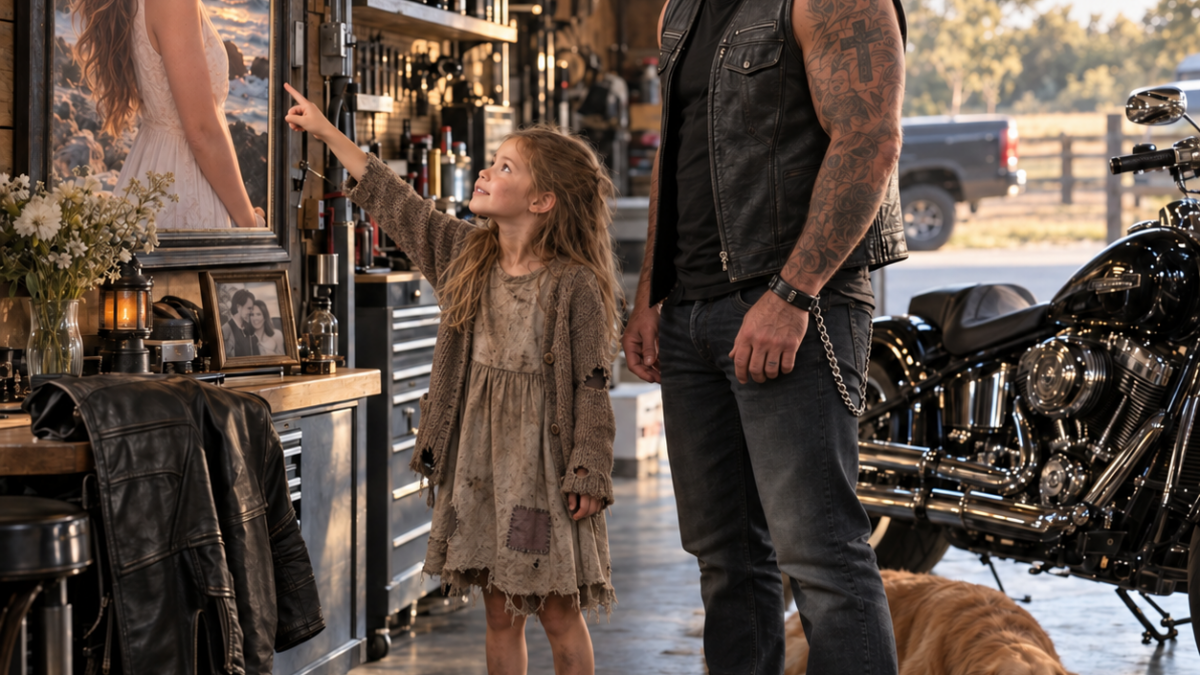
The garage smelled like gasoline, leather, rubber, soap, metal, and heat. Not bad exactly. Just powerful. Motorcycles lined the walls like sleeping animals. Some were sleek and black. Some bright red or blue. Some taken apart down to bones. Toolboxes stood taller than me. Old license plates decorated one wall. Framed newspaper articles hung beside racing trophies, charity ride plaques, and photographs of men and women in leather standing beside bikes.
Jack pointed toward a chair near the office.
“Sit if you want.”
“I’m okay.”
He gave me a look adults give children when they know the child is lying but choose mercy.
“Suit yourself.”
He went toward a refrigerator in the office.
I looked around because children in strange places are part curiosity, part fear.
That was when I saw the photograph.
It hung near a row of racing trophies, half hidden by a faded rally poster. It was older than the rest, slightly sun-faded, edges curling under the glass. A young woman stood beside a red motorcycle near the ocean. Her hair blew across her cheek. She wore a yellow sweater and laughed toward the camera like whoever held it had said something she wanted to pretend was not funny.
A younger Jack stood behind her, one hand resting on the motorcycle seat, looking at her instead of the camera.
My body went cold.
I stepped closer.
The woman’s face was fuller. Younger. Healthier. No tired shadows beneath her eyes. No worry lines carved around her mouth. But I knew her.
I knew the tilt of her head.
The dimple that appeared only when she smiled without meaning to.
The little crease between her eyebrows even while laughing.
“Mom?”
The word fell out of me.
My basket slipped from my hand.
Oranges rolled across the concrete floor, bright and wild, bumping into boots, tires, and toolboxes.
Jack hurried back with a water bottle.
“What happened?”
I pointed.
“Why do you have that?”
He followed my finger.
Stopped.
Everything in him seemed to freeze.
The water bottle trembled in his hand.
“That woman,” I whispered. “She’s my mother.”
Jack turned slowly toward me.
“What did you say?”
“My mom. Caroline Hayes.”
The garage went quiet in pieces.
A wrench stopped clicking.
A mechanic looked up.
Somewhere in the back, a radio played low, but even that seemed far away.
Jack stared at me like my face had become a locked door and he was terrified of what might be behind it.
“How old are you?” he asked.
“Eleven.”
His eyes moved over my hair, my nose, my eyes, my mouth. Not rudely. Not like strangers sometimes stare at children. Like he was searching for a memory he had not known he still had.
Then he crouched until we were eye level.
“Lily, where does your mother live?”
I took the photograph from the wall before he could stop me and held it against my chest.
“Why?”
“Because I knew Caroline a long time ago.”
“Were you friends?”
His jaw tightened.
“That’s complicated.”
That is an answer adults use when the truth is messy and they hope children are too young to notice.
I was not.
“Were you friends?” I asked again.
“More than friends.”
The garage seemed to tilt beneath me.
Mom had told me about Virginia, about Grandpa, about moving to Baltimore, about working at a bookstore, about meeting Daniel Hayes—the man I called Dad though he had died when I was little.
She had never told me about Jack Bennett.
Not once.
Jack gently reached for the photo.
I did not let go.
He did not pull.
“Lily,” he said quietly, “has your mother ever told you who your father is?”
My stomach tightened.
“My dad was Daniel Hayes.”
Jack’s face changed again.
Not disappointment.
Not relief.
Pain, maybe.
Before I could ask, he turned the photograph carefully in my hands.
There was writing on the back.
My mother’s handwriting.
The date was from twelve years earlier.
Beneath it were four faded words.
Maybe someday, tell him.
Jack read them once.
Then again.
All the color drained from his face.
“Oh God,” he whispered. “Caroline… what did you do?”
I pulled the picture back.
“Tell who?”
Jack swallowed.
“I don’t know.”
“You do know.”
Even at eleven, I could tell.
Adults think uncertainty sounds different from avoidance.
It does not.
Around us, men pretended not to listen badly.
Jack turned sharply.
“Eddie, give us a minute.”
A mechanic with a shaved head and kind eyes nodded.
“Sure, boss.”
The men drifted toward the far end of the garage, suddenly fascinated by tools nowhere near us.
Jack pulled an old wooden chair from beside his desk.
“Sit down, Lily.”
“I don’t want to sit down.”
That surprised both of us.
All day my legs had begged for rest. But now rest felt dangerous. Sitting felt like agreeing to be small while adults moved pieces of my life around without asking me.
“My mother is sick,” I said. “I came here because I needed money for medicine. Now you have a picture of her from before I was born, and you’re asking about my father.”
Jack lowered his eyes.
“You’re right.”
“So tell me why.”
He leaned against the desk.
For a while, the only sound was the distant clicking of a cooling engine.
“I met your mother when we were both twenty-four,” he said. “She worked at a bookstore near Fell’s Point. I had a motorcycle shop about the size of your kitchen.”
“Our kitchen is tiny.”
“That sounds about right.”
Despite everything, I almost smiled.
Jack noticed, and his face softened.
“Caroline used to bring me coffee when I worked late. Said I was incapable of remembering meals.”
“That still sounds like Mom.”
“I figured it might.”
His eyes went to the photograph.
“We were close.”
“More than friends.”
“Yes.”
“How much more?”
He gave me a look.
I gave it right back.
He sighed.
“We talked about getting married.”
I stared at him.
That did not fit anywhere inside the story of my life.
“What happened?”
“I was ambitious. Too ambitious. I wanted to build bikes, race them, travel, prove myself. Your mother wanted something steadier.”
“Like what?”
“A home. A family. A person who came back when he said he would.”
The sentence seemed to hurt him.
“Didn’t you?”
“Sometimes.”
“That means no.”
A faint smile touched his face, but it was sad.
“You sound exactly like her.”
I looked down at the photo.
Mom looked happy in a way I had rarely seen except in old pictures with Dad. Not ordinary happy. The kind of happy that made you believe the future had already promised not to break your heart.
“So you broke up?”
“We argued before I left for a racing job in California. It was supposed to be six weeks.”
“How long were you gone?”
“Almost eight months.”
My eyebrows rose.
Jack nodded.
“I deserved that face.”
“Did you call?”
“Not enough.”
“Did she call you?”
“Yes.”
“What did she say?”
“That she didn’t want to spend her life waiting for someone who always had somewhere else to be.”
That sounded like Mom.
“What did you say?”
He rubbed a hand across his jaw.
“Something stupid.”
“How stupid?”
“I told her maybe she wanted a different life more than she wanted me.”
I folded my arms.
“That was stupid.”
“Yes.”
He did not defend himself.
That made me trust him a little more than I wanted to.
“What does the writing mean?”
His gaze returned to the words.
“I’m not sure.”
“You keep saying that.”
“Because there are things I suspected then that I stopped allowing myself to think about.”
My mouth went dry.
“Like what?”
Jack studied me again.
Searching.
Before he could answer, I grabbed my basket.
“I need to go home.”
“I’ll drive you.”
“No.”
“Lily, it’s several miles.”
“I walked here.”
“You’ve been out all day.”
“My mom will worry if a stranger brings me home.”
The word stranger landed hard.
I saw it hit him.
But he only nodded.
“That’s fair.”
Then he glanced toward the garage doors.
“At least let Eddie drive behind you while you walk.”
“That sounds even stranger.”
Jack laughed.
It was the first normal sound he had made since the photograph.
“All right,” he said. “How about I call your mother?”
“No.”
“Why not?”
“Because she doesn’t know I came out selling oranges.”
He blinked.
“You didn’t tell her?”
“She thinks I’m at Emma’s.”
“Lily.”
He said my name exactly like an adult preparing a lecture.
“I left a note.”
“That does not help your case.”
“I needed the medicine.”
Jack sat down slowly.
Something in his face made my defensiveness fade.
“What medicine?”
I told him the name printed on the prescription slip.
He recognized it as an antibiotic.
“Has she seen a doctor?”
“Three days ago.”
“Is anyone with her?”
“Mrs. Alvarez checks on her.”
Jack nodded.
Then he reached for the phone on his desk.
“I’m calling your mother.”
“You can’t.”
“I’m not going to tell her about the oranges first.”
“Then what are you going to say?”
“That her daughter walked into my garage.”
He paused.
“And that after twelve years, Caroline and I need to talk.”
My heart began beating hard enough to feel in my throat.
I gave him our number.
He dialed.
I heard it ring twice.
Then Mom answered.
Her voice sounded weak enough that guilt stabbed through me.
“Hello?”
Jack went pale.
“Caroline?”
Silence.
Not ordinary silence.
The kind that filled every corner of the garage.
Then my mother said, very quietly, “Jack?”
He closed his eyes.
“Yeah.”
Another silence.
“How did you get this number?”
Jack looked at me.
“Your daughter is standing in my garage.”
I could hear Mom inhale sharply through the receiver.
“Lily?”
“I’m okay!” I called quickly.
“Lily Hayes, you were supposed to be at Emma’s.”
“I know.”
“Why are you at Bennett Custom Cycles?”
That question told me something.
Mom knew exactly where I was.
She knew the name.
Jack noticed too.
“Caroline,” he said, “I’ll bring her home.”
“No.”
His fingers tightened around the phone.
“We need to talk.”
“Not today.”
“I found the photograph.”
Silence again.
Then Mom said something so softly I could barely hear it.
“I wondered if you still had it.”
Jack turned toward me.
“Caroline, what did you mean by what you wrote?”
My mother did not answer.
“Maybe someday, tell him,” Jack repeated. “Tell who?”
“Jack.”
“Tell who, Caroline?”
Her voice changed.
Not frightened.
Tired.
“Please bring Lily home.”
Then she hung up.
Jack kept holding the phone after the line went dead.
I stared at him.
“What does it mean?”
He slowly replaced the receiver.
“I think your mother should be the one to explain.”
Twenty minutes later, I was riding in Jack Bennett’s truck with my empty basket between my knees.
His motorcycle stayed at the garage.
“I thought famous bikers rode motorcycles everywhere,” I said.
“Not when transporting children who lied to their mothers.”
“I left a note.”
“You mentioned that.”
His truck was surprisingly ordinary. Receipts in the cup holder. A faded baseball cap on the dashboard. A paper bag holding half a sandwich on the seat behind us.
“You really do forget meals.”
He glanced at the sandwich.
“Your mother used to complain about that.”
“Apparently she was right.”
“Frequently.”
The city passed outside my window.
As we approached my neighborhood, Jack became quieter. When I pointed to our small brick row house, he slowed nearly to a stop.
“That one?”
“Yes.”
He parked.
Before either of us opened our doors, our front door swung open.
Mom stood there wrapped in her blue cardigan.
She looked smaller than usual.
Her face was pale from being sick, her dark hair tied loosely behind her head. One hand gripped the doorframe. She looked angry, relieved, terrified, and fragile all at once.
Jack stared through the windshield.
For a moment, he did not move.
Twelve years disappeared from his face.
He looked young.
Uncertain.
Wounded.
“Is she okay?” he whispered.
“She’s getting better.”
I opened my door.
Jack followed.
Mom stepped onto the porch.
The first thing she did was hold out her arms to me.
I ran to her.
She hugged me tight enough to hurt.
“You scared me half to death.”
“I’m sorry.”
“You cannot disappear all day.”
“I wanted to buy your medicine.”
Her arms tightened.
“Oh, sweetheart.”
“I got enough.”
I pulled the money from my pocket.
Mom stared at it.
Then at Jack.
“He bought all the oranges,” I explained.
Jack raised both hands slightly.
“No conditions attached.”
Mom gave him a look that seemed to contain a whole language I did not speak.
“I’m paying you back.”
“No.”
“Jack.”
“Caroline.”
For one second, something almost familiar passed between them.
Then Mom sighed.
“Come inside.”
Our house seemed much smaller with Jack Bennett in it.
The living room had an old sofa, a chipped coffee table, two lamps with mismatched shades, and framed photographs along the wall: me as a baby, Mom and Daniel on their wedding day, Dad holding me on his shoulders at the Inner Harbor, Mom smiling beside him in a red winter coat. Those photos were the story I knew. They had always felt complete.
Now Jack stood in the middle of them like a missing paragraph.
Mrs. Alvarez knocked a few minutes later carrying soup.
When Mom introduced Jack simply as “an old friend,” Mrs. Alvarez looked from him to the motorcycle magazine visible through the open door of his truck.
Her eyebrows rose.
But she asked no questions.
She took the prescription slip and money from me.
“I’ll get the medicine.”
“I can go,” Jack said.
Mrs. Alvarez studied him.
“I have known these two for six years. You?”
Jack glanced toward Mom.
“A long time ago.”
Mrs. Alvarez apparently decided that was not a satisfactory measurement.
“I’ll get the medicine.”
Then she pointed at me.
“You stay home.”
“Yes, ma’am.”
After she left, Mom sat on the sofa.
Jack took the chair across from her.
I stayed beside Mom.
“No secrets,” I said.
Mom looked at me.
“Lily.”
“You both keep talking like I’m not here.”
Jack rubbed the back of his neck.
“She has a point.”
Mom gave him a look.
“You’ve known her thirty minutes.”
“And she’s made several good points.”
That almost made Mom smile.
Almost.
Then she looked at the photograph Jack had brought in.
“I thought you threw that away.”
“Never.”
Her fingers brushed the corner of the picture.
“I wrote that after our last trip to Ocean City.”
“You wrote, ‘Maybe someday, tell him.’”
“I know.”
“Tell who?”
Mom looked at me.
That was when I knew.
Whatever the answer was, it involved me.
She took my hand.
“Lily, there’s something I should have explained when you were older.”
“I’m older now.”
“You’re eleven.”
“That’s older than ten.”
Jack covered a smile.
Mom ignored him.
“Your father was Daniel Hayes.”
I relaxed slightly.
I knew that.
Dad had died when I was little. I remembered only pieces of him: carrying me on his shoulders, pancakes shaped like stars, the smell of his winter coat, his laugh when Mom told him he was putting too much garlic in everything.
Mom kept photographs everywhere.
“He loved you from the moment you were born,” she said.
“I know.”
“He was your father in every way that mattered.”
Something in that sentence made me uneasy.
“In every way that mattered?”
Mom’s eyes filled, though she did not cry.
Jack went completely still.
She squeezed my fingers.
“Daniel knew there was a possibility that someone else was your biological father.”
My ears seemed to stop working properly.
“What?”
Mom looked at Jack.
He looked as stunned as I felt.
“You never told me that,” he said.
“I know.”
He stood.
Then immediately sat down again, as if remembering I was beside her.
“When did you know?” he asked.
“I didn’t.”
“What does that mean?”
“It means I wasn’t sure.”
Mom turned back to me.
“Daniel and I met several weeks after Jack left Baltimore. We became friends first. By the time I realized I was pregnant, Jack was traveling constantly. Daniel knew everything.”
Jack’s voice was barely audible.
“You were pregnant when I left?”
“I didn’t know yet.”
“Why didn’t you call me?”
“I did.”
He frowned.
“No, you didn’t.”
“Yes, Jack. I did.”
The room became strangely quiet.
“I called the number I had,” Mom continued. “Disconnected. I wrote to the address in California you gave me.”
“I moved.”
“The letter came back.”
Jack stared at her.
“I sent you letters too.”
Mom blinked.
“What letters?”
“To your apartment.”
“I moved out after the lease ended.”
“I didn’t know.”
Neither of them spoke.
It was the saddest misunderstanding I had ever heard.
No enormous betrayal.
No grand secret plan.
Just two people writing to addresses where the other person no longer lived.
“Why didn’t you try again?” I asked.
Mom looked down.
“Because by then Daniel was part of my life. And he knew about Jack. He told me that whatever I chose, he would help.”
“What did you choose?”
“You.”
I frowned.
“That’s not an answer.”
Mom smiled faintly.
“No. I suppose it isn’t.”
She reached for the photograph.
“Daniel and I married after you were born. He signed your birth certificate because he wanted to be your father.”
“Was he?”
“Yes,” she said immediately. “He was.”
Then she glanced at Jack.
“But biologically… I never knew for certain.”
Jack looked at me.
For the first time since we had met, he did not search my face for resemblance.
He simply looked at me as Lily.
I appreciated that more than I understood at the time.
“What about the words on the picture?” I asked.
Mom turned it over.
“I wrote them after I learned I was pregnant. I had been carrying that photograph in my purse. I suppose some part of me thought that one day I would find Jack and tell him.”
“But you didn’t.”
“No.”
“Why?”
“Because life kept moving.”
Her voice softened.
“Daniel loved you. Jack had become successful. I read about him sometimes. Every year it seemed harder to reopen a door I had closed.”
Jack looked wounded, but he did not interrupt.
“Then Daniel got sick.”
I remembered that part only through photographs and stories. Dad’s illness had been short. A bad cancer found too late. After he died, Mom and I moved twice before settling in Baltimore again.
“I kept thinking I would contact Jack,” she said. “But by then years had passed.”
Jack leaned forward.
“You were back in Baltimore?”
“For six years.”
His eyebrows lifted.
“Six?”
Mom nodded.
“Why didn’t you come see me?”
“Because I didn’t know what you would want.”
“You could have asked.”
“I know.”
The words hung between them.
Not accusation.
Regret.
Jack looked toward the window.
“I spent years thinking you didn’t want me in your life.”
Mom’s expression softened.
“And I spent years thinking you had chosen a life without me.”
They looked almost amused by the terrible symmetry of it.
I had one question left.
I almost did not ask.
But I needed to know.
“So Jack might be my father?”
Mom squeezed my hand.
“He might.”
Jack’s eyes met mine.
He did not smile.
Did not make promises.
He only said, “Whatever we learn, you don’t owe me anything.”
That mattered.
More than I expected.
Then he reached into his jacket and placed something on the coffee table.
An envelope.
Old.
Yellowed around the edges.
Mom stared at it.
“What is that?”
“I found it years ago inside a box from my first shop,” Jack said. “It was mixed with invoices and paperwork after the building was sold.”
Mom slowly reached for it.
Her name was written on the front.
Caroline Miller.
Her maiden name.
The handwriting belonged to Jack.
“It never got mailed,” he said.
Mom looked at him.
“Why?”
“I thought it had.”
He swallowed.
“My old business partner packed the office while I was traveling. I found it almost ten years later.”
Mom turned the envelope over.
Still sealed.
“What does it say?”
“I don’t remember every word.”
“You never opened it?”
“It wasn’t mine anymore.”
Mom ran one finger beneath the flap.
Jack watched quietly.
So did I.
When she finally opened the letter, a smaller photograph slipped onto her lap.
It showed Jack standing beside the same red motorcycle.
On the back were five words.
I’m coming home for good.
Mom covered her mouth.
Jack looked toward the floor.
And suddenly the mystery between them was not just about who my biological father might be.
It was about a letter that had waited twelve years to arrive.
Mom unfolded the pages with trembling fingers.
I watched her read.
At first, her face stayed guarded.
Then it changed.
Softened.
Broke.
Jack sat with both hands clasped between his knees like a man waiting for a verdict.
Mom read silently for so long that even I understood not to interrupt.
Finally, she handed him the letter.
“You wrote this before you came back from California?”
“Yes.”
“You said you were sorry.”
“I was.”
“You said you turned down the Los Angeles contract.”
“I did.”
“You said you wanted to come home, sell the racing bike if you had to, and build something steady.”
He nodded.
“I came back two weeks after I wrote it. Your apartment was empty.”
Mom closed her eyes.
“I had moved to Daniel’s building by then. My lease ended. I couldn’t afford the place alone.”
“I went to the bookstore too. They said you quit.”
“I had morning sickness. I could barely stand through shifts.”
“I thought you were done with me.”
“I thought you never wrote.”
Jack’s face twisted.
“I gave the letter to Roy.”
Mom opened her eyes.
The name meant nothing to me then.
But it meant something to her.
“Roy Maddox?”
Jack nodded.
“He was handling invoices and mail while I traveled.”
Mom’s expression turned cold.
“I went to your old shop once.”
Jack looked up.
“When?”
“After Lily was born. She was three weeks old.”
My breath caught.
“I thought maybe I could find you,” Mom said. “Daniel drove me because I was still recovering. Roy was there.”
Jack’s face hardened.
“What did he say?”
Mom looked at me, then back at Jack.
“He said you knew about the baby.”
Jack went completely still.
“What?”
“He said someone had told you. He said you were in California for good and that you didn’t want anything slowing you down.”
“No.”
His voice came out like a break.
“No, Caroline. No.”
“I wanted not to believe him.”
“Roy knew nothing.”
“He knew enough to hurt me.”
Jack stood.
This time he did not sit down.
“He told me you had married Daniel and wanted no contact. He said you came by the shop to make that clear.”
Mom shook her head slowly.
“I never said that.”
“I know that now.”
“He lied to both of us.”
The room felt suddenly too small.
I looked from Mom to Jack.
“Why would he do that?”
Jack’s jaw tightened.
“Because Roy needed me in California.”
Mom’s eyes narrowed.
“What do you mean?”
Jack ran one hand through his hair.
“When I left Baltimore, Roy and I were barely surviving. Then the racing work took off. People noticed my builds. Roy was the business side. He kept saying if I came back for good, we’d lose momentum. Sponsors wanted me single, free, traveling, racing. That was how he sold me.”
“Sold you?”
“He made money off my name. More than I knew.”
The bitterness in his voice was new.
“He pushed me to sign contracts. He collected deposits. He handled mail, calls, parts orders. I thought he was keeping the business alive. Later I found out he was skimming, but by then Bennett Custom had taken off and I was too busy cutting him out legally to look back at every old wound.”
Mom stared at the unopened past lying open on the table.
“Roy told me you chose the road.”
Jack looked at her.
“I did at first. That part is on me. I left. I stayed away too long. I hurt you before Roy ever lied.”
Mom’s anger softened, but only slightly.
“Yes.”
“But I came back.”
Her eyes filled.
“I know that now.”
I sat between them, feeling the shape of my life stretch and bend.
Dad had still been Dad.
Mom had still been Mom.
But somewhere, before I was born, a man had tried to come home.
A letter had not been mailed.
A lie had been told.
And because of it, twelve years disappeared.
Mrs. Alvarez returned with the medicine before anyone knew what else to say.
She handed the pharmacy bag to Mom, then froze at the sight of everyone’s faces.
“Oh,” she said. “This is not a soup situation.”
“No,” Mom whispered.
Mrs. Alvarez looked at me.
“You ate today?”
I shook my head.
“Then it is always a soup situation.”
She went straight to the kitchen.
That was Mrs. Alvarez.
The world could collapse, but children still needed food.
Jack stayed until Mom took her medicine and ate half a bowl of soup under Mrs. Alvarez’s supervision.
He did not ask for a DNA test that day.
He did not ask to stay.
He did not demand anything.
Before he left, he knelt in front of me near the door.
“I’m not going anywhere without permission,” he said.
“Whose permission?”
“Yours and your mother’s.”
“Even if you’re my biological father?”
His face flinched a little at the phrase, but he answered steadily.
“Even then.”
“What if you’re not?”
“Then I’m still a man who bought your oranges and owes you water.”
I almost smiled.
“That’s not a lot.”
“It’s a start.”
After he left, Mom and I sat on the sofa.
For a while, neither of us spoke.
Then I said, “Why didn’t you tell me?”
Mom touched my hair.
“Because I thought knowing might make you feel like Daniel was less yours.”
“He isn’t.”
“I know.”
“Do you?”
She looked at me.
“Maybe I was afraid I didn’t.”
That was one of the first times my mother admitted fear without wrapping it in adult explanation.
I leaned against her shoulder carefully so I would not make her cough.
“Dad is still Dad.”
“Yes.”
“But Jack might be something too.”
Her arm tightened around me.
“Yes.”
The next weeks were the strangest of my life.
Jack called every day, but only after Mom said he could. At first, the conversations were short.
Did she take the medicine?
Did I need school supplies?
Was the cough better?
Did we need groceries?
Mom refused groceries twice.
Mrs. Alvarez accepted them once “by accident,” which was how a box of food appeared on our porch with no card except a drawing of an orange on the top.
Jack started showing up carefully.
Not too often.
Not empty-handed, but not extravagantly either.
Soup.
Books.
A replacement strap for my backpack.
A small fan when June heat made the row house stuffy and Mom’s cough worse.
He asked before fixing the loose railing on our steps.
Mom watched him from the doorway as he worked.
“You still hold nails in your mouth,” she said.
Jack froze with a nail between his lips.
Then slowly removed it.
“Bad habit.”
“You said you’d stop before you swallowed one.”
“I stopped many other habits.”
“That one survived?”
“Apparently.”
She smiled.
A real one.
Small, but real.
I saw what they had been then.
Not in a way that erased Daniel.
But in a way that explained the old photograph.
Some people look at each other like they are meeting again even while standing in the same room.
The DNA test happened three weeks after the orange basket.
Mom cried before we went.
Not because she did not want the truth.
Because truth has a way of rearranging furniture inside your heart without asking which pieces are fragile.
Jack drove us to the clinic.
We used a private lab because he insisted we should not wait months if we did not have to. He paid. Mom argued. He said, “Caroline, please.” She stopped arguing, which told me those words had a history.
They swabbed our cheeks.
Mine.
Jack’s.
We waited.
One week.
Then two.
During that time, Roy Maddox reappeared.
Not in person at first.
In the newspaper.
Jack had told one trusted mechanic, Eddie, about the old letter. Eddie had apparently remembered Roy’s name with disgust and mentioned that Roy now owned a chain of used motorcycle dealerships outside Annapolis. The next morning, a small motorcycle gossip blog posted a headline:
BENNETT CUSTOM FOUNDER ACCUSED OF ABANDONING SECRET FAMILY?
By noon, bigger outlets had picked it up.
By evening, strangers online were calling Mom names.
Gold digger.
Liar.
Mistress.
Woman after money.
A few called me worse things.
I did not understand all the words, but I understood enough from Mom’s face when she tried to close the laptop quickly.
Jack arrived at our house that night furious.
Not loud.
Worse.
Quiet.
“Roy leaked it,” he said.
Mom looked tired.
“You don’t know that.”
“I know his hands.”
“What does he gain?”
“My humiliation. Distraction. Maybe money. He’s been trying to get investors for his dealerships. Dragging my name into scandal gets attention.”
Mom wrapped her cardigan tighter.
“It could have come from the lab.”
“It didn’t.”
“How do you know?”
“Because the blog mentioned details only Roy would know.”
“What details?”
“That you came to the old shop with Daniel after Lily was born.”
Mom went still.
“That wasn’t in the letter?”
“No.”
I stood near the stairs, listening.
Jack saw me.
His face softened.
“I’m sorry, Lily.”
“For what?”
“For grown-ups being careless with your life.”
I looked at Mom.
She looked like she might fold inward from shame.
Something hot rose in me.
“My mom didn’t do anything wrong.”
Jack’s eyes met mine.
“No. She didn’t.”
The next morning, paparazzi were outside Bennett Custom Cycles.
Not many.
Enough.
At school, two girls asked if my mother had lied about my dad. A boy named Trevor asked if I was “bike famous now.” My teacher pulled me aside with a concerned face that made me want to disappear.
At the grocery store, a woman recognized Mom from a local news post and stared openly.
Mom left without buying milk.
That was the first time I understood public humiliation not as something loud, but as something that follows you into ordinary places and poisons them.
Jack wanted to sue immediately.
Mom wanted silence.
I wanted everyone to fall into a hole.
Mrs. Alvarez wanted to beat Roy Maddox with a frying pan and said so in both English and Spanish.
The test results came on a Thursday.
Jack brought them to our house unopened because he said we should all learn together or not at all.
Mom sat at the kitchen table.
I sat beside her.
Jack sat across from us.
The envelope lay between us like it had weight.
Mom looked at me.
“Do you want to open it?”
I shook my head.
“You.”
Her hands trembled when she tore the seal.
She unfolded the pages.
Read.
Her face changed.
Jack did not breathe.
Mom placed the paper on the table.
Probability of paternity: 99.99%.
Jack Bennett was my biological father.
No one spoke.
I thought I would feel something obvious.
Joy.
Anger.
Grief.
Confusion.
Instead, I felt all of it, which made it feel like nothing at first.
Jack covered his mouth with one hand.
His eyes filled.
He looked at me, then away, like he was afraid too much feeling might scare me.
Mom reached for my hand.
“Lily?”
I looked at Jack.
“So you’re my father.”
His face crumpled.
“Biologically, yes.”
“And Dad is still my father too.”
Jack nodded immediately.
“Absolutely.”
“You’re not going to make me stop calling him Dad.”
“No.”
“You’re not going to take his pictures down.”
“No.”
“You’re not going to be mad if I don’t call you Dad.”
His voice broke.
“No, sweetheart.”
Sweetheart.
The word landed gently.
That was what undid me.
I started crying.
Not pretty crying. Not quiet crying. Eleven-year-old crying with too much inside it and no place for it to go.
Mom pulled me close.
After a second, I reached for Jack too.
He froze, then came around the table and knelt beside us.
We were not a family yet.
Not in the way people imagine.
We were three people holding the truth while it hurt.
But something began there.
Something real.
The next day, Roy Maddox went on a local radio show.
He was older than in the stories, with slick gray hair and a smile too white to trust. He called himself Jack Bennett’s “forgotten founding partner.” He said he was heartbroken to see Jack “rewrite history.” He suggested Mom had always been “unstable,” that Jack had been “too generous,” and that the paternity story was “convenient” given Jack’s success.
He said, “Some women know exactly when to reappear.”
Mom turned the radio off with shaking hands.
Jack heard it too.
By noon, he called a press conference.
Mom refused to go.
Then changed her mind.
Not because Jack asked.
Because Lily Hayes—me—stood in the kitchen and said, “If we hide, he gets to sound true.”
Mom looked at me for a long time.
“You’re eleven.”
“That keeps coming up.”
Mrs. Alvarez said from the stove, “The child is correct.”
So we went.
Bennett Custom Cycles had never been so crowded.
Motorcycle magazines, local news, bloggers, riders, customers, curious neighbors, and people who liked drama more than justice packed the street. Cameras pointed toward the garage bay where Jack had set up a microphone.
Mom wore a blue dress and looked pale but upright.
I held her hand.
Jack stood on one side of us.
Eddie stood near the door with crossed arms, looking like he hoped someone would misbehave.
Roy Maddox came too.
That was his mistake.
He stood near the front in a tan suit, smiling like he had already won.
Jack stepped to the microphone.
“I’m going to keep this simple,” he said. “Twelve years ago, Caroline Miller and I were separated by distance, pride, and lies. Most of the pride was mine. Most of the lies came from Roy Maddox.”
Roy laughed loudly.
Cameras turned.
Jack did not look at him.
“I learned this week that Lily Hayes is my biological daughter.”
Whispers moved through the crowd.
“She has a father named Daniel Hayes, who loved and raised her until his death. Nothing I say changes that. Nothing anyone writes changes that. Biology does not erase love.”
Mom’s grip tightened around my hand.
Jack continued.
“Caroline did not come after my money. Lily walked into my garage selling oranges to buy medicine for her sick mother. She did not know who I was to her. Caroline did not arrange that. She did not leak this story. She did not ask for anything.”
He looked at Roy then.
“But Roy Maddox knew exactly what he did twelve years ago.”
Roy’s smile thinned.
Jack lifted the old letter.
“This letter was written by me to Caroline before I returned to Baltimore. It says I was coming home for good. Roy was supposed to mail it. He didn’t.”
Roy called out, “That’s absurd.”
Jack nodded toward Eddie.
Eddie stepped forward holding a file box.
“This is Roy’s handwriting on old shipping notes from the shop,” Jack said. “This is the envelope he marked as sent even though it was found sealed ten years later. These are old business ledgers showing sponsor payments Roy collected while telling me the company was broke. And this—”
He lifted another page.
“—is a sworn statement from a former assistant at Maddox Motors, who says Roy bragged two days ago about keeping me ‘free of domestic baggage’ back when I was making him money.”
Roy’s face changed.
The cameras loved that.
Jack’s voice hardened.
“Caroline came to my old shop after Lily was born. Roy told her I knew about the baby and wanted nothing to do with them. That was a lie. Roy told me Caroline wanted no contact. That was a lie too.”
A reporter shouted, “Are you filing charges?”
“My attorney is reviewing civil action for defamation, fraud, and financial misconduct related to our old partnership.”
Another reporter turned to Roy.
“Mr. Maddox, did you intercept the letter?”
Roy’s face flushed.
“This is a stunt. Jack Bennett has always known how to perform for a crowd.”
Then Mom stepped forward.
I felt her hand leave mine.
She went to the microphone.
My mother, who hated attention, who had been coughing for weeks, who had been shamed by strangers online and whispered about in grocery aisles, stood in front of cameras and looked directly at Roy Maddox.
“You told me he knew about my daughter.”
Roy rolled his eyes.
“Caroline—”
“No. You don’t get to say my name like we’re old friends.”
The crowd went quiet.
“You looked at a woman holding a three-week-old baby and told her the baby’s father had chosen fame over her. You watched me leave that garage believing I had been rejected and that my child had been rejected too.”
Roy’s mouth tightened.
“I don’t recall that conversation.”
“I do.”
Her voice did not shake.
That was the strongest I had ever seen her.
“I remembered it when Daniel stayed up all night with Lily’s fever. I remembered it when she took her first steps. I remembered it when Daniel died and I wondered if I should contact Jack but thought of your words. I remembered it every time I read about Jack in a magazine and told myself he had made his choice.”
Jack’s eyes were wet.
Mom took a breath.
“You stole years. From Jack. From me. From Lily. From the truth. I don’t know what the law will call that. But I know what I call it.”
She leaned closer to the microphone.
“Cruel.”
The word landed harder than shouting.
Roy left before the press conference ended.
But the damage had turned.
This time, publicly, truth followed him.
The investigation into Roy took months.
Jack’s attorneys dug through old financial records. Former employees came forward. Roy had not only hidden letters. He had forged expense documents, diverted sponsor money, and used Jack’s name to secure loans for ventures Jack had never approved. The defamation suit became only one piece. Fraud charges followed when investigators found old accounts tied to the original Bennett shop.
Roy tried to settle quietly.
Jack refused unless the settlement included a public apology to Mom and me.
Roy refused that.
So the case went forward.
By then, Mom was better physically, but the emotional strain weighed on her. Jack paid medical bills at first through an anonymous foundation, which fooled no one. Mom got angry. He apologized. They fought in our kitchen like people who had twelve years of interrupted arguments to catch up on.
“You can’t fix everything with money,” she told him.
“I know.”
“Do you?”
“No. But I’m learning.”
“I don’t want Lily thinking you appear and suddenly all problems vanish.”
“I don’t want that either.”
“Then stop making problems vanish before we discuss them.”
Jack looked at me, then at Mom.
“Okay.”
Mom blinked, as if she had expected more resistance.
“Okay?”
“Yes.”
“Just like that?”
“Caroline, I built a motorcycle empire and apparently failed basic communication for twelve years. I’m open to correction.”
I laughed before I could stop myself.
Mom tried not to.
Failed.
That became our life for a while.
Messy.
Careful.
Funny at the strangest times.
Jack did not move in.
He did not try to become my everyday father overnight.
He visited. Called. Took me to lunch with Mom’s permission. Brought me to the garage on Saturdays and taught me the names of tools. Introduced me to Eddie, who showed me how to change oil and told me motorcycles were easier than people because they at least made noise where they were broken.
Jack gave me a helmet.
Purple.
Not pink.
I had mentioned once that I hated when adults assumed all girls wanted pink. He remembered.
The first time he took me on a short motorcycle ride, Mom stood on the sidewalk with both hands pressed together like she was praying and angry about needing to pray. Jack rode slowly. Painfully slowly. Bicycles passed us. A man walking a dog passed us. I loved every second.
At a stoplight, Jack turned slightly.
“You okay back there?”
“Yes!”
“Scared?”
“Yes!”
“Want to go back?”
“No!”
He laughed.
The sound vibrated through the bike.
For my twelfth birthday, Jack invited me and Mom to Bennett Custom after closing. I thought it would be cake in the office.
Instead, the entire garage had been transformed.
String lights hung between lifts. A long table held food. Eddie had made a cake shaped like an orange, badly, which somehow made it better. Mechanics, riders, Mrs. Alvarez, Emma, and even my teacher came. On one wall, Jack had hung three photographs side by side.
The old Ocean City photo of him and Mom.
A picture of Daniel holding me as a baby.
A new photograph of me sitting on a purple motorcycle helmet, grinning.
Under them was a small plaque.
Every road that brought us here matters.
Mom cried when she saw it.
I did too.
Jack stood behind us, uncertain.
“I didn’t want Daniel left out,” he said quietly.
Mom looked at him.
“Thank you.”
That was when I knew she trusted him with the hardest part.
Not me.
Not money.
Not the past.
Daniel.
A month later, Roy Maddox’s public apology aired as part of the civil settlement.
He looked stiff and furious behind a polished conference table.
“Twelve years ago,” he read, “I made false statements to Caroline Miller and Jack Bennett that contributed to their prolonged estrangement. I failed to mail correspondence entrusted to me and later made public statements about Ms. Miller and her daughter that were untrue and harmful. I apologize.”
It was not enough.
It could never be enough.
But it was public.
And sometimes public lies require public correction.
The fraud case cost Roy his dealerships.
That felt closer to justice.
Still, the deeper consequence came quietly.
One afternoon after everything legal had settled, Jack drove us to a cemetery outside Baltimore.
Daniel Hayes was buried beneath a maple tree.
Mom brought flowers.
I brought a small orange because I did not know what else to bring, and Dad had loved jokes.
Jack stood back at first.
Mom noticed.
“You can come closer.”
He looked uncomfortable.
“I don’t want to intrude.”
“You’re not.”
We stood before the stone.
Daniel Robert Hayes.
Beloved husband and father.
Jack read the words.
Then removed his cap.
“Thank you,” he said quietly.
Mom’s eyes filled.
I looked at him.
“For what?”
Jack kept his eyes on the stone.
“For loving them when I didn’t know how to find them. For choosing Caroline. For choosing Lily. For being the father she needed.”
The wind moved through the leaves.
Mom took my hand.
Then, after a moment, she took Jack’s too.
That was not the moment they got back together.
Life is not always that neat.
Mom and Jack did not suddenly erase twelve years, Daniel’s marriage, grief, illness, fear, pride, and the practical reality that people change. They moved slowly. Sometimes they stepped closer. Sometimes away. Sometimes Mom cried after Jack left because the past felt too alive. Sometimes Jack sat in his truck outside our house before coming in because he was afraid of doing too much or too little.
But they kept showing up.
That was what changed everything.
Jack came to my school science fair and looked more nervous than I did. Mom started bringing him coffee at the garage again, just once in a while, pretending it was because she happened to be nearby. He always forgot lunch. She always acted annoyed.
One evening, a year after the orange basket, I found them sitting on the porch after I was supposed to be asleep.
They were not touching.
Just sitting.
Talking softly.
“I loved Daniel,” Mom said.
“I know.”
“I still do.”
“I know that too.”
“You can’t compete with a ghost.”
“I’m not trying to.”
“You say that now.”
“Caroline, I have competed with men my whole life. Racers, builders, businessmen, myself. I’m tired. Daniel loved you well. I’m grateful to him. I don’t need to beat him to love what’s here now.”
Mom was quiet for so long I thought she would not answer.
Then she said, “You finally learned how to come home.”
Jack’s voice was rough.
“Took me long enough.”
She reached for his hand.
I went back to bed before they could catch me listening.
They married two years later.
Small ceremony.
No magazines.
No photographers except Eddie, who cut off half the cake in every picture. Mrs. Alvarez cried loudly. Mom wore pale blue instead of white. Jack wore a suit but kept his motorcycle boots. I stood between them.
When the preacher asked who gave my mother away, Mom looked at me.
I said, “Nobody gives her away. She chooses for herself.”
Everyone laughed.
Mom squeezed my hand.
Jack whispered, “Good point.”
At the reception inside Bennett Custom, beneath the same wall where I had first seen the old photograph, Jack danced with Mom to a song from the nineties that embarrassed me deeply. Then he danced with me.
I stepped on his boot.
“Sorry.”
“I’ve had worse damage in this garage.”
“Jack?”
He looked down.
“Yes?”
“Can I call you Dad sometimes?”
His eyes filled so fast I almost regretted asking.
“You can call me whatever feels true.”
“Jack-Dad sounds weird.”
“It does.”
“Dad Jack?”
“Sounds like a pirate.”
I laughed.
He held my hand tighter.
“Dad is okay,” he said softly. “When you want. If you want. Daniel keeps his place.”
“I know.”
“And I’ll keep earning mine.”
That was the promise he kept.
Not perfectly.
No parent does.
He got overprotective. He tried to buy me things when he did not know how to ask if I was sad. He panicked the first time I had a fever and called two doctors, Mom, Mrs. Alvarez, and Eddie, who arrived with soup because apparently everyone in our life believed illness required soup. He once tried to teach me algebra and somehow ended up explaining carburetors.
But he showed up.
Every school meeting.
Every birthday.
Every ordinary Tuesday when nothing dramatic happened and that was exactly the gift.
I grew up in two fathers’ love.
One who chose me from the beginning and one who found me late but never again looked away.
People sometimes asked if that was confusing.
It was.
But many true things are confusing.
Daniel was my father.
Jack was my father.
Mom was the bridge between the life that raised me and the life that had almost missed me.
The orange basket stayed at Bennett Custom.
Jack mounted it on the wall below the old Ocean City photograph.
I thought that was ridiculous at first.
“It’s an old laundry basket,” I said.
“It’s a historic artifact.”
“It has a cracked handle.”
“So do many important things.”
Under it, he placed a small brass tag.
The sale that saved us all.
I rolled my eyes every time I saw it.
I also loved it.
Years later, when I was old enough to understand the story not as a child trapped inside it but as a woman looking back, I thought often about how thin the line had been.
If Mom’s medicine had been cheaper, I would not have sold oranges.
If Mrs. Alvarez’s cousin had said no, I would not have reached Bennett Custom.
If Jack had been out racing that Saturday, I might never have seen the photograph.
If he had thrown it away, if Mom had not written on the back, if the letter had been lost forever, if Roy’s lie had remained buried—
So many ifs.
A life can turn on a child being thirsty in a garage.
A photograph hanging slightly crooked.
A man buying too many oranges.
A mother too sick to stop her daughter from trying to save her.
When people hear the story, they often focus on the dramatic parts.
The famous biker.
The secret daughter.
The villain who hid the letter.
The public apology.
The DNA test.
But the part I remember most clearly is smaller.
Jack crouched in front of me that first day and said, “Whatever we learn, you don’t owe me anything.”
That sentence mattered because everyone else in the story owed something.
Mom owed herself the truth.
Jack owed us years of showing up.
Roy owed a debt he could never repay.
I owed Daniel remembrance.
But I did not owe Jack instant love simply because blood said he had a claim.
He understood that before he knew how badly he wanted the claim to be true.
That is why I could eventually love him.
Not because he was my biological father.
Because he never tried to use biology as a weapon against the father who had raised me or the mother who had protected me the best way she knew how.
When I turned eighteen, Jack gave me the red motorcycle from the old photograph.
Restored.
Perfect.
Terrifying.
Mom said absolutely not.
Then said maybe.
Then said only after proper training.
Then cried the first time I rode it around the empty garage lot wearing full gear while Jack jogged beside me like he could catch a motorcycle with his hands.
Mrs. Alvarez stood nearby shouting prayers.
Eddie filmed everything.
On the gas tank, Jack had painted a small orange blossom.
“For luck,” he said.
“For branding,” Eddie said.
“For making me cry in public,” Mom said.
I rode slowly at first.
Then steadier.
Wind touched my face.
The bike trembled beneath me like something alive.
For the first time, I understood why Jack had left Baltimore at twenty-four chasing speed, noise, freedom, and some version of himself he thought could only exist far from home.
I also understood what it cost him.
Roads give.
Roads take.
The trick is learning when to turn back.
Jack learned late.
But he learned.
Mom used to say some letters arrive too late to change the past but just in time to change what the past becomes.
The letter Jack never mailed did not give me my childhood with him.
It did not erase Mom’s fear, Daniel’s illness, Roy’s cruelty, or twelve years of absence.
But it changed the meaning of what had happened.
Jack had not chosen to abandon me.
Mom had not hidden me out of greed or bitterness.
Daniel had not been a replacement for a better man; he had been a good man who stepped forward when life was uncertain and loved me without conditions.
And I was not a mistake trapped between two stories.
I was loved before I was known.
By Daniel, who knew the truth might be complicated and chose me anyway.
By Mom, who chose me when every option hurt.
By Jack, who lost me before he knew I existed and spent the rest of his life making sure I never felt like an afterthought again.
So yes, I sold oranges to buy medicine.
Yes, I walked into a motorcycle garage because desperation made me braver than common sense.
Yes, I saw my mother’s face in an old photograph and watched a famous biker turn pale as if the past had reached out and grabbed him by the heart.
But that is not only a story about secrets.
It is a story about timing.
About pride.
About lies.
About the terrible damage one cruel man caused because he thought love was bad for business.
About a mother who tried to protect her daughter from uncertainty and a daughter who found the truth anyway.
About two fathers, one who raised me and one who found me.
About a letter that waited twelve years in the dark.
And about the day an old basket of oranges rolled across a garage floor and scattered my life into pieces that, somehow, finally fit.
I still have one of those oranges.
Not the real fruit, of course. That would be disgusting.
But Eddie, being Eddie, made a small metal orange from scrap parts and painted it bright as sunlight. It sits on my desk now, beside a photograph of Mom and Jack at their wedding, one of Daniel holding me as a baby, and the original Ocean City picture that started everything.
On the back of that old photo, my mother’s handwriting is still faded but readable.
Maybe someday, tell him.
She did.
Not when she planned.
Not how she expected.
But someday came.
It arrived wearing dusty shoes, carrying a basket, sunburned and stubborn, calling “Fresh oranges!” in front of a motorcycle garage.
And when it came, it did not just tell him.
It brought him home.








