An 11-Year-Old Girl Found a Cat Nailed to a Fence Post and Pulled the Nails Out With Her Bare Hands—Eight Years Later, the Scars on Her Palms Told the Rest of the Story
An 11-Year-Old Girl Found a Cat Nailed to a Fence Post and Pulled the Nails Out With Her Bare Hands—Eight Years Later, the Scars on Her Palms Told the Rest of the Story.
At eleven years old, she found a tabby-and-white cat pinned to a fence post on a freezing November morning and pulled two steel nails free with nothing but her bare hands.
The cat survived, but the rescue left three permanent scars across the girl’s palms—thin white lines she would carry through school, university interviews, and every examination that followed.
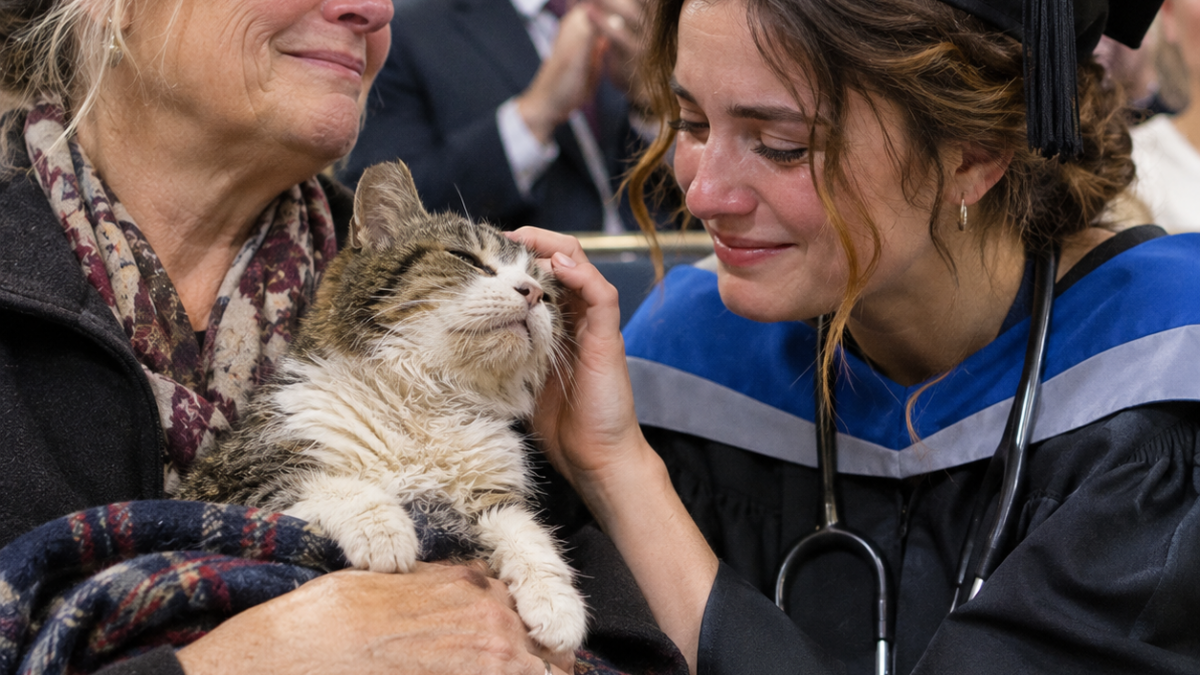
Eight years later, when she crossed a graduation stage to become a veterinarian, the same cat was waiting in the third row on her mother’s lap, nineteen years old and still alive.
The morning began like hundreds of others.
Cold.
Gray.
Quiet.
A thin layer of frost lay across the fields of northern Lincolnshire, where long dirt roads divided farmland into wide rectangles of winter soil.
The sun had not fully risen.
At 7:30, the horizon was only beginning to turn pale.
Eleven-year-old Hannah Whitmore left the small farmhouse where she lived with her mother and began walking toward the bus stop at the end of Mill Lane.
She wore a navy school skirt.
Black tights.
A blue wool jumper.
A coat that was slightly too large because her mother had bought it to last through another winter.
Her backpack bounced against her shoulders as she walked.
Nothing about that morning felt unusual.
She was thinking about school.
A maths test.
Whether her friend Sophie would save her a seat on the bus.
And whether she could convince her mother to let her have cereal for dinner because Tuesday’s stew had been terrible.
Then she saw something on the fence.
At first she thought it was a bag.
A piece of cloth, perhaps.
Something pale hanging against one of the old wooden posts running beside the lane.
She almost kept walking.
Then the shape moved.
Hannah stopped.
The movement was small.
Barely visible.
She stepped closer.
What she saw stayed with her for the rest of her life.
A cat.
Small.
Female.
Tabby-and-white.
PART2:
Suspended against the wooden post roughly four feet above the ground.
Both front paws had been fixed against the timber with large steel nails.
Her rear legs hung beneath her.
Her body trembled.
Her head drooped forward.
She was breathing.
Fast.
Shallow.
But alive.
Hannah dropped her school bag.
For one second, she simply stared.
Not because she did not understand what she was seeing.
Because she did.
Someone had done this deliberately.
The road was empty.
No houses immediately beside her.
No passing cars.
No adults.
No mobile phone in her pocket.
This was years before every child carried one.
She could have run home.
The farmhouse was perhaps half a mile behind her.
She could have called her mother.
Asked a neighbor.
Found tools.
PART3:
Done something sensible.
Years later, Hannah would say she never really considered any of that.
She looked at the cat.
And decided the animal could not stay there another minute.
She stepped toward the post.
“Okay.”
Her voice shook.
“I’m going to get you down.”
The cat did not react.
Hannah reached for the first nail.
Six inches long.
Galvanised steel.
Driven deep into the hardwood.
She gripped the head between both hands.
Pulled.
Nothing.
She tried again.
The metal barely shifted.
Hannah looked around for something she could use.
Stone.
Piece of wood.
Fence wire.
Nothing useful.
So she planted one shoe against the base of the post.
Wrapped both hands around the nail.
And pulled with everything she had.
The metal moved.
Only slightly.
Enough.
Hannah changed her grip.
Pulled again.
The nail scraped against the timber.
Her fingers slipped.
The edge cut into her skin.
She ignored it.
Pulled again.
And again.
The cat remained almost completely silent.
That silence frightened Hannah more than any cry could have.
She kept talking.
“I know.”
“I know.”
“Just wait.”
“Please wait.”
After what felt like forever, the first nail came free.
Hannah nearly fell backward.
The cat’s body twisted against the remaining paw.
Hannah immediately supported her weight with one arm.
“Okay.”
“One more.”
Her hands were already bleeding.
Not badly at first.
Several shallow cuts across her fingers.
One split near her right palm.
The second nail was worse.
Deeper.
The wood had tightened around it.
Hannah tried pulling.
Nothing.
She changed position.
Used both hands.
The nail did not move.
The cat’s breathing quickened.
Hannah started crying.
Not screaming.
Silent tears.
Frustration.
Fear.
She looked toward home.
Then back at the animal.
“I’m not leaving you.”
She tried again.
The nail edge tore across the base of her right fingers.
A deeper cut.
She gasped.
Her grip loosened.
Then tightened again.
Later, adults would ask how an eleven-year-old had managed to pull a six-inch nail from treated hardwood with bare hands.
Hannah never had a satisfying answer.
“I kept pulling.”
That was it.
No technique.
No extraordinary strength.
No miracle.
She just refused to stop.
After several minutes, the second nail began to lift.
A fraction.
Then more.
Hannah pulled until her arms shook.
The nail finally came loose.
The cat dropped.
Hannah caught her.
The animal weighed almost nothing.
That was the first thing she remembered.
She had expected more.
Instead, the cat felt frighteningly light.
Hannah removed her blue school jumper.
Wrapped the cat inside it.
Pressed the bundle against her chest.
Then ran home.
Her school bag remained beside the road.
So did the two nails.
Her mother, Margaret Whitmore, was washing breakfast dishes when Hannah burst through the kitchen door.
“Mum!”
Margaret turned.
Saw blood.
Saw her daughter.
Saw the bundle.
For one terrible second she thought Hannah herself had been seriously injured.
“What happened?”
Hannah was crying now.
“She was on the fence.”
“Who?”
“The cat.”
“What cat?”
Hannah opened the jumper.
Margaret stopped speaking.
The cat’s front paws were injured and swollen.
Blood had soaked into the blue wool.
Hannah’s hands were cut too.
“What happened?”
“Someone nailed her.”
Margaret stared.
“What?”
“To the fence.”
That was enough.
Margaret grabbed her keys.
Towels.
A blanket.
Put Hannah and the cat in the car.
They drove twenty minutes to a veterinary surgery in town.
Hannah sat in the back seat.
The cat against her chest.
Every bump in the road made the animal tense.
Hannah whispered:
“I’m sorry.”
“I’m sorry.”
“I’m sorry.”
Margaret kept looking at them in the rearview mirror.
At one point she said:
“Hannah, your hands.”
“I’m fine.”
“You are bleeding.”
“She’s worse.”
There was no argument after that.
At the veterinary clinic, everything moved quickly.
The receptionist saw the cat.
Called for help.
A veterinary surgeon named Dr. Andrew Collins came out.
He took one look.
“Treatment room.”
Hannah tried following.
A nurse stopped her.
“We need to help your hands too.”
“No.”
“Hannah.”
“I want to stay.”
Dr. Collins looked at her.
Then at the cat.
“You got her down?”
Hannah nodded.
“With what?”
“My hands.”
He looked at Margaret.
Margaret looked close to tears.
Dr. Collins crouched so his face was level with Hannah’s.
“We’re going to help her.”
“I need you to let someone help you now.”
Hannah looked toward the treatment room.
“You promise?”
“I promise we’re going to do everything we can.”
Only then did she let her mother take her to urgent care.
The deepest cut required five stitches.
Two other cuts were cleaned and bandaged.
Her palms burned.
Her fingers hurt when she tried closing them.
Hannah asked one question repeatedly.
“Has Mum called the vet?”
Then:
“Is she alive?”
Margaret finally reached Dr. Collins.
The cat was alive.
Critically injured.
But alive.
The first examination revealed severe puncture trauma to both front paws.
The left paw had suffered fractures.
The right had extensive soft-tissue injury.
Both were swollen.
Dirty.
Beginning to show signs of infection.
The cat was dehydrated.
Exhausted.
Hypothermic.
Based on the condition of the wounds and her hydration level, Dr. Collins estimated she had been hanging from that fence for somewhere between eight and twelve hours.
Most likely since the previous evening.
Through a November night.
Temperatures near freezing.
No food.
No water.
Unable to move.
Hannah listened from a plastic chair when Dr. Collins explained it later that afternoon.
She held both bandaged hands in her lap.
“How old is she?”
“Hard to say exactly.”
“Maybe around eleven?”
Hannah’s eyes widened.
“My age?”
“Approximately.”
“Will she walk?”
Dr. Collins hesitated.
“We hope so.”
“Will she keep both paws?”
Another pause.
“We’re going to try.”
That word frightened Hannah.
Try.
She had assumed once the cat reached the clinic, everything would become certain.
Adults would know what to do.
Doctors fixed things.
Veterinarians fixed animals.
That day she learned professionals did not always have guarantees.
They had knowledge.
Tools.
Experience.
And sometimes only a chance.
The veterinary team cleaned the wounds.
Stabilized the fractures.
Started antibiotics.
Fluids.
Pain medication.
The cat stayed overnight.
Then another.
Then several more.
Hannah visited every day after school.
Her mother drove her.
Sometimes they stayed ten minutes.
Sometimes an hour.
The cat was weak at first.
Barely lifted her head.
Hannah would sit beside the kennel.
Hands still bandaged.
Talk about school.
Her maths test.
A girl in class who had cheated during spelling.
What they were having for dinner.
Anything.
On the fourth day, the cat leaned her head against Hannah’s fingers.
Very gently.
Hannah looked at Dr. Collins.
“She likes me.”
Dr. Collins smiled.
“I think she does.”
The police investigated.
So did local animal-welfare officers.
They searched the area.
Talked to both neighboring farms.
Asked whether anyone recognized the cat.
Nobody did.
No CCTV.
No witnesses.
No vehicle description.
No obvious owner.
The road was isolated enough that someone could have driven there after dark and left without being seen.
Local newspapers reported the case.
People were horrified.
Some offered rewards for information.
Nothing came.
No arrest.
No charge.
No explanation.
For Hannah, that became one of the hardest parts.
She asked her mother repeatedly:
“Why would someone do that?”
Margaret never invented an answer.
“I don’t know.”
“Did she hurt someone?”
“No.”
“Maybe they hated cats?”
“Maybe.”
“But why like that?”
“I don’t know.”
Hannah hated not knowing.
She wanted a reason because reasons make terrible things feel contained.
No reason ever arrived.
The cat recovered slowly.
The right paw responded well.
The left never returned to normal.
The fractures healed.
But movement remained limited.
The toes could not fully extend.
When she walked, she placed the paw carefully.
Step.
Pause.
Step.
A small permanent limp.
The clinic expected the cat would eventually need a home.
Margaret said:
“No.”
Hannah looked at her.
“No what?”
“We are not keeping her.”
“I didn’t ask.”
“You were about to.”
“I was thinking.”
“You think loudly.”
Hannah looked at the cat.
She had named her already.
Hope.
Margaret noticed.
“You named her?”
“The nurses needed something to call her.”
“They have medical numbers.”
“Mum.”
“No.”
Three days later, Margaret bought a litter tray.
Hannah said nothing.
Two days after that, a cat bed appeared near the radiator.
Then bowls.
Then toys.
Margaret insisted:
“This is temporary.”
Hope lived with them for nineteen years.
She never completely stopped limping.
Cold weather made it worse.
As she aged, arthritis settled into the damaged paw.
Sometimes she held it up after walking too long.
But she adapted.
She learned where furniture sat.
Used low surfaces instead of jumping.
Slept beside Hannah whenever possible.
And she had one strange habit.
She disliked fence posts.
Not fences generally.
Wooden posts.
If Hannah carried her near one, Hope’s body tightened.
They stopped doing that.
Hannah’s hands healed faster.
Bandages came off.
Stitches removed.
The scars remained.
Two thin white lines across her right palm.
One across the left.
The deepest scar lay beneath the base of her right fingers.
At eleven, she hated them.
Classmates asked.
Some wanted the story.
Some did not believe her.
One boy said:
“No way you pulled nails out.”
Hannah showed him a newspaper clipping.
He never asked again.
By thirteen, she rarely noticed the marks.
By fifteen, they had faded.
But they never disappeared.
Hope was there through all of it.
Secondary school.
Exams.
First heartbreak.
Arguments with Margaret.
Late-night revision.
University applications.
Hannah often studied at the kitchen table.
Hope slept on her textbooks.
Whenever Hannah moved her, the cat returned.
At seventeen, Hannah began considering careers seriously.
Teachers suggested medicine.
Biology.
Research.
She had strong grades.
Her mother once asked:
“Do you still want veterinary medicine?”
Hannah looked surprised.
“Still?”
“You used to talk about it constantly.”
“When?”
“Since the fence.”
Hannah had almost forgotten that.
Not the event.
The ambition.
At eleven, she had told Dr. Collins:
“When I grow up, I’m going to know how to fix animals.”
Children say things.
Astronaut.
Doctor.
Pilot.
Veterinarian.
Most statements disappear.
This one did not.
At eighteen, Hannah applied to veterinary school.
The personal statement was difficult.
She wrote drafts.
Deleted them.
Her teachers told her not to make it sentimental.
Admissions committees wanted evidence of academic preparation.
Animal experience.
Scientific curiosity.
Resilience.
So Hannah wrote about placements.
Farm work.
Clinical shadowing.
Biology.
Then, near the end, she added one paragraph.
“When I was eleven, I pulled two nails out of a cat’s paws on a fence post using nothing but my bare hands. I had no idea what I was doing. I only knew that something was suffering, and I had hands that could help. I want to spend my life learning how to use those hands properly. I want to know what I’m doing the next time.”
She nearly deleted it.
Her teacher told her:
“Keep it.”
She did.
Later, an admissions tutor told her that paragraph had stayed in his mind.
Not because it proved she was brave.
Because of the final sentence.
I want to know what I’m doing the next time.
Hannah was accepted.
Veterinary school was nothing like rescuing Hope.
That surprised her.
It was harder.
Less emotional.
More demanding.
Anatomy.
Pharmacology.
Pathology.
Surgery.
Statistics.
Long nights.
Clinical rotations.
Mistakes.
Examinations.
Animals that could not be saved.
Owners who could not afford treatments.
Cases where knowledge did not create a good outcome.
The first time Hannah lost a patient during clinical training, she went home and cried on the floor.
Hope was fifteen by then.
Older.
Slower.
She walked over.
Lay against Hannah’s leg.
Exactly as she had countless times.
Hannah said:
“I knew what I was doing this time.”
Hope purred.
“It still wasn’t enough.”
That became another lesson.
Knowing what you are doing does not guarantee that you win.
It gives you a better chance.
Sometimes that is all medicine can offer.
Hannah’s hands became more skilled.
The scars remained.
During practical examinations, she sometimes noticed them while placing sutures.
Thin white lines beneath gloves.
She remembered eleven-year-old fingers gripping steel.
Pulling without knowing whether she was helping or making things worse.
That memory made her careful.
Not afraid.
Careful.
Hope aged alongside her.
At sixteen, her vision began declining.
At seventeen, arthritis worsened.
At eighteen, she developed early kidney disease.
Hannah was already deep into training by then and understood exactly what each diagnosis meant.
Sometimes she wished she didn’t.
Her mother would call.
“Hope didn’t finish breakfast.”
Hannah’s mind immediately generated a list.
Renal values.
Pain.
Dental disease.
Nausea.
Hydration.
Then Margaret would say:
“She ate it twenty minutes later.”
Hannah hated being a veterinary student when her own cat was old.
Knowledge made every small change visible.
Hope slept more.
Her tabby markings faded.
Her white muzzle became thinner.
One eye clouded.
The old damaged paw became increasingly stiff.
But she continued.
One day at a time.
When graduation approached, Hannah was twenty-seven.
Eight years had passed since she began professional training.
Sixteen years since the fence post.
Hope was nineteen.
Mostly blind.
Thin.
Arthritic.
She slept almost twenty hours a day.
Margaret called two weeks before the ceremony.
“I want to bring her.”
Hannah thought her mother was joking.
“To graduation?”
“Yes.”
“Mum.”
“She started it.”
“That is not how degrees work.”
“She absolutely started it.”
“Animals are not supposed to be in the auditorium.”
“I asked.”
“You asked?”
“Yes.”
“What did they say?”
“They said if she remained in a carrier and was comfortable, they would allow it.”
Hannah covered her face.
“You planned this before calling.”
“Obviously.”
“Hope hates carriers.”
“She hates vets too, which is ironic given what you’ve done with your life.”
That was true.
On graduation day, the university hall was crowded.
Families.
Flowers.
Academic robes.
Programs.
Phones.
Hannah stood backstage wearing a black gown.
Her right hand kept moving toward the old scar.
She still did that when nervous.
Rubbed it with her thumb.
The ceremony began.
Names called.
Applause.
Hannah waited.
Then her turn.
She stepped onto the stage.
Walked toward the official holding her degree.
Halfway across, she looked down.
Third row.
Margaret sat there.
Gray hair.
Blue dress.
And on her lap:
A soft-sided pet carrier.
The mesh top had been opened slightly.
Hope’s face appeared.
Tabby-and-white.
One cloudy eye.
Ears low.
Old.
Very old.
But there.
Hannah stopped for perhaps half a second.
Nobody else would have noticed.
Margaret did.
She smiled.
Then touched the carrier.
Hannah continued walking.
Received her degree.
Turned toward the audience.
Applause came.
She barely heard it.
She was looking at Hope.
The same animal that had once hung helplessly from a fence post.
The same animal she had carried home inside a school jumper.
The same animal that had slept across her textbooks.
The same animal beside her during exams.
Bad days.
Good days.
Now sitting in the room where Hannah became a veterinarian.
After the ceremony, Margaret took Hope outside to a quiet courtyard.
Hannah removed her gown.
Sat on the grass.
Opened the carrier.
Hope did not immediately move.
Hannah reached inside.
The old cat smelled her fingers.
Then placed one paw into Hannah’s palm.
The damaged left paw.
The one that had never fully recovered.
Hannah began crying.
Margaret sat nearby.
“You okay?”
Hannah laughed.
“No.”
Hope shifted forward.
Hannah lifted her carefully.
The cat weighed less than she remembered.
Much less.
Hope settled against her chest.
Hannah looked at her mother.
“You really brought a nineteen-year-old cat to graduation.”
Margaret said:
“She had perfect attendance.”
A university newspaper reporter noticed them.
Asked about the cat.
Margaret said:
“You’d better ask the veterinarian.”
Hannah told the story.
Not every detail.
Enough.
The fence.
The nails.
The rescue.
The scars.
The reporter looked horrified.
Then asked:
“Is that why you became a vet?”
Hannah looked down at her right hand.
Turned it over.
Showed the thin white scar across her palm.
“Yes.”
Then she thought.
“No.”
The reporter waited.
Hannah said:
“It’s why I started wanting to become one.”
“The reason I kept going changed.”
“What was that?”
Hannah stroked Hope’s head.
“When I was eleven, I thought helping meant doing something immediately.”
“And sometimes it does.”
“But veterinary medicine taught me that helping also means knowing when to wait, when to operate, when not to operate, when pain matters more than cure, when an owner needs honesty, and when there’s nothing left to fix.”
She looked at the scar again.
“This is what happens when you don’t know what you’re doing but choose to help anyway.”
“I wanted to learn how to use these hands properly.”
“So the next time something was suffering, I could do better.”
The reporter asked:
“Did you?”
Hannah looked at Hope.
“I hope so.”
Four months later, Hope stopped eating.
Not completely.
Then almost completely.
Hannah examined her herself.
She already knew.
Kidneys worse.
Arthritis severe.
Weight loss.
Age.
Nineteen years and three months.
It would have been possible to do more.
Fluids.
Hospitalization.
Additional medication.
Tests.
Maybe more days.
Maybe weeks.
Hannah had spent years learning how to extend life.
Her final lesson with Hope was learning when not to.
Margaret asked:
“What do you think?”
Hannah hated the question.
Not because she didn’t know.
Because she did.
“She’s tired.”
Margaret nodded.
“She’s been tired.”
“Yes.”
“Is she hurting?”
“Some.”
“Can we fix it?”
Hannah looked at Hope curled on her childhood bed.
“No.”
That night, Hannah slept beside the cat.
Just as she had at eleven.
Hope lay near her hip.
Her breathing shallow.
Quiet.
Hannah kept one hand against her side.
Sometime before dawn, Hope shifted.
Placed the damaged paw across Hannah’s palm.
Maybe coincidence.
Probably.
Hannah did not move.
She stayed there until morning.
The following day, Hope passed peacefully at home.
No clinic.
No stainless table.
No frightening sounds.
Margaret sat beside them.
Hannah held the cat who had once fallen into her arms from a fence post.
Nineteen years old.
Her final breath came quietly.
Afterward, Hannah kept sitting.
One hand beneath Hope’s paw.
The same hand marked by the rescue.
Margaret asked:
“Do you want me to call someone?”
Hannah shook her head.
“Not yet.”
So they stayed.
Later, they buried Hope beneath an apple tree at the edge of the garden.
Not beside a fence.
Hannah insisted on that.
Margaret placed the old blue school jumper there too.
The one they had kept all those years.
Faded.
Washed.
Small brown stains impossible to remove.
Hannah stood beside the grave.
Looked at her hands.
At twenty-seven, the scars were almost invisible unless you knew where to look.
She knew.
She would always know.
Years passed.
Hannah became a practicing veterinarian.
Then a senior vet.
Eventually a clinic owner.
She treated thousands of animals.
Dogs hit by cars.
Cats with kidney failure.
Farm injuries.
Infections.
Cancer.
Broken bones.
Abandoned animals.
Loved animals.
Difficult owners.
Kind owners.
People with money.
People without it.
Some animals survived.
Some did not.
She never got used to losing them.
She learned not to expect herself to.
Young veterinary students sometimes shadowed her.
They noticed the scars.
Occasionally somebody asked.
Hannah told the shortened version.
“Cat on a fence.”
“I was eleven.”
“Pulled her down.”
“She lived.”
Students often responded:
“That’s incredible.”
Hannah usually corrected them.
“It was stupid.”
They looked surprised.
“I could have made things worse.”
“I could have been hurt badly.”
“I should have called for tools and help if I’d had the option.”
Then she would pause.
“But she was dying.”
“And I was there.”
Both things were true.
Bravery and recklessness are sometimes neighbors.
What mattered was what came afterward.
An eleven-year-old girl acted because she knew nothing except that an animal was suffering.
A twenty-seven-year-old veterinarian graduated because she had spent years learning what to do after compassion says:
Help.
Toward the end of her career, a young nurse at Hannah’s clinic found an injured stray cat beside a road.
The cat had a badly damaged paw.
The nurse carried him in.
Panicked.
“Doctor Whitmore.”
“I don’t know what to do.”
Hannah looked at her.
She was sixty-eight then.
Hair gray.
Glasses.
Hands slightly stiff with age.
Three scars still visible when light hit them correctly.
She held out one hand.
“First thing?”
The nurse hesitated.
“Stay calm?”
“Good.”
“Second?”
“Pain relief?”
“Exactly.”
They worked.
The cat survived.
After surgery, Hannah stood beside the recovery cage.
The nurse asked:
“Were you always this calm?”
Hannah laughed.
“No.”
“What changed?”
She looked at her hands.
“Practice.”
That was the answer.
Not heroism.
Not destiny.
Practice.
Knowledge.
Thousands of small decisions learned after one enormous decision made by a child.
Hannah retired in her late sixties.
On her final day, the clinic staff gave her a framed photograph.
Not of herself.
Not of the clinic.
Hope.
Graduation day.
Nineteen years old.
Cloudy eye visible through the carrier mesh.
Hannah laughed when she saw it.
Then cried.
Beneath the photograph, somebody had written:
SHE WAS THERE AT THE BEGINNING.
Hannah turned the frame over.
On the back, she added something herself.
AND SHE STAYED LONG ENOUGH TO SEE WHAT CAME NEXT.
She kept it on her desk at home.
Beside her veterinary degree.
If anyone asked which mattered more, Hannah never answered.
They belonged to the same story.
A story that began at 7:30 on a freezing November morning.
An eleven-year-old girl walking to school.
A lonely dirt road.
A fence post.
A cat who had somehow survived the night.
Two nails.
Two hands.
No tools.
No training.
No idea what she was doing.
Only the certainty that walking away was impossible.
Hannah could never undo what somebody had done to Hope.
She could not erase the scars from the cat’s paws.
Could not restore perfect movement.
Could not make the person responsible answer for it.
But she could choose what happened after she found her.
She could pull.
Carry.
Learn.
Study.
Practice.
Heal.
And for nineteen years, Hope kept walking beside her with that careful little limp.
Through school.
Through university.
Through graduation.
All the way to the day an eleven-year-old girl finally became the person she had wished existed beside that fence post.
Someone who knew what to do.
Hope died four months later.
Her paws finally still.
Hannah’s scars remained.
They followed her into every operating room.
Every consultation.
Every emergency.
Every animal she touched.
Thin white reminders that compassion had come first.
Knowledge came later.
And a lifetime had grown in the space between them.








