An 11-Year-Old Cat Lost Both Ears and Nearly His Life Protecting a Sleeping Baby—But What He Did After Coming Home Made Millions Understand Why He Never Ran
PART3:
The screen looked intact.
I locked the front door, turned off the lamp, and went to bed.
I slept badly, the way single mothers sleep: never fully under, always listening. I heard Lily shift once around 1:00. I heard the refrigerator hum. I heard a car roll slowly through the parking lot and then move on.
I did not hear the fox enter.
The veterinarian later explained that a hungry adult fox could push through a weak screen or loose window if it smelled food, trash, rodents, anything. Animal control said foxes had been seen near the drainage ditch all summer. A neighbor claimed one had gotten into the dumpster behind the building. Mr. Calloway insisted no one had reported anything to him, which was a lie. I would learn that later.
What I know is this.
Sometime after 2:00 a.m., a red fox forced open my living room window far enough to slip inside.
It must have landed on the carpet near the couch. I imagine it freezing there, narrow chest heaving, ears sharp, paws silent. I imagine the wild smell of it filling the room, earthy and sour and alive. I imagine Ghost lifting his head in the hallway, old body suddenly awake in a way he had not been for years.
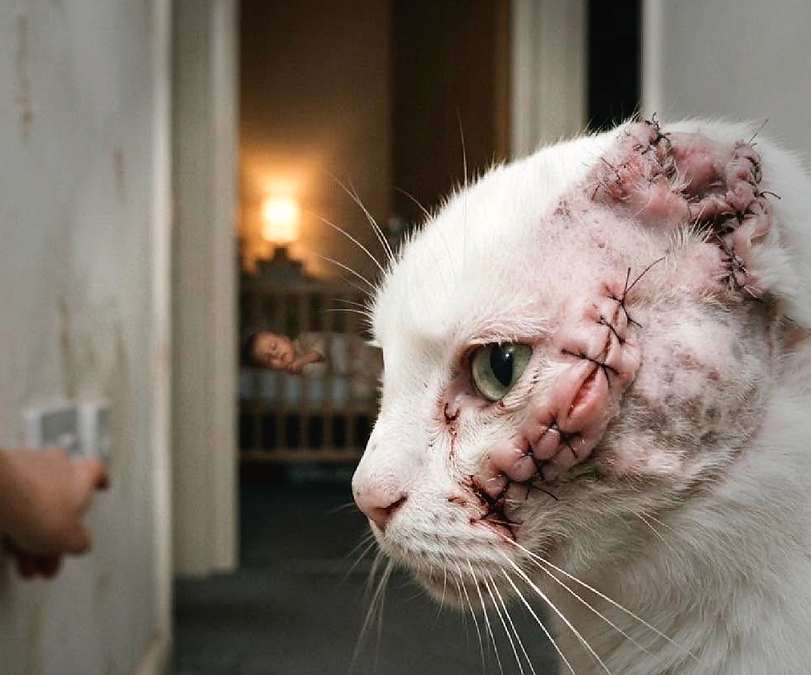
He was partially deaf in his left ear because of an infection he’d had before I adopted him, back when he belonged to nobody and survived behind a closed grocery store. The shelter told me he had been found thin, dirty, and too tired to run from the trap. His ears were scarred even then. His eyes had that faraway look some animals carry when humans have failed them before.
“He’s sweet,” the volunteer had said, “but he’s not flashy. Most people walk past older cats.”
I had been twenty-seven then, newly married, still believing my life would unfold in the order people promised it would. House someday. Baby someday. Love that stayed.
Ghost had been in a lower cage, sitting very still while kittens tumbled and pawed above him.
“What’s his story?” I asked.
The volunteer sighed. “He waited behind the store for months after the manager stopped feeding the strays. We think somebody dumped him there. He kept sitting by the back door like the person was coming back.”
I looked at Ghost.
He looked at me.
There are moments in life when two wounded things recognize each other before either one knows the wound is there.
“I’ll take him,” I said.
Tyler laughed when I told him the cat’s name was Ghost. “That’s depressing.”
I scratched the cat under the chin. “Maybe he just survived long enough to haunt the people who gave up on him.”
At 3:20 in the morning, Ghost made a sound I had never heard from any animal in my life.
It tore me out of sleep.
Not a meow. Not a hiss. Not a yowl like cats make when they fight outside.
A scream.
Raw. Guttural. Continuous.
For one stupid second, I sat upright in bed, disoriented, heart hammering, not understanding where I was. Then Lily cried out once from her room, a startled, breathless sound.
I was on my feet before I was fully awake.
The hallway was dark except for the thin glow of Lily’s moon night-light spilling through her doorway.
Ghost was in the doorway.
At first my brain could not understand what I was seeing. His white body was arched so high he looked larger than himself. Every hair stood out. His tail was puffed, his mouth open, teeth exposed. He had planted himself directly across the entrance to Lily’s room, not inside it, not behind the door, but in the exact center of the frame as though some invisible line had been drawn there and he had decided nothing would cross it.
Less than three feet in front of him stood a fox.
A real fox.
In my apartment.
Its red coat looked almost black in the dim light. Its eyes reflected the night-light in two bright, cold points. Its mouth was slightly open. I could see its tongue. I could see the sharp white of its teeth.
For a moment, no one moved.
My daughter was behind Ghost, awake now, making small frightened noises in her crib.
The fox lowered its head.
Ghost screamed again.
The sound hit the walls and came back at me. It was not fear. I know fear. I had lived with fear for months: fear of bills, fear of being alone, fear of failing Lily, fear of becoming one of those women people pity in grocery store lines. This was something else. This was warning. This was rage. This was an old, quiet animal pulling every forgotten piece of wilderness from his bones and throwing it into one sound.
“Hey!” I shouted.
The fox turned its head toward me.
And Ghost launched himself.
I have tried to describe that moment a hundred times, and I still cannot do it without feeling my body go cold. He did not hesitate. He did not test the distance. He did not do what any sensible animal would have done, which was run under the bed and save himself.
He hit the fox from the side with his whole body.
They slammed into the wall hard enough to knock a framed photo off the hallway table. Glass shattered. Lily began screaming. The fox twisted with a sharp, high bark, and then the hallway became a violent blur of fur, teeth, claws, and sound.
I grabbed the closest thing I could find, a wooden laundry basket, and swung it without thinking.
“Get out!” I screamed. “Get out! Get away from her!”
Ghost and the fox rolled across the floor. The fox snapped. Ghost shrieked, but he did not release. They crashed into the shoe cabinet, splintering one of the cheap particleboard doors. A pair of Lily’s tiny pink socks flew into the air. The fox raked its claws across Ghost’s face, and I saw a dark line open where white fur had been.
I screamed again, but my own voice sounded far away.
The fight could not have lasted more than twenty seconds. That is what animal control estimated later. Fifteen to twenty seconds.
In memory, it lasts forever.
I remember the chair falling in the kitchen. I remember the metallic bang of Ghost’s water bowl flipping over. I remember the fox’s smell, sharp and musky. I remember Lily’s cries changing from startled to terrified. I remember thinking, If it gets past him, if it gets into her room, if I cannot stop it—
Ghost bit the fox near the shoulder. The fox jerked backward, dragging him several inches. Then it twisted free, scrambled across the living room, and sprang toward the open window. Its claws scraped the sill. For one horrible second, it seemed too large to fit through the gap it had forced open.
Then it was gone.
The apartment fell into a silence so sudden it hurt.
Lily was still crying.
I stood in the hallway holding the broken laundry basket, barefoot in broken glass, breathing so hard my throat burned.
Ghost did not chase the fox.
He turned.
Slowly.
He walked back toward Lily’s doorway.
There was blood on the floor. At first I thought it belonged to the fox because my mind refused to accept anything else. Then Ghost staggered, and the hallway tilted under me.
“No,” I said.
He made it to the doorway. The exact doorway. The exact place he had been standing before the fight.
He sat down.
His body swayed.
Then he collapsed.
I dropped beside him so fast my knees struck the floor. Blood was everywhere now, not pouring dramatically the way movies show it, but soaking, spreading, darkening the white fur along his face and chest and front leg. His right ear hung at an impossible angle. His left ear was split. One eye was swelling. His mouth opened, but no sound came out.
“Ghost,” I whispered. “Ghost, baby, no. No, no, no.”
He was conscious. That almost made it worse. His eyes found mine, cloudy with pain but aware. He tried to lift his head.
“Don’t move,” I said, sobbing now. “Please don’t move.”
Lily wailed behind us.
The mother in me and the creature in me tore in half.
My baby was crying. My cat was bleeding out. The window was open. The fox could come back. I had no one in the apartment. No husband. No family nearby. No neighbor I trusted enough to hand my daughter to at three in the morning.
For a few seconds, I froze.
Then Ghost’s paw twitched toward the nursery.
It was such a small movement. Maybe it meant nothing. Maybe it was only pain firing through damaged muscle. But in that moment, it felt like he was still trying to point me back to Lily.
So I stood.
I ran into her room, lifted her from the crib, and held her against me. She clung to my shirt with both fists, hot and shaking. I checked her face, her arms, her legs. No blood. No marks. No injuries.
“Okay,” I whispered, though nothing was okay. “You’re okay. You’re okay.”
I carried her to the living room and strapped her into her car seat with hands that shook so badly I could barely click the buckle. Then I shut the window with all my weight, shoved the coffee table against it, grabbed the thickest bath towel from the closet, and returned to Ghost.
He had not moved.
That scared me more than anything.
I wrapped him gently, terrified I would hurt him, but terrified not to. The towel turned red almost immediately. He weighed almost nothing in my arms. Ghost had always been lean, but not like this. Not this fragile bundle of bone, fur, and blood. He made one low sound when I lifted him, and I will hear that sound until the day I die.
“I’m sorry,” I cried. “I’m so sorry. Hold on, okay? Please hold on.”
The emergency veterinary clinic was twenty-five minutes away.
I drove there in sixteen.
I should not have. I know that. I ran red lights after slowing enough to see empty roads. I drove with one hand on the wheel and one hand reaching back to touch Lily’s car seat when she cried. Ghost lay on the passenger seat wrapped in the towel, his head turned toward me, his breathing shallow.
“Stay with me,” I kept saying. “Stay with me, Ghost. You hear me? Stay with me.”
Of course he could barely hear me even before that night.
I said it anyway.
At the clinic, I pulled crookedly across two parking spaces and ran inside carrying Ghost while Lily screamed from the back seat. A young receptionist looked up, saw the towel, and stood so quickly her chair rolled into the wall.
“I need help,” I said.
My voice did not sound human.
Two vet techs rushed out. One took Ghost from me. Another asked what happened.
“A fox,” I said. “There was a fox in my apartment. He fought it. He protected my baby. Please, please, save him.”
The doors swung shut behind them.
And then he was gone.
For the first time since waking up, there was nothing in my hands.
I ran back to the car for Lily, brought her inside, and sat in the waiting room under fluorescent lights that made everything feel unreal. There was a vending machine humming in the corner. A poster about heartworm prevention on the wall. A woman across from me held a dachshund wrapped in a blanket and stared at the blood on my shirt but said nothing.
Lily quieted after a while, exhausted and hiccuping against my chest.
I rocked her and stared at the swinging doors.
Twenty minutes passed.
Then forty.
A veterinarian named Dr. Hannah Mercer came out wearing blue scrubs with blood on the front. She was probably in her late thirties, with kind eyes and the careful expression of someone who has delivered bad news too many times to rush it.
“Are you Ghost’s owner?” she asked.
I stood too quickly. “Yes. Is he alive?”
“He’s alive,” she said.
My knees almost gave out.
“But he is in critical condition.”
That sentence pulled me right back down.
Dr. Mercer led me into a small consultation room. Lily had fallen asleep in my arms, her face pressed into my collarbone. I sat. Dr. Mercer sat across from me and folded her hands on the table.
“I’m going to be very direct,” she said gently. “His injuries are severe.”
“Okay.”
“His right ear is almost completely avulsed. It’s attached by a small strip of cartilage, but the blood supply is gone. We can’t save it.”
I nodded because I did not understand yet what it meant to lose an ear. Not really.
“His left ear is torn from the base through the canal. That one also can’t be reconstructed in a way that would be safe. The risk of infection would be extremely high. We are recommending surgical removal of both external ears.”
Both.
The word landed like a stone.
“He has four deep lacerations on the right side of his face,” she continued. “One comes very close to the eye. Very close. A few millimeters. The eye itself appears intact, but there may be swelling and damage we need to monitor.”
I put my hand over my mouth.
“He has a deep bite wound through the left front leg. Entry and exit wound. Muscle involvement. There are also three puncture wounds along the chest wall. One is near a rib. It did not enter the chest cavity, from what we can tell, but it was close.”
“How close?” I whispered.
Dr. Mercer hesitated.
“How close?” I asked again.
“Two millimeters, maybe less, from causing a pneumothorax. A collapsed lung.”
I closed my eyes.
Lily shifted in my arms. Her tiny hand opened against my shirt, then closed again.
“He has lost a significant amount of blood and fluid,” Dr. Mercer said. “His temperature is low. He’s in shock. We’ve started fluids, pain control, antibiotics. We need to take him into surgery as soon as possible.”
“Do it.”
“There is also the matter of cost.”
I looked at her.
She looked genuinely sorry before she even said the number.
The estimate was more money than I had in my bank account, on my credit card, or hidden in the coffee can above the fridge for emergencies. It was more than two months’ rent. More than Tyler had sent for Lily in all of August. More than I could imagine paying while buying diapers and formula and keeping the lights on.
For a moment, shame rose in me so hot I could barely breathe.
I was sitting in a veterinary clinic at four in the morning, covered in my cat’s blood, holding a baby whose father had decided responsibility was optional, and now a kind stranger was telling me the life of the animal who had saved my daughter had a price I could not afford.
“I don’t have that,” I whispered.
Dr. Mercer nodded slowly. “We have a charitable fund. It’s limited, but I can apply part of it. We can also do a payment plan for some of the balance.”
“I’ll pay it,” I said. “However I have to. I’ll sell my car. I’ll—”
My voice broke.
Dr. Mercer leaned forward. “Mara, breathe.”
I had not told her my name. She must have read it from the intake form.
“He stood in front of her,” I said. “He stood in the doorway. It was going toward her room, and he stood there.”
Dr. Mercer’s face changed. She had been professional before. Gentle, but controlled. Now emotion flickered across her eyes.
“We’re going to do everything we can,” she said.
“Can I see him?”
“Not before surgery. We need to move quickly.”
I nodded, and that was when the guilt fully hit me.
“If I hadn’t opened the window—”
Dr. Mercer interrupted, firm but not unkind. “You did not invite a wild animal into your home.”
“The latch was broken.”
“Did you know a fox would enter your apartment and approach your baby’s room?”
“No, but—”
“Then don’t do that to yourself right now.”
I wanted to believe her.
I did not.
They took Ghost into surgery at 4:37 a.m.
I know because I stared at the clock so long the numbers burned into my memory.
By then, the police had come and gone. The responding officer was young and looked uncomfortable taking a report about a fox attack from a woman with a sleeping baby and blood on her clothes. Animal control said they would inspect the apartment after sunrise. I called my neighbor, Mrs. Alvarez from Unit 2A, because she was the only person in the building who had ever offered help without making me feel small.
She answered on the second ring.
“Mara? What happened?”
I started crying as soon as I heard her voice.
She arrived at the clinic at 5:20 wearing slippers and a winter coat over her nightgown even though it was September. She took Lily from me with the confidence of a grandmother who had raised four children and did not need instructions.
“Go wash your hands,” she said.
“I can’t leave—”
“Bathroom. Now.”
I looked down and saw dried blood under my fingernails.
In the bathroom, under harsh white light, I saw myself for the first time. My hair was tangled. My face was gray. There was blood on my neck, my shirt, my jeans, even one cheek. A smear of it crossed my collarbone where Lily’s face had rested.
I turned on the faucet.
The water ran pink.
That was when I started shaking so hard I had to sit on the closed toilet lid.
I thought about Ghost as he had been the day I brought Lily home from the hospital. Tyler had carried the car seat in like he was holding luggage. My body hurt everywhere. I was terrified the baby would stop breathing if I looked away.
Ghost had approached the car seat slowly, sniffed Lily’s blanket, and then sat beside it.
Tyler laughed. “Great. The cat looks disappointed.”
But Ghost stayed there all afternoon.
When Lily cried that first night, Ghost came to the bedroom door and made one tiny chirping sound, the softest noise in the world, as if asking whether I understood that the small human was malfunctioning and needed attention.
He had watched over her from the beginning.
And I had left the window open.
When I returned to the waiting room, Mrs. Alvarez looked up from rocking Lily.
“You stop blaming yourself,” she said.
I blinked. “I didn’t say anything.”
“You don’t have to. I know a mother’s face when she is punishing herself for being human.”
I sat beside her.
“He might die,” I said.
She reached over and took my hand.
“Then he will die loved,” she said. “But not yet. That cat sounds stubborn.”
Ghost was in surgery for more than two hours.
They removed both damaged ears. They cleaned and closed the facial wounds. They placed drains. They flushed the bite wounds. They repaired what they could in his leg. They gave him fluids, antibiotics, pain medication, warmth, and every chance modern veterinary medicine could offer an old cat who had decided a baby’s doorway was worth his body.
At 7:06, Dr. Mercer came out again.
“He made it through surgery,” she said.
I cried so hard I could not speak.
“He is not out of danger,” she warned. “The next twenty-four to forty-eight hours matter a lot. Infection is a major concern. So is shock. But he is stable enough for now.”
“Can I see him?”
“Yes. Briefly.”
They took me to the back.
Ghost lay in a heated recovery cage on a clean blanket. His head was wrapped, his face swollen and stitched, his chest shaved in uneven patches. Tubes ran from him. His ears were gone. Not folded, not bandaged flat. Gone.
I pressed my hand against the cage door.
“Oh, Ghost,” I whispered.
His one less-swollen eye opened slightly.
I do not know if he saw me clearly.
His paw moved.
Not much. Just enough.
I broke.
“I’m sorry,” I said. “I’m so sorry. You saved her. You saved my baby. I’m sorry I didn’t save you first.”
A vet tech standing nearby turned away and wiped her cheek.
Dr. Mercer unlocked the cage so I could touch him with two fingers. I stroked the uninjured part of his forehead, barely touching.
“You don’t have to guard anything right now,” I whispered. “Just rest. Please just rest.”
His eye closed.
I went home that morning without him.
The apartment looked like a crime scene.
Mrs. Alvarez kept Lily upstairs while I met animal control and the police. In daylight, the damage was uglier. Blood streaked the hallway floorboards. The shoe cabinet leaned broken against the wall. One kitchen chair lay overturned. The window screen bowed inward, torn along one edge. The latch hung loose, one screw missing, the wood around it splintered where the fox had forced the frame.
An animal control officer named Bethany Price crouched by the window and took photos.
“This latch was already compromised,” she said.
I looked at Mr. Calloway, who had arrived ten minutes earlier wearing a baseball cap and an expression of deep inconvenience.
“That window was secure enough for normal use,” he said.
Bethany stood. “A wild animal entered through it.”
“Because she left it open.”
I turned toward him. “It was open three inches because the air conditioner barely works and you wouldn’t fix that either.”
He lifted both hands. “I’m just saying there’s personal responsibility here.”
The words hit me like a slap.
Personal responsibility.
Behind him, Officer Grant, the young policeman from the clinic, looked up from his notes.
“Mr. Calloway,” he said, “now might not be the time.”
But Mr. Calloway was the kind of man who mistook cruelty for honesty and authority for intelligence. He looked at the blood on the hallway floor and shook his head.
“You people keep pets and then act surprised when animals bring trouble.”
“You people?” I asked quietly.
His face stiffened. “Tenants. I meant tenants.”
No, he did not.
I saw Bethany notice. I saw Officer Grant notice too.
Mr. Calloway cleared his throat. “Anyway, the lease states management is not responsible for incidents caused by open windows.”
“The lease also states management is responsible for functional locks and window hardware,” I said.
He smiled in a way that made my skin crawl. “Good luck proving it wasn’t functional before last night.”
I walked to the kitchen drawer, pulled out my phone, and opened the maintenance request app the property company used.
June 14: Living room window latch loose, does not lock properly.
July 3: Second request, latch still not repaired.
August 22: Third request, concerned for infant safety.
I turned the screen toward him.
His smile faded.
Bethany looked at the phone, then at him.
“You might want to preserve those records,” she said to me.
“I will.”
Mr. Calloway’s jaw tightened. “All maintenance requests are internal property matters.”
“Not if a child was endangered,” Officer Grant said.
For the first time since I had met him, Mr. Calloway shut up.
That should have been the end of his involvement, but people like him do not like being embarrassed, especially by women they think are too tired, too poor, or too alone to fight back.
By noon, he had posted a notice on my door claiming management would inspect the unit for “lease violations related to unauthorized animal damage.” By evening, a woman in Unit 3C told Mrs. Alvarez that she heard I had “let a wild animal in” and was “trying to blame maintenance.” By the next day, Tyler’s mother called me for the first time in weeks, not to ask if Lily was okay, but to say she had heard “disturbing things” about my judgment.
“My judgment?” I repeated.
“Opening a window at night with a baby in the home, Mara.”
I was standing in the clinic parking lot, waiting to be allowed in for Ghost’s second visit. My hand tightened around the phone.
“It was September. The apartment was hot. The latch was broken.”
“You always have an excuse.”
That sentence stole my breath because it sounded exactly like Tyler.
“Your granddaughter could have been mauled,” I said.
“And where were you when this animal supposedly entered?”
I closed my eyes. “Sleeping. Like people do at three in the morning.”
“And the cat was just roaming around?”
“He saved her.”
There was a pause.
Then she sighed. “It’s a cat, Mara.”
I looked through the clinic window and saw a vet tech carrying a folded towel past the front desk.
“No,” I said. “He is family.”
“Don’t be dramatic.”
I hung up.
Inside, Ghost was still alive.
For seven days, he remained at the emergency clinic on IV antibiotics. I visited every morning before work and every evening after Mrs. Alvarez could watch Lily. The bill grew. My credit card maxed out. Dr. Mercer used every assistance program she could find. One vet tech slipped me a bag of donated prescription food and pretended it was standard discharge material.
Ghost improved in small, fragile increments.
On the second day, he lifted his head.
On the third, he ate a teaspoon of wet food from Dr. Mercer’s finger.
On the fourth, he hissed weakly at a golden retriever passing his cage, and everyone celebrated because irritation meant energy.
On the fifth, his fever dropped.
On the seventh, Dr. Mercer said, “I think he wants to go home.”
I laughed and cried at the same time. “How can you tell?”
She smiled. “He keeps trying to remove his IV and glaring at us. Very clear communication.”
But he could not come home yet. The drains needed monitoring. The wounds needed cleaning. He had to tolerate medication. Infection could still take him. His leg might not heal properly. His hearing, already damaged, was nearly gone now without the structures of his ears.
“He may be almost completely deaf,” Dr. Mercer told me. “You’ll need to approach him carefully. Use vibration. Visual cues. Don’t startle him.”
I nodded, absorbing instructions like commandments.
“And Mara?”
I looked up.
“He may look different.”
I knew what she meant. Still, my throat tightened.
“He won’t know that the way you do,” she said. “He will know whether you love him.”
The first photo of Ghost after surgery was not the one that went viral.
The first photo was private.
I took it on the ninth day at the clinic, when Dr. Mercer let me sit with him in a quiet exam room. He wore a soft recovery collar. His head looked strangely small without ears. The stitches along his face pulled the skin in a way that made him look permanently stern. A bandage wrapped his chest. His shaved patches made him seem more vulnerable than the wounds themselves.
I sat on the floor because he had always hated exam tables.
He limped out of the carrier, sniffed my knee, and pressed his forehead into my palm.
No ceremony. No drama. No awareness that he had become the center of my whole heart.
Just Ghost, asking to be touched.
“I missed you,” I whispered.
He leaned harder against my hand.
I took one picture, not to post, not to show anyone, but because some part of me needed proof that he was still here.
When I got home that evening, there was another notice on my door.
FINAL WARNING: PET-RELATED DAMAGES AND UNSANITARY CONDITIONS.
My hands went cold.
The apartment had already been cleaned. Mrs. Alvarez’s sons came over with gloves, bleach, trash bags, and quiet kindness. They moved the broken furniture out. They scrubbed the hallway. They fixed a temporary board over the window until management replaced it, which they only did after animal control filed a report.
But Mr. Calloway was not trying to fix anything.
He was building a story.
A story where I was negligent. A story where my cat caused damage. A story where the property company could avoid responsibility by making me look like the problem.
I called the leasing office.
A woman named Denise answered.
“Maple Court Properties, this is Denise.”
“This is Mara Ellis in Unit 1B. I received a final warning about pet-related damages.”
“Yes, ma’am. The manager reported significant damage following an animal incident.”
“A wild fox entered through a broken window latch I reported three times.”
“I understand that’s your position.”
My position.
Not the documented maintenance requests. Not the animal control photographs. Not the police report.
My position.
“I want everything in writing,” I said.
“All notices are in writing.”
“I want the basis for the warning in writing. I want copies of every maintenance request I submitted. I want the inspection report. I want photographs of the alleged unsanitary conditions.”
Denise paused. Her voice changed slightly. “You may submit a formal records request by email.”
“I will.”
I did.
I copied the city housing office, animal control, and a legal aid clinic whose website I found at 1:00 a.m. while Lily slept and I sat on the couch surrounded by vet bills.
Two days later, Mr. Calloway knocked on my door.
I opened it with Lily on my hip.
His smile was tight. “You’ve been making quite a fuss.”
“I’ve been documenting what happened.”
“There’s no need to involve outside agencies.”
“There was a need when you ignored the window.”
His eyes flicked to Lily. “You should be careful, Miss Ellis. Housing gets hard to find when landlords hear you’re difficult.”
There it was.
The threat was soft enough to deny and clear enough to understand.
I felt my fear rise. He saw it. Men like him always see it.
Then Lily reached toward the hallway and made a happy little sound.
Ghost was not home yet, but she had started looking for him there. Every day. She would point at the doorway where he usually sat and babble, “Gah. Gah.”
Ghost.
Something inside me steadied.
“You should be careful too,” I said.
His eyebrows lifted.
“Because the next time you threaten me, I’m recording.”
He stepped back.
I closed the door.
My hands shook afterward, but I did not regret it.
Ghost came home on the twelfth day.
I prepared the apartment like I was bringing home a newborn all over again. I moved furniture to make clear paths. I placed soft blankets in quiet corners. I put his food and water where he would not have to jump. I bought a low-sided litter box with money I should have spent on groceries. Mrs. Alvarez made chicken soup for me and mashed sweet potatoes for Lily and told me not to argue.
At the clinic, Dr. Mercer reviewed the medication schedule twice.
“He needs rest,” she said. “No stress. No stairs. No rough handling.”
I looked at Lily, who was chewing the strap of her stroller.
“I’ll keep them separated unless I’m right there.”
“That’s wise.”
Then they brought Ghost out.
He was lighter than before. His white fur had been shaved across his chest, leg, and part of his face. His stitches were dark and angry. The bandage around his chest covered one drain site. His eyes looked huge without ears above them.
Lily saw him and froze.
For a second, I was afraid she would cry.
Instead, she reached out one tiny hand and whispered, “Gah.”
Ghost turned his head.
He could not hear her. Not really.
But maybe he felt something. The vibration. The movement. The old familiar presence of the baby he had guarded.
He blinked slowly.
I cried the whole drive home.
When I opened the apartment door, Ghost sniffed the air from inside his carrier. I expected him to hide under the couch. I expected him to avoid the hallway where it happened. I expected trauma to make him smaller, because that is what trauma had done to me for months.
But Ghost stepped out, unsteady and limping, and walked straight toward Lily’s room.
“Ghost,” I whispered. “No, honey, you don’t have to—”
He did not look back.
He reached the doorway.
The same doorway.
The place where his blood had soaked into the floorboards so deeply I could still see a faint shadow no amount of scrubbing erased.
He lowered himself carefully.
And sat.
Lily, standing in her crib after her nap, gripped the rail and watched him through the open door.
That was the photograph.
I did not plan it. I did not stage it. I did not adjust the light or clear the laundry basket from the corner. I simply saw him there, earless and stitched and exhausted, sitting between the hallway and my daughter as if no one had told him the fight was over.
I took out my phone.
One photo.
No filter.
No caption.
Then I posted it because people had been asking if he survived: Mrs. Alvarez’s daughters, coworkers who had covered shifts for me, the vet techs who wanted updates, a small local pet group where I had asked about recovery tips.
At first, I wrote nothing.
Then, after staring at the picture for several minutes, I added one sentence.
He came home today and went right back to her door.
I put my phone down and went to give Ghost his medication.
By morning, the photo had been shared 8,000 times.
By the second day, 400,000 people had seen it.
By the fourth day, the number passed two million.
The phrase started appearing in the comments before I understood what was happening.
He didn’t run.
Again and again.
He didn’t run.
Four words from strangers who had never met him and somehow understood the entire story.
They wrote about their own animals. Dogs who woke families during fires. Cats who sensed seizures. Old pets who stayed beside sick children. People sent photos of gray muzzles, missing legs, cloudy eyes, bent tails, and the beloved wreckage of creatures who had given humans more than humans deserved.
For a little while, the kindness was overwhelming.
A woman from Ohio sent a crocheted blanket with Ghost’s name on it. A retired firefighter sent a note that said, “Courage is not size. It is decision.” A class of third graders made cards covered in white cats with superhero capes. A man who said he had not cried in years wrote, “I wish someone had stood in a doorway for me when I was little.”
Donations came through the clinic before I even knew people had asked how to help. Dr. Mercer called me sounding stunned.
“Mara,” she said, “someone paid the remaining balance.”
“What?”
“And then more people called. We’ve set up a fund in Ghost’s name for emergency care cases.”
I sat down on the kitchen floor.
Lily crawled over and patted my knee.
“How much?” I asked.
“Enough that Ghost’s bill is covered. Enough that several other animals will be helped too.”
I pressed my hand to my mouth.
For months, I had felt like the world only took. Took sleep. Took money. Took trust. Took the version of my life I thought I was building. Now strangers were sending back pieces of grace in envelopes, comments, phone calls, and paid invoices.
But attention is never only kindness.
By the fifth day, the cruel comments found us.
Why was the window open?
Where was the mother?
Sounds fake.
That cat looks abused.
She used him for attention.
Take the baby away if she can’t keep a fox out.
I told myself not to read them.
Then I read them anyway.
Each accusation hooked into the guilt already living inside me. I could ignore strangers calling me stupid, but I could not ignore the part of me that agreed. I had failed to prevent it. Ghost had paid for my failure. Lily had been endangered in the one place she was supposed to be safe.
Then a local blog picked up the story with the headline: “Hero Cat Saves Baby After Mother Leaves Window Open Overnight.”
Not broken latch.
Not ignored maintenance requests.
Mother leaves window open.
The article used my photo without permission. It quoted anonymous neighbors saying I was “overwhelmed” and “always having trouble.” One person claimed animal control had been called before, which was false. Another said my apartment was “chaotic.” The piece ended by asking whether viral sympathy had “distracted from questions about parental responsibility.”
Tyler saw it.
Of course he did.
He called that night.
I almost did not answer, but part of me still wanted him to care. That was the humiliating truth. After everything, some exhausted part of me wanted Lily’s father to hear what happened and say, I’m coming. I’m sorry. Are you okay?
Instead, he said, “What the hell, Mara?”
I closed my eyes.
Ghost was sleeping on a folded towel near Lily’s door. Lily was asleep. The apartment was dim and quiet.
“Hello to you too,” I said.
“My mom sent me an article.”
“Your mom has my number. She could have asked if Lily was alive.”
“Don’t start. Is any of it true?”
“A fox got into the apartment. Ghost stopped it from reaching Lily’s room. He almost died.”
“Because you left a window open.”
“Because the latch was broken and management ignored it.”
“You always blame somebody else.”
I laughed once, coldly. “That is rich coming from you.”
He exhaled sharply. “I’m serious. This looks bad.”
“To who?”
“To everybody. People are asking questions.”
“People?” I repeated. “Or you?”
There was a pause.
Then he said the thing I did not expect.
“My mom thinks I should file for temporary custody until things settle down.”
The room seemed to tilt.
“You abandoned her,” I said quietly.
“I didn’t abandon her. I needed space.”
“You left when she was three months old.”
“And now she almost got attacked by a wild animal in your apartment.”
My hand tightened around the phone so hard it hurt.
“Ghost stopped it.”
“A cat should not be your safety plan.”
“No,” I said. “A father should have been part of it.”
Silence.
Then his voice hardened. “You don’t want to do this with me.”
Something inside me went very still.
For months, I had begged him to show up. I had softened my language in texts because I needed money for diapers. I had swallowed anger so Lily might someday have a father who felt welcome enough to return. I had let him rewrite leaving as “needing space” because fighting took energy I did not have.
But that night, with Ghost lying wounded by my daughter’s door and Tyler threatening to take her because the world had finally noticed us, something in me closed.
“No,” I said. “You don’t want to do this with me.”
He scoffed. “What’s that supposed to mean?”
“It means I have every message you sent refusing childcare money. Every missed visit. Every excuse. Every time you called her ‘the baby’ because saying her name made responsibility too real. You want to stand in front of a judge and argue I’m unfit because a wild animal entered through a broken window I reported three times? Let’s do it.”
“Mara—”
“And Tyler?”
“What?”
“Her name is Lily.”
I hung up.
Then I sat on the couch and shook for ten minutes.
The next morning, I called legal aid.
A woman named Priya listened as I explained everything: the fox, the window, the maintenance records, the viral photo, the blog, the landlord’s notices, Tyler’s threat. She asked precise questions. Dates. Names. Documents. Screenshots.
At the end, she said, “You need to stop speaking to Mr. Calloway in person.”
“I’ve tried.”
“Put everything in writing. Photograph every notice. Save every voicemail. Do not delete comments from local people if they mention things management told them.”
“Can they evict me?”
“They can try. That doesn’t mean they will succeed.”
The word try made my stomach drop.
“I can’t lose this apartment,” I said. “I have nowhere else to go.”
“I understand. That’s why we document.”
So I documented.
I became a woman made of folders.
Police report. Animal control report. Veterinary records. Photos of the latch. Photos of the window. Screenshots of maintenance requests. Screenshots of Mr. Calloway’s notices. Screenshots of the blog headline. Screenshots of Tyler’s messages. Every receipt. Every date.
Meanwhile, Ghost healed.
Healing was not beautiful.
People like the idea of recovery when it looks like soft blankets and brave eyes. They do not see the medication spit onto your shirt at 6 a.m., the wound drainage that makes you gag and cry at the same time, the way an animal trembles when you clean stitches even though he trusts you. They do not see you sitting on the bathroom floor whispering apologies to a cat who cannot hear them while your baby pounds on the door because she does not understand why you are both crying.
Ghost hated his antibiotics. He tolerated pain medicine. He despised the cone with a quiet intensity that felt almost spiritual. He bumped into furniture because his balance had changed without his ears. Sudden touches startled him. Loud sounds no longer reached him, but vibrations did. If someone knocked on the door, he felt it through the floor and lifted his head.
Lily adapted faster than I did.
I taught her “gentle” by guiding her hand over Ghost’s back. She learned to touch him with an open palm instead of grabbing. She learned not to approach from behind. Sometimes she crawled to the edge of the hallway and babbled at him, and he watched her with that serious, scarred face.
One evening, about three weeks after the attack, she pulled herself upright using the crib rail while Ghost sat outside her room.
“Gah,” she said.
Ghost looked at her.
She bounced once.
“Gah.”
His tail moved.
Just once.
It was the first time I laughed without feeling guilty.
The investigation into Maple Court began quietly.
Bethany from animal control came back to inspect the property. She found gaps under the dumpster fence, trash overflow that attracted wildlife, and evidence of fox movement near the drainage ditch. A neighbor in Unit 4A, Mr. Ingram, admitted he had reported fox sightings to management twice in July after seeing one near the ground-floor windows.
“I told Calloway,” he said when Bethany interviewed him. “He said unless it was paying rent, it wasn’t his problem.”
Bethany wrote that down.
Mrs. Alvarez found a text thread in the building group chat from August. Someone had posted a blurry photo of a fox near the dumpster. Mr. Calloway had responded with a laughing emoji and, “Keep pets inside and windows shut.”
I stared at that screenshot for a long time.
He knew.
Not just about the latch. Not just about the window.
He knew foxes were near the building.
And when one entered my apartment, when Ghost nearly died and Lily could have been hurt, he tried to bury the truth under warnings and gossip.
Priya filed a complaint with the city housing department and sent a letter to Maple Court Properties.
The tone was polite.
The content was not.
It cited failure to repair a documented window lock, unsafe building conditions attracting wildlife, retaliation after a tenant reported a safety incident, and defamatory statements allegedly made by property staff. It requested immediate withdrawal of all lease violation notices, reimbursement for damaged property, confirmation that no eviction action would be pursued, and preservation of all records related to maintenance requests, wildlife complaints, and communications about me.
Two days after the letter went out, Denise from the leasing office called.
I let it go to voicemail.
Her voice was much softer than before.
“Hi, Ms. Ellis. We received correspondence from your representative. We’d like to resolve this amicably.”
Amicably.
That word people use after they fail to scare you.
The city inspector came the following Monday.
Mr. Calloway showed up in a clean polo shirt, suddenly full of concern.
“We take all tenant safety matters seriously,” he told the inspector.
I stood in my living room holding a folder against my chest.
The inspector, a woman with silver hair and no patience for performance, looked at the newly replaced window latch.
“When was this repaired?” she asked.
“Immediately after the reported incident,” Mr. Calloway said proudly.
She looked at me.
“Ten days after,” I said. “After animal control photographed the broken one.”
Mr. Calloway’s face reddened. “There were scheduling issues.”
I opened my folder and handed the inspector printed maintenance requests.
She read them. Slowly.
Then she looked at the window again.
“June fourteenth,” she said.
Mr. Calloway said nothing.
She inspected every ground-floor window in the building. Three had loose latches. Two had damaged screens. The dumpster lid did not close. The back security light was burned out. The brush near the fence was overgrown enough to hide animals, trash, or people.
By the end of the inspection, Mr. Calloway was sweating.
By the end of the week, Maple Court Properties had been cited for multiple violations.
But the public humiliation came from somewhere else.
The local blog that had framed me as a negligent mother published a follow-up after Priya sent them a letter too. This one was shorter and far less smug.
“New Documents Show Repeated Maintenance Requests Before Fox Entered Apartment of Viral ‘Hero Cat’ Family.”
I did not like being in the news. I did not like my pain turned into content for strangers to debate between breakfast and work. But I admit, when I saw that headline, I sat at the kitchen table and cried from relief.
Not because everyone believed me.
Everyone never believes a woman like me.
But because the truth had left my mouth and entered the record.
That mattered.
Then Dr. Mercer called.
At first, I thought something was wrong with Ghost’s latest bloodwork.
“Mara,” she said, “are you sitting down?”
My stomach dropped. “Why?”
“It’s good news.”
I sat anyway.
“The emergency fund in Ghost’s name has received more donations. A lot more.”
“How much more?”
She told me.
I went silent.
“Mara?”
“That can’t be right.”
“It is.”
The story had reached a national animal welfare page. People kept calling the clinic, asking to donate not to me directly, but to animals whose owners could not afford emergency treatment. Dr. Mercer and the clinic owner had decided to create a formal fund: The Ghost Fund. It would help cover life-saving care in cases involving senior pets, rescue animals, and families facing financial hardship.
“His name is going to help other animals,” Dr. Mercer said.
I looked down the hallway.
Ghost was asleep outside Lily’s door, his scarred face resting on his paws.
“He’d hate that,” I said, crying.
Dr. Mercer laughed softly. “Probably.”
A week later, the clinic asked if they could take a professional photo of him for the fund’s page. I said yes on one condition: no making him look pathetic.
“He’s not a tragedy,” I told the photographer. “He’s grumpy and stubborn and he likes turkey baby food even though he pretends he doesn’t.”
The photographer, a soft-spoken man named Ellis, got down on the floor and waited twenty minutes for Ghost to stop glaring at the camera. The final picture showed him sitting upright on a blue blanket, stitches healing, eyes clear, no ears, no attempt to hide the scars.
Under it, the clinic wrote: He didn’t run. Now his courage helps others stay.
Donations doubled.
The first animal helped by the Ghost Fund was a brown tabby named Pickles who had swallowed thread. The second was a beagle hit by a car. The third was an old black cat with a urinary blockage whose owner, a widower on disability, sobbed in the lobby when he learned the fund would cover the deposit.
Dr. Mercer sent me updates only when owners gave permission.
I saved every one.
It helped turn the worst night of my life into something larger than damage.
But my personal life did not transform overnight just because strangers were kind.
Tyler filed a custody petition in October.
He did it quietly, maybe expecting me to panic. The paperwork claimed he was concerned about Lily’s safety due to “recent events involving a wild animal attack in the mother’s residence” and “unstable housing circumstances.” He requested temporary shared physical custody, despite having never kept Lily overnight and not knowing the name of her pediatrician.
The day I received the papers, I vomited in the kitchen sink.
Then I called Priya.
Then I opened my folder.
Court was scheduled for three weeks later.
Those three weeks felt like walking through life with a hand around my throat. I worked. I cared for Lily. I cleaned Ghost’s healing wounds. I answered legal questions. I gathered messages. I asked Dr. Mercer if she would write a letter documenting Ghost’s injuries and the likely direction of the fox. I asked animal control for the final report. I printed Tyler’s texts. I printed bank statements showing missed support payments. I printed photos of Lily smiling in clean pajamas, which Priya gently told me were emotionally meaningful but legally unnecessary.
“I just need them to know she’s loved,” I said.
“They will,” Priya said.
But I had learned that love and proof are not the same thing.
The night before court, I barely slept.
Ghost sat outside Lily’s door until I turned off the living room light. Then, instead of staying there, he limped toward the couch where I sat surrounded by papers.
“You should be resting,” I told him.
He stepped onto the rug, paused, and looked up at me.
Getting on the couch was hard for him now. His front leg had healed, but not cleanly. The muscle damage left him with a slight shortening, a hitch in his step that appeared when he was tired. I lifted him gently and placed him beside me.
He settled against my thigh.
For five years, Ghost had never been a lap cat. He accepted affection, but on his terms, with the dignified distance of an old man allowing visitors. That night, he pressed his scarred head against my leg and stayed.
“I’m scared,” I whispered.
His eyes half-closed.
“I know you can’t hear me. That’s probably good. I’m tired of hearing me too.”
He tucked his front paw under his chest.
“I keep thinking everybody is going to decide I’m not enough. Tyler. His mother. The landlord. The court. People online. Like if enough people say I failed, it becomes true.”
Ghost breathed slowly.
“But you stood there,” I said. “You didn’t ask whether you were enough.”
My voice broke.
“You just stood there.”
The next morning, Mrs. Alvarez watched Lily while I went to court.
Tyler wore a suit I had bought him for a wedding two years earlier. His mother sat behind him, pearls at her throat, lips pressed thin. He looked nervous when he saw Priya beside me. I think he expected me to come alone.
The hearing was not dramatic the way people imagine. No one shouted. No one confessed. No judge slammed a gavel and delivered poetic justice.
Real justice often arrives in beige rooms under fluorescent lights, through documents stacked in folders and questions answered clearly while your hands sweat.
Tyler’s attorney argued that the fox incident raised concerns about the safety of my residence.
Priya presented the maintenance records, the animal control report, the city citations, the repaired window documentation, and proof that management had ignored prior wildlife complaints.
Tyler’s attorney argued that my sudden internet attention created instability.
Priya presented my work records, Lily’s medical records, and letters from her pediatrician and Mrs. Alvarez.
Tyler’s attorney suggested Tyler wanted to be more involved.
Priya presented six months of missed visits, inconsistent payments, and text messages where Tyler referred to parenting as “too much right now.”
The judge, a woman with tired eyes and a calm voice, asked Tyler, “How many overnights have you had with the child?”
Tyler glanced at his attorney.
“None yet, Your Honor.”
“Who is the child’s pediatrician?”
He shifted.
“I don’t have the name in front of me.”
“What size diapers does she wear?”
His face colored.
I looked down at my hands.
Not because I enjoyed his humiliation. I did not. Some part of me still grieved the father I had hoped he would become. But there was a difference between grief and guilt, and I was finally learning not to confuse them.
The judge did not grant temporary custody.
She established a visitation schedule that began with supervised visits and required Tyler to complete a parenting class before requesting overnights. She ordered temporary child support based on his income. She warned both of us not to discuss the case publicly.
Then she looked directly at me.
“Ms. Ellis, based on the evidence presented, the court does not find that the fox incident resulted from neglect by you.”
I swallowed hard.
“The court does find,” she continued, “that you responded appropriately to an emergency and have taken steps to ensure the residence is safer.”
It was not a hug. It was not someone saying, You poor thing. It was better.
It was a legal record saying the shame did not belong to me.
Outside the courtroom, Tyler caught up with me near the elevator.
“Mara.”
I stopped but did not turn fully.
His mother hovered several feet behind him, angry and silent.
“I didn’t know about all the maintenance stuff,” he said.
“You didn’t ask.”
He looked down. “My mom was worried.”
“No,” I said. “Your mom was embarrassed. There’s a difference.”
He flinched.
“I want to see Lily,” he said.
“Then show up when the schedule says to show up.”
“I’m trying.”
I looked at him then, really looked. He seemed smaller than I remembered. Not physically, but in the way selfish people shrink when consequences finally reach them.
“Trying starts before court,” I said.
I walked away.
That evening, when I came home, Lily was in her high chair covered in applesauce, Mrs. Alvarez was washing dishes she did not dirty, and Ghost was sitting in the hallway.
“How did it go?” Mrs. Alvarez asked.
I put my bag down.
“We’re okay,” I said.
She turned off the faucet and came over to hug me.
For the first time in months, I believed the words.
Winter came slowly.
Ghost’s fur grew back in uneven patches. The scars settled into four pale lines along the right side of his face, running from above his eye toward his jaw. Without ears, his head had a round, otherworldly shape that made children stare and adults try not to. His hearing was almost completely gone. We learned new ways to speak.
I stomped gently on the floor before entering a room so he could feel the vibration. I flicked lights on and off to get his attention. I touched the floor near him before touching his body. Lily learned too. By the time she was one, she would pat the floor with her little hand before reaching for him, solemn as a priest performing a ritual.
Ghost returned to his post every night.
At first, I tried to stop him. Dr. Mercer said routine could be comforting but warned me not to let him overexert himself.
“You don’t have to sit there,” I told him again and again.
He ignored me.
At 9:00, after Lily’s bath and bedtime story, he would rise from wherever he had been resting and make his slow, limping way to her doorway. He sat facing the hallway, not the room. Always the hallway. Always whatever might come.
The window stayed locked. I checked it every night.
Then I checked it again.
Sometimes fear made me obsessive. I would push the latch five times. Tug the frame. Look behind the curtains. Check the front door. Check Lily’s closet even though no fox could possibly be hiding among tiny dresses and diaper boxes.
Trauma teaches the body that safety is a rumor.
Ghost seemed to understand that too.
He did not trust the latch.
He trusted himself.
The property company offered me a settlement in December.
They did not admit wrongdoing. Companies rarely do. But they withdrew all lease violation notices, reimbursed my damaged property, covered part of Ghost’s medical costs that had already been paid by donations—which I redirected to the Ghost Fund—and offered to release me from my lease without penalty if I wanted to move.
For weeks, I did not know what to do.
That apartment held the worst night of my life. It held the hallway where Ghost fell. It held Mr. Calloway’s threats, the broken window, the fear of losing Lily. But it also held Mrs. Alvarez upstairs. It held Lily’s first crawl, first tooth, first time saying “Mama” clearly enough that I cried into a dish towel. It held Ghost’s return to the doorway. It held survival.
In the end, I decided to move.
Not because I was running.
Because Ghost had taught me the difference between guarding and staying trapped.
Mrs. Alvarez helped me find a small duplex ten minutes away, owned by a retired school principal named Mrs. Donnelly who fixed the back door before I even signed the lease because “a mother shouldn’t have to ask twice for a lock that works.”
The new place had a tiny fenced yard, a kitchen with yellow curtains, and a bedroom for Lily painted pale blue. The windows locked. The heat worked. The rent was slightly higher, but with child support finally coming regularly under court order and my supervisor approving a more stable schedule, I could manage it.
Moving day was cold and bright.
Ghost hated the carrier, the car, the new smells, and the general concept of change. He expressed this by sitting in the middle of the empty living room at the new place and refusing to look at me.
“I know,” I said. “Deeply offensive.”
Lily toddled unsteadily across the floor, arms out for balance, and dropped a stuffed rabbit beside him.
Ghost sniffed it.
Then he looked toward the hallway.
I held my breath.
The new hallway was shorter than the old one. Lily’s new room was at the end, with a white door and a brass knob. The doorway was wider. Sunlight reached it in the afternoon.
Ghost limped down the hall.
He sniffed the threshold.
He stepped inside, checked under the crib, came back out, and sat facing the front of the house.
I sat down on a moving box and cried.
My brother, Daniel, who had driven three hours to help after months of not knowing how bad things had become because I had been too proud to tell him, came in carrying a lamp.
He saw my face and stopped.
“What happened?”
I pointed.
Daniel looked at Ghost.
Then he set the lamp down gently.
“That cat is something else,” he said.
“Yes,” I whispered. “He is.”
By spring, Lily was walking.
She walked like a tiny drunk president, waving one hand and making announcements no one understood. Ghost tolerated her processional marches past his bed. Sometimes she brought him toys he did not want. Sometimes she tried to feed him Cheerios, which he accepted once and regretted immediately.
Her first clear word after “Mama” was not “Dada.”
It was “Go.”
Not go as in leave.
Go as in Ghost.
She stood in the hallway one morning, pointed at him, and said, “Go.”
Ghost opened one eye.
I laughed so hard I had to sit down.
Tyler heard it during a supervised visit at the family center two weeks later. By then he had been showing up consistently for a month. He looked tired, humbled in ways I did not entirely trust but no longer needed to manage emotionally.
“She says Ghost?” he asked.
“She says Go.”
He smiled a little. “That’s cute.”
I watched Lily stack blocks while he sat across from her, careful and uncertain.
“She loves him,” I said.
Tyler nodded.
After a moment, he said, “I’m sorry.”
I looked at him.
“For leaving?” I asked. “For threatening custody? For believing your mother before asking me? You’ll need to be more specific.”
His face tightened, but he did not get defensive. That was new.
“All of it,” he said quietly. “I was ashamed. And I made it your problem.”
I studied him. There had been a time when those words would have opened every locked door in me. I would have rushed to forgive him because forgiveness felt like the price of being loved.
Now, forgiveness felt different. Less like opening a door. More like setting down a bag I did not need to carry.
“Thank you for saying that,” I said.
He waited.
I added, “It doesn’t erase anything.”
“I know.”
“Good.”
We never got back together.
That was one of the healthiest endings of my life.
Tyler became a better father slowly, imperfectly, under structure at first and then by choice. He learned Lily’s pediatrician’s name. He learned how she liked her bananas sliced. He learned that she cried when anyone sang too loudly but danced when Mrs. Alvarez played old salsa records. He learned to say Ghost’s name with respect.
His mother took longer.
The first time she saw Ghost after the attack, she recoiled before she could hide it.
Lily noticed.
She was almost eighteen months old then, standing beside Ghost with one hand on his back. She looked up at her grandmother’s face, then at Ghost, then frowned with the moral clarity only toddlers possess.
“Nice,” Lily said sternly.
Tyler’s mother blinked. “What?”
“Nice,” Lily repeated, patting Ghost gently.
Be nice.
I did not laugh because that would have ruined it.
Tyler’s mother looked at me, embarrassed.
I looked back.
To her credit, she knelt carefully, not too close.
“Hello, Ghost,” she said stiffly.
Ghost ignored her.
It was perfect.
The Ghost Fund grew beyond anything I expected. The clinic held a small fundraiser in May, and Dr. Mercer asked if I would speak. I almost said no. Public speaking sounded awful. Telling the story again sounded worse.
But then she sent me a note from the widower whose cat had been saved.
It said, I had already said goodbye in my head because I thought money decided whether my best friend lived. Please tell Ghost he gave me more time.
So I said yes.
The event was held in the parking lot of the clinic on a sunny Saturday. There were folding tables, donated cupcakes, dogs in bandanas, children drawing pictures of pets, and a banner with Ghost’s photo that made him look like the world’s angriest angel.
I brought him for exactly twenty minutes, with Dr. Mercer’s approval and a quiet room ready if he got stressed. He wore a soft blue harness and sat in a stroller because walking through a crowd would have been too much. People approached slowly. Many cried when they saw him.
“Is that him?” a little boy whispered.
His mother nodded.
The boy held out a drawing. It showed a white cat with no ears standing in front of a crib. Above him, in uneven letters, he had written: BRAVE GOST.
I crouched down.
“This is beautiful,” I told him.
“Did he know the baby wasn’t his?” the boy asked.
The question pierced me.
I looked at Ghost. He was staring past everyone, unimpressed by fame.
“I don’t think love works that way for him,” I said. “I don’t think he cared whose baby she was. She was small, and she was ours, and something was coming.”
The boy nodded seriously, as if that made perfect sense.
When it was time for me to speak, my hands shook around the microphone.
I looked out at the crowd and saw Dr. Mercer, the vet techs, Mrs. Alvarez, my brother, Tyler holding Lily near the back, people from town who had donated, people who had once judged me, people who had maybe changed their minds and maybe only come for cupcakes. I saw Mr. Ingram from Maple Court, who raised one hand in encouragement. I saw Bethany from animal control standing near the tent with sunglasses on her head.
I took a breath.
“Ghost was not a loud cat,” I began.
My voice trembled, but it held.
“He was not young. He was not strong in the way people usually mean strong. He was an old rescue cat with bad hearing, a crooked tail, and a serious attitude problem.”
People laughed softly.
“He had already been abandoned once before I adopted him. Maybe more than once. We don’t know. What I do know is that when danger entered our home, he did not do what would have made sense. He did not hide. He did not run. He stood in the doorway of my daughter’s room and gave everything he had.”
I looked down.
Ghost blinked.
“Afterward, a lot of people called him a hero. He is. But he is also still just Ghost. He still hates medicine. He still judges my cooking. He still sits in inconvenient places and refuses to move. He is not brave because he was never afraid. I think he was brave because something mattered more to him than fear.”
The crowd was quiet.
“The fund in his name exists because emergency care should not belong only to people with money in the bank. I know what it feels like to hear a number and think love might not be enough. Because of everyone who donated, more families will get a chance to bring someone home.”
My throat tightened.
“And if Ghost could understand all this attention, I think he would be annoyed.”
More laughter, wetter this time.
“But I hope he would understand one thing. What he did did not end in that hallway. It kept going. It is still going. Every animal helped by this fund carries a little piece of the night he chose not to move.”
When I finished, people applauded.
Ghost fell asleep.
That felt right.
On September second, 2024, one year after the attack, I woke before dawn.
For a few seconds, I did not remember why my body was tense. Then the date settled over me.
The anniversary.
I got up quietly and checked on Lily. She was asleep with one foot sticking through the crib bars, hair wild across her pillow. She had turned two the week before. She spoke in small sentences now. She called blueberries “boobies” no matter how many times I corrected her. She insisted on kissing Ghost goodnight on the top of his head, which he endured with saintly resentment.
Ghost was not outside her door.
Panic sparked before reason could stop it.
Then I found him in the living room, sitting by the front window.
The window was closed. Locked. Safe.
Outside, early light softened the yard. Nothing moved except a squirrel on the fence.
I sat beside him on the floor.
He glanced at me, then back outside.
“I remember too,” I said.
He could not hear me.
I said it anyway.
For a long time, we sat there together.
I thought about the woman I had been a year before, half-broken and pretending not to be. I thought about the window latch, the scream, the hallway. I thought about Ghost’s blood on my hands. I thought about strangers calling me negligent and a judge saying I was not. I thought about Tyler learning to show up, Mrs. Alvarez holding my baby in a waiting room, Dr. Mercer’s hands saving what could be saved.
I thought about the fact that healing had not returned us to who we were before.
Ghost did not get his ears back. His scars did not disappear. His leg did not stop limping. My trust did not magically repair itself. Lily would grow up with a story that began before she had memory, a story about danger entering her room and love blocking the door.
Healing did not mean the damage never happened.
Healing meant the damage did not get the final word.
At 7:10, Lily woke up calling, “Mama! Go!”
Ghost rose with effort.
“You don’t have to,” I told him.
He limped down the hallway anyway.
By the time I reached Lily’s room, he was already there, sitting in the doorway, facing out.
Lily stood in her toddler bed, curls wild, cheeks flushed from sleep.
“Go!” she said happily.
He turned his head just enough to see her.
She blew him a kiss.
His tail moved once.
Every night after that, the routine continued.
At 8:30, bath.
At 8:45, pajamas.
At 8:55, a book, usually the one about the rabbit who says goodnight to everything in the room.
At 9:00, Ghost rose.
It did not matter if he had been asleep. It did not matter if visitors were over. It did not matter if rain tapped the windows or snow pressed against the fence or summer heat filled the house again. He made his slow way to Lily’s door and sat down.
As if clocks meant nothing.
As if pain meant nothing.
As if he had made a promise in blood and intended to keep it longer than anyone asked.
One night, when Lily was two and a half, she asked the question I had known would come someday.
I was tucking her blanket around her when she touched the side of her own head.
“Ghost ears?” she asked.
I froze.
Ghost sat outside the door, his scarred profile visible in the hall light.
I sat on the edge of her bed.
“Ghost doesn’t have ears like we do anymore,” I said carefully.
“Why?”
I swallowed.
How do you explain sacrifice to a toddler? How do you tell a child that before she knew words, an old cat spent his body buying her safety? How do you make it true without making it frightening?
“He got hurt protecting you,” I said.
Her eyes widened.
“Me?”
“Yes, baby.”
She looked toward the doorway.
“Ghost ouchie?”
“He had big ouchies. But the doctors helped him, and he came home.”
Lily was quiet for a moment.
Then she climbed out of bed before I could stop her and padded to the doorway in her footie pajamas.
Ghost looked up.
She crouched in front of him, not touching yet. We had taught her that. Let him see you. Let him know.
Then she placed one gentle hand on his back.
“Thank you, Go,” she whispered.
I covered my mouth.
Ghost, who hated being fussed over and ignored most human emotion on principle, leaned forward and pressed his forehead against her chest.
Lily wrapped both arms around him carefully.
He stayed.
That was the moment the story became hers too.
Not the internet’s. Not the blog’s. Not the court’s. Not even mine.
Hers.
The baby behind the doorway had become a child who could thank the guardian she did not remember needing.
Years from now, when Lily is old enough, I will tell her more.
I will tell her that courage can be quiet for years before one moment asks everything of it.
I will tell her that family is not always made by blood, marriage, paperwork, or promises people make when life is easy. Sometimes family is made by who stays in the doorway when something dangerous comes down the hall.
I will tell her that Ghost had been abandoned before he became ours, and maybe that was why he understood something many humans forget: being unwanted once does not make you worthless. Being old does not make you useless. Being wounded does not make you weak. And love, real love, does not stop to calculate whether the life behind you belongs to you by biology before deciding whether to protect it.
Ghost is thirteen now.
He sleeps more than he used to. His limp is more noticeable on cold mornings. His scars have faded from angry red to pale silver, but they are always visible. The right side of his face will never be smooth again. Where his ears once were, soft fur has grown over the rounded edges, giving him a strange and beautiful silhouette.
Children sometimes ask what happened to him.
Adults usually pretend not to stare.
Ghost does not care.
He still judges my cooking. He still refuses expensive cat beds in favor of cardboard boxes. He still tries to steal turkey from Lily’s plate if she holds it too low. He still sits with his back to her room, facing the hallway.
The window stays locked every night.
The doors too.
I check them because I am a mother and because fear leaves habits behind.
But Ghost checks the hallway.
Not because the locks do not matter.
Not because the danger is still there.
But because once, in the dark, something came for the smallest member of our family, and Ghost learned exactly where he belonged.
Between.
Between the wild and the sleeping.
Between terror and innocence.
Between the thing that wanted in and the child who could not defend herself.
People still sometimes message me about the photo. They tell me they saw it during a hard time. They tell me Ghost reminded them of a father, a mother, a dog, a friend, a stranger who stepped in when no one else did. They tell me they cried over an old cat they never met.
I understand.
Because I still cry too.
Not every day. Not like before.
But sometimes, when the house is quiet and Lily is asleep and Ghost is sitting in that pool of hallway light, I look at him and remember the sound that woke me. I remember his small body filling the doorway. I remember thinking he could not possibly win.
And maybe he did not win in the way people imagine.
He lost his ears.
He lost blood.
He lost part of his face.
He lost the easy movement of one leg.
He lost almost all the hearing he had left.
But the fox never reached the crib.
Lily grew.
The truth came out.
The man who threatened me did not take my child.
The landlord who blamed me had to answer for what he ignored.
The clinic that saved him now saves others in his name.
And every night, my daughter falls asleep behind a doorway guarded by a cat who has already given more than anyone had the right to ask.
So when people ask me what kind of animal Ghost is, I do not say hero first.
Heroes can sound distant, like statues, like legends, like beings too perfect to understand.
Ghost is not perfect.
He is cranky. He is scarred. He is stubborn. He is old. He is sometimes ridiculous. He once spent an entire afternoon refusing to forgive me because I bought the wrong brand of wet food.
So I tell them the truth.
Ghost is what love looks like after it has been hurt and still chooses to stay.
Ghost is what courage looks like when it is smaller than the danger in front of it.
Ghost is what family looks like when it plants itself in a doorway and decides, without words, without applause, without knowing anyone will ever understand:
Nothing gets past me.
Not tonight.
Not her.
Not while I am here.








