An 11-Year-Old Boy Secretly Saved Every Dollar for Nearly a Year to Fix a Biker’s Broken Motorcycle—Then 700 Riders Discovered What He Had Been Sacrificing All Along
PART3:
“You should get home, William. It’s getting dark, and your mama’s probably wondering where you are.”
He was right.
My mother worried professionally.
Still, I did not leave.
I looked at the motorcycle, at the faded eagle, at the way Kevin’s hand rested on the seat when he thought I was not watching.
“How much would it cost?” I asked.
“To fix it, I mean.”
Kevin blinked.
“Why do you care?”
I did not have an answer that sounded smart.
“I don’t know,” I said. “I just do.”
He exhaled long and slow.
The way grown-ups do when the truth is heavier than they want to lift.
“Couple hundred dollars at least. Maybe more if the transmission’s shot.”
A couple hundred dollars.
At eleven, that number might as well have been the moon.
I nodded anyway.
Like I was filing it somewhere important.
Kevin pointed down the road.
“Go on, kid. Don’t make your mama come looking for you.”
This time, I listened.
I climbed onto my bike and rode home in the fading orange light past the church with the crooked steeple, past Mrs. Higgins watering tomatoes, past the corner where the Iron Riders Motorcycle Club kept its clubhouse behind a chain-link fence most of the neighborhood treated like a warning sign.
I did not tell my mother about Kevin that night.
I told myself it was because she was tired.
The truth was that I already knew she would tell me to stay away.
That night, after she went to bed, I pulled the allowance jar from under my bed.
Coins clinked against glass.
Crumpled one-dollar bills folded small.
A five-dollar bill from my birthday.
I counted everything twice.
Thirty-four dollars.
I sat on the floor in the dim light of my bedroom and thought about Kevin’s motorcycle sitting dead on the shoulder. I thought about his voice when he said, Story of my life, kid. I thought about my mother’s voice when she said, We’ll figure it out, even when there was nothing left to figure with.
Then I made the decision.
I was going to help fix that bike.
Nobody teaches an eleven-year-old how to save two hundred dollars.
There is no school lesson called What To Do When You Quietly Decide To Repair A Stranger’s Motorcycle Without Adult Permission.
I started with what I knew.
My allowance was five dollars a week, paid every Saturday morning from the tips my mother brought home from the diner. She would count the bills from her apron pocket, smooth them against the table, and hand me my five like it did not cost her anything.
But I knew it did.
Five dollars a week meant forty weeks to reach two hundred, assuming I spent nothing.
No comic books.
No candy.
No ice cream truck.
No Saturday movies with Tyler Brooks, my best friend from two doors down.
No corner-store chips after school.
For a boy in summer, that was its own kind of impossible.
I told no one.
Not Tyler, who would have wanted in immediately and then probably ruined it by talking too loudly.
Not my mother, who already worked too hard to be burdened with her son’s strange project.
This was mine to carry.
The next week, I went back to Lebanon Pike.
The motorcycle was gone.
For one terrible second, I thought the story had ended without me.
Then a man at the auto parts store told me Kevin had gotten the bike hauled to the garage behind the Iron Riders clubhouse.
That should have stopped me.
It did not.
I rode to Dickerson Road and stopped across from the clubhouse. The place looked exactly like the rumors said it would. Chain-link fence. Gravel lot. Rows of motorcycles. Corrugated metal building. Men in leather vests. A sign near the gate that said MEMBERS ONLY.
I stood there ten minutes before Kevin saw me.
“You’re back,” he said, not quite hiding his surprise.
“I wanted to see how it’s going.”
“It’s not going anywhere,” he said. “That’s the problem.”
He wiped grease from his hands with a rag so black it seemed impossible it had ever been useful.
“Parts cost money. Money I don’t have this month. Rent comes first.”
That was the first surprise.
Big men with leather vests worried about rent too.
“Why do you want it fixed so bad?” I asked.
Kevin went quiet.
Long enough that I wondered if I had crossed a line.
Then he leaned against the workbench and looked at the bike.
“It belonged to my brother.”
I waited.
Kevin’s voice changed when he continued.
“Name was Ray. Heart gave out on him a few years back. Too young. He painted that eagle on the tank the year before he died.”
He touched the scratched wing.
“I’ve kept this bike running because riding it is about the only way I still feel like he’s around.”
He looked embarrassed then, like grief was something a grown man should not have let a child see.
“Sounds foolish to a kid, probably.”
“It doesn’t,” I said.
And I meant it.
I understood missing someone who was gone.
I understood wanting an object to stand in for a person.
That night, I moved my allowance jar to the very back of my closet, behind a shoebox of baseball cards I no longer looked at.
A jar was not enough anymore.
This had become heavier than coins.
A month later, I moved the money into an old cigar box Mrs. Higgins gave me after I raked her yard. It smelled faintly like wood and smoke. I wrote NOTHING IMPORTANT on the lid in pencil, because I was eleven and thought that was subtle.
It was not.
I earned money anywhere I could.
Three dollars raking Mrs. Higgins’s yard.
Two dollars a week walking the Delgado family’s ancient dog, Pepper, who moved so slowly I suspected I was being paid mostly for emotional support.
Loose change from returning bottles.
A dollar from Mr. Jenkins for sweeping leaves out of his carport.
Coins found under vending machines.
Aluminum cans collected from the ditch along Lebanon Pike and hauled to the recycling center in a wagon that squeaked loud enough to announce my poverty three blocks ahead.
Progress was slow.
Painfully slow.
Some weeks I added eight dollars.
Some weeks only one.
Some weeks nothing at all because temptation won. A comic book. A snow cone. A movie Tyler begged me to see.
Whenever that happened, I lay awake feeling like I had failed a test only I knew I was taking.
By August, I had sixty-one dollars.
By October, ninety-eight.
The cigar box grew heavier.
The secret did too.
My mother noticed, of course.
Mothers always notice the thing you think you are hiding, even if they do not know its shape yet.
One evening, while she dried dishes and I pretended to do homework at the kitchen table, she said, “You’ve stopped asking for movie money.”
“I’m saving up.”
“For what?”
I froze.
“Something important.”
She studied me.
Not suspicious exactly.
Concerned.
That was worse.
“What kind of important?”
“The kind I want to finish before I talk about it.”
Her towel stopped moving.
I waited for her to push.
She did not.
The two years since my father left had changed her. She had learned that I processed the world in my own time, and that forcing me open rarely made the truth come out cleaner.
“All right,” she said finally. “But if this important thing starts hurting you, I expect you to tell me.”
I nodded.
I was already afraid it might.
By December, I had visited Kevin nine more times.
I learned the Iron Riders were not what people said.
Or maybe they were not only what people said.
That was more honest.
They were loud.
They were rough around the edges.
Some had records.
Some had tempers.
Some looked like the kind of men teachers warned you about in assemblies.
But they also fixed cars for widows who could not pay. They raised money every Thanksgiving for families who could not afford turkeys. They delivered Christmas gifts to children whose names came from school counselors and church basements. They escorted funerals for veterans who had outlived most of their own friends.
No reporters came for those things.
No one wrote about Christopher, who looked like a movie villain but cried every year during the toy drive.
No one wrote about Gary Whitfield, the club president, who kept a notebook of every family helped and every promise made.
No one wrote about Kevin sleeping in the room above the garage because after his injury cost him steady mechanic work, the club had refused to let him lose both his income and his place in the world.
I learned that Kevin had been a mechanic for twenty-three years before his shoulder got injured badly enough that long jobs became difficult.
I learned he hated asking for help.
I learned he kept one picture of Ray tucked behind a toolbox magnet.
Two brothers standing beside the Harley ten years earlier, laughing at something outside the frame.
I learned grief looks different on different people, but it has the same weather underneath.
By February, the cigar box held one hundred fifty-three dollars.
I was close.
Close enough to taste it.
That was exactly when everything started to go wrong.
The trouble began with Tyler Brooks.
Tyler was my best friend, and best friends are dangerous because they notice patterns before adults do.
He noticed I had stopped going to the pool on Saturdays.
Stopped buying snacks.
Stopped trading comic books.
Kept disappearing on my bike toward Lebanon Pike.
Toward the part of town his parents had warned him to avoid.
One Friday afternoon, he blocked my driveway with his bike.
“Where do you keep going?”
“Nowhere.”
“That’s not an answer.”
“It’s the only one I have.”
“William.”
I should have ridden past him.
Instead, the secret had become too heavy.
So I told him.
Kevin.
The motorcycle.
Ray.
The cigar box.
The nearly year-long plan.
Tyler’s face went from curious to alarmed before I even finished.
“William, that’s the biker gang.”
“They’re not a gang.”
“My dad says those guys are dangerous.”
“Your dad doesn’t know them.”
“He says they deal drugs and stuff.”
“They don’t.”
“How do you know?”
“Because I go there.”
“That doesn’t make it better!”
I got angry then.
Not because Tyler was trying to hurt me.
Because he sounded like everyone else.
“You don’t even know Kevin,” I said. “You don’t know any of them.”
“Neither do you.”
“Yes, I do.”
Tyler did what frightened eleven-year-olds do when they think they are saving a friend.
He told his mother.
His mother told mine.
By that evening, my mother stood in my bedroom doorway holding the cigar box.
I had never seen that expression on her face before.
Not anger exactly.
Terrified confusion.
“Is it true?” she asked.
My stomach dropped.
“You went to that motorcycle clubhouse alone for months?”
“Mom—”
“Months, William?”
“It’s not what you think.”
“What I think,” she said, voice tightening, “is that my eleven-year-old son has been sneaking off to see grown men I know nothing about and lying to me about where his allowance has been going.”
“I wasn’t lying. I just didn’t tell you.”
“That is the same thing.”
The cigar box sat between us like evidence.
I tried to explain.
Kevin.
Ray.
The eagle on the gas tank.
The rent.
The transmission.
The promise I had not technically made out loud but had carried anyway.
The words tangled.
My mother heard danger before she heard meaning.
That is what fear does.
“You are not going back there,” she said.
I stared at her.
“What?”
“I don’t care what your reasons are. You are not going back to that clubhouse.”
“But Mom—”
“No.”
“You don’t understand.”
“You’re right. I don’t understand how you thought any of this was safe.”
She took the cigar box.
That was the part that broke me.
Not the punishment.
Not the yelling.
The box.
The money that had taken almost a year.
The proof of every small sacrifice.
Gone into her hands like it was evidence of foolishness instead of love.
That night, I lay awake staring at the empty space behind my baseball cards.
I did not cry.
At least, not in a way I would admit.
For three days, I did nothing.
School.
Home.
Homework.
Silence.
I did not ride my bike anywhere except where I was supposed to. I did not mention Kevin. I did not ask for the cigar box back.
My mother noticed.
That is one of the terrible things about love.
It notices the wound it caused.
On the fourth day, she found me sitting on the back steps staring at the yard.
The cigar box was in her hands.
She sat beside me.
Neither of us spoke for a while.
Then she said, “Tell me about him.”
I did not look at her.
“Who?”
“Kevin.”
My chest tightened.
“Really?”
“Tell me the whole thing.”
So I did.
This time, she listened.
Every visit.
Every detail.
The motorcycle.
The brother.
The eagle.
The rent.
The Iron Riders’ Thanksgiving deliveries.
The toy drive.
The way Kevin’s voice changed when he talked about Ray.
The way the men at the clubhouse treated me like I mattered, but never like I belonged there without caution.
When I finished, my mother looked older than she had ten minutes before.
“You’ve been saving for almost a year,” she said.
“Almost.”
“How much more?”
“Forty-seven dollars.”
She opened the box and looked inside.
“I still want to meet him,” she said.
Hope moved carefully in my chest.
“Kevin?”
“Yes. Before you go back.”
“That’s fair.”
“It is not permission to roam motorcycle clubhouses freely like some tiny outlaw.”
“I know.”
“Visits only if I know.”
“I know.”
“No nights.”
“I know.”
“No secrets.”
That one landed harder.
“I know.”
The following Saturday, Diane Carter met Kevin Mercer.
She wore her diner jacket and the expression of a mother prepared to fight a building if necessary. Her arms stayed crossed from the moment we reached the Iron Riders gate.
Kevin came out without his vest.
I think he did it on purpose.
He wore a flannel shirt, jeans, and work boots, looking less like the man from neighborhood rumors and more like someone’s tired uncle.
“Mrs. Carter,” he said. “I’m Kevin Mercer.”
“My son says you’re the reason he has been hiding money in a cigar box for almost a year.”
Kevin’s jaw tightened.
“I didn’t know about that until recently. And if I had, I would’ve told him to stop.”
“He says the bike belonged to your brother.”
Kevin looked at me, then at her.
“Yes, ma’am.”
“Tell me.”
So he did.
The same story he had told me in pieces.
Ray.
The heart attack.
The eagle patch.
The feeling of riding and, for a few miles, believing grief could move instead of sit inside him.
My mother’s arms slowly uncrossed.
Not all at once.
But enough.
“He’s a child,” she said.
“I know.”
“He should not be worrying about your problems.”
Kevin nodded.
“No, ma’am.”
“But he decided your problem mattered anyway.”
Kevin looked down.
“Yes, he did.”
She studied him for a long moment.
“I came here ready to be angry at you.”
“I understand.”
“I’m not angry at you anymore.”
Kevin’s eyes flicked toward me.
Something like relief moved across his face, but behind it was guilt.
“I don’t want his money,” he said.
My mother surprised us both.
“That may not be your choice.”
By late March, the cigar box held one hundred eighty-one dollars.
I was so close I had begun counting in days.
Two more lawns.
Three more dog walks.
Maybe one weekend collecting cans.
Then Kevin ruined everything.
Not intentionally.
That almost made it worse.
I was in the garage one Saturday morning, counting coins on the workbench while Kevin tightened something on the bike that did not fix it but made him feel useful.
“You’re pushing yourself too hard, kid,” he said.
“I’m fine.”
“You skipped your own birthday party.”
“I had cake at home.”
“You walked Pepper in the rain.”
“He likes rain.”
“Pepper is eighty in dog years and hates everything.”
I shrugged.
Kevin set down the wrench.
“You’ve given up half your childhood for a stranger’s motorcycle.”
I looked at him.
“You’re not a stranger. Not anymore.”
Something unreadable moved across his face.
Then he said, “I need to tell you something.”
I did not like his voice.
“The mechanic gave me the real estimate this week.”
I waited.
“It’s not two hundred anymore.”
My stomach tightened.
“Parts are harder to find. Prices went up. The transmission needs more than we hoped.”
“How much?”
Kevin looked away.
“Closer to four hundred.”
The number landed like a weight dropped on my chest.
Four hundred.
Almost double what I had been chasing for nearly a year.
My brain did the math instantly.
Another year.
Maybe more.
Another summer of no pool.
Another birthday.
Another Christmas.
Another year of hiding every dollar from wanting.
I swallowed hard.
“I’m not giving up.”
“I know you’re not.”
“I can keep saving.”
“William.”
“I said I’m not giving up.”
Kevin knelt in front of me, which made him look even larger somehow.
“You already did something most grown men never do. You saw somebody else’s grief and decided it mattered. You don’t have to finish this.”
“I want to finish.”
His eyes shone.
“I know.”
“I told myself I would.”
“That’s not the same as owing me.”
“It is to me.”
That night, my mother and I sat at the kitchen table with the cigar box between us.
I told her the new number.
She did not sigh.
Did not say I told you so.
Did not tell me the world was too big for an eleven-year-old’s promise.
She looked at the money, then at me.
“You’re exhausted,” she said.
“I’m fine.”
“You are eleven. You are not supposed to look like a man coming home from a double shift.”
I did not know what to say to that.
My mother tapped the cigar box.
“I’m going to help.”
My head snapped up.
“Not by giving you the money outright,” she said quickly. “That’s not the lesson here, and I think you know that.”
I did.
Somehow, I did.
“But I know people at the diner,” she continued. “And Kevin knows people. And that club knows people.”
I frowned.
“What are you saying?”
“I’m saying maybe this was never supposed to be only your secret.”
Three days later, my mother walked into the Iron Riders clubhouse for the second time.
Not to inspect.
Not to warn.
To ask Gary Whitfield, the club president, one question.
“How many riders do you have in your network?”
Gary leaned back in his chair.
“This chapter?”
“No. Everyone. Every club connected to you across the state. Across other states if you have them.”
Gary looked at Kevin.
Then at me.
Then back at my mother.
“Depends how wide you mean.”
“As wide as the story can go.”
The answer, after calls and counting and messages sent through club networks, was seven hundred.
What my mother proposed was simple.
And, to me, terrifying.
Tell them.
All of it.
Every dollar.
Every Saturday.
Every lawn.
Every dog walked.
Every candy bar not bought.
Every movie skipped.
Every birthday party shrunk.
Let the story be known.
“No,” I said immediately.
My mother looked at me.
“The whole point was quiet.”
Kevin crouched beside me.
“Some stories aren’t just yours to keep small.”
“It’s my money.”
“Yes.”
“My promise.”
“Yes.”
“I don’t want people thinking I did it for attention.”
Kevin’s face softened.
“Anyone who hears this story and thinks that wasn’t listening.”
Gary nodded.
“What you did already changed one man’s life,” Kevin said. “Let it change more.”
In April, Gary posted the story to the Iron Riders regional network.
Not exaggerated.
Not polished into something fake.
Just the truth.
An eleven-year-old boy had spent nearly a year saving allowance and odd-job money to fix a grieving biker’s motorcycle because he could not stand to see a man lose the last moving piece of his brother.
The story moved through motorcycle clubs across Tennessee, then Kentucky, Georgia, and Alabama.
Riders who had never met me, who knew nothing about Maple Street or my mother’s diner shifts or my cigar box, began contributing.
Not to replace my money.
Gary was clear about that.
“The boy’s sacrifice finishes the bike,” he wrote. “We help him cross the line. We do not erase the road he walked.”
That mattered.
Even at eleven, I understood the difference between help and having your effort taken away.
On the second Saturday of May, Kevin asked me to come to the clubhouse for “a small get-together.”
My mother drove me.
The cigar box sat on my lap.
One hundred eighty-one dollars inside.
I wore my best shirt because my mother made me.
“You look like you’re going to court,” she said.
“I feel like I am.”
She reached across the seat and squeezed my shoulder.
When we turned onto Dickerson Road, I heard nothing.
That was strange.
The Iron Riders lot usually had engine noise, music, men talking, tools clanking.
That morning, it was silent.
Then we rounded the corner.
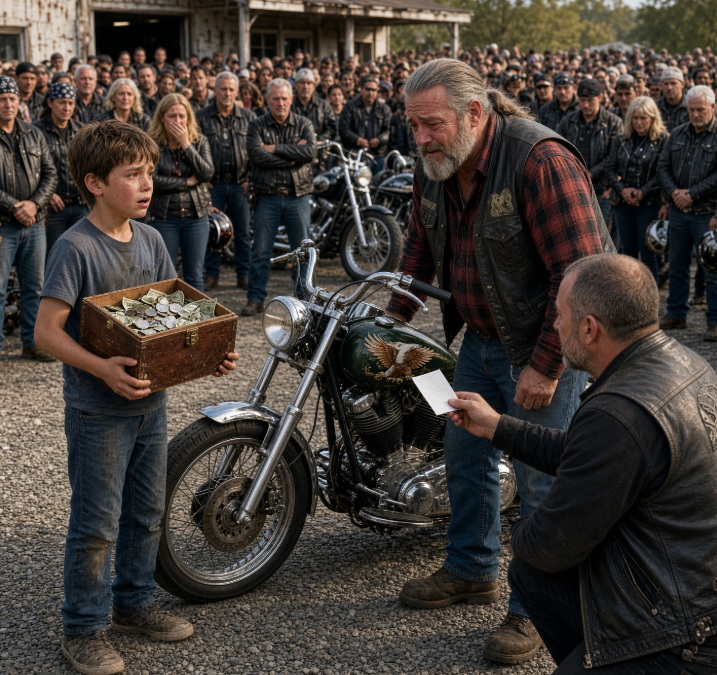
Seven hundred motorcycles filled the gravel lot and spilled onto the road in every direction.
Engines off.
Riders standing beside them in a wide, respectful crescent.
Men and women from clubs I had never heard of, wearing patches from towns I had never visited. Some had gray beards. Some had braids. Some wore veterans’ hats. Some held helmets against their hips.
All of them were looking at me.
I froze in the passenger seat.
My mother whispered, “Oh my God.”
Kevin stood in the center of the lot beside his motorcycle.
Only it was no longer broken.
The Harley gleamed.
The chrome had been polished.
The transmission repaired.
The faded eagle on the tank had been carefully touched up, but not repainted completely. Its age remained. Its scratches remained. Ray’s hand was still there.
The bike looked alive.
I opened the car door and stepped out with the cigar box clutched against my chest.
For a second, nobody moved.
Then the riders began tapping their fists softly against their hearts.
One after another.
A quiet thunder without engines.
Gary Whitfield came forward first.
He was broad-shouldered, silver-haired, and looked like someone who could settle an argument by raising one eyebrow.
He knelt slightly so his eyes met mine.
“William Carter.”
My mouth had gone dry.
“Yes, sir.”
“We heard what you did.”
I looked at the motorcycles, the riders, Kevin’s restored bike.
“I didn’t finish.”
Gary smiled.
“That’s why we’re here.”
He led me to the Harley.
On the handlebars, taped carefully so it would not damage the paint, was a folded check.
Not made out to Kevin.
Made out to me.
Two hundred nineteen dollars.
Exactly what the cigar box was still short.
Gary touched the handlebars.
“We didn’t want to take this away from you,” he said. “This was always going to be your victory. We just wanted to help you cross the finish line.”
I could not speak.
My mother started crying behind me.
Kevin stepped forward.
His eyes were wet too, and he did not bother hiding it.
“I told you that you didn’t have to finish,” he said.
I nodded.
“But you wanted to.”
I nodded again.
“So finish.”
I opened the cigar box.
My hands shook so badly that coins rattled against the wood.
One hundred eighty-one dollars.
Ones.
Fives.
Coins.
A year of lawns, dogs, cans, birthdays, movie nights, comic books, and candy bars.
I placed the cigar box on the motorcycle seat.
Gary added the check beside it.
“Paid in full,” he said.
The riders began clapping.
Not wild applause.
Not noise for noise’s sake.
Something slower.
Heavier.
Like respect.
Kevin put one hand on the gas tank, right over the eagle.
“My brother would have liked you,” he said.
His voice broke.
“He’d have said you ride with more heart than most grown men ever manage.”
Then he swung one leg over the bike.
The whole lot went still.
Kevin turned the key.
For one second, nothing.
Then the engine caught on the second try.
The sound rolled across the gravel like something coming back from the dead.
Kevin bowed his head over the handlebars.
Seven hundred riders stood silent while one grieving man cried on his brother’s motorcycle.
I looked at my mother.
Her face had changed.
Not because of the motorcycles.
Because of me.
Because she finally saw that the world being dangerous did not mean every stranger was danger, and that protecting me could not mean stopping me from becoming the kind of person she had raised me to be.
Later, she told me that was the moment the last thread of her fear loosened.
Not all fear.
Mothers keep some forever.
But the kind built from rumor.
The kind built from stories nobody checked.
That day, it let go.
The Iron Riders did not let the moment end with the motorcycle.
Gary announced that every year, on the second Saturday of May, the club and its extended network would hold something called the Allowance Ride.
A charity run to help families who could not afford basic repairs.
Cars.
Furnaces.
Wheelchair ramps.
Leaking roofs.
Broken water heaters.
Things that were not glamorous enough for big fundraisers but serious enough to break a family if no one helped.
The starting fund would include donations left over from the bike repair.
But at the center of it, Gary said, would be my cigar box.
Not the money.
The meaning.
“Every rider who joins this run needs to remember where it started,” Gary told the crowd. “Not with a corporation. Not with a rich donor. With an eleven-year-old boy giving up candy bars and birthday parties because somebody else’s loss mattered to him.”
I wanted to disappear.
I also wanted to remember every second.
Both feelings can live in the same chest.
The first Allowance Ride happened that day.
Not officially, maybe, but that was how everyone remembered it.
Kevin rode first.
Slowly.
Just once around the lot.
The restored Harley growled beneath him, deep and uneven and perfect. Riders stood as he passed. Some touched their hearts. Some raised two fingers. Christopher, who looked too large to cry safely, cried anyway.
When Kevin returned, he stopped in front of me.
“You want to sit on it?”
My mother made a sound.
Kevin glanced at her.
“Engine off.”
She narrowed her eyes.
“Kickstand down.”
“Yes, ma’am.”
“Both of you within arm’s reach.”
“Yes, ma’am.”
I sat on the Harley for thirty seconds.
It felt enormous beneath me.
Too heavy.
Too adult.
Too full of grief and gratitude and noise.
Kevin placed my hands on the handlebars.
“Careful,” he said. “Machines remember how they’re treated.”
“So do people,” my mother said quietly.
Kevin looked at her.
“Yes, ma’am,” he said. “They do.”
I did not become famous.
Not really.
A few local reporters covered the story. Someone took a photo of me standing beside Kevin’s motorcycle with the cigar box in my hands. My ears stuck out. My shirt was wrinkled. I looked overwhelmed because I was.
The story lived mostly in the memory of the people who were there.
That was better.
Famous stories get turned into slogans.
Remembered stories stay human.
The Iron Riders became part of our life after that.
Carefully at first.
My mother still had rules.
No clubhouse visits without her knowing.
No nighttime rides.
No getting on motorcycles.
No accepting food from Christopher unless she inspected it first, which offended him deeply because he had spent twenty years perfecting brisket.
But slowly, the Iron Riders stopped being “those men” and became names.
Kevin.
Gary.
Christopher.
Luis.
Annie.
Raymond.
Dale.
People with jobs, injuries, grandchildren, arguments, terrible jokes, and an alarming ability to organize community help faster than most churches.
Kevin’s bike stayed fixed.
He rode it every Sunday morning, weather permitting.
Not far.
Usually just out to the old river overlook and back.
Sometimes he took flowers to Ray’s grave.
Sometimes he stopped by our house afterward and sat on the porch while my mother drank coffee before her shift.
Their friendship surprised everyone except maybe me.
Grief recognizes grief.
So does responsibility.
My mother had carried too much alone.
Kevin had carried his brother’s memory like a weight no one could help hold.
Somewhere between porch coffee and motorcycle oil, they learned how to talk.
Not romance.
People always want to make things into romance.
This was better.
It was friendship built from respect.
The kind adults do not always know they need until someone sits beside them and says nothing for a while.
As for me, I kept the cigar box.
Gary offered to have a plaque made for it.
I said no.
It stayed plain.
Scratched.
Pencil words still faint on the lid.
NOTHING IMPORTANT.
That made everyone laugh because by then, of course, it had become very important.
Every year, before the Allowance Ride, I put money in it.
At first, dollars from allowance.
Then lawn money.
Then, when I was older, part of my paycheck from an auto parts store where Kevin helped me get a weekend job.
I never spent the leftover money on myself.
Not because I was noble.
Because I had learned something.
Some kindnesses are not meant to close.
They are meant to move.
The Allowance Ride grew.
The first year, it helped a single mother replace the alternator in the car she needed to get to work.
The second, it repaired a veteran’s roof before winter.
The third, it fixed a church van that transported seniors to medical appointments.
The fourth, it bought a water heater for a family with four kids who had been boiling water on the stove for baths.
Each time, Gary told the story.
Not too long.
Not too polished.
Just enough.
“Started with a boy and a cigar box,” he would say. “Don’t tell me small money can’t matter. Don’t tell me small people can’t move the world.”
I hated standing up when he said it.
But I stood.
Kevin always stood beside me.
Years later, when I was old enough to understand more than I had at eleven, I asked Kevin if he had known what my saving meant to him before the bike was fixed.
We were in the garage.
The Harley sat between us, older now, still beautiful, the eagle patch worn smooth under years of care.
Kevin took a long time answering.
“I knew it mattered,” he said.
“How?”
“Because you kept coming back.”
That was all.
But it was enough.
I think about that whenever people call kindness easy.
Sometimes it is not.
Sometimes kindness is boring and slow.
Sometimes it is five dollars a week.
Sometimes it is missing movies.
Sometimes it is walking old dogs in rain.
Sometimes it is being misunderstood by your mother, your best friend, and almost everyone else.
Sometimes it is continuing after the number doubles.
Sometimes it is letting other people help without feeling like they have stolen the meaning.
That may have been the hardest lesson.
Letting the riders contribute.
I wanted the victory to be clean.
Mine to give.
Kevin’s to receive.
But life is not usually that neat.
The bike was finished because I started.
And because my mother listened.
And because Kevin told the truth.
And because Gary understood the difference between charity and honor.
And because seven hundred riders decided a boy’s sacrifice should not be wasted.
I did not lose the meaning because others helped carry it.
The meaning grew.
That is what kindness does when you stop hiding it.
It gives other people permission to remember who they want to be.
When I look back now, I do not remember the crowd first.
I remember the first day.
Lebanon Pike.
Heat shimmering above the gravel.
A broken motorcycle.
A tired man staring at the engine like it had betrayed him.
And me, eleven years old, asking a question before I knew it would become a promise.
Something wrong with it?
That was all.
A small question.
A small boy.
A small beginning.
But the world often turns on things that look small at first.
A dollar in a jar.
A chore done after school.
A birthday party made smaller.
A mother willing to change her mind.
A biker willing to admit grief.
A clubhouse full of people the town had judged too quickly.
A cigar box hidden behind baseball cards.
Kevin used to say the bike sounded different after the rebuild.
I told him that was impossible.
Same engine.
Same frame.
Same eagle.
He shook his head.
“No,” he said. “Machines remember how they’re treated.”
Maybe he was right.
Maybe the Harley did sound different because now every mile carried more than Ray’s memory. It carried mine too. My mother’s. Gary’s. The seven hundred riders. Every family helped by the Allowance Ride. Every person who learned, even briefly, to look past leather and rumor and ask a better question.
People ask sometimes what I learned from that year.
I learned that grown men can be lonely.
That mothers can be scared and still brave enough to reconsider.
That fathers who leave do not get the final say in what kind of man a boy becomes.
That grief can live inside a motorcycle, a diner shift, a porch conversation, or a cigar box.
That judgment collapses fastest in the presence of proof.
And that kindness does not check a person’s leather vest before deciding whether they are worth trusting.
I also learned this:
You do not have to be rich to give something costly.
At eleven, I did not have much.
Five dollars a week.
A bent-kickstand bike.
A stubborn heart.
And an old cigar box.
But for nearly a year, I gave what I could.
One dollar at a time.
One choice at a time.
One quiet sacrifice at a time.
And when seven hundred motorcycles stood silent in that gravel lot, waiting for me, I finally understood that no act of love is ever truly private once it starts changing people.
It travels.
Through garages.
Through diners.
Through mothers.
Through riders.
Through families who need help years later and never know the name of the boy whose cigar box started it.
Kevin’s bike still runs.
The eagle is faded again now, because time keeps touching everything. But if you look closely, you can still see where the paint was restored, where Ray’s hand and the riders’ hands and my small impossible promise all met on the same tank.
And in my closet, all these years later, I still keep the cigar box.
Not hidden anymore.
Just waiting.
Because some kindnesses are meant to be carried forward.
And because every time I open it, I remember the sound of seven hundred riders standing silent while a broken motorcycle came back to life.
I remember Kevin crying.
My mother smiling through tears.
Gary kneeling to tell me it was still my victory.
And I remember the boy I was, counting thirty-four dollars on a bedroom floor, staring at a number that felt as far away as the moon, deciding anyway that distance could be closed.
One dollar.
One chore.
One promise.
One mile of kindness at a time.