An 11-Year-Old Boy Refused to Leave an Injured Biker Alone in a Freezing Storm—Weeks Later, the Sound of 600 Motorcycles Rolling Toward Him Left the Entire Street Speechless
PART3:
He could not read those from the fence.
Instead, he wrote what he could identify.
Harley. Black. Loud pipes. 3:42.
Blue sport bike. Too fast. 4:11.
Old red one. Sounded sick. 5:03.
His friends at school collected trading cards, baseball statistics, and video game achievements.
Benjamin collected engines.
Walter thought it was the strangest hobby he had ever seen in sixty-eight years of living in the mountains.
But he never told the boy to stop.
That mattered.
Adults were always telling children what not to become too interested in. Not too loud. Not too weird. Not too much.
Walter let Benjamin be too much about motorcycles.
Sometimes, when Diane worked late, Walter made grilled cheese sandwiches and sat beside him on the porch. He would point with one crooked finger toward the road and explain things Benjamin had already partly figured out.
“Listen there. Hear how that one downshifted too late?”
Benjamin would nod.
“Means he don’t know the curve.”
“Or he knows it and thinks he’s better than it.”
Walter would look over at him.
“That’s usually worse.”
Benjamin liked those evenings best.
The house smelled like coffee and old wood. Walter’s old dog, Mae, slept beneath the porch swing. Engines came and went beyond the trees, each one briefly entering their lives before disappearing down the mountain.
It made Benjamin feel like the world was always moving.
Even when his own life felt stuck between school, his mother’s shifts, and questions he did not ask about the father who never came back.
On the Tuesday that changed everything, Benjamin was sitting on the fence later than usual.
His math teacher had kept the class after the bell to finish a worksheet on long division. Benjamin hated long division. It felt less like math and more like being punished by numbers.
By the time he reached his grandfather’s house, the sky above the Blue Ridge had turned the color of a bruise.
Purple-gray clouds stacked behind Craggy Dome, swollen and heavy, the way they did before mountain thunderstorms that rolled through almost every October evening.
Walter had told him once that riders called that kind of sky a biker’s warning.
Beautiful enough to tempt you onto the road.
Dangerous enough to kill you if you did not respect it.
Benjamin should have gone inside.
His mother’s rule was firm.
Fence until 5:30.
Homework after.
No exceptions, especially not with a storm coming.
But he had counted only four motorcycles all afternoon, which was unusually quiet for a Tuesday. Some stubborn, curious part of him wanted to know whether a fifth would come before the rain did.
At 5:27, he heard it.
A single engine.
Deep.
Heavy.
A big touring bike.
The sound came from the direction of the parkway entrance, moving fast around the bend.
Too fast, Benjamin thought.
It was not a full sentence in his mind.
More like a warning bell.
He had watched enough traffic on that curve to know the rhythm of a safe approach. This rider carried speed like someone who either did not know the road or was thinking about something else.
Then Benjamin saw the deer.
It came out of the tree line on the inside of the curve exactly where Benjamin always said they crossed. A young doe, panicked and awkward, lunging sideways as engine noise caught her mid-run.
The rider swerved hard right.
For one suspended second, the whole scene seemed to hold still in Benjamin’s vision.
The motorcycle leaning at an angle no bike should hold.
The rear tire touching the wet leaves.
The rider’s shoulder dropping.
Then the world came apart into sound.
Metal screamed against asphalt.
The engine died mid-cry.
The bike slid toward the guardrail in a long, terrible shower of sparks.
Then impact.
Benjamin was off the fence and running before he made any decision to run at all.
Three hours earlier and forty miles east, Michael Hendricks had been sitting alone in a booth at a diner outside Marion, North Carolina, finishing a cup of coffee that had gone cold twenty minutes before he noticed.
Michael was fifty-three years old, broad through the shoulders, built like a man who had spent thirty years doing physical work and had only recently allowed some of that muscle to soften into the comfortable stoop of middle age.
His hands carried the map of his life.
Burns from engines.
Nicks from tools.
One crooked pinky that had been broken and reset badly on a job site in 1998.
He had worked as a diesel mechanic most of his adult life, the kind of work that got under fingernails, into knuckles, and eventually into the bones.
He belonged to the Highland Guardians Motorcycle Club, a group based out of Asheville that had become less of a club and more of a family for men and women who did not always have much family left.
They were not the kind of motorcycle club people saw in movies.
They did not deal in trouble.
They dealt in weekend rides through Tennessee, spring charity runs for the children’s hospital, toy drives in December, and every third Tuesday of the month, a diner meeting where twelve to twenty riders in leather vests talked about carburetors, grandchildren, bad knees, and gas prices with equal seriousness.
Michael had joined almost by accident.
Years earlier, his wife Karen had told him he needed something outside the garage.
“You talk to engines more than people,” she had said, handing him a cup of lemonade while he worked under the hood of a neighbor’s truck.
“Engines make more sense.”
“Then go find men who agree with you.”
She had been joking.
Mostly.
What Michael found instead was a brotherhood.
An unspoken understanding among people who rarely discussed pain directly but somehow always knew when a member was struggling.
When Karen got sick, three Highland Guardians showed up at the hospital without being asked.
They took turns sitting in the waiting room so Michael never had to hear an update from her doctors alone.
When she died, forty motorcycles rode in formation behind the hearse through downtown Asheville.
Michael had not cried at the funeral.
Not during the service.
Not during the burial.
But when the engines started behind Karen’s hearse, low and steady and reverent, he had nearly fallen apart.
That was when he understood what older riders meant when they called the road a brotherhood.
Not because it was romantic.
Because it meant someone rode behind you when you could not hold yourself upright.
Karen had been gone six years now.
Their only son, Tyler, lived in Denver and called on Sundays out of duty rather than desire. Michael did not resent him for it. Not anymore. He understood in the quiet way grief eventually teaches you things you did not want to learn.
Tyler had built a life far from the mountains because staying close to his mother’s memory had become unbearable.
Michael had stayed close on purpose.
He kept the house.
Kept the garage.
Kept Karen’s coffee mugs.
Kept the club.
The Highland Guardians were the only place left where people still said his name like it meant something.
That Tuesday’s meeting had run long because Daryl Whitfield, the club’s oldest member at seventy-one, had announced he was finally hanging up his riding boots for good.
No one wanted to let the moment pass without stories.
And Daryl had stories.
A ride to Sturgis in 1979 involving a flat tire, a stolen goat, and one night in a South Dakota jail cell that he still refused to fully explain.
Michael had laughed harder that afternoon than he had in months.
By the time he climbed onto his deep green 2015 Harley-Davidson Road King, the storm clouds were already gathering over the ridge line.
Any sensible rider would have taken the interstate.
Four lanes.
Flat.
Boring.
Forgiving.
But Michael had never been able to resist the parkway route through Craggy Gardens, especially in October, when the leaves turned the mountainside into something that looked less like North Carolina and more like a memory of a better world.
He told himself he would beat the rain.
He almost always did.
The first twenty minutes were everything Michael loved about riding.
The cool mountain air sharpening against his face.
The long curves.
The quiet inside the helmet, where a person could think about nothing and everything at once.
He thought about Karen.
He thought about Daryl’s stolen goat.
He thought, briefly and without much sting anymore, about how strange it was that a man could build a whole life, lose half of it, and somehow keep riding.
He did not think about the deer until it was already in front of him.
Michael had ridden thirty-one years without a serious accident.
He was proud of that in the quiet way riders are proud of things they know are partly skill and partly luck.
His instincts took over the moment the doe broke from the trees.
Swerve.
Do not grab the brake too hard.
Lean away from the animal, not into it.
He executed the maneuver almost perfectly.
What he could not account for was the carpet of wet leaves hidden beneath a thin sheen of rainwater exactly where his rear tire needed traction most.
The back end of the Road King stepped out from under him with a suddenness that felt, in the strange slow-motion honesty of danger, almost gentle.
Then it was not gentle at all.
Michael felt the bike go.
Felt his body separate from four hundred pounds of falling steel.
Felt asphalt strike his shoulder, hip, ribs, and helmet in a rapid, disorienting sequence he would only reconstruct properly weeks later.
The world tumbled.
Metal screamed.
Then there was nothing but the sound of rain beginning to fall and his own ragged breath filling the inside of a helmet that had likely just saved his life.
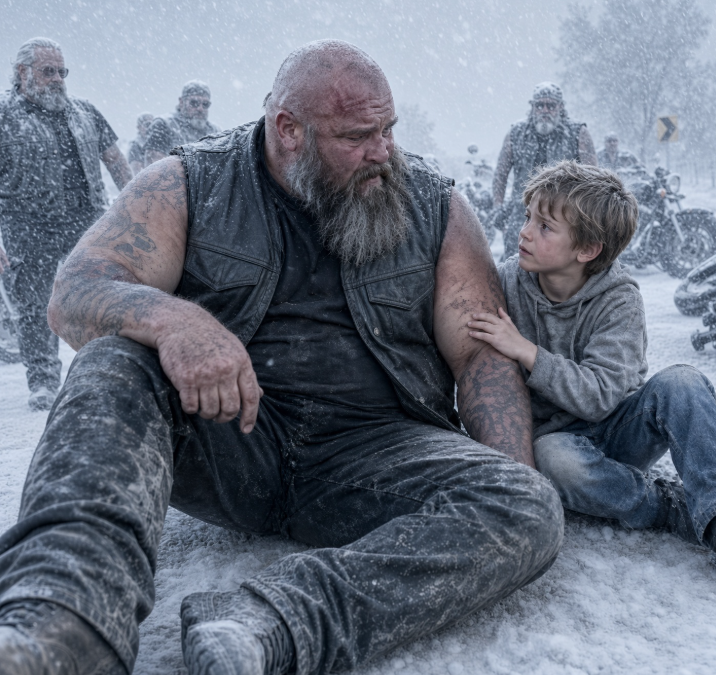
Michael Hendricks lay on the shoulder of Beaver Dam Road, his left leg bent at an angle that told him with total clarity it was broken.
And with the particular loneliness of an injured man on an empty road, he understood that he had no idea whether anyone had seen him fall.
Benjamin reached the guardrail in under a minute.
It felt like no time at all.
It felt like an entire lifetime.
He had never run that fast in his life, not even during the mile they made students run every spring at school. His lungs burned, but he did not have room to notice.
The motorcycle lay on its side twenty feet past the bent guardrail, one wheel still spinning slowly, ticking as hot metal cooled beneath rain.
The rider was on the ground near the tree line.
A big man.
Gray stubble visible beneath the helmet.
Green and black leather vest.
Patches Benjamin did not recognize.
Unmoving except for the rise and fall of his chest.
“Hey,” Benjamin said, voice cracking as he dropped to his knees in the wet grass. “Hey, mister. Can you hear me?”
The man’s eyes opened slowly behind a cracked visor.
“I hear you,” he managed.
His voice was thick with pain.
“Leg’s broken. Don’t… don’t move me.”
“I won’t,” Benjamin said quickly. “I know. My grandfather says you’re not supposed to move somebody after a crash.”
He fumbled his phone from his backpack. His hands shook so badly he had to try twice before his fingers found the right buttons.
The dispatcher’s voice was calm in a way Benjamin found almost unbearable.
“What is your location?”
“Beaver Dam Road,” he said. “Near the curve by the old guardrail. Close to my grandfather’s house.”
“Is the injured person conscious?”
“Yes. He’s talking.”
“Is he bleeding?”
Benjamin looked down.
Rain made everything shiny.
“I don’t know. Maybe. His leg looks wrong.”
“Do not move him. Help is on the way.”
Thunder rolled behind Craggy Dome.
The first fat drops of rain became a steady sheet.
Benjamin hung up only after the dispatcher told him other adults had called too and help was coming.
He crawled closer to Michael.
“They’re coming. But it’s going to take a while. We’re kind of far from town.”
“Figured as much,” Michael muttered.
Even through the pain, Benjamin heard something like dry humor in it.
“What’s your name?” Benjamin asked.
“Michael.”
“I’m Benjamin.”
“You live around here, Benjamin?”
“Right up there.” He pointed toward the fence line, barely visible through rain. “I was watching the road. I saw you come around the curve.”
Michael’s eyes closed briefly.
For one terrible second, Benjamin thought he had lost consciousness.
Then they opened again.
“Doe came out of nowhere.”
“I know. I’ve seen deer cross right there a hundred times. Nobody ever believes me when I tell them it’s dangerous.”
Rain came harder now.
Cold.
Relentless.
It plastered Benjamin’s hair to his forehead and soaked through his school jacket within minutes.
Without thinking, he shrugged off the jacket and draped it over Michael’s chest, tucking it as best he could around the older man’s shoulders.
“You don’t have to do that, kid.”
“You’re hurt.”
“You’ll get cold faster than me.”
“I’m okay.”
This was not true.
Benjamin was already shaking.
But some lies are useful when they keep fear from entering the room.
Or the roadside.
A truck slowed above them. A man in a fluorescent work vest climbed down the embankment, radio crackling at his hip.
“I called it in too,” he said, kneeling on Michael’s other side. “Ambulance is coming from Weaverville. Might be fifteen, twenty minutes with this rain.”
“Twenty minutes,” Michael repeated.
Something in his face tightened.
“I’m not going anywhere,” Benjamin said.
The certainty in his own voice surprised him.
The construction worker’s name was Roy Ferris. He gently suggested that Benjamin head back up to the road, get out of the rain, and let the grown men handle things.
Benjamin shook his head.
“He needs someone to keep talking to him. Keep him awake. That’s what you’re supposed to do.”
He was not entirely sure where he had learned that.
Maybe a first-aid unit at school.
Maybe medical dramas his mother watched on rare nights off.
Maybe from the instinct children sometimes have before adults teach them to doubt it.
But it felt true.
More than true.
Necessary.
Roy exchanged a glance with an older woman named Patricia Doyle, who had stopped behind his truck and brought a blanket from her trunk.
Nobody argued with Benjamin after that.
There was something about the set of his jaw, kneeling in the freezing rain with his small hand wrapped around a stranger’s, that made grown adults quietly step back and let him keep doing what he was doing.
For the better part of twenty minutes, Benjamin talked.
He talked about the fence.
The curve.
The motorcycles he counted after school.
His grandfather’s old club, the Blue Ridge Road Brothers.
The photograph on the mantel.
He asked Michael questions to keep him answering.
“What club are you with?”
“Highland Guardians.”
“How long have you ridden?”
“Thirty-one years.”
“Do you have kids?”
“One son.”
“What color is your bike?”
“Green.”
“Why green?”
Michael’s eyes fluttered.
His words began to blur.
Real fear moved through Benjamin’s chest for the first time.
“Hey,” Benjamin said sharply, gripping his hand tighter. “Stay with me. Tell me about your bike. Why green?”
Michael swallowed.
“Wife picked it.”
“Why?”
“Said it matched my eyes.”
“That’s a good color,” Benjamin said, though he could barely see Michael’s eyes through the rain and visor.
He kept talking.
Kept squeezing.
Kept refusing, in the small fierce way only a child fully committed to a decision can refuse to let silence win.
When the ambulance finally arrived, its lights washed red and white across the wet road.
One of the paramedics had to gently pry Benjamin’s fingers loose from Michael’s hand.
“You did good, son,” the paramedic told him. “Real good. You probably helped keep him conscious and calm, which matters more than people think.”
Benjamin stood in the rain, soaked through, shaking from cold and adrenaline.
They lifted Michael onto a stretcher.
As they carried him toward the ambulance, Michael turned his head as much as he could and found Benjamin’s eyes.
“Thank you,” he said. “I mean it. Thank you.”
Benjamin did not know what to say back.
So he nodded.
He stood there on the shoulder of Beaver Dam Road until the ambulance doors closed.
Then his mother’s car came skidding to a stop beside him.
Diane Carter got out so fast she nearly slipped.
“Benjamin!”
Her face was white with a fear that had nothing to do with the storm.
He turned toward her.
Only then did he begin to cry.
Michael Hendricks spent six days at Mission Hospital with a fractured femur, three broken ribs, a badly bruised shoulder, and a mild concussion the doctors watched carefully for the first forty-eight hours.
He drifted in and out of a fog of pain medication for most of the first two days, but one memory stayed sharp and constant beneath the haze.
A boy’s voice.
Steady.
Stubborn.
Refusing to let him go quiet.
On the third day, clearer-headed and restless, Michael asked a nurse whether anyone knew what had happened to the boy who had stayed with him on the road.
It was Diane Carter, as it turned out, who worked the evening shift on that very floor.
She overheard the question from the doorway.
“That was my son,” she said.
Michael looked at her.
“Benjamin.”
His eyes filled with something close to disbelief.
“Your son saved my life.”
Diane gave a tired, proud smile.
“He wouldn’t stop talking about you for three days. Wanted to know if you were okay.”
Michael looked toward the window.
Outside, the sky over Asheville was clear now, as if the storm had never happened.
“Tell him I’m okay.”
“I did.”
“Tell him again.”
That evening, when her shift ended, Diane brought Benjamin to room 412.
He stood in the doorway for a moment, oddly shy in a way he had not been kneeling in the rain.
Michael waved him in with the one arm that was not wrapped or bruised.
“There he is,” Michael said. “The kid who wouldn’t let a grown man quit on himself.”
Benjamin’s face turned red.
“I just talked.”
“No,” Michael said. “You stayed.”
For a while, neither of them said anything important.
They talked about the motorcycle, which had been towed to a shop in town.
They talked about the deer.
The curve.
School.
Benjamin’s grandfather.
But something had shifted between them that had little to do with words.
Michael Hendricks, a man who had spent six years since his wife’s death gradually shrinking his world down to a club, a garage, and a house too quiet for comfort, found himself looking at an eleven-year-old boy and feeling, for the first time in a long while, something close to hope.
Diane noticed.
So did Benjamin.
Kids always notice more than adults think.
Word of what happened moved through the Highland Guardians the way important news always moved through the club: fast, loud, and through Daryl Whitfield first.
Daryl called Michael’s hospital room the moment he heard.
By the time that call ended, half the club knew a local kid had knelt in a thunderstorm and refused to leave one of their own.
“You should’ve seen him,” Michael said, voice rough. “Eleven years old. Didn’t budge for twenty minutes.”
Daryl was quiet on the other end.
“You know what that is, right?”
“What?”
“That’s a road brother, Mike.”
Michael laughed weakly.
“He’s a child.”
“Doesn’t matter. Kid’s got the heart for it.”
The idea took hold among the Highland Guardians the way ideas take hold among people who believe gestures matter more than speeches.
At first, it was small.
A few members wanted to visit Benjamin and thank him personally. Maybe bring him a patch as a keepsake. Maybe invite him and his mother to the spring charity run.
Then the story spread.
From the Highland Guardians to the Smoky Mountain Riders.
Then to the Foothills Freedom Association.
Then to smaller clubs across western North Carolina.
Then Tennessee.
Then South Carolina.
Then Virginia.
Riders who had never met Michael heard about the boy in the rain and said the same thing in different words.
We should show up.
Two weeks after the accident, Daryl sat in a folding chair beside Michael’s hospital bed.
Michael’s leg was still in a heavy cast, and physical therapy had begun using words like difficult but promising.
Daryl folded his hands over his stomach.
“We want to bring you home.”
Michael frowned.
“Diane’s got the discharge plan worked out.”
“Not like that.”
“What are you talking about?”
“When you’re discharged, we escort you home.”
Michael stared at him.
“A couple of you?”
Daryl smiled.
“No.”
“Daryl.”
“Every club that’ll come.”
Michael’s throat tightened.
“That’s too much.”
“No, it isn’t.”
“For me?”
Daryl leaned forward.
“Not just for you.”
Michael looked away.
“He’s eleven.”
“And?”
“He didn’t do it for attention.”
“That’s exactly why it matters.”
Michael was quiet.
Daryl’s voice softened.
“We escort you and the boy. So he knows what it means when somebody says a whole community has your back.”
“Six hundred people don’t just show up for a stranger.”
“They’re not showing up for a stranger,” Daryl said. “They’re showing up for a kid who reminded every single one of us why we ride together in the first place.”
The planning took nearly three weeks.
It was coordinated mostly through phone calls, group texts, and a shared spreadsheet that Daryl’s daughter managed because Daryl referred to everything involving computers as “the devil’s filing cabinet.”
Clubs from Knoxville, Greenville, Johnson City, and Roanoke confirmed.
A local radio station picked up the story after a Highland Guardian mentioned it during a charity interview.
Within days, calls came from riders who had no connection to Michael, Benjamin, or Asheville at all.
They simply wanted to be part of something that felt, in a world that often rewarded indifference, like decency being recognized in public.
Michael found the growing scale almost embarrassing.
“It’s getting bigger than I ever meant it to be,” he told Daryl.
“That’s not up to you anymore,” Daryl said, not unkindly. “Some things stop belonging to the person they started with. This one belongs to the boy now.”
Daryl called Diane himself.
Careful.
Respectful.
He asked permission before anything was announced publicly.
Diane sat Benjamin down at the kitchen table that evening, the same table where he did homework most days, and explained what the Highland Guardians and neighboring clubs wanted to do.
Benjamin, for once in his life, had nothing to say.
“They want to do this because of you,” Diane said gently. “Because you didn’t leave that man alone on the road.”
Benjamin looked down at his hands.
The same hands that had held Michael’s through the storm.
“I just did what Grandpa always says you’re supposed to do.”
“What’s that?”
“Stay with someone who needs you.”
Diane reached across the table and took his hand.
“That’s exactly why they’re coming.”
The morning Michael was discharged from Mission Hospital broke clear and cold over the Blue Ridge.
The kind of crisp October sky that seemed almost designed for the occasion.
Benjamin had barely slept the night before.
He had lain awake listening for the first distant rumble of engines the way he used to listen for single motorcycles passing his grandfather’s fence.
He heard it long before it arrived.
Not the hum of one engine.
A sound that built and rolled and grew until it seemed to come from the mountains themselves.
A low, continuous thunder that had nothing to do with weather.
By the time Benjamin, Diane, and Walter Carter reached the hospital’s front circle, the street beyond it was filling with motorcycles as far as the eye could see.
Green and black Highland Guardians vests mixed with colors from a dozen other clubs.
Riders from Tennessee.
South Carolina.
Virginia.
Local riders.
Old riders.
Young riders.
Men and women who had traveled because they heard about a boy in the rain and decided a story like that deserved witnesses.
Daryl Whitfield, out of retirement for one final ride, stood beside Michael’s wheelchair near the hospital entrance, grinning like a man half his age.
“Told you they’d come,” he said.
Michael, freshly discharged, leg propped in a heavy cast, could not speak for a moment.
Six hundred riders filled Biltmore Avenue and beyond, engines idling in a low chorus Benjamin felt in his chest more than he heard with his ears.
When Benjamin appeared at the top of the entrance ramp beside his mother, a hush moved through the crowd.
It spread outward like a ripple.
Then, one by one, men and women who had never met him began to applaud.
Not polite applause.
Not the careful clapping adults use at school assemblies.
This was louder.
Rougher.
Gloved hands.
Boots shifting.
Engines revving.
A roar built around him until Benjamin could barely breathe.
He had spent three years watching motorcycles pass his grandfather’s fence as though they belonged to a world he could only observe from a distance.
Now that world had stopped for him.
Daryl waved him forward.
Benjamin walked down the ramp slowly, overwhelmed, until he reached Michael’s wheelchair.
“These are all for you too, you know,” Michael said, voice thick. “Every single one of them.”
“I didn’t do anything special,” Benjamin said.
The same thing he had told his mother.
The same thing he would say for years afterward because children who do brave things often believe bravery should feel more dramatic than it does.
Daryl crouched to Benjamin’s eye level. His knees cracked loudly enough that Michael laughed.
“Son,” Daryl said, “let me tell you something it took most of us thirty, forty years of riding to understand. It’s not the miles that make you part of something. It’s showing up when somebody needs you and not leaving until the job’s done.”
Benjamin swallowed.
“You did that in a thunderstorm, on your own, at eleven years old, for a stranger. Every rider here has spent a lifetime trying to live up to that idea. You just went ahead and did it.”
He reached into his vest and produced a small leather patch.
The Highland Guardians crest.
Beneath it, on a smaller banner made especially for that day, were three words:
Honorary Road Brother.
“This isn’t official until you’re eighteen and can actually ride,” Daryl said, pressing it into Benjamin’s hands. “But as far as every person on this street is concerned, you already earned your place.”
Benjamin held the patch carefully.
Like something alive.
The procession took nearly two hours to travel a route that normally took twenty minutes.
It moved slowly and deliberately from the hospital through downtown Asheville and out toward Beaver Dam Road.
Police guided intersections.
People came out of shops, houses, and restaurants to watch.
Some held phones.
Some waved.
Some simply stood with their hands over their hearts because the sound of six hundred motorcycles moving together at a respectful pace does something to the air around it.
Benjamin rode the final stretch in the passenger seat of Daryl’s pickup truck, directly behind the van carrying Michael home.
In the side mirror, motorcycles stretched back farther than he could see.
What mattered to Benjamin was not the size.
Not really.
What mattered was that every engine in that procession existed because a group of strangers had decided that loyalty once shown deserved to be answered.
When they passed the curve on Beaver Dam Road, the whole procession slowed.
No one told them to.
They simply did.
Benjamin looked out the window at the bent guardrail.
The wet leaves had dried.
The rain was gone.
But he could still see it.
Michael on the ground.
His own jacket over the man’s chest.
His fingers locked around a stranger’s hand.
For a moment, Benjamin felt cold again.
Then the motorcycles behind him rumbled softly, not loud enough to frighten, just enough to remind him he was not standing there alone anymore.
When they reached Michael’s driveway, the riders parked in careful rows along both sides of the street. Engines fell silent one by one until the only sound left was wind moving through the trees and the distant familiar hum of Beaver Dam Road.
Michael was helped from the van into a chair set up on his front porch.
Benjamin stood beside him.
Diane stood near Walter.
Walter’s eyes stayed on the motorcycles. His face had the faraway look of a man seeing every year of his youth arrive at once.
Daryl called for quiet.
“Michael Hendricks has been part of this club for fifteen years,” he announced. “And in all that time, I don’t think any of us truly understood what it meant to be part of something bigger than ourselves quite as clearly as we do today, because of an eleven-year-old boy who had never sat on a motorcycle before that Tuesday.”
He turned to Benjamin.
“Anything you want to say, son?”
Benjamin looked out at six hundred riders standing in yards, driveways, and along the quiet street he had known all his life.
All of them waiting patiently.
For him.
He thought about the photograph on his grandfather’s mantel.
The Blue Ridge Road Brothers outside the diner in 1987.
He thought about the sound of engines rounding the bend on Beaver Dam Road, a sound he had once believed meant nothing more than someone passing through.
“I always thought bikers were just people passing by,” he said.
His voice carried farther than he expected in the quiet.
“I didn’t know you were all looking out for each other this whole time.”
A few riders nodded.
Benjamin looked at Michael.
“I guess now I know.”
Michael reached over from his chair and rested a hand on Benjamin’s shoulder.
The same shoulder the boy had once used to shield him from rain with a jacket too thin to matter and a will too strong to break.
“You’re one of us now, Ben,” Michael said quietly. “Wherever the road takes you.”
Benjamin Carter went home that evening to his grandfather’s house.
Walter was waiting on the porch, seated in his old rocking chair. He had watched the entire procession pass by, both hands resting on his cane, eyes wet in a way Benjamin pretended not to notice because he loved him.
Walter did not say much.
He rarely did when things mattered most.
Instead, he handed Benjamin a folded photograph.
The same one that had sat on the mantel for as long as Benjamin could remember.
The Blue Ridge Road Brothers.
Outside a diner.
“You keep this now,” Walter said.
Benjamin held it carefully.
“But it’s yours.”
Walter shook his head.
“Now you understand what it means.”
Benjamin looked at the photo.
All those men.
All that road behind them.
All that road ahead.
Then he looked back down Beaver Dam Road toward the curve where a stranger had fallen and a boy had decided, without fully knowing why, that some people are worth staying for.
For weeks afterward, people called him a hero.
Teachers.
Neighbors.
Reporters.
Riders.
Even strangers at the grocery store.
Benjamin did not like the word.
It felt too big.
Too shiny.
Too far away from what had actually happened.
He had been scared.
He had been cold.
He had not known whether Michael would live.
He had only known that leaving felt wrong.
Years later, that would become the lesson he carried.
Not that courage meant feeling brave.
Not that good people always knew what to do.
But that sometimes the most important thing a person can offer is not expertise, money, strength, or age.
Sometimes it is presence.
A hand.
A voice.
A stubborn refusal to walk away.
Michael came to Walter’s house for dinner two months after the accident, still on crutches, still moving carefully. Diane made pot roast. Walter made cornbread. Benjamin pretended not to care when Michael gave him a small model motorcycle painted the same deep green as the Road King.
“I can’t give you the real one,” Michael said. “Your mother would kill me.”
“She would,” Diane said from the kitchen.
Michael laughed.
Benjamin placed the model on the mantel beside the Blue Ridge Road Brothers photograph.
It stayed there for years.
Michael’s real motorcycle took longer to repair than his leg did.
When he finally rode again, months later, he did not take the curve fast.
He slowed before it.
Always.
Every time.
And whenever he passed Walter Carter’s fence, he lifted one hand.
Sometimes Benjamin was there.
Sometimes not.
But the wave was always given.
A promise kept to the road.
The Highland Guardians never forgot him.
On his twelfth birthday, they sent a card signed by more than eighty riders.
On his sixteenth, Daryl taught him how to change oil on a motorcycle that did not yet belong to him.
On his eighteenth, Diane stood on the driveway trying not to cry while Benjamin completed his motorcycle safety course, Walter watching from a folding chair with a grin he did not bother hiding.
Michael was there too.
Leaning against the green Road King.
Older.
Limp still visible if you knew where to look.
Alive.
That was what Benjamin saw every time.
Not the accident.
The alive part.
When Benjamin finally got his own motorcycle, he rode slowly past the curve on Beaver Dam Road.
He stopped near the guardrail.
Not the exact bent section. The county had replaced it after Michael’s crash.
Still, he knew the place.
He parked, took off his helmet, and stood there listening.
The road was quiet.
No thunder.
No rain.
No metal.
Only wind in the trees and the distant hum of an engine somewhere higher on the mountain.
He thought of his eleven-year-old self kneeling in wet grass, cold hand wrapped around a stranger’s.
He thought of Michael whispering about a green bike his wife had loved.
He thought of six hundred riders filling the street because they believed staying mattered.
Then he took the patch from his jacket pocket.
Honorary Road Brother.
He had kept it all those years.
Daryl had told him, back then, it would not be official until he was eighteen.
Benjamin smiled.
Then he tucked the patch back inside his jacket and rode home.
Not fast.
Never through that curve.
He had learned early that the road gives freedom, but it does not forgive arrogance.
That evening, Walter Carter sat on the porch, older now, thinner, his knees worse, but his eyes still sharp enough to spot a bike by sound.
Benjamin pulled into the driveway.
Walter looked at the motorcycle.
Then at his grandson.
“Good ride?”
Benjamin took off his helmet.
“Good ride.”
Walter nodded toward Beaver Dam Road.
“You understand the picture?”
Benjamin looked through the living-room window.
On the mantel sat the old photograph from 1987, the model motorcycle Michael had given him, and a newer photo Diane had framed from the hospital escort.
Six hundred riders.
A boy in the middle.
Michael in his chair.
Engines everywhere.
“Yeah,” Benjamin said. “I think I do.”
Walter smiled.
“Took you long enough.”
Benjamin laughed.
The sound drifted down the porch steps and out toward the road.
Years later, people in Buncombe County would still talk about the day six hundred motorcycles escorted a boy and an injured biker home.
Some remembered the noise.
Some remembered the size of the procession.
Some remembered the way traffic stopped through Asheville and people came out of restaurants to watch.
But Benjamin remembered other things.
Rainwater running down his face.
Michael’s hand tightening around his.
The way adults stopped arguing once they realized he was not going anywhere.
The sound of engines going quiet in Michael’s driveway.
His grandfather handing him the old photograph.
Diane holding him so tightly after the ambulance left that he could barely breathe.
And the sentence that stayed with him longer than the applause, longer than the patch, longer than the roar of six hundred engines.
Stay with someone who needs you.
That was all he had done.
That was everything.
Because the world often teaches people to pass by.
To assume someone else will stop.
To believe that being small means being useless.
That fear is a good enough reason to leave.
Benjamin learned differently on Beaver Dam Road.
He learned that a boy could kneel in the rain and become the thing that kept a grown man conscious.
He learned that a stranger’s life could depend on a voice refusing to go quiet.
He learned that community was not just people who knew your name.
Sometimes community was people who heard what you did when no one expected anything from you and decided to answer with everything they had.
And Michael learned something too.
For six years after Karen died, he had thought the road was the only place where grief loosened its grip.
Then an eleven-year-old boy held his hand in a thunderstorm and refused to let him drift away.
After that, Michael stopped pretending he was fine simply because he could still ride.
He called Tyler more often.
Not just Sundays.
Not only out of habit.
Real calls.
Messy calls.
He let the Highland Guardians into the house more.
Let Daryl show up with soup he claimed his daughter made.
Let the younger riders help repair the garage roof.
Let Benjamin visit sometimes after school to hear stories, ask questions, and sit beside the green Road King like it was a museum exhibit.
Life did not become simple.
Michael’s leg hurt in the cold.
His ribs healed but ached when rain came in.
He missed Karen every morning.
But the house no longer felt like a place he was quietly disappearing inside.
There were voices again.
Engines.
Visitors.
An eleven-year-old boy who grew taller every time Michael saw him and never stopped asking questions.
Maybe that was the final gift.
Not the rescue.
Not the escort.
Not even the patch.
The road connected two lonely people who might otherwise have stayed separate.
A widower who thought his best years were behind him.
A boy who watched motorcycles because he wanted to believe someone was always moving toward something.
On that Tuesday, they moved toward each other.
One by accident.
One by choice.
And because a child refused to leave, neither of them was ever quite alone on the road again.
So when people tell the story now, they usually start with the biggest part.
Six hundred riders.
Engines like thunder.
A boy applauded by strangers.
A patch pressed into his hands.
That is a good story.
But it is not where the meaning lives.
The meaning lives on wet asphalt.
In the first cold minutes after the crash.
Before the crowd.
Before the headlines.
Before anyone knew Michael’s club existed.
Before anyone knew Benjamin’s name.
Just a fallen man fighting to stay conscious and a boy too stubborn to let go.
That is where everything began.
With one hand holding another.
With rain falling hard enough to blur the world.
With an eleven-year-old boy saying, again and again:
“Stay with me. Help is coming. I’m not leaving.”
And he didn’t.
Not until the lights came.
Not until the stretcher arrived.
Not until another set of hands took over.
That is why the riders came.
Not because Benjamin was fearless.
He was not.
Not because he knew exactly what to do.
He did not.
They came because he stayed.
And sometimes staying is the bravest thing a person can do.
The last engine faded from Beaver Dam Road long after sunset that day, but Benjamin remained on the porch, the honorary patch in one hand and his grandfather’s photograph in the other.
Walter watched him from the doorway.
“You waiting for something?” he asked.
Benjamin looked toward the curve.
The road was empty.
For once, that did not make it feel lonely.
“No,” he said.
Then, after a moment, he smiled.
“Maybe.”
Walter chuckled and went inside.
Benjamin stayed a little longer.
Listening.
Watching.
Waiting the way he always had for whatever came around the bend next.
Only now he knew something he had not known before.
Every engine had a person behind it.
Every person had a story.
And sometimes, when the road broke someone open, the only thing that mattered was who stopped.
Who knelt.
Who reached out.
Who stayed.
That was the day Benjamin Carter became part of the road.
Not because he rode.
Because he refused to leave someone behind.