An 11-Year-Old Boy Left His Backpack on My School Bus—When I Opened It, I Found the Secret He Had Been Carrying All Year
An 11-Year-Old Boy Left His Backpack on My School Bus—When I Opened It, I Found the Secret He Had Been Carrying All Year.
On the last day of school, an eleven-year-old boy left his backpack on my bus, and when I opened it to find his name, I discovered there were no textbooks, notebooks, pencils, or homework inside—only cat food, a bottle of water, and a manual can opener.
His teacher told me his grades had fallen badly during the second semester and that he disappeared behind the athletic building every recess, but nobody at the school knew what he was doing there or why he always came back with dirty knees.
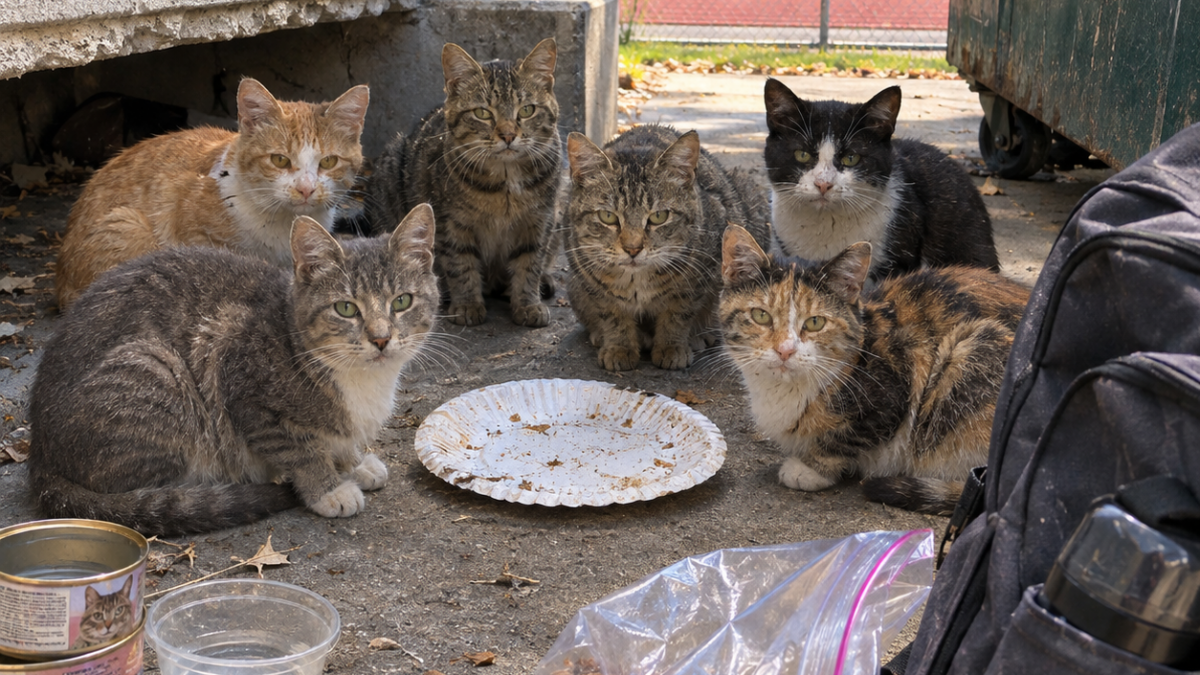
Then I returned to the empty campus on Saturday and found six stray cats sitting behind the dumpsters around a clean paper plate—and realized the quiet boy on my route had been carrying a secret every single day that was costing him more than anyone understood.
I have driven a school bus for nine years.
Same district.
Same rural roads.
Same subdivisions spreading farther into old cornfields every year.
Same elementary and middle school campus just outside a small Ohio town where people still wave when a bus passes, even if they have no child on it.
There are easier jobs.
There are harder jobs.
Mine begins early.
Very early.
My alarm goes off at 4:45 every weekday morning during the school year.
By 5:25 I am at the transportation lot with coffee in a travel mug and a clipboard tucked under one arm.
Pre-trip inspection.
Lights.
Tires.
Mirrors.
Emergency door.
Brake pressure.
Seats.
Everything that must work before forty children begin trusting you without realizing they are trusting you.
By 6:10 I am moving.
After nine years, the route lives inside me.
Left at County Road 8.
Right at the white farmhouse.
Stop near the old grain elevator.
Three children at Maple Lane.
Two at Briarwood.
One boy whose grandmother waits at the end of the driveway every morning in a robe no matter how cold it is.
Children think bus drivers only know whether they are sitting down.
We know much more than that.
We know who gets on sleepy.
Who gets on angry.
Who has breakfast.
Who does not.
Who is dropped off by a parent.
Who walks out of an empty house and locks the door behind them.
Who talks so loudly the entire bus knows their weekend.
Who says almost nothing from September to June.
You learn patterns.
Children are patterns before they are explanations.
There was one boy on my route named Caleb.
I am not using his real name.
His mother asked me not to.
I will respect that.
He was eleven that year.
Fifth grade.
Thin.
Brown hair that was always a little too long over his forehead.
Usually wore hoodies even when the weather was warm.
Not unfriendly.
Just quiet.
There is a difference.
PART2:
If I said, “Morning, Caleb,” he would answer.
“Morning.”
If I asked how he was, he would say:
“Good.”
If another child needed to squeeze past him, he moved.
If someone dropped a pencil, he picked it up.
He was never in trouble on my bus.
Never yelled.
Never fought.
Never threw anything.
Never made me stop the vehicle and turn around with the look every school-bus driver develops after enough years.
What I noticed about Caleb was his backpack.
Every morning he carried it on his lap.
Every afternoon too.
Most kids treat backpacks like objects they are actively trying to destroy.
They throw them.
Kick them under seats.
Use them as pillows.
Drag them by one strap.
Leave them on the aisle until somebody trips.
Caleb never did.
PART3:
He held his against his chest.
Sometimes both arms around it.
Never placed it on the floor.
Never shoved it beside him.
Never put it overhead.
Always on his knees.
I assumed there was something breakable inside.
A tablet.
A laptop.
Maybe a project.
Months went by.
The backpack remained on his lap.
Every day.
September.
October.
November.
Winter.
Spring.
It became one of those details your brain records without asking why.
Caleb sits row seven, passenger side.
Caleb gets off at the third house after the church.
Caleb carries his backpack on his lap.
Simple.
Ordinary.
The last day of school came in early June.
That day is chaos on a bus.
Always.
Children who spend ten months pretending school is a prison suddenly become emotional about leaving.
Everybody is louder.
Teachers hand out things that do not fit in backpacks.
Poster boards.
Folders.
Plastic bags full of desk contents.
Half-used notebooks.
Broken crayons.
Awards.
Children sign yearbooks while the bus is moving even though I tell them not to.
Somebody always cries.
Somebody always sings.
Somebody forgets something.
That year, it was Caleb.
I finished the afternoon route around 3:48.
Returned to the transportation lot.
Parked.
Then did the mandatory post-trip inspection.
Every seat.
Every row.
We check for sleeping children.
Left objects.
Damage.
Anything unusual.
Row seven.
Passenger side.
There it was.
Caleb’s backpack.
Dark blue.
Old.
One zipper pull replaced with a piece of green string.
I picked it up.
He had never forgotten it before.
Not once.
I expected it to be heavy.
It wasn’t.
That surprised me.
I called dispatch.
“Bus 14. I have a backpack left behind.”
“Student name?”
“Not sure.”
I knew whose it was, but procedure required confirmation.
There was usually an ID card somewhere.
Maybe a name written inside.
I opened the main compartment.
And stopped.
No textbooks.
No notebooks.
No folders.
No pencil case.
No school Chromebook.
No homework.
No papers.
Nothing that looked remotely related to fifth grade.
There was a large freezer bag filled with dry cat food.
A reused plastic water bottle.
Full.
A manual can opener.
Two empty cans of wet cat food inside a grocery bag.
A plastic spoon.
And several folded paper plates.
I stared.
Then checked another pocket.
Nothing.
Side pocket.
A crumpled granola-bar wrapper.
That was all.
I stood in an empty school bus holding a backpack that had traveled with an eleven-year-old boy twice a day for nearly ten months.
And it contained cat food.
Not one emergency can.
Not food from a class project.
A system.
Dry food.
Water.
Can opener.
Plates.
Empty cans packed neatly for disposal.
I zipped the bag closed.
Then opened it again.
As if textbooks might appear the second time.
They did not.
Dispatch called over the radio.
“Bus 14?”
I answered.
“Yeah.”
“Find the name?”
“I know whose it is.”
“Can family pick it up?”
“I’ll take it to the school office Monday.”
There was a pause.
“Monday?”
School was technically over, but staff still had administrative days.
“Yeah.”
I looked at the bag again.
“I need to ask someone something.”
That weekend, I kept thinking about it.
Not in a dramatic way.
More like a loose thread.
Why cat food?
Caleb’s family could own cats.
That was the obvious explanation.
Maybe he took food home between households.
Maybe he helped an elderly neighbor.
Maybe there was a perfectly reasonable answer.
But then why carry it to school?
Every day?
And why no school materials?
His backpack had been protected like something valuable.
Maybe what was inside was valuable.
Just not to school.
Monday morning I went to the elementary office.
The halls were quieter than I had ever heard them.
No children.
No backpacks dragging.
No teachers calling names.
The school without students feels like a theater after everyone leaves.
Desks.
Posters.
Bulletin boards.
Everything waiting.
I carried Caleb’s backpack to the front office.
The secretary recognized it.
“Oh, that’s Caleb’s.”
“I know.”
“His mom called Friday evening. He was upset.”
That made sense.
“Is his teacher here?”
“Mrs. Bennett? Yes.”
“I need to talk to her.”
The secretary looked at me.
“About?”
I opened the backpack.
She stared.
“Oh.”
“Yeah.”
Mrs. Bennett met me in her classroom.
She was in her early forties.
Patient face.
The kind of teacher children remember twenty years later because she spoke to them like people.
I put the backpack on a desk.
“Do you know why Caleb carries cat food?”
She frowned.
“What?”
I opened it.
Her expression changed immediately.
“What is all that?”
“That’s what I’m asking.”
She lifted the bag of kibble.
“He brings this to school?”
“Apparently.”
“Every day?”
“I don’t know.”
I thought about his hands around the backpack every morning.
“Yes.”
Probably.
Mrs. Bennett sat down.
“That explains the weight.”
“What?”
She looked at me.
“I thought it was odd.”
“What?”
“His schoolwork.”
I waited.
“Caleb was one of my stronger students in the fall.”
“How strong?”
“Mostly As and Bs.”
“And now?”
“Cs. A few Ds.”
“Since when?”
“After winter break, mostly.”
She glanced at the backpack.
“He stopped bringing materials consistently.”
“Did anybody call home?”
“Yes.”
“And?”
“His mother thought he was forgetting things at school.”
I stared.
“She didn’t know?”
“Apparently not.”
“What about homework?”
“He often said he misplaced it.”
Mrs. Bennett looked increasingly concerned.
Then she said something that immediately connected another piece.
“He disappears at recess.”
“Where?”
“I assumed behind the athletic building.”
“Why?”
“That’s where several kids sometimes play near the fence.”
“Does he play with them?”
“I don’t know.”
She thought.
“Actually…”
“What?”
“He usually comes back alone.”
My attention sharpened.
“And his knees are always dirty.”
“What?”
“Grass. Dust. Sometimes mud.”
I pulled out the paper plates.
Mrs. Bennett stared.
“Cats.”
We said it almost simultaneously.
“Are there cats behind the athletic building?” I asked.
“I’ve never seen any.”
“Has anyone?”
“Not that I know.”
The athletic building sat behind the main school.
Beyond it was the maintenance area.
Dumpsters.
Storage sheds.
A concrete pad.
Chain-link fencing.
Not somewhere parents visited.
Children were not supposed to go past the far end without permission, though fifth graders had enough freedom at recess that somebody could probably slip behind the corner for ten or fifteen minutes without immediately being noticed.
Mrs. Bennett looked upset.
“He was out there every day.”
“How long is recess?”
“Twenty minutes.”
“And lunch?”
“Twenty-five.”
“Does he eat in the cafeteria?”
She paused.
“I thought so.”
That answer bothered me.
“You thought?”
“I have lunch duty only twice a week.”
“Does anybody know?”
“I can ask.”
She did.
Ten minutes later, we learned Caleb often ate quickly.
Sometimes barely ate.
Then asked to use the restroom.
Or left with the group when lunch ended and disappeared toward the athletic field during recess.
The backpack went with him.
Always.
I looked at Mrs. Bennett.
“Can I go behind the building?”
“Now?”
“No.”
I looked toward the windows.
“I’m going Saturday.”
She seemed surprised.
“Why Saturday?”
“No one will be here.”
“What do you think you’re going to find?”
I looked at the cat food.
“I don’t know.”
That was true.
But I wanted to know.
Saturday morning, I drove to the school around nine.
It felt strange driving my own pickup into a parking lot I normally entered behind the wheel of a forty-foot bus.
The campus was empty.
No soccer practice.
No summer program.
Just heat beginning to rise off the pavement.
I parked near the athletic building.
Walked around the side.
Behind it, the school became something else.
No colorful playground.
No banners.
Just utility space.
Dumpsters.
An electrical box.
Concrete.
Weeds.
A maintenance shed.
I walked toward the largest dumpster.
Nothing.
Then I heard movement beneath the concrete pad.
A scrape.
I stopped.
Two eyes appeared.
Then disappeared.
A gray tabby shot from beneath the edge of the slab and stopped behind a dumpster.
Another cat emerged farther down.
Tortoiseshell.
Then black.
Then a second tabby.
One.
Two.
Three.
Within five minutes I counted six.
Six cats.
Not pets.
They did not approach me.
But they did not run far either.
They knew humans.
Or one human.
I crouched.
“Hey.”
The gray cat stared.
On the concrete near the slab were two paper plates.
Clean.
Not clean like unused.
Licked clean.
Beside them sat a small plastic cup.
There was a faint water line inside.
Against the back wall, partly hidden behind a pipe, were empty wet-food cans.
Rinsed.
Stacked.
Neatly.
Not trash scattered around.
Stacked.
Somebody had been cleaning up.
I looked at the backpack in my hand.
I had brought it with me.
The paper plates inside matched.
The empty cans matched.
I sat on the curb.
For a few minutes, I said nothing.
Six cats lived under a concrete slab behind the school dumpsters.
And an eleven-year-old boy had apparently been feeding them.
Not once.
Not occasionally.
There was enough evidence to show routine.
Water container.
Plates.
Stacked cans.
The cats themselves.
They watched me with expectation.
One orange tabby appeared last.
Thin.
Not skeletal.
One ear torn.
It sat near a plate.
Then looked at me.
I opened Caleb’s backpack.
The sound of the food bag changed everything.
Three cats stepped closer.
Then another.
I poured kibble onto a plate.
The cats came.
Not immediately beside me.
But close.
They knew the sound.
They knew the plate.
That was the moment I understood the scale of it.
Caleb had trained them to expect him.
Which meant he had been coming long enough for wild animals to build their day around an eleven-year-old child.
I poured water.
Then sat several feet away.
The cats ate.
Six heads down.
One plate.
I took a photograph.
Not for social media.
Not then.
Just evidence.
Six cats in a half-circle around a paper plate behind a dumpster.
I later looked at that photograph dozens of times.
It always bothered me for the same reason.
There is no child in it.
But you can see him everywhere.
The plate.
The cup.
The cans.
The cats staying close.
The clean little feeding area.
His work was visible.
He wasn’t.
I stayed almost an hour.
When I got back to my truck, I called Caleb’s mother.
Her name was Angela.
I had met her a few times at pickup.
She worked shifts at a pharmacy and was usually still in scrubs when Caleb got off the bus.
She answered on the third ring.
“Hello?”
“Hi, this is Mr. Harris. I drive Caleb’s school bus.”
Her voice changed immediately.
“Is everything okay?”
“Yes. Caleb is fine.”
That is the first thing you say to a parent if you call unexpectedly.
“He left his backpack Friday.”
“Oh my gosh, yes. He’s been worried sick about it.”
“I have it.”
“Thank you. I can come get it.”
“There’s something else.”
Silence.
“What happened?”
“Nothing bad.”
I looked toward the athletic building.
“Does Caleb feed cats?”
Another pause.
“Our cat?”
“You have one?”
“Yeah. Pepper.”
“Does the food disappear faster than it should?”
Angela did not answer.
Then:
“Oh.”
One word.
But everything changed inside it.
“What?” I asked.
“Oh my God.”
“Mrs. Lewis?”
“That’s where the food is going.”
“What do you mean?”
“I buy a large bag.”
Her voice started shaking.
“I thought maybe Pepper was eating more. Or my sister was giving him too much when she came over.”
She stopped.
“Caleb.”
I waited.
“He takes it?”
“Yes.”
“How much?”
“Enough to fill a freezer bag.”
Angela went silent.
I told her everything.
The backpack.
No school supplies.
His teacher.
The dirty knees.
The athletic building.
The six cats.
The plates.
The water.
The cans.
By the time I finished, she was crying.
Not loudly.
The kind of crying where someone keeps trying to speak normally and cannot.
“He never told me.”
“I figured.”
“He never said anything.”
“I know.”
“I would have helped him.”
“I think maybe he thought you’d stop him.”
She breathed in sharply.
“Maybe.”
I did not know Caleb well enough to say that.
But it felt possible.
Angela said, “He loves animals.”
“I can see that.”
“When he was little, he used to cry if he saw dead bugs.”
I smiled.
“That sounds difficult.”
“You have no idea.”
She laughed once through tears.
Then became serious.
“His grades.”
“His teacher told me.”
“I’ve been on him for months.”
There it was.
Guilt entering the conversation.
“I took his tablet away.”
I said nothing.
“I told him he was being lazy.”
Her voice broke.
“God.”
“Angela.”
“I thought he didn’t care.”
“He does care.”
“That’s the problem.”
She cried harder.
I let her.
Then she said something I never forgot.
“His only crime is caring about something more than his grades.”
I looked toward the cats.
“I wouldn’t call that a crime.”
“No.”
She exhaled.
“But he can’t fail school.”
“No.”
“And he can’t keep stealing Pepper’s food.”
“Probably not.”
She laughed again.
“What am I supposed to do?”
That question had followed the cats now.
Everybody who found out asked it.
What do we do?
The easy answer would have been:
Feed them.
But six outdoor cats become twelve.
Twelve become twenty.
Then disease.
Kittens.
Fights.
Traffic.
People complain.
Animal control.
Feeding without a plan could keep them alive while allowing the colony to grow.
I knew enough to know I did not know enough.
“Let’s call a rescue.”
Angela was quiet.
“You think they’ll take all six?”
“I don’t know.”
“What if they euthanize them?”
“I don’t know.”
That scared both of us.
So I called someone who did know.
Her name was Dana Miles.
She ran a local trap-neuter-return program.
I knew her because she had once given a presentation to bus drivers about checking wheel wells for cats during winter.
When I told her the story, she interrupted me.
“Six?”
“Six that I saw.”
“Any kittens?”
“No.”
“Ear tips?”
“What?”
“Any cats missing the very tip of one ear?”
I thought.
“I don’t think so.”
“That probably means none have been fixed.”
She sighed.
“Then your eleven-year-old has been keeping a colony alive.”
There was admiration in her voice.
And concern.
“Is that bad?”
“Feeding them? No.”
Pause.
“Feeding without sterilizing? Eventually.”
“What do we do?”
“We trap them.”
My stomach tightened.
“Then?”
“Vet checks. Spay or neuter. Vaccines. Test the friendly ones. Return truly feral adults if the site is safe. Adopt out anyone socialized enough.”
“And school?”
“We need permission.”
Right.
It was school property.
That complicated things.
Monday morning became a meeting.
Me.
Angela.
Mrs. Bennett.
The principal, Dr. Evans.
Dana.
And Caleb.
Angela brought him.
He looked terrified.
I had never seen him without the backpack.
His hands kept moving in his lap.
He looked from adult to adult.
Finally, Dr. Evans spoke.
“Caleb, nobody is angry with you.”
The boy immediately looked at his mother.
That told me he expected her to be.
Angela reached for his hand.
“I’m not mad.”
His eyes filled.
He looked away.
Mrs. Bennett placed the backpack on the table.
“Can you tell us about the cats?”
Caleb’s shoulders tightened.
“How did you know?”
I answered.
“You left your backpack.”
His face went pale.
“You opened it?”
“I was looking for your identification.”
He nodded.
Then looked down.
“I’m sorry.”
That was his first response.
Not:
They’re mine.
Not:
Don’t hurt them.
“I’m sorry.”
Angela started crying again.
“No, baby.”
Caleb looked at her.
“I took Pepper’s food.”
“I know.”
“I was going to replace it.”
“With what money?”
He had no answer.
“You should have told me.”
“I thought you’d say no.”
Angela closed her eyes.
There it was.
“I might have.”
Caleb nodded.
The honesty hurt.
Dr. Evans leaned forward.
“How long have you been feeding them?”
Caleb shrugged.
“Since October.”
The room went still.
“October?” Mrs. Bennett repeated.
He nodded.
Nine months.
Almost the entire school year.
“How did you find them?”
“One cat was behind the gym.”
“Which one?”
“The orange one.”
I pictured the torn ear.
“What happened?”
“He was eating a chip bag.”
Caleb spoke quietly.
“I gave him half my sandwich.”
That was how it began.
One orange cat.
Half a sandwich.
The next day Caleb brought a little cat food from home.
When he arrived, there were two cats.
Then three.
By November he had counted six.
“Did you tell anybody?”
“No.”
“Why?”
Caleb looked toward Dr. Evans.
“I thought the school would make them leave.”
The principal did not answer immediately.
That silence confirmed the fear had not been irrational.
Schools have rules.
Sanitation concerns.
Liability.
Dumpsters and stray animals are not a simple combination.
“Why did you feed them during recess?” Mrs. Bennett asked.
“That’s when I had time.”
“Why not after school?”
“My bus comes.”
He looked at me.
“I can’t miss it.”
“Lunch?”
“Sometimes.”
Mrs. Bennett’s face changed.
“Did you skip lunch?”
“Not all of it.”
“What does that mean?”
“I ate some.”
“How much?”
Caleb stared at the floor.
Angela gripped his hand tighter.
“Caleb.”
He whispered:
“Sometimes I saved part.”
“For the cats?”
He nodded.
That hurt worse than the stolen cat food.
“What did you give them?” Dana asked gently.
“Chicken. Tuna if the cafeteria had it.”
“Milk?”
“No. Cats shouldn’t have milk.”
Dana smiled despite herself.
“Correct.”
Caleb looked at her cautiously.
“Are you taking them?”
There it was.
The real fear.
Dana answered carefully.
“We’re going to help them.”
“That means take them.”
“Some might need homes.”
“They have a home.”
Everyone looked at him.
“Under the concrete,” he said.
“They sleep there.”
Dana nodded.
“I saw it.”
Caleb looked surprised.
“You went?”
“Mr. Harris showed me yesterday.”
He turned toward me.
I felt like I had trespassed into his secret.
“I’m sorry.”
He shook his head.
“No.”
Then:
“Are they okay?”
“Yes.”
His whole body relaxed.
That was when I understood something.
He had spent the weekend without his backpack.
Without his food.
School was closed.
He had probably been thinking about those cats the entire time.
Angela said, “He went Saturday.”
I looked at her.
“What?”
“On his bike.”
Caleb looked embarrassed.
“It’s three miles.”
“You rode to school?”
He nodded.
“To feed them?”
Another nod.
Angela rubbed her forehead.
“I found out yesterday.”
“School is closed.”
“I went around the back.”
“How did you get through the fence?”
“There’s a gap.”
Dr. Evans closed his eyes.
Of course there was.
Every school has one child who knows every gap in every fence.
Dana asked, “Do the cats approach you?”
“Some.”
“Which?”
“The orange one.”
“Anyone else?”
“The small tortie.”
“Touch them?”
“The orange one.”
“Can you pick him up?”
“No.”
“Good.”
Caleb frowned.
“Why good?”
“Because you didn’t force him.”
Something about Dana’s answer made Caleb trust her.
We made a plan.
Not to punish him.
Not to pretend everything was fine either.
First, the colony.
Dana would set humane traps.
The school would allow temporary access to the maintenance area.
All cats would receive veterinary assessment.
Spay or neuter.
Rabies vaccines.
Basic treatment.
Friendly cats would be evaluated for adoption.
Truly feral cats would return to the site after sterilization if the district approved a managed colony.
Second, feeding.
No more random lunch food.
No more open cans beside dumpsters.
A designated feeding station.
Set times.
Water.
Cleanup.
An adult volunteer schedule over summer.
Third, Caleb.
His backpack would go back to carrying schoolwork when classes resumed.
Angela would buy separate food for the colony if she could afford it.
The rescue would help.
And tutoring.
Mrs. Bennett volunteered before anyone asked.
“Summer reading and math.”
Caleb’s face fell.
We all laughed.
“Sorry,” she said. “Compassion does not eliminate fractions.”
He almost smiled.
Then Dana said, “I need your help.”
Caleb looked at her.
“With what?”
“The cats trust you.”
His eyes widened.
“You know their patterns.”
“Yes.”
“You know which comes first.”
“Yes.”
“Who is afraid.”
“Yes.”
“Who fights.”
“The black one chases the gray one if food’s too close.”
Dana nodded.
“That is exactly what I need.”
For the first time during the meeting, Caleb sat taller.
Not because someone praised him.
Because someone needed knowledge only he had.
That mattered.
The trapping started Tuesday evening.
I went.
I had no official reason.
School was out.
My route was finished.
I told myself I was curious.
Truthfully, I had become invested.
Caleb arrived with Angela.
Dana had six traps.
Caleb led us behind the athletic building.
The cats appeared almost immediately when they heard him.
That was difficult to watch.
He crouched.
“Hey, guys.”
Orange came first.
Then tortie.
The gray tabby stayed farther back.
Caleb poured a small amount of food near the traps.
Dana showed him how.
“Not too much outside.”
“Why?”
“We want them hungry enough to enter.”
He frowned.
“They hate cages.”
“They won’t like them.”
“Then why—”
“Because one bad hour can prevent years of kittens.”
Caleb thought about it.
Then nodded.
The first cat entered a trap after twelve minutes.
Tortoiseshell.
The door snapped shut.
She exploded.
Throwing herself against metal.
Caleb jumped.
“No!”
He moved forward.
Dana stopped him gently.
“Wait.”
“She’s scared.”
“I know.”
Dana covered the trap with a towel.
The tortie stopped thrashing.
Silence.
Caleb stood there breathing hard.
“She’s okay?”
“Yes.”
“Are you sure?”
“Yes.”
He crouched beside the covered trap.
“I’m sorry.”
My throat tightened.
He apologized to the cat for helping her.
That is the kind of child he was.
The orange cat took longer.
Almost an hour.
He entered.
Door closed.
He hissed.
Then settled under the cover.
By the end of the evening, we had four.
The black male refused.
The gray female watched from beneath the slab.
Dana decided to stop.
“We don’t push too hard.”
Caleb asked, “What if they leave?”
“They know food is here.”
“You’ll come tomorrow?”
“Yes.”
“Promise?”
Dana looked directly at him.
“Yes.”
That word mattered to him.
Maybe to every child.
The four cats went to a low-cost veterinary clinic the next morning.
Caleb wanted updates before breakfast.
Dana sent them.
TORTIE: FEMALE. HEALTHY. SPAY TODAY.
ORANGE: MALE. OLD INJURY TO EAR. OTHERWISE OKAY.
TABBY MALE: HEALTHY.
SMALL GRAY: FEMALE. POSSIBLY PREGNANT.
That changed things.
Pregnant.
We had arrived just in time.
The veterinarian estimated early pregnancy.
The rescue handled it according to their standard TNR program.
Caleb struggled with the idea.
Dana explained carefully that unmanaged colonies can become dangerous for the cats themselves.
More kittens than food.
Disease.
Injury.
Cars.
Parasites.
He listened.
He did not like every part.
But he listened.
That impressed me more than unquestioning agreement would have.
The next evening, we caught the remaining two cats.
All six.
The orange male was the only one considered potentially adoptable immediately.
He allowed touch after sedation wore off.
Purred.
Headbutted hands.
Had probably belonged to someone once.
Caleb wanted him returned.
Dana asked why.
“His friends are there.”
“Maybe.”
“He’ll be lonely.”
“Maybe.”
“What if he wants to go back?”
Dana said, “Then we pay attention.”
The rescue kept him in foster care for evaluation.
Three days later, the foster volunteer sent a video.
Orange sleeping on a couch.
Upside down.
Purring.
Caleb watched it three times.
“Does he look scared?”
“No,” Angela said.
“Does he look like he wants the dumpster?”
No.
He smiled slightly.
“What will his name be?”
The rescue called him Chester.
Caleb hated it.
“His name is Rusty.”
Apparently the orange cat had possessed a name for months.
Nobody knew.
“Then Rusty it is,” Dana said.
Rusty was adopted two weeks later by a seventy-year-old widower named Howard.
Caleb met him first.
That was Dana’s idea.
Howard arrived wearing suspenders and carrying a folder of veterinary records from his previous cat.
“My cat Milo died last year.”
Caleb looked at him carefully.
“How old?”
“Seventeen.”
“Did you let him outside?”
“No.”
“Why?”
“Cars.”
Good answer.
“What food did he eat?”
“Whatever the veterinarian told me, mostly.”
Another acceptable answer.
“Will Rusty sleep on furniture?”
Howard smiled.
“If he allows me to use some too.”
Caleb finally relaxed.
When Rusty approached Howard and rubbed against his pant leg, the boy looked away.
Angela touched his shoulder.
“You okay?”
He nodded.
Then shook his head.
Then started crying.
Howard did something smart.
He did not say:
Don’t cry.
He crouched.
“I’ll take care of him.”
Caleb wiped his face.
“You have to.”
“I know.”
“He likes tuna but not the really wet kind.”
“Okay.”
“And he eats too fast.”
“I have a slow feeder.”
Caleb looked impressed.
“He has a scar on his ear.”
“I saw.”
“Don’t touch it too much.”
“I won’t.”
“And…”
His voice broke.
“He waits sometimes.”
Howard’s expression softened.
“For what?”
“I don’t know.”
Caleb looked at Rusty.
“Just don’t make him wait too long.”
Howard nodded.
“I won’t.”
Rusty went home with him.
The other five returned to the school colony after recovering from surgery.
Ear-tipped.
Vaccinated.
Managed.
The district approved a small feeding station away from the dumpsters.
A maintenance worker built it from scrap wood.
Covered roof.
Two bowls.
Water.
A sign that said:
AUTHORIZED COMMUNITY CAT FEEDING SITE.
Dr. Evans hated the wording.
Dana loved it.
Caleb loved everything about it.
Over the summer, a schedule appeared.
Monday: Angela and Caleb.
Tuesday: Dana volunteer.
Wednesday: school custodian.
Thursday: Angela and Caleb.
Friday: another volunteer.
Weekends: rotating.
Caleb still rode his bike sometimes.
Not because he had to.
Because he wanted to.
Three miles.
Summer heat.
Backpack.
But now the backpack had water for him too.
And sunscreen.
Angela insisted.
I visited once in July.
The school parking lot shimmered in the heat.
Caleb’s bike leaned against the fence.
I found him behind the athletic building sitting on the concrete.
Five cats nearby.
Not touching him.
Just around.
He had one plate out.
Water bowl filled.
I sat beside him.
“Where’s Rusty?”
He looked at me like I was stupid.
“Adopted.”
“I know.”
“Howard sends pictures.”
“Good.”
“He sleeps in bed.”
“Sounds rough.”
Caleb smiled.
“He got fat.”
“That happens to retired men.”
“I mean Rusty.”
“I know.”
We watched the cats eat.
After a while I asked:
“Why didn’t you tell anybody?”
He shrugged.
“You can tell me.”
Another shrug.
Then:
“People ruin things.”
That answer surprised me.
“What does that mean?”
He picked at a crack in the concrete.
“If adults know about animals, they call animal control.”
“Sometimes.”
“And then they disappear.”
“Sometimes.”
“My friend’s neighbor had cats under their porch. Someone complained. Then the cats were gone.”
That had taught him something.
Maybe the wrong thing.
Maybe not entirely wrong.
“So you thought keeping them secret protected them.”
He nodded.
“You know feeding six cats alone forever wasn’t really a plan.”
“I know.”
“Do you?”
He looked at me.
“I didn’t know what else to do.”
That sentence contained more truth than most adult plans.
I did not know what else to do.
So he did the thing he could.
Food.
Water.
Show up.
It was not enough to solve everything.
But it was enough to keep them alive until someone else noticed.
We sat there.
The black cat approached the water.
Caleb whispered, “That one’s Midnight.”
“Of course.”
“What?”
“Nothing.”
“The gray one is Pebble.”
“Good.”
“Small tortie is Maple.”
“Okay.”
“The big tabby is Diesel.”
I laughed.
“What?”
“Diesel?”
“He growls.”
Fair.
“And the other tabby?”
“Mouse.”
“That makes no sense.”
“He catches mice.”
“Then it makes too much sense.”
Caleb smiled.
For a quiet kid, he had entire relationships back there.
Names.
Histories.
Patterns.
I understood why the place mattered.
Behind the dumpsters, he was not the child whose grades dropped.
Not the boy teachers worried about.
Not the kid who forgot homework.
He was the person five animals expected.
There is power in being needed.
Especially for children who do not feel powerful anywhere else.
That realization made me more cautious about how we “fixed” him.
Adults love correcting children.
Schedule.
Grades.
Priorities.
Responsibility.
All important.
But if we were not careful, we could teach Caleb the wrong lesson:
That caring had caused the problem.
It had not.
Secrecy had.
Lack of support had.
A child trying to manage an adult-sized problem alone had.
The caring part was the thing worth protecting.
Mrs. Bennett understood that.
She tutored Caleb twice a week through summer.
Not as punishment.
She worked cats into everything.
Math:
“If five cats eat three-quarters of a cup each…”
Caleb rolled his eyes.
Reading assignments included animal-rescue articles.
He knew what she was doing.
But he improved.
By August, he had recovered most of the math he lost.
Angela created a shelf at home for cat-colony supplies.
The food no longer disappeared mysteriously.
She bought it openly.
Sometimes donations covered it.
Sometimes she did.
Caleb earned part of the cost by doing chores.
That was important to her.
“If you care about something,” she told him, “you can contribute without carrying the whole thing.”
I liked that.
Contribute.
Not carry everything.
School began again.
My route remained mostly the same.
First morning, Caleb boarded Bus 14.
New backpack.
Dark green.
He stopped at the top step.
“Morning, Mr. Harris.”
“Morning.”
He sat in row seven.
Passenger side.
The backpack went onto his lap.
I noticed immediately.
After we pulled away, I checked the mirror.
He opened it.
Inside I could see a binder.
Notebook.
Pencil case.
Actual school supplies.
I smiled.
Then, as he moved something aside, I glimpsed a small zip-top bag of cat food.
Of course.
Not enough to replace his books.
Just enough.
I did not say anything.
At school, a new rule had been arranged.
Caleb could check the colony with an adult after lunch twice a week.
On other days, a custodian or volunteer handled feeding.
No more disappearing.
No more missed recess entirely.
No carrying the entire colony alone.
At first Caleb disliked the schedule.
“They’re used to me.”
“They’ll adapt,” Dana told him.
“What if they think I stopped coming?”
“You are still coming.”
“What if—”
“Caleb.”
Dana waited until he looked at her.
“Help does not mean you abandoned them.”
He went quiet.
I think that was a new idea.
Adults struggle with it too.
If I am not the one doing everything, I failed.
If I rest, I stopped caring.
If someone else helps, I am no longer needed.
Children learn that from somewhere.
Maybe from us.
Over the next year, the colony remained at five.
That was the proof the TNR program worked.
No kittens.
No sudden explosion of numbers.
The cats looked healthier.
Mouse developed a minor eye infection and was trapped for treatment.
Maple disappeared for four days and returned like nothing happened.
Midnight remained suspicious of everyone except Caleb.
Pebble eventually allowed the custodian to stand within four feet.
Diesel still growled.
Consistent branding.
Rusty, meanwhile, became spectacularly spoiled.
Howard emailed photographs through Dana.
Rusty on a recliner.
Rusty in the window.
Rusty under a Christmas tree.
Rusty wearing a bow tie he clearly hated.
Caleb saved every picture.
At Christmas, Howard came to a school fundraiser.
He brought Caleb a framed photograph.
Rusty asleep across Howard’s chest.
Caleb looked at it for a long time.
Then said:
“He really likes you.”
Howard answered:
“I really like him.”
Simple.
Enough.
Caleb’s grades came back.
Not instantly.
No miracle.
Sixth grade was difficult.
Middle school is difficult even for children who are not secretly managing animal colonies.
But he passed.
Then improved.
By seventh grade, science became his best subject.
No surprise.
He joined an after-school environmental club.
Then volunteered with Dana once a month.
At thirteen, he learned how to set humane traps.
At fourteen, he could tell the difference between a frightened stray and a truly feral cat better than I could.
At fifteen, he helped with his first kitten foster litter.
I still drove his bus until he moved to high school.
High school used different routes.
The final morning he rode with me, he stepped onto Bus 14 taller than I remembered being possible.
Voice lower.
Same brown hair.
Same habit of saying:
“Morning.”
He sat in row seven.
Passenger side.
Backpack on his lap.
At the end of the afternoon run, only two students remained.
Caleb was the second to last.
When we reached his stop, he stood.
Then paused beside me.
“You know you started all this.”
I looked at him.
“What?”
“The cats.”
“No.”
“You found the backpack.”
“You left the backpack.”
“Still.”
I smiled.
“You started it when you fed Rusty half your sandwich.”
He looked embarrassed.
“I didn’t think anyone knew that part.”
“I know everything.”
“You’re creepy.”
“Occupational requirement.”
He laughed.
Then became serious.
“Thanks for not getting them taken away.”
I looked at him.
“They were taken away.”
He frowned.
“For surgery.”
“Technically.”
“And Rusty was adopted.”
“Yeah.”
“So I did get some taken away.”
“You know what I mean.”
I did.
“Caleb.”
He waited.
“You kept them alive until there was a better plan.”
His eyes dropped.
“That’s not nothing.”
He nodded.
Then stepped off the bus.
Angela stood near the driveway.
He walked toward her.
Green backpack over one shoulder now.
No longer clutched against his chest.
I sat there a moment before closing the door.
Children grow gradually when you see them every day.
You do not notice.
Then suddenly one leaves your route and you realize the eleven-year-old is gone.
Years passed.
The colony changed.
Outdoor cat colonies always do.
Pebble disappeared first.
We never knew what happened.
That hurt Caleb.
Dana reminded him that feral-cat lives contain unknown endings.
He hated that answer because it was true.
Mouse lived another six years.
Maple almost eight.
Midnight eventually became friendly enough to move into the custodian’s home after a brutal winter.
Diesel, the growler, outlived everybody.
Of course he did.
By then, Caleb had graduated high school.
I attended.
Not officially.
Bus drivers do not normally attend graduations for every child they once transported.
That would become impossible.
But Angela invited me.
Caleb wore a blue gown.
When his name was called, I clapped too loudly.
He noticed me afterward.
“Mr. Harris?”
“Congratulations.”
“You came?”
“I had nothing better to do.”
He smiled.
Angela hugged me.
Then whispered:
“He got into Ohio State.”
I looked at Caleb.
“What are you studying?”
He shrugged.
“Biology.”
“Of course.”
“Maybe veterinary medicine.”
“Maybe?”
He smiled.
“Don’t make it a thing.”
“I’m a bus driver. Everything is a thing.”
He rolled his eyes.
There he was.
Still eleven somewhere inside eighteen.
Dana was there too.
So was Mrs. Bennett.
Howard could not attend.
He had died the previous winter.
Rusty had died two years before him at an estimated sixteen.
Howard’s daughter sent Caleb a small box after her father’s death.
Inside was Rusty’s collar.
And the framed photograph of Rusty asleep on Howard’s chest.
A note said:
Dad said this belonged to the boy who made sure they found each other.
Caleb kept it.
The school eventually rebuilt the athletic area.
New gym.
New maintenance zone.
The old dumpsters were removed.
The concrete slab demolished.
By then only Diesel remained in the original colony.
Dana arranged to move him to a managed barn property before construction.
Caleb came home from college to help trap him.
Diesel was old.
Thin.
Still furious.
Caleb sat behind the athletic building one final time.
Same concrete.
Different boy.
I was there too.
I had driven over after my afternoon route.
The old feeding station remained.
Weathered.
Roof warped.
The sign faded.
AUTHORIZED COMMUNITY CAT FEEDING SITE.
Caleb ran one finger across the wood.
“I built this,” a voice said behind us.
The school custodian.
Mr. Lopez.
He had aged too.
Caleb smiled.
“You made it crooked.”
“It lasted nine years.”
“Fair.”
Diesel finally entered the trap after dark.
Door closed.
He growled.
Caleb covered the trap.
“Still Diesel.”
We all laughed.
The next week the athletic building came down.
The dumpster area vanished.
New concrete covered the ground.
Students who arrived the following year had no idea five cats had lived there.
No idea an eleven-year-old had sat on that ground eating lunch with them.
No idea how many cans he opened.
How many water bottles he filled.
How many times he chose to come back.
That is what places do.
They erase evidence.
Memory does not always.
I still have the photograph.
Six cats in a semicircle.
Paper plate in the center.
Concrete behind them.
Dumpsters in the background.
Nothing beautiful about the setting.
No sunset.
No professional composition.
No child visible.
But I know exactly where he would have been sitting.
Just outside the frame.
Probably cross-legged.
Backpack beside him.
Maybe eating half a sandwich.
Maybe talking to cats that had no idea his grades were slipping.
No idea his mother was wondering where the food went.
No idea teachers thought he was careless.
They only knew one thing.
At some point during the school day, the quiet boy appeared.
Food came.
Water came.
Then he left.
Next day:
He came back.
There is something powerful about being predictable to a creature that has no reason to trust the world.
Caleb did not solve homelessness for cats.
He did not understand TNR.
He had no money.
No car.
No legal authority.
No veterinary training.
He did not even have permission to be behind the athletic building.
He had a freezer bag.
A can opener.
A bottle of water.
Twenty minutes.
That was his entire rescue organization.
And for months, it worked.
Imperfectly.
Unsustainably.
Secretly.
But five of those cats were healthy enough to be sterilized because an eleven-year-old fed them through winter.
Rusty lived years in a warm home because Caleb first noticed him eating from a chip bag.
Sometimes adults evaluate children almost entirely by what they fail to do.
Missing assignment.
Bad grade.
Dirty knees.
Lost pencil.
Late homework.
We see the absence.
What is not turned in.
What is incomplete.
Caleb’s backpack contained no notebooks.
That was a problem.
It mattered.
Education mattered.
His mother was right to worry.
Mrs. Bennett was right to intervene.
But that empty space in his backpack was not empty at all.
It was occupied by another responsibility.
One nobody had assigned.
One nobody was grading.
One nobody even knew existed.
He had made a choice every morning.
Book or food.
Binder or cans.
Homework or water bottle.
A child should not have had to make those choices.
That is the part I think adults need to understand.
The lesson is not that grades do not matter.
They do.
The lesson is not that children should sacrifice school to rescue animals.
They should not.
The lesson is that when a child begins carrying something too heavy alone, the answer is not always to tell him to care less.
Sometimes the answer is to help carry it.
Once adults knew, Caleb did not stop loving the cats.
He simply stopped being solely responsible.
The rescue brought food.
The school approved a station.
His mother helped.
Volunteers helped.
Veterinarians helped.
Caleb went back to carrying books.
Nothing important had to be destroyed.
His compassion and his education could exist in the same backpack.
That might be the real story.
Years after Caleb graduated, I saw him again unexpectedly.
I was fueling the bus at a station outside town.
A young man walked toward me wearing dark blue scrubs.
I recognized him only after he smiled.
“Mr. Harris.”
“Caleb?”
He laughed.
“You sound surprised.”
“You’re supposed to be eleven.”
“Sorry.”
“What are you doing?”
He pointed toward the clinic across the road.
“Vet assistant.”
I stared.
“No.”
“Yeah.”
“College?”
“Still doing prereqs. Working part time.”
I climbed down from the bus.
“You became a vet?”
“Not yet.”
“Close enough.”
He smiled.
Then looked at the bus.
“Still Route 14?”
“Mostly.”
“Row seven still squeak?”
“Every pothole.”
He laughed.
We stood beside the fuel pump.
Then I asked:
“You still feeding cats?”
His face changed.
Not dramatically.
Just softer.
“Yeah.”
“Of course.”
“I volunteer with a community-cat program.”
“Dana?”
“She retired.”
“No.”
“Two years ago.”
“That woman was seventy when you were eleven.”
“She was fifty-eight.”
“Impossible.”
Caleb laughed.
Then he pulled out his phone.
“I want to show you something.”
Photograph.
A small room.
Several humane traps.
A teenage girl kneeling beside them.
Cats inside.
“What’s this?”
“School colony.”
“Another one?”
“Different district.”
“How many?”
“Twelve.”
I stared.
“The girl found them?”
“Yeah. She was feeding them with cafeteria food.”
That hit me.
Caleb smiled.
“I told her she doesn’t have to do it alone.”
There it was.
The whole circle in one sentence.
I told her she doesn’t have to do it alone.
Maybe that is what he had needed at eleven.
Not praise.
Not punishment.
Help.
A way to keep caring without disappearing beneath the care.
We talked ten minutes.
Then I had to go.
Children were waiting.
Always another route.
Before he left, Caleb said:
“Do you still have that picture?”
“What picture?”
“The six cats.”
“Yes.”
His eyebrows rose.
“Really?”
“Of course.”
“Can you send it?”
“I thought your mom hated it being shared.”
“To me.”
“Oh.”
“Yes.”
That evening, I found it.
Old phone backup.
June.
Six cats.
Empty plate.
I sent it.
A few minutes later:
Thanks.
Then another message.
I didn’t know anyone saw what I was doing back then.
I stared at that sentence for a long time.
I typed:
Nobody did.
Then deleted it.
Because that was not entirely true.
The cats saw.
They saw him every day.
But I knew what he meant.
Adults.
Teachers.
Family.
The world outside that dumpster area.
He had done something for months without audience.
That mattered.
I finally replied:
You weren’t doing it to be seen.
He answered:
I know.
Then:
Still nice that somebody did.
That one hurt.
Children want to be seen.
Even the quiet ones.
Especially the quiet ones.
Not watched.
Not monitored.
Seen.
There is a difference.
I think about that every morning now.
New students.
New patterns.
Who always sleeps.
Who has no coat.
Who hoards snacks.
Who suddenly becomes silent.
Who always carries a backpack too carefully.
I am not a counselor.
Not a teacher.
Not a parent to those children.
I drive the bus.
There are boundaries.
There should be.
But driving the same children day after day gives you a strange view of their lives.
A child can hide many things.
Not everything.
Sometimes the clue is a backpack.
Sometimes it is dirty knees.
Sometimes it is the fact that somebody who used to laugh stops laughing.
I pay attention more now.
Not suspiciously.
Just enough.
Years later, people who hear Caleb’s story often say the same thing:
“What an amazing kid.”
He was.
But I always correct one part.
He was not amazing because he sacrificed everything.
He was amazing because he noticed something hungry and responded.
The sacrifice was the part adults needed to fix.
The compassion was already perfect.
That distinction matters.
His grades eventually recovered.
Of course they did.
He learned algebra.
Wrote essays.
Passed science.
Graduated.
Went to college.
The academic crisis that seemed enormous when he was eleven became a small chapter.
The thing inside him that made him sit behind a dumpster with six frightened cats?
That remained.
That became useful.
It grew up with him.
Last spring, I retired.
Nine years became thirteen.
Then fourteen.
Eventually my knees decided for me.
On my final route, the transportation department decorated Bus 14 with a ridiculous banner.
Children signed a card.
Somebody gave me a mug that said:
I SURVIVED THE SCHOOL BUS.
Accurate.
At the retirement gathering, Angela arrived.
I had not seen her in several years.
She hugged me.
Then stepped aside.
Caleb stood behind her.
Older again.
He had become one of those adults whose age makes no sense because part of your brain has frozen them at eleven.
He handed me a gift bag.
“I hate gifts.”
“I know.”
Inside was a framed photograph.
Not the one I took.
A new one.
Caleb sitting on concrete beside a managed cat colony.
Not at the old school.
Somewhere else.
Several cats nearby.
He was wearing veterinary-school scrubs.
I looked at him.
“Veterinary school?”
He smiled.
“Second year.”
Angela started crying immediately.
Mothers do that.
I looked back at the picture.
At the bottom of the frame was a small metal plate.
It read:
YOU FOUND MY BACKPACK.
I stared at him.
“You’re trying to make an old man cry.”
“It’s working.”
“Barely.”
He laughed.
Then handed me an envelope.
Inside was a photocopy of a page from a notebook.
Handwriting.
Child handwriting.
Date at the top.
October 14.
Years earlier.
A list:
Orange cat — ate.
Gray cat — ate.
Black cat — waited.
Tortie — ate wet food.
Need water tomorrow.
Bring another plate.
At the bottom:
Don’t forget.
I looked at Caleb.
“What is this?”
“I found it in a box at Mom’s.”
Angela wiped her eyes.
“He kept notes.”
I looked again.
A child had been keeping medical-chart-style records without knowing that was what he was doing.
“Why give this to me?”
Caleb shrugged.
“You were the first adult who found out.”
Not quite.
His teacher knew pieces.
His mother knew pieces.
But I understood what he meant.
“I just opened a backpack.”
“Yeah.”
He smiled.
“That was enough.”
After they left, I sat alone in Bus 14 for the last time.
Empty seats.
Late afternoon light.
The same rows I had checked thousands of times.
I walked back.
Row seven.
Passenger side.
I sat down.
School bus seats are not built for adults.
My knees complained immediately.
I thought about that last day of school years earlier.
Blue backpack.
Green string on zipper.
I had opened it expecting identification.
Maybe a worksheet.
Maybe a name written on a folder.
Instead:
Cat food.
Water.
Can opener.
Paper plates.
An entire hidden world inside one child’s bag.
That is the thing I still cannot get over.
How much can be carried inside something that looks ordinary.
A backpack.
A child.
A quiet person.
You cannot know by looking.
Caleb rode my bus all year.
I saw him twice every school day.
Roughly 180 days.
Maybe 350 rides.
I knew where he sat.
I knew his stop.
I knew his voice.
I knew he held his backpack carefully.
I had no idea what mattered most to him.
That humbles me.
Adults often think knowing a child’s schedule means knowing their life.
It does not.
The real life may be behind a gym.
Under concrete.
Beside a dumpster.
Somewhere adults do not look.
I took one last photograph from row seven.
Empty aisle.
Driver’s seat in the distance.
Then I stood.
Carried Caleb’s framed picture to the front.
Closed the bus door.
That night, I hung the photograph in my kitchen.
Beside it, I put the old image of the six cats.
Past and present.
In the first, no child.
Only evidence of him.
In the second, the child grown.
Still showing up.
I like them together.
They remind me that children do not always need adults to teach them kindness.
Sometimes they arrive with it.
What they need from us is structure.
Resources.
Perspective.
Transportation.
Money.
Permission.
A way to turn instinct into something sustainable.
At eleven, Caleb believed helping meant:
I must do this myself.
At twenty-something, he had learned something better.
Helping can mean building a system where nobody has to do it alone.
That is growth.
Not caring less.
Caring more intelligently.
I still hear updates occasionally.
Last I heard, he was finishing veterinary school.
Community medicine.
Shelter work.
Of course.
Angela tells me he still keeps cat food in his car.
Not instead of textbooks anymore.
Alongside everything else.
Apparently some habits deserve to survive.
There is one thing I never told Caleb.
Maybe I will someday.
That Saturday morning when I first found the colony, before calling his mother, I sat behind the athletic building longer than I needed to.
The cats were eating.
I had poured food from his backpack.
One by one they emerged.
The orange cat.
The tortie.
The gray.
The black.
All six.
They positioned themselves around that paper plate.
Not fighting.
Not relaxed exactly.
But familiar.
And after they ate, something strange happened.
The orange one stayed.
The others drifted back beneath the slab.
Rusty sat on the concrete.
Looking toward the corner of the building.
Not at me.
Toward the direction Caleb would normally appear from.
He waited.
Five minutes.
Maybe ten.
I remember realizing:
He is waiting for the boy.
That broke me more than anything in the backpack.
Because feeding creates expectation.
Show up enough times and somebody begins believing you will show up again.
That is responsibility.
Caleb had stumbled into it without knowing the word.
The cats had learned his schedule.
Recess.
Footsteps.
Blue backpack.
Food.
He was not simply tossing scraps to animals anymore.
He had become part of their environment.
Reliable.
Predictable.
Trusted.
That is a large thing for an eleven-year-old to become.
Maybe too large.
But he became it anyway.
And every day, he came back.
That is why I do not tell this story as a story about a child who chose cats over school.
That makes it too simple.
He was a child trying to keep six living things from being hungry with the only tools available to him.
Sometimes he made bad choices.
Of course.
He was eleven.
Adults make worse choices with more resources.
His backpack should have held homework.
Yes.
He should have told somebody.
Yes.
He should not have carried the burden alone.
Absolutely.
But when he saw hunger, he did not train himself to walk past it.
That is the part I hope adulthood never fixed.
The world is very good at teaching people to keep moving.
Not my problem.
Someone else will handle it.
I’m busy.
I don’t have enough.
I can’t fix everything.
All of those things can be true.
We cannot solve everything.
Caleb could not solve those cats either.
But he could feed them that day.
So he did.
Then the next day.
Then the next.
Until people with more tools arrived.
Sometimes that is how change starts.
Not with someone capable of solving the whole problem.
With someone unwilling to ignore the part directly in front of them.
Caleb was eleven.
He could not drive.
Could not pay veterinary bills.
Could not adopt six cats.
Could not create school policy.
Could not run a rescue.
Could not build a TNR program.
He could open a can.
Pour water.
Sit on concrete.
Return tomorrow.
So that is what he did.
And years later, when he finally had more tools, he kept doing the same thing on a larger scale.
Notice.
Help.
Return.
That is why I still have the backpack photograph too.
I took one before giving it back.
Dark blue bag open on a school-bus seat.
Bag of cat food.
Water bottle.
Can opener.
Paper plates.
Nothing impressive.
Nothing a stranger would frame.
But I know what I am looking at.
Not failure.
Not exactly.
A child’s first attempt at building a rescue organization.
Terrible paperwork.
No budget.
No adult supervision.
Academically disastrous.
But the mission was clear.
Feed them.
Keep them alive.
Come back.
His grades improved.
His backpack eventually carried books again.
His life moved forward.
But the most important thing inside that eleven-year-old never needed correcting.
When something living was hungry and he could do something about it, he did.
Not for praise.
Not for a photograph.
Not because a teacher assigned it.
Not because an adult promised a reward.
For months, nobody knew.
That was the point.
The cats ate anyway.
And maybe that is one of the purest forms of kindness I have ever seen.
Doing the useful thing when there is no audience.
Then returning the next day and doing it again.








