After Our Cat Vanished, My Husband Started Leaving Water Out for Strays Every Night—Months Later, One Quiet Discovery Showed Me He Had Been Hoping for More Than Survival
PART3:
But belief is harder at three in the morning when the food bowl by the back door is untouched and rain has turned the flyers soft at the edges.
Weeks became a month.
Then six weeks.
The calls stopped coming. The online post drifted down the neighborhood page beneath yard sales and complaints about potholes. The missing-cat flyers faded in the sun. Someone removed the one from the bakery window to advertise Easter cookies. I saw it crumpled in the trash near the counter and had to leave before I embarrassed myself.
At home, the full food bowl by the back door became unbearable.
Every morning, Daniel replaced the food.
Every evening, it was still there, damp or stale or untouched.
I stopped looking.
Daniel could not.
One night, nearly two months after she vanished, I found him standing on the back steps in his slippers, holding a small ceramic bowl.
“What are you doing?” I asked.
He did not turn around.
The porch light made his hair look grayer than it had in winter.
“Water,” he said.
“For who?”
He set the bowl beside the steps.
“Whoever needs it.”
At first, I thought he was simply being kind.
Daniel had always been kind in practical ways. He was the sort of man who carried jumper cables, helped strangers load furniture, and shoveled our elderly neighbor’s sidewalk before doing our own. He disliked attention and grew uncomfortable when praised. If a thing needed doing, he did it. If someone was hungry, he fed them. If a hinge squeaked, he fixed it. That was Daniel.
So when he began leaving water outside each evening, I told myself it was kindness with nowhere else to go.
Then he placed a bowl near the alley behind the bakery.
Then one by the bus stop.
Then one beside the community garden fence.
Then I found cans of cat food in his coat pockets and a bag of dry food hidden behind the driver’s seat of the truck.
“Daniel,” I said one morning, holding up the bag.
He looked caught, almost embarrassed.
I tried to keep my voice gentle.
“Why are you doing this?”
He took the bag from me and folded the top carefully.
“If she’s out there,” he said, “I want somebody to have left something for her.”
That answer stayed inside me like a candle.
I had been trying to survive by accepting that Marnie might never come home.
Daniel had been trying to survive by making sure that if she was somewhere hungry, cold, and frightened, the world might be a little softer because someone like him existed in it.
I did not know what to say.
So I put my arms around him.
He stood stiff for one second, then folded into me.
“I keep thinking,” he whispered, “what if she’s waiting near some door and nobody knows she matters?”
“She matters,” I said.
“I know she matters to us.”
His voice broke.
“I want her to matter out there too.”
The next week, Daniel built the first shelter.
It was not much to look at: a small wooden box made from leftover lumber in the garage, raised on short legs to keep it off wet ground, with a slanted roof covered in scrap shingles and a doorway just wide enough for a cat. He lined it with an old towel and placed it beneath the overhang behind the bakery, where the brick wall blocked the wind.
I stood beside him while he adjusted the roof.
“It’s crooked,” he said.
“Marnie has a crooked tail. She’ll appreciate the theme.”
He smiled for the first time in days.
At first, I worried people would complain.
People complain about everything when grief leaves evidence in public places.
But the bakery owner, Mrs. Alvarez, came out while we were placing the shelter and handed Daniel a plastic container.
“Dry food,” she said.
Daniel looked startled.
“You don’t mind?”
She glanced toward the alley.
“Honey, every town has hungry things. Most of us just get good at not seeing them.”
After that, something shifted.
A bus driver noticed the water bowl near the stop and began refilling it in the mornings. A teenager from the high school sent me a photo of an orange cat sleeping in the bakery shelter with only his tail sticking out. Someone left a folded fleece blanket on our porch with a note: For Marnie’s friends. An elderly man named Mr. Patterson, who lived on the next street and had once yelled at children for cutting across his lawn, began leaving food beside the garden box every morning at seven.
Then Daniel built another shelter.
And another.
Nothing fancy. Just little weatherproof boxes lined with old towels, placed quietly in safe corners around town.
The fourth shelter was painted by Mrs. Alvarez’s niece, a second-grade teacher. Her class covered it in blue paint and yellow stars. Each child signed the underside of the roof in crooked letters. They called it the Star House.
Daniel placed that one behind a tiny used bookstore near the river, where the owner, Nora Fields, had called about stray cats sheltering under her back steps.
“It’s beautiful,” Nora said, touching one painted star.
Daniel shook his head.
“It’s just a box.”
“No,” she said. “It’s proof somebody thought cold animals deserved beauty too.”
He looked away quickly.
Daniel never knew what to do with people who saw him clearly.
Summer came.
Marnie was still gone.
And because of her, dozens of animals had somewhere dry to sleep.
That should have comforted me completely.
Sometimes it did.
Sometimes I would drive through town and see one of Daniel’s bowls tucked discreetly near a wall, clean and full, and feel a strange, aching pride. Sometimes I would see a cat I had never met crouched inside one of the shelters and whisper, “Be safe,” through my windshield. Sometimes neighbors stopped us in the grocery store to tell us about “Daniel’s houses,” and his ears turned red while mine filled with tears.
But grief is not generous all the time.
Sometimes I resented the shelters.
I resented every stray cat that was not Marnie. I resented the bowls that needed washing, the towels that needed replacing, the money spent on food for animals that came and went like shadows while the one we loved stayed missing.
Worst of all, I resented Daniel’s hope.
Not because it was wrong.
Because mine was dying.
One evening in July, I came home from work to find him in the garage sanding the edges of another box. Sweat darkened the collar of his T-shirt. Sawdust clung to his forearms.
I stood in the doorway and said, “How many are you going to build?”
He looked up.
“As many as we can use.”
“That’s not what I asked.”
He set down the sandpaper.
“What’s wrong?”
I laughed once, but there was no humor in it.
“What’s wrong? Daniel, it has been four months.”
His face closed.
“I know how long it’s been.”
“Do you?”
The words came out sharper than I intended.
His eyes flashed.
“Don’t do that.”
“Do what?”
“Act like I’m confused because I refuse to give up.”
“I’m not saying you’re confused. I’m saying this”—I gestured around the garage at the lumber, towels, food bags, bowls—“this is becoming your whole life.”
His jaw tightened.
“It helps.”
“Does it?”
“Yes.”
“Or does it keep you from accepting she may not be coming back?”
The silence after that was immediate and terrible.
Daniel looked as if I had slapped him.
I wished I could pull the words back.
But pain, once spoken, does not obediently return to the mouth.
He wiped his hands on a rag and walked past me.
“Daniel.”
He stopped at the garage door but did not turn.
“I’m sorry,” I said.
His shoulders rose and fell.
“I know you’re tired,” he said quietly. “I am too.”
Then he went inside.
That night, Marnie’s absence slept between us.
The next morning, I woke early and found Daniel at the kitchen table. In front of him was Marnie’s first collar, the red one she had worn as a kitten until she learned how to escape it.
He was turning it over in his hands.
“I keep dreaming she comes to the back door,” he said.
I sat across from him.
“In the dream, I hear her scratching. I open the door, and she’s there. Wet, skinny, mad at me. And every time, I wake up before I can pick her up.”
Tears burned my eyes.
“I shouldn’t have said what I said.”
He looked at the collar.
“I know she might be gone, Em.”
It hurt to hear him say it.
“I’m not stupid. I know the odds. But every bowl, every shelter…” He swallowed. “It’s the only way I can say sorry to her when I don’t know where she is.”
That broke me.
I reached across the table and took his hand.
“It wasn’t your fault.”
“I should’ve checked the gate.”
“I signed the paperwork.”
“I should’ve checked.”
“I should’ve checked too.”
We sat there holding the same guilt from opposite sides of the table.
Then Daniel whispered, “I was supposed to keep her safe.”
I thought of all the years Marnie had slept with her white paw on his hand, trusting him without question. I thought of the gate swinging in the rain. I thought of how cruel love can become when there is no one left to protect, so the heart turns on itself.
“You did keep her safe,” I said. “For eleven years. And now you’re keeping others safe because you still love her.”
He closed his eyes.
That morning, I went with him to refill the bowls.
Not because my hope had returned.
Because his mattered.
By August, not everyone in town found Daniel’s kindness charming.
The complaints began in the neighborhood Facebook group.
Can whoever is leaving cat food everywhere please stop attracting raccoons?
Stray cats are a nuisance.
Those ugly boxes are making the area look trashy.
Good intentions don’t excuse creating a health hazard.
Maybe if people kept their pets indoors, we wouldn’t have this problem.
That last one felt like a knife.
Then came the letter from the homeowners’ association.
Technically, our neighborhood association had very little authority, but its president, Elaine Porter, behaved as if Maple Avenue were a gated estate and she had been elected queen by divine right. Elaine was in her early sixties, always dressed in pressed linen, with silver hair cut sharply at her jaw and a voice that could turn “Good morning” into a warning.
The letter stated that unapproved animal feeding stations and “makeshift structures” were prohibited on visible residential or shared community property. It requested immediate removal.
Daniel read it twice and set it on the counter.
“The bakery isn’t HOA property,” he said.
“Neither is the bookstore.”
“The bus stop belongs to the city.”
“The community garden?”
He grimaced.
“That one’s complicated.”
The next evening, Elaine knocked on our door.
She did not come alone.
Behind her stood Travis Beale, the contractor whose crew had repaired our fence.
I had not seen him since the day Marnie disappeared.
The sight of him made my stomach drop.
Elaine smiled tightly.
“Emily. Daniel. I hoped we could speak like adults.”
Daniel’s body went still.
Travis looked at the porch floor.
“What is he doing here?” Daniel asked.
Elaine’s smile sharpened.
“Mr. Beale has received several unfair accusations online regarding your cat’s disappearance. I thought it might help to clear the air before this little crusade of yours gets further out of hand.”
I stared at her.
“We never accused him online.”
“You implied negligence.”
“The gate was left open.”
Travis lifted his hands.
“My guys secured that gate.”
Daniel stepped forward.
“No, they didn’t.”
Elaine’s eyes narrowed.
“Daniel, grief is understandable. Harassing local businesses is not.”
“Harassing?”
“You’ve turned this neighborhood into a memorial for an animal that is, in all likelihood, no longer alive.”
The words hit the porch like broken glass.
I saw Daniel flinch.
Something in me hardened.
“You need to leave,” I said.
Elaine looked surprised.
“Excuse me?”
“You came to our home with the contractor whose gate failure cost us our cat, and you just told my husband she’s probably dead. Leave.”
Travis muttered, “I told you this was a bad idea.”
Elaine ignored him.
“I am trying to protect this community.”
Daniel spoke then, his voice low.
“From what? Water bowls?”
“From disorder,” Elaine said. “From people making private grief everyone else’s problem.”
Daniel’s face changed.
For months, grief had bent him inward.
Now it straightened him.
“If compassion looks like disorder to you,” he said, “maybe the problem is not the bowls.”
Elaine’s cheeks colored.
“This will be discussed at the next board meeting.”
“Then discuss it,” Daniel said.
She turned and walked away, Travis following behind her like a man wishing he had stayed in his truck.
The meeting happened the following Tuesday at the community center.
I expected six irritated neighbors and stale coffee.
Instead, more than forty people came.
Some came to support us. Mrs. Alvarez from the bakery sat in the front row with flour still on her sleeve. Nora from the bookstore brought a folder of photos showing cats using the Star House. Mr. Patterson arrived in a brown suit that smelled faintly of pipe tobacco, carrying a notebook where he had tracked which cats appeared at the garden box.
Others came to complain.
Elaine stood at the front beside a folding table, holding a clipboard and wearing the pleased expression of someone who believed rules were morality with better formatting.
Daniel sat beside me, hands clasped tightly.
The discussion started civilly.
Then it became something else.
A man from Oak Street said the shelters attracted fleas. A woman claimed stray cats had scratched her patio furniture, though she admitted she had never seen them near Daniel’s shelters. Someone else said feeding strays would make them dependent, as though hunger were character-building.
Mrs. Alvarez stood.
“I have run my bakery for twenty-seven years,” she said. “There have always been alley cats. Before Daniel, they slept under dumpsters. Now they sleep somewhere dry. If that offends you, look away like you always did.”
A few people clapped.
Elaine tapped her pen.
“This is not about feelings. It is about community standards.”
Nora stood next.
“I have fewer torn trash bags since the shelter was placed behind my store. Daniel keeps the area clean. He replaces water daily. This is more responsible than pretending hungry animals disappear because we dislike seeing them.”
More clapping.
Elaine’s mouth tightened.
Then Travis stood near the back.
“I’d like to say something,” he said.
My heartbeat quickened.
Daniel’s hand found mine.
Travis cleared his throat.
“I’m sorry they lost their cat. Truly. But my crew didn’t leave that gate open. I checked the paperwork. We followed procedure. Sometimes animals get out. It’s nobody’s fault.”
Daniel’s grip tightened.
I turned.
“Did you personally check the gate?”
Travis looked at me.
“I supervised the job.”
“That’s not what I asked.”
Elaine interrupted.
“This meeting is not a trial.”
“No,” I said. “Apparently it’s a place where everyone can discuss our grief except us.”
The room went quiet.
I stood, though my knees shook.
“For months, my husband has been leaving food and water for animals because he knows what it feels like to imagine one you love hungry somewhere. He has cleaned every site, replaced every towel, spent his own money, asked permission from business owners, and bothered no one who didn’t want to be bothered.”
Elaine folded her arms.
“And yet the structures remain unapproved.”
I looked at her.
“Do you know what’s unapproved, Elaine? Cruelty disguised as standards.”
Someone gasped.
I kept going.
“You don’t have to love cats. You don’t have to understand why Marnie mattered. But do not stand in a room full of people and turn kindness into a violation because it makes you uncomfortable.”
Daniel stared up at me.
His eyes were wet.
For once, I did not care who saw.
The meeting ended without resolution. Elaine announced there would be a formal vote after “further review.” The shelters could remain temporarily except for the community garden box, which she demanded be removed within forty-eight hours.
Mr. Patterson stood with visible effort.
“If you remove that box,” he said, “you remove me from this association.”
Elaine blinked.
He lifted his chin.
“My wife loved cats. After she died, I stopped feeding anything, including myself some days. That box gave me a reason to walk to the garden every morning. So if compassion violates your standards, Madam President, consider this my resignation from whatever sort of neighborhood you think you’re preserving.”
No one spoke.
Mr. Patterson walked out slowly.
Mrs. Alvarez followed him.
Then Nora.
Then half the room.
Elaine won the meeting.
But she lost something larger.
The next morning, someone left six bags of cat food on our porch.
By evening, there were blankets too.
The day after that, a handwritten sign appeared on the community garden fence:
THE STAR HOUSE STAYS.
For the first time in months, Daniel laughed.
It was small, but real.
Then September came, and with it, the call we almost missed.
Daniel’s phone rang at 8:43 on a Thursday night while we were washing dishes. Unknown number. He almost let it go to voicemail. I do not know why he answered.
“Hello?”
I watched his face.
At first, nothing changed.
Then the dish towel slipped from his hand.
“Yes,” he said. “Yes, she does have a crooked tail.”
My whole body froze.
Daniel turned toward me.
His eyes were wide with terror and hope.
“Where?” he whispered.
The woman on the phone spoke for a few seconds.
Daniel closed his eyes.
“We’re coming.”
I could barely form words.
“What? Daniel, what?”
He looked at me, and I saw the man I had married, the man who had held Marnie as a kitten, the man who had built boxes because he did not know where to put love that had nowhere to land.
“A bookstore near the river,” he said. “Nora says there’s a gray cat behind the shop. One white paw. Strange tail.”
Hope is not gentle when it returns.
It hits like a car.
I grabbed my coat. Daniel grabbed the carrier we had stopped keeping by the door because looking at it hurt too much. We drove through town without speaking.
We were too afraid to hope out loud.
The streets were dark and wet from an earlier rain. Traffic lights reflected red and green on the pavement. The bakery was closing when we passed it; Mrs. Alvarez stood inside wiping the counter, unaware that the trail Daniel had made might finally be leading somewhere.
At the bookstore, Nora was waiting by the back door with a flashlight.
“She’s still there,” she whispered, as if loud voices could shatter miracles.
Daniel could not seem to move.
So I took his hand.
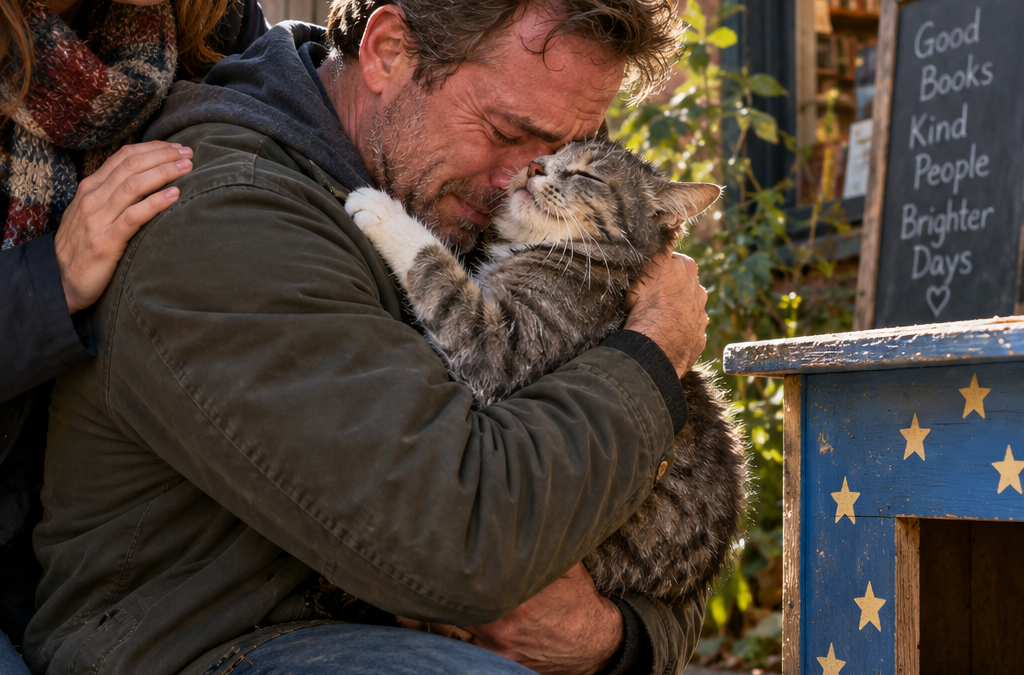
Behind the bookstore, near the river wall, sat the blue wooden shelter painted with yellow stars.
The Star House.
Beside it was a thin gray cat.
For one terrible second, I thought hope had tricked us.
This cat was smaller than Marnie had been, or seemed smaller under her tangled fur. Her face had sharpened. One ear had a nick in it. Her eyes looked older, cautious, wild at the edges. Time and weather had changed her into someone we almost did not recognize.
Then she lifted her front paw.
White.
Daniel made a sound I had never heard from him before.
Half sob.
Half prayer.
“Marnie,” he whispered.
The cat stared at him.
The world stopped.
Nora covered her mouth.
Daniel lowered himself slowly to his knees on the wet pavement. He did not reach for her. He did not rush. He only knelt there, shaking, with both hands open.
“Hi, baby,” he said, his voice breaking. “Hi, sweetheart. I’m sorry. I’m so sorry.”
Marnie took one step.
Stopped.
Her crooked tail twitched.
Daniel’s shoulders trembled.
“It’s me,” he whispered. “It’s Dad.”
Marnie took another step.
Then another.
Slowly at first.
Then faster.
She crossed the wet pavement, thin and dirty and alive, and walked straight into Daniel’s arms as if she had been gone only an afternoon.
He folded around her with a sound that tore through me.
Marnie pressed her face beneath his chin.
Daniel held her like something holy.
“I found you,” he kept saying. “I found you. I found you.”
I dropped to the ground beside them.
Marnie turned her head.
For a moment, she looked at me with those green-gold eyes I had dreamed about for eight months.
“Marnie,” I sobbed.
She reached out one dirty white paw and touched my sleeve.
That was all.
It was enough.
We brought her home wrapped in my scarf.
At the emergency vet, they told us she was thin, dehydrated, full of fleas, and had an old healed injury near her hip, likely from a fall or a glancing hit by a car. But she was alive. Her kidneys were stable. Her heart was strong. Her bloodwork was better than anyone expected for a fourteen-year-old cat who had survived eight months outside.
“She’s a fighter,” the vet said.
Daniel looked down at Marnie curled in the towel.
“No,” he said softly. “She’s family.”
We took her home just after midnight.
The first thing Marnie did was walk through every room.
Slowly, stiffly, with Daniel following a few steps behind as if afraid she might vanish if he blinked.
She checked the couch.
The windows.
The hallway.
The bedroom.
The laundry room.
When she saw the empty laundry basket near the dryer, she climbed inside, turned around twice, and sat down.
I laughed and cried at the same time.
Daniel sat on the floor beside the basket.
“I left it there,” he said.
“I know.”
“I couldn’t move it.”
“I know.”
Marnie blinked at him.
Then she climbed out and went to the back door.
Her old food bowl was gone.
In its place, Daniel had built a small wooden shelter with a painted star on the roof, the first one he had made for our own yard but never used because we could not bear to admit why it might be needed.
Marnie sat beside it for a moment.
Then she looked up at Daniel.
I do not pretend animals understand symbolism the way humans do.
But I know what I saw.
Marnie had survived because somewhere along her long way home, there had been water. There had been shelter. There had been someone like Daniel in one place, and another person in another, and a painted box behind a bookstore where she finally stopped running long enough to be seen.
That night, she slept between us, one white paw resting on Daniel’s hand.
He did not sleep.
Neither did I.
We lay on either side of her, listening to her breathe.
Every exhale felt like mercy.
By morning, half the neighborhood knew.
Nora had posted only three words: MARNIE IS HOME.
Mrs. Alvarez arrived with muffins and cried in our kitchen. Mr. Patterson came with a tin of tuna and stood in the doorway pretending his eyes were watery because of allergies. Children from the school class who painted the Star House sent handmade cards. One read, “Dear Marnie, You are good at finding boxes.”
Elaine Porter did not call.
Travis Beale did.
His number appeared on Daniel’s phone two days after Marnie came home.
Daniel stared at it.
“Answer,” I said.
He put it on speaker.
Travis sounded rough.
“I heard you found her.”
Daniel did not respond.
“I’m glad,” Travis said.
Silence.
Then he exhaled.
“Listen. I need to tell you something.”
My stomach tightened.
Daniel’s face went still.
“That day,” Travis said. “The gate wasn’t latched when we left.”
I gripped the edge of the counter.
Daniel closed his eyes.
“One of my guys told me after,” Travis continued. “He thought he had shut it, but the latch was bent. I told him not to worry about it because the paperwork was signed and I didn’t want insurance trouble. I told myself maybe your cat slipped out some other way.”
Daniel’s voice was quiet.
“You lied.”
“Yes.”
“For eight months.”
“I know.”
“You came to my house with Elaine.”
“I know.”
“You stood in a room and said you followed procedure.”
Travis’s voice cracked.
“I was scared of getting sued.”
Daniel laughed once, hollow and disbelieving.
“You were scared of paperwork. She was out there starving.”
“I’m sorry.”
The words sounded small.
Daniel looked toward the living room, where Marnie slept inside the laundry basket on a heated blanket, safe at last but thinner than she should have been, older than she had to become.
“I don’t forgive you right now,” Daniel said.
“I understand.”
“No,” Daniel said. “You don’t. But you will put it in writing.”
Travis was silent.
“What?”
“You will put exactly what you just said in writing. You will send it to us, your company, the insurance adjuster, and the HOA board.”
“Daniel—”
“You let my wife and me blame ourselves for eight months.”
His voice did not rise.
That made it stronger.
“You let people call this grief. You let people call it obsession. You let a whole town argue about water bowls because admitting you left a gate open was inconvenient.”
Travis said nothing.
“So now you tell the truth where everyone can hear it. Or I will.”
Travis sent the letter that afternoon.
By evening, it was in the hands of the board.
By the next day, Elaine resigned.
Not gracefully. Not with humility. Her resignation email blamed “hostile emotionalism” and “the weaponization of pet ownership.” But she resigned.
The HOA withdrew its complaint. The city, with pressure from business owners and residents, created a community cat care program with guidelines for safe feeding stations, clean water, and weatherproof shelters. Daniel was asked to help design them.
At first, he said no.
Then he looked at Marnie sleeping with her white paw over her eyes.
He said yes.
The repair company paid Marnie’s veterinary bills and donated materials for twenty shelters. Travis came by once to deliver lumber himself. He stood awkwardly in our driveway, older somehow than he had been on our porch.
Daniel accepted the wood.
He did not offer absolution.
That was honest.
Justice did not bring back the eight months Marnie lost. It did not erase the nights Daniel dreamed of opening the door too late. It did not fatten her body overnight or make her stop flinching when trucks rumbled by.
But justice did something.
It moved the guilt to the place it belonged.
And sometimes that is the beginning of healing.
Marnie recovered slowly.
At first, she ate small meals six times a day. She slept more than she used to. She startled easily. She hated wind against the windows. She followed Daniel from room to room, and if he stepped outside without her seeing where he went, she cried in a hoarse little voice that broke his heart.
So he changed his routines.
He tapped the wall before entering rooms because she had become hard of hearing. He placed ramps by the couch and bed. He kept the laundry basket in a sunny corner with soft blankets. He sat on the floor whenever she seemed unsure and let her come to him.
Some nights, she woke from dreams and stood in the hallway confused.
Daniel always heard her first.
“Marnie,” he would whisper, rising from bed. “I’m here.”
She would make that rough little cry.
He would carry her back, and she would press her face beneath his chin.
Healing looked like that for a while.
Not dramatic.
Not clean.
Just returning, again and again, to the truth that she was home.
And every morning, Daniel still went outside to refill the water bowl.
The first time, I watched from the kitchen window.
Marnie followed him to the door.
She did not try to leave.
She simply stood there, one white paw on the threshold, watching him set the bowl by the steps.
Daniel looked back at her.
“You don’t have to worry about that anymore,” he said.
Marnie blinked.
Then she sat down.
Maybe she remembered.
Maybe she did not.
Maybe what mattered was that Daniel remembered for both of them.
As winter approached, the town shelters became official.
Mrs. Alvarez hosted a fundraiser called Bowls for Marnie and sold soup in ceramic bowls made by the high school art department. Nora organized a reading night at the bookstore, where children brought blankets for the shelters. Mr. Patterson became the unofficial morning inspector of the community garden station, taking his job with military seriousness.
The Star House behind the bookstore stayed exactly where it was.
Daniel repaired its roof, cleaned it, and added a small brass plate that Nora had made.
It read:
FOR EVERYONE STILL FINDING THE WAY HOME.
Marnie never returned to the bookstore.
We brought her once, months later, in a secure carrier, just so Nora could see her healthy. Marnie glared at everyone, accepted three treats, and made it clear she preferred retirement.
Nora cried anyway.
“I kept thinking I should have noticed sooner,” she said.
Daniel shook his head.
“You noticed when it mattered.”
Nora looked at the Star House.
“No,” she said. “You built something worth noticing.”
The line stayed with me.
Because that was what Daniel had done with his grief.
He had built something worth noticing.
A path.
Not just for Marnie.
For all the hungry, frightened, overlooked creatures that moved through the edges of human life while we were busy calling ourselves civilized.
A year after Marnie came home, the school invited Daniel to speak.
He hated the idea.
“I build boxes,” he said. “I don’t give speeches.”
“You can talk to cats in alleys but not third graders?”
“Cats are less judgmental.”
“Cats are extremely judgmental.”
He smiled.
In the end, he went.
I sat in the back of the classroom beside Marnie’s carrier. She had become something of a local legend by then, though she herself remained unimpressed. The children sat cross-legged on the rug beneath a bulletin board covered in paper stars.
Daniel stood at the front holding one of the small water bowls.
He looked terrified.
Then a little girl raised her hand and said, “Did Marnie know the houses were from you?”
Daniel looked at the bowl.
“I don’t know,” he said honestly. “But I don’t think kindness needs to know your name to matter.”
The room went quiet in the way children get quiet when they are absorbing something true.
Daniel continued.
“When Marnie was missing, I kept imagining her somewhere cold and hungry. I couldn’t find her. But I could leave water. I could build shelters. I could help whoever crossed the same road she might be walking. Sometimes we can’t fix the exact hurt we want to fix. But we can still make the world kinder around it.”
A boy in the front asked, “Were you sad every day?”
Daniel nodded.
“Yes.”
“But you still helped?”
“Yes.”
“Why?”
Daniel looked toward me.
Then toward the carrier where Marnie sat with one white paw visible through the mesh.
“Because love doesn’t know what else to do.”
I cried quietly in the back row.
So did the teacher.
Marnie washed her paw.
Life settled after that.
Not back to the way it had been.
Back is not a place grief allows.
Life settled forward.
Marnie grew stronger. Her fur regained its shine. Her crooked tail lifted again when she walked. She returned to sleeping in laundry baskets and claiming Daniel’s work jacket the moment he set it down. She never liked closed gates after that. Neither did we. Daniel installed new latches on every gate in our yard, then checked them twice each night with the devotion of a man who had learned how small mistakes can become enormous regrets.
Sometimes, on warm evenings, we sat on the back steps together while Marnie watched from inside the screen door.
The water bowl remained outside.
Other cats came.
A black-and-white tom with torn ears.
A ginger kitten who eventually let Mrs. Alvarez trap him and find him a home.
A long-haired brown cat with one cloudy eye who slept in our yard shelter during snowstorms.
Daniel named none of them, at least not out loud.
But he noticed them.
He noticed who limped, who looked pregnant, who came alone, who waited for others to eat first. He worked with the rescue group to trap, neuter, vaccinate, and return the feral ones. He fostered two kittens for exactly six days before crying when they were adopted, then pretending his allergies were acting up.
And Marnie watched it all.
Sometimes I wondered what she thought of the life that had grown from her absence.
Maybe cats do not think in those shapes.
Maybe she simply knew that food appeared, warmth stayed, and the people she loved were near.
That was enough.
It should be enough for us too, more often than it is.
On the second anniversary of her return, Nora held a small gathering behind the bookstore. Nothing formal. Just the people who had been part of the story: Mrs. Alvarez with a box of pastries, Mr. Patterson with his notebook, Hannah from the rescue, the teacher and some of the students who had painted the Star House, neighbors who had donated blankets, even a city councilwoman who had helped approve the shelter program.
Daniel brought Marnie in her carrier.
She was older now, slower, but dignified as ever. When we opened the carrier door, she did not come out. She simply sat inside and surveyed her admirers like a retired queen receiving citizens.
Nora unveiled a new sign above the Star House.
Marnie’s Way.
Daniel pressed his lips together.
I knew that expression.
It meant he was trying not to cry in public.
The sign was simple, carved into wood and painted blue with small yellow stars.
Beneath the name were the words:
A kindness left for one can become shelter for many.
Mrs. Alvarez put one arm around me.
“You know,” she said, “I used to think grief made people smaller.”
I watched Daniel crouch beside the Star House, tightening a screw that did not need tightening.
“Sometimes it does,” I said.
“And sometimes?”
“Sometimes it gives them somewhere to pour the love.”
At sunset, people began drifting home.
Daniel and I stayed a little longer.
The alley behind the bookstore looked ordinary again once everyone left. Brick wall. Back steps. Trash bins. The river beyond the rail. The Star House tucked safely near the corner.
I thought of Marnie there that night, thin and tired, sitting on the painted roof as if she had finally found a place that smelled like someone who might care.
I thought of Daniel kneeling in wet pavement.
I thought of the white paw lifting.
There are moments life gives you that become holy not because they are perfect, but because they arrive after you have stopped believing mercy knows your address.
Daniel stood beside me, carrier in hand.
“You okay?” I asked.
He nodded.
Then he said, “For eight months, I thought I was leaving bowls for her.”
“You were.”
He looked at the shelter.
“But I think maybe I was leaving them for myself too. So I wouldn’t become someone who stopped caring because caring hurt too much.”
I took his hand.
“You never could have become that.”
He smiled sadly.
“I don’t know. Pain can make people hard.”
“Yes,” I said. “But love made you stubborn.”
He laughed softly.
From inside the carrier, Marnie gave a rough little meow, impatient with sentiment.
Daniel wiped his eyes.
“Yes, ma’am,” he said. “We’re going home.”
Home.
That word had changed.
Once, it meant a house with a crooked fence, a laundry basket, and a cat who belonged entirely indoors.
Then it meant flyers in rain, a back step with an untouched bowl, and two people calling into dark streets.
Then it meant alleys, water bowls, shelters, neighbors, confessions, consequences, and a blue wooden box covered in stars.
Now it meant all of it.
The loss.
The waiting.
The anger.
The kindness.
The return.
That night, Marnie slept between us as she had since coming home. Her white paw rested on Daniel’s hand. Her crooked tail lay across my wrist.
Just before dawn, I woke and looked at them.
Daniel was asleep on his side, one hand open beneath Marnie’s paw. His face was peaceful in a way I had not seen during those eight months. Marnie breathed softly, safe and warm, her body no longer thin, her fur silver in the early light.
I thought about how many people had told us hope was foolish after enough time had passed.
Maybe it was.
Maybe hope is foolish.
Maybe it is unreasonable to keep filling a bowl when the one you love does not come.
Maybe it is foolish to build shelter for strangers because you cannot find your own.
Maybe it is foolish to believe a small gray cat with a crooked tail can survive rain, traffic, hunger, cold, and all the indifference of a busy town.
But sometimes foolish hope becomes something else.
A bowl of water.
A dry place to sleep.
A stranger stopping long enough to care.
A child painting stars on a wooden roof.
An old man finding a reason to walk to the garden.
A bookstore owner looking twice.
A husband kneeling on wet pavement with his hands open.
A path home.
Marnie stirred then, opened her eyes, and looked at me.
I whispered her name.
She could not understand all the things I wanted to tell her. She could not know how sorry I was, how grateful, how often I had imagined her alone and wished I could trade places with her for just one cold night so she would not have to be afraid.
But maybe love does not need every word.
Maybe it only needs to be there when the door opens.
Marnie stretched her white paw and placed it on Daniel’s wrist again.
He woke just enough to cover it gently with his fingers.
And in the quiet morning, with our lost cat home between us and water waiting outside for whoever still needed it, I finally understood what Daniel had known long before I did.
Hope is not always the belief that what you lost will return.
Sometimes hope is refusing to let your heartbreak become the end of your kindness.
Sometimes hope is building a little wooden shelter in a cold world and trusting that love, somehow, will know the way.








