After 729 Days in a Shelter, My New Pit Bull Escaped at the Exit—But She Ran Back for the One Dog Everyone Else Had Forgotten
After 729 Days in a Shelter, My New Pit Bull Escaped at the Exit—But She Ran Back for the One Dog Everyone Else Had Forgotten
After 729 days in a shelter, my newly adopted Pit Bull slipped backward out of her harness at the front door and ran the wrong way—not toward freedom, but straight back into the kennel hallway she had spent two years trying to survive.
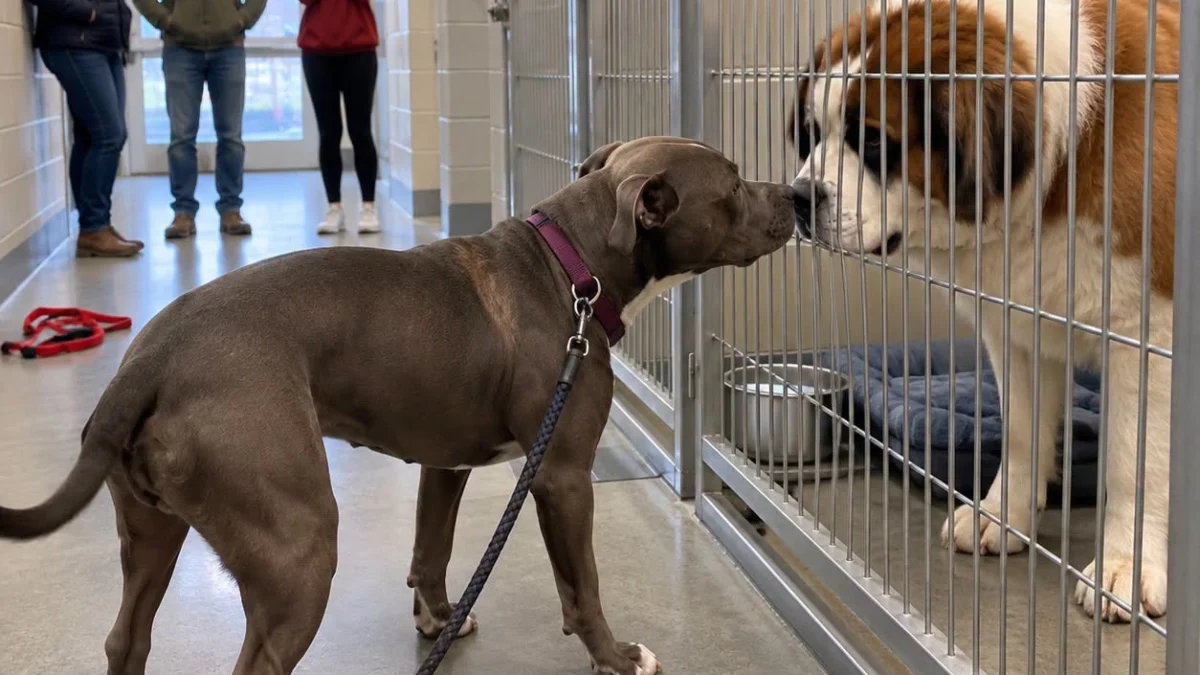
She ignored the puppies, the barking dogs, and every open doorway until she reached Kennel 18, where an eleven-year-old Saint Bernard with a cloudy eye struggled painfully to his feet just to touch his nose to hers through the bars.
Everyone around us thought Nell had gone back to say goodbye, but when I learned what that old dog had been doing for her through a concrete wall for fourteen months, I asked my parents one question that changed all of our lives: “Who’s coming back for Moses?”
My name is Claire Keller.
I was fourteen years old when this happened.
Old enough to think I understood what adoption meant.
I thought it meant choosing.
You walk into a shelter.
You meet a dog.
Something happens.
You sign papers.
You take the dog home.
Maybe the dog is scared at first.
Maybe it sleeps by the door.
Maybe it has accidents.
Maybe it chews a shoe.
Then, gradually, it learns that your house is home.
That was how I imagined it.
I did not understand that sometimes the animal you choose has already chosen someone else too.
And sometimes bringing one dog home means discovering another one was part of the rescue all along.
Her name was Nell.
Charcoal-gray Pit Bull.
Five years old.
Low to the ground.
White stripe running down her muzzle.
White patch on her chest that tilted slightly to the right.
Old scar beneath the fur on her right shoulder where the hair never fully grew back.
She had been at the shelter 729 days.
Almost two years.
I knew the exact number because the shelter website displayed it underneath every long-term dog.
729 DAYS WAITING.
I hated that line.
It made waiting sound passive.
Nell had not been passively waiting.
She had been surviving.
There is a difference.
My parents, Hannah and Drew Keller, had promised me a dog if I finished middle school with good grades and if we all agreed the timing was right.
I met Nell because we came to the shelter “just to look.”
Nobody ever means just to look.
My mother wanted a smaller dog.
My father said we should consider a dog that was already house-trained.
I had no idea what I wanted.
The lobby smelled like disinfectant, wet coats and dog food.
The kennels were loud.
Puppies jumped.
Young dogs barked.
Some pressed themselves against the doors.
Some spun in circles.
Some wagged so hard their whole bodies bent.
Nell did none of that.
Kennel 17.
She sat against the back wall.
Not trembling.
Not barking.
Just making herself small.
People walked past.
She watched.
People stopped in front of the dog beside her.
She watched.
A family with two little boys leaned down to look into her kennel.
One boy said:
“She looks sad.”
His father answered:
“Let’s see the puppies.”
They left.
Nell did not move.
I stopped.
My mother was three kennels ahead before she realized.
“Claire?”
I sat down on the cold floor.
Nell looked at me.
“Just a minute.”
My father came back.
“What are you doing?”
“Nothing.”
“On the floor?”
“Yes.”
“Useful.”
I had my algebra book in my backpack because we were supposed to go to my grandmother’s after the shelter and I had homework.
I took it out.
Opened to linear equations.
My mother stared.
“You’re doing math?”
“No.”
“What are you doing?”
I looked toward Nell.
“Reading.”
“To the dog?”
“Yes.”
My parents exchanged the look parents use when deciding whether their teenager has finally become too strange to correct.
I began.
“Linear equations can be written in slope-intercept form…”
Nell did not approach.
That was fine.
I kept reading.
Slope.
Intercept.
X.
Y.
Things I barely cared about even at school.
But my voice gave me something to do besides stare at her.
The shelter worker eventually told us her history was mostly unknown.
Picked up as a stray.
Old injury.
No microchip.
No owner came.
Gentle with staff after she knew them.
Terrified of strangers.
Loved tennis balls.
Did better around calm dogs.
They used words like shy.
Reserved.
Sensitive.
I was fourteen.
I already knew adults softened hard truths for children.
Shy sometimes meant terrified.
Sensitive sometimes meant traumatized.
Needs patience sometimes meant everybody else gave up too soon.
We left without adopting her.
I cried in the car.
My father said:
“Claire, we need to make the right decision, not the emotional one.”
I hated that sentence.
Mostly because he was right.
A dog is not a sad story you bring home because you feel guilty.
A dog becomes part of your life.
Medical bills.
Training.
Vacations.
Furniture.
Time.
Years.
You owe it more than sympathy.
So we returned.
Second visit.
I sat outside Kennel 17.
Read algebra.
Nell moved one paw forward.
That was all.
Third visit.
She slept while I read.
I considered that a major victory.
Fourth visit.
She came close enough to the door that I could see her eyes clearly.
Brown.
Not hard.
Not angry.
Just tired.
Fifth visit.
She walked to the bottom of the kennel door.
Pressed her nose against the gap.
Breathed on the toe of my sneaker.
I did not move.
My entire body was screaming:
SHE TOUCHED ME.
I remained still.
My father later said he had never seen me exercise that much self-control in my life.
Sixth visit.
Meeting room.
A shelter behavior coordinator named Marcy brought Nell in on a leash.
Nell froze in the doorway.
I sat on the floor.
No reaching.
No calling.
I opened the algebra book.
“Do you know how bad I am at this chapter?”
Nell looked at me.
“I’m serious. If you understand equations, now is the time to contribute.”
My mother laughed quietly.
Nell took one step.
Then another.
She sniffed my sleeve.
Walked around me.
Sat.
I kept reading.
After maybe ten minutes, she lowered herself beside my leg.
Then something I will never forget.
She put her head on my knee.
All the weight.
Not much physically.
Everything emotionally.
She exhaled.
A long breath.
Like she had been carrying something heavy and had finally decided I could hold one corner.
I looked at my parents.
“She’s the one.”
My mother cried.
My father rubbed his face.
Nobody argued.
The adoption took another week.
Forms.
References.
Home review.
Vet plan.
Harness fitting.
Finally, one cold October afternoon, we came to take Nell home.
The shelter staff packed her things.
Gray blanket.
Blue rubber toy.
Medical records.
Medication.
Food.
Marcy cried before we even left the lobby.
“She’s been here a long time.”
My mother hugged her.
“We know.”
My father put the food in the car.
I clipped the red leash to Nell’s new harness.
She was nervous.
But moving.
That mattered.
We crossed the lobby.
Black rubber mat.
Front desk.
Glass exit.
Everyone expected her to hesitate.
I did.
Two years behind those doors.
729 days.
I thought she might freeze.
Instead, Nell walked straight forward.
My chest filled.
This is it, I thought.
This is the moment she starts over.
The automatic door opened.
Cold air came inside.
Then, from behind us, deep in the kennel corridor—
CLANG.
Metal door.
Nell stopped.
So suddenly the leash loosened.
Her head turned.
“Nell?”
Her ears lifted.
Body stiff.
Then she did something none of us expected.
She backed up.
Twisted.
Dropped one shoulder.
The harness slid over her chest.
My mother grabbed.
Too late.
One second Nell was beside us.
Next second my mother held an empty red harness.
“NELL!”
She ran.
Not through the open exit.
Not outside.
Back.
Toward the barking.
Toward the kennels.
Staff moved.
Someone shouted:
“Close the front door!”
Another worker stepped toward the hallway.
Then stopped.
Because Nell was not running blindly.
She knew exactly where she was going.
Past Kennel 4.
Past 7.
Past 10.
Past the puppy room.
Past dogs throwing themselves against doors.
Kennel 17.
Her old kennel.
She ran past it.
Then stopped at 18.
I reached the hallway just behind my father.
Inside Kennel 18 lay the biggest dog I had ever seen up close.
Saint Bernard.
Rust and white.
Massive head.
Cloudy left eye.
Gray around the muzzle.
Back legs thin beneath his body.
I had seen him before.
Briefly.
That was how most people saw Moses.
Briefly.
You noticed the size.
Then the age.
Then the eye.
Then the stiff hips.
Then you kept walking.
People wanted dogs they imagined having years with.
Moses looked like heartbreak with an adoption fee.
Nell pushed her nose through the lower bars.
Moses lifted his head.
He saw her.
For a second he did nothing.
Then he tried to stand.
His back paws slipped.
My mother gasped.
He tried again.
Front legs braced.
Back end trembling.
He reached the kennel door.
Nell pressed harder against the bars.
Their noses touched.
Everything around them seemed to stop.
Barking still happened.
Metal bowls still moved.
People still breathed.
But I heard none of it.
Nell stopped trembling.
Moses stood there, barely.
No barking.
No whining.
Just noses touching through steel.
My mother stood behind us holding the empty harness.
“She came back for him.”
Marcy had tears running down her face.
I looked at her.
“What?”
She wiped her cheeks.
“Nell and Moses have been neighbors fourteen months.”
“What do you mean neighbors?”
“Shared divider.”
Kennel 17 and 18.
Concrete wall.
They could not see each other from most positions.
But they could hear.
Smell.
Feel movement through the structure.
Marcy continued.
“During storms, Nell panics.”
My hand tightened around the leash I no longer had a dog attached to.
“Moses started sleeping against their shared wall.”
“Why?”
“We don’t know.”
She shrugged.
“He just did.”
“And?”
“Nell eventually started sleeping against the other side.”
My father looked at Moses.
Marcy spoke more quietly.
“When Moses went to the clinic for two days, Nell stopped eating.”
My mother covered her mouth.
“When he came back, she ate that night.”
I looked through the bars.
Moses lowered himself slowly.
Nell remained pressed against the kennel.
“They’ve never been together?”
“Not loose.”
“Never?”
“Not in the same room.”
“They only had a wall?”
Marcy nodded.
“They had a wall.”
Everyone around me seemed touched by the goodbye.
I wasn’t.
Because it did not feel like goodbye.
Goodbyes are when one person leaves because leaving is necessary.
Nell had reached freedom.
Then gone back.
She had made a decision.
Maybe not the way humans make one.
I know that.
But her behavior was obvious.
She did not want to leave Moses behind.
We got her harness back on.
My parents thanked everyone.
We walked to the parking lot.
Nell kept looking toward the building.
My mother opened the back door.
Nell climbed in.
Blue toy beside her.
I sat next to her.
My father started the car.
Nobody spoke.
Then I asked:
“Who’s coming back for Moses?”
My mother stared through the windshield.
My father’s hands tightened on the steering wheel.
“Claire.”
“Who?”
“Sweetheart, he’s eleven.”
“I know.”
“He’s a Saint Bernard.”
“I know.”
“Senior giant breeds can have a lot of medical needs.”
“I know.”
“We came for Nell.”
I looked at her.
“And Nell came for him.”
Silence.
Nell sat beside me.
Not whining.
Not scratching the door.
Just staring back at the shelter.
My father exhaled.
We pulled away.
Slowly.
Halfway home, Nell lowered her head onto my sneaker.
My mother saw it in the mirror.
Her face crumpled.
That night Nell explored our house like she expected every room to disappear.
Couch.
Kitchen.
Back door.
Laundry basket.
My backpack.
The place my father had spilled coffee.
Every sound made her stop.
Furnace kicked on.
She dropped low.
I sat on my bedroom floor.
Opened algebra.
“Linear equations can be written…”
My voice shook.
Nell listened.
Then walked to the wall beside my closet.
Turned three circles.
Lay down with her whole body pressed against it.
Not the dog bed.
Not near me.
Against the wall.
The way she had slept on the other side of Moses.
That was when I cried.
Quietly.
I tried not to scare her.
Nell lifted her head.
Watched.
Then came to me.
Placed one paw on my knee.
Light.
Careful.
Almost formal.
Like:
I don’t know how to fix you.
But I know how to stay.
Downstairs, my parents were talking.
I could hear pieces.
“Arthritis.”
“Expenses.”
“Space.”
“Claire.”
Then my dad:
“Did you see her face?”
My mother answered:
“I saw Nell’s.”
The next morning, they were both sitting at the kitchen table.
My father’s coffee untouched.
My mother’s laptop open.
Nell stood beside me.
Shoulder touching my leg.
“We called the shelter,” Mom said.
My heart slammed.
“And?”
“Moses is still there.”
“Can we go get him?”
Dad leaned back.
“We’re not saying yes.”
I expected anger.
Instead I heard fear.
Not fear of Moses.
Fear of what loving him might cost.
My mother turned the laptop.
Moses’s adoption page.
SENIOR SAINT BERNARD.
Gentle.
Slow moving.
Arthritis management required.
Best with calm dogs.
I read that line twice.
Best with calm dogs.
Nell stared at the wall.
“We asked if we could visit him,” Mom said.
“When?”
“After school.”
I nearly knocked her chair over hugging her.
Then my father.
He complained.
I ignored him.
That school day lasted approximately seven years.
After the final bell, I ran outside.
Nell was already in the back seat.
Harness tightened properly.
My father had learned.
Mom said:
“She knew.”
Dad said:
“Dogs do not understand appointment times.”
Then smiled.
Back at the shelter, Nell walked beside me.
Low body.
Nervous.
But controlled.
Then, from down the kennel corridor:
Clink.
A collar tag touching concrete.
Nell stopped trembling.
Moses was waiting.
The meeting room had scratched tan walls.
Rubber mats.
A bench.
Basket of ignored toys.
Moses came in first.
Slow.
Each step deliberate.
He lowered himself with a deep sigh.
Nell entered.
Froze.
Moses made a soft huff.
She walked directly to him.
Lay down.
Their front paws touched.
My mother turned toward the window.
She pretended not to cry.
Nobody believed her.
Dad sat silently.
Moses placed his chin on the floor.
Nell leaned her shoulder against his.
That was different from hiding against a wall.
This was recognition.
Marcy crouched.
“I should tell you more.”
She explained Nell’s first months.
She would not eat with humans watching.
Metal bowls terrified her.
Thunderstorms made her panic so badly she once threw herself against the kennel door.
They moved her.
Changed rooms.
Tried quieter spaces.
Nothing worked.
Then she ended up in Kennel 17.
Beside Moses.
First big storm, Moses got up.
Walked to the concrete divider.
Lay against it.
All night.
By morning, Nell was asleep against the opposite side.
After that, he did it every storm.
Whenever the shelter became loud.
Whenever she paced.
Moses went to the wall.
Nell followed.
If Moses left for a walk, Nell watched the hallway until he returned.
If he went to veterinary care, she waited.
When he stayed two days in the clinic, Nell stopped eating.
“He kept her going,” I said.
Marcy nodded.
“More than we understood at first.”
My mother looked horrified.
“Why weren’t they adopted together?”
Marcy’s expression hurt.
“We considered it.”
“Then?”
“Bonded placements are harder.”
She looked toward Moses.
“A shy adult Pit Bull and an eleven-year-old Saint Bernard with medical needs?”
Her eyes filled.
“Most people wouldn’t meet either one.”
That was terrible.
And logical.
The shelter feared advertising them as a pair would keep both trapped.
Love had made them harder to place.
My father walked across the room.
Hands on hips.
The practical questions came next.
Medication.
Arthritis.
Joint support.
Stairs.
Ramp.
Weight.
Cloudy eye.
Short walks.
Pain management.
Then the question none of us wanted.
“How long does he have?”
Marcy did not lie.
“No one knows.”
“Months?”
“Maybe.”
“A year?”
“Maybe.”
“Longer?”
“Possible.”
My mother whispered:
“That’s why people pass him.”
Marcy nodded.
“They’re afraid to love a dog they’ll lose.”
Moses looked at my father.
One cloudy eye.
One clear.
No begging.
No performance.
Dad crouched.
“Hey, big guy.”
Hand out.
Moses sniffed.
Then leaned his enormous head into Dad’s palm.
My father closed his eyes.
His shoulders dropped.
That was when I knew.
Practicality had met Moses.
Practicality lost.
Still, we could not take him immediately.
Medical consultation.
Home inspection.
Trial foster.
Proper preparation.
I hated the system for about six minutes.
Then understood why it existed.
Moses needed more than our feelings.
We left him again.
Nell watched him disappear down the hallway.
At the end, Moses stopped.
Looked back.
His hind legs shook.
Nell made the smallest sound.
A broken little breath.
My mother knelt.
“We’re trying.”
She put her hand near Nell’s chest.
“I promise.”
That night Dad measured every doorway.
Mom researched orthopedic beds.
Medication.
Senior-dog diets.
I researched Saint Bernards until midnight.
Dad watched videos about ramps.
The next morning he bought plywood.
When I came home from school, half a ramp existed in the garage.
“You said we weren’t sure.”
“We aren’t.”
“You built a ramp.”
“It’s for hypothetical use.”
“By what hypothetical 127-pound animal?”
He pointed a drill at me.
“Go do homework.”
The home check happened two days later.
Fence.
Floors.
Stairs.
Doors.
Nonslip mats.
Ramp.
Teresa, the shelter volunteer, looked at Dad’s half-finished construction.
“You built that already?”
He shrugged.
“Needed something to do.”
Nell followed Teresa carefully.
At one point Teresa bent down.
Nell placed one paw on her shoe.
Teresa froze.
Then whispered:
“Oh, sweetheart.”
Approval came the next morning.
Two-week trial.
If everything worked, adoption.
I screamed.
Nell startled.
Grabbed her blue toy.
Ran around the coffee table.
Dad laughed.
“Great. We traumatized the dog with good news.”
Friday afternoon, we brought Moses home.
Shelter staff lined the hallway.
Blue bandana around his neck.
Medication bag.
Orthopedic bed.
People cried.
Some had cared for Moses fourteen months.
That is something I had not considered.
Adoption meant happiness for us.
It meant goodbye for the people who had been his family when nobody came.
Moses reached the lobby.
Nell saw him.
Her whole body changed.
Ready.
That is the only word.
Not frantic.
Not afraid.
Ready.
Getting Moses into the car took twelve minutes.
Ramp.
One paw.
Back up.
Treats.
Encouragement.
Patience.
Then Nell walked up first.
Turned around.
Looked at him.
Moses sighed.
Followed.
At the top, staff clapped quietly.
Marcy handed Mom his medication.
“Pills in peanut butter.”
“Got it.”
“He drinks a lot after dinner.”
“Okay.”
“Sometimes he dreams loudly.”
Dad smiled.
“So do I.”
Marcy knelt.
“You be good, old man.”
Moses licked her wrist.
She broke.
At our house, Moses stood in the driveway almost a minute.
Yellow two-story.
White trim.
Maple tree.
Nothing special.
He looked at it like a country he had heard about but never expected to visit.
Nell waited beside him.
Ramp.
Back door.
Kitchen.
Water.
Fireplace bed.
Moses inspected everything.
Then found the hallway wall.
Lowered himself.
Nell lay on the other side of him.
No concrete divider now.
Their backs touched.
Mom took one photograph.
Never posted it.
She held the phone against her chest and cried.
The first night was rough.
Moses panted.
Nell woke every time he moved.
At two in the morning, claws scraped downstairs.
I ran.
Moses could not get his back legs under him.
Nell circled.
Whining.
Dad came down in pajama pants.
“Okay, buddy.”
He used the support towel the shelter had shown us.
“Got you.”
Moses stood.
Head low.
Embarrassed.
Dad rubbed his neck.
“No shame here.”
Moses leaned into him.
“Everybody needs help getting up sometimes.”
That became a rule in our house.
No shame here.
The first week revolved around tiny victories.
Moses crossed the kitchen without slipping.
Nell ate while the blender ran.
Moses learned the ramp.
Nell walked past a trash truck without flattening herself.
Moses lost three pounds.
Nell learned my school bus schedule.
Every afternoon, two faces waited at the window.
Nell.
Moses.
I called them my babies.
Dad objected.
“You cannot call a 127-pound Saint Bernard a baby.”
“He’s my baby.”
“He outweighs you.”
“Still baby.”
Moses supported my position by drooling on Dad.
The trial was supposed to answer:
Could we handle Moses?
After one week, I had another question.
How had Nell survived without him?
Not physically.
Shelter staff had fed her.
Treated her.
Kept her warm.
Loved her.
I mean the invisible part.
The part that watched doors.
The part that slept pressed against walls.
The part that believed loud sounds meant danger.
Moses had been a sound through concrete saying:
I am still here.
Eventually, Nell began changing.
First she followed Moses constantly because she feared he would disappear.
Then because she liked him nearby.
Then one afternoon, Moses slept by the fireplace and Nell came upstairs alone.
She stood in my bedroom doorway.
Unsure.
I patted her bed.
She entered.
Sniffed everything.
Then climbed onto the bed we had bought weeks earlier.
For the first time.
I sat absolutely still.
Downstairs, Moses snored.
The sound came through the vent.
Nell heard it.
Closed her eyes.
She did not need the wall.
She knew where he was.
At the end of the trial, Marcy visited.
She entered the living room.
Stopped.
Moses asleep by fireplace.
Nell pressed along his side.
Dad on the floor doing a puzzle because Moses had stolen his couch spot.
Marcy covered her mouth.
“Oh.”
Nell stood.
Walked to her.
Leaned against her knees.
Marcy cried.
Then Moses struggled upright.
Dad reached for the support towel.
Moses managed alone.
Three slow steps.
He pressed his head into Marcy’s stomach.
She bent over him.
“You old miracle.”
The adoption papers were signed at our kitchen table.
Mom.
Dad.
Then me as witness because I demanded it.
My signature shook.
Moses officially became Keller while Nell slept with her chin across his tail.
Marcy gave us his file.
Vet records.
Feeding notes.
Medical history.
And a small envelope.
PERSONAL ITEMS.
Inside was a photograph.
Moses on a porch.
Younger.
Beside an elderly man in plaid.
Hand resting on his head.
Back:
MOSES AND MR. ALVAREZ.
There was a note.
His former owner’s daughter had left it.
Mom read aloud.
“To whoever loves Moses next…”
Then stopped halfway.
Dad continued.
Mr. Alvarez had raised Moses from a puppy.
Moses slept by his chair.
Followed him to the garden.
Waited at the window during dialysis.
When Mr. Alvarez became too sick to remain home, Moses lay beside the door for two days.
His family tried.
But a giant senior dog with grief and medical needs became too much for the available home.
The line that destroyed us:
“Please know he was never unwanted.”
Another:
“If you can, tell him he is a good boy.”
Dad looked across the room.
Moses was awake.
Watching.
“Moses.”
Tail moved.
“You’re a good boy.”
One thump.
Nell lifted her head.
She looked between them as if to say:
Obviously.
We framed the photo.
Put it on the mantel.
Because Moses’s life did not begin when we adopted him.
Mr. Alvarez mattered.
His family mattered.
The shelter mattered.
Nell mattered.
Love before us was still love.
Winter came early.
First snow.
Nell hated it.
Growled at the sky.
Moses became five years younger.
He walked onto the ramp.
Lifted his nose.
Snow landed on his muzzle.
Tail moving.
Nell stood inside.
Moses walked three steps.
Looked back.
Nell looked at me.
“You don’t have to.”
She went anyway.
At first she lifted every paw like the snow might explode.
Then Moses shoved his face into it.
Sneezed.
Nell jumped.
Then play-bowed.
I had never seen her do that.
Moses looked offended.
Then barked once.
Nell ran.
Wide circles.
Careful around his hips.
Mouth open.
Snow flying.
Mom whispered:
“Look at her.”
Moses eventually lay down.
Nell immediately returned.
Curled around his paws.
That photo went on the shelter page.
No dramatic headline.
Just:
NELL AND MOSES WENT HOME TOGETHER.
Thousands of people responded.
Some said they had passed Moses.
Some apologized.
Some said they were going to look at senior dogs differently.
One woman commented:
“I think that was my uncle’s dog.”
Mom messaged privately.
It was Mr. Alvarez’s niece.
Mr. Alvarez was alive.
Long-term care facility outside Cleveland.
Memory inconsistent.
Some days he remembered Moses.
Some days he asked why the dog had not come to breakfast.
We arranged a visit.
Vet approval.
Facility approval.
Short.
December afternoon.
We loaded Moses.
Nell went too.
At the care facility, Moses walked slowly down polished floors.
Nurses stopped.
Nell stayed beside him.
Mr. Alvarez sat in a sunroom.
Blanket over knees.
Smaller than the man in the photo.
His daughter Elena stood nearby.
She saw Moses.
Covered her mouth.
“Dad.”
Mr. Alvarez did not look up.
“Someone came.”
Moses stopped three feet away.
His entire body went still.
Then he whined.
Low.
Ache in sound.
Mr. Alvarez lifted his head.
For several seconds his face did not change.
Then recognition came.
Slow.
Like his heart arrived before his memory.
“Moses?”
The Saint Bernard took one step.
Then another.
Put his head in Mr. Alvarez’s lap.
The room disappeared.
Mr. Alvarez’s shaking hand rested on his head.
“There’s my boy.”
Moses closed his eyes.
Nell watched.
Mr. Alvarez stroked him.
“You were good?”
Dad cried.
“He’s very good, sir.”
“You taking care of him?”
“Yes.”
Mr. Alvarez looked toward Nell.
“And the little one?”
“This is Nell.”
I crouched beside her.
“She’s his friend.”
Mr. Alvarez smiled faintly.
“Moses always liked the ones that needed him.”
Elena started crying.
Then told us stories.
Moses sleeping outside the bedroom when her father was ill.
Moses staying on the porch in a storm because a stray kitten hid beneath it.
Moses always watching people.
“He took care of everyone.”
I looked at Nell.
She moved closer.
Pressed her shoulder into Moses’s back leg.
Twenty-minute visit.
When it ended, Mr. Alvarez held Moses’s face.
“You be good.”
Moses licked his wrist.
In the car, nobody spoke.
Moses slept.
Nell rested her head on his paws.
I kept thinking:
Nell went back for Moses.
Moses waited for Mr. Alvarez.
We went back to the shelter.
All those returns.
Family built from people refusing to let goodbye be automatic.
Christmas came.
Moses wore a red bandana.
Nell stole one low ornament every morning.
Dad pretended annoyance.
Then started buying soft ornaments to place low enough for her.
Moses used wrapped gifts as pillows.
My grandmother secretly fed Nell turkey.
Denied everything.
House felt fuller.
Not simply louder.
Though Moses’s snoring was architectural.
Fuller.
As if there had been a room inside us we did not know was empty until those dogs occupied it.
January.
Nell had a nightmare.
Woke barking.
Laundry basket went flying.
I sat up.
“Nell.”
She panted.
Then Moses appeared in my doorway.
Upstairs.
The dog was not supposed to use stairs.
We had a gate.
Dad had apparently failed to latch it.
Moses stood there panting like an elderly criminal.
Nell saw him.
Immediately softened.
Walked forward.
Moses touched his forehead to hers.
I called my parents.
Dad appeared.
Saw Moses upstairs.
Said a word I am not allowed to print.
Then sat down and laughed until he cried.
“You stubborn old saint.”
We all slept downstairs that night.
Mom couch.
Dad recliner.
Me sleeping bag.
Moses orthopedic bed.
Nell beside him.
Next weekend Dad installed a better gate.
Moses looked personally betrayed.
Spring came.
Medication helped.
Moses never became young.
That was not the miracle.
The miracle was comfort.
He wanted breakfast.
Wanted the yard.
Wanted short walks.
Wanted sun.
Wanted to complain when carrots lacked broth.
He liked sleeping on shoes.
Distrusted the mail carrier but accepted bribes.
Hated rain touching his ears.
Owned the left side of the couch.
Nell changed too.
She still feared storms.
But less beside Moses.
She preferred tennis balls to every expensive toy.
Liked Mom singing.
Dad did not.
She learned strangers could wait for permission.
She learned the park was safe after observation.
She learned trust was not a door you kicked open.
It was a porch light you left on.
At the shelter reunion in May, we brought both dogs.
I worried.
Would Nell think we were returning her?
Would Moses?
We entered carefully.
Staff gathered quietly.
No clapping.
No crowding.
Marcy knelt.
Nell walked to her.
Leaned.
Moses followed.
Put one paw on Marcy’s shoe.
Marcy laughed.
“Of course you taught her.”
We passed the kennel hallway entrance.
Nell looked toward it.
Moses looked.
Then Nell turned to me.
Ready to leave.
Not trapped.
That was when I understood:
Remembering is not the same as being stuck.
Memory can be a cage.
Or a map.
Sometimes it tells you exactly where you need to return.
And who you should bring with you when you leave again.
That summer, Moses slowed.
Small changes.
Skipped food.
Slept through the mail.
Evening walks became yard time.
Dr. Patel adjusted medication.
“He’s comfortable.”
My mother held her breath.
“But he’s aging.”
We knew.
Still hurt.
We made a Moses list.
Not bucket list.
Moses list.
Things he liked.
Snow unavailable in July, so Dad put crushed ice in a kiddie pool.
Moses approved.
Cheeseburger bites after vet visits.
Visits to Mr. Alvarez.
We managed two more.
Sleeping under the maple tree while Dad read mystery novels badly.
Being brushed.
Car windows cracked.
Nell bringing tennis balls he had no intention of chasing.
And being told he was good.
Every day.
“You’re a good boy, Moses.”
Tail.
Nell cared for him her own way.
Cleaned his ears.
Slept closer on painful days.
Waited at the bottom of the ramp.
Once he stumbled.
Nell ran to the back door barking until we came.
Mom checked him.
“He’s okay.”
Nell paced until Moses stood.
Then buried her face against his neck.
Nearly one year after Nell’s adoption, the shelter asked us to speak at a fundraiser for senior and long-stay dogs.
I said yes.
I stood at a podium.
Fourteen years old.
Paper shaking.
Mom and Dad front row.
Nell and Moses beside my feet.
“My name is Claire Keller.”
I told the story.
Six visits.
Algebra.
729 days.
Exit.
Empty harness.
Kennel 18.
Concrete divider.
Thunderstorms.
Moses’s collar touching the floor.
Then:
“He wasn’t extra.”
My voice cracked.
“He wasn’t too old to matter.”
I looked at him.
“He wasn’t just a sad ending waiting to happen.”
Moses slept through my speech.
The room laughed.
I continued.
“He was part of why Nell survived long enough for us to meet her.”
Mom cried.
Dad denied his own tears later.
I ended:
“Some dogs don’t run to the kennel door when families pass.”
Pause.
“Some dogs have forgotten how to ask.”
Nell looked up.
“But that doesn’t mean they stopped wanting a family.”
The room stood.
Applause startled Nell.
Moses lifted his head, deeply offended that people had interrupted his nap.
Afterward:
Three senior dogs got applications.
Two long-stay dogs got meet-and-greets.
A family asked about a bonded pair.
Marcy hugged me.
“You did good.”
I looked at Moses.
“No.”
“He did.”
On the anniversary of Nell’s adoption, we returned with donations.
Blankets.
Tennis balls.
Peanut butter.
Joint supplements.
Harnesses.
And money my parents had saved.
The shelter created a senior medical fund.
THE MOSES FUND.
Dad pretended something was in his eye.
Kennel 18 had another dog.
Kennel 17 had a black dog sitting against the back wall.
Nell stopped.
Looked.
Then walked to the door.
Lay down.
Chin on paws.
Moses lowered himself beside her with a groan.
The black dog watched.
One paw forward.
Then another.
Marcy whispered:
“Well, look at that.”
We stayed twenty minutes.
No miracle.
No viral moment.
Two rescued dogs lying outside a kennel, showing a frightened one that the world continued beyond the bars.
When we left, the black dog stood at the door.
Mom filled out a sponsorship form.
Dad said:
“We are not adopting a third dog today.”
Mom smiled.
“Today?”
Dad sighed.
Nell wagged.
Moses looked tired of the entire family.
Then winter returned.
Another snowfall.
Less than the year before.
Moses was weaker.
Walks were now to the maple tree and back.
His face had thinned.
His naps deepened.
Cold air came through the back door.
Moses lifted his head.
Nell looked at him.
Then us.
We helped him stand.
Support towel beneath his belly.
Down the ramp.
Into snow.
He lifted his nose.
Snowflakes touched his muzzle.
Nell walked beside him.
No running.
No play bow.
No circles.
She matched him.
Slow.
Moses reached the maple tree.
Lay down.
Nell lay beside him.
My parents and I stood on the porch.
Nobody spoke.
Moses closed his eyes.
Nell touched her forehead to his.
I thought about Kennel 17.
Kennel 18.
Concrete.
The old Saint Bernard sleeping against a wall so a terrified Pit Bull could sleep on the other side.
I thought about the shelter door opening.
Nell having her first chance at freedom.
And choosing loyalty instead.
I thought about the question I asked in the parking lot:
Who’s coming back for Moses?
The answer was us.
All of us.
Moses stayed longer than anyone promised.
Long enough for Christmas.
Spring.
Summer beneath the maple.
Fundraiser.
Shelter anniversary.
One more snowfall.
Then his body became tired in a way medication could no longer fix.
Dr. Patel came to our house.
That was important.
No clinic.
No slippery floor.
No strange room.
Moses lay on his bed by the fireplace.
Nell beside him.
Pressed close.
Mom held one paw.
Dad kept his hand on Moses’s head.
I sat near his face.
I whispered everything.
“You’re home.”
Moses breathed slowly.
“You’re loved.”
Nell’s nose touched his.
“You’re a good boy.”
His eyes were half closed.
“You saved her.”
My throat closed.
“You saved us too.”
Moses died with Nell touching him.
Quiet.
No panic.
No fear.
Only grief.
And gratitude so heavy I did not know the two emotions could occupy the same body.
Afterward, Nell searched.
Fireplace bed.
Ramp.
Maple tree.
Hallway wall.
Every place Moses had existed.
We never told her to stop.
Never moved his bed immediately.
Never tried to distract grief out of her.
Moses had taught us better.
On the fourth night, Nell carried her blue rubber toy to the fireplace.
Placed it in the center of Moses’s bed.
Then lay beside it.
I slept on the floor.
Near dawn she moved closer.
Placed one paw on my arm.
Light.
Careful.
Almost formal.
Exactly like the first night.
Like a promise.
People later asked whether adopting Moses was worth it.
That question made me angry at first.
Because it meant:
Was a year enough?
Was the grief worth the love?
Dad always answered before I could.
“Short isn’t the same as small.”
Mom said:
“He gave Nell her life back.”
I used to think that was true.
Now I think it was bigger.
Moses gave all of us something.
He taught us that rescue is not always one person choosing one animal.
Sometimes it is a chain.
A shelter worker notices two dogs sleeping on opposite sides of concrete.
An old dog stays close.
A frightened dog survives.
A girl sits outside a kennel reading algebra badly.
The frightened dog finally trusts.
The family adopts her.
She reaches the exit.
Then runs back.
The girl asks a question.
The parents return.
The old dog gets a home.
Then another scared dog gets noticed.
Then another.
A chain.
Nell is older now.
White around her muzzle.
Confident.
She sleeps wherever she wants.
My bed.
The couch.
Fireplace.
Sometimes beneath the photograph of Moses and Mr. Alvarez.
But thunderstorms still do something to her.
When the first low rumble rolls across the sky, she wakes.
Walks slowly to the hallway.
Finds the wall.
Lies beside it.
Not because she is trapped.
Memory lives in the body.
I go with her.
Sit on the floor.
Open a book.
Sometimes algebra, just to annoy myself.
Sometimes a novel.
I read.
Mom occasionally joins.
Dad too.
We stay until the thunder passes.
Every now and then the rain gets especially loud.
Nell lifts her head.
Looks toward the empty place beside her.
And her tail moves.
Once.
Just once.
As though somewhere beyond the storm she can still hear an old Saint Bernard settling against concrete.
A quiet breath.
A heavy body.
And the soft touch of a collar against the floor.








