After 437 Days Without My Missing Cat, I Had Nearly Given Up—Then Three Familiar Whistles Beside an Old Truck Brought Him Running Back to Me
PART3:
The air was warm, the garage smelled like dust and old cardboard, and I had the radio playing. Marla was inside baking banana bread because she said old boxes “release sadness” and the house needed a better smell. Otis had been on the couch that morning. Then in the laundry basket. Then on top of the freezer, judging me.
At some point, he stopped being visible.
At some point, the door opened.
At some point, he slipped through a crack in the day.
We did not realize until after supper.
Marla was rinsing plates when she looked toward the living room.
“Where’s Otis?”
I did not worry at first.
“He’s probably in the closet.”
She dried her hands.
“Otis?”
Nothing.
I whistled from the kitchen.
Two short notes.
One long.
Usually, even if he took his time, we heard something. A thud. A chirp. The scratch of claws jumping down from a place he was not supposed to be.
Nothing.
I opened the pantry.
Shook the treat bag.
Nothing.
Marla checked beneath the beds.
I checked the closets.
She checked the laundry room.
I checked the garage.
By the time we had circled the house twice, the little unease in my stomach had become something heavier.
“Maybe he got shut in a box,” Marla said.
We opened every box I had moved.
Christmas ornaments. Old files. Extension cords. No cat.
At 10:30, I went outside with a flashlight.
“Otis!”
The neighborhood was quiet. Crickets. Porch lights. A dog barking two streets over.
“Otis!”
Marla came out behind me in house slippers, holding his food bowl.
She tapped it with a spoon.
“Otis, baby!”
No answer.
At midnight, we were walking up and down Briar Creek Road with flashlights, calling into hedges, under porches, beneath parked cars. I felt foolish at first, calling a cat into the dark while neighbors’ curtains shifted.
Then I stopped feeling foolish and started feeling scared.
By morning, fear had fully arrived.
We printed flyers at the UPS store.
MISSING CAT
OTIS
Orange and white male, 9 years old
White patch under chin shaped like a raindrop
Notch above right eye
Indoor cat, very loved
Please call anytime
We taped them to stop signs, telephone poles, the bulletin board at the grocery store, the feed store where we had found him, veterinary clinics, laundromats, the entrance to the subdivision, and the community mailbox shelter. We knocked on doors until my knuckles hurt. We posted in every local group Marla could find.
Lost Pets Knoxville.
Knox County Missing Cats.
East Tennessee Animal Alerts.
Neighborhood pages.
Church pages.
Groups I did not know existed until my wife joined them at two in the morning with red eyes and shaking hands.
We checked shelters.
We called vets.
We walked at dawn and after dark because people online said missing cats hide during the day and come out when things quiet down. I set humane traps in the backyard with sardines, then checked them every hour through the night. We caught one raccoon, two possums, and a neighbor’s black-and-white cat named Stanley who looked personally offended by rescue.
No Otis.
For weeks, every message made my heart race.
“I think I saw him behind Food City.”
I grabbed my keys and drove too fast.
Orange cat.
Not Otis.
“Is this him? Found under porch near Hensley Drive.”
Photo attached.
I enlarged it until the pixels broke.
Orange and white.
Not Otis.
“Cat matching description near church parking lot.”
I left work early.
Not Otis.
Then someone sent a photo that looked so much like him Marla started crying before I even got there. Same orange back. Same white chest. Same general shape. I drove twenty minutes with my heart pounding so hard I felt sick.
The cat was friendly.
Too friendly.
Otis acted like strangers were tax collectors.
And there was no little white raindrop under the chin.
When I got home, Marla was standing in the kitchen with her hands clasped under her chin.
I shook my head.
She nodded once.
Then turned away.
That was the first time I heard her cry behind a closed bathroom door.
People were kind at first.
They really were.
Neighbors helped search. Kids on bikes called his name. A woman three streets over lent us a trail camera. Our mailman promised to watch for orange cats. My coworkers asked every morning if we had found him.
For a while, hope had a schedule.
Dawn search.
Work.
Lunch break scrolling lost-pet posts.
Evening search.
Late-night whistle from the back steps.
I set his litter box outside because someone said cats could smell it from far away. I put out one of my old T-shirts. Marla put out the fleece blanket he slept on during winter. Every morning, we checked.
Every morning, nothing.
After the first month, people stopped asking every day.
After two months, they asked gently, if they asked at all.
After three, they stopped mentioning him unless we did.
I understood.
Life keeps moving. Other people cannot stand forever beside the hole in your house. They have their own dinners, bills, appointments, grandchildren, leaking faucets, and pets who are still visible.
But for us, Otis had not become past tense.
Not fully.
His bowl stayed in the cabinet, but Marla kept a small bowl of water beside the back door “just in case.” His favorite toy, a ridiculous green mouse with one missing ear, stayed beneath the edge of the couch because neither of us wanted to pick it up. His window spot stayed empty.
That was the hardest.
The back cushion of the couch beside the front window had been his throne.
After he disappeared, neither Marla nor I sat there.
We never discussed it.
We simply avoided that section of the couch like it was sacred or cursed or both.
Sometimes I would walk into the living room and catch Marla looking at it.
Sometimes she caught me.
Neither of us said anything.
Grief can make people quiet in the same room.
Months passed.
Summer became fall.
The flyers curled at the edges and faded in the sun. Some disappeared. Some were replaced. I kept a stack in the garage, though I stopped hanging them as often because each new flyer felt like arguing with reality.
I still looked under parked cars.
Every orange flash at the edge of the road made my chest jump.
A pile of leaves.
A grocery bag.
A different cat.
Once, while driving home, I saw an orange cat lying in the grass near the shoulder and pulled over so fast a truck honked behind me. I approached shaking, expecting the worst, only for the cat to leap up and sprint away, healthy, offended, and entirely not Otis.
I sat in the truck afterward with both hands on the steering wheel, breathing like I had narrowly escaped something and also lost something again.
That is what missing does.
It makes you lose them repeatedly.
Every lead is a tiny resurrection.
Every mistake is another funeral without a body.
Marla joined online groups about lost cats. She learned things neither of us wanted to know. Indoor cats often hide close by. Some come home months later. Some get trapped in sheds. Some are taken in by people who assume they are strays. Some are killed by coyotes. Some travel miles. Some survive winters. Some do not.
Every possibility became a room my mind entered at night.
I imagined Otis hiding under someone’s deck, hungry and afraid.
I imagined a kind old woman feeding him, calling him Pumpkin because she did not know his name.
I imagined him injured.
I imagined him curled up somewhere warm, alive but lost.
I imagined him not alive.
That was the worst part.
When a pet dies, the grief is devastating, but at least grief has a direction. You know where to put flowers. You know which memory is final. You can say, “He died,” and the sentence, horrible as it is, ends.
When a pet disappears, grief does not know where to stand.
It paces.
It opens windows.
It hears phantom meows.
It leaves water bowls by doors long after logic has given up.
Around month eight, Marla stopped checking lost-pet pages every morning.
She did not announce it.
I just noticed she reached for coffee instead of her phone.
I kept checking for a while longer in secret, ashamed of both hope and surrender.
Around month ten, our son, Tyler, visited with his wife and two children. The grandkids asked where Otis was because children do not understand that questions can step on landmines.
Marla said, “He got lost, sweetheart.”
Our granddaughter asked, “Will he come back?”
Marla looked at me.
I said, “We hope so.”
Tyler’s face broke a little because he knew what hope cost.
After they left, Marla washed dishes for a long time.
Then she said, “I hate that couch.”
I looked toward the living room.
“So do I.”
It was the first time we had said anything about the empty spot.
On the one-year anniversary of Otis disappearing, Marla picked up the water bowl.
I watched from the kitchen doorway.
She held it over the sink for a long time.
Her shoulders were still.
Not shaking.
Some kinds of crying happen without movement.
Finally, she poured the water out.
“I think we have to accept it,” she said.
I nodded.
I tried to say something.
Nothing came.
Because what could I say?
That I accepted it?
I did not.
That I did not accept it?
That sounded cruel to her, as if I were asking her to keep bleeding because I was not ready to stop.
So I nodded.
She washed the bowl.
Dried it.
Put it in the cabinet.
Then went upstairs.
That night, for the first time in a year, I did not whistle at the back door before bed.
Seventy-two days later, I took my old bike out after lunch.
Not a motorcycle.
A bicycle.
An old blue Schwinn I had bought during a health kick that lasted roughly three weeks before the bike became a garage decoration. After Otis vanished, I started riding it again because walking through the neighborhood hurt too much. On a bike, I could move past places faster. I could tell myself I was exercising instead of searching.
That day, I did not have anywhere specific to go.
I just needed out.
The house felt too quiet. Marla had gone to a church luncheon. The couch sat in the living room with sunlight on the empty back cushion. I stood looking at it until anger rose in me for no reason I could explain.
So I got on the bike and rode.
I took back roads, then roads I did not usually take, winding farther than planned through older neighborhoods east of us. Knoxville spreads strangely once you leave familiar routes. One minute you are near tidy lawns and brick ranch houses, the next near old garages, wooded lots, mobile homes, forgotten storefronts, gravel drives, creeks slipping behind chain-link fences.
I rode six and a half miles from home.
I know because I checked later.
At the time, I was simply tired and thinking maybe I had gone too far for a man who still wanted to get back without calling his wife for rescue and hearing about it forever.
That was when I saw the orange movement beneath a parked pickup truck.
An old Ford sat near the curb outside a closed upholstery shop. Its paint was faded green. One tire looked low. Weeds grew through cracks in the pavement near the bumper.
Something orange shifted beneath it.
I almost kept riding.
By then, orange cats had become dangerous to me.
Seeing them hurt.
Hope had become a reflex I no longer trusted. It leapt before I could stop it, and every time it landed wrong, something inside me bruised.
Don’t do this, I told myself.
But my hands squeezed the brakes.
The bike slowed.
Stopped.
I stood over the frame, one foot on the ground, staring.
The cat under the truck stepped partly into view.
Filthy.
That was my first clear thought.
His orange fur was dull with dirt, clumped along one side. White chest grayish from grime. Tail thin. Hips sharp. One ear ragged at the edge. He moved stiffly, like every bone had learned caution.
A stray.
Just another orange stray.
Then he lifted his head.
My breath stopped.
Under his chin, dirty but visible, was a little white patch shaped like a raindrop.
My hands began to shake so hard the bike wobbled.
“No,” I whispered.
Not because I did not want it to be him.
Because I wanted it too much.
The cat stared at me from beside the truck tire.
His face was rougher. Narrower. Weathered in a way cats should not look. But above his right eye, in the orange fur, there was a small uneven notch.
The world went very quiet.
I lowered the kickstand badly, nearly dropped the bike, and crouched beside the curb.
The cat did not run.
He did not approach either.
He simply watched.
I could not bring myself to say his name.
If I said Otis and he ran, or stared blankly, or turned away, I was afraid something in me would break in a way I had been preventing for 437 days.
So I did the only thing I could.
I whistled.
Two short notes.
One long.
The cat froze.
His ears lifted.
My heart slammed against my ribs.
I whistled again.
This time, the last note shook.
The cat’s mouth opened.
A tiny sound came out.
Not a normal meow.
Not the loud indignant yell Otis had once used to demand dinner.
It was rough.
Thin.
Tired.
A broken little cry.
Then he ran.
Straight toward me.
Not fast like a healthy cat.
Awkward, stumbling, desperate.
“Otis?”
His name tore out of me.
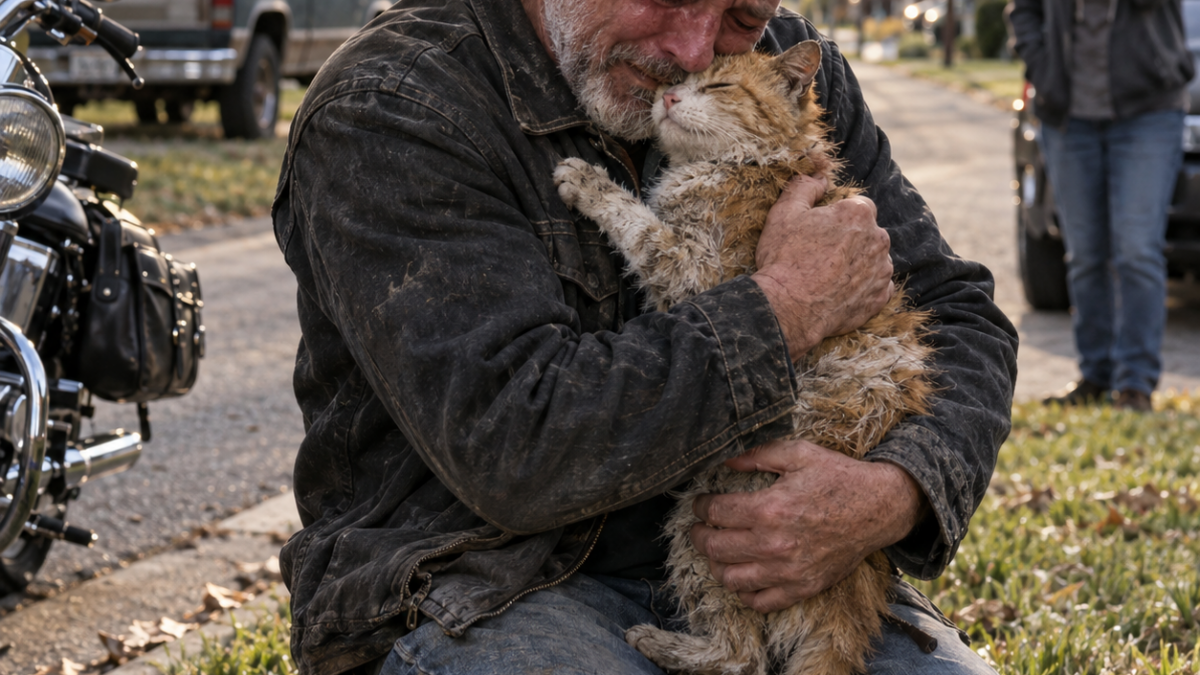
He reached me before I could stand and launched himself at my chest with what strength he had left. I caught him clumsily, falling backward onto the grass beside the curb. He dug his claws into my shirt, buried his head under my chin, and started purring.
Loud.
Immediate.
Familiar.
I had forgotten how strong that purr was.
No, that is not true.
I had remembered it every day and thought memory had made it larger than life.
It had not.
His whole thin body vibrated against me.
I wrapped both arms around him and held on.
He smelled terrible.
Dirt, oil, damp fur, old leaves, survival.
I did not care.
I sat beside the road with my filthy, skeleton-thin cat pressed to my chest and cried like a child.
I am not ashamed of that.
I cried because I had been holding 437 days inside my ribs, and suddenly the door opened.
I cried for every false sighting.
Every flyer.
Every unanswered whistle.
Every night Marla stood at the sink pretending not to listen for paws.
Every morning the couch stayed empty.
Otis purred through all of it, head tucked under my chin as if no time had passed, as if he had simply been delayed.
A car slowed.
Someone asked, “Sir, are you okay?”
I could not answer properly.
I waved them on.
Then I fumbled my phone from my pocket and called Marla.
She answered on the second ring.
“Dean?”
I tried to speak.
What came out was a sound.
“Dean? What happened?”
“I need you to come here.”
My voice broke so badly she panicked.
“Are you hurt?”
“No.”
“Where are you?”
“I’m sending the location.”
“Dean, what is going on?”
I looked down at the orange head pressed beneath my chin.
“It’s Otis.”
Silence.
Not disbelief.
Not joy.
A stunned, empty silence.
Then Marla whispered, “Don’t say that if you’re not sure.”
“I’m sure.”
“Dean.”
“I whistled. He came.”
I heard her inhale.
Then movement.
Keys.
A chair scraping.
“I’m coming.”
While I waited, I took off my jacket and wrapped Otis in it. He resisted weakly until he realized warmth was involved, then tucked himself inside like he had invented jackets. I sat in the grass beside the old truck, one hand on his back, afraid if I stopped touching him he would vanish again.
He was so thin.
That became clearer as the shock settled enough for me to see properly. Beneath the dirt, his frame felt fragile. His shoulder blades too sharp. Spine ridged under my palm. Fur patchy near the tail. His paws were rough. One claw broken. His whiskers uneven. His eyes watery but bright.
Alive.
Alive.
Alive.
I kept thinking the word like prayer.
Marla arrived twelve minutes later, though she said she had no memory of the drive.
Her car pulled to the curb behind my bike. The driver’s door opened. She stepped out, saw me sitting in the grass with the jacket bundle, and stopped.
Her hand went over her mouth.
“Dean?”
Otis lifted his head.
For a moment, he did not move.
I saw the fear on Marla’s face.
The terrible fear of hope standing right in front of her and still maybe being taken away.
Then she whispered, “Otis.”
His ears turned.
She took one step closer.
“Otis, baby.”
He pulled himself out of my lap, stumbled once, then ran to her.
Marla dropped to her knees so fast I thought she hurt herself.
Otis climbed into her arms.
She made a sound I had never heard from her before, something between a laugh, a sob, and a wound opening after too long.
She buried her face in his filthy fur.
“My baby,” she kept saying. “My baby. My sweet boy. Where have you been?”
Otis purred against her neck.
He remembered her.
Of course he remembered her.
After 437 days, we had no idea if he was alive.
Otis did not need 437 seconds to know he was home.
Getting him into the car took effort because Marla did not want to let go, and Otis did not want to be put down. I loaded my bike into the trunk as badly as physics allowed, then sat in the back seat with Otis wrapped in my jacket while Marla drove to the nearest emergency vet with tears streaming down her face.
She kept glancing in the mirror.
“Is he breathing okay?”
“Yes.”
“Is he looking at you?”
“Yes.”
“Does he seem hurt?”
“He’s tired.”
“Talk to him.”
“I am touching him.”
“Talk to him, Dean.”
So I did.
“Hey, old man,” I whispered. “You caused a lot of trouble.”
Otis blinked slowly.
“You better not have joined a gang.”
His paw flexed against my sleeve.
“You owe your mother an apology.”
Marla laughed and cried harder.
At the veterinary clinic, the tech at the desk took one look at us and moved quickly.
“We found our cat,” Marla said, though nobody had asked yet. “He’s been missing over a year.”
The tech’s face softened.
“Oh my goodness.”
They scanned him for a microchip.
We held our breath.
The scanner beeped.
Our information came up.
Otis Holloway.
Male neutered domestic shorthair.
Orange and white.
Marla covered her face.
The vet, Dr. Singh, examined him while we hovered uselessly.
“He is severely underweight,” she said gently. “Dehydrated. Flea burden. Some skin irritation. Broken claw. Mild upper respiratory infection. But I don’t feel any obvious fractures, and his heart and lungs sound better than I expected.”
Marla gripped my hand.
“He’ll be okay?”
“With food, fluids, medication, parasite treatment, and careful monitoring, I’m optimistic.”
Optimistic.
That word felt like sunlight after a year underground.
Dr. Singh warned us not to overfeed him immediately. Refeeding a starved animal too quickly could be dangerous. Small meals. Frequent. Prescription food. Follow-up bloodwork. Keep him warm. Watch for vomiting, lethargy, breathing issues. Call if anything changed.
I nodded like I understood, then forgot half of it immediately because Otis looked at me from the exam table and gave the weakest little meow.
Marla said, “We need it written down.”
Dr. Singh smiled.
“I’ll write everything down.”
Before we left, she said, “Do you want to update his microchip notes?”
“What notes?” I asked.
“Just that he was recovered after being missing. It helps shelters track reunions.”
Marla looked at me.
“Recovered,” she whispered.
Then she started crying again.
We brought Otis home just after dark.
That drive felt impossible.
For 437 days, every return home had included the tiny unconscious disappointment of Otis not being there. Now he was in a carrier on Marla’s lap, wrapped in a towel, making small irritated sounds because apparently emergency medical care had restored his ability to complain.
At the house, I opened the front door.
Marla carried the carrier inside and set it down in the living room.
We had prepared nothing.
No welcome home setup.
No fresh bed.
No special food bowls out.
We had not dared keep the house ready in that visible way.
But the moment I opened the carrier, Otis stepped out like a tiny old man returning from war.
He stood in the center of the room.
Sniffed.
Slowly.
The coffee table.
The rug.
The corner near the bookshelf.
His old scratching post, still in the guest room because I had never found the courage to throw it away.
He walked toward the kitchen, paused where his food bowls used to sit, then looked back at us.
Marla laughed through tears.
“Of course.”
I prepared the tiny amount of food Dr. Singh allowed.
Otis ate like he wanted to devour the bowl itself, but we paced him carefully. He growled once when I took it away, then seemed surprised by his own rudeness and pressed his head into my hand.
After he ate, I placed a folded blanket on the living room floor.
“I thought he might want somewhere low,” I said.
Marla nodded.
Otis sniffed the blanket.
Ignored it.
Walked to the couch.
We both froze.
He gathered himself, weak legs trembling, and jumped.
He did not make it cleanly.
I lunged forward, but he scrambled up with stubborn dignity, glared at me as if I had doubted him, then climbed onto the back cushion beside the front window.
The exact spot that had been empty for more than a year.
He turned around twice.
Slowly.
Then curled into a ball.
His orange body fit into the hollow we had left without meaning to.
Marla covered her mouth.
“He remembers.”
I nodded.
My voice barely worked.
“Yeah,” I whispered. “He remembers.”
That night, neither of us slept much.
Otis slept.
Deeply.
He twitched in dreams, paws moving, whiskers flickering. Twice he woke with a start and lifted his head, as if expecting danger. Each time, Marla whispered his name, and he settled again.
We slept on the couch near him like nervous parents with a newborn.
At 3:12 a.m., he woke, climbed down carefully, and came to me.
He stepped onto my chest.
Lighter than before.
Too light.
Then he stared at my face.
It was not 5:42.
I did not care.
“Hey,” I whispered.
He pressed his forehead to my chin.
I cried again, quieter this time.
Recovery was not instant.
People like happy endings clean, but real returns bring their own work.
Otis had to relearn abundance.
For the first week, he panicked when food disappeared, even when more was coming. He tried to bury bits of kibble under towels. He drank too fast and vomited once, sending both of us into terror so intense Marla called the vet while I held him like he had broken again.
He slept more than he used to.
He startled at loud trucks.
He hissed at the back door for no reason we could see.
He refused to enter the garage.
That hurt.
I wondered if he remembered slipping out there. Wondered if he had spent part of those 437 days trying to find his way back and failing. Wondered if he had been trapped somewhere. Taken in somewhere. Chased. Lost. Fed. Hurt. Helped. Ignored.
We never found out.
I posted the reunion on the lost-pet pages because I had promised myself I would if the miracle ever came.
FOUND AFTER 437 DAYS. OTIS IS HOME.
I included a photo of him curled on the couch, thinner, rougher, but alive.
The response overwhelmed us.
Hundreds of comments.
People crying for a cat they had never met.
People saying they remembered his flyers.
People sharing stories of pets found after weeks, months, years.
People still searching, writing, “This gives me hope.”
One woman messaged privately to say her cat had been missing two years and she had almost taken down the porch bed that morning, but now she would leave it one more week.
I sat at the kitchen table reading messages until my eyes burned.
Marla put her hand on my shoulder.
“You okay?”
“No.”
“Good no or bad no?”
“Both.”
She leaned down and kissed my head.
“That sounds about right.”
Three days after Otis came home, a woman named Elaine called.
She lived near the upholstery shop where I found him.
“I saw your post,” she said. “I think I know your cat.”
My hand tightened around the phone.
“What do you mean?”
“There’s been an orange cat around our block for months. Skittish. Wouldn’t come close. We left food out sometimes. My neighbor did too. We called him Rusty.”
Rusty.
I looked toward the living room where Otis slept with one paw over his face.
“How long?”
“Since maybe winter? I’m not sure. He disappeared sometimes. We thought he was feral.”
“He was six and a half miles from home.”
“I know. I’m sorry we didn’t scan him.”
“No,” I said quickly. “You fed him. You helped keep him alive.”
Her voice broke.
“He never let us touch him.”
“He barely let most people look at him before.”
She laughed softly.
“That tracks.”
Elaine told me Otis had been living around that street for at least several months, maybe longer. Sleeping under porches, in an old shed behind the upholstery shop, sometimes beneath the green truck. A retired man put out food near his garage. A teenager tried to trap him once, but Otis avoided it. During a cold snap, someone made a shelter from a plastic tote and straw.
I wrote down every name.
Every address.
Every person who had left food, water, shelter.
Then Marla and I made thank-you cards.
Real ones.
Handwritten.
We delivered them two weeks later with cookies Marla baked and small bags of coffee from a local roaster.
Elaine cried when she saw updated pictures.
The retired man, Mr. Pruitt, said, “Well, I’ll be damned. Rusty had people.”
“He did,” I said. “He just couldn’t find us.”
Mr. Pruitt looked away.
“Glad he did.”
The teenager who tried to trap him apologized.
“I thought maybe he needed a shelter,” she said.
“He did,” Marla told her. “You were trying to help.”
That day helped me in a way I did not expect.
I had spent so long imagining Otis alone that learning strangers had cared for him felt like a missing piece of mercy. He had suffered, yes. He had been hungry, yes. But he had not been invisible to everyone. Kindness had found him in fragments until I found him whole enough to bring home.
A month after his return, Otis gained almost two pounds.
His fur improved.
The dullness lifted from his coat, and orange came back like sunrise through fog. The white raindrop beneath his chin turned bright again. The notch above his eye remained. His tail regained its ridiculous little hook.
His personality returned in stages.
First came complaining.
Then stealing Marla’s chair.
Then knocking a pen off my desk while looking directly at me.
The day he tried to take a bite from my turkey sandwich, I nearly applauded.
Marla said, “Do not encourage theft.”
“He’s healing.”
“He is stealing.”
“Emotionally significant stealing.”
Otis chewed the turkey with the solemn satisfaction of a survivor reclaiming his rights.
The couch changed too.
At first, we approached that window spot like it might reject us. But Otis made it ordinary again simply by occupying it. He slept there every afternoon, thinner but stubbornly present, and the room rearranged itself around his return.
One evening, Marla sat beside the window with a cup of tea.
For the first time in 437 days.
Otis stretched one paw and rested it against her shoulder.
She closed her eyes.
I did not speak.
Some moments are too delicate for words.
As months passed, people asked if we were angry we never knew where he had been.
At first, yes.
I wanted the whole map.
I wanted to know which way he turned that first night. How far he went. Where he slept. Who scared him. Who fed him. Whether he tried to come home. Whether he heard me calling in those first weeks. Whether he ever stood near our street and got confused. Whether he remembered the whistle before the day I found him or only in that moment.
I wanted answers because answers feel like control.
But animals do not owe us stories in human order.
Otis came home with his body, not his diary.
Eventually, I stopped needing to know every mile.
I knew enough.
He survived.
He remembered.
He came when I whistled.
That became the whole miracle.
Our life did not go back to exactly what it had been.
It became something altered.
More careful.
More grateful.
Otis was no longer allowed near any exterior door without one of us blocking like a football lineman. We checked window screens obsessively. We updated his microchip, bought a GPS collar he hated, and placed a bright tag on him though he remained strictly indoors.
He learned the sound of the treat drawer again.
He resumed his 5:42 a.m. chest patrol.
He yelled at birds through the window.
He sat on my newspaper.
He ignored the expensive cat bed we bought to celebrate his return and slept in the cardboard box it shipped in.
Every night before bed, I whistled softly from the living room.
Two short notes.
One long.
At first, he came every time, quickly, as if afraid delay might undo something.
Later, he grew casual again. A slow trot. A pause to stretch. Sometimes an annoyed chirp because apparently being summoned was beneath his rank.
That casualness felt like healing too.
He no longer ran like he had to prove he was still ours.
He simply knew.
One year after the day I found him, we drove back to the old upholstery shop.
I brought Otis in a carrier.
Marla thought it might be too much, but I needed to stand there differently. Not searching. Not collapsing on the grass. Not shaking beside an old truck with a jacket full of bones and purrs.
The green pickup was gone.
The building had been sold.
Someone had painted the front door red.
We parked at the curb.
I set the carrier on the grass where I had sat that day.
Otis looked out through the mesh, unimpressed.
“Do you remember?” I asked him.
He blinked.
Marla smiled.
“That means yes, no, or feed me.”
“Likely all three.”
I whistled.
Two short notes.
One long.
Otis’s ears perked.
He looked at me through the carrier.
Then he meowed.
Strong.
I reached through the opening and touched his head.
“Good boy.”
Marla leaned against my shoulder.
For a while, we stood there in the Tennessee sun, remembering the day hope stopped being painful long enough to become real again.
I know not every missing-pet story ends like ours.
That truth matters.
Some families search for years and never receive the call, the sighting, the miracle. Some leave bowls by doors until raccoons find them. Some keep collars in drawers. Some never know. Some cannot bear to hope anymore, and I understand them completely.
I would never tell anyone, “Don’t give up,” like a command.
That can be cruel.
People survive uncertainty however they can.
But Otis taught me that hope does not always look like optimism.
Sometimes hope looks like avoiding one cushion on the couch because admitting it is empty would hurt too much.
Sometimes hope looks like checking beneath one more parked car even when you are tired of being wrong.
Sometimes hope is a water bowl by the back door.
Sometimes it is a stack of faded flyers in the garage.
Sometimes it is your wife whispering, “I think we have to accept it,” while still keeping the microchip company’s number saved in her phone.
Sometimes it is three little whistles you thought you had retired.
And sometimes, after 437 days, hope looks like a filthy orange cat lifting his head under an old truck with the same white raindrop under his chin.
Otis lived six more years after he came home.
Good years.
Spoiled years.
Years full of sunbeams, stolen turkey, vet checkups he resented, grandchildren learning to pet gently, Marla’s lap, my chest at 5:42, and the couch spot by the window that was never empty again until the very end.
When he finally passed, he was warm, old, safe, and surrounded by the people he had made wait for him.
That grief was terrible.
But it was clean.
We knew.
We held him.
We said goodbye.
Afterward, Marla placed his green mouse on the back cushion by the window.
For one day, the spot hurt the old way.
Then, the next afternoon, sunlight fell across it, and I heard in my memory the sound of paws, the rumble of his purr, the rough little cry he made when he came running from under that truck.
I realized then that the couch was not only empty.
It was full.
Full of every afternoon he slept there.
Full of the year we left it waiting.
Full of the night he returned and climbed onto it like a king reclaiming a throne.
Full of proof that love can survive not knowing.
We never got all the answers.
We got Otis.
That was more than enough.
And even now, years later, sometimes when I come through the front door, I pause in the entryway out of habit.
I know he will not come running.
Not this time.
Still, every once in a while, when the house is quiet and the light hits the couch just right, I whistle.
Two short notes.
One long.
Not because I expect an orange cat to appear from the hallway.
Because somewhere inside me, he always does.








