A Wounded Navy SEAL Warned the New Nurse, “He Only Listens to Me”—Then His K9 Stepped Aside When She Said Six Quiet Words.
PART3:
The night staff was fading into that strange hospital quiet that happens when one shift is too tired to speak and the next has not yet become busy enough to forget they are human. Outside, rain still tapped softly against the glass.
I was half awake, floating somewhere between pain and medication, when I heard a voice in the hallway.
“Be careful,” one nurse whispered. “The dog won’t let anyone near him unless the SEAL says so.”
A pause.
Then another voice.
Calm.
Not offended.
Not nervous.
“Then I won’t ask him to.”
I opened my eyes halfway.
Through the glass, I saw her.
Claire Bennett.
I did not know her name yet.
She stood outside room 214 holding my chart, reading quietly under the hallway light. She was maybe in her mid-thirties, dark hair pulled back neatly, face composed in a way that did not look practiced for authority, only shaped by long hours around suffering.
Some medical people entered rooms as if they owned recovery.
Claire did not.
She glanced through the glass.
Atlas was already watching her.
Their eyes met for less than a second.
Then she looked away.
Not because she was afraid.
Because she understood that staring back would be a challenge.
That was the first thing Atlas noticed.
It was the first thing I noticed too.
Claire stepped inside slowly.
No perfume.
No unnecessary sound.
No quick movement.
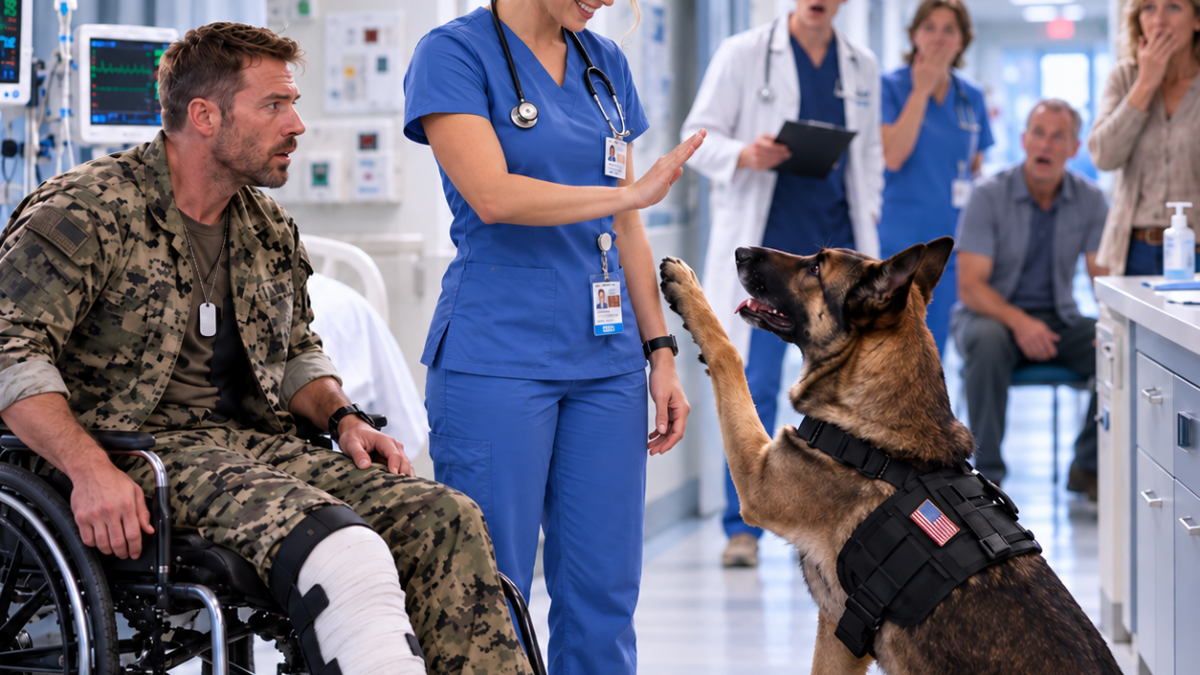
Atlas rose without a bark.
His body aligned between her and my bed.
His shoulders lifted.
His ears fixed.
His gaze never left her face.
Every instinct inside him demanded caution.
Every memory told him strangers often arrived before pain followed.
Claire stopped several feet from the bed.
She did not reach toward me.
Did not extend a hand toward Atlas.
Did not coo at him.
Did not say, “It’s okay, boy,” the way people say when they want to reassure themselves, not the dog.
Instead, she quietly pulled a chair near the window and sat down.
I watched through almost-closed eyes.
Atlas watched too.
Rain tapped the glass.
The monitor beside me kept its patient little promises.
Beep.
Beep.
Beep.
For a long moment, nothing happened.
Claire did not fill the quiet.
She simply existed inside it.
And after several minutes, Atlas lowered his head.
Not much.
Less than an inch.
Not trust.
Not acceptance.
But he chose not to escalate.
In room 214, that was no small thing.
I must have drifted off again, because the next time I opened my eyes, pale dawn had reached the polished floor. Claire was still there by the window. A paperback novel rested unopened in her lap. My chart lay beside her. She was not watching me directly.
Atlas was still standing.
But not tense.
Not the way he had been.
His gaze moved between Claire and me, measuring, deciding, building his own file.
“You’re new,” I said.
My voice came out rough.
Weeks of medication, dry air, and not enough use had sanded it down.
Claire looked at me.
“Claire Bennett. Trauma unit. I started this week.”
I nodded once, then looked at Atlas.
“He didn’t give you any trouble?”
She glanced at him.
“He was only doing his job.”
That was not the answer most people gave.
Most people laughed nervously.
Or said he was intimidating.
Or told me he was “protective” in a tone that made protection sound like a diagnosis.
I managed the faintest smile.
“Most people call security before they say that.”
Claire’s mouth curved slightly.
“I try not to punish loyalty when I see it.”
That sentence stayed with me.
I looked toward the rain sliding down the window.
“Atlas was never trained to trust quickly.”
“How long have you been partners?”
My hand shifted on the blanket.
Atlas immediately lowered his head to the edge of the mattress, as if the movement itself answered for us.
“Almost six years.”
My voice softened without permission.
“I met him at Lackland. He was barely two. Everybody wanted the fastest dog or the strongest dog. Atlas stayed in the back of the kennel watching everything without making a sound.”
Claire listened.
She did not write anything down.
That mattered more than I expected.
“The trainers warned me he was stubborn,” I continued. “Said he questioned every command before following it.”
“What did you say?”
“I told them I preferred a dog that thought for himself.”
A quiet laugh escaped me.
It surprised us both.
“The first week, he ignored me twice, stole my gloves once, and refused to get into the transport truck.”
Claire smiled.
“What changed?”
I looked at Atlas.
He closed his eyes for one brief second, then opened them again.
“I stopped trying to make him obey,” I said. “I earned his respect instead.”
The room went quiet.
Not empty quiet.
Full quiet.
I told her things I had not meant to tell a new nurse.
Training days under Texas heat.
Dusty obstacle courses before sunrise.
Runs that began in darkness and ended with both of us breathing hard under a sky turning gold.
Long evenings sitting side by side after exercises were over, saying nothing because nothing needed to be said.
Somewhere between those ordinary moments, commands became conversations.
Discipline became trust.
Atlas learned the slightest change in my breathing. Every shift in posture. Every glance that meant danger, wait, move, stay, safe.
I learned the meaning behind every tilt of his ears and every silent pause before movement.
Claire listened like she understood that I was not telling her a story about a man and a dog.
I was telling her how we survived each other.
When I finished, Atlas lifted his head and looked toward Claire again.
This time there was no warning in his amber eyes.
Only careful curiosity.
As if he had started asking himself a question he had never considered before.
Could someone else be allowed inside the circle?
That afternoon, therapy began.
I knew what the rehabilitation specialist wanted before he said a word. He entered with a lightweight walker, a calm smile, and the emotional brightness of a person about to ask you to do something that would feel humiliating.
The next step in recovery.
That was how they phrased it.
Steps.
Progress.
Milestones.
I hated milestones.
Milestones were just reminders that my body now needed applause for things I used to do while carrying seventy pounds of gear.
I sat upright slowly. Fatigue settled over me like wet wool.
Atlas stood immediately.
He moved closer until his shoulder rested beside the bed.
The therapist smiled.
“He knows before any of us do.”
I nodded.
“He always has.”
Claire adjusted the IV line, then stepped back without crowding me. She had learned quickly that I valued space almost as much as silence.
The first attempt to stand lasted only a few seconds.
Pain flared.
Strength failed.
My vision tightened at the edges.
I sat back down with a sharp breath.
No frustration crossed Claire’s face.
That helped.
Most encouragement is heavy when you are already disappointed.
She only offered a cup of water and waited.
The second attempt lasted longer.
Atlas stood perfectly still, watching every movement. He did not pull forward. Did not distract me. Did not whine.
Finally, I managed three careful steps.
Three.
Then I lowered myself back onto the bed with sweat across my forehead and anger burning behind my teeth.
“That is enough for today,” Claire said gently.
I looked down.
“I should have done better.”
“No.”
I hated how quickly she said it.
Not harshly.
Firmly.
“Healing is not measured by distance,” she said. “Sometimes it is measured by deciding to try again tomorrow.”
I looked away toward the window.
Two sparrows landed briefly on the hospital courtyard fence before flying off together.
“I used to believe every problem had a mission,” I said. “Every mission had an objective. Every objective had a deadline.”
Claire stood beside the bed.
“Recovery does not seem to care about deadlines.”
“No,” she said softly. “Neither does trust.”
I looked at Atlas.
He had settled back onto the floor, but his eyes followed Claire with calm curiosity instead of suspicion.
Small change.
Almost invisible.
But I knew my dog.
When Claire crossed the room to adjust the blinds, Atlas tracked her movement without tensing.
When she returned with a fresh blanket, he remained where he was.
It was the first afternoon since my admission that another person could move freely in the room without his silent resistance.
Claire unfolded the blanket and placed it over my legs.
She did not reach for Atlas.
Did not call his name.
Did not attempt to win him.
Respect came before affection.
By evening, the hallway lights dimmed and the familiar chorus of rolling carts and quiet conversations faded. I drifted toward sleep while the monitor kept its rhythm beside me.
Claire gathered her notes and moved toward the door.
Just before she left, I saw Atlas’s tail move once against the polished floor.
Not excitement.
Not surrender.
The smallest possible greeting.
Claire noticed.
She paused in the doorway and smiled quietly.
She did not make a big deal out of it.
That was why it mattered.
The following morning arrived wrapped in sunlight instead of rain.
For the first time in weeks, I slept longer than two hours at a stretch. When I opened my eyes, the tight lines in my forehead had softened. The restless dreams that usually chased me through the night had stayed away.
Atlas lay curled beside the bed, one ear lifting the moment footsteps approached.
Claire entered carrying breakfast on a rolling tray.
“Good morning,” she said.
“Morning.”
“You always wake up before I can pretend I’m bringing a surprise.”
“I can smell hospital eggs through concrete.”
She laughed quietly.
“Then I’ll blame the kitchen.”
Atlas watched the exchange in silence.
Claire placed the tray beside the bed, arranged everything within reach, then stepped back. She never hovered. Never rushed.
Her patience filled the room more completely than words.
While I ate slowly, she reviewed the therapy schedule.
Every small improvement mattered to her.
Another five steps.
A steadier heartbeat during rehabilitation.
Longer periods without fatigue.
They were ordinary victories to most people.
To me, they felt like negotiating with a body that had become suspicious of its own survival.
After breakfast, Claire noticed a worn leather pouch inside my bedside drawer.
I followed her gaze and reached for it.
Inside was an old photograph.
Texas.
Dust.
Sun.
A younger version of me kneeling beside Atlas during our first months together.
He was leaner then.
So was I.
Both of us looked covered in dirt and stupid pride.
Atlas lifted his head at the sight of the picture and gently rested his nose against my arm.
“That was the day we completed certification,” I said.
Claire studied the photograph.
“You both look proud.”
“I think he was prouder than I was.”
“Maybe he already knew what the two of you would become.”
For several peaceful minutes, we spoke about simple memories instead of injuries.
Atlas stealing baseball caps when he wanted attention.
Long drives with the windows down.
Country music filling the truck.
Dust in my teeth.
His first time refusing a command because he detected something I missed.
Stories with no fear in them.
Only warmth.
Claire noticed, I think, that when I remembered ordinary moments, my shoulders relaxed.
Healing sometimes arrives disguised as memory.
Then the door opened.
A volunteer entered pushing a cart of therapy supplies.
The interruption cut the room clean in half.
Atlas stood instantly.
Alert.
Controlled.
Eyes fixed on the stranger.
Claire thanked the volunteer, accepted the supplies herself, and wished him a pleasant morning before he continued down the hall.
Only after the stranger disappeared did Atlas settle again.
But something had changed.
During the exchange, he had not looked to me first.
He had looked to Claire.
Only for a heartbeat.
Just long enough to ask, in the silent way dogs ask things:
Is this all right?
I saw it.
Claire saw it too.
She did not mention it.
Trust was no longer growing in one direction.
Atlas had started including her in the small circle he had spent six years protecting.
That evening, the hospital settled into its familiar rhythm.
Outside the windows, the sky turned deep navy. A cool breeze stirred the maple trees below, sending dry leaves across the courtyard like little boats.
Inside room 214, only the bedside lamp remained on.
Atlas rested with his head stretched between his paws.
I had finished a therapy session that afternoon. Exhaustion weighed on me, but the frustration that had followed me since admission had begun to weaken. Not disappear. Just loosen.
Claire returned near the end of her shift carrying a small cup of chamomile tea for me and a fresh bowl of water for Atlas.
I looked at the tea.
“You always seem to know what people need before they ask.”
She placed the water beside Atlas.
“Sometimes people tell you without speaking.”
I glanced at my dog.
“He’s been doing that his entire life.”
Atlas stood, walked to the bowl, and drank calmly while Claire remained in the room.
Another change.
A few days earlier, he would never have turned his back on her.
Now he trusted that nothing harmful would happen while he drank.
It was a tiny victory no chart would ever record.
The quiet evening continued for another ten minutes.
Then my chest tightened.
Not dramatically.
Not enough to set off every alarm.
Just wrong.
My breath shortened.
My body went cold in that old familiar way that tells you something has shifted before your mind can label it.
I pressed one hand against my chest and closed my eyes, trying to slow everything down.
Claire noticed immediately.
She set her clipboard aside and stepped toward me without panic.
Atlas was faster.
He rose and positioned himself between me and the approaching nurse.
His body remained perfectly still.
Not aggressive.
Not threatening.
Determined.
The message was clear.
You do not reach him unless I allow it.
Claire stopped several feet away.
One wrong movement could shatter everything she had spent days earning.
She looked directly at Atlas.
Her voice was barely louder than a whisper.
“Atlas.”
He kept his eyes fixed on her.
She did not step forward.
Did not raise her voice.
Did not try to command him like a handler.
She simply spoke again.
“Help me take care of him.”
The room became so quiet even the hallway clock sounded loud.
I sat there breathing carefully, one hand at my chest, Atlas frozen between us.
For a long second, nothing changed.
Then Atlas looked back at me.
Back to Claire.
Back to me.
His ears shifted.
His whole body seemed to make a decision.
Slowly, cautiously, he stepped to one side.
One step.
That was all.
But it opened a path to my bed.
Claire moved forward at once.
Calm hands.
Pulse.
Oxygen.
Positioning.
She adjusted the bed, helped me settle, monitored my breathing, and within a minute the tightness began to release.
“Just overdid therapy,” I managed.
A weak apology disguised as explanation.
Claire nodded.
“Your body is asking for rest. That is not failure. That is healing.”
I looked at Atlas.
He had resumed his place beside the bed. Alert, but no longer tense.
I reached down slowly and rested my hand against his neck.
“Did you let her help me?” I whispered.
He leaned into my hand, then lifted his eyes toward Claire.
That was when I understood.
Something far greater than obedience had happened.
Atlas had not disobeyed me.
He had not chosen someone else over me.
He had done what he had always done.
Protected me.
Only now, protection meant making room.
The guardian who had trusted one person for six years had quietly admitted another heart into the promise he had sworn to keep.
The days that followed were different.
Not dramatic.
Real healing rarely announces itself with music.
It arrives in ordinary rhythms.
Morning coffee.
Sunlight on tile.
Nurses greeting each other in hushed voices.
A therapist smiling when I managed two more steps than yesterday.
An elderly veteran down the hall laughing at a joke everyone had already heard.
Claire came each morning with the same calm smile and steady patience. She celebrated every extra step, every deeper breath, every night without restless dreams.
Atlas noticed all of it.
He watched how my shoulders relaxed when she entered.
He watched her hands.
Her pace.
The distance she kept when I needed it.
The way she never asked for trust she had not earned.
Little by little, the invisible space between them became smaller.
One afternoon, while I completed therapy in the rehabilitation gym, Claire remained with Atlas in the hospital courtyard.
I saw them later through the glass before either noticed me.
Autumn had reached its brightest colors. The maple trees burned crimson and gold. A cool breeze carried the scent of fallen leaves and damp grass.
Claire sat on a wooden bench with a paperback novel in her lap.
Atlas sat beside her.
Posture disciplined.
No longer tense.
She did not reach for him immediately.
That was her way.
She let silence speak first.
After several minutes, Atlas stood and moved closer.
Claire looked at him with a warm smile, then returned to her book.
A squirrel darted across the brick path. Atlas glanced at it, then calmly returned his attention to Claire.
Then she dropped a soft tennis ball from her jacket pocket.
It rolled a few feet and stopped against the bench leg.
Atlas looked at the ball.
Then at her.
Claire nodded once.
“If you feel like it.”
He walked to the ball, picked it up gently, and returned it without hesitation.
Claire accepted it with a quiet laugh.
“Thank you, Atlas.”
They repeated the little game twice more before I emerged from the therapy building using my walker.
I stopped.
Atlas stood beside Claire with relaxed ears, calmly waiting for the next throw.
I could hardly believe it.
Six years together had taught me Atlas did not accept new people easily. Yet there they stood beneath golden autumn trees, sharing something as simple and impossible as trust.
I approached slowly.
Atlas trotted to me and leaned gently against my leg, then looked back toward Claire as if inviting us both into the same moment.
I shook my head with a soft laugh.
“I guess you’ve made your decision, buddy.”
Claire looked slightly embarrassed.
“I didn’t teach him anything.”
I rested my hand on Atlas’s neck.
“That’s exactly why he believes you.”
As we walked together toward the hospital entrance—me with the walker, Atlas matching my pace, Claire beside us with the therapy schedule—several staff members paused to watch.
They smiled not because they had seen a trick.
Not because a service dog had obeyed a new command.
Because they had witnessed something rarer.
A wounded man was no longer carrying recovery alone.
And the loyal guardian who once protected only one heart had chosen to protect two.
The final week of rehabilitation arrived with the gentle confidence of early November.
Crisp air drifted through the hospital doors whenever they opened, carrying the scent of pine, damp earth, and fresh rain. Sunlight reflected across the glass walls of the rehab center, filling the halls with warm gold.
The nurses noticed changes before I did.
I no longer stared out the window for hours.
I greeted people by name.
I laughed more easily.
The heaviness that had followed me from room to room began to lift.
Claire noticed something else.
Atlas no longer placed himself between me and everyone who approached.
Instead, he walked beside me, occasionally glancing back toward Claire as though making sure she was still following.
It became a routine none of us planned.
None of us wanted to change it.
One afternoon, the rehabilitation director arranged a mobility assessment inside the hospital’s indoor recovery garden. It was a peaceful space with flowering shrubs, stone pathways, wooden benches, and soft fountains surrounded by glass.
The assignment was simple.
I would complete the course using a cane instead of a walker.
For the first time.
The therapists stood at a respectful distance.
Claire waited near the end of the path.
Atlas remained beside me, focused but relaxed.
I took a slow breath.
The first steps were careful.
Every movement demanded concentration.
Atlas matched my pace perfectly, never pulling ahead, never falling behind.
Water moved gently in the fountain.
Birdsong filtered from speakers hidden somewhere above.
Halfway through the path, I paused.
Not because of pain.
Because uncertainty returned.
One wrong step.
One buckle.
One fall.
One reminder that my body was still not the machine I remembered.
My grip tightened around the cane.
Atlas looked up at me and waited.
Claire did not rush forward.
She only smiled with quiet reassurance.
“You’re already farther than you believed you could be.”
I looked from her to Atlas.
The German Shepherd stood completely still, calm amber eyes reflecting the same unwavering trust we had shared for years.
I smiled softly.
“All right, partner.”
Another step.
Then another.
Soon hesitation disappeared beneath growing confidence.
When I reached the end of the path, the therapists applauded quietly.
Then I laughed.
A genuine laugh.
It echoed through the garden and startled me more than the applause.
Before anyone expected it, Atlas turned away from me and walked directly to Claire.
He gently pressed his head against her hand and waited.
Claire stroked the side of his neck with the same quiet respect she had shown from the beginning.
I watched them together.
For a long moment, I said nothing.
Then I understood what had been happening all along.
“I spent years believing he trusted only me because I protected him,” I said.
Claire looked at me.
I rested one hand on Atlas’s back.
“Now I understand the truth.”
She waited.
“He trusts the people who protect the ones he loves.”
The words settled over the garden like the last golden leaves drifting outside.
Atlas looked from me to Claire.
His tail moved slowly against the stone path.
Then he stepped between us.
Not to separate us.
To walk with both.
For the first time since entering the hospital, I realized I had not lost the strongest bond in my life.
It had grown large enough to welcome another heart beside it.
Two mornings later, the discharge date appeared across my chart in neat blue ink.
A single line on paper.
But everyone who had walked beside me knew how much fight was hidden behind it.
Outside, the hospital grounds shimmered beneath a clear autumn sky. A gentle breeze carried cedar and fallen leaves through the courtyard. Sunlight reflected from the windows like quiet reminders that every season eventually changes.
Inside room 214, I folded the last of my clothes into a worn canvas duffel.
My movements were slower than before the injury.
But no longer uncertain.
The cane rested against the chair.
I still needed it.
Just not as much as I feared.
Atlas watched from beside the door, ears lifting whenever someone passed in the hallway, body relaxed.
The room that had first felt like a place where life paused had become a place where healing learned to breathe.
Claire entered carrying final paperwork and a small envelope.
“Everything is ready,” she said.
I accepted the documents.
“What’s that?”
She hesitated.
“The therapy team asked everyone who worked with you to write something you could take home. Nothing official. Just a few thoughts.”
I opened the envelope carefully.
Inside were handwritten notes from physical therapists, nurses, physicians, volunteers, and even the cafeteria employee who always remembered Atlas deserved a plain piece of grilled chicken after difficult therapy days.
Some messages were one sentence.
Others filled whole cards.
I read them quietly.
One note stopped me.
Recovery is never about becoming who you were. It is about discovering who you are now.
I folded it carefully and placed it inside the same leather pouch that held the old photograph from Texas.
“Thank you,” I said.
The words carried more emotion than volume.
Claire nodded.
“You earned every word.”
A gentle knock interrupted us.
Several members of the rehabilitation staff had gathered outside the room.
No speeches were planned.
No ceremony announced.
They had simply come to say goodbye.
I stood with the cane in one hand.
Atlas moved naturally to my left side.
One by one, staff members shook my hand, offered smiles, quiet laughter, promises to keep in touch. Atlas accepted every farewell with calm dignity, even allowing gentle scratches behind his ears from people he now recognized as friends.
Claire stepped forward last.
She knelt beside Atlas instead of speaking immediately.
Atlas walked toward her without hesitation and rested his head softly against her shoulder.
Several nurses smiled, remembering the first morning when he would not let anyone near the bed.
Claire whispered, “Take good care of him.”
Atlas answered with the smallest wag of his tail, then stepped back beside me.
I looked at both of them.
“You know,” I said, “I used to think healing meant learning to stand on my own again.”
I glanced toward Atlas.
Then met Claire’s eyes.
“Now I think healing is remembering none of us were ever meant to stand alone.”
Together, we walked down the long hallway toward the hospital entrance.
Sunlight poured through the glass doors ahead.
The polished floor reflected three quiet figures moving side by side.
One carried a cane.
One walked on four steady paws.
One simply stayed close enough that neither of us had to wonder if someone was there.
And somehow, without anyone saying another word, the journey that had begun with guarded hearts already felt like the beginning of something stronger than recovery.
Winter arrived quietly a few weeks later.
A soft snowfall wrapped my small home in stillness. Frost rested on the wooden fence. Thin ribbons of smoke drifted from neighboring chimneys into a pale morning sky. The world moved slower there, free from the endless rhythm of hospital monitors and hallway lights.
Inside, sunlight spilled across hardwood floors.
Atlas stretched beside the fireplace, amber eyes following me as I made breakfast with steady hands.
The cane rested in the corner more often now than in my hand.
Recovery had not erased every ache.
It had not erased the operation.
Or the faces I remembered.
Or the nights when my body woke before my mind and searched for danger in an empty room.
But it gave me something stronger than pretending.
It returned the simple joy of ordinary mornings.
After breakfast, I clipped Atlas’s leash in place, though both of us knew he barely needed it.
We walked through the neighborhood, fresh snow softening every sound beneath boots and paws. Children laughed while building snowmen. Elderly neighbors waved from porches wrapped in blankets.
People smiled when Atlas greeted them calmly.
The world no longer felt like something to guard against.
It felt like something worth walking through again.
At the small community park, I noticed a familiar blue pickup near the entrance.
Claire stepped out carrying two cups of hot coffee, cheeks pink from the winter air.
Same quiet smile.
Same patient presence.
“I thought you might enjoy a walk,” she said.
I accepted the warm cup.
“I was hoping you would say that.”
Atlas looked from her to me.
Then stepped naturally between us.
Not out of duty.
Out of contentment.
We wandered slowly beneath bare oak trees, their branches reaching toward the bright winter sky like silent prayers. Our conversation moved from books to childhood memories, holiday traditions, bad cafeteria coffee, and dreams that had seemed impossible during the hardest days of recovery.
Nothing needed to be hurried.
Some bonds grow strongest in ordinary moments no one else would notice.
We stopped beside a frozen pond where sunlight shimmered across the ice like scattered glass.
Atlas stood at the edge, ears lifted toward geese flying overhead.
For a long moment, none of us spoke.
Then I reached into my coat pocket and removed the old photograph from Texas.
Younger me.
Younger Atlas.
Dust.
Pride.
A life I thought I had lost.
“I spent a long time believing he was carrying me through life,” I said.
I folded the photograph and slipped it back into the pouch.
“Now I think he was leading me toward the people I still had left to meet.”
Claire looked at Atlas, then at me.
“Sometimes the strongest hearts don’t protect us by keeping everyone else away,” she said. “Sometimes they protect us by showing us who deserves to come closer.”
Atlas walked back to us then.
He rested his head beneath my hand before leaning briefly against Claire’s shoulder.
The gesture lasted only seconds.
But it carried the weight of every patient step that brought us there.
I looked toward the winter sky and breathed the cold, clean air into my lungs.
For the first time in many years, I smiled without sadness.
Around us, the world remained wonderfully ordinary.
Snow fell in slow silent flakes.
The wind whispered through bare branches.
Three sets of footprints stretched together across the fresh white path.
Side by side.
Disappearing gently into the distance.
And in that quiet morning, I finally understood what Atlas had known before I did.
The deepest kind of loyalty is never afraid to make room for one more heart.








