A Wounded Navy SEAL Found a Frightened German Shepherd Puppy Behind an Abandoned Gas Station—Then the Stray Followed His Crutch All the Way Home and Led Him Toward a Place Everyone Had Forgotten.
PART3:
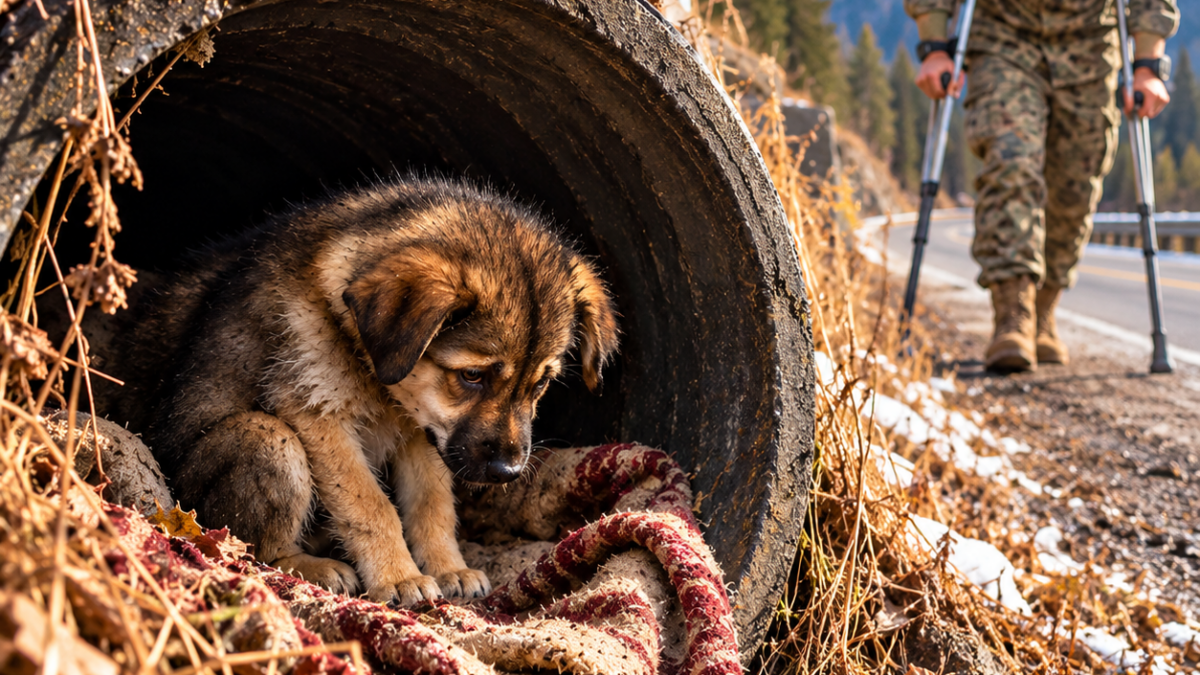
One ear standing upright, the other leaning sideways like it had not made up its mind about the world yet.
He was thin from too many days without proper food, but his eyes were alert.
Dark.
Careful.
He did not bark.
He did not wag.
He did not move toward me.
He simply watched as if every person he had ever known had taught him to expect disappointment.
I stopped several feet away and lowered myself slowly, careful not to make the movement sudden. My leg protested. I ignored it.
The puppy’s body tightened.
“I’m not going to touch you,” I said.
My voice sounded rough from disuse.
“You can stay where you are.”
His gaze moved from my face to the paper bag in my hand.
I opened it and took out a small piece of chicken. Then I placed it on the ground between us and leaned back.
He did not move at first.
His nose lifted slightly.
Testing the air.
I recognized the hesitation.
It was not simply hunger.
It was the fear of approaching something good and discovering that the good thing came with a price.
After nearly a minute, the puppy stretched his neck forward.
Stopped.
Looked at me.
Moved one paw across the dust.
I kept my hand still.
Another paw followed.
He approached the chicken slowly, lowered his head, picked up the piece without taking his eyes off me, and backed toward the crate before chewing.
I placed another piece closer to the shadows.
“That’s all right,” I murmured. “You don’t have to trust me.”
The words surprised me.
Not because they were kind.
Because they sounded like something I had wanted someone to say to me.
For months, people had told me to trust the doctors, trust the process, trust my body, trust that life would eventually become meaningful again.
No one had told me I was allowed to be afraid while learning.
The puppy ate the second piece, then remained still.
I looked at the narrow space inside the crate and imagined choosing a place too small for comfort because it felt safer than the open world.
I understood that more than I wanted to.
I placed the last piece of chicken near him, pushed a shallow cup of water beside the crate, and slowly rose. My leg ached. My hand tightened around the crutch.
“You’ll be all right,” I said quietly.
I was not sure whether I meant the dog or myself.
Then I turned and walked toward the road.
I did not call him.
Did not promise to return.
Did not look back.
I told myself I had done enough for one day.
Behind me, the crate creaked.
A few seconds later, I heard soft paws on broken pavement.
I stopped.
Turned.
The puppy stood several yards away beneath the faded gas station sign, head lowered slightly, like he had been caught doing something forbidden.
I pointed back toward the building.
“Go on,” I said. “That’s where you were.”
He did not move.
I waited, expecting him to lose interest.
He only watched me.
So I continued down the road.
The tapping began again.
Not fast.
Not confident.
He kept his distance, stopping whenever I turned, moving again whenever I faced forward.
At first, irritation rose in me.
I had spent months organizing my life around avoiding responsibility. Now a stray puppy seemed determined to follow me directly into it.
“You don’t know me,” I said over my shoulder. “I could be the worst choice you’ve made today.”
The puppy kept walking.
The road from the gas station curved past a closed hardware store, a row of small houses, and a dry field bordered by wire fence. Cedar Ridge was quiet at that hour. Pine drifted down from the hills. Sunlight softened the windows. My leg forced me to move slowly.
The puppy matched my pace without complaint.
Whenever I stopped to rest, he stopped too.
He did not come close.
But he no longer looked as if he might run.
A delivery truck rolled past an intersection, and the puppy startled backward toward the weeds.
I turned immediately, not toward him, but away, giving him space.
“It’s all right,” I said. “Wait until it passes.”
The truck disappeared around the corner.
After several seconds, he returned to the road.
By the time we reached the lane leading toward my house, the distance between us had shortened. He walked maybe ten feet behind me now, close enough that I could hear his breathing, far enough to preserve an escape route.
I considered calling county animal services.
My phone had weak signal.
The nearest shelter was crowded.
And if I left him alone after dark, it would mean pretending I had not heard him.
I had become too good at pretending.
My wooden house appeared beyond the pines, quiet and unchanged from the morning. I climbed the porch steps one at a time and unlocked the door.
I expected the puppy to remain at the bottom.
When I looked back, he had reached the first step.
I opened the door wider and stood aside.
“I’m not promising anything,” I said. “You can have water, food, and a warm place for tonight. That’s all.”
The puppy lifted one paw onto the porch.
Then withdrew it.
I waited.
The house was silent behind me, evening light stretching across the floorboards.
After nearly a minute, he stepped inside.
He did not explore.
Did not sniff the furniture.
Did not search the rooms.
He crossed the entryway, stopped beside the wall, and lowered himself near the door.
I placed a bowl of water a short distance away and divided the remaining chicken into small pieces. He waited until I turned my back before eating.
I found a clean towel, folded it beside the wall, and left him alone.
For the next hour, I heated soup, took my medication, and tried to read a report from the rehabilitation center. I read the same paragraph four times without understanding it.
Every few minutes, my attention shifted to the entryway.
The puppy remained there, alert even as his eyes began to close.
When I finally turned off the kitchen light, he lifted his head.
“You can sleep,” I said. “Nobody’s coming in.”
He lowered his head again.
But he did not move from the door.
I went to bed without deciding what would happen in the morning.
I told myself the county shelter would take him. Olivia’s clinic could check for an owner. The whole situation would be handled by people more qualified than I was.
Yet before falling asleep, I found myself listening for the soft movement of paws in the next room.
The next morning, the puppy was still there.
He had moved only a few inches from the wall. The food bowl was empty. The water had been disturbed but not overturned.
I stood in the doorway and watched him.
He looked up, then lowered his eyes.
“You need a doctor,” I said.
I did not know whether I meant a veterinarian or myself.
After a quick breakfast, I placed a clean towel inside a cardboard box and carried it to the truck. The puppy hesitated when I opened the passenger door. He looked at the seat, then at the house, as if afraid that entering the vehicle would make the temporary arrangement permanent.
I sat behind the wheel and waited without reaching for him.
At last, he climbed in and curled himself on the towel.
Cedar Ridge Animal Care sat near the middle of town in a modest brick building with green trim and a faded sign hanging above the door. Dr. Olivia Bennett was already inside when we arrived.
I knew Olivia only in passing.
Everyone in Cedar Ridge knew her in passing.
She was in her early forties, practical and warm, with brown hair usually tied back in the patient kind of knot frightened animals seemed to trust before they trusted her hands. Her father had founded the clinic years earlier, and Olivia had kept it alive after his death.
Alive, but not thriving.
The roof needed repairs. Medicine costs had risen. The waiting room chairs were old. The rescue yard behind the building had too many dogs and too little money.
I did not know all of that yet.
I only knew Olivia looked at the puppy beside me and said, “You came back.”
“It followed me.”
“That is not the same thing.”
She glanced at the puppy.
Then at my crutch.
“No,” she said softly. “But it may become important.”
I did not answer.
I placed the box on the floor and stepped away.
The puppy stayed inside until Olivia crouched several feet from it. She spoke quietly, letting him study her before moving any closer.
From the back room, a girl appeared carrying clean towels. Thirteen or so. Olivia’s daughter, Lily.
She stopped when she saw the puppy.
I learned later that Lily had become nervous around sudden noises after a traffic accident the previous year. Larger dogs unsettled her, especially if they moved quickly or barked without warning.
This one did neither.
He stayed still, watching the room with cautious eyes.
Olivia asked Lily to bring a small plate of food. Lily nodded and returned with it, holding the plate carefully in both hands. She placed it on the floor and stepped back.
The puppy did not approach.
Lily waited.
Then moved another step away.
Only then did he leave the box.
He walked toward the food, stopped once to look at me, and continued.
Lily’s face softened with surprise.
She did not reach out.
The puppy did not ask her to.
They simply shared the same quiet space.
Olivia examined him gently. Paws. Ears. Breathing. Teeth. Old scar near the shoulder. Thin body. No collar. No microchip.
“No immediate emergency,” she said. “But he’s gone without proper care for a while.”
She photographed him for a found-animal notice and promised to post the information through the county network.
“If someone is looking for him, they may contact us.”
“And if no one does?”
“Then we can begin the adoption process.”
“I’m not adopting him,” I said.
Olivia looked at the puppy, who had settled near my boot.
“This is temporary,” I added.
“Temporary arrangements can still be meaningful.”
I ignored that.
I completed the found-animal form, provided my address, and agreed to keep him safe while the search continued.
When Olivia asked what name to put on the record, I looked down.
The puppy was no longer watching the door.
He was watching me.
I thought of the way he had followed me across town.
Never rushing.
Never asking for more than the chance to remain nearby.
“Ranger,” I said after a moment.
Olivia wrote it down.
Lily repeated it softly from across the room.
“Ranger.”
The puppy lifted his head.
I looked away before anyone could notice how much that small response affected me.
I still told myself the arrangement would not last.
But when I opened the truck door, Ranger climbed inside without hesitation.
And for the first time since returning to Cedar Ridge, I did not drive home alone.
The first week passed quietly, though the house no longer felt empty in the same way.
Ranger learned the sound of my crutch on the wooden floor, the kitchen cabinet, the slow rhythm of my steps from one room to another. Still, he stayed careful about everything.
He ate only after I turned away.
Slept near the front door.
Kept distance between himself and any object that might move unexpectedly.
I did not try to change those habits.
Trust cannot be demanded because a person has offered food and shelter.
Some mornings I placed his bowl in the kitchen and sat several feet away with my back turned, pretending to read while listening to the faint sound of him eating. When the bowl moved across the floor, I knew he had finished.
I never praised him loudly.
Never made the moment too important.
Too much attention might have sent him back into himself.
I was learning his boundaries while trying to understand my own.
My physical therapist had asked me to practice walking across the living room without putting all my weight on the crutch. The exercise looked simple on paper. In reality, every step required concentration.
I placed three strips of blue tape across the floor. Each strip marked a short distance.
I would stand beside the sofa, breathe slowly, and move toward the first strip.
Ranger watched from the edge of the room.
On the first morning, he remained near the door.
On the second, he moved closer.
By the third, he followed several steps behind, stopping whenever I stopped.
He never crossed into my path.
Never brushed against me.
Never interfered.
He simply kept pace, as if he had decided my slow movements were the natural speed of the world.
At night, I sometimes woke before dawn with a dull ache spreading through my leg. I would sit on the edge of the bed, staring at the dark window, waiting for the discomfort to settle.
Before the injury, I had been trained to ignore pain long enough to complete a mission.
Now I was learning that some pain was information.
That rest did not mean surrender.
I disliked that lesson because it forced me to admit my body had limits.
Ranger would lift his head from the hallway when I moved, but he never came closer without being invited.
The distance between us held an agreement neither of us had said aloud.
Neither would force the other to be ready before the time was right.
On the fourth morning, a dark blue collar sat on the kitchen counter.
I had bought it after leaving Olivia’s clinic, telling myself it was practical. A dog with no identification needed one.
Even if the arrangement lasted only a few days.
I had not put it on Ranger because he still became tense whenever anyone reached toward his neck.
The collar remained in its paper wrapping.
That morning, someone knocked twice at the front door.
Before I could answer, the door opened and Marcus Reed stepped inside.
Marcus had served beside me for years and was one of the few people who still entered my house without waiting for permission. Early forties. Broad shoulders. Clean shaven. Direct in the steady way of someone who preferred honest silence to empty encouragement.
He carried a paper bag in one hand and a folder under his arm.
Ranger rose immediately and moved beside my right leg.
“I brought coffee,” Marcus said.
“You brought paperwork.”
“The paperwork is hiding beneath the coffee.”
He placed the bag on the counter and kept his attention away from Ranger.
He understood sudden movements made the puppy uneasy.
“There’s a veteran support program starting next month,” Marcus said.
“No.”
“You didn’t ask what it is.”
“I know what it is.”
“Small group. No speeches. No uniforms. Just people learning how to live after service.”
“I’m not interested.”
“Then you know it isn’t a place for weak people.”
My jaw tightened.
The words were not cruel, but they touched the part of me I protected most.
Marcus continued before the silence became an argument.
“You don’t have to tell them anything. You can sit there, drink bad coffee, and leave.”
“I can do that at home.”
“You already are.”
Ranger glanced between us, then lowered his head.
“I’m fine,” I said.
Marcus gave a small nod.
“Keep saying that as if repetition will make it true.”
He left the folder on the counter and told me there was no deadline.
Before stepping outside, he looked briefly at Ranger.
“He seems to have better judgment than you.”
“He follows strangers. He’s still learning.”
When the door closed, I remained still for a long moment.
Ranger stood beside my leg, watching the place where Marcus had disappeared.
“Don’t take advice from him,” I said.
Ranger blinked.
Across town, Olivia Bennett was facing a different kind of injury.
Cedar Ridge Animal Care was in trouble.
The bank had given her ninety days to settle the outstanding loan or begin the process of transferring the property. The same envelope contained a proposal from Northline Veterinary Group offering to purchase the building and the narrow strip of rescue land behind it.
The offer would clear her debt.
Provide financial security.
Repair the roof.
Replace equipment.
Make sense on paper.
It would also turn her father’s little community clinic into another polished branch where animals without owners became liabilities instead of promises.
Olivia told me none of that at first.
I learned pieces from Lily.
Then Marcus.
Then Olivia herself one evening when Ranger needed a follow-up visit and I found her alone at the front desk, staring at papers as if they had personally betrayed her.
“Bad news?” I asked.
She folded the papers.
“Expensive news.”
“That’s most news.”
She almost smiled.
Behind her, Lily sat beside a small terrier, gently brushing its fur. The dog rested its chin against her knee. Lily looked calmer there than I had ever seen her anywhere else.
Olivia watched her daughter.
“My father built this place because he believed animals without owners still deserved careful treatment,” she said. “I kept telling myself I was preserving that.”
“You are.”
“I’m behind on the loan, the roof is leaking, and Northline wants the building.”
“That doesn’t mean you failed.”
“No,” she said. “It means failure has good stationery.”
I understood that more than she knew.
That evening, I returned home and practiced walking across the living room.
Three steps.
That was the goal.
Ranger stood near the blue tape.
“Three steps,” I said quietly. “That’s all.”
I shifted my weight forward.
First step controlled.
Second harder.
Third, my foot caught against the edge of the rug.
I reached toward the sofa.
Missed the armrest.
Went down hard.
The impact was not severe, but the sound filled the room.
Ranger jumped backward and ran to the front door.
I remained still, breathing through the pain, checking my leg, hip, back.
Nothing new.
Nothing broken.
I heard Ranger sit near the entrance.
His head lowered.
His body became small.
I knew that posture.
He believed something had gone wrong and the next part would involve being sent away.
“Hey,” I said.
He did not move.
I pushed myself against the sofa and tried again.
“It was an accident.”
Ranger stayed near the door.
I looked toward the kitchen counter where the unopened collar lay in its paper wrapping.
“You didn’t do anything,” I said. “I fell. That’s my mistake.”
His ears shifted.
He did not come closer.
I waited.
Several minutes passed.
Then Ranger stood and walked toward the kitchen.
He disappeared from view.
Returned carrying the blue collar in his mouth.
He stopped several feet away and placed it on the floor.
I stared at it.
The collar was still partly wrapped, loose end dragging behind him.
Neither of us moved.
Then I lowered myself onto the floor and tapped the space beside me.
“You can stay,” I said. “One fall doesn’t change that.”
Ranger looked toward the door.
Then at the collar.
Then at me.
One cautious step.
Another.
He stopped beside the blue tape, close enough for me to hear his breathing.
Nothing was repaired that morning.
My leg still hurt.
Marcus’s folder still waited on the counter.
Olivia still faced a decision that could change the clinic forever.
But Ranger had returned after the sound of a fall.
And I had not turned away from him.
For the first time, I understood that trust was not built by avoiding every mistake.
Sometimes it began when two frightened souls stayed in the same room after something went wrong.
Two days later, Lily found an old metal box in the clinic storage room.
Inside were photographs.
Weathered.
Faded.
Some stuck together at the corners.
They showed a younger man standing beside a wooden sign that read SECOND CHANCE RESCUE.
The man had silver beginning at his temples, a tired smile, and one hand resting on the head of a German Shepherd.
Not Ranger.
A shepherd that looked like him.
Beside the photos were old notes, rescue intake forms, adoption records, and a journal written by someone named Daniel Brooks.
Olivia recognized the name.
“Daniel ran the old rescue yard before my father bought the clinic,” she said. “He disappeared after a bad winter. People said he lost everything.”
Lily ran her fingers over one photo.
“Did he leave the dogs?”
“I don’t know.”
Ranger lowered his nose to the photograph, then looked toward the back of the property.
Behind the clinic stood the remains of the old Second Chance parcel. A few empty kennels. A crooked fence. A weathered shed. Dead leaves gathered around a wooden sign that had fallen flat years earlier.
Second Chance.
The words had become barely readable.
A quiet boy named Ben noticed that sign more than anyone.
Ben was nine, the grandson of one of Olivia’s longtime clients. He spent afternoons at the clinic because animals made more sense to him than people. He rarely spoke unless necessary, but he drew constantly. Dogs. Fences. Little buildings. Signs.
After Lily showed him the old photographs, Ben became fixed on Daniel Brooks and Second Chance.
“Will the sign disappear if the clinic sells?” he asked Olivia.
She told him no decision had been made.
But the answer did not comfort him.
The next morning, Ben was gone.
Lily noticed first.
His notebook lay open on the floor of the storage room. One page showed a careful drawing of the old rescue yard. His blue scarf was missing from the hook beside the back door.
Olivia called Ben’s grandmother.
He had not gone home.
She contacted the sheriff’s office.
Then she called me.
I arrived at the clinic with Ranger before the first search vehicle left town.
“He took something,” Lily said, voice shaking but steady. “His scarf is gone.”
Olivia brought another scarf from the hook where Ben had left it the previous day. Ranger lowered his nose toward the fabric and remained still for several seconds.
Then he moved toward the back door.
Stopped.
Looked over his shoulder.
I took my crutch and followed.
The trail led beyond the old rescue yard, across a dry field, toward the low hills outside Cedar Ridge. I sent our location to the sheriff’s office before leaving the pavement.
The dispatcher asked me not to move into unsafe terrain.
“I won’t,” I said.
I meant it.
I had no intention of turning a search into a mission.
Still, as Ranger moved farther ahead, old instincts awakened.
Scanning ground.
Measuring distance.
Calculating how quickly I could reach someone who needed help.
My body had once responded before my mind finished deciding.
Now my right leg reminded me those days were over.
Ranger moved twenty feet ahead.
Stopped.
Looked back.
I continued at my slower pace.
The distance between us widened and closed repeatedly, as if he understood I could not move quickly but refused to leave me behind.
The trail narrowed between pale rocks and dry grass. Nothing looked dramatic. It was simply a quiet stretch of land rising in uneven shelves before dropping toward a shallow canyon.
Ranger stopped near the edge of a flat stone.
Lifted his head.
I heard nothing at first.
Then a small voice came from below.
“Ethan?”
I moved closer but remained several feet from the edge.
“Ben, can you hear me clearly?”
“Yes.”
“Are you hurt?”
“I don’t think so.”
His voice trembled.
He had slipped onto a lower shelf while searching for Daniel’s old rescue sign. He could not find a safe way back up.
I looked at the ground.
Loose surface.
Bad angle.
No obvious route.
My first impulse was to lower myself and reach him.
The thought came so fast I almost moved before considering the consequences.
Then I looked at my leg.
My crutch.
The unstable ground.
If I rushed down, I could make everything worse.
I stepped back and called the sheriff’s office.
“I have visual contact,” I said. “The boy is conscious and answering questions. I’m staying above the lower shelf until rescue arrives.”
The decision felt like failure.
I had spent years believing the person who arrived first had to act first. Sitting still while someone waited below me felt unbearable.
Ranger remained near the edge but did not go farther.
I placed one hand on his harness and kept my voice calm.
“Ben, I need you to stay where you are. Don’t try to climb yet. Help is coming.”
“Are you going to leave?”
“No. I’m right here.”
“What if nobody finds us?”
“They know where we are.”
I gave the dispatcher our location and described landmarks without guessing. Then I focused on Ben.
“Name five things you can see,” I said.
“What?”
“Five things.”
He named pale rocks, a dry branch, blue sky, Ranger’s ears, and the shadow of the hill.
“Four things you can hear.”
Wind.
Birds.
My voice.
A truck far away.
“Three things you can feel.”
The rock.
His scarf.
The sun on his arm.
His voice steadied with each answer.
I kept talking.
About Daniel.
About the drawing in his notebook.
About the old sign.
Ben admitted he wanted to see it before the property changed forever.
“Daniel said places can remember people after they’re gone,” he said.
I looked toward the hills.
“He was right. But you don’t have to risk yourself to prove that.”
“I wasn’t trying to risk anything.”
“I know.”
My voice softened.
“You were trying to hold on to something important.”
Ranger sat beside me, shoulder close to my injured side. He did not whine or pace. He simply stayed.
After several long minutes, rescue vehicles reached the trail.
Olivia came too.
Lily.
Ben’s grandmother.
A county rescue team moved along a more stable route while I stepped back to give them room. I wanted to help physically, but the safest assistance I could provide was information.
That was a hard truth.
But it was still truth.
The rescuers reached Ben without rushing him. They guided him back to level ground.
When Ben appeared on the trail, Olivia started forward, but Lily reached him first. She wrapped both arms around him, and he held on tightly.
I stood a short distance away with Ranger beside me.
Ben looked toward the rocks, then at me.
“I found the sign,” he said. “It was still there.”
I nodded.
“Then you don’t have to carry it with you.”
“Why not?”
“Because what Daniel built isn’t only in the wood.”
I glanced toward the clinic, the people gathered around Ben, and the dog leaning against my leg.
“People don’t disappear just because the place they helped create changes.”
Ben wiped his eyes.
The rescue brought Cedar Ridge’s attention to the future of Olivia’s clinic.
That evening, residents gathered in the community hall to discuss Northline’s offer. Some thought Olivia should accept. The amount would erase debt, provide modern equipment, and protect her family from financial uncertainty.
Others argued Cedar Ridge would lose more than a building.
Marcus attended quietly. He spent most of the meeting outside the main room, speaking with veterans, former medics, mechanics, drivers, carpenters. By the end of the night, he had gathered promises.
Repair fences.
Transport animals.
Volunteer at the clinic.
Organize a fundraiser.
No one called it a solution yet.
But it was the beginning of a plan.
Lily had not intended to speak.
She sat beside Olivia with both hands folded in her lap, listening while adults debated figures and contracts.
Then the meeting chair asked whether anyone wanted to say something about the clinic.
Lily looked at Ranger, who lay near my chair, and slowly stood.
Her voice was quiet at first.
She explained that the clinic was where frightened animals were given time instead of being pushed away. She said Ranger had helped her remain calm when she was afraid, not by doing anything extraordinary, but by sitting nearby and waiting.
Then she said, “Some places matter because they give people and animals a chance to feel safe. If we sell this place, we should be certain we are not selling that chance too.”
The room became silent.
Olivia reached for Lily’s hand.
Marcus lowered his head.
People began discussing donations before the meeting even ended.
I looked at Ranger and understood that the dog had changed more than my quiet house.
He had brought people together without knowing how.
For the first time since returning to Cedar Ridge, I did not feel like the man standing outside everyone else’s life.
I felt like someone who had helped keep a door open.
The problem was not solved.
The future remained uncertain.
But Ben was safe.
Lily had found her voice.
And the town had begun to remember why second chances mattered.
After Ben was brought home safely, people looked at me differently.
They greeted me outside the grocery store. Asked about Ranger. Thanked me for staying with Ben until rescue arrived.
I accepted their words with brief nods.
I never explained that I spent most of the rescue afraid of making the wrong choice.
Instead, I returned to my quiet routine and began spending more time at the old Second Chance property.
While everyone thought I was helping Olivia repair the clinic and organize donations, I was measuring abandoned kennels, checking fencing, and drawing a rough plan of the land on the back of an old map.
Recovery room.
Storage area.
Training yard.
Quiet spaces where frightened dogs could rest without being forced to interact.
The work was slow because my leg tired easily.
Ranger stayed near me, carrying loose rope, sitting beside timber piles, watching every decision as though he understood the place mattered.
I did not tell anyone what I was planning.
Not Marcus.
Not Olivia.
Certainly not the people who had begun praising me.
Announcing an idea too early made it vulnerable. If the plan failed, I did not want anyone looking at me with disappointment.
At night, I spread documents across my kitchen table.
Property records.
Repair estimates.
Insurance notes.
Nonprofit forms.
Accessibility guidelines.
Supply lists from local veterans.
Then I opened an account tied to a small condominium I had purchased before my final deployment.
I had not lived there since returning.
I had kept it only because selling felt like admitting another part of my old life was over.
Now I contacted a realtor and put it on the market.
The decision unsettled me.
But it did not feel uncertain.
I had spent months protecting everything I owned while refusing to imagine a future. This time, I was willing to use what remained of my past to build something useful.
Marcus helped me contact a veteran support organization in Colorado Springs. They advised us on nonprofit registration, accessibility, insurance, transportation, volunteer screening, animal handling, and programs that paired former service members with rescue animals.
I took notes.
I wanted the place to be more than a shelter.
A quiet center.
Veterans recovering from physical or emotional injuries could learn to care for animals, rebuild routines, practice patience, and feel needed without being asked to pretend they were unchanged.
Dogs would receive food, training, medical care, and time.
People would receive structure, companionship, and the chance to contribute.
The idea was too ambitious for one injured man with limited savings.
I knew that.
Still, every time I looked at Ranger, I remembered that one safe room had changed the direction of a life.
A few weeks later, I signed the final documents for the sale of my condominium and used part of the money to secure the old Second Chance parcel before Northline could complete its purchase agreement.
The parcel was legally separate from Olivia’s clinic.
That mattered.
It allowed the transfer to move forward without closing Cedar Ridge Animal Care.
I worked with an attorney to make everything properly recorded.
Then I kept the news private until the deed was final.
The first person to discover the truth was Olivia.
She arrived at my house carrying a bank folder and found me at the kitchen table with the property documents open in front of me. Ranger lay beneath the table while hand-drawn plans covered the surface.
Olivia read the name on the deed.
Then looked at me.
“You bought the Second Chance property.”
I did not deny it.
“The transfer went through yesterday.”
“With what money?”
“My savings.”
“Ethan.”
Her voice was not loud.
The disappointment beneath it was worse.
“You sold your condominium?”
“Yes.”
“And you never told me?”
“I was waiting until it was certain.”
She placed her folder on the table.
“You used almost everything you had to buy a piece of land that needs repairs, insurance, fencing, staff, permits, and a dozen things you probably haven’t listed yet.”
“I listed most of them.”
“That is not the point.”
She walked to the window and stared toward the dry field beyond the house.
“You are turning your pain into another mission.”
My expression tightened.
“This is different.”
“Is it?”
She turned toward me.
“You were injured because you believed you had to be the one who carried everyone out. Now you are doing the same thing with this place.”
I looked down at my hands.
The room held only the quiet sound of Ranger shifting beneath the table.
“I don’t know if it will work,” I said. “I know the money may not be enough. I know the property may take years to repair. But for the first time since I came home, I’m doing something because I believe it matters, not because I’m trying to prove I’m still the man I was.”
Olivia’s anger softened.
It did not disappear.
But it softened.
“What will you call it?”
“I don’t know yet.”
“Then don’t decide everything alone.”
I looked at her, surprised.
“If this place is meant to help people and animals,” Olivia said, “it cannot be built around one person refusing to let anyone in.”
I did not answer.
But I slid the property plan toward her.
That small movement was the closest thing to an apology I could offer.
Across town, Lily and Ben began restoring the old kennels. They wore work gloves, used brushes to repaint doors, and labeled each space with simple words:
Quiet.
Rest.
Food.
Safe.
Ben refused to repaint Daniel’s old wooden sign. Instead, he cleaned it carefully and placed it beneath a covered section of the shed so it would not be damaged.
Lily painted a small blue line along the fence because she said the color reminded her of the collar Ranger had carried to me.
Neither child knew the property would be for veterans as well as animals.
When I finally told them, Ben asked, “Can people be frightened the same way dogs are?”
“Yes,” I said.
Lily answered before I could add anything.
“Then maybe both need a place where nobody demands they become brave.”
That became the soul of the plan.
Marcus began preparing a list of former service members who might benefit from the program. He contacted people who needed job training, counseling referrals, transportation, volunteer work, or simply a reason to leave the house.
He also arranged for veterans to repair fencing on weekends.
I watched the list grow and felt something unfamiliar forming around me.
It was not dependence.
It was cooperation.
There was a difference.
The final secret I had been carrying was connected to Daniel Brooks.
With help from Marcus and the records Olivia preserved, I found an old contact linked to a veterans treatment center in New Mexico.
Daniel was living there quietly.
Late fifties.
Silver hair.
Tired face.
The careful manner of someone who had spent years avoiding promises because he was afraid of failing them.
I did not call immediately.
First, I gathered the photographs from the metal box, including the image of Daniel standing beside the Second Chance sign. Then I wrote a short letter.
I did not tell him the property would be restored.
Did not promise the past could be repaired.
I simply explained that the land was safe for now, that Ranger was healthy, and that there was still a place for Daniel if he ever wanted to return.
Before sealing the envelope, I added one final sentence:
You do not have to come back as the man you were. You only have to come back as yourself.
That evening, I mailed the letter and photographs.
Olivia stood beside me on the porch, still worried, but no longer angry.
Ranger rested near my injured leg, watching the road.
Nothing had been solved completely.
The property needed work.
The clinic still faced uncertainty.
I still had difficult days ahead.
But the old Second Chance land belonged to someone who intended to protect it. The first volunteers were already arriving. And somewhere in New Mexico, Daniel Brooks would soon learn that the place he thought he had lost was waiting for him again.
By the beginning of autumn, the old Second Chance property no longer looked forgotten.
The repaired kennels stood beneath golden trees. Fences had been strengthened. The storage shed had new shelves. A small cabin near the back had been prepared for veterans who needed a quiet place to recover.
A new wooden sign rested above the entrance.
HOMEWARDBOUND RANCH
The name came from Lily.
Not me.
She said it sounded like a place that understood getting home was not always the same as arriving at a house.
She was right.
The ranch was not perfect.
Some walls still needed work.
One storage room had an uneven floor.
The main house contained more donated furniture than matching chairs.
But it was warm.
Clean.
Alive.
Olivia refused a grand opening.
I agreed.
No cameras.
No banners.
No speeches from people who did not know us.
On the first morning, volunteers arrived with food, blankets, medical supplies, and tools. Lily carried a notebook filled with names and notes about every dog. Ben checked water bowls and carefully wiped dust from Daniel’s old sign.
Marcus stood near the gate, organizing schedules and answering questions from veterans who had agreed to help with transportation, repairs, and animal care.
I moved through the property with my crutch, giving instructions when needed and sitting whenever my leg grew tired.
I no longer tried to hide the moments when my body asked me to slow down.
Ranger stayed close, but not because he was afraid of being left behind.
He walked through the open yard with his head raised, greeting volunteers, disappearing behind kennels, returning with a fallen glove or piece of rope like he had been placed in charge of lost things.
A former service member arrived with a quiet expression and uncertain steps. Ranger did not rush him. He approached slowly, stopped several feet away, and sat down.
The man looked at me.
Unsure.
“He waits,” I said. “You don’t have to touch him.”
The man sat on the porch edge.
Ranger remained nearby.
After several minutes, the man reached out and let Ranger sniff his hand.
Nothing dramatic happened.
But when the man looked up again, his shoulders seemed less tense.
Ranger was offering people the same patience he had once needed himself.
Daniel arrived just before noon.
His journey from New Mexico had taken several days, and he had almost turned back twice before reaching Cedar Ridge.
He stepped out of the car with a small suitcase in one hand and paused beside the gate.
He had grown older than in the photographs. His silver hair was thinner. His face carried the quiet weariness of someone who had spent years avoiding unfinished memories.
He looked at the sign.
Then the kennels.
Then Ranger.
The dog had been resting beneath a tree.
The moment he saw Daniel, he lifted his head.
Ranger walked across the yard slowly.
Daniel lowered himself to one knee, leaving enough space for the dog to decide what came next.
Ranger stopped in front of him.
Studied his face.
Then leaned forward.
Daniel placed both hands around the dog’s neck and held him gently. His shoulders trembled.
No one interrupted.
“I thought I had lost you,” he whispered.
Ranger remained against him.
Calm.
Steady.
Daniel later told me he believed Second Chance ended when he left Cedar Ridge. He thought the dogs had moved on, volunteers had forgotten him, and the work no longer mattered.
I showed him the old photographs.
The preserved sign.
The new plan for the ranch.
“You don’t have to rebuild everything alone,” I said.
Daniel looked across the yard where Lily was helping a family meet one of the rescued dogs.
“I don’t know if I still know how to do this.”
“You don’t have to be the man in the old photographs,” I said. “You only have to be here.”
That afternoon, I spoke to the first group of veterans gathered at the ranch.
I sat on a wooden stool instead of standing.
My crutch rested beside me.
In the past, I would have considered the stool a sign of weakness. Now I understood it allowed me to remain present without punishing my body.
I told them recovery was not a straight road. Some days would feel smaller than others. I spoke about the fear of becoming a burden, the shame of asking for help, and the quiet pressure to return to an earlier version of yourself.
I did not glorify war.
Did not pretend courage removed pain.
Instead, I said a person could still contribute while healing.
Usefulness did not depend on running fastest or carrying the heaviest load.
Ranger slept near my boots while they listened.
When I finished, no one applauded immediately.
Then one veteran nodded.
Another asked how he could volunteer with the dogs.
That was enough.
I had never wanted admiration.
I wanted people to understand their lives were not over simply because they had changed.
The decision that surprised everyone came at the end of the week.
I announced Olivia would become director of Homewardbound Ranch.
She stared at me when I handed her the office keys.
“You bought this place,” she said.
“That doesn’t mean I should run it.”
“Ethan.”
“You know how to keep people and animals safe. You know the community. You know what this place is supposed to protect.”
I turned to Daniel.
“Daniel will lead rescue and animal care.”
Daniel looked startled.
Then nodded quietly.
“Marcus will coordinate veteran support, transportation, and volunteer training. I’ll handle the recovery program.”
Olivia studied me.
“You’re giving away the center you built.”
I smiled faintly.
“I’m giving it to the people who can make it last.”
That was the moment I understood what had changed inside me.
I was no longer trying to prove I could carry everything alone.
A meaningful life could be shared.
Lily organized the ranch’s first adoption day several weeks later. She prepared information cards for every dog and practiced introducing them in front of an empty row of chairs.
When families arrived, she stood near the entrance and spoke clearly about each animal’s habits, routines, and needs. Her voice still became unsteady sometimes, but she no longer stepped away from the crowd.
Ranger sat beside her during the opening speech. Lily rested one hand on his back whenever she needed to feel grounded.
Ben began an apprenticeship at the ranch, helping Daniel with feeding schedules, records, and basic care. He kept Daniel’s old sign in a protected corner of the office and began writing a new journal about the dogs who found homes.
Instead of fearing Daniel’s memory would disappear, Ben learned how to carry it forward.
Olivia and I grew closer in the quiet spaces between work.
Coffee after long days.
Practical advice.
Shared silence that did not ask to be filled.
Neither of us rushed to name what we felt.
Trust, I had learned, was better when not forced.
Months later, I sat on the porch of my wooden house at the end of a long day.
My right leg still ached.
I still used the crutch when distance demanded it.
Nothing had returned me to the man I had been before the injury.
I no longer needed that restoration.
Ranger lay beside me with his head resting against my injured leg, completely relaxed beneath the evening light. The front door stood open. He never looked toward it now.
The road, the town, and the ranch beyond the pines were all part of our lives.
I lowered my hand and stroked his neck.
I thought about the puppy in the broken crate.
The man who almost kept walking.
The animal that followed anyway.
Ranger had once believed every door might close behind him.
I had once believed my worth had ended with my service.
Together, we learned something neither of us could have understood alone.
Home was not a place where pain disappeared.
It was a place where pain no longer made anyone disposable.
I looked toward the distant lights of Homewardbound Ranch.
Olivia was closing the clinic.
Lily was finishing adoption records.
Ben was checking the evening schedule.
Marcus was answering messages from veterans.
Daniel was sitting beside dogs he once believed he had lost forever.
The future remained difficult.
But it was no longer empty.
I rested my hand on Ranger’s shoulder and whispered, “We made it home.”
Ranger closed his eyes.
For the first time, the silence around us felt peaceful rather than lonely.
I had not returned to the man I used to be.
I had become someone new.
A man willing to open the door.
Accept love.
Share purpose.
Let others help carry what mattered.
And Ranger, the lost puppy who once followed a wounded Navy SEAL home, became the quiet heart of a place where every frightened soul—human or animal—could be given another chance.








