A Widowed Mother Posted One Desperate Midnight Plea to Keep Her Late Husband’s Birthday Promise—At Dawn, Thousands of Motorcycles Filled Their Street
PART2:
“I’m fine.”
“You’re not moving.”
“Considering my options.”
I walked over.
His face had gone gray.
That was the morning I stopped asking.
I told him we were going to the hospital.
He argued.
I threatened to call his mother.
He got into the car.
We expected something manageable.
Gallbladder.
Ulcer.
Kidney stone.
A prescription and a lecture about taking care of himself.
Instead, the doctor closed the exam room door.
Doctors closing doors should be illegal.
Nothing good follows.
The scans showed cancer.
Advanced.
Already spread.
I remember staring at the doctor’s mouth while he spoke because I could not connect the words to my husband.
Treatment.
Palliative.
Progression.
Months.
Maybe longer if he responded well.
Caleb asked practical questions.
That was his way.
“How long can I work?”
“What will pain look like?”
“What does Eli need to know?”
I sat beside him holding his hand so tightly I could feel the pulse in his thumb.
He never asked why.
Not once.
That made me angrier than if he had screamed.
On the drive home, he stared through the windshield.
I finally said, “Say something.”
He nodded.
“Okay.”
“That’s not something.”
“I’m trying.”
I pulled into an empty church parking lot and stopped the car.
Then I hit the steering wheel.
Once.
Twice.
Again.
“This is not happening.”
Caleb reached for me.
I pushed him away.
Not because I did not want him.
Because I did not want comfort from the person I was about to lose.
He waited.
Then I turned and hit his chest with both hands.
“You’re not allowed.”
“I know.”
“You’re not allowed to leave us.”
“I know.”
“You promised me old.”
His face broke then.
Just slightly.
“I know, Nay.”
That was when I finally cried.
I cried until breathing hurt.
Caleb held me until I stopped.
Then he said the cruelest true thing anybody has ever said to me.
“We need to tell Eli before he knows we’re lying.”
Children notice what adults think they hide.
Eli had already noticed.
His father stopped lifting him.
Stopped kneeling easily.
Started sleeping during football games.
Stopped finishing dinner.
One evening, Eli asked, “Is Dad sick like Grandma was?”
My mother had died when he was four.
I looked at Caleb.
He nodded.
So we told him.
Not everything.
Enough.
Dad is very sick.
Doctors are helping.
He may get weaker.
None of this is because of anything you did.
Nothing you say or feel is wrong.
Eli listened.
Then asked, “When will he get better?”
The room went silent.
Caleb answered.
“I’m going to work really hard at feeling as good as I can.”
Children know when adults bend language.
Eli did not ask again that night.
Treatment bought us time.
Not enough.
Never enough.
We learned how disease rearranges a family without asking permission.
Medication bottles appeared beside the toaster.
Appointments replaced weekend plans.
I learned insurance vocabulary I never wanted.
Caleb lost weight.
His wedding ring became loose.
He punched another hole in his belt, then another.
Eli grew quieter.
The garage grew quiet too.
Thunder stayed beneath a cover.
Some afternoons, Caleb sat in a lawn chair outside while Eli pushed a plastic motorcycle through piles of leaves.
October light filtered through the trees.
Eli made engine noises.
Caleb smiled.
But when he thought nobody was watching, he looked at our son as though he were memorizing him.
That was the part I could barely survive.
A dying person looks at ordinary moments differently.
The rest of us believe there will be another Tuesday.
Another Christmas.
Another birthday.
Caleb knew better.
By November, hospice entered our vocabulary.
I hated the word.
Caleb did not.
“They help people,” he said.
“They help people die.”
“They help people live while they’re dying.”
I stared at him.
He squeezed my hand.
“There’s a difference.”
He was right.
I hated him for being right.
Hospice brought a bed into the front room because stairs became difficult.
Eli decorated the rolling table with drawings.
One of Thunder.
One of our house.
One of all three of us holding hands beneath a sun that occupied half the page.
His eighth birthday was three weeks away.
I had barely thought about it.
Survival had shrunk my calendar to medications and hours.
Eli had not forgotten.
One afternoon after school, he climbed carefully onto the edge of Caleb’s bed.
Caleb was weaker that day.
His skin looked almost translucent.
Eli talked about school.
A spelling test.
A kid named Mason who cheated at kickball.
A science project involving beans.
Caleb listened as if Eli were delivering matters of national importance.
Then Eli asked the question I had been dreading without knowing I was dreading it.
“Dad?”
“Yeah, buddy?”
“Will you be at my birthday?”
Everything inside me stopped.
Caleb looked at me.
One second.
That was all.
But in that second, an entire marriage passed between us.
Do I tell him?
Do I lie?
What do I give him?
Then Caleb turned back to Eli.
He reached up and brushed our son’s hair away from his forehead.
“Buddy, I don’t know if I’m going to be able to be there the way we want.”
Eli stared.
His mouth opened.
Caleb kept going before fear could take over.
“But I’m making you a promise.”
Eli loved promises.
Caleb knew that.
“Your eighth birthday is going to be so special you’ll remember it for the rest of your life.”
Eli’s eyes widened.
“How?”
Caleb smiled.
A tired smile.
Still his.
“There’ll be motorcycles outside.”
Eli sat straighter.
“Like Thunder?”
“Like Thunder.”
“How many?”
Caleb looked toward me.
I wanted to stop him.
I wanted to say do not make promises from a bed you may not leave.
Instead, I remained silent.
Caleb’s eyes returned to Eli.
“So many you won’t be able to count.”
Eli grinned.
“Ten?”
“More.”
“Twenty?”
“More.”
“Fifty?”
Caleb laughed, then winced.
“More.”
“A hundred?”
“Maybe.”
Eli nearly bounced off the mattress.
“Dad!”
Caleb reached for his hand.
“Friends from everywhere.”
“Really?”
“Really.”
“And they’ll come for me?”
“They’ll come because you’re my boy.”
Eli’s entire face filled with joy.
“I’m gonna wear my vest.”
“Absolutely.”
“And we can show them Thunder.”
Caleb paused.
Then whispered, “Yeah.”
I turned away because I could no longer let either of them see me.
That night, after Eli went to sleep, I sat beside Caleb.
“What did you do?”
He looked at me.
“What?”
“That promise.”
“I know.”
“You don’t have a hundred motorcycle friends.”
“Depends how loosely we define friend.”
“Caleb.”
He smiled weakly.
“I have some people.”
“Some people?”
“I’ll make calls.”
“You can barely hold your phone.”
“Then you’ll help.”
I covered my face.
“What if…”
I could not say it.
What if you die first?
He knew.
“Nay.”
I looked at him.
“If I don’t make it…”
“No.”
“If I don’t…”
“I said no.”
“Please.”
Something in his voice made me lower my hands.
“If I don’t, make sure he gets something good that day.”
My eyes burned.
“Don’t let my last gift to him be everybody whispering because I’m not there.”
I leaned forward until my forehead touched his.
“You are so selfish.”
“I know.”
“You leave me all this and now I have to organize a motorcycle parade?”
He smiled.
“I always said you were capable.”
“I hate you.”
“No, you don’t.”
“No.”
I kissed him.
“I really don’t.”
Caleb died twelve days before Eli’s birthday.
Tuesday morning.
Gray sky.
6:11 a.m.
I was holding his hand.
He had been mostly asleep.
Then his eyes opened.
He looked at me.
I leaned close.
“I’m here.”
His fingers moved once around mine.
“Eli?”
“Sleeping.”
He breathed.
Then whispered, “Thunder.”
I knew what he meant.
The birthday.
The promise.
“I know.”
His eyes stayed on mine.
“I’ll do it.”
That was the last promise I made my husband.
He died less than a minute later.
Nobody tells you how normal the world looks immediately after your entire life changes.
A garbage truck passed our house.
Somebody started a leaf blower.
My phone vibrated with a pharmacy reminder for medicine Caleb would never take.
The hospice nurse spoke gently.
I signed forms.
People arrived.
People cried.
People brought food.
Somebody took the hospital bed away.
That hurt more than I expected.
By evening, the space where it had been was empty.
Eli stood there staring.
“Where’s Dad’s bed?”
I knelt.
“Sweetheart…”
He already knew.
Children always know before adults finish sentences.
He cried into my shoulder until he fell asleep.
The funeral was small.
Family.
Coworkers.
Neighbors.
A handful of local riders Caleb knew from weekend charity events and occasional rides.
They stood near the back in clean jeans and dark vests.
Afterward, maybe fourteen motorcycles followed the hearse to the cemetery.
The sound was beautiful.
Respectful.
But as we drove home, Eli asked from the back seat, “Are those the birthday motorcycles?”
My heart shattered again.
“No, baby.”
“Oh.”
He looked through the window.
“More are coming?”
I swallowed.
“Yes.”
Because I had promised.
Every night after that, Eli slept with Caleb’s old riding jacket across his blanket.
It still smelled faintly like leather and garage oil.
Every morning, he asked how many days until his birthday.
Hospital bills arrived.
Funeral expenses arrived.
Life insurance paperwork did not arrive quickly enough.
I increased my hours at the dental office.
Started cleaning office buildings at night.
My mother-in-law tried helping, but she lived on retirement income.
I had no idea how I was going to create a birthday full of motorcycles.
Three nights before the birthday, I sat at the kitchen table after midnight.
Eli was asleep.
Caleb’s jacket lay across his bed.
I opened my laptop.
Typed motorcycle riders Oklahoma into a search bar.
Found forums.
Facebook groups.
Memorial pages.
Charity ride groups.
Veteran riders.
Local clubs.
National communities.
I clicked until my eyes hurt.
Then I found a large rider forum.
Thousands of members.
I opened a new post.
Stared at the blank box for twenty minutes.
Then typed:
My husband died twelve days ago.
I deleted it.
Started again.
My name is Naomi Mercer. My husband Caleb loved motorcycles, but he loved our son more.
That stayed.
I wrote everything.
Not dramatically.
I did not know how.
I told them Caleb was thirty-eight.
That he was a father.
That he had cancer.
That our son Eli would turn eight on Saturday.
That from hospice, Caleb had promised motorcycles.
Lots of them.
Friends from everywhere.
I wrote that Eli still believed.
I wrote that I had promised my husband I would try.
I attached two photographs.
Caleb beside Thunder.
And Eli wearing his little vest, holding a hand-drawn sign:
WELCOME DAD’S MOTORCYCLE FRIENDS.
My finger hovered over POST.
Then I clicked.
I closed the laptop and cried at the kitchen table.
When I woke three hours later, my phone was vibrating.
Messages.
Dozens.
Then hundreds.
Arkansas.
Texas.
Missouri.
Kansas.
Colorado.
New Mexico.
Tennessee.
Louisiana.
California.
Some messages contained only:
We’re coming.
Others told stories.
A father who died when his daughter was nine.
A brother lost to cancer.
A son killed overseas.
A rider who said Caleb once stopped during a charity run to help him repair a broken clutch cable near Amarillo.
A man named Wade Porter called around noon.
“Mrs. Mercer?”
“Yes?”
“My name’s Wade.”
His voice was low.
Calm.
“I rode with Caleb years ago.”
“You knew him?”
“Enough to know he talked too much about that black Harley.”
I laughed through tears.
“That sounds right.”
“He helped me outside Oklahoma City once. My bike threw a belt. Everyone else kept riding.”
Of course.
Caleb could not pass anything broken.
Wade continued.
“I’m calling because this thing got bigger.”
“How much bigger?”
Pause.
“Latest count is a little over two thousand.”
I sat down on the porch step.
“Two thousand what?”
“Riders.”
I almost dropped the phone.
“That’s not possible.”
“It apparently is.”
“No.”
“Ma’am—”
“Wade, this is a neighborhood.”
“I know.”
“We have one main entrance.”
“I know.”
“People park on both sides.”
“I know.”
“You cannot bring two thousand motorcycles into my subdivision.”
Another pause.
“Not without a plan.”
I stared at the yard.
Eli was at the kitchen table coloring another sign.
“Are they really coming?”
“Yes.”
“From where?”
“Everywhere.”
“Why?”
Wade’s answer was simple.
“Because your husband made a promise to his boy.”
Word spread.
That created another problem.
Neighbors.
At first, the neighborhood group was supportive.
Mrs. Decker from two houses over offered donuts.
The Thompsons offered folding tables.
A retired teacher said she would make lemonade.
Then Linda Hawthorne entered the conversation.
Every neighborhood has a Linda Hawthorne.
Ours lived in a two-story brick house with perfect hedges and a belief that property values depended personally on her vigilance.
She wrote:
How many motorcycles are we discussing?
I answered honestly.
That was a mistake.
Within an hour, there were comments.
Traffic.
Noise.
Safety.
Gang activity.
Insurance.
Children.
Pets.
Emergency access.
One person wrote that bikers “attract certain elements.”
Another asked whether the police had been notified.
Someone else said our subdivision was not a venue.
Linda organized what she called an emergency homeowners’ meeting.
I was not invited.
That told me everything.
By Friday evening, the city was involved.
Complaints had reached the mayor’s office.
Police Chief Martin Reyes called me.
He spoke carefully.
Professionally.
“Mrs. Mercer, I’m sorry for your loss.”
“Thank you.”
“I understand what tomorrow represents.”
I waited.
“But the numbers we’re hearing are significant.”
“I know.”
“Your residential streets are not designed for this traffic.”
“I know.”
“We have emergency access concerns, noise ordinances, permitting issues, crowd control.”
My hand shook around the phone.
“Are you telling me they can’t come?”
“I’m telling you some people at city hall want the entrances closed before they arrive.”
I closed my eyes.
Inside, Eli was arranging toy motorcycles on the living room floor.
Chief Reyes continued.
“I’m trying to avoid that.”
I stepped onto the porch.
“Chief.”
“Yes?”
“I understand your job.”
My voice surprised me.
It sounded stronger than I felt.
“I truly do.”
Silence.
“But my husband is dead.”
The words still felt impossible.
“My son has held onto one promise because it’s the only thing that still feels alive.”
Reyes said nothing.
“Those riders are traveling from across the country because they believe Caleb’s word matters.”
My throat tightened.
“I cannot be the person who tells my child his father’s last promise meant nothing.”
Silence.
Long enough that I thought the call had dropped.
Then Chief Reyes exhaled.
“I’m not promising anything tonight.”
I looked toward Eli through the window.
“But?”
“But I hear you.”
After hanging up, I went to Eli’s room.
He was half asleep.
One hand rested on his welcome sign.
“Mom?”
“Yeah, baby?”
“Tomorrow’s real, right?”
I sat beside him.
My husband was gone.
The city might stop the riders.
Half the neighborhood wanted barricades.
I had no idea what morning would bring.
But parents sometimes choose hope because every other option would break the child in front of them.
“Yes.”
I kissed his forehead.
“Tomorrow is real.”
At 6:42 the next morning, I stood at my bedroom window.
The street was empty.
My stomach dropped.
Nothing.
No motorcycles.
No Wade.
No thunder.
I thought maybe the police stopped them.
Maybe everyone changed plans.
Maybe I had believed too much.
Then I heard something.
Faint.
Low.
At first, wind.
Then vibration.
My window glass trembled.
The sound grew.
Layer upon layer.
Deep.
Mechanical.
Rolling.
I ran downstairs.
Eli came out of his room.
“Mom?”
“Get your vest.”
His eyes widened.
Outside, neighbors stepped onto porches.
The sound swelled.
At the far end of Maple Haven Road, the first headlight appeared.
Then another.
Then ten.
Then fifty.
Then rows.
Motorcycles filled the entrance road with disciplined motion.
Chrome catching sunrise.
Dark jackets.
Flags.
Helmets.
Headlights stretching farther than I could see.
The sound rolled through the neighborhood like thunder crossing open land.
Dogs barked.
A car alarm started.
Someone laughed.
Someone cried.
Neighbors stood in pajamas.
Then I saw police vehicles.
My heart jumped.
Chief Reyes stood near the main intersection wearing a reflective vest.
Officers directed riders.
Not stopping them.
Guiding them.
Reyes saw me.
Raised one hand.
That was all.
He had made his choice.
The riders followed every instruction.
No reckless revving.
No burnouts.
No shouting.
They parked where officers directed.
Long, neat rows.
Engines shut off almost together.
The silence afterward hit harder than the noise.
Wade found me in the front yard.
Gray beard.
Black riding jacket.
Helmet under his arm.
He stopped several feet away.
“Naomi?”
I nodded.
He smiled.
“We’re here for your boy.”
My eyes filled.
“And Caleb.”
Inside, Eli had his face pressed against the living room window.
“Mom!”
I went in.
He was trembling.
Actually trembling.
“They came!”
“I know.”
“Dad did it!”
I knelt and helped him into his little vest.
His fingers could barely manage the zipper.
Then he grabbed my hand.
We stepped onto the porch.
Something moved through the crowd.
No one shouted an order.
It simply happened.
Riders removed their helmets.
One after another.
Hundreds.
Thousands.
Then they bowed their heads.
Complete silence.
Eli looked up at me.
Tears filled his eyes.
“They came.”
I squeezed his hand.
“Yes.”
“Dad really did it.”
That sentence almost took my legs out.
What followed did not feel like a birthday party.
It felt like a promise becoming physical.
Riders brought cards.
Books.
Toy motorcycles.
Model kits.
Tools for when Eli got older.
Patches from places he had never visited.
Photographs.
Letters.
Stories.
One group from Texas presented a child-sized display motorcycle painted black with silver trim to resemble Thunder.
Eli walked around it with his mouth open.
“Can I ride it?”
Wade laughed.
“When you’re about ten years older.”
“That’s forever.”
“Feels like it.”
Another rider handed me an envelope.
I started shaking my head.
“No.”
“Open it later.”
“What is it?”
“Donations.”
“I can’t—”
“You can.”
“I did not ask for money.”
“He didn’t say you did.”
Wade spoke quietly.
“People saw the medical bills in your story.”
My face burned.
“I didn’t put numbers.”
“You didn’t need to.”
He handed me the envelope.
“Let people carry something.”
That stopped me.
Because I had spent months carrying everything.
Caleb.
Eli.
Bills.
Work.
Fear.
Grief.
Maybe there was no honor in refusing every offered hand.
So I took it.
“Thank you.”
Wade shook his head.
“Thank Caleb.”
A cake arrived.
Huge.
Blue frosting.
Silver motorcycle wheels.
HAPPY 8TH BIRTHDAY ELI.
Folding tables filled the driveway.
Mrs. Decker brought donuts after all.
The Thompsons brought coffee.
Then something extraordinary happened.
The neighbors who had complained started helping.
One man dragged out coolers of water.
A woman who had written about “dangerous bikers” brought extra trash bags.
Parents let children outside.
Kids stared at motorcycles as riders explained engines, helmets, and road safety.
Even Linda Hawthorne appeared eventually.
She stood at the edge of my lawn with arms crossed.
I noticed Chief Reyes speaking to her.
I could not hear the conversation.
After a minute, Linda walked home.
Ten minutes later, she returned carrying two trays of sandwiches.
She did not apologize.
Some people say sorry with turkey and cheese.
I accepted.
At ten o’clock, thousands of voices sang Happy Birthday.
The sound was terrible.
Absolutely terrible.
Bikers, I discovered, do not improve as a choir just because there are more of them.
Eli loved every second.
He stood beside the cake wearing his vest, tears running down his cheeks while he smiled so wide I thought his face might split.
Then riders began approaching him one by one.
That changed everything.
They told him about Caleb.
Not the sick Caleb.
Not the man in hospice.
His father.
A rider from Arkansas knelt.
“Your dad once stopped in freezing rain because I lost a chain.”
Another.
“He lent me three hundred dollars when my daughter needed a hotel after her apartment fire.”
Another.
“I called him at two in the morning after my divorce. He stayed on the phone until sunrise.”
Another.
“He could fix anything except his own terrible jokes.”
Eli laughed.
I cried.
They were giving my son pieces of his father I did not own.
A person lives different lives inside different people.
Wife knows one.
Child another.
Friend another.
Coworker another.
That morning, Eli inherited parts of Caleb that death had nearly taken with him.
Just before noon, Wade announced the riders would begin leaving soon.
I felt relief and sadness at the same time.
Then Eli disappeared into the house.
“Where’d he go?”
I followed.
He came back carrying a framed photograph.
Caleb standing beside Thunder.
Healthy.
Sunlight on his face.
Eli hugged it to his chest.
Then looked at Wade.
“Can everybody see this?”
Wade’s face changed.
“Yeah, buddy.”
He helped Eli climb onto a parked motorcycle.
Engine off.
Bike stable.
Eli stood on the footboard while Wade kept one hand ready behind him.
The crowd quieted.
Eli lifted the photograph with both hands.
Thousands of faces looked toward him.
He spoke.
His voice was small.
But silence carried it.
“Thank you for keeping my dad’s promise.”
My hand went to my mouth.
“He told me I’d never forget this birthday.”
Eli looked down at the photograph.
Then back at the crowd.
“And I won’t.”
There are men who have lived through war, prison, accidents, broken marriages, funerals, and enough hard years to convince themselves tears are an inconvenience.
That morning, none of them cared.
Gray-bearded men cried.
Young riders cried.
Chief Reyes removed his sunglasses and wiped his eyes.
Wade looked toward the sky.
I stood below Eli with my hand over my heart.
Caleb had promised thunder.
He got thunder.
Not because he planned it.
Not because he had enough friends.
Because he had lived in a way that made his promise worth carrying after he was gone.
By noon, the riders started leaving.
One row at a time.
Police guided them toward the main road.
Engines started.
The thunder returned.
Then slowly faded.
Rows became clusters.
Clusters became individual bikes.
Then nothing.
Our street looked enormous after they left.
Empty pavement.
Paper plates.
Folding chairs.
A few balloons tangled in a tree.
Eli stood in the yard holding Caleb’s photograph.
I put one arm around him.
“Good birthday?”
He nodded.
“The best.”
Then his smile disappeared slightly.
“I wish Dad saw it.”
I knelt.
“He did.”
Eli looked at me.
I did not know exactly what I believed about death.
Grief had made certainty difficult.
So I did not tell him something I could not prove.
Instead, I said, “Your dad knew you would be loved.”
That was true.
“And all those people came because he mattered to them.”
Eli looked down at the photo.
“So he made them come?”
“In a way.”
“How?”
“By being the kind of person people wanted to show up for.”
Eli thought about that.
Then said, “I want to be like that.”
I kissed his forehead.
“So do I.”
The donations covered three months of mortgage payments.
A large portion of Caleb’s remaining medical debt.
School expenses.
And enough breathing room that I could stop cleaning offices at night.
I struggled to accept that.
Then Wade told me something I still remember.
“People didn’t donate because they think you’re weak.”
He sat at my kitchen table drinking terrible coffee.
“They donated because grief is heavy and sometimes a crowd can carry a piece.”
The city meeting after the event surprised everyone.
Chief Reyes attended.
So did several neighbors.
So did Wade.
Linda Hawthorne spoke first.
I prepared myself.
She cleared her throat.
“I was wrong.”
You could have knocked me over.
She continued.
“I saw leather vests and motorcycles and assumed danger.”
Wade raised one eyebrow.
Linda ignored him.
“What I saw Saturday was more orderly than several neighborhood graduation parties.”
Someone laughed.
She looked at me.
“I’m sorry, Naomi.”
“Thank you.”
Chief Reyes spoke next.
“The department received no significant incidents.”
He paused.
“Zero arrests.”
Wade whispered, “Personal best.”
I nearly laughed.
Reyes continued.
“Riders followed traffic instructions, respected residential restrictions, and assisted with cleanup.”
Then he looked toward me.
“I’m glad we helped instead of blocked it.”
That mattered.
Not because everybody suddenly agreed about everything.
They did not.
But something had changed.
Fear had been forced to share the room with evidence.
The next year, three weeks before Eli’s ninth birthday, he asked me a question.
“Are two thousand motorcycles coming again?”
I laughed.
“No.”
His face fell.
Then he smiled.
“Kidding.”
“Not funny.”
“Dad would think it was.”
He was right.
By then, Wade had become part of our lives.
Not constantly.
He lived hours away.
But calls.
Christmas cards.
Occasional rides through Tulsa.
Other riders stayed in touch too.
The giant birthday became something people online called the Caleb Mercer Promise Ride.
I hated the name at first.
It sounded too grand.
Then Eli loved it.
That settled the debate.
Instead of repeating the birthday spectacle, Wade suggested turning the attention into something useful.
Each year, riders across several states began collecting donations for children who had lost a parent.
Nothing enormous at first.
Birthday gifts.
School supplies.
Emergency rent.
Grief counseling.
Then more chapters joined.
Local businesses donated.
A nonprofit lawyer offered help.
By the third year, the Promise Ride funded small grants for families dealing with terminal illness and bereavement.
Eli helped pack boxes.
He insisted every birthday package include a handwritten card.
His cards always said:
Someone remembers you.
He never signed Caleb’s name.
He signed his own.
That made me prouder than I could explain.
Thunder stayed in our garage.
For years, I could barely look at it.
Caleb’s helmet hung above the workbench.
His gloves remained in a drawer.
One afternoon when Eli was twelve, I found him sitting on the garage floor.
He had removed the cover from Thunder.
“You okay?”
He nodded.
“Can you teach me?”
“Teach you what?”
“Dad’s bike.”
My first instinct was no.
Too dangerous.
Too much Caleb.
Too much fear.
Then I remembered what my husband had spent his life teaching our son.
How things work.
How to respect tools.
How to fix what you can.
“I don’t know enough.”
Eli smiled.
“Wade does.”
Traitor.
We called Wade.
He arrived two weeks later with tools and an expression far too pleased with himself.
For the next years, Thunder became a classroom.
Not a shrine.
Eli learned engines.
Safety.
Maintenance.
Patience.
He learned that motorcycles do not make a man brave.
That leather does not make a man loyal.
That noise does not make a man strong.
Those things require choices.
On Eli’s sixteenth birthday, Wade handed him a key.
Not to Thunder.
I would have killed him.
To a small used motorcycle they had restored together.
I cried.
Eli pretended not to notice.
Then before his first ride, he walked into the house and returned carrying Caleb’s old helmet.
I shook my head.
“No.”
“What?”
“Too old.”
“It’s Dad’s.”
“Exactly.”
He looked disappointed.
I touched the helmet.
“Some things are for memory, baby. Not protection.”
We bought a new one.
That felt like healing.
Not replacing Caleb.
Choosing the living.
Years after the birthday, people still sent me photos from that morning.
Different angles.
Eli on the motorcycle holding his father’s picture.
Rows of bikes disappearing around the corner.
Chief Reyes directing traffic.
Linda carrying sandwiches while looking deeply irritated about being photographed.
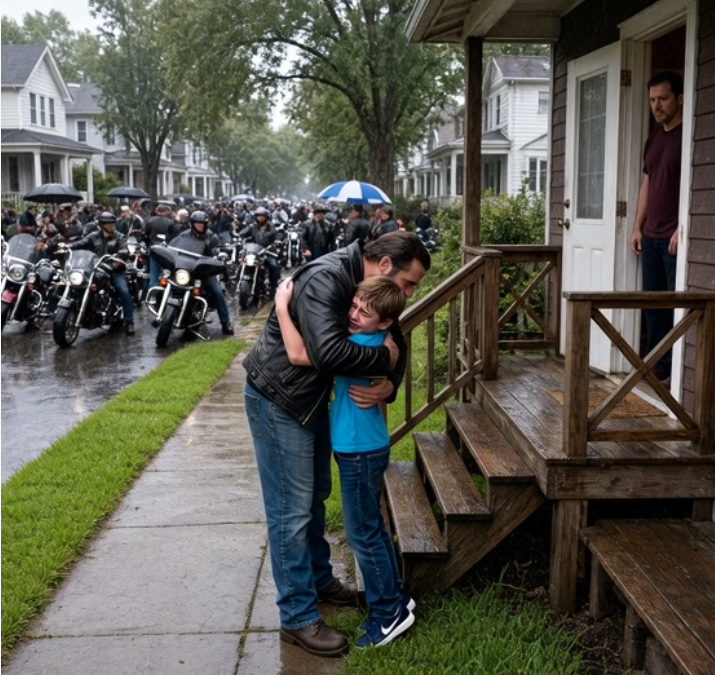
But my favorite image was taken before the party truly began.
Eli and me on the porch.
His hand inside mine.
Thousands of riders in front of us.
Helmets removed.
Heads bowed.
My son is looking at them.
I am looking at him.
Whenever I see it, I remember what he whispered.
“They came.”
Three words.
That was the miracle.
They came.
Caleb died.
They came.
Eli waited.
They came.
I asked strangers for help.
They came.
The city could have shut the roads.
Instead, people found a safer way.
They came.
Neighbors were afraid.
Then they opened their doors.
They came.
Grief told me we were alone.
Then the ground began to shake.
They came.
I used to think keeping Caleb’s promise was my responsibility.
It wasn’t.
Not entirely.
Some promises are too large for one person.
That is why community matters.
One person carries it until their hands shake.
Then someone else takes the weight.
Then another.
Until something impossible becomes simply a lot of people doing one small thing at the same time.
Ride the miles.
Bring the water.
Direct traffic.
Bake the cake.
Tell the story.
Show up.
Years later, Eli asked me what I remembered most about his eighth birthday.
I could have said the motorcycles.
The noise.
The cake.
The riders filling our street.
Instead, I told him the truth.
“The silence.”
He looked confused.
“What silence?”
“When you walked onto the porch.”
I could still feel it.
Thousands of people.
Then suddenly nothing.
No engines.
No voices.
Just heads bowed for a father most of them had never met.
“That silence was louder than the motorcycles.”
Eli smiled.
“Dad would’ve liked the engines better.”
I laughed.
“Absolutely.”
Caleb never saw his son’s eighth birthday.
That fact will always hurt.
Love does not erase death.
Kindness does not cancel grief.
Two thousand motorcycles cannot replace one father kneeling in a driveway with his little boy.
But Caleb did something before he left.
He planted himself deeply enough in other people that when his body could no longer keep its promise, his character did.
He had stopped for stranded riders.
Answered late-night calls.
Fixed engines.
Loaned tools.
Remembered names.
Shown up.
And then, when the person who needed someone to show up was his son, the road answered.
That is what I learned from the morning thunder came to Maple Haven Road.
A promise to a child has weight.
Love can travel through strangers.
Community is sometimes simply grief refusing to let another person carry everything alone.
And the dead do not remain with us only in photographs, jackets, motorcycles, or the sound of their voice fading from memory.
They remain in what they taught other people to do.
Caleb taught people to show up.
So when his little boy needed him most, more than two thousand people showed us exactly how far one good man’s love could travel.
And all these years later, whenever I hear motorcycles somewhere in the distance, I still stop.
I still listen.
The first rumble always takes me back to that Saturday morning.
To Eli beside me in his little vest.
To sunrise on chrome.
To thousands of helmets coming off.
To the boy looking up at me with tears in his eyes.
“They came.”
Yes, baby.
They did.
Your father promised thunder.
And love kept his word.








