A Widowed Mother Arrived With Four Sons and Nowhere Left to Go—Then a Lonely Farmer Opened His Door and Offered the One Thing They Both Desperately Needed
PART3:
A modest farmhouse stood beyond a weathered gate, white paint faded by wind and seasons. A red barn leaned against the sky, sturdy despite its age. Fields stretched behind it farther than anything my family had owned in over a year. A line of fencing needed mending along the west pasture. Smoke lifted thinly from the chimney.
A place still alive, though tired.
I stopped at the gate.
My sons stopped behind me.
No one spoke.
Even Samuel had no joke left.
I could feel every mile in my feet. Every failure behind us. Every possibility ahead. I thought of William. I thought of the farm we had lost. I thought of the bank man’s clean hands. I thought of my sons watching me, waiting to know if I still knew how to be their mother when I had nowhere to take them.
“Ma?” Thomas said quietly.
I straightened my shoulders.
“Stay close.”
We walked to the porch.
I knocked before courage could leave me.
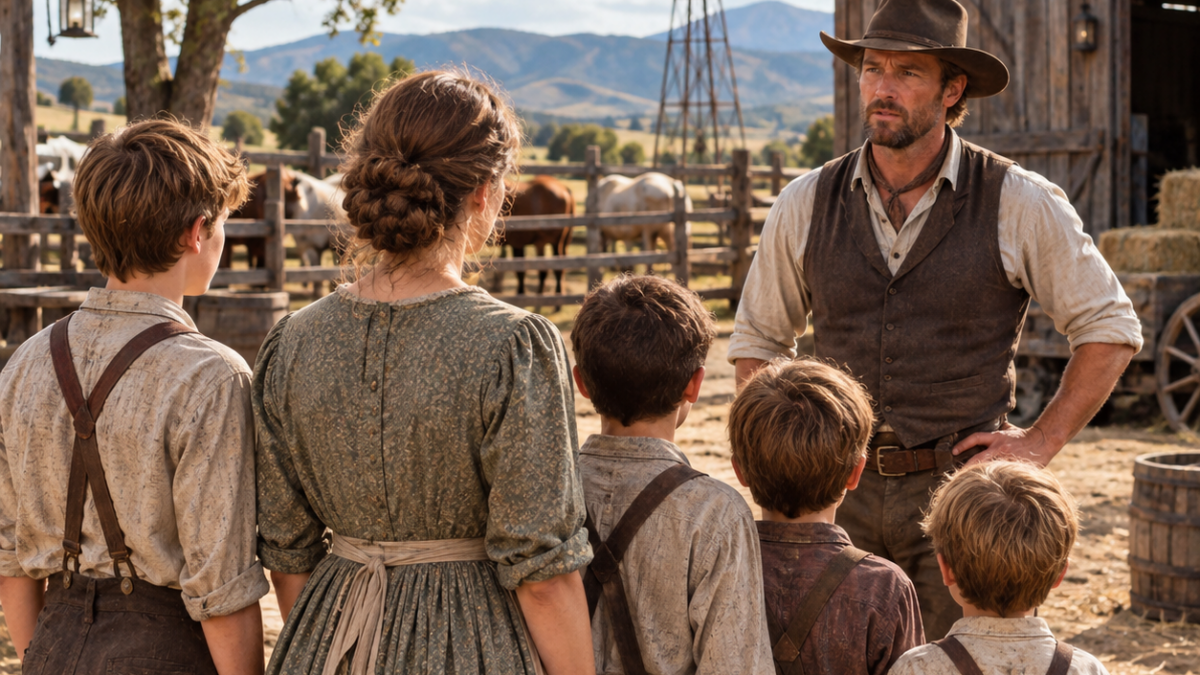
The man who opened the door was tall, broad-shouldered, weathered, and quiet in a way that felt older than his years. He might have been in his early forties, though solitude had added something to him age alone could not. His shirt sleeves were rolled, and one hand still held a rag dark with machine grease. His eyes moved from my face to the boys behind me.
He did not look startled.
He did not look pleased.
He looked like a man who had expected the day to continue as every other day had, and suddenly found something standing on his porch that would not fit into habit.
I could have explained.
I could have told him about William, the fever, the auction, Edward’s barn, the road, the hungry nights, the fear that had lived under my ribs since the bank man first folded his hands across our table.
But pity was dangerous.
Pity could feed a person once and leave her owing more than she could repay.
So I gave him only the truth.
“I have four children and nowhere to go.”
The boys were silent behind me.
Thomas stood straight.
Samuel looked down at his boots.
Henry clutched his bundle.
James’s hand found my skirt, though he was trying hard to appear too old for that.
The man looked at them for a long moment.
Then at me.
“I have a farm I can’t run alone,” he said.
It was not quite an answer.
Somehow, it was more.
His name was Jonathan Reed.
He did not invite us inside immediately. That might have embarrassed us both. Instead, we worked out the arrangement on the porch, in plain words, under a sky that looked ready to rain.
There were two spare rooms upstairs, unused for years. We could have them.
Food from the farm’s stores.
In exchange, my boys would work the property beside him according to their strength and age. I would manage the house, cooking, mending, washing, preserving, and whatever else needed doing.
“This isn’t charity,” Jonathan said.
His voice was not harsh.
Only exact.
“I need the hands, same as you need the roof. We’re square on that point before either of us steps through this door.”
Square.
I had not known how much I needed that word until he gave it to me.
Not saved.
Not pitied.
Square.
A trade.
A place to stand without lowering my eyes.
“Square,” I said.
Only then did Jonathan step back and open the door wide enough for all of us.
The first thing I noticed inside was the silence.
Not ordinary quiet.
I knew ordinary quiet.
I had heard it after the boys slept, after chores were done, after William closed the barn and came inside smelling of hay and cold air.
This was different.
This was the silence of a house that had once been full and had never recovered from the shock of emptiness.
The kitchen was clean but scarcely used. Pots hung exactly where some woman had once decided they belonged. Shelves were arranged with a care Jonathan clearly had not disturbed. A blue cup sat on the second shelf, turned handle-out, untouched by dust only because he must have cleaned around it.
The table was built for more than one man.
Six chairs.
Only one showed regular use.
I did not ask.
A woman learns to recognize grief in a room before she knows its name.
Jonathan showed the boys where to put their bundles upstairs. The rooms smelled closed but dry. James touched the quilt on one narrow bed as if afraid it might vanish. Henry immediately went to the window to see the fields. Samuel claimed the bed nearest the wall and then offered it to James when he thought no one was looking. Thomas stood in the doorway, not entering until all his brothers had.
That evening, I made supper from what Jonathan had on hand: beans, salt pork, bread fried in a pan because there was no fresh loaf, and dried apples softened with water and a little molasses I found tucked behind the flour.
I set six places.
Jonathan came in from the yard and stopped.
For a moment he looked at the table as though I had put a ghost in one of the chairs.
“You don’t need to change everything about how I run this house,” he said.
“I’m not changing how you run it,” I replied. “I’m simply feeding the people living in it properly.”
His mouth tightened slightly.
I could not tell whether he was annoyed.
“You’re welcome to object to the bread, Mr. Reed,” I added, “though I’ll warn you, it’s a good deal better than whatever you’ve been managing alone.”
Samuel made a sound into his sleeve.
Jonathan looked at him.
Samuel went still.
Then Jonathan sat.
He ate three pieces of that rough pan bread.
Halfway through the second, Samuel said something about a goat we had passed on the road that looked like it had judged him personally. Henry corrected the description. James added that the goat had better manners than Samuel. Thomas tried not to smile and failed.
And Jonathan Reed laughed.
It was rusty with disuse.
A short laugh, quickly swallowed.
But it was real.
It startled him more than it startled us.
After supper, while the boys carried plates to the washbasin, I saw Jonathan glance toward the second shelf where the blue cup sat. His face changed so briefly another person might have missed it.
I did not move the cup.
Not that night.
Not for many weeks.
Life on the Reed farm settled around work.
Work was a mercy.
Work gave the boys something to do besides remember all they had lost. It gave their fear a shape, their hunger a schedule, their bodies a reason to grow strong instead of merely tired.
Thomas took to the cattle first.
He asked Jonathan more questions in the first week than I suspected the man had answered in six years.
How do you tell when a cow is close to calving?
Why does that steer favor one side?
What makes the south pasture poorer than the east?
How long before hay turns if rain catches it?
Jonathan answered plainly at first, then more fully as he began to see that Thomas was not asking to be polite. The boy watched animals the way some men read weather. He noticed tension before a cow kicked. He saw lameness before it became obvious. He could calm a nervous heifer with one low word and a steady hand.
One afternoon, I stood near the barn door and heard Jonathan say, “You have a good eye for this.”
Thomas looked down, trying and failing to hide his pride.
“Pa used to say I noticed things he didn’t.”
“Your pa was right.”
Thomas did not answer.
But that evening, he ate with a softness in his face I had not seen since William died.
Samuel turned fence mending into a race, because Samuel turned nearly everything into a race if it prevented him from admitting he cared. Henry raced him because Henry liked winning more than he pretended. They came in most evenings streaked with dirt, hands blistered, arguing over who had set more posts straight.
James wanted to do everything his brothers did, whether his body allowed it or not.
Once, I found him red-faced and shaking, trying to lift a feed sack far too heavy for him. Jonathan reached him before I did.
“You don’t have to prove anything, James.”
“Thomas says I have to earn my keep. Same as everybody.”
Jonathan took the sack from him and set it down.
“Thomas isn’t wrong. But earning your keep doesn’t mean breaking your back to prove it in one afternoon. There’s work suited to a boy your size. I’ll show you, if you’ll let me.”
James hesitated.
He had grown suspicious of kindness since the auction.
Then he nodded.
After that, Jonathan gave him chores that mattered without crushing him: carrying water to the hens, gathering kindling, counting tools, bringing nails, holding a lantern, oiling harness straps under supervision. Small work, perhaps, but real work.
That distinction mattered to James.
It mattered to me too.
As for me, I learned Jonathan’s house carefully.
I did not storm into it as if grief could be scrubbed away.
I added myself around its edges.
I baked bread before dawn because boys work better when fed and because flour beneath my hands reminded me I was still capable of making something useful. I washed curtains that had held six years of dust but did not move the blue cup. I mended Jonathan’s shirts and folded them where he could find them without feeling accused by their neatness. I planted beans near the kitchen garden. I aired the upstairs rooms. I polished the stove.
I set six places every night.
And every night, Jonathan sat at the head of the table like a man slowly relearning what supper was for.
I insisted on grace.
The first time, the boys bowed their heads out of habit. Jonathan’s hand froze near his fork.
“We say grace,” I said gently.
His expression closed.
“I haven’t kept that habit in some time.”
“Then we’ll keep it for you until you remember how.”
He looked at me for a long second.
Then lowered his head.
His prayer was silent.
Mine was not.
“For bread,” I said, “for shelter, for work suited to our hands, and for mercy we did not know to ask for. Amen.”
Nobody spoke for several seconds after.
Then Samuel whispered, “And for goats who mind their business.”
Henry kicked him under the table.
Jonathan looked down at his plate.
His shoulders shook once.
Not quite a laugh.
But close.
For all his practical kindness, Jonathan was less comfortable with conversation that wandered beyond crops, fences, livestock, and weather. Ask him how deep to plant corn, and he would answer fully. Ask whether he had slept well, and he looked at you as if you had asked for the combination to a safe.
I noticed it first at supper.
He could explain crop rotation to Henry at length, teach Thomas about calving signs, correct Samuel’s hammer grip, and show James how to oil leather.
But if one of the boys asked about his childhood, his family, his favorite meal, his old life, the answer shortened until it nearly disappeared.
One evening, after the boys had gone upstairs and the lamp had burned low, I poured coffee for both of us.
“You’ve said perhaps ten words about your wife since we arrived.”
Jonathan’s hand tightened around his cup.
“Not much worth saying.”
“I don’t believe that’s true.”
He looked toward the stove.
For a while, the only sound was the small tick of cooling iron.
“Her name was Margaret,” he said finally. “Good woman. Better than I deserved most days.”
I did not speak.
“We lost her and our daughter both to fever the same week. Six years back.”
His voice was flat, but not empty.
Flat like ground after fire.
“I don’t talk about it because talking doesn’t bring either of them back. I’ve never found much use in a habit that changes nothing.”
“Perhaps it isn’t meant to change anything,” I said.
He looked at me then.
“Perhaps it is simply meant to be carried a little easier with someone else helping to hold it.”
Jonathan did not answer.
But he did not leave the table either.
I counted that silence as progress.
The storm came in early summer.
That afternoon, the air turned wrong.
Heavy.
Greenish along the horizon.
The animals knew before we did. The hens went quiet. The horses stamped and tossed their heads. The wind lay still for too long, as if the world had drawn breath and forgotten to release it.
Jonathan stood in the yard, looking west.
“Get the wash in,” he said.
No one asked why.
By dusk, the sky had turned black at the edges.
By full dark, the storm struck like a living thing.
Wind hit the farmhouse hard enough to rattle every window. Rain drove sideways, finding cracks in walls and roof seams we had not known existed. Thunder rolled over the fields so close the floor seemed to answer.
Every hand on that farm worked past midnight.
Thomas and Jonathan fought the barn doors first, wind trying to tear them loose, both of them soaked within minutes. Samuel and Henry herded panicked livestock toward shelter, slipping in mud, shouting to each other through sheets of rain. James and I carried lanterns, rope, tools, blankets, whatever was needed, wherever it was needed.
I wanted James inside.
But there are storms where even a child’s hands become necessary, and he proved steadier than my fear expected.
At the worst of it, a section of fence gave way near the west pasture.
If it opened fully, we might lose cattle into the storm-dark fields.
Jonathan and Thomas went after it.
I followed as far as the barn with a lantern held under my shawl, heart pounding so hard I could feel it in my teeth.
“Hold it there!” Jonathan shouted.
Thomas braced the rail with both arms, mud up to his knees, rain running down his face.
His body shook with effort.
But he held.
Jonathan drove a temporary brace down, then another.
The wind screamed.
Samuel appeared from nowhere with rope.
Henry behind him with a hammer.
Together, all four of them held that fence against the storm until Jonathan could secure it well enough to last the night.
Afterward, when the worst had passed east and the rain softened to a tired drizzle, I found myself sitting on the porch steps with James asleep against my shoulder. I did not remember sitting down.
My dress was soaked.
My hair had fallen loose.
My hands ached.
Jonathan came from the yard, moving like every joint in his body had filed a complaint.
He saw James sleeping and eased him gently from my shoulder onto the porch bench, covering him with his own coat.
“Your boys worked like grown men tonight,” he said.
“They’ve had to grow up faster than I’d have chosen for them.”
He sat beside me.
For a long while, we watched lightning flicker far off beyond the fields.
“I don’t know that I’ve properly thanked you,” I said. “Not just for tonight. For all of it.”
“Don’t need thanking. Told you from the start, this wasn’t charity.”
“No,” I agreed. “But somewhere in these past months, it became something more than a trade, whatever either of us called it at the start.”
Jonathan did not disagree.
That was how I knew he had begun to feel it too.
The house changed after the storm.
Not all at once.
Houses, like people, do not heal simply because one night proves something.
But there was a shift.
Thomas moved beside Jonathan as if he belonged there. Samuel and Henry argued louder because they no longer feared loudness might cost us shelter. James followed Jonathan through evening chores not because work required it, but because he wanted the company.
One evening, I found them near the barn, Jonathan mending a harness, James standing beside him trying to whistle.
“Like this,” Jonathan said, shaping his lips.
James tried.
Nothing but air.
“Again.”
Another breathy failure.
“Again.”
On the thirteenth attempt, something like a note came out.
“I did it!”
“You did.”
Jonathan grinned.
A real grin.
James beamed with a delight too large for the achievement.
Then his face softened.
“Pa used to whistle.”
Jonathan grew still.
“I don’t remember it as good as Thomas does,” James said. “I’m glad you can teach me instead.”
I stood behind the corner of the barn, hand against the wood, and watched Jonathan understand what the boy had offered without knowing the weight of it.
A place not replacing William.
But standing near the empty space.
Teaching a whistle.
Holding a lantern.
Showing a boy how not to break his back proving he deserved to eat.
That night, after the boys slept, Jonathan and I sat on the porch while summer insects hummed in the grass.
“I don’t believe you arrived at my door by accident,” he said.
“Neither do I.”
“Though I spent a great many miles on that road convinced I was walking toward nothing at all.”
“Perhaps we were both walking toward the same nothing,” Jonathan said, “and found far more waiting for us than either of us expected.”
His words warmed me.
Then frightened me.
That was the trouble with hope.
It did not ask whether a person was ready before returning.
And I was not ready.
After William died, I promised myself I would never again build a life entirely dependent on a man’s goodwill.
I had watched what happened when his income stopped. How quickly everything we had disappeared. The bank did not care that I had been a faithful wife. It did not care that my sons were good boys. It did not care that William had meant to pay, that fever had interrupted intention, that grief had hardly cooled before the auctioneer came.
Without him, we had nothing.
I would not put my children through that twice.
So one evening, with autumn moving in at the edges of the air, I told Jonathan what I had been carrying.
“I think it may be time the boys and I found a place of our own.”
He stared at me as if I had struck him.
“After everything we just said?”
“Because of everything we just said.”
His face closed in pain he did not yet know how to hide from me.
“I’ve begun to think of this place as home,” I said. “The boys already do. That frightens me more than being homeless ever did.”
“Why?”
“Because I know what it is to build my whole life around someone and lose it overnight. I don’t know if I can survive teaching my children to call somewhere home again when none of it truly belongs to us.”
He was quiet a long time.
I could hear Samuel and Henry arguing softly upstairs. James laughed once in his sleep. Thomas crossed the hallway, floorboards creaking under his careful step.
All the sounds of a family.
In a house that was not mine.
Finally, Jonathan spoke.
“Six years, I told myself this farm and solitude were simply what remained of my life. I stopped expecting anything beyond work and quiet because expecting more felt like inviting loss back through the door.”
He looked at me.
“You didn’t arrive as hands to work my farm, Evelyn. Whatever we called it at the start. You arrived as the family I had stopped believing I was allowed to have again.”
My throat tightened.
“I’m not prepared to let you walk back onto that road over a fear I can put to rest.”
“What are you saying?”
“I’m saying this farm was never mine alone to run. Not really. Not in any way that mattered.”
He stepped closer, but not too close.
Jonathan always understood distance when something mattered.
“I’d like you and the boys to stay. Not as an arrangement. As my family. Properly and permanently, if you’ll have that.”
I closed my eyes.
For a moment, I saw William.
Not angry.
Not erased.
Only gone in the way the dead are gone, leaving love behind and no instructions clear enough for the living.
“Jonathan…”
“I know I’m not William.”
“No.”
“I would never ask to be.”
“I know that too.”
“I can’t hand you certainty in a single conversation,” he said. “I can only keep showing up the same way day after day until the showing up itself becomes the proof you’re waiting for.”
Those were the words that undid me.
Not forever.
Not love.
Not stay.
Showing up.
That was what he had done from the first afternoon.
He had opened the door.
Fed my sons.
Worked beside them.
Corrected them.
Praised them.
Let them laugh in his house.
Let me put bread on his table and grace back into his evenings.
He had never once made us feel like guests he might grow tired of.
Still, fear does not disappear simply because love makes a good argument.
It took time.
The harvest gave us that time.
Autumn tested every hand on the property.
From dawn until dark, we worked. Thomas beside Jonathan in the fields, moving with him now in a rhythm so natural it made my heart ache. Samuel and Henry managed rows and tools with surprising efficiency, blistered and aching but proud. James, taller and stronger than he had been in spring, finally held his own in ways that made his brothers stop teasing him for nearly an entire day.
I fed them all.
Before dawn, I cooked breakfast by lamplight. At midday, I carried food wrapped in cloth. At night, I mended torn work clothes while the boys fell asleep mid-sentence and Jonathan sat at the table pretending not to watch me with an expression that softened every week.
It was the best harvest the Reed farm had seen since Margaret died.
Jonathan said so plainly, standing in the barn after the last load came in.
“Couldn’t have brought in half this crop alone.”
“Then perhaps we’ve more than earned our keep.”
“Several times over.”
He looked at me, and I knew before he spoke that the conversation had returned.
“That’s precisely the trouble, Evelyn. I no longer know how to think of you and the boys as hands earning their keep. I think of you as my family and have for some months now.”
The boys were nearby.
Not close enough to hear every word, but close enough to feel the change in the air.
Thomas stood by the barn doors.
Samuel and Henry paused their argument.
James stopped sweeping.
I looked at all four of my sons.
Then at the full barn.
Then at Jonathan, a lonely man who had become less lonely not because we had fixed him, but because he had made room for us before he knew how badly he needed to.
“All right,” I said softly.
Jonathan blinked.
“All right?”
“If the offer still stands.”
For once, words failed him.
Samuel saved him.
“Does this mean we don’t have to pack?”
Henry elbowed him.
James began crying immediately and claimed there was dust in his eye despite the fact we were outside in clean air.
Thomas stepped forward, solemn as a judge.
He held out his hand to Jonathan.
Jonathan looked at it, then took it.
Thomas said quietly, “Pa would have liked you.”
Jonathan’s eyes went suspiciously bright.
He nodded once.
“I would have liked him too.”
We married that winter in the farmhouse.
There was snow along the fence line and frost on the windows. Neighbors came bundled in wool and good intentions, bringing pies, preserves, bread, cider, and more opinions than any household required.
I wore my best dress, altered twice because grief had taken weight from me and the months at Jonathan’s table had slowly given some back. Margaret’s blue cup, which I had finally moved only after asking Jonathan, sat on the shelf beside my white pitcher. Not replaced. Not hidden. Part of the room.
William’s pocketknife was in Thomas’s jacket.
He had asked to carry it.
Jonathan stood near the hearth, hands folded, looking more nervous than I had ever seen him in storm, harvest, or broken fence. James stood beside Samuel and Henry, crying openly this time and accusing nobody of dust. Samuel whispered that if James flooded the room, he would have to mop it. Henry told him to hush before Ma heard. I heard.
I pretended not to.
When the vows came, I did not feel I was leaving William behind.
That had been one of my fears.
Instead, I felt all the roads that had led us there: the fever, the auction, Edward’s barn, the long walk, the porch, the sentence that cost me every scrap of pride I had left.
I have four children and nowhere to go.
And Jonathan’s answer.
I have a farm I can’t run alone.
We had both spoken our lack aloud.
We had both heard an invitation inside it.
After the ceremony, one neighbor teased Jonathan by saying, “Took a widow and four boys to finally fix your fences properly.”
Jonathan looked at my sons.
Then at me.
“Took the right family,” he said.
Nobody argued.
Years passed.
The farm prospered, though prospering is never as simple as stories make it sound. There were hard winters. Dry weeks. Sick animals. Broken equipment. Arguments. Bills. Boys growing into men and testing the seams of the household as boys must. Days when I missed William so sharply that I stepped outside just to breathe without anyone seeing. Days when Jonathan stood by Margaret’s resting place and came home quiet.
Love did not erase what came before.
It made room for it.
Thomas became the kind of stockman who could read a herd before other men saw a problem. Samuel could fix nearly anything if given enough wire, wood, and stubbornness. Henry kept farm records so precise Jonathan joked that the bank would fear him one day. James learned to whistle properly, then taught a dozen children badly and proudly over the years.
The table that had once held one place stayed full most evenings.
Grace was said before every meal.
Jonathan never again objected to the bread.
In later years, he liked to tell the story of that first afternoon to anyone willing to sit still long enough to hear it.
“She told me she had four children and nowhere to go,” he would say. “I told her I had a farm I couldn’t run alone. Didn’t either of us know standing there that we had just described the same problem.”
I always smiled when he said that.
Because it was true.
I had arrived believing I had nothing left to offer anyone beyond four tired sons and a debt I could not repay.
Jonathan had opened his door believing his life had settled into solitude for good.
What we discovered together was that need is not always weakness.
Sometimes need is a doorway.
A farm needing hands.
A family needing a home.
A lonely man needing laughter at his table.
A frightened widow needing proof that safety could be built one ordinary day at a time.
Four boys needing work, guidance, bread, discipline, and someone strong enough to teach them without trying to replace the father they had lost.
Two hearts, both wounded differently, both convinced hope was too dangerous to hold again.
And God, in His quiet way, waiting just beyond an open door.
I still remember the feel of James’s hand in mine that final afternoon on the road.
The question he asked.
What if there’s nothing to see?
I could not answer then.
Now I can.
Sometimes there is nothing to see until you walk the last mile.
Sometimes mercy looks like a weathered farmhouse beyond a rise.
Sometimes grace speaks in a plain man’s voice and offers not pity, but work.
And sometimes, when the road has taken almost everything, what you have left is exactly what someone else has been missing.








